Volume 2 — CHAPTER XVIII. THE KINGSHIP IN FRANCE. (continued 2)
Robert Black translation
There can be little doubt but that the affection of Philip Augustus for Agnes of Merania was sincere; nothing can be better proof of it than the long struggle he maintained to prevent separation from her; but, to say nothing of the religious scruples which at last, perhaps, began to prick the conscience of the king, great political activity and the government of a kingdom are a powerful cure for sorrows of the heart, and seldom is there a human soul so large and so constant as to have room for sentiments and interests so different, both of them at once, and for a long continuance. It has been shown with what intelligent assiduity Philip Augustus strove to extend, or, rather, to complete the kingdom of France; what a mixture of firmness and moderation he brought to bear upon his relations with his vassals, as well as with his neighbors; and what bravery he showed in war, though he preferred to succeed by the weapons of peace. He was as energetic and effective in the internal administration of his kingdom as in foreign affairs. M. Leopold Delisle, one of the most learned French academicians, and one of the most accurate in his knowledge, has devoted a volume of more than seven hundred pages octavo to a simple catalogue of the official acts of Philip Augustus, and this catalogue contains a list of two thousand two hundred and thirty-six administrative acts of all kinds, of which M. Delisle confines himself to merely setting forth the title and object. Search has been made in this long table to see what part was taken by Philip Augustus in the establishment and interior regulation of the communes, that great fact which is so conspicuous in the history of French civilization, and which will before long be made the topic of discourse here. The search brings to light, during this reign, forty-one acts confirming certain communes already established, or certain privileges previously granted to certain populations, forty-three acts establishing new communes, or granting new local privileges, and nine acts decreeing suppression of certain communes, or a repressive intervention of the royal authority in their internal regulation, on account of quarrels or irregularities in their relations either with their lord, or, especially, with their bishop. These mere figures show the liberal character of the government of Philip Augustus, in respect of this important work of the eleventh, twelfth, and thirteenth centuries. Nor are we less struck by his efficient energy in his care for the interests and material civilization of his people. In 1185, “as he was walking one day in his palace, he placed himself at a window whence he was sometimes pleased, by way of pastime, to watch the Seine flowing by. Some carts, as they passed, caused the mud with which the streets were filled to emit a fetid smell, quite unbearable. The king, shocked at what was as unhealthy as it was disgusting, sent for the burghers and provost of the city, and ordered that all the thoroughfares and streets of Paris should be paved with hard and solid stone, for this right Christian prince aspired to rid Paris of her ancient name, Lutetia (Mud-town).” It is added that, on hearing of so good a resolution, a moneyed man of the day, named Gerard de Poissy, volunteered to contribute towards the construction of the pavement eleven thousand silver marks. Nor was Philip Augustus less concerned for the external security than for the internal salubrity of Paris. In 1190, on the eve of his departure for the crusade, “he ordered the burghers of Paris to surround with a good wall, flanked by towers, the city he loved so well, and to make gates thereto;” and in twenty years this great work was finished on both sides of the Seine. “The king gave the same orders,” adds the historian Rigord, “about the towns and castles of all his kingdom;” and indeed it appears from the catalogue of M. Leopold Delisle, at the date of 1193, “that, at the request of Philip Augustus, Peter de Courtenai, Count of Nevers, with the aid of the church-men, had the walls of the town of Auxerre built.” And Philip’s foresight went beyond such important achievements. “He had a good wall built to enclose the wood of Vincennes, heretofore open to any sort of folk. The King of England, on hearing thereof, gathered a great mass of fawns, hinds, does, and bucks, taken in his forests in Normandy and Aquitaine; and having had them shipped aboard a large covered vessel, with suitable fodder, he sent them by way of the Seine to King Philip Augustus, his liege-lord at Paris. King Philip received the gift gladly, had his parks stocked with the animals, and put keepers over them.” A feeling, totally unconnected with the pleasures of the chase, caused him to order an enclosure very different from that of Vincennes. “The common cemetery of Paris, hard by the Church of the Holy Innocents, opposite the street of St. Denis, had remained up to that time open to all passers, man and beast, without anything to prevent it from being confounded with the most profane spot; and the king, hurt at such indecency, had it enclosed by high stone walls, with as many gates as were judged necessary, which were closed every night.” At the same time he had built, in this same quarter, the first great municipal market-places, enclosed, likewise, by a wall, with gates shut at night, and surmounted by a sort of covered gallery. He was not quite a stranger to a certain instinct, neither systematic nor of general application, but practical and effective on occasion, in favor of the freedom of industry and commerce. Before his time, the ovens employed by the baking trade in Paris were a monopoly for the profit of certain religious or laic establishments; but when Philip Augustus ordered the walling in of the new and much larger area of the city “he did not think it right to render its new inhabitants subject to these old liabilities, and he permitted all the bakers to have ovens wherein to bake their bread, either for themselves, or for all individuals who might wish to make use of them.” Nor were churches and hospitals a whit less than the material interests of the people an object of solicitude to him. His reign saw the completion, and, it might almost be said, the construction of Notre-Dame de Paris, the frontage of which, in particular, was the work of this epoch. At the same time the king had the palace of the Louvre repaired and enlarged; and he added to it that strong tower in which he kept in captivity for more than twelve years Ferrand, Count of Flanders, taken prisoner at the battle of Bouvines. It would be a failure of justice and truth not to add to these proofs of manifold and indefatigable activity on the part of Philip Augustus the constant interest he testified in letters, science, study, the University of Paris, and its masters and pupils. It was to him that in 1200, after a violent riot, in which they considered they had reason to complain of the provost of Paris, the students owed a decree, which, by regarding them as clerics, exempted them from the ordinary criminal jurisdiction, so as to render them subject only to ecclesiastical authority. At that time there was no idea how to efficiently protect freedom save by granting some privilege.
A death which seems premature for a man as sound and strong in constitution as in judgment struck down Philip Augustus at the age of only fifty-eight, as he was on his way from Pacy-sur-Eure to Paris to be present at the council which was to meet there and once more take up the affair of the Albigensians. He had for several months been battling with an incessant fever; he was obliged to halt at Mantes, and there he died on the 14th of January, 1223, leaving the kingdom of France far more extensive and more compact, and the kingship in France far stronger and more respected than he had found them. It was the natural and well-deserved result of his life. At a time of violence and irregular adventure, he had shown to Europe the spectacle of an earnest, far-sighted, moderate, and able government, and one which in the end, under many hard trials, had nearly always succeeded in its designs, during a reign of forty-three years.
He disposed, by will, of a considerable amount amassed without parsimony, and even, historians say, in spite of a royal magnificence. We will take from that will but two paragraphs, the first two:—
“We will and prescribe first of all that, without any gainsaying, our testamentary executors do levy and set aside, out of our possessions, fifty thousand livres of Paris, in order to restore, as God shall inspire them with wisdom, whatsoever may be due to those from whom they shall recognize that we have unjustly taken or extorted or kept back aught; and we do ordain this most strictly.”
“We do give to our dear spouse Isamber (evidently Inyeburya), Queen of the French, ten thousand livres of Paris. We might have given more to the said queen, but we have confined ourselves to this sum in order that we might make more complete restitution and reparation of what we have unjustly levied.”
There is in these two cases of testamentary reparation, to persons unknown on the one hand and to a lady long maltreated on the other, a touch of probity and honorable regret for wrong-doing which arouses for this great king, in his dying hour, more moral esteem than one would otherwise be tempted to feel for him.
His son, Louis VIII., inherited a great kingdom, an undisputed crown, and a power that was respected. It was matter of general remark, moreover, that, by his mother, Isabel of Hainault, he was descended in the direct line from Hermengarde, Countess of Namur, daughter of Charles of Lorraine, the last of the Carlovingians. Thus the claims of the two dynasties of Charlemagne and of Hugh Capet were united in his person; and, although the authority of the Capetians was no longer disputed, contemporaries were glad to see in Louis VIII. this two-fold heirship, which gave him the perfect stamp of a legitimate monarch. He was, besides, the first Capetian whom the king his father had not considered it necessary to have consecrated during his own life so as to impress upon him in good time the seal of religion. Louis was consecrated at Rheims no earlier than the 6th of August, 1223, three weeks after the death of Philip Augustus; and his consecration was celebrated, at Paris as well as at Rheims, with rejoicings both popular and magnificent. But in the condition in which France was during the thirteenth century, amidst a civilization still so imperfect and without the fortifying institutions of a free government, no accidental good fortune could make up for a king’s want of personal merit; and Louis VIII. was a man of downright mediocrity, without foresight, volatile in his resolves and weak and fickle in the execution of them. He, as well as Philip Augustus, had to make war on the King of England, and negotiate with the pope on the subject of the Albigensians; but at one time he followed, without well understanding it, his father’s policy, at another he neglected it for some whim, or under some temporary influence. Yet he was not unsuccessful in his wax-like enterprises; in his campaign against Henry III., King of England, he took Niort, St. Jean d’Angely, and Rochelle; he accomplished the subjection of Limousin and Perigord; and had he pushed on his victories beyond the Garonne, he might perhaps have deprived the English of Aquitaine, their last possession in France; but at the solicitation of Pope Honorius III., he gave up this war, to resume the crusade against the Albigensians. Philip Augustus had foreseen this mistake. “After my death,” he had said, “the clergy will use all their efforts to entangle my son Louis in the matters of the Albigensians; but he is in weak and shattered health; he will be unable to bear the fatigue; he will soon die, and then the kingdom will be left in the hands of a woman and children; and so there will be no lack of dangers.” The prediction was realized. The military campaign of Louis VIII. on the Rhone was successful; after a somewhat difficult siege, he took Avignon; the principal towns in the neighborhood, Nimes and Arles, amongst others, submitted; Amaury de Montfort had ceded to him all his rights over his father’s conquests in Languedoc; and the Albigensians were so completely destroyed or dispersed or cowed that, when it seemed good to make a further example amongst them of the severity of the Church against heretics, it was a hard matter to rout out in the diocese of Narbonne one of their former preachers, Peter Isarn, an old man hidden in an obscure retreat, from which he was dragged to be burned in solemn state. This was Louis VIII.‘s last exploit in Southern France. He was displeased with the pope, whom he reproached with not keeping all his promises; his troops were being decimated by sickness; and he was deserted by Theobald IV., Count of Champagne, after serving, according to feudal law, for forty days.
Louis, incensed, disgusted, and ill, himself left his army, to return to his own Northern France; but he never reached it, for fever compelled him to halt at Montpensier, in Auvergne, where he died on the 8th of November, 1226, after a reign of three years, adding to the history of France no glory save that of having been the son of Philip Augustus, the husband of Blanche of Castille, and the father of St. Louis.
We have already perused the most brilliant and celebrated amongst the events of St. Louis’s reign, his two crusades against the Mussulmans; and we have learned to know the man at the same time with the event, for it was in these warlike outbursts of his Christian faith that the king’s character, nay, his whole soul, was displayed in all its originality and splendor. It was his good fortune, moreover, to have at that time as his comrade and biographer, Sire de Joinville, one of the most sprightly and charming writers of the nascent French language. It is now of Louis in France and of his government at home that we have to take note. And in this part of his history he is not the only royal and really regnant personage we encounter: for of the forty-four years of St. Louis’s reign, nearly fifteen, with a long interval of separation, pertained to the government of Queen Blanche of Castille rather than that of the king her son. Louis, at his accession in 1226, was only eleven; and he remained a minor up to the age of twenty-one, in 1236, for the time of majority in the case of royalty was not yet specially and rigorously fixed. During those ten years Queen Blanche governed France; not at all, as is commonly asserted, with the official title of regent, but simply as guardian of the king her son. With a good sense really admirable in a person so proud and ambitious, she saw that official power was ill suited to her woman’s condition, and would weaken rather than strengthen her; and she screened herself from view behind her son. He it was who, in 1226, wrote to the great vassals, bidding them to his consecration; he it was who reigned and commanded; and his name alone appeared on royal decrees and on treaties. It was not until twenty-two years had passed, in 1248, that Louis, on starting for the crusade, officially delegated to his mother the kingly authority, and that Blanche, during her son’s absence, really governed with the title of regent, up to the 1st of December, 1252, the day of his death.
During the first period of his government, and so long as her son’s minority lasted, Queen Blanche had to grapple with intrigues, plots, insurrections, and open war, and, what was still worse for her, with the insults and calumnies of the crown’s great vassals, burning to seize once more, under a woman’s government, the independence and power which had been effectually disputed with them by Philip Augustus. Blanche resisted their attempts, at one time with open and persevering energy, at another dexterously with all the tact, address, and allurements of a woman. Though she was now forty years of age, she was beautiful, elegant, attractive, full of resources, and of grace in her conversation as well as her administration, endowed with all the means of pleasing, and skilful in availing herself of them with a coquetry which was occasionally more telling than discreet. The malcontents spread the most odious scandals about her. It so happened that one of the most considerable amongst the great vassals of France, Theobald IV., Count of Champagne, a brilliant and gay knight, an ingenious and prolific poet, had conceived a passion for her; and it was affirmed not only that she had yielded to his desires, in order to keep him bound to her service, but that she had, a while ago, in concert with him, murdered her husband, King Louis VIII. In 1230, some of the greatest barons of the kingdom, the Count of Brittany, the Count of Boulogne, and the Count of St. Pol formed a coalition for an attack upon Count Theobald, and invaded Champagne. Blanche, taking with her the young king her son, went to the aid of Count Theobald, and, on arriving near Troyes, she had orders given, in the king’s name, for the barons to withdraw: “If you have plaint to make,” said she, “against the Count of Champagne, present before me your claim, and I will do you justice.” “We will not plead before you,” they answered, “for the custom of women is to fix their choice upon him, in preference to other men, who has slain their husband.” But in spite of this insulting defiance, the barons did withdraw. Five years later, in 1235, the Count of Champagne had, in his turn, risen against the king, and was forced, as an escape from imminent defeat, to accept severe terms.
An interview took place between Queen Blanche and him; and “‘Pardie, Count Theobald,’ said the queen, ‘you ought not to have been against us; you ought surely to have remembered the kindness shown you by the king my son, who came to your aid, to save your land from the barons of France when they would fain have set fire to it all and laid it in ashes.’ The count cast a look upon the queen, who was so virtuous and so beautiful that at her great beauty he was all abashed, and answered her, ‘By my faith, madame, my heart and my body and all my land is at your command, and there is nothing which to please you I would not readily do; and against you or yours, please God, I will never go.’ Thereupon he went his way full pensively, and often there came back to his remembrance the queen’s soft glance and lovely countenance. Then his heart was touched by a soft and amorous thought. But when he remembered how high a dame she was, so good and pure that he could never enjoy her, his soft thought of love was changed to a great sadness. And because deep thoughts engender melancholy, it was counselled unto him by certain wise men that he should make his study of canzonets for the viol and soft delightful ditties. So made he the most beautiful canzonets and the most delightful and most melodious that at any time were heard.” (Histoire des Dues et des Comtes de Champagne, by M. d’Arbois de Jubainville, t. iv. pp. 249, 280; Chroniques de Saint-Denis, in the Recueil des Historiens des Gaules et de France, t. xxi. pp. 111, 112.)
Neither in the events nor in the writings of the period is it easy to find anything which can authorize the accusations made by the foes of Queen Blanche. There is no knowing whether her heart were ever so little touched by the canzonets of Count Theobald; but it is certain that neither the poetry nor the advances of the count made any difference in the resolutions and behavior of the queen. She continued her resistance to the pretensions and machinations of the crown’s great vassals, whether foes or lovers, and she carried forward, in the face and in the teeth of all, the extension of the domains and the power of the kingship. We observe in her no prompting of enthusiasm, of sympathetic charitableness, or of religious scrupulousness, that is, none of those grand moral impulses which are characteristic of Christian piety, and which were predominant in St. Louis. Blanche was essentially politic and concerned with her temporal interests and successes; and it was not from her teaching or her example that her son imbibed those sublime and disinterested feelings which stamped him the most original and the rarest on the roll of glorious kings. What St. Louis really owed to his mother —and it was a great deal—was the steady triumph which, whether by arms or by negotiation, Blanche gained over the great vassals, and the preponderance which, amidst the struggles of the feudal system, she secured for the kingship of her son in his minority. She saw by profound instinct what forces and alliances might be made serviceable to the kingly power against its rivals. When, on the 29th of November, 1226, only three weeks after the death of her husband, Louis VIII., she had her son crowned at Rheims, she bade to the ceremony not only the prelates and grandees of the kingdom, but also the inhabitants of the neighboring communes; wishing to let the great lords see the people surrounding the royal child. Two years later, in 1228, amidst the insurrection of the barons, who were assembled at Corbeil, and who meditated seizing the person of the young king during his halt at Montlhery on his march to Paris, Queen Blanche had summoned to her side, together with the faithful chivalry of the country, the burghers of Paris and of the neighborhood; and they obeyed the summons with alacrity. “They went forth all under arms, and took the road to Montlhery, where they found the king, and escorted him to Paris, all in their ranks and in order of battle. From Montlhery to Paris, the road was lined, on both sides, by men-at-arms and others, who loudly besought Our Lord to grant the young king long life and prosperity, and to vouchsafe him protection against all his enemies. As soon as they set out from Paris, the lords, having been told the news, and not considering themselves in a condition to fight so great a host, retired each to his own abode; and by the ordering of God, who disposes as he pleases Him of times and the deeds of men, they dared not undertake anything against the king during the rest of this year.” (Vie de Saint Louis, by Lenain de Tillemont, t. i. pp. 429, 478.)
Eight years later, in 1236, Louis IX. attained his majority, and his mother transferred to him a power respected, feared, and encompassed by vassals always turbulent and still often aggressive, but disunited, weakened, intimidated, or discredited, and always outwitted, for a space of ten years, in their plots.
When she had secured the political position of the king her son, and as the time of his majority approached, Queen Blanche gave her attention to his domestic life also. She belonged to the number of those who aspire to play the part of Providence towards the objects of their affection, and to regulate their destiny in everything. Louis was nineteen; he was handsome, after a refined and gentle style which spoke of moral worth without telling of great physical strength; he had delicate and chiselled features, a brilliant complexion, and light hair, abundant and glossy, which, through his grandmother Isabel, he inherited from the family of the Counts of Hainault. He displayed liveliness and elegance in his tastes; he was fond of amusements, games, hunting, hounds and hawking-birds, fine clothes, magnificent furniture. A holy man, they say, even reproached the queen his mother with having winked at certain inclinations evinced by him towards irregular connections. Blanche determined to have him married; and had no difficulty in exciting in him so honorable a desire. Raymond Beranger, Count of Provence, had a daughter, his eldest, named Marguerite, “who was held,” say the chronicles, “to be the most noble, most beautiful, and best educated princess at that time in Europe. . . . By the advice of his mother and of the wisest persons in his kingdom,” Louis asked for her hand in marriage. The Count of Provence was overjoyed at the proposal; but he was somewhat anxious about the immense dowry which, it was said, he would have to give his daughter. His intimate adviser was a Provencal nobleman, named Romeo de Villeneuve, who said to him, “Count, leave it to me, and let not this great expense cause you any trouble. If you marry your eldest high, the more consideration of the alliance will get the others married better and at less cost.” Count Raymond listened to reason, and before long acknowledged that his adviser was right. He had four daughters, Marguerite, Eleanor, Sancie, and Beatrice; and when Marguerite was Queen of France, Eleanor became Queen of England, Sancie Countess of Cornwall and afterwards Queen of the Romans, and Beatrice Countess of Anjou and Provence, and ultimately Queen of Sicily. Princess Marguerite arrived in France escorted by a brilliant embassy, and the marriage was celebrated at Sens, on the 27th of May, 1234, amidst great rejoicings and abundant largess to the people. As soon as he was married and in possession of happiness at home, Louis of his own accord gave up the worldly amusements for which he had at first displayed a taste; his hunting establishment, his games, his magnificent furniture and dress, gave place to simpler pleasures and more Christian occupations. The active duties of the kingship, the fervent and scrupulous exercise of piety, the pure and impassioned joys of conjugal life, the glorious plans of a knight militant of the cross, were the only things which took up the thoughts and the time of this young king, who was modestly laboring to become a saint and a hero.
There was one heartfelt discomfort which disturbed and troubled sometimes the sweetest moments of his life. Queen Blanche, having got her son married, was jealous of the wife and of the happiness she had conferred upon her; jealous as mother and as queen, a rival for affection and for empire. This sad and hateful feeling hurried her into acts as devoid of dignity as they were of justice and kindness. “The harshness of Queen Blanche towards Queen Marguerite,” says Joinville, “was such that Queen Blanche would not suffer, so far as her power went, that her son should keep his wife’s company. Where it was most pleasing to the king and the queen to live was at Pontoise, because the king’s chamber was above and the queen’s below. And they had so well arranged matters that they held their converse on a spiral staircase which led down from the one chamber to the other. When the ushers saw the queen-mother coming into the chamber of the king her son, they knocked upon the door with their staves, and the king came running into his chamber, so that his mother might find him there; and so, in turn, did the ushers of Queen Marguerite’s chamber when Queen Blanche came thither, so that she might find Queen Marguerite there. One day the king was with the queen his wife, and she was in great peril of death, for that she had suffered from a child of which she had been delivered. Queen Blanche came in, and took her son by the hand, and said to him, ‘Come you away; you are doing no good here.’ When Queen Marguerite saw that the queen-mother was taking the king away, she cried, ‘Alas! neither dead nor alive will you let me see my lord; and thereupon she swooned, and it was thought that she was dead. The king, who thought she was dying, came back, and with great pains she was brought round.”
Louis gave to his wife consolation and to his mother support. Amongst the noblest souls and in the happiest lives there are wounds which cannot be healed and sorrows which must be borne in silence.
When Louis reached his majority, his entrance upon personal exercise of the kingly power produced no change in the conduct of public affairs. There was no vain seeking after innovation on purpose to mark the accession of a new master, and no reaction in the deeds and words of the sovereign or in the choice and treatment of his advisers; the kingship of the son was a continuance of the mother’s government. Louis persisted in struggling for the preponderance of the crown against the great vassals; succeeded in taming Peter Mauclerc, the turbulent Count of Brittany; wrung from Theobald IV., Count of Champagne, the rights of suzerainty in the countships of Chartres, Blois, and Sancerre, and the viscountship of Chateaudun, and purchased the fertile countship of Macon from its possessor. It was almost always by pacific procedure, by negotiations ably conducted, and conventions faithfully executed, that he accomplished these increments of the kingly domain; and when he made war on any of the great vassals, he engaged therein only on their provocation, to maintain the rights or honor of his crown, and he used victory with as much moderation as he had shown before entering upon the struggle. In 1241, he was at Poitiers, where his brother Alphonso, the new Count of Poitou, was to receive, in his presence, the homage of the neighboring lords whose suzerain he was. A confidential letter arrived, addressed not to Louis himself, but to Queen Blanche, whom many faithful subjects continued to regard as the real regent of the kingdom, and who probably continued also to have her own private agents. An inhabitant of Rochelle, at any rate, wrote to inform the queen-mother that a great plot was being hatched amongst certain powerful lords, of La Marche, Saintonge, Angoumois, and perhaps others, to decline doing homage to the new Count of Poitou, and thus to enter into rebellion against the king himself. The news was true, and was given with circumstantial detail. Hugh de Lusignan, Count of La Marche, and the most considerable amongst the vassals of the Count of Poitiers, was, if not the prime mover, at any rate the principal performer in the plot. His wife, Joan (Isabel) of Angouleme, widow of the late King of England, John Lackland, and mother of the reigning king, Henry III., was indignant at the notion of becoming a vassal of a prince himself a vassal of the King of France, and so seeing herself—herself but lately a queen, and now a king’s widow and a king’s mother—degraded, in France, to a rank below that of the Countess of Poitiers. When her husband, the Count of La Marche, went and rejoined her at Angouleme, he found her giving way alternately to anger and tears, tears and anger. “Saw you not,” said she, “at Poitiers, where I waited three days to please your king and his queen, how that when I appeared before them, in their chamber, the king was seated on one side of the bed, and the queen, with the Countess of Chartres, and her sister, the abbess, on the other side: They did not call me nor bid me sit with them, and that purposely, in order to make me vile in the eyes of so many folk. And neither at my coming in nor at my going out did they rise just a little from their scats, rendering me vile, as you did see yourself. I cannot speak of it, for grief and shame. And it will be my death, far more even than the less of our land which they have unworthily wrested from us; unless, by God’s grace, they do repent them, and I see them in their turn reduced to desolation, and losing somewhat of their own lands. As for me, either I will lose all I have for that end or I will perish in the attempt.” Queen Blanche’s correspondent added, “The Count of La Marche, whose kindness you know, seeing the countess in tears, said to her, ‘Madam, give your commands: I will do all I can; be assured of that.’ ‘Else,’ said she, ‘you shall not come near my person, and I will never see you more.’ Then the count declared, with many curses, that he would do what his wife desired.”
And he was as good as his word. That same year, 1241, at the end of the autumn, “the new Count of Poitiers, who was holding his court for the first time, did not fail to bid to his feasts all the nobility of his appanage, and, amongst the very first, the Count and Countess of La Marche. They repaired to Poitiers; but, four days before Christmas, when the court of Count Alphonso had received all its guests, the Count of La Marche, mounted on his war-horse, with his wife on the crupper behind him, and escorted by his men-at-arms also mounted, cross-bow in hand and in readiness for battle, was seen advancing to the prince’s presence. Every one was on the tiptoe of expectation as to what would come next. Then the Count of La Marche addressed himself in a loud voice to the Count of Poitiers, saying, ‘I might have thought, in a moment of forgetfulness and weakness, to render thee homage; but now I swear to thee, with a resolute heart, that I will never be thy liegeman; thou dost unjustly dub thyself my lord; thou didst shamefully filch this countship from my step-son, Earl Richard, whilst he was faithfully fighting for God in the Holy Land, and was delivering our captives by his discretion and his compassion.’ After this insolent declaration, the Count of La Marche violently thrust aside, by means of his men-at-arms, all those who barred his passage; hasted, by way of parting insult, to fire the lodging appointed for him by Count Alphonso, and, followed by his people, left Poitiers at a gallop.” (Histoire de Saint Louis, by M. Felix Faure, t. i. p. 347.)
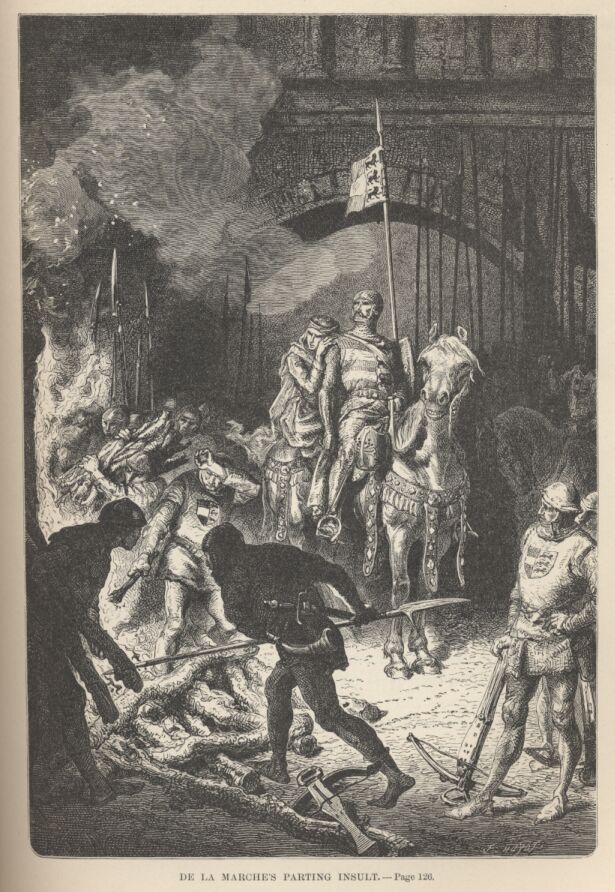
This meant war; and it burst out at the commencement of the following spring. It found Louis equally well prepared for it and determined to carry it through. But in him prudence and justice were as little to seek as resolution; he respected public opinion, and he wished to have the approval of those whom he called upon to commit themselves for him and with him. He summoned the crown’s vassals to a parliament; and, “What think you,” he asked them, “should be done to a vassal who would fain hold land without owning a lord, and who goeth against the fealty and homage due from him and his predecessors?” The answer was, that the lord ought in that case to take back the fief as his own property. “As my name is Louis,” said the king, “the Comet of La Marche doth claim to hold land in such wise, land which hath been a fief of France since the days of the valiant King Clovis, who won all Aquitaine from King Alaric, a pagan without faith or creed, and all the country to the Pyrenean mount.” And the barons promised the king their energetic co-operation.
The war was pushed on zealously by both sides. Henry III., King of England, sent to Louis messengers charged to declare to him that his reason for breaking the truce concluded between them was, that he regarded it as his duty towards his step-father, the Count of La Marche, to defend him by arms. Louis answered that, for his own part, he had scrupulously observed the truce, and had no idea of breaking it; but he considered that he had a perfect right to punish a rebellious vassal. In this young King of France, this docile son of an able mother, none knew what a hero there was, until he revealed himself on a sudden. Near two towns of Saintonge, Taillebourg and Saintes, at a bridge which covered the approaches of one and in front of the walls of the other, Louis, on the 21st and 22d of July, delivered two battles, in which the brilliancy of his personal valor and the affectionate enthusiasm he excited in his troops secured victory and the surrender of the two places. “At sight of the numerous banners, above which rose the oriflamme, close to Taillebourg, and of such a multitude of tents, one pressing against another and forming as it were a large and populous city, the King of England turned sharply to the Count of La Marche, saying, ‘My father, is this what you did promise me? Is yonder the numerous chivalry that you did engage to raise for me, when you said that all I should have to do would be to get money together?’ ‘That did I never say,’ answered the count. ‘Yea, verily,’ rejoined Richard, Earl of Cornwall, brother of Henry III.: ‘for yonder I have amongst my baggage writing of your own to such purport.’ And when the Count of La Marche energetically denied that he had ever signed or sent such writing, Henry III. reminded him bitterly of the messages he had sent to England, and of his urgent exhortations to war. ‘It was never done with my consent,’ cried the Count of La Marche, with an oath; ‘put the blame of it upon your mother, who is my wife; for, by the gullet of God, it was all devised without my knowledge.’”
It was not Henry III. alone who was disgusted with the war in which his mother had involved him; the majority of the English lords who had accompanied him left him, and asked the King of France for permission to pass through his kingdom on their way home. There were those who would have dissuaded Louis from compliance; but, “Let them go,” said he; “I would ask nothing better than that all my foes should thus depart forever far away from my abode.” Those about him made merry over Henry III., a refugee at Bordeaux, deserted by the English and plundered by the Gascons. “Hold! hold!” said Louis; “turn him not into ridicule, and make me not hated of him by reason of your banter; his charities and his piety shall exempt him from all contumely.” The Count of La Marche lost no time in asking for peace; and Louis granted it with the firmness of a far-seeing politician and the sympathetic feeling of a Christian. He required that the domains he had just wrested from the count should belong to the crown, and to the Count of Poitiers, under the suzerainty of the crown. As for the rest of his lands, the Count of La Marche, his wife and children, were obliged to beg a grant of them at the good pleasure of the king, to whom the count was, further, to give up, as guarantee for fidelity in future, three castles, in which a royal garrison should be kept at the count’s expense. When introduced into the king’s presence, the count, his wife, and children, “with sobs, and sighs, and tears, threw themselves upon their knees before him, and began to cry aloud, ‘Most gracious sir, forgive us thy wrath and thy displeasure, for we have done wickedly and pridefully towards thee.’ And the king, seeing the Count of La Marche such humble guise before him, could not restrain his compassion amidst his wrath, but made him rise up, and forgave him graciously all the evil he had wrought against him.”
A prince who knew so well how to conquer and how to treat the conquered might have been tempted to make an unfair use, alternately, of his victories and of his clemency, and to pursue his advantages beyond measure; but Louis was in very deed a Christian. When War was not either a necessity or a duty, this brave and brilliant knight, from sheer equity and goodness of heart, loved peace rather than war. The successes he had gained in his campaign of 1242 were not for him the first step in an endless career of glory and conquest; he was anxious only to consolidate them whilst securing, in Western Europe, for the dominions of his adversaries, as well as for his own, the benefits of peace. He entered into negotiations, successively, with the Count of La Marche, the King of England, the Count of Toulouse, the King of Aragon, and the various princes and great feudal lords who had been more or less engaged in the war; and in January, 1213, says the latest and most enlightened of his biographers, “the treaty of Lorris marked the end of feudal troubles for the whole duration of St. Louis’s reign. He drew his sword no more, save only against the enemies of the Christian faith and Christian civilization, the Mussulmans.” (Histoire de St. Louis, by M. Felix Faure, t. i. p. 388.)
Nevertheless there was no lack of opportunities for interfering with a powerful arm amongst the sovereigns his neighbors, and for working their disagreements to the profit of his ambition, had ambition guided his conduct. The great struggle between the Empire and the Papacy, in the persons of Frederick II., Emperor of Germany, and the two popes, Gregory IX. and Innocent IV., was causing violent agitation in Christendom, the two powers setting no bounds to their aspirations of getting the dominion one over the other, and of disposing one of the other’s fate. Scarcely had Louis reached his majority when, in 1237, he tried his influence with both sovereigns to induce them to restore peace to the Christian world. He failed; and thenceforth he preserved a scrupulous neutrality towards each. The principles of international law, especially in respect of a government’s interference in the contests of its neighbors, whether princes or peoples, were not, in the thirteenth century, systematically discussed and defined as they are nowadays with us; but the good sense and the moral sense of St. Louis caused him to adopt, on this point, the proper course, and no temptation, not even that of satisfying his fervent piety, drew him into any departure from it. Distant or friendly, by turns, towards the two adversaries, according as they tried to intimidate him or win him over to them, his permanent care was to get neither the State nor the Church of France involved in the struggle between the priesthood and the empire, and to maintain the dignity of his crown and the liberties of his subjects, whilst employing his influence to make prevalent throughout Christendom a policy of justice and peace.
That was the policy required, in the thirteenth century more than ever, by the most urgent interests of entire Christendom.
She was at grips with two most formidable foes and perils. Through the crusades she had, from the end of the eleventh century, become engaged in a deadly struggle against the Mussulmans in Asia; and in the height of this struggle, and from the heart of this same Asia, there spread, towards the middle of the thirteenth century, over Eastern Europe, in Russia, Poland, Hungary, Bohemia, and Germany, a barbarous and very nearly pagan people, the Mongol Tartars, sweeping onward like an inundation of blood, ravaging and threatening with complete destruction all the dominions which were penetrated by their hordes. The name and description of these barbarians, the fame and dread of their devastations, ran rapidly through the whole of Christian Europe. “What must we do in this sad plight?” asked Queen Blanche of the king, her son. “We must, my mother,” answered Louis (with sorrowful voice, but not without divine inspiration, adds the chronicler), “we must be sustained by a heavenly consolation. If these Tartars, as we call them, arrive here, either we will hurl them back to Tartarus, their home, whence they are come, or they shall send us up to Heaven.” About the same period, another cause of disquietude and another feature of attraction came to be added to all those which turned the thoughts and impassioned piety of Louis towards the East. The perils of the Latin empire of Constantinople, founded, as has been already mentioned, in 1204, under the headship of Baldwin, Count of Flanders, were becoming day by day more serious. Greeks, Mussulmans, and Tartars were all pressing it equally hard. In 1236, the emperor, Baldwin II., came to solicit in person the support of the princes of Western Europe, and especially of the young King of France, whose piety and chivalrous ardor were already celebrated everywhere. Baldwin possessed a treasure, of great power over the imaginations and convictions of Christians, in the crown of thorns worn by Jesus Christ during His passion. He had already put it in pawn at Venice for a considerable loan advanced to him by the Venetians; and he now offered it to Louis in return for effectual aid in men and money. Louis accepted the proposal with transport. He had been scared, a short time ago, at the chance of losing another precious relic deposited in the abbey of St. Denis, one of the nails which, it was said, had held Our Lord’s body upon the cross. It had been mislaid one ceremonial day whilst it was being exhibited to the people; and, when he recovered it, “I would rather,” said Louis, “that the best city in my kingdom had been swallowed up in the earth.” After having taken all the necessary precautions for avoiding any appearance of a shameful bargain, he obtained the crown of thorns, all expenses included, for eleven thousand livres of Paris, that is, they say, about twenty-six thousand dollars of our money. Our century cannot have any fellow-feeling with such ready credulity, which is not required by Christian faith or countenanced by sound criticism; but we can and we ought to comprehend such sentiments in an age when men not only had profound faith in the facts recorded in the Gospels, but could not believe themselves to be looking upon the smallest tangible relic of those facts without experiencing an emotion and a reverence as profound as their faith. It is to such sentiments that we owe one of the most perfect and most charming monuments of the middle ages, the Holy Chapel, which St. Louis had built between 1245 and 1248 in order to deposit there the precious relics he had collected. The king’s piety had full justice and honor done it by the genius of the architect, Peter de Montreuil, who, no doubt, also shared his faith.
It was after the purchase of the crown of thorns and the building of the Holy Chapel that Louis, accomplishing at last the desire of his soul, departed on his first crusade. We have already gone over the circumstances connected with his determination, his departure, and his life in the East, during the six years of pious adventure and glorious disaster he passed there. We have already seen what an impression of admiration and respect was produced throughout his kingdom when he was noticed to have brought back with him from the Holy Land “a fashion of living and doing superior to his former behavior, although in his youth he had always been good and innocent and worthy of high esteem.” These expressions of his confessor are fully borne out by the deeds and laws, the administration at home and the relations abroad, by the whole government, in fact, of St. Louis during the last fifteen years of his reign. The idea which was invariably conspicuous and constantly maintained during his reign was not that of a premeditated and ambitious policy, ever tending towards an interested object which is pursued with more or less reasonableness and success, and always with a large amount of trickery and violence on the part of the prince, of unrighteousness in his deeds, and of suffering on the part of the people. Philip Augustus, the grandfather, and Philip the Handsome, the grandson, of St. Louis, the former with the moderation of an able man, the latter with headiness and disregard of right or wrong, labored both of them without cessation to extend the domains and power of the crown, to gain conquests over their neighbors and their vassals, and to destroy the social system of their age, the feudal system, its rights as well as its wrongs and tyrannies, in order to put in its place pure monarchy, and to exalt the kingly authority above all liberties, whether of the aristocracy or of the people. St. Louis neither thought of nor attempted anything of the kind; he did not make war, at one time openly, at another secretly, upon the feudal system; he frankly accepted its principles, as he found them prevailing in the facts and the ideas of his times. Whilst fully bent on repressing with firmness his vassals’ attempts to shake themselves free from their duties towards him, and to render themselves independent of the crown, he respected their rights, kept his word to them scrupulously, and required of them nothing but what they really owed him. Into his relations with foreign sovereigns, his neighbors, he imported the same loyal spirit. “Certain of his council used to tell him,” reports Joinville, “that he did not well in not leaving those foreigners to their warfare; for, if he gave them his good leave to impoverish one another, they would not attack him so readily as if they were rich.” To that the king replied that they said not well; for, quoth he, if the neighboring princes perceived that I left them to their warfare, they might take counsel amongst themselves, and say, ‘It is through malice that the king leaves us to our warfare; then it might happen that by cause of the hatred they would have against me, they would come and attack me, and I might be a great loser there-by. Without reckoning that I should thereby earn the hatred of God, who says, ‘Blessed be the peacemakers!’ So well established was his renown as a sincere friend of peace and a just arbiter in great disputes between princes and peoples that his intervention and his decisions were invited wherever obscure and dangerous questions arose. In spite of the brilliant victories which, in 1212, he had gained at Taillebourg and Saintes over Henry III., King of England, he himself perceived, on his return from the East, that the conquests won by his victories might at any moment become a fresh cause of new and grievous wars, disastrous, probably, for one or the other of the two peoples. He conceived, therefore, the design of giving to a peace which was so desirable a more secure basis by founding it upon a transaction accepted on both sides as equitable. And thus, whilst restoring to the King of England certain possessions which the war of 1242 had lost to him, he succeeded in obtaining from him in return “as well in his own name as in the names of his sons and their heirs, a formal renunciation of all rights that he could pretend to over the duchy of Normandy, the countships of Anjou, Maine, Touraine, Poitou, and, generally, all that his family might have possessed on the continent, except only the lands which the King of France restored to him by the treaty and those which remained to him in Gascony. For all these last the King of England undertook to do liege-homage to the King of France, in the capacity of peer of France and Duke of Aquitaine and to faithfully fulfil the duties attached to a fief.” When Louis made known this transaction to his counsellors, “they were very much against it,” says Joinville. “It seemeth to us, sir,” said they to the king, “that, if you think you have not a right to the conquest won by you and your antecessors from the King of England, you do not make proper restitution to the said king in not restoring to him the whole; and if you think you have a right to it, it seemeth to us that you are a loser by all you restore.” “Sirs,” answered Louis, “I am certain that the antecessors of the King of England did quite justly lose the conquest which I hold; and as for the land I give him, I give it him not as a matter in which I am bound to him or his heirs, but to make love between my children and his, who are cousins-german. And it seemeth to me that what I give him I turn to good purpose, inasmuch as he was not my liegeman, and he hereby cometh in amongst my liegeman.” Henry III., in fact, went to Paris, having with him the ratification of the treaty, and prepared to accomplish the ceremony of homage. “Louis received him as a brother, but without sparing him aught of the ceremony, in which, according to the ideas of the times, there was nothing humiliating any more than in the name of vassal, which was proudly borne by the greatest lords. It took place on Thursday, December 4, 1259, in the royal enclosure stretching in front of the palace, on the spot where at the present day is the Place Dauphine. There was a great concourse of prelates, barons, and other personages belonging to the two courts and the two nations. The King of England, on his knees, bareheaded, without cloak, belt, sword, or spurs, placed his folded hands in those of the King of France his suzerain, and said to him, ‘Sir, I become your liegeman with mouth and hands, and I swear and promise you faith and loyalty, and to guard your right according to my power, and to do fair justice at your summons or the summons of your bailiff, to the best of my wit.’ Then the king kissed him on the mouth and raised him up.”
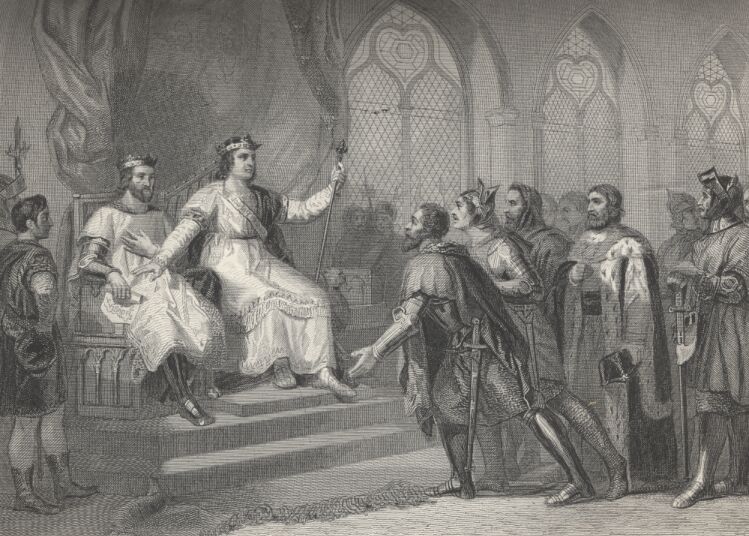
Three years later Louis gave not only to the King of England, but to the whole English nation, a striking proof of his judicious and true-hearted equity. An obstinate civil war was raging between Henry III. and his barons. Neither party, in defending its own rights, had any notion of respecting the rights of its adversaries, and England was alternating between a kingly and an aristocratic tyranny. Louis, chosen as arbiter by both sides, delivered solemnly, on the 23d of January, 1264, a decision which was favorable to the English kingship, but at the same, time expressly upheld the Great Charter and the traditional liberties of England. He concluded his decision with the following suggestions of amnesty: “We will also that the King of England and his barons do forgive one another mutually, that they do forget all the resentments that may exist between them; by consequence of the matters submitted to our arbitration, and that henceforth they do refrain reciprocally from an offence and injury on account of the same matters.” But when men have had their ideas, passions, and interests profoundly agitated and made to clash, the wisest decisions and the most honest counsels in the world are not sufficient to re-establish peace; the cup of experience has to be drunk to the dregs; and the parties are not resigned to peace until on or the other, or both, have exhausted themselves in the struggle and perceive the absolute necessity of accepting either defeat compromise. In spite of the arbitration of the King of France the civil war continued in England; but Louis did not seek any way to profit by it so as to extend, at the expense of his neighbors, his own possessions or power; he held himself also from their quarrels, and followed up by honest neutrality ineffectual arbitration. Five centuries afterwards the great English historian, Hume, rendered him due homage in these terms: “Every time this virtuous prince interfered in the affairs of England, it was invariably with the view of settling differences between the king and the nobility. Adopting an admirable course of conduct, as politic probably as it certainly was just, he never interposed his good offices save to put an end the disagreements of the English; he seconded all the measures which could give security to both parties, and he made persistent efforts, though without success, to moderate the fiery ambition of the Earl of Leicester.” (Hume, History of England, t. ii. p. 465.)
It requires more than political wisdom, more even than virtue, to enable a king, a man having in charge the government of men, to accomplish his mission and to really deserve the title of Most Christian; it requires that he should be animated by a sentiment of affection, and that he should, in heart as well as mind, be in sympathy with those multitudes of creatures over whose lot he exercises so much influence. St. Louis more perhaps than any other king was possessed of this generous and humane quality: spontaneously and by the free impulse of his nature he loved his people, loved mankind, and took a tender and comprehensive interest in their fortunes, their joys, or their miseries. Being seriously ill in 1259, and desiring to give his eldest son, Prince Louis, whom he lost in the following year, his last and most heartfelt charge, “Fair son,” said he, “I pray thee make thyself beloved of the people of thy kingdom, for verily I would rather a Scot should come from Scotland and govern our people well and loyally than have thee govern it ill.” To watch over the position and interests of all parties in his dominions, and to secure to all his subjects strict and prompt justice, this was what continually occupied the mind of Louis IX. There are to be found in his biography two very different but equally striking proofs of his solicitude in this respect. M. Felix Faure has drawn up a table of all the journeys made by Louis in France, from 1254 to 1270, for the better cognizance of matters requiring his attention, and another of the parliaments which he held, during the same period, for considering the general affairs of the kingdom and the administration of justice. Not one of these sixteen years passed without his visiting several of his provinces, and the year 1270 was the only one in which he did not hold a parliament. (Histoire de Saint Louis, by M. Felix Faure, t. ii. pp. 120, 339.) Side by side with this arithmetical proof of his active benevolence we will place a moral proof taken from Joinville’s often-quoted account of St. Louis’s familiar intervention in his subjects’ disputes about matters of private interest. “Many a time,” says he, “it happened in summer that the king went and sat down in the wood of Vincennes after mass, and leaned against an oak, and made us sit down round about him. And all those who had business came to speak to him without restraint of usher or other folk. And then he demanded of them with his own mouth, ‘Is there here any who hath a suit?’ and they who had their suit rose up; and then he said, ‘Keep silence, all of ye; and ye shall have despatch one after the other.’ And then he called my Lord Peter de Fontaines and my Lord Geoffrey de Villette (two learned lawyers of the day and counsellors of St. Louis), and said to one of them, ‘Despatch me this suit.’ And when he saw aught to amend in the words of those who were speaking for another, he himself amended it with his own mouth. I sometimes saw in summer that, to despatch his people’s business, he went into the Paris garden, clad in camlet coat and linsey surcoat without sleeves, a mantle of black taffety round his neck, hair right well combed and without coif, and on his head a hat with white peacock’s plumes. And he had carpets laid for us to sit round about him. And all the people who had business before him set themselves standing around him; and then he had their business despatched in the manner I told you of before as to the wood of Vincennes.” (Joinville, chap. xii.)
The active benevolence of St. Louis was not confined to this paternal care for the private interests of such subjects as approached his person; he was equally attentive and zealous in the case of measures called for by the social condition of the times and the general interests of the kingdom. Amongst the twenty-six government ordinances, edicts, or letters, contained under the date of his reign in the first volume of the Recueil des Ordonnances des Rois de France, seven, at the least, are great acts of legislation and administration of a public kind; and these acts are all of such a stamp as to show that their main object is not to extend the power of the crown or subserve the special interests of the kingship at strife with other social forces; they are real reforms, of public and moral interest, directed against the violence, disturbances, and abuses of the feudal system. Many other of St. Louis’s legislative and administrative acts have been published either in subsequent volumes of the Recueil des Ordonnances des Rois, or in similar collections, and the learned have drawn attention to a great number of them still remaining unpublished in various archives. As for the large collection of legislative enactments known by the name of Etailissements de Saint Louis, it is probably a lawyer’s work, posterior, in great part at least, to his reign, full of incoherent and even contradictory enactments, and without any claim to be considered as a general code of law of St. Louis’s date and collected by his order, although the paragraph which serves as preface to the work is given under his name and as if it had been dictated by him.
Another act, known by the name of the Pragmatic Sanction, has likewise got placed, with the date of March, 1268, in the Recueil des Ordonnances des Rois de France, as having originated with St. Louis. Its object is, first of all, to secure the rights, liberties, and canonical rules, internally, of the Church of France; and, next, to interdict “the exactions and very heavy money-charges which have been imposed or may hereafter be imposed on the said Church by the court of Rome, and by the which our kingdom hath been miserably impoverished; unless they take place for reasonable, pious, and very urgent cause, through inevitable necessity, and with our spontaneous and express consent and that of the Church of our kingdom.” The authenticity of this act, vigorously maintained in the seventeenth century by Bossuet (in his Defense de la Declaration du Clerge de France de 1682, chap. ix. t. xliii. p. 26), and in our time by M. Daunou (in the Histoire litteraire de la France, continuee par des Hembres de l’Institut, t. xvi. p. 75, and t. xix. p. 169), has been and still is rendered doubtful for strong reasons, which M. Felix Faure, in his Histoire de Saint Louis (t. ii. p. 271), has summed up with great clearness. There is no design of entering here upon an examination of this little historical problem; but it is a bounden duty to point out that, if the authenticity of the Pragmatic Sanction, as St. Louis’s, is questionable, the act has, at bottom, nothing but what bears a very strong resemblance to, and is quite in conformity with, the general conduct of that prince. He was profoundly respectful, affectionate, and faithful towards the papacy, but, at the same time, very careful in upholding both the independence of the crown in things temporal, and its right of superintendence in things spiritual. Attention has been drawn to his posture of reserve during the great quarrel between the priestdom and the empire, and his firmness in withstanding the violent measures adopted by Gregory IX. and Innocent IV. against the Emperor Frederick II. Louis carried his notions, as to the independence of his judgment and authority, very far beyond the cases in which that policy went hand in hand with interest, and even into purely religious questions. The Bishop of Auxerre said to him one day, in the name of several prelates, “‘Sir, these lords which be here, archbishops and bishops, have told me to tell you that Christianity is perishing in your hands.’ The king crossed himself and said, Well, tell me how that is made out!’ ‘Sir,’ said the bishop, ‘it is because nowadays so little note is taken of excommunications, that folk let death overtake them excommunicate without getting absolution, and have no mind to make atonement to the Church. These lords, therefore, do pray you, sir, for the love of God and because you ought to do so, to command your provosts and bailiffs that all those who shall remain a year and a day excommunicate be forced, by seizure of their goods, to get themselves absolved.’ Whereto the king made answer that he would willingly command this in respect of the excommunicate touching whom certain proofs should be given him that they were in the wrong. The bishop said that the prelates would not have this at any price, and that they disputed the king’s right of jurisdiction in their causes. And the king said that he would not do it else; for it would be contrary to God and reason if he should force folks to get absolution when the clergy had done them wrong. As to that,’ said the king, ‘I will give you the example of the Count of Brittany, who for seven years, being fully excommunicate, was at pleas with the prelates of Brittany; and he prevailed so far that the pope condemned them all. If, then, I had forced the Count of Brittany, the first year, to get absolution, I should have sinned against God and against him.’ Then the prelates gave up; and never since that time have I heard that a single demand was made touching the matters above spoken of.” (Joinville, chap. xiii. p. 43.)
One special fact in the civil and municipal administration of St. Louis deserves to find a place in history. After the time of Philip Augustus there was malfeasance in the police of Paris. The provostship of Paris, which comprehended functions analogous to those of prefect, mayor, and receiver-general, became a purchasable office, filled sometimes by two provosts at a time. The burghers no longer found justice or security in the city where the king resided. At his return from his first crusade, Louis recognized the necessity for applying a remedy to this evil; the provostship ceased to be a purchasable office; and he made it separate from the receivership of the royal domain. In 1258 he chose as provost Stephen Boileau, a burgher of note and esteem in Paris; and in order to give this magistrate the authority of which he had need, the king sometimes came and sat beside him when he was administering justice at the Chatelet. Stephen Boileau justified the king’s confidence, and maintained so strict a police that he had his own godson hanged for theft. His administrative foresight was equal to his judicial severity. He established registers wherein were to be inscribed the rules habitually followed in respect of the organization and work of the different corporations of artisans, the tariffs of the dues charged, in the name of the king, upon the admittance of provisions and merchandise, and the titles on which the abbots and other lords founded the privileges they enjoyed within the walls of Paris. The corporations of artisans, represented by their sworn masters or prud’hommes, appeared one after the other before the provost to make declaration of the usages in practice amongst their communities, and to have them registered in the book prepared for that purpose. This collection of regulations relating to the arts and trades of Paris in the thirteenth century, known under the name of Livre des Metiers d’Etienne Boileau, is the earliest monument of industrial statistics drawn up by the French administration, and it was inserted, for the first time in its entirety, in 1837, amongst the Collection des Documents relatifs d l’Histoire de France, published during M. Guizot’s ministry of public instruction.
St. Louis would be but very incompletely understood if we considered him only in his political and kingly aspect; we must penetrate into his private life, and observe his personal intercourse with his family, his household, and his people, if we would properly understand and appreciate all the originality and moral worth of his character and his life. Mention has already been made of his relations towards the two queens, his mother and his wife; and, difficult as they were, they were nevertheless always exemplary. Louis was a model of conjugal fidelity, as well as of filial piety. He had by Queen Marguerite eleven children, six sons and five daughters; he loved her tenderly, he never severed himself from her, and the modest courage she displayed in the first crusade rendered her still dearer to him. But he was not blind to her ambitious tendencies, and to the insufficiency of her qualifications for government. When he made ready for his second crusade, not only did he not confide to Queen Marguerite the regency of the kingdom, but he even took care to regulate her expenses, and to curb her passion for authority. He forbade her to accept any present for herself or her children, to lay any commands upon the officers of justice, and to choose any one for her service, or for that of her children, without the consent of the council of the regency. And he had reason so to act; for, about this same time, Queen Marguerite, emulous of holding in the state the same place that had been occupied by Queen Blanche, was giving all her thoughts to what her situation would be after her husband’s death, and was coaxing her eldest son, Philip, then sixteen years old, to make her a promise on oath to remain under her guardianship up to thirty years of age, to take to himself no counsellor without her approval, to reveal to her all designs which might be formed against her, to conclude no treaty with his uncle, Charles of Anjou, King of Sicily, and to keep as a secret the oath she was thus making him take. Louis was probably informed of this strange promise by his young son Philip himself, who got himself released from it by Pope Urban IV. At any rate, the king had a foreshadowing of Queen Marguerite’s inclinations, and took precautions for rendering them harmless to the crown and the state.
As for his children, Louis occupied himself in thought and deed with their education and their future, moral and social, showing as much affection and assiduity as could have been displayed by any father of a family, even the most devoted to this single task. “After supper they followed him into his chamber, where he made them sit down around him; he instructed them in their duties, and then sent them away to bed. He drew their particular attention to the good and evil deeds of princes. He, moreover, went to see then in their own apartment when he had any leisure, informed himself as to the progress they were making, and, like another Tobias, gave them excellent instructions. . . . On Holy Thursday his sons used to wash, just as he used, the feet of thirteen of the poor, give them a considerable sum as alms, and then wait upon them at table. The king having been minded to carry the first of the poor souls to the Hotel-Dieu, at Compiegne, with the assistance of his son-in-law, King Theobald of Navarre, whom he loved as a son, his two eldest sons, Louis and Philip, carried the second thither.” They were wont to behave towards him in the most respectful manner. He would have all of them, even Theobald, yield him strict obedience in that which he enjoined upon them. He desired anxiously that the three children born to him in the East, during his first crusade, John Tristan, Peter, and Blanche, and even Isabel, his eldest daughter, should enter upon the cloistered life, which he looked upon as the safest for their salvation. He exhorted them thereto, especially his daughter Isabel, many and many a time, in letters equally tender and pious; but, as they testified no taste for it, he made no attempt to force their inclinations, and concerned himself only about having them well married, not forgetting to give them good appanages, and, for their life in the world, the most judicious counsels. The instructions, written with his own hand in French, which he committed to his eldest son, Philip, as soon as he found himself so seriously ill before Tunis, are a model of virtue, wisdom, and tenderness on the part of a father, a king, and a Christian.
Pass we from the king’s family to the king’s household, and from the children to the servitors of St. Louis. We have here no longer the powerful tie of blood, and of that feeling, at the same time personal and yet disinterested, which is experienced by parents on seeing themselves living over again in their children. Far weaker motives, mere kindness and custom, unite masters to their servants, and stamp a moral character upon the relations between them; but with St. Louis, so great was his kindness, that it resembled affection, and caused affection to spring up in the hearts of those who were the objects of it. At the same time that he required in his servitors an almost austere morality, he readily passed over in silence their little faults, and treated them, in such cases, not only with mildness, but with that consideration which, in the humblest conditions, satisfies the self-respect of people, and elevates them in their own eyes. “Louis used to visit his domestics when they were ill; and when they died he never failed to pray for them, and to commend them to the prayers of the faithful. He had the mass for the dead, which it was his custom to hear every day, sung for them.” He had taken back an old servitor of his grandfather, Philip Augustus, whom that king had dismissed because his fire sputtered, and John, whose duty it was to attend to it, did not know how to prevent that slight noise. Louis was, from time to time, subject to a malady, during which his right leg, from the ankle to the calf, became inflamed, as red as blood, and painful. One day, when he had an attack of this complaint, the king, as he lay, wished to make a close inspection of the redness in his leg; as John was clumsily holding a lighted candle close to the king, a drop of hot grease fell on the bad leg; and the king, who had sat up on his bed, threw himself back, exclaiming, “Ah! John, John, my grandfather turned you out of his house for a less matter!” and the clumsiness of John drew down upon him no other chastisement save this exclamation. (Vie de Saint Louis, by Queen Marguerite’s confessor; Recueiz des Historiens de France, t. xx. p. 105; Vie de Saint Louis, by Lenain de Tillemont, t. v. p. 388.)
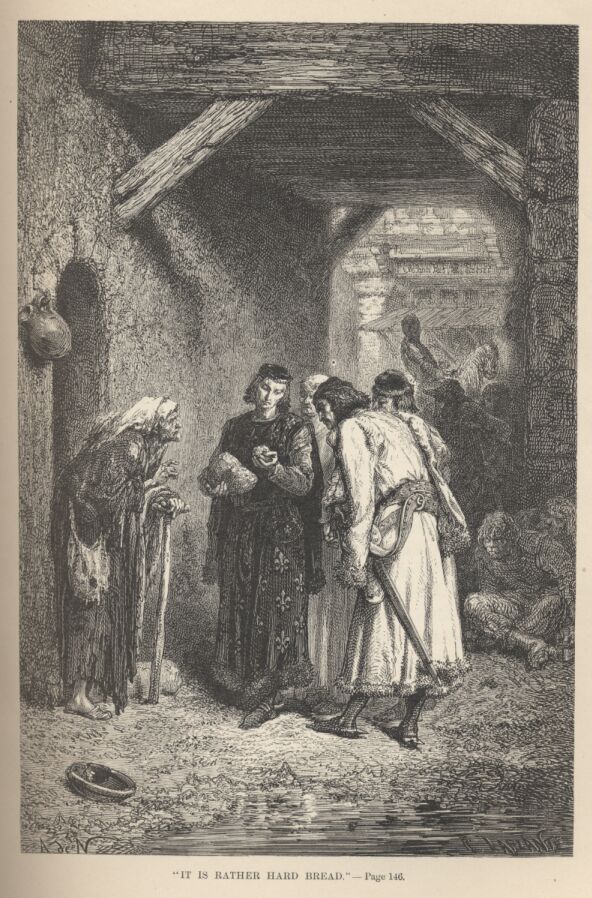
Far away from the king’s household and service, and without any personal connection with him, a whole people, the people of the poor, the infirm, the sick, the wretched, and the neglected of every sort occupied a prominent place in the thoughts and actions of Louis. All the chroniclers of the age, all the historians of his reign, have celebrated his charity as much as his piety; and the philosophers of the eighteenth century almost forgave him his taste for relics, in consideration of his beneficence. And it was not merely legislative and administrative beneficence; St. Louis did not confine himself to founding and endowing hospitals, hospices, asylums, the Hotel-Dieu at Pontoise, that at Vernon, that at Compiegne, and, at Paris, the house of Quinze-Vingts, for three hundred blind, but he did not spare his person in his beneficence, and regarded no deed of charity as beneath a king’s dignity. “Every day, wherever the king went, one hundred and twenty-two of the poor received each two loaves, a quart of wine, meat or fish for a good dinner, and a Paris denier. The mothers of families had a loaf more for each child. Besides these hundred and twenty-two poor having out-door relief, thirteen others were every day introduced into the hotel, and there lived as the king’s officers; and three of them sat at table at the same time with the king, in the same hall as he, and quite close.” . . . “Many a time,” says Joinville, “I saw him cut their bread, and give them to drink. He asked me one day if I washed the feet of the poor on Holy Thursday. ‘Sir,’ said I, ‘what a benefit! The feet of those knaves! Not I.’ ‘Verily,’ said he, ‘that is ill said, for you ought not to hold in disdain what God did for our instruction. I pray you, therefore, for love of me accustom yourself to wash them.’” Sometimes, when the king had leisure, he used to say, “Come and visit the poor in such and such a place, and let us feast them to their hearts’ content.” Once when he went to Chateauneuf-sur-Loire, a poor old woman, who was at the door of her cottage, and held in her hand a loaf, said to him, “Good king, it is of this bread, which comes of thine alms, that my husband, who lieth sick yonder indoors, doth get sustenance.” The king took the bread, saying, “It is rather hard bread.” And he went into the cottage to see with his own eyes the sick man.
When he was visiting the churches one Holy Friday, at Compiegne, as he was going that day barefoot according to his custom, and distributing alms to the poor whom he met, he perceived, on the yonder side of a miry pond which filled a portion of the street, a leper, who, not daring to come near, tried, nevertheless, to attract the king’s attention. Louis walked through the pond, went up to the leper, gave him some money, took his hand and kissed it. “All present,” says the chronicler, “crossed themselves for admiration at seeing this holy temerity of the king, who had no fear of putting his lips to a hand that none would have dared to touch.” In such deeds there was infinitely more than the goodness and greatness of a kingly sold; there was in them that profound Christian sympathy which is moved at the sight of any human creature suffering severely in body or soul, and which, at such times, gives heed to no fear, shrinks from no pains, recoils with no disgust, and has no other thought but that of offering some fraternal comfort to the body or the soul that is suffering.
He who thus felt and acted was no monk, no prince enwrapt in mere devoutness and altogether given up to works and practices of piety; he was a knight, a warrior, a politician, a true king, who attended to the duties of authority as well as to those of charity, and who won respect from his nearest friends as well as from strangers, whilst astonishing them at one time by his bursts of mystic piety and monastic austerity, at another by his flashes of the ruler’s spirit and his judicious independence, even towards the representatives of the faith and Church with whom he was in sympathy. “He passed for the wisest man in all his council.” In difficult matters and on grave occasions none formed a judgment with more sagacity, and what his intellect so well apprehended he expressed with a great deal of propriety and grace. He was, in conversation, the nicest and most agreeable of men; “he was gay,” says Joinville, “and when we were private at court, he used to sit at the foot of his bed; and when the preachers and cordeliers who were there spoke to him of a book he would like to hear, he said to them, ‘Nay, you shall not read to me, for there is no book so good, after dinner, as talk ad libitum, that is, every one saying what he pleases.’” Not that he was at all averse from books and literates: “He was sometimes present at the discourses and disputations of the University; but he took care to search out for himself the truth in the word of God and in the traditions of the Church. . . . Having found out, during his travels in the East, that a Saracenic sultan had collected a quantity of books for the service of the philosophers of his sect, he was shamed to see that Christians had less zeal for getting instructed in the truth than infidels had for getting themselves made dexterous in falsehood; so much so that, after his return to France, he had search made in the abbeys for all the genuine works of St. Augustin, St. Ambrose, St. Jerome, St. Gregory, and other orthodox teachers, and, having caused copies of them to be made, he had them placed in the treasury of Sainte-Chapelle. He used to read them when he had any leisure, and he readily lent them to those who might get profit from them for themselves or for others. Sometimes, at the end of the afternoon meal, he sent for pious persons with whom he conversed about God, about the stories in the Bible and the histories of the saints, or about the lives of the Fathers.” He had a particular friendship for the learned Robert of Sorbon, founder of the Sorbonne, whose idea was a society of secular ecclesiastics, who, living in common and having the necessaries of life, should give themselves up entirely to study and gratuitous teaching. Not only did St. Louis give him every facility and every aid necessary for the establishment of his learned college, but he made him one of his chaplains, and often invited him to his presence and his table in order to enjoy his conversation. “One day it happened,” says Joinville, “that Master Robert was taking his meal beside me, and we were talking low. The king reproved us, and said, ‘Speak up, for your company think that you may be talking evil of them. If you speak, at meals, of things which should please us, speak up; if not, be silent.’” Another day, at one of their reunions, with the king in their midst, Robert of Sorbon reproached Joinville with being “more bravely clad than the king; for,” said he, “you do dress in furs and green cloth, which the king doth not.” Joinville defended himself vigorously, in his turn attacking Robert for the elegance of his dress. The king took the learned doctor’s part, and when he had gone, “My lord the king,” says Joinville, “called his son, my lord Philip, and King Theobald, sat him down at the entrance of his oratory, placed his hand on the ground and said, ‘Sit ye down here close by me, that we be not overheard;’ and then he told me that he had called us in order to confess to us that he had wrongfully taken the part of Master Robert; for, just as the seneschal [Joinville] saith, ye ought to be well and decently clad, because your womankind will love you the better for it, and your people will prize you the more; for, saith the wise man, it is right so to bedeck one’s self with garments and armor that the proper men of this world say not that there is too much made thereof, nor the young folk too little.” (Joinville, ch. cxxxv. p. 301; ch. v. and vi. pp. 12 16; t. v. pp. 326, 364, and 368.)
Assuredly there was enough in such and so free an exercise of mind, in such a rich abundance of thoughts and sentiments, in such a religious, political, and domestic life, to occupy and satisfy a soul full of energy and power. But, as has already been said, an idea cherished with a lasting and supreme passion, the idea of the crusade took entire possession of St. Louis. For seven years, after his return from the East, from 1254 to 1261, he appeared to think no more of it; and there is nothing to show that he spoke of it even to his most intimate confidants. But, in spite of apparent tranquillity, he lived, so far, in a ferment of imagination and a continual fever, resembling in that respect, though the end aimed at was different, those great men, ambitious warriors or politicians, of natures forever at boiling point, for whom nothing is sufficient, and who are constantly fostering, beyond the ordinary course of events, some vast and strange desire, the accomplishment of which becomes for them a fixed idea and an insatiable passion. As Alexander and Napoleon were incessantly forming some new design, or, to speak more correctly, some new dream of conquest and dominion, in the same way St. Louis, in his pious ardor, never ceased to aspire to a re-entry of Jerusalem, to the deliverance of the Holy Sepulchre, and to the victory of Christianity over Mohammedanism in the East, always flattering himself that some favorable circumstance would recall him to his interrupted work. It has already been told, at the termination, in the preceding chapter, of the crusaders’ history, how he had reason to suppose, in 1261, that circumstances were responding to his desire; how he first of all prepared, noiselessly and patiently, for his second crusade; how, after seven years’ labor, less and less concealed as days went on, he proclaimed his purpose, and swore to accomplish it in the following year; and how at last, in the month of March, 1270, against the will of France, of the pope, and even of the majority of his comrades, he actually set out—to go and die, on the 25th of the following August, before Tunis, without having dealt the Mussulmans of the East even the shadow of an effectual blow, having no strength to do more than utter, from time to time, as he raised himself on his bed, the cry of Jerusalem! Jerusalem! and, at the last moment, as he lay in sackcloth and ashes, pronouncing merely these parting words: “Father, after the example of our Divine Master, into Thy hands I commend my spirit!” Even the crusader was extinct in St. Louis; and only the Christian remained.
The world has seen upon the throne greater captains, more profound politicians, vaster and more brilliant intellects, princes who have exercised, beyond their own lifetime, a more powerful and a more lasting influence than St. Louis; but it has never seen a rarer king, never seen a man who could possess, as he did, sovereign power without contracting the passions and vices natural to it, and who, in this respect, displayed in his government human virtues exalted to the height of Christian. For all his moral sympathy, and superior as he was to his age, St. Louis, nevertheless, shared, and even helped to prolong, two of its greatest mistakes; as a Christian he misconceived the rights of conscience in respect of religion, and, as a king, he brought upon his people deplorable evils and perils for the sake of a fruitless enterprise. War against religious liberty was, for a long course of ages, the crime of Christian communities and the source of the most cruel evils as well as of the most formidable irreligious reactions the world has had to undergo. The thirteenth century was the culminating period of this fatal notion and the sanction of it conferred by civil legislation as well as ecclesiastical teaching. St. Louis joined, so far, with sincere conviction, in the general and ruling idea of his age; and the jumbled code which bears the name of Etablissements de Saint Louis, and in which there are collected many ordinances anterior or posterior to his reign, formally condemns heretics to death, and bids the civil judges to see to the execution, in this respect, of the bishops’ sentences. In 1255 St. Louis himself demanded of Pope Alexander IV. leave for the Dominicans and Franciscans to exercise, throughout the whole kingdom, the inquisition already established, on account of the Albigensians, in the old domains of the Counts of Toulouse. The bishops, it is true, were to be consulted before condemnation could be pronounced by the inquisitors against a heretic; but that was a mark of respect for the episcopate and for the rights of the Gallican Church rather than a guarantee for liberty of conscience; and such was St. Louis’s feeling upon this subject, that liberty, or rather the most limited justice, was less to be expected from the kingship than from the episcopate. St. Louis’s extreme severity towards what he called the knavish oath (vilain serment), that is, blasphemy, an offence for which there is no definition save what is contained in the bare name of it, is, perhaps, the most striking indication of the state of men’s minds, and especially of the king’s, in this respect. Every blasphemer was to receive on his mouth the imprint of a red-hot iron. “One day the king had a burgher of Paris branded in this way; and violent murmurs were raised in the capital and came to the king’s ears. He responded by declaring that he wished a like brand might mark his lips, and that he might bear the shame of it all his life, if only the vice of blasphemy might disappear from his kingdom. Some time afterwards, having had a work of great public utility executed, he received, on that occasion, from the landlords of Paris numerous expressions of gratitude. ‘I expect,’ said he, ‘a greater recompense from the Lord for the curses brought upon me by that brand inflicted upon blasphemers than for the blessings I get because of this act of general utility.’” (Joinville, chap. cxxxviii.; Histoire de Saint Louis, by M. Felix Faure, t. ii. p. 300.)
Of all human errors those most in vogue are the most dangerous, for they are just those from which the most superior minds have the greatest difficulty in preserving themselves. It is impossible to see, without horror, into what aberrations of reason and of moral sense men otherwise most enlightened and virtuous may be led away by the predominant ideas of their age. And the horror becomes still greater when a discovery is made of the iniquities, sufferings, and calamities, public and private, consequent upon the admission of such aberrations amongst the choice spirits of the period. In the matter of religious liberty, St. Louis is a striking example of the vagaries which may be fallen into, under the sway of public feeling, by the most equitable of minds and the most scrupulous of consciences. A solemn warning, in times of great intellectual and popular ferment, for those men whose hearts are set on independence in their thoughts as well as in their conduct, and whose only object is justice and truth.
As for the crusades, the situation of Louis was with respect to them quite different and his responsibility far more personal. The crusades had certainly, in their origin, been the spontaneous and universal impulse of Christian Europe towards an object lofty, disinterested, and worthy of the devotion of men; and St. Louis was, without any doubt, the most lofty, disinterested, and heroic representative of this grand Christian movement. But towards the middle of the thirteenth century the moral complexion of the crusades had already undergone great alteration; the salutary effect they were to have exercised for the advancement of European civilization still loomed obscurely in the distance; whilst their evil results were already clearly manifesting themselves, and they had no longer that beauty lent by spontaneous and general feeling which had been their strength and their apology. Weariness, doubt, and common sense had, so far as this matter was concerned, done their work amongst all classes of the feudal community. As Sire de Joinville, so also had many knights, honest burghers, and simple country-folks recognized the flaws in the enterprise, and felt no more belief in its success. It is the glory of St. Louis that he was, in the thirteenth century, the faithful and virtuous representative of the crusade such as it was when it sprang from the womb of united Christendom, and when Godfrey de Bouillon was its leader at the end of the eleventh. It was the misdemeanor of St. Louis, and a great error in his judgment, that he prolonged, by his blindly prejudiced obstinacy, a movement which was more and more inopportune and illegitimate, for it was becoming day by day more factitious and more inane.
In the long line of kings of France, called Most Christian Kings, only two, Charlemagne and Louis IX., have received the still more august title of Saint. As for Charlemagne, we must not be too exacting in the way of proofs of his legal right to that title in the Catholic Church; he was canonized, in 1165 or 1166, only by the anti-pope Pascal III., through the influence of Frederick Barbarossa; and since that time, the canonization of Charlemagne has never been officially allowed and declared by any popes recognized as legitimate. They tolerated and tacitly admitted it, on account, no doubt, of the services rendered by Charlemagne to the papacy. But Charlemagne had ardent and influential admirers outside the pale of popes and emperors; he was the great man and the popular hero of the Germanic race in Western Europe. His saintship was welcomed with acclamation in a great part of Germany, where it had always been religiously kept up. Prom the earliest date of the University of Paris, he had been the patron there of all students of the German race. In France, nevertheless, his position as a saint was still obscure and doubtful, when Louis XI., towards the end of the fifteenth century, by some motive now difficult to unravel, but probably in order to take from his enemy, Charles the Rash, Duke of Burgundy, who was in possession of the fairest provinces of Charlemagne’s empire, the exclusive privilege of so great a memory, ordained that there should be rendered to the illustrious emperor the honors due to the saints; and he appointed the 28th of January for his feast-day, with a threat of the penalty of death against all who should refuse conformity with the order. Neither the command nor the threat of Louis XI. had any great effect. It does not appear that, in the Church of France, the saintship of Charlemagne was any the more generally admitted and kept up; but the University of Paris faithfully maintained its traditions, and some two centuries after Louis XI., in 1661, without expressly giving to Charlemagne the title of saint, it loudly proclaimed him its patron, and made his feast-day an annual and solemn institution, which, in spite of some hesitation on the part of the parliament of Paris, and in spite of the revolutions of our time, still exists as the grand feast-day throughout the area of our classical studies. The University of France repaid Charlemagne for the service she had received from him; she protected his saintship as he had protected her schools and her scholars.