Volume 3 — Chapter XXIV. Charles I. And The Civil War. (continued 2)
Reading edition
Meanwhile Fairfax advanced, and Oxford was about to be invested. The king made an offer to Colonel Rainsborough, who had already arrived before the town, to surrender to him on condition that he should conduct him to Parliament at once. The colonel refused. Charles was about to fall as a prisoner of war into the hands of his enemies. One resource only remained to him. For two months M. de Montreuil, the French ambassador, had been laboring to procure him an opportunity of taking refuge in the camp of the Scots. He thought himself secure of the personal safety of the king in the midst of an army which looked upon Charles as its legitimate sovereign. The queen, still in France, also kept up relations with the Scotch military leaders. She urged her husband to put trust in them. He still hesitated, but he issued forth from Oxford on the 27th of April, at midnight, followed only by his valet-de-chambre, Ashburnham, and a clergyman. Dr. Hudson, well versed in all the roads.
For a moment, when at Harrow-on-the-Hill, in sight of London, the king stopped. Should he take a bold step and suddenly appear in the midst of the city? It was too venturesome a stroke for his timid and sensitive dignity. He turned away, directing his course towards the north, still desiring to join Montrose. Hudson, who had gone forward to reconnoitre, came back to say that M. de Montreuil still answered for the Scots. The king at length made up his mind, though from weariness rather than from choice. On the morning of the 5th of May he arrived at Kelham, the headquarters of the Scotch commander.
The Earl of Leven and his officers at first affected surprise, but they received the king with great respect. They however hastened to apprise the Parliaments of Edinburgh and London, and, in the evening, when the king wished to give the watchword to the sentinels placed at his door, "Pardon me, Sire," Leven said, "I am the oldest soldier here; your Majesty will permit me to undertake that duty."
It was soon known in London that the king had quitted Oxford, but nothing indicated the direction of his flight. On the 6th of May it was at length learned that he had confided his person to the Scotch, who had raised their camp and were marching in great haste towards the border. They only stopped at Newcastle. From there the king could negotiate with the Presbyterians of the two kingdoms.
This was what all the Independents dreaded. For a year past everything had prospered with them. They were masters of the army, and all daring spirits, the energetic and ambitious had placed themselves under their banner. Their influence continued to increase on all hands. They were ruined if at the moment of reaching the summit of power, the king should ally himself with the Presbyterians against them.
They adopted every means to ward off the blow, without scrupling to offend the Scotch, whom they desired to separate from the Presbyterian party in England. The Commons voted that the Scotch army was no longer necessary; that a hundred thousand pounds would be paid to it in advance on account of their claims, and that it should be induced to return to Scotland. Insults were lavished upon those allies, of whom it was now desired to be rid at all costs.
The Scotch and their illustrious guest facilitated the task of their enemies. They were not angry, but they hesitated, they felt their way carefully, they were afraid to take sides. The king still endeavored to deceive his rebellious subjects. "I do not despair," he wrote to Lord Digby before his departure from Oxford, "of inducing the Presbyterians or the Independents to join with me to exterminate each other, and then I shall become once more king in reality." On their side, the Presbyterians, passionately attached to the Covenant, would not hear of any arrangement which did not secure the triumph of their Church. While promising the king to negotiate for peace, they gave further tokens of fidelity towards their brothers, the English, and caused the execution of the most illustrious companions of Montrose, who had been prisoners of war since the battle of Philip-Haugh. The Marquis of Ormond published a letter of the king, asserting that he only repaired to the camp of the Scotch upon their promise, in case of need, to support him and his just rights. The Scotch immediately caused this almost exact interpretation of their words to be belied. The cavaliers could no longer have access to their master, and the clergy were invited to instruct the monarch in the true doctrine of Christ.
Charles did not resist, but even bore with the theological discussions; though the learned preacher, Henderson, who had undertaken his conversion, was not able to congratulate himself upon having shaken the king's fidelity to the Anglican Church. Charles was expecting proposals from the House, to whom he caused to be surrendered all the towns which still held out for him. But he hoped for aid from Ireland, and he wrote to Glamorgan, who was still the sole depositary of his secret designs, "If you can procure a large sum of money for me, pledging my kingdoms as a guarantee, I shall be delighted, and as soon as I shall have recovered the possession, I will amply pay this debt. Tell the nuncio that if I find some means of placing myself in his hands and yours, I will certainly not neglect it, for all the others despise me as I fully see."
At length the proposals of Parliament arrived: they were more humiliating and harsh than those which the king had hitherto rejected. He was asked to adopt the Covenant, to abolish the Church of England, to consign to the Houses for twenty years the command of the army, the militia, and the navy; to allow to be excluded from the armistice seventy-one of his most faithful friends, while all those who had taken arms for him were to be removed from all public functions at the good pleasure of Parliament. On all sides he was urged to accept this disgraceful peace. The queen sent messenger after messenger to him. M. de Bellièvre, the French ambassador, proceeded to Newcastle to advise him to accept it in the name of his court. Several towns in Scotland sent amicable petitions to him. The city of London wished to do likewise: a formal prohibition only prevented it. Threats were coupled with entreaties. The general assembly of the Scotch Church demanded, if the king should refuse the Covenant, that he should be forbidden to remain on Scottish soil, and the Chancellor of Scotland, Lord Lowsden, made him understand that, deprived of his hereditary kingdom, he might very probably find himself deposed in England.
All was powerless against the pride of the king, his religious scruples and also some secret hope which credulous or intriguing friends still kept alive. After having delayed his reply from day to day, he at length consigned to the commissioners on the 1st of August, a written message, in which, without absolutely rejecting the proposals, he again demanded that he should be received in London to negotiate in person with Parliament.
The Independents were unable to restrain their joy. "What is to become of us," said a Presbyterian, "now that the king has refused our proposals?" "What would have become of us if he had accepted them?" replied an Independent. The Scotch proposed to withdraw from England; but they required first the settlement of the arrears, and their claims were enormous. It was necessary to decide who should dispose of the person of the king. The parties commenced the struggle upon this point.
An understanding was arrived at, however, after bitter words and reciprocal recriminations. The arrears were fixed at four hundred thousand pounds sterling, and the House of Commons finally brought the Lords to accept the vote in the terms it had given out for five months past, "that to Parliament alone belonged the right of disposing of the king's person." The Scots resisted feebly, saying that Charles was their king as well as the sovereign of the English. Charles continued to demand to negotiate in person with Parliament.
The wish was as useless the fifth time as the first. The Houses had just signed the treaty which arranged for the withdrawal of the Scotch army, and how the price should be paid. The name of the king was not mentioned in all the clauses of this negotiation, but, on the 3d of December, 1646, at the moment when the convoy of wagons bearing twenty thousand pounds sterling to the Scotch, entered York, the Houses voted that the king should be conducted to Holmby Castle, in Northamptonshire. On the 12th of January, 1647, nine commissioners, three Lords, and six members of the Commons departed from London to take possession respectfully of their sovereign. The dignity of the king proudly resisted this terrible blow. "I am bought and sold," he said, when he learnt that the Parliament of Scotland officially consented to his being consigned into the hands of the English; but he quietly finished his game of chess, replying to the growing anxiety of his servants that he would make known his will to the commissioners when they should arrive. He awaited them without countenancing the confused projects of flight or insurrection which were being hatched around him. The people began to take pity on him. One Sunday, at Newcastle, the Scotch minister who preached before him having chosen his text from a version of the 52d Psalm, beginning,
Why dost thou, tyrant, boast thyself, Thy wicked deeds to praise?
the king suddenly rose and began instead of this the 56th Psalm, commencing,
Have mercy on me, Lord, I pray, For men would me devour!
The whole congregation joined with him. A last attempt of the Scotch in favor of the Covenant having miscarried, the Scotch army delivered both Newcastle and the king into the hands of the English. On the 9th of February, Charles left that town under the escort of a regiment of cavalry, everywhere followed by a numerous crowd which thronged on his way, not hostile, but respectful, and asking him to touch the sick persons afflicted with king's evil. The commissioners became uneasy at this gathering, but their prohibitions were ineffectual. When the king arrived at Holmby, where many gentlemen from the neighborhood had assembled, he congratulated himself upon the reception which he had received from his subjects.
Dissensions at Westminster broke out afresh. Assured of the person of the king, the Presbyterians, whose influence had once more become paramount in the House, in consequence of the terror which the Independents began to inspire among moderate men, carried a motion for disbanding the army, except the troops required by the war in Ireland and the service of the garrisons. Fairfax was to retain the command of the reduced forces, but no officer under his orders was to rise above the rank of colonel. All were obliged to conform to the Presbyterian form of government. A loan was voted to pay the arrears due the soldiers. Cromwell sat in the House, when this vote dealt a death-blow to the army he had been instrumental in forming, and among whom his authority continued to increase. He remained in London, and burst into protestations of devotion towards Parliament, but the numerous friends who followed his secret inspiration secretly entertained the natural discontent of the army. A petition, modest and friendly in tone, reached the Houses, signed only by fourteen officers. They promised to repair to Ireland at the first order, merely offering their humble advice upon the payment of the troops and the guarantees to which they were entitled. After this petition, which was somewhat ill-received, came another, more firm and precise, demanding the prompt settlement of the arrears, the pensions for the widows of the soldiers, and asserting the right of the troops to decline service in Ireland. The petition was read at the head of the regiments, and the officers who refused to sign were assailed with threats.
Parliament became incensed and commanded Fairfax to put an end to all these disorders. The facts were impudently denied. The House sent five commissioners to headquarters, to urge forward the disbandment. Two hundred officers came to meet them. "Who are to command us in Ireland?" asked Lambert, a brilliant soldier, ambitious and skilled in oratory. "Major-General Skippon and Major-General Massey." "They are brave soldiers, but we must have general officers whom we have so many times put to the proof." And all the officers exclaimed at once, "Yes, all, Fairfax and Cromwell." A few days afterwards, eight regiments of cavalry refused to repair to Ireland. "A treacherous snare," said the petition brought to the House, "to separate the soldiers from the officers whom they love, and to cover the ambition of a few men who have tasted sovereignty, and who in order to remain masters, degenerate into tyrants." The attack was personal. The soldiers who had brought the petitions were sent for. "Where was this letter taken into consideration?" the speaker asked them. "At a meeting of regiments." "Have your officers approved of it?" "Very few know it." "Have you not been cavaliers?" "We entered the service of Parliament before the battle of Edgehill, and we have never quitted it. We are only the agents of our regiments."
A great uproar arose in the House. Cromwell leant over Ludlow. "Those men," he said, "will have no rest until the army has put them outside by the ears." The instrument was being prepared for the execution. Two councils, one composed of the officers, the other of the representatives of the soldiers, fixed all the proceedings of the army. It was said that it had proposed to the king, if he would place himself at its head, to restore to him his just rights. The Presbyterian leaders took alarm; concessions were made to the soldiers. Cromwell, Ireton, Skippon, Fleetwood, all members of the Commons, were empowered to re-establish a good understanding between Parliament and the army. They repaired to headquarters, where their efforts, certainly not very sincere, brought about no result. The same demands continued to arrive from the army; immediate disbandment was ordered, and five Presbyterian commissioners set out to see to the execution of the decree. They found the army in a full state of insurrection. In the council of war which Fairfax convoked, all the officers, with the exception of six, voted that the resolutions of Parliament were not sufficient, and that the army could not separate without more substantial guarantees. Fairfax had become powerless; the power was passing into the hands of the soldiers and the leaders who possessed their confidence. The Presbyterians had now to struggle against a new enemy. If the army joined the king, they were ruined. Their leaders thought of becoming reconciled with the king.
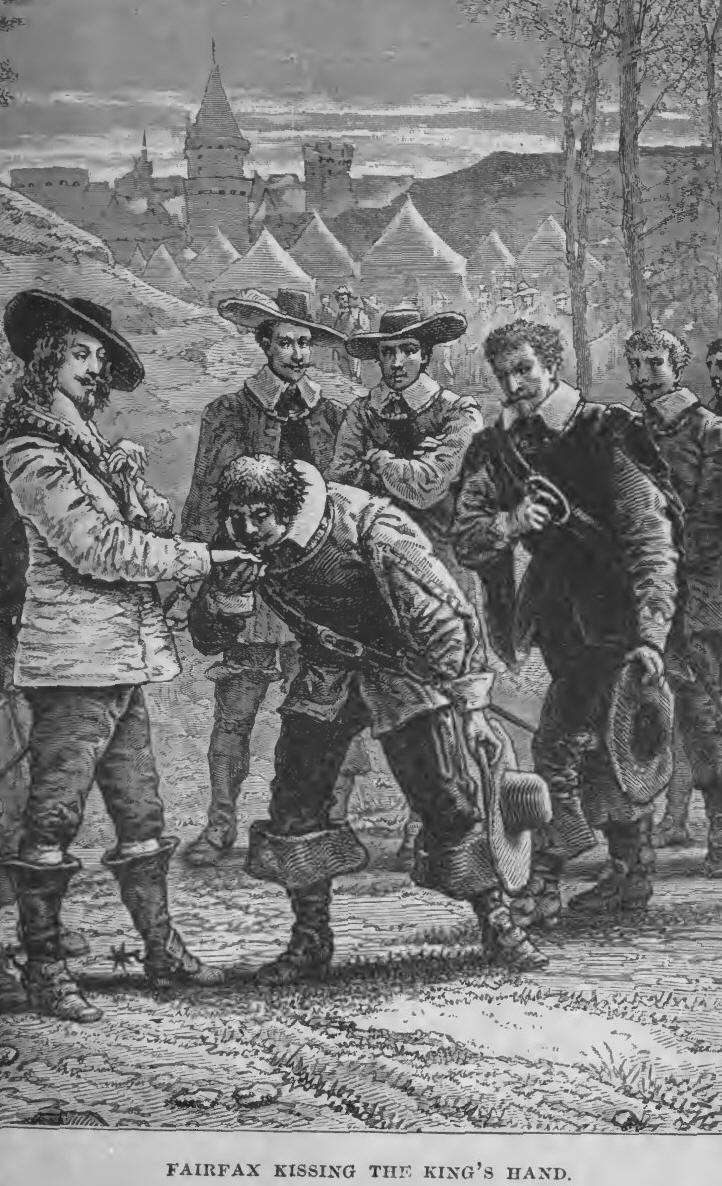
Fairfax Kissing The King's Hand.