Description Of The Contents Of The Lithographed Plates1.
Reading edition
Description Of The Contents Of The Lithographed Plates1.
[Transcriber's Note: The plates have been all placed in this section so that the extended comments for each can be with the plates themselves.]
Plate I
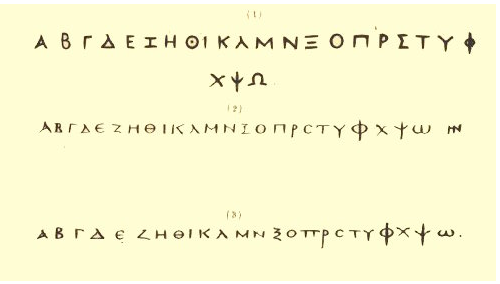
Plate I.
1. (1) Alphabet from the Rosetta Stone [b.c. 196], a specimen of capitals.
2. (2) Alphabet from Cod. Sinaiticus, specimen of uncials.
3. (3) Alphabet from Cod. Alexandrinus, specimen of uncials.
Plate II
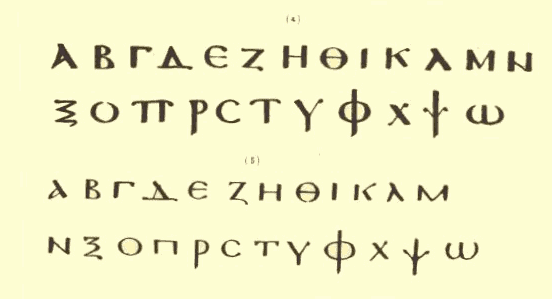
Plate II.
1. (4) Alphabet from the Cotton Fragment (Evan. N) and Titus C. xv [vi],
2. (5) And from Cod. Nitriensis (Evan. R, Brit. Mus. Add. 17,211).
Plate III
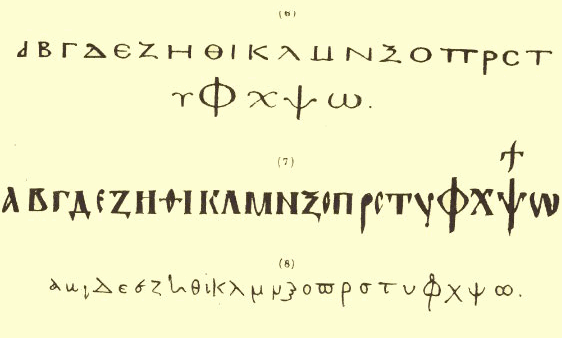
Plate II.
1. (6) Alphabet from Cod. Dublinensis (Evan. Z).
2. (7) From Brit. Mus. Harl. 5598 (Evst. 150), [a.d. 995].
3. (8) From Brit. Mus. Burney 19 (Evan. 569). Note that above psi in 2 stands the cross-like form of that letter as found in Apoc., B. [viii].
Plate IV
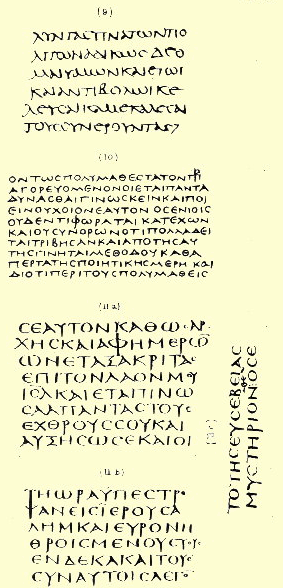
Plate IV.
1. (9) Extract from Hyperides' Oration for Lycophron, col. 15, 1. 23, &c. (Ὑπερίδου Λόγοι, ed. Babington, 1853). Dating between b.c. 100 to a.d. 100, on Egyptian papyrus, in a cursive or running hand. λυντας τινα των πο|λιτων αδικως δεο|μαι υμων και ετωι|και αντιβολωι κε|λευσαι καμε καλεσαι|τους συνερουντας >. See pp. 44, 51.
2. (10) Extract from Philodemus περὶ κακιῶν (Herculanensium voluminum quae supersunt, fol., Tom. 3, Col. xx. ll. 6-15). See pp. 30, 33. οντως πολυμαθεστατον προς | αγορευομενον οιεται παντα | δυνασθαι γινωσκειν και ποι|ειν ουχ οιον εαυτον οσ ενιοισ | ουδεν τι φωραται κατεχων | και ου συνορων οτι πολλα δει|ται τριβης αν και απο τησ αυ|τησ γινηται μεθοδου καθα|περ τα τησ ποιητικησ μερη και | διοτι περι τουσ πολυμαθεισ.
[pg xiii]
3. (11a) Cod. Friderico-August. [iv], 2 Sam. vii. 10, 11, Septuagint: σεαυτων καθωσ αρ|χησ και αφ ημερῶ | ων εταξα κριτασ | επι τον λαον μου | ισλ και εταπινω|σα απαντασ τους | εχθρουσ σου και | αυξησω σε και οι|.
4. (11b) Cod. Sinaiticus, א [iv], Luke xxiv. 33-4: τη ωρα ϋπεστρε|ψαν εισ ϊερουσα|λημ2 και ευρον η|θροισμενουσ τουσ | ενδεκα και τουσ | συν αυτοισ λεγο|.
5. (11c) Cod. Sin., 1 Tim. iii. 16, το τησ ευσεβειασ | μυστηριον οσ ε with a recent correction. See II. 391. There are no capital letters in this Plate.
Plate V
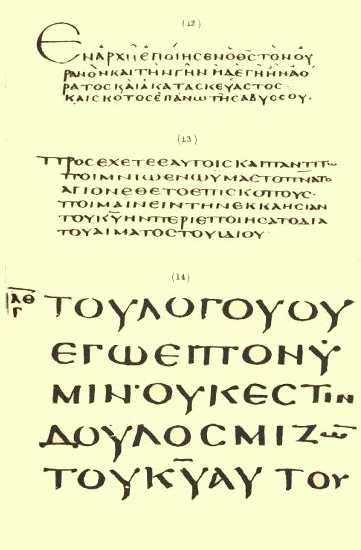
Plate V.
1. (12) Cod. Alexandrinus, A [v], Gen. i. 1-2, Septuagint. These four lines are in bright red, with breathings and accents3. Henceforth capital letters begin to appear. Εν ἀρχῆ ἐπόιησεν ὁ θσ τὸν ὀυ|ρανὸν και τὴν γῆν ἡ δὲ γῆ ἦν ἀό|ρατοσ κὰι ἀκατασκεύαστοσ; | και σκότοσ ἐπάνω τῆσ αβύσσου.|
2. (13) Cod. Alex., Acts xx. 28, in common ink. See II. 37. Προσεχετε εαυτοισ και παντι τω | ποιμνιω; εν ω ϋμασ το πνα το | αγιον εθετο επισκοπουσ; | ποιμαινειν την εκκλησιαν | του κυ ην περιεποιησατο δια | του αιματος του ιδιου;|
3. (14) Cod. Cotton., Titus C. xv, Evan. N, with Ammonian section and Eusebian canon in the margin. John xv. 20: του λογου ου | εγω ειπον υ|μιν; ουκ εστιν | δουλοσ μιζῶ | του κυ αυτου.
Plate VI
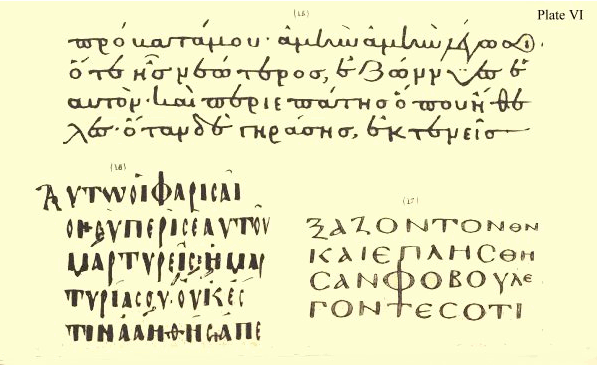
Plate VI.
1. (15) Cod. Burney 21 [a.d. 1292], Evan. 571. See p. 257. John xxi. 17-18: πρόβατά μου; ἀμὴν ἀμὴν λέγω σοι; | ὅτε ἦσ νεώτεροσ, ἐζώννϋεσ ἑ|αυτὸν; καὶ περιεπάτησ ὅπου ἤθε|λεσ; ὅταν δε γηράσησ, ἐκτενεῖσ|.
2. (16) Cod. Arundel 547, Evst. 257 [ix or x]. See p. 345. The open work indicates stops and musical notes in red. John viii. 13-14: Αυτω ὁι θαρισᾶι | οι + σὺ περὶ σὲαυτου | μαρτυρεῖσ ἡ μαρ|τυρία σου ὀυκ ἔσ|τιν ἀλῃθήσ + ἀπε|.
3. (17) Cod. Nitriensis, R of the Gospels, a palimpsest [vi]. Luke v. 26: ξαζον τον θν | και επλησθη|σαν φοβου λε|γοντεσ οτι|.
Plate VII
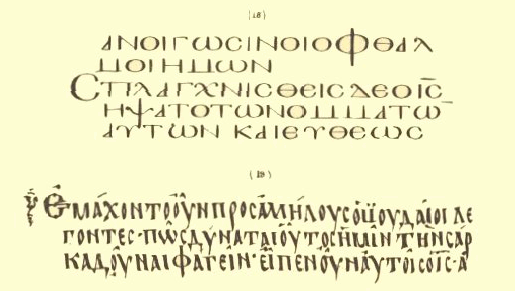
Plate VII.
1. (18) Cod. Dublin., Z of the Gospels, a palimpsest [vi], from Barrett. Matt. xx. 33-4: ανοιγωσιν οι οφθαλ|μοι ημων | Σπλαγχνισθεισ δε ο ισ | ηψατο των ομματῶ | αυτων και ευθεωσ|.
2. (19) Cod. Cyprius, K of the Gospels [ix], John vi. 52-3: Ἐμάχοντο ὀῦν προσ ἀλλήλουσ ὁι ϊουδαῖοι; λε|γοντεσ; πῶσ δύναται ὁῦτοσ ἡμῖν τὴν σάρ|κα δοῦναι φαγεῖν; ἐῖπεν ὀῦν ἀυτοῖσ ὁ ισ; ἀ|. It has the Ammonian section in the margin (ξς = 66), and a flourish in the place of the Eusebian canon. See p. 137.
[pg xiv]
Plate VIII
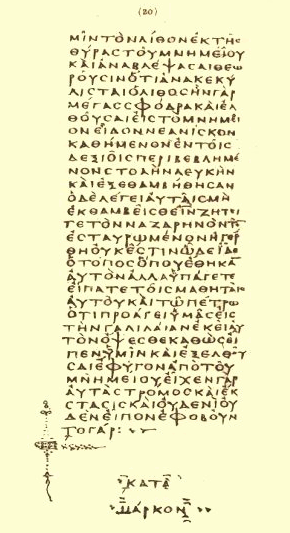
Plate VIII.
(20) Cod. Vaticanus, B of the Gospels, Acts and Epistles [iv], taken from Burgon's photograph of the whole page. Mark xvi. 3-8: μῖν τὸν λίθον ἐκ τῆς | θύρασ τόυ μνημέῖου | κὰι ἀναβλέψασαι θεω|ροῦσιν ὅτι ἀνακεκύ|λισται ὁ λιθοσ ἦν γὰρ | μέγασ σφόδρα κὰι ἐλ|θοῦσαι ἐισ τὸ μνημεῖ|ον ἐῖδον νεανίσκον | καθήμενον ἐν τοῖσ | δεξιοῖσ περιβεβλημέ|νον στολὴν λευκὴν | κὰι ἐξεθαμβήθησαν | ὁ δὲ λέγει ἀυτᾶισ μὴ | ἐκθαμβεῖσθε ἰν ζητει|τε τὸν ναζαρηνὸν τὸ | ἐσταυρωμένον ἠγὲρ|θη ὀυκ ἐστιν ὧδε ϊδε | ὁ τόποσ ὅπου ἔθηκᾶ | ἀυτὸν ἀλλα ϋπάγετε | ἐίπατε τοῖσ μαθητᾶισ | ἀυτοῦ κὰι τῶ πέτρω | ὅτι προάγει ὑμᾶσ ἐισ | τὴν γαλιλάιαν ἐκει ἀυ|τὸν ὄψεσθε καθὼσ ἐι|πεν ὑμῖν κὰι ἐξελθοῦ|σαι ἔφυγον ἀπὸ τοῦ | μνημέιου ἐίχεν γὰρ | ἀυτὰσ τρόμοσ κὰι ἔκ|στασισ κὰι ὀυδενὶ ὀυ|δὲν ἐῖπον ἐφοβοῦν|το γάρ: Here again, as in Plate IV, no capital letters appear. What follows on the Plate is by a later hand.
Plate IX
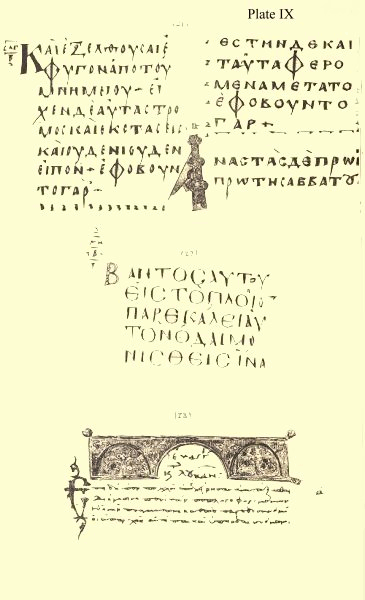
Plate IX.
1. (21) Cod. Par. Nat. Gr. 62, Evan. L of the Gospels [viii], as also 3 (23) below, are from photographs given by Dean Burgon: see pp. 133-4. In the first column stands Mark xvi. 8 with its Ammonian section (σλγ 233) and Eusebian canon (β = 2): Καὶ ἐξελθουσαι ἐ|φυγον ἀπο τοῦ | μνημειου + ἐι|χεν δὲ αὐτας τρο|μοσ καὶ εκστασεισ; | καὶ ουδενι οὐδεν | εἰπον + ἐφοβουν|το γὰρ + In the second column, after the strange note transcribed by us (II. 388), εστην δε και | ταῦτα φερο|μενα μετα το | ἑφοβουντο | γαρ + | Ἀναστὰσ δὲ πρωϊ | πρωτη σαββατυ + (ver. 9) Xi much resembles that in Plate XI, No. 27.
2. (22) Cod. Nanianus, Evan. U, retraced after Tregelles. Burgon (Guardian, Oct. 29, 1873) considers this facsimile unworthy of the original writing, which is “even, precise, and beautiful.” Mark v. 18: Βάντοσ αυτου | ἐισ τὸ πλοῖο | παρεκάλει ἀυ|τὸν ὁ δαιμο|νισθεισ ἵνα. The Ammonian section (μη = 48) is in the margin with the Eusebian canon (Β, in error for Η) underneath. The ν on the other side is by a much later hand. See p. 149.
3. (23) Cod. Basil. of the Gospels, Evan. 1 [x?]. See p. 190. Luke i. 1, 2. (the title: ἐυαγγέ[λιον] κατὰ λουκᾶν: being under an elegant arcade): Επειδήπερ πολλοὶ ἐπεχείρησαν ἀνατάξασθαι | διήγησιν περὶ τῶν πεπληροφορημένων | ἐν ἡμῖν πραγματων. καθὼς παρέδοσαν ἡμῖ | ὀι ἀπαρχῆσ αὐτόπται καὶ ὑπηρεται γενόμενοι|. The numeral in the margin must indicate the Ammonian section, not the larger κεφάλαιον (see p. 57).
Plate X
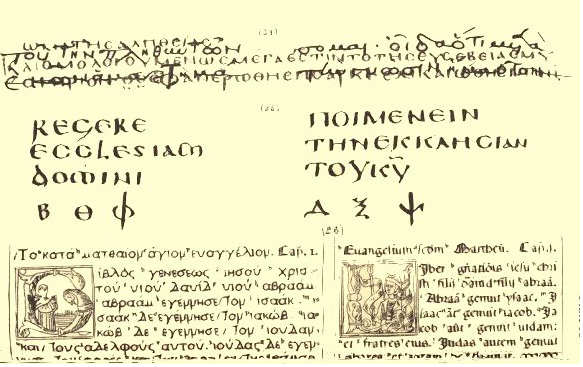
Plate X.
1. (24) Cod. Ephraemi, C, a palimpsest [v], from Tischendorf's facsimile. The upper writing [xii?] is τοῦ τὴν πληθῦν τῶν | ἐμῶν ἁμαρτημά || σομαι; οἶδα ὅτι μετὰ | τὴν γνῶσιν ἥμαρτον. Translated from St. Ephraem the Syrian. The earlier text is 1 Tim. iii. 15-16: ωμα τησ αληθείασ; | Και ομολογουμενωσ μέγα ἐστιν το τησ ἐυσεβειασ μυ|στηριον; θσ ἑφανερωθη εν σαρκι; εδικαιωθη ἑν πνϊ. For the accents, &c., see p. 123.
[pg xv]
2. (25) Cod. Laud. 35, E of the Acts [vi], Latin and Greek, in a sort of stichometry. Acts xx. 28: regere | ecclesiam | domini || ποιμενειν | την εκκλησιαν | του κυ. Below are specimens of six letters taken from other parts of the manuscript. See p. 169.
3. (26) Matt i. 1-3, Greek and Latin, from the Complutensian Polyglott, a.d. 1514. See II. 176.
Plate XI
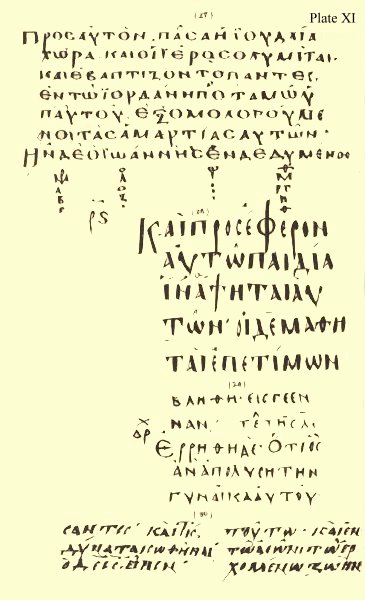
Plate XI.
1. (27) Cod. Basil., Evan. E [vii], from a photograph given by Dean Burgon, Mark i. 5-6: Προσ αὐτὸν. πᾶσα ἡ ϊουδαία | χωρα. και οἱ ἱεροσολυμῖται; | και ἐβαπτιζοντο παντεσ, | ἐν τὠ ἰορδάνη ποταμῶ ὑ|π᾽ ἀυτοῦ. ἐξομολογόυμε|νοι τὰσ ἁμαρτίασ αυτῶν; | Ἦν δε ὁ ϊωάννησ ενδεδυμένοσ. The harmonizing references will be found underneath, and some stops in the text (see p. 48). The next two specimens are retraced after Tregelles.
2. (28) Cod. Boreeli, Evan. F [viii-x], Mark x. 13 (Ammonian section only, ρς = 106): Καὶ προσέφερον | αὐτῶ παιδία | ἵν ἅψηται ἀυ|τῶν; ὁι δὲ μαθη|τὰι ἐπετίμων|.
3. (29) Cod. Harleian. 5684, Evan. G [x], Matt. v. 30-1: βληθη; εισ γεεν|ναν; τέ τῆσ λε. | Ἐρρηθη δέ; Ὅτι ὃσ | ἀν ἀπολυση την | γυνἀικα ἀυτοῦ; | χαρ (ἀρχὴ) stands in the margin of the new Lesson.
4. (30) Cod. Bodleian., Λ of the Gospels [x or ix], in sloping uncials, Luke xviii. 26, 27, and 30: σαντεσ; κὰι Τίσ, | δύναται σωθῆναι; | ὁ δὲ ἰσ. ἐῖπεν; || τοῦτω; κὰι ἐν | τῶ ἀιῶνι τῶ ἐρ|χομένω ζωὴν|. See p. 160.
Plate XII
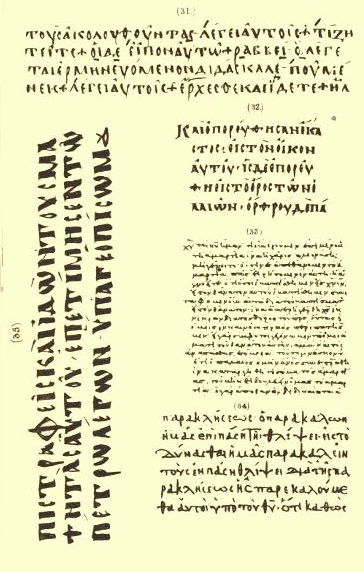
Plate XII.
1. (31) Cod. Wolfii B, Evan. H [ix], John i. 38-40: τοὺσ ἀκολουθοῦντασ λέγει ἀυτοῖσ + τί ζη|τεῖτε + ὁι δε. ἐῖπον ἀυτῶ + ραββεί; ὃ λέγε|ται ἐρμηνευόμενον διδάσκαλε ποῦ μέ|νεισ + λέγει ἀυτοῖσ + ἔρχεσθε και ϊδετε + ἦλ|. Retraced after Tregelles: in the original the dark marks seen in our facsimile are no doubt red musical notes.
2. (32) Cod. Campianus, Evan. M [ix], from a photograph of Burgon's. John vii. 53-viii. 2: Καὶ ἐπορέυθησαν ἔκα|στοσ: ἐισ τὸν ὀῖκον | ἀυτοῦ; ισ δὲ ἐπορεῦ|θη ἐισ τὸ ὄροσ τῶν ἐ|λαιῶν. ὄρθρου δὲ πά|. Observe the asterisk set against the passage.
3. (33) Cod. Emman. Coll. Cantab., Act. 53, Paul. 30 [xii]. See p. 288. This minute and elegant specimen, beginning Rom. v. 21, χυ τοῦ κυ ἡμων; and ending vi. 7, δεδικαίωται ἀ, is left to exercise the reader's skill.
4. (34) Cod. Ruber., Paul. M [x]. See p. 184. 2 Cor. i. 3-5: παρακλήσεωσ; ὁ παρακαλῶν | ἡμᾶσ ἐπί πάση Τῆι θλίψει; ἐισ τὸ | δύνασθαι ἡμᾶσ παρακαλεῖν | τοὺσ ἐν πάση θλίψει διὰ τῆσ πα|ρακλήσεωσ ἧσ παρεκαλούμε|θα ἀυτοὶ ὑπὸ τοῦ θῦ. ὅτι καθὼσ|.
5. (35) Cod. Bodleian., Evan. Γ of the Gospels [ix]. See p. 155. Mark viii. 33: πιστραφείσ καὶ ἰδὼν τουσ μα|θητὰσ ἀυτοῦ. ἐπετίμησεν τῶ | πέτρω λέγων. ὕπαγε ὁπίσω μυ|.
[pg xvi]
Plate XIII
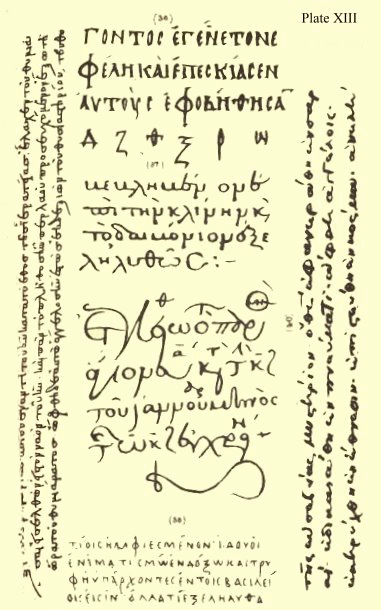
Plate XIII.
1. (36) Parham. 18, Evst. 234 [a.d. 980], Luke ix. 84: γοντοσ ἐγένετο νε|φέλη κὰι ἐπεσκίασεν | ἀυτοὺσ ἐφοβήθησᾱ|. Annexed are six letters taken from other parts of the manuscript.
2. (37) Cod. Burney 22, Evst. 259 [a.d. 1319]. The Scripture text is Mark vii. 30: βεβλημέν ον ἐ|πὶ κλίνην κ | τὸ δαιμόνιον ἐξε|λἠλυθῶσ:—The subscription which follows is given at length in p. 43, note 3.
3. (38) Cod. Monacensis, Evan. X [ix], retraced after Tregelles. See p. 152. Luke vii. 25-6: τίοισ ἠμφιεσμένον; ϊδου ὁι | ἐν ϊματισμώ ἐνδοξω και τρυ|φῆ ὑπάρχοντεσ έν τοισ βασιλεί | οισ ἐισὶν; άλλὰ τί ἐξεληλυθα|.
4. (39) Cod. Par. Nat. Gr. 14, or Evan. 33: from a photograph of Burgon's. See p. 195. Luke i. 8-11: ξει τῆς ἐφημερίασ ἀυτοῦ ἔναντι τοῦ κυ κατὰ τὸ ἔθοσ τῆς ἱερατείασ. ἔλαχεν τοῦ θυμιᾶ|σαι εἰσελθὼν εἰς τὸν | ὤρα τοῦ θυμιάματοσ. ὤφθη δε ἀυτῶ ἄγγελος κυ ἐστὼσ ἐκδεξιὼν τοῦ θυσιαστηρίου, τοῦ θυ|.
5. (40) Cod. Leicestrensis, Evan. 69, Paul. 37 [xiv]. See p. 202. 1 Tim. iii. 16: τῆς εὐσεβε(?)ίας μυστήριον; ὁ θό ἐφανερώθη ἐν σαρ|κί; ἐδικαιώθη ἐν πνεύματι; ὤφθη ἀγγέλοις; | ἐκηρύχθη ἐν ἔπιςεύθη ἐν κόσμω; ἀνελή—.
Plate XIV. Contains specimens of open leaves of the two chief bilingual manuscripts
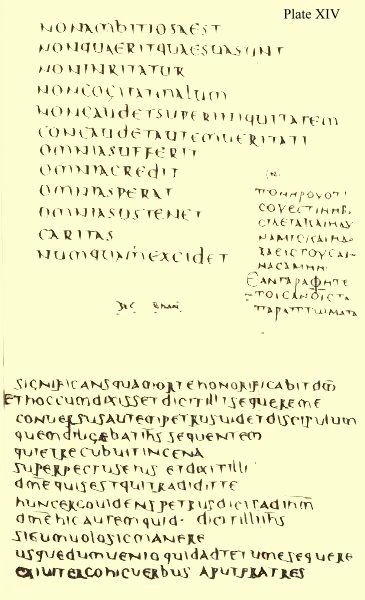
Plate XIV.
1. (41) Cod. Claromontanus or Paul. D (1 Cor. xiii. 5-8), p. 173.
2. (42) Cod. Bezae or Evan, and Act. D (John xxi. 19-28), p. 124. Observe the stichometry, the breathings, &c., of the Pauline facsimile (which we owe to Dean Burgon's kindness). These codices, so remarkably akin as well in their literary history as in their style of writing and date (vi or v), will easily be deciphered by the student.
3. (43) Cod. Rossanensis or Evan. Σ (p. 163), is one of the most interesting, as it is amongst the latest of our discoveries. Our passage is Matt. vi. 18, 14: πονηρου οτι | σου εστιν η βα|σιλεια και η δυ|ναμισ και η δο|ξα εισ τουσ αιω|νασ αμην.| Εαν γαρ αφητε | τοισ ανοισ τα | παραπτωματα|. In the margin below the capital Ε is the Ammonian section μδ (44) and the Eusebian canon ς (66): ανοισ is an abbreviation for ἀνθρώποις. All is written in silver on fine purple vellum.
Plate XV
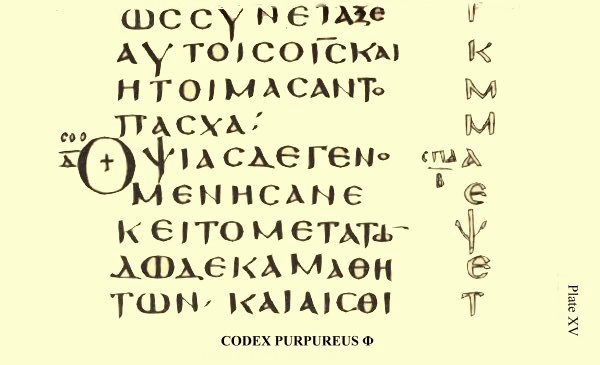
Plate XV.
Cod. Beratinus or Evan. Φ, Matt. xxvi. 19-20: ως συνεταξεν | αυτοις ϊς και ητοιμασαν το | πασχα; | Οψιας δε γενομενης ανε|κειτο μετα των | δωδεκα μαθη|των; και αισθι|. Observe the reference given for the paragraph to the Ammonian section and Eusebian canon on the left: σοθ = 279, δ = 4. The MS. is written in two columns, and the initial letters of each line are exhibited on the right, with Am. and Eus., σπα = 279, and β = 2; which as in the other case are in a different hand.
[pg xvii]