Chapter LXXXVI · IMPEACHMENT.
Reading edition
The determination of the President to proceed with his own plan of restoring the states lately in insurrection to their former status, in violation of all law, and of the rights of the Legislative branch of the Government, to whom this work had been confided by the constitution, as well as the defiant and hostile spirit he manifested toward all who opposed his course, led many of the members of both houses of Congress to feel that it would be necessary to check his career by impeachment.
Still there was a very great reluctance to resort to such an extreme measure, except under circumstances of extraordinarily aggravated offence. Many of the Republican members believed for months that Mr. Johnson’s course was merely experimental, and that he would ere long return to harmony and co-operation with the party which had elected him to the Vice-Presidency; and entertaining this view, they were unwilling to resort to any measures which should alienate him still more.
The more advanced Republicans were convinced that these views were erroneous; that Mr. Johnson really sought a breach with the Republicans; that he was at heart a Democrat, and in sympathy with the Rebel leaders; that his violations of the laws and of the rights of Congress had been deliberate and intentional, and that he intended to continue his course so long as he could do it with impunity.
The first positive movement looking toward impeachment, was made on the 17th of December, 1866, when the Hon. James M. Ashley, of Ohio, moved a suspension of the rules 670to enable him to report, from the Committee on Territories, a resolution for the appointment of a select committee of seven by the Speaker, to inquire whether any acts had been done by any officer of the Government of the United States, which in contemplation of the constitution, were high crimes, or misdemeanors, &c. The suspension of the rules was refused, (two-thirds being necessary). Yeas, 90; nays, 49.
On the 7th of January, 1867, Hon. Ben. F. Loan, of Missouri, moved a resolution, (which was referred to the Committee on Reconstruction), declaring it the imperative duty of the Thirty-Ninth Congress, (among other things), to take, without delay, such action as would accomplish the impeachment of the officer now exercising the functions pertaining to the office of President of the United States of America, and his removal from said office upon his conviction, in due form of law, of the high crimes and misdemeanors of which he is manifestly and notoriously guilty, and which render it unsafe longer to permit him to exercise the powers he has unlawfully assumed.
On the same day, Hon. John R. Kelso, of Missouri, offered a resolution of nearly similar tenor, which was referred to the Committee on the Judiciary.
On the same day, Hon. James M. Ashley, of Ohio, offered, as a question of privilege, the following:
“I do impeach Andrew Johnson, Vice-President and acting President of the United States, of high crimes and misdemeanors.
“I charge him with a usurpation of power and violation of law;
“In that he has corruptly used the appointing power;
“In that he has corruptly used the pardoning power;
“In that he has corruptly used the veto power;
“In that he has corruptly disposed of public property of the United States;
“In that he has corruptly interfered in elections, and committed acts which, in contemplation of the Constitution, are high crimes and misdemeanors; Therefore,
Be it resolved, That the Committee on the Judiciary be, and they are hereby authorized to inquire into the official conduct of Andrew Johnson, Vice-President of the United States, discharging the powers and duties of the office of President of the United States, and to report to this House whether, in their 671opinion, the said Andrew Johnson, while in said office, has been guilty of acts which are designed or calculated to overthrow, subvert, or corrupt the Government of the United States, or any department or office thereof; and whether the said Andrew Johnson has been guilty of any act, or has conspired with others to do acts, which, in contemplation of the Constitution, are high crimes and misdemeanors, requiring the interposition of the constitutional power of this House; and that said committee have power to send for persons and papers, and to administer the customary oath to witnesses.”
This resolution was adopted by a vote of 108 to 39. The subject was frequently discussed during the session.
The Judiciary Committee, on the 3d of March, reported that it had not concluded its investigation, but that, in the opinion of the majority, eight to one, “sufficient testimony had been brought to the notice of the Committee to justify and demand a further prosecution of the investigation.” The Judiciary Committee of the XLth Congress was empowered to continue the investigation, by action had on the 7th of March.
The Judiciary Committee reported November 25th, 1867. The majority, consisting of Messrs. George S. Boutwell, Francis Thomas, Thomas Williams, William Lawrence, and John C. Churchill, favored impeachment. Messrs. James F. Wilson and Frederick E. Woodbridge united in a report opposed thereto, and Marshall and Eldridge signed another minority report. Debate on these reports began in the House December 5th, and closed the 7th. The impeachment resolution was then lost, 57 to 108. The affirmative were all Republicans. In the negative were 67 Republicans and 41 Democrats; there were 20 absentees, 16 Republicans and 4 Democrats. The following is the vote in detail:
Yeas.—Anderson, of Missouri; Arnell, of Tenn.; Ashley, of Ohio; Boutwell, of Mass; Bromwell, of Illinois; Broomall, of Penn; Butler, of Mass; Churchill of N. Y.; Clarke, of Ohio; Clarke, of Kansas; Cobb, of Wisconsin; Coburn, of Indiana; Covode, of Penn.; Collum, of Illinois; Donnelly, of Minn.; Eckley, of Ohio; Ela, of New Hampshire; Farnsworth, of Illinois; Gravelly, of Missouri; Harding, of Illinois; Higby, of California; Hopkins, of Wisconsin; Hunter, of Indiana; Judd, of Illinois; Julian, of Indiana; Kelley, of Penn.; Kelsey, of New York; Lawrence of Ohio; Loan, of Missouri; Logan, of Illinois; Lynch, of Maine; Maynard, of Tenn.; McClurg, of Missouri; Mercer, of Penn.; Mullins, of Tenn.; Myers, of Penn.; Newcomb, of Missouri; Nunn, of Tenn.; O’Neil, of Penn; Orth, of Indiana; Paine, of Wisconsin; Pile, of Missouri; Price, of Iowa; Schenck, of Ohio; Shanks, of Indiana; Stevens, of New Hampshire; Stevens, of Penn.; Stokes, of Tenn.; Thomas, of Maryland; Trimble, of Tenn.; Trowbridge, of Michigan; Van Horn, of Missouri; Ward, of New York; Williams, of Penn.; Williams, of Indiana; Wilson, of Pennsylvania.—57.
Nays.—Republicans in Roman, Democrats in italic.
Adams, of Kentucky; Allison, of Iowa; Ames, of Mass.; Archer, of Maryland; Ashley, of Nevada; Axtell, of California; Bailey, of New York; Baker, of Illinois; Baldwin, of Mass; Banks, of Mass; Barnum of Conn.; Beaman, of Michigan; Beck, of Kentucky; Benjamin, of Missouri; Benton, of N. H.; Bingham, of Ohio; Blaine, of Maine; Boyer, of Penn.; Brooks, of New York; 672Buckland, of Ohio; Burr, of Illinois; Carey, of Ohio; Chanler, of New York; Cook, of Illinois; Dawes, of Mass; Dixon, of R. I.; Dodge, of Iowa; Driggs, of Michigan; Eggleston, of Ohio; Eldridge, of Wisconsin; Eliot, of Mass; Ferris, of New York; Ferry, of Michigan; Fields, of New York; Garfield, of Ohio; Getz, of Penn.; Glossbrenner, of Penn.; Golladay, of Kentucky; Griswold, of New York; Grover, of Kentucky; Haight, of New Jersey; Halsey, of New Jersey; Hamilton, of Ohio; Hawkins, of Tenn.; Hill, of New Jersey; Holman, of Indiana; Hooper, of Mass; Hotchkiss, of Conn; Hubbard, of Iowa; Hubbard, of West Va.; Hubbard, of Conn; Hubbard, of New York; Humphrey, of New York; Ingersoll, of Illinois; Johnson, of Cal.; Jones, of Kentucky; Kerr, of Indiana; Ketchum, of New York; Knott, of Kentucky; Koontz, of Penn.; Laflin, of New York; Lawrence, of Penn.; Lincoln, of New York; Marshall, of Illinois; Marvin, of New York; McCarty, of New York; McCullough, of Maryland; Miller, of Penn.; Morehead, of Penn.; Morgan, of Ohio; Mungen, of Ohio; Niblack, of Indiana; Nicholson, of Delaware; Perham, of Maine; Peters, of Maine; Phelps, of Maryland; Pike, of Maine; Plants, of Ohio; Poland, of Vermont; Polsley, of West Va.; Pruyn, of New York; Randall, of Penn.; Robertson, of New York; Robinson, of New York; Ross, of Illinois; Sawyer, of Wisconsin; Sitgreaves, of New Jersey; Smith, of Vermont; Spalding, of Ohio; Starkweather, of Conn.; Stewart, of New York; Stone, of Maryland; Taber, of New York; Taylor, of Penn.; Upson, of Michigan; Van Aernam, of New York; Van Auken, of Penn.; Van Trump, of Ohio; Van Wyck, of New York; Washburne, of Wisconsin; Washburne, of Indiana; Washburne, of Illinois; Washburn, of Mass.; Welker, of Ohio; Wilson, of Iowa; Wilson, of Ohio; Woodbridge, of Vermont; Woodward, of Pennsylvania.—108.
Absentees.—Messrs. Blair, Michigan; Cornell, New York; Finney, Penn.; Jenckes, Rhode Island; Kitchen, West Va.; Mallory, Oregon; Morrell, Penn.; Pomeroy, New York; Raum, Illinois; Selye, New York; Scofield, Penn.; Shellabarger, Ohio; Taffe, Neb.; Twitchell, Mass; Van Horn, New York; Windom, Minn.; all Republicans: and Barnes, Fox, and Morrissey, all of New York, and Democrats.
It was conceded on all hands that this was the end of impeachment for that time at least, and it was thought that, the President, feeling that his conduct had brought down upon him the censure of a large body of the Members of Congress, who though they were not willing to proceed to extremities, still disapproved of his course, would, for the future, act more wisely, and refrain from those overt acts which might bring him into further collision with Congress.
But those who reasoned thus with regard to Andrew Johnson, knew nothing of his character. Elated with his victory, he could not conceal his disposition to show his defiance to 673Congress by further and more considerable acts of aggression. He interfered in several of the desolated states which were about voting upon the question of calling a convention, and electing delegates to prepare a new constitution, suggesting to them ways and means of thwarting the reconstruction measures; continued so far as possible his systematic removals of loyal and incorruptible officers, and nominated to their places corrupt men, whom the Senate could not confirm without becoming partners in corruption; and in every way possible made known his determination to defy Congress, which he believed he could now do, with impunity.
On the 13th of January, 1868, Congress having decided that his suspension of Secretary Stanton was illegal, and that he must be reinstated, General Grant, who had been Secretary ad interim, quietly relinquished the War Office to Secretary Stanton, and notified the President that he had done so.
A very bitter correspondence ensued between the President and General Grant, (the General, however, keeping his temper), in which the President charged Grant with duplicity, treachery and inveracity because he had not given him previous notice of his intention of surrendering the office to Secretary Stanton, so that he (Johnson) might have put some one in possession who would have prevented Secretary Stanton’s reinstatement. The whole issue between the President and the General was, in fact, that the President had intended to violate the Tenure of Office Act and defy the Senate, and General Grant by his judicious course, had prevented him from doing so.
The excitement growing out of this correspondence, and of the attempts of Mr. Johnson to compel General Grant not to issue his orders through the War Department, had not died out, when Mr. Johnson prepared, by a new act of aggression, to show his defiance of Congress.
On the 21st of February, 1868, he sent the following order to Secretary Stanton, by Brevet Major-General Lorenzo Thomas, Adjutant-General of the Army, a subordinate of the Secretary:
674Executive Mansion,
Washington, D. C., Feb. 21, 1868.
Sir: By virture of the power and authority vested in me as President by the Constitution and laws of the United States, you are hereby removed from office as Secretary of War, and your functions as such will terminate upon receipt of this communication.
You will transfer to Brevet Major-Gen. Lorenzo Thomas, Adjutant-General of the Army, who has this day been authorized to act as Secretary of War ad interim, all records, books, papers, and other public property now in your custody and charge.
Respectfully yours,
Andrew Johnson, President.
To the Hon. Edwin M. Stanton, Washington, D. C.
Secretary Stanton being satisfied that under the Tenure of Office Act, the President had no power to remove him, refused obedience, and ordered Gen. Thomas to his own office. The General refused to go, and expressed his determination to obtain possession by force, if necessary. That he understood at the time that the President had authorized him to use force if necessary, there can be no doubt; whether he understood Mr. Johnson correctly, may be a question.
Mr. Stanton continued in possession, and notified Congress of the action of the President, and of what he had done.
This act was so plainly a violation both of the Tenure of Office Act, and the rights of the Senate, that it produced at once the most intense excitement, and convinced those who had hitherto doubts, that impeachment was necessary.
On the same day, February 21st, Mr. Covode, of Pennsylvania, offered a resolution that the President be impeached, which was referred to the Committee on Reconstruction. On the 22d of February, (Saturday,) Mr. Stevens, of Pennsylvania, from the Committee on Reconstruction, made the following report:
That, in addition to the papers referred to, the Committee find that the President, on the 21st day of February, 1868, signed and ordered a commission or letter of authority to one Lorenzo Thomas, directing and authorizing said Thomas to act as Secretary of War ad interim, and to take possession of the books, records, papers, and other public property in the War Department, of which the following is a copy:
675Executive Mansion, }
Washington, D. C., Feb. 21, 1868. }
Sir: The Hon. Edwin M. Stanton having been removed from office as Secretary of the Department of War, you are hereby authorized and empowered to act as Secretary of War ad interim, and will immediately enter upon the discharge of the duties pertaining to that office. Mr. Stanton has been instructed to transfer to you all records, books, papers, and other public property intrusted to his charge.
Respectfully yours,
Andrew Johnson.
To Brevet Major-Gen. Lorenzo Thomas, Adjutant-General U. S. A.
(Official copy.)—Respectfully furnished to Hon. Edwin M. Stanton.
L. Thomas, Secretary of War ad interim.
Upon the evidence collected by the Committee, which is hereafter presented, and in virtue of the powers with which they have been invested by the House, they are of the opinion that Andrew Johnson, President of the United States, be impeached of high crimes and misdemeanors. They, therefore, recommend to the House the adoption of the accompanying resolution:
THADDEUS STEVENS,
GEORGE A. BOUTWELL,
JOHN A. BINGHAM,
F. C. BEAMAN,
C. T. HULBURD,
JOHN F. FARNSWORTH,
H. E. PAINE.
Resolved, That Andrew Johnson, President of the United States, be impeached of high crimes and misdemeanors.
On the 24th of February, (Monday), this resolution passed the House by 126 yeas to 47 nays; the yeas being all Republicans, and the nays all Democrats, except Mr. Cary, of Ohio, who was elected as an Independent. The names of those who voted on the question were as follows:
Yeas.—Allison, Ames, Anderson, Arnell, Ashley (Nev.), Ashley (Ohio), Bailey, Baker, Baldwin, Banks, Beaman, Beatty, Benton, Bingham, Blaine, Blair, Boutwell, Bromwell, Broomall, Buckland, Butler, Cake, Churchill, Clarke (Kan.), Clark (Ohio), Cobb, Coburn, Cook, Cornell, Covode, Cullum, Dawes, Dodge, Driggs, Eckley, Eggleston, Eliot, Farnsworth, Ferris, Ferry, Fields, Gravelly, Griswold, Halsey, Harding, Higby, Hill, Hooper, Hopkins, Hubbard (Iowa), Hubbard (W. V.), Hulburd, Hunter, Ingersoll, Jenckes, Judd, Julian, Kelley, Kelsey, Ketcham, Kitchen, Laflin, Lawrence (Pa.), Lawrence (Ohio), Lincoln, Loan, Logan, Loughridge, Lynch, Mallory, Marvin, McCarthy, McClurg, Mercer, Miller, Moore, Moorhead, Morrill, Mullins, Myers, Newcomb, Nunn, Orth, O’Neill, Paine, Perham, Peters, Pike, Pile, Plants, Poland, Polsley, Price, Raum, Robertson, Sawyer, Schenck, Scofield, Selye, Shanks, Smith, Spalding, Starkweather, Stevens (N. H.), Stevens (Pa.), Stokes, Taffe, Taylor, Trowbridge, Twitchell, 676Upson, Van Aernam, Van Horn (N. Y.), Van Wyck, Ward, Washburn (Wis.), Washburne (Ill.), Washburn (Mass.), Welker, Williams (Pa.), Wilson (Iowa), Wilson (Ohio), Wilson (Pa.), Windom, Woodbridge, The Speaker—126.
Nays.—Adams, Archer, Axtell, Barnes, Barnum, Beck, Boyer, Brooks, Burr, Cary (Ind.), Chanler, Eldridge, Fox, Getz, Glossbrenner, Golladay, Grover, Haight, Holman, Hotchkiss, Hubbard (Conn.), Humphrey, Johnson, Jones, Kerr, Knott, Marshall, McCormick, McCullough, Morgan, Morrissey, Mungen, Niblack, Nicholson, Phelps, Pruyn, Randall, Ross, Sitgreaves, Stewart, Stone, Taber, Trimble (Ky.), Van Auken, Van Trump, Wood, Woodward—47.
Mr. Stevens of Pennsylvania, then moved that a committee of two be appointed to go to the Senate and at the bar thereof, in the name of the House of Representatives, and of all the people of the United States, impeach Andrew Johnson, President of the United States, of high crimes and misdemeanors. This motion prevailed, and on the 25th of February, Messrs. Thaddeus Stevens and John A. Bingham, of the House of Representatives, appeared before the bar of the Senate, and read the following announcement:
“Mr. President: In obedience to the order of the House of Representatives, we have appeared before you, and in the name of the House of Representatives and of all the people of the United States, we do impeach Andrew Johnson, President of the United States, of high crimes and misdemeanors in office; and we further inform the Senate that the House of Representatives will in due time exhibit particular articles of impeachment against him, and make good the same; and in their name we demand that the Senate take due order for the appearance of the said Andrew Johnson, to answer to the said Impeachment.”
The President pro tem. replied: The Senate will take order in the premises.
A committee of seven, appointed by the President, and consisting of Messrs. Howard, Trumbull, Conkling, Edmunds, Morton, Pomeroy, and Johnson, were on motion of Mr. Howard, directed to consider and report upon this announcement.
Between this date and the 4th of March, the action of the House was mainly confined to the preparation of the Articles of Impeachment, their adoption, and the election of Managers of the Impeachment. The Managers elected were Mr. Stevens 677of Pennsylvania, Mr. Butler of Massachusetts, Mr. Bingham of Ohio, Mr. Boutwell of Massachusetts, Mr. Wilson of Iowa, Mr. Williams of Pennsylvania, and Mr. Logan of Illinois.
On Wednesday, March 4th, the series of Articles of Impeachment which had passed the House, were presented to the Senate by a House Committee. They were as follows:
Article 1. That said Andrew Johnson, President of the United States, on the 21st day of February, in the year of our Lord one thousand eight hundred and sixty-eight, at Washington, in the District of Columbia, unmindful of the high duties of his office, his oath of office, and of the requirement of the Constitution that he should take care that the laws be faithfully executed, did unlawfully and in violation of the Constitution and laws of the United States, issue an order in writing for the removal of Edwin M. Stanton from the office of Secretary for the Department of War, said Edwin M. Stanton having been, theretofore, duly appointed and commissioned by and with the consent of the Senate of the United States as such Secretary; and said Andrew Johnson, President of the United States, on the 12th day of August, in the year of our Lord one thousand eight hundred and sixty-seven, and during the recess of the said Senate, having suspended by his order Edwin M. Stanton from said office, and within twenty days after the first day of the next meeting of the Senate, on the 12th day of December, in the year of our Lord aforesaid, having reported to said Senate such suspension, with the evidence and reasons for his action in the case, and the name of the person designated to perform the duties of such office temporarily until the next meeting of the Senate, and said Senate there-afterward on the 13th day of January, in the year of our Lord 1868, having duly considered the evidence and reasons reported by said Andrew Johnson for said suspension, did refuse to concur in said suspension, whereby, and by force of provision of an act entitled “An act regulating the tenure of certain civil offices,” passed March 2, 1867, said Edwin M. Stanton did forthwith resume the functions of his office, whereof the said Andrew Johnson had then and there due notice, and said Edwin M. Stanton, by reason of the premises on said 21st day of February, was lawfully entitled to hold said office of Secretary for the Department of War, which said order for the removal of said Edwin M. Stanton is, in substance, as follows, that is to say:
Executive Mansion, }
Washington, D. C., Feb. 21, 1868, }
Sir: By virtue of the power and authority vested in me as President by the Constitution and laws of the United States, you are hereby removed from office as Secretary for the Department of War, and your functions as such will terminate upon receipt of this communication. You will transfer to Brevet Major-Gen. Lorenzo Thomas, Adjutant-General of the Army, who has this day been 678authorized and empowered to act as Secretary of War ad interim, all records, books, papers, and other public property now in your custody and charge.
Respectfully yours,
Andrew Johnson.
To the Hon. Edwin M. Stanton, Washington, D. C.
Which order was unlawfully issued, with intent then and there to violate an act entitled “An act regulating the tenure of certain civil offices,” passed March 21, 1867, and contrary to the provisions of said act and in violation thereof, and contrary to the provisions of the Constitution of the United States, and without the advice and consent of the Senate of the United States, the said Senate then and there being in session, to remove said Edwin M. Stanton from the office of Secretary for the Department of War, whereby said Andrew Johnson, President of the United States, did then and there commit and was guilty of a high misdemeanor in office.
Art. 2. That on the said 21st day of February, in the year of our Lord one thousand eight hundred and sixty-eight, at Washington, in the District of Columbia, said Andrew Johnson, President of the United States, unmindful of the high duties of his office, of his oath of office, and in violation of the Constitution of the United States, and contrary to the provisions of an act entitled “An act regulating the tenure of certain civil offices,” passed March 2, 1867, without the advice and consent of the Senate of the United States, said Senate then and there being in session, and without authority of law, did appoint one Lorenzo Thomas to be Secretary of War ad interim, by issuing to the said Lorenzo Thomas a letter of authority in substance as follows, that is to say:
Executive Mansion, }
Washington, D. C., Feb. 21, 1868. }
Sir: The Hon. Edwin M. Stanton having been this day removed from office as Secretary for the Department of War, you are hereby authorized and empowered to act as Secretary of War ad interim, and will immediately enter upon the discharge of the duties pertaining to that office.
Mr. Stanton has been instructed to transfer to you all the records, books, papers, and other public property now in his custody and charge.
Respectfully yours,
Andrew Johnson.
To Brevet Major-Gen. Lorenzo Thomas, Adjutant-General U. S. A., Washington, D. C.
Whereby the said Andrew Johnson, President of the United States, did then and there commit and was guilty of a high misdemeanor in office.
Art. 3. That said Andrew Johnson, President of the United States, on the 21st day of February, in the year of our Lord one thousand eight hundred and sixty-eight, at Washington, in the District of Columbia, did commit and was guilty of a high misdemeanor in office, in this: That, without authority of law, while the Senate of the United States was then and there in session, he did appoint one Lorenzo Thomas to be Secretary for the Department of War ad interim, without the advice and consent of the Senate, and in violation of 679the Constitution of the United States; no vacancy having happened in said office of Secretary for the Department of War during the recess of the Senate, and no vacancy existing in said office at the time, and which said appointment, so made by the said Andrew Johnson, of the said Lorenzo Thomas, is in substance as follows: (See Art. 2.)
Art. 4. That said Andrew Johnson, President of the United States, unmindful of the high duties of his office, and of his oath of office, in violation of the Constitution and laws of the United States, on the twenty-first day of February, in the year of our Lord one thousand eight hundred and sixty-eight, at Washington, in the District of Columbia, did unlawfully conspire with one Lorenzo Thomas, and with other persons to the House of Representatives unknown, with intent by intimidation and threats to hinder and prevent Edwin M. Stanton, then and there the Secretary for the Department of War, duly appointed under the laws of the United States, from holding said office for Secretary of the Department of War, contrary to and in violation of the Constitution of the United States, and of the provision of an act, entitled “An act to define and punish certain conspiracies,” approved July 21, 1861, whereby said Andrew Johnson, President of the United States, did then and there commit and was guilty of a high crime in office.
Art. 5. That the said Andrew Johnson, President of the United States, unmindful of the high duties of his office, and of his oath of office, on the 21st day of February, in the year of our Lord 1868, and on divers other days and times in said year, before the 28th day of said February, at Washington, in the District of Columbia, did unlawfully conspire with one Lorenzo Thomas, and with other persons to the House of Representatives unknown, by force to prevent and hinder the execution of an act entitled “An act regulating the tenure of certain civil offices,” passed March 2, 1867, and in pursuance of said conspiracy did attempt to prevent Edwin M. Stanton, then and there being Secretary for the Department of War, duly appointed and commissioned under the laws of the United States, from holding such office, whereby the said Andrew Johnson, President of the United States, did then and there commit and was guilty of a high misdemeanor in office.
Art. 6. That the said Andrew Johnson, President of the United States, unmindful of the duties of his high office, and of his oath of office, on the twenty-first day of February, in the year of our Lord one thousand eight hundred and sixty-eight, at Washington, in the District of Columbia, did unlawfully conspire with one Lorenzo Thomas by force, to seize and take possession of property of the United States in the War Department, contrary to the provisions of an act entitled “An act to define and punish certain conspiracies,” approved July 21, 1861, and with intent to violate and disregard an act entitled “An act regulating the tenure of certain civil offices,” passed March 2, 1867, whereby said Andrew Johnson, President of the United States, did then and there commit a high crime in office.
Art. 7. That said Andrew Johnson, President of the United States, unmindful of the high duties of his office, and of his oath of office, on the 21st 680day of February, in the year of our Lord one thousand eight hundred and sixty-eight, and on divers other days in said year, before the 28th day of February, at Washington, in the District of Columbia, did unlawfully conspire with one Lorenzo Thomas to prevent and hinder the execution of an act of the United States, entitled “An act regulating the tenure of certain civil offices,” passed March 5, 1867, and in pursuance of said conspiracy did unlawfully attempt to prevent Edwin M. Stanton, then and there being Secretary for the Department of War, under the laws of the United States, from holding said office, to which he had been duly appointed and commissioned, whereby said Andrew Johnson, President of the United States, did then and there commit, and was guilty of high misdemeanor in office.
Art. 8. That said Andrew Johnson, President of the United States, unmindful of the high duties of his office, and of his oath of office, on the 21st day of February, in the year of our Lord one thousand eight hundred and sixty, eight, at Washington, in the District of Columbia, did unlawfully conspire with one Lorenzo Thomas to seize and take possession of the property of the United States in the War Department with intent to violate and disregard the act entitled “An act regulating the tenure of certain civil offices,” passed March 2, 1867, whereby said Andrew Johnson, President of the United States, did then and there commit a high misdemeanor in office.
Art. 9. That said Andrew Johnson, President of the United States, unmindful of the high duties of his office, and of his oath of office, with intent unlawfully to control the disbursement of the moneys appropriated for the military service and for the Department of War, on the 21st day of February, in the year of our Lord one thousand eight hundred and sixty-eight, at Washington, in the District of Columbia, did unlawfully and contrary to the provisions of an act entitled “An act regulating the tenure of certain civil offices,” passed March 2, 1867, and in violation of the Constitution of the United States, and without the advice and consent of the Senate of the United States, and while the Senate was then and there in session, there being no vacancy in the office of Secretary for the Department of War, appoint Lorenzo Thomas Secretary of War ad interim, and then and there deliver to said Lorenzo Thomas letter of authority, in writing, in substance as follows, that is to say:
(See Art. 2.)
Whereby said Andrew Johnson, President of the United States, did then and there commit, and was guilty of high misdemeanor in office.
Art. 10. That said Andrew Johnson, President of the United States, on the 22d day of February, in the year of our Lord 1868, at Washington, in the District of Columbia, in disregard of the Constitution and the laws of Congress duly enacted, as Commander-in-Chief of the Army of the United States, did bring before him then and there, William H. Emory, a Major-General by brevet in the Army of the United States, actually in command of the Department of Washington, and the military forces thereof, and did then and there, as such Commander-in-Chief, declare to and instruct said Emory, that part of a law of the United States, passed March 2, 1867, entitled “An act making appropriations for the support of the army for the year ending June 30, 1868, and for 681other purposes,” especially the second section thereof, which provides among other things, that “all orders in instructions relating to military operations issued by the President or Secretary of War shall be issued through the General of the Army, and in case of his inability, through the next in rank,” was unconstitutional and in contravention of the commission of said Emory, and therefore not binding on him as an officer in the Army of the United States, which said provision of law had been theretofore duly and legally promulgated by general order for the government and direction of the Army of the United States, as the said Andrew Johnson then and there well knew, with intent thereby to induce said Emory in his official capacity as Commander of the Department of Washington to violate the provisions of said act, and to take and receive, act upon, and obey such orders as he, the said Andrew Johnson, might make and give, and which should not be issued through the General of the Army of the United States, according to the provisions of said act, whereby said Andrew Johnson, President of the United States, did then and there commit and was guilty of a high misdemeanor in office; and the House of Representatives, by protestation, saving to themselves the liberty of exhibiting at any time hereafter any further articles or other accusation or impeachment against the said Andrew Johnson, President of the United States, and also of replying to his answer which he shall make to the articles herein preferred against him, and of offering proof to the same and every part thereof, and to all and every other article, accusation or impeachment which shall be exhibited by them as the case shall require, do demand that the said Andrew Johnson may be put to answer the high crimes and misdemeanors in office herein charged against him, and that such proceedings, examinations, trials and judgments may be thereupon had and given as may be agreeable to law and justice.
To these Articles was afterward added:
Art. 11. That the said Andrew Johnson, President of the United States, unmindful of the high duties of his office and of the dignity and proprieties thereof, and of the harmony and courtesies which ought to exist and be maintained between the executive and legislative branches of the Government of the United States, designing and intending to set aside the rightful authority and powers of Congress, did attempt to bring into disgrace, ridicule, hatred, contempt, and reproach, the Congress of the United States and the several branches thereof, to impair and destroy the regard and respect of all the good people of the United States for the Congress and legislative power thereof, which all officers of the Government ought inviolately to preserve and maintain, and to excite the odium and resentment of all the good people of the United States against Congress and the laws by it duly and constitutionally enacted; and in pursuance of his said design and intent, openly and publicly, and before divers assemblages of the citizens of the United States convened in divers parts thereof, to meet and receive said Andrew Johnson as the Chief Magistrate of the United States, did on the 18th day of August, in the year of our Lord 1866, and on divers other days and times, as well before as afterward, make and deliver, with a loud voice, certain intemperate, inflammatory and scandalous harangues, and did therein utter 682loud threats and bitter menaces, as well against Congress as the laws of the United States, duly enacted thereby, amid the cries, jeers, and laughter of the multitude then assembled and in hearing, which are set forth in the several specifications hereinafter written, in substance and effect; that is to say:
Specification 1.—In this, that at Washington, in the District of Columbia, in the Executive Mansion, to a committee of citizens who called upon the President of the United States, speaking of and concerning the Congress of the United States, said Andrew Johnson, President of the United States, heretofore, to wit: on the 18th day of August, in the year of our Lord, 1866, did in a loud voice declare, in substance and effect, among other things, that is to say:
“So far as the Executive Department of the Government is concerned, the effort has been made to restore the Union, to heal the breach, to pour oil into the wounds which were consequent upon the struggle, and to speak in a common phrase, to prepare, as the learned and wise physician would, a plaster healing in character, and coextensive with the wound. We thought, and we think, that we had partially succeeded, but as the work progresses, as reconstruction seemed to be taking place, and the country was becoming reunited, we found a disturbing and marring element opposing us. In alluding to that element I shall go no further than your Convention, and the distinguished gentleman who has delivered to me the report of the proceedings. I shall make no reference to it that I do not believe the time and the occasion justify. We have witnessed in one department of the Government every endeavor to prevent the restoration of peace, harmony and union. We have seen hanging upon the verge of the Government, as it were, a body called, or which assumes to be the Congress of the United States, while in fact it is a Congress of only part of the States. We have seen this Congress pretend to be for the Union, when its every step and act tended to perpetuate disunion, and make a disruption of the States inevitable. We have seen Congress gradually encroach, step by step, upon Constitutional rights, and violate day after day, and month after month, fundamental principles of the Government. We have seen a Congress that seemed to forget that there was a limit to the sphere and scope of legislation. We have seen a Congress in a minority assume to exercise power, which if allowed to be consummated, would result in despotism, in monarchy itself.”
Specification 2.—In this, that at Cleveland, in the State of Ohio, heretofore, to wit: on the 3d day of September, in the year of our Lord one thousand eight hundred and sixty-six, before a public assemblage of citizens and others, said Andrew Johnson, President of the United States, speaking of and concerning the Congress of the United States, did in a loud voice declare in substance and effect, among other things, that is to say:
“I will tell you what I did do. I called upon your Congress, that is trying to break up the Government. In conclusion, besides, that Congress had taken much pains to poison their constituents against him. But what has Congress done? Have they done anything to restore the Union of these States? No! On the contrary, they had done everything to prevent it, and, because he stood now where he did when the Rebellion commenced, he had been denounced as a 683traitor. Who had run greater risks or made greater sacrifices than himself? But Congress, factious and domineering, had undertaken to poison the minds of the American people.”
Specification 3.—In this, that at St. Louis, in the State of Missouri, heretofore, to wit, on the 8th day of September, in the year of our Lord, 1866, before a public assemblage of citizens and others, said Andrew Johnson, President of the United States, speaking of and concerning the Congress of the United States, did in a loud voice declare in substance and effect, among other things, that is to say:
“Go on; perhaps if you had a word or two on the subject of New Orleans you might understand more about it than you do, and if you will go back and ascertain the cause of the riot at New Orleans, perhaps you will not be so prompt in calling out ‘New Orleans.’ If you will take up the riot of New Orleans and trace it back to its source or its immediate cause, you will find out who was responsible for the blood that was shed there. If you will take up the riot at New Orleans and trace it back to the Radical Congress, you will find that the riot at New Orleans was substantially planned. If you will take up the proceedings in their caucuses, you will understand that they there knew that a Convention was to be called, which was extinct, by its power having expired; that it was said that the intention was that a new government was to be organized, and on the organization of that government the intention was to enfranchise one portion of the population, called the colored population, who had just been emancipated, and at the same time disfranchise white men. When you design to talk about New Orleans you ought to understand what you are talking about. When you read the speeches that were made, and take up the facts on the Friday and Saturday before that Convention sat, you will find that speeches were made, incendiary in their character, exciting that portion of the population—the black population—to arm themselves and prepare for the shedding of blood. You will also find that that Convention did assemble in violation of law, and the intention of that Convention was to supersede the organized authorities in the State government of Louisiana, which had been organized by the Government of the United States, and every man engaged in that rebellion, in that Convention, with the intention of superseding and upturning the civil government which had been recognized by the United States, I say that he was a traitor to the Constitution of the United States, and hence you find that another rebellion was commenced, having its origin in the Radical Congress. So much for the New Orleans riot; and there was the cause and the origin of the blood that was shed, and every drop of blood that was shed is upon their skirts, and they are responsible for it. I could test this thing a little closer, but will not do it here to-night; but when you talk about the causes and consequences that resulted from proceedings of that kind, perhaps as I have been introduced here and you have provoked questions of this kind, though it does not provoke me, I will tell you a few wholesome things that have been done by this Radical Congress, in connection with New Orleans, and the extension of elective franchise. I know that I have been traduced and abused. I know that it has come in advance of me 684here as elsewhere. That I have attempted to exercise an arbitrary power in resisting laws that were intended to be forced upon the Government, that I had exercised that power, that I had abandoned the party that elected me, and that I was a traitor, because I exercised the veto power in attempting, and I did arrest for a time the bill that was called a Freedman’s Bureau Bill. Yes, I was a traitor, and I have been traduced, I have been slandered, I have been maligned, I have been called Judas Iscariot, and all that. Now my countrymen here to-night, it is very easy to indulge in epithets. It is easy to call a man Judas and cry out traitor; but when he is called upon to give arguments and facts he is very often found wanting. Judas Iscariot; Judas! There was a Judas and he was one of the twelve Apostles. Oh yes, the twelve Apostles had a Christ, and he never could have had a Judas unless he had had twelve Apostles. If I have played the Judas, who has been my Christ that I have played the Judas with? Was it Thad. Stevens? Was it Wendell Phillips? Was it Charles Sumner? These are the men that stop and compare themselves with the Saviour, and every body that differs with them in opinion, and who try to stay and arrest their diabolical and nefarious policy, is to be denounced as a Judas. Well, let me say to you, if you will stand by me in this action; if you will stand by me in trying to give the people a fair chance, soldiers and citizens, to participate in these offices, God being willing I will kick them out. I will kick them out just as fast as I can. Let me say to you, in conclusion, that what I have said, I intended to say. I was not provoked into this, and I care not for their menaces, the taunts and the jeers. I care not for threats, I do not intend to be bullied by my enemies nor overawed by my friends; but, God willing, with your help, I will veto their measures, whenever any of them come to me.”
Which said utterances, declarations, threats, and harangues, highly censurable in any, are peculiarly indecent and unbecoming in the Chief Magistrate of the United States, by means whereof said Andrew Johnson has brought the high office of President of the United States into contempt, ridicule, and disgrace, to the great scandal of all good citizens, whereby said Andrew Johnson, President of the United States, did commit, and was then and there guilty of high misdemeanor in office.
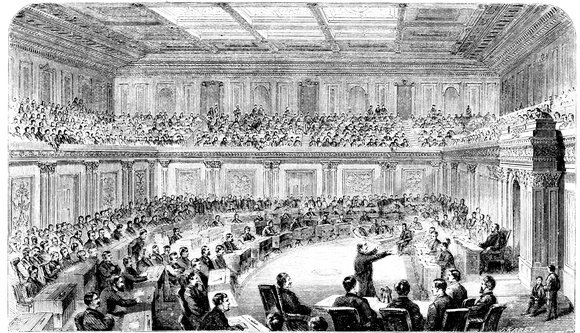
THE HIGH COURT OF IMPEACHMENT. (THE ARTIST MADE A JOURNEY TO WASHINGTON ON PURPOSE TO MAKE THE DRAWING—IT IS RELIABLE.)
685The Senate having adopted rules for the trial, reported by its committee, proceeded on Thursday, March 5th, to organize as a Court of Impeachment, Chief Justice Chase presiding. On Saturday, March 7th, the summons requiring the President to appear and answer the Articles of Impeachment was served on him, with a copy of the articles. On Friday, March 13th, the President appeared by his counsel before the Senate and requested forty days’ time in which to prepare and serve his answers to the articles. His counsel, as first named, consisted of Messrs. Evarts, Stanbery, Curtis, Nelson, and Black. Subsequently, Mr. Black withdrew, and Mr. Groesbeck was added to the number. The Senate did not comply with the President’s request, but designated Monday, March 23d, as the day for the presentation of his answers to the charges, and they were read before the Senate on that day. On the following day the Managers of the House presented their replication to the President’s answers, and it was read before the Senate. On Monday, March 30th, the great trial began, Mr. Butler making the opening speech on behalf of the Managers. The latter at once introduced their testimony, which consumed six days, until Saturday, April 4th. On Thursday, April 9th, the President’s counsel began his defense, Mr. Curtis delivering the opening speech. Nine days were consumed by them in presenting their testimony, until Saturday, April 18th. Two days later, April 20th, additional testimony was offered by both sides. On Wednesday, April 22d, Mr. Boutwell of the Managers began to sum up the case in a protracted speech. Messrs. Stevens and Bingham likewise spoke for the prosecution, and Messrs. Nelson, Groesbeck, Evarts, and Stanbery for the President. Mr. Bingham’s speech, the closing speech of the trial, was concluded on Wednesday, May 6th. On Thursday, May 7th, the Senate, as the Court of Impeachment, sat in secret session six hours, during which it was decided to take the final vote on Tuesday, May 12th. May 11th, the Court deliberated on impeachment in secret session, and on the 12th of May, Senator Howard being unable to take his seat, the final vote was postponed until Saturday, May 16th.
Meantime, painful rumors had been current of the defection of some of those Republican Senators who had at first appeared to be earnest and zealous for the President’s impeachment. These rumors gained strength throughout the week, and when the vote was taken on Saturday, May 16th, on the Eleventh Article, which it was thought best to have voted upon first, the vote stood thirty-five for conviction to nineteen for acquittal, and as the Constitution requires a two-thirds 686vote for conviction, Mr. Johnson was technically acquitted on this article.
The Votes for Conviction were:—Anthony, Cameron, Cattell, Chandler, Cole, Conkling, Conness, Corbett, Cragin, Drake, Edmunds, Ferry, Frelinghuysen, Harlan, Howard, Howe, Morgan, Morrill, (Me.) Morrill, (Vt.) Morton, Nye, Patterson, (N. H.) Pomeroy, Ramsey, Sherman, Sprague, Stewart, Sumner, Thayer, Tipton, Wade, Willey, Williams, Wilson, Yates—35.
For Acquittal:—Bayard, Buckalew, Davis, Dixon, Doolittle, Fessenden, Fowler, Grimes, Henderson, Hendricks, Johnson, McCreery, Norton, Patterson, (Tenn.) Ross, Saulsbury, Trumbull, Van Winkle, Vickers—19.
Messrs. Fessenden, Fowler, Grimes, Henderson, Ross, Trumbull, and Van Winkle, all hitherto regarded as stanch Republicans, voted with the Democrats, and by their votes prevented the conviction of the President of the high crimes and misdemeanors of which he was accused. Other Senators, the peers of any of these in legal attainment and judicial ability, were fully convinced that the Managers had made out their case conclusively, and some of these also have admitted their belief in his guilt, but professed to find objections to the phraseology of the Articles of Impeachment. That the course of these seven Senators disappointed their friends, and gave encouragement to the enemies of reconstruction, can not be gainsaid. That it caused painful surmisings in regard to their motives, is equally true.
In the case of almost any other man, an escape from conviction and deposition from his high station by the lack of one vote to make up two-thirds, and this not without strong suspicion of the purchase of that vote on his part, would be a lesson sufficiently severe to secure the most decorous behavior for the remainder of his term, if for no other reason than that he might avert the judgment still hanging over him by a slender hair; but as we have already shown, there is no reason from Mr. Johnson’s past conduct, to expect anything more than an aggravation of his previous offences, and a determination to vent upon the nation all the malignity of his bitter and vindictive nature.
687But to proceed with the record. After the vote on the Eleventh Article, further action was postponed till the 26th of May. On that day the second and third articles were voted upon, with precisely the same result as before, and as it was evident that a conviction could not be secured, the record of technical acquittal on the second, third and eleventh articles was entered, and the High Court of Impeachment adjourned sine die. On the same day, Mr. Stanton sent his relinquishment of the office of Secretary of War to the President, feeling that as Impeachment had failed, it was best for him to withdraw.
A few days later, General J. M. Schofield, who had previously been nominated, was confirmed by the Senate as Secretary of War, the Senate declaring that it was in the place of Edwin M. Stanton, unlawfully removed.
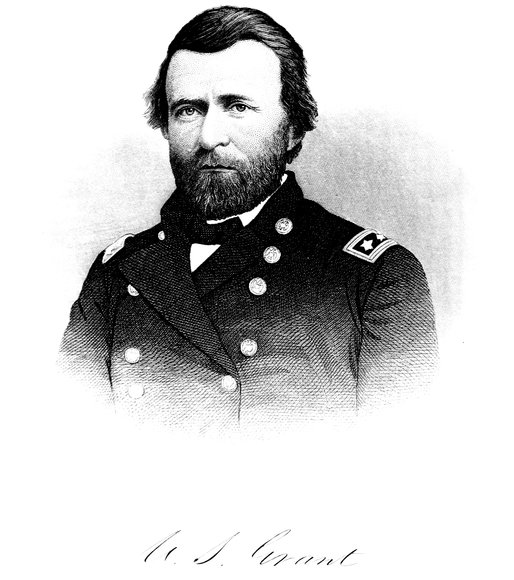
In the interim between the two votes on the question of Impeachment, the National Republican Union Convention was held at Chicago, and Ulysses S. Grant nominated for the Presidency by the unanimous vote of all the delegates, 650 in number, on the first ballot. Schuyler Colfax, of Indiana, was nominated for Vice-President on the fifth ballot, receiving by the change of votes of State delegations, 522 out of 650 votes. The balloting previous to these changes which were incident to the conviction that he had the majority, was as follows:
1st Ballot. 2d. 3d. 4th. 5th.
Benjamin F. Wade, 149 170 178 204 199
Reuben E. Fenton, 132 140 130 144 137
Henry Wilson, 119 113 101 87 61
Schuyler Colfax, 118 149 164 186 224
Andrew G. Curtin, 52 45 30
Hannibal Hamlin, 30 30 25 25 19
James Speed, 22
James Harlan, 16
John A. J. Cresswell, 14
William D. Kelley, 6
688The canvass for Mr. Colfax at the Convention was conducted on strictly temperance principles, Mr. Colfax having expressly requested his friend, Mr. Defrees, who conducted it, to permit no intoxicating liquor on the premises.
The platform on which the Convention have placed these candidates, whose names win all hearts, is worthy of the men. It is as follows:
The National Republican Party of the United States, assembled in National Convention in the City of Chicago, on the 21st day of May, 1868, make the following Declaration of Principles:
1. We congratulate the country on the assured success of the Reconstruction policy of Congress, as evinced by the adoption, in the majority of the States lately in rebellion, of Constitutions securing Equal Civil and Political Rights to all, and it is the duty of the Government to sustain those institutions, and to prevent the people of such States from being remitted to a state of anarchy.
II. The guaranty by Congress, of Equal Suffrage to all loyal men at the South, was demanded by every consideration of public safety, of gratitude, and of justice, and must be maintained; while the question of Suffrage in all the loyal States properly belongs to the people of those States.
III. We denounce all forms of Repudiation as a national crime; and the national honor requires the payment of the public indebtedness in the uttermost good faith to all creditors at home and abroad, not only according to the letter but the spirit of the laws under which it was contracted.
IV. It is due to the Labor of the Nation that taxation should be equalized, and reduced as rapidly as the national faith will permit.
V. The National debt, contracted, as it has been, for the preservation of the Union for all time to come, should be extended over a fair period for redemption; and it is the duty of Congress to reduce the rate of interest thereon whenever it can be honestly done.
VI. That the best policy to diminish our burden of debt is to so improve our credit that capitalists will seek to loan us money at lower rates of interest than we now pay, so long as repudiation, partial or total, open or covert, is threatened or suspected.
VII. The Government of the United States should be administered with the strictest economy; and the corruptions which have been so shamefully nursed and fostered by Andrew Johnson call loudly for radical reform.
VIII. We profoundly deplore the untimely and tragic death of Abraham Lincoln, and regret the accession to the Presidency, of Andrew Johnson, who has acted treacherously to the people who elected him and the cause he was pledged to support; who has usurped high legislative and judicial functions; who has refused to execute the laws; who has used his high office to induce other officers to ignore and violate the laws; who has employed his executive powers to render insecure the property, the peace, liberty and life, of the citizen; who 689has abused the pardoning power; who has denounced the National Legislature as unconstitutional; who has persistently and corruptly resisted, by every means in his power, every proper attempt at the reconstruction of the States lately in rebellion; who has perverted the public patronage into an engine of wholesale corruption; and who has been justly impeached for high crimes and misdemeanors, and properly pronounced guilty thereof by the vote of thirty-five Senators.
IX. The doctrine of Great Britain and other European powers that, because a man is once a subject he is always so, must be resisted at every hazard by the United States, as a relic of feudal times not authorized by the laws of nations, and at war with our national honor and independence. Naturalized citizens are entitled to protection in all their rights of citizenship, as though they were native-born; and no citizen of the United States, native or naturalized, must be liable to arrest and imprisonment by any foreign power for acts done or words spoken in this country; and, if so arrested and imprisoned, it is the duty of the Government to interfere in his behalf.
X. Of all who were faithful in the trials of the late war, there were none entitled to more especial honor than the brave soldiers and seamen who endured the hardships of campaign and cruise, and imperilled their lives in the service of the country; the bounties and pensions provided by the laws for these brave defenders of the nation, are obligations never to be forgotten; the widows and orphans of the gallant dead are the wards of the people—a sacred legacy bequeathed to the nation’s protecting care.
XI. Foreign immigration, which in the past has added so much to the wealth, development and resources and increase of power to this republic, the asylum of the oppressed of all nations, should be fostered and encouraged by a liberal and just policy.
XII. This Convention declares itself in sympathy with all oppressed peoples struggling for their rights.
Unanimously added, on motion of Gen. Schurz:
Resolved, That we highly commend the spirit of magnanimity and forbearance with which men who have served in the Rebellion, but who now frankly and honestly coöperate with us in restoring the peace of the country and reconstructing the Southern State governments upon the basis of Impartial Justice and Equal Rights, are received back into the communion of the loyal people; and we favor the removal of the disqualifications and restrictions imposed upon the late Rebels in the same measure as their spirit of loyalty will direct, and as may be consistent with the safety of the loyal people.
Resolved, That we recognize the great principles laid down in the immortal Declaration of Independence, as the true foundation of democratic government; and we hail with gladness every effort toward making these principles a living reality on every inch of American soil.
With such a platform, and such candidates, there should be, there can be, no question of the success of the Republican 690Party in the coming election. The only question should be, whether any States, except Kentucky and Maryland, can be allowed to the Democratic Party, and whether the candidate of that party, whoever he may be, may not need a certificate after the election, testifying to the fact of his candidacy.
With Reconstruction, Retrenchment, Reform, Equal Rights, Impartial Suffrage, and No Repudiation, for its cardinal principles, the great party of Freedom stands firm as the everlasting hills. It can afford to let traitors and renegades strut out their brief hour, for the eternal years of God belong to the party of Freedom and Right, and it may well say in the grand words of Whittier:
“God’s ways seem dark, but soon or late
They touch the shining hills of day.
The evil can not brook delay;
The good can well afford to wait.
Give ermined knaves their hour of crime;
We have the future grand and great,
The safe appeal of Truth to Time!”
U. S. Grant
a01