VOLUME XIV (continued 3)
William F. Fleming translation
Elizabeth committed an act of tyranny, and her parliament one of infamous weakness, in causing Queen Mary Stuart to be assassinated by an executioner; but in the rest of her government she was not tyrannical; she was clever and manœuvering, but prudent and strong.
Richard III. was a barbarous tyrant; but he was punished. Pope Alexander VI. was a more execrable tyrant than any of these, and he was fortunate in all his undertakings. Christian II. was as wicked a tyrant as Alexander VI., and was punished, but not sufficiently so.
If we were to reckon Turkish, Greek, and Roman tyrants, we should find as many fortunate as the contrary. When I say fortunate, I speak according to the vulgar prejudice, the ordinary acceptation of the word, according to appearances; for that they can be really happy, that their minds can be contented and tranquil, appears to me to be impossible.
Constantine the Great was evidently a tyrant in a double sense. In the north of England he usurped the crown of the Roman Empire, at the head of some foreign legions, notwithstanding all the laws, and in spite of the senate and the people, who legitimately elected Maxentius. He passed all his life in crime, voluptuousness, fraud, and imposture. He was not punished, but was he happy? God knows; but I know that his subjects were not so.
The great Theodosius was the most abominable of tyrants, when, under pretence of giving a feast, he caused fifteen thousand Roman citizens to be murdered in the circus, with their wives and children, and when he added to this horror the facetiousness of passing some months without going to tire himself at high mass. This Theodosius has almost been placed in the ranks of the blessed; but I should be very sorry if he were happy on earth. In all cases it would be well to assure tyrants that they will never be happy in this world, as it is well to make our stewards and cooks believe that they will be eternally damned if they rob us.
The tyrants of the Lower Greek Empire were almost all dethroned or assassinated by one another. All these great offenders were by turns the executioners of human and divine vengeance. Among the Turkish tyrants, we see as many deposed as those who die in possession of the throne. With regard to subaltern tyrants, or the lower order of monsters who burden their masters with the execration with which they are loaded, the number of these Hamans, these Sejanuses, is infinite.
UNIVERSITY.
Du Boulay, in his "History of the University of Paris," adopts the old, uncertain, not to say fabulous tradition, which carries its origin to the time of Charlemagne. It is true that such is the opinion of Guagin and of Gilles de Beauvais; but in addition to the fact that contemporary authors, as Eginhard, Almon, Reginon, and Sigebert make no mention of this establishment; Pasquier and Du Tillet expressly assert that it commenced in the twelfth century under the reigns of Louis the Young and of Philip Augustus.
Moreover, the first statutes of the university were drawn up by Robert de Coceon, legate of the pope, in the year 1215, which proves that it received from the first the form it retains at present; because a bull of Gregory IX., of the year 1231, makes mention of masters of theology, masters of law, physicians, and lastly, artists. The name "university" originated in the supposition that these four bodies, termed faculties, constituted a universality of studies; that is to say, that they comprehended all which could be cultivated.
The popes, by the means of these establishments, of the decisions of which they made themselves judges, became masters of the instruction of the people; and the same spirit which made the permission granted to the members of the Parliament of Paris to inter themselves in the habits of Cordeliers, be regarded as an especial favor—as related in the article on "Quête"—dictated the decrees pronounced by that sovereign court against all who dared to oppose an unintelligible scholastic system, which, according to the confession of the abbé Triteme, was only a false science that had vitiated religion. In fact, that which Constantine had only insinuated with respect to the Cumæan Sibyl, has been expressly asserted of Aristotle. Cardinal Pallavicini supported the maxim of I know not what monk Paul, who pleasantly observed, that without Aristotle the Church would have been deficient in some of her articles of faith.
Thus the celebrated Ramus, having composed two works in which he opposed the doctrine of Aristotle taught in the universities, would have been sacrificed to the fury of his ignorant rival, had not King Francis I. referred to his own judgment the process commenced in Paris between Ramus and Anthony Govea. One of the principal complaints against Ramus related to the manner in which he taught his disciples to pronounce the letter Q.
Ramus was not the only disputant persecuted for these grave absurdities. In the year 1624, the Parliament of Paris banished from its district three persons who wished to maintain theses openly against Aristotle. Every person was forbidden to sell or to circulate the propositions contained in these theses, on pain of corporal punishment, or to teach any opinion against ancient and approved authors, on pain of death.
The remonstrances of the Sorbonne, in consequence of which the same parliament issued a decision against the chemists, in the year 1629, testified that it was impossible to impeach the principles of Aristotle, without at the same time impeaching those of the scholastic theology received by the Church. In the meantime, the faculty having issued, in 1566, a decree forbidding the use of antimony, and the parliament having confirmed the said decree, Paumier de Caen, a great chemist and celebrated physician of Paris, for not conforming to it, was degraded in the year 1609. Lastly, antimony being afterwards inserted in the books of medicines, composed by order of the faculty in the year 1637, the said faculty permitted the use of it in 1666, a century after having forbidden it, which decision the parliament confirmed by a new decree. Thus the university followed the example of the Church, which finally proscribed the doctrine of Arius, under pain of death, and approved the word "consubstantial," which it had previously condemned—as we have seen in the article on "Councils."
What we have observed of the university of Paris, may serve to give us an idea of other universities, of which it was regarded as the model. In fact, in imitation of it, eighty universities passed the same decree as the Sorbonne in the fourteenth century; to wit, that when the cap of a doctor was bestowed, the candidate should be made to swear that he will maintain the immaculate conception of the Virgin Mary; which he did not regard, however, as an article of faith, but as a Catholic and pious opinion.
USAGES.
Contemptible Customs do not Always Imply a Contemptible Nation.
There are cases in which we must not judge of a nation by its usages and popular superstitions. Suppose Cæsar, after having conquered Egypt, wishing to make commerce flourish in the Roman Empire, had sent an embassy to China by the port of Arsinoë, the Red Sea and Indian Ocean. The emperor Yventi, the first of the name, then reigned in China; the Chinese annals represent him to us as a very wise and learned prince. After receiving the ambassadors of Cæsar with all Chinese politeness, he secretly informs himself through his interpreter of the customs, the usages, sciences, and religion of the Roman people, as celebrated in the West as the Chinese people are in the East. He first learns that their priests have regulated their years in so absurd a manner, that the sun has already entered the celestial signs of Spring when the Romans celebrate the first feasts of Winter. He learns that this nation at a great expense supports a college of priests, who know exactly the time in which they must embark, and when they should give battle, by the inspection of a bullock's liver, or the manner in which fowls eat grain. This sacred science was formerly taught to the Romans by a little god named Tages, who came out of the earth in Tuscany. These people adore a supreme and only God, whom they always call a very great and very good God; yet they have built a temple to a courtesan named Flora, and the good women of Rome have almost all little gods—Penates—in their houses, about four or five inches high. One of these little divinities is the goddess of bosoms, another that of posteriors. They have even a divinity whom they call the god Pet. The emperor Yventi began to laugh; and the tribunals of Nankin at first think with him that the Roman ambassadors are knaves or impostors, who have taken the title of envoys of the Roman Republic; but as the emperor is as just as he is polite, he has particular conversations with them. He then learns that the Roman priests were very ignorant, but that Cæsar actually reformed the calendar. They confess to him that the college of augurs was established in the time of their early barbarity, that they have allowed this ridiculous institution, become dear to a people long ignorant, to exist, but that all sensible people laugh at the augurs; that Cæsar never consulted them; that, according to the account of a very great man named Cato, no augur could ever look another in the face without laughing; and finally, that Cicero, the greatest orator and best philosopher of Rome, wrote a little work against the augurs, entitled "Of Divination," in which he delivers up to eternal ridicule all the predictions and sorceries of soothsayers with which the earth is infatuated. The emperor of China has the curiosity to read this book of Cicero; the interpreters translate it; and in consequence he admires at once the book and the Roman Republic.
VAMPIRES.
What! is it in our eighteenth century that vampires exist? Is it after the reigns of Locke, Shaftesbury, Trenchard, and Collins? Is it under those of d'Alembert, Diderot, St. Lambert, and Duclos that we believe in vampires, and that the reverend father Dom Calmet, Benedictine priest of the congregation of St. Vannes, and St. Hidulphe, abbé of Senon—an abbey of a hundred thousand livres a year, in the neighborhood of two other abbeys of the same revenue—has printed and reprinted the history of vampires, with the approbation of the Sorbonne, signed Marcilli?
These vampires were corpses, who went out of their graves at night to suck the blood of the living, either at their throats or stomachs, after which they returned to their cemeteries. The persons so sucked waned, grew pale, and fell into consumption; while the sucking corpses grew fat, got rosy, and enjoyed an excellent appetite. It was in Poland, Hungary, Silesia, Moravia, Austria, and Lorraine, that the dead made this good cheer. We never heard a word of vampires in London, nor even at Paris. I confess that in both these cities there were stock-jobbers, brokers, and men of business, who sucked the blood of the people in broad daylight; but they were not dead, though corrupted. These true suckers lived not in cemeteries, but in very agreeable palaces.
Who would believe that we derive the idea of vampires from Greece? Not from the Greece of Alexander, Aristotle, Plato, Epicurus, and Demosthenes; but from Christian Greece, unfortunately schismatic. For a long time Christians of the Greek rite have imagined that the bodies of Christians of the Latin church, buried in Greece, do not decay, because they are excommunicated. This is precisely the contrary to that of us Christians of the Latin church, who believe that corpses which do not corrupt are marked with the seal of eternal beatitude. So much so, indeed, that when we have paid a hundred thousand crowns to Rome, to give them a saint's brevet, we adore them with the worship of "dulia."
The Greeks are persuaded that these dead are sorcerers; they call them "broucolacas," or "vroucolacas," according as they pronounce the second letter of the alphabet. The Greek corpses go into houses to suck the blood of little children, to eat the supper of the fathers and mothers, drink their wine, and break all the furniture. They can only be put to rights by burning them when they are caught. But the precaution must be taken of not putting them into the fire until after their hearts are torn out, which must be burned separately. The celebrated Tournefort, sent into the Levant by Louis XIV., as well as so many other virtuosi, was witness of all the acts attributed to one of these "broucolacas," and to this ceremony.
After slander, nothing is communicated more promptly than superstition, fanaticism, sorcery, and tales of those raised from the dead. There were "broucolacas" in Wallachia, Moldavia, and some among the Polanders, who are of the Romish church. This superstition being absent, they acquired it, and it went through all the east of Germany. Nothing was spoken of but vampires, from 1730 to 1735; they were laid in wait for, their hearts torn out and burned. They resembled the ancient martyrs—the more they were burned, the more they abounded.
Finally, Calmet became their historian, and treated vampires as he treated the Old and New Testaments, by relating faithfully all that has been said before him.
The most curious things, in my opinion, were the verbal suits juridically conducted, concerning the dead who went from their tombs to suck the little boys and girls of their neighborhood. Calmet relates that in Hungary two officers, delegated by the emperor Charles VI., assisted by the bailiff of the place and an executioner, held an inquest on a vampire, who had been dead six weeks, and who had sucked all the neighborhood. They found him in his coffin, fresh and jolly, with his eyes open, and asking for food. The bailiff passed his sentence; the executioner tore out the vampire's heart, and burned it, after which he feasted no more.
Who, after this, dares to doubt of the resuscitated dead, with which our ancient legends are filled, and of all the miracles related by Bollandus, and the sincere and revered Dom Ruinart? You will find stories of vampires in the "Jewish Letters" of d'Argens, whom the Jesuit authors of the "Journal of Trévoux" have accused of believing nothing. It should be observed how they triumph in the history of the vampire of Hungary; how they thanked God and the Virgin for having at last converted this poor d'Argens, the chamberlain of a king who did not believe in vampires. "Behold," said they, "this famous unbeliever, who dared to throw doubts on the appearance of the angel to the Holy Virgin; on the star which conducted the magi; on the cure of the possessed; on the immersion of two thousand swine in a lake; on an eclipse of the sun at the full moon; on the resurrection of the dead who walked in Jerusalem—his heart is softened, his mind is enlightened; he believes in vampires."
There no longer remained any question, but to examine whether all these dead were raised by their own virtue, by the power of God, or by that of the devil. Several great theologians of Lorraine, of Moravia, and Hungary, displayed their opinions and their science. They related all that St. Augustine, St. Ambrose, and so many other saints, had most unintelligibly said on the living and the dead. They related all the miracles of St. Stephen, which are found in the seventh book of the works of St. Augustine. This is one of the most curious of them: In the city of Aubzal in Africa, a young man was crushed to death by the ruins of a wall; the widow immediately invoked St. Stephen, to whom she was very much devoted. St. Stephen raised him. He was asked what he had seen in the other world. "Sirs," said he, "when my soul quitted my body, it met an infinity of souls, who asked it more questions about this world than you do of the other. I went I know not whither, when I met St. Stephen, who said to me, 'Give back that which thou hast received.' I answered, 'What should I give back? you have given me nothing.' He repeated three times, 'Give back that which thou hast received.' Then I comprehended that he spoke of the credo; I repeated my credo to him, and suddenly he raised me." Above all, they quoted the stories related by Sulpicius Severus, in the life of St. Martin. They proved that St. Martin, with some others, raised up a condemned soul.
But all these stories, however true they might be, had nothing in common with the vampires who rose to suck the blood of their neighbors, and afterwards replaced themselves in their coffins. They looked if they could not find in the Old Testament, or in the mythology, some vampire whom they could quote as an example; but they found none. It was proved, however, that the dead drank and ate, since in so many ancient nations food was placed on their tombs.
The difficulty was to know whether it was the soul or the body of the dead which ate. It was decided that it was both. Delicate and unsubstantial things, as sweetmeats, whipped cream, and melting fruits, were for the soul, and roast beef and the like were for the body.
The kings of Persia were, said they, the first who caused themselves to be served with viands after their death. Almost all the kings of the present day imitate them; but they are the monks who eat their dinner and supper, and drink their wine. Thus, properly speaking, kings are not vampires; the true vampires are the monks, who eat at the expense of both kings and people.
It is very true that St. Stanislaus, who had bought a considerable estate from a Polish gentleman, and not paid him for it, being brought before King Boleslaus by his heirs, raised up the gentleman; but this was solely to get quittance. It is not said that he gave a single glass of wine to the seller, who returned to the other world without having eaten or drunk. They afterwards treated of the grand question, whether a vampire could be absolved who died excommunicated, which comes more to the point.
I am not profound enough in theology to give my opinion on this subject; but I would willingly be for absolution, because in all doubtful affairs we should take the mildest part. "Odia restringenda, favores ampliandi."
The result of all this is that a great part of Europe has been infested with vampires for five or six years, and that there are now no more; that we have had Convulsionaries in France for twenty years, and that we have them no longer; that we have had demoniacs for seventeen hundred years, but have them no longer; that the dead have been raised ever since the days of Hippolytus, but that they are raised no longer; and, lastly, that we have had Jesuits in Spain, Portugal, France, and the two Sicilies, but that we have them no longer.
VELETRI.
A Small Town of Umbria, Nine Leagues from Rome; and, Incidentally, of the Divinity of Augustus.
Those who love the study of history are glad to understand by what title a citizen of Veletri governed an empire, which extended from Mount Taurus to Mount Atlas, and from the Euphrates to the Western Ocean. It was not as perpetual dictator; this title had been too fatal to Julius Cæsar, and Augustus bore it only eleven days. The fear of perishing like his predecessor, and the counsels of Agrippa, induced him to take other measures; he insensibly concentrated in his own person all the dignities of the republic. Thirteen consulates, the tribunate renewed in his favor every ten years, the name of prince of the senate, that of imperator, which at first signified only the general of an army, but to which it was known how to bestow a more extensive signification—such were the titles which appeared to legitimate his power.
The senate lost nothing by his honors, but preserved even its most extensive rights. Augustus divided with it all the provinces of the empire, but retained the principal for himself; finally, he was master of the public treasury and the soldiery, and in fact sovereign.
What is more strange, Julius Cæsar having been enrolled among the gods after his death, Augustus was ordained god while living. It is true he was not altogether a god in Rome, but he was so in the provinces, where he had temples and priests. The abbey of Ainai at Lyons was a fine temple of Augustus. Horace says to him: "Jurandasque tuum per nomen ponimus aras." That is to say, among the Romans existed courtiers so finished as to have small altars in their houses dedicated to Augustus. He was therefore canonized during his life, and the name of god—divus—became the title or nickname of all the succeeding emperors. Caligula constituted himself a god without difficulty, and was worshipped in the temple of Castor and Pollux; his statue was placed between those of the twins, and they sacrificed to him peacocks, pheasants, and Numidian fowls, until he ended by immolating himself. Nero bore the name of god, before he was condemned by the senate to suffer the punishment of a slave.
We are not to imagine that the name of "god" signified, in regard to these monsters, that which we understand by it; the blasphemy could not be carried quite so far. "Divus" precisely answers to "sanctus." The Augustan list of proscriptions and the filthy epigram against Fulvia, are not the productions of a divinity.
There were twelve conspiracies against this god, if we include the pretended plot of Cinna; but none of them succeeded; and of all the wretches who have usurped divine honors, Augustus was doubtless the most unfortunate. It was he, indeed, who actually terminated the Roman Republic; for Cæsar was dictator only six months, and Augustus reigned forty years. It was during his reign that manners changed with the government. The armies, formerly composed of the Roman legions and people of Italy, were in the end made up from all the barbarians, who naturally enough placed emperors of their own country on the throne.
In the third century they raised up thirty tyrants at one time, of whom some were natives of Transylvania, others of Gaul, Britain, and Germany. Diocletian was the son of a Dalmatian slave; Maximian Hercules, a peasant of Sirmik; and Theodosius, a native of Spain—not then civilized.
We know how the Roman Empire was finally destroyed; how the Turks have subjugated one half, and how the name of the other still subsists among the Marcomans on the shores of the Danube. The most singular of all its revolutions, however, and the most astonishing of all spectacles, is the manner in which its capital is governed and inhabited at this moment.
VENALITY.
The forger of whom we have spoken so much, who made the testament of Cardinal Richelieu, says in chapter iv.: "That it would be much better to allow venality and the 'droit annuel' to continue to exist, than to abolish these two establishments, which are not to be changed suddenly without shaking the state."
All France repeated, and believed they repeated after Cardinal Richelieu, that the sale of offices of judicature was very advantageous. The abbé de St. Pierre was the first who, still believing that the pretended testament was the cardinal's, dared to say in his observation on chapter iv.: "The cardinal engaged himself on a bad subject, in maintaining that the sale of places can be advantageous to the state. It is true that it is not possible to otherwise reimburse all the charges."
Thus this abuse appeared to everybody, not only unreformable, but useful. They were so accustomed to this opprobrium that they did not feel it; it seemed eternal; yet a single man in a few months has overthrown it. Let us therefore repeat, that all may be done, all may be corrected; that the great fault of almost all who govern, is having but half wills and half means. If Peter the Great had not willed strongly, two thousand leagues of country would still be barbarous.
How can we give water in Paris to thirty thousand houses which want it? How can we pay the debts of the state? How can we throw off the dreaded tyranny of a foreign power, which is not a power, and to which we pay the first fruits as a tribute? Dare to wish it, and you will arrive at your object more easily than you extirpated the Jesuits, and purged the theatre of petits-maîtres.
VENICE.
And, Incidentally, of Liberty.
No power can reproach the Venetians with having acquired their liberty by revolt; none can say to them, I have freed you—here is the diploma of your manumission.
They have not usurped their rights, as Cæsar usurped empire, or as so many bishops, commencing with that of Rome, have usurped royal rights. They are lords of Venice—if we dare use the audacious comparison—as God is Lord of the earth, because He founded it.
Attila, who never took the title of the scourge of God, ravaged Italy. He had as much right to do so, as Charlemagne the Austrasian, Arnold the Corinthian Bastard, Guy, duke of Spoleto, Berenger, marquis of Friuli, or the bishops who wished to make themselves sovereigns of it.
In this time of military and ecclesiastical robberies, Attila passed as a vulture, and the Venetians saved themselves in the sea as kingfishers, which none assist or protect; they make their nest in the midst of the waters, they enlarge it, they people it, they defend it, they enrich it. I ask if it is possible to imagine a more just possession? Our father Adam, who is supposed to have lived in that fine country of Mesopotamia, was not more justly lord and gardener of terrestrial paradise.
I have read the "Squittinio della libertà di Venezia," and I am indignant at it. What! Venice could not be originally free, because the Greek emperors, superstitious, weak, wicked, and barbarous, said—This new town has been built on our ancient territory; and because a German, having the title of Emperor of the West, says: This town being in the West, is of our domain?
It seems to me like a flying-fish, pursued at once by a falcon and a shark, but which escapes both. Sannazarius was very right in saying, in comparing Rome and Venice: "Illam homines dices, hanc posuisse deos." Rome lost, by Cæsar, at the end of five hundred years, its liberty acquired by Brutus. Venice has preserved hers for eleven centuries, and I hope she will always do so.
Genoa! why dost thou boast of showing the grant of a Berenger, who gave thee privileges in the year 958? We know that concessions of privileges are but titles of servitude. And this is a fine title! the charter of a passing tyrant, who was never properly acknowledged in Italy, and who was driven from it two years after the date of the charter!
The true charter of liberty is independence, maintained by force. It is with the point of the sword that diplomas should be signed securing this natural prerogative. Thou hast lost, more than once, thy privilege and thy strong box, since 1748: it is necessary to take care of both. Happy Helvetia! to what charter owest thou thy liberty? To thy courage, thy firmness, and thy mountains. But I am thy emperor. But I will have thee be so no longer. Thy fathers have been the slaves of my fathers. It is for that reason that their children will not serve thee. But I have the right attached to my dignity. And we have the right of nature.
When had the Seven United Provinces this incontestable right? At the moment in which they were united; and from that time Philip II. was the rebel. What a great man was William, prince of Orange: he found them slaves, and he made them free men! Why is liberty so rare? Because it is the first of blessings.
VERSE.
It is easy to write in prose, but very difficult to be a poet. More than one "prosateur" has affected to despise poetry; in reference to which propensity, we may call to mind the bon-mot of Montaigne: "We cannot attain to poetry; let us revenge ourselves by abusing it."
We have already remarked, that Montesquieu, being unable to succeed in verse, professed, in his "Persian Letters," to discover no merit in Virgil or Horace. The eloquent Bossuet endeavored to make verses, but they were detestable; he took care, however, not to declaim against great poets.
Fénelon scarcely made better verses than Bossuet, but knew by heart all the fine poetry of antiquity. His mind was full of it, and he continually quotes it in his letters.
It appears to me, that there never existed a truly eloquent man who did not love poetry. I will simply cite, for example, Cæsar and Cicero; the one composed a tragedy on Œdipus, and we have pieces of poetry by the latter which might pass among the best that preceded Lucretius, Virgil, and Horace.
A certain Abbé Trublet has printed, that he cannot read a poem at once from beginning to end. Indeed, Air. Abbé! but what can we read, what can we understand, what can we do, for a long time together, any more than poetry?
VIANDS.
Forbidden Viands, Dangerous Viands.—A short Examination of Jewish and Christian Precepts, and of those of the Ancient Philosophers.
"Viand" comes no doubt from "victus"—that which nourishes and sustains life: from victus was formed viventia; from viventa, "viand." This word should be applied to all that is eaten, but by the caprice of all languages, the custom has prevailed of refusing this denomination to bread, milk, rice, pulses, fruits, and fish, and of giving it only to terrestrial animals. This seems contrary to reason, but it is the fancy of all languages, and of those who formed them.
Some of the first Christians made a scruple of eating that which had been offered to the gods, of whatever nature it might be. St. Paul approved not of this scruple. He writes to the Corinthians: "Meat commendeth us not to God: for neither if we eat are we the better; neither if we eat not, are we the worse." He merely exhorts them not to eat viands immolated to the gods, before those brothers who might be scandalized at it. We see not, after that, why he so ill-treats St. Peter, and reproaches him with having eaten forbidden viands with the Gentiles. We see elsewhere, in the Acts of the Apostles, that Simon Peter was authorized to eat of all indifferently; for he one day saw the firmament open, and a great sheet descending by the four corners from heaven to earth; it was covered with all kinds of four-footed beasts, with all kinds of birds and reptiles—or animals which swim—and a voice cried to him: "Kill and eat."
You will remark, that Lent and fast-days were not then instituted. Nothing is ever done, except by degrees. We can here say, for the consolation of the weak, that the quarrel of St. Peter and St. Paul should not alarm us: saints are men. Paul commenced by being the jailer, and even the executioner, of the disciples of Jesus; Peter had denied Jesus; and we have seen that the dawning, suffering, militant, triumphant church has always been divided, from the Ebionites to the Jesuits.
I think that the Brahmins, so anterior to the Jews, might well have been divided also; but they were the first who imposed on themselves the law of not eating any animal. As they believed that souls passed and repassed from human bodies to those of beasts, they would not eat their relatives. Perhaps their best reason was the fear of accustoming men to carnage, and inspiring them with ferocious manners.
We know that Pythagoras, who studied geometry and morals among them, embraced this humane doctrine, and brought it into Italy. His disciples followed it a very long time: the celebrated philosophers, Plotinus, Jamblicus, and Porphyry, recommended and even practised it—though it is very rare to practise what is preached. The work of Porphyry on abstinence from meat, written in the middle of our third century, and very well translated into our language by M. de Burigni, is very much esteemed by the learned; but it has not made more disciples among us than the book of the physician Héquet. It is in vain that Porphyry proposes, as models, the Brahmins and Persian magi of the first class, who had a horror of the custom of burying the entrails of other creatures in our own; he is not now followed by the fathers of La Trappe. The work of Porphyry is addressed to one of his ancient disciples, named Firmus, who, it is said, turned Christian, to have the liberty of eating meat and drinking wine.
He shows Firmus, that in abstaining from meat and strong liquors, we preserve the health of the soul and body; that we live longer, and more innocently. All his reflections are those of a scrupulous theologian, of a rigid philosopher, and of a mild and sensible mind. We might think, in reading his work, that this great enemy of the church was one of its fathers.
He speaks not of metempsychosis, but he regards animals as our brethren, because they are animated like ourselves; they have the same principles of life; they have, as well as ourselves, ideas, sentiment, memory, and industry. They want but speech; if they had it, should we dare to kill and eat them; should we dare to commit these fratricides? Where is the barbarian who would roast a lamb, if it conjured him by an affecting speech not to become at once an assassin, an anthropophagus?
This book proves, at least, that among the Gentiles there were philosophers of the most austere virtue; but they could not prevail against butchers and gluttons. It is to be remarked, that Porphyry makes a very fine eulogium on the Essenians: he is filled with veneration for them, although they sometimes eat meat. He was for whoever was the most virtuous, whether Essenians, Pythagoreans, Stoics, or Christians. When sects are formed of a small number, their manners are pure; and they degenerate in proportion as they become powerful. Lust, gaming, and luxury then prevail, and all the virtues fly away:
La gola, il dado e l'otiose piume Hanno dal' mondo ogni virtù sbandita.
VIRTUE.
SECTION I.
It is said of Marcus Brutus, that before killing himself, he pronounced these words: "Oh, Virtue! I believed that thou wert something, but thou art only a vile phantom!"
Thou wast right, Brutus, if thou madest virtue consist in being the chief of a party, and the assassin of thy benefactor, of thy father, Julius Cæsar. Hadst thou made virtue to consist only in doing good to those who depended on thee, thou wouldst not have called it a phantom, or have killed thyself in despair.
I am very virtuous, says a miserable excrement of theology. I possess the four cardinal virtues, and the three theological ones. An honest man asks him: What are the cardinal virtues? The other answers: They are fortitude, prudence, temperance, and justice.
HONEST MAN.
If thou art just, thou hast said all. Thy fortitude, prudence, and temperance are useful qualities: if thou possessest them, so much the better for thee; but if thou art just, so much the better for others. It is not sufficient to be just, thou shouldst be beneficent; this is being truly cardinal. And thy theological virtues, what are they?
THEOLOGIAN.
Faith, hope, and charity.
HONEST MAN.
Is there virtue in believing? If that which thou believest seems to thee to be true, there is no merit in believing it; if it seems to thee to be false, it is impossible for thee to believe it.
Hope should no more be a virtue than fear; we fear and we hope, according to what is promised or threatened us. As to charity, is it not that which the Greeks and Romans understood by humanity—love of your neighbor? This love is nothing, if it does not act; beneficence is therefore the only true virtue.
THEOLOGIAN.
What a fool! Yes, truly, I shall trouble myself to serve men, if I get nothing in return! Every trouble merits payment. I pretend to do no good action, except to insure myself paradise.
Quis enim virtutem amplectitur, ipsam Prœmia si tolias?—JUVENAL, sat. x. For, if the gain you take away, To virtue who will homage pay!
HONEST MAN.
Ah, good sir, that is to say, that if you did not hope for paradise, or fear hell, you would never do a good action. You quote me lines from Juvenal, to prove to me that you have only your interest in view. Racine could at least show you, that even in this world we might find our recompense, while waiting for a better:
Quel plaisir de penser, et de dire en vous-même, Partout en ce moment on me bénit, on m'aime! On ne voit point le peuple à mon nom s'alarmer; Le ciel dans tous leurs pleurs ne m'entend point nommer, Leur sombre inimitie ne fuit point mon visage; Je vois voter partout les cœurs a mon passage. Tels étaient vos plaisirs. —RACINE, Britannicus, act iv, sc. ii. How great his pleasure who can justly say, All at this moment either bless or love me; The people at my name betray no fear, Nor in their plaints does heaven e'er hear of me! Their enmity ne'er makes them fly my presence, But every heart springs out at my approach! Such were your pleasures!
Believe me, doctor, there are two things which deserve to be loved for themselves—God and Virtue.
THEOLOGIAN.
Ah, sir! you are a Fénelonist.
HONEST MAN.
Yes, doctor.
THEOLOGIAN.
I will inform against you at the tribunal of Meaux.
HONEST MAN.
Go, and inform!
SECTION II.
What is virtue? Beneficence towards your neighbor. Can I call virtue anything but that which does good! I am indigent, thou art liberal. I am in danger, thou succorest me. I am deceived, thou tellest me the truth. I am neglected, thou consolest me. I am ignorant, thou teachest me. I can easily call thee virtuous, but what will become of the cardinal and theological virtues? Some will remain in the schools.
What signifies it to me whether thou art temperate? It is a precept of health which thou observest; thou art the better for it; I congratulate thee on it. Thou hast faith and hope; I congratulate thee still more; they will procure thee eternal life. Thy theological virtues are celestial gifts; thy cardinal ones are excellent qualities, which serve to guide thee; but they are not virtues in relation to thy neighbor. The prudent man does himself good; the virtuous one does it to other men. St. Paul was right in telling thee, that charity ranks above faith and hope.
But how! wilt thou admit of no other virtues than those which are useful to thy neighbor? How can I admit any others? We live in society; there is therefore nothing truly good for us but that which does good to society. An hermit will be sober, pious, and dressed in sackcloth: very well; he will be holy; but I will not call him virtuous until he shall have done some act of virtue by which men may have profited. While he is alone, he is neither beneficent nor the contrary; he is nobody to us. If St. Bruno had made peace in families, if he had assisted the indigent, he had been virtuous; having fasted and prayed in solitude, he is only a saint. Virtue between men is a commerce of good actions: he who has no part in this commerce, must not be reckoned. If this saint were in the world, he would doubtless do good, but while he is not in the world, we have no reason to give him the name of virtuous: he will be good for himself, and not for us.
But, say you, if an hermit is gluttonous, drunken, given up to a secret debauch with himself, he is vicious; he is therefore virtuous, if he has the contrary qualities. I cannot agree to this: he is a very vile man, if he has the faults of which you speak; but he is not vicious, wicked, or punishable by society, to which his infamies do no harm. It may be presumed, that if he re-enters society, he will do evil to it; he then will be very vicious; and it is even more probable that he will be a wicked man, than it is certain that the other temperate and chaste hermit will be a good man; for in society faults augment, and good qualities diminish.
A much stronger objection is made to me: Nero, Pope Alexander VI., and other monsters of the kind, have performed good actions. I reply boldly, that they were virtuous at the time. Some theologians say, that the divine Emperor Antoninus was not virtuous; that he was an infatuated Stoic, who, not content with commanding men, would further be esteemed by them; that he gave himself credit for the good which he did to mankind; that he was all his life just, laborious, beneficent, through vanity; and that he only deceived men by his virtues. To which I exclaim: My God! often send us such knaves!
VISION.
When I speak of vision, I do not mean the admirable manner in which our eyes perceive objects, and in which the pictures of all that we see are painted on the retina—a divine picture designed according to all the laws of mathematics, which is, consequently, like everything else from the hand of the Eternal geometrician; in spite of those who explain it, and who pretend to believe, that the eye is not intended to see, the ear to hear, or the feet to walk. This matter has been so learnedly treated by so many great geniuses, that there is no further remnant to glean after their harvests.
I do not pretend to speak of the heresy of which Pope John XXII. was accused, who pretended that saints will not enjoy beatific vision until after the last judgment. I give up this vision. My subject is the innumerable multitude of visions with which so many holy personages have been favored or tormented; which so many idiots are believed to have seen; with which so many knavish men and women have duped the world, either to get the reputation of being favored by heaven, which is very flattering, or to gain money, which is still more so to rogues in general.
Calmet and Langlet have made ample collections of these visions. The most interesting in my opinion is the one which has produced the greatest effects, since it has tended to reform three parts of the Swiss—that of the young Jacobin Yetzer, with which I have already amused my dear reader. This Yetzer, as you know, saw the Holy Virgin and St. Barbara several times, who informed him of the marks of Jesus Christ. You are not ignorant of how he received, from a Jacobin confessor, a host powdered with arsenic, and how the bishop of Lausanne would have had him burned for complaining that he was poisoned. You have seen, that these abominations were one of the causes of the misfortune which happened to the Bernese, of ceasing to be Catholic, Apostolical, and Roman.
The Vision.
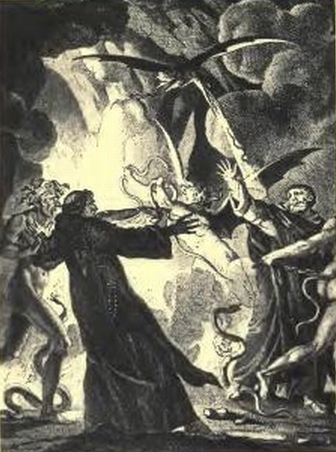
I am sorry that I have no visions of this consequence to tell you of. Yet you will confess, that the vision of the reverend father Cordeliers of Orleans, in 1534, approaches the nearest to it, though still very distant. The criminal process which it occasioned is still in manuscript in the library of the king of France, No. 1770.
The illustrious house of St. Memin did great good to the convent of the Cordeliers, and had their vault in the church. The wife of a lord of St. Memin, provost of Orleans, being dead, her husband, believing that his ancestors had sufficiently impoverished themselves by giving to the monks, gave the brothers a present which did not appear to them considerable enough. These good Franciscans conceived a plan for disinterring the deceased, to force the widower to have her buried again in their holy ground, and to pay them better. The project was not clever, for the lord of St. Memin would not have failed to bury her elsewhere. But folly often mixes with knavery.
At first, the soul of the lady of St. Memin appeared only to two brothers. She said to them: "I am damned, like Judas, because my husband has not given sufficient." The two knaves who related these words perceived not, that they must do more harm to the convent than good. The aim of the convent was to extort money from the lord of St. Memin, for the repose of his wife's soul. Now, if Madame de St. Memin was damned, all the money in the world could not save her. They got no more; the Cordeliers lost their labor.
At this time there was very little good sense in France: the nation had been brutalized by the invasion of the Franks, and afterwards by the invasion of scholastic theology; but in Orleans there were some persons who reasoned. If the Great Being permitted the soul of Madame de St. Memin to appear to two Franciscans, it was not natural, they thought, for this soul to declare itself damned like Judas. This comparison appeared to them to be unnatural. This lady had not sold our Lord Jesus Christ for thirty deniers; she was not hanged; her intestines had not obtruded themselves; and there was not the slightest pretext for comparing her to Judas.
This caused suspicion; and the rumor was still greater in Orleans, because there were already heretics there who believed not in certain visions, and who, in admitting absurd principles, did not always fail to draw good conclusions. The Cordeliers, therefore, changed their battery, and put the lady in purgatory.
She therefore appeared again, and declared that purgatory was her lot; but she demanded to be disinterred. It was not the custom to disinter those in purgatory; but they hoped that M. de St. Memin would prevent this extraordinary affront, by giving money. This demand of being thrown out of the church augmented the suspicions. It was well known, that souls often appeared, but they never demanded to be disinterred.
From this time the soul spoke no more, but it haunted everybody in the convent and church. The brother Cordeliers exorcised it. Brother Peter of Arras adopted a very awkward manner of conjuring it. He said to it: "If thou art the soul of the late Madame de St. Memin, strike four knocks;" and the four knocks were struck. "If thou are damned, strike six knocks;" and the six knocks were struck. "If thou art still tormented in hell, because thy body is buried in holy ground, knock six more times;" and the other six knocks were heard still more distinctly. "If we disinter thy body, and cease praying to God for thee, wilt thou be the less damned? Strike five knocks to certify it to us;" and the soul certified it by five knocks.
This interrogation of the soul, made by Peter of Arras, was signed by twenty-two Cordeliers, at the head of which was the reverend father provincial. This father provincial the next day asked it the same questions, and received the same answers.
It will be said, that the soul having declared that it was in purgatory, the Cordeliers should not have supposed that it was in hell; but it is not my fault if theologians contradict one another.
The lord of St. Memin presented a request to the king against the father Cordeliers. They presented a request on their sides; the king appointed judges, at the head of whom was Adrian Fumée, master of requests.
The procureur-general of the commission required that the said Cordeliers should be burned, but the sentence only condemned them to make the "amende honorable" with a torch in their bosom, and to be banished from the kingdom. This sentence is of February 18, 1535.
After such a vision, it is useless to relate any others: they are all a species either of knavery or folly. Visions of the first kind are under the province of justice; those of the second are either visions of diseased fools, or of fools in good health. The first belong to medicine, the second to Bedlam.
VISION OF CONSTANTINE.
Grave theologians have not failed to allege a specious reason to maintain the truth of the appearance of the cross in heaven; but we are going to show that these arguments are not sufficiently convincing to exclude doubt; the evidences which they quote being neither persuasive nor according with one another.
First, they produce no witnesses but Christians, the deposition of whom may be suspected in the treatment of a fact which tended to prove the divinity of their religion. How is it that no Pagan author has made mention of this miracle, which was seen equally by all the army of Constantine? That Zosimus, who seems to have endeavored to diminish the glory of Constantine, has said nothing of it, is not surprising; but the silence appears very strange in the author of the panegyric of Constantine, pronounced in his presence at Trier; in which oration the panegyrist expresses himself in magnificent terms on all the war against Maxentius, whom this emperor had conquered.
Another orator, who, in his panegyric, treats so eloquently of the war against Maxentius, of the clemency which Constantine showed after the victory, and of the deliverance of Rome, says not a word on this apparition; while he assures us, that celestial armies were seen by all the Gauls, which armies, it was pretended, were sent to aid Constantine.
This surprising vision has not only been unknown to Pagan authors, but to three Christian writers, who had the finest occasion to speak of them. Optatianus Porphyrius mentions more than once the monogram of Christ, which he calls the celestial sign, in the panegyric of Constantine which he wrote in Latin verse, but not a word on the appearance of the cross in the sky.
Lactantius says nothing of it in his treatise on the "Death of Persecutors," which he composed towards the year 314, two years after the vision of which we speak; yet he must have been perfectly informed of all that regards Constantine, having been tutor to Crispus, the son of this prince. He merely relates, that Constantine was commanded, in a dream, to put the divine image of the cross on the bucklers of his soldiers, and to give up war: but in relating a dream, the truth of which had no other support than the evidence of the emperor, he passes, in silence over a prodigy to which all the army were witnesses.
Further, Eusebius of Cæsarea himself, who has given the example to all other Christian historians on the subject, speaks not of this wonder, in the whole course of his "Ecclesiastical History," though he enlarges much on the exploits of Constantine against Maxentius. It is only in his life of this emperor that he expresses himself in these terms: "Constantine resolved to adore the god of Constantius; his father implored the protection of this god against Maxentius. Whilst he was praying, he had a wonderful vision, which would appear incredible, if related by another; but since the victorious emperor has himself related it to us, who wrote this history; and that, after having been long known to this prince, and enjoying a share in his good graces, the emperor confirming what he said by oath—who could doubt it? particularly since the event has confirmed the truth of it.
"He affirmed, that in the afternoon, when the sun set, he saw a luminous cross above it, with this inscription in Greek—'By this sign, conquer:' that this appearance astonished him extremely, as well as all the soldiers who followed him, who were witnesses of the miracle; that while his mind was fully occupied with this vision, and he sought to penetrate the sense of it, the night being come, Jesus Christ appeared to him during his sleep, with the same sign which He had shown to him in the air in the day-time, and commanded him to make a standard of the same form, and to bear it in his battles, to secure him from danger. Constantine, rising at break of day, related to his friends the vision which he had beheld; and, sending for goldsmiths and lapidaries, he sat in the midst of them, explained to them the figure of the sign which he had seen, and commanded them to make a similar one of gold and jewels; and we remember having sometimes seen it."
Eusebius afterwards adds, that Constantine, astonished at so admirable a vision, sent for Christian priests; and that, instructed by them, he applied himself to reading our sacred books, and concluded that he ought to adore with a profound respect the God who appeared to him.
How can we conceive that so admirable a vision, seen by so many millions of people, and so calculated to justify the truth of the Christian religion, could be unknown to Eusebius, an historian so careful in seeking all that could contribute to do honor to Christianity, as even to quote profane monuments falsely, as we have seen in the article on "Eclipse?" And how can we persuade ourselves that he was not informed of it, until several years after, by the sole evidence of Constantine? Were there no Christians in the army, who publicly made a glory of having seen such a prodigy? Had they so little interest in their cause as to keep silence on so great a miracle? Ought we to be astonished, after that, that Gelasius, one of the successors of Eusebius, in the siege of Cæsarea in the fifth century, has said that many people suspected that it was only a fable, invented in favor of the Christian religion?
This suspicion will become much stronger, if we take notice how little the witnesses agree on the circumstances of this marvellous appearance. Almost all affirm, that the cross was seen by Constantine and all his army; and Gelasius speaks of Constantine alone. They differ on the time of the vision. Philostorgius, in his "Ecclesiastical History," of which Photius has preserved us the extract, says, that it was when Constantine gained the victory over Maxentius; others pretend that it was before, when Constantine was making preparations for attacking the tyrant, and was on his march with his army. Arthemius, quoted by Metaphrastus and Surius, mentions the 20th of October, and says that it was at noon; others speak of the afternoon at sunset.
Authors do not agree better even on the vision: the greatest number acknowledged but one, and that in a dream. There is only Eusebius, followed by Philostorgius and Socrates, who speaks of two; the one that Constantine saw in the day-time, and the other which he saw in a dream, tending to confirm the first. Nicephorus Callistus reckons three.
The inscription offers new differences: Eusebius says that it was in Greek characters, while others do not speak of it. According to Philostorgius and Nicephorus, it was in Latin characters; others say nothing about it, and seem by their relation to suppose that the characters were Greek. Philostorgius affirms, that the inscription was formed by an assemblage of stars; Arthemius says that the letters were golden. The author quoted by Photius, represents them as composed of the same luminous matter as the cross; and according to Sosomenes, it had no inscription, and they were angels who said to Constantine: "By this sign, gain the victory."
Finally, the relation of historians is opposed on the consequences of this vision. If we take that of Eusebius, Constantine, aided by God, easily gained the victory over Maxentius; but according to Lactantius, the victory was much disputed. He even says that the troops of Maxentius had some advantage, before Constantine made his army approach the gates of Rome. If we may believe Eusebius and Sosomenes, from this epoch Constantine was always victorious, and opposed the salutary sign of the cross to his enemies, as an impenetrable rampart. However, a Christian author, of whom M. de Valois has collected some fragments, at the end of Ammianus Marcellinus—relates, that in the two battles given to Licinius by Constantine, the victory was doubtful, and that Constantine was even slightly wounded in the thigh; and Nicephorus says, that after the first apparition, he twice combated the Byzantines, without opposing the cross to them, and would not even have remembered it, if he had not lost nine thousand men, and had the same vision twice more. In the first, the stars were so arranged that they formed these words of a psalm: "Call on me in the day of trouble: I will deliver thee, and thou shalt glorify me;" and the last, much clearer and more brilliant still, bore: "By this sign, thou shalt vanquish all thy enemies."
Philostorgius affirms, that the vision of the cross, and the victory gained over Maxentius, determined Constantine to embrace the Christian faith; but Rufinus, who has translated the "Ecclesiastical History" of Eusebius into Latin, says that he already favored Christianity, and honored the true God. It is however known, that he did not receive baptism until a few days before his death, as is expressly said by Philostorgius, St. Athanasius, St. Ambrose, St. Jerome, Socrates, Theodoret, and the author of the Chronicle of Alexandria. This custom, then common, was founded on the belief that, baptism effacing all the sins of him who received it, he died certain of his salvation.
We might confine ourselves to these general reflections, but by superabundance of right we will discuss the authority of Eusebius, as an historian, and that of Constantine and Arthemius, as ocular witnesses.
As to Arthemius, we think that he ought not to be placed in the rank of ocular witnesses; his discourse being founded only on his "Acts," related by Metaphrastus, a fabulous author: "Acts" which Baronius pretends it was wrong to impeach, at the same time that he confesses that they are interpolated.
As to the speech of Constantine, related by Eusebius, it is indisputably an astonishing thing, that this emperor feared that he should not be believed unless he made oath; and that Eusebius has not supported his evidence by that of any of the officers or soldiers of the army. But without here adopting the opinion of some scholars, who doubt whether Eusebius is the author of the life of Constantine, is he not an author who, in this work, bears throughout the character of a panegyrist, rather than that of a historian? Is he not a writer who has carefully suppressed all which could be disadvantageous to his hero? In a word, does he not show his partiality, when he says, in his "Ecclesiastical History," speaking of Maxentius, that having usurped the sovereign power at Rome, to flatter the people he feigned at first to profess the Christian religion? As if it was impossible for Constantine to make use of such a feint, and to pretend this vision, just as Licinius, some time after, to encourage his soldiers against Maximin, pretended that an angel in a dream had dictated a prayer to him, which he must repeat with his army.
How could Eusebius really have the effrontery to call a prince a Christian who caused the temple of Concord to be rebuilt at his own expense, as is proved by an inscription, which was read in the time of Lelio Geraldi, in the temple of Latran? A prince who caused his son Crispus, already honored with the title of Cæsar, to perish on a slight suspicion of having commerce with Fausta, his stepmother; who caused this same Fausta, to whom he was indebted for the preservation of his life, to be suffocated in an overheated bath; who caused the emperor Maximian Hercules, his adopted father, to be strangled; who took away the life of the young Licinius, his nephew, who had already displayed very good qualities; and, in short, who dishonored himself by so many murders, that the consul Ablavius called his times Neronian? We might add, that much dependence should not be placed on the oath of Constantine, since he had not the least scruple in perjuring himself, by causing Licinius to be strangled, to whom he had promised his life on oath. Eusebius passes in silence over all the actions of Constantine which are related by Eutropius, Zosimus, Orosius, St. Jerome, and Aurelius Victor.
After this, have we not reason to conclude that the pretended appearance of the cross in the sky is only a fraud which Constantine imagined to favor the success of his ambitious enterprises? The medals of this prince and of his family, which are found in Banduri, and in the work entitled, "Numismata Imperatorum Romanorum"; the triumphal arch of which Baronius speaks, in the inscription of which the senate and the Roman people said that Constantine, by the direction of the Divinity, had rid the republic of the tyrant Maxentius, and of all his faction; finally, the statue which Constantine himself caused to be erected at Rome, holding a lance terminating in the form of a cross, with this inscription—as related by Eusebius: "By this saving sign, I have delivered your city from the yoke of tyranny"—all this, I say, only proves the immoderate pride of this artificial prince, who would everywhere spread the noise of his pretended dream, and perpetuate the recollection of it.
Yet, to excuse Eusebius, we must compare him to a bishop of the seventeenth century, whom La Bruyère hesitated not to call a father of the Church. Bossuet, at the same time that he fell so unmercifully on the visions of the elegant and sensible Fénelon, commented himself, in the funeral oration of Anne of Gonzaga of Cleves, on the two visions which worked the conversion of the Princess Palatine. It was an admirable dream, says this prelate; she thought that, walking alone in a forest, she met with a blind man in a small cell. She comprehended that a sense is wanting to the incredulous as well as to the blind; and at the same time, in the midst of so mysterious a dream, she applied the fine comparison of the blind man to the truths of religion and of the other life.
In the second vision, God continued to instruct her, as He did Joseph and Solomon; and during the drowsiness which the trouble caused her, He put this parable into her mind, so similar to that in the gospel: She saw that appear which Jesus Christ has not disdained to give us as an image of His tenderness—a hen become a mother, anxious round the little ones which she conducted. One of them having strayed, our invalid saw it swallowed by a hungry dog. She ran and tore the innocent animal away from him. At the same time, a voice cried from the other side that she must give it back to the ravisher. "No," said she, "I will never give it back." At this moment she awakened, and the explanation of the figure which had been shown to her presented itself to her mind in an instant.
VOWS.
To make a vow for life, is to make oneself a slave. How can this worst of all slavery be allowed in a country in which slavery is proscribed? To promise to God by an oath, that from the age of fifteen until death we will be a Jesuit, Jacobin, or Capuchin, is to affirm that we will always think like a Capuchin, a Jacobin, or a Jesuit. It is very pleasant to promise, for a whole life, that which no man can certainly insure from night to morning!
How can governments have been such enemies to themselves, and so absurd, as to authorize citizens to alienate their liberty at an age when they are not allowed to dispose of the least portion of their fortunes? How, being convinced of the extent of this stupidity, have not the whole of the magistracy united to put an end to it?
Is it not alarming to reflect that there are more monks than soldiers? Is it possible not to be affected by the discovery of the secrets of cloisters; the turpitudes, the horrors, and the torments to which so many unhappy children are subjected, who detest the state which they have been forced to adopt, when they become men, and who beat with useless despair the chains which their weakness has imposed upon them?
I knew a young man whose parents engaged to make a Capuchin of him at fifteen years and a half old, when he desperately loved a girl very nearly of his own age. As soon as the unhappy youth had made his vow to St. Francis, the devil reminded him of the vows which he had made to his mistress, to whom he had signed a promise of marriage. At last, the devil being stronger than St. Francis, the young Capuchin left his cloister, repaired to the house of his mistress, and was told that she had entered a convent and made profession.
He flew to the convent, and asked to see her, when he was told that she had died of grief. This news deprived him of all sense, and he fell to the ground nearly lifeless. He was immediately transported to a neighboring monastery, not to afford him the necessary medical aid, but in order to procure him the blessing of extreme unction before his death, which infallibly saves the soul.
The house to which the poor fainting boy was carried, happened to be a convent of Capuchins, who charitably let him remain at the door for three hours; but at last he was recognized by one of the venerable brothers, who had seen him in the monastery to which he belonged. On this discovery, he was carried into a cell, and attention paid to recover him, in order that he might expiate, by a salutary penitence, the errors of which he had been guilty.
As soon as he had recovered strength, he was conducted, well bound, to his convent, and the following is precisely the manner in which he was treated. In the first place he was placed in a dungeon under ground, at the bottom of which was an enormous stone, to which a chain of iron was attached. To this chain he was fastened by one leg, and near him was placed a loaf of barley bread and a jug of water; after which they closed the entrance of the dungeon with a large block of stone, which covered the opening by which they had descended.
At the end of three days they withdrew him from the dungeon, in order to bring him before the criminal court of the Capuchins. They wished to know if he had any accomplices in his flight, and to oblige him to confess, applied the mode of torture employed in the convent. This preparatory torture was inflicted by cords, which bound the limbs of the patient, and made him endure a sort of rack.
After having undergone these torments, he was condemned to be imprisoned for two years in his cell, from which he was to be brought out thrice a week, in order to receive upon his naked body the discipline with iron chains.
For six months his constitution endured this punishment, from which he was at length so fortunate as to escape in consequence of a quarrel among the Capuchins, who fought with one another, and allowed the prisoner to escape during the fray.
After hiding himself for some hours, he ventured to go abroad at the decline of day, almost worn out by hunger, and scarcely able to support himself. A passing Samaritan took pity upon the poor, famished spectre, conducted him to his house, and gave him assistance. The unhappy youth himself related to me his story in the presence of his liberator. Behold here the consequence of vows!
It would be a nice point to decide, whether the horrors of passing every day among the mendicant friars are more revolting than the pernicious riches of the other orders, which reduce so many families into mendicants.
All of them have made a vow to live at our expense, and to be a burden to their country; to injure its population, and to betray both their contemporaries and posterity; and shall we suffer it?
Here is another interesting question for officers of the army: Why are monks allowed to recover one of their brethren who has enlisted for a soldier, while a captain is prevented from recovering a deserter who has turned monk?
VOYAGE OF ST. PETER TO ROME.
Of the famous dispute, whether Peter made the journey to Rome, is it not in the main as frivolous as most other grand disputes? The revenues of the abbey of St. Denis, in France, depend neither on the truth of the journey of St. Dionysius the Areopagite from Athens to the midst of Gaul; his martyrdom at Montmartre; nor the other journey which he made after his death, from Montmartre to St. Denis, carrying his head in his arms, and kissing it at every step.
The Carthusians have great riches, without there being the least truth in the history of the canon of Paris, who rose from his coffin three successive days, to inform the assistants that he was damned.
In like manner it is very certain that the rights and revenues of the Roman pontiff can exist, whether Simon Barjonas, surnamed Cephas, went to Rome or not. All the rights of the archbishops of Rome and Constantinople were established at the Council of Chalcedon, in the year 451 of our vulgar era, and there was no mention in this council of any journey made by an apostle to Byzantium or to Rome.
The patriarchs of Alexander and Constantinople followed the lot of their provinces. The ecclesiastical chiefs of these two imperial cities, and of opulent Egypt, must necessarily have more authority, privileges, and riches, than bishops of little towns.
If the residence of an apostle in a city decided so many rights, the bishop of Jerusalem would have been, without contradiction, the first bishop of Christendom. He was evidently the successor of St. James, the brother of Jesus Christ, acknowledged as the founder of this church, and afterwards called the first of all bishops. We should add by the same reasoning, that all the patriarchs of Jerusalem should be circumcised, since the fifteen first bishops of Jerusalem—the cradle of Christianity and tomb of Jesus Christ—had all received circumcision. It is indisputable that the first largesses made to the church of Rome by Constantine, have not the least relation to the journey of St. Peter.
1. The first church raised at Rome was that of St. John; it is still the true cathedral. It is evident that it would have been dedicated to St. Peter, if he had been the first bishop of it. It is the strongest of all presumptions, and that alone might have ended the dispute.
2. To this powerful conjecture are joined convincing negative proofs. If Peter had been at Rome with Paul, the Acts of the Apostles would have mentioned it; and they say not a word about it.
3. If St. Peter went to preach the gospel at Rome, St. Paul would not have said, in his Epistle to the Galatians: "When they saw that the gospel of the uncircumcisions was committed unto me, as the gospel of the circumcision was unto Peter; and when James, Cephas, and John, who seemed to be pillars, perceived the grace that was given unto me, they gave to me and Barnabas the right hand of fellowship, that we should go unto the heathen, and they unto the circumcision."
4. In the letters which Paul writes from Rome, he never speaks of Peter; therefore, it is evident that Peter was not there.
5. In the letters which Paul writes to his brethren of Rome, there is not the least compliment to Peter, nor the least mention of him; therefore, Peter neither made a journey to Rome when Paul was in prison, nor when he was free.
6. We have never known any letter of St. Peter's dated from Rome.
7. Some, like Paul Orosius, a Spaniard of the fifth century, say that he was at Rome in the first years of the reign of Claudius. The Acts of the Apostles say that he was then at Jerusalem; and the Epistles of Paul, that he was at Antioch.
8. I do not pretend to bring forward any proof, but speaking humanly, and according to the rules of profane criticism, Peter could scarcely go from Jerusalem to Rome, knowing neither the Latin nor even the Greek language, which St. Paul spoke, though very badly. It is said that the apostles spoke all the languages of the universe; therefore, I am silenced.
9. Finally, the first mention which we ever had of the journey of St. Peter to Rome, came from one named Papias, who lived about a hundred years after St. Peter. This Papias was a Phrygian; he wrote in Phrygia; and he pretended that St. Peter went to Rome, because in one of his letters he speaks of Babylon. We have, indeed, a letter, attributed to St. Peter, written in these obscure times, in which it is said: "The Church which is at Babylon, my wife, and my son Mark, salute you." It has pleased some translators to translate the word meaning my wife, by "chosen vessel": "Babylon, the chosen vessel." This is translating comprehensively.
Papias, who was, it must be confessed, one of the great visionaries of these ages, imagined that Babylon signified Rome. It was, however, very natural for Peter to depart from Antioch to visit the brethren at Babylon. There were always Jews at Babylon; and they continually carried on the trade of brokers and peddlers; it is very likely that several disciples sought refuge there, and that Peter went to encourage them. There is not more reason in supposing that Babylon signifies Rome, than in supposing that Rome means Babylon. What an extravagant idea, to suppose that Peter wrote an exhortation to his comrades, as we write at present, in ciphers! Did he fear that his letter should be opened at the post? Why should Peter fear that his Jewish letters should be known—so useless in a worldly sense, and to which it was impossible for the Romans to pay the least attention? Who engaged him to lie so vainly? What could have possessed people to think, that when he wrote Babylon, he intended Rome?
It was after similar convincing proofs that the judicious Calmet concludes that the journey of St. Peter to Rome is proved by St. Peter himself, who says expressly, that he has written his letter from Babylon; that is to say, from Rome, as we interpret with the ancients. Once more, this is powerful reasoning! He has probably learned this logic among the vampires!
The learned archbishop of Paris, Marca, Dupin, Blondel, and Spanheim, are not of this opinion; but it was that of Calmet, who reasoned like Calmet, and who was followed by a multitude of writers so attached to the sublimity of their principles that they sometimes neglected wholesome criticism and reason. It is a very poor pretence of the partisans of the voyage to say that the Acts of the Apostles are intended for the history of Paul, and not for that of Peter; and that if they pass in silence over the sojourn of Simon Barjonas at Rome, it is that the actions and exploits of Paul were the sole object of the writer.
The Acts speak much of Simon Barjonas, surnamed Peter; it is he who proposes to give a successor to Judas. We see him strike Ananias and his wife with sudden death, who had given him their property, but unfortunately not all of it. We see him raise his sempstress Dorcas, at the house of the tanner Simon at Joppa. He has a quarrel in Samaria with Simon, surnamed the Magician; he goes to Lippa, Cæsarea, and Jerusalem; what would it have cost him to go to Rome?
It is very difficult to decide whether Peter went to Rome under Tiberius, Caligula, Claudius, or Nero. The journey in the time of Tiberius is only founded on the pretended apocryphal fasti of Italy.
Another apocrypha, entitled "Catalogues of Bishops," makes Peter bishop of Rome immediately after the death of his master. I know not what Arabian tale sent him to Rome under Caligula. Eusebius, three hundred years after, makes him to be conducted to Rome under Claudius by a divine hand, without saying in what year.
Lactantius, who wrote in the time of Constantine, is the first veracious author who has said that Peter went to Rome under Nero, and that he was crucified there.
We must avow, that if such claims alone were brought forward by a party in a lawsuit, he would not gain his cause, and he would be advised to keep to the maxim of "uti possedetis"; and this is the part which Rome has taken.
But it is said that before Eusebius and Lactantius, the exact Papias had already related the adventure of Peter and Simon; the virtue of God which removed him into the presence of Nero; the kinsman of Nero half raised from the dead, in the name of God, by Simon, and wholly raised by Peter; the compliments of their dogs; the bread given by Peter to Simon's dogs; the magician who flew into the air; the Christian who caused him to fall by a sign of the cross, by which he broke both his legs; Nero, who cut off Peter's head to pay for the legs of his magician, etc. The grave Marcellus repeats this authentic history, and the grave Hegesippus again repeats it, and others repeat it after them; and I repeat to you, that if ever you plead for a meadow before the judge of Vaugirard, you will never gain your suit by such claims.
I doubt not that the episcopal chair of St. Peter is still at Rome in the fine church. I doubt not but that St. Peter enjoyed the bishopric of Rome twenty-nine years, a month, and nine days, as it is said. But I may venture to say that that is not demonstratively proved; and I say that it is to be thought that the Roman bishops of the present time are more at their ease than those of times past—obscure times, which it is very difficult to penetrate.
WALLER.
The celebrated Waller has been much spoken of in France; he has been praised by La Fontaine, St. Évremond, and Bayle, who, however, knew little of him beyond his name.
He had pretty nearly the same reputation in London as Voiture enjoyed in Paris, but I believe that he more deserved it. Voiture existed at a time when we were first emerging from literary ignorance, and when wit was aimed at, but scarcely attained. Turns of expression were sought for instead of thoughts, and false stones were more easily discovered than genuine diamonds. Voiture, who possessed an easy and trifling turn of mind, was the first who shone in this aurora of French literature. Had he come after the great men who have thrown so much lustre on the age of Louis XIV., he would have been forced to have had something more than mere wit, which was enough for the hotel de Rambouillet, but not enough for posterity. Boileau praises him, but it was in his first satires, and before his taste was formed. He was young, and of that age in which men judge rather by reputation than from themselves; and, besides, Boileau was often unjust in his praise as well as his censure. He praised Segrais, whom nobody read; insulted Quinault, who everybody repeated by heart; and said nothing of La Fontaine.
Waller, although superior to Voiture, was not perfect. His poems of gallantry are very graceful, but they are frequently languid from negligence, and they are often disfigured by conceits. In his days, the English had not learned to write correctly. His serious pieces are replete with vigor, and exhibit none of the softness of his gallant effusions. He composed a monody on the death of Cromwell, which, with several faults, passes for a masterpiece; and it was in reference to this eulogy that Waller made the reply to Charles II., which is inserted in "Bayle's Dictionary." The king—to whom Waller, after the manner of kings and poets, presented a poem stuffed with panegyric—told him that he had written more finely on Cromwell. Waller immediately replied: "Sire, we poets always succeed better in fiction than in truth." This reply was not so sincere as that of the Dutch ambassador, who, when the same king complained to him that his masters had less regard for him than for Cromwell, replied: "Ah, sire! that Cromwell was quite another thing." There are courtiers in England, as elsewhere, and Waller was one of them; but after their death, I consider men only by their works; all the rest is annihilated. I simply observe that Waller, born to an estate of the annual value of sixty thousand livres, had never the silly pride or carelessness to neglect his talent. The earls of Dorset and Roscommon, the two dukes of Buckingham, the earl of Halifax, and a great many others, have not thought it below them to become celebrated poets and illustrious writers; and their works do them more honor than their titles. They have cultivated letters as if their fortunes depended on their success, and have rendered literature respectable in the eyes of the people, who in all things require leaders from among the great—who, however, have less influence of this kind in England than in any other place in the world.
WAR.
All animals are perpetually at war; every species is born to devour another. There are none, even to sheep and doves, who do not swallow a prodigious number of imperceptible animals. Males of the same species make war for the females, like Menelaus and Paris. Air, earth, and the waters, are fields of destruction.
It seems that God having given reason to men, this reason should teach them not to debase themselves by imitating animals, particularly when nature has given them neither arms to kill their fellow-creatures, nor instinct which leads them to suck their blood.
Yet murderous war is so much the dreadful lot of man, that except two or three nations, there are none but what their ancient histories represent as armed against one another. Towards Canada, man and warrior are synonymous; and we have seen, in our hemisphere, that thief and soldier were the same thing. Manichæans! behold your excuse.
The most determined of flatterers will easily agree, that war always brings pestilence and famine in its train, from the little that he may have seen in the hospitals of the armies of Germany, or the few villages he may have passed through in which some great exploit of war has been performed.
That is doubtless a very fine art which desolates countries, destroys habitations, and in a common year causes the death of from forty to a hundred thousand men. This invention was first cultivated by nations assembled for their common good; for instance, the diet of the Greeks declared to the diet of Phrygia and neighboring nations, that they intended to depart on a thousand fishers' barks, to exterminate them if they could.
The assembled Roman people judged that it was to their interest to go and fight, before harvest, against the people of Veii or the Volscians. And some years after, all the Romans, being exasperated against all the Carthaginians, fought them a long time on sea and land. It is not exactly the same at present.
A genealogist proves to a prince that he descends in a right line from a count, whose parents made a family compact, three or four hundred years ago, with a house the recollection of which does not even exist. This house had distant pretensions to a province, of which the last possessor died of apoplexy. The prince and his council see his right at once. This province, which is some hundred leagues distant from him, in vain protests that it knows him not; that it has no desire to be governed by him; that to give laws to its people, he must at least have their consent; these discourses only reach as far as the ears of the prince, whose right is incontestable. He immediately assembles a great number of men who have nothing to lose, dresses them in coarse blue cloth, borders their hats with broad white binding, makes them turn to the right and left, and marches to glory.
Other princes who hear of this equipment, take part in it, each according to his power, and cover a small extent of country with more mercenary murderers than Genghis Khan, Tamerlane, and Bajazet employed in their train. Distant people hear that they are going to fight, and that they may gain five or six sous a day, if they will be of the party; they divide themselves into two bands, like reapers, and offer their services to whoever will employ them.
These multitudes fall upon one another, not only without having any interest in the affair, but without knowing the reason of it. We see at once five or six belligerent powers, sometimes three against three, sometimes two against four, and sometimes one against five; all equally detesting one another, uniting with and attacking by turns; all agree in a single point, that of doing all the harm possible.
The most wonderful part of this infernal enterprise is that each chief of the murderers causes his colors to be blessed, and solemnly invokes God before he goes to exterminate his neighbors. If a chief has only the fortune to kill two or three thousand men, he does not thank God for it; but when he has exterminated about ten thousand by fire and sword, and, to complete the work, some town has been levelled with the ground, they then sing a long song in four parts, composed in a language unknown to all who have fought, and moreover replete with barbarism. The same song serves for marriages and births, as well as for murders; which is unpardonable, particularly in a nation the most famous for new songs.
Natural religion has a thousand times prevented citizens from committing crimes. A well-trained mind has not the inclination for it; a tender one is alarmed at it, representing to itself a just and avenging God; but artificial religion encourages all cruelties which are exercised by troops—conspiracies, seditions, pillages, ambuscades, surprises of towns, robberies, and murder. Each marches gaily to crime, under the banner of his saint.
A certain number of orators are everywhere paid to celebrate these murderous days; some are dressed in a long black close coat, with a short cloak; others have a shirt above a gown; some wear two variegated stuff streamers over their shirts. All of them speak for a long time, and quote that which was done of old in Palestine, as applicable to a combat in Veteravia.
The rest of the year these people declaim against vices. They prove, in three points and by antitheses, that ladies who lay a little carmine upon their cheeks, will be the eternal objects of the eternal vengeances of the Eternal; that Polyeuctus and Athalia are works of the demon; that a man who, for two hundred crowns a day, causes his table to be furnished with fresh sea-fish during Lent, infallibly works his salvation; and that a poor man who eats two sous and a half worth of mutton, will go forever to all the devils.
Of five or six thousand declamations of this kind, there are three or four at most, composed by a Gaul named Massillon, which an honest man may read without disgust; but in all these discourses, you will scarcely find two in which the orator dares to say a word against the scourge and crime of war, which contains all other scourges and crimes. The unfortunate orators speak incessantly against love, which is the only consolation of mankind, and the only mode of making amends for it; they say nothing of the abominable efforts which we make to destroy it.
You have made a very bad sermon on impurity—oh, Bourdaloue!—but none on these murders, varied in so many ways; on these rapines and robberies; on this universal rage which devours the world. All the united vices of all ages and places will never equal the evils produced by a single campaign.
Miserable physicians of souls! you exclaim, for five quarters of an hour, on some pricks of a pin, and say nothing on the malady which tears us into a thousand pieces! Philosophers! moralists! burn all your books. While the caprice of a few men makes that part of mankind consecrated to heroism, to murder loyally millions of our brethren, can there be anything more horrible throughout nature?
What becomes of, and what signifies to me, humanity, beneficence, modesty, temperance, mildness, wisdom, and piety, while half a pound of lead, sent from the distance of a hundred steps, pierces my body, and I die at twenty years of age, in inexpressible torments, in the midst of five or six thousand dying men, while my eyes which open for the last time, see the town in which I was born destroyed by fire and sword, and the last sounds which reach my ears are the cries of women and children expiring under the ruins, all for the pretended interests of a man whom I know not?
What is worse, war is an inevitable scourge. If we take notice, all men have worshipped Mars. Sabaoth, among the Jews, signifies the god of arms; but Minerva, in Homer, calls Mars a furious, mad, and infernal god.
The celebrated Montesquieu, who was called humane, has said, however,' that it is just to bear fire and sword against our neighbors, when we fear that they are doing too well. If this is the spirit of laws, At is also that of Borgia and of Machiavelli. If unfortunately he says true, we must write against this truth, though it may be proved by facts.
This is what Montesquieu says: "Between societies, the right of natural defence sometimes induces the necessity of attacking, when one people sees that a longer peace puts another in a situation to destroy it, and that attack at the given moment is the only way of preventing this destruction."
How can attack in peace be the only means of preventing this destruction? You must be sure that this neighbor will destroy you, if he become powerful. To be sure of it, he must already have made preparations for your overthrow. In this case, it is he who commences the war; it is not you: your supposition is false and contradictory.
If ever war is evidently unjust, it is that which you propose: it is going to kill your neighbor, who does not attack you, lest he should ever be in a state to do so. To hazard the ruin of your country, in the hope of ruining without reason that of another, is assuredly neither honest nor useful; for we are never sure of success, as you well know.
If your neighbor becomes too powerful during peace, what prevents you from rendering yourself equally powerful? If he has made alliances, make them on your side. If, having fewer monks, he has more soldiers and manufacturers, imitate him in this wise economy. If he employs his sailors better, employ yours in the same manner: all that is very just. But to expose your people to the most horrible misery, in the so often false idea of overturning your dear brother, the most serene neighboring prince!—it was not for the honorary president of a pacific society to give you such advice.
WEAKNESS ON BOTH SIDES.
Weakness on both sides is, as we know, the motto of all quarrels. I speak not here of those which have caused blood to be shed—the Anabaptists, who ravaged Westphalia; the Calvinists, who kindled so many wars in France; the sanguinary factions of the Armagnacs and Burgundians; the punishment of the Maid of Orleans, whom one-half of France regarded as a celestial heroine, and the other as a sorceress; the Sorbonne, which presented a request to have her burned; the assassination of the duke of Orleans, justified by the doctors; subjects excused from the oath of fidelity by a decree of the sacred faculty; the executioners so often employed to enforce opinions; the piles lighted for unfortunates who persuaded others that they were sorcerers and heretics—all that is more than weakness. Yet these abominations were committed in the good times of honest Germanic faith and Gallic naivete! I would send back to them all honest people who regret times past.
I will make here, simply for my own particular edification, a little instructive memoir of the fine things which divided the minds of our grandfathers. In the eleventh century—in that good time in which we knew not the art of war, which however we have always practised; nor that of governing towns, nor commerce, nor society, and in which we could neither read nor write—men of much mind disputed solemnly, at much length, and with great vivacity, on what happened at the water-closet, after having fulfilled a sacred duty, of which we must speak only with the most profound respect. This was called the dispute of the stercorists; and, not ending in a war, was in consequence one of the mildest impertinences of the human mind.
The dispute which divided learned Spain, in the same century, on the Mosarabic version, also terminated without ravaging provinces or shedding human blood. The spirit of chivalry, which then prevailed, permitted not the difficulty to be enlightened otherwise than in leaving the decision to two noble knights. As in that of the two Don Quixotes, whichever overthrew his adversary caused his own party to triumph. Don Ruis de Martanza, knight of the Mosarabic ritual, overthrew the Don Quixote of the Latin ritual; but as the laws of chivalry decided not positively that a ritual must be proscribed because its knight was unhorsed, a more certain and established secret was made use of, to know which of the books should be preferred. The expedient alluded to was that of throwing them both into the fire, it not being possible for the sound ritual to perish in the flames. I know not how it happened, however, but they were both burned, and the dispute remained undecided, to the great astonishment of the Spaniards. By degrees, the Latin ritual got the preference; and if any knight afterwards presented himself to maintain the Mosarabic, it was the knight and not the ritual which was thrown into the fire.