VOLUME XIII (continued 3)
William F. Fleming translation
3. For dispensation and absolution of bigamy, one thousand and fifty livres.
4. For a dispensation for the error of a false judgment in the administration of justice or the exercise of medicine, ninety livres.
5. Absolution for heresy, twenty-four livres.
6. Brief of forty hours, for seven years, twelve livres.
7. Absolution for having committed homicide in self-defence, or undesignedly, ninety-five livres. All in company of the murderer also need absolution, and are to pay for the same eighty-five livres each.
8. Indulgences for seven years, twelve livres.
9. Perpetual indulgences for a brotherhood, forty livres.
10. Dispensation for irregularity and incapacity, twenty-five livres; if the irregularity is great, fifty livres.
11. For permission to read forbidden books, twenty-five livres.
12. Dispensation for simony, forty livres; with an augmentation according to circumstances.
13. Brief to permit the eating of forbidden meats, sixty-five livres.
14. Dispensation for simple vows of chastity or of religion, fifteen livres. Brief declaratory of the nullity of the profession of a monk or a nun, one hundred livres. If this brief be requested ten years after profession, double the amount.
Dispensations in Relation to Marriage.
Dispensations for the fourth degree of relationship, with cause, sixty-five livres; without cause, ninety livres; with dispensation for familiarities that have passed between the future married persons, one hundred and eighty livres.
For relations of the third or fourth degree, both on the side of the father and mother, without cause, eight hundred and eighty livres; with cause, one hundred and forty-five livres.
For relations of the second degree on one side, and the fourth on the other; nobles to pay one thousand four hundred and thirty livres; roturiers, one thousand one hundred and fifty livres.
He who would marry the sister of the girl to whom he has been affianced, to pay for a dispensation, one thousand four hundred and thirty livres.
Those who are relations in the third degree, if they are nobles, or live creditably, are to pay one thousand four hundred and thirty livres; if the relationship is on the side of father as well as mother, two thousand four hundred and thirty livres.
Relations in the second degree to pay four thousand five hundred and thirty livres; and if the female has accorded favors to the male, in addition for absolution, two thousand and thirty livres.
For those who have stood sponsors at the baptism of the children of each other, the dispensation will cost two thousand seven hundred and thirty livres. If they would be absolved from premature familiarity, one thousand three hundred and thirty livres in addition.
He who has enjoyed the favors of a widow during the life of her deceased husband, in order to legitimately espouse her, will have to pay one hundred and ninety livres.
In Spain and Portugal, the marriage dispensations are still dearer. Cousins-german cannot obtain them for less than two thousand crowns.
The poor not being able to pay these taxes, abatements may be made. It is better to obtain half a right, than lose all by refusing the dispensation.
No reference is had here to the sums paid to the pope for the bulls of bishops, abbots, etc., which are to be found in the almanacs; but we cannot perceive by what authority the pope of Rome levies taxes upon laymen who choose to marry their cousins.
RIVERS.
The progress of rivers to the ocean is not so rapid as that of man to error. It is not long since it was discovered that all rivers originate in those eternal masses of snow which cover the summits of lofty mountains, those snows in rain, that rain in the vapor exhaled from the land and sea; and that thus everything is a link in the great chain of nature.
When a boy, I heard theses delivered which proved that all rivers and fountains came from the sea. This was the opinion of all antiquity. These rivers flowed into immense caverns, and thence distributed their waters to all parts of the world.
When Aristeus goes to lament the loss of his bees to Cyrene his mother, goddess of the little river Enipus in Thessaly, the river immediately divides itself, forming as it were two mountains of water, right and left, to receive him according to ancient and immemorial usage; after which he has a view of those vast and beautiful grottoes through which flow all the rivers of the earth; the Po, which descends from Mount Viso in Piedmont, and traverses Italy; the Teverone, which comes from the Apennines; the Phasis, which issues from Mount Caucasus, and falls into the Black Sea; and numberless others.
Virgil, in this instance, adopted a strange system of natural philosophy, in which certainly none but poets can be indulged.
Such, however, was the credit and prevalence of this system that, fifteen hundred years afterwards, Tasso completely imitated Virgil in his fourteenth canto, while imitating at the same time with far greater felicity Ariosto. An old Christian magician conducts underground the two knights who are to bring back Rinaldo from the arms of Armida, as Melissa had rescued Rogero from the caresses of Alcina. This venerable sage makes Rinaldo descend into his grotto, from which issue all the rivers which refresh and fertilize our earth. It is a pity that the rivers of America are not among the number. But as the Nile, the Danube, the Seine, the Jordan, and the Volga have their source in this cavern, that ought to be deemed sufficient. What is still more in conformity to the physics of antiquity is the circumstance of this grotto or cavern being in the very centre of the earth. Of course, it is here that Maupertuis wanted to take a tour.
After admitting that rivers spring from mountains, and that both of them are essential parts of this great machine, let us beware how we give in to varying and vanishing systems.
When Maillet imagined that the sea had formed the mountains, he should have dedicated his book to Cyrano de Bergerac. When it has been said, also, that the great chains of mountains extend from east to west, and that the greatest number of rivers also flow always to the west, the spirit of system has been more consulted than the truth of nature.
With respect to mountains, disembark at the Cape of Good Hope, you will perceive a chain of mountains from the south as far north as Monomotapa. Only a few persons have visited that quarter of the world, and travelled under the line in Africa. But Calpe and Abila are completely in the direction of north and south. From Gibraltar to the river Guadiana, in a course directly northward, there is a continuous range of mountains. New and Old Castile are covered with them, and the direction of them all is from south to north, like that of all the mountains in America. With respect to the rivers, they flow precisely according to the disposition or direction of the land.
The Guadalquivir runs straight to the south from Villanueva to San Lucar; the Guadiana the same, as far as Badajos. All the rivers in the Gulf of Venice, except the Po, fall into the sea towards the south. Such is the course of the Rhone from Lyons to its mouth. That of the Seine is from the north-northwest. The Rhine, from Basle, goes straight to the north. The Meuse does the same, from its source to the territory overflowed by its waters. The Scheldt also does the same.
Why, then, should men be so assiduous in deceiving themselves, just for the pleasure of forming systems, and leading astray persons of weak and ignorant minds? What good can possibly arise from inducing a number of people—who must inevitably be soon undeceived—to believe that all rivers and all mountains are in a direction from east to west, or from west to east; that all mountains are covered with oyster-shells—which is most certainly false—that anchors have been found on the summit of the mountains of Switzerland; that these mountains have been formed by the currents of the ocean; and that limestone is composed entirely of seashells? What! shall we, at the present day, treat philosophy as the ancients formerly treated history?
To return to streams and rivers. The most important and valuable things that can be done in relation to them is preventing their inundations, and making new rivers—that is, canals—out of those already existing, wherever the undertaking is practicable and beneficial. This is one of the most useful services that can be conferred upon a nation. The canals of Egypt were as serviceable as its pyramids were useless.
With regard to the quantity of water conveyed along the beds of rivers, and everything relating to calculation on the subject, read the article on "River," by M. d'Alembert. It is, like everything else done by him, clear, exact, and true; and written in a style adapted to the subject; he does not employ the style of Telemachus to discuss subjects of natural philosophy.
ROADS.
It was not until lately that the modern nations of Europe began to render roads practicable and convenient, and to bestow on them some beauty. To superintend and keep in order the road is one of the most important cares of both the Mogul and Chinese emperors. But these princes never attained such eminence in this department as the Romans. The Appian, the Aurelian, the Flaminian, the Æmilian, and the Trajan ways exist even at the present day. The Romans alone were capable of constructing such roads, and they alone were capable of repairing them.
Bergier, who has written an otherwise valuable book, insists much on Solomon's employing thirty thousand Jews in cutting wood on Mount Lebanon, eighty thousand in building the temple, seventy thousand on carriages, and three thousand six hundred in superintending the labors of others. We will for a moment admit it all to be true; yet still there is nothing said about his making or repairing highways.
Pliny informs us that three hundred thousand men were employed for twenty years in building one of the pyramids of Egypt; I am not disposed to doubt it; but surely three hundred thousand men might have been much better employed. Those who worked on the canals in Egypt; or on the great wall, the canals, or highways of China; or those who constructed the celebrated ways of the Roman Empire were much more usefully occupied than the three hundred thousand miserable slaves in building a pyramidal sepulchre for the corpse of a bigoted Egyptian.
We are well acquainted with the prodigious works accomplished by the Romans, their immense excavations for lakes of water, or the beds of lakes formed by nature, filled up, hills levelled, and a passage bored through a mountain by Vespasian, in the Flaminian way, for more than a thousand feet in length, the inscription on which remains at present. Pausilippo is not to be compared with it.
The foundations of the greater part of our present houses are far from being so solid as were the highways in the neighborhood of Rome; and these public ways were extended throughout the empire, although not upon the same scale of duration and solidity. To effect that would have required more men and money than could possibly have been obtained.
Almost all the highways of Italy were erected on a foundation four feet deep; when a space of marshy ground or bog was on the track of the road, it was filled up; and when any part of it was mountainous, its pretipitousness was reduced to a gentle and trifling inclination from the general line of the road. In many parts, the roads were supported by solid walls.
Upon the four feet of masonry, were placed large hewn stones of marble, nearly one foot in thickness, and frequently ten feet wide; they were indented by the chisel to prevent the slipping of the horses. It was difficult to say which most attracted admiration—the utility or the magnificence of these astonishing works.
Nearly all of these wonderful constructions were raised at the public expense. Cæsar repaired and extended the Appian way out of his own private funds; those funds, however, consisted of the money of the republic.
Who were the persons employed upon these works? Slaves, captives taken in war, and provincials that were not admitted to the distinction of Roman citizens. They worked by "corvée," as they do in France and elsewhere; but some trifling remuneration was allowed them.
Augustus was the first who joined the legions with the people in labors upon the highways of the Gauls, and in Spain and Asia. He penetrated the Alps by the valley which bore his name, and which the Piedmontese and the French corruptly called the "Valley of Aöste." It was previously necessary to bring under subjection all the savage hordes by which these cantons were inhabited. There is still visible, between Great and Little St. Bernard, the triumphal arch erected by the senate in honor of him after this expedition. He again penetrated the Alps on another side leading to Lyons, and thence into the whole of Gaul. The conquered never effected for themselves so much as was effected for them by their conquerors.
The downfall of the Roman Empire was that of all the public works, as also of all orderly police, art, and industry. The great roads disappeared in the Gauls, except some causeways, "chaussées," which the unfortunate Queen Brunehilde kept for a little time in repair. A man could scarcely move on horseback with safety on the ancient celebrated ways, which were now becoming dreadfully broken up, and impeded by masses of stone and mud. It was found necessary to pass over the cultivated fields; the ploughs scarcely effected in a month what they now easily accomplish in a week. The little commerce that remained was limited to a few woollen and linen cloths, and some wretchedly wrought hardwares, which were carried on the backs of mules to the fortifications or prisons called "châteaux" situated in the midst of marshes, or on the tops of mountains covered with snow.
Whatever travelling was accomplished—and it could be but little—during the severe seasons of the year, so long and so tedious in northern climates, could be effected only by wading through mud or climbing over rocks. Such was the state of the whole of France and Germany down to the middle of the seventeenth century. Every individual wore boots; and in many of the cities of Germany the inhabitants went into the streets on stilts.
At length, under Louis XIV., were begun those great roads which other nations have imitated. Their width was limited to sixty feet in the year 1720. They are bordered by trees in many places to the extent of thirty leagues from the capital, which has a most interesting and delightful effect. The Roman military ways were only sixteen feet wide, but were infinitely more solid. It was necessary to repair them every year, as is the practice with us. They were embellished by monuments, by military columns, and even by magnificent tombs; for it was not permitted, either in Greece or Italy, to bury the dead within the walls of cities, and still less within those of temples; to do so would have been no less an offence than sacrilege. It was not then as it is at present in our churches, in which, for a sum of money, ostentatious and barbarous vanity is allowed to deposit the dead bodies of wealthy citizens, infecting the very place where men assemble to adore their God in purity, and where incense seems to be burned solely to counteract the stench of carcasses; while the poorer classes are deposited in the adjoining cemetery; and both unite their fatal influence to spread contagion among survivors.
The emperors were almost the only persons whose ashes were permitted to repose in the monuments erected at Rome.
Highways, sixty feet in width, occupy too much land; it is about forty feet more than necessary. France measures two hundred leagues, or thereabouts, from the mouth of the Rhone to the extremity of Brittany, and about the same from Perpignan to Dunkirk; reckoning the league at two thousand five hundred toises. This calculation requires, merely for two great roads, a hundred and twenty millions of square feet of land, all which must of course be lost to agriculture. This loss is very considerable in a country where the harvests are by no means always abundant.
An attempt was made to pave the high road from Orleans, which was not of the width above mentioned; but it was seen, in no long time, that nothing could be worse contrived for a road constantly covered with heavy carriages. Of these hewn paving stones laid on the ground, some will be constantly sinking, and others rising above the correct level, and the road becomes rugged, broken, and impracticable; it was therefore found necessary that the plan should be abandoned.
Roads covered with gravel and sand require a renewal of labor every year; this labor interferes with the cultivation of land, and is ruinous to agriculture.
M. Turgot, son of the mayor of Paris—whose name is never mentioned in that city but with blessings, and who was one of the most enlightened, patriotic, and zealous of magistrates—and the humane and beneficent M. de Fontette have done all in their power, in the provinces of Limousin and Normandy, to correct this most serious inconvenience.
It has been contended that we should follow the example of Augustus and Trajan, and employ our troops in the construction of highways. But in that case the soldier must necessarily have an increase of pay; and a kingdom, which was nothing but a province of the Roman Empire, and which is often involved in debt, can rarely engage in such undertakings as the Roman Empire accomplished without difficulty.
It is a very commendable practice in the Low Countries, to require the payment of a moderate toll from all carriages, in order to keep the public roads in proper repair. The burden is a very light one. The peasant is relieved from the old system of vexation and oppression, and the roads are in such fine preservation as to form even an agreeable continued promenade.
Canals are much more useful still. The Chinese surpass all other people in these works, which require continual attention and repair. Louis XIV., Colbert, and Riquet, have immortalized themselves by the canal which joins the two seas. They have never been as yet imitated. It is no difficult matter to travel through a great part of France by canals. Nothing could be more easy in Germany than to join the Rhine to the Danube; but men appear to prefer ruining one another's fortunes, and cutting each other's throats about a few paltry villages, to extending the grand means of human happiness.
ROD.
The Theurgists and ancient sages had always a rod with which they operated.
Mercury passes for the first whose rod worked miracles. It is asserted that Zoroaster also bore a great rod. The rod of the ancient Bacchus was his Thyrsus, with which he separated the waters of the Orontes, the Hydaspus, and the Red Sea. The rod of Hercules was his club. Pythagoras was always represented with his rod. It is said it was of gold; and it is not surprising that, having a thigh of gold, he should possess a rod of the same metal.
Abaris, priest of the hyperborean Apollo, who it is pretended was contemporary with Pythagoras, was still more famous for his rod. It was indeed only of wood, but he traversed the air astride of it. Porphyry and Iamblichus pretend that these two grand Theurgists, Abaris and Pythagoras, amicably exhibited their rods to each other.
The rod, with sages, was at all times a sign of their superiority. The sorcerers of the privy council of Pharaoh at first effected as many feats with their rods as Moses with his own. The judicious Calmet informs us, in his "Dissertation on the Book of Exodus," that "these operations of the Magi were not miracles, properly speaking, but metamorphoses, viz.: singular and difficult indeed, but nevertheless neither contrary to nor above the laws of nature." The rod of Moses had the superiority, which it ought to have, over those of the Chotins of Egypt.
Not only did the rod of Aaron share in the honor of the prodigies of that of his brother Moses, but he performed some admirable things with his own. No one can be ignorant that, out of thirteen rods, Aaron's alone blossomed, and bore buds and flowers of almonds.
The devil, who, as is well known, is a wicked aper of the deeds of saints, would also have his rod or wand, with which he gratified the sorcerers: Medea and Circe were always armed with this mysterious instrument. Hence, a magician never appears at the opera without his rod, and on which account they call their parts, "rôles de baguette." No performer with cups and balls can manage his hey presto! without his rod or wand.
Springs of water and hidden treasures are discovered by means of a rod made of a hazel twig, which fails not to press the hand of a fool who holds it too fast, but which turns about easily in that of a knave. M. Formey, secretary of the academy of Berlin, explains this phenomenon by that of the loadstone. All the conjurers of past times, it was thought, repaired to a sabbath or assembly on a magic rod or on a broom-stick; and judges, who were no conjurers, burned them.
Birchen rods are formed of a handful of twigs of that tree with which malefactors are scourged on the back. It is indecent and shameful to scourge in this manner the posteriors of young boys and girls; a punishment which was formerly that of slaves. I have seen, in some colleges, barbarians who have stripped children almost naked; a kind of executioner, often intoxicated, lacerate them with long rods, which frequently covered them with blood, and produced extreme inflammation. Others struck them more gently, which from natural causes has been known to produce consequences, especially in females, scarcely less disgusting.
By an incomprehensible species of police, the Jesuits of Paraguay whipped the fathers and mothers of families on their posteriors. Had there been no other motive for driving out the Jesuits, that would have sufficed.
ROME (COURT OF).
Before the time of Constantine, the bishop of Rome was considered by the Roman magistrates, who were unacquainted with our holy religion, only as the chief of a sect, frequently tolerated by the government, but frequently experiencing from it capital punishment. The names of the first disciples, who were by birth Jews, and of their successors, who governed the little flock concealed in the immense city of Rome, were absolutely unknown by all the Latin writers. We well know that everything was changed, and in what manner everything was changed under Constantine.
The bishop of Rome, protected and enriched as he was, was always in subjection to the emperors, like the bishop of Constantinople, and of Nicomedia, and every other, not making even the slightest pretension to the shadow of sovereign authority. Fatality, which guides the affairs of the universe, finally established the power of the ecclesiastical Roman court, by the hands of the barbarians who destroyed the empire.
The ancient religion, under which the Romans had been victorious for such a series of ages, existed still in the hearts of the population, notwithstanding all the efforts of persecution, when, in the four hundred and eighth year of our era, Alaric invaded Italy and beseiged Rome. Pope Innocent I. indeed did not think proper to forbid the inhabitants of that city sacrificing to the gods in the capitol, and in the other temples, in order to obtain the assistance of heaven against the Goths. But this same Pope Innocent, if we may credit Zosimus and Orosius, was one of the deputation sent to treat with Alaric, a circumstance which shows that the pope was at that time regarded as a person of considerable consequence.
When Attila came to ravage Italy in 452, by the same right which the Romans themselves had exercised over so many and such powerful nations; by the right of Clovis, of the Goths, of the Vandals, and the Heruli, the emperor sent Pope Leo I., assisted by two personages of consular dignity, to negotiate with that conqueror. I have no doubt, that agreeably to what we are positively told, St. Leo was accompanied by an angel, armed with a flaming sword, which made the king of the Huns tremble, although he had no faith in angels, and a single sword was not exceedingly likely to inspire him with fear. This miracle is very finely painted in the Vatican, and nothing can be clearer than that it never would have been painted unless it had actually been true. What particularly vexes and perplexes me is this angel's suffering Aquileia, and the whole of Illyria, to be sacked and ravaged, and also his not preventing Genseric, at a later period, from giving up Rome to his soldiers for fourteen days of plunder. It was evidently not the angel of extermination.
Under the exarchs, the credit and influence of the popes augmented, but even then they had not the smallest degree of civil power. The Roman bishop, elected by the people, craved protection for the bishop, of the exarch of Ravenna, who had the power of confirming or of cancelling the election.
After the exarchate was destroyed by the Lombards, the Lombard kings were desirous of becoming masters also of the city of Rome; nothing could certainly be more natural.
Pepin, the usurper of France, would not suffer the Lombards to usurp that capital, and so become too powerful against himself; nothing again can be more natural than this.
It is pretended that Pepin and his son Charlemagne gave to the Roman bishops many lands of the exarchate, which was designated the Justices of St. Peter—"les Justices de St. Pierre." Such is the real origin of their temporal power. From this period, these bishops appear to have assiduously exerted themselves to obtain something of rather more consideration and of more consequence than these justices.
We are in possession of a letter from Pope Arian I. to Charlemagne, in which he says, "The pious liberality of the emperor Constantine the Great, of sacred memory, raised and exalted, in the time of the blessed Roman Pontiff, Sylvester, the holy Roman Church, and conferred upon it his own power in this portion of Italy."
From this time, we perceive, it was attempted to make the world believe in what is called the Donation of Constantine, which was, in the sequel, for a period of five hundred years, not merely regarded as an article of faith, but an incontestable truth. To entertain doubts on the subject of this donation included at once the crime of treason and the guilt of mortal sin.
After the death of Charlemagne, the bishop augmented his authority in Rome from day to day; but centuries passed away before he came to be considered as a sovereign prince. Rome had for a long period a patrician municipal government.
Pope John XII., whom Otho I., emperor of Germany, procured to be deposed in a sort of council, in 963, as simoniacal, incestuous, sodomitical, an atheist, in league with the devil, was the first man in Italy as patrician and consul, before he became bishop of Rome; and notwithstanding all these titles and claims, notwithstanding the influence of the celebrated Marosia, his mother, his authority was always questioned and contested.
Gregory VII., who from the rank of a monk became pope, and pretended to depose kings and bestow empires, far from being in fact complete master of Rome, died under the protection, or rather as the prisoner of those Norman princes who conquered the two Sicilies, of which he considered himself the paramount lord.
In the grand schism of the West, the popes who contended for the empire of the world frequently supported themselves on alms.
It is a fact not a little extraordinary that the popes did not become rich till after the period when they dared not to exhibit themselves at Rome.
According to Villani, Bertrand de Goth, Clement V. of Bordeaux, who passed his life in France, sold benefices publicly, and at his death left behind him vast treasures.
The same Villani asserts that he died worth twenty-five millions of gold florins. St. Peter's patrimony could not certainly have brought him such a sum.
In a word, down to the time of Innocent VIII., who, made himself master of the castle of St. Angelo, the popes never possessed in Rome actual sovereignty.
Their spiritual authority was undoubtedly the foundation of their temporal; but had they confined themselves to imitating the conduct of St. Peter, whose place it was pretended they filled, they would never have obtained any other kingdom than that of heaven. Their policy always contrived to prevent the emperors from establishing themselves at Rome, notwithstanding the fine and flattering title of "king of the Romans." The Guelph faction always prevailed in Italy over the Ghibelline. The Romans were more disposed to obey an Italian priest than a German king.
In the civil wars, which the quarrel between the empire and the priesthood excited and kept alive for a period of five hundred years, many lords obtained sovereignties, sometimes in quality of vicars of the empire, and sometimes in that of vicars of the Holy See. Such were the princes of Este at Ferrara, the Bentivoglios at Bologna, the Malatestas at Rimini, the Manfredis at Faenza, the Bagliones at Perouse, the Ursins in Anguillara and in Serveti, the Collonas in Ostia, the Riarios at Forli, the Montefeltros in Urbino, the Varanos in Camerino, and the Gravinas in Senigaglia.
All these lords had as much right to the territories they possessed as the popes had to the patrimony of St. Peter; both were founded upon donations.
It is known in what manner Pope Alexander VI. made use of his bastard to invade and take possession of all these principalities. King Louis XII. obtained from that pope the cancelling of his marriage, after a cohabitation of eighteen years, on condition of his assisting the usurper.
The assassinations committed by Clovis to gain possession of the territories of the petty kings who were his neighbors, bear no comparison to the horrors exhibited on this occasion by Alexander and his son.
The history of Nero himself is less abominable; the atrocity of whose crimes was not increased by the pretext of religion; and it is worth observing, that at the very time these diabolical excesses were performed, the kings of Spain and Portugal were suing to that pope, one of them for America, and the other for Asia, which the monster accordingly granted them in the name of that God he pretended to represent. It is also worth observing that not fewer than a hundred thousand pilgrims flocked to his jubilee and prostrated themselves in adoration of his person.
Julius II. completed what Alexander had begun. Louis XII., born to become the dupe of all his neighbors, assisted Julius in seizing upon Bologna and Perouse. That unfortunate monarch, in return for his services, was driven out of Italy, and excommunicated by the very pope whom the archbishop of Auch, the king's ambassador at Rome, addressed with the words "your wickedness," instead of "your holiness."
To complete his mortification, Anne of Brittany, his wife, a woman as devout as she was imperious, told him in plain terms, that he would be damned for going to war with the pope.
If Leo X. and Clement VII. lost so many states which withdrew from the papal communion, their power continued no less absolute than before over the provinces which still adhered to the Catholic faith. The court of Rome excommunicated the emperor Henry III., and declared Henry IV. unworthy to reign.
It still draws large sums from all the Catholic states of Germany, from Hungary, Poland, Spain, and France. Its ambassadors take precedence of all others; it is no longer sufficiently powerful to carry on war; and its weakness is in fact its happiness. The ecclesiastical state is the only one that has regularly enjoyed the advantages of peace since the sacking of Rome by the troops of Charles V. It appears, that the popes have been often treated like the gods of the Japanese, who are sometimes presented with offerings of gold, and sometimes thrown into the river.
SAMOTHRACE.
Whether the celebrated isle of Samothrace be at the mouth of the river Hebrus, as it is said to be in almost all the geographical dictionaries, or whether it be twenty miles distant from it, which is in fact the case, is not what I am now investigating.
This isle was for a long time the most famous in the whole archipelago, and even in the whole world. Its deities called Cabiri, its hierophants, and its mysteries, conferred upon it as much reputation as was obtained not long since by St. Patrick's cave in Ireland.
This Samothrace, the modern name of which is Samandrachi, is a rock covered with a very thin and barren soil, and inhabited by poor fishermen. They would be extremely surprised at being told of the glory which was formerly connected with their island; and they would probably ask, What is glory?
I inquire, what were these hierophants, these holy free masons, who celebrated their ancient mysteries in Samothrace, and whence did they and their gods Cabiri come?
It is not probable that these poor people came from Phœnicia, as Bochart infers by a long train of Hebrew etymologies, and as the Abbé Barrier, after him, is of opinion also. It is not in this manner that gods gain establishments in the world. They are like conquerors who subjugate nations, not all at once, but one after another. The distance from Phœnicia to this wretched island is too great to admit of the supposition that the gods of the wealthy Sidon and the proud Tyre should come to coop themselves up in this hermitage. Hierophants are not such fools.
The fact is, that there were gods of the Cabiri, priests of the Cabiri, and mysteries of the Cabiri, in this contemptible and miserable island. Not only does Herodotus mention them, but the Phœnician historian Sanchoniathon, who lived long before Herodotus, speaks of them in those fragments which have been so fortunately preserved by Eusebius. What is worse still, this Sanchoniathon, who certainly lived before the period in which Moses flourished, cites the great Thaut, the first Hermes, the first Mercury of Egypt; and this same great Thaut lived eight hundred years before Sanchoniathon, as that Phœnician acknowledges himself.
The Cabiri were therefore in estimation and honor two thousand and three or four hundred years before the Christian era.
Now, if you are desirous of knowing whence those gods of the Cabiri, established in Samothrace, came, does it not seem probable that they came from Thrace, the country nearest to that island, and that that small island was granted them as a theatre on which to act their farces, and pick up a little money? Orpheus might very possibly be the prime minstrel of these gods.
But who were these gods? They were what all the gods of antiquity were, phantoms invented by coarse and vulgar knaves, sculptured by artisans coarser still, and adored by brutes having the name of men.
There were three sorts of Cabiri; for, as we have already observed, everything in antiquity was done by threes. Orpheus could not have made his appearance in the world until long after the invention of these three gods; for he admits only one in his mysteries. I am much disposed to consider Orpheus as having been a strict Socinian.
I regard the ancient gods Cabiri as having been the first gods of Thrace, whatever Greek names may have been afterwards given to them.
There is something, however, still more curious, respecting the history of Samothrace. We know that Greece and Thrace were formerly afflicted by many inundations. We have read of the deluges of Deucaleon and Ogyges. The isle of Samothrace boasted of a yet more ancient deluge; and its deluge corresponds, in point of time, with the period in which it is contended that the ancient king of Thrace, Xixuter, lived, whom we have spoken of under the article on "Ararat."
You may probably recollect that the gods of Xixuter, or Xissuter, who were in all probability the Cabiri, commanded him to build a vessel about thirty thousand feet long, and a hundred and twelve wide; that this vessel sailed for a long time over the mountains of Armenia during the deluge; that, having taken on board with him some pigeons and many other domestic animals, he let loose his pigeons to ascertain whether the waters had withdrawn; and that they returned covered with dirt and slime, which induced Xixuter to resolve on disembarking from his immense vessel.
You will say that it is a most extraordinary circumstance that Sanchoniathon does not make any mention of this curious adventure. I reply, that it is impossible for us to decide whether it was mentioned in his history or not, as Eusebius, who has only transmitted to us some fragments of this very ancient historian, had no particular inducement to quote any passage that might have existed in his work respecting the ship and pigeons. Berosus, however, relates the case, and he connects it with the marvellous, according to the general practice of the ancients. The inhabitants of Samothrace had erected monuments of this deluge.
What is more extraordinary and astonishing still is, as indeed we have already partly remarked, that neither Greece nor Thrace, nor the people of any other country, ever knew anything of the real and great deluge, the deluge of Noah.
How could it be possible, we once more ask, that an event so awful and appalling as that of the submersion of the whole earth should be unknown by the survivors? How could the name of our common father, Noah, who re-peopled the world, be unknown to all those who were indebted to him for life? It is the most prodigious of all progidies, that, of so many grandchildren, not one should have ever spoken of his grandfather!
I have applied to all the learned men that I have seen, and said, Have you ever met with any old work in Greek, Tuscan, Arabian, Egyptian, Chaldæan, Indian, Persian, or Chinese, in which the name of Noah is to be found? They have all replied in the negative. This is a fact that perpetually perplexes and confounds me.
But that the history of this universal inundation should be found in a single page of a book written in the wilderness by fugitives, and that this page should have been unknown to all the rest of the world till about nine hundred years after the foundation of Rome—this perfectly petrifies me. I cannot not recover from its impression. The effect is completely overpowering. My worthy reader, let us both together exclaim: "O altitudo ignorantiarum!"
Samson destroying the Temple.
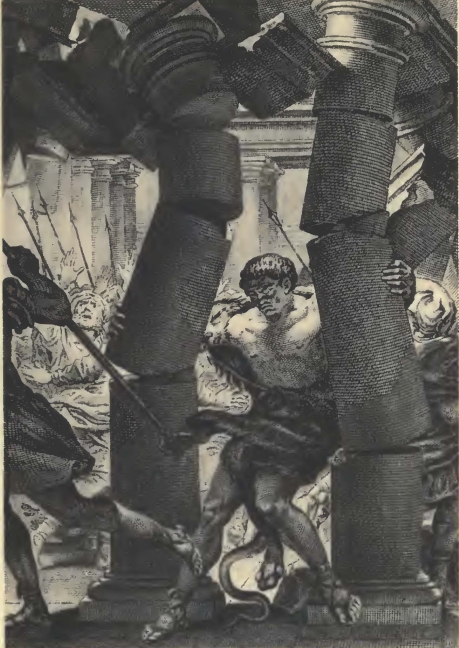
SAMSON.
In quality of poor alphabetical compilers, collectors of anecdotes, gatherers of trifles, pickers of rags at the corners of the streets, we glorify ourselves with all the pride attached to our sublime science, on having discovered that "Samson the Strong," a tragedy, was played at the close of the sixteenth century, in the town of Rouen, and that it was printed by Abraham Couturier. John Milton, for a long time a schoolmaster of London, afterwards Latin secretary to the protector, Cromwell—Milton, the author of "Paradise Lost" and "Paradise Regained"—wrote the tragedy of "Samson Agonistes"; and it is very unfortunate that we cannot tell in what year.
We know, however, that it has been printed with a preface, in which much is boasted, by one of our brethren, the commentator named Paræus, who first perceived by the force of his genius, that the Apocalypse is a tragedy. On the strength of this discovery he divided the Apocalypse into five acts, and inserted choruses worthy of the elegance and fine nature of the piece. The author of this preface speaks to us of the fine tragedies of St. Gregory of Nazianzen. He asserts, that a tragedy should never have more than five acts, and to prove it, he gives us the "Samson Agonistes" of Milton, which has but one. Those who like elaborate declamation will be satisfied with this piece.
A comedy of Samson was played for a long time in Italy. A translation of it was made in Paris in 1717, by one named Romagnesi; it was represented on the French theatre of the pretended Italian comedy, formerly the palace of the dukes of Burgundy. It was published, and dedicated to the duke of Orleans, regent of France.
In this sublime piece, Arlequin, the servant of Samson, fights with a turkey-cock, whilst his master carries off the gates of Gaza on his shoulders.
In 1732, it was wished to represent, at the opera of Paris, a tragedy of Samson, set to music by the celebrated Rameau; but it was not permitted. There was neither Arlequin nor turkey-cock; but the thing appeared too serious; besides, certain people were very glad to mortify Rameau, who possessed great talents. Yet at that time they performed the opera of "Jephthah," extracted from the Old Testament, and the comedy of the "Prodigal Son," from the New Testament.
There is an old edition of the "Samson Agonistes" of Milton, preceded by an abridgment of the history of the hero. The following is this abridgment:
The Jews, to whom God promised by oath all the country which is between the river of Egypt and the Euphrates, and who through their sins never had this country, were on the contrary reduced to servitude, which slavery lasted for forty years. Now there was a Jew of the tribe of Dan, named Manoah; and the wife of this Manoah was barren; and an angel appeared to this woman, and said to her, "Behold, thou shalt conceive and bear a son; and now drink no wine nor strong drink, neither eat any unclean thing; for the child shall be a Nazarite to God, from the womb to the day of his death."
The angel afterwards appeared to the husband and wife; they gave him a kid to eat; he would have none of it, and disappeared in the midst of the smoke; and the woman said, We shall surely die, because we have seen God; but they died not.
The slave Samson being born, was consecrated a Nazarite. As soon as he was grown up, the first thing he did was to go to the Phœnician or Philistine town of Timnath, to court a daughter of one of his masters, whom he married.
In going to his mistress he met a lion, and tore him in pieces with his naked hand, as he would have done a kid. Some days after, he found a swarm of bees in the throat of the dead lion, with some honey, though bees never rest on carrion.
Then he proposed this enigma to his companions: Out of the eater came forth meat, and out of the strong came forth sweetness: if you guess, I will give you thirty tunics and thirty gowns; if not, you shall give me thirty gowns and thirty tunics. The comrades, not being able to guess in what the solution of the enigma consisted, gained over the young wife of Samson; she drew the secret from her husband, and he was obliged to give them thirty tunics and thirty gowns. "Ah," said he to them, "if ye had not ploughed with my heifer, ye would not have found out my riddle."
Soon after, the father-in-law of Samson gave another husband to his daughter.
Samson, enraged at having lost his wife, immediately caught three hundred foxes, tied them two together by the tails with lighted firebrands, and they fired the corn of the Philistines.
The Jewish slaves, not being willing to be punished by their masters for the exploits of Samson, surprised him in the cavern in which he dwelt, tied him with great ropes, and delivered him to the Philistines. As soon as he was in the midst of them, he broke his cords, and finding the jawbone of an ass, with one effort he killed a thousand Philistines. Such an effort making him very warm, he was dying of thirst, on which God made a fountain spout from one of the teeth of the ass's jaw-bone. Samson, having drunk, went into Gaza, a Philistine town; he there immediately became smitten with a courtesan. As he slept with her, the Philistines shut the gates of the town, and surrounded the house, when he arose, took the gates, and carried them away. The Philistines, in despair at not being able to overcome this hero, addressed themselves to another courtesan named Delilah, with whom he afterwards slept. She finally drew from him the secret in which his strength consisted: it was only necessary to shave him, to render him equal to other men. He was shaved, became weak, and his eyes being put out, he was made to turn a mill and to play on the violin. One day, while playing in a Philistine temple, between two of its columns, he became indignant that the Philistines should have columned temples, whilst the Jews had only a tabernacle supported on four poles. He also felt that his hair began to grow; and being transported with a holy zeal, he pulled down the two pillars; by which concussion the temple was overthrown, the Philistines were crushed to death, and he with them.
Such is this preface, word for word.
This is the history which is the subject of the piece of Milton, and Romagnesi: it is adapted to Italian farce.
SATURN'S RING.
This astonishing phenomenon, but not more astonishing than others, this solid and luminous body, which surrounds the planet Saturn, which it enlightens, and by which it is enlightened, whether by the feeble reflection of the sun's rays, or by some unknown cause, was, according to a dreamer who calls himself a philosopher, formerly a sea. This sea, according to him, has hardened and become earth or rock; once it gravitated towards two centres, whereas at present it gravitates only towards one.
How pleasantly you proceed, my ingenious dreamer! how easily you transform water into rock! Ovid was nothing in the comparison. What a marvellous power you exercise over nature; imagination by no means confounds you. Oh, greediness to utter novelties! Oh, fury for systems! Oh, weakness of the human mind! If anyone has spoken of this reverie in the "Encyclopædia," it is doubtless to ridicule it, without which other nations would have a right to say: Behold the use which the French make of the discovery of other people! Huyghens discovered the ring of Saturn, and calculated its appearances; Hook and Flamstead have done the same thing. A Frenchman has discovered that this solid body was even a circular ocean, and this Frenchman is not Cyrano de Bergerac!
SCANDAL.
Without inquiring whether scandal originally meant a stone which might occasion people to stumble and fall, or a quarrel, or a seduction, we consider it here merely in its present sense and acceptation. A scandal is a serious indecorum which is used generally in reference to the clergy. The tales of Fontaine are libertine or licentious; many passages of Sanchez, of Tambourin, and of Molina are scandalous.
A man is scandalous by his writings or by his conduct. The siege which the Augustins maintained against the patrol, at the time of the Fronde, was scandalous. The bankruptcy of the brother La Valette, of the Society of Jesuits, was more than scandalous. The lawsuit carried on by the reverend fathers of the order of the Capuchins of Paris, in 1764, was a most satisfactory and delightful scandal to thousands. For the edification of the reader, a word or two upon that subject in this place will not be ill employed.
These reverend fathers had been fighting in their convent; some of them had hidden their money, and others had stolen the concealed treasure. Up to this point the scandal was only particular, a stone against which only Capuchins could trip and tumble; but when the affair was brought before the parliament, the scandal became public.
It is stated in the pleadings in the cause, that the convent of the St. Honoré consumes twelve hundred pounds of bread a week, and meat and wood in proportion; and that there are four collecting friars, "quêteurs," whose office it is, conformably to the term, to raise contributions in the city. What a frightful, dreadful scandal! Twelve hundred pounds of meat and bread per week for a few Capuchins, while so many artisans overwhelmed with old age, and so many respectable widows, are exposed to languish in want, and die in misery!
That the reverend father Dorotheus should have accumulated an income of three thousand livres a year at the expense of the convent, and consequently of the public, is not only an enormous scandal, but an absolute robbery, and a robbery committed upon the most needy class of citizens in Paris; for the poor are the persons who pay the tax imposed by the mendicant monks. The ignorance and weakness of the people make them imagine that they can never obtain heaven without parting with their absolute necessaries, from which these monks derive their superfluities.
This single brother, therefore, the chief of the convent, Dorotheus, to make up his income of a thousand crowns a year, must have extorted from the poor of Paris, no less a sum than twenty thousand crowns.
Consider, my good reader, that such cases are by no means rare, even in this eighteenth century of our era, which has produced useful books to expose abuses and enlighten minds; but, as I have before observed, the people never read. A single Capuchin, Recollet, or Carmelite is capable of doing more harm than the best books in the world will ever be able to do good.
I would venture to propose to those who are really humane and well-disposed, to employ throughout the capital a certain number of anti-Capuchins and anti-Recollets, to go about from house to house exhorting fathers and mothers to virtue, and to keep their money for the maintenance of their families, and the support of their old age; to love God with all their hearts, but to give none of their money to monks. Let us return, however, to the real meaning of the word "scandal."
In the above-mentioned process on the subject of the Capuchin convent, Brother Gregory is accused of being the father of a child by Mademoiselle Bras-defer, and of having her afterwards married to Moutard, the shoe-maker. It is not stated whether Brother Gregory himself bestowed the nuptial benediction on his mistress and poor Moutard, together with the required dispensation. If he did so, the scandal is rendered as complete as possible; it includes fornication, robbery, adultery, and sacrilege. "Horresco referens."
I say in the first place "fornication," as Brother Gregory committed that offence with Magdalene Bras-defer, who was not at the time more than fifteen years of age.
I also say "robbery," as he gave an apron and ribbons to Magdalene; and it is clear he must have robbed the convent in order to purchase them, and to pay for suppers, lodgings, and other expenses attending their intercourse.
I say "adultery," as this depraved man continued his connection with Magdalene after she became Madame Moutard.
And I say "sacrilege," as he was the confessor of Magdalene. And, if he himself performed the marriage ceremony for his mistress, judge what sort of man Brother Gregory must really have been.
One of our colleagues in this little collection of philosophic and encyclopædic questions is now engaged on a moral work, on the subject of scandal, against the opinion of Brother Patouillet. We hope it will not be long before it sees the light.
SCHISM.
All that we had written on the subject of the grand schism between the Greeks and Latins, in the essay on the manners and spirit of nations, has been inserted in the great encyclopædic dictionary. We will not here repeat ourselves.
But when reflecting on the meaning of the word "schism," which signifies a dividing or rending asunder, and considering also the present state of Poland, divided and rent as it is in a manner the most pitiable, we cannot help anew deploring that a malady so destructive should be peculiar to Christians. This malady, which we have not described with sufficient particularity, is a species of madness which first affects the eyes and the mouth; the patient looks with an impatient and resentful eye on the man who does not think exactly like himself, and soon begins to pour out all the abuse and reviling that his command of language will permit. The madness next seizes the hands; and the unfortunate maniac writes what exhibits, in the most decided manner, the inflamed and delirious state of the brain. He falls into demoniacal convulsions, draws his sword, and fights with fury and desperation to the last gasp. Medicine has never been able to find a remedy for this dreadful disease. Time and philosophy alone can effect a cure.
The Poles are now the only people among whom this contagion at present rages. We may almost believe that the disorder is born with them, like their frightful plica. They are both diseases of the head, and of a most noxious character. Cleanliness will cure the plica; wisdom alone can extirpate schism.
We are told that both these diseases were unknown to the Samartians while they were Pagans. The plica affects only the common people at present, but all the evils originating in schism are corroding and destroying the higher classes of the republic.
The cause of the evil is the fertility of their land, which produces too much corn. It is a melancholy and deplorable case that even the blessing of heaven should in fact have involved them in such direful calamity. Some of the provinces have contended that it was absolutely necessary to put leaven in their bread, but the greater part of the nation entertain an obstinate and unalterable belief, that, on certain days of the year, fermented bread is absolutely mortal.
Such is one of the principal causes of the schism or the rending asunder of Poland; the dispute has infused acrimony into their blood. Other causes have added to the effect.
Some have imagined, in the paroxysms and convulsions of the malady under which they labor, that the Holy Spirit proceeded both from the Father and the Son: and the others have exclaimed, that it proceeded from the Father only. The two parties, one of which is called the Roman party, and the other the Dissident, look upon each other as if they were absolutely infected by the plague; but, by a singular symptom peculiar to this complaint, the infected Dissidents have always shown an inclination to approach the Catholics, while the Catholics on the other hand have never manifested any to approach them.
There is no disease which does not vary in different circumstances and situations. The diet, which is generally esteemed salutary, has been so pernicious to this unhappy nation, that after the application of it in 1768, the cities of Uman, Zablotin, Tetiou, Zilianki, and Zafran were destroyed and inundated with blood; and more than two hundred thousand patients miserably perished.
On one side the empire of Russia, and on the other that of Turkey, have sent a hundred thousand surgeons provided with lancets, bistouries, and all sorts of instruments, adapted to cut off the morbid and gangrened parts; but the disease has only become more virulent. The delirium has even been so outrageous, that forty of the patients actually met together for the purpose of dissecting their king, who had never been attacked by the disease, and whose brain and all the vital and noble parts of his body were in a perfectly sound state, as we shall have to remark under the article on "Superstition." It is thought that if the contending parties would refer the case entirely to him, he might effect a cure of the whole nation; but it is one of the symptoms of this cruel malady to be afraid of being cured, as persons laboring under hydrophobia dread even the sight of water.
There are some learned men among us who contend that the disease was brought, a long time ago, from Palestine, and that the inhabitants of Jerusalem and Samaria were long harassed by it. Others think that the original seat of the disease was Egypt, and that the dogs and cats, which were there held in the highest consideration, having become mad, communicated the madness of schism, or tearing asunder, to the greater part of the Egyptians, whose weak heads were but too susceptible to the disorder.
It is remarked also, that the Greeks who travelled to Egypt, as, for example, Timeus of Locris and Plato, somewhat injured their brains by the excursion. However, the injury by no means reached madness, or plague, properly so called; it was a sort of delirium which was not at all times easily to be perceived, and which was often concealed under a very plausible appearance of reason. But the Greeks having, in the course of time, carried the complaint among the western and northern nations, the malformation or unfortunate excitability of the brain in our unhappy countries occasioned the slight fever of Timeus and Plato to break out among us into the most frightful and fatal contagion, which the physicians sometimes called intolerance, and sometimes persecution; sometimes religious war, sometimes madness, and sometimes pestilence.
We have seen the fatal ravages committed by this infernal plague over the face of the earth. Many physicians have offered their services to destroy this frightful evil at its very root. But what will appear to many scarcely credible is, that there are entire faculties of medicine, at Salamanca and Coimbra, in Italy and even in Paris, which maintain that schism, division, or tearing asunder, is necessary for mankind; that corrupt humors are drawn off from them through the wounds which it occasions; that enthusiasm, which is one of the first symptoms of the complaint, exalts the soul, and produces the most beneficial consequences; that toleration is attended with innumerable inconveniences; that if the whole world were tolerant, great geniuses would want that powerful and irresistible impulse which has produced so many admirable works in theology; that peace is a great calamity to a state, because it brings back the pleasures in its train; and pleasures, after a course of time, soften down that noble ferocity which forms the hero; and that if the Greeks had made a treaty of commerce with the Trojans, instead of making war with them, there would never have been an Achilles, a Hector, or a Homer, and that the race of man would have stagnated in ignorance.
These reasons, I acknowledge, are not without force; and I request time for giving them due consideration.
SCROFULA.
It has been pretended that divine power is appealed to in regard to this malady, because it is scarcely in human power to cure it.
Possibly some monks began by supposing that kings, in their character of representatives of the divinity, possessed the privilege of curing scrofula, by touching the patients with their anointed hands. But why not bestow a similar power on emperors, whose dignity surpasses that of kings, or on popes, who call themselves the masters of emperors, and who are more than simple images of God, being His vicars on earth? It is possible, that some imaginary dreamer of Normandy, in order to render the usurpation of William the Bastard the more respectable, conceded to him, in quality of God's representative, the faculty of curing scrofula by the tip of his finger.
It was some time after William that this usage became established. We must not gratify the kings of England with this gift, and refuse it to those of France, their liege lords. This would be in defiance of the respect due to the feudal system. In short, this power is traced up to Edward the Confessor in England, and to Clovis in France.
The only testimony, in the least degree credible, of the antiquity of this usage, is to be found in the writings in favor of the house of Lancaster, composed by the judge, Sir John Fortescue, under Henry VI., who was recognized king of France at Paris in his cradle, and then king of England, but who lost both kingdoms. Sir John Fortescue asserts, that from time immemorial, the kings of England were in possession of the power of curing scrofula by their touch. We cannot perceive, however, that this pretension rendered their persons more sacred in the wars between the roses.
Queens consort could not cure scrofula, because they were not anointed in the hands, like the kings: but Elizabeth, a queen regnant and anointed, cured it without difficulty.
A sad thing happened to Mortorillo the Calabrian, whom we denominate St. Francis de Paulo. King Louis XI. brought him to Plessis les Tours to cure him of his tendency to apoplexy, and the saint arrived afflicted by scrofula.
"Ipse fuit detentus gravi, inflatura, quam in parte inferiori, genæ suæ dextrae circa guttur patiebatur. Chirugii dicebant, mortum esse scrofarum."
The saint cured not the king, and the king cured not the saint.
When the king of England, James II., was conducted from Rochester to Whitehall, somebody proposed that he should exhibit a proof of genuine royalty, as for instance, that of touching for the evil; but no one was presented to him. He departed to exercise his sovereignty in France at St. Germain, where he touched some Hibernians. His daughter Mary, King William, Queen Anne, and the kings of the house of Brunswick have cured nobody. This sacred gift departed when people began to reason.
SECT.
SECTION I.
Every sect, of whatever opinion it may be, is a rallying point for doubt and error. Scotists, Thomists, Realists, Nominalists, Papists, Calvinists, Molinists, and Jansenists, are only warlike appellations.
There is no sect in geometry; we never say: A Euclidian, an Archimedian. When truth is evident, it is impossible to divide people into parties and factions. Nobody disputes that it is broad day at noon.
That part of astronomy which determines the course of the stars, and the return of eclipses, being now known, there is no longer any dispute among astronomers.
It is similar with a small number of truths, which are similarly established; but if you are a Mahometan, as there are many men who are not Mahometans, you may possibly be in error.
What would be the true religion, if Christianity did not exist? That in which there would be no sects; that in which all minds necessarily agreed.
Now, in what doctrine are all minds agreed? In the adoration of one God, and in probity. All the philosophers who have professed a religion have said at all times: "There is a God, and He must be just." Behold then the universal religion, established throughout all time and among all men! The point then in which all agree is true; the systems in regard to which all differ are false.
My sect is the best, says a Brahmin. But, my good friend, if thy sect is the best, it is necessary; for if not absolutely necessary, thou must confess that it is useless. If, on the contrary, it is necessary, it must be so to all men; how then is it that all men possess not what is absolutely necessary to them? How is it that the rest of the world laughs at thee and thy Brahma?
When Zoroaster, Hermes, Orpheus, Minos, and all the great men say: Let us worship God, and be just, no one laughs; but all the world sneers at him who pretends, that to please God it is proper to die holding a cow by the tail; at him who cuts off a particle of foreskin for the same purpose; at him who consecrates crocodiles and onions; at him who attaches eternal salvation to the bones of dead men carried underneath the shirt, or to a plenary indulgence purchased at Rome for two sous and a half.
Whence this universal assemblage of laughing and hissing from one end of the universe to the other? It must be that the things which all the world derides are not evident truths. What shall we say to a secretary of Sejanus, who dedicates to Petronius a book, in a confused and involved style, entitled "The Truth of the Sibylline Oracles, Proved from Facts."
This secretary at first proves to you, that God sent upon earth many Sibyls, one after the other, having no other means of instructing men. It is demonstrated, that God communicated with these Sibyls, because the word "sibyl" signifies "Council of God." They ought to live a long time, for this privilege at least belongs to persons with whom God communicates. They amounted to twelve, because this number is sacred. They certainly predicted all the events in the world, because Tarquin the Proud bought their book from an old woman for a hundred crowns. What unbeliever, exclaims the secretary, can deny all these evident facts, which took place in one corner of the earth, in the face of all the world? Who can deny the accomplishment of their prophecies? Has not Virgil himself cited the predictions of the Sibyls? If we have not the first copies of the Sibylline books, written at a time when no one could read and write, we have authentic copies. Impiety must be silent before such proofs. Thus spoke Houteville to Sejanus, and hoped to obtain by it the place of chief augur, with a revenue of fifty thousand livres; but he obtained nothing.
That which my sect teaches me is obscure, I confess it, exclaims a fanatic; and it is in consequence of that obscurity that I must believe it; for it says itself that it abounds in obscurities. My sect is extravagant, therefore it is divine; for how, appearing so insane, would it otherwise have been embraced by so many people. It is precisely like the Koran, which the Sonnites say presents at once the face of an angel and that of a beast. Be not scandalized at the muzzle of the beast, but revere the face of the angel. Thus spoke this madman; but a fanatic of another sect replied to the first fanatic: It is thou who art the beast, and I who am the angel.
Now who will judge this process, and decide between these two inspired personages? The reasonable and impartial man who is learned in a science which is not that of words; the man divested of prejudice, and a lover of truth and of justice; the man, in fine, who is not a beast, and who pretends not to be an angel.
SECTION II.
Sect and error are synonymous terms. Thou art a peripatetic and I a Platonist; we are therefore both in the wrong; for thou opposest Plato, because his chimeras repel thee; and I fly from Aristotle, because it appears to me that he knew not what he said. If the one or the other had demonstrated the truth, there would have been an end of sect. To declare for the opinion of one in opposition to that of another, is to take part in a civil war. There is no sect in mathematics or experimental philosophy: a man who examines the relation between a cone and a sphere is not of the sect of Archimedes; and he who perceived that the square of the hypotenuse of a right-angled triangle is equal to the sum of the squares of the other two sides, is not in consequence a Pythagorean.
When we say that the blood circulates, that the air is weighty, that the rays of the sun are a bundle of seven refrangible rays, it follows not that we are of the sect of Harvey, of Torricelli, or of Newton; we simply acquiesce in the truths which they demonstrate, and the whole universe will be of the same opinion.
Such is the character of truth, which belongs to all time and to all men. It is only to be produced to be acknowledged, and admits of no opposition. A long dispute signifies that both parties are in error.
SELF-LOVE.
Nicole, in his "Moral Essays," written after two or three thousand volumes on morals (Treatise on Charity, chap, ii.), says, that "by means of the gibbets and tortures which are established in common, the tyrannical designs of the self-love of each individual are repressed."
I will not examine whether we have gibbets in common, as we have fields and woods in common, and a common purse, or if thoughts are repressed by wheels; but it seems to me very strange that Nicole has taken highway robbery and murder for self-love. The distinctions must be a little more examined. He who should say that Nero killed his mother from self-love, that Cartouche had much self-love, would not express himself very correctly. Self-love is not a wickedness; it is a sentiment natural to all men; it is much more the neighbor of vanity than of crime.
A beggar of the suburbs of Madrid boldly asked alms; a passenger said to him: Are you not ashamed to carry on this infamous trade, when you can work? Sir, replied the mendicant, I ask you for money, and not for advice; and turned his back on him with Castilian dignity. This gentleman was a haughty beggar; his vanity was wounded by very little: he asked alms for love of himself, and would not suffer the reprimand from a still greater love of himself.
A missionary, travelling in India, met a fakir loaded with chains, naked as an ape, lying on his stomach, and lashing himself for the sins of his countrymen, the Indians, who gave him some coins of the country. What a renouncement of himself! said one of the spectators. Renouncement of myself! said the fakir, learn that I only lash myself in this world to serve you the same in the next, when you will be the horses and I the rider.
Those who said that love of ourselves is the basis of all our sentiments and actions were right; and as it has not been written to prove to men that they have a face, there is no occasion to prove to them that they possess self-love. This self-love is the instrument of our preservation; it resembles the provision for the perpetuity of mankind; it is necessary, it is dear to us, it gives us pleasure, and we must conceal it.
SENSATION.
Oysters, it is said, have two senses; moles four; all other animals, like man, five. Some people contend for a sixth, but it is evident that the voluptuous sensation to which they allude is reducible to that of touch; and that five senses are our lot. It is impossible for us to imagine anything beyond them, or to desire out of their range.
It may be, that in other globes the inhabitants possess sensations of which we can form no idea. It is possible that the number of our senses augments from globe to globe, and that an existence with innumerable and perfect senses will be the final attainment of all being.
But with respect to ourselves and our five senses, what is the extent of our capacity? We constantly feel in spite of ourselves, and never because we will do so: it is impossible for us to avoid having the sensation which our nature ordains when any object excites it. The sensation is within us, but depends not upon ourselves. We receive it, but how do we receive it? It is evident that there is no connection between the stricken air, the words which I sing, and the impression which these words make upon my brain.
We are astonished at thought, but sensation is equally wonderful. A divine power is as manifest in the sensation of the meanest of insects as in the brain of Newton. In the meantime, if a thousand animals die before our eyes, we are not anxious to know what becomes of their faculty of sensation, although it is as much the work of the Supreme Being as our own. We regard them as the machines of nature, created to perish, and to give place to others.
For what purpose and in what manner may their sensations exist, when they exist no longer? What need has the author of all things to preserve qualities, when the substance is destroyed? It is as reasonable to assert that the power of the plant called "sensitive," to withdraw its leaves towards its branches, exists when the plant is no more. You will ask, without doubt, in what manner the sensation of animals perishes with them, while the mind of man perishes not? I am too ignorant to solve this question. The eternal author of mind and of sensation alone knows how to give, and how to preserve them.
All antiquity maintains that our understanding contains nothing which has not been received by our senses. Descartes, on the contrary, asserts in his "Romances," that we have metaphysical ideas before we are acquainted with the nipple of our nurse. A faculty of theology proscribed this dogma, not because it was erroneous, but because it was new. Finally, however, it was adopted, because it had been destroyed by Locke, an English philosopher, and an Englishman must necessarily be in the wrong. In fine, after having so often changed opinion, the ancient opinion which declares that the senses are the inlets to the understanding is finally proscribed. This is acting like deeply indebted governments, who sometimes issue certain notes which are to pass current, and at other times cry them down; but for a long time no one will accept the notes of the said faculty of theology.
All the faculties in the world will never prevent a philosopher from perceiving that we commence by sensation, and that our memory is nothing but a continued sensation. A man born without his five senses would be destitute of all idea, supposing it possible for him to live. Metaphysical notions are obtained only through the senses; for how is a circle or a triangle to be measured, if a circle or a triangle has neither been touched nor seen? How form an imperfect notion of infinity, without a notion of limits? And how take away limits, without having either beheld or felt them?
Sensation includes all our faculties, says a great philosopher. What ought to be concluded from all this? You who read and think, pray conclude.
The Greeks invented the faculty "Psyche" for sensation, and the faculty "Nous" for mind. We are, unhappily, ignorant of the nature of these two faculties: we possess them, but their origin is no more known to us than to the oyster, the sea-nettle, the polypus, worms, or plants. By some inconceivable mechanism, sensitiveness is diffused throughout my body, and thought in my head alone. If the head be cut off, there will remain a very small chance of its solving a problem in geometry. In the meantime, your pineal gland, your fleshly body, in which abides your soul, exists for a long time without alteration, while your separated head is so full of animal spirits that it frequently exhibits motion after its removal from the trunk. It seems as if at this moment it possessed the most lively ideas, resembling the head of Orpheus, which still uttered melodious song, and chanted Eurydice, when cast into the waters of the Hebrus.
If we think no longer, after losing our heads, whence does it happen that the heart beats, and appears to be sensitive after being torn out?
We feel, you say, because all our nerves have their origin in the brain; and in the meantime, if you are trepanned, and a portion of your brain be thrown into the fire, you feel nothing the less. Men who can state the reason of all this are very clever.
SENTENCES (REMARKABLE).
On Natural Liberty.
In several countries, and particularly in France, collections have been made of the juridical murders which tyranny, fanaticism, or even error and weakness, have committed with the sword of justice.
There are sentences of death which whole years of vengeance could scarcely expiate, and which will make all future ages tremble. Such are the sentences given against the natural king of Naples and Sicily, by the tribunal of Charles of Anjou; against John Huss and Jerome of Prague, by priests and monks; and against the king of England, Charles I., by fanatical citizens.
After these enormous crimes, formally committed, come the legal murders committed by indolence, stupidity, and superstition, and these are innumerable. We shall relate some of them in other articles.
In this class we must principally place the trials for witchcraft, and never forget that even in our days, in 1750, the sacerdotal justice of the bishop of Würzburg has condemned as a witch a nun, a girl of quality, to the punishment of fire. I here repeat this circumstance, which I have elsewhere mentioned, that it should not be forgotten. We forget too much and too soon.
Every day of the year I would have a public crier, instead of crying as in Germany and Holland what time it is—which is known very well without their crying—cry: It was on this day that, in the religious wars Magdeburg and all its inhabitants were reduced to ashes. It was on May 14th that Henry IV. was assassinated, only because he was not submissive to the pope; it was on such a day that such an abominable cruelty was perpetrated in your town, under the name of justice.
These continual advertisements would be very useful; but the judgments given in favor of innocence against persecutors should be cried with a much louder voice. For example, I propose, that every year, the two strongest throats which can be found in Paris and Toulouse shall cry these words in all the streets: It was on such a day that fifty magistrates of the council re-established the memory of John Calas, with a unanimous voice, and obtained for his family the favors of the king himself, in whose name John Calas had been condemned to the most horrible execution.
It would not be amiss to have another crier at the door of all the ministers, to say to all who came to demand lettres de cachet, in order to possess themselves of the property of their relations, friends, or dependents: Gentlemen, fear to seduce the minister by false statements, and to abuse the name of the king. It is dangerous to take it in vain. There was in the world one Gerbier, who defended the cause of the widow and orphan oppressed under the weight of a sacred name. It was he who, at the bar of the Parliament of Paris, obtained the abolishment of the Society of Jesus. Listen attentively to the lesson which he gave to the society of St. Bernard, conjointly with Master Loiseau, another protector of widows.
You must first know, that the reverend Bernardine fathers of Clairvaux possess seventeen thousand acres of wood, seven large forges, fourteen large farms, a quantity of fiefs, benefices, and even rights in foreign countries. The yearly revenue of the convent amounts to two hundred thousand livres. The treasure is immense; the abbot's palace is that of a prince. Nothing is more just; it is a poor recompense for the services which the Bernardines continually render to the State.
It happened, that a youth of seventeen years of age, named Castille, whose baptismal name was Bernard, believed, for that reason, that he should become a Bernardine. It is thus that we reason at seventeen, and sometimes at thirty. He went to pass his novitiate at Lorraine, in the abbey of Orval. When he was required to pronounce his vows, grace was wanting in him: he did not sign them; he departed and became a man again. He established himself at Paris, and at the end of thirty years, having made a little fortune, he married, and had children.
The reverend father, attorney of Clairvaux, named Mayeur, a worthy solicitor, brother of the abbot, having learned from a woman of pleasure at Paris, that this Castille was formerly a Bernardine, plotted to challenge him as a deserter—though he was not really engaged—to make his wife pass for his concubine, and to place his children in the hospital as bastards. He associated himself with another rogue, to divide the spoils. Both went to the court for lettres de cachet, exposed their grievances in the name of St. Bernard, obtained the letter, seized Bernard Castille, his wife, and their children, possessed themselves of all the property, and are now devouring it, you know where.
Bernard Castille was shut up at Orval in a dungeon, where he was executed after six months, for fear that he should demand justice. His wife was conducted to another dungeon, at St. Pelagie, a house for prostitutes. Of three children, one died in the hospital.
Things remained in this state for three years. At the end of this time, the wife of Castille obtained her enlargement. God is just: He gave a second husband to the widow. The husband, named Lannai, was a man of head, who discovered all the frauds, horrors, and crimes employed against his wife. They both entered into a suit against the monks. It is true, that brother Mayeur, who is called Dom Mayeur, was not hanged, but the convent of Clairvaux was condemned to pay forty thousand livres. There is no convent which would not rather see its attorney hanged than lose its money.
This history should teach you, gentlemen, to use much moderation in the fact of lettres de cachet. Know, that Master Elias de Beaumont, that celebrated defender of the memory of Calas, and Master Target that other protector of oppressed innocence, caused the man to pay a fine of twenty thousand francs, who by his intrigues had gained a lettre de cachet to seize upon the dying countess of Lancize, to drag her from the bosom of her family and divest her of all her titles.
When tribunals give such sentences as these, we hear clapping of hands from the extent of the grand chamber to the gates of Paris. Take care of yourselves, gentlemen; do not lightly demand lettres de cachet.
An Englishman, on reading this article, exclaimed, "What is a lettre de cachet?" We could never make him comprehend it.
SENTENCES OF DEATH.
In reading history, and seeing its course continually interrupted with innumerable calamities heaped upon this globe, which some call the best of all possible worlds, I have been particularly struck with the great quantity of considerable men in the State, in the Church, and in society, who have suffered death like robbers on the highway. Setting aside assassinations and poisonings, I speak only of massacres in a juridical form, performed with loyalty and ceremony; I commence with kings and queens; England alone furnishes an ample list; but for chancellors, knights, and esquires, volumes are required. Of all who have thus perished by justice, I do not believe that there are four in all Europe who would have undergone their sentence if their suits had lasted some time longer, or if the adverse parties had died of apoplexy during the preparation.
If fistula had gangrened the rectum of Cardinal Richelieu some months longer, the virtuous de Thou, Cinq-Mars, and so many others would have been at liberty. If Barneveldt had had as many Arminians for his judges as Gomerists, he would have died in his bed; if the constable de Luynes had not demanded the confiscation of the property of the lady of the Marshal d'Ancre, she would not have been burned as a witch. If a really criminal man, an assassin, a public thief, a poisoner, a parricide, be arrested, and his crime be proved, it is certain that in all times and whoever the judges, he will be condemned. But it is not the same with statesmen; only give them other judges, or wait until time has changed interests, cooled passions, and introduced other sentiments, and their lives will be in safety.
Suppose Queen Elizabeth had died of an indigestion on the eve of the execution of Mary Stuart, then Mary Stuart would have been seated on the throne of England, Ireland, and Scotland, instead of dying by the hand of an executioner in a chamber hung with black. If Cromwell had only fallen sick, care would have been taken how Charles I.'s head was cut off. These two assassinations—disguised, I know not how, in the garb of the laws—scarcely entered into the list of ordinary injustice. Figure to yourself some highwaymen who, having bound and robbed two passengers, amuse themselves with naming in the troop an attorney-general, a president, an advocate and counsellors, and who, having signed a sentence, cause the two victims to be hanged in ceremony; it was thus that the Queen of Scotland and her grandson were judged.
But of common judgments, pronounced by competent judges against princes or men in place, is there a single one which would have been either executed, or even passed, if another time had been chosen? Is there a single one of the condemned, immolated under Cardinal Richelieu, who would not have been in favor if their suits had been prolonged until the regency of Anne of Austria? The Prince of Condé was arrested under Francis II., he was condemned to death by commissaries; Francis II. died, and the Prince of Condé again became powerful.
These instances are innumerable; we should above all consider the spirit of the times. Vanini was burned on a vague suspicion of atheism. At present, if any one was foolish and pedantic enough to write such books as Vanini, they would not be read, and that is all which could happen to them. A Spaniard passed through Geneva in the middle of the sixteenth century; the Picard, John Calvin, learned that this Spaniard was lodged at an inn; he remembered that this Spaniard had disputed with him on a subject which neither of them understood. Behold! my theologian, John Calvin, arrested the passenger, contrary to all laws, human or divine, contrary to the right possessed by people among all nations; immured him in a dungeon, and burned him at a slow fire with green faggots, that the pain might last the longer. Certainly this infernal manœuvre would never enter the head of any one in the present day; and if the fool Servetus had lived in good times, he would have had nothing to fear; what is called justice is therefore as arbitrary as fashion. There are times of horrors and follies among men, as there are times of pestilence, and this contagion has made the tour of the world.
SERPENTS.
"I certify that I have many times killed serpents by moistening in a slight degree, with my spittle, a stick or a stone, and giving them a slight blow on the middle of the body, scarcely sufficient to produce a small contusion. January 19, 1757. Figuier, Surgeon."
The above surgeon having given me this certificate, two witnesses, who had seen him kill serpents in this manner, attested what they had beheld. Notwithstanding, I wished to behold the thing myself; for I confess that, in various parts of these queries, I have taken St. Thomas of Didymus for my patron saint, who always insisted on an examination with his own hands.
For eighteen hundred years this opinion has been perpetuated among the people, and it might possibly be even eighteen thousand years old, if Genesis had not supplied us with the precise date of our enmity to this reptile. It may be asserted that if Eve had spit on the serpent when he took his place at her ear, a world of evil would have been spared human nature.
Lucretius, in his fourth book, alludes to this manner of killing serpents as very well known:
Est utique ut serpens hominis contacta salivis. Disperit, ac sese mandendo conficit ipsa. —LIB., iv, v. 642-643. Spit on a serpent, and his vigor flies, He straight devours himself, and quickly dies.
There is some slight contradiction in painting him at once deprived of vigor and self-devouring, but my surgeon Figuier asserts not that the serpents which he killed were self-devouring. Genesis says wisely that we kill them with our heels, and not with spittle.
We are in the midst of winter on January 19, which is the time when serpents visit us. I cannot find any at Mount Krapak; but I exhort all philosophers to spit upon every serpent they meet with in the spring. It is good to know the extent of the power of the saliva of man.
It is certain that Jesus Christ employed his spittle to cure a man who was deaf and dumb. He took him aside, placed His fingers on his ears, and looking up to heaven, sighed and said to him: "Ephphatha"—"be opened"—when the deaf and dumb person immediately began to speak.
It may therefore be true that God has allowed the saliva of man to kill serpents; but He may have also permitted my surgeon to assail them with heavy blows from a stick or a stone, in such a way that they would die whether he spat upon them or not.
I beg of all philosophers to examine the thing with attention. For example, should they meet Freron in the street, let them spit in his face, and if he die, the fact will be confirmed, in spite of all the reasoning of the incredulous.
I take this opportunity also to beg of philosophers not to cut off the heads of any more snails; for I affirm that the head has returned to snails which I have decapitated very effectively. But it is not enough that I know it by experience, others must be equally satisfied in order that the fact be rendered probable; for although I have twice succeeded, I have failed thirty times. Success depends upon the age of the snail, the time in which the head is cut off, the situation of the incision, and the manner in which it is kept until the head grows again.
If it is important to know that death may be inflicted by spitting, it is still more important to know that heads may be renewed. Man is of more consequence than a snail, and I doubt not that in due time, when the arts are brought to perfection, some means will be found to give a sound head to a man who has none at all.
SHEKEL.
A weight and denomination of money among the Jews; but as they never coined money, and always made use of the coinage of other people, all gold coins weighing about a guinea, and all silver coins of the weight of a small French crown, were called a shekel; and these shekels were distinguished into those of the weight of the sanctuary, and those of the weight of the king.
It is said in the Book of Samuel that Absalom had very fine hair, from which he cut a part every year. Many profound commentators assert that he cut it once a month, and that it was valued at two hundred shekels. If these shekels were of gold, the locks of Absalom were worth two thousand four hundred guineas per annum. There are few seigniories which produce at present the revenue that Absalom derived from his head.
It is said that when Abraham bought a cave in Hebron from the Canaanite Ephron, Ephron sold him the cave for four hundred shekels of silver, of current money with the merchant—probatæ monetæ publicæ.
We have already remarked that there was no coined money in these days, and thus these four hundred shekels of silver became four hundred shekels in weight, which, valued at present at three livres four sous each, are equal to twelve hundred and eighty livres of France.
It follows that the little field, which was sold with this cavern, was excellent land, to bring so high a price.
When Eleazar, the servant of Abraham, met the beautiful Rebecca, the daughter of Bethnel, carrying a pitcher of water upon her shoulder, from which she gave him and his camels leave to drink, he presented her with earrings of gold, which weighed two shekels, and bracelets which weighed ten, amounting in the whole to a present of the value of twenty-four guineas.
In the laws of Exodus it is said that if an ox gored a male or female slave, the possessor of the ox should give thirty shekels of silver to the master of the slave, and that the ox should be stoned. It is apparently to be understood that the ox in this case has produced a very dangerous wound, otherwise thirty-two crowns was a large sum for the neighborhood of Mount Sinai, where money was uncommon. It is for the same reason that many grave, but too hasty, persons suspect that Exodus as well as Genesis was not written until a comparatively late period.
What tends to confirm them in this erroneous opinion is a passage in the same Exodus: "Take of pure myrrh five hundred shekels, and of sweet cinnamon half as much; of sweet calamus two hundred and fifty shekels; of cassia five hundred shekels, after the shekel of the sanctuary; and of olive-oil a ton, to form an ointment to annoint the tabernacle"; and whosoever anointed himself or any stranger with a similar composition, was to be put to death.
It is added that with all these aromatics were to be united stacte, onyx, galbanum, and frankincense; and that a perfume was to be mixed up according to the art of the apothecary or perfumer.
But I cannot perceive anything in this composition which ought to excite the doubt of the incredulous. It is natural to imagine that the Jews—who, according to the text, stole from the Egyptians all which they could bring away—had also taken frankincense, galbanum, onyx, stacte, olive-oil, cassia, sweet calamus, cinnamon, and myrrh. They also, without doubt, stole many shekels; indeed, we have seen, that one of the most zealous partisans of this Hebrew horde estimates what they stole, in gold alone, at nine millions. I abide by his reckoning.
SIBYL.
The first woman who pronounced oracles at Delphos was called Sibylla. According to Pausanias, she was the daughter of Jupiter, and of Lamia, the daughter of Neptune, and she lived a long time before the siege of Troy. From her all women were distinguished by the name of sibyls, who, without being priestesses, or even attached to a particular oracle, announced the future, and called themselves inspired. Different ages and countries have had their sibyls, or preserved predictions which bear their name, and collections were formed of them.