Volume 9 — The WORKS of VOLTAIRE (continued 4)
William F. Fleming translation
That worthy chief of the dervishes, Ben-al-betif, said to his brethren one day: "My brethren, it is good that you should frequently use that sacred formula of our Koran, 'In the name of the most merciful God'; because God uses mercy, and you learn to do so too, by oft repeating the words that recommend virtue, without which there would be few men left upon the earth. But, my brethren, beware of imitating those rash ones who boast, on every occasion, of laboring for the glory of God.
"If a young simpleton maintains a thesis on the categories, an ignoramus in furs presiding, he is sure to write in large characters, at the head of his thesis, 'Ek alha abron doxa!—'Ad majorem Dei gloriam.' —To the greater glory of God. If a good Mussulman has had his house whitewashed, he cuts this foolish inscription in the door. A saka carries water for the greater glory of God. It is an impious usage, piously used. What would you say of a little chiaoux, who, while emptying our sultan's close-stool, should exclaim: "To the greater glory of our invincible monarch?" There is certainly a greater distance between God and the sultan than between the sultan and the little chiaoux.
"Ye miserable earth-worms, called men, what have you resembling the glory of the Supreme Being? Can He love glory? Can He receive it from you? Can He enjoy it? How long, ye two-legged animals without feathers, will you make God after your own image? What! because you are vain, because you love glory, you would have God love it also? If there were several Gods, perhaps each one would seek to gain the good opinion of his fellows. That might be glory to God. Such a God, if infinite greatness may be compared with extreme lowliness, would be like King Alexander or Iscander, who would enter the lists with none but kings. But you, poor creatures! what glory can you give to God? Cease to profane the sacred name. An emperor, named Octavius Augustus, forbade his being praised in the schools of Rome, lest his name should be brought into contempt. You can bring the name of the Supreme Being neither into contempt, nor into honor. Humble yourselves in the dust; adore, and be silent."
Thus spake Ben-al-betif; and the dervishes cried out: "Glory to God! Ben-al-betif has said well."
SECTION III.
Conversation with a Chinese.
In 1723, there was in Holland a Chinese: this Chinese was a man of letters and a merchant; which two professions ought not to be incompatible, but which have become so amongst us, thanks to the extreme regard which is paid to money, and the little consideration which mankind have ever shown, and will ever show, for merit.
This Chinese, who spoke a little Dutch, was once in a bookseller's shop with some men of learning. He asked for a book, and "Bossuet's Universal History," badly translated, was proposed to him. "Ah!" said he, "how fortunate! I shall now see what is said of our great empire—of our nation, which has existed as a national body for more than fifty thousand years—of that succession of emperors who have governed us for so many ages. I shall now see what is thought of the religion of the men of letters—of that simple worship which we render to the Supreme Being. How pleasing to see what is said in Europe of our arts, many of which are more ancient amongst us than any European kingdom. I guess the author will have made many mistakes in the history of the war which we had twenty-two thousand five hundred and fifty-two years ago, with the warlike nations of Tonquin and Japan, and of that solemn embassy which the mighty emperor of the Moguls sent to ask laws from us, in the year of the world 500,000,000,000,079,123,450,000." "Alas!" said one of the learned men to him, "you are not even mentioned in that book; you are too inconsiderable; it is almost all about the first nation in the world—the only nation, the great Jewish people!"
"The Jewish people!" exclaimed the Chinese. "Are they, then, masters of at least three-quarters of the earth?" "They flatter themselves that they shall one day be so," was the answer; "until which time they have the honor of being our old-clothes-men, and, now and then, clippers of our coin."—"You jest," said the Chinese; "had these people ever a vast empire?" "They had as their own for some years," said I, "a small country; but it is not by the extent of their states that a people are to be judged; as it is not by his riches that we are to estimate a man."
"But is no other people spoken of in this book?" asked the man of letters. "Undoubtedly," returned a learned man who stood next me, and who instantly replied, "there is a deal said in it of a small country sixty leagues broad, called Egypt, where it is asserted that there was a lake a hundred and fifty leagues round, cut by the hands of men."—"Zounds!" said the Chinese; "a lake a hundred and fifty leagues round in a country only sixty broad! That is fine, indeed!"—"Everybody was wise in that country," added the doctor. "Oh! what fine times they must have been," said the Chinese. "But is that all?"—"No," replied the European; "he also treats of that celebrated people, the Greeks." "Who are these Greeks?" asked the man of letters. "Ah!" continued the other, "they inhabited a province about a two-hundredth part as large as China, but which has been famous throughout the world." "I have never heard speak of these people, neither in Mogul nor in Japan, nor in Great Tartary," said the Chinese, with an ingenuous look.
"Oh, ignorant, barbarous man!" politely exclaimed our scholar. "Know you not, then, the Theban Epaminondas; nor the harbor of Piraeus; nor the name of the two horses of Achilles; nor that of Silenus's ass? Have you not heard of Jupiter, nor of Diogenes, nor of Lais, nor of Cybele, nor—"
"I am much afraid," replied the man of letters, "that you know nothing at all of the ever memorable adventure of the celebrated Xixofou Concochigramki, nor of the mysteries of the great Fi Psi Hi Hi. But pray, what are the other unknown things of which this universal history treats?" The scholar then spoke for a quarter of an hour on the Roman commonwealth: but when he came to Julius Cæsar, the Chinese interrupted him, saying, "As for him, I think I know him: was he not a Turk?"
"What!" said the scholar, somewhat warm, "do you not at least know the difference between Pagans, Christians, and Mussulmans? Do you not know Constantine, and the history of the popes?" "We have indistinctly heard," answered the Asiatic, "of one Mahomet."
"It is impossible," returned the other, "that you should not, at least, be acquainted with Luther, Zuinglius, Bellarmin, Œcolampadius." "I shall never remember those names," said the Chinese. He then went away to sell a considerable parcel of tea and fine grogram, with which he bought two fine girls and a ship-boy, whom he took back to his own country, adoring Tien, and commending himself to Confucius.
For myself, who was present at this conversation, I clearly saw what glory is; and I said: Since Cæsar and Jupiter are unknown in the finest, the most ancient, the most extensive, the most populous and well-regulated kingdom upon earth; it beseems you, ye governors of some little country, ye preachers in some little parish, or some little town—ye doctors of Salamanca and of Bourges, ye flimsy authors, and ye ponderous commentators—it beseems you to make pretensions to renown!
GOAT—SORCERY.
The honors of every kind which antiquity paid to goats would be very astonishing, if anything could astonish those who have grown a little familiar with the world, ancient and modern. The Egyptians and the Jews often designated the kings and the chiefs of the people by the word "goat." We find in Zachariah:
"Mine anger was kindled against the shepherds, and I punished the goats; for the Lord of Hosts hath visited his flock, the house of Judah, and hath made them as his goodly horse in the battle."
"Remove out of the midst of Babylon," says Jeremiah to the chiefs of the people; "go forth out of the land of the Chaldæans, and be as the he-goats before the flocks."
Isaiah, in chapters x. and xiv., uses the term "goat," which has been translated "prince." The Egyptians went much farther than calling their kings goats; they consecrated a goat in Mendes, and it is even said that they adored him. The truth very likely was, that the people took an emblem for a divinity, as is but too often the case.
It is not likely that the Egyptian shoën or shotim, i.e., priests, immolated goats and worshipped them at the same time. We know that they had their goat Hazazel, which they adorned and crowned with flowers, and threw down headlong, as an expiation for the people; and that the Jews took from them, not only this ceremony, but even the very name of Hazazel, as they adopted many other rites from Egypt.
But goats received another, and yet more singular honor. It is beyond a doubt that in Egypt many women set the same example with goats, as Pasiphae did with her bull.
The Jews but too faithfully imitated these abominations. Jeroboam instituted priests for the service of his calves and his goats.
The worship of the goat was established in Egypt, and in the lands of a part of Palestine. Enchantments were believed to be operated by means of goats, and other monsters, which were always represented with a goat's head.
Magic, sorcery, soon passed from the East into the West, and extended itself throughout the earth. The sort of sorcery that came from the Jews was called Sabbatum by the Romans, who thus confounded their sacred day with their secret abominations. Thence it was, that in the neighboring nations, to be a sorcerer and to go to the sabbath, meant the same thing.
Wretched village women, deceived by knaves, and still more by the weakness of their own imaginations, believed that after pronouncing the word "abraxa", and rubbing themselves with an ointment mixed with cow-dung and goat's hair, they went to the sabbath on a broom-stick in their sleep, that there they adored a goat, and that he enjoyed them.
This opinion was universal. All the doctors asserted that it was the devil, who metamorphosed himself into a goat. This may be seen in Del Rio's "Disquisitions," and in a hundred other authors. The theologian Grillandus, a great promoter of the Inquisition, quoted by Del Rio, says that sorcerers call the goat Martinet. He assures us that a woman who was attached to Martinet, mounted on his back, and was carried in an instant through the air to a place called the Nut of Benevento.
There were books in which the mysteries of the sorcerers were written. I have seen one of them, at the head of which was a figure of a goat very badly drawn, with a woman on her knees behind him. In France, these books were called "grimoires"; and in other countries "the devil's alphabet." That which I saw contained only four leaves, in almost illegible characters, much like those of the "Shepherd's Almanac."
Reasoning and better education would have sufficed in Europe for the extirpation of such an extravagance; but executions were employed instead of reasoning. The pretended sorcerers had their "grimoire" and the judges had their sorcerer's code. In 1599, the Jesuit Del Rio, a doctor of Louvain, published his "Magical Disquisitions." He affirms that all heretics are magicians, and frequently recommends that they be put to the torture. He has no doubt that the devil transforms himself into a goat and grants his favors to all women presented to him. He quotes various jurisconsults, called demonographers, who assert that Luther was the son of a woman and a goat. He assures us that at Brussels, in 1595, a woman was brought to bed of a child, of which the devil, disguised as a goat, was father, and that she was punished, but he does not inform us in what manner.
But the jurisprudence of witchcraft has been the most profoundly treated by one Boguet, "grand juge en dernier ressort" of an abbey of St. Claude in Franche-Comté. He gives an account of all the executions to which he condemned wizards and witches, and the number is very considerable. Nearly all the witches are supposed to have had commerce with the goat.
It has already been said that more than a hundred thousand sorcerers have been executed in Europe. Philosophy alone has at length cured men of this abominable delusion, and has taught judges that they should not burn the insane.
GOD—GODS.
SECTION I.
The reader cannot too carefully bear in mind that this dictionary has not been written for the purpose of repeating what so many others have said.
The knowledge of a God is not impressed upon us by the hands of nature, for then men would all have the same idea; and no idea is born with us. It does not come to us like the perception of light, of the ground, etc., which we receive as soon as our eyes and our understandings are opened. Is it a philosophical idea? No; men admitted the existence of gods before they were philosophers.
Whence, then, is this idea derived? From feeling, and from that natural logic which unfolds itself with age, even in the rudest of mankind. Astonishing effects of nature were beheld—harvests and barrenness, fair weather and storms, benefits and scourges; and the hand of a master was felt. Chiefs were necessary to govern societies; and it was needful to admit sovereigns of these new sovereigns whom human weakness had given itself—beings before whose power these men who could bear down their fellow-men might tremble. The first sovereigns in their time employed these notions to cement their power. Such were the first steps; thus every little society had its god. These notions were rude because everything was rude. It is very natural to reason by analogy. One society under a chief did not deny that the neighboring tribe should likewise have its judge, or its captain; consequently it could not deny that the other should also have its god. But as it was to the interest of each tribe that its captain should be the best, it was also interested in believing, and consequently it did believe, that its god was the mightiest. Hence those ancient fables which have so long been generally diffused, that the gods of one nation fought against the gods of another. Hence the numerous passages in the Hebrew books, which we find constantly disclosing the opinion entertained by the Jews, that the gods of their enemies existed, but that they were inferior to the God of the Jews.
Meanwhile, in the great states where the progress of society allowed to individuals the enjoyment of speculative leisure, there were priests, Magi, and philosophers.
Some of these perfected their reason so far as to acknowledge in secret one only and universal god. So, although the ancient Egyptians adored Osiri, Osiris, or rather Osireth (which signifies this land is mine); though they also adored other superior beings, yet they admitted one supreme, one only principal god, whom they called "Knef", whose symbol was a sphere placed on the frontispiece of the temple.
After this model, the Greeks had their Zeus, their Jupiter, the master of the other gods, who were but what the angels are with the Babylonians and the Hebrews, and the saints with the Christians of the Roman communion.
It is a more thorny question than it has been considered, and one by no means profoundly examined, whether several gods, equal in power, can exist at the same time?
We have no adequate idea of the Divinity; we creep on from conjecture to conjecture, from likelihood to probability. We have very few certainties. There is something; therefore there is something eternal; for nothing is produced from nothing. Here is a certain truth on which the mind reposes. Every work which shows us means and an end, announces a workman; then this universe, composed of springs, of means, each of which has its end, discovers a most mighty, a most intelligent workman. Here is a probability approaching the greatest certainty. But is this supreme artificer infinite? Is he everywhere? Is he in one place? How are we, with our feeble intelligence and limited knowledge, to answer these questions?
My reason alone proves to me a being who has arranged the matter of this world; but my reason is unable to prove to me that he made this matter—that he brought it out of nothing. All the sages of antiquity, without exception, believed matter to be eternal, and existing by itself. All then that I can do, without the aid of superior light, is to believe that the God of this world is also eternal, and existing by Himself. God and matter exist by the nature of things. May not other gods exist, as well as other worlds? Whole nations, and very enlightened schools, have clearly admitted two gods in this world—one the source of good, the other the source of evil. They admitted an eternal war between two equal powers. Assuredly, nature can more easily suffer the existence of several independent beings in the immensity of space, than that of limited and powerless gods in this world, of whom one can do no good, and the other no harm.
If God and matter exist from all eternity, as antiquity believed, here then are two necessary beings; now, if there be two necessary beings, there may be thirty. These doubts alone, which are the germ of an infinity of reflections, serve at least to convince us of the feebleness of our understanding. We must, with Cicero, confess our ignorance of the nature of the Divinity; we shall never know any more of it than he did.
In vain do the schools tell us that God is infinite negatively and not privatively—"formaliter et non materialiter" that He is the first act, the middle, and the last—that He is everywhere without being in any place; a hundred pages of commentaries on definitions like these cannot give us the smallest light. We have no steps whereby to arrive at such knowledge.
We feel that we are under the hand of an invisible being; this is all; we cannot advance one step farther. It is mad temerity to seek to divine what this being is—whether he is extended or not, whether he is in one place or not, how he exists, or how he operates.
SECTION II.
I am ever apprehensive of being mistaken; but all monuments give me sufficient evidence that the polished nations of antiquity acknowledged a supreme god. There is not a book, not a medal, not a bas-relief, not an inscription, in which Juno, Minerva, Neptune, Mars, or any of the other deities, is spoken of as a forming being, the sovereign of all nature. On the contrary, the most ancient profane books that we have—those of Hesiod and Homer—represent their Zeus as the only thunderer, the only master of gods and men; he even punishes the other gods; he ties Juno with a chain, and drives Apollo out of heaven.
The ancient religion of the Brahmins—the first that admitted celestial creatures—the first which spoke of their rebellion—explains itself in sublime manner concerning the unity and power of God; as we have seen in the article on "Angel."
The Chinese, ancient as they are, come after the Indians. They have acknowledged one only god from time immemorial; they have no subordinate gods, no t mediating demons or genii between God and man; no oracles, no abstract dogmas, no theological disputes among the lettered; their emperor was always the first pontiff; their religion was always august and simple; thus it is that this vast empire, though twice subjugated, has constantly preserved its integrity, has made its conquerors receive its laws, and notwithstanding the crimes and miseries inseparable from the human race, is still the most flourishing state upon earth.
The Magi of Chaldæa, the Sabeans, acknowledged but one supreme god, whom they adored in the stars, which are his work. The Persians adored him in the sun. The sphere placed on the frontispiece of the temple of Memphis was the emblem of one only and perfect god, called "Knef" by the Egyptians.
The title of "Deus Optimus Maximus" was never given by the Romans to any but "Jupiter, hominum sator atque deorum." This great truth, which we have elsewhere pointed out, cannot be too often repeated.
This adoration of a Supreme God, from Romulus down to the total destruction of the empire and of its religion, is confirmed. In spite of all the follies of the people, who venerated secondary and ridiculous gods, and in spite of the Epicureans, who in reality acknowledged none, it is verified that, in all times, the magistrates and the wise adored one sovereign God.
From the great number of testimonies left us to this truth, I will select first that of Maximus of Tyre, who flourished under the Antonines—those models of true piety, since they were models of humanity. These are his words, in his discourse entitled "Of God," according to Plato. The reader who would instruct himself is requested to weigh them well:
"Men have been so weak as to give to God a human figure, because they had seen nothing superior to man; but it is ridiculous to imagine, with Homer, that Jupiter or the Supreme Divinity has black eyebrows and golden hair, which he cannot shake without making the heavens tremble.
"When men are questioned concerning the nature of the Divinity, their answers are all different. Yet, notwithstanding this prodigious variety of opinions, you will find one and the same feeling throughout the earth—viz., that there is but one God, who is the father of all...."
After this formal avowal, after the immortal discourses of Cicero, of Antonine, of Epictetus, what becomes of the declamations which so many ignorant pedants are still repeating? What avail those eternal reproachings of base polytheism and puerile idolatry, but to convince us that the reproachers have not the slightest acquaintance with sterling antiquity? They have taken the reveries of Homer for the doctrines of the wise.
Is it necessary to have stronger or more expressive testimony? You will find it in the letter from Maximus of Madaura to St. Augustine; both were philosophers and orators; at least, they prided themselves on being so; they wrote to each other freely; they were even friends as much as a man of the old religion and one of the new could be friends. Read Maximus of Madaura's letter, and the bishop of Hippo's answer:
Letter from Maximus of Madaura.
"Now, that there is a sovereign God, who is without beginning, and, who, without having begotten anything like unto himself, is nevertheless the father and the former of all things, what man can be gross and stupid enough to doubt? He it is of whom, under different names, we adore the eternal power extending through every part of the world—thus honoring separately, by different sorts of worship, what may be called his several members, we adore him entirely.... May those subordinate gods preserve you, under whose names, and by whom all we mortals upon earth adore the common father of gods and men, by different sorts of worship, it is true, but all according in their variety, and all tending to the same end."
By whom was this letter written? By a Numidian—one of the country of the Algerines!
Augustine's Answer.
"In your public square there are two statues of Mars, the one naked, the other armed; and close by, the figure of a man who, with three fingers advanced towards Mars, holds in check that divinity, so dangerous to the whole town. With regard to what you say of such gods, being portions of the only true God, I take the liberty you give me, to warn you not to fall into such a sacrilege; for that only God, of whom you speak, is doubtless He who is acknowledged by the whole world, and concerning whom, as some of the ancients have said, the ignorant agree with the learned. Now, will you say that he whose strength, if not his cruelty, is represented by an inanimate man, is a portion of that God? I could easily push you hard on this subject; for you will clearly see how much might be said upon it; but I refrain, lest you should say that I employ against you the weapons of rhetoric rather than those of virtue."
We know not what was signified by these two statues, of which no vestige is left us; but not all the statues with which Rome was filled—not the Pantheon and all the temples consecrated to the inferior gods, nor even those of the twelve greater gods prevented "Deus Optimus Maximus"—"God, most good, most great"—from being acknowledged throughout the empire.
The misfortune of the Romans, then, was their ignorance of the Mosaic law, and afterwards, of the law of the disciples of our Saviour Jesus Christ—their want of the faith—their mixing with the worship of a supreme God the worship of Mars, of Venus, of Minerva, of Apollo, who did not exist, and their preserving that religion until the time of the Theodosii. Happily, the Goths, the Huns, the Vandals, the Heruli, the Lombards, the Franks, who destroyed that empire, submitted to the truth, and enjoyed a blessing denied to Scipio, to Cato, to Metellus, to Emilius, to Cicero, to Varro, to Virgil, and to Horace.
None of these great men knew Jesus Christ, whom they could not know; yet they did not worship the devil, as so many pedants are every day repeating. How should they worship the devil, of whom they had never heard?
A Calumny on Cicero by Warburton, on the Subject of a Supreme God.
Warburton, like his contemporaries, has calumniated Cicero and ancient Rome. He boldly supposes that Cicero pronounced these words, in his "Oration for Flaccus":
"It is unworthy of the majesty of the empire to adore only one God"—"Majestatem imperii non decuit ut unus tantum Deus colatur."
It will, perhaps, hardly be believed that there is not a word of this in the "Oration for Flaccus," nor in any of Cicero's works. Flaccus, who had exercised the prætorship in Asia Minor, is charged with exercising some vexations. He was secretly persecuted by the Jews, who then inundated Rome; for, by their money, they had obtained privileges in Rome at the very time when Pompey, after Crassus, had taken Jerusalem, and hanged their petty king, Alexander, son of Aristobolus. Flaccus had forbidden the conveying of gold and silver specie to Jerusalem, because the money came back altered, and commerce was thereby injured; and he had seized the gold which was clandestinely carried. This gold, said Cicero, is still in the treasury. Flaccus has acted as disinterestedly as Pompey.
Cicero, then, with his wonted irony, pronounces these words: "Each country has its religion; we have ours. While Jerusalem was yet free, while the Jews were yet at peace, even then they held in abhorrence the splendor of this empire, the dignity of the Roman name, the institutions of our ancestors. Now that nation has shown more than ever, by the strength of its arms, what it should think of the Roman Empire. It has shown us, by its valor, how dear it is to the immortal gods; it has proved it to us, by its being vanquished, expatriated, and tributary."—"Stantibus Hierosolymis, pacatisque Judais, tamen istorum religio sacrorum, a splendore hujus imperii, gravitate nominis nostri, ma jorum institutis, abhorrebat; nunc vero hoc magis quid ilia gens, quid de imperio nostro sentiret, ostendit armis; quam cara diis immortalibus esset, docuit, quod est victa, quod elocata, quod servata."
It is then quite false that Cicero, or any other Roman, ever said that it did not become the majesty of the empire to acknowledge a supreme God. Their Jupiter, the Zeus of the Greeks, the Jehovah of the Phœnicians, was always considered as the master of the secondary gods. This great truth cannot be too forcibly inculcated.
Did the Romans Take Their Gods from the Greeks?
Had not the Romans served gods for whom they were not indebted to the Greeks? For instance, they could not be guilty of plagiarism in adoring Coelum, while the Greeks adored Ouranon; or in addressing themselves to Saturnus and Tellus, while the Greeks addressed themselves to Ge and Chronos. They called Ceres, her whom the Greeks named Deo and Demiter.
Their Neptune was Poseidon, their Venus was Aphrodite; their Juno was called, in Greek, Era; their Proserpine, Core; and their favorites, Mars and Bellona, were Ares and Enio. In none of these instances do the names resemble.
Did the inventive spirits of Rome and of Greece assemble? or did the one take from the other the thing, while they disguised the name? It is very natural that the Romans, without consulting the Greeks, should make to themselves gods of the heavens, of time; beings presiding over war, over generation, over harvests, without going to Greece to ask for gods, as they afterwards went there to ask for laws. When you find a name that resembles nothing else, it is but fair to believe it a native of that particular country.
But is not Jupiter, the master of all the gods, a word belonging to every nation, from the Euphrates to the Tiber? Among the first Romans, it was Jov, Jovis; among the Greeks, Zeus; among the Phœnicians, the Syrians, and the Egyptians, Jehovah.
Does not this resemblance serve to confirm the supposition that every people had the knowledge of the Supreme Being?—a knowledge confused, it is true; but what man can have it distinct?
SECTION III.
Examination of Spinoza.
Spinoza cannot help admitting an intelligence acting in matter, and forming a whole with it.
"I must conclude," he says, "that the absolute being is neither thought nor extent, exclusively of each other; but that extent and thought are necessary attributes of the absolute being."
Herein he appears to differ from all the atheists of antiquity; from Ocellus, Lucanus, Heraclitus, Democritus, Leucippus, Strato, Epicurus, Pythagoras, Diagoras, Zeno of Elis, Anaximander, and so many others. He differs from them, above all, in his method, which he took entirely from the reading of Descartes, whose very style he has imitated.
The multitude of those who cry out against Spinoza, without ever having read him, will especially be astonished by his following declaration. He does not make it to dazzle mankind, nor to appease theologians, nor to obtain protectors, nor to disarm a party; he speaks as a philosopher, without naming himself, without advertising himself; and expresses himself in Latin, so as to be understood by a very small number. Here is his profession of faith.
Spinoza's Profession of Faith.
"If I also concluded that the idea of God, comprised in that of the infinity of the universe, excused me from obedience, love, and worship, I should make a still more pernicious use of my reason; for it is evident to me that the laws which I have received, not by the relation or intervention of other men, but immediately from Him, are those which the light of nature points out to me as the true guides of rational conduct. If I failed of obedience, in this particular, I should sin, not only against the principle of my being and the society of my kind, but also against myself, in depriving myself of the most solid advantage of my existence. This obedience does, it is true, bind me only to the duties of my state, and makes me look on all besides as frivolous practices, invented in superstition to serve the purposes of their inventors.
"With regard to the love of God, so far, I conceive, is this idea from tending to weaken it, that no other is more calculated to increase it; since, through it, I know that God is intimate with my being; that He gives me existence and my every property; but He gives me them liberally, without reproach, without interest, without subjecting me to anything but my own nature. It banishes fear, uneasiness, distrust, and all the effects of a vulgar or interested love. It informs me that this is a good which I cannot lose, and which I possess the more fully, as I know and love it."
Are these the words of the virtuous and tender Fénelon, or those of Spinoza? How is it that two men so opposed to each other, have, with such different notions of God, concurred in the idea of loving God for Himself?
It must be acknowledged that they went both to the same end—the one as a Christian, the other as a man who had the misfortune not to be so; the holy archbishop, as philosopher, convinced that God is distinct from nature; the other as a widely-erring disciple of Descartes, who imagined that God is all nature.
The former was orthodox, the latter was mistaken, I must assent; but both were honest, both estimable in their sincerity, as in their mild and simple manners; though there is no other point of resemblance between the imitator of the "Odyssey," and a dry Cartesian fenced round with arguments; between one of the most accomplished men of the court of Louis XIV. invested with what is called a high divinity, and a poor unjudaïzed Jew, living with an income of three hundred florins, in the most profound obscurity.
If there be any similitude between them, it is that Fénelon was accused before the Sanhedrim of the new law, and the other before a synagogue without power or without reason; but the one submitted, the other rebelled.
Foundation of Spinoza's Philosophy.
The great dialectician Bayle has refuted Spinoza. His system, therefore, is not demonstrated, like one of Euclid's propositions; for, if it were so, it could not be combated. It is, therefore, at least obscure.
I have always had some suspicion that Spinoza, with his universal substance, his modes and accidents, had some other meaning than that in which he is understood by Bayle; and consequently, that Bayle may be right, without having confounded Spinoza. And, in particular, I have always thought that often Spinoza did not understand himself, and that this is the principal reason why he has not been understood.
It seems to me that the ramparts of Spinozism might be beaten down on a side which Bayle has neglected. Spinoza thinks that there can exist but one substance; and it appears throughout his book that he builds his theory on the mistake of Descartes, that "nature is a plenum."
The theory of a plenum is as false as that of a void. It is now demonstrated that motion is as impossible in absolute fulness, as it is impossible that, in an equal balance, a weight of two pounds in one scale should sink a weight of two in the other.
Now, if every motion absolutely requires empty space, what becomes of Spinoza's one and only substance? How can the substance of a star, between which and us there is a void so immense, be precisely the substance of this earth, or the substance of myself, or the substance of a fly eaten by a spider?
Perhaps I mistake, but I never have been able to conceive how Spinoza, admitting an infinite substance of which thought and matter are the two modalities—admitting the substance which he calls God, and of which all that we see is mode or accident—could nevertheless reject final causes. If this infinite, universal being thinks, must he not have design? If he has design, must he not have a will?
Descartes.
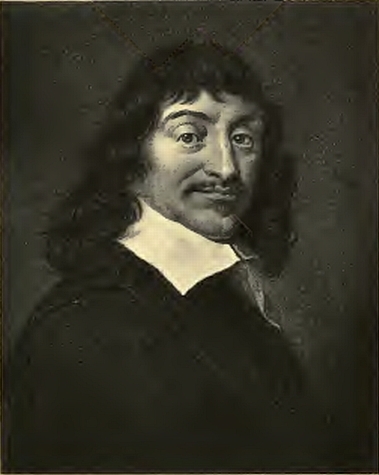
Spinoza says, we are modes of that absolute, necessary, infinite being. I say to Spinoza, we will, and have design, we who are but modes; therefore, this infinite, necessary, absolute being cannot be deprived of them; therefore, he has will, design, power.
I am aware that various philosophers, and especially Lucretius, have denied final causes; I am also aware that Lucretius, though not very chaste, is a very great poet in his descriptions and in his morals; but in philosophy I own he appears to me to be very far behind a college porter or a parish beadle. To affirm that the eye is not made to see, nor the ear to hear, nor the stomach to digest—is not this the most enormous absurdity, the most revolting folly, that ever entered the human mind? Doubter as I am, this insanity seems to me evident, and I say so.
For my part, I see in nature, as in the arts, only final causes, and I believe that an apple tree is made to bear apples, as I believe that a watch is made to tell the hour.
I must here acquaint the readers that if Spinoza, in several passages of his works, makes a jest of final causes, he most expressly acknowledges them in the first part of his "Being, in General and in Particular."
Here he says, "Permit me for a few moments to dwell with admiration on the wonderful dispensation of nature, which, having enriched the constitution of man with all the resources necessary to prolong to a certain term the duration of his frail existence, and to animate his knowledge of himself by that of an infinity of distant objects, seems purposely to have neglected to give him the means of well knowing what he is obliged to make a more ordinary use of—the individuals of his own species. Yet, when duly considered, this appears less the effect of a refusal than of an extreme liberality; for, if there were any intelligent being that could penetrate another against his will, he would enjoy such an advantage as would of itself exclude him from society; whereas, in the present state of things, each individual enjoying himself in full independence communicates himself so much only as he finds convenient."
What shall I conclude from this? That Spinoza frequently contradicted himself; that he had not always clear ideas; that in the great wreck of systems, he clung sometimes to one plank, sometimes to another; that in this weakness he was like Malebranche, Arnauld, Bossuet, and Claude, who now and then contradicted themselves in their disputes; that he was like numberless metaphysicians and theologians? I shall conclude that I have additional reason for distrusting all my metaphysical notions; that I am a very feeble animal, treading on quicksands, which are continually giving way beneath me; and that there is perhaps nothing so foolish as to believe ourselves always in the right.
Baruch Spinoza, you are very confused; but are you as dangerous as you are said to be? I maintain that you are not; and my reason is, that you are confused, that you have written in bad Latin, and that there are not ten persons in Europe who read you from beginning to end, although you have been translated into French. Who is the dangerous author? He who is read by the idle at court and by the ladies.
SECTION IV.
The "System of Nature."
The author of the "System of Nature" has had the advantage of being read by both learned and ignorant, and by women. His style, then, has merits which that of Spinoza wanted. He is often luminous, sometimes eloquent; although he may be charged, like all the rest, with repetition, declamation, and self-contradiction. But for profundity, he is very often to be distrusted both in physics and in morals. The interest of mankind is here in question; we will, therefore, examine whether his doctrine is true and useful; and will, if we can, be brief.
"Order and disorder do not exist." What! in physics, is not a child born blind, without legs, or a monster, contrary to the nature of the species? Is it not the ordinary regularity of nature that makes order, and irregularity that constitutes disorder? Is it not a great derangement, a dreadful disorder, when nature gives a child hunger and closes the œsophagus? The evacuations of every kind are necessary; yet the channels are frequently without orifices, which it is necessary to remedy. Doubtless this disorder has its cause; for there is no effect without a cause; but it is a very disordered effect.
Is not the assassination of our friend, or of our brother, a horrible disorder in morals? Are not the calumnies of a Garasse, of a Letellier, of a Doucin, against Jansenists, and those of Jansenists against Jesuits, petty disorders? Were not the massacre of St. Bartholomew, the Irish massacre, etc., execrable disorders? This crime has its cause in passion, but the effect is execrable; the cause is fatal; this disorder makes us shudder. The origin of the disorder remains to be discovered, but the disorder exists.
"Experience proves to us that the matter which we regard as inert and dead assumes action, intelligence, and life, when it is combined in a certain way."
This is precisely the difficulty. How does a germ come to life? Of this the author and the reader are alike ignorant. Hence, are not the "System of Nature," and all the systems in the world, so many dreams?
"It would be necessary to define the vital principle, which I deem impossible." Is not this definition very easy, very common? Is not life organization with feeling? But that you have these two properties from the motion of matter alone, it is impossible to give any proof; and if it cannot be proved, why affirm it? Why say aloud, "I know," while you say to yourself, "I know not"?
"It will be asked, what is man?" etc. Assuredly, this article is no clearer than the most obscure of Spinoza's; and many readers will feel indignant at the decisive tone which is assumed without anything being explained.
"Matter is eternal and necessary; but its forms and its combinations are transitory and contingent," etc. It is hard to comprehend, matter being, according to our author, necessary, and without freedom, how there can be anything contingent. By contingency, we understand that which may be, or may not be; but since all must be, of absolute necessity, every manner of being, which he here very erroneously calls contingent, is as absolutely of necessity as the being itself. Here again we are in a labyrinth.
When you venture to affirm that there is no God, that matter acts of itself by an eternal necessity, it must be demonstrated like a proposition in Euclid, otherwise you rest your system only on a perhaps. What a foundation for that which is most interesting to the human race!
"If man is by his nature forced to love his well-being, he is forced to love the means of that well-being. It were useless, and perhaps unjust, to ask a man to be virtuous, if he cannot be so without making himself unhappy. So soon as vice makes him happy, he must love vice."
This maxim is yet more execrable in morals than the others are in physics. Were it true that a man could not be virtuous without suffering, he must be encouraged to suffer. Our author's proposition would evidently be the ruin of society. Besides, how does he know that we cannot be happy without having vices? On the contrary, is it not proved by experience that the satisfaction of having subdued them is a thousand times greater than the pleasure of yielding to them?—a pleasure always empoisoned, a pleasure leading to woe. By subduing our vices, we acquire tranquillity, the consoling testimony of our conscience; by giving ourselves up to them, we lose our health, our quiet—we risk everything. Thus our author himself, in twenty passages, wishes all to be sacrificed to virtue; and he advances this proposition only to give in his system a fresh proof of the necessity of being virtuous.
"They who, with so many arguments, reject innate ideas should have perceived that this ineffable intelligence by which the world is said to be guided, and of which our senses can determine neither the existence nor the qualities, is a being of reason."
But, truly, how does it follow from our having no innate ideas, that there is no God? Is not this consequence absurd? Is there any contradiction in saying that God gives us ideas through our senses? Is it not, on the contrary, most clearly evident, that if there is an Almighty Being from whom we have life, we owe to him our ideas and our senses as well as everything else? It should first have been proved that God does not exist, which our author has not done, which he has not even attempted to do before this page of his tenth chapter.
Fearful of wearying the reader by an examination of all these detached passages, I will come at once to the foundation of the book, and the astonishing error upon which the author has built his system.
Story of the Eels on Which the System is Founded.
About the year 1750 there was, in France, an English Jesuit called Needham, disguised as a secular, who was then serving as tutor to the nephew of M. Dillon, archbishop of Toulouse. This man made experiments in natural philosophy, and especially in chemistry.
Having put some rye meal into well-corked bottles, and some boiled mutton gravy into other bottles, he thought that his mutton gravy and his meal had given birth to eels, which again produced others; and that thus a race of eels was formed indifferently from the juice of meat, or from a grain of rye.
A natural philosopher, of some reputation, had no doubt that this Needham was a profound atheist. He concluded that, since eels could be made of rye meal, men might be made of wheat flour; that nature and chemistry produce all; and that it was demonstrated that we may very well dispense with an all-forming God.
This property of meal very easily deceived one who, unfortunately, was already wandering amidst ideas that should make us tremble for the weakness of the human mind. He wanted to dig a hole in the centre of the earth, to see the central fire; to dissect Patagonians, that he might know the nature of the soul; to cover the sick with pitch, to prevent them from perspiring; to exalt his soul, that he might foretell the future. If to these things it were added, that he had the still greater unhappiness of seeking to oppress two of his brethren, it would do no honor to atheism; it would only serve to make us look into ourselves with confusion.
It is really strange that men, while denying a creator, should have attributed to themselves the power of creating eels.
But it is yet more deplorable that natural philosophers, of better information, adopted the Jesuit Needham's ridiculous system, and joined it to that of Maillet, who asserted that the ocean had formed the Alps and Pyrenees, and that men were originally porpoises, whose forked tails changed in the course of time into thighs and legs. Such fancies are worthy to be placed with the eels formed by meal. We were assured, not long ago, that at Brussels a hen had brought forth half a dozen young rabbits.
This transmutation of meal and gravy into eels was demonstrated to be as false and ridiculous as it really is, by M. Spallanzani, a rather better observer than Needham. But the extravagance of so palpable an illusion was evident without his observations.
Needham's eels soon followed the Brussels' hen.
Nevertheless, in 1768, the correct, elegant, and judicious translator of Lucretius was so far led away, that he not only, in his notes to book viii. p. 361, repeats Needham's pretended experiments, but he also does all he can to establish their validity. Here, then, we have the new foundation of the "System of Nature."
The author, in the second chapter, thus expresses himself: "After moistening meal with water, and shutting up the mixture, it is found after a little time, with the aid of the microscope, that it has produced organized beings, of whose production the water and meal were believed to be incapable. Thus inanimate nature can pass into life, which is itself but an assemblage of motions."
Were this unparalleled blunder true, yet, in rigorous reasoning, I do not see how it would prove there is no God; I do not see why a supreme, intelligent, and mighty being, having formed the sun and the stars, might not also deign to form animalculae without a germ. Here is no contradiction in terms. A demonstrative proof that God has no existence must be sought elsewhere; and most assuredly no person has ever found, or will ever find, one.
Our author treats final causes with contempt, because the argument is hackneyed; but this much-contemned argument is that of Cicero and of Newton. This alone might somewhat lessen the confidence of atheists in themselves. The number is not small of the sages who, observing the course of the stars, and the prodigious art that pervades the structure of animals and vegetables, have acknowledged a powerful hand working these continual wonders.
The author asserts that matter, blind and without choice, produces intelligent animals. Produce, without intelligence, beings with intelligence! Is this conceivable? Is this system founded on the smallest verisimilitude? An opinion so contradictory requires proofs no less astonishing than itself. The author gives us none; he never proves anything; but he affirms all that he advances. What chaos! what confusion! and what temerity!
Spinoza at least acknowledged an intelligence acting in this great whole, which constituted nature: in this there was philosophy. But in the new system, I am under the necessity of saying that there is none.
Matter has extent, solidity, gravity, divisibility. I have all these as well as this stone: but was a stone ever known to feel and think? If I am extended, solid, divisible, I owe it to matter. But I have sensations and thoughts—to what do I owe them? Not to water, not to mire—most likely to something more powerful than myself. Solely to the combination of the elements, you will say. Then prove it to me. Show me plainly that my intelligence cannot have been given to me by an intelligent cause. To this are you reduced.
Our author successively combats the God of the schoolmen—a God composed of discordant qualities; a God to whom, as to those of Homer, is attributed the passions of men; a God capricious, fickle, unreasonable, absurd—but he cannot combat the God of the wise. The wise, contemplating nature, admit an intelligent and supreme power. It is perhaps impossible for human reason, destitute of divine assistance, to go a step further.
Our author asks where this being resides; and, from the impossibility that anyone, without being infinite, should tell where He resides, he concludes that He does not exist. This is not philosophical; for we are not, because we cannot tell where the cause of an effect is, to conclude that there is no cause. If you had never seen a gunner, and you saw the effects of a battery of cannon, you would not say it acts entirely by itself. Shall it, then, only be necessary for you to say there is no God, in order to be believed on your words?
Finally, his great objection is, the woes and crimes of mankind—an objection alike ancient and philosophical; an objection common, but fatal and terrible, and to which we find no answer but in the hope of a better life. Yet what is this hope? We can have no certainty in it but from reason. But I will venture to say, that when it is proved to us that a vast edifice, constructed with the greatest art, is built by an architect, whoever he may be, we ought to believe in that architect, even though the edifice should be stained with our blood, polluted by our crimes, and should crush us in its fall. I inquire not whether the architect is a good one, whether I should be satisfied with his building, whether I should quit it rather than stay in it, nor whether those who are lodged in it for a few days, like myself, are content: I only inquire if it be true that there is an architect, or if this house, containing so many fine apartments and so many wretched garrets, built itself.
SECTION V.
The Necessity of Believing in a Supreme Being.
The great, the interesting object, as it appears to me, is, not to argue metaphysically, but to consider whether, for the common good of us miserable and thinking animals, we should admit a rewarding and avenging God, at once our restraint and consolation, or should reject this idea, and so abandon ourselves to calamity without hope, and crime without remorse.
Hobbes says that if, in a commonwealth, in which no God should be acknowledged, any citizen were to propose one, he would have him hanged.
Apparently, he meant by this strange exaggeration, a citizen who should seek to rule in the name of a god, a charlatan who would make himself a tyrant. We understand citizens, who, feeling the weakness of human nature, its perverseness, and its misery, seek some prop to support it through the languors and horrors of this life.
From Job down to us, a great many men have cursed their existence; we have, therefore, perpetual need of consolation and hope. Of these your philosophy deprives us. The fable of Pandora was better; it left us hope—which you snatch from us! Philosophy, you say, furnishes no proof of happiness to come. No—but you have no demonstration of the contrary. There may be in us an indestructible monad which feels and thinks, without our knowing anything at all of how that monad is made. Reason is not absolutely opposed to this idea, though reason alone does not prove it. Has not this opinion a prodigious advantage over yours? Mine is useful to mankind, yours is baneful; say of it what you will, it may encourage a Nero, an Alexander VI., or a Cartouche. Mine may restrain them.
Marcus Antoninus and Epictetus believed that their monad, of whatever kind it was, would be united to the monad of the Great Being; and they were the most virtuous of men.
In the state of doubt in which we both are, I do not say to you with Pascal, "choose the safest." There is no safety in uncertainty. We are here not to talk, but to examine; we must judge, and our judgment is not determined by our will. I do not propose to you to believe extravagant things, in order to escape embarrassment. I do not say to you, "Go to Mecca, and instruct yourself by kissing the black stone, take hold of a cow's tail, muffle yourself in a scapulary, or be imbecile and fanatical to acquire the favor of the Being of beings." I say to you: "Continue to cultivate virtue, to be beneficent, to regard all superstition with horror, or with pity; but adore, with me, the design which is manifested in all nature, and consequently the Author of that design—the primordial and final cause of all; hope with me that our monad, which reasons on the great eternal being, may be happy through that same great Being." There is no contradiction in this. You can no more demonstrate its impossibility than I can demonstrate mathematically that it is so. In metaphysics we scarcely reason on anything but probabilities. We are all swimming in a sea of which we have never seen the shore. Woe be to those who fight while they swim! Land who can: but he that cries out to me, "You swim in vain, there is no land," disheartens me, and deprives me of all my strength.
What is the object of our dispute? To console our unhappy existence. Who consoles it—you or I?
You yourself own, in some passages of your work, that the belief in a God has withheld some men on the brink of crime; for me, this acknowledgment is enough. If this opinion had prevented but ten assassinations, but ten calumnies, but ten iniquitous judgments on the earth, I hold that the whole earth ought to embrace it.
Religion, you say, has produced thousands of crimes—say, rather, superstition, which unhappily reigns over this globe; it is the most cruel enemy of the pure adoration due to the Supreme Being.
Let us detest this monster which has constantly been tearing the bosom of its mother; they who combat it are benefactors to mankind: it is a serpent enclosing religion in its folds, its head must be bruised, without wounding the parent whom it infects and devours.
You fear, "that, by adoring God, men would soon again become superstitious and fanatical." But is it not to be feared that in denying Him, they would abandon themselves to the most atrocious passions, and the most frightful crimes? Between these two extremes is there not a very rational mean? Where is the safe track between these two rocks? It is God, and wise laws.
You affirm that it is but one step from adoration to superstition: but there is an infinity to well-constituted minds, and these are now very numerous; they are at the head of nations; they influence public manners, and, year by year, the fanaticism that overspread the earth is receding in its detestable usurpations.
I shall say a few words more in answer to what you say in page 223. "If it be presumed that there are relations between man and this incredible being, then altars must be raised and presents must be made to him, etc.; if no conception be formed of this being, then the matter must be referred to priests, who...." A great evil to be sure, to assemble in the harvest season, and thank God for the bread that He has given us! Who says you should make presents to God? The idea is ridiculous! But where is the harm of employing a citizen, called an "elder" or "priest," to render thanks to the Divinity in the name of the other citizens?—provided the priest is not a Gregory VII. trampling on the heads of kings, nor an Alexander VI. polluting by incest his daughter, the offspring of a rape, and, by the aid of his bastard son, poisoning and assassinating almost all the neighboring princes: provided that, in a parish, this priest is not a knave, picking the pockets of the penitents he confesses, and using the money to seduce the girls he catechises; provided that this priest is not a Letellier, putting the whole kingdom in combustion by rogueries worthy of the pillory, nor a Warburton, violating the laws of society, making public the private papers of a member of parliament in order to ruin him, and calumniating whosoever is not of his opinion. The latter cases are rare. The sacerdotal state is a curb which forces to good behavior.
A stupid priest excites contempt; a bad priest inspires horror; a good priest, mild, pious, without superstition, charitable, tolerant, is one who ought to be cherished and revered. You dread abuses—so do I. Let us unite to prevent them; but let us not condemn the usage when it is useful to society, when it is not perverted by fanaticism, or by fraudulent wickedness.
I have one very important thing to tell you. I am persuaded that you are in a great error, but I am equally convinced that you are honest in your self-delusion. You would have men virtuous even without a God, although you have unfortunately said that "so soon as vice renders man happy, he must love vice"—a frightful proposition, which your friends should have prevailed on you to erase. Everywhere else you inspire probity. This philosophical dispute will be only between you and a few philosophers scattered over Europe; the rest of the earth will not even hear of it. The people do not read us. If some theologian were to seek to persecute us, he would be impudent as well as wicked; he would but serve to confirm you, and to make new atheists.
You are wrong: but the Greeks did not persecute Epicurus; the Romans did not persecute Lucretius. You are wrong: but your genius and your virtue must be respected, while you are refuted with all possible strength.
In my opinion, the finest homage that can be rendered to God is to stand forward in His defence without anger; as the most unworthy portrait that can be drawn of Him is to paint Him vindictive and furious. He is truth itself; and truth is without passion. To be a disciple of God is to announce Him as of a mild heart and of an unalterable mind.
I think, with you, that fanaticism is a monster a thousand times more dangerous than philosophical atheism. Spinoza did not commit a single bad action. Châtel and Ravaillac, both devotees, assassinated Henry IV.
The atheist of the closet is almost always a quiet philosopher, while the fanatic is always turbulent: but the court atheist, the atheistical prince, might be the scourge of mankind. Borgia and his like have done almost as much harm as the fanatics of Münster and of the Cévennes. I say the fanatics on both sides. The misfortune is, that atheists of the closet make atheists of the court. It was Chiron who brought up Achilles; he fed him with lion's marrow. Achilles will one day drag Hector's body round the walls of Troy, and immolate twelve captives to his vengeance.
God keep us from an abominable priest who should hew a king in pieces with his sacrificing knife, as also from him who, with a helmet on his head and a cuirass on his back, at the age of seventy, should dare to sign with his three bloody fingers the ridiculous excommunication of a king of France! and from.... and from....
But also, may God preserve us from a choleric and barbarous despot, who, not believing in a God, should be his own God, who should render himself unworthy of his sacred trust by trampling on the duties which that trust imposes, who should remorselessly sacrifice to his passions, his friends, his relatives, his servants, and his people. These two tigers, the one shorn, the other crowned are equally to be feared. By what means shall we muzzle them?....
If the idea of a God has made a Titus or a Trajan, an Antonine or an Aurelius, and those great Chinese emperors, whose memory is so dear to the second of the most ancient and most extensive empires in the world, these examples are sufficient for my cause—and my cause is that of all mankind.
I do not believe that there is in all Europe one statesman, one man at all versed in the affairs of the world, who has not the most profound contempt for the legends with which we have been inundated, even more than we now are with pamphlets. If religion no longer gives birth to civil wars, it is to philosophy alone that we are indebted, theological disputes beginning to be regarded in much the same manner as the quarrels of Punch and Judy at the fair. A usurpation, alike odious and ridiculous, founded upon fraud on one side and stupidity on the other, is every instant undermined by reason, which is establishing its reign. The bull "In cæna Domini"—that masterpiece of insolence and folly, no longer dares appear, even in Rome. If a regiment of monks makes the least evolution against the laws of the state, it is immediately broken. But, because the Jesuits have been expelled, must we also expel God? On the contrary, we must love Him the more.
SECTION VI.
In the reign of Arcadius, Logomachos, a theologue of Constantinople, went into Scythia and stopped at the foot of Mount Caucasus in the fruitful plains of Zephirim, on the borders of Colchis. The good old man Dondindac was in his great hall between his large sheepfold and his extensive barn; he was on his knees with his wife, his five sons and five daughters, his kinsmen and servants; and all were singing the praises of God, after a light repast. "What are you doing, idolater?" said Logomachos to him. "I am not an idolater," said Dondindac. "You must be an idolater," said Logomachos, "for you are not a Greek. Come, tell me what you were singing in your barbarous Scythian jargon?" "All tongues are alike to the ears of God," answered the Scythian; "we were singing His praises." "Very extraordinary!" returned the theologue; "a Scythian family praying to God without having been instructed by us!" He soon entered into conversation with the Scythian Dondindac; for the theologue knew a little Scythian, and the other a little Greek. This conversation has been found in a manuscript preserved in the library of Constantinople.
LOGOMACHOS.
Let us see if you know your catechism. Why do you pray to God?
DONDINDAC.
Because it is just to adore the Supreme Being, from whom we have everything.
LOGOMACHOS.
Very fair for a barbarian. And what do you ask of him?
DONDINDAC
I thank Him for the blessings I enjoy, and even for the trials which He sends me; but I am careful to ask nothing of Him; for He knows our wants better than we do; besides, I should be afraid of asking for fair weather while my neighbor was asking for rain.
LOGOMACHOS.
Ah! I thought he would say some nonsense or other. Let us begin farther back. Barbarian, who told you that there is a God?
DONDINDAC
All nature tells me.
LOGOMACHOS.
That is not enough. What idea have you of God?
DONDINDAC
The idea of my Creator; my master, who will reward me if I do good, and punish me if I do evil.
LOGOMACHOS.
Trifles! trash! Let us come to some essentials. Is God infinite secundum quid, or according to essence?
DONDINDAC
I don't understand you.
LOGOMACHOS.
Brute beast! Is God in one place, or in every place?
DONDINDAC.
I know not ... just as you please.
LOGOMACHOS.
Ignoramus!... Can He cause that which has not been to have been, or that a stick shall not have two ends? Does He see the future as future, or as present? How does He draw being from nothing, and how reduce being to nothing?
DONDINDAC.
I have never examined these things.
LOGOMACHOS.
What a stupid fellow! Well, I must come nearer to your level.... Tell me, friend, do you think that matter can be eternal?
DONDINDAC
What matters it to me whether it exists from all eternity or not? I do not exist from all eternity. God must still be my Master. He has given me the nature of justice; it is my duty to follow it: I seek not to be a philosopher; I wish to be a man.
LOGOMACHOS.
One has a great deal of trouble with these block-heads. Let us proceed step by step. What is God?
DONDINDAC
My sovereign, my judge, my father.
LOGOMACHOS.
That is not what I ask. What is His nature?
DONDINDAC.
To be mighty and good.
LOGOMACHOS.
But is He corporeal or spiritual?
DONDINDAC.
How should I know that?
LOGOMACHOS.
What; do you not know what a spirit is?
DONDINDAC.
Not in the least. Of what service would that knowledge be to me? Should I be more just? Should I be a better husband, a better father, a better master, or a better citizen?
LOGOMACHOS.
You must absolutely be taught what a spirit is. It is—it is—it is—I will say what another time.
DONDINDAC.
I much fear that you will tell me rather what it is not than what it is. Permit me, in turn, to ask you one question. Some time ago, I saw one of your temples: why do you paint God with a long beard?
LOGOMACHOS.
That is a very difficult question, and requires preliminary instruction.
DONDINDAC.
Before I receive your instruction, I must relate to you a thing which one day happened to me. I had just built a closet at the end of my garden, when I heard a mole arguing thus with an ant: "Here is a fine fabric," said the mole; "it must have been a very powerful mole that performed this work." "You jest," returned the ant; "the architect of this edifice is an ant of mighty genius." From that time I resolved never to dispute.
GOOD—THE SOVEREIGN GOOD, A CHIMERA.
SECTION I.
Happiness is an abstract idea composed of certain pleasurable sensations. Plato, who wrote better than he reasoned, conceived the notion of his world in archetype; that is, his original world—of his general ideas of the beautiful, the good, the orderly, and the just, as if there had existed eternal beings, called order, good, beauty, and justice; whence might be derived the feeble copies exhibited here below of the just, the beautiful, and the good.
It is, then, in consequence of his suggestions that philosophers have occupied themselves in seeking for the sovereign good, as chemists seek for the philosopher's stone; but the sovereign good has no more existence than the sovereign square, or the sovereign crimson: there is the crimson color, and there are squares; but there is no general existence so denominated. This chimerical manner of reasoning was for a long time the bane of philosophy.
Animals feel pleasure in performing all the functions for which they are destined. The happiness which poetical fancy has imagined would be an uninterrupted series of pleasures; but such a series would be incompatible with our organs and our destination. There is great pleasure in eating, drinking, and connubial endearments; but it is clear that if a man were always eating, or always in the full ecstasy of enjoyment, his organs would be incapable of sustaining it: it is further evident that he would be unable to fulfil the destinies he was born to, and that, in the case supposed, the human race would absolutely perish through pleasure.
To pass constantly and without interruption from one pleasure to another is also a chimera. The woman who has conceived must go through childbirth, which is a pain; the man is obliged to cleave wood and hew stone, which is not a pleasure.
If the name of happiness is meant to be applied to some pleasures which are diffused over human life, there is in fact, we must admit, happiness. If the name attaches only to one pleasure always permanent, or a continued although varied range of delicious enjoyment, then happiness belongs not to this terraqueous globe. Go and seek for it elsewhere.
If we make happiness consist in any particular situation that a man may be in, as for instance, a situation of wealth, power, or fame, we are no less mistaken. There are some scavengers who are happier than some sovereigns. Ask Cromwell whether he was more happy when he was lord protector of England, than when, in his youthful days, he enjoyed himself at a tavern; he will probably tell you in answer, that the period of his usurpation was not the period most productive of pleasures. How many plain or even ugly country women are more happy than were Helen and Cleopatra.
We must here however make one short remark; that when we say such a particular man is probably happier than some other; that a young muleteer has advantages very superior to those of Charles V.; that a dressmaker has more enjoyment than a princess, we should adhere to the probability of the case. There is certainly every appearance that a muleteer, in full health, must have more pleasure than Charles the Fifth, laid up with the gout; but nevertheless it may also be, that Charles, on his crutches, revolves in his mind with such ecstasy the facts of his holding a king of France and a pope prisoners, that his lot is absolutely preferable to that of the young and vigorous muleteer.
It certainly belongs to God alone, to a being capable of seeing through all hearts, to decide which is the happiest man. There is only one case in which a person can affirm that his actual state is worse or better than that of his neighbor; this case is that of existing rivalship, and the moment that of victory.
I will suppose that Archimedes has an assignation at night with his mistress. Nomentanus has the same assignation at the same hour. Archimedes presents himself at the door, and it is shut in his face; but it is opened to his rival, who enjoys an excellent supper, which he enlivens by his repeated sallies of wit upon Archimedes, and after the conclusion of which he withdraws to still higher enjoyments, while the other remains exposed in the street to all the pelting of a pitiless storm. There can be no doubt that Nomentanus has a right to say: "I am more happy to-night than Archimedes: I have more pleasure than he"; but it is necessary, in order to admit the truth and justness of the inference of the successful competitors in his own favor, to suppose that Archimedes is thinking only about the loss of his good supper, about being despised and deceived by a beautiful woman, about being supplanted by his rival, and annoyed by the tempest; for, if the philosopher in the street should be calmly reflecting that his soul ought to be above being discomposed by a strumpet or a storm, if he should be absorbed in a profound and interesting problem, and if he should discover the proportions between the cylinder and the sphere, he may experience a pleasure a hundred times superior to that of Nomentanus.
It is only therefore in the single case of actual pleasure and actual pain, and without a reference to anything else whatever, that a comparison between any two individuals can be properly made. It is unquestionable that he who enjoys the society of his mistress is happier at the moment than his scorned rival deploring over his misfortune. A man in health, supping on a fat partridge, is undoubtedly happier at the time than another under the torment of the colic; but we cannot safely carry our inferences farther; we cannot estimate the existence of one man against that of another; we possess no accurate balance for weighing desires and sensations.
We began this article with Plato and his sovereign good; we will conclude it with Solon and the saying of his which has been so highly celebrated, that "we ought to pronounce no man happy before his death." This maxim, when examined into, will be found nothing more than a puerile remark, just like many other apothegms consecrated by their antiquity. The moment of death has nothing in common with the lot experienced by any man in life; a man may perish by a violent and ignominious death, and yet, up to that moment, may have enjoyed all the pleasures of which human nature is susceptible. It is very possible and very common for a happy man to cease to be so; no one can doubt it; but he has not the less had his happy moments.
What, then, can Solon's expression strictly and fairly mean? that a man happy to-day is not certain of being so to-morrow! In this case it is a truth so incontestable and trivial that, not merely is it not worthy of being elevated into a maxim, but it is not worthy delivering at all.
SECTION II.
Well-being is a rare possession. May not the sovereign good in this world be considered as a sovereign chimera? The Greek philosophers discussed at great length, according to their usual practice, this celebrated question. The reader will, probably, compare them to just so many mendicants reasoning about the philosopher's stone.
The sovereign good! What an expression! It might as well have been asked: What is the sovereign blue, or the sovereign ragout, or the sovereign walk, or the sovereign reading?
Every one places his good where he can, and has as much of it as he can, in his own way, and in very scanty measure. Castor loved horses; his twin brother, to try a fall—
Quid dem? quid non dem? renuis tu quod jubet alter.... Castor gaudet equis, ovo prognatus eodem Pugnis, etc.
The greatest good is that which delights us so powerfully as to render us incapable of feeling anything else; as the greatest evil is that which goes so far as to deprive us of all feeling. These are the two extremes of human nature, and these moments are short. Neither extreme delight nor extreme torture can last a whole life. The sovereign good and the sovereign evil are nothing more than chimeras.
We all know the beautiful fable of Crantor. He introduces upon the stage at the Olympic games, Wealth, Pleasure, Health, and Virtue. Each claims the apple. Wealth says, I am the sovereign good, for with me all goods are purchased. Pleasure says, the apple belongs to me, for it is only on my account that wealth is desired. Health asserts, that without her there can be no pleasure, and wealth is useless. Finally, Virtue states that she is superior to the other three, because, although possessed of gold, pleasures, and health, a man may make himself very contemptible by misconduct. The apple was conferred on Virtue.
The fable is very ingenious; it would be still more so if Crantor had said that the sovereign good consists in the combination of the four rivals, Virtue, Health, Wealth, and Pleasure; but this fable neither does, nor can, resolve the absurd question about the sovereign good. Virtue is not a good; it is a duty. It is of a different nature; of a superior order. It has nothing to do with painful or with agreeable sensations. A virtuous man, laboring under stone and gout, without aid, without friends, destitute of necessaries, persecuted, and chained down to the floor by a voluptuous tyrant who enjoys good health, is very wretched; and his insolent persecutor, caressing a new mistress on his bed of purple, is very happy. Say, if you please, that the persecuted sage is preferable to the persecuting profligate; say that you admire the one and detest the other; but confess that the sage in chains is scarcely less than mad with rage and pain; if he does not himself admit that he is so, he completely deceives you; he is a charlatan.
GOOD.
Of Good and Evil, Physical and Moral.
We here treat of a question of the greatest difficulty and importance. It relates to the whole of human life. It would be of much greater consequence to find a remedy for our evils; but no remedy is to be discovered, and we are reduced to the sad necessity of tracing out their origin. With respect to this origin, men have disputed ever since the days of Zoroaster, and in all probability they disputed on the same subject long before him. It was to explain the mixture of good and evil that they conceived the idea of two principles—Oromazes, the author of light, and Arimanes, the author of darkness; the box of Pandora; the two vessels of Jupiter; the apple eaten by Eve; and a variety of other systems. The first of dialecticians, although not the first of philosophers, the illustrious Bayle, has clearly shown how difficult it is for Christians who admit one only God, perfectly good and just, to reply to the objections of the Manichæans who acknowledge two Gods—one good, and the other evil.
The foundation of the system of the Manichæans, with all its antiquity, was not on that account more reasonable. Lemmas, susceptible of the most clear and rigid geometrical demonstrations, should alone have induced any men to the adoption of such a theorem as the following: "There are two necessary beings, both supreme, both infinite, both equally powerful, both in conflict with each other, yet, finally, agreeing to pour out upon this little planet—one, all the treasures of his beneficence, and the other all the stores of his malice." It is in vain that the advocates of this hypothesis attempt to explain by it the cause of good and evil: even the fable of Prometheus explains it better. Every hypothesis which only serves to assign a reason for certain things, without being, in addition to that recommendation, established upon indisputable principles, ought invariably to be rejected.
The Christian doctors—independently of revelation, which makes everything credible—explain the origin of good-and evil no better than the partner-gods of Zoroaster.
When they say God is a tender father, God is a just king; when they add the idea of infinity to that of love, that kindness, that justice which they observe in the best of their own species, they soon fall into the most palpable and dreadful contradictions. How could this sovereign, who possessed in infinite fulness the principle or quality of human justice, how could this father, entertaining an infinite affection for his children; how could this being, infinitely powerful, have formed creatures in His own likeness, to have them immediately afterwards tempted by a malignant demon, to make them yield to that temptation to inflict death on those whom He had created immortal, and to overwhelm their posterity with calamities and crimes! We do not here speak of a contradiction still more revolting to our feeble reason. How could God, who ransomed the human race by the death of His only Son; or rather, how could God, who took upon Himself the nature of man, and died on the cross to save men from perdition, consign over to eternal tortures nearly the whole of that human race for whom He died? Certainly, when we consider this system merely as philosophers—without the aid of faith—we must consider it as absolutely monstrous and abominable. It makes of God either pure and unmixed malice, and that malice infinite, which created thinking beings, on purpose to devote them to eternal misery, or absolute impotence and imbecility, in not being able to foresee or to prevent the torments of his offspring.
But the eternity of misery is not the subject of this article, which relates properly only to the good and evil of the present life. None of the doctors of the numerous churches of Christianity, all of which advocate the doctrine we are here contesting, have been able to convince a single sage.
We cannot conceive how Bayle, who managed the weapons of dialectics with such admirable strength and dexterity, could content himself with introducing in a dispute a Manichæan, a Calvinist, a Molinist, and a Socinian. Why did he not introduce, as speaking, a reasonable and sensible man? Why did not Bayle speak in his own person? He would have said far better what we shall now venture to say ourselves. A father who kills his children is a monster; a king who conducts his subjects into a snare, in order to obtain a pretext for delivering them up to punishment and torture, is an execrable tyrant. If you conceive God to possess the same kindness which you require in a father, the same justice that you require in a king, no possible resource exists by which, if we may use the expression, God can be exculpated; and by allowing Him to possess infinite wisdom and infinite goodness you, in fact, render Him infinitely odious; you excite a wish that He had no existence; you furnish arms to the atheist, who will ever be justified in triumphantly remarking to you: Better by far is it to deny a God altogether, than impute to Him such conduct as you would punish, to the extremity of the law, in men.
We begin then with observing, that it is unbecoming in us to ascribe to God human attributes. It is not for us to make God after our own likeness. Human justice, human kindness, and human wisdom can never be applied or made suitable to Him. We may extend these attributes in our imagination as far as we are able, to infinity; they will never be other than human qualities with boundaries perpetually or indefinitely removed; it would be equally rational to attribute to Him infinite solidity, infinite motion, infinite roundness, or infinite divisibility. These attributes can never be His.
Philosophy informs us that this universe must have been arranged by a Being incomprehensible, eternal, and existing by His own nature; but, once again, we must observe that philosophy gives us no information on the subject of the attributes of that nature. We know what He is not, and not what He is.
With respect to God, there is neither good nor evil, physically or morally. What is physical or natural evil? Of all evils, the greatest, undoubtedly, is death. Let us for a moment consider whether man could have been immortal.
In order that a body like ours should have been indissoluble, imperishable, it would have been necessary that it should not be composed of parts; that it—should not be born; that it should have neither nourishment nor growth; that it should experience no change. Let any one examine each of these points; and let every reader extend their number according to his own suggestions, and it will be seen that the proposition of an immortal man is a contradiction.
If our organized body were immortal, that of mere animals would be so likewise; but it is evident that, in the course of a very short time, the whole globe would, in this case, be incompetent to supply nourishment to those animals; those immortal beings which exist only in consequence of renovation by food, would then perish for want of the means of such renovation. All this involves contradiction. We might make various other observations on the subject, but every reader who deserves the name of a philosopher will perceive that death was necessary to everything that is born; that death can neither be an error on the part of God, nor an evil, an injustice, nor a chastisement to man.
Man, born to die, can no more be exempt from pain than from death. To prevent an organized substance endowed with feeling from ever experiencing pain, it would be necessary that all the laws of nature should be changed; that matter should no longer be divisible; that it should neither have weight, action, nor force; that a rock might fall on an animal without crushing it; and that water should have no power to suffocate, or fire to burn it. Man, impassive, then, is as much a contradiction as man immortal.
This feeling of pain was indispensable to stimulate us to self-preservation, and to impart to us such pleasures as are consistent with those general laws by which the whole system of nature is bound and regulated.
If we never experienced pain, we should be every moment injuring ourselves without perceiving it. Without the excitement of uneasiness, without some sensation of pain, we should perform no function of life; should never communicate it, and should be destitute of all the pleasures of it. Hunger is the commencement of pain which compels us to take our required nourishment. Ennui is a pain which stimulates to exercise and occupation. Love itself is a necessity which becomes painful until it is met with corresponding attachment. In a word, every desire is a want, a necessity, a beginning of pain. Pain, therefore, is the mainspring of all the actions of animated beings. Every animal possessed of feeling must be liable to pain, if matter is divisible; and pain was as necessary as death. It is not, therefore, an error of Providence, nor a result of malignity, nor a creature of imagination. Had we seen only brutes suffer, we should, for that, never have accused nature of harshness or cruelty; had we, while ourselves were impassive, witnessed the lingering and torturing death of a dove, when a kite seized upon it with his murderous talons, and leisurely devouring its bleeding limbs, doing in that no more than we do ourselves, we should not express the slightest murmur of dissatisfaction. But what claim have we for an exemption of our own bodies from such dismemberment and torture beyond what might be urged in behalf of brutes? Is it that we possess an intellect superior to theirs? But what has intellect to do with the divisibility of matter? Can a few ideas more or less in a brain prevent fire from burning, or a rock from crushing us?
Moral evil, upon which so many volumes have been written is, in fact, nothing but natural evil. This moral evil is a sensation of pain occasioned by one organized being to another. Rapine, outrage, etc., are evil only because they produce evil. But as we certainly are unable to do any evil, or occasion any pain to God, it is evident by the light of reason—for faith is altogether a different principle—that in relation to the Supreme Being and as affecting Him, moral evil can have no existence.
As the greatest of natural evils is death, the greatest of moral evils is, unquestionably, war. All crimes follow in its train; false and calumnious declarations, perfidious violation of the treaties, pillage, devastation, pain, and death under every hideous and appalling form.
All this is physical evil in relation to man, but can no more be considered moral evil in relation to God than the rage of dogs worrying and destroying one another. It is a mere common-place idea, and as false as it is feeble, that men are the only species that slaughter and destroy one another. Wolves, dogs, cats, cocks, quails, all war with their respective species: house spiders devour one another; the male universally fights for the female. This warfare is the result of the laws of nature, of principles in their very blood and essence; all is connected; all is necessary.
Nature has granted man about two and twenty years of life, one with another; that is, of a thousand children born in the same month, some of whom have died in their infancy, and the rest lived respectively to the age of thirty, forty, fifty, and even eighty years, or perhaps beyond, the average calculation will allow to each the above-mentioned number of twenty-two years.
How can it affect the Deity, whether a man die in battle or of a fever? War destroys fewer human beings than smallpox. The scourge of war is transient, that of smallpox reigns with paramount and permanent fatality throughout the earth, followed by a numerous train of others; and taking into consideration the combined, and nearly regular operation of the various causes which sweep mankind from the stage of life, the allowance of two and twenty years for every individual will be found in general to be tolerably correct.
Man, you say, offends God by killing his neighbor; if this be the case, the directors of nations must indeed be tremendous criminals; for, while even invoking God to their assistance, they urge on to slaughter immense multitudes of their fellow-beings, for contemptible interests which it would show infinitely more policy, as well as humanity, to abandon. But how—to reason merely as philosophers—how do they offend God? Just as much as tigers and crocodiles offend him. It is, surely, not God whom they harass and torment, but their neighbor. It is only against man that man can be guilty. A highway robber can commit no robbery on God. What can it signify to the eternal Deity, whether a few pieces of yellow metal are in the hands of Jerome, or of Bonaventure? We have necessary desires, necessary passions, and necessary laws for the restraint of both; and while on this our ant-hill, during the little day of our existence, we are engaged in eager and destructive contest about a straw, the universe moves, on in its majestic course, directed by eternal and unalterable laws, which comprehend in their operation the atom that we call the earth.
GOSPEL.
It is a matter of high importance to ascertain which are the first gospels. It is a decided truth, whatever Abbadie may assert to the contrary, that none of the first fathers of the Church, down to Irenæus inclusively, have quoted any passage from the four gospels with which we are acquainted. And to this it may be added, that the Alogi, the Theodosians, constantly rejected the gospel of St. John, and always spoke of it with contempt; as we are informed by St. Epiphanius in his thirty-fourth homily. Our enemies further observe that the most ancient fathers do not merely forbear to quote anything from our gospels, but relate many passages or events which are to be found only in the apocryphal gospels rejected by the canon.
St. Clement, for example, relates that our Lord, having been questioned concerning the time when His kingdom would come, answered, "That will be when what is without shall Resemble that within, and when there shall be neither male nor female." But we must admit that this passage does not occur in either of our gospels. There are innumerable other instances to prove this truth; which may be seen in the "Critical Examination" of M. Fréret, perpetual secretary of the Academy of Belles Lettres at Paris.
The learned Fabricius took the pains to collect the ancient gospels which time has spared; that of James appears to be the first; and it is certain that it still possesses considerable authority with some of the Oriental churches. It is called "the first gospel." There remain the passion and the resurrection, pretended to have been written by Nicodemus. This gospel of Nicodemus is quoted by St. Justin and Tertullian. It is there we find the names of our Lord's accusers—Annas, Caiaphas, Soumas, Dathan, Gamaliel, Judas, Levi, and Napthali; the attention and particularity with which these names are given confer upon the work an appearance of truth and sincerity. Our adversaries have inferred that as so many false gospels were forged, which at first were recognized as true, those which constitute at the present day the foundation of our own faith may have been forged also. They dwell much on the circumstance of the first heretics suffering even death itself in defence of these apocryphal gospels. There have evidently been, they say, forgers, seducers, and men who have been seduced by them into error, and died in defence of that error; it is, at least, therefore, no proof of the truth of Christianity that it has had its martyrs who have died for it.
They add further, that the martyrs were never asked the question, whether they believed the gospel of John or the gospel of James. The Pagans could not put a series of interrogatories about books with which they were not at all acquainted; the magistrates punished some Christians very unjustly, as disturbers of the public peace, but they never put particular questions to them in relation to our four gospels. These books were not known to the Romans before the time of Diocletian, and even towards the close of Diocletian's reign, they had scarcely obtained any publicity. It was deemed in a Christian a crime both abominable and unpardonable to show a gospel to any Gentile. This is so true, that you cannot find the word "gospel" in any profane author whatever.