Volume 8 — The Scene is in Tartarus. The Furies Entwined with Serpents, and Whips in Their Hands. (continued 2)
William F. Fleming translation
Or was the term "enthusiasm," after painful affection of the bowels, first applied to the contortions of the Pythia, who, on the Delphian tripod, admitted the inspiration of Apollo in a place apparently intended for the receptacle of body rather than of spirit?
What do we understand by enthusiasm? How many shades are there in our affections! Approbation, sensibility, emotion, distress, impulse, passion, transport, insanity, rage, fury. Such are the stages through which the miserable soul of man is liable to pass.
A geometrician attends at the representation of an affecting tragedy. He merely remarks that it is a judicious, well-written performance. A young man who sits next to him is so interested by the performance that he makes no remark at all; a lady sheds tears over it; another young man is so transported by the exhibition that to his great misfortune he goes home determined to compose a tragedy himself. He has caught the disease of enthusiasm.
The centurion or military tribune who considers war simply as a profession by which he is to make his fortune, goes to battle coolly, like a tiler ascending the roof of a house. Cæsar wept at seeing the statue of Alexander.
Ovid speaks of love only like one who understood it. Sappho expressed the genuine enthusiasm of the passion, and if it be true that she sacrificed her life to it, her enthusiasm must have advanced to madness.
The spirit of party tends astonishingly to excite enthusiasm; there is no faction that has not its "energumens" its devoted and possessed partisans. An animated speaker who employs gesture in his addresses, has in his eyes, his voice, his movements, a subtle poison which passes with an arrow's speed into the ears and hearts of his partial hearers. It was on this ground that Queen Elizabeth forbade any one to preach, during six months, without an express licence under her sign manual, that the peace of her kingdom might be undisturbed.
St. Ignatius, who possessed very warm and susceptible feelings, read the lives of the fathers of the desert after being deeply read in romances. He becomes, in consequence, actuated by a double enthusiasm. He constitutes himself knight to the Virgin Mary, he performed the vigil of arms; he is eager to fight for his lady patroness; he is favored—with visions; the virgin appears and recommends to him her son, and she enjoins him to give no other name to his society than that of the "Society of Jesus."
Ignatius communicates his enthusiasm to another Spaniard of the name of Xavier. Xavier hastens away to the Indies, of the language of which he is utterly ignorant, thence to Japan, without knowing a word of Japanese. That, however, is of no consequence; the flame of his enthusiasm catches the imagination of some young Jesuits, who, at length, make themselves masters of that language. These disciples, after Xavier's death, entertain not the shadow of a doubt that he performed more miracles than ever the apostles did, and that he resuscitated seven or eight persons at the very least. In short, so epidemic and powerful becomes the enthusiasm that they form in Japan what they denominate a Christendom (une Chrétienté). This Christendom ends in a civil war, in which a hundred thousand persons are slaughtered: the enthusiasm then is at its highest point, fanaticism; and fanaticism has become madness.
The young fakir who fixes his eye on the tip of his nose when saying his prayers, gradually kindles in devotional ardor until he at length believes that if he burdens himself with chains of fifty pounds weight the Supreme Being will be obliged and grateful to him. He goes to sleep with an imagination totally absorbed by Brahma, and is sure to have a sight of him in a dream. Occasionally even in the intermediate state between sleeping and waking, sparks radiate from his eyes; he beholds Brahma resplendent with light; he falls into ecstasies, and the disease frequently becomes incurable.
What is most rarely to be met with is the combination of reason with enthusiasm. Reason consists in constantly perceiving things as they really are. He, who, under the influence of intoxication, sees objects double is at the time deprived of reason.
Enthusiasm is precisely like wine, it has the power to excite such a ferment in the blood-vessels, and such strong vibrations in the nerves, that reason is completely destroyed by it. But it may also occasion only slight agitations so as not to convulse the brain, but merely to render it more active, as is the case in grand bursts of eloquence and more especially in sublime poetry. Reasonable enthusiasm is the patrimony of great poets.
This reasonable enthusiasm is the perfection of their art. It is this which formerly occasioned the belief that poets were inspired by the gods, a notion which was never applied to other artists.
How is reasoning to control enthusiasm? A poet should, in the first instance, make a sketch of his design. Reason then holds the crayon. But when he is desirous of animating his characters, to communicate to them the different and just expressions of the passions, then his imagination kindles, enthusiasm is in full operation and urges him on like a fiery courser in his career. But his course has been previously traced with coolness and judgment.
Enthusiasm is admissible into every species of poetry which admits of sentiment; we occasionally find it even in the eclogue; witness the following lines of Virgil (Eclogue x. v. 58):
Jam mihi per rupes videor lucosque sonantes Ire; libet Partho torquere cydonia cornu Spicula; tanquam haec sint nostri medicina furoris, Aut deus ille malis hominum mitescere discat! Nor cold shall hinder me, with horns and hounds To thrid the thickets, or to leap the mounds. And now, methinks, through steepy rocks I go, And rush through sounding woods and bend the Parthian bow: As if with sports my sufferings I could ease, Or by my pains the god of Love appease.
The style of epistles and satires represses enthusiasm, we accordingly see little or nothing of it in the works of Boileau and Pope.
Our odes, it is said by some, are genuine lyrical enthusiasm, but as they are not sung with us, they are, in fact, rather collections of verses, adorned with ingenious reflections, than odes.
Of all modern odes that which abounds with the noblest enthusiasm, an enthusiasm that never abates, that never falls into the bombastic or the ridiculous, is "Timotheus, or Alexander's Feast," by Dryden. It is still considered in England as an inimitable masterpiece, which Pope, when attempting the same style and the same subject, could not even approach. This ode was sung, set to music, and if the musician had been worthy of the poet it would have been the masterpiece of lyric poesy.
The most dangerous tendency of enthusiasm in this occurs in an ode on the birth of a prince of the bast, rant, and burlesque. A striking example of this occurs in an ode on the birth of a prince of the blood royal:
Où suis-je? quel nouveau miracle Tient encore mes sens enchantés Quel vaste, quel pompeux spectacle Frappe mes yeux épouvantés? Un nouveau monde vient d'éclore L'univers se reforme encore Dans les abîmes du chaos; Et, pour réparer ses ruines Je vois des demeures divines Descendre un peuple de héros. —J.B. ROUSSEAU. "Ode on the Birth of the Duke of Brittany."
Here we find the poet's senses enchanted and alarmed at the appearance of a prodigy—a vast and magnificent spectacle—a new birth which is to reform the universe and redeem it from a state of chaos, all which means simply that a male child is born to the house of Bourbon. This is as bad as "Je chante les vainqueurs, des vainqueurs de la terre."
We will avail ourselves of the present opportunity to observe that there is a very small portion of enthusiasm in the "Ode on the Taking of Namur."
ENVY.
We all know what the ancients said of this disgraceful passion and what the moderns have repeated. Hesiod is the first classic author who has spoken of it.
"The potter envies the potter, the artisan the artisan, the poor even the poor, the musician the musician—or, if any one chooses to give a different meaning to the word avidos—the poet the poet."
Long before Hesiod, Job had remarked, "Envy destroys the little-minded."
I believe Mandeville, the author of the "Fable of the Bees," is the first who has endeavored to prove that envy is a good thing, a very useful passion. His first reason is that envy was as natural to man as hunger and thirst; that it may be observed in all children, as well as in horses and dogs. If you wish your children to hate one another, caress one more than the other; the prescription is infallible.
He asserts that the first thing two young women do when they meet together is to discover matter for ridicule, and the second to flatter each other.
He thinks that without envy the arts would be only moderately cultivated, and that Raphael would never have been a great painter if he had not been jealous of Michael Angelo.
Mandeville, perhaps, mistook emulation for envy; perhaps, also, emulation is nothing but envy restricted within the bounds of decency.
Michael Angelo might say to Raphael, your envy has only induced you to study and execute still better than I do; you have not depreciated me, you have not caballed against me before the pope, you have not endeavored to get me excommunicated for placing in my picture of the Last Judgment one-eyed and lame persons in paradise, and pampered cardinals with beautiful women perfectly naked in hell! No! your envy is a laudable feeling; you are brave as well as envious; let us be good friends.
But if the envious person is an unhappy being without talents, jealous of merit as the poor are of the rich; if under the pressure at once of indigence and baseness he writes "News from Parnassus," "Letters from a Celebrated Countess," or "Literary Annals," the creature displays an envy which is in fact absolutely good for nothing, and for which even Mandeville could make no apology.
Descartes said: "Envy forces up the yellow bile from the lower part of the liver, and the black bile that comes from the spleen, which diffuses itself from the heart by the arteries." But as no sort of bile is formed in the spleen, Descartes, when he spoke thus, deserved not to be envied for his physiology.
A person of the name of Poet or Poetius, a theological blackguard, who accused Descartes of atheism, was exceedingly affected by the black bile. But he knew still less than Descartes how his detestable bile circulated through his blood.
Madame Pernelle is perfectly right: "Les envieux mourront, mais non jamais l'envie."—The envious will die, but envy never. ("Tartuffe," Act V, Scene 3.)
That it is better to excite envy than pity is a good proverb. Let us, then, make men envy us as much as we are able.
EPIC POETRY.
Since the word "epos," among the Greeks, signified a discourse, an epic poem must have been a discourse, and it was in verse because it was not then the custom to write in prose. This appears strange, but it is no less true. One Pherecydes is supposed to have been the first Greek who made exclusive use of prose to compose one of those half-true, half-false histories so common to antiquity.
Orpheus, Linus, Thamyris, and Musæus, the predecessors of Homer, wrote in verse only. Hesiod, who was certainly contemporary with Homer, wrote his "Theogony" and his poem of "Works and Days" entirely in verse. The harmony of the Greek language so invited men to poetry, a maxim turned into verse was so easily engraved on the memory that the laws, oracles, morals, and theology were all composed in verse.
Of Hesiod.
He made use of fables which had for a long time been received in Greece. It is clearly seen by the succinct manner in which he speaks of Prometheus and Epimetheus that he supposes these notions already familiar to all the Greeks. He only mentions them to show that it is necessary to labor, and that an indolent repose, in which other mythologists have made the felicity of man to consist, is a violation of the orders of the Supreme Being.
Hesiod afterwards describes the four famous ages, of which he is the first who has spoken, at least among the ancient authors who remain to us. The first age is that which preceded Pandora—the time in which men lived with the gods. The iron age is that of the siege of Thebes and Troy. "I live in the fifth," says he, "and I would I had never been born." How many men, oppressed by envy, fanaticism, and tyranny, since Hesiod, have said the same!
It is in this poem of "Works and Days" that those proverbs are found which have been perpetuated, as—"the potter is jealous of the potter," and he adds, "the musician of the musician, and the poor even of the poor." We there find the original of our fable of the nightingale fallen into the claws of the vulture. The nightingale sings in vain to soften him; the vulture devours her. Hesiod does not conclude that a hungry belly has no ears, but that tyrants are not to be mollified by genius.
A hundred maxims worthy of Xenophon and Cato are to be found in this poem.
Men are ignorant of the advantage of society: they know not that the half is more valuable than the whole.
Iniquity is pernicious only to the powerless.
Equity alone causes cities to flourish.
One unjust man is often sufficient to ruin his country.
The wretch who plots the destruction of his neighbor often prepares the way to his own.
The road to crime is short and easy. That of virtue is long and difficult, but towards the end it is delightful.
God has placed labor as a sentinel over virtue.
Lastly, the precepts on agriculture were worthy to be imitated by Virgil. There are, also, very fine passages in his "Theogony." Love, who disentangles chaos; Venus, born of the sea from the genital parts of a god nourished on earth, always followed by Love, and uniting heaven, earth, and sea, are admirable emblems.
Why, then, has Hesiod had less reputation than Homer? They seem to me of equal merit, but Homer has been preferred by the Greeks because he sang their exploits and victories over the Asiatics, their eternal enemies. He celebrated all the families which in his time reigned in Achaia and Peloponnesus; he wrote the most memorable war of the first people in Europe against the most flourishing nation which was then known in Asia. His poem was almost the only monument of that great epoch. There was no town nor family which did not think itself honored by having its name mentioned in these records of valor. We are even assured that a long time after him some differences between the Greek towns on the subject of adjacent lands were decided by the verses of Homer. He became, after his death, the judge of cities in which it is pretended that he asked alms during his life, which proves, also, that the Greeks had poets long before they had geographers.
It is astonishing that the Greeks, so disposed to honor epic poems which immortalized the combats of their ancestors, produced no one to sing the battles of Marathon, Thermopylæ, Platæa, and Salamis. The heroes of these times were much greater men than Agamemnon, Achilles, and Ajax.
Tyrtæus, a captain, poet, and musician, like the king of Prussia in our days, made war and sang it. He animated the Spartans against the Messenians by his verses, and gained the victory. But his works are lost. It does not appear that any epic poem was written-in the time of Pericles. The attention of genius was turned towards tragedy, so that Homer stood alone, and his glory increased daily. We now come to his "Iliad."
Of the Iliad.
What confirms me in the opinion that Homer was of the Greek colony established at Smyrna is the oriental style of all his metaphors and pictures: The earth which shook under the feet of the army when it marched like the thunderbolts of Jupiter on the hills which overwhelmed the giant Typhon; a wind blacker than night winged with tempests; Mars and Minerva followed by Terror, Flight, and insatiable Discord, the sister and companion of Homicide, the goddess of battles, who raises tumults wherever she appears, and who, not content with setting the world by the ears, even exalts her proud head into heaven. The "Iliad" is full of these images, which caused the sculptor Bouchardon to say, "When I read Homer I believe myself twenty feet high."
His poem, which is not at all interesting to us, was very precious to the Greeks. His gods are ridiculous to reasonable but they were not so to partial eyes, and it was for partial eyes that he wrote.
We laugh and shrug our shoulders at these gods, who abused one another, fought one another, and combated with men—who were wounded and whose blood flowed, but such was the ancient theology of Greece and of almost all the Asiatic people. Every nation, every little village had its particular god, which conducted it to battle.
The inhabitants of the clouds and of the stars which were supposed in the clouds, had a cruel war. The combat of the angels against one another was from time immemorial the foundation of the religion of the Brahmins. The battle of the Titans, the children of heaven and earth, against the chief gods of Olympus, was also the leading mystery of the Greek religion. Typhon, according to the Egyptians, had fought against Oshiret, whom we call Osiris, and cut him to pieces.
Madame Dacier, in her preface to the "Iliad," remarks very sensibly, after Eustathius, bishop of Thessalonica, and Huet, bishop of Avranches, that every neighboring nation of the Hebrews had its god of war. Indeed, does not Jephthah say to the Ammonites, "Wilt not thou possess that which Chemosh thy god giveth thee to possess? So, whomsoever the Lord our God shall drive out from before us, from them will we possess."
Do we not see the God of Judah a conqueror in the mountains and repulsed in the valleys?
As to men wrestling against divinities, that is a received idea. Jacob wrestled one whole night with an angel. If Jupiter sent a deceiving dream to the chief of the Greeks, the Lord also sent a deceiving spirit to King Ahab. These emblems were frequent and astonished nobody. Homer has then painted the ideas of his own age; he could not paint those of the generations which succeeded him.
Homer has great faults. Horace confesses it, and all men of taste agree to it; there is only one commentator who is blind enough not to see them. Pope, who was himself a translator of the Greek poet, says: "It is a vast but uncultivated country where we meet with all kinds of natural beauties, but which do not present themselves as regularly as in a garden; it is an abundant nursery which contains the seeds of all fruits; a great tree that extends superfluous branches which it is necessary to prune."
Madame Dacier sides with the vast country, the nursery and the tree, and would have nothing curtailed. She was no doubt a woman superior to her sex, and has done great service to letters, as well as her husband, but when she became masculine and turned commentator, she so overacted her part that she piqued people into finding fault with Homer. She was so obstinate as to quarrel even with Monsieur de La Motte. She wrote against him like the head of a college, and La Motte answered like a polite and witty woman. He translated the "Iliad" very badly, but he attacked Madame Dacier very well.
We will not speak of the "Odyssey" here; we shall say something of that poem while treating of Ariosto.
Of Virgil.
It appears to me that the second, fourth, and sixth book of the "Æneid" are as much above all Greek and Latin poets, without exception, as the statues of Girardon are superior to all those which preceded them in France.
It is often said that Virgil has borrowed many of the figures of Homer, and that he is even inferior to him in his imitations, but he has not imitated him at all in the three books of which I am speaking; he is there himself touching and appalling to the heart. Perhaps he was not suited for terrific detail, but there had been battles enough. Horace had said of him, before he attempted the "Æneid:"
Molle atque facetum Virgilio annuerunt gaudentes rure camoenæ. Smooth flow his lines, and elegant his style, On Virgil all the rural muses smile. —FRANCIS.
"Facetum" does not here signify facetious but agreeable. I do not know whether we shall not find a little of this happy and affecting softness in the fatal passion of Dido. I think at least that we shall there recognize the author of those admirable verses which we meet with in his Eclogues: "Ut vidi, ut perii, ut me malus abstulit error!"—I saw, I perished, yet indulged my pain.—(Dryden.)
Certainly the description of the descent into hell would not be badly matched with these lines from the fourth Eclogue:
Ille Deum vitam accipiet, divisque videbit Permistos heroas, et ipse videbitur illis— Pacatumque reget patriis virtutibus orbem. The sons shall lead the lives of gods, and be By gods and heroes seen, and gods and heroes see. The jarring nations he in peace shall bind, And with paternal virtues rule mankind. —DRYDEN.
I meet with many of these simple, elegant, and affecting passages in the three beautiful books of the "Æneid."
All the fourth book is filled with touching verses, which move those who have any ear or sentiment at all, even to tears, and to point out all the beauties of this book it would be necessary to transcribe the whole of it. And in the sombre picture of hell, how this noble and affecting tenderness breathes through every line.
It is well known how many tears were shed by the emperor Augustus, by Livia, and all the palace, at hearing this half line alone: "Tu Marcellus eris."—A new Marcellus will in thee arise.
Homer never produces tears. The true poet, according to my idea, is he who touches the soul and softens it, others are only fine speakers. I am far from proposing this opinion as a rule. "I give my opinion," says Montaigne, "not as being good, but as being my own."
Of Lucan.
If you look for unity of time and action in Lucan you will lose your labor, but where else will you find it? If you expect to feel any emotion or any interest you will not experience it in the long details of a war, the subject of which is very dry and the expressions bombastic, but if you would have bold ideas, an eloquent expatiation on sublime and philosophical courage, Lucan is the only one among the ancients in whom you will meet with it. There is nothing finer than the speech of Labienus to Cato at the gates of the temple of Jupiter Ammon, if we except the answer of Cato itself:
Hœremus cuncti superis? temploque tacente Nil facimus non sponte Dei .... Steriles num legit arenas. Ut caneret paucis; mersit ne hoc pulvere verum! Estne Dei sedes nisi terra et pontus et aer, Et cœlum et virtus? Superos quid quærimus ultra? Jupiter est quodcumque vides quocumque moveris. And though our priests are mutes, and temples still, We act the dictates of his mighty will; Canst thou believe, the vast eternal mind, Was e'er to Syrts and Libyan sands confined? That he would choose this waste, this barren ground, To teach the thin inhabitants around? Is there a place that God would choose to love Beyond this earth, the seas, yon heaven above, And virtuous minds, the noblest throne of Jove? Why seek we farther, then? Behold around; How all thou seest doth with the God abound, Jove is seen everywhere, and always to be found. —ROWE.
Put together all that the ancients poets have said of the gods and it is childish in comparison with this passage of Lucan, but in a vast picture, in which there are a hundred figures, it is not sufficient that one or two of them are finely designed.
Of Tasso.
Boileau has exposed the tinsel of Tasso, but if there be a hundred spangles of false gold in a piece of gold cloth, it is pardonable. There are many rough stones in the great marble building raised by Homer. Boileau knew it, felt it, and said nothing about it. We should be just.
We recall the reader's memory to what has been said of Tasso in the "Essay on Epic Poetry," but we must here observe that his verses are known by heart all over Italy. If at Venice any one in a boat sings a stanza of the "Jerusalem Delivered," he is answered from a neighboring bark with the following one.
If Boileau had listened to these concerts he could have said nothing in reply. As enough is known of Tasso, I will not repeat here either eulogies or criticisms. I will speak more at length of Ariosto.
Of Ariosto.
Homer's "Odyssey" seems to have been the first model of the "Morgante," of the "Orlando Innamorato," and the "Orlando Furioso," and, what very seldom happens, the last of the poems is without dispute the best.
The companions of Ulysses changed into swine; the winds shut up in goats' skins; the musicians with fishes' tails, who ate all those who approached them; Ulysses, who followed the chariot of a beautiful princess who went to bathe quite naked; Ulysses, disguised as a beggar, who asked alms, and afterwards killed all the lovers of his aged wife, assisted only by his son and two servants—are imaginations which have given birth to all the poetical romances which have since been written in the same style.
But the romance of Ariosto is so full of variety and so fertile in beauties of all kinds that after having read it once quite through I only wish to begin it again. How great the charm of natural poetry! I never could read a single canto of this poem in a prose translation.
That which above all charms me in this wonderful work is that the author is always above his subject, and treats it playfully. He says the most sublime things without effort and he often finishes them by a turn of pleasantry which is neither misplaced nor far-fetched. It is at once the "Iliad," the "Odyssey," and "Don Quixote," for his principal knight-errant becomes mad like the Spanish hero, and is infinitely more pleasant.
The subject of the poem, which consists of so many things, is precisely that of the romance of "Cassandra," which was formerly so much in fashion with us, and which has entirely lost its celebrity because it had only the length of the "Orlando Furioso," and few of its beauties, and even the few being in French prose, five or six stanzas of Ariosto will eclipse them all. His poem closes with the greater part of the heroes and princesses who have not perished during the war all meeting in Paris, after a thousand adventures, just as the personages in the romance of "Cassandra" all finally meet again in the house of Palemon.
The "Orlando Furioso" possesses a merit unknown to the ancients—it is that of its exordiums.
Every canto is like an enchanted palace, the vestibule of which is always in a different taste—sometimes majestic, sometimes simple, and even grotesque. It is moral, lively, or gallant, and always natural and true.
EPIPHANY.
The Manifestation, the Appearance, the Illustration, the Radiance.
It is not easy to perceive what relation this word can have to the three kings or magi, who came from the east under the guidance of a star. That brilliant star was evidently the cause of bestowing on the day of its appearance the denomination of the Epiphany.
It is asked whence came these three kings? What place had they appointed for their rendezvous? One of them, it is said, came from Africa; he did not, then, come from the East. It is said they were three magi, but the common people have always preferred the interpretation of three kings. The feast of the kings is everywhere celebrated, but that of the magi nowhere; people eat king's-cake and not magi-cake, and exclaim "the king drinks"—not "the magi drink."
Moreover, as they brought with them much gold, incense, and myrrh, they must necessarily have been persons of great wealth and consequence. The magi of that day were by no means very rich. It was not then as in the times of the false Smerdis.
Tertullian is the first who asserted that these three travellers were kings. St. Ambrose, and St. Cæsar of Arles, suppose them to be kings, and the following passages of Psalm lxxi. are quoted in proof of it: "The kings of Tarshish and of the isles shall offer him gifts. The kings of Arabia and of Saba shall bring him presents." Some have called these three kings Magalat, Galgalat, and Saraim, others Athos, Satos, and Paratoras. The Catholics knew them under the names of Gaspard, Melchior, and Balthazar. Bishop Osorio relates that it was a king of Cranganore, in the kingdom of Calicut, who undertook this journey with two magi, and that this king on his return to his own country built a chapel to the Holy Virgin.
It has been inquired how much gold they gave Joseph and Mary. Many commentators declare that they made them the richest presents; they built on the authority of the "Gospel of the Infancy," which states that Joseph and Mary were robbed in Egypt by Titus and Dumachus, "but," say they, "these men would never have robbed them if they had not had a great deal of money." These two robbers were afterwards hanged; one was the good thief and the other the bad one. But the "Gospel of Nicodemus" gives them other names; it calls them Dimas and Gestas.
The same "Gospel of the Infancy" says that they were magi and not kings who came to Bethlehem; that they had in reality been guided by a star, but that the star having ceased to appear while they were in the stable, an angel made its appearance in the form of a star to act in its stead. This gospel asserts that the visit of the three magi had been predicted by Zerdusht, whom we call Zoroaster.
Suarez has investigated what became of the gold which the three kings or magi presented; he maintains that the amount must have been very large, and that three kings could never make a small or moderate present. He says that the whole sum was afterwards given to Judas, who, acting as steward, turned out a rogue and stole the whole amount.
All these puerilities can do no harm to the Feast of the Epiphany, which was first instituted by the Greek Church, as the term implies, and was afterwards celebrated by the Latin Church.
EQUALITY.
Nothing can be clearer than that men, enjoying the faculties of their common nature, are in a state of equality; they are equal when they perform their animal functions, and exercise their understandings. The king of China, the great mogul, or the Turkish pasha cannot say to the lowest of his species, "I forbid you to digest your food, to discharge your fæces, or to think." All animals of every species are on an equality with one another, and animals have by nature beyond ourselves the advantages of independence. If a bull, while paying his attentions to a heifer, is driven away by the horns of another bull stronger than himself, he goes to seek a new mistress in another meadow, and lives in freedom. A cock, after being defeated, finds consolation in another hen-roost. It is not so with us. A petty vizier banishes a bostangi to Lemnos; the vizier Azem banishes the petty vizier to Tenedos; the pasha banishes the vizier Azem to Rhodes; the janissaries imprison the pasha and elect another who will banish the worthy Mussulmans just when and where he pleases, while they will feel inexpressibly obliged to him for so gentle a display of his authority.
If the earth were in fact what it might be supposed it should be—if men found upon it everywhere an easy and certain subsistence, and a climate congenial to their nature, it would be evidently impossible for one man to subjugate another. Let the globe be covered with wholesome fruits; let the air on which we depend for life convey to us no diseases and premature death; let man require no other lodging than the deer or roebuck, in that case the Genghis Khans and Tamerlanes will have no other attendants than their own children, who will be very worthy persons, and assist them affectionately in their old age.
In that state of nature enjoyed by all undomesticated quadrupeds, and by birds and reptiles, men would be just as happy as they are. Domination would be a mere chimera—an absurdity which no one would think of, for why should servants be sought for when no service is required?
If it should enter the mind of any individual of a tyrannical disposition and nervous arm to subjugate his less powerful neighbor, his success would be impossible; the oppressed would be on the Danube before the oppressor had completed his preparations on the Volga.
All men, then, would necessarily have been equal had they been without wants; it is the misery attached to our species which places one man in subjection to another; inequality is not the real grievance, but dependence. It is of little consequence for one man to be called his highness and another his holiness, but it is hard for me to be the servant of another.
A numerous family has cultivated a good soil, two small neighboring families live on lands unproductive and barren. It will therefore be necessary for the two poor families to serve the rich one, or to destroy it. This is easily accomplished. One of the two indigent families goes and offers its services to the rich one in exchange for bread, the other makes an attack upon it and is conquered. The serving family is the origin of domestics and laborers, the one conquered is the origin of slaves.
It is impossible in our melancholy world to prevent men living in society from being divided into two classes, one of the rich who command, the other of the poor who obey, and these two are subdivided into various others, which have also their respective shades of difference.
You come and say, after the lots are drawn, I am a man as well as you; I have two hands and two feet; as much pride as yourself, or more; a mind as irregular, inconsequent, and contradictory as your own. I am a citizen of San Marino, or Ragusa, or Vaugirard; give me my portion of land. In our known hemisphere are about fifty thousand millions of acres of cultivable land, good and bad. The number of our two-footed, featherless race within these bounds is a thousand millions; that is just fifty acres for each: do me justice; give me my fifty acres.
The reply is: go and take them among the Kaffirs, the Hottentots, and the Samoyeds; arrange the matter amicably with them; here all the shares are filled up. If you wish to have food, clothing, lodging, and warmth among us, work for us as your father did—serve us or amuse us, and you shall be paid; if not, you will be obliged to turn beggar, which would be highly degrading to your sublime nature, and certainly preclude that actual equality with kings, or even village curates, to which you so nobly pretend.
All the poor are not unhappy. The greater number are born in that state, and constant labor prevents them from too sensibly feeling their situation; but when they do strongly feel it, then follow wars such as those of the popular party against the senate at Rome, and those of the peasantry in Germany, England, and France. All these wars ended sooner or later in the subjection of the people, because the great have money, and money in a state commands everything; I say in a state, for the case is different between nation and nation. That nation which makes the best use of iron will always subjugate another that has more gold but less courage.
Every man is born with an eager inclination for power, wealth, and pleasure, and also with a great taste for indolence. Every man, consequently, would wish to possess the fortunes and the wives or daughters of others, to be their master, to retain them in subjection to his caprices, and to do nothing, or at least nothing but what is perfectly agreeable. You clearly perceive that with such amiable dispositions, it is as impossible for men to be equal as for two preachers or divinity professors not to be jealous of each other.
The human race, constituted as it is, cannot exist unless there be an infinite number of useful individuals possessed of no property at all, for most certainly a man in easy circumstances will not leave his own land to come and cultivate yours; and if you want a pair of shoes you will not get a lawyer to make them for you. Equality, then, is at the same time the most natural and the most chimerical thing possible.
As men carry everything to excess if they have it in their power to do so, this inequality has been pushed too far; it has been maintained in many countries that no citizen has a right to quit that in which he was born. The meaning of such a law must evidently be: "This country is so wretched and ill-governed we prohibit every man from quitting it, under an apprehension that otherwise all would leave it." Do better; excite in all your subjects a desire to stay with you, and in foreigners a desire to come and settle among you.
Every man has a right to entertain a private opinion of his own equality to other men, but it follows not that a cardinal's cook should take it upon him to order his master to prepare his dinner. The cook, however, may say: "I am a man as well as my master; I was born like him in tears, and shall like him die in anguish, attended by the same common ceremonies. We both perform the same animal functions. If the Turks get possession of Rome, and I then become a cardinal and my master a cook, I will take him into my service." This language is perfectly reasonable and just, but, while waiting for the Grand Turk to get possession of Rome, the cook is bound to do his duty, or all human society is subverted.
With respect to a man who is neither a cardinal's cook nor invested with any office whatever in the state—with respect to an individual who has no connections, and is disgusted at being everywhere received with an air of protection or contempt, who sees quite clearly that many men of quality and title have not more knowledge, wit, or virtue than himself, and is wearied by being occasionally in their antechambers—what ought such a man to do? He ought to stay away.
ESSENIANS.
The more superstitious and barbarous any nation is, the more obstinately bent on war, notwithstanding its defeats; the more divided into factions, floating between royal and priestly claims; and the more intoxicated it may be by fanaticism, the more certainly will be found among that nation a number of citizens associated together in order to live in peace.
It happens during a season of pestilence that a small canton forbids all communication with large cities. It preserves itself from the prevailing contagion, but remains a prey to other maladies.
Of this description of persons were the Gymnosophists in India, and certain sects of philosophers among the Greeks. Such also were the Pythagoreans in Italy and Greece, and the Therapeutæ in Egypt. Such at the present day are those primitive people called Quakers and Dunkards, in Pennsylvania, and very nearly such were the first Christians who lived together remote from cities.
Not one of these societies was acquainted with the dreadful custom of binding themselves by oath to the mode of life which they adopted, of involving themselves in perpetual chains, of depriving themselves, on a principle of religion, of the grand right and first principle of human nature, which is liberty; in short, of entering into what we call vows. St. Basil was the first who conceived the idea of those vows, of this oath of slavery. He introduced a new plague into the world, and converted into a poison that which had been invented as a remedy.
There were in Syria societies precisely similar to those of the Essenians. This we learn from the Jew Philo, in his treatise on the "Freedom of the Good." Syria was always superstitious and factious, and always under the yoke of tyrants. The successors of Alexander made it a theatre of horrors. It is by no means extraordinary that among such numbers of oppressed and persecuted beings, some, more humane and judicious than the rest, should withdraw from all intercourse with great cities, in order to live in common, in honest poverty, far from the blasting eyes of tyranny.
During the civil wars of the latter Ptolemies, similar asylums were formed in Egypt, and when that country was subjugated by the Roman arms, the Therapeutæ established themselves in a sequestered spot in the neighborhood of Lake Mœris.
It appears highly probable that there were Greek, Egyptian, and Jewish Therapeutæ. Philo, after eulogizing Anaxagoras, Democritus, and other philosophers, who embraced their way of life, thus expresses himself:
"Similar societies are found in many countries; Greece and other regions enjoy institutions of this consoling character. They are common in Egypt in every district, and particularly in that of Alexandria. The most worthy and moral of the population have withdrawn beyond Lake Mœris to a secluded but convenient spot, forming a gentle declivity. The air is very salubrious, and the villages in the neighborhood sufficiently numerous," etc.
Thus we perceive that there have everywhere existed societies of men who have endeavored to find a refuge from disturbances and factions, from the insolence and rapacity of oppressors. All, without exception, entertained a perfect horror of war, considering it precisely in the same light in which we contemplate highway robbery and murder.
Such, nearly, were the men of letters who united, in France and founded the Academy. They quietly withdrew from the factious and cruel scenes which desolated the country in the reign of Louis XIII. Such also were the men who founded the Royal Society at London, while the barbarous idiots called Puritans and Episcopalians were cutting one another's throats about the interpretation of a few passages from three or four old and unintelligible books.
Some learned men have been of opinion that Jesus Christ, who condescended to make his appearance for some time in the small district of Capernaum, in Nazareth, and some other small towns of Palestine, was one of those Essenians who fled from the tumult of affairs and cultivated virtue in peace. But the name "Essenian," never even once occurs in the four Gospels, in the Apocrypha, or in the Acts, or the Epistles of the apostles.
Although, however, the name is not to be found, a resemblance is in various points observable—confraternity, community of property, strictness of moral conduct, manual labor, detachment from wealth and honors; and, above all, detestation of war. So great is this detestation, that Jesus Christ commands his disciples when struck upon one cheek to offer the other also, and when robbed of a cloak to deliver up the coat likewise. Upon this principle the Christians conducted themselves, during the two first centuries, without altars, temples, or magistracies—all employed in their respective trades or occupations, all leading secluded and quiet lives.
Their early writings attest that they were not permitted to carry arms. In this they perfectly resembled our Quakers, Anabaptists, and Mennonites of the present day, who take a pride in following the literal meaning of the gospel. For although there are in the gospel many passages which, when incorrectly understood, might breed violence—as the case of the merchants scourged out of the temple avenues, the phrase "compel them to come in," the dangers into which they were thrown who had not converted their master's one talent into five talents, and the treatment of those who came to the wedding without the wedding garment—although, I say, all these may seem contrary to the pacific spirit of the gospel, yet there are so many other passages which enjoin sufferance instead of contest, that it is by no means astonishing that, for a period of two hundred years, Christians held war in absolute execration.
Upon this foundation was the numerous and respectable society of Pennsylvanians established, as were also the minor sects which have imitated them. When I denominate them respectable, it is by no means in consequence of their aversion to the splendor of the Catholic church. I lament, undoubtedly, as I ought to do, their errors. It is their virtue, their modesty, and their spirit of peace, that I respect.
Was not the great philosopher Bayle right, then, when he remarked that a Christian of the earliest times of our religion would be a very bad soldier, or that a soldier would be a very bad Christian?
This dilemma appears to be unanswerable; and in this point, in my opinion, consists the great difference between ancient Christianity and ancient Judaism.
The law of the first Jews expressly says, "As soon as you enter any country with a view to possess it, destroy everything by fire and sword; slay, without mercy, aged men, women, and children at the breast; kill even all the animals; sack everything and burn everything. It is your God who commands you so to do." This injunction is not given in a single instance, but on twenty different occasions, and is always followed.
Mahomet, persecuted by the people of Mecca, defends himself like a brave man. He compels his vanquished persecutors to humble themselves at his feet, and become his disciples. He establishes his religion by proselytism and the sword.
Jesus, appearing between the times of Moses and Mahomet, in a corner of Galilee, preaches forgiveness of injuries, patience, mildness, and forbearance, dies himself under the infliction of capital punishment, and is desirous of the same fate for His first disciples.
I ask candidly, whether St. Bartholomew, St. Andrew, St. Matthew, and St. Barnabas, would have been received among the cuirassiers of the emperor, or among the royal guards of Charles XII.?
Would St. Peter himself, though he cut off Malchus' ear, have made a good officer? Perhaps St. Paul, accustomed at first to carnage, and having had the misfortune to be a bloody persecutor, is the only one who could have been made a warrior. The impetuosity of his temperament and the fire of his imagination would have made him a formidable commander. But, notwithstanding these qualities, he made no effort to revenge himself on Gamaliel by arms. He did not act like the Judases, the Theudases, and the Barchochebases, who levied troops: he followed the precepts of Jesus Christ; he suffered; and, according to an account we have of his death, he was beheaded.
To compose an army of Christians, therefore, in the early period of Christianity, was a contradiction in terms.
It is certain that Christians were not enlisted among the troops of the empire till the spirit by which they were animated was changed. In the first two centuries they entertained a horror for temples, altars, tapers, incense, and lustral water. Porphyry compares them to the foxes who said "the grapes are sour." "If," said he, "you could have had beautiful temples burnished with gold, and large revenues for a clergy, you would then have been passionately fond of temples." They afterwards addicted themselves to all that they had abhorred. Thus, having detested the profession of arms, they at length engaged in war. The Christians in the time of Diocletian were as different from those of the time of the apostles, as we are from the Christians of the third century.
I cannot conceive how a mind so enlightened and bold as Montesquieu's could severely censure another genius much more accurate than his own, and oppose the following just remark made by Bayle: "a society of real Christians might live happily together, but they would make a bad defence on being attacked by an enemy."
"They would," says Montesquieu, "be citizens infinitely enlightened on the subject of their duties, and ardently zealous to discharge them. They would be fully sensible of the rights of natural defence. The more they thought they owed religion, the more they would think they owed their country. The principles of Christianity deeply engraved on their hearts would be infinitely more powerful than the false honor of monarchies, the human virtues of republics, or the servile fear which operates under despotism."
Surely the author of the "Spirit of Laws" did not reflect upon the words of the gospel, when saying that real Christians would be fully sensible of the rights of natural defence. He did not recollect the command to deliver up the coat after the cloak had been taken; and, after having received a blow upon one cheek, to present the other also. Here the principle of natural defence is most decidedly annihilated. Those whom we call Quakers have always refused to fight; but in the war of 1756, if they had not received assistance from the other English, and suffered that assistance to operate, they would have been completely crushed.
Is it not unquestionable that men who thought and felt as martyrs would fight very ill as grenadiers? Every sentence of that chapter of the "Spirit of Laws" appears to me false. "The principles of Christianity deeply engraved on their hearts, would be infinitely more powerful," etc. Yes, more powerful to prevent their exercise of the sword, to make them tremble at shedding their neighbor's blood, to make them look on life as a burden of which it would be their highest happiness to be relieved.
"If," says Bayle, "they were appointed to drive back veteran corps of infantry, or to charge regiments of cuirassiers, they would be seen like sheep in the midst of wolves."
Bayle was perfectly right. Montesquieu did not perceive that, while attempting to refute him, he contemplated only the mercenary and sanguinary soldiers of the present day, and not the early Christians. It would seem as if he had been desirous of preventing the unjust accusations which he experienced from the fanatics, by sacrificing Bayle to them. But he gained nothing by it. They are two great men, who appear to be of different opinions, but who, if they had been equally free to speak, would have been found to have the same.
"The false honor of monarchies, the human virtues of republics, the servile fear which operates under despotism;" nothing at all of this goes towards the composition of a soldier, as the "Spirit of Laws" pretends. When we levy a regiment, of whom a quarter part will desert in the course of a fortnight, not one of the men enlisted thinks about the honor of the monarchy: they do not even know what it is. The mercenary troops of the republic of Venice know their country; but nothing about republican virtue, which no one ever speaks of in the place of St. Mark. In one word, I do not believe that there is a single man on the face of the earth who has enlisted in his regiment from a principle of virtue.
Neither, again, is it out of a servile fear that Turks and Russians fight with the fierceness and rage of lions and tigers. Fear does not inspire courage. Nor is it by devotion that the Russians have defeated the armies of Mustapha. It would, in my opinion, have been highly desirable that so ingenious a man should have sought for truth rather than display. When we wish to instruct mankind, we ought to forget ourselves, and have nothing in view but truth.
ETERNITY.
In my youth I admired all the reasonings of Samuel Clarke. I loved his person, although he was a determined Arian as well as Newton, and I still revere his memory, because he was a good man; but the impression which his ideas had stamped on my yet tender brain was effaced when that brain became more firm. I found, for example, that he had contested the eternity of the world with as little ability as he had proved the reality of infinite space.
I have so much respect for the Book of Genesis, and for the church which adopts it, that I regard it as the only proof of the creation of the world five thousand seven hundred and eighteen years ago, according to the computation of the Latins, and seven thousand and seventy-eight years, according to the Greeks. All antiquity believed matter, at least, to be eternal; and the greatest philosophers attributed eternity also to the arrangement of the universe.
They are all mistaken, as we well know; but we may believe, without blasphemy, that the eternal Former of all things made other worlds besides ours.
EUCHARIST.
On this delicate subject, we shall not speak as theologians. Submitting in heart and mind to the religion in which we are born, and the laws under which we live, we shall have nothing to do with controversy; it is too hostile to all religions which it boasts of supporting—to all laws which it makes pretensions to explain, and especially to that harmony which in every period it has banished from the world.
One-half of Europe anathematizes the other on the subject of the Eucharist; and blood has flowed in torrents from the Baltic Sea to the foot of the Pyrenees, for nearly two centuries, on account of a single word, which signifies gentle charity.
Various nations in this part of the world view with horror the system of transubstantiation. They exclaim against this dogma as the last effort of human folly. They quote the celebrated passage of Cicero, who says that men, having exhausted all the mad extravagancies they are capable of, have yet never entertained the idea of eating the God whom they adore. They say that as almost all popular opinions are built upon ambiguities and abuse of words, so the system of the Roman Catholics concerning the Eucharist and transubstantiation is founded solely on an ambiguity; that they have interpreted literally what could only have been meant figuratively; and that for the sake of mere verbal contests, for absolute misconceptions, the world has for six hundred years been drenched in blood.
Their preachers in the pulpits, their learned in their publications, and the people in their conversational discussions, incessantly repeat that Jesus Christ did not take His body in His two hands to give His disciples to eat; that a body cannot be in a hundred thousand places at one time, in bread and in wine; that the God who formed the universe cannot consist of bread which is converted into fæces, and of wine which flows off in urine; and that the doctrine may naturally expose Christianity to the derision of the least intelligent, and to the contempt and execration of the rest of mankind.
In this opinion the Tillotsons, the Smallridges, the Claudes, the Daillés, the Amyrauts, the Mestrezats, the Dumoulins, the Blondels, and the numberless multitude of the reformers of the sixteenth century, are all agreed; while the peaceable Mahometan, master of Africa, and of the finest part of Asia, smiles with disdain upon our disputes, and the rest of the world are totally ignorant of them.
Once again I repeat that I have nothing to do with controversy. I believe with a lively faith all that the Catholic apostolic religion teaches on the subject of the Eucharist, without comprehending a single word of it.
The question is, how to put the greatest restraint upon crimes. The Stoics said that they carried God in their hearts. Such is the expression of Marcus Aurelius and Epictetus, the most virtuous of mankind, and who might almost be called gods upon earth. They understood by the words "I carry God within me," that part of the divine universal soul which animates every intelligent being.
The Catholic religion goes further. It says, "You shall have within you physically what the Stoics had metaphysically. Do not set yourselves about inquiring what it is that I give you to eat and drink, or merely to eat. Only believe that what I so give you is God. He is within you. Shall your heart then be defiled by anything unjust or base? Behold then men receiving God within them, in the midst of an august ceremonial, by the light of a hundred tapers, under the influence of the most exquisite and enchanting music, and at the footstool of an altar of burnished gold. The imagination is led captive, the soul is rapt in ecstasy and melted! The votary scarcely breathes; he is detached from every terrestrial object, he is united with God, He is in our flesh, and in our blood! Who will dare, or who even will be able, after this, to commit a single fault, or to entertain even the idea of it? It was clearly impossible to devise a mystery better calculated to retain mankind in virtue."
Yet Louis XI., while receiving God thus within him, poisons his own brother; the archbishop of Florence, while making God, and the Pazzi while receiving Him, assassinate the Medici in the cathedral. Pope Alexander VI., after rising from the bed of his bastard daughter, administers God to Cæsar Borgia, his bastard son, and both destroy by hanging, poison, and the sword, all who are in possession of two acres of land which they find desirable.
Julius II. makes and eats God; but, with his cuirass on his back and his helmet on his head, he imbrues his hands in blood and carnage. Leo X. contains God in his body, his mistress in his arms, and the money extorted by the sale of indulgences, in his own and his sister's coffers.
Trolle, archbishop of Upsala, has the senators of Sweden slaughtered before his face, holding a papal bull in his hand. Von Galen, bishop of Münster, makes war upon all his neighbors, and becomes celebrated for his rapine.
The Abbé N—— is full of God, speaks of nothing but God, imparts God to all the women, or weak and imbecile persons that he can obtain the direction of, and robs his penitents of their property.
What are we to conclude from these contradictions? That all these persons never really believed in God; that they still less, if possible, believed that they had eaten His body and drunk His blood; that they never imagined they had swallowed God; that if they had firmly so believed, they never would have committed any of those deliberate crimes; in a word, that this most miraculous preventive of human atrocities has been most ineffective? The more sublime such an idea, the more decidedly is it secretly rejected by human obstinacy.
The fact is, that all our grand criminals who have been at the head of government, and those also who have subordinately shared in authority, not only never believed that they received God down their throats, but never believed in God at all; at least they had entirely effaced such an idea from their minds. Their contempt for the sacrament which they created or administered was extended at length into a contempt of God Himself. What resource, then, have we remaining against depredation, insolence, outrage, calumny, and persecution? That of persuading the strong man who oppresses the weak that God really exists. He will, at least, not laugh at this opinion; and, although he may not believe that God is within him, he yet may believe that God pervades all nature. An incomprehensible mystery has shocked him. But would he be able to say that the existence of a remunerating and avenging God is an incomprehensible mystery? Finally, although he does not yield his belief to a Catholic bishop who says to him, "Behold, that is your God, whom a man consecrated by myself has put into your mouth;" he may believe the language of all the stars and of all animated beings, at once exclaiming: "God is our creator!"
EXECUTION.
SECTION I.
Yes, we here repeat the observation, a man that is hanged is good for nothing; although some executioner, as much addicted to quackery as cruelty, may have persuaded the wretched simpletons in his neighborhood that the fat of a person hanged is a cure for the epilepsy.
Cardinal Richelieu, when going to Lyons to enjoy the spectacle of the execution of Cinq-Mars and de Thou, was informed that the executioner had broken his leg. "What a dreadful thing it is," says he to the chancellor Séguier, "we have no executioner!" I certainly admit that it must have been a terrible disaster. It was a jewel wanting in his crown. At last, however, an old worthy was found, who, after twelve strokes of the sabre, brought low the head of the innocent and philosophic de Thou. What necessity required this death? What good could be derived from the judicial assassination of Marshal de Marillac?
I will go farther. If Maximilian, duke of Sully, had not compelled that admirable King Henry IV. to yield to the execution of Marshal Birou, who was covered with wounds which had been received in his service, perhaps Henry would never have suffered assassination himself; perhaps that act of clemency, judiciously interposed after condemnation, would have soothed the still raging spirit of the league; perhaps the outcry would not then have been incessantly thundered into the ears of the populace—the king always protects heretics, the king treats good Catholics shamefully, the king is a miser, the king is an old debauchée, who, at the age of fifty-seven fell in love with the young princess of Condé, and forced her husband to fly the kingdom with her. All these embers of universal discontent would probably not have been alone sufficient to inflame the brain of the fanatical Feuillant, Ravaillac.
With respect to what is ordinarily called justice, that is, the practice of killing a man because he has stolen a crown from his master; or burning him, as was the case with Simon Morin, for having said that he had had conferences with the Holy Spirit; and as was the case also with a mad old Jesuit of the name of Malagrida, for having printed certain conversations which the holy virgin held with St. Anne, her mother, while in the womb—this practice, it must be acknowledged, is neither conformable to humanity or reason, and cannot possibly be of the least utility.
We have already inquired what advantage could ensue to the state from the execution of that poor man known under the name of the madman; who, while at supper with some monks, uttered certain nonsensical words, and who, instead of being purged and bled, was delivered over to the gallows?
We further ask, whether it was absolutely necessary that another madman, who was in the bodyguards, and who gave himself some slight cuts with a hanger, like many other impostors, to obtain remuneration, should be also hanged by the sentence of the parliament? Was this a crime of such great enormity? Would there have been any imminent danger to society in saving the life of this man?
What necessity could there be that La Barre should have his hand chopped off and his tongue cut out, that he should be put to the question ordinary and extraordinary, and be burned alive? Such was the sentence pronounced by the Solons and Lycurguses of Abbeville! What had he done? Had he assassinated his father and mother? Had people reason to apprehend that he would burn down the city? He was accused of want of reverence in some secret circumstances, which the sentence itself does not specify. He had, it was said, sung an old song, of which no one could give an account; and had seen a procession of capuchins pass at a distance without saluting it.
It certainly appears as if some people took great delight in what Boileau calls murdering their neighbor in due form and ceremony, and inflicting on him unutterable torments. These people live in the forty-ninth degree of latitude, which is precisely the position of the Iroquois. Let us hope that they may, some time or other, become civilized.
Among this nation of barbarians, there are always to be found two or three thousand persons of great kindness and amiability, possessed of correct taste, and constituting excellent society. These will, at length, polish the others.
I should like to ask those who are so fond of erecting gibbets, piles, and scaffolds, and pouring leaden balls through the human brain, whether they are always laboring under the horrors of famine, and whether they kill their fellow-creatures from any apprehension that there are more of them than can be maintained?
I was once perfectly horror-struck at seeing a list of deserters made out for the short period merely of eight years. They amounted to sixty thousand. Here were sixty thousand co-patriots, who were to be shot through the head at the beat of drum; and with whom, if well maintained and ably commanded, a whole province might have been added to the kingdom.
I would also ask some of these subaltern Dracos, whether there are no such things wanted in their country as highways or crossways, whether there are no uncultivated lands to be broken up, and whether men who are hanged or shot can be of any service?
I will not address them on the score of humanity, but of utility: unfortunately, they will often attend to neither; and, although M. Beccaria met with the applauses of Europe for having proved that punishments ought only to be proportioned to crimes, the Iroquois soon found out an advocate, paid by a priest, who maintained that to torture, hang, rack, and burn in all cases whatsoever, was decidedly the best way.
SECTION II.
But it is England which, more than any other country, has been distinguished for the stern delight of slaughtering men with the pretended sword of the law. Without mentioning the immense number of princes of the blood, peers of the realm, and eminent citizens, who have perished by a public death on the scaffold, it is sufficient to call to mind the execution of Queen Anne Boleyn, Queen Catherine Howard, Lady Jane Grey, Queen Mary Stuart, and King Charles I, in order to justify the sarcasm which has been frequently applied, that the history of England ought to be written by the executioner.
Next to that island, it is alleged that France is the country in which capital punishments have been most common. I shall say nothing of that of Queen Brunehaut, for I do not believe it. I pass by innumerable scaffolds, and stop before that of Count Montecuculi, who was cut into quarters in the presence of Francis I. and his whole court, because Francis, the dauphin, had died of pleurisy.
That event occurred in 1536. Charles V., victorious on all the coasts of Europe and Africa, was then ravaging both Provence and Picardy. During that campaign which commenced advantageously for him, the young dauphin, eighteen years of age, becomes heated at a game of tennis, in the small city of Tournon. When in high perspiration he drinks iced water, and in the course of five days dies of the pleurisy. The whole court and all France exclaim that the Emperor Charles V. had caused the dauphin of France to be poisoned. This accusation, equally horrible and absurd, has been repeated from time to time down to the present. Malherbe, in one of his odes, speaks of Francis, whom Castile, unequal to cope with in arms, bereaved of his son.
We will not stop to examine whether the emperor was unequal to the arms of Francis I., because he left Provence after having completely sacked it, nor whether to poison a dauphin is to steal him; but these bad lines decidedly show that the poisoning of the dauphin Francis by Charles V. was received throughout France as an indisputable truth.
Daniel does not exculpate the emperor. Henault, in his "Chronological Summary," says: "Francis, the dauphin, poisoned." It is thus that all writers copy from one another. At length the author of the "History of Francis I." ventures, like myself, to investigate the fact.
It is certain that Count Montecuculi, who was in the service of the dauphin, was condemned by certain commissioners to be quartered, as guilty of having poisoned that prince.
Historians say that this Montecuculi was his cup-bearer. The dauphins have no such officer: but I will admit that they had. How could that gentleman, just at the instant, have mixed up poison in a glass of fresh water? Did he always carry poison in his pocket, ready whenever his master might call for drink? He was not the only person present with the dauphin, who was, it appears, wiped and rubbed dry by some of his attendants after the game of tennis was finished. The surgeons who opened the body declared, it is said, that the prince had taken arsenic. Had the prince done so, he must have felt intolerable pains about his throat, the water would have been colored, and the case would not have been treated as one of pleurisy. The surgeons were ignorant pretenders, who said just what they were desired to say; a fact which happens every day.
Francis I. and his sister.
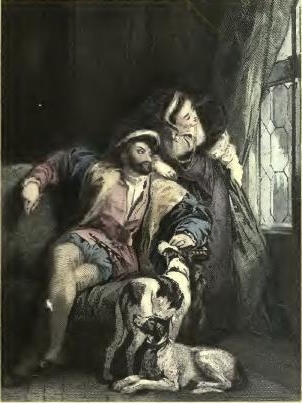
What interest could this officer have in destroying his master? Who was more likely to advance his fortune? But, it is said, it was intended also to poison the king. Here is a new difficulty and a new improbability.
Who was to compensate him for this double crime? Charles V., it is replied—another improbability equally strong. Why begin with a youth only eighteen years and a half old, and who, moreover, had two brothers? How was the king to be got at? Montecuculi did not wait at his table.
Charles V. had nothing to gain by taking away the life of the young dauphin, who had never drawn a sword, and who certainly would have had powerful avengers. It would have been a crime at once base and useless. He did not fear the father, we are to believe, the bravest knight of the French court; yet he was afraid of the son, who had scarcely reached beyond the age of childhood!
But, we are informed, this Montecuculi, on the occasion of a journey to Ferrara, his own country, was presented to the emperor, and that that monarch asked him numerous questions relating to the magnificence of the king's table and the economy of his household. This certainly is decisive evidence that the Italian was engaged by Charles V. to poison the royal family!
Oh! but it was not the emperor himself who urged him to commit this crime: he was impelled to it by Anthony de Leva and the Marquis di Gonzaga. Yes, truly, Anthony de Leva, eighty years of age, and one of the most virtuous knights in Europe! and this noble veteran, moreover, was indiscreet enough to propose executing this scheme of poisoning in conjunction with a prince of Gonzaga. Others mention the Marquis del Vasto, whom we call du Gast. Contemptible impostors! Be at least agreed among yourselves. You say that Montecuculi confessed the fact before his judges. Have you seen the original documents connected with the trial?
You state that the unfortunate man was a chemist. These then are your only proofs, your only reasons, for subjecting him to the most dreadful of executions: he was an Italian, he was a chemist, and Charles V. was hated. His glory then provoked indeed a base revenge. Good God! Your court orders a man of rank to be cut into quarters upon bare suspicion, in the vain hope of disgracing that powerful emperor.
Some time afterwards your suspicions, always light and volatile, charge this poisoning upon Catherine de Medici, wife of Henry II., then dauphin and subsequently king of France. You say that, in order to reign, she destroyed by poison the first dauphin, who stood between her husband and the throne. Miserable impostors! Once again, I say, be consistent! Catherine de Medici was at that time only seventeen years of age.
It has been said that Charles V. himself imputed this murder to Catherine, and the historian Pera is quoted to prove it. This however, is an error. These are the historian's words:
"This year the dauphin of France died at Paris with decided indications of poison. His friends ascribed it to the orders of the Marquis del Vasto and Anthony de Leva, which led to the execution of Count Montecuculi, who was in the habit of corresponding with them: base and absurd suspicion of men so highly honorable, as by destroying the dauphin little or nothing could be gained. He was not yet known by his valor any more than his brothers, who were next in the succession to him.
"To one presumption succeeded another. It was pretended that this murder was committed by order of the duke of Orleans, his brother, at the instigation of his wife, Catherine de Medici, who was ambitious of being a queen, which, in fact, she eventually was. It is well remarked by a certain author, that the dreadful death of the duke of Orleans, afterwards Henry II., was the punishment of heaven upon him for poisoning his brother—at least, if he really did poison him—a practice too common among princes, by which they free themselves at little cost from stumbling-blocks in their career, but frequently and manifestly punished by God."
Signor di Pera, we instantly perceive, is not an absolute Tacitus; besides, he takes Montecuculi, or Montecuculo, as he calls him, for a Frenchman. He says the dauphin died at Paris, whereas it was at Tournon. He speaks of decided indications of poison from public rumor; but it is clear that he attributes the accusation of Catherine de Medici only to the French. This charge is equally unjust and extravagant with that against Montecuculi.
In fact, this volatile temperament, so characteristic of the French, has in every period of our history led to the most tragical catastrophes. If we go back from the iniquitous execution of Montecuculi to that of the Knights Templars, we shall see a series of the most atrocious punishments, founded upon the most frivolous presumptions. Rivers of blood have flowed in France in consequence of the thoughtless character and precipitate judgment of the French people.
We may just notice the wretched pleasure that some men, and particularly those of weak minds, secretly enjoy in talking or writing of public executions, like that they derive from the subject of miracles and sorceries. In Calmet's "Dictionary of the Bible" you may find a number of fine engravings of the punishments in use among the Hebrews. These prints are absolutely sufficient to strike every person of feeling with horror. We will take this opportunity to observe that neither the Jews nor any other people ever thought of fixing persons to the cross by nails; and that there is not even a single instance of it. It is the fiction of some painter, built upon an opinion completely erroneous.
SECTION III.
Ye sages who are scattered over the world—for some sages there are—join the philosophic Beccaria, and proclaim with all your strength that punishments ought to be proportioned to crimes:
That after shooting through the head a young man of the age of twenty, who has spent six months with his father and mother or his mistress, instead of rejoining his regiment, he can no longer be of any service to his country:
That if you hang on the public gallows the servant girl who stole a dozen napkins from her mistress, she will be unable to add to the number of your citizens a dozen children, whom you may be considered as strangling in embryo with their parent; that there is no proportion between a dozen napkins and human life; and, finally, that you really encourage domestic theft, because no master will be so cruel as to get his coachman hanged for stealing a few of his oats; but every master would prosecute to obtain the infliction of a punishment which should be simply proportioned to the offence:
That all judges and legislators are guilty of the death of all the children which unfortunate, seduced women desert, expose, or even strangle, from a similar weakness to that which gave them birth.
On this subject I shall without scruple relate what has just occurred in the capital of a wise and powerful republic, which however, with all its wisdom, has unhappily retained some barbarous laws from those old, unsocial, and inhuman ages, called by some the ages of purity of manners. Near this capital a new-born infant was found dead; a girl was apprehended on suspicion of being the mother; she was shut up in a dungeon; she was strictly interrogated; she replied that she could not have been the mother of that child, as she was at the present time pregnant. She was ordered to be visited by a certain number of what are called (perfectly malapropos in the present instance) wise women—by a commission of matrons. These poor imbecile creatures declared her not to be with child, and that the appearance of pregnancy was occasioned by improper retention. The unfortunate woman was threatened with the torture; her mind became alarmed and terrified; she confessed that she had killed her supposed child; she was capitally convicted; and during the actual passing of her sentence was seized with the pains of childbirth. Her judges were taught by this most impressive case not lightly to pass sentences of death.
With respect to the numberless executions which weak fanatics have inflicted upon other fanatics equally weak, I will say nothing more about them; although it is impossible to say too much.
There are scarcely any highway robberies committed in Italy without assassinations, because the punishment of death is equally awarded to both crimes.
It cannot be doubted that M. de Beccaria, in his "Treatise on Crimes and Punishments" has noticed this very important fact.
EXECUTIONER.
It may be thought that this word should not be permitted to degrade a dictionary of arts and sciences; it has a connection however with jurisprudence and history. Our great poets have not disdained frequently to avail themselves of this word in tragedy: Clytemnestra, in Iphigenia, calls Agamemnon the executioner of his daughter.
In comedy it is used with great gayety; Mercury in the "Amphitryon" (act i. scene 2), says: "Comment, bourreau! tu fais des cris!"—"How, hangman! thou bellowest!"
And even the Romans permitted themselves to say: "Quorsum vadis, carnifex?"—"Whither goest thou, hangman?"
The Encyclopædia, under the word "Executioner," details all the privileges of the Parisian executioner; but a recent author has gone farther. In a romance on education, not altogether equal to Xenophon's "Cyropædia" or Fénelon's "Telemachus," he pretends that the monarch of a country ought, without hesitation, to bestow the daughter of an executioner in marriage on the heir apparent of the crown, if she has been well educated, and if she is of a sufficiently congruous disposition with the young prince. It is a pity that he has not mentioned the precise sum she should carry with her as a dower, and the honors that should be conferred upon her father on the day of marriage.
It is scarcely possible, with due congruity, to carry further the profound morality, the novel rules of decorum, the exquisite paradoxes, and divine maxims with which the author I speak of has favored and regaled the present age. He would undoubtedly feel the perfect congruity of officiating as bridesman at the wedding. He would compose the princess's epithalamium, and not fail to celebrate the grand exploits of her father. The bride may then possibly impart some acrid kisses; for be it known that this same writer, in another romance called "Héloise," introduces a young Swiss, who had caught a particular disorder in Paris, saying to his mistress, "Keep your kisses to yourself; they are too acrid."
A time will come when it will scarcely be conceived possible that such works should have obtained a sort of celebrity; had the celebrity continued, it would have done no honor to the age. Fathers of families soon made up their minds that it was not exactly decorous to marry their eldest sons to the daughters of executioners, whatever congruity might appear to exist between the lover and the lady. There is a rule in all things, and certain limits which cannot be rationally passed.
Est modus in rebus, sunt certi denique fines, Quos ultra citraque nequit consistere rectum.
EXPIATION.
Dieu fit du repentir la vertu des mortels.
The repentance of man is accepted by God as virtue, and perhaps the finest institution of antiquity was that solemn ceremony which repressed crimes by announcing that they would be punished, and at the same time soothed the despair of the guilty by permitting them to redeem their transgressions by appointed modes of penance. Remorse, it is to be remembered, must necessarily have preceded expiation, for diseases are older than medicine, and necessities than relief.
There was, then, previously to all public and legal forms of worship, a natural and instinctive religion which inflicted grief upon the heart of any one who, through ignorance or passion, had committed an inhuman action. A man in a quarrel has killed his friend, or his brother, or a jealous and frantic lover has taken the life of her without whom he felt as if it were impossible to live. The chief of a nation has condemned to death a virtuous man and useful citizen. Such men, if they retain their senses and sensibility, become overwhelmed by despair. Their consciences pursue and haunt them; two courses only are open to them, reparation or to become hardened in guilt. All who have the slightest feeling remaining choose the former; monsters adopt the latter.
As soon as religion was established, expiations were admitted. The ceremonies attending them were, unquestionably, ridiculous; for what connection is there between the water of the Ganges and a murder? How could a man repair homicide by bathing? We have already commented on the excess of absurdity and insanity which can imagine that what washes the body, washes the soul also, and expunges from it the stain of evil actions.
The water of the Nile had afterwards the same virtue as that of the Ganges; other ceremonies were added to these ablutions. The Egyptians took two he-goats and drew lots which of the two should be cast out loaded with the sins of the guilty. This goat was called Hazazel, the expiator. What connection is there, pray, between a goat and the crime of a human being?
It is certainly true that in after times this ceremony was sanctified among our fathers the Jews, who adopted many of the Egyptian rites; but the souls of the Jews were undoubtedly purified, not by the goat but by repentance.
Jason, having killed Absyrtus, his brother-in-law, went, we are told, with Medea, who was more guilty than himself, to be absolved by Circe, the queen and priestess of Æa, who passed in those days for a most powerful sorceress. Circe absolved them with a sucking pig and salt cakes. This might possibly be a very good dish, but it could neither compensate for the blood of Absyrtus, nor make Jason and Medea more worthy people, unless while eating their pig they also manifested the sincerity of their repentance.
The expiation of Orestes, who had avenged his father by the murder of his mother, consisted in going and stealing a statue from the Tartars of the Crimea. The statue was probably extremely ill executed, and there appeared nothing to be gained by such an enterprise. In later times these things were contrived better: mysteries were invented, and the offenders might obtain absolution at these mysteries by submitting to certain painful trials, and swearing to lead a new life. It is from this oath that the persons taking it had attached to them, among all nations, a name corresponding to that of initiated "qui ineunt vitam novam,"—who begin a new career, who enter upon the path of virtue.
We have seen under the article on "Baptism" that the Christian catechumens were not called initiated till after they had been baptized.
It is indisputable, that persons had not their sins washed away in these mysteries, but by virtue of their oath to become virtuous: the hierophant in all the Grecian mysteries, when dismissing the assembly, pronounced the two Egyptian words, "Koth, ompheth," "watch, be pure"; which at once proves that the mysteries came originally from Egypt, and that they were invented solely for the purpose of making mankind better.
Wise men, we thus see, have, in every age, done all in their power to inspire the love of virtue, and to prevent the weakness of man from sinking under despair; but, at the same time there have existed crimes of such magnitude and horror that no mystery could admit of their expiation. Nero, although an emperor, could not obtain initiation into the mysteries of Ceres. Constantine, according to the narrative of Zosimus, was unable to procure the pardon of his crimes: he was polluted with the blood of his wife, his son, and all his relations. It was necessary, for the protection of the human race, that crimes so flagitious should be deemed incapable of expiation, that the prospect of absolution might not invite to their committal, and that hideous atrocity might be checked by universal horror.
The Roman Catholics have expiations which they call penances. We have seen, under the article on "Austerities," how grossly so salutary an institution has been abused.
According to the laws of the barbarians who subverted the Roman Empire, crimes were expiated by money. This was called compounding: "Let the offender compound by paying ten, twenty, thirty shillings." Two hundred sous constituted the composition price for killing a priest, and four hundred for killing a bishop; so that a bishop was worth exactly two priests.
After having thus compounded with men, God Himself was compounded with, when the practice of confession became generally established. At length Pope John XXII. established a tariff of sins.
The absolution of incest, committed by a layman, cost four livres tournois: "Ab incestu pro laico in foro conscienticæ turonenses quatuor." For a man and woman who have committed incest, eighteen livres tournois, four ducats, and nine carlines. This is certainly unjust; if one person pays only four livres tournois, two persons ought not to pay more than eight.
Even crimes against nature have actually their affixed rates, amounting to ninety livres tournois, twelve ducats, and six carlines: "Cum inhibitione turonenses 90, ducatos 12, carlinos 90," etc.
It is scarcely credible that Leo X. should have been so imprudent as to print this book of rates or indulgences in 1514, which, however, we are assured he did; at the same time it must be considered that no spark had then appeared of that conflagration, kindled afterwards by the reformers; and that the court of Rome reposed implicitly upon the credulity of the people, and neglected to throw even the slightest veil over its impositions. The public sale of indulgences, which soon followed, shows that that court took no precaution whatever to conceal its gross abominations from the various nations which had been so long accustomed to them. When the complaints against the abuses of the Romish church burst forth, it did all in its power to suppress this publication, but all was in vain.
If I may give my opinion upon this book of rates, I must say that I do not believe the editions of it are genuine; the rates are not in any kind of proportion and do not at all coincide with those stated by d'Aubigné, the grandfather of Madame de Maintenon, in the confession of de Sancy. Depriving a woman of her virginity is estimated at six gros, and committing incest with a mother or a sister, at five gros. This is evidently ridiculous. I think that there really was a system of rates or taxes established for those who went to Rome to obtain absolution or purchase dispensations, but that the enemies of the Holy See added largely, in order to increase the odium against it. Consult Bayle, under the articles on "Bank," "Dupinet," "Drelincourt."
It is at least positively certain that these rates were never authorized by any council; that they constituted an enormous abuse, invented by avarice, and respected by those who were interested in its not being abolished. The sellers and the purchasers equally found their account in it; and accordingly none opposed it before the breaking out of the disturbances attending the Reformation. It must be acknowledged that an exact list of all these rates or taxes would be eminently useful in the formation of a history of the human mind.
EXTREME.
We will here attempt to draw from the word "extreme" an idea that may be attended with some utility.
It is every day disputed whether in war success is ascribable to conduct or to fortune.
Whether in diseases, nature or medicine is most operative in healing or destroying.
Whether in law it is not judicious for a man to compromise, although he is in the right, and to defend a cause although he is in the wrong.
Whether the fine arts contribute to the glory or to the decline of a state.
Whether it is wise or injudicious to encourage superstition in a people.
Whether there is any truth in metaphysics, history, or morals.
Whether taste is arbitrary, and whether there is in reality a good and a bad taste.
In order to decide at once all these questions, take an advantage of the extreme cases under each, compare these two extremes, and you will immediately discover the truth.
You wish to know whether success in war can be infallibly decided by conduct; consider the most extreme case, the most opposed situations in which conduct alone will infallibly triumph. The hostile army must necessarily pass through a deep mountain gorge; your commander knows this circumstance; he makes a forced march, gets possession of the heights, and completely encloses the enemy in the defile; there they must either perish or surrender. In this extreme case fortune can have no share in the victory. It is demonstrable, therefore, that skill may decide the success of a campaign, and it hence necessarily follows that war is an art.
Afterwards imagine an advantageous but not a decisive position; success is not certain, but it is exceedingly probable. And thus, from one gradation to another, you arrive at what may be considered a perfect equality between the two armies. Who shall then decide? Fortune; that is, some unexpected circumstance or event; the death of a general officer going to execute some important order; the derangement of a division in consequence of a false report, the operation of sudden panic, or various other causes for which prudence can find no remedy; yet it is still always certain that there is an art, that there is a science in war.
The same must be observed concerning medicine; the art of operating with the head or hand to preserve the life which appears likely to be lost.
The first who applied bleeding as speedily as possible to a patient under apoplexy; the first who conceived the idea of plunging a bistoury into the bladder to extract the stone from it, and of closing up the wound; the first who found out the method of stopping gangrene in any part of the human frame, were undoubtedly men, almost divine, and totally unlike the physicians of Molière.
Descend from this strong and decisive example to cases less striking and more equivocal; you perceive fevers and various other maladies cured without its being possible to ascertain whether this is done by the physician or by nature; you perceive diseases, the issue of which cannot be judged; various physicians are mistaken in their opinions of the seat or nature of them; he who has the acutest genius, the keenest eye, develops the character of the complaint. There is then an art in medicine, and the man of superior mind is acquainted with its niceties. Thus it was that La Peyronie discovered that one of the courtiers had swallowed a sharp bone, which had occasioned an ulcer and endangered his life; and thus also did Boerhaave discover the complaint, as unknown as it was dreadful, of a countess of Wassenaer. There is, therefore, it cannot be doubted, an art in medicine, but in every art there are Virgils and Mæviuses.
In jurisprudence, take a case that is clear, in which the law pronounces decisively; a bill of exchange correctly drawn and regularly accepted; the acceptor is bound to pay it in every country in the world. There is, therefore, a useful jurisprudence, although in innumerable cases sentences are arbitrary, because, to the misery of mankind, the laws are ill-framed.
Would you wish to know whether the fine arts are beneficial to a nation? Compare the two extremes: Cicero and a perfect ignoramus. Decide whether the fall of Rome was owing to Pliny or to Attila.
It is asked whether we should encourage superstition in the people. Consider for a moment what is the greatest extreme on this baleful subject, the massacre of St. Bartholomew, the massacres of Ireland, or the Crusades; and the question is decided.
Is there any truth in metaphysics? Advert to those points which are most striking and true. Something exists; something, therefore, has existed from all eternity. An eternal being exists of himself; this being cannot be either wicked or inconsistent. To these truths we must yield; almost all the rest is open to disputation, and the clearest understanding discovers the truth.
It is in everything else as it is in colors; bad eyes can distinguish between black and white; better eyes, and eyes much exercised, can distinguish every nicer gradation: "Usque adeo quod tangit idem est, tamen ultima distant."
EZEKIEL.
Of Some Singular Passages in This Prophet, and of Certain Ancient Usages.
It is well known that we ought not to judge of ancient usages by modern ones; he that would reform the court of Alcinous in the "Odyssey," upon the model of the Grand Turk, or Louis XIV., would not meet with a very gentle reception from the learned; he who is disposed to reprehend Virgil for having described King Evander covered with a bear's skin and accompanied by two dogs at the introduction of ambassadors, is a contemptible critic.