Volume 7 — ON SUICIDE, AND THE ABBE ST. CYRAN'S BOOK LEGITIMATING SUICIDE. (continued 4)
William F. Fleming translation
On the day of the feast which was called by the Jews the solemn atonement, the devout among them confessed to one another, specifying their sins. The confessor repeated three times thirteen words of the seventy-seventh Psalm, at the same time giving the confessed thirty-nine stripes, which the latter returned, and they went away quits. It is said that this ceremony is still in use.
St. John's reputation for sanctity brought crowds to confess to him, as they came to be baptized by him with the baptism of justice; but we are not informed that St. John gave his penitents thirty-nine stripes. Confession was not then a sacrament; for this there are several reasons. The first is, that the word "sacrament" was at that time unknown, which reason is of itself sufficient. The Christians took their confession from the Jewish rites, and not from the mysteries of Isis and Ceres. The Jews confessed to their associates, and the Christians did also. It afterwards appeared more convenient that this should be the privilege of the priests. No rite, no ceremony, can be established but in process of time. It was hardly possible that some trace should not remain of the ancient usage of the laity of confessing to one another.
In Constantine's reign, it was at first the practice publicly to confess public offences. In the fifth century, after the schism of Novatus and Novatian, penitentiaries were instituted for the absolution of such as had fallen into idolatry. This confession to penitentiary priests was abolished under the Emperor Theodosius. A woman having accused herself aloud, to the penitentiary of Constantinople, of lying with the deacon, caused so much scandal and disturbance throughout the city that Nectarius permitted all the faithful to approach the holy table without confession, and to communicate in obedience to their consciences alone. Hence these words of St. John Chrysostom, who succeeded Nectarius: "Confess yourselves continually to God; I do not bring you forward on a stage to discover your faults to your fellow-servants; show your wounds to God, and ask of Him their cure; acknowledge your sins to Him who will not reproach you before men; it were vain to strive to hide them from Him who knows all things," etc.
It is said that the practice of auricular confession did not begin in the west until about the seventh century, when it was instituted by the abbots, who required their monks to come and acknowledge their offences to them twice a year. These abbots it was who invented the formula: "I absolve thee to the utmost of my power and thy need." It would surely have been more respectful towards the Supreme Being, as well as more just, to say: "May He forgive both thy faults and mine!"
The good which confession has done is that it has sometimes procured restitution from petty thieves. The ill is, that, in the internal troubles of states, it has sometimes forced the penitents to be conscientiously rebellious and blood-thirsty. The Guelph priests refused absolution to the Ghibellines, and the Ghibellines to the Guelphs.
The counsellor of state, Lénet, relates, in his "Memoirs," that all he could do in Burgundy to make the people rise in favor of the Prince Condé, detained at Vincennes by Cardinal Mazarin, was "to let loose the priests in the confessionals"—speaking of them as bloodhounds, who were to fan the flame of civil war in the privacy of the confessional.
At the siege of Barcelona, the monks refused absolution to all who remained faithful to Philip V. In the last revolution of Genoa, it was intimated to all consciences that there was no salvation for whosoever should not take up arms against the Austrians. This salutary remedy has, in every age, been converted into a poison. Whether a Sforza, a Medici, a Prince of Orange, or a King of France was to be assassinated, the parricide always prepared himself by the sacrament of confession. Louis XI., and the Marchioness de Brinvilliers always confessed as soon as they had committed any great crime; and they confessed often, as gluttons take medicines to increase their appetite.
The Disclosure of Confessions.
Jaurigini and Balthazar Gérard, the assassins of William I., Prince of Orange, the dominican Jacques Clément, Jean Châtel, the Feuillant Ravaillac, and all the other parricides of that day, confessed themselves before committing their crimes. Fanaticism, in those deplorable ages, had arrived at such a pitch that confession was but an additional pledge for the consummation of villainy. It became sacred for this reason—that confession is a sacrament.
Strada himself says: "Jaurigni non ante facinus aggredi sustinuit, quam expiatam noxis animam apud Dominicanum sacerdotem cœlesti pane firmaverit". "Jaurigini did not venture upon this act until he had purged his soul by confession at the feet of a Dominican, and fortified it by the celestial bread."
We find, in the interrogatory of Ravaillac, that the wretched man, quitting the Feuillans, and wishing to be received among the Jesuits, applied to the Jesuit d'Aubigny and, after speaking of several apparitions that he had seen, showed him a knife, on the blade of which was engraved a heart and a cross, and said, "This heart indicates that the king's heart must be brought to make war on the Huguenots."
Perhaps, if this d'Aubigny had been zealous and prudent enough to have informed the king of these words, and given him a faithful picture of the man who had uttered them, the best of kings would not have been assassinated.
On August 20, 1610, three months after the death of Henry IV., whose wounds yet bleed in the heart of every Frenchman, the Advocate-General Sirvin, still of illustrious memory, required that the Jesuits should be made to sign the four following rules:
1. That the council is above the pope. 2. That the pope cannot deprive the king of any of his rights by excommunication. 3. That ecclesiastics, like other persons, are entirely subject to the king. 4. That a priest who is made acquainted, by confession, with a conspiracy against the king and the state, must disclose it to the magistrates.
On the 22nd, the parliament passed a decree, by which it forbade the Jesuits to instruct youth before they had signed these four articles; but the court of Rome was then so powerful, and that of France so feeble, that this decree was of no effect. A fact worthy of attention is, that this same court of Rome, which did not choose that confession should be disclosed when the lives of sovereigns were endangered, obliged its confessors to denounce to the inquisitors those whom their female penitents accused in confession of having seduced and abused them. Paul IV., Pius IV., Clement VIII., and Gregory XV., ordered these disclosures to be made.
This was a very embarrassing snare for confessors and female penitents; it was making the sacrament a register of informations, and even of sacrileges. For, by the ancient canons, and especially by the Lateran Council under Innocent III., every priest that disclosed a confession, of whatever nature, was to be interdicted and condemned to perpetual imprisonment.
But this is not the worst; here are four popes, of the sixteenth and seventeenth centuries, ordering the disclosure of a sin of impurity, but not permitting that of a parricide. A woman, in the sacrament, declares, or pretends, before a carmelite, that a cordelier has seduced her; and the carmelite must denounce the cordelier. A fanatical assassin, thinking that he serves God by killing his prince, comes and consults a confessor on this case of conscience; and the confessor commits a sacrilege if he saves his sovereign's life.
This absurd and horrible contradiction is one unfortunate consequence of the constant opposition existing for so many centuries between the civil and ecclesiastical laws. The citizen finds himself, on fifty occasions, placed without alternative between sacrilege and high treason; the rules of good and evil being not yet drawn from beneath the chaos under which they have so long been buried. The Jesuit Coton's reply to Henry IV. will endure longer than his order. "Would you reveal the confession of a man who had resolved to assassinate me?" "No; but I would throw myself between him and you."
Father Coton's maxim has not always been followed. In some countries there are state mysteries unknown to the public, of which revealed confessions form no inconsiderable part. By means of suborned confessors the secrets of prisoners are learned. Some confessors, to reconcile their conscience with their interest, make use of a singular artifice. They give an account, not precisely of what the prisoner has told them, but of what he has not told them. If, for example, they are employed to find out whether an accused person has for his accomplice a Frenchman or an Italian, they say to the man who employs them, "the prisoner has sworn to me that no Italian was informed of his designs;" whence it is concluded that the suspected Frenchman is guilty.
Bodin thus expresses himself, in his book, "De la République": "Nor must it be concealed, if the culprit is discovered to have conspired against the life of the sovereign, or even to have willed it only; as in the case of a gentleman of Normandy, who confessed to a monk that he had a mind to kill Francis I. The monk apprised the king, who sent the gentleman to the court of parliament, where he was condemned to death, as I learned from M. Canage, an advocate in parliament."
The writer of this article was himself almost witness to a disclosure still more important and singular. It is known how the Jesuit Daubenton betrayed Philip V., king of Spain, to whom he was confessor. He thought, from a very mistaken policy, that he should report the secrets of his penitent to the duke of Orleans, regent of the kingdom, and had the imprudence to write to him what he should not, even verbally, communicate to any one. The duke of Orleans sent his letter to the king of Spain. The Jesuit was discarded, and died a short time after. This is an authenticated fact.
It is still a grave and perplexing question, in what cases confessions should be disclosed. For, if we decide that it should be in cases of human high treason, this treason may be made to include any direct offence against majesty, even the smuggling of salt or muslins. Much more should high treasons against the Divine Majesty be disclosed; and these may be extended to the smallest faults, as having missed evening service.
It would, then, be very important to come to a perfect understanding about what confessions should be disclosed, and what should be kept secret. Yet would such a decision be very dangerous; for how many things are there which must not be investigated!
Pontas, who, in three folio volumes, decides on all the possible cases of conscience in France, and is unknown to the rest of the world, says that on no occasion should confession be disclosed. The parliaments have decided the contrary. Which are we to believe? Pontas, or the guardians of the laws of the realm, who watch over the lives of princes and the safety of the state?
Whether Laymen and Women Have Been Confessors?
As, in the old law, the laity confessed to one another; so, in the new law, they long had the same privilege by custom. In proof of this, let it suffice to cite the celebrated Joinville, who expressly says that "the constable of Cyprus confessed himself to him, and he gave him absolution, according to the right which he had so to do." St. Thomas, in his dream, expresses himself thus: "Confessio ex defectu sacerdotis laico facta, sacramentalis est quodam modo." "Confession made to a layman, in default of a priest, is in some sort sacramental."
We find in the life of St. Burgundosarius, and in the rule of an unknown saint, that the nuns confessed their very grossest sins to their abbess. The rule of St. Donatus ordains that the nuns shall discover their faults to their superior three times a day. The capitulars of our kings say that abbesses must be forbidden the exercise of the right which they have arrogated against the custom of the holy church, of giving benediction and imposing hands, which seems to signify the pronouncing of absolution, and supposes the confession of sins. Marcus, patriarch of Alexandria, asks Balzamon, a celebrated canonist of his time, whether permission should be granted to abbesses to hear confessions, to which Balzamon answers in the negative. We have, in the canon law, a decree of Pope Innocent III., enjoining the bishops of Valencia and Burgos, in Spain, to prevent certain abbesses from blessing their nuns, from confessing, and from public preaching: "Although," says he, "the blessed Virgin Mary was superior to all the apostles in dignity and in merit, yet it is not to her, but to the apostles, that the Lord has confided the keys of the kingdom of heaven."
So ancient was this right, that we find it established in the rules of St. Basil. He permits abbesses to confess their nuns, conjointly with a priest. Father Martène, in his "Rights of the Church," says that, for a long time, abbesses confessed their nuns; but, adds he, they were so curious, that it was found necessary to deprive them of this privilege.
The ex-Jesuit Nonnotte should confess himself and do penance; not for having been one of the most ignorant of daubers on paper, for that is no crime; not for having given the name of errors to truths which he did not understand; but for having, with the most insolent stupidity, calumniated the author of this article, and called his brother raca (a fool), while he denied these facts and many others, about which he knew not one word. He has put himself in danger of hell fire; let us hope that he will ask pardon of God for his enormous folly. We desire not the death of a sinner, but that he turn from his wickedness and live.
It has long been debated why men, very famous in this part of the world where confession is in use, have died without this sacrament. Such are Leo X., Pélisson, and Cardinal Dubois. The cardinal had his perineum opened by La Peyronie's bistoury; but he might have confessed and communicated before the operation. Pélisson, who was a Protestant until he was forty years old, became a convert that he might be made master of requests and have benefices. As for Pope Leo X., when surprised by death, he was so much occupied with temporal concerns, that he had no time to think of spiritual ones.
Confession Tickets.
In Protestant countries confession is made to God; in Catholic ones, to man. The Protestants say you can hide nothing from God, whereas man knows only what you choose to tell him. As we shall never meddle with controversy, we shall not enter here into this old dispute. Our literary society is composed of Catholics and Protestants, united by the love of letters; we must not suffer ecclesiastical quarrels to sow dissension among us. We will content ourselves with once more repeating the fine answer of the Greek already mentioned, to the priest who would have had him confess in the mysteries of Ceres: "Is it to God, or to thee, that I am to address myself?" "To God." "Depart then, O man."
In Italy, and in all the countries of obedience, every one, without distinction, must confess and communicate. If you have a stock of enormous sins on hand, you have also grand penitentiaries to absolve you. If your confession is worth nothing, so much the worse for you. At a very reasonable rate, you get a printed receipt, which admits you to communion; and all the receipts are thrown into a pix; such is the rule.
These bearers' tickets were unknown at Paris until about the year 1750, when an archbishop of Paris bethought himself of introducing a sort of spiritual bank, to extirpate Jansenism and insure the triumph of the bull Unigenitus. It was his pleasure that extreme unction and the viaticum should be refused to every sick person who did not produce a ticket of confession, signed by a constitutionary priest.
This was refusing the sacrament to nine-tenths of Paris. In vain was he told: "Think what you are doing; either these sacraments are necessary, to escape damnation, or salvation may be obtained without them by faith, hope, charity, good works, and the merits of our Saviour. If salvation be attainable without this viaticum, your tickets are useless; if the sacraments be absolutely necessary, you damn all whom you deprive of them; you consign to eternal fire seven hundred thousand souls, supposing you live long enough to bury them; this is violent; calm yourself, and let each one die as well as he can."
In this dilemma he gave no answer, but persisted. It is horrible to convert religion, which should be man's consolation, into his torment. The parliament, in whose hands is the high police, finding that society was disturbed, opposed—according to custom—decrees to mandaments. But ecclesiastical discipline would not yield to legal authority. The magistracy was under the necessity of using force, and to send archers to obtain for the Parisians confession, communion, and interment.
By this excess of absurdity, men's minds were soured and cabals were formed at court, as if there had been a farmer-general to be appointed, or a minister to be disgraced. In the discussion of a question there are always incidents mixed up that have no radical connection with it; and in this case so much so, that all the members of the parliament were exiled, as was also the archbishop in his turn.
These confession tickets would, in the times preceding, have caused a civil war, but happily, in our days, they produced only civil cavils. The spirit of philosophy, which is no other than reason, has become, with all honest men, the only antidote against these epidemic disorders.
CONFISCATION.
It is well observed, in the "Dictionnaire Encyclopédique," in the article "Confiscation," that the fisc, whether public, or royal, or seignorial, or imperial, or disloyal, was a small basket of reeds or osiers, in which was put the little money that was received or could be extorted. We now use bags; the royal fisc is the royal bag.
In several countries of Europe it is a received maxim, that whosoever confiscates the body, confiscates the goods also. This usage is established in those countries in particular where custom holds the place of law; and in all cases, an entire family is punished for the fault of one man only.
To confiscate the body, is not to put a man's body into his sovereign lord's basket. This phrase, in the barbarous language of the bar, means to get possession of the body of a citizen, in order either to take away his life, or to condemn him to banishment for life. If he is put to death, or escapes death by flight, his goods are seized. Thus it is not enough to put a man to death for his offences; his children, too, must be deprived of the means of living.
In more countries than one, the rigor of custom confiscates the property of a man who has voluntarily released himself from the miseries of this life, and his children are reduced to beggary because their father is dead. In some Roman Catholic provinces, the head of a family is condemned to the galleys for life, by an arbitrary sentence, for having harbored a preacher in his house, or for having heard one of his sermons in some cavern or desert place, and his wife and family are forced to beg their bread.
This jurisprudence, which consists in depriving orphans of their food, was unknown to the Roman commonwealth. Sulla introduced it in his proscriptions, and it must be acknowledged that a rapine invented by Sulla was not an example to be followed. Nor was this law, which seems to have been dictated by inhumanity and avarice alone, followed either by Cæsar, or by the good Emperor Trajan, or by the Antonines, whose names are still pronounced in every nation with love and reverence. Even under Justinian, confiscations took place only in cases of high treason. Those who were accused having been, for the most part, men of great possessions, it seems that Justinian made this ordinance through avarice alone. It also appears that, in the times of feudal anarchy, the princes and lords of lands, being not very rich, sought to increase their treasure by the condemnation of their subjects. They were allowed to draw a revenue from crime. Their laws being arbitrary, and the Roman jurisprudence unknown among them, their customs, whether whimsical or cruel, prevailed. But now that the power of sovereigns is founded on immense and assured wealth, their treasure needs no longer to be swollen by the slender wreck of the fortunes of some unhappy family. It is true that the goods so appropriated are abandoned to the first who asks for them. But is it for one citizen to fatten on the remains of the blood of another citizen?
Confiscation is not admitted in countries where the Roman law is established, except within the jurisdiction of the parliament of Toulouse. It was formerly established at Calais, where it was abolished by the English when they were masters of that place. It appears very strange that the inhabitants of the capital live under a more rigorous law than those of the smaller towns; so true is it, that jurisprudence has often been established by chance, without regularity, without uniformity, as the huts are built in a village.
The following was spoken by Advocate-General Omer Talon, in full parliament, at the most glorious period in the annals of France, in 1673, concerning the property of one Mademoiselle de Canillac, which had been confiscated. Reader, attend to this speech; it is not in the style of Cicero's oratory, but it is curious:
"In the thirteenth chapter of Deuteronomy, God says, 'If thou shalt find a city where idolatry prevails, thou shalt surely smite the inhabitants of that city with the edge of the sword, destroying it utterly, and all that is therein. And thou shalt gather all the spoil of it into the midst of the street thereof, and shalt burn with fire the city and all the spoil thereof, every whit, for the Lord thy God.'
"So, in the crime of high treason, the king seized the property, and the children were deprived of it. Naboth having been proceeded against, 'quia maledixerat regi,' King Ahab took possession of his inheritance. David, being apprised that Mephibosheth had taken part in the rebellion, gave all his goods to Sheba, who brought him the news—'Tibi sunt omnia quæ fuerunt Mephibosheth.'"
The question here was, who should inherit the property of Mademoiselle de Canillac—property formerly confiscated from her father, abandoned by the king to a keeper of the royal treasure, and afterwards given by this keeper of the royal treasure to the testatrix. And in this case of a woman of Auvergne a lawyer refers us to that of Ahab, one of the petty kings of a part of Palestine, who confiscated Naboth's vineyard, after assassinating its proprietor with the poniard of Jewish justice—an abominable act, which has become a proverb to inspire men with a horror for usurpation. Assuredly, Naboth's vineyard has no connection with Mademoiselle de Canillac's inheritance. Nor do the murder and confiscation of the goods of Mephibosheth, grandson of King Saul, and son of David's friend Jonathan, bear a much greater affinity to this lady's will.
With this pedantry, this rage for citations foreign to the subject; with this ignorance of the first principles of human nature; with these ill-conceived and ill-adapted prejudices, has jurisprudence been treated on by men who, in their sphere, have had some reputation.
CONSCIENCE.
SECTION I.
Of the Conscience of Good and of Evil.
Locke has demonstrated—if we may use that term in morals and metaphysics—that we have no innate ideas or principles. He was obliged to demonstrate this position at great length, as the contrary was at that time universally believed. It hence clearly follows that it is necessary to instil just ideas and good principles into the mind as soon as it acquires the use of its faculties.
Locke adduces the example of savages, who kill and devour their neighbors without any remorse of conscience; and of Christian soldiers, decently educated, who, on the taking of a city by assault, plunder, slay, and violate, not merely without remorse, but with rapture, honor, and glory, and with the applause of all their comrades.
It is perfectly certain that, in the massacres of St. Bartholomew, and in the "autos-da-fé" the holy acts of faith of the Inquisition, no murderer's conscience ever upbraided him with having massacred men, women, and children, or with the shrieks, faintings, and dying tortures of his miserable victims, whose only crime consisted in keeping Easter in a manner different from that of the inquisitors. It results, therefore, from what has been stated, that we have no other conscience than what is created in us by the spirit of the age, by example, and by our own dispositions and reflections.
Man is born without principles, but with the faculty of receiving them. His natural disposition will incline him either to cruelty or kindness; his understanding will in time inform him that the square of twelve is a hundred and forty-four, and that he ought not to do to others what he would not that others should do to him; but he will not, of himself, acquire these truths in early childhood. He will not understand the first, and he will not feel the second.
A young savage who, when hungry, has received from his father a piece of another savage to eat, will, on the morrow, ask for the like meal, without thinking about any obligation not to treat a neighbor otherwise than he would be treated himself. He acts, mechanically and irresistibly, directly contrary to the eternal principle.
Nature has made a provision against such horrors. She has given to man a disposition to pity, and the power of comprehending truth. These two gifts of God constitute the foundation of civil society. This is the reason there have ever been but few cannibals; and which renders life, among civilized nations, a little tolerable. Fathers and mothers bestow on their children an education which soon renders them social, and this education confers on them a conscience.
Pure religion and morality, early inculcated, so strongly impress the human heart that, from the age of sixteen or seventeen, a single bad action will not be performed without the upbraidings of conscience. Then rush on those headlong passions which war against conscience, and sometimes destroy it. During the conflict, men, hurried on by the tempest of their feelings, on various occasions consult the advice of others; as, in physical diseases, they ask it of those who appear to enjoy good health.
This it is which has produced casuists; that is, persons who decide on cases of conscience. One of the wisest casuists was Cicero. In his book of "Offices," or "Duties" of man, he investigates points of the greatest nicety; but long before him Zoroaster had appeared in the world to guide the conscience by the most beautiful precept, "If you doubt whether an action be good or bad, abstain from doing it." We treat of this elsewhere.
Whether a Judge Should Decide according to his Conscience, or according to the Evidence.
Thomas Aquinas, you are a great saint, and a great divine, and no Dominican has a greater veneration for you than I have; but you have decided, in your "Summary," that a judge ought to give sentence according to the evidence produced against the person accused, although he knows that person to be perfectly innocent. You maintain that the deposition of witnesses, which must inevitably be false, and the pretended proofs resulting from the process, which are impertinent, ought to weigh down the testimony of his own senses. He saw the crime committed by another; and yet, according to you, he ought in conscience to condemn the accused, although his conscience tells him the accused is innocent. According to your doctrine, therefore, if the judge had himself committed the crime in question, his conscience ought to oblige him to condemn the man falsely accused of it.
In my conscience, great saint, I conceive that you are most absurdly and most dreadfully deceived. It is a pity that, while possessing such a knowledge of canon law, you should be so little acquainted with natural law. The duty of a magistrate to be just, precedes that of being a formalist. If, in virtue of evidence which can never exceed probability, I were to condemn a man whose innocence I was otherwise convinced of, I should consider myself a fool and an assassin.
Fortunately all the tribunals of the world think differently from you. I know not whether Farinaceus and Grillandus may be of your opinion. However that may be, if ever you meet with Cicero, Ulpian, Trebonian, Demoulin, the Chancellor de l'Hôpital, or the Chancellor d'Aguesseau, in the shades, be sure to ask pardon of them for falling into such an error.
Of a Deceitful Conscience.
The best thing perhaps that was ever said upon this important subject is in the witty work of "Tristram Shandy," written by a clergyman of the name of Sterne, the second Rabelais of England. It resembles those small satires of antiquity, the essential spirit of which is so piquant and precious.
An old half-pay captain and his corporal, assisted by Doctor Slop, put a number of very ridiculous questions. In these questions the French divines are not spared. Mention is particularly made of a memoir presented to the Sorbonne by a surgeon, requesting permission to baptize unborn children by means of a clyster-pipe, which might be introduced into the womb without injuring either the mother or the child. At length the corporal is directed to read to them a sermon, composed by the same clergyman, Sterne.
Among many particulars, superior even to those of Rembrandt and Calot, it describes a gentleman, a man of the world, spending his time in the pleasures of the table, in gaming, and debauchery, yet doing nothing to expose himself to the reproaches of what is called good company, and consequently never incurring his own. His conscience and his honor accompany him to the theatres, to the gaming houses, and are more particularly present when he liberally pays his lady under protection. He punishes severely, when in office, the petty larcenies of the vulgar, lives a life of gayety, and dies without the slightest feeling of remorse.
Doctor Slop interrupts the reading to observe that such a case was impossible with respect to a follower of the Church of England, and could happen only among papists. At last the sermon adduces the example of David, who sometimes possessed a conscience tender and enlightened, at others hardened and dark.
When he has it in his power to assassinate his king in a cavern, he scruples going beyond cutting off a corner of his robe—here is the tender conscience. He passes an entire year without feeling the slightest compunction for his adultery with Bathsheba and his murder of Uriah—here is the same conscience in a state of obduracy and darkness.
Such, says the preacher, are the greater number of mankind. We concede to this clergyman that the great ones of the world are very often in this state; the torrent of pleasures and affairs urges them almost irresistibly on; they have no time to keep a conscience. Conscience is proper enough for the people; but even the people dispense with it, when the question is how to gain money. It is judicious, however, at times, to endeavor to awaken conscience both in mantua-makers and in monarchs, by the inculcation of a morality calculated to make an impression upon both; but, in order to make this impression, it is necessary to preach better than modern preachers usually do, who seldom talk effectively to either.
Liberty of Conscience.
[Translated from the German.]
[We do not adopt the whole of the following article; but, as it contains some truths, we did not consider ourselves obliged to omit it; and we do not feel ourselves called upon to justify what may be advanced in it with too great rashness or severity.—Author.]
"The almoner of Prince ——, who is a Roman Catholic, threatened an anabaptist that he would get him banished from the small estates which the prince governed. He told him that there were only three authorized sects in the empire—that which eats Jesus Christ, by faith alone, in a morsel of bread, while drinking out of a cup; that which eats Jesus Christ with bread alone; and that which eats Jesus Christ in body and in soul, without either bread or wine; and that as for the anabaptist who does not in any way eat God, he was not fit to live in monseigneur's territory. At last, the conversation kindling into greater violence, the almoner fiercely threatened the anabaptist that he would get him hanged. 'So much the worse for his highness,' replied the anabaptist; 'I am a large manufacturer; I employ two hundred workmen; I occasion the influx of two hundred thousand crowns a year into his territories; my family will go and settle somewhere else; monseigneur will in consequence be a loser.'
"'But suppose monseigneur hangs up your two hundred workmen and your family,' rejoined the almoner, 'and gives your manufactory to good Catholics?'
"'I defy him to do it,' says the old gentleman. 'A manufactory is not to be given like a farm; because industry cannot be given. It would be more silly for him to act so than to order all his horses to be killed, because, being a bad horseman, one may have thrown him off his back. The interest of monseigneur does not consist in my swallowing the godhead in a wafer, but in my procuring something to eat for his subjects, and increasing the revenues by my industry. I am a gentleman; and although I had the misfortune not to be born such, my occupation would compel me to become one; for mercantile transactions are of a very different nature from those of a court, and from your own. There can be no success in them without probity. Of what consequence is it to you that I was baptized at what is called the age of discretion, and you while you were an infant? Of what consequence is it to you that I worship God after the manner of my fathers? Were you able to follow up your wise maxims, from one end of the world to the other, you will hang up the Greek, who does not believe that the spirit proceeds from the Father and the Son; all the English, all the Hollanders, Danes, Swedes, Icelanders, Prussians, Hanoverians, Saxons, Holsteiners, Hessians, Würtembergers, Bernese, Hamburgers, Cossacks, Wallachians, and Russians, none of whom believe the pope to be infallible; all the Mussulmans, who believe in one God, and who give him neither father nor mother; the Indians, whose religion is more ancient than the Jewish; and the lettered Chinese, who, for the space of four thousand years, have served one only God without superstition and without fanaticism. This, then, is what you would perform had you but the power!' 'Most assuredly,' says the monk, 'for the zeal of the house of the Lord devours me.' 'Zelus domus suæ comedit me.'
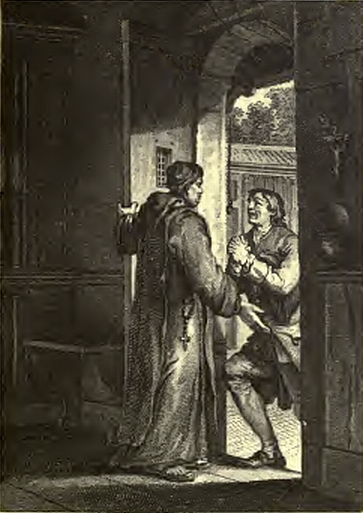
"'Just tell me now, my good almoner,' resumed the anabaptist, 'are you a Dominican, or a Jesuit, or a devil?' 'I am a Jesuit,' says the other. 'Alas, my friend, if you are not a devil, why do you advance things so utterly diabolical?' 'Because the reverend father, the rector, has commanded me to do so.' 'And who commanded the reverend father, the rector, to commit such an abomination?' 'The provincial.' 'From whom did the provincial receive the command?' 'From our general, and all to please the pope.'
"The poor anabaptist exclaimed: 'Ye holy popes, who are at Rome in possession of the throne of the Cæsars—archbishops, bishops, and abbés, become sovereigns, I respect and fly you; but if, in the recesses of your heart, you confess that your opulence and power are founded only on the ignorance and stupidity of our fathers, at least enjoy them with moderation. We do not wish to dethrone you; but do not crush us. Enjoy yourselves, and let us be quiet. If otherwise, tremble, lest at last people should lose their patience, and reduce you, for the good of your souls, to the condition of the apostles, of whom you pretend to be the successors.'
"'Wretch! you would wish the pope and the bishop of Würtemberg to gain heaven by evangelical poverty!' 'You, reverend father, would wish to have me hanged!'"
"I'm a Jesuit."
CONSEQUENCE.
What is our real nature, and what sort of a curious and contemptible understanding do we possess? A man may, it appears, draw the most correct and luminous conclusions, and yet be destitute of common sense. This is, in fact, too true. The Athenian fool, who believed that all the vessels which came into the port belonged to him, could calculate to a nicety what the cargoes of those vessels were worth, and within how many days they would arrive from Smyrna at the Piræus.
We have seen idiots who could calculate and reason in a still more extraordinary manner. They were not idiots, then, you tell me. I ask your pardon—they certainly were. They rested their whole superstructure on an absurd principle; they regularly strung together chimeras. A man may walk well, and go astray at the same time; and, then, the better he walks the farther astray he goes.
The Fo of the Indians was son of an elephant, who condescended to produce offspring by an Indian princess, who, in consequence of this species of left-handed union, was brought to bed of the god Fo. This princess was sister to an emperor of the Indies. Fo, then, was the nephew of that emperor, and the grandson of the elephant and the monarch were cousins-german; therefore, according to the laws of the state, the race of the emperor being extinct, the descendants of the elephant become the rightful successors. Admit the principle, and the conclusion is perfectly correct.
It is said that the divine elephant was nine standard feet in height. You reasonably suppose that the gate of his stable should be above nine feet in height, in order to admit his entering with ease. He consumed twenty pounds of rice every day, and twenty pounds of sugar, and drank twenty-five pounds of water. You find, by using your arithmetic, that he swallows thirty-six thousand five hundred pounds weight in the course of a year; it is impossible to reckon more correctly. But did your elephant ever, in fact, exist? Was he the emperor's brother-in-law? Had his wife a child by this left-handed union? This is the matter to be investigated. Twenty different authors, who lived in Cochin China, have successively written about it; it is incumbent on you to collate these twenty authors, to weigh their testimonies, to consult ancient records, to see if there is any mention of this elephant in the public registers; to examine whether the whole account is not a fable, which certain impostors have an interest in sanctioning. You proceed upon an extravagant principle, but draw from it correct conclusions.
Logic is not so much wanting to men as the source of logic. It is not sufficient for a madman to say six vessels which belong to me carry two hundred tons each; the ton is two thousand pounds weight; I have therefore twelve hundred thousand pounds weight of merchandise in the port of the Piræus. The great point is, are those vessels yours? That is the principle upon which your fortune depends; when that is settled, you may estimate and reckon up afterwards.
An ignorant man, who is a fanatic, and who at the same time strictly draws his conclusions from his premises, ought sometimes to be smothered to death as a madman. He has read that Phineas, transported by a holy zeal, having found a Jew in bed with a Midianitish woman, slew them both, and was imitated by the Levites, who massacred every household that consisted one-half of Midianites and the other of Jews. He learns that Mr. ——, his Catholic neighbor, intrigued with Mrs. ——, another neighbor, but a Huguenot, and he will kill both of them without scruple. It is impossible to act in greater consistency with principle; but what is the remedy for this dreadful disease of the soul? It is to accustom children betimes to admit nothing which shocks reason, to avoid relating to them histories of ghosts, apparitions, witches, demoniacal possessions, and ridiculous prodigies. A girl of an active and susceptible imagination hears a story of demoniacal possessions; her nerves become shaken, she falls into convulsions, and believes herself possessed by a demon or devil. I actually saw one young woman die in consequence of the shock her frame received from these abominable histories.
CONSTANTINE.
SECTION I.
The Age of Constantine.
Among the ages which followed the Augustan, that of Constantine merits particular distinction. It is immortalized by the great changes which it ushered into the world. It commenced, it is true, with bringing back barbarism. Not merely were there no Ciceros, Horaces, and Virgils, any longer to be found, but there was not even a Lucan or a Seneca; there was not even a philosophic and accurate historian. Nothing was to be seen but equivocal satires or mere random panegyrics.
It was at that time that the Christians began to write history, but they took not Titus Livy, or Thucydides as their models. The followers of the ancient religion wrote with no greater eloquence or truth. The two parties, in a state of mutual exasperation, did not very scrupulously investigate the charges which they heaped upon their adversaries; and hence it arises that the same man is sometimes represented as a god and sometimes as a monster.
The decline of everything, in the commonest mechanical arts, as well as in eloquence and virtue, took place after the reign of Marcus Aurelius. He was the last emperor of the sect of stoics, who elevated man above himself by rendering him severe to himself only, and compassionate to others. After the death of this emperor, who was a genuine philosopher, there was nothing but tyranny and confusion. The soldiers frequently disposed of the empire. The senate had fallen into such complete contempt that, in the time of Gallienus, an express law was enacted to prevent senators from engaging in war. Thirty heads of parties were seen, at one time, assuming the title of emperor in thirty provinces of the empire. The barbarians already poured in, on every side, in the middle of the third century, on this rent and lacerated empire. Yet it was held together by the mere military discipline on which it had been founded.
During all these calamities, Christianity gradually established itself, particularly in Egypt, Syria, and on the coasts of Asia Minor. The Roman Empire admitted all sorts of religions, as well as all sects of philosophy. The worship of Osiris was permitted, and even the Jews were left in the enjoyment of considerable privileges, notwithstanding their revolts. But the people in the provinces frequently rose up against the Christians. The magistrates persecuted them, and edicts were frequently obtained against them from the emperors. There is no ground for astonishment at the general hatred in which Christians were at first held, while so many other religions were tolerated. The reason was that neither Egyptians nor Jews, nor the worshippers of the goddess of Syria and so many other foreign deities, ever declared open hostility to the gods of the empire. They did not array themselves against the established religion; but one of the most imperious duties of the Christians was to exterminate the prevailing worship. The priests of the gods raised a clamor on perceiving the diminution of sacrifices and offerings; and the people, ever fanatical and impetuous, were stirred up against the Christians, while in the meantime many emperors protected them. Adrian expressly forbade the persecution of them. Marcus Aurelius commanded that they should not be prosecuted on account of religion. Caracalla, Heliogabalus, Alexander, Philip, and Gallienus left them entire liberty. They had, in the third century, public churches numerously attended and very opulent; and so great was the liberty they enjoyed that, in the course of that century, they held sixteen councils. The road to dignities was shut up against the first Christians, who were nearly all of obscure condition, and they turned their attention to commerce, and some of them amassed great affluence. This is the resource of all societies that cannot have access to offices in the state. Such has been the case with the Calvinists in France, all the Nonconformists in England, the Catholics in Holland, the Armenians in Persia, the Banians in India, and the Jews all over the world. However, at last the toleration was so great, and the administration of the government so mild, that the Christians gained access to all the honors and dignities of the state. They did not sacrifice to the gods of the empire; they were not molested, whether they attended or avoided the temples; there was at Rome the most perfect liberty with respect to the exercises of their religion; none were compelled to engage in them. The Christians, therefore, enjoyed the same liberty as others. It is so true that they attained to honors, that Diocletian and Galerius deprived no fewer than three hundred and three of them of those honors, in the persecution of which we shall have to speak.
It is our duty to adore Providence in all its dispensations; but I confine myself to political history. Manes, under the reign of Probus, about the year 278, formed a new religion in Alexandria. The principles of this sect were made up of some ancient doctrines of the Persians and certain tenets of Christianity. Probus, and his successor, Carus, left Manes and the Christians in the enjoyment of peace. Numerien permitted them entire liberty. Diocletian protected the Christians, and tolerated the Manichæans, during twelve years; but in 296 he issued an edict against the Manichæans, and proscribed them as enemies to the empire and adherents of the Persians. The Christians were not comprehended in the edict; they continued in tranquillity under Diocletian, and made open profession of their religion throughout the whole empire until the latter years of that prince's reign.
To complete the sketch, it is necessary to describe of what at that period the Roman Empire consisted. Notwithstanding internal and foreign shocks, notwithstanding the incursions of barbarians, it comprised all the possessions of the grand seignor at the present day, except Arabia; all that the house of Austria possesses in Germany, and all the German provinces as far as the Elbe; Italy, France, Spain, England, and half of Scotland; all Africa as far as the desert of Sahara, and even the Canary Isles. All these nations were retained under the yoke by bodies of military less considerable than would be raised by Germany and France at the present day, when in actual war.
This immense power became more confirmed and enlarged, from Cæsar down to Theodosius, as well by laws, police, and real services conferred on the people, as by arms and terror. It is even yet a matter of astonishment that none of these conquered nations have been able, since they became their own rulers, to form such highways, and to erect such amphitheatres and public baths, as their conquerors bestowed upon them. Countries which are at present nearly barbarous and deserted, were then populous and well governed. Such, were Epirus, Macedonia, Thessaly, Illyria, Pannonia, with Asia Minor, and the coasts of Africa; but it must also be admitted that Germany, France, and Britain were then very different from what they are now. These three states are those which have most benefited by governing themselves; yet it required nearly twelve centuries to place those kingdoms in the flourishing situation in which we now behold them; but it must be acknowledged that all the rest have lost much by passing under different laws. The ruins of Asia Minor and Greece, the depopulation of Egypt and the barbarism of Africa, are still existing testimonials of Roman greatness. The great number of flourishing cities which covered those countries had now become miserable villages, and the soil had become barren under the hands of a brutalized population.
SECTION II.
Character of Constantine.
I will not here speak of the confusion which agitated the empire after the abdication of Diocletian. There were after his death six emperors at once. Constantine triumphed over them all, changed the religion of the empire, and was not merely the author of that great revolution, but of all those which have since occurred in the west. What was his character? Ask it of Julian, of Zosimus, of Sozomen, and of Victor; they will tell you that he acted at first like a great prince, afterwards as a public robber, and that the last stage of his life was that of a sensualist, a trifler, and a prodigal. They will describe him as ever ambitious, cruel, and sanguinary. Ask his character of Eusebius, of Gregory Nazianzen, and Lactantius; they will inform you that he was a perfect man. Between these two extremes authentic facts alone can enable us to obtain the truth. He had a father-in-law, whom he impelled to hang himself; he had a brother-in-law whom he ordered to be strangled; he had a nephew twelve or thirteen years old, whose throat he ordered to be cut; he had an eldest son, whom he beheaded; he had a wife, whom he ordered to be suffocated in a bath. An old Gallic author said that "he loved to make a clear house."
If you add to all these domestic acts that, being on the banks of the Rhine in pursuit of some hordes of Franks who resided in those parts, and having taken their kings, who probably were of the family of our Pharamond or Clodion le Chevelu, he exposed them to beasts for his diversion; you may infer from all this, without any apprehension of being deceived, that he was not the most courteous and accommodating personage in the world.
Let us examine, in this place, the principal events of his reign. His father, Constantius Chlorus, was in the heart of Britain, where he had for some months assumed the title of emperor. Constantine was at Nicomedia, with the emperor Galerius. He asked permission of the emperor to go to see his father, who was ill. Galerius granted it, without difficulty. Constantine set off with government relays, called veredarii. It might be said to be as dangerous to be a post-horse as to be a member of the family of Constantine, for he ordered all the horses to be hamstrung after he had done with them, fearful lest Galerius should revoke his permission and order him to return to Nicomedia. He found his father at the point of death, and caused himself to be recognized emperor by the small number of Roman troops at that time in Britain.
An election of a Roman emperor at York, by five or six thousand men, was not likely to be considered legitimate at Rome. It wanted at least the formula of "Senatus populusque Romanus." The senate, the people, and the prætorian bands unanimously elected Maxentius, son of the Cæsar Maximilian Hercules, who had been already Cæsar, and brother of that Fausta whom Constantine had married, and whom he afterwards caused to be suffocated. This Maxentius is called a tyrant and usurper by our historians, who are uniformly the partisans of the successful. He was the protector of the pagan religion against Constantine, who already began to declare himself for the Christians. Being both pagan and vanquished, he could not but be an abominable man.
Eusebius tells us that Constantine, when going to Rome to fight Maxentius, saw in the clouds, as well as his whole army, the grand imperial standard called the labarum, surmounted with a Latin P. or a large Greek R. with a cross in "saltier," and certain Greek words which signified, "By this sign thou shalt conquer." Some authors pretend that this sign appeared to him at Besancon, others at Cologne, some at Trier and others at Troyes. It is strange that in all these places heaven should have expressed its meaning in Greek. It would have appeared more natural to the weak understandings of men that this sign should have appeared in Italy on the day of the battle; but then it would have been necessary that the inscription should have been in Latin. A learned antiquary, of the name of Loisel, has refuted this narrative; but he was treated as a reprobate.
It might, however, be worth while to reflect that this war was not a war of religion, that Constantine was not a saint, that he died suspected of being an Arian, after having persecuted the orthodox; and, therefore, that there is no very obvious motive to support this prodigy.
After this victory, the senate hastened to pay its devotion to the conqueror, and to express its detestation of the memory of the conquered. The triumphal arch of Marcus Aurelius was speedily dismantled to adorn that of Constantine. A statue of gold was prepared for him, an honor which had never been shown except to the gods. He received it, notwithstanding the labarum, and received further the title of Pontifex Maximus, which he retained all his life. His first care, according to Zosimus, was to exterminate the whole race of the tyrant, and his principal friends; after which he assisted very graciously at the public spectacles and games.
The aged Diocletian was at that time dying in his retreat at Salonica. Constantine should not have been in such haste to pull down his statues at Rome; he should have recollected that the forgotten emperor had been the benefactor of his father, and that he was indebted to him for the empire. Although he had conquered Maxentius, Licinius, his brother-in-law, an Augustus like himself, was still to be got rid of; and Licinius was equally anxious to be rid of Constantine, if he had it in his power. However, their quarrels not having yet broken out in hostility, they issued conjointly at Milan, in 313, the celebrated edict of liberty of conscience. "We grant," they say, "to all the liberty of following whatever religion they please, in order to draw down the blessing of heaven upon us and our subjects; we declare that we have granted to the Christians the free and full power of exercising their religion; it being understood that all others shall enjoy the same liberty, in order to preserve the tranquillity of our government." A volume might be written on such an edict, but I shall merely venture a few lines.
Constantine was not as yet a Christian; nor, indeed, was his colleague, Licinius, one. There was still an emperor or a tyrant to be exterminated; this was a determined pagan, of the name of Maximin. Licinius fought with him before he fought with Constantine. Heaven was still more favorable to him than to Constantine himself; for the latter had only the apparition of a standard, but Licinius that of an angel. This angel taught him a prayer, by means of which he would be sure to vanquish the barbarian Maximin. Licinius wrote it down, ordered it to be recited three times by his army, and obtained a complete victory. If this same Licinius, the brother-in-law of Constantine, had reigned happily, we should have heard of nothing but his angel; but Constantine having had him hanged, and his son slain, and become absolute master of everything, nothing has been talked of but Constantine's labarum.
It is believed that he put to death his eldest son Crispus, and his own wife Fausta, the same year that he convened the Council of Nice. Zosimus and Sozomen pretend that, the heathen priests having told him that there were no expiations for such great crimes, he then made open profession of Christianity, and demolished many temples in the East. It is not very probable that the pagan pontiffs should have omitted so fine an opportunity of getting back their grand pontiff, who had abandoned them. However, it is by no means impossible that there might be among them some severe men; scrupulous and austere persons are to be found everywhere. What is more extraordinary is, that Constantine, after becoming a Christian, performed no penance for his parricide. It was at Rome that he exercised that cruelty, and from that time residence at Rome became hateful to him. He quitted it forever, and went to lay the foundations of Constantinople. How dared he say, in one of his rescripts, that he transferred the seat of empire to Constantinople, "by the command of God himself?" Is it anything but an impudent mockery of God and man? If God had given him any command, would it not have been—not to assassinate his wife and son?
Diocletian had already furnished an example of transferring the empire towards Asia. The pride, the despotism, and the general manners of the Asiatics disgusted the Romans, depraved and slavish as they had become. The emperors had not ventured to require, at Rome, that their feet should be kissed, nor to introduce a crowd of eunuchs into their palaces. Diocletian began in Nicomedia, and Constantine completed the system at Constantinople, to assimilate the Roman court to the courts of the Persians. The city of Rome from that time languished in decay, and the old Roman spirit declined with her. Constantine thus effected the greatest injury to the empire that was in his power.
Of all the emperors, he was unquestionably the most absolute. Augustus had left an image of liberty; Tiberius, and even Nero, had humored the senate and people of Rome; Constantine humored none. He had at first established his power in Rome by disbanding those haughty prætorians who considered themselves the masters of the emperors. He made an entire separation between the gown and the sword. The depositories of the laws, kept down under military power, were only jurists in chains. The provinces of the empire were governed upon a new system.
The grand object of Constantine was to be master in everything; he was so in the Church, as well as in the State. We behold him convoking and opening the Council of Nice; advancing into the midst of the assembled fathers, covered over with jewels, and with the diadem on his head, seating himself in the highest place, and banishing unconcernedly sometimes Arius and sometimes Athanasius. He put himself at the head of Christianity without being a Christian; for at that time baptism was essential to any person's becoming one; he was only a catechumen. The usage of waiting for the approach of death before immersing in the water of regeneration, was beginning to decline with respect to private individuals. If Constantine, by delaying his baptism till near the point of death, entertained the notion that he might commit every act with impunity in the hope of a complete expiation, it was unfortunate for the human race that such an opinion should have ever suggested itself to the mind of a man in possession of uncontrolled power.
CONTRADICTIONS.
SECTION I.
The more we see of the world, the more we see it abounding in contradictions and inconsistencies. To begin with the Grand Turk: he orders every head that he dislikes struck off, and can very rarely preserve his own. If we pass from the Grand Turk to the Holy Father, he confirms the election of emperors, and has kings among his vassals; but he is not so powerful as a duke of Savoy. He expedites orders for America and Africa, yet could not withhold the slightest of its privileges from the republic of Lucca. The emperor is the king of the Romans; but the right of their king consists in holding the pope's stirrup, and handing the water to him at mass. The English serve their monarch upon their knees, but they depose, imprison, and behead him.
Men who make a vow of poverty, gain in consequence an income of about two hundred thousand crowns; and, in virtue of their vow of humility, they become absolute sovereigns. The plurality of benefices with care of souls is severely denounced at Rome, yet every day it despatches a bull to some German, to enable him to hold five or six bishoprics at once. The reason, we are told, is that the German bishops have no cure of souls. The chancellor of France is the first person in the State, but he cannot sit at table with the king, at least he could not till lately, although a colonel, who is scarcely perhaps a gentleman—gentil-homme—may enjoy that distinction. The wife of a provincial governor is a queen in the province, but merely a citizen's wife at court.
Persons convicted of the crime of nonconformity are publicly roasted, and in all our colleges the second eclogue of Virgil is explained with great gravity, including Corydon's declarations of love to the beautiful Alexis; and it is remarked to the boys that, although Alexis be fair and Amyntas brown, yet Amyntas may still deserve the preference.
If an unfortunate philosopher, without intending the least harm, takes it into his head that the earth turns round, or to imagine that light comes from the sun, or to suppose that matter may contain some other properties than those with which we are acquainted, he is cried down as a blasphemer, and a disturber of the public peace; and yet there are translations in usum Delphini of the "Tusculan Questions" of Cicero, and of Lucretius, which are two complete courses of irreligion.
Courts of justice no longer believe that persons are possessed by devils, and laugh at sorcerers; but Gauffredi and Grandier were burned for sorcery; and one-half of a parliament wanted to sentence to the stake a monk accused of having bewitched a girl of eighteen by breathing upon her.
The skeptical philosopher Bayle was persecuted, even in Holland. La Motte le Vayer, more of a skeptic, but less of a philosopher, was preceptor of the king Louis XIV., and of the king's brother. Gourville was hanged in effigy at Paris, while French minister in Germany.
The celebrated atheist Spinoza lived and died in peace. Vanini, who had merely written against Aristotle, was burned as an atheist; he has, in consequence, obtained the honor of making one article in the histories of the learned, and in all the dictionaries, which, in fact, constitute immense repositories of lies, mixed up with a very small portion of truth. Open these books, and you will there find not merely that Vanini publicly taught atheism in his writings, but that twelve professors of his sect went with him to Naples with the intention of everywhere making proselytes. Afterwards, open the books of Vanini, and you will be astonished to find in them nothing but proofs of the existence of God. Read the following passage, taken from his "Amphitheatrum," a work equally unknown and condemned; "God is His own original and boundary, without end and without beginning, requiring neither the one nor the other, and father of all beginning and end; He ever exists, but not in time; to Him there has been no past, and will be no future; He reigns everywhere, without being in any place; immovable without rest, rapid without motion; He is all, and out of all; He is in all, without being enclosed; out of everything, without being excluded from anything; good, but without quality; entire, but without parts; immutable, while changing the whole universe; His will is His power; absolute, there is nothing of Him of what is merely possible; all in Him is real; He is the first, the middle, and the last; finally, although constituting all, He is above all beings, out of them, within them, beyond them, before them, and after them." It was after such a profession of faith that Vanini was declared an atheist. Upon what grounds was he condemned? Simply upon the deposition of a man named Francon. In vain did his books depose in favor of him; a single enemy deprived him of life, and stigmatized his name throughout Europe.
The little book called "Cymbalum Mundi," which is merely a cold imitation of Lucian, and which has not the slightest or remotest reference to Christianity, was condemned to be burned. But Rabelais was printed "cum privilegio"; and a free course was allowed to the "Turkish Spy," and even to the "Persian Letters"; that volatile, ingenious, and daring work, in which there is one whole letter in favor of suicide; another in which we find these words: "If we suppose such a thing as religion;" a third, in which it is expressly said that "the bishops have no other functions than dispensing with the observance of the laws"; and, finally, another in which the pope is said to be a magician, who makes people believe that three are one, and that the bread we eat is not bread, etc.
The Abbé St. Pierre, a man who could frequently deceive himself, but who never wrote without a view to the public good, and whose works were called by Cardinal Dubois, "The dreams of an honest citizen"; the Abbé St. Pierre, I say, was unanimously expelled from the French Academy for having, in some political work, preferred the establishment of councils under the regency to that of secretaries of state under Louis XIV.; and for saying that towards the close of that glorious reign the finances were wretchedly conducted. The author of the "Persian Letters" has not mentioned Louis XIV. in his book, except to say that he was a magician who could make his subjects believe that paper was money; that he liked no government but that of Turkey; that he preferred a man who handed him a napkin to a man who gained him battles; that he had conferred a pension on a man who had run away two leagues, and a government upon another who had run away four; that he was overwhelmed with poverty, although it is said, in the same letter, that his finances are inexhaustible. Observe, then, I repeat, all that this writer, in the only work then known to be his, has said of Louis XIV., the patron of the French Academy. We may add, too, as a climax of contradiction, that that society admitted him as a member for having turned them into ridicule; for, of all the books by which the public have been entertained at the expense of the society, there is not one in which it has been treated more disrespectfully than in the "Persian Letters." See that letter wherein he says, "The members of this body have no other business than incessantly to chatter; panegyric comes and takes its place as it were spontaneously in their eternal gabble," etc. After having thus treated this society, they praise him, on his introduction, for his skill in drawing likenesses.
Were I disposed to continue the research into the contraries to be found in the empire of letters, I might give the history of every man of learning or wit; just in the same manner as, if I were inclined to detail the contradictions existing in society, it would be necessary to write the history of mankind. An Asiatic, who should travel to Europe, might well consider us as pagans; our week days bear the names of Mars, Mercury, Jupiter, and Venus; and the nuptials of Cupid and Psyche are painted in the pope's palace; but, particularly, were this Asiatic to attend at our opera, he would not hesitate in concluding it to be a festival in honor of the pagan deities. If he endeavored to gain more precise information respecting our manners, he would experience still greater astonishment; he would see, in Spain, that a severe law forbids any foreigner from having the slightest share, however indirect, in the commerce of America; and that, notwithstanding, foreigners—through the medium of Spanish factors—carry on a commerce with it to the extent of fifteen millions a year. Thus Spain can be enriched only by the violation of a law always subsisting and always evaded. He would see that in another country the government establishes and encourages a company for trading to the Indies, while the divines of that country have declared the receiving of dividends upon the shares offensive in the sight of God. He would see that the offices of a judge, a commander, a privy counsellor, are purchased; he would be unable to comprehend why it is stated in the patents appointing to such offices that they have been bestowed gratis and without purchase, while the receipt for the sum given for them is attached to the commission itself. Would not our Asiatic be surprised, also, to see comedians salaried by sovereigns, and excommunicated by priests? He would inquire why a plebeian lieutenant-general, who had won battles, should be subject to the taille, like a peasant; and a sheriff should be considered, at least in reference to this point, as noble as a Montmorency; why, while regular dramas are forbidden to be performed during a week sacred to edification, merry-andrews are permitted to offend even the least delicate ears with their ribaldry. He would almost everywhere see our usages in opposition to our laws; and were we to travel to Asia, we should discover the existence of exactly similar contradictions.
Men are everywhere inconsistent alike. They have made laws by piecemeal, as breaches are repaired in walls. Here the eldest sons take everything they are able from the younger ones; there all share equally. Sometimes the Church has ordered duels, sometimes it has anathematized them. The partisans and the opponents of Aristotle have been both excommunicated in their turn; as have also the wearers of long hair and short hair. There has been but one perfect law in the world, and that was designed to regulate a species of folly—that is to say, play. The laws of play are the only ones which admit of no exception, relaxation, change or tyranny. A man who has been a lackey, if he plays at lansquenet with kings, is paid with perfect readiness when he wins. In other cases the law is everywhere a sword, with which the strongest party cuts in pieces the weakest.
In the meantime the world goes on as if everything was wisely arranged; irregularity is part of our nature. Our social world is like the natural globe, rude and unshapely, but possessing a principle of preservation; it would be folly to wish that mountains, seas, and rivers were traced in regular and finished forms; it would be a still greater folly to expect from man the perfection of wisdom; it would be as weak as to wish to attach wings to dogs or horns to eagles.
Examples Taken from History, from Sacred Scripture, from Numerous Authors, etc.
We have just been instancing a variety of contradictions in our usages, our manners, and our laws, but we have not said enough. Everything, particularly in Europe, has been made in the same manner as Harlequin's habit. His master, when he wanted to have a dress made for him, had not a piece of cloth, and therefore took old cuttings of all sorts of colors. Harlequin was laughed at, but then he was clothed.
The Germans are a brave nation, whom neither the Germanicuses nor the Trajans were ever able completely to subjugate. All the German nations that dwelt beyond the Elbe were invincible, although badly armed; and from these gloomy climes issued forth, in part, the avengers of the world. Germany, far from constituting the Roman Empire, has been instrumental in destroying it.
This empire had found a refuge at Constantinople, when a German—an Austrasian—went from Aix-la-Chapelle to Rome, to strip the Greek Cæsars of the remainder of their possessions in Italy. He assumed the name of Cæsar Imperator; but neither he nor his successors even ventured to reside at Rome. That capital could not either boast or regret that from the time of Augustulus, the final excrement of the genuine Roman Empire, a single Cæsar had lived and been buried within its walls.
It is difficult to suppose the empire can be "holy," as it professes three different religions, of which two are declared impious, abominable, damnable, and damned, by the court of Rome, which the whole imperial court considers in such cases to be supreme. It is certainly not Roman, since the emperor has not any residence at Rome.
In England people wait upon the king kneeling. The constant maxim is, "The king can do no wrong"; his ministers only can deserve blame; he is as infallible in his actions as the pope in his judgments. Such is the fundamental, the "Salic" law of England. Yet the parliament sat in judgment on its king, Edward II., who had been vanquished and taken prisoner by his wife; he was declared to have done all possible wrong, and deprived of all his rights to the crown. Sir William Tressel went to him in prison, and made him the following complimentary address:
"I, William Tressel, as proxy for the parliament and the whole English nation, revoke the homage formerly paid you; I put you to defiance, and deprive you of royal power, and from this time forth we will hold no allegiance to you."
The parliament tried and sentenced King Richard II., grandson of the great Edward III. Thirty-one articles of accusation were brought against him, among which two are not a little singular—that he had borrowed money and not repaid it; and that he had asserted before witnesses that he was master of the lives and properties of his subjects.
The parliament deposed Henry VI., who, undoubtedly, was exceedingly wrong, but in a somewhat different sense: he was imbecile.
The parliament declared Edward IV. a traitor, and confiscated his goods; and afterwards, on his being successful, restored him. As for Richard III., he undoubtedly committed more wrong than all the others; he was a Nero, but a bold one; and the parliament did not declare his wrongs till after he was slain.
The House of Commons imputed to Charles I. more wrong than he was justly chargeable with, and brought him to the scaffold. Parliament voted that James II. had committed very gross and flagrant wrongs, and particularly that of withdrawing himself from the kingdom. It declared the throne vacant; that is, it deposed him. In the present day, Junius writes to the king of England that he is faulty in being good and wise. If these are not contradictions, I know not where to find them.
Contradictions in Certain Rites.
Next to those great political contradictions, which are subdivided into innumerable little ones, nothing more forcibly attracts our notice than the contradiction apparent in reference to some of our rites. We hate Judaism. No longer than fifteen years ago Jews were still burned at the stake. We consider them as murderers of our God, and yet we assemble every Sunday to chant Jewish psalms and canticles; it is only owing to our ignorance of the language that we do not recite them in Hebrew. But the fifteen first bishops, the priests, deacons and congregation of Jerusalem, which was the cradle of the Christian religion, always recited the Jewish psalms in the Jewish idiom of the Syriac language; and, till the time of the Caliph Omar, almost all the Christians, from Tyre to Aleppo, prayed in that Jewish idiom. At present any one reciting the psalms as they were originally composed, or chanting them in the Jewish language, would be suspected of being a circumcised Jew, and might be burned as one; at least, not more than twenty years since, that would have been his fate, although Jesus Christ was circumcised, as were also his apostles and disciples. I set aside the mysterious doctrines of our holy religion—everything that is an object of faith—everything that we ought to approach only with awe and submission. I look only at externals; I refer simply to observances; I ask if anything was ever more contradictory?
Contradictions in Things and Men.
If any literary society is inclined to undertake a history of contradictions, I will subscribe for twenty folio volumes. The world displays nothing but contradictions. What would be necessary to put an end to them? To assemble the states-general of the human race. But, according to the nature and constitution of mankind, it would be a new contradiction were they to agree. Bring together all the rabbits in the world, and there would not be two different minds among them.
I know only two descriptions of immovable beings in the world—geometricians and brute animals; they are guided by two invariable rules—demonstration and instinct. Some disputes, indeed, have occurred between geometricians, but brutes have never varied.
The contrasts, the lights and shades, in which men are represented in history, are not contradictions; they are faithful portraits of human nature. Every day both censure and admiration are applied to Alexander, the murderer of Clitus, but the avenger of Greece; the conqueror of Persia, and the founder of Alexandria; to Cæsar, the debauchee, who robbed the public treasury of Rome to enslave his country, but whose clemency was equal to his valor, and whose genius was equal to his courage; to Mahomet, the impostor and robber, but the only legislator of religion that ever displayed courage, or founded a great empire; to the enthusiast, Cromwell, at once knave and fanatic, the murderer of his king by form of law, but equally profound as a politician, and valiant as a warrior. A thousand contrasts frequently present themselves at once to the mind, and these contrasts are in nature. They are not more astonishing than a fine day followed by a tempest.
Apparent Contradictions in Books.
We must accurately distinguish in books, and particularly the sacred ones, between apparent and real contradictions. It is said in the Pentateuch that Moses was the meekest of men, and that he ordered twenty-three thousand Hebrews to be slain who had worshipped the golden calf, and twenty-four thousand more, who had, like himself, married Midianitish women. But sagacious commentators have adduced solid proofs that Moses possessed a most amiable temper, and that he only executed the vengeance of God in massacring these forty-seven thousand Israelites, as just stated.
Some daring critics have pretended to perceive a contradiction in the narrative in which it is said that Moses changed all the waters of Egypt into blood, and that the magicians of Pharaoh afterwards performed the same prodigy—the Book of Exodus leaving no interval of time between the miracle of Moses and the magical operation of the enchanters.
It appears, at first view, impossible that these magicians should change to blood that which was already made such; but the difficulty may be removed by supposing that Moses had allowed the waters to resume their original nature, in order to give Pharaoh time for reflection. This supposition is the more plausible, inasmuch as, if not expressly favored by the text, the latter is not contrary to it.
The same skeptics inquire how, after all the horses were destroyed by hail, in the sixth plague, Pharaoh was able to pursue the Jewish nation with cavalry. But this contradiction is not even an apparent one, since the hail which killed all the horses that were out in the fields, could not fall on those which were in the stables.
One of the greatest contradictions which has been supposed to be found in the history of the kings is the utter scarcity of offensive and defensive arms among the Jews at the time of the accession of Saul, compared with the army of three hundred and thirty thousand men, whom he conducted against the Ammonites who were besieging Jabesh Gilead.
It is a fact related that, then, and even after that battle, there was not a lance, not even a single sword, among the whole Hebrew people; that the Philistines prevented the Hebrews from manufacturing swords and lances; that the Hebrews were obliged to have recourse to the Philistines for sharpening and repairing their plowshares, mattocks, axes, and pruning-hooks.
This acknowledgment seems to prove that the Hebrews consisted of only a very small number, and that the Philistines were a powerful and victorious nation, who kept the Israelites under the yoke, and treated them as slaves; in short, that it was impossible for Saul to collect three hundred and thirty thousand fighting men, etc.
The reverend Father Calmet says it is probable "that there is a little exaggeration in what is stated about Saul and Jonathan"; but that learned man forgets that the other commentators ascribe the first victories of Saul and Jonathan to one of those decided miracles which God so often condescended to perform in favor of his miserable people. Jonathan, with his armor-bearer only, at the very beginning, slew twenty of the enemy; and the Philistines, utterly confounded, turned their arms against each other. The author of the Book of Kings positively declares that it was a miracle of God: "Accidit quasi miraculum a Deo." There is, therefore, no contradiction.
The enemies of the Christian religion, the Celsuses, the Porphyrys, and the Julians, have exhausted the sagacity of their understandings upon this subject. The Jewish writers have availed themselves of all the advantages they derived from their superior knowledge of the Hebrew language to explain these apparent contradictions. They have been followed even by Christians, such as Lord Herbert, Wollaston, Tindal, Toland, Collins, Shaftesbury, Woolston, Gordon, Bolingbroke, and many others of different nations. Fréret, perpetual secretary of the Academy of Belles Lettres in France, the learned Le Clerc himself, and Simon of the Oratory thought they perceived some contradictions which might be ascribed to the copyists. An immense number of other critics have endeavored to remove or correct contradictions which appeared to them inexplicable.
We read in a dangerous little book, composed with much art: "St. Matthew and St. Luke give each a genealogy of Christ different from the other; and lest it should be thought that the differences are only slight, such as might be imputed to neglect or oversight, the contrary may easily be shown by reading the first chapter of Matthew and the third of Luke. We shall then see that fifteen generations more are enumerated in the one than in the other; that, from David, they completely separate; that they join again at Salathiel; but that, after his son, they again separate, and do not reunite again but in Joseph.
"In the same genealogy, St. Matthew again falls into a manifest contradiction, for he says that Uzziah was the father of Jotham; and in the "Paralipomena," book I, chap. iii., v. II, 12, we find three generations between them—Joas, Amazias, and Azarias—of whom Luke, as well as Matthew, make no mention. Further, this genealogy has nothing to do with that of Jesus, since, according to our creed, Joseph had had no intercourse with Mary."
In order to reply to this objection, urged from the time of Origen, and renewed from age to age, we must read Julius Africanus. See the two genealogies reconciled in the following table, as we find it in the repository of ecclesiastical writers:
DAVID. Solomon and his Nathan and his descendants, enumerated descendants, enumerated by Saint by Saint Matthew. Luke. ESTHER. Mathan, her first Melchi, or rather husband. Mathat, her second husband. The wife of these two persons successively, Jacob, son of married first to Heli, Heli. Mathan, the by whom she had no first husband. child, and afterwards to Jacob, his brother. Joseph, natural Legitimate son of son of Jacob. Heli.
There is another method to reconcile the two genealogies, by St. Epiphanius. According to him, Jacob Panther, descended from Solomon, is the father of Joseph and of Cleophas. Joseph has six children by his first wife—James, Joshua, Simeon, Jude, Mary, and Salome. He then espouses the Virgin Mary, the mother of Jesus, and the daughter of Joachim and Anne.
There are many other methods of explaining these two genealogies. See the "Dissertation" of Father Calmet, in which he endeavors to reconcile St. Matthew with St. Luke, on the genealogy of Jesus Christ. The same learned skeptics, who make it their business to compare dates, to explore books and medals, to collate ancient authors, and to seek for truth by human skill and study, and who lose in their knowledge the simplicity of their faith, reproach St. Luke with contradicting the other evangelists, and in being mistaken in what he advances on the subject of our Lord's birth. The author of the "Analysis of the Christian Religion" thus rashly expresses himself on the subject (p. 23):
"St. Luke says that Cyrenius was the governor of Syria, when Augustus ordered the numbering of all the people of the empire. We will show how many decided falsehoods are contained in these few words. First, Tacitus and Suetonius, the most precise of historians, say not a single word of the pretended numbering of the whole empire, which certainly would have been a very singular event, since there never had been one under any emperor—at least, no author mentions such a case. Secondly, Cyrenius did not arrive in Syria till ten years after the time fixed by St. Luke; it was then governed by Quintilius Varus, as Tertullian relates, and as is confirmed by medals."
We contend that in fact there never was a numbering of the whole Roman empire, but only a census of Roman citizens, according to usage; although it is possible that the copyists may have written "numbering" for "census." With regard to Cyrenius, whom the copyists have made Cirinus, it is certain that he was not governor of Syria at the time of the birth of Jesus Christ, the governor being Quintilius Varus; but it is very probable that Quintilius might send into Judæa this same Cyrenius, who ten years after succeeded him in the government of Syria. We cannot dissemble, however, that this explanation still leaves some difficulties.
In the first place, the census made under Augustus does not correspond in time with the birth of Jesus Christ. Secondly, the Jews were not comprised in that census. Joseph and his wife were not Roman citizens. Mary, therefore, it is said, being under no necessity, was not likely to go from Nazareth, which is at the extremity of Judæa, within a few miles of Mount Tabor, in the midst of the desert, to lie in at Bethlehem, which is eighty miles from Nazareth.
But it might easily happen that Cirinus, or Cyrenius, having been sent to Jerusalem by Quintilius Varus to impose a poll-tax, Joseph and Mary were summoned by the magistrate of Bethlehem to go and pay the tax in the town of Bethlehem, the place of their birth. In this there is nothing contradictory. The critics may endeavor to weaken this solution by representing that it was Herod only who imposed taxes; that the Romans at that time levied nothing on Judæa; that Augustus left Herod completely his own master for the tribute which that Idumean paid to the empire. But, in an emergency, it is not impossible to make some arrangement with a tributary prince, and send him an intendant to establish in concert with him the new tax.
We will not here say, like so many others, that copyists have committed many errors, and that in the version we possess there are to be found more than ten thousand; we had rather say with the doctors of the Church and the most enlightened persons, that the Gospels were given us only to teach us to live holily, and not to criticise learnedly.
These pretended contradictions produced a dreadful impression on the much lamented John Meslier, rector of Etrepigni and But in Champagne. This truly virtuous and charitable, but at the same time melancholy, man, being possessed of scarcely any other books than the Bible and some of the fathers, read them with a studiousness of attention that became fatal to him. Although bound by the duties of his office to inculcate docility upon his flock, he was not sufficiently docile himself. He saw apparent contradictions, and shut his eyes to the means suggested for reconciling them. He imagined that he perceived the most frightful contradictions between Jesus being born a Jew and afterwards being recognized as God; in regard to that God known from the first as the son of Joseph the carpenter and the brother of James, yet descended from an empyrean which does not exist, to destroy sin upon earth that is still covered with crimes; in regard to that God, the son of a common artisan and a descendant of David on the side of his father, who was not in fact his father; between the creator of all worlds, and the descendant of the adulterous Bathsheba, the prurient Ruth, the incestuous Tamar, the prostitute of Jericho, the wife of Abraham, so suspiciously attractive to a king of Egypt, and again at the age of ninety years to a king of Gerar.
Meslier expatiates with an impiety absolutely monstrous on these pretended contradictions, as they struck him, for which, however, he might easily have found an explanation, had he possessed only a small portion of docility. At length his gloom so grew upon him in his solitude that he actually became horror-stricken at that holy religion which it was his duty to preach and love; and, listening only to his seduced and wandering reason, he abjured Christianity by a will written in his own hand, of which he left three copies behind him at his death, which took place in 1732. The copy of this will has been often printed, and exhibits, in truth, a most cruel stumbling-block. A clergyman, who at the point of death, asks pardon of God and his parishioners for having taught the doctrines of Christianity; a charitable clergyman, who holds Christianity in execration because many who profess it are depraved; who is shocked at the pomp and pride of Rome, and exasperated by the difficulties of the sacred volume; a clergyman who speaks of Christianity like Porphyry, Jamblichus, Epictetus, Marcus Aurelius, and Julian! And this just as he is to make his appearance before God! How fatal a case for him, and for all who may be led astray by his example!
In a similar manner the unfortunate preacher Antony, misled by the apparent contradictions which he imagined he saw between the new and the old law, between the cultivated olive and the wild olive, wretchedly abandoned the Christian religion for the Jewish; and, more courageous than John Meslier, preferred death to recantation.
It is evident from the will of John Meslier that the apparent contradictions of the gospel were the principal cause of unsettling the mind of that unfortunate pastor, who was, in other respects, a man of the strictest virtue, and whom it is impossible to think of without compassion. Meslier is deeply impressed by the two genealogies, which seem in direct opposition; he had not seen the method of reconciling them; he feels agitated and provoked to see that St. Matthew makes the father and mother of the child travel into Egypt, after having received the homage of the three eastern magi or kings, and while old King Herod, under the apprehension of being dethroned by an infant just born at Bethlehem, causes the slaughter of all the infants in the country, in order to prevent such a revolution. He is astonished that neither St. Luke, nor St. Mark, nor St. John make any mention of this massacre. He is confounded at observing that St. Luke makes Joseph, and the blessed Virgin Mary, and Jesus our Saviour, remain at Bethlehem, after which they withdraw to Nazareth. He should have seen that the Holy Father might at first go into Egypt, and some time afterwards to Nazareth, which was their country.
If St. Matthew alone makes mention of the three magi, and of the star which guided them to Bethlehem from the remote climes of the East, and of the massacre of the children; if the other evangelists take no notice of these events, they do not contradict St. Matthew; silence is not contradiction.
If the three first evangelists—St. Matthew, St. Mark, and St. Luke—make Jesus Christ to have lived but three months from his baptism in Galilee till his crucifixion at Jerusalem; and if St. John extends that time to three years and three months, it is easy to approximate St. John to the other evangelists, as he does not expressly state that Jesus Christ preached in Galilee for three years and three months, but only leaves it to be inferred from his narrative. Should a man renounce his religion upon simple inferences, upon points of controversy, upon difficulties in chronology?
It is impossible, says Meslier, to harmonize St. Mark and St. Luke; since the first says that Jesus, when he left the wilderness, went to Capernaum, and the second that he went to Nazareth. St. John says that Andrew was the first who became a follower of Jesus Christ; the three other evangelists say that it was Simon Peter.
He pretends, also, that they contradict each other with respect to the day when Jesus celebrated the Passover, the hour and place of His execution, the time of His appearance and resurrection. He is convinced that books which contradict each other cannot be inspired by the Holy Spirit; but it is not an article of faith to believe that the Holy Spirit inspired every syllable; it did not guide the hand of the copyist; it permitted the operation of secondary causes; it was sufficient that it condescended to reveal the principal mysteries, and that in the course of time it instituted a church for explaining them. All those contradictions, with which the gospels have been so often and so bitterly reproached, are explained by sagacious commentators; far from being injurious, they mutually clear up each other; they present reciprocal helps in the concordances and harmony of the four gospels.
And if there are many difficulties which we cannot solve, mysteries which we cannot comprehend, adventures which we cannot credit, prodigies which shock the weakness of the human understanding, and contradictions which it is impossible to reconcile, it is in order to exercise our faith and to humiliate our reason.
Contradictions in Judgments Upon Works of Literature or Art.
I have sometimes heard it said of a good judge on these subjects, and of exquisite taste, that man decides according to mere caprice. He yesterday described Poussin as an admirable painter; to-day he represents him as an ordinary one. The fact is, that Poussin has merited both praise and censure.
There is no contradiction in being enraptured by the delicious scenes of the Horatii and Curiatii, of the Cid, of Augustus and of Cinna, and afterwards in seeing, with disgust and indignation, fifteen tragedies in succession, containing no interest, no beauty, and not even written in French.