VOLUME VI (continued 2)
William F. Fleming translation
Slight Inconveniences Attached to the Arts.
Those who handle lead and quicksilver are subject to dangerous colics, and very serious affections of the nerves. Those who use pen and ink are attacked by vermin, which they have continually to shake off; these vermin are some ex-Jesuits, who employ themselves in manufacturing libels. You, Sire, do not know this race of animals; they are driven from your states, as well as from those of the empress of Russia, the king of Sweden, and the king of Denmark, my other protectors. The ex-Jesuits Polian and Nonotte, who like me cultivate the fine arts, persecute me even unto Mount Krapak, crushing me under the weight of their reputation, and that of their genius, the specific gravity of which is still greater. Unless your majesty vouchsafe to assist me against these great men, I am undone.
ASMODEUS.
No one at all versed in antiquity is ignorant that the Jews knew nothing of the angels but what they gleaned from the Persians and Chaldæans, during captivity. It was they, who, according to Calmet, taught them that there are seven principal angels before the throne of the Lord. They also taught them the names of the devils. He whom we call Asmodeus, was named Hashmodaï or Chammadaï. "We know," says Calmet, "that there are various sorts of devils, some of them princes and master-demons, the rest subalterns."
How was it that this Hashmodaï was sufficiently powerful to twist the necks of seven young men who successively espoused the beautiful Sarah, a native of Rages, fifteen leagues from Ecbatana? The Medes must have been seven times as great as the Persians. The good principle gives a husband to this maiden; and behold! the bad principle, this king of demons, Hashmodaï, destroys the work of the beneficent principle seven times in succession.
But Sarah was a Jewess, daughter of the Jew Raguel, and a captive in the country of Ecbatana. How could a Median demon have such power over Jewish bodies? It has been thought that Asmodeus or Chammadaï was a Jew likewise; that he was the old serpent which had seduced Eve; and that he was passionately fond of women, sometimes seducing them, and sometimes killing their husbands through an excess of love and jealousy.
Indeed the Greek version of the Book of Tobit gives us to understand that Asmodeus was in love with Sarah—"oti daimonion philei autein." It was the opinion of all the learned of antiquity that the genii, whether good or evil, had a great inclination for our virgins, and the fairies for our youths. Even the Scriptures, accommodating themselves to our weakness, and condescending to speak in the language of the vulgar, say, figuratively, that "the sons of God saw the daughters of men, that they were fair; and they took them wives of all which they chose."
But the angel Raphael, the conductor of young Tobit, gives him a reason more worthy of his ministry, and better calculated to enlighten the person whom he is guiding. He tells him that Sarah's seven husbands were given up to the cruelty of Asmodeus, only because, like horses or mules, they had married her for their pleasure alone. "Her husband," says the angel, "must observe continence with her for three days, during which time they must pray to God together."
This instruction would seem to have been quite sufficient to keep off Asmodeus; but Raphael adds that it is also necessary to have the heart of a fish grilled over burning coals. Why, then, was not this infallible secret afterwards resorted to in order to drive the devil from the bodies of women? Why did the apostles, who were sent on purpose to cast out devils never lay a fish's heart upon the gridiron? Why was not this expedient made use of in the affair of Martha Brossier; that of the nuns of Loudun; that of the mistresses of Urban Gandier; that of La Cadière; that of Father Girard; and those of a thousand other demoniacs in the times when there were demoniacs?
The Greeks and Romans, who had so many philters wherewith to make themselves beloved, had others to cure love; they employed herbs and roots. The agnus castus had great reputation. The moderns have administered it to young nuns, on whom it has had but little effect. Apollo, long ago, complained to Daphne that, physician as he was, he had never yet met with a simple that would cure love:
Heu mihi! quod nullis amor est medicabilis herbis. What balm can heal the wounds that love has made?
The smoke of sulphur was tried; but Ovid, who was a great master, declares that this recipe was useless:
Nec fugiat viro sulphure victus amor. Sulphur—believe me—drives not love away.
The smoke from the heart or liver of a fish was more efficacious against Asmodeus. The reverend father Calmet is consequently in great trouble, being unable to comprehend how this fumigation could act upon a pure spirit. But he might have taken courage from the recollection that all the ancients gave bodies to the angels and demons. They were very slender bodies; as light as the small particles that rise from a broiled fish; they were like smoke; and the smoke from a fried fish acted upon them by sympathy.
Not only did Asmodeus flee, but Gabriel went and chained him in Upper Egypt, where he still is. He dwells in a grotto near the city of Saata or Taata. Paul Lucas saw and spoke to him. They cut this serpent in pieces, and the pieces immediately joined again. To this fact Calmet cites the testimony of Paul Lucas, which testimony I must also cite. It is thought that Paul Lucas's theory may be joined with that of the vampires, in the next compilation of the Abbé Guyon.
ASPHALTUS.
ASPHALTIC LAKE.—SODOM.
Asphaltus is a Chaldæan word, signifying a species of bitumen. There is a great deal of it in the countries watered by the Euphrates; it is also to be found in Europe, but of a bad quality. An experiment was made by covering the tops of the watch-houses on each side of one of the gates of Geneva; the covering did not last a year, and the mine has been abandoned. However, when mixed with rosin, it may be used for lining cisterns; perhaps it will some day be applied to a more useful purpose.
The real asphaltus is that which was obtained in the vicinity of Babylon, and with which it is said that the Greek fire was fed. Several lakes are full of asphaltus, or a bitumen resembling it, as others are strongly impregnated with nitre. There is a great lake of nitre in the desert of Egypt, which extends from lake Mœris to the entrance of the Delta; and it has no other name than the Nitre Lake.
The Lake Asphaltites, known by the name of Sodom, was long famed for its bitumen; but the Turks now make no use of it, either because the mine under the water is diminished, because its quality is altered, or because there is too much difficulty in drawing it from under the water. Oily particles of it, and sometimes large masses, separate and float on the surface; these are gathered together, mixed up, and sold for balm of Mecca.
Flavius Josephus, who was of that country, says that, in his time, there were no fish in the lake of Sodom, and the water was so light that the heaviest bodies would not go to the bottom. It seems that he meant to say so heavy instead of so light. It would appear that he had not made the experiment. After all, a stagnant water, impregnated with salts and compact matter, its specific matter being then greater than that of the body of a man or a beast, might force it to float. Josephus's error consists in assigning a false cause to a phenomenon which may be perfectly true.
As for the want of fish, it is not incredible. It is, however, likely that this lake, which is fifty or sixty miles long, is not all asphaltic, and that while receiving the waters of the Jordan it also receives the fishes of that river; but perhaps the Jordan, too, is without fish, and they are to be found only in the upper lake of Tiberias.
Josephus adds, that the trees which grow on the borders of the Dead Sea bear fruits of the most beautiful appearance, but which fall into dust if you attempt to taste them. This is less probable; and disposes one to believe that Josephus either had not been on the spot, for has exaggerated according to his own and his countrymen's custom. No soil seems more calculated to produce good as well as beautiful fruits than a salt and sulphurous one, like that of Naples, of Catania, and of Sodom.
The Holy Scriptures speak of five cities being destroyed by fire from heaven. On this occasion natural philosophy bears testimony in favor of the Old Testament, although the latter has no need of it, and they are sometimes at variance. We have instances of earthquakes, accompanied by thunder and lightning, which have destroyed much more considerable towns than Sodom and Gomorrah.
But the River Jordan necessarily discharging itself into this lake without an outlet, this Dead Sea, in the same manner as the Caspian, must have existed as long as there has been a River Jordan; therefore, these towns could never stand on the spot now occupied by the lake of Sodom. The Scripture, too, says nothing at all about this ground being changed into a lake; it says quite the contrary: "Then the Lord rained upon Sodom and upon Gomorrah brimstone and fire, from the Lord out of heaven. And Abraham got up early in the morning, and he looked toward Sodom and Gomorrah, and toward all the land of the plain, and beheld; and lo, the smoke of the country went up as the smoke of a furnace."
These five towns, Sodom, Gomorrah, Zeboin, Adamah, and Segor, must then have been situated on the borders of the Dead Sea. How, it will be asked, in a desert so uninhabitable as it now is, where there are to be found only a few hordes of plundering Arabs, could there be five cities, so opulent as to be immersed in luxury, and even in those shameful pleasures which are the last effect of the refinement of the debauchery attached to wealth?
It may be answered that the country was then much better.
Other critics will say—how could five towns exist at the extremities of a lake, the water of which, before their destruction, was not potable? The Scripture itself informs us that all this land was asphaltic before the burning of Sodom: "And the vale of Sodom was full of slime-pits; and the kings of Sodom and Gomorrah fled and fell there."
Another objection is also stated. Isaiah and Jeremiah say that Sodom and Gomorrah shall never be rebuilt; but Stephen, the geographer, speaks of Sodom and Gomorrah on the coast of the Dead Sea; and the "History of the Councils" mentions bishops of Sodom and Segor. To this it may be answered that God filled these towns, when rebuilt, with less guilty inhabitants; for at that time there was no bishop in partibus.
But, it will be said, with what water could these new inhabitants quench their thirst? All the wells are brackish; you find asphaltus and corrosive salt on first striking a spade into the ground.
It will be answered that some Arabs still subsist there, and may be habituated to drinking very bad water; that the Sodom and Gomorrah of the Eastern Empire were wretched hamlets, and that at that time there were many bishops whose whole diocese consisted in a poor village. It may also be said that the people who colonized these villages prepared the asphaltus, and carried on a useful trade in it.
The arid and burning desert, extending from Segor to the territory of Jerusalem, produces balm and aromatic herbs for the same reason that it supplies naphtha, corrosive salt and sulphur.
It is said that petrifaction takes place in this desert with astonishing rapidity; and this, according to some natural philosophers, makes the petrifaction of Lot's wife Edith a very plausible story.
But it is said that this woman, "having looked back, became a pillar of salt." This, then, was not a natural petrifaction, operated by asphaltus and salt, but an evident miracle. Flavius Josephus says that he saw this pillar. St. Justin and St. Irenæus speak of it as a prodigy, which in their time was still existing.
These testimonies have been looked upon as ridiculous fables. It would, however, be very natural for some Jews to amuse themselves with cutting a heap of asphaltus into a rude figure, and calling it Lot's wife. I have seen cisterns of asphaltus, very well made, which may last a long time. But it must be owned that St. Irenæus goes a little too far when he says that Lot's wife remained in the country of Sodom no longer in corruptible flesh, but as a permanent statue of salt, her feminine nature still producing the ordinary effect: "Uxor remansit in Sodomis, jam non caro corruptibilis sed statua salis semper manens, et per naturalia ea quæsunt consuetudmis hominis ostendens."
St. Irenæus does not seem to express himself with all the precision of a good naturalist when he says Lot's wife is no longer of corruptible flesh, but still retains her feminine nature.
In the poem of Sodom, attributed to Tertullian, this is expressed with still greater energy:
Dicitur et vivens alio sub corpore se us, Mirifice solito dispungere sanguine menses.
This was translated by a poet of the time of Henry II., in his Gallic style:
La femme à Loth, quoique sel devenue, Est femme encore; car elle a sa menstrue.
The land of aromatics was also the land of fables. Into the deserts of Arabia Petræa the ancient mythologists pretend that Myrrha, the granddaughter of a statue, fled after committing incest with her father, as Lot's daughters did with theirs, and that she was metamorphosed into the tree that bears myrrh. Other profound mythologists assure us that she fled into Arabia Felix; and this opinion is as well supported as the other.
Be this as it may, not one of our travellers has yet thought fit to examine the soil of Sodom, with its asphaltus, its salt, its trees and their fruits, to weigh the water of the lake, to analyze it, to ascertain whether bodies of greater specific gravity than common water float upon its surface, and to give us a faithful account of the natural history of the country. Our pilgrims to Jerusalem do not care to go and make these researches; this desert has become infested by wandering Arabs, who range as far as Damascus, and retire into the caverns of the mountains, the authority of the pasha of Damascus having hitherto been inadequate to repress them. Thus the curious have but little information about anything concerning the Asphaltic Lake.
As to Sodom, it is a melancholy reflection for the learned that, among so many who may be deemed natives, not one has furnished us with any notion whatever of this capital city.
ASS.
We will add a little to the article "Ass" in the "Encyclopædia," concerning Lucian's ass, which became golden in the hands of Apuleius. The pleasantest part of the adventure, however, is in Lucian: That a lady fell in love with this gentleman while he was an ass, but would have nothing more to say to him when he was but a man. These metamorphoses were very common throughout antiquity. Silenus's ass had spoken; and the learned had thought that he explained himself in Arabic; for he was probably a man turned into an ass by the power of Bacchus, and Bacchus, we know, was an Arab.
Virgil speaks of the transformation of Mœris into a wolf, as a thing of very ordinary occurrence:
Saepe lupum fieri Mœrim, et se condere silvis. Oft changed to wolf, he seeks the forest shade.
Was this doctrine of metamorphoses derived from the old fables of Egypt, which gave out that the gods had changed themselves into animals in the war against the giants?
The Greeks, great imitators and improvers of the Oriental fables, metamorphosed almost all the gods into men or into beasts, to make them succeed the better in their amorous designs. If the gods changed themselves into bulls, horses, swans, doves, etc., why should not men have undergone the same operation?
Several commentators, forgetting the respect due to the Holy Scriptures, have cited the example of Nebuchadnezzar changed into an ox; but this was a miracle—a divine vengeance—a thing quite out of the course of nature, which ought not to be examined with profane eyes, and cannot become an object of our researches.
Others of the learned, perhaps with equal indiscretion, avail themselves of what is related in the Gospel of the Infancy. An Egyptian maiden having entered the chamber of some women, saw there a mule with a silken cloth over his back, and an ebony pendant at his neck.
These women were in tears, kissing him and giving him to eat. The mule was their own brother. Some sorceresses had deprived him of the human figure; but the Master of Nature soon restored it.
Although this gospel is apocryphal, the very name that it bears prevents us from examining this adventure in detail; only it may serve to show how much metamorphoses were in vogue almost throughout the earth. The Christians who composed their gospel were undoubtedly honest men. They did not seek to fabricate a romance; they related with simplicity what they had heard. The church, which afterwards rejected their gospel, together with forty-nine others, did not accuse its authority of impiety and prevarication; those obscure individuals addressed the populace in language comformable with the prejudices of the age in which they lived. China was perhaps the only country exempt from these superstitions.
The adventure of the companions of Ulysses, changed into beasts by Circe, was much more ancient than the dogma of the metempsychosis, broached in Greece and Italy by Pythagoras.
On what can the assertion be founded that there is no universal error which is not the abuse of some truth; that there have been quacks only because there have been true physicians; and that false prodigies have been believed only because there have been true ones?
Were there any certain testimonies that men had become wolves, oxen, horses, or asses? This universal error had for its principle only the love of the marvellous and the natural inclination to superstition.
One erroneous opinion is enough to fill the whole world with fables. An Indian doctor sees that animals have feeling and memory. He concludes that they have a soul. Men have one likewise. What becomes of the soul of man after death? What becomes of that of the beast? They must go somewhere. They go into the nearest body that is beginning to be formed. The soul of a Brahmin takes up its abode in the body of an elephant, the soul of an ass is that of a little Brahmin. Such is the dogma of the metempsychosis, which was built upon simple deduction.
But it is a wide step from this dogma to that of metamorphosis. We have no longer a soul without a tenement, seeking a lodging; but one body changed into another, the soul remaining as before. Now, we certainly have not in nature any example of such legerdemain.
Let us then inquire into the origin of so extravagant yet so general an opinion. If some father had characterized his son, sunk in ignorance and filthy debauchery, as a hog, a horse, or an ass, and afterwards made him do penance with an ass's cap on his head, and some servant girl of the neighborhood gave it out that this young man had been turned into an ass as a punishment for his faults, her neighbors would repeat it to other neighbors, and from mouth to mouth this story, with a thousand embellishments, would make the tour of the world. An ambiguous expression would suffice to deceive the whole earth.
Here then let us confess, with Boileau, that ambiguity has been the parent of most of our ridiculous follies. Add to this the power of magic, which has been acknowledged as indisputable in all nations, and you will no longer be astonished at anything.
One word more on asses. It is said that in Mesopotamia they are warlike and that Mervan, the twenty-first caliph, was surnamed "the Ass" for his valor.
The patriarch Photius relates, in the extract from the Life of Isidorus, that Ammonius had an ass which had a great taste for poetry, and would leave his manger to go and hear verses. The fable of Midas is better than the tale of Photius.
Machiavelli's Golden Ass.
Machiavelli's ass is but little known. The dictionaries which speak of it say that it was a production of his youth; it would seem, however, that he was of mature age; for he speaks in it of the misfortunes which he had formerly and for a long time experienced. The work is a satire on his contemporaries. The author sees a number of Florentines, of whom one is changed into a cat, another into a dragon, a third into a dog that bays the moon, a fourth into a fox who does not suffer himself to be caught; each character is drawn under the name of an animal. The factions of the house of Medicis and their enemies are doubtless figured therein; and the key to this comic apocalypse would admit us to the secrets of Pope Leo and the troubles of Florence. This poem is full of morality and philosophy. It ends with the very rational reflections of a large hog, which addresses man in nearly the following terms:
Ye naked bipeds, without beaks or claws. Hairless, and featherless, and tender-hided, Weeping ye come into the world—because Ye feel your evil destiny decided; Nature has given you industrious paws; You, like the parrots, are with speech provided; But have ye honest hearts?—Alas! alas! In this we swine your bipedships surpass! Man is far worse than we—more fierce, more wild— Coward or madman, sinning every minute; By frenzy and by fear in turn beguiled, He dreads the grave, yet plunges headlong in it; If pigs fall out, they soon are reconciled; Their quarrel's ended ere they well begin it. If crime with manhood always must combine, Good Lord! let me forever be a swine.
This is the original of Boileau's "Satire on Man," and La Fontaine's fable of the "Companions of Ulysses"; but it is quite likely that neither La Fontaine nor Boileau had ever heard of Machiavelli's ass.
The Ass of Verona.
I must speak the truth, and not deceive my readers. I do not very clearly know whether the Ass of Verona still exists in all his splendor; but the travellers who saw him forty or fifty years ago agree in saying that the relics were enclosed in the body of an artificial ass made on purpose, which was in the keeping of forty monks of Our Lady of the Organ, at Verona, and was carried in procession twice a year. This was one of the most ancient relics of the town. According to the tradition, this ass, having carried our Lord in his entry into Jerusalem, did not choose to abide any longer in that city, but trotted over the sea—which for that purpose became as hard as his hoof—by way of Cyprus, Rhodes, Candia, Malta, and Sicily. There he went to sojourn at Aquilea; and at last he settled at Verona, where he lived a long while.
This fable originated in the circumstance that most asses have a sort of black cross on their backs. There possibly might be an old ass in the neighborhood of Verona, on whose back the populace remarked a finer cross than his brethren could boast of; some good old woman would be at hand to say that this was the ass on which Christ rode into Jerusalem; and the ass would be honored with a magnificent funeral. The feast established at Verona passed into other countries, and was especially celebrated in France. In the mass was sung:
Orientis partibus Adventabit asinus, Pulcher et fortissimus.
There was a long procession, headed by a young woman with a child in her arms, mounted on an ass, representing the Virgin Mary going into Egypt. At the end of the mass the priest, instead of saying Ite missa est, brayed three times with all his might, and the people answered in chorus.
We have books on the feast of the ass, and the feast of fools; they furnish material towards a universal history of the human mind.
ASSASSIN—ASSASSINATION.
SECTION I.
A name corrupted from the word Ehissessin. Nothing is more common to those who go into a distant country than to write, repeat, and understand incorrectly in their own language what they have misunderstood in a language entirely foreign to them, and afterwards to deceive their countrymen as well as themselves. Error flies from mouth to mouth, from pen, to pen, and to destroy it requires ages.
In the time of the Crusades there was a wretched little people of mountaineers inhabiting the caverns near the road to Damascus. These brigands elected a chief, whom they named Cheik Elchassissin. It is said that this honorific title of cheik originally signified old, as with us the title of seigneur comes from senior, elder, and the word graf, a count, signifies old among the Germans; for, in ancient times almost every people conferred the civil command upon the old men. Afterwards, the command having become hereditary, the title of cheik, graf, seigneur, or count has been given to children; and the Germans call a little master of four years old, the count—that is, the old gentleman.
The Crusaders named the old man of the Arabian mountains, the Old Man of the Hill, and imagined him to be a great prince, because he had caused a count of Montserrat and some other crusading nobles to be robbed and murdered on the highway. These people were called the assassins, and their cheik the king of the vast country of the assassins. This vast territory is five or six leagues long by two or three broad, being part of Anti-Libanus, a horrible country, full of rocks, like almost all Palestine, but intersected by pleasant meadowlands, which feed numerous flocks, as is attested by all who have made the journey from Aleppo to Damascus.
The cheik or senior of these assassins could be nothing more than a chief of banditti; for there was at that time a sultan of Damascus who was very powerful.
Our romance-writers of that day, as fond of chimeras as the Crusaders, thought proper to relate that in 1236 this great prince of the assassins, fearing that Louis IX., of whom he had never heard, would put himself at the head of a crusade, and come and take from him his territory, sent two great men of his court from the caverns of Anti-Libanus to Paris to assassinate that king; but that having the next day heard how generous and amiable a prince Louis was, he immediately sent out to sea two more great men to countermand the assassination. I say out to sea, for neither the two emissaries sent to kill Louis, nor the two others sent to save him, could make the voyage without embarking at Joppa, which was then in the power of the Crusaders, which rendered the enterprise doubly marvellous. The two first must have found a Crusaders' vessel ready to convey them in an amicable manner, and the two last must have found another.
However, a hundred authors, one after another, have related this adventure, though Joinville, a contemporary, who was on the spot, says nothing about it—"Et voilà justement comme on écrit l'histoire."
The Jesuit Maimbourg, the Jesuit Daniel, twenty other Jesuits, and Mézeray—though he was not a Jesuit—have repeated this absurdity. The Abbé Véli, in his history of France, tells it over again with perfect complaisance, without any discussion, without any examination, and on the word of one William of Nangis, who wrote about sixty years after this fine affair is said to have happened at a time when history was composed from nothing but town talk.
If none but true and useful things were recorded, our immense historical libraries would be reduced to a very narrow compass; but we should know more, and know it better.
For six hundred years the story has been told over and over again, of the Old Man of the Hill—le vieux de la montagne—who, in his delightful gardens, intoxicated his young elect with voluptuous pleasures, made them believe that they were in paradise, and sent them to the ends of the earth to assassinate kings in order to merit an eternal paradise.
Near the Levantine shores there dwelt of old An aged ruler, feared in every land; Not that he owned enormous heaps of gold, Not that vast armies marched at his command,— But on his people's minds he things impressed, Which filled with desperate courage every breast The boldest of his subjects first he took, Of paradise to give them a foretaste— The paradise his lawgiver had painted; With every joy the lying prophet's book Within his falsely-pictured heaven had placed, They thought their senses had become acquainted. And how was this effected? 'Twas by wine— Of this they drank till every sense gave way, And, while in drunken lethargy they lay, Were borne, according to their chief's design, To sports of pleasantness—to sunshine glades, Delightful gardens and inviting shades. Young tender beauties were abundant there, In earliest bloom, and exquisitely fair; These gayly thronged around the sleeping men, Who, when at length they were awake again, Wondering to see the beauteous objects round, Believed that some way they'd already found Those fields of bliss, in every beauty decked, The false Mahomet promised his elect. Acquaintance quickly made, the Turks advance; The maidens join them in a sprightly dance; Sweet music charms them as they trip along; And every feathered warbler adds his song. The joys that could for every sense suffice. Were found within this earthly paradise. Wine, too, was there—and its effects the same; These people drank, till they could drink no more, Were earned to the place from whence they came. And what resulted from this trickery? These men believed that they should surely be Again transported to that place of pleasure, If, without fear of suffering or of death, They showed devotion to Mahomet's faith, And to their prince obedience without measure. Thus might their sovereign with reason say, And that, now his device had made them so, His was the mightiest empire here below....
All this might be very well in one of La Fontaine's tales—setting apart the weakness of the verse; and there are a hundred historical anecdotes which could be tolerated there only.
SECTION II.
Assassination being, next to poisoning, the crime most cowardly and most deserving of punishment, it is not astonishing that it has found an apologist in a man whose singular reasoning is, in some things, at variance with the reason of the rest of mankind.
In a romance entitled "Emilius," he imagines that he is the guardian of a young man, to whom he is very careful to give an education such as is received in the military school—teaching him languages, geometry, tactics, fortification, and the history of his country. He does not seek to inspire him with love for his king and his country, but contents himself with making him a joiner. He would have this gentleman-joiner, when he has received a blow or a challenge, instead of returning it and fighting, "prudently assassinate the man." Molière does, it is true, say jestingly, in "L'Amour Peintre," "assassination is the safest"; but the author of this romance asserts that it is the most just and reasonable. He says this very seriously, and, in the immensity of his paradoxes, this is one of the three or four things which he first says. The same spirit of wisdom and decency which makes him declare that a preceptor should often accompany his pupil to a place of prostitution, makes him decide that this disciple should be an assassin. So that the education which Jean Jacques would give to a young man consists in teaching him how to handle the plane, and in fitting him for salivation and the rope.
We doubt whether fathers of families will be eager to give such preceptors to their children. It seems to us that the romance of Emilius departs rather too much from the maxims of Mentor in "Telemachus"; but it must also be acknowledged that our age has in all things very much varied from the great age of Louis XIV.
Happily, none of these horrible infatuations are to be found in the "Encyclopædia." It often displays a philosophy seemingly bold, but never that atrocious and extravagant babbling which two or three fools have called philosophy, and two or three ladies, eloquence.
ASTROLOGY.
Astrology might rest on a better foundation than magic. For if no one has seen farfadets, or lemures, or dives, or peris, or demons, or cacodemons, the predictions of astrologers have often been found true. Let two astrologers be consulted on the life of an infant, and on the weather; if one of them say that the child shall five to the age of man, the other that he shall not; if one foretell rain and the other fair weather, it is quite clear that there will be a prophet.
The great misfortune of astrologers is that the heavens have changed since the rules of the art were laid down. The sun, which at the equinox was in the Ram in the time of the Argonauts, is now in the Bull; and astrologers, most unfortunately for their art, now attribute to one house of the sun that which visibly belongs to another. Still, this is not a demonstrative argument against astrology. The masters of the art are mistaken; but it is not proved that the art cannot exist.
There would be no absurdity in saying, "Such a child was born during the moon's increase, in a stormy season, at the rising of a certain star; its constitution was bad, and its life short and miserable, which is the ordinary lot of weak temperaments; another, on the contrary, was born when the moon was at the full, and the sun in all his power, in calm weather, at the rising of another particular star; his constitution was good, and his life long and happy." If such observations had been frequently repeated, and found just, experience might, at the end of a few thousand centuries, have formed an art which it would have been difficult to call in question; it would have been thought, not without some appearance of truth, that men are like trees and vegetables, which must be planted only in certain seasons. It would have been of no service against the astrologers to say, "My son was born in fine weather, yet he died in his cradle." The astrologer would have answered, "It often happens that trees planted in the proper season perish prematurely; I will answer for the stars, but not for the particular conformation which you communicated to your child; astrology operates only when there is no cause opposed to the good which they have power to work."
An Astrologer.
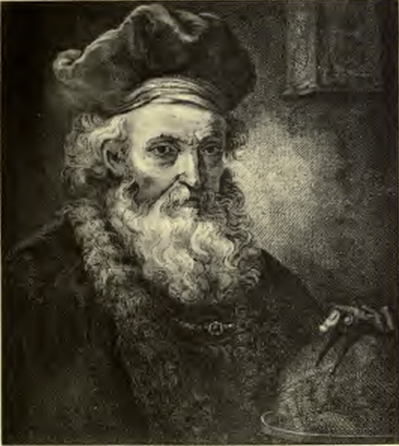
Nor would astrology have suffered any more discredit from it being said: "Of two children who were born in the same minute, one became a king, the other nothing more than churchwarden of his parish;" for a defence would easily have been made by showing that the peasant made his fortune in becoming churchwarden, just as much as the prince did in becoming king.
And if it were alleged that a bandit, hung up by order of Sixtus the Fifth, was born at the same time as Sixtus, who, from being a swineherd, became pope, the astrologers would say that there was a mistake of a few seconds, and that, according to the rules, the same star could not bestow the tiara and the gallows. It was, then, only because long-accumulated experience gave the lie to the predictions that men at length perceived that the art was illusory; but their credulity was of long duration.
One of the most famous mathematicians of Europe, named Stoffler, who flourished in the fifteenth and sixteenth centuries, foretold a universal deluge for the year 1524. This deluge was to happen in the month of February, and nothing can be more plausible, for Saturn, Jupiter, and Mars were then in conjunction in the sign of the Fishes. Every nation in Europe, Asia, and Africa that heard of the prediction was in consternation. The whole world expected the deluge, in spite of the rainbow. Several contemporary authors relate that the inhabitants of the maritime provinces of Germany hastened to sell their lands, at any price, to such as had more money and less credulity than themselves. Each one provided himself with a boat to serve as an ark. A doctor of Toulouse, in particular, named Auriol, had an ark built for himself, his family, and friends; and the same precautions were taken in a great part of Italy. At last the month of February arrived, and not a drop of rain fell, never was a month more dry, never were the astrologers more embarrassed. However, we neither discouraged nor neglected them; almost all our princes continued to consult them.
I have not the honor to be a prince; nevertheless, the celebrated Count de Boulainvilliers and an Italian, named Colonna, who had great reputation at Paris, both foretold to me that I should assuredly die at the age of thirty-two. I have already been so malicious as to deceive them thirty years in their calculation—for which I most humbly ask their pardon.
ASTRONOMY,
WITH A FEW MORE REFLECTIONS ON ASTROLOGY.
M. Duval, who, if I mistake not, was librarian to the Emperor Francis I., gives us an account of the manner in which, in his childhood, pure instinct gave him the first ideas of astronomy. He was contemplating the moon which, as it declined towards the west, seemed to touch the trees of a wood. He doubted not that he should find it behind the trees, and, on running thither, was astonished to see it at the extremity of the horizon.
The following days his curiosity prompted him to watch the course of this luminary, and he was still more surprised to find that it rose and set at various hours. The different forms which it took from week to week, and its total disappearance for some nights, also contributed to fix his attention. All that a child could do was to observe and to admire, and this was doing much; not one in ten thousand has this curiosity and perseverance.
He studied, as he could, for three years, with no other book than the heavens, no other master than his eyes. He observed that the stars did not change their relative positions; but the brilliancy of the planet Venus having caught his attention, it seemed to him to have a particular course, like that of the moon. He watched it every night; it disappeared for a long time; and at length he saw it become the morning instead of the evening star. The course of the sun, which from month to month, rose and set in different parts of the heavens, did not escape him. He marked the solstices with two staves, without knowing what the solstices were.
It appears to me that some profit might be derived from this example, in teaching astronomy to a child of ten or twelve years of age, and with much greater facility than this extraordinary child, of whom I have spoken, taught himself its first elements.
It is a very attractive spectacle for a mind disposed to the contemplation of nature to see that the different phases of the moon are precisely the same as those of a globe round which a lighted candle is moved, showing here a quarter, here the half of its surface, and becoming invisible when an opaque body is interposed between it and the candle. In this manner it was that Galileo explained the true principles of astronomy before the doge and senators of Venice on St. Mark's tower; he demonstrated everything to the eyes.
Indeed, not only a child, but even a man of mature age, who has seen the constellations only on maps or globes, finds it difficult to recognize them in the heavens. In a little time the child will quite well comprehend the causes of the sun's apparent course, and the daily revolutions of the fixed stars.
He will, in particular, discover the constellations with the aid of these four Latin lines, made by an astronomer about fifty years ago, and which are not sufficiently known:
Delta Aries, Perseum Taurus, Geminique Capellam; Nil Cancer, Plaustrum Leo, Virgo Coman, atque Bootem, Libra Anguem, Anguiferum fert Scorpios; Antinoum Arcus; Delphinum Caper, Amphora Equos, Cepheida Pisces.
Nothing should be said to him about the systems of Ptolemy and Tycho Brahe, because they are false; they can never be of any other service than to explain some passages in ancient authors, relating to the errors of antiquity. For instance, in the second book of Ovid's "Metamorphoses" the sun says to Phaëton:
Adde, quod assidua rapitur vertigine cœlum; Nitor in adversum; nec me, qui cætera, vincit Impetus; et rapido contrarius evehor orbi. A rapid motion carries round the heavens; But I—and I alone—resist its force, Marching secure in my opposing path.
This idea of a first mover turning the heavens round in twenty-four hours with an impossible motion, and of the sun, though acted upon by this first motion, yet imperceptibly advancing from west to east by a motion peculiar to itself, and without a cause, would but embarrass a young beginner.
It is sufficient for him to know that, whether the earth revolves on its own axis and round the sun, or the sun completes his revolution in a year, appearances are nearly the same, and that, in astronomy, we are obliged to judge of things by our eyes before we examine them as natural philosophers.
He will soon know the cause of the eclipses of the sun and the moon, and why they do not occur every night. It will at first appear to him that, the moon being every month in opposition to and in conjunction with the sun, we should have an eclipse of the sun and one of the moon every month. But when he finds that these two luminaries are not in the same plane and are seldom in the same line with the earth, he will no longer be surprised.
He will easily be made to understand how it is that eclipses have been foretold, by knowing the exact circle in which the apparent motion of the sun and the real motion of the moon are accomplished. He will be told that observers found by experience and calculation the number of times that these two bodies are precisely in the same line with the earth in the space of nineteen years and a few hours, after which they seem to recommence the same course; so that, making the necessary allowances for the little inequalities that occurred during those nineteen years, the exact day, hour, and minute of an eclipse of the sun or moon were foretold. These first elements are soon acquired by a child of clear conceptions.
Not even the precession of the equinoxes will terrify him. It will be enough to tell him that the sun has constantly appeared to advance in his annual course, one degree in seventy-two years, towards the east; and this is what Ovid meant to express: "Contrarius evehor orbi";—"Marching secure in my opposing path."
Thus the Ram, which the sun formerly entered at the beginning of spring, is now in the place where the Bull was then. This change which has taken place in the heavens, and the entrance of the sun into other constellations than those which he formerly occupied, were the strongest arguments against the pretended rules of judicial astrology. It does not, however, appear that this proof was employed before the present century to destroy this universal extravagance which so long infected all mankind, and is still in great vogue in Persia.
A man born, according to the almanac, when the sun was in the sign of the Lion, was necessarily to be courageous; but, unfortunately, he was in reality born under the sign of the Virgin. So that Gauric and Michael Morin should have changed all the rules of their art.
It is indeed odd that all the laws of astrology were contrary to those of astronomy. The wretched charlatans of antiquity and their stupid disciples, who have been so well received and so well paid by all the princes of Europe, talked of nothing but Mars and Venus, stationary and retrograde. Such as had Mars stationary were always to conquer. Venus stationary made all lovers happy. Nothing was worse than to be born under Venus retrograde. But the fact is that these planets have never been either retrograde or stationary, which a very slight knowledge of optics would have sufficed to show.
How, then, can it have been that, in spite of physics and geometry, the ridiculous chimera of astrology is entertained even to this day, so that we have seen men distinguished for their general knowledge, and especially profound in history, who have all their lives been infatuated by so despicable an error? But the error was ancient, and that was enough.
The Egyptians, the Chaldæans, the Jews, foretold the future; therefore, it may be foretold now. Serpents were charmed and spirits were raised in those days; therefore, spirits may be raised and serpents charmed now. It is only necessary to know the precise formula made use of for the purpose. If predictions are at an end, it is the fault, not of the art, but of the artist. Michael Morin and his secret died together. It is thus that the alchemists speak of the philosopher's stone; if, say they, we do not now find it, it is because we do not yet know precisely how to seek it; but it is certainly in Solomon's collar-bone. And, with this glorious certainty, more than two hundred families in France and Germany have ruined themselves.
It is not then to be wondered at that the whole world has been duped by astrology. The wretched argument, "there are false prodigies, therefore there are true ones," is neither that of a philosopher, nor of a man acquainted with the world. "That is false and absurd, therefore it will be believed by the multitude," is a much truer maxim.
It is still less astonishing that so many men, raised in other things so far above the vulgar; so many princes, so many popes, whom it would have been impossible to mislead in the smallest affair of interest, have been so ridiculously seduced by this astrological nonsense. They were very proud and very ignorant. The stars were for them alone; the rest of the world a rabble, with whom the stars had nothing to do. They were like the prince who trembled at the sight of a comet, and said gravely to those who did not fear it, "You may behold it without concern; you are not princes."
The famous German leader, Wallenstein, was one of those infatuated by this chimera; he called himself a prince, and consequently thought that the zodiac had been made on purpose for him. He never besieged a town, nor fought a battle, until he had held a council with the heavens; but, as this great man was very ignorant, he placed at the head of this council a rogue of an Italian, named Seni, keeping him a coach and six, and giving him a pension of twenty thousand livres. Seni, however, never foresaw that Wallenstein would be assassinated by order of his most gracious sovereign, and that he himself would return to Italy on foot.
It is quite evident that nothing can be known of the future, otherwise than by conjectures. These conjectures may be so well-founded as to approach certainty. You see a shark swallow a little boy; you may wager ten thousand to one that he will be devoured; but you cannot be absolutely sure of it, after the adventures of Hercules, Jonas, and Orlando Furioso, who each lived so long in a fish's belly.
It cannot be too often repeated that Albertus Magnus and Cardinal d'Ailli both made the horoscope of Jesus Christ. It would appear that they read in the stars how many devils he would cast out of the bodies of the possessed, and what sort of death he was to die. But it was unfortunate that these learned astrologers foretold all these things so long after they happened.
We shall elsewhere see that in a sect which passes for Christian, it is believed to be impossible for the Supreme Intelligence to see the future otherwise than by supreme conjecture; for, as the future does not exist, it is, say they, a contradiction in terms to talk of seeing at the present time that which is not.
ATHEISM.
SECTION I.
On the Comparison so Often Made between Atheism and Idolatry.
It seems to me that, in the "Dictionnaire Encyclopédique," a more powerful refutation might have been brought against the Jesuit Richeome's opinion concerning atheists and idolaters—an opinion formerly maintained by St. Thomas, St. Gregory Nazianzen, St. Cyprian, and Tertullian—an opinion which Arnobius placed in a strong light when he said to the pagans, "Do you not blush to reproach us with contempt for your gods? Is it not better to believe in no god than to impute to them infamous actions?"—an opinion long before established by Plutarch, who stated that he would rather have it said that there was no Plutarch than that there was a Plutarch, inconstant, choleric, and vindictive—an opinion, too, fortified by all the dialectical efforts of Bayle.
Such is the ground of dispute, placed in a very striking point of view by the Jesuit Richeome, and made still more specious by the way in which Bayle sets it off:
"There are two porters at the door of a house. You ask to speak to the master. He is not at home, answers one. He is at home, answers the other, but is busied in making false money, false contracts, daggers, and poisons, to destroy those who have only accomplished his designs. The atheist resembles the former of these porters, the pagan the latter. It is then evident that the pagan offends the Divinity more grievously than the atheist."
With the permission of Father Richeome, and that of Bayle himself, this is not at all the state of the question. For the first porter to be like the atheist, he must say, not "My master is not here," but "I have no master; he who you pretend is my master does not exist. My comrade is a blockhead to tell you that the gentleman is engaged in mixing poisons and wetting poniards to assassinate those who have executed his will. There is no such being in the world."
Richeome, therefore, has reasoned very ill; and Bayle, in his rather diffuse discourses, has so far forgotten himself as to do Richeome the honor of making a very lame comment upon him.
Plutarch seems to express himself much better, in declaring that he prefers those who say there is no Plutarch to those who assert that Plutarch is unfit for society. Indeed, of what consequence to him was its being said that he was not in the world? But it was of great consequence that his reputation should not be injured. With the Supreme Being it is otherwise.
Still Plutarch does not come to the real point in discussion. It is only asked who most offends the Supreme Being—he who denies Him, or he who disfigures Him? It is impossible to know, otherwise than by revelation, whether God is offended at the vain discourses which men hold about Him.
Philosophers almost always fall unconsciously into the ideas of the vulgar, in supposing that God is jealous of His glory, wrathful, and given to revenge, and in taking rhetorical figures for real ideas. That which interests the whole world is to know whether it is not better to admit a rewarding and avenging God, recompensing hidden good actions, and punishing secret crimes, than to admit no God at all.
Bayle exhausts himself in repeating all the infamous things imputed to the gods of antiquity. His adversaries answer him by unmeaning commonplaces. The partisans and the enemies of Bayle have almost always fought without coming to close quarters. They all agree that Jupiter was an adulterer, Venus a wanton, Mercury a rogue. But this, I conceive, ought not to be considered; the religion of the ancient Romans should be distinguished from Ovid's "Metamorphoses." It is quite certain that neither they nor even the Greeks ever had a temple dedicated to Mercury the Rogue, Venus the Wanton, or Jupiter the Adulterer.
The god whom the Romans called "Deus optimus maximus"—most good, most great—was not believed to have encouraged Clodius to lie with Cæsar's wife, nor Cæsar to become the minion of King Nicomedes.
Cicero does not say that Mercury incited Verres to rob Sicily, though, in the fable, Mercury had stolen Apollo's cows. The real religion of the ancients was that Jupiter, most good and just, with the secondary divinities, punished perjury in the infernal regions. Thus, the Romans were long the most religious observers of their oaths. It was in no wise ordained that they should believe in Leda's two eggs, in the transformation of Inachus's daughter into a cow, or in Apollo's love for Hyacinthus. Therefore it must not be said that the religion of Numa was dishonoring to the Divinity. So that, as but too often happens, there has been a long dispute about a chimera.
Then, it is asked, can a people of atheists exist? I consider that a distinction must be made between the people, properly so called, and a society of philosophers above the people. It is true that, in every country, the populace require the strongest curb; and that if Bayle had had but five or six hundred peasants to govern, he would not have failed to announce to them a rewarding and avenging God. But Bayle would have said nothing about them to the Epicureans, who were people of wealth, fond of quiet, cultivating all the social virtues, and friendship in particular, shunning the dangers and embarrassments of public affairs—leading, in short, a life of ease and innocence. The dispute, so far as it regards policy and society, seems to me to end here.
As for people entirely savage, they can be counted neither among the theists nor among the atheists. To ask them what is their creed would be like asking them if they are for Aristotle or Democritus. They know nothing; they are no more atheists than they are peripatetics.
But, it may be insisted, that they live in society, though they have no God, and that, therefore, society may subsist without religion.
In this case I shall reply that wolves live so; and that an assemblage of barbarous cannibals, as you suppose them to be, is not a society. And, further, I will ask you if, when you have lent your money to any one of your society, you would have neither your debtor, nor your attorney, nor your notary, nor your judge, believe in a God?
SECTION II.
Modern Atheists.—Arguments of the Worshippers of God.
We are intelligent beings, and intelligent beings cannot have been formed by a blind, brute, insensible being; there is certainly some difference between a clod and the ideas of Newton. Newton's intelligence, then, came from some other intelligence.
When we see a fine machine, we say there is a good machinist, and that he has an excellent understanding. The world is assuredly an admirable machine; therefore there is in the world, somewhere or other, an admirable intelligence. This argument is old, but is not therefore the worse.
All animated bodies are composed of levers and pulleys, which act according to the laws of mechanics; of liquors, which are kept in perpetual circulation by the laws of hydrostatics; and the reflection that all these beings have sentiment which has no relation to their organization, fills us with wonder.
The motions of the stars, that of our little earth round the sun—all are operated according to the laws of the profoundest mathematics. How could it be that Plato, who knew not one of these laws—the eloquent but chimerical Plato, who said that the foundation of the earth was an equilateral triangle, and that of water a right-angled triangle—the strange Plato, who said there could be but five worlds, because there were but five regular bodieshow, I say, was it that Plato, who was not even acquainted with spherical trigonometry, had nevertheless so fine a genius, so happy an instinct, as to call God the Eternal Geometrician—to feel that there exists a forming Intelligence? Spinoza himself confesses it. It is impossible to controvert this truth, which surrounds us and presses us on all sides.
Argument of the Atheists.
I have, however, known refractory individuals, who have said that there is no forming intelligence, and that motion alone has formed all that we see and all that we are. They say boldly that the combination of this universe was possible because it exists; therefore it was possible for motion of itself to arrange it. Take four planets only—Mars, Venus, Mercury, and the Earth; let us consider them solely in the situations in which they now are; and let us see how many probabilities we have that motion will bring them again to those respective places. There are but twenty-four chances in this combination; that is, it is only twenty-four to one that these planets will not be found in the same situations with respect to one another. To these four globes add that of Jupiter; and it is then only a hundred and twenty to one that Jupiter, Mars, Venus, Mercury, and our globe will not be placed in the same positions in which we now see them.
Lastly, add Saturn; and there will then be only seven hundred and twenty chances to one against putting these planets in their present arrangement, according to their given distances. It is, then, demonstrated that once, at least, in seven hundred and twenty cases, chance might place these planets in their present order.
Then take all the secondary planets, all their motions, all the beings that vegetate, live, feel, think, act, on all these globes; you have only to increase the number of chances; multiply this number to all eternity—to what our weakness calls infinity—there will still be an unit in favor of the formation of the world, such as it is, by motion alone; therefore it is possible that, in all eternity, the motion of matter alone has produced the universe as it exists. Nay, this combination must, in eternity, of necessity happen. Thus, say they, not only it is possible that the world is as it is by motion alone, but it was impossible that it should not be so after infinite combinations.
Answer.
All this supposition seems to me to be prodigiously chimerical, for two reasons: the first is, that in this universe there are intelligent beings, and you cannot prove it possible for motion alone to produce understanding. The second is, that, by your own confession, the chances are infinity to unity, that an intelligent forming cause produced the universe. Standing alone against infinity, a unit makes but a poor figure.
Again Spinoza himself admits this intelligence; it is the basis of his system. You have not read him, but you must read him. Why would you go further than he, and, through a foolish pride, plunge into the abyss where Spinoza dared not to descend? Are you not aware of the extreme folly of saying that it is owing to a blind cause that the square of the revolution of one planet is always to the squares of the others as the cube of its distance is to the cubes of the distances of the others from the common centre? Either the planets are great geometricians, or the Eternal Geometrician has arranged the planets.
But where is the Eternal Geometrician? Is He in one place, or in all places, without occupying space? I know not. Has He arranged all things of His own substance? I know not. Is He immense, without quantity and without quality? I know not. All I know is, that we must adore Him and be just.
New Objection of a Modern Atheist.
Can it be said that the conformation of animals is according to their necessities? What are those necessities? Self-preservation and propagation. Now, is it astonishing that, of the infinite combinations produced by chance, those only have survived which had organs adapted for their nourishment and the continuation of their species? Must not all others necessarily have perished?
Answer.
This argument, taken from Lucretius, is sufficiently refuted by the sensation given to animals and the intelligence given to man. How, as has just been said in the preceding paragraph, should combinations produced by chance produce this sensation and this intelligence? Yes, doubtless, the members of animals are made for all their necessities with an incomprehensible art, and you have not the boldness to deny it. You do not mention it. You feel that you can say nothing in answer to this great argument which Nature brings against you. The disposition of the wing of a fly, or of the feelers of a snail, is sufficient to confound you.
An Objection of Maupertuis.
The natural philosophers of modern times have done nothing more than extend these pretended arguments; this they have sometimes done even to minuteness and indecency. They have found God in the folds of a rhinoceros's hide; they might, with equal reason, have denied His existence on account of the tortoise's shell.
Answer.
What reasoning! The tortoise and the rhinoceros, and all the different species, prove alike in their infinite varieties the same cause, the same design, the same end, which are preservation, generation, and death. Unity is found in this immense variety; the hide and the shell bear equal testimony. What! deny God, because a shell is not like a skin! And journalists have lavished upon this coxcombry praises which they have withheld from Newton and Locke, both worshippers of the Divinity from thorough examination and conviction!
Another of Maupertuis's Objections.
Of what service are beauty and fitness in the construction of a serpent? Perhaps, you say, it has uses of which we are ignorant. Let us then, at least, be silent, and not admire an animal which we know only by the mischief it does.
Answer.
Be you silent, also, since you know no more of its utility than myself; or acknowledge that, in reptiles, everything is admirably proportioned. Some of them are venomous; you have been so too. The only subject at present under consideration is the prodigious art which has formed serpents, quadrupeds, birds, fishes, and bipeds. This art is evident enough. You ask, Why is not the serpent harmless? And why have you not been harmless? Why have you been a persecutor? which, in a philosopher, is the greatest of crimes. This is quite another question; it is that of physical and moral evil. It has long been asked, Why are there so many serpents, and so many wicked men worse than serpents? If flies could reason, they would complain to God of the existence of spiders; but they would, at the same time, acknowledge what Minerva confessed to Arachne in the fable, that they arrange their webs in a wonderful manner.
We cannot, then, do otherwise than acknowledge an ineffable Intelligence, which Spinoza himself admitted. We must own that it is displayed as much in the meanest insect as in the planets. And with regard to moral and physical evil, what can be done or said? Let us console ourselves by the enjoyment of physical and moral good, and adore the Eternal Being, who has ordained the one and permitted the other.
One word more on this topic. Atheism is the vice of some intelligent men, and superstition is the vice of fools. And what is the vice of knaves?—Hypocrisy.
SECTION III.
Unjust Accusation.—Justification of Vanini.
Formerly, whoever was possessed of a secret in any art was in danger of passing for a sorcerer; every new sect was charged with murdering infants in its mysteries; and every philosopher who departed from the jargon of the schools was accused of atheism by knaves and fanatics, and condemned by blockheads.
Anaxagorus dares to assert that the sun is not conducted by Apollo, mounted in a chariot and four; he is condemned as an atheist, and compelled to fly.
Aristotle is accused of atheism by a priest, and not being powerful enough to punish his accuser, he retires to Chalcis. But the death of Socrates is the greatest blot on the page of Grecian history.
Aristophanes—he whom commentators admire because he was a Greek, forgetting that Socrates was also a Greek—Aristophanes was the first who accustomed the Athenians to regard Socrates as an atheist.
This comic poet, who is neither comic nor poetical, would not, among us, have been permitted to exhibit his farces at the fair of St. Lawrence. He appears to me to be much lower and more despicable than Plutarch represents him. Let us see what the wise Plutarch says of this buffoon: "The language of Aristophanes bespeaks his miserable quackery; it is made up of the lowest and most disgusting puns; he is not even pleasing to the people; and to men of judgment and honor he is insupportable; his arrogance is intolerable, and all good men detest his malignity."
This, then, is the jack-pudding whom Madame Dacier, an admirer of Socrates, ventures to admire! Such was the man who, indirectly, prepared the poison by which infamous judges put to death the most virtuous man in Greece.
The tanners, cobblers, and seamstresses of Athens applauded a farce in which Socrates was represented lifted in the air in a hamper, announcing that there was no God, and boasting of having stolen a cloak while he was teaching philosophy. A whole people, whose government sanctioned such infamous licences, well deserved what has happened to them, to become slaves to the Romans, and, subsequently, to the Turks. The Russians, whom the Greeks of old would have called barbarians, would neither have poisoned Socrates, nor have condemned Alcibiades to death.
We pass over the ages between the Roman commonwealth and our own times. The Romans, much more wise than the Greeks, never persecuted a philosopher for his opinions. Not so the barbarous nations which succeeded the Roman Empire. No sooner did the Emperor Frederick II. begin to quarrel with the popes, than he was accused of being an atheist, and being the author of the book of "The Three Impostors," conjointly with his chancellor De Vincis.
Does our high-chancellor, de l'Hôpital, declare against persecution? He is immediately charged with atheism—"Homo doctus, sed vetus atheus." There was a Jesuit, as much beneath Aristophanes as Aristophanes is beneath Homer—a wretch, whose name has become ridiculous even among fanatics—the Jesuit Garasse, who found atheists everywhere. He bestows the name upon all who are the objects of his virulence. He calls Theodore Beza an atheist. It was he, too, that led the public into error concerning Vanini.
The unfortunate end of Vanini does not excite our pity and indignation like that of Socrates, because Vanini was only a foreign pedant, without merit; however, Vanini was not, as was pretended, an atheist; he was quite the contrary.
He was a poor Neapolitan priest, a theologian and preacher by trade, an outrageous disputer on quiddities and universals, and "utrum chimæra bombinans in vacuo possit comedere secundas intentiones." But there was nothing in him tending to atheism. His notion of God is that of the soundest and most approved theology: "God is the beginning and the end, the father of both, without need of either, eternal without time, in no one place, yet present everywhere. To him there is neither past nor future; he is within and without everything; he has created all, and governs all; he is immutable, infinite without parts; his power is his will." This is not very philosophical, but it is the most approved theology.
Vanini prided himself on reviving Plato's fine idea, adopted by Averroës, that God had created a chain of beings from the smallest to the greatest, the last link of which was attached to his eternal throne; an idea more sublime than true, but as distant from atheism as being from nothing.
He travelled to seek his fortune and to dispute; but, unfortunately, disputation leads not to fortune; a man makes himself as many irreconcilable enemies as he finds men of learning or of pedantry to argue against. Vanini's ill-fortune had no other source. His heat and rudeness in disputation procured him the hatred of some theologians; and having quarrelled with one Franconi, this Franconi, the friend of his enemies, charged him with being an atheist and teaching atheism.
Franconi, aided by some witnesses, had the barbarity, when confronted with the accused, to maintain what he had advanced. Vanini, on the stool, being asked what he thought of the existence of a God, answered that he, with the Church, adored a God in three persons. Taking a straw from the ground, "This," said he, "is sufficient to prove that there is a creator." He then delivered a very fine discourse on vegetation and motion, and the necessity of a Supreme Being, without whom there could be neither motion nor vegetation.
The president Grammont, who was then at Toulouse, repeats this discourse in his history of France, now so little known; and the same Grammont, through some unaccountable prejudice, asserts that Vanini said all this "through vanity, or through fear, rather than from inward conviction."
On what could this atrocious, rash judgment of the president be founded? It is evident, from Vanini's answer, that he could not but be acquitted of the charge of atheism. But what followed? This unfortunate foreign priest also dabbled in medicine. There was found in his house a large live toad, which he kept in a vessel of water; he was forthwith accused of being a sorcerer. It was maintained that this toad was the god which he adored. An impious meaning was attributed to several passages of his books, a thing which is both common and easy, by taking objections for answers, giving some bad sense to a loose phrase, and perverting an innocent expression. At last, the faction which oppressed him forced from his judges the sentence which condemned him to die.
In order to justify this execution it was necessary to charge the unfortunate man with the most enormous of crimes. The grey friar—the very grey friar Marsenne, was so besotted as to publish that "Vanini set out from Naples, with twelve of his apostles, to convert the whole world to atheism." What a pitiful tale! How should a poor priest have twelve men in his pay? How should he persuade twelve Neapolitans to travel at great expense, in order to spread this revolting doctrine at the peril of their lives? Would a king himself have it in his power to pay twelve preachers of atheism? No one before Father Marsenne had advanced so enormous an absurdity. But after him it was repeated; the journals and historical dictionaries caught it, and the world, which loves the extraordinary, has believed the fable without examination.
Even Bayle, in his miscellaneous thoughts (Pensées Diverses), speaks of Vanini as of an atheist. He cites his example in support of his paradox, that "a society of atheists might exist." He assures us that Vanini was a man of very regular morals, and that he was a martyr to his philosophical opinions. On both these points he is equally mistaken. Vanini informs us in his "Dialogues," written in imitation of Erasmus, that he had a mistress named Isabel. He was as free in his writings as in his conduct; but he was not an atheist.
A century after his death, the learned Lacroze, and he who took the name of Philaletes, endeavored to justify him. But as no one cares anything about the memory of an unfortunate Neapolitan, scarcely any one has read these apologies.
The Jesuit Hardouin, more learned and no less rash than Garasse, in his book entitled "Athei Detecti" charges the Descartes, the Arnaulds, the Pascals, the Malebranches, with atheism. Happily, Vanini's fate was not theirs.
SECTION IV.
A word on the question in morals, agitated by Bayle, "Whether a society of atheists can exist." Here let us first observe the enormous self-contradictions of men in disputation. Those who have been most violent in opposing the opinion of Bayle, those who have denied with the greatest virulence the possibility of a society of atheists, are the very men who have since maintained with equal ardor that atheism is the religion of the Chinese government.
They have most assuredly been mistaken concerning the government of China; they had only to read the edicts of the emperors of that vast country, and they would have seen that those edicts are sermons, in which a Supreme Being—governing, avenging, and rewarding—is continually spoken of.
But, at the same time, they are no less deceived respecting the impossibility of a society of atheists; nor can I conceive how Bayle could forget a striking instance which might have rendered his cause victorious.
In what does the apparent impossibility of a society of atheists consist? In this: It is judged that men without some restraint could not live together; that laws have no power against secret crimes; and that it is necessary to have an avenging God—punishing, in this world or in the next, such as escape human justice.
The laws of Moses, it is true, did not teach the doctrine of a life to come, did not threaten with chastisements after death, nor even teach the primitive Jews the immortality of the soul; but the Jews, far from being atheists, far from believing that they could elude the divine vengeance, were the most religious of men. They believed not only in the existence of an eternal God, but that He was always present among them; they trembled lest they should be punished in themselves, their wives, their children, their posterity to the fourth generation. This was a very powerful check.
But among the Gentiles various sects had no restraint; the Skeptics doubted of everything; the Academics suspended their judgment on everything; the Epicureans were persuaded that the Divinity could not meddle in human affairs, and in their hearts admitted no Divinity. They were convinced that the soul is not a substance, but a faculty which is born and perishes with the body; consequently, they had no restraint but that of morality and honor. The Roman senators and knights were in reality atheists; for to men who neither feared nor hoped anything from them, the gods could not exist. The Roman senate, then, in the time of Cæsar and Cicero, was in fact an assembly of atheists.
That great orator, in his oration for Cluentius, says to the whole assembled senate: "What does he lose by death? We reject all the silly fables about the infernal regions. What, then, can death take from him? Nothing but the susceptibility of sorrow."
Does not Cæsar, wishing to save the life of his friend Catiline, threatened by the same Cicero, object that to put a criminal to death is not to punish him—that death is nothing—that it is but the termination of our ills—a moment rather fortunate than calamitous? Did not Cicero and the whole senate yield to this reasoning? The conquerors and legislators of all the known world then, evidently, formed a society of men who feared nothing from the gods, but were real atheists.
Bayle next examines whether idolatry is more dangerous than atheism—whether it is a greater crime not to believe in the Divinity than to have unworthy notions of it; in this he thinks with Plutarch—that it is better to have no opinion than a bad opinion; but, without offence to Plutarch, it was infinitely better that the Greeks should fear Ceres, Neptune, and Jupiter than that they should fear nothing at all. It is clear that the sanctity of oaths is necessary; and that those are more to be trusted who think a false oath will be punished, than those who think they may take a false oath with impunity. It cannot be doubted that, in an organized society, it is better to have even a bad religion than no religion at all.
It appears then that Bayle should rather have examined whether atheism or fanaticism is the most dangerous. Fanaticism is certainly a thousand times the most to be dreaded; for atheism inspires no sanguinary passion, but fanaticism does; atheism does not oppose crime, but fanaticism prompts to its commission. Let us suppose, with the author of the "Commentarium Return Gallicarum," that the High-Chancellor de l'Hôpital was an atheist; he made none but wise laws; he recommended only moderation and concord. The massacres of St. Bartholomew were committed by fanatics. Hobbes passed for an atheist; yet he led a life of innocence and quiet, while the fanatics of his time deluged England, Scotland, and Ireland with blood. Spinoza was not only an atheist—he taught atheism; but assuredly he had no part in the judicial assassination of Barneveldt; nor was it he who tore in pieces the two brothers De Witt, and ate them off the gridiron.
Atheists are, for the most part, men of learning, bold but bewildered, who reason ill and, unable to comprehend the creation, the origin of evil, and other difficulties, have recourse to the hypothesis of the eternity of things and of necessity.
The ambitious and the voluptuous have but little time to reason; they have other occupations than that of comparing Lucretius with Socrates. Such is the case with us and our time.
It was otherwise with the Roman senate, which was composed almost entirely of theoretical and practical atheists, that is, believing neither in Providence nor in a future state; this senate was an assembly of philosophers, men of pleasure, and ambitious men, who were all very dangerous, and who ruined the commonwealth. Under the emperors, Epicureanism prevailed. The atheists of the senate had been factious in the times of Sulla and of Cæsar; in those of Augustus and Tiberius, they were atheistical slaves.
I should not wish to come in the way of an atheistical prince, whose interest it should be to have me pounded in a mortar; I am quite sure that I should be so pounded. Were I a sovereign, I would not have to do with atheistical courtiers, whose interest it was to poison me; I should be under the necessity of taking an antidote every day. It is then absolutely necessary for princes and people that the idea of a Supreme Being—creating, governing, rewarding, and punishing—be profoundly engraved on their minds.
There are, nations of atheists, says Bayle in his "Thoughts on Comets." The Kaffirs, the Hottentots, and many other small populations, have no god; they neither affirm nor deny that there is one; they have never heard of Him; tell them that there is one, and they will easily believe it; tell them that all is done by the nature of things, and they will believe you just the same. To pretend that they are atheists would be like saying they are anti-Cartesians. They are neither for Descartes nor against him; they are no more than children; a child is neither atheist nor deist; he is nothing.
From all this, what conclusion is to be drawn? That atheism is a most pernicious monster in those who govern; that it is the same in the men of their cabinet, since it may extend itself from the cabinet to those in office; that, although less to be dreaded than fanaticism, it is almost always fatal to virtue. And especially, let it be added, that there are fewer atheists now than ever—since philosophers have become persuaded that there is no vegetative being without a germ, no germ without a design, etc., and that the corn in our fields does not spring from rottenness.
Unphilosophical geometricians have rejected final causes, but true philosophers admit them; and, as it is elsewhere observed, a catechist announces God to children, and Newton demonstrates Him to the wise.
If there be atheists, who are to blame? Who but the mercenary tyrants of our souls, who, while disgusting us with their knavery, urge some weak spirits to deny the God whom such monsters dishonor? How often have the people's bloodsuckers forced overburdened citizens to revolt against the king!
Men who have fattened on our substance, cry out to us: "Be persuaded that an ass spoke; believe that a fish swallowed a man, and threw him up three days after, safe and sound, on the shore; doubt not that the God of the universe ordered one Jewish prophet to eat excrement, and another to buy two prostitutes, and have bastards by them;" such are the words put into the mouth of the God of purity and truth! Believe a hundred things either visibly abominable or mathematically impossible; otherwise the God of Mercy will burn you in hell-fire, not only for millions of millions of ages, but for all eternity, whether you have a body or have not a body.
These brutal absurdities are revolting to rash and weak minds, as well as to firm and wise ones. They say: "Our teachers represent God to us as the most insensate and barbarous of all beings; therefore, there is no God." But they ought to say, "Our teachers represent God as furious and ridiculous, therefore God is the reverse of what they describe Him; He is as wise and good as they say He is foolish and wicked." Thus do the wise decide. But, if a fanatic hears them, he denounces them to a magistrate—a sort of priest's officer, which officer has them burned alive, thinking that he is therein imitating and avenging the Divine Majesty which he insults.
ATHEIST.
SECTION I.
There were once many atheists among the Christians; they are now much fewer. It at first appears to be a paradox, but examination proves it to be a truth, that theology often threw men's minds into atheism, until philosophy at length drew them out of it. It must indeed have been pardonable to doubt of the Divinity, when His only announcers disputed on His nature. Nearly all the first Fathers of the Church made God corporeal, and others, after them, giving Him no extent, lodged Him in a part of heaven. According to some, He had created the world in Time; while, according to others, He had created Time itself. Some gave Him a Son like to Himself; others would not grant that the Son was like to the Father. It was also disputed in what way a third person proceeded from the other two.
It was agitated whether the Son had been, while on earth, composed of two persons. So that the question undesignedly became, whether there were five persons in the Divinity—three in heaven and two for Jesus Christ upon earth; or four persons, reckoning Christ upon earth as only one; or three persons, considering Christ only as God. There were disputes about His mother, His descent into hell and into limbo; the manner in which the body of the God-man was eaten, and the blood of the God-man was drunk; on grace; on the saints, and a thousand other matters. When the confidants of the Divinity were seen so much at variance among themselves anathematizing one another from age to age, but all agreeing in an immoderate thirst for riches and grandeur—while, on the other hand, were beheld the prodigious number of crimes and miseries which afflicted the earth, and of which many were caused by the very disputes of these teachers of souls—it must be confessed that it was allowable for rational men to doubt the existence of a being so strangely announced, and for men of sense to imagine that a God, who could of His own free will make so many beings miserable, did not exist.
Suppose, for example, a natural philosopher of the fifteenth century reading these words in "St. Thomas's Dream": "Virtus cœli, loco spermatis, sufficit cum elementis et putrefactione ad generationem animalium imperfectorum." "The virtue of heaven instead of seed is sufficient, with the elements and putrefaction, for the generation of imperfect animals." Our philosopher would reason thus: "If corruption suffices with the elements to produce unformed animals, it would appear that a little more corruption, with a little more heat, would also produce animals more complete. The virtue of heaven is here no other than the virtue of nature. I shall then think, with Epicurus and St. Thomas, that men may have sprung from the slime of the earth and the rays of the sun—a noble origin, too, for beings so wretched and so wicked. Why should I admit a creating God, presented to me under so many contradictory and revolting aspects?" But at length physics arose, and with them philosophy. Then it was clearly discovered that the mud of the Nile produced not a single insect, nor a single ear of corn, and men were found to acknowledge throughout, germs, relations, means, and an astonishing correspondence among all beings. The particles of light have been followed, which go from the sun to enlighten the globe and the ring of Saturn, at the distance of three hundred millions of leagues; then, coming to the earth, form two opposite angles in the eye of the minutest insect, and paint all nature on its retina. A philosopher was given to the world who discovered the simple and sublime laws by which the celestial globes move in the immensity of space. Thus the work of the universe, now that it is better known, bespeaks a workman, and so many never-varying laws announce a lawgiver. Sound philosophy, therefore, has destroyed atheism, to which obscure theology furnished weapons of defence.
But one resource was left for the small number of difficult minds, which, being more forcibly struck by the pretended injustices of a Supreme Being than by his wisdom, were obstinate in denying this first mover. Nature has existed from all eternity; everything in nature is in motion, therefore everything in it continually changes. And if everything is forever changing, all possible combinations must take place; therefore the present combinations of all things may have been the effect of this eternal motion and change alone. Take six dice, and it is 46,655 to one that you do not throw six times six. But still there is that one chance in 46,656. So, in the infinity of ages, any one of the infinite number of combinations, as that of the present arrangement of the universe, is not impossible.
Minds, otherwise rational, have been misled by these arguments; but they have not considered that there is infinity against them, and that there certainly is not infinity against the existence of God. They should, moreover, consider that if everything were changing, the smallest things could not remain unchanged, as they have so long done. They have at least no reason to advance why new species are not formed every day. On the contrary, it is very probable that a powerful hand, superior to these continual changes, keeps all species within the bounds it, has prescribed them. Thus the philosopher, who acknowledges a God, has a number of probabilities on his side, while the atheist has only doubts.
It is evident that in morals it is much better to acknowledge a God than not to admit one. It is certainly to the interest of all men that there should be a Divinity to punish what human, justice cannot repress; but it is also clear that it were better to acknowledge no God than to worship a barbarous one, and offer Him human victims, as so many nations have done.
We have one striking example, which places this truth beyond a doubt. The Jews, under Moses, had no idea of the immortality of the soul, nor of a future state. Their lawgiver announced to them, from God, only rewards and punishments purely temporal; they, therefore, had only this life to provide for. Moses commands the Levites to kill twenty-three thousand of their brethren for having had a golden or gilded calf. On another occasion twenty-four thousand of them are massacred for having had commerce with the young women of the country; and twelve thousand are struck dead because some few of them had wished to support the ark, which was near falling. It may, with perfect reverence for the decrees of Providence, be affirmed, humanly speaking, that it would have been much better for these fifty-nine thousand men, who believed in no future state, to have been absolute atheists and have lived, than to have been massacred in the name of the God whom they acknowledged.
It is quite certain that atheism is not taught in the schools of the learned of China, but many of those learned men are atheists, for they are indifferent philosophers. Now it would undoubtedly be better to live with them at Pekin, enjoying the mildness of their manners and their laws, than to be at Goa, liable to groan in irons, in the prisons of the inquisition, until brought out in a brimstone-colored garment, variegated with devils, to perish in the flames.
They who have maintained that a society of atheists may exist have then been right, for it is laws that form society, and these atheists, being moreover philosophers, may lead a very wise and happy life under the shade of those laws. They will certainly live in society more easily than superstitious fanatics. People one town with Epicureans such as Simonides, Protagoras, Des Barreux, Spinoza; and another with Jansenists and Molinists. In which do you think there will be the most quarrels and tumults? Atheism, considering it only with relation to this life, would be very dangerous among a ferocious people, and false ideas of the Divinity would be no less pernicious. Most of the great men of this world live as if they were atheists. Every man who has lived with his eyes open knows that the knowledge of a God, His presence, and His justice, has not the slightest influence over the wars, the treaties, the objects of ambition, interest or pleasure, in the pursuit of which they are wholly occupied. Yet we do not see that they grossly violate the rules established in society. It is much more agreeable to pass our lives among them than among the superstitious and fanatical. I do, it is true, expect more justice from one who believes in a God than from one who has no such belief; but from the superstitious I look only for bitterness and persecution. Atheism and fanaticism are two monsters which may tear society in pieces; but the atheist preserves his reason, which checks his propensity to mischief, while the fanatic is under the influence of a madness which is constantly urging him on.
SECTION II.
In England, as everywhere else, there have been, and there still are, many atheists by principle; for there are none but young, inexperienced preachers, very ill-informed of what passes in the world, who affirm that there cannot be atheists. I have known some in France, who were quite good natural philosophers; and have, I own, been very much surprised that men who could so ably develop the secret springs of nature should obstinately refuse to acknowledge the hand which so evidently puts those springs in action.
It appears to me that one of the principles which leads them to materialism is that they believe in the plentitude and infinity of the universe, and the eternity of matter. It must be this which misleads them, for almost all the Newtonians whom I have met admit the void and the termination of matter, and consequently admit a God.
Indeed, if matter be infinite, as so many philosophers, even including Descartes, pretend, it has of itself one of the attributes of the Supreme Being: if a void be impossible, matter exists of necessity; it has existed from all eternity. With these principles, therefore, we may dispense with God, creating, modifying, and preserving matter.
I am aware that Descartes, and most of the schools which have believed in the plenum, and the infinity of matter, have nevertheless admitted a God; but this is only because men scarcely ever reason or act upon their principles.
Had men reasoned, consequently, Epicurus and his apostle Lucretius must have been the most religious assertors of the Providence which they combated; for when they admitted the void and the termination of matter, a truth of which they had only an imperfect glimpse, it necessarily followed that matter was the being of necessity, existing by itself, since it was not indefinite. They had, therefore, in their own philosophy, and in their own despite, a demonstration that there is a Supreme Being, necessary, infinite, the fabricator of the universe. Newton's philosophy, which admits and proves the void and finite matter, also demonstratively proves the existence of a God.
Thus I regard true philosophers as the apostles of the Divinity. Each class of men requires its particular ones; a parish catechist tells children that there is a God, but Newton proves it to the wise.
In London, under Charles II. after Cromwell's wars, as at Paris under Henry IV. after the war of the Guises, people took great pride in being atheists; having passed from the excess of cruelty to that of pleasure, and corrupted their minds successively by war and by voluptuousness, they reasoned very indifferently. Since then the more nature has been studied the better its Author has been known.
One thing I will venture to believe, which is, that of all religions, theism is the most widely spread in the world. It is the prevailing religion of China; it is that of the wise among the Mahometans; and, among Christian philosophers, eight out of ten are of the same opinion. It has penetrated even into the schools of theology, into the cloisters, into the conclave; it is a sort of sect without association, without worship, without ceremonies, without disputes, and without zeal, spread through the world without having been preached. Theism, like Judaism, is to be found amidst all religions; but it is singular that the latter, which is the extreme of superstition, abhorred by the people and contemned by the wise, is everywhere tolerated for money; while the former, which is the opposite of superstition, unknown to the people, and embraced by philosophers alone, is publicly exercised nowhere but in China. There is no country in Europe where there are more theists than in England. Some persons ask whether they have a religion or not.