PECTORAL GIRDLE (Figs. 8, 9, 10)
Reading edition
PECTORAL GIRDLE (Figs. 8, 9, 10)
The right scapulocoracoid is almost complete, and the left one is present but partly broken into three pieces, somewhat pushed out of position. With the advantage of this new material, we may comment on the scapulocoracoid of H. garnettense as described by Peabody (1958). In size and contour, the slight differences between the type (KU 9976) and the new skeleton (KU 10295) are considered to be no more than individual variation. We have redrawn the type (Fig. 8) in order to show the resemblances more clearly.
The small sections that were missing from the type are present in KU 10295. The jagged edge directly posterior to the area occupied by the neural arch in the type extends 0.5 mm. farther back in our specimen. The angle formed between the recurved dorsal ramus and the edge of the ventral flange is seen in our specimen to be less than 90°. The glenoid fossa, appearing as a concave articular surface for the cap of the humerus, was in part covered by cartilage and shows as "unfinished" bone (Peabody, 1958, p. 572); this area is more oval than triangular, as Peabody thought. The obstruction of a clear view of this part of the type is the result of the accidental position of a neural arch. The raised portion immediately dorsal to the glenoid fossa exhibits an unfinished surface, suggesting the presence of either cartilage or a ligament.
Fig. 8. Hesperoherpeton garnettense Peabody. Type specimen redrawn. Right scapulocoracoid in external view (at left), and internal view (at right). KU 9976, × 4.
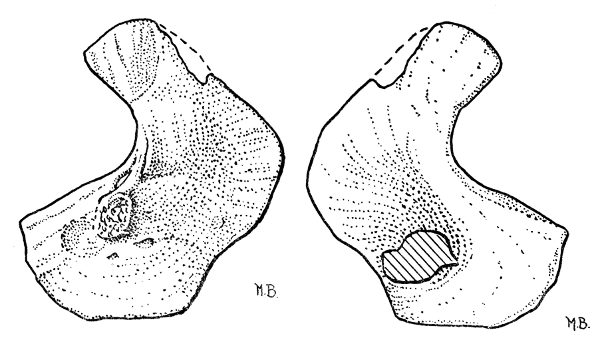
Fig. 9. Hesperoherpeton garnettense Peabody. Right scapulocoracoid in external view, showing part of interclavicle, and position occupied by clavicle. The specimen is flattened and lies entirely in one plane. KU 10295, × 4.
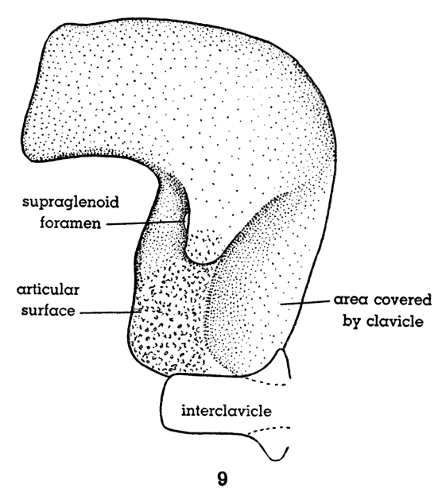
Fig. 10. Hesperoherpeton garnettense Peabody. Right clavicle in external view. Anterior edge to right. KU 10295, × 4.
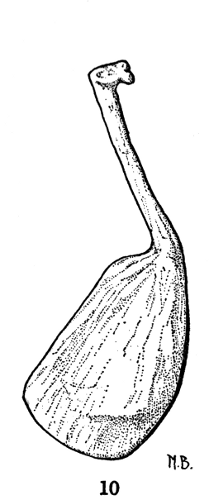
The right clavicle is complete, and resembles a spoon having a slender handle. The dorsal tip of the handle is L-shaped. The expanded ventral part is convex externally, and rested upon the anteroventral surface of the scapulocoracoid. The lateral edge next to the "stem" is distinctly concave, abruptly becoming similar in contour to the opposite edge, and giving the impression of an unsymmetrical spoon. The left clavicle is present in scattered fragments, its dorsal hooklike end being intact.
The posterior end of the interclavicle lies in contact with the right scapulocoracoid. There are short lateral processes at the point where the interclavicle was overlapped by the clavicles, but we cannot be sure of the extent of this bone anteriorly or posteriorly.
The presumed left cleithrum, a long rectangle, is approximately equal in length to the rodlike stem of the clavicle, and is about as wide as the dorsal L-shaped tip of the clavicle. The posterior end of the cleithrum presumably met the tip of the clavicle, while the rest of it was directed anteriorly and a little dorsally. There seems to be a small articular surface near the anterior extremity which suggests the presence of a supracleithrum. The upper border of the cleithrum is slightly convex and the lower concave.