Chapter XXV · (continued 2)
Reading edition
The Spanish forces withdrew from Cuba, December 31, 1898, and, on the following day, the Stars and Stripes was hoisted over Havana. The change of sovereignties in Porto Rico took place without trouble, but there has been some disturbance in Cuba, and it is evident that considerable time must elapse before peace will be fully restored and a stable government established in the island.
Though the war with Spain was closed, serious trouble broke out in the Philippines. Aguinaldo, who had headed most of the rebellions against Spain during the later years, refused to acknowledge the authority of the United States, and, rallying thousands of Filipinos around him, set on foot what he claimed was a war of independence. Our government sent a strong force of regulars and volunteers thither, all of whom acquitted themselves with splendid heroism and bravery, and defeated the rebels repeatedly, capturing strongholds one after the other, and, in fact, driving everything resistlessly before them. The fighting was of the sharpest kind, and our troops had many killed and wounded, though that of the enemy was tenfold greater. All such struggles, however, when American valor and skill are arrayed on one side, can have but one result; and, animated by our sense of duty, which demanded that a firm, equitable, and just government should be established in the Philippines, this beneficent purpose was certain to be attained in the end.
On March 3, 1899, President McKinley nominated Rear-Admiral George Dewey to the rank of full admiral, his commission to date from March 2d, and the Senate immediately and unanimously confirmed the nomination, which had been so richly earned. This hero, as modest as he is great, remained in the Philippines to complete his herculean task, instead of seizing the first opportunity to return home and receive the overwhelming honors which his countrymen were eagerly waiting to show him. Finally, when his vast work was virtually completed and his health showed evidence of the terrific and long-continued strain to which it had been subjected, he turned over his command, by direction of the government, to Rear-Admiral Watson, and, proceeding by a leisurely course, reached home in the autumn of 1899. The honors showered upon him by his grateful and admiring countrymen proved not only his clear title to the foremost rank among the greatest naval heroes of ancient and modern times, but attested the truth that the United States is not ungrateful, and that there is no reward too exalted for her to bestow upon those who have worthily won it.
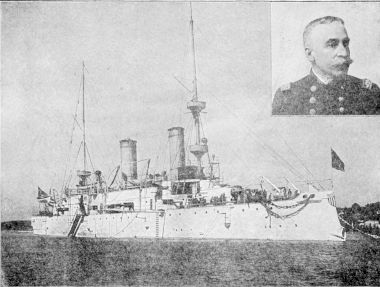
ADMIRAL DEWEY'S FLAGSHIP THE "OLYMPIA."
POPULAR COMMANDERS IN THE FILIPINO WAR.
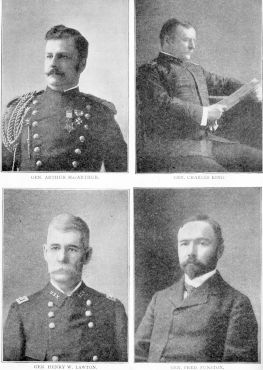
(clockwise from top-left) GEN. ARTHUR MacARTHUR,GEN. CHARLES KING, GEN. FRED. FUNSTON, GEN HENRY W. LAWTON.