Front matter (continued 3)
Reading edition
[sic]
his name, for one of the finest artists in the world.
Of the PYRAMIDS of EGYPT.
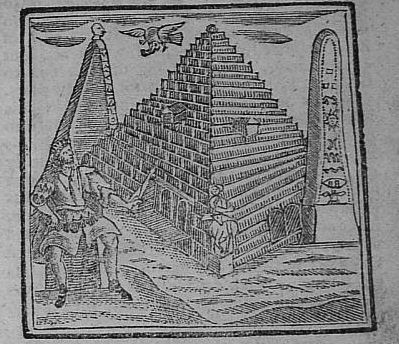
IF the amazing bulk, the regular form, and the almost inconceivable duration of public or monumental buildings call for surprize
[sic]
and astonishment, we have certainly just reason to give the Pyramids of Egypt a place among the Seven Wonders. These buildings remain almost as strong and beautiful as ever, 'till this very time. There are three of them; the largest of which was erected by Chemnis, one of the Kings of Egypt, as a monument of his power when alive, and for a receptacle of his body when dead
. It was situated about 16 English miles from Memphis, now known by the name of Grand Cairo, and was about 1440 feet in height, and about 143 feet long, on each side of the square basis. It was built of hard Arabian stones, each of which is about 30 feet long. The building of it is said to have employed 600,000 men for twenty years. Chemnis however was not interred in this lofty monument, but was barbarously torn to pieces in a mutiny of his people. Cephas, his brother, succeeding him, discovered an equally culpable vanity, and erected another, though a less magnificent pyramid. The third was built by King Mycernius according to some, but, according to others, by the celebrated courtesan Rhodope. This structure is rendered still more surprising, by having placed upon its top a head of black marble, 102 feet round the temples, and about 60 feet from the chin to the crown of the head.
The TOMB of MAUSOLUS.
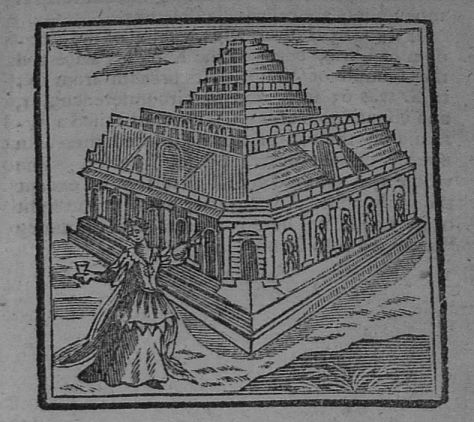
THE next is the celebrated monument of conjugal love, known by the name of the Mausoleum, and erected by Artemesia, Queen of Caria, in honour of her husband Mausolus, whom she loved so tenderly, that, after his death, she ordered his body to be burnt, and put his ashes in a cup of wine, and drank it, that she might lodge the remains of her husband as near to her heart as she possibly could. This structure she enriched with such a profusion of art and expence, that it was justly looked upon as one of the greatest wonders of the world, and ever since magnificent funeral monuments are called Mausoleums.
It stood in Halicarnassus, capital of the kingdom of Caria, between the King's Palace and the Temple of Venus. Its breadth from N. to S. was 63 feet, and in circumference 411, and about 120 feet high. Pyrrhus raised a pyramid on the top of it, and placed thereon a marble chariot drawn by four horses. The whole was admired by all that saw it, except the philosopher Anaxagoras, who, at the sight of it, cried, "There is a great deal of money changed into stone."
The COLOSSUS of the SUN.
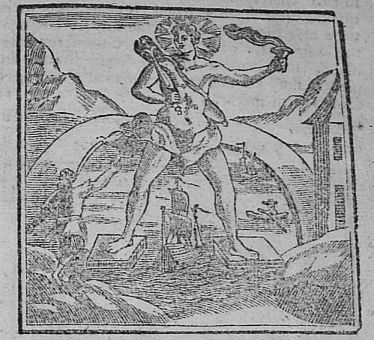
THE Colossus of Rhodes, is justly accounted the sixth Wonder; a statue of so prodigious a bulk, that it could not have been believed, had it not been recorded by the best historians. It was made of brass by one Chares of Asia Minor, who consumed twelve years in finishing it. It was erected over the entry of the harbour of the city, with the right foot on one side, and the left on the other. The largest ships could pass between the legs without lowering their masts. It is said to have cost 44,000l. English money. It was 800 feet in height, and all its members proportionable; so that when it was thrown down by an earthquake, after having stood 50 years, few men were able to embrace its little finger. When the Saracens, who in 684 conquered the island, had broken this immense statue to pieces, they are said to have loaded above 900 camels with the brass of it.
The IMAGE of Jupiter.
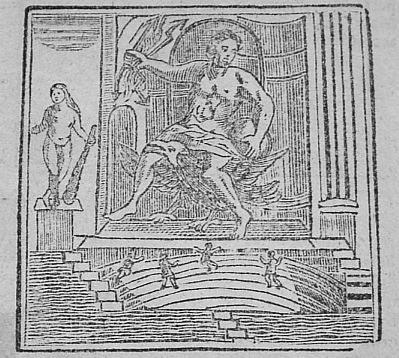
THE last, most elegant, and curious of all these works, known by the name of the Seven Wonders, was the incomparable statue of Jupiter Olympus, erected by the Elians, a people of Greece, and placed in a magnificent temple consecrated to Jupiter. This statue represented Jupiter sitting in a chair, with his upper part naked, but covered down from the girdle, in his right hand holding an eagle, and in his left a sceptre. This statue was made by the celebrated Phidias, and was 150 cubits high. The body is said to have been of brass, and the head of pure gold. Caligula endeavoured to get it transported to Rome, but the persons employed in that attempt were frightened from their purpose by some unlucky accident.
Top
Thus having given an Account of the Seven Wonders of the World, let us take a View of the Burning Mountains, or Volcanos, called Mount Vesuvius and Mount Ætna; than which there is, perhaps, nothing in the whole Course of Nature more worthy our Notice [sic] , or so capable of raising our Admiration; and which, when considered in a religious sense, may, with Justice, be said to be one of the wonderful Works of GOD.
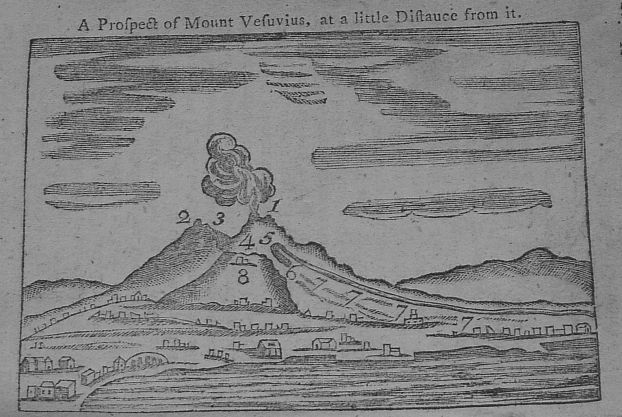
MOUNT VESUVIUS stands about six miles from the city of Naples, and on the side of the Bay towards the East. The plains round it form a beautiful prospect, and on one side are seen fruitful trees of different kinds, and vineyards that produce the most excellent wine; but when one ascends higher, on the side which looks to the South, the face of things is entirely changed, and one sees a tract of ground, which presents only images of horror, viz. a desolate country covered with ashes, pumice-stones, and cinders; together with rocks burned up with the fire, and split into dreadful precipices. It is reckoned four miles high, and the top of it is a wide naked plain, smoking with sulphur in many places; in the midst of which plain stands another high hill, in the shape of a sugar-loaf, on the top of which is a vast mouth or cavity, that goes shelving down on all sides about a hundred yards deep, and about four hundred over; from whence proceeds a continual smoke, and sometimes those astonishing and dreadful eruptions of flame, ashes, and burning matter, that fill the inhabitants around with consternation, and bear down and destroy all before it. Among the many eruptions which it has had, at different times, we need instance only one, which happened on the fifth of June, 1717, and is thus related by Mr. Edward Berkley, who was present at the time, in his letter to Dr. Arbuthnot in England, viz. That he with much difficulty, reached the top of Vesuvius on the 17th of April, 1717, where says he, I saw a vast aperture full of smoke, and heard within that horrid gulph certain odd sounds, as it were murmuring, sighing, throbbing, churning, dashing of waves; and, between while, a noise like that of thunder or cannon, attended constantly, from the belly of the mountain, with a clattering like that of tiles falling from the tops of houses into a street. After an hour's stay, the smoke being moved by the wind, I could discern two furnaces, almost contiguous; one on the left, which seemed to be about three yards diameter, glowed with red flames, and threw up red hot stones with a hideous noise, which, as they fell back, caused the fore-mentioned clattering.
On May 8, ascending to the top of Vesuvius, I had a full prospect of the crater, which appeared to be about a mile in circumference, and a hundred yards deep, with a conical mount in the middle of the bottom, made of stones thrown up and fallen back again into the crater: And the left-hand furnace, mentioned before, threw up every three or four minutes, with a dreadful bellowing, a vast number of red hot stones, sometimes more than a 1000, but never less than 300 feet higher than my head, as I stood upon the brink, which fell back perpendicularly into the crater, there being no wind. This furnace or mouth was in the vortex of the hill, which it had formed round it. The other mouth was lower, in the side of the same new-formed hill, and filled with such red hot liquid matter as we see in a glass-house furnace, which raged and wrought as the waves in the sea, causing a short abrupt noise, like what may be imagined from a sea of quicksilver dashing among uneven rocks. This stuff would sometimes spew over, and run down the convex side of the conical hill, and appearing at first red hot, it changed colour, and hardened as it cooled, shewing the first rudiments of an eruption, or an eruption in miniature: All which I could exactly survey by the favour of the wind, for the space of an hour and a half; during which it was very observable, that all the vollies
[sic]
of smoke, flame, and burning stone, came only out of the hole to our left, while the liquid stuff in the other mouth worked and overflowed.
On June 5, after a horrid noise, the mountain was seen, at Naples, to spew a little out of the crater, and so continued till about two hours before night on the 7th, when it made hideous bellowing, which continued all that night, and the next day till noon, causing all the windows, and, as some affirm, the very houses in Naples (about six miles distant) to shake. From that time it spewed vast quantities of melted stuff to the South, which streamed down the side of the mountain, like a pot boiling over.
On the 9th, at night, a column of fire shot at intervals out of its summit.
On the 10th, the mountain grew very outrageous again, roaring and groaning most dreadfully, sounding like a noise made up of a raging tempest, the murmur of a troubled sea, and the roaring of thunder and artillery, confused altogether. This moved my curiosity to approach the mountain. Three or four of us were carried in a boat, and landed at Torre del Greco, a town situate at the foot of Vesuvius to the S.W. whence we rode between four and five miles before we came to the burning river, which was about midnight; and as we approached, the roaring of the volcano grew exceeding loud and terrible. I observed a mixture of colours in the cloud over the crater, green, yellow, red, and blue. There was likewise a ruddy dismal light in the air, over the tract of land where the burning river flowed; ashes continually showering on us all the way from the sea-coast, which horrid scene grew still more extraordinary, as we came nearer the stream. Imagine a vast torrent of liquid fire rolling from the top down the side of the mountain, and with irresistible fury bearing down and consuming vines, olives, fig-trees, houses, and, in a word, every thing that stood in its way.
Death, in a thousand forms, destructive frown'd,
And Woe, Despair, and Horror rag'd around.
Æneid II. by Pitt.
The largest stream of fire seemed half a mile broad at least, and five miles long. During our return, at about three o'clock in the morning, we constantly heard the murmur and groaning of the mountain, which sometimes burst out into louder peals, throwing up huge spouts of fire, and burning stones, which, falling down again, resembled stars in our rockets. Sometimes I observed two, and at others three distinct columns of flames, and sometimes one vast one, that seemed to fill the whole crater; which burning columns, and the fiery stones, seemed to be shot 1000 feet perpendicular above the summit of the volcano.
On the 11th, at night, I observed it from a terrace, at Naples, to throw up incessantly a vast body of fire, and great stones, to a surprising height.
On the 12th, in the morning, it darkened the sun with smoke and ashes, causing a sort of an eclipse. Horrid bellowings, on this and the foregoing day, were heard at Naples, whither part of the ashes also reached.
On the 13th we saw a pillar of black smoke shoot upright to a prodigious height.
On the 15th, in the morning, the court and walls of our house in Naples were covered with ashes. In the evening a flame appeared in the mountain through the clouds.
On the 17th, the smoke appeared much diminished, fat, and greasy. And
On the 18th, the whole appearance ended, the mountain remaining perfectly quiet.
To this memorable account it cannot be amiss to add, that the first notice we have of this volcano's casting out flames, was in the reign of the Emperor Titus. At which first eruption, we are informed, that it flowed with that vehemence, that it entirely overwhelmed and destroyed the two great cities Herculaneum and Pompeia, and very much damaged Naples itself, with its stones and ashes.
In 471, if we may credit tradition, this mountain broke out again so furiously, that its cinders and liquid fire were carried as far as Constantinople; which prodigy was thought, by superstitious minds, to presage the destruction of the empire, that happened immediately after, by that inundation of Goths, which spread itself all over Europe.
There are several other eruptions recorded, but not so considerable as the former, until 1631, when the earth shook so much as to endanger the total destruction of Naples and Benevento. This did inestimable damage to the neighbouring places; and it is computed near 10,000 lost their lives in the flames and ruins.
The air was infected with such noxious vapours that it caused a plague, which lasted a long time, and spread as far as the neighbourhood of Rome. Since which time, the most memorable are the eruptions in 1701, (of which Mr. Addison, who saw it, has left us a good description), and in 1717, as described above, by a curious spectator.
There have been eight eruptions within the last 30 years; of some of which Sir Wm. Hamilton has favoured the world with very particular and interesting accounts.
What tongue the dreadful slaughter could disclose;
Or, oh! what tears could answer half their woes?
Explanation of the Cut of Mount Vesuvius.
The Southern Summit, out of which the fire proceeds.
The Northern Summit.
The Rocks on the North.
The Valley between the two Summits.
The Opening on the Side where the fiery Torrent broke out.
The first Opening, called the Plain.
The Course which the last fiery Torrent took.
The Chapel of St. Januarius.
HAVING been so particular in describing Vesuvius, we need say the less concerning ÆTNA, which is the greatest mountain in Sicily, eight
miles high, and sixty in compass. There are many of its furious eruptions recorded in history, some of which have proved very fatal to the neighbourhood; we shall instance only one, that began the 11th of March, 1669, and is thus described in the Philosophical Transactions, viz.
It broke out towards the evening, on the south-east side of the mountain, about twenty miles from the old mouth, and ten from the city of Catanea. The bellowing noise of the eruption was heard a hundred miles off, to which distance the ashes were also carried. The matter thrown out was a stream of metal and minerals, rendered liquid by the fierceness of the fire, which boiled up at the mouth like water at the head of a great river; and having run a little way, the extremity thereof began to crust and cruddle, turning into large porous stones, resembling cakes of burning sea-coal. These came rolling and tumbling one over another, bearing down any common building by their weight, and burning whatever was combustible. At first the progress of this inundation was at the pace of three miles in 24 hours, but afterwards scarcely a furlong in a day. It thus continued for fifteen or sixteen days together, running into the sea close by the walls of Catanea, and at length over the walls into the city, where it did no considerable damage, except to a convent, which it almost destroyed.
In its course it overwhelmed fourteen towns and villages, containing three or four thousand inhabitants; and it is very remarkable, that (during the whole time of this eruption, which was fifty-four days), neither sun nor stars appeared.
But though Catanea had at this time the good fortune to escape the threatened destruction, it was almost totally ruined in 1692 by an earthquake, one of the most terrible in all history. This was not only felt all over Sicily, but likewise in Naples and Malta. The shock was so violent, that the people could not stand on their legs, and those that lay on the ground were tossed from side to side, as if upon a rolling billow. The earth opened in several places, throwing up large quantities of water, and great numbers perished in their houses by the fall of rocks, rent from the mountains. The sea was violently agitated, and roared dreadfully. Mount Ætna threw up vast spires of flame, and the shock was attended with a noise exceeding the loudest claps of thunder. Fifty-four cities and towns, with an incredible number of villages, were destroyed, or greatly damaged; and it was computed, that near 60,000 people perished in different parts of the island, very few escaping the general and sudden destruction.
There have been ten other eruptions, one of which, subsequent to the preceding in 1753, was a very large one. Mr. Brydone, in his tour of Sicily and Malta, has given many ingenious particulars concerning it.
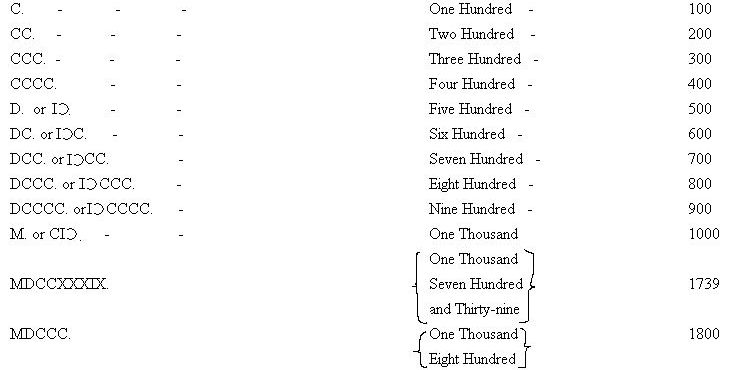
Explanation of NUMBERS expressed by Letters.
N.B.
A less Numerical Letter, set before a greater, takes away from the greater so many as the letter stands for; but being set after the greater, adds so many to it as the letter stands for. For example, V stands for five alone, but put I before it, thus IV, and it stands for four; and put I on the other side, thus VI, and it stands for six. So X alone stands for ten, but put I before it, thus IX, and it stands for nine; and put I to it on the other side, thus XI, and it becomes eleven. So L stands for fifty; put X before it, thus XL, and it stands for forty, but put the X on the other side, thus LX, and it is sixty. So C stands for one hundred, place X before it, thus XC, and it is but ninety; again, put the X on the other side, thus CX, and it is one hundred and ten. So in all other cases.
Top
LETTERS, TALES AND FABLES, FOR AMUSEMENT AND INSTRUCTION.
A Letter from Master
JACKY CURIOUS,
in London, to his Mamma in the Country, giving a Description of the Tower, Monument, and St. Paul's Church.
Honoured Madam,
AT my departure, I remember you ordered me to send you accounts of every thing I saw remarkable in London; I will obey your commands as well as I can; but pray excuse my defects, and let my will plead for my inability, to entertain my absent friends.
I am just now come from seeing the tower, monument and St. Paul's cathedral, (places which I remember to have heard much talk of in the country, and which scarce any body that comes to London omits seeing). The tower, which stands by the Thames, is a large strong building, surrounded with a high wall, about a mile in compass, and a broad ditch supplied with water out of the River Thames. Round the outward wall are guns planted, which on extraordinary occasions are fired. At the entrance, the first thing we saw was a collection of wild beasts, viz. lions, panthers, tygers
[sic]
, &c. also eagles and vultures: These are of no sort of use, and kept only for curiosity and shew. We next went to the mint, (which is in the tower observe) where we saw the manner of coining money, which is past my art, especially in the compass of a letter, to describe. From thence we went to the jewel room, and saw the crown of England, and other regalia, which are well worth seeing, and gave me a great deal of pleasure. The next is the horse armory, a grand sight indeed; here are fifteen of our English monarchs on horseback, all dressed in rich armour, and attended by their guards; but I think it not so beautiful as the next thing we saw, which was the small armory: This consists of pikes, muskets, swords, halberts
[sic]
, and pistols, sufficient, as they told us, for three-score thousand men; and are all placed in such different figures, representing the sun, star and garter, half moons, and such like, that I was greatly delighted with it; and they being all kept clean and scowered, made a most brilliant appearance. Hence we went and saw the train of artillery, in the grand storehouse, as they call it, which is filled with cannon and mortars, all extremely fine: Here is also a diving-bell, with other curiosities too tedious to mention; which having examined, we came away and went to the monument, which was built in remembrance of the fire of London: It is a curious lofty pillar, 200 feet high, and on the top a gallery, to which we went by tedious winding stairs in the inside: from this gallery we had a survey of the whole city: And here having feasted our eyes with the tops of houses, ships, and multitude of boats on the River Thames, we came down and went to St. Paul's Cathedral, which is a most magnificent pile, and stands on high ground, near the centre of the city. This noble building struck me with surprise, and is admired by the whole world, as well for its beautiful architecture as height and magnitude; it has a grand awful choir, chapel, a dome finely painted by that masterly hand Sir J. Thornhill, a whispering gallery, and other curiosities, with which I conclude my first letter, and am,
Madam,
Your very dutiful son,
JOHN CURIOUS.
LETTER II.
Honoured Madam,
I NOW proceed to acquaint you with my next excursion, in search of the curiosities of this famous city; which was to Westminster Abbey. This is really a magnificent ancient building; but what most surprised me, was the vast number of beautiful monuments and figures with which the inside is adorned. Among such as were pointed out to me, as being remarkable either for their costliness or beauty, I remember were those of the Duke of Newcastle, a magnificent and expensive piece, Sir Isaac Newton, General Stanhope, the Earl of Chatham, General Wolf, and that exquisite statue of Shakepeare, which, I am told, is inimitable. When I had for some time enjoyed the pleasure of gazing at these, I was conducted into that part of the church where the Royal monuments are placed. These, I thought, were exceeding grand. But nothing surprised and delighted me so much as King Henry the Seventh's chapel, which, for beauty and magnificence, I am told, far surpasses any thing of that kind in Europe. Here too I saw the chair in which the Kings of England are crowned, which, I believe, is more regarded for its antiquity, and the honourable use it is assigned to, than for any great beauty it has, at least that I could discover.
The next sight that entertained me, was the effigies of King William and Queen Mary in wax, as large as the life, standing in their coronation robes; they are said to be very well done, and to bear a great resemblance to the life. Queen Anne, the Duchess of Richmond, the Duke of Buckingham, &c. all of the same composition, and richly dressed, are there also. In short, there are so many curiosities contained in this venerable repository, that, to describe one half of them would as far exceed the compass of a letter, as of my abilities to do justice to them: However, I shall just mention some which appeared to me most worthy of notice. But these must be the subject of a future letter, from,
Honoured Madam,
Your, &c.
LETTER III.
Honoured Madam,
AS I have the pleasure to find that my letters, however mean in themselves, are agreeable to my dear parent, I shall continue my account of some of those many curiosities which I saw in Westminster-Abbey. Among the monuments of our ancient Kings is that of Henry V. whose effigy has lost its head, which being of silver, I am told, was stolen in the civil wars.
Here are two coffins covered with velvet, in which are said to be the bodies of two Ambassadors, detained here for debt; but what were their names, or what Princes they served, I could not learn.
Our guide next showed us the body of King Henry the Fifth's Queen, Catherine, in an open coffin, who is said to have been a very beautiful Princess; but whose shrivelled skin, much resembling discoloured parchment, may now serve as a powerful antidote to that vanity with which frail beauty is apt to inspire its possessors.
Among the waxen effigies, I had almost forgot to mention King Charles II. and his faithful servant General Monk, whose furious aspect has something terrible in it.
Not far from these is the figure of a lady, one of the Maids of Honour to Queen Elizabeth, who is said to have bled to death by only pricking her finger with a needle
.
I must now return to those monuments, which are in the open part of the church, and free to every one's sight; for those I have been speaking of are inclosed
[sic]
, and not to be seen without a small gratuity to the conductor.
Among these, then, on the north side, stands a magnificent monument erected to Lady Carteret, for whose death some reports assign a cause something odd, viz. the late French King Louis the XIV.'s saying, That a lady (whom one of his Nobles compared to Lady Carteret) was handsomer than she.
Near this stands a grand monument of Lord De Courcy, with an inscription, signifying that one of his ancestors had obtained a privilege of wearing his hat before the King.
Next these follow a groupe
[sic]
of Statesmen, Warriors, Musicians, &c. among whom is Col. Bingfield, who lost his head by a cannon ball, as he was remounting the Duke of Marlborough, whose horse had been shot under him.
The famous musicians Purcell, Gibbons, Blow, and Crofts, have here their respective monuments and inscriptions; as has also that eminent painter Sir Godfrey Kneller, with an elegant epitaph by Mr. Pope. As you enter the west door of the church, on the right hand stands a monument with a curious figure of Secretary Craggs, on whom likewise Mr. Pope has bestowed a beautiful epitaph. On the south side is a costly monument, erected by Queen Anne to the memory of that brave Admiral Sir Cloudesley Shovel, who was shipwrecked on the rocks of Scilly. In the same aisle, and nearly opposite to this, is a beautiful monument of white marble, to the memory of Thomas Thynne, of Long-Leat, in the county of Wilts, Esq. who was shot in his coach, on Sunday the 12th of February, 1682: In the front is cut the figure of him in his coach, with those of the three assassins who murdered him. At the end of this aisle, and on one side of what is called the Poets' Row, lies covered with a handsome monument, and his effigy a large as the life, the very famous Dr. Busby, Master of Westminster School, whose strict discipline and severity are every where so much talked of.
I must now take notice of the Poets, whose monuments stand mostly contiguous. Here are the ancient monuments of Chaucer and Spencer, with those of Ben Johnson, Drayton, Milton, and Butler; also of the great Dryden, the ingenious Phillips, the divine Cowley, the harmonious Prior, and the inimitable Shakespeare, of whose curious effigy I have spoken before: nor must I omit the gentle Mr. John Gay, to whose memory his Grace the Duke of Queensberry has erected a noble monument, which Mr. Pope has adorned with a very elegant inscription in verse. I must here end my remarks, but cannot take leave of this venerable place, without observing, that it has many curious painted windows, a noble choir, a fine organ, and a magnificent altar-piece.
I am, Honoured Madam, &c.
A memorable Saying of the Duke de ORLEANS, at the Surrender of Gravelling, with a generous Action of that Prince.
WHEN Gravelling was surrendered to the Duke of Orleans, just as he entered into town he was heard to say these words: "Let us endeavour, by generous actions, to win the hearts of all men; so we may hope for a daily victory. Let the French learn from me this new way of conquest, to subdue men by mercy and clemency."
With what a matchless virtue did this Prince dismiss a gentleman that was hired to murder him! This assassin was suffered to pass into the Duke's bedchamber one morning early, pretending business of grave moment from the Queen. As soon as the Duke cast his eyes on him, he spoke thus: "I know thy business, friend: thou art sent to take away my life. What hurt have I done thee? It is now in my power, with a word, to have thee cut in pieces before my face. But I pardon thee; go thy way, and see my face no more."
The gentleman, stung with his own guilt, and astonished at the excellent nature of this Prince, fell on his knees, confessed his design, and who employed him; and having promised eternal gratitude for his Royal favour, departed without any other notice taken of him; and fearing to tarry in France, entered himself into the service of the Spanish King. It was his fortune afterwards to encounter the Duke of Orleans in a battle in Flanders. The Duke, at that instant, was oppressed with a crowd of Germans, who surrounded him; and, in the conflict, he lost his sword; which this gentleman perceiving, nimbly stept to him, and delivered one into the Duke's hand, saying withal, "Now reap the fruit of thy former clemency. Thou gavest me my life, now I put thee in a capacity to defend thy own." The Duke by this means at length escaped the danger he was in; and that day the fortune of war was on his side. The French had a considerable victory. You see by this, that heroic actions have something divine in them, and attract the favours of Heaven. No man was a loser by good works; for though he be not presently rewarded, yet, in length of time, some happy emergency arises to convince him, "That virtuous men are the darlings of Providence."
The remarkable Story of GIOTTO, an Italian Painter, and his Crucifix.
IT was a cruel and inhuman caprice of an Italian Painter (I think his name was Giotto), who designing to draw a crucifix to the life, wheedled a poor man to suffer himself to be bound to the cross an hour, at the end of which he should be released again, and receive a considerable gratuity for his pains. But instead of this, as soon as he had him fast on the cross, he stabbed him dead, and then fell to drawing. He was esteemed the greatest master in all Italy at that time; and having this advantage of a dead man hanging on a cross before him, there is no question but he made a matchless piece of work on't. As soon as he had finished his picture he carried it to the Pope, who was astonished, as at a progidy [sic] of art, highly extolling the exquisiteness of the features and limbs, the languishing pale deadness of the face, the unaffected sinking of the head: In a word, he had drawn to the life not only that privation of sense and motion which we call death, but also the very want of the least vital symptom. This is better understood than expressed. Every body knows that it is a master-piece to represent a passion or a thought well and natural. Much greater is it to describe the total absence of these interior facilities, so as to dis
tinguish the figure of a dead man from one that is only asleep. Yet all this, and much more, could the Pope discern in the admirable draught which Giotto presented him. And he liked it so well, that he resolved to place it over the altar of his own chapel. Giotto told him, since he liked the copy so well he would shew him the original, if he pleased. What dost thou mean by the original, said the Pope? Wilt thou shew me Jesus Christ on the cross in his own person? No, replied Giotto, but I'll shew your Holiness the original from whence I drew this, if you will absolve me from all punishment. The good old father suspecting something extraordinary from the painter's thus capitulating with him, promised, on his word, to pardon him, which Giotto believing, immediately told him where it was; and attending him to the place, as soon as they were entered, he drew a curtain back which hung before the dead man on the cross, and told the Pope what he had done. The Holy Father, extremely troubled at so inhuman and barbarous an action, repealed his promise, and told the painter he should surely be put to an exemplary death. Giotto seemed resigned to the sentence pronounced upon him, and only begged leave to finish the picture before he died, which was granted him. In the mean while a guard was set upon him to prevent his escape. As soon as the Pope had caused the picture to be delivered
into his hands, he takes a brush, and dipping it into a sort of stuff he had ready for that purpose, daubs the picture all over with it, so that nothing now could be seen of the crucifix, for it was quite effaced in all outward appearance.
This made the Pope stark mad; he stamped, foamed, and raved like one in a phrenzy: he swore the painter should suffer the most cruel death that could be invented, unless he drew another full as good as the former, for if but the least grace was missing, he would not pardon him; but if he would produce an exact parallel he should not only give him life, but an ample reward in money.
The painter, as he had reason, desired this under the Pope's signet, that he might not be in danger of a second repeal; which was granted him; and then he took a wet sponge, and wiped off the varnish he had daubed on the picture, and the crucifix appeared the same in all respects as it was before.
The Pope, who looked upon this as a great secret, being ignorant of the arts which the painters use, was ravished at the strange metamorphosis. And to reward the painter's triple ingenuity, he absolved him from all his sins, and the punishment due them; ordering moreover his steward to cover the picture with gold, as a farther gratuity for the painter. And, they say, this crucifix is the original, by which the most famous crucifixes in Europe are drawn.
FABLE of the HARE and many FRIENDS. By Mr. GAY.
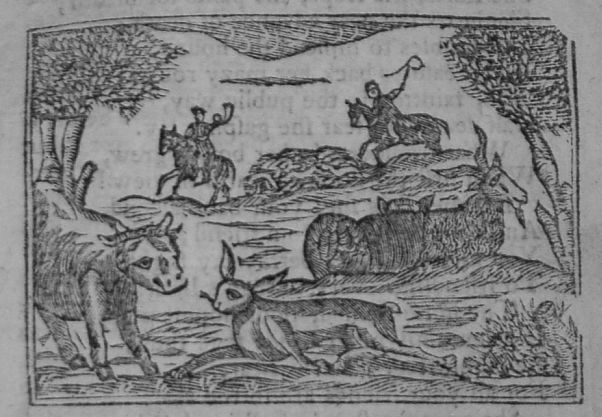
FRIENDSHIP, like love, is but a name, Unless to one you stint the flame, The child whom many fathers share, Hath seldom known a father's care; 'Tis thus in friendship; who depend On many, rarely find a friend. A hare, who, in a civil way, Complied with ev'ry thing, like Gay, Was known by all the bestial train Who haunt the wood, or graze the plain; Her care was, never to offend, And ev'ry creature was her friend. As forth she went at early dawn, To taste the dew-besprinkled lawn, Behind she hears the hunter's cries, And from the deep-mouth'd thunder flies; She starts, she stops, she pants for breath; She hears the near advance of death; She doubles to mislead the hound, And measures back her mazy round; 'Till, fainting in the public way, Half dead with fear she gasping lay. What transports in her bosom grew, When first the horse appear'd in view! Let me, says she, your back ascend, And owe my safety to a friend; You know my feet betray my flight, To friendship every burden's light. The horse replied, poor honest puss, It grieves my heart to see thee thus; Be comforted, relief is near, For all your friends are in the rear. She next the stately bull implor'd, And thus replied the mighty lord; Since every beast alive can tell That I sincerely wish you well, I may, without offence, pretend To take the freedom of a friend; Love calls me hence; a fav'rite cow Expects me near yon barley mow; And when a lady's in the case, You know all other things give place. To leave you thus might seem unkind, But see, the goat is just behind. The goat remark'd her pulse was high, Her languid head, her heavy eye; My back, says he, may do you harm; The sheep's at hand, and wool is warm. The sheep was feeble, and complain'd His sides a load of wool sustain'd, Said he was slow, confest his fears; For hounds eat sheep as well as hares. She now the trotting calf addrest, To save from death a friend distrest. Shall I, says he, of tender age, In this important care engage? Older and abler past you by; How strong are those! how weak am I! Should I presume to bear you hence, Those friends of mine may take offence: Excuse me then. You know my heart, But dearest friends, alas, must part! How shall we all lament: Adieu! For see the hounds are just in view.
The dying Words and Behaviour of three great Men, when just quitting the Stage of Life.
SIR Francis Walsingham, towards the end of his life, grew very melancholy, and writ to the Lord Burleigh to this purpose: "We have lived long enough to our country,. to our fortunes, and to our Sovereign; it is high time we begin to live to ourselves, and to our God." Sir Henry Wotton, who had gone on several embassies, and was intimate with the greatest Princes, chose to retire from all, saying, The utmost happiness a man could attain to, was to be at leisure to be, and to do good; never reflecting on his former years, but with tears, he would say, "How much time have I to repent of! and how little to do it in!" Philip III. King of Spain, seriously reflecting upon the life he had led in the world, cried out upon his death-bed, How happy were I, had I spent those twenty-three years that I have held my kingdom, in a retirement! saying to his confessor, "My concern is for my soul, not my body."
FINIS.
SALISBURY: Printed by B.C. COLLINS.
Top