TERMS USED IN ORNAMENTAL ART.
Reading edition
Ornament is the means by which Beauty or Significance is imparted to Utility. It is either Symbolical or Aesthetic. Symbolic ornament consists of elements or forms chosen for the sake of their significance—Aesthetic ornament consists of forms or elements chosen for their Beauty alone, or their power of appealing to the senses.
Of the historic styles of ornament, the Egyptian, Assyrian, Byzantine, Scandinavian, Persian, Indian, Gothic, Polynesian, and much of the Chinese and Japanese are symbolical, having elements and ornamental details chosen for their significance; while in the Greek, Roman, and Renascence ornament, the purely aesthetic motive is characteristic.
Ornament, again, may be natural or conventional—Imitative or Inventive. The terms “natural” and “imitative” have the same significance—viz., the exact copying of natural forms, so that they become principal—not secondary as perfect ornament should be. Conventional ornament is the adaptation of natural forms to ornamental and technical requirements, and is seen in its greatest beauty in the frank treatment by the Indians and Persians of their flora and fauna for the decorative enrichment of their textile fabrics, pottery, and jewellery.
Inventive ornament is that which consists of elements not derived from any natural source; the Moresque style is a good example of this type.
The elements of ornament are the details or forms chosen for ornamental motives, and the principals of ornament are the arrangement of these forms and details; they comprise repetition, alternation, symmetry, radiation, balance, proportion, variety, eurythmy, contrast, intersection, complication, fitness, and utility.
Repetition is the use of elements in a continuous series; Alternation is the repetition of an element at intervals, with others intervening; Symmetry: when the leading lines are equal or similar (or reciprocal) on both sides; Radiation: when the lines spring from a centre, for example, a bird’s wing and the flower of the daisy; Balance and Proportion: when the relation and harmony of parts is based upon natural laws; Variety implies difference in the details, with respect to form or type; Eurythmy signifies rhythms or harmony in ornament; Contrast is the arrangement in close proximity of colours or forms of opposite characters, as the straight line with the curve, or light with dark; Intersection is the crossing of the leading lines, the Arabian, Moresque and Celtic styles are examples of this principle; Complication is the effect produced by elements so arranged as to be more or less difficult to trace with the eye alone: as in the Japanese key and the Moresque star pattern. Fitness and utility as their names imply are essentials in all good periods of ornamentation.
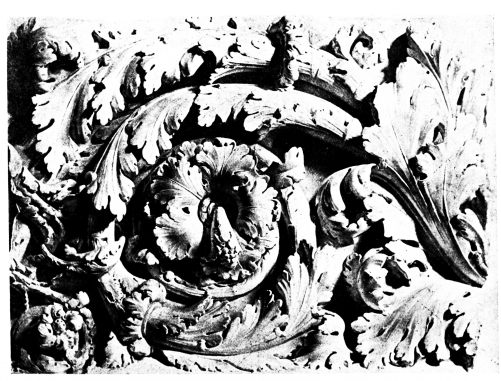
ROMAN SCROLL.
Text Books upon Architecture and Ornament.
Classic and Early Christian Architecture Roger Smith,5/-
Gothic and RenascenceRoger Smith,5/-
Glossary of ArchitectureJ. Parker,7/6
Handbook of Architectural StylesRosengarten,7/6
Introduction to Gothic ArchitectureJ. Parker,5/-
Three Manuals of Gothic OrnamentJ. Parker, each1/-
Classic and Early Christian SculptureG. Redford,5/-
Gothic and Renascence SculptureLeader Scott,5/-
Handbook of Greek Sculpture, 2 vols.Ed. Gardner,10/-
History of Greek ArtTarbell,5/-
Analysis of OrnamentJ. Wornum,8/-
Handbook of OrnamentMeyer,10/6
An excellent series of illustrated Handbooks upon the Industrial Arts by writers of repute, is published by the Science and Art Department, and may be obtained at the Bookstall of the South Kensington Museum, at a cost of 1/-each part (paper covers), or they may be purchased through Messrs. Chapman and Hall, at 2/6 each part, bound in cloth, they include:
The Industrial Arts of IndiaSir G. Birdwood—each in two parts.
” ” SpainJuan F. Riano
” ” DenmarkJ. J. Worsaae
” ” ScandinaviaHans Hildebrand
The Saracens of EgyptStanley Lane Poole
Early Christian Art in IrelandMargaret Stokes
English EarthenwareA. H. Church
” PorcelainA. H. Church
French PotteryP. Gasnault & E. Garnier
Wrought Iron WorkJ. Starkie Gardner
BronzesDrury E. Fortnum—complete in one part.
College and Corporation PlateWilfred Cripps
FurnitureJ. H. Pollen
Gold and Silversmith’s WorkJ. H. Pollen
GlassA. Nesbitt
IvoriesW. Maskell
Japanese PotteryA. W. Franks
MaiolicaDrury E. Fortnum
Persian ArtR. Murdoch Smith
Textile FabricsRev. Daniel Rock
TapestryAlfred de Champeaux
Works of Reference.
Architecture:—
Antiquities of RomeTaylor & Cresy.
Antiquities of AthensStuart & Revett.
Analysis of Gothic ArchitectureBrandon.
Architecture for General ReadersH. H. Statham.
Byzantine ArchitectureTexies & Pullan.
ConstantinopleSalzenberg.
Civil ArchitectureChambers.
Decorated Window TraceryE. Sharpe.
Encyclopædia of ArchitectureGwilt.
English Renascence ArchitectureJ. A. Gotch.
Gothic MouldingsF. A. Paley.
Gothic ArchitectureT. Rickman.
Gothic Architecture in FranceE. Corroyer.
Gothic Architecture in SpainG. E. Street.
Gothic FoliageJ. K. Collings.
Handbook of ArchitectureJ. Fergusson.
History of ArchitectureJ. Fergusson.
Indian and Eastern ArchitectureJ. Fergusson.
Mansions of EnglandJ. Nash.
Old English MansionsC. Richardson.
Orders of ArchitectureR. Phéne Spiers.
Orders of ArchitectureC. Norman.
Orders of ArchitectureJ. M. Manch.
Spanish RenascenceD. N. Prentice.
Stones of VeniceJ. Ruskin.
Seven Lamps of ArchitectureJ. Ruskin.
The Seven Periods of Church ArchitectureE. Sharpe.
Ornament and Sculpture:—
Art of the Old English PotterL. M. Solon.
Ancient PotteryS. Birch.
AlphabetsE. Strange.
AlphabetsLewis F. Day.
Basis of DesignWalter Crane.
Fresco Decoration in ItalyL. Gruner.
Grammar of OrnamentOwen Jones.
Greek and Roman SculptureW. G. Perry.
Greek Vase PaintingJane Harrison.
Glass PaintingC. Winston.
Stained Glass WindowsLewis F. Day.
Handbook of Greek ArchæologyA. S. Murray.
Primitive GreeceGeorge Perrot and C. Chipiez.
PersiaGeorge Perrot and C. Chipiez.
PhrygiaGeorge Perrot and C. Chipiez.
Chaldea and AssyriaGeorge Perrot and C. Chipiez.
EgyptGeorge Perrot and C. Chipiez.
Keramic Art of JapanAudsley & Bowles.
NinevehLayard.
Ornamental Metal WorkDigby Wyatt.
Ornamental ArtGruner.
Ornamental TextilesFischbach.
Ornament of Textile FabricsDupont Auberville.
PompeiiZahn.
Polychromatic OrnamentRacinet.
The AlhambraOwen Jones.
Alfred Stevens, his life and workHugh Stannus.
Many excellent “Cantor Lectures,” by experts, upon the practical application of the Industrial Arts, will be found in the Society of Arts Journal.
The following Lectures may be studied with advantage:
April, 1891CloisonnéClement Heaton.
Feb., 1894Decorative Treatment of Artificial FoliageHugh Stannus.
April, 1891Decorative Treatment of Natural FoliageHugh Stannus.
June, 1897Delft WareJ. W. L. Glaisher.
March, 1891EnamelsJ. Starkie Gardner.
Jan., 1892Indian ArtSir G. Birdwood.
Feb., 1892Japanese PotteryE. Hart.
Feb., 1891LithographyW. Simpson.
Jan., 1897Material and Design in PotteryWilliam Burton.
April, 1891Plaster WorkA. Robinson.
Feb., 1891StoriationHugh Stannus.
Feb., 1891S’graffitoHeywood Sumner.
March, 1899Vitreous EnamelsC. Davenport.
Feb., 1898Some Laws of Form in Applied ArtHugh Stannus.
In the transactions of the Rochdale Literary Society for 1891 (Aldine Press) is a most instructive and well-illustrated article on “The Ornamental Art of Savage People,” by Dr. Hjalmar Stolpe, translated by Mrs. H. C. March.
The transactions of the Lancashire and Cheshire Antiquarian Society (1891) contains an excellent article upon “The Pagan Christian Overlap in the North,” by H. Colley March, M.D.
The illustrated articles in the transactions of the Royal Institute of British Architects, may also be studied with advantage, they include:
1892 Byzantine ArchitectureGeorge Aitchison.
1892 Casting in MetalsD. Graham, H. Longden & H. Singer.
1891 Decorative Plaster WorkG. Robinson, Heywood Sumner and Stephen Webb.
1897 Heraldry in English Mediæval ArchitectureW. H. St. John Hope.
1897 Heraldry of the Renascence in EnglandAlfred Gotch.
1898 Heraldic DrawingJ. D. Crace.
1894 MosaicsC. H. Harrison & J. C. Powell.
1898 Sculptured Columns of the Temple at EphesusA. S. Murray.
1891 Sculpture in relation to ArchitectureG. Simonds.
1892 Stained GlassH. Charpenter, J. Powell, H. Westlake and C. Heaton.
1891 Wrought Iron Work, Mediæval PeriodJ. Starkie Gardner.
1891 Wrought Iron Work, Renascence PeriodJ. Starkie Gardner.
Good articles are found in the Magazine of Art, they include:
1897Chippendale FurnitureC. Dempsey.
1893DesignWalter Crane.
1890Embroidered BookcoversS. E. Prideaux.
1896IronworkJ. Starkie Gardner.
1888Language of LineWalter Crane.
1882-3 Stained GlassLewis F. Day.
1883Sheraton FurnitureE. Balfour.
1891The Use of Metals in BookbindingS. E. Prideaux.
1884The Ficoroni Dressing Case
1896The Influence of Architecture Style upon DesignWalter Crane.
In the Art Journal, there is:
1888 Ancient Glass in the British MuseumHenry Wallis.
1889 Antique Glass in the Naples MuseumHenry Wallis.
1888 Textile Fabrics in the South Kensington MuseumGilbert R. Redgrave.
1887 Meaning in OrnamentLewis F. Day.
1888 The Boulaq MuseumHenry Wallis.
In the Portfolio, there is:
1893 Old English PotteryA. H. Church.
1893 English EnamelsJ. Starkie Gardner.
1893 English BookbindingW. Y. Fletcher.
1894 Bookbinding in FranceW. Y. Fletcher.
1894 Italian Book IllustrationsA. W. Pollard.
1894 Josiah WedgwoodA. H. Church.
1898 Greek BronzesA. S. Murray.
1897 Armour in EnglandJ. Starkie Gardner.
1898 Foreign Armour in EnglandJ. Starkie Gardner.
In the Builder, there are the Royal Academy Lectures upon Architecture given by George Aitchison, R.A. They include:
1891 Roman Architecture.
1892 Saracenic Architecture.
1893 Byzantine Architecture.
1894 Renascence Architecture.
1896 Romanesque Architecture.