AUTHOR’S NOTE (continued 2)
Reading edition
“My friend Mr. Ogilvie has just amputated a finger; in my opinion it would have been running an unjustifiable risk not to have done so. There were several minor injuries, but happily they did not require such drastic measures. May I ask, Miss Lackett, without impertinence, if you have known Mr. Cromartie long? You are, I understand, a personal friend, a close and dear friend of Mr. Cromartie’s.”
Miss Lackett opened her eyes rather wide at this remark, and replied:
“I was naturally anxious.... Yes, I am an old friend of Mr. Cromartie’s—and, if you like, a close friend.” She laughed. “Is there danger of blood-poisoning?”
“There is a risk of it, but we have taken every precaution.”
“The King of Greece died of being bitten by a monkey,” cried Josephine suddenly.
“That’s rubbish,” interrupted the curator, coming forward. “Why everybody in the Gardens has been more or less seriously bitten by monkeys at some time or other. It is always happening. It’s dreadful to think that the poor fellow should have lost a finger, but there’s no danger.”
“You are sure there’s no danger?” asked Josephine.
The curator appealed to the medical men. They allowed themselves to smile.
Josephine withdrew, and in the hall the curator said to her:
“Don’t worry about him, Miss Lackett; it’s a beastly thing of course to think of, but it’s not serious. He isn’t the King of Greece; the monkey isn’t that sort of monkey even. He’ll be up and about in a day or two at the most. By the way, is your father General Lackett?”
Josephine was surprised, but admitted it without hesitation.
“Oh, yes—he’s an old friend of mine. Drop in one day next week to tea and see how our friend is going on.”
Josephine left in very much better spirits than she had come, and though she once or twice was troubled by the recollection of Mr. Cromartie’s unconscious form, the head swathed in bandages, and the body covered with a blanket, she felt small anxiety. On the contrary, she very soon gave herself up to rosy visions of the future.
Thus nothing appeared to her to be more clear than that Mr. Cromartie would leave the Zoo, and the loss of a finger was perhaps not too high a price to pay for restoring him to ordinary ways, or perhaps she might say not too great a punishment for conduct such as his had been.
And it crossed her mind also that now there was no need for her to humble herself to Cromartie, for he would leave the Zoo and become reconciled to her now as a matter of course. It was for her to forgive him! She had had a narrow escape. What a weak position she might have been in had she seen him before the ape bit him! How strong a position she now occupied! She must, she reflected, take this lesson to heart and never act hurriedly on the impulse of the moment, otherwise she would give John every advantage and there would be no dealing with him at all. Next she recollected the letter she had sent him, and spent a little while trying to recall the exact terms of it. When she remembered that she had said that she was ashamed and had asked to be forgiven, she bit her lips with vexation, but the next moment she stopped short and said aloud: “How unworthy this is of you! How petty! How vulgar!”
And she remembered at that moment all the vulgar and horrible things she had felt when she had first learnt that John had gone to the Zoo, and how much ashamed she was of them afterwards, and how hatefully she had behaved on both of her visits to him. She told herself then that she ought to be ashamed, ought to ask forgiveness, and that she ought to be thankful that she had done so in her letter, but in the next instant she was saying to herself: “All the same, it won’t do to put myself at his mercy. I must keep the upper hand or my life won’t be worth living.” And after that her mind raced off again to visions of the future in which John was rewarded with her hand and they took a country house. Her father was an authority on fishponds and trout streams. He and Cromartie would of course lay out a fishpond. Perhaps there would be a moat round the house. But the figure who bent over her father’s shoulder at breakfast, pushing away the egg-boiling machine to look at a plan of the new trout hatchery, that figure was a very different person from Mr. Cromartie the mutilated, monkey-bitten man in the Zoo.
When Josephine got home she found a note which had been left for her, but which was not in Mr. Cromartie’s handwriting.
It ran as follows:
Infirmary, Zoo.
Dear Josephine,
Your note has come by the messenger. I shall not be free to see you this afternoon, which relieves me from making the decision not to do so. You say that the reason you behave cruelly to me is because you love me. It is because I know that, that I have tried to do without your love. I think you are a character who will always torture the people you love. I cannot bear pain well; that alone makes us unsuited to each other. It is the principal reason why I never wish to see you again.
You are mistaken when you say that you have something of the first importance to tell me. Unless it is something to do with the arrangements which the Zoo authorities make with regard to the Ape-house, it cannot be of importance to me.
Please believe that I bear you no resentment for the past; indeed I still love you, but I mean what I say.
Yours ever, John Cromartie.
When Josephine had read this letter over twice and had realised that it must have been written after he had been bitten by the ape, and just before his finger was cut off, she gave up her hopes.
Everything she had been feeling was revealed as ridiculous folly. If John could write like that at the moment when he must have been most wishing to escape from confinement, she saw that her plans for his regeneration were impossible. She went up to her room and lay down. All was lost.
That morning Mr. Cromartie had taken his breakfast of rolls, butter, Oxford marmalade, and coffee as usual. When it had been cleared away he began to play ball with the Caracal.
For this purpose he used an ordinary tennis ball, and throwing it on the floor of his cage, made it bounce on to the netting and back to him. The game therefore resembled fives, the object, however, being, on his part, to prevent the Caracal intercepting the ball, which, by the way, he was rarely able to do more than three or four times running, for the cat was very quick on its legs and had a good eye.
After they had been playing for about ten minutes Mr. Cromartie slipped backwards in taking a ball
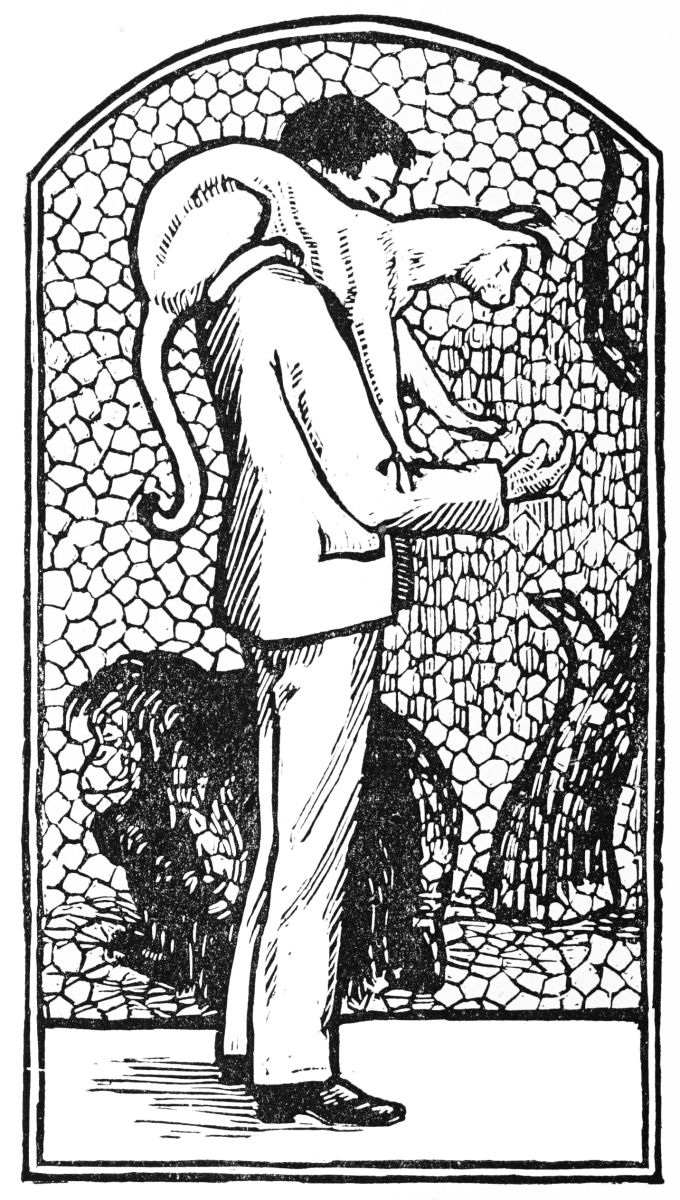
which bounced high, and fell heavily against the wire netting wall of his cage. Before he could get his balance he felt himself taken hold of by the hair, and understood at once that it was his neighbour the Orang who had got him in its clutches. The brute then got a finger as far as Mr. Cromartie’s ear and slit it through, though not injuring the drum. Mr. Cromartie managed to turn his head then in order to see his assailant, and found his face was now exposed, and his forehead was scratched. To protect himself he put one hand in front of his face, and was pushing himself away from the netting with the other when the Orang caught hold of two of his fingers in its teeth. The pain of this made him jerk his head free, and the lock of hair by which the Orang held him came right out of his scalp.
The ape still held on to his fingers like a bulldog. Just then his Caracal, which had been dodging about between his legs, got one paw through the netting and raked the Orang’s thighs with his claws, but the ape did not leave go even then. Mr. Cromartie, who had a very cool head for a man in such a situation, took out a couple of wax vestas from his pocket, struck them on his heel, and thrust the flaring fusees through the wire into the ape’s muzzle and in that way made him leave go his hold at once.
This circumstance of his feeling for the fusees in his pocket while the ape was slowly grinding his fingers to a mere pulp very greatly impressed the spectators, who beyond shouting for assistance were powerless to do anything. No less remarkable was the way in which, directly he was free, he pulled away the Caracal from the netting before the ape could catch hold of him, and this though the cat was beside itself with the fury of the fight. But strangely enough in doing this he did not get scratched, either because he pulled him off by the scruff with his uninjured hand and carried him right out of the cage, or because the Caracal knew him even at that moment.
Collins arrived just as this happened and the shock was almost too much for him; it was remarked that he was deathly white and could scarcely speak. Mr. Cromartie was covered with blood, blood pouring from his ear and his fingers, and all his hair matted with blood, but he came back at once after locking up his Caracal, to show the spectators that he was not badly hurt; they for their part clapped their hands with joy, either because they were glad to see him escape, or because they were grateful for having been presented with such an unusual spectacle for nothing.
Cromartie then went back to his inner room and Collins led him off at once to the infirmary, where he was given first aid. It was some little while after this that he received Josephine’s letter and dictated an answer for the messenger to take to her. There was some little delay in the messenger getting to him.
Directly he had despatched the letter he was anæsthetised and the third finger of his right hand amputated.
After the operation and before he had regained consciousness, he was taken to the house of the curator, who had decided that he would be more comfortable there than anywhere else. Although at the time Mr. Cromartie had behaved with perfect composure and had borne his injuries without flinching, not only at the time of the assault, but for over three hours afterwards, and had been able to compose a letter during that time as if nothing had happened, he had received a great nervous shock the effects of which only became apparent next day. He spent a very disturbed night, but in the morning was much better; ate an ordinary breakfast but did not get up, and Sir Walter Tintzel, who visited him about eleven o’clock, was sanguine and predicted a rapid recovery. In the afternoon he was restless and suffered acutely, and as evening came on his temperature rose rapidly. That night he was in a condition of fitful delirium, occasionally falling asleep and waking up with nightmares which persisted even when he appeared to be wide awake.
On the second day the fever increased and blood-poisoning in an acute form was recognised, but the patient was altogether rational in his mind. On the third day the symptoms of blood-poisoning were more pronounced. The patient fell into a delirium which lasted without intermission for the following three days. Most of the feverish hallucinations which filled his mind then passed completely away when he recovered consciousness. Yet Mr. Cromartie had a clear and vivid memory of one of them. This was, he knew, nothing but a dream, yet it seemed but to have just happened to him, and the dream or vision was singular enough for it to be put down here.
In the Strand people were hurrying along in little crowds like gusts of dirty smoke that was blown at intervals in wisps across the road. They were all coming towards him as he walked down from Somerset House towards Trafalgar Square. No one was walking the same way that he was, and none of the people he met brushed against him or even looked at him, but they melted away to right and left and so let him pass by. Sometimes when a band of them passed him he caught a whiff of their odour, and the smell sickened him.
They were frightened, they hurried by, but he was thinking of that great man Sir Christopher Wren, who had planned the street he was then walking in. But nobody cared, nobody had built it, though the plans were all there rolled up and ready, and just as good to-day as they were in the reign of King Charles II.
He lifted up his head presently, and up in the sky a white streak was being deliberately drawn. It was an aeroplane writing advertisements. So he stood still in the middle of the hurrying crowds to watch it; now he could just see the tiny aeroplane like a little brown insect. Slowly in the sky a long straight line was drawn and then a loop—surely it must be the figure 6. And then the aeroplane stopped throwing out smoke and became almost invisible as it went off tittering across the sky.
The numeral swelled and grew and was being slowly blown away when all of a sudden another white streak appeared and the aeroplane was drawing something else. But as he watched he was aware that after all it was the same thing again, another 6, and when it had done that the aeroplane mounted again into the sky and drew another 6, but already its first work was undone by the wind and in a few moments there was nothing to be seen in the sky but a few wisps of smoke.
For a second or two Cromartie felt himself rocking in the aeroplane, which went humming away across the sky before falling again sideways like a snipe bleating; that was only a moment, as when you shut your eyes and fancy that you can feel the earth spinning in space, and then Cromartie was walking out of the Strand into Trafalgar Square. It was empty, and he looked at the Nelson monument with wonder. Landseer’s great beasts planted their feet flat down before them. What were they, he wondered? Lions or Leopards, or perhaps Bears? He could not say. And suddenly he saw that his right hand was bleeding and his fingers gone. A great crowd had entered the Square; the fountains were playing, the sun was shining, and he got on to a scarlet omnibus. But very soon he saw that the people were whispering together on the omnibus and they were all looking at him, and he knew that it was because they saw his wounded hand. He put his other hand up to his forehead and there was blood on that also. He was afraid then of the people on the bus and so he got out. But wherever he wandered the people stopped and stared at him and whispered, and as he walked among them they drew aside and formed into little groups and gazed after him as he went by, and it was because they knew him by the wounds on his head and on his hand.
They were all of them muttering and looking at him with hatred, but something restrained them, so that though their eyes were like sharp daggers they were one and all afraid to point their fingers....
He was going to vote. He would cast his vote. Nothing should stop him. At last he saw the two entrances to the underground voting hall with Ladies written over one and Gentlemen written over the other, and he went downstairs. But when he asked the attendant for his voting card the man took down a large book bound in lambskin with the wool left on, and turned over several pages and looked down them. At last he said: “But your name is not written in the Book of Life, Mr. Cromartie. You must give up your secret, you know, if you wish to be registered.” When he heard this Mr. Cromartie felt sick, and he noticed the smell that came from all the other voters in their ballot boxes; he hesitated, and at last he said:
“But if I do not give up my secret may I not vote?”
“No, Mr. Cromartie. Nobody can vote who does not give up his secret, that is called the secrecy of the ballot—but it is out of the question for you to vote, anyhow ... you bear the Mark of the Beast.”
And Mr. Cromartie looked at his hand and felt his forehead and saw that he did indeed bear the Mark of the Beast where it had bitten him, and he knew that he was an outcast. That was what everybody had whispered. He would not give up his secret so he was rejected by mankind and hated by them, for he frightened them. They were all alike, they had no secrets, but he had kept his and now the Beast had set its Mark upon him, and he seemed terrible to them all, and he himself was afraid. “The Beast has set his Mark on me,” he said to himself. “It will slowly eat me up. I cannot escape now, and one thing is as bad as another. On the whole I would rather the Beast slowly ate me up than give up so much, and the stench of my fellows disgusts me.”
And then he heard the Beast moving restlessly behind some partition; he heard the rustling of straw and the great creature slowly licking itself all over; and then its smell, sweet, and warm, and awful, swallowed him up, and he lay quite still on the floor of the cage, listening to its tail going thump, thump, thump on the floor beside him. Terror could go no further, and at last he opened his eyes and slowly understood that it was his own heart which was beating and no beast’s tail, and all about him there were clean sheets and flowers and a smell of iodoform. But his fear lasted for half that day.
In a fortnight Mr. Cromartie was pronounced out of danger, but he continued in so weak a state for some time afterwards that he was not allowed to receive any visitors, so that although Josephine called every day it was only to hear the latest news of how he had passed the night, and to leave flowers for the sickroom.
In the following weeks Mr. Cromartie made a rapid recovery; that is to say, though by no means restored to his ordinary health, he was able first to get up for an hour in the middle of the day, and then to go for a short walk round the Gardens.
The doctors attending upon him suggested at this time that an entire change of scene would be beneficial, and the curator, far from putting any obstacles in the way of this, frequently urged the patient to go for a month’s holiday to Cornwall. But in this he was met by a steady and obstinate refusal, or rather by complete passivity and non-resistance. Mr. Cromartie refused to take a holiday. He declined to go away anywhere by himself, though he added that he was completely at the curator’s disposal and prepared to go to any place where he was sent in charge of a keeper. After some days, during which the curator proposed first one scheme and then another, the plan of Mr. Cromartie’s being sent away was abandoned. In the first place it was difficult to spare a keeper, or for that matter to find a suitable man among the staff to go with Mr. Cromartie, and it was difficult to find a suitable place where they should be sent.
But the chief reason why these schemes were given up was because of the apathetic and even hostile attitude which the invalid adopted to them, and because it occurred to the curator that this hostility was perhaps not without a reason.
And indeed there is no doubt that Mr. Cromartie felt that if he once took such a holiday as had been suggested he would find it very much harder to go back into captivity at the end of it, and he opposed it because he was resolved not to escape from what he conceived were his obligations.
It was therefore decided that Mr. Cromartie should go straight back to his cage, though it was impressed upon him that he would not be expected to be on view to the public any longer than he wished, and that he must lie down to rest in his inner room for two or three hours every day.
In this way, and by taking him for motor-car drives for a couple of hours or so after dark, it was hoped that he would be able to regain his accustomed health and shake off that state of apathy which seemed his most alarming symptom to the medical men who attended him.
But before Cromartie went back to his old quarters he was to hear a piece of news from the curator which concerned him very closely, though he did not at first realise the full significance of it.
The curator was so confused in imparting this information, and so apologetic, and occupied so much time with a preamble explaining how much the Zoological Society felt themselves indebted to him, that Mr. Cromartie had some difficulty in following what he said, but at last he got at the gist of it, and the long and the short of the matter was: The experiment of exhibiting a man had been a much greater success than any of the Committee had dared to hope; such a success, indeed, that it had decided to follow it up by having a second man, a negro. It had actually engaged him two or three days since, and had installed him only that day. The intention of the Committee was eventually to establish a “Man-house” which should contain specimens of all the different races of mankind, with a Bushman, South Sea Islanders, etc., in native costume, but such a collection could of course only be formed gradually and as occasion offered.
The embarrassment of the poor curator as he made these revelations was so extreme that Cromartie could only think of how best to set him once more at his ease, and though he had a very distinct moment of annoyance when he heard of the negro, yet he suppressed it completely. When the curator had been persuaded that Cromartie bore him no grudge for these innovations, nay more, that he was perfectly indifferent to them, his joy and relief were as overwhelming as his distress and embarrassment had been before.
First he blew out a great breath, and mopped his forehead with a big silk handkerchief; then, his honest face quite transformed with happiness, he seized Cromartie by the hand, and then by the lapel, and laughed again and again while he explained that he had opposed the project with all his might because he was sure Cromartie would not like it, and after he had been overruled he had not known how to break the news to him. He vowed he had not slept for two nights thinking about it, but now when he learnt that Cromartie actually approved of the plan, he felt a new man. “I am the biggest fool in the world,” said he; “my imagination runs away with me. I am always thinking of how other people are going to be upset, and then it turns out that they don’t give a row of pins about the whole affair and I am the only person who feels upset at all ... all on account of somebody else.... Ha! Ha! Ha! It has been just like that over and over again with my wife. It is always happening to me. Well now I’ll go full blast ahead with the new ‘Man-house,’ because, you know, it’s a damned good notion. I felt that the whole time, but I couldn’t get it out of my head that it was unfair to you.”
But Mr. Cromartie did not share his enthusiasm; he merely repeated to himself, as he had done so often before, that he intended observing his side of the contract so long as the Zoo kept its own, and that there was nothing in all this which infringed or invalidated the contract in any way. But when Mr. Cromartie went into his cage he saw a black man in the cage next door—he was brushing a black bowler hat—it came as a great shock to Mr. Cromartie to realise that this man was the neighbour about whom the curator had spoken. This negro was almost coal black, a jovial fellow, dressed in a striped pink and green shirt, a mustard-coloured suit, and patent leather boots. When he saw Mr. Cromartie he at once wheeled round, and saying “The interesting invalid has arrived,” walked up to the partition separating him from Cromartie and said to him: “Allow me to welcome you back to what is now the Man-house. If I may introduce myself, Joe Tennison: I am delighted to meet you, Mr. Cromartie, it is a real pleasure to have a man next door.” Cromartie bowed stiffly and said “Good afternoon” very awkwardly, but the negro was not abashed, and leaned against the wire partition between them so that it bulged.
“They are going to clear all that poor trash away now,” he said, pointing at the Chimpanzee beyond Cromartie. “They isn’t to be kept with us any more, nasty jealous brutes; bite your fingers off if they catch you.”
Cromartie turned and looked at the Chimpanzee; it had always seemed to him rather a pathetic beast, but how much more so now while his new neighbour Tennison was speaking of it! And not for the first time he felt a friendly sympathy for the ugly little ape. Indeed he would far rather have seen the savage old Orang back in her place than have this insufferably verbose fellow patronising the animals near him.
For the moment Cromartie was quite at a loss, and had no idea what to reply to the stream of Mr. Tennison’s remarks. He had said nothing at all when a minute or two later he was relieved by the arrival of Collins with his Caracal, which had been sent back to his old cage in the cat-house after Mr. Cromartie’s injuries.
The pleasure of the two friends at once more being together was unbounded, and was shown by each of them very strongly after his own fashion. For at first the Caracal trotted up to Cromartie debonairly enough, as if he were just come to give him a sniff, then he began purring loudly and rubbed himself a score of times against Cromartie’s legs, winding himself about them, and finally he sprang right up into his friend’s arms, licked his face and his hair, and curled up for a moment or two as if he would sleep there; but no, this was not for long, for he sprang down again. Then he began trotting round the cage, sniffed in the corners, leapt on the table and made certain that all was well.
When Joe Tennison called to him, the Caracal passed by without giving him a glance, and it was just the same with his friend too, for when Cromartie heard the negro begin talking to him he just nodded his head and went into his inner room. But once there Mr. Cromartie reflected that this negro was to be his companion and neighbour for some years, and it would never do to run away from him every time he spoke. Somehow he must make Tennison respect his privacy without making an enemy of him, and at that moment Mr. Cromartie saw no way of doing this. However, he took down a book of Waley’s poems translated from the Chinese, and went back into his cage with it in his hand, and then sat down and began reading.
He lives in thick forests, deep among the hills, Or houses in the clefts of sharp, precipitous rocks; Alert and agile is his nature, nimble are his wits; Swift are his contortions, Apt to every need, Whether he climbs tall tree-stems of a hundred feet, Or sways on the shuddering shoulder of a long bough. Before him, the dark gullies of unfathomable streams; Behind, the silent hollows of the lonely hills. Twigs and tendrils are his rocking-chairs, On rungs of rotting wood he trips Up perilous places; sometimes, leap after leap, Like lightning flits through the woods. Sometimes he saunters with a sad, forsaken air; Then suddenly peeps round Beaming with satisfaction. Up he springs, Leaps and prances, whoops and scampers on his way. Up cliffs he scrambles, up pointed rocks, Dances on shale that shifts or twigs that snap, Suddenly swerves and lightly passes.... Oh, what tongue could unravel The tale of all his tricks? Alas, one trait With the human tribe he shares; their sweets his sweet, Their bitter is his bitter. Off sugar from the vat Of brewers’ dregs he loves to sup. So men put wine where he will pass. How he races to the bowl! How nimbly licks and swills! Now he staggers, feels dazed and foolish, Darkness falls upon his eyes.... He sleeps and knows no more. Up steal the trappers, catch him by the mane, Then to a string or ribbon tie him, lead him home; Tether him in the stable or lock him in the yard; Where faces all day long Gaze, gape, gasp at him and will not go away.
Joe Tennison came up three or four times while he was reading and began a conversation, but Cromartie ignored his remarks and did not even lift his head, but just read quietly on.
Fortunately there were a great many of the public come to see their old favourite Mr. Cromartie now he was back, and to have a look at the new black man also, about whom there was nearly as much discussion as there ever had been about Cromartie himself.
The presence of the public was lucky for two reasons; firstly, it served to distract Joe Tennison by giving him that which he most wanted in life—an audience; and secondly, Mr. Cromartie was able, by totally ignoring spectators, to show him that that was his ordinary method of conducting himself. There was therefore no reason why the negro should feel himself insulted by being treated as if he did not exist. And here I should explain that Mr. Cromartie had no objection to his neighbour as a negro, and no particular prejudice against persons of that colour. Mr. Tennison was indeed the first negro to whom he had spoken. At the same time the fellow aroused a strong feeling of dislike, and this aversion was one which steadily increased as time went on.
The next day Mr. Cromartie found Josephine Lackett waiting for him when he first went into his cage after breakfast. She was standing a little distance off looking out of the door of the Ape-house (to give it its old name), and Cromartie called out to her before he reflected on what he was doing: “Josephine! Josephine! What are you doing there?”
She turned round and came towards him, and the sight of her so much affected Mr. Cromartie that for some time he did not trust himself to speak again, and when he did so it was more tenderly than he had done since his captivity. But Josephine on her part could not for some time get used to the presence of Mr. Tennison, who sat lolling in a deck chair within a few feet of them and kept putting his gold-rimmed eyeglass in his eye to stare at her, and then letting it fall out, as if he had not quite learnt the trick of it, which was indeed the case, as he had only bought it a week before.
For some little time then Josephine found herself with nothing to say except to congratulate John on his recovery, and to tell him how glad she was that he was well again. Then she thanked him for calling to her and letting her speak to him.
“Don’t behave like a goose, Josephine,” said John Cromartie. Then guessing why she was constrained, he said: “My dear Josephine, do ignore him as I do.”
But Josephine did not speak, and just then in strolled the Caracal, having just completed his morning toilet.
“I paid your cat several visits while you were ill,” said Josephine. “He seemed very unhappy and would not take much notice of me. I think he is rather shy of women, and is not used to them.”
Mr. Cromartie nodded. He was glad Josephine had gone to see the Caracal, but he knew that she had wasted her time; he did not care for the people who came and gazed into his cage from the outside. Suddenly he heard Josephine say: “John, I must see you in private. I must talk to you, because I cannot go on like this. You cannot go on shirking things any longer.”
“What do you mean?”
“I mean that you must recognise that we are bound up with each other. I don’t mind what you decide to do, but you must do something. I cannot go on living like this any longer. Please arrange somehow for us to see each other and talk it over.”
It was Cromartie now who was embarrassed and shy; Cromartie who could not talk simply about what he felt, at least not for a considerable time. At last, however, he got out a few disconnected remarks, saying he was very sorry but he could do nothing then, and that he was not a free agent. But in the end he got more confidence and looked Josephine straight in the eyes and said: “My dear, it’s quite inevitable that both of us should be unhappy. I love you, if you want me to put it in that way. I cannot ever forget you, and now you seem to be feeling the same for me, and you too must expect to be very unhappy. I only hope your feeling for me will wear off. I daresay it will in time, and I hope my feeling for you will also. Until then we must try and be resigned.”
“I am not resigned,” said Josephine. “I’m going to get savage about it, or go mad or something.”
“It’s the greatest mistake for us to stir up each other’s feelings,” said Cromartie rather roughly. “That’s the worst thing we can either of us do, the most unkind thing. No, the only thing for you to do is to forget me, the only hope for me is to forget you.”
“That’s impossible; it’s worse when we don’t see each other,” said Josephine.
Just then they realised that several people had come into the Ape-house and were hesitating to interrupt their conversation.
“It’s a bad business,” said Cromartie, “a damned bad business,” and at these words Josephine went away. He turned away and sat down, but a moment later he heard a loud “Excuse me, Sah. Excuse an intrusion, but I believe, Sah, that your young lady friend’s christian name is Josephine. That is a remarkable coincidence! for my own name, you know, is Joseph. Joseph and Josephine.”
If, on hearing this remark, Mr. Cromartie gave Tennison any encouragement to continue, it was quite accidental. At the moment he was feeling faint, and only by an effort of will continued standing where he was without clutching hold of the bars.
“Are you interested in the girls?” asked the negro. “They come and watch me all the morning, and they do stare so ... he, he, he.”
“No, I’m not interested,” said Mr. Cromartie. Nobody could have mistaken the desperate sincerity in his voice.
“I’m glad to hear that,” said Tennison, at once restored to his former heartiness and buoyancy of manner.
“That is how I feel myself, just how I feel. I have no interest in women at all. Only my poor old mammy, my old black mammy, she was of the very best, the very best she was. A mother is the best friend you have through life—the best friend you can make. My mother was ignorant, she could not read, neither could she write, but she knew almost all of the whole Bible by heart, and I first learnt of Salvation from my mother’s lips. When I was five years old she taught me the Holy Words of Glory, and I repeated them after her text by text. She was the best friend I shall ever have.
“But other women—no, sir. I have no use for them. They are just a temptation in a man’s life, a temptation to make him forget his true manhood. And the worst of it is that the more you shun them the more they do run after you. That’s a fact.
“No, I am very much safer and better off here shut up alongside of you, with this wire netting and bars to fence off the women, and I guess you feel the same way as I do. Don’t you, Mr. Cromartie?” Cromartie suddenly looked up and saw the person who had been addressing him.
“Who are you?” he asked, and then, looking rather wildly, he walked out of his cage into his back room, where he lay down feeling very exhausted.
He was still very weak from his illness, and the close atmosphere of the Ape-house gave him a headache. Every moment he had now to exercise self-control, and it was more and more exhausting for him to do so. Very often he did what he did on this occasion, and this was to lie down to rest in his back room and then burst into tears, quite without any restraint, and though he laughed at himself afterwards, the act of weeping comforted him, although it left him weaker than before and more inclined to weep again.
But the pricks and troubles of the outside world meant very little to Mr. Cromartie just then. He could not help thinking the whole time of Josephine.
For so long he had believed that there were so many insuperable obstacles which would prevent them ever being happy together, that the additional fact of his being shut up in the Zoo was a relief to him. But now that he felt so weak it was an extra strain, and especially now as he was beginning to wonder if Josephine and he could not be happy together for a little while.
He still knew that they were too proud to endure each other for very long, but could they not have a week or a month or even a year of happiness together?
Perhaps they might, but anyhow it wasn’t possible, and here he was locked up in a cage, with a nigger waiting outside to talk some disgusting trash at him and wear out his patience.
But as a matter of fact, when Cromartie pulled himself together once more and went out into his cage Joe Tennison did not address him—that is, not directly. But he was as tiresome as he had been before, but now it was in a different way.
When Cromartie had settled down and had been reading for a little while, there were no visitors for two or three minutes, and then he heard the negro speaking to himself as he gazed in his direction.
“Poor fellow! Poor young fellow! The women do make hay with a man, they do. I’ve been through it all.... I know all about it.... Oh, gracious, yes. Love! Love is the very devil. And that poor young man is certainly in love. Nobody can cheer him up. Nobody can do anything except her that caused the trouble in his heart. There’s nothing I can do for him now except just to pretend to notice nothing, the same as I always do.” At this point the speaker was distracted by the arrival of a party of visitors who stopped outside his cage, but thereafter Mr. Cromartie adopted the same method to the negro that he had always adopted to the public. That is to say, he ignored his existence and contrived never to meet his eyes, and never took the least notice of what he said.
The next morning, while Cromartie was playing with his Caracal, with a ball, as he had been accustomed to do before the Orang had taken advantage of him, he heard Josephine’s voice calling to him.
He threw the ball to his friend the bounding, tasselled cat, and went straight to her, and without waiting for any greeting she said to him:
“John, I love you, and I must see you alone at once. I must come into your cage and talk to you there.”
“No, Josephine, don’t—that’s not possible,” said Cromartie. “I can’t go on seeing you like this even, and surely you see that if you were to come into my cage I could not bear it after you had gone away.”
“But I don’t want to go away,” said Josephine.
“If you were ever to come inside my cage you would have to stay for ever,” said Cromartie. He had recovered himself now, his moment of weakness was past. “And if you don’t decide to do that, I don’t think we can go on seeing each other at all. I think I shall die if I see you like this. We can never be happy together.”
“Well, we had better be unhappy together than unhappy apart,” said Josephine. She had suddenly begun to cry.
“My darling creature,” said Cromartie, “it’s all a silly mistake; but we will arrange things somehow. I’ll get the curator to have you in the next cage to me instead of that damned nigger, and we shall see each other all the time.”
Josephine shook her head vigorously to get the tears out of her eyes, like a dog that has been swimming.
“No, that won’t do,” she declared angrily, “that won’t do at all. It has got to be the same cage as yours or I won’t live in a cage at all. I haven’t come here to live in a cage by myself. I’ll share yours and be damned to everyone else.”
She gave an angry laugh and shook her yellow hair back. Her eyes sparkled with tears, but she looked steadily at Cromartie. “Damn other people,” she repeated; “I care for nobody in the world but you, John, and if we are going to be put in a cage and persecuted, we must just bear it. I hate them all, and I’m going to be happy with you in spite of them. Nobody can make me feel ashamed now. I can’t help being myself and I will be myself.”
“Darling,” said Cromartie, “you would be wretched here. It’s awful; you mustn’t think of it. I have a much more sensible plan. I can’t ask them to let me go. Anyhow I shan’t do that. But I am still so feeble that I can easily make myself really ill again, and then I think they will let me go and we can get married.”
“That won’t do,” said Josephine. “We can’t wait any longer, and you would die if you tried that. There was nothing about your not being allowed to marry in the contract when you came here, was there?” she asked. “You have only got to tell them that you are going to get married to-day, and that your wife is ready to live in your cage.”
During this conversation several people had come into the Ape-house, and after looking at Josephine in a highly scandalised manner had gone out again, but now Collins came in. He looked rather puzzled and awkward when he saw Josephine, but she turned to him at once and said:
“Mr. Cromartie and I wish to see the curator; will you please find him and ask him to come here?”
“Very good,” said Collins; then catching sight of Joe Tennison gazing at Cromartie and the lady from a distance of three feet, with his yellow eyeballs almost popping out of his sooty face, he sternly ordered him to go into the back room of his cage.
“Oh, I can tell you something, I can tell you what you’ld never believe,” cried Joe, but Collins silently pointed his finger at him, and the nigger jumped up and slowly beat a retreat into his own quarters.
Ten minutes later the curator came in.
“Come round to the back where we can talk more conveniently, Miss Lackett,” he said. Then he unlocked the door of the inner cage or den and Josephine walked in. They sat down.
“I have asked Miss Lackett to marry me, and have been accepted,” said Cromartie rather stiffly. “I was anxious to tell you at once, so as to make arrangements with regard to the ceremony, which of course we wish to be carried out as privately as possible, and at once. After our marriage my wife is prepared to live with me in this cage, unless of course you arrange for us to have other quarters.”
The curator suddenly laughed, a loud, good-natured, hearty laugh. To Cromartie it seemed a piece of brutality, to Josephine a menace. They both frowned, and drew slightly together waiting for the worst.
“I ought to explain to you,” the curator began, “that the committee has already considered what to do in the event of such a contingency as this occurring.
“It is impossible, for various reasons, for us to keep married couples in the Man-house, and we decided that in the event of your mentioning marriage, Mr. Cromartie, that we should consider our contract with you at an end. In other words you are free to go, and in fact I am now going to turn you out.”
As he said these words the curator rose and opened the door. For a moment the happy couple hesitated; they looked at each other and then walked out of the cage together, but Josephine kept hold of her man as they did so. The curator slammed the door and locked it on the forgotten Caracal, and then said:
“Cromartie, I congratulate you very heartily; and my dear Miss Lackett, you have chosen a man for whom all of us here have the very greatest respect and admiration. I hope you will be happy with him.”
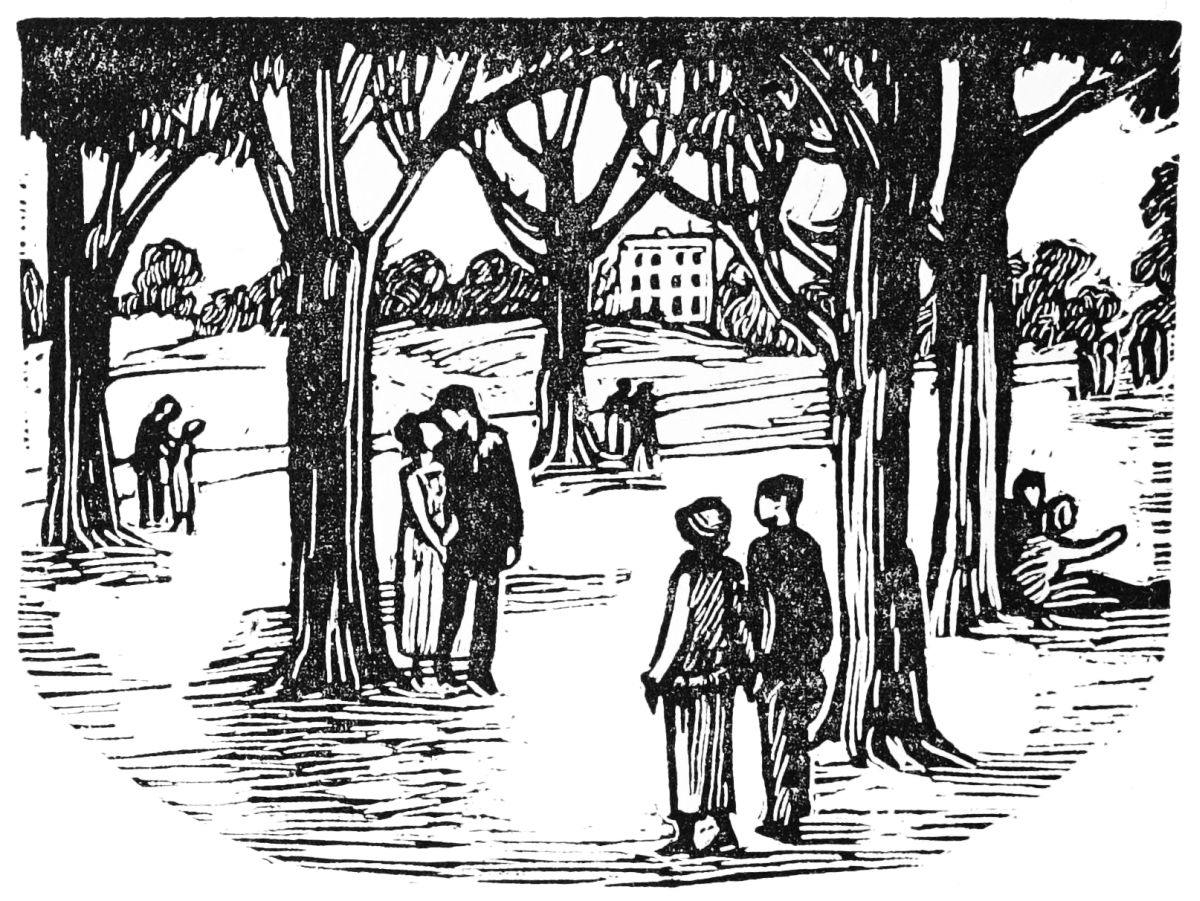
Hand in hand Josephine and John hurried through the Gardens. They did not stop to look at dogs or foxes, or wolves or tigers, they raced past the lion house and the cattle sheds, and without glancing at the pheasants or a lonely peacock, slipped through the turnstile into Regent’s Park. There, still hand in hand, they passed unnoticed into the crowd. Nobody looked at them, nobody recognised them. The crowd was chiefly composed of couples like themselves.
THE END

The Westminster Press 411a Harrow Road London, W.9