OLIVER OPTIC (continued 5)
Reading edition
"We was gwine to run away on de hosses," added a very black fellow.
"Don't know who shut de big doors, Mars'r, if de robbers don't do it," said another, who was evidently a field-hand.
"I didn't think there was more'n one of them here," added Phil, as he held up a revolver with which he had armed himself after the departure of the planter. "I meant to kill him, and get away with the horses."
"Perhaps you would have done so."
"I do it for sure."
"Now, where are the robbers?" asked Warren.
"In the house. We don't see any for more'n half an hour. I think they looked part of the house over to find the money, and then went up-stairs to hunt for it," replied Phil, who appeared to be an intelligent fellow, far superior to the rest of them.
"Very well; you may get on the horses, and ride down the avenue till you meet the colonel," added the son of the planter. "Now, Sergeant, we will find the condition of things in the house."
The negroes led all the horses down an inclined plane into the cellar. This was not an uncommon device in large cities to economize space; but the planter had caused it to be built for just such an emergency as the present, and he had made his escape in this manner from the estate. The terrified servants mounted the horses in the cellar, and entered the avenue by the way Warren and the sergeant had left it.
The two scouts passed out of the stable by the same door. Keeping behind the outbuildings, they reached the side of the mansion. Passing entirely around it, they looked in at every window very cautiously; but were unable to see a single guerilla on the lower floor. By an outside door they went into the cellar of the dwelling. They found several places where the earth had been dug up, but not a man was to be seen.
"Now, Warren, I am going up-stairs; and I should like to have you return to the avenue, and bring up the rest of our party as quickly as possible," said Fronklyn in a low tone.
"Up-stairs!" exclaimed the planter's son. "Do you mean to throw away your life?"
"Not if I know myself; but I wish the lieutenant was here," replied the sergeant, who had noted the stairs that led to the next floor.
"I will do as you say, Sergeant; but I hardly expect to find you alive when I come back," answered Warren.
"I believe I can take care of myself; and I think these ruffians have put themselves just where we want them," said Fronklyn, recalling the strategy at Mr. Halliburn's mansion.
Warren left the cellar by the same way they had entered, and made his way around the out-buildings to the avenue. Fronklyn stole up the stairs, after he had removed his shoes, and looked into half a dozen rooms on the first floor. The carpets had been partly torn up, the furniture overturned and broken up, the closets ransacked, and abundant other evidence that the search for money or other valuables had been completed in this part of the mansion.
On the floors of the second story he could hear the tramp of shoes, the cracking and snapping of furniture, and the rough speech of coarse men. The search for money was still in progress; and the planter's son was sure the marauders would not find that which they were seeking. The money might be safe, but that was certainly not the case with the mansion and furniture.
In the great hall, in a corner behind the front door, the sergeant found a large steel safe, with its door wide open, and entirely empty. The planter had evidently removed his valuables, including his books and papers, to what he believed was a more secure depository for them. The robbers had drawn it out from the corner, plainly to search behind it for the hidden treasure. Fronklyn opened the front door of the mansion, and then deposited himself behind the safe, the house door concealing him on the open side.
His carbine was in condition for immediate use, and he had taken a revolver from the horse he had ridden belonging to the trooper who had perished in the river. The noise up-stairs continued, and he had become somewhat impatient for the appearance of the rest of the party. He was inclined to "open the ball;" but he concluded that it would be a piece of rashness for him to do so, and he refrained from doing anything. Between the door and the safe he obtained a full view of the head of the staircase.
"There comes the planter!" shouted some one in the hall above.
"Hang him!" yelled another.
"Down-stairs all together!" cried the first speaker, who was perhaps the leader of the ruffians.
He was the first to appear at the landing. Several voices repeated the cry to hang the colonel. At that moment a shot was heard, and the first ruffian came tumbling down the steps. The next instant the one behind him shared his fate, and both of them lay motionless at the foot of the stairs.
A moment later Deck rushed in through the open door, followed by the three riflemen.
CHAPTER XXIX
A NEW METHOD OF OPERATIONS
The fall of the two ruffians evidently created a panic among the robbers, for they all retreated from the head of the staircase. They could not see the person who had fired the shots. Fronklyn had used the heavy revolver of the trooper, reserving his carbine for more difficult practice. There was a pause, for no more victims were in sight.
"You are in a dangerous position, Lieutenant Lyon," said the sergeant, as soon as Deck rushed into the hall.
"Where are you, Sergeant?" asked the officer, as he retired from his exposed situation.
"Behind the safe," replied Fronklyn. "Ask one of the planter's sons if there are any other stairs from above."
"Another staircase at the rear of the hall," answered Warren.
"Go there quick!" said Deck, as soon as he had mastered the situation. "If any one attempts to come down, shoot him on the instant! But let them surrender if they will do so."
"Surrender!" exclaimed Harlan in disgust. "I don't feel exactly like letting one of the men that want to hang my father surrender."
"Let them surrender!" replied Deck very decidedly.
"From my position I could manage the whole of them," interposed the sergeant.
"You are in a safe place to do so," added the lieutenant.
"Some of the party ought to look out for the outside of the house, or the ruffians will escape from the windows," suggested the sergeant.
"Colonel Hickman is out-doors, with his negroes, to keep watch of the windows," answered Deck. "You have begun the fight here on the plan we adopted at Mr. Halliburn's."
"I was thinking of fighting it out alone when one of the ruffians up-stairs shouted that Colonel Hickman was coming; and the cry was to hang him. They started to come down, and I dropped two of them; the others ran away. I can dispose of them as fast as they show themselves," Fronklyn explained.
"Give them a chance to surrender before you kill them, Sergeant."
At that moment a shot was heard from the rear end of the hall, and the lieutenant hastened to ascertain the occasion of it. One of the ruffians had attempted to come down the back stairs, and Warren had put a rifle-ball through his head. There were only seven of the marauders left in the house, and the two parties were equalized.
"Up-stairs!" hailed Deck, when the third ruffian had fallen.
"What's wanted?" shouted some one who was prudent enough to keep out of sight.
"You may surrender if you prefer that to being shot," replied Deck.
"On what terms may we surrender?" demanded the spokesman of the second floor.
"No terms."
"Do you mean to murder us all?"
"It would serve you right. You came here to hang Colonel Hickman, and you would have done so if he had not found friends to assist him in defending his property and his life," added the lieutenant with proper indignation.
"We did not intend to hang him if he gave up his money. He is a rich man, and he could afford to part with some of it," said the spokesman.
"That is the argument of pirates and robbers. If you wish to surrender, say so; and do it quick!"
"We have nothing more to say," returned the spokesman.
For an hour longer the situation remained the same. But it required only Fronklyn at the main staircase, and Warren at the rear one, to keep the seven ruffians where they were. The villains were all armed, the planter said; and the lieutenant was not willing to sacrifice the life of even a single member of the loyal party. But the sergeant was impatient to terminate the affair. Deck had seated himself in the parlor in the midst of the broken furniture, where he could talk with the sergeant.
"This is becoming rather monotonous," said the latter.
"I don't think it is prudent to go up and attack the ruffians," replied Deck.
"But I think that something can be done from the outside," suggested Fronklyn.
"What?" asked Deck.
"I don't know."
"I will go out and see if anything can be done. I should like to return to the camp of the Riverlawns; for I suppose my father and the others still believe that you and I were killed in the fight at the intrenchments," replied Deck, as he passed out of the house at the front door.
He found Colonel Hickman on the end piazza of the mansion, seated in one of the armchairs. But he was astonished to see the display of arms near him; and he concluded that the weapons the planter kept in his spring-house had been brought up by the negroes to the piazza. At least a dozen rifles were standing against the side of the house, and a box of revolvers was near them. On each side of the colonel was a brass field-piece, with several boxes which he supposed contained ammunition for them.
"You seem to be ready for battle, Colonel Hickman," said Deck, as he surveyed the armament.
"I am ready; and I expect to have a use for these rifles and field-pieces before night," replied the planter.
"To-day?" queried Deck.
"I expected three times as many as came this morning; but I suppose the rest of them have cleaned out some other mansion. The ruffians in the house promised to come with thirty men when they were here before. If all the white men belonging on the plantation had not been absent, we should never have let this lot of infernals come near the place."
"But I think we had better get rid of the lot here now before we entertain another horde of them," suggested the lieutenant.
"The sergeant appears to have locked up the ruffians in the second story as though he meant to keep them there the rest of their natural lives," replied the planter. "We have not yet lost a single one of our number."
"It is the policy of war to save your own men while you destroy the enemy," added Deck. "The next thing to be done is to drive the ruffians out of the house."
"That seems to be easier said than done," replied the colonel, with an inquiring look at the young officer. "How do you propose to do it?"
"I don't know that it can be done; but there is nothing like trying. I suppose you are still a rifleman, Colonel Hickman?"
"I am, as I have been since I was a dozen years old. I have my old rifle here," he answered, pointing to the dozen of them resting against the side of the house. "I judge that you have some plan in your busy young head, Lieutenant. I am ready to obey all your orders, without regard to my age."
Deck stated his plan, which he had arranged after a survey of the surroundings of the mansion. It involved a change of position among the men, the most important of which was placing the planter behind the safe in the hall, thus releasing Fronklyn for more active duty. The colonel was willing, and even glad, to take the position assigned to him, and, like a good soldier, asked no questions.
"But what about the attack you expect this afternoon?" asked Deck.
"I have put my servants on picket, as they have been for several days. They are all mounted, just as they came back from the avenue. They are all faithful to me, though I don't expect them to do any fighting; but they can keep watch as well as white men."
"Then, if you are ready, Colonel, we will go to the front hall of the house," said the lieutenant, as he led the way.
At the door he called the sergeant from behind his breastwork, and put the planter in his place. The old soldier had hardly shown himself in the hall before a shot was fired down the stairway. Doubtless one or more of the ruffians had been on the lookout for the appearance of a man in the hall below; and as the planter passed behind the open door, the opportunity had been used.
Fortunately the venerable planter was not hit; for the enemy had only such old flint-lock guns as General Crittenden describes in his report of the battle of Mill Springs, and they were far from being reliable weapons. The bullet shattered the edge of the door, and no other damage was done. The veteran proved that he was still an active man; for as soon as he was behind the steel fortress, he cast a searching glance up the stairs.
On the landing he discovered a head on the floor; for the man who had fired the shot was lying where he could see down into the hall. It would have been better for him if his feet had been where his head was; for the planter raised his rifle, and fired at almost the same instant. His companions drew his body back without exposing themselves to the deadly fire from the hall.
"Flickens is killed!" exclaimed one of them; and the enemy were one less in number.
The planter, with his rifle in position for instant use, fixed his gaze upon the head of the staircase; but no one now was to be seen there. Deck and the sergeant had passed into the parlor, the door of which was next to the safe, after the colonel had discharged his rifle.
"Are you all right, sir?" asked the lieutenant, stopping in a safe place near the door of the apartment.
"I am better off than the fellow I just hit in the top of his head," replied the planter. "I wish another of them would try that experiment again."
"I know you can hold this position, and I will see what can be done elsewhere," returned Deck, as he moved towards the door of the rear room.
"You need not be concerned about me; I can finish the affair if the villains will only show themselves," replied the colonel; and his cheerful tones indicated that he was happy in his new position.
Deck and Fronklyn passed around into the rear of the hall, where they found Warren Hickman standing at the door of the dining-room, where he could not be seen from the head of the back stairs. He was informed that an attempt would be made to drive the enemy from the second story. He was to remain in his present position. The lieutenant and the sergeant passed out at the back door into the kitchen, some distance from the mansion. Here they found the other two sons of the planter, watching the windows on that side of the house.
The end of the cook-room extended back into a grove of trees which surrounded the mansion, and which had given Deck his first suggestion of his method of future operations. Taking the two Hickmans with them, the four went through a window into the grove. The building containing the kitchen concealed them from the view of the ruffians, if any of them went to the windows.
The trees around the mansion, like those in the avenue, were large, and the foliage dense. Deck explained to his companions his plan, and then directed one of them to proceed by the grove to each of the sides of the house, reserving the one by the stable for himself.
"What then?" inquired Fronklyn.
"Each of you will sling his rifle, and then climb a tree commanding all the windows on his side of the mansion," replied Deck. "When you see one of the enemy at a window, use your rifle. I shall be on the stable side."
The lieutenant, who had provided himself with a rifle on the piazza, followed the grove in the direction of the stable, outside of all the out-buildings, while the other three proceeded the opposite way. There were no trees between the mansion and the stable; but Deck made his way to the hayloft, which commanded a view of all the windows of the former. He waited long enough to enable his companions to secure their places in the trees, and then opened a window, which enabled him to obtain a safe position for himself.
While he was waiting, he took a couple of horse-blankets from the harness-room, and fastened them up before the only two windows in the loft. This made the place quite dark, though there was light enough to enable him to find his way. Then he kneeled about ten feet from the open window, darkened to within a foot of the bottom. From this point he discovered, by looking through the window directly opposite his opening, three men sitting on a bed.
He fired his rifle, and saw one of the ruffians drop on the floor.
CHAPTER XXX
THE SURRENDER OF CAPTAIN GRUNDY
Deck Lyon reloaded his rifle without a moment's delay; then resuming his kneeling posture, he gazed at the window again. The ruffian had fallen forwards from the bed, and his companions had picked him up. The observer could see that he had not been killed. The other two laid him on the bed, and it was evident that he had been severely wounded. They examined him, but of course the result could not be known to the lieutenant.
While one of them was tying a handkerchief around the head of the wounded man, the other went to the window. A pane of glass had been broken, and this must have assured him that the ball had come from outside of the mansion. Then he proceeded to look about the surroundings in search of the person who had fired the shot, confining his gaze to the ground. If he had reasoned at all over the matter, which perhaps his education did not enable him to do, he might have realized that the bullet did not come from the ground.
The man had thrown the window wide open, and was making a very scrutinizing examination of every part of the courtyard. He could see plainly whatever was in front of the window; but this did not seem to satisfy him. He thrust half his body out of the opening, looking both sides of him, as though it had been possible to fire a rifle around a corner. The fellow was certainly stupid enough to be shot, and Deck did not wait any longer to do his work.
The ball struck him in the head as he was stretching his neck to the utmost to enlarge the extent of his vision to a point from which the fatal bullet could not possibly have come. If he could have imagined a line from the round hole in the pane of glass to the point where his comrade's head had been, it would have pointed directly to Deck's locality when he discharged the rifle.
The ruffian dropped from the window-sill to the ground with a heavy thud, and did not move again. The ball had penetrated his brain, and he was the victim of his unscientific observations. But the lieutenant did not remove his gaze from the open window. It seemed very like slaughter to shoot down the enemy in this manner, and a twinge of conscience disturbed him. But he reasoned that he had given the ruffians a chance to surrender, which they had refused to accept. Then they were pirates, robbers, making war for gain against friend and foe alike.
"The ball struck him in the head." Page 388.
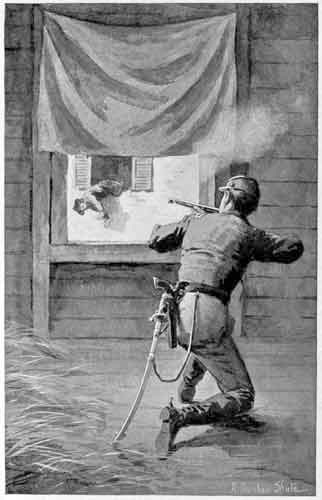
The third man in the room did not remain there any longer. He could hardly have known what became of the one at the window, unless he had heard the crack of a rifle, and failed to see him again. Under these circumstances it was not difficult for him to reason out the conclusion that the chamber where he was must be a dangerous locality, and he sought a safer place.
The lieutenant continued to watch the window, but no enemy appeared in the room again. It had proved to be a chamber of death. He had hardly lost sight of the foe before he heard the crack of a rifle in the grove. The two Hickmans there were riflemen, and Deck did not believe it would be possible for either of them to fire without killing or wounding his man; but he heard but one shot, and probably four of the land pirates were still living.
Deck waited some time for the sound of another shot, but in vain. He did not believe another ruffian would enter the fatal room commanded by his position, and he decided to seek a more promising place for his operations. Since the shot he had heard, he was confident that none of the enemy would show themselves at the windows. He descended to the cellar of the stable, and then, by the way he had come, reached the kitchen, and then the parlor, at the door of which the planter was fortified.
"Anything new, Colonel Hickman?" he asked.
"Yes, indeed!" exclaimed the sentinel over the staircase. "What have you been doing outside? Something has happened."
"I think we have reduced the enemy by three, and perhaps more," replied the young officer; and he proceeded to explain what he and his companions had been doing.
"You think you have knocked down three or more of the robbers?"
"As many as that."
"Then that explains it!"
"Explains what?" asked Deck, as much puzzled by the exhilarated tones of the planter as by his questions.
"One of them hailed me some time ago, and wanted to see the one in command. I told him the commander was not in the house, but was conducting the fight outside. He asked me to send for him, but I refused to do so. I did not intend to interrupt your operation; for I never take another's command away from him," replied the colonel, indulging at the same time in a chuckle, to which he was somewhat given when pleased.
"Do you know what he wanted?"
"I do; for he shouted down the stairs that he and the rest of them desired to surrender."
"Then we will let them do so," added Deck, who was not disposed to fight after the battle had been won.
"What shall you do with them after they have surrendered, Lieutenant?" asked the planter, plainly much interested in the question.
"I shall do nothing at all with them; I am not the judge or the civil power of Russell County. We have beaten the enemy, and I have nothing further to do with the matter," answered Deck.
The colonel decided not to ask any more questions, though the lieutenant suspected he intended to dispose of the prisoners as he thought best.
"Up-stairs, there!" shouted the planter. "The commander is here now."
"Ask him to come up here, and we will arrange things," returned the ruffian with unblushing effrontery.
"The commander will do nothing of the sort," replied the colonel indignantly. "Do you really believe that he would trust himself with such cutthroats as you are?"
"We will agree not to hurt him, though he has used us very unfairly," said the spokesman. "He has tried to murder all of us!"
"You deserve to be hung; and it would be too merciful to shoot you!" roared the colonel, his wrath getting the better of him.
"Do Union men hang their prisoners?" demanded the ruffian bitterly.
"Prisoners!" exclaimed the planter contemptuously. "You are such prisoners as they shut up in the penitentiary, or hang in the public square."
"Can I see the commander?" asked the spokesman, quite gently by this time.
"I will see him if he comes down into the parlor," said Deck. "I shall make prisoners of them; but I wish to stipulate that neither Sergeant Fronklyn nor myself shall have anything to do with punishing them, either by hanging or shooting after they have surrendered."
"The commander will see you down-stairs; but I will shoot any other that attempts to put his foot on the first stair," shouted Colonel Hickman.
"I will come down," replied the spokesman; and he came to the head of the staircase with a gun in his hand.
"Halt!" cried the planter. "Leave all your arms up-stairs! Have you any pistols about you?"
He passed his musket to one of the others, and did the same with a couple of pistols when the colonel mentioned them. Having complied with the order, he came down the stairs. He was directed to the parlor in which the lieutenant was waiting for him.
"Are you the commander here?" he inquired.
"I am. May I ask what you are?" demanded Deck, without rising from the armchair in which he was seated.
"I am called Captain Grundy."
"Not Mrs. Grundy?"
"Captain Grundy," replied the ruffian, with something of dignity in his looks and manner.
"Have you a captain's commission?"
"Not yet."
"In what service are you?"
"In the service of the Confederate States of America."
"In what regiment?"
"In no regiment; in a company organized by my government."
"A company of Partisan Rangers?"
"But in the service of my country."
"Are you a Kentuckian?"
"I am."
"And your service is to roam over your native State, killing, robbing, plundering your fellow-citizens; a highwayman, a thief, and a murderer," continued the lieutenant very severely. "This is the second time you have visited this mansion for plunder; but you don't come out of it so well as you expected," said Deck with a sneer, evident in his tones as well as his looks.
"Where is the rest of your company, Captain Grundy?"
"On duty in another county."
"But you expect the balance of your command here some time to-day?"
"There will soon be a time when the treatment we have received here will be returned with compound interest," said Grundy with a savage and revengeful look on his ill-favored countenance.
"You wished to see me; what is your business?" demanded the lieutenant.
"I am ready to surrender. You and your gang have murdered nearly all my men here in cold blood. I can do nothing more, and I must yield," replied Grundy.
"Are you a lawyer, Captain?"
"I am not; I am a horse-dealer."
"I should think you might be!" sneered Deck. "Do you think it is right to ride over the State, robbing your fellow-citizens, threatening to hang a planter to a tree for refusing to give up his money?"
"In the service of my country, yes! Kentucky belongs to the Confederacy; and those who fight to keep the State in the exploded Union are traitors, and should be treated as enemies of the State and the Confederacy."
"Suppose I should visit your house, demand your money, and hang you if you did not give it up? Would that be all right?"
"That is another matter," growled Grundy.
"Precisely; the same boot don't fit both feet," returned Deck.
"I am your prisoner; but you need not thorn me with your Union logic."
At this moment the lieutenant heard the voice of Davis Hickman in the hall, talking to his father. He called him into the parlor, and requested him to bring a quantity of cord or straps to him; and he went for them.
"What do you want of cords and straps?" asked Grundy.
"To bind my prisoner."
"Do you mean to hang me?"
"I do not; I leave that job to the regular hangman. He will perform it in due time, I have no doubt," replied Deck, as Davis brought in the cords.
"I don't mean to be tied up like a wildcat," said the captain doggedly.
"Then you do not surrender; and if you wish to do so, you may go up-stairs again."
"I surrender; but I will not be bound like a nigger!" exclaimed Captain Grundy, as he sprang away from the lieutenant, and ran into the back room.
"What's the matter now, Phil?" demanded the colonel, as the mulatto of this name rushed into the hall, panting more from excitement than physical exertion, for his horse was at the door.
Both Deck and Davis pursued the captain; but they were taken off their guard, and neither of them succeeded in getting hold of the ruffian. He fled to a window which some one had left open, leaped out, and ran towards the front of the mansion. Davis fired his rifle at him; but being "on the wing," he failed to bring him down. Deck, believing that the fight was finished, had left his rifle in the parlor.
"The Lord save us, Mars'r Cun'l!" shouted Phil, as he broke into the hall. "The ruffians, more'n twenty of 'em, is coming up the road on hossback, at full gallop!"
It looked like another fight against great odds.
CHAPTER XXXI
AN UNEXPECTED RE-ENFORCEMENT
Captain Grundy's claim that he was in the Confederate service was undoubtedly pure fiction; and he did not even pretend to have a commission of any kind, not even as a Partisan Ranger. The Riverlawn Cavalry had rendered important service to the State in the suppression of guerilla bands, acting under no authority whatever, plundering and killing Union men. Grundy's force consisted of over thirty men. They were mounted, and doubtless had stolen the horses they rode from the plantations they had raided.
They were simply brigands; they wore no uniform beyond a belt, and had taken no part in the battle of the day before. Their leader was an enterprising man, and seemed to be operating at the same time in several places. Their sole mission was to rob the planters; and they were especially eager to obtain money, though it was a very scarce article in the State.
Lieutenant Lyon had talked with Colonel Hickman about the band, and he had gathered much information in regard to their operations in the northern and western counties. The planter was a fighting man, as well as a strong Unionist. He had been aware of the approach of the gang, and while he had seven white men living on his estate he had felt abundantly able to defend his property.
His spring-house was his arsenal; and it was well stored with arms and ammunition, including two field-pieces. He was not a man to be intimidated, as many loyal citizens had been; and he had made his preparations to give the brigands a warm reception when they paid him a visit, as he had no doubt they would.
After the return of the colonel with his re-enforcements from the ferry, Deck Lyon had not had the opportunity to examine minutely the premises, especially outside of the immediate scene of operations. He had followed Captain Grundy from the mansion when he escaped from the parlor in company with Davis. The latter had fired at him; but the density of the grove interfered with his aim, and the ruffian had suddenly disappeared.
Outside of the grove there were no trees, and the lieutenant saw on a hill the mounted gang riding at full speed towards the elevation on which stood the mansion. The road was a private one, and very narrow. Deck counted twenty-four riders in the distance, for they rode two abreast. As he and his companion came out of the grove to the front of the mansion, the officer discovered something that looked like a mound of earth on one side of the road to the mansion.
"What is that, Davis?" asked Deck, pointing at the work.
"That is the governor's fortification," replied the rifleman.
"The governor's?"
"Not the governor of the State, but my father's."
"What is it?" asked the lieutenant curiously; for he had not been able to make out the use of the mound.
"Come in a little nearer to the mansion, and you will see," replied Davis; and he led the way across a corner of the grove.
"It looks like a fort," added Deck as he obtained a view of the inside of the earthwork.
"That is just what it is," said his companion. "The governor has kept a squad of the servants over on the hill you see at the farther end of the valley through which the road passes, as sentinels. They all have horses; and when they discover the approach of an enemy, they gallop to the mansion, and notify the colonel. We are as careful of our lives here as you have been since you came."
"What's coming now?" inquired Deck, as he heard the tramp of footsteps behind him.
"The governor's coming, and I think we will go and meet him," replied the planter's son; and he led the way through the grove towards the great house.
It was quite a procession that advanced at a rapid pace from beyond the building. At the head of it rode Colonel Hickman, mounted on the horse he generally used. Next behind him came his sons Warren and Harlan. Then came Phil, leading a mule harnessed to a wagon, with all the other servants following it. Last of all came the two field-pieces Deck had seen on the piazza, each of them drawn by two mules. About a dozen negroes appeared in the rear and on the flanks of the column; and the lieutenant wondered where they had come from, though there was a village of huts some distance from the stable.
"How many of the robbers are left in the second story of the mansion?" asked Davis, as the procession approached.
"Only two, I think, though I am not sure," replied Deck; and he proceeded to reckon up the number that had been put out of the way. "Only two."
"Enough to burn the house," added Davis.
As he spoke he raised his rifle and fired. The lieutenant looked at the house, and saw one of the ruffians fall at the open window, over the piazza. No doubt he and the other ruffian who remained in the house had heard the commotion on the premises, and Phil had shouted loud enough to be heard in every room. The one who had gone to the window evidently could not control his curiosity, and it had cost him his life.
"Probably the other has looked out the window also, and has seen the approach of the rest of the gang," said Davis, as he reloaded his rifle. "He can leave now if he wants to; for there is no one left in the house to prevent him from going. But I don't like to have another added to the number of the enemy."
The rifleman walked over to a point where he could obtain a better view of the other window. It was open, but no one could be seen in the room. Very likely he had heard the report of the rifle which killed the other, or the noise of his fall. At any rate, he did not show himself.
"No more game here just now," said Davis; and he and Deck walked over to the fort.
They found the two brass guns in position for use, and Warren in charge of them. Four of the servants, including Phil, were his assistants. The dozen rifles Deck had seen on the piazzas, and the heavy revolvers, were leaning against the trees, or hanging from the branches. The mule-wagon was in the grove, containing the ammunition; the mules harnessed to the fore-trucks of the gun-carriages were at a safe distance, and everything seemed to be ready to open fire upon the enemy.
"Colonel Hickman, you are much more familiar with the situation here than I am," said Deck when he met the planter. "You are a veteran soldier, and I am glad to resign the command, and pass it over to you."
"I accept it, for I know the ground, as you say; but I shall be happy to have your counsel," replied the colonel.
"I have none to offer at present. I will take a rifle, and act with your sons, though they are better riflemen than I am."
"All we have to do is to blaze away when the enemy begin to rise the hill, and I shall use the same weapon. Warren is the chief gunner, and he has trained some of the servants to handle the guns," said the planter, looking down the hill.
"Can any of your negroes handle a rifle, Colonel?" asked Deck, recalling the time when his father's servants had been armed with muskets, and had made good use of them at the "Battle of Riverlawn."
"Some of them can; but I have scruples against arming them for fighting purposes."
"So had my father; but when it came to the question of defending himself and the members of his family against a mob of ruffians such as those now approaching your mansion,—for they threatened to burn his house and hang him to a tree,—he did not hesitate," added Deck, recalling the stirring events of that time. "Of course there was no place for them in the army, though the overseer has kept them in training for the defence of the family and the plantation."
"We have no time to discuss that question now, and the negroes are assisting Warren at the guns," replied the colonel. "But who is that man over on the left? He seems to be running with all his might towards the column of the robbers."
"That must be Captain Grundy who surrendered and then ran away," answered Deck. "But he is too far off even for the riflemen."
The chief of the brigands had taken a wide sweep in order to reach the approaching force of mounted men, and was now about as far from them as from the colonel's fort. The face of the country was uneven, and he soon disappeared behind a hill. Lieutenant Lyon had endeavored to obtain some information in regard to the Riverlawn Cavalry of Warren Hickman as soon as he found the time to do so. But the riflemen were quartered apart from the mounted men, and he knew very little about the squadron. In the morning it was ascertained that General Crittenden's forces had evacuated the fort, and crossed the river. The sharpshooters, being no longer needed, had been dismissed, and the planter's sons had gone directly to their home.
"There comes Cuffy the ferryman, riding with all the speed he can get out of his poor horse," said Warren, as he pointed to the negro coming across the field from the Jamestown road. "He is devoted to the governor; and I think he brings news of some sort, good or bad."
Between the mansion and the road there was a hill which prevented them from seeing the road; but the negro soon reached the fort, which was his nearest point. He drew in his rein, and stopped his steed at one end of the breastwork. He was out of breath, apparently from excitement rather than exertion.
"Dar's a whole comp'ny of sodjers on hossback comin' down de road!" shouted Cuffy, as soon as he could collect breath enough to speak.
"What are they, Cuffy?" demanded Warren.
"Sodjers! Mars'r Warren."
"Of course they are soldiers; but on which side do they belong?"
"Dressed in blue, Mars'r Warren. Mus' be Union."
"The force must be one, or both, of your companies, Lieutenant," added Warren. "I heard something said about sending them on a reconnoissance when Captain Woodbine dismissed the riflemen. Where is the company now, Cuffy?"
"Dey done halt behind dat hill, and send two men to de top ob it," replied the ferryman, who was quite cool by this time.
"Here comes the governor; and he will be glad to hear Cuffy's news," added the chief of artillery. "We shall be able to drive the brigands off now."
"Drive them off!" exclaimed Deck. "I hope we shall be able to do something better than that."
"What better than that can we do?" asked Warren.
"Do you want to put them in condition to raid the next plantation, and hang the owner if he won't give up his money by to-morrow?"
Colonel Hickman came into the fort, and his son promptly gave him the welcome news. He added that Lieutenant Lyon had some views of his own in regard to the situation, and did not believe in simply driving the enemy away.
"I should be glad to hear your views, Lieutenant," said the planter, turning to the young officer.
"Of course the major or captain in command of the cavalry does not know the country in this vicinity, though Cuffy says men have been sent to the top of the hill to obtain information," said Deck. "But they can see nothing, for there is another and higher hill between them and the enemy. With your permission, Sergeant Fronklyn and myself will join our company if they are in the road. Perhaps the entire squadron is there."
"What is your plan, Lieutenant?" asked the colonel, a little impatient in his manner.
"We ought to capture every one of that gang; and it can be easily done."
"How?"
"I don't know who is in command of the force; but I should suggest to him to send half of his command to a position under cover of the hill nearest to the road, and the other half around the north end of the same hill," replied Deck earnestly. "We shall have them between the jaws of a vise then!"
"Excellent, Lieutenant!" exclaimed the colonel. "The coming of this force is a godsend to us. You and the sergeant can go at once; but you must both have better horses than those old stags the runaways left."
The planter selected two of his best animals for them; and they galloped across the field to the road. As they approached the Riverlawns they were recognized, and a hearty cheer welcomed them.
CHAPTER XXXII
DECK LYON'S PLAN OF BATTLE
Lieutenant Lyon soon ascertained that the force in the road included the two companies of the squadron. The cheers of those who were on the right of the column brought Major Lyon and Captain Woodbine to the front; and as soon as they learned the cause of the cheering they rode forward to meet the returning wanderers.
"I am glad to see you again, Dexter," said the major, as he extended his hand to his son.
"I am just as glad to see you, father," replied Deck, returning the hearty pressure of the hand.
Sergeant Fronklyn was greeted in the same manner, and heartily welcomed by the commander of the battalion. The staff-officer had halted a couple of rods behind the major, to permit the father and son to meet without being observed.
"You come back as from the grave, or a Confederate prison," said the major, still holding the hand of his son, and betraying more emotion than he was in the habit of manifesting.
"I have been neither in a grave nor a prison," answered the lieutenant very cheerfully.
"We concluded that you had been either killed or captured; and I am rejoiced to see you again alive and apparently well."
"I am as well as I ever was in my life; but we must not stop to talk now, father, for the services of your command are greatly needed in this vicinity," said Deck.
"Where?" demanded the major, releasing his son's hand, and beckoning to the staff-officer, who immediately rode to the spot.
"I am very glad to see you again, Lieutenant Lyon," said Captain Woodbine, grasping the hand of the young officer. "We feared that you were a prisoner, or that something worse had happened to you."
"But Dexter tells me that my force is needed here, Captain Woodbine," interposed the major; "and we must hear his story at some other time. Where are we needed, my son?"
"On a hill a mile from here is the mansion of Colonel Hickman," replied Deck, pointing in the direction of the house. "Part of a gang of guerillas have been in possession of it all the morning, and threatened to hang the owner if he did not give up his money."
"It is the old story," added the major.
"But we have shot all but one or two who were in the mansion; and the rest of the gang, twenty-four of them the servants say, are now approaching the hill," continued Deck.
"Then we will not remain here another moment. I sent Knox and Sluder to the top of the nearest hill to make an observation," said the major.
"They cannot see the ruffians, for there is another hill that conceals them," Deck interposed. "I know the lay of the land here, and if you will allow me to give advice which is not asked for I will do so."
"Certainly!" exclaimed the staff-officer, who was the superior of the major. "State your plan at once, Lieutenant."
"By this time Captain Grundy, the leader of the gang, has joined his force. They are advancing by a private road from Millersville," Deck explained. "Colonel Hickman has two field-pieces behind a breastwork, and a few riflemen; and he is ready to give the ruffians a warm reception, though the enemy are four to his one. My advice is that the second company march towards the mansion, with Sergeant Fronklyn as guide, and halt under cover of the hill nearest to the private road. Let the first company march in the opposite direction, with me as guide, and halt behind another hill near the private road."
"Very good!" exclaimed the major. "That is all clear enough; and the plan is to put the enemy between the jaws of a vise."
"That is just what I said to Colonel Hickman when I explained the plan to him," added Deck.
The major led the way up to the main body of the troopers. While the commander was giving his orders to the two captains of the companies, the two sergeants returned from the hill, and reported that nothing was to be seen in any direction, for the view was obstructed by other hills. When Knox had made his report he happened to see Deck. He rushed upon him, grasped him in his arms, and lifted him from the ground as though he had been a baby, hugging him in a transport of rapture, to the great amusement of officers and soldiers.
"I was afeared you had gone where you couldn't hear the bugle-call, littl' un, and I bless the Lord with all my might that you ain't food for the worms or the crows," said the big Kentuckian fervently. "You oughtn't to gone off without me; but I reckon"—
"That will do for now, Sergeant Knox!" shouted Captain Gordon. "We have no time for long stories. Attention—company!"
As Deck rode to his place at the head of the second platoon, Captain Gordon and Lieutenant Belthorpe grasped his hand, and spoke a word of welcome to him. The men in the ranks greeted him with pleasant words. The first company countermarched; and as the captain came to the position of the second lieutenant, he directed him to march at his side in his capacity as guide. Fronklyn took a similar position at the side of Captain Truman, and both companies moved as the guides directed.
"You have had a hard time of it, Deck," said Captain Gordon as they left the road and entered the field.
"Not very, Captain. Both Fronklyn and myself were knocked from our horses; and it would have been all up with me if the sergeant had not dragged me out of the mêlée. But I was only stunned by the flat side of a sabre, as Fronklyn was by a pistol-bullet," Deck explained.
"But you were within the breastworks of the enemy?"
"We were, forced in by the crowd of runaways from the battle-field. We both came to our senses, kept out of sight for a while, then took possession of a boat astern of a steamer, and floated down the Cumberland to Robertsport, or a little farther, and got ashore. I haven't time to tell the whole story. Three sons of Colonel Hickman were with Captain Ripley's riflemen; and with them we met the colonel. We cleaned out the robbers from his mansion. I think we had better halt here, Captain Gordon, and do a little scouting."
The suggestion was promptly adopted, and the company came to a halt just at the foot of the first hill. Deck and Knox were sent to the top of the next hill on foot, both armed with carbines. There were trees and bushes on the summit, but not on the sides, of the elevation. They took a position in the shelter of this growth, but the guerillas were not yet in sight. They must have halted for some time; and Deck conjectured that Captain Grundy must have joined them, and had taken the time to tell his story.
"I see nothing of them yet, Life," said the lieutenant, after he had surveyed the country in all directions.
"Which way they comin', Deck?" asked the sergeant.
"You can see the road across the fields at the foot of this hill. I think the first company is in the right position where it is now," said the lieutenant. "The second company will halt under cover of the same hill. Neither of them can be seen from that road till the enemy have advanced half-way up the hill to the mansion."
"I thought the company was to move to the lower end of the hill, where we uns is," suggested Knox.
"That was my first view of it; but there is no need of going any farther. I did not suppose there was any chance to conceal the position of the force where they could get at the enemy in good season. I have not been over this ground; only seen it from the mansion hill. We are all right as we are. Now, Life, you will return to the company; tell Captain Gordon to remain where he is till I give him a signal with my handkerchief on this carbine."
As he spoke, the lieutenant proceeded to tie the white signal to the weapon.
"Then he will go at a gallop through the valley between these two hills, and fall upon the enemy in the rear, as the second company attacks in front. Do you understand it?" continued Deck.
"I reckon I do; but am I to leave you here alone?" demanded the sergeant.
"Of course you are," replied the lieutenant with a laugh. "Do you think I can't take care of myself?"
"You didn't do it last night."
"I think I did, for here I am. Hold on a minute! I think we can arrange this matter a little better. The second company will not know when to make the attack."
"Are you gwine to lay out the whole battle, Deck?" asked Life.
"I am going to do what I can to make it a success, and to capture every one of those ruffians. If one of them escapes it shall not be my fault," replied the lieutenant in vigorous speech. "Ask Captain Gordon to rig a signal like this one, and send a messenger to Major Lyon, who has gone with the second company, so that he will understand its meaning. When I wave my signal twice, it will be for the second company to attack; when I wave it once it will be for the first company to fall on the enemy's rear. The major is not more than half a mile from the first company. Now go, Life, and don't let the grass grow under your feet."
"All right; but I reckon you are the commander-in-chief of this battalion, Deck."
The long-legged Kentuckian went down the hill with long strides; and in about three minutes he saluted Captain Gordon, and delivered his message. Then he was ordered to mount his horse, and ride over to deliver the instructions to the major.
"That is an excellent plan of Lieutenant Lyon, and it will prevent any confusion," said the captain as the sergeant was mounting his horse.
In a few minutes more Knox came into the presence of Captain Woodbine and Major Lyon. He described the arrangement for the signals.
Sergeant Fronklyn and Bugler Stufton were stationed on a knoll where they could see the signal when it was given by Captain Gordon, and the musician was to sound the advance.
"These signals are a capital idea of your son, Major," said the staff-officer in the hearing of Life Knox, as he was starting on his return to his company.
Deck was left alone; but in spite of the solicitude of the Kentuckian, he did not regard himself as in any danger, for the guerillas were not likely to explore the hills on their way to the mansion, where Captain Grundy doubtless expected to make an easy victory over the force defending it. He was not aware that cannon were to figure in the contest; and with his large force he could easily overcome the small number behind the breastwork. He was confident that there was a large sum of money concealed in the mansion, or in its vicinity; and he was fully determined to hang Colonel Hickman to one of his own trees if he did not disclose the hiding-place of the treasure.
It was fully half an hour before Deck saw anything of the approaching guerillas. Four mounted men were the first indications of the advance of the enemy. They seemed to be the pickets of the main body. They rode in couples, and did not trouble themselves to scout the hills on their left; for they could not have had any suspicion that there was a large force of cavalry anywhere near the mansion. The pickets moved on slowly till they came to the beginning of the ascent of the hill, and there they halted. They had nothing to report, and they awaited the coming of the force.
From his position behind the bushes and trees Deck could see the mansion, and the road leading up to it. The pickets had hardly halted before the main column came into view. They marched by fours, two in the road, and two in the field, and in very irregular order. The lieutenant observed them with intense interest, and counted them as they advanced. Instead of twenty-four, as the negro scouts had reported, there were thirty-eight of them. They had either been re-enforced, or the scouts had not seen them all. They marched very confidently, and began the ascent of the hill.
When they had ascended about half the distance to the summit, one of the cannon pealed, and three men were seen to fall from their horses. The assailants had evidently not expected to encounter artillery, and the result of the first discharge checked them. At this moment Deck twice waved the signal. A minute later the blast of the bugle was heard in the distance, followed immediately by the onslaught of Captain Trueman's company.
Deck observed the impetuous charge. Captain Grundy appeared to have ordered his command to deploy to the right; but they had no time to do so, for the troopers dashed into them in front. The guerillas could not hold their ground for a moment against this fiery charge. They broke, and began to retreat by the way they had come. Deck waved his signal once; and Captain Gordon's company dashed through the valley, and confronted the ruffians in their hot retreat.
CHAPTER XXXIII
THE DEFEAT AND SURRENDER OF THE GUERILLAS
The moment Deck Lyon had given the signal for the first company to advance, he ran down the hill with all the speed he could command, to a tree where Life had hitched his horse in readiness for him. It was not the animal he had ridden from Colonel Hickman's mansion, but Ceph, the steed he had trained and used from the beginning of his career as a soldier. He was very intelligent, and seemed to understand precisely what was required of him in action; though he sometimes overdid his part, as when he tried to leap over the horse of his rider's opponent.
The lieutenant did not feel quite at home on any other horse. The baggage-wagons of the squadron had been halted in the road with a sufficient guard, and the spare horses included not a few picked up on the battle-field of Mill Springs. Ceph whinnied vigorously, and pawed the sod with his forefeet when he saw his master running down the hill. These were his expressions of rejoicing to meet his rider again.
But Deck, who was anxious to be at the head of his platoon on the field, could only pat him on the neck and stroke his nose as he unhitched him. Life had attached a sabre to the saddle for his use, for he was sure that he would want one. Mounting hastily, he disengaged the weapon, and started in the direction his company had taken. If the rider had fully informed his steed what he wanted, the animal could not have understood him any better; for he darted away at his swiftest gallop, and bounded through the valley like the flight of an arrow. Deck had slung his carbine over his shoulder, and carried the naked sabre in his hand, with the scabbard attached to his belt.
As the lieutenant advanced he obtained a view of the field, and could measure the progress of the action as far as it had gone. Four shots had been sent from the fort; though after Captain Grundy had scattered his men, the last two were less effective than the first two. Up to this time the guerilla leader evidently believed that he had no enemy except the few men in the vicinity of the mansion. It was after the second gun from the breastwork that Deck had given the signal for the advance of the second company.
At the onslaught of this company, consisting of about eighty troopers, Grundy could not help seeing that he was outnumbered two to one, and that his opponents were trained soldiers, mounted upon excellent horses; and he had no alternative but a hasty retreat. He led them in the direction of the road; but at this time Deck had given his second signal, and the first company were stretching across the field to intercept his flight. It must have been an appalling sight to him, and he saw that he must be ground to powder between the upper and the nether millstone.
Deck had reached his place at the head of his platoon, which Life Knox was glad to yield to him. Captain Gordon was on the flank at the left. His command was stretched across the field, and were a wall of steel against the farther retreat of the enemy. It was about half a mile from the second company, which was driving the guerillas before it upon the point of their sabres. The captain called a halt when the head of his column had reached what appeared to be a swamp, and faced them to the enemy, ready to charge upon the broken ranks of the ruffians.
"This can be nothing but a butchery," said Captain Gordon, as he reined in his horse in front of his second lieutenant; and his tones and his manner indicated his disgust at this sort of warfare.
"When I was in the mansion, Captain Grundy surrendered to me; but when I proposed to secure him with cords and straps, he broke away from us, and we were unable to recapture him," added Deck.
"It is not usual to bind captured prisoners," suggested the captain.
"But we had only half a dozen men, and I would not trust the fellow out of sight," replied Deck. "But I have secured my prisoners when they were guerillas, and not soldiers."
"No doubt you were right in dealing so with these ruffians," added the captain. "I think we have this gang where not one of them can escape, and perhaps we may have to bind them as you did their leader."
"There goes the recall!" exclaimed the lieutenant, as the bugle-notes sounded across the field from the right of the second company, where Major Lyon had taken his place.
"There is a white flag displayed in the centre of the enemy's line," added Captain Gordon. "Your father does not relish a butchery any more than I do."
The commander of the company took his field-glass from its case, and directed it towards the position of the major. The troopers fell back, evidently at the command of their officers, at the signal, stretching nearly across the field.
"Look through my glass, Deck, and tell me what is going on there," said the captain, as he handed the glass to the lieutenant. "There is a tall gentleman there who is a stranger to me; and he seems to be talking and gesticulating very earnestly."
"That is Colonel Hickman, and it is easy enough for me to guess what he is talking about," added Deck.
"But the major seems to be as dignified as he always is, and don't appear to be much moved by what the other is saying. But what is the matter with Colonel Hickman?"
"He believes in hanging these fellows as fast as they are taken, though perhaps he would be satisfied to see them cut down before the sabres of our men. I had to tell him squarely that no prisoner should be hung, or punished in any manner, except by the law of the land," replied Deck.
"Does he believe in firing or charging on a flag of truce?"
"Doubtless he believes that a flag in the hands of these fellows is not entitled to be respected."
"Major Lyon is the right man to settle the question, with the advice of Captain Woodbine," said Captain Gordon. "While they are discussing it, we will move forward;" and in a loud tone he gave the order to march, which was repeated by the subordinate officers.
The long line moved forward, at a walk, about half a mile, and halted forty rods in the rear of the disordered ranks of the enemy. Presently a sergeant rode across the field, passing to the left of the guerillas, and making his way to the centre of the first company. It proved to be Sergeant Fronklyn, who saluted the captain.
"It is the order of Major Lyon, Captain Gordon, that you send Sergeant Knox, with ten men, to the right of your line, to prevent the escape of any of the enemy to the swamp. Also, that you send Lieutenant Lyon to headquarters," said Fronklyn, delivering his message.
On the right of the line four of the ruffians had attempted to flee from the scene of the anticipated surrender; but Lieutenant Gadbury had ordered four of his men to fire upon them. One had been wounded, and the others had returned to the ranks. This was the occasion of the order to send Knox to the border of the swamp. Deck went with Fronklyn to the major by the same way the sergeant had come. On their arrival the lieutenant found Grundy had come over to interview the major, attended by a man bearing the flag of truce.
"You are treating these ruffians as though they were regular soldiers, Major Lyon; and I protest against it!" exclaimed Colonel Hickman, just as Deck saluted the major.
"I can answer you better when I have heard what Captain Grundy has to say," replied the major with his usual dignity and gentleness.
"He is not a captain; he has no commission or authority of any kind from the State or Nation," protested the planter.
"I can understand and appreciate your feelings, Colonel, in the face of the outrages to which you have been subjected; but I shall be greatly obliged to you if you will permit me to discharge my duty without further interruption. I have been the victim of similar indignities; but I cannot order men who probably intend to surrender, to be hung, or to be shot down in cold blood."
Upon this appeal Colonel Hickman was silent, though evidently very much against his will. Captain Grundy approached the major at a signal from him. He was asked to make the communication he sought to offer under the flag of truce.
"My troop are fighting-men; but of course, surrounded by six times their number, we should all be sabred or shot down in a few minutes. Against this odds I do not intend to fight," said the guerilla leader, who was evidently a man of some education, and conducted himself with some degree of dignity.
"Do you propose to surrender?" asked the major.
"I do, if reasonable terms are held out to me," replied Captain Grundy.
"What do you consider reasonable terms?" inquired the commander of the squadron.
"That we should lay down our arms, retain our horses, and retire to our homes, returning to our usual occupations," answered the captain of the ruffians.
"That is better terms than a defeated company of regular troops of the Confederate army would have any right to ask for or expect," added the major with a smile.
"I have named what I consider fair terms under the circumstances; and now I will ask what terms you are willing to make," continued Captain Grundy.
"No terms at all," replied Major Lyon very decidedly. "I do not regard you as soldiers in the service of the Confederacy, but as lawless marauders, cutthroats, and murderers."
"Good!" exclaimed Colonel Hickman. "That is hitting the nail on the head."
"Many gentlemen who support the Confederate side of the question have expressed the same opinions to me. I can make no terms whatever with you, Captain Grundy. The surrender must be unconditional."
"Do you propose to put us in irons, or bind us with ropes and straps, as the young officer at your side did?" demanded the guerilla chief bitterly.
"I should feel entirely justified in doing so if the circumstances required such an extreme measure; but with the ample force under my command I don't think such a step would be necessary, though my men would shoot down any one who attempted to escape."
"Your terms are very unfair and very unchivalrous; and I should judge that you were a Yankee, as I am told that you are," growled the marauder.
"Doubtless you consider the robbing of a private mansion, and threatening to hang the owner if he don't inform you where he has hidden his money, chivalrous deeds; but I do not so regard them. We are wasting time. Do you surrender, or shall I order my men to charge upon your column?" demanded the major.
"What do you intend to do with us after we have laid down our arms?" asked Captain Grundy, after he had glanced at the files of troopers on both sides of his command.
"Though the State of Kentucky is in a very disordered state, the civil law is still in force in most parts of it. I shall deliver you over to the civil government whose laws you have broken."
"Hemmed in as my men are by six times their number, I have no alternative but to surrender, unfair and outrageous as the terms are," replied the marauder, with a despairing look as he glanced again at the loyal troops that surrounded his company.
"The terms are better than you deserve, and if I had my way I would hang you to the nearest tree as a beginning!" shouted Colonel Hickman.
"I may have a chance to do you that favor, Colonel, before many weeks have gone by," added the outlaw.
"You sent for me, Major Lyon," said Deck, stepping forward, and saluting his father. "I am ready for any duty to which I may be assigned."
"Captain Woodbine wants both you and Sergeant Fronklyn as guides; for both of you have become acquainted with this locality," replied the major, as he proceeded to give orders for the conduct of the surrender.
The first company was moved up, and the guerillas marched in single file between the two, laying down their arms, though a couple of sergeants searched them for pistols and knives. Lieutenant Blenks, with the second platoon of the second company, was detailed to march the prisoners to Jamestown, which was the capital of Russell County, where they were to be delivered to the sheriff. It was not a long march, and the platoon rejoined the squadron on the bank of the Cumberland at dark.
The next day a mob took Grundy from the jail, and hung him in the village; and possibly Colonel Hickman knew more about the affair than any other single person.
The colonel was the highest type of a Kentucky gentleman, and no one not in his difficult position could fully comprehend his apparently ferocious views.
CHAPTER XXXIV
THE GATHERING OF A NEW COMMAND
The guerillas were disposed of, and it did not appear that there was any other enemy in the vicinity. Major Lyon marched his squadron back to the road where he had left his wagons. Captain Woodbine, at the invitation of Colonel Hickman, visited the mansion, and required Deck to go with him. As they rode up the hill the lieutenant gave the details of his escape from the Beech Grove breastworks, the drowning of the four fugitives, and the defence of the mansion of the planter.
Colonel Hickman rode with them, and listened to the narrative, and stated that the young lieutenant had conducted the defence, and that all the gang who gained admission to the house, with the exception of one or two, had been killed or wounded. On their arrival at the mansion the party visited every room. Those on the lower floor exhibited the havoc made by the ruffians in their search for the planter's money.
Deck pointed to the safe in the hall, and explained in what manner Sergeant Fronklyn had covered the staircase; and the body of the first man who had attempted the descent lay where it had fallen. Then they went up-stairs. The same havoc appeared in all the apartments. The bodies of two men who had been instantly killed at the windows, and several other wounded ruffians, lay on the beds.
"The assault was skilfully and safely managed," said the staff-officer, patting the lieutenant on the back.
"Lieutenant Lyon has been the hero of the day on my premises, and he has placed me under ever-lasting obligations to him," added the colonel. "With a very insignificant force we had cleaned out the ruffians from the house when the approach of the main body of the gang was announced by my servants, who had been scouting beyond the hills. The coming of the cavalry has probably saved my mansion and my life. As the villains supposed, I have a considerable sum of money concealed; for I could not trust it in any bank in the present condition of the State. I should like to reward the lieutenant"—
"I would not accept any reward for simply doing my duty," interposed Deck.
"But I hope it will be in my power to serve you, young man."
"I am too happy to have served you, Colonel Hickman, to need anything more than the approval of my own conscience," replied Deck, moving off.
"I am not without influential friends, Lieutenant Lyon, and you may hear from me when you least expect it," continued Colonel Hickman, as he followed the young officer, and grasped him by the hand.
"I do not ask for any influence in my favor. I am a second lieutenant at eighteen, and I ask for no promotion to which my services do not entitle me," replied Deck proudly. "I have sent the horse you were kind enough to loan me back to your stable; and now I am at your service, Captain Woodbine."
Both of the officers mounted their steeds, and the planter showered benedictions upon them as they rode off. Deck had had some conversation with the three sons of the Colonel, and they had been as hearty in their commendations of the young officer as their father. The staff-officer then informed his companion that the Riverlawn squadron had been sent out on a reconnoissance down the river, and that the battalion was subject to his orders.
"Then you wish to go to the river?" suggested Deck.
"I do; as soon as possible," replied the captain.
"Then we will take the avenue, which is the nearest road;" and Deck led the way into the grove, and they soon reached the great bend of the stream where he and Fronklyn had effected their landing, and near Cuffy's ferry.
At this point Captain Woodbine took his field-glass from its case, and carefully examined the country on the other side of the river. Deck had no idea what he was looking for, and he said nothing. As he had come with the Riverlawns, it was evident that he had a mission to carry out; but so far he had kept his own counsel. Possibly he did not yet know what he should do. The Confederate army, or the greater portion of it, had effected its escape across the river in the steamer the fugitives had seen where they took the boat, and in other craft gathered there.
General Crittenden had abandoned a vast quantity of arms and munitions for which he had not sufficient transportation, and the Union army had taken possession of them in the morning. The cavalry had attempted to swim their horses over the swift-flowing river, but a great number of them had been drowned. The shore for a considerable distance below the breastworks was covered with dead horses, and with the bodies of men who had run the risk of riding their steeds through the angry stream.
"It will be impossible for the army of the enemy to remain in the fortifications they have erected at Mill Springs," said Captain Woodbine, as he closed the field-glass, and returned it to the case. "They were in a starving condition on this side of the river, and they must be worse off on the other side. We will ride up the stream, and see what there is to be seen."
The staff-officer led the way, and Deck followed him in silence. He wondered what the captain was driving at, but he asked no questions. At Cuffy's ferry the captain found the ferryman, and halted to write a note in his memorandum-book, which he tore out, and directed the negro to deliver it to the commanding officer of the squadron when the force arrived.
"It is only an order for your father to wait till we return," said the captain; and then he rode on. "Do you know your way along the river, Lieutenant?" he asked a little later.
"No, sir; Fronklyn and I came down to this bend in a boat, of which the ferryman has taken possession, as I told him to do, for he had lost his own. But you will soon come to a swollen stream that flows into the river; and you cannot get across that, for the banks are very high and steep," replied Deck.
The captain continued on his way at a slow walk, for the horses mired in the soft soil, keeping his gaze fixed on the opposite shore. At the end of half an hour they came to a little hill, at the foot of which the tributary stream discharged itself into the Cumberland. The staff-officer directed his glass to the other shore, and there was nothing to obstruct his vision.
"As I supposed," said he, turning his horse, and starting on the return to the ferry.
"It is pleasant to have your supposition confirmed," Deck ventured to remark.
"My supposition was that the Confederate army would march to the south at once, and I have seen the column moving in that direction on the road that leads to Oak Forest," said Captain Woodbine, revealing his object for the first time, though he said nothing about his purpose in marching the Riverlawns to the river.
Deck asked no questions, but when they had gone half-way to the ferry the sound of several bugles was heard ahead of them.
"Our squadron appears to have arrived," said he.
"Perhaps it has," replied the captain with a smile.
"That is an artillery call!" exclaimed the lieutenant, as he recognized the sounds; and he was not a little astonished.
"I should judge that it was," added the captain.
His companion was not communicative; and Deck said no more, for ten minutes would explain the mystery that bothered him. In less time than he thought he obtained a view of the ground near the ferry; and the first thing that confronted him was a battery of four guns. In the field were plainly to be seen two companies of cavalry, dressed in United States uniform; but they were not the Riverlawn Squadron.
"That is not our battalion, Captain Woodbine," said he, amazed at the appearance of this strange force.
"It certainly is not," answered the staff-officer.
"Two more companies of cavalry comin' down de road, Mars'r," Cuffy volunteered to inform them.
"Those must be the Riverlawns, as you call them, Lieutenant."
The two companies of cavalry near the river and the battery were taking their rations from their haversacks, and Captain Woodbine did not disturb them. By this time Major Lyon's command had halted in the road, the head of the column near Cuffy's house. A trooper, running his horse, was approaching; and Deck saw that it was his brother Artie, who rode up to the staff-officer, saluted him, and reported the arrival of the squadron by order of his father.
As soon as he had delivered his message, he grasped the hand of the lieutenant; for they had not yet come together in the hurry of the events of the afternoon. The meeting was such as two loving brothers could not help making it. Artie congratulated Deck on his escape and his present safety; for the story of his adventure with Fronklyn had been circulated through both companies, and there was no occasion for the lieutenant to repeat it.
"I say, Deck! what is going on here? What is that battery of light artillery and the two companies of cavalry doing here?" inquired Artie very earnestly.
"They seem to be taking a late dinner out of their haversacks," replied Deck, who was not a whit wiser than his brother.
"I could see that for myself," added Artie, laughing.
"That is all I know about it; and if you want to know anything more, you must ask Captain Woodbine, for I fancy he is the only person on the ground who understands the matter."
"I should as soon think of asking General Thomas, if he were here; for I suppose he knows all about it wherever he is."
"No doubt of it; and the captain is his only mouthpiece about this region. But if we wait a while I have no doubt we shall know all about the situation, though I do not expect to be supplied with a copy of the staff-officer's orders."
"Of course not."
"Orderly!" called the officer mentioned.
Artie, who answered to this designation near his father, rode up to the captain, and saluted him with even more than usual deference; for just now he seemed to be a sort of mysterious personage, in whom all power in this locality resided.
"If you have finished your interview with your brother, for I do not wish to hurry you, as we are in no special haste while the three companies are eating their dinner, you will deliver this order to Major Lyon."
"We have finished, Captain," replied Artie, surprised at the kindness of the staff-officer, who had been writing in his memorandum-book, and had torn out the leaf, which he tendered to the orderly.
Artie took the folded paper, and galloped back to the head of the Riverlawn column. Though he was a boy of eighteen, like his brother, but really only his cousin, he was not tempted to read the order he was carrying, greatly as his curiosity was stimulated; for it was a matter of honor with both of the young men to "mind their own business," and especially not to meddle with that of others; and either of them would have been a model postmaster, in whose keeping even postal-cards would have been sacred.
The three companies nearest to the river finished their dinner, and Deck looked the men over as they prepared to resume their places in the ranks. The horses had all been supplied with a feed of oats, poured upon the cleanest spots to be found on the grass, which had been somewhat kicked up by the tramp of horses. The men went to their steeds, and the lieutenant thought they were fine-looking men; and some few of them were as tall and bony as Life Knox. The members of the battery "hitched up" their animals again, and then took their seats on their horses and the gun-carriages and caissons.
Major Lyon, evidently in obedience to the order he had just received, had given his commands to the captains of the two companies, and they were marching them into the field behind the ferry-house; and in a few minutes they had formed in double ranks on the west side of the ground, north and south. Then the two other companies of cavalry formed in the same manner on the north side of the field, east and west. The battery came into line on the south side, and the whole made the three sides of the square.
The formation of the square was completed; and Deck, who had been instructed to accompany Captain Woodbine, was directed to summon the two majors in command of the squadrons into his presence. He shook hands with both of them, calling them by name. Then the order was given by the captains to present arms. The staff-officer raised his cap, and bowed.
"I will now cause my commission to be read to you," he continued, handing the document to Lieutenant Lyon, and directing him to read it, which he did in a voice loud and clear enough to be heard by all on the field.
CHAPTER XXXV
A FIRST LIEUTENANT AT EIGHTEEN
The reading of the commission was an unusual proceeding; but the recipient of it appeared to consider it advisable, especially as several changes in the organization were to be announced. The document was dated back over two months, and made him who had been known as Captain Woodbine on the staff a brigadier-general. A chorus of cheers resounded all along the lines as Deck finished the reading of the commission, especially from the Riverlawn Cavalry.
General Woodbine acknowledged the compliment with dignity. He explained that his commission had been in his keeping since the date appended to it; but he had preferred to retain his position on the staff of General Thomas, who had insisted that morning that he should assume the rank to which he was entitled; for the services of one so well acquainted with the country, both in Kentucky and Tennessee, were needed at this time.
He had been permitted to select the force to form his brigade, and he had chosen those that he regarded as best fitted for the duty to which he expected to be assigned. Major Lyon would retain the command of the Riverlawn Cavalry, and Major Richland that of the other squadron of Kentucky cavalry, while Captain Batterson would remain at the head of the battery on the field, attached to the brigade.
"Lieutenant Lyon, of the first company of the Riverlawn Squadron," continued the general, "is promoted from the rank of second to that of first lieutenant; and I have the pleasure of presenting to him his commission;" and he handed to him the important document.
A spontaneous volley of cheers burst from the ranks of both companies of the Riverlawns, for Deck was as popular in one company as in the other; and it was continued till the general stopped it with a wave of his hand.
"First Lieutenant Lyon is appointed to serve on the staff of the general in command," added the commander of the brigade. "Second Lieutenant Herndon is also promoted to the rank of first lieutenant, and he will come forward to receive his commission. He is also appointed to serve on my staff."
An outburst of cheers followed from the Marion Cavalry, as they had chosen to call themselves, in which both the Riverlawns and the battery joined. Lieutenant Herndon rode forward to the position of the general; and Deck observed him with the most intense interest, for he was likely to be his most intimate companion in future campaigns. He was a young man of not more than twenty-one, but he was six feet in height, well built, and quite muscular. He had a decidedly handsome face, with a very pleasant expression; and Deck was sure that he was popular with the ladies. The general presented his commission to him, which he received with a graceful bow.
"Lieutenant Lyon, let me introduce to you Lieutenant Herndon; and as you are now members of my military family, I hope you will be good friends," said General Woodbine; and the two young men grasped each other's hands, and the meeting was as cordial as it was promising for the future.
"The major, in consultation with the captains of the companies in which the vacancies occur, will fill them by appointing acting second lieutenants; and, if practicable, I will thank them to send me the names of those selected at once," continued the general, as he fell into conversation with his newly appointed staff-officers.
In less than five minutes a messenger came from each of the battalions bearing the names of the appointees; and in both cases they were the orderly sergeants of the companies.
"Eliphalet Knox is appointed acting second lieutenant of the first company of Riverlawn Cavalry, and Thomas Jefferson to the same position in the first company of Marion Cavalry; and they will be obeyed and respected as such," said the general, as he read the names from the papers.
This announcement was received with cheers, as the others had been, and the business of the occasion was finished. The parade was dismissed. The baggage-wagons, each drawn by eight mules on account of the condition of the roads and fields, an abundant supply of which had been collected on the field of battle, and taken from the breastworks at Beech Grove, were in the road.
Deck and Life were heartily congratulated by officers and soldiers; and Captain Gordon expressed his regret at the loss of such a useful lieutenant as the appointee on the staff of the general had been.
The general then gave the order for the brigade to form for a march though it was six o'clock in the afternoon; and the new aids performed their first duty as such in carrying the order to the commanders of the three bodies of troops. It was ascertained that the commission of Major Lyon antedated that of Major Richland, and the right of the column was given to the Riverlawns. Of course there was no end of conjecture as to where the brigade was to march; but the general did not whisper a word in regard to his destination to any one.
The brigade marched but about five miles, and it was after dark when it halted and went into camp. The general had been unusually taciturn on the way, and it was evident to his aids that he was troubled about something. The tents were pitched, and the horses picketed. In his marquee the commander of the expedition placed his maps on the table, and began to study them with an intensity which prevented the other members of his family from saying anything, even between themselves, though he had required them to remain near him.
"Neither of you officers, I believe, has ever been on staff-duty," said he, suddenly whirling about on his stool, and facing them.
Neither of them had ever served except as the officer of a platoon.
"Then you must learn in the beginning that absolute secrecy is required in my family, in regard to all orders and military movements," added the general.
"I have already learned that lesson," replied Deck.
"I have learned it now; and my lips will hereafter be like the shell of an oyster," added Lieutenant Herndon, who was such a pleasant fellow that he had already excited the admiration of his associate on the staff.
"I am exceedingly anxious to learn upon what point the enemy on the other side of the river are moving," continued General Woodbine, speaking in a very low tone so that the sentinel outside the tent could not hear him. "I satisfied myself this morning that they are moving to the southward; but they would be obliged to follow the road to Oak Forest if Crittenden intended to recross the Cumberland, and make a raid into Kentucky to obtain supplies; therefore I am entirely in the dark."
"I should say that it would not be a difficult matter to obtain the information you need, General," suggested Deck.
"How?" demanded the commander, fixing an earnest gaze upon the face of the lieutenant.
"The Confederate army is so crippled for the want of horses and mules that it can move only at a snail's pace," answered Deck. "A company could be sent over"—
"Quite impossible!" exclaimed the general. "We have no boats, though they might be obtained farther down the stream."
"A couple of scouts, then," added the lieutenant.
"Whom could I send on such an errand?" asked the commander with a smile.
"Me for one; and I should be willing to go alone if I knew the country," replied Deck very promptly. "My horse Ceph would take me over the river."
"Have you forgotten the dead horses that strewed the shores of the stream, and the four men who were drowned in trying to cross in a boat?"
"Those men were no boatmen, and I have had some experience in that line. I am willing to take my chances of getting over, sir."
The subject was discussed for a full hour longer, and Deck carried his point; but he concluded that he was unwilling to risk the loss of Ceph, and would go over in Cuffy's boat, and find a horse on the other side. It was decided that he must have some one with him who was acquainted with the region they were to visit, even to a considerable distance into the State of Tennessee. Life Knox was sent for; and he informed the general that he had travelled all over the country mentioned several times when he was buying horses for a trader, though it was many years before. He was willing to go anywhere and do anything with Deck.
"I suppose you know very well, both of you, that if you were caught, and your mission understood, you would be hung or shot without benefit of clergy," said General Woodbine impressively.
"We shall come back, and with the information you want, in forty-eight hours," replied Deck confidently.
"Do you intend to go over in the full uniform of a staff-officer?" inquired the general.
"I think not, sir. If you will leave the matter to Life and me, we will manage all the details."
"Very well; you will perhaps find my command at Burkesville when you return," added the general, rising from his seat at the table; and taking the hands of the scouts, he wished them a safe return, and they left the tent.
They walked back to the shanty of Cuffy, and found him seated in his kitchen. Not a word was said to Major Lyon about the enterprise of his son; and Deck could not bid good-by to his father, his brother, or to the many friends he had in the squadron. Both of them were in uniform, and they had no difficulty in passing the guards.
Cuffy was not only a ferryman, but a river-driver. He made a business of picking up whatever floated down the stream, not excepting the dead bodies of men and horses, the former for their clothing and whatever their pockets contained, and the latter for the saddles and bridles on them. He buried the bodies of the men in a pit he had made for the purpose, drying and storing in his house portions of their clothing.
It required a good deal of talking and a handsome reward to induce the ferryman to exhibit his stock of clothing; but from it the scouts took what they needed; and were soon clothed in rusty and damaged Confederate uniforms of privates. They bargained for the use for two days of Cuffy's boat, and embarked about midnight on their mission. The Cumberland was still in a turbulent condition; but Deck had seen enough of the stream to enable him to avoid the dangerous places. At the point where Deck and Fronklyn had landed, they had a hard battle with the raging current; but the skill of the lieutenant and the strength of Life carried them safely through the peril.
At daylight in the morning, they discovered a creek flowing into the river from the south side. They pulled up this stream five or six miles till the shallow water interrupted their further progress. They concealed the boat very carefully, and then proceeded on foot up the stream till they came to a house, more elaborate than most of the dwellings in this region. They found a negro cutting up wood near the house. He told them that it was the home of Colonel Bickford, who had been very badly wounded in the battle on the other side of the river, and had reached his residence the night before.
"We want some breakfast," said Deck.