APPENDICES
Reading edition
I.—Recent Explorations in Turkestan in their Relation to the Sumerian Problem.
II.—A Chronological List of the Kings and Rulers of Sumer and Akkad.
APPENDIX I
RECENT EXPLORATIONS IN TURKESTAN IN THEIR RELATION TO THE SUMERIAN PROBLEM.
In the second chapter of this volume the opinion was expressed that, in spite of the unsoundness of certain arguments in favour of the theory, the original home of the Sumerians was to be sought beyond the mountains to the east of the Babylonian plain.[1] The arrival of the Sumerians on the banks of the Euphrates would thus have been a single episode in a series of similar migrations from the east, which, during the historical period, are known to have made their appearance in that quarter of Western Asia. Until recently it was only possible to suggest that such migratory movements were to be traced to racial unrest in more distant regions, and few data were available for supporting any detailed theory as to the causes of this occasional pressure westwards. Important evidence, which has both a direct and an indirect bearing on the problem, has, however, been obtained as a result of recent explorations in Russian and Chinese Turkestan.
The two expeditions conducted by Mr. Raphael Pumpelly, on behalf of the Carnegie Institution of Washington, in 1903 and 1904, the results of which have now been fully published, were occupied mainly with work in the Transcaspian province of Russian Turkestan. The physiographical observations collected by the first Pumpelly Expedition were supplemented during the second of them by archaeological evidence, obtained by excavations at Anau near Askhabad, and in the Merv Oasis, under the direction of Dr. Hubert Schmidt, of Berlin, who joined the staff of the expedition for that purpose. Both classes of evidence have a direct bearing upon the problem under discussion.
Of more remote interest, in the present connection, are the explorations and excavations carried out by Dr. Stein in Chinese Turkestan, on behalf of the Indian Government, during his journeys of 1900-1 and 1906-8. Lying in the Tarim basin to the east of the Pamirs, the principal scene of his labours is far removed from those regions of Western and Central Asia from which direct light may be expected upon the Sumerian problem. But the Khotan oases and the Taklamakan Desert present in many respects an interesting parallel to the conditions prevailing in the southern districts of the Russian province; and they illustrate, during more recent historical periods, a climatic and geological process of which far earlier traces have been noted in the latter region. The investigation of the archaeological remains, till lately buried in Khotan, has also demonstrated the comparatively short period of time required for extensive physical changes to have taken place. Finally, the physiographical researches of Mr. Ellsworth Huntington, who accompanied the first Pumpelly expedition, have been extended during 1905-7 into the region of Dr. Stein's travels, along the southern and eastern borders of the Taklamakan Desert, and have resulted in obtaining corroborative evidence of theories already deduced from observations in Russian Turkestan.
It has already been remarked that the work of the Pumpelly Expeditions was of a twofold character. On the one hand, the majority of the members devoted themselves to the collection of material bearing on the physiography of the Central Asian deserts and oases; and, as a result of their labours, they have produced a valuable series of monographs, illustrating climatic and physical changes which have taken place in that region of the world. On the other hand, the excavations conducted at Anau by Dr. Schmidt have been followed by a careful presentment of the archaeological material, including a very complete ceramic record. The general discussion of the results was undertaken by Mr. Raphael Pumpelly, the leader of the expeditions, who has given an able and suggestive summary of what he conceives to be their general bearing, not only from the geological side, but also in their relation to the early history of Western Asiatic, and even of North African culture.[2] At the outset it should be mentioned that, on the archaeological side, several of Mr. Pumpelly's generalizations appear to be too far reaching, and he seems to push some of his conclusions beyond the limit of his evidence. But this does not detract in any way from the value of the new data, which he has been largely instrumental in acquiring.
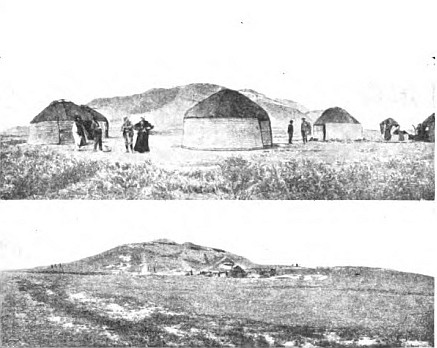
I.—THE NORTH KURGAN AT ANAU AND THE CAMP OF THE PUMPELLY EXPEDITION. II.—THE SOUTH KURGAN AT ANAU, SHOWING EXCAVATIONS IN PROGRESS.—From Pumpelly, Expl. in Turk. 1, p. 17, Figs. 5 and 6
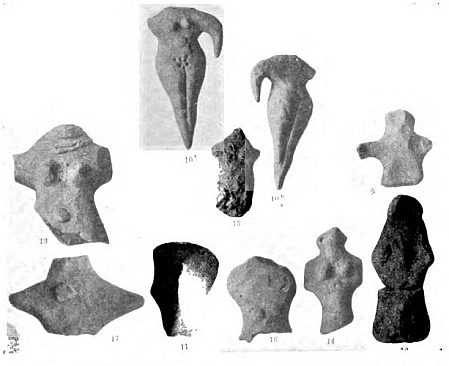
TERRA-COTTA FIGURINES FROM THE SOUTH KURGAN AT ANAU. —From Pumpelly, Expl. in Turk., 1, pl. 46, Figs. 9-17
We are not here concerned with details of the earlier geological evidence, except in so far as they illustrate or explain the physical changes in the character of the country during more recent times. It has long been recognized that the deserts of Central Asia owe their existence to a process of desiccation that has taken place since the Glacial epoch,[3] and recent investigations have shown that the contrast to present conditions was even more marked than was previously supposed. The members of the first Pumpelly Expedition have noted that glaciers existed on a greatly extended scale throughout the mountains bordering the great basins of Central Asia on the south and east, and they have proved the existence of several great glacial expansions, each of which naturally reacted on the climate of the central region. During the sub-glacial period there was a general trend towards desolation, and the dried silts of seas and rivers were carried by the wind across the surface of the ground. The lightest material was carried farthest, and, wherever the scanty vegetation could hold it, it was deposited in beds of "loess," the extraordinarily fine and fertile soil which covers a great part of Northern China and Turkestan, and extends in a continuous zone from North of the Caspian to Central Europe.[4] The heavier silts in the shape of sands moved more slowly under the pressure of the wind, and they formed great deserts of sand-dunes, heaped in places more than a hundred feet high. It is to the shifting or formation of such sand-deserts in historic times that we owe the burial of the cities in the Khotan region, which have been so successfully excavated by Dr. Stein for the Indian Government.[5]
Although it is clear that since Glacial times there has been a general trend towards the present arid condition of Central Asia, there is reason to believe that, as in the Glacial epoch, the subsequent climatic changes have not been uniform. Periods of extreme aridity have occurred in which the condition of certain regions may have been more desolate than it is to-day. But these appear to have alternated with more humid periods, when the tracts which were deserted may again have been rendered capable of sustaining life. Already in the prehistoric period, however, the sea of sand-dunes had encroached upon the fertile plains of loess, and it is mainly in the delta-oases, formed by streams emerging from the mountains, or at points where large rivers lose themselves in the plain, as at Merv, that traces of man's handiwork have been discovered.
Throughout the region of the oases in Southern Turkestan, to the north of the Kopet Dagh, the Pumpelly Expedition constantly noted the sites of former habitations in regions which are now desolate. Not only are there traces of occupation where villages exist to-day, but there are also large areas which must once have been densely peopled, although they are now deserted. The present supply of water in the region could support but a small proportion of its former inhabitants, and it is necessary to suppose either that there was a greater rainfall, or that evaporation was less rapid owing to a lower temperature. Similar evidence has been collected with regard to the former condition of Chinese Turkestan,[6] and it is clear that extensive tracts in Central Asia, which are now abandoned to the desert, at one time supported a considerable population. The evidence points to a change in climatic conditions, which has reacted on the character of the country in such a way as to cause racial migrations.[7]
In the hope of throwing light on the character of the former dwellers in the deserted regions of Russian Turkestan, the second Pumpelly Expedition undertook excavations at selected sites. At Ghiaur Kala in the Merv Oasis it was ascertained that the earliest period of occupation was not older than a few centuries B.C., though it is probable that among the great number of mounds in the oasis some are of a considerably earlier date. Far more important were the results obtained by excavations in the region below the northern slopes of the Kopet Dagh. It was at one of the delta-oases, at Anau, near Askhabad, some three hundred miles east of the Caspian, that the Pumpelly Expedition found traces of prehistoric cultures, and obtained its principal material for archaeological study.
Near the middle of the Anau oasis, and about a mile apart, are two hills with rounded contours, rising some forty and fifty feet above the plain, and marking the sites of long-forgotten cities. The structure of the North Kurgan, or tumulus, had already been exposed by a trench cut in it some twenty-five years ago by General Komorof, which showed stratified remains, including bones of animals and potsherds of plain and painted wares. It was this trench that first directed Mr. Pumpelly's attention to the mound during his first expedition, and his subsequent excavations, both here and in the South Kurgan, exposed the same stratified structure.
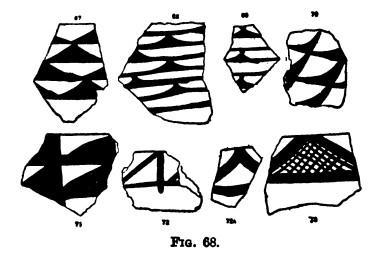
Fig. 68. Designs on painted potsherds of the Neolithic period (Culture I.) from the North Kurgan at Anau.—From Pumpelly, Expl. in Turk., I., p. 128, Nos. 67-73.
The strata represented successive occupations of the site, and, as its inhabitants lived in houses built of sun-dried bricks, the hills gradually rose in height. Of the two hills, the North Kurgan was of earliest formation, its earlier strata containing the remains of a stone-age culture, and its upper culture representing an aeneolithic stage of civilization. The third culture, that of the lowest strata in the South Kurgan, dates from a copper age. The archaeological part of the work was directed by Dr. Schmidt, and to his admirable method of noting the precise spot and level of every object recovered we owe the possibility of tracing the gradual development of culture during the successive periods of settlement. Moreover, the Transcaspian railway passes little more than half a mile to the north of the northern mound, or Kurgan. Hence there was no difficulty and little risk involved in the conveyance to Europe of all the archaeological material obtained. The collection of animal bones from the North Kurgan weighed nearly half a ton, but they were despatched without difficulty to Dr. Duerst of Zurich, who contributed a report on them to the record of the second expedition.
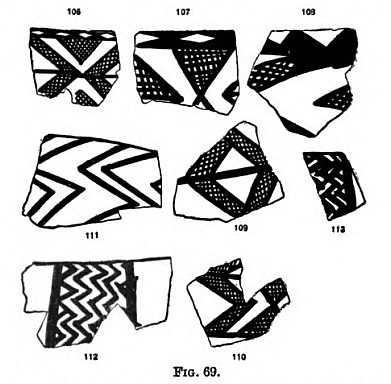
Fig. 69. Designs on painted potsherds of the Aeneolithic period (Culture II.) from the North Kurgan at Anau.—From Pumpelly, Expl. in Turk., I., p. 133, Nos. 106-113.
The cultural progress of the three periods is, however, most clearly revealed by the pottery, which exhibits a gradual evolution in form, technique, and decoration. Although the vessels of the first two cultures are hand-made, and the wheel was not introduced until Culture III., yet the vessels of both earlier epochs are excellent ceramic productions. It has already been noted that many of the geometric designs occurring on pottery of the earlier periods from the North Kurgan bear a certain resemblance to similar pottery found by MM. Gautier and Lampre at Mussian, and by M. de Morgan at Susa. This may well point to some connection between the stone and early metal-using cultures of Transcaspia and Elam; while the baked clay figurines from the copper culture of the South Kurgan may be held to prove some early cultural contact with the Sumerians.[8]
Mr. Pumpelly himself would regard the Central Asian oases as the fountain-head of Western Asiatic culture. According to his theory, they were isolated from Europe and Africa from the Glacial period onwards, and their cultural requirements were evolved in complete independence. Changes in climatic conditions, however, took place, under which the early civilizations in these regions tended to disappear, and these gave rise to extensive migrations, which reacted in turn on the outside world. In support of his theory he would trace the early appearance of wheat and barley both in Egypt and Babylonia, and the presence of certain breeds of domestic animals, to their first establishment in the Transcaspian oases. But, in addition to differences in their ceramics, the total absence of any form of writing in the mounds at Anau tells against any theory necessitating a very close racial connection between the early inhabitants of the oases and the Sumerians of Babylonia.
The evidence, in fact, does not justify us in placing the original home of the Sumerians at Anau, nor indeed in any particular spot in Central Asia or Iran that has yet been examined. But it serves to indicate the region of the world in which we may expect that future excavations will reveal data of a more conclusive character. It may be that the ruined sites of Seistan and the Kirman province will exhibit closer parallels with the civilizations of Elam and Sumer. Meanwhile it is clear that some contact must have taken place between the early peoples of the latter countries and the settlements to the north of the Kopet Dagh. We may thus picture the Sumerians before their arrival in Babylonia as inhabitants of some district to the east of the Euphrates valley, where they evolved the elements of their culture, which is already found in a comparatively advanced stage of development on the earliest of South Babylonian sites.
A further result of the recent explorations in Turkestan is that an adequate explanation is afforded of the unrest in Central Asia, which gave rise to the Sumerian immigration and to similar racial movements westward. It may now be regarded as established that periods of desiccation and extreme aridity have led to the abandonment of extensive tracts of country, with the result that their former inhabitants have, from time to time, been forced to seek sanctuary in more favoured districts. While nomad tribes in their search for fresh pasturage might drift over the broad steppes to the north and west of Turkestan, the agricultural peoples on its southern border would be forced to turn south of the Caspian. The bleak uplands of the Iranian plateau offer small attractions for permanent settlement, and the routes of the migrant tribes would naturally lead in the direction of Asia Minor and the Mesopotamian plain. Such a condition of unrest in Central Asia would naturally react on peoples at a considerable distance, and this fact explains the periodical invasions to which Babylonia has been subjected from the east. It may be added that the immigration of Semitic tribes into Syria and Northern Babylonia should possibly be traced to physical causes of a like nature. Periods of aridity may have occurred in the central portions of the Arabian continent, and may have given rise to the Semitic invasions of prehistoric and historic times.
Thus it is possible that the two races, which we find in possession of Sumer and Akkad during the earliest historical periods, though they arrived from opposite quarters, were forced into the region of the Euphrates by causes of a precisely similar character. As the Semites, on their way northwards from Arabia, colonized the Syrian coast-lands through which they passed, so the Sumerian race may well have left permanent traces of its presence in the valleys and more fertile oases of Iran. There are already indications that work on Syrian and West Mesopotamian sites will throw a flood of light upon the problems of early Semitic history, and it may perhaps fall to the lot of a fortunate excavator, in some region east of the Euphrates valley, to recover the cult-images of primitive Sumerian gods, and to bring to light examples of the picture-writing from which the early cuneiform characters were derived.
APPENDIX II
A CHRONOLOGICAL LIST OF THE KINGS AND RULERS OF SUMER AND AKKAD
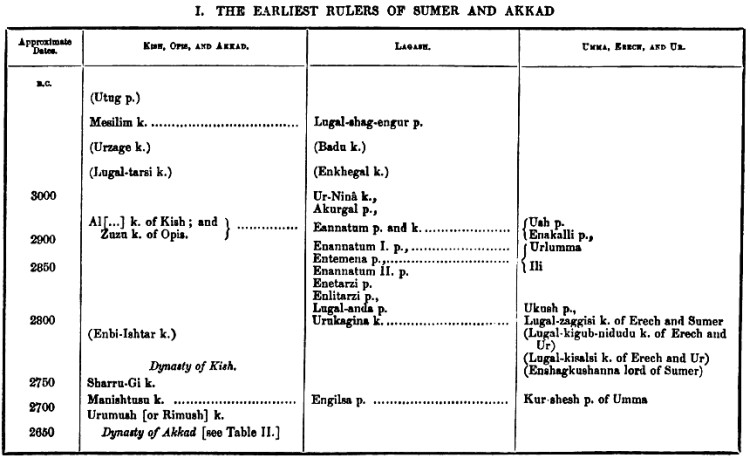
I. THE EARLIEST RULERS OF SUMER AND AKKAD
[enlarge]
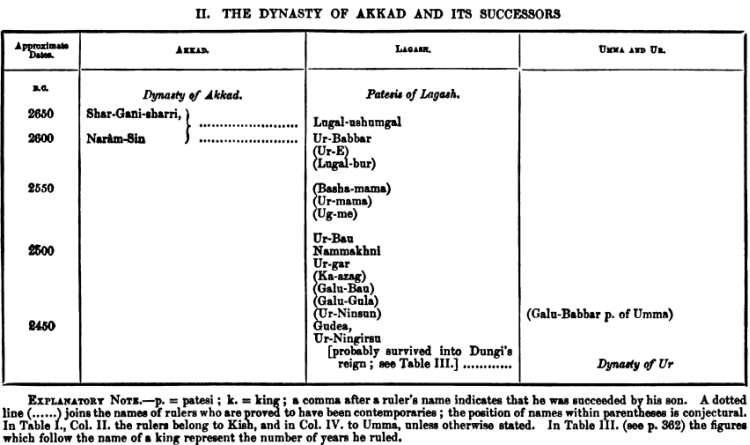
II. THE DYNASTY OF AKKAD AND ITS SUCCESSORS
[enlarge]
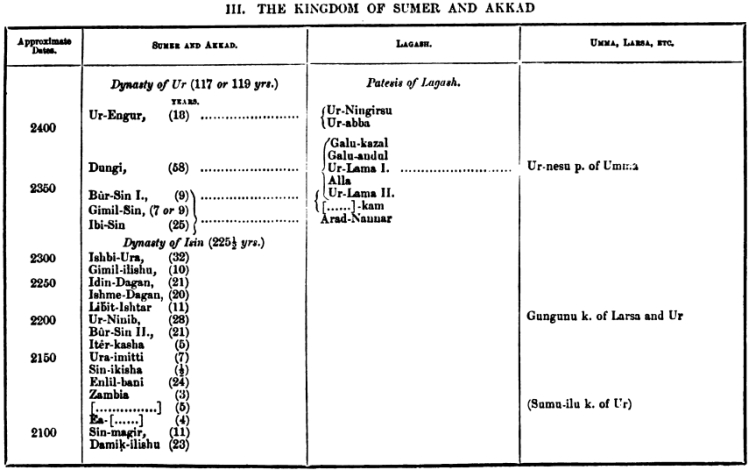
EXPLANATORY NOTE.—p. = patesi; k. = king; a comma after a ruler's name indicates that he was succeeded by his son. A dotted line (......) joins the names of rulers who are proved to have been contemporaries; the position of names within parentheses is conjectural. In Table I., Col. II. the rulers belong to Kish, and in Col. IV. to Umma, unless otherwise stated. In Table III. (see p. 362) the figures which follow the name of a king represent the number of years he ruled.
III. THE KINGDOM OF SUMER AND AKKAD
[enlarge]
INDEX
Aa, gifts to, 223 Abba-dugga, 313 Abi-ishar, seal of, 246 Abû Habba, site of Sippar, 8 f.; excavations at, 37, 223; objects and inscriptions from, 204, 206, 212, 218, 223, 235, 250, 309 f. Abû Hatab, site of Kisurra, 9; excavations at, 28 ff.; plan of, 29; inscribed brick from, 284; contracted burials at, 331 Abû Khuwâsîj, 31 Abû Shahrain, site of Eridu, 35; excavations at, 35 f.; plan of, 36 Abydos, 323 f., 332; recent diggings at, 324, 326 f., 332 Abyssinia, 334 Abzu-banda, 111, 189 f. Abzu-ega, 190 Accounts, tablets of, 169, 177, 284, 293 Achaemenian kings, 337 Adab, site of, 9, 97, 163; excavations at, 30; in relation to Euphrates, 11; its commercial relations with Lagash, 238; destruction of, 31 f.; see also Bismâya Adamdun, situation of, 290; patesis of, 292 Adda-Pakshu, sukkal of Elam, 306 f.; tablets from period of, 336 Addatur, 113 Adhem, 7, 287 Aegean, sites, 81; Asiatic coast of, 347; sea-rovers of, 347 Aegean culture, stages of, 1; its early connection with Egypt, 341; traces of Babylonian influence in, 322, 345 ff.; wild comparisons between Aegean and Babylonian art, 344 f. Aenragin, 171 'Afej marshes, 85 f. Agade, older name of Akkad, 14; site of, 37; Sargon of, 216 ff.; see Akkad Agathias, 312 Agia Paraskevi, 344 Aha, mastaba-tomb of, 323 'Akarkûf, 38 Akhush, 189 f. Akkad, city, site of, 37; early centre of Semitic settlement, 53; in relation to Kish, 210 f., 214 f., 228, 231 f., 249; in relation to Elam, 226; "sons," or citizens, of, 208, 211; siege of, 240; Dynasty of, 216 ff, 252 ff., 351 f.; in relation to the Dynasty of Ur, 253; kings of Sumer and, 362 Akkad, land, limits of, 6 f., 12 f.; name of, 13 ff., 17; inhabitants of, 40 ff.; Semitic immigration into, 203; system of land tenure in, 95; influence of art of, 66; early relations with Elam, 214, 244; cultural connections with Elam, 335 ff. Akkadian, the Semitic speech of Babylonia, 52 f. Akkadians, the Semitic inhabitants of Northern Babylonia, 4; former use of the term, 4 Akkadû, 14 Akki, 232 Akurgal, patesi of Lagash, 117 f.; sculptured figures of, 112 ff.; in chronological table, 360 Al[...], king of Kish, 141; in chronological table, 360 Al-Batîha, 8 Al-Gimil-Sin, "the City of Gimil-Sin," 301 Aliakhu, 208 Alla, patesi of Lagash, 296; in chronological table, 362 Alla, resident in Lagash, 237 Alloys, evidence as to use of, 73 f. Alluvium, limit of Babylonian, 7 Alu-usharshid, a former reading of the name Urumush or Rimush, 203 Amageshtin, temple of, 190 Amal, temple of, 226, 232 Amananu, governor of Sippar, 316 Amanus, 261 Amat-Bati, 171 Amattar-sirsirra, 184 Ambar Su, 244 Amiaud, Arthur, 18, 20, 109 Ammi-zaduga, 307 Amorite invasion, disproved in reign of Libit-Ishtar, 284 Amurru (Martu), a West Semitic god, 344 Amurru, the Western Semites, 55; origin of, 55 Amurru, the Western Land, 261, 300, 321; Sargon's conquest of, 225, 233 f.; its king deported, 244; slaves from, 238; relation of kings of Isin to, 311, 315 f.; Babylonian influence in and beyond, 322 Ana, 194, 196, 198; see also Anu Anatolia, 346 f. Anau, excavations at, 2, 351, 355 f.; potsherds from, 341, 355 f.; terra-cotta figurines from, 342, 356; wheat and barley found in earliest stratum at, 332, 357 Andrae, W., 11, 22 ff., 28 f.,78, 330 Anikurra, 112 Animal cults, Egyptian, 334 Animal forms, Sumerian treatment of, 80 Animal motives, on Elamite painted pottery, 341 f.; on proto-Elamite seal-impressions, 342 Anita, 112 ff., 116 Anshan, its conquest by Manishtusu, 224, 231, 244; its conquest by Gudea, 279, 289; alliance of Dungi's daughter with the patesi of, 287; its conquest by Dungi, 288; officials for, 290; a patesi of, 292; captivity of Ibi-Sin in, 304; its success against Ur, 308; its defeat by Anu-mutabil, 308 Antasurra, 146, 189 f. Antimony, 73 f. Anu, 48, 104, 275; see also Ana Anu-banini, king of Lulubu, 250 Anu-mutabil, governor of Dêr, 308 Anunitu, 226, 232, 268 Anunpad, 113 Anzanite inscriptions, 206, 212 Apirak, 241, 243 Apil-Sin, contracts of reign of, 316 Arabesque pattern, on Sumerian sealing, 176 Arabia, 242, 251, 258, 261, 323, 358 Arabian desert, 6 Arad-Nannar, patesi of Lagash, 301 f.; in chronological table, 362 Archers, in the army of Ur, 286 Architect, Gudea as, 260 f., 269 Archive-chambers, at Tello, 293 Ark, of bulrushes, 232 Armanu, 242 Art, comparison of early Sumerian and Akkadian, 228 f.; of Kish and Akkad, 230 Arua, 149 ff. Asar, Osiris, 325 Asari, Sumerian god, 325 Ashnunnak, or Tupliash, 306; under Manishtusu, 212; patesis of, 306 Ashukhu-wood, 261 Ashur, 287 Ashur-bani-pal, 12, 204 f.; tablets from Library of, 4, 59, 217, 299, 303 f. Asia Minor, 342, 347, 358; Central, 54, 351 ff. Askhabad, 351, 355 Asphalt, 261; see also Bitumen Asses, for chariots, 162; House of the, 259 Assyria, 7 Assyrian kings, their policy of deportation, 240 Assyrians, sculpture of, 68 ff.; omen-literature of, 206 Astrological texts, 217 Asukhur Canal, 109, 149 f. Axe, Sumerian form of, 137 Az, 150 f., 290 Azupirânu, 232 Bab el-Mandeb, Straits of, 323 Babbar, 84, 124, 127, 129, 148, 194, 281 Babishue, 301 Babylon, 13, 38, 309; excavations at, 37; pot-burials and early remains at, 30, 37; Sargon's buildings at, 226, 236; Dungi's sack of, 281 ff., 285; in relation to the Dynasty of Isin, 63 f., 313 ff.; rise of, 319; in relation to the Dynasty of the Sea-country, 62 f.; her struggle with Larsa, 318 f.; her position in later history, 319 f. Babylonia, in the Neolithic period, 2; relics of prehistoric culture in, 342; her early cultural influence, 321 ff.; in relation to Egypt, 322 ff., 334 f.; in relation to Elam, 335 ff.; in the West, 322, 343 ff. Babylonian Chronicle, 62 Babylonian Monarchy, foundation of, 63 f., 313 ff. Bad-mada, 296 Badu, king of Lagash, 105; in chronological table, 360 Baga, 189 f. Baghdad, 38 f., 218 Bahr Nejef, 10 Banar, 114 Banks, E. J., 97 Barakhsu, 205, 308 Baraz-sîrim, Field of, 206 Barges, for grain, 262 Barkiba, 160 Barley, 357; in earliest stratum at Anau, 332 Barnamtarra, wife of Lugal-anda, 170 f., 173 Barsagannudu, 113 f. Barshib, 261 Basalla, 261 Basar, 225 Basha-mama, patesi of Lagash, 254; in chronological table, 361 Basha-Shushinak, patesi of Susa, 214, 289; period of, 305; proto-Elamite inscriptions of, 338 Basime, 209 Bas-reliefs, Sumerian, 66 ff., 110 ff., 129 ff.; early Semitic, 220 f., 228 f., 242 f., 247 ff.; Assyrian, 68 ff., 82 Battle-axe, Sumerian use of the, 286; of Narâm-Sin, 243 Battle-mace, 131, 156 Battle-scenes, 135 ff., 220, 230, 247 ff. Bau, 108, 181, 185 f., 271, 275, 296; temples of, 259, 264, 267, 269, 273, 298; bowls dedicated to, 107 ff.; representation of, 135 Bau-ninam, official of Ur-Ningirsu, 275 f. Bavian, 63 Baz, Field of, 206 Bazuzu, father of Utug, 103 Bead-making, Egyptian art of, 328 Bedouin custom, 40 Bêl, name of, 52; the god Marduk, 282 Belaku, patesi of Ashnunnak, 306 Beleous, 312 Beletaras, 312 Beli-arik, patesi of Susa, 291, 305 Berber dialects, 323 Berossus, 53, 59; Dynasties of, 63 Berthelot, M. P. E., 73 Bezold, Prof. C., 344 Bi-Gani-sharri, 246 Bilâdhuri, 8 Bilingual compositions, 4 Bin-Gani-sharri, son of Narâm-Sin, 246 Bint el-Mderre, 31 Birs, site of Borsippa, 10 Bismâya, site of Adab, 9; excavations at, 30, 97; character of buildings uncovered at, 89 Bitumen, 76, 212, 262 "Black-headed ones," 40 Blau monuments, 65 Boat-inspectors, 181 Boats, for transport, 235, 261 Body-paint, 27, 330 Boeotia, Neolithic potsherds from, 341 Boissier, A., 205, 304, 309 Borsippa, 10, 13; excavations at, 37 Bosanquet, Prof. R. C., 346 Boundary-ditch, between Lagash and Umma, 126; of Ur-Engur, 282; see also Frontier Boundary-stones, 143 Bow, introduced by the Semites, 247 f., 286; of Narâm-Sin, 243; adopted by Dungi, 287 Breasted, Prof. J. H., 334 Breccia, 270 f. Bricks, of Sumer, 13; character of Babylonian, 91; plano-convex, 26, 35, 91, 94, 332; change in size of, 263 f.; manufacture of, 267; stamped with figure of Imgig, 98; origin of the Egyptian brick, 323, 332 Brick-stamps, 75, 219 Bronze, evidence with regard to, 72 ff.; later Elamite work in, 337 Budge, Dr. E. A. Wallis, 37, 160, 329 Bull-monsters, proto-Elamite, 242 Bulls, as offerings, 129, 140; copper figures of, 256; human-headed, 77, 330 Bûr-Sin I., king of Ur, reign of, 296 ff.; expeditions of, 299; buildings of, 298; in relation to Enlil, 297; statue of, 298; his deification and cult, 298; his survival as a deity in the Moon-god's suite, 299, 344; in chronological table, 362 Bûr-Sin II., king of Isin, 312; in chronological table, 362 Burial, of the dead, 21; different forms of, 26 f., 30; after battle, 138 f., 149, 331; Egyptian and Babylonian fashions of, 325 f., 331 f.; earliest Susian form of, 331 f. Burial fees, 181 f. Burial-mounds, after battle, 125, 162 331 Burrows, Prof. R. M., 345 Buwârîya, 33 Canals, 3, 107, 153 ff., 185 Canopic branch, of the Nile, 324 Cappadocia, 339; prehistoric pottery from, 341 Caravan-routes, from the Iranian plateau, 335 Carnegie Institution, of Washington, 351 f. Caspian, 353, 355, 358 Casting, in metal, 72 ff. Cattle, transport of, 235, 237 Cedar, remains of pillars of, 93; from Mt. Amanus, 261 Cedar-groves, sacred, 267 Cemeteries, in Upper Egypt, 326 Central Arabia, 358 Central Asia, 54, 351 ff. Cesnola, General di, 343 Chamberlain, royal, 115 Chariots, of war, 162; representation of a, 134 Chialy Effendi, 245 China, 353 Chinese, 54 Chinese Turkestan, 351, 354 Chronicle, the Babylonian, 62; of Sargon and Narâm-Sin, 220, 225, 233 ff., 240 f.; concerning early Babylonian kings, 282, 312; Dynastic, from Nippur, 59, 63, 279 f., 303, 308 f., 311 f., 315 Chronicles, Hebrew Books of, 240 Chronological table, of kings and rulers of Sumer and Akkad, 360 ff. Chronology, classes of data for determining, 57 ff.; Babylonian, 62 ff.; of the later Sumerian period, 315 Chicago, Exploration Fund of the University of, 30 Chieftains, meeting of, 45 f. Chipiez, Charles, 66 Cilician Gates, 347 Citadel Tell, at Susa, 339 Cities, in Babylonia, 16 ff.; origin of, 84 f.; communication between, 237 City-gods, origin and development of, 84 f.; description of a, 268; position of, 101 f.; in relation to the patesi, 181; disputes between, 101, 121 f. City-states, development of, 84 f., 321; wars of the, 120 ff.; weakening and decay of the, 239 f., 252 Clay, Prof. A. T., 9, 52, 228 Clay tablet, borrowed by Elam, 338 f.; introduced into Cappadocia, 339; reached Crete, 345 Climatic changes, a cause of racial migrations, 354, 357 f. Clothing, Sumerian and Semitic, 41 f. Code, of Hammurabi, 184; Sumerian origin of, 184, 348; of Gudea, 272; see also Laws Codes, legal, 347 Colour-dishes, for face or body-paint, 27, 330 Commercial intercourse, in Babylonia, 237 f.; with foreign countries, 238, 321 f. Conch-shells, cylinders and plaques from, 78 Cones, votive, 258; of copper, 256; coloured, 34; historical, 164 f., 178 ff. Confiscation, Sumerian laws against, 182 Constantinople, 218 Contract tablets, 64 Contracted burial, Sumerian practice of, 331 Convoys, early service of, 237, 244 Copper, Babylonian evidence with regard to, 72 ff.; objects from Fâra, 3, 26 f.; from Kimash, 261; lance of, 229; known to predynastic Egyptians, 326; its displacement of flint in Egypt, 327; effect of Egyptian skill in working, 327 Copper-mines, in Elam, 261 Corn, tribute of, 164; fees of, 181 f.; see also Grain Corvée, 182 Couriers, 291 Court, expenses of the, 169 Crenelated buildings, Egyptian and Sumerian, 332 Crenelation, in walls of early Egyptian buildings, 323 Crete, traces of Babylonian culture in, 345 f.; parallels between cultures of Elam and, 341 Cros, Commandant Gaston, 17, 172, 189, 269 Cruciform monument, from Sippar, 223 Cult-centres, 84, 321 Cult-images, 50, 358 Cults, survival of Sumerian, 347 Cuneiform writing, invention of, 65, 348; the Sumerian form the parent of other systems, 348 Cupbearers, 112 f., 236 Cuq, Prof. Edouard, 184 Curium, 343 Cutha, 8 f., 13, 37 f., 283, 293; centre of Nergal's cult, 38 Cylinders, of Gudea, 266 f. Cylinder-seal, early migrations of the, 333 f.; introduced into Babylonia by Sumerians, 333; possible Egyptian evolution of the, 333 f.; earliest form of, 334 Cylinder-seals, engraving of, 78; composite monsters on, 77; official use of, 236 f.; Sumerian, 3, 27, 48, 174 ff., 284; early Semitic or Akkadian, 176, 229, 344; Egyptian, 322, 334 f.; Cypriote, 343 f.; Cyro-Cappadocian and Hittite, 344; Cretan, 346 Cyprus, prehistoric pottery of, 341; its alleged conquest by Sargon of Agade, 234, 343; inadequate evidence for the theory, 343 f.; extent of Babylonian influence in, 234, 343 ff. Dada, patesi of Shuruppak, 283 Dada, magician, 237 Dagan, 284 Daggers, Sumerian, 79; engraved panels from handles of, 81 f. Damgalnunna, temple of, 294 Damik-ilishu, king of Isin, 309, 316 ff., 319; in chronological table, 362 Date-formulæ, 225, 257 f., 285, 295 Date-lists, 58 Dates, trade in, 237 Dâti-Enlil, father of Shar-Gani-sharri, 227, 232 Dating, methods of, 57 f., 168, 170, 219, 318 De Clercq Collection, 158, 218, 308 De la Fuÿe, Col. Allotte, 168 ff., 170, 173 ff. De Lancy, Barré, 218 De Morgan, J., 39, 66, 206, 212, 324, 330, 332, 335, 337, 339 ff., 356 De Sarzec, E., 17 ff., 77 f., 90, 92 f., 96, 130, 169, 258, 261, 266, 270, 332 Dead, treatment of the, 21, 26 f., 125, 138 ff., 149, 162, 331; Egyptian worship of the, 334 Decadence, in Sumerian art, 82 Deification, of early Babylonian kings, 203, 222, 251, 273 f., 288, 298 f., 310; effect of, 300 ff.; origin of, 273 f., 335 Deir, 37 Deke, 31 Delitzsch, Prof. Friedrich, 5, 12, 317 Delta, Egyptian, 2, 324, 334 Demonology, 76 Deportation, policy of, 239 f. Dêr, 226, 285, 308 Dhorme, Père Paul, 228 Diarbekr, 244 f. Dilbat, 319 Dilmun, 235, 262, 291 Diorite, 71; from Magan, 242, 258, 262, 269 f. Disk, from Phaestos, 346 Divination, by oil, 183 Diviners, professional, 183 Divorce, fees for, 183 f.; abuse of, 184 Dîwânîya, 85 Diyala, 287 Door-sockets, 219 Dorians, 50 Doves, as offerings, 128 f. Dragons, in Sumerian art, 77 Drainage, systems of, 345 Dreams, of Eannatum, 124; of Gudea, 266 Dress, 41 ff., 111 f. Drill, in engraving, 78, 344 Droop, J. P., 341 Dubâ'i, 31 Dudu, official at Ur-Ninâ's court, 113 Dudu, chief priest of Ningirsu under Entemena, 166 ff.; perforated block of, 100, 110, 166 Duerst, Dr. J. Ulrich, 356 Dugru, of Ningirsu, 190 Dumuzi-abzu, 190 Dun-..., patron deity of Ur-Ninâ's dynasty, 109, 177 Dungi, king of Ur, policy of, 282; empire of, 253, 285 f.; his adoption of the bow, 286 f.; Elamite campaigns of, 287; provincial administration of, 288 ff.; buildings of, 293 f.; copper cone of, 256; deification of, 274, 288; cult of, 274, 298 f.; in chronological table, 362 Dungi-Babbar, 295 Dunpae, 299 Dunshagga, 109, 181, 267; temples to, 185, 264 Dûr-ilu, former reading of the name of Der, 226 Dûr-Sharrukîn, 217 Dûr-Sin, 206 Dynastic Chronicle, from Nippur, 59, 63, 279 f., 303, 308 f., 311 f., 315 Dynastic Egyptians, 323 Dynastic lists, 59 Dynasties, Babylonian, 62 f. E-abzu, king of Umma, 97 E-anna, in Erech, 12, 33, 196, 280, 293; in Lagash, 121, 161, 190, 264, 269, 273 E-babbar, in Sippar, 218, 268; in Larsa, 186; in Lagash, 186, 189 E-ditar-kalama, 319 E-engur, 190 E-khalbi, 294 E-kharsag, 294 E-kur, 32, 86, 88,193, 198, 201, 235, 281, 297 E-meslam, 293 E-meteursagga, 39 E-ninnû, 77, 107 f., 160, 168, 185, 261, 265 ff., 269, 272, 274, 276, 296; earliest mention of, 95; remains of, 19, 259 E-pa, 108, 264 E-patutila, 319 E-sagila, 282 E-salgilsa, 296 E-silsirsir, 273 E-ulmash, 217 Ea, 246, 289; see Enki Ea-[...], king of Isin, 313; in chronological table, 362 Ea-bani, figures identified with, 77, 174 f. Eagle, as emblem, 133; lion-headed, 81 f. Eannatum, patesi of Lagash, 42 f., 68, 104, 192, 229 f.; reign of, 120 ff.; conquests of, 144 ff.; character of, 152, 155 f.; titles of, 152; buildings and canals of, 152 ff.; well of, 93, 155; representations of, 136 ff., 140 f.; in chronological table, 360 Ebarti, Elamite dynasty of, 306, 308 Eclipse, 62 Edfu, 324; legend of, 324 Egypt, Palaeolithic and Neolithic remains in, 2; recent excavations on early sites in, 324 ff.; early cultural connections with Babylonia, 78, 322 ff., 332 f., 328, 334 f., 346; suggested relations with Elam, 340 f., 345; early influence in Syria, 334 f., 346; connection with Hittite culture, 346; with the Aegean, 341; hypothetical Semitic invasion of Upper, 323 ff., 328; granaries of, 92 Egyptian culture, 326 ff.; legends, 323 f.; language, 323; religion, Semitic element in, 334; writing, origin of, 329 f. Egyptians, Neolithic and predynastic, 1, 323, 332; early dynastic, 323, 332 Ekikala, 189 El-Hibba, excavations at, 20 f.; inscriptions from, 157 ff. El-Katr, 8 El-Ohêmir, site of Kish, 8 f., 38 f. Elam, prehistoric peoples of, 342; prehistoric pottery of, 340 ff.; early cultural relations with Babylonia, 321, 335 ff.; suggested cultural parallels with Egypt, 340 f., 345; with Crete, 341; frontier of, 6 f.; defeated by Eannatum, 145, 148 ff., 160; defeated by Lu-enna, 172; relations of Manishtusu with, 212 ff., 231; conquered by Urumush, 205, 231; relations of Sargon and Narâm-Sin with, 225 f., 231 f., 243 f.; commercial intercourse with, 238, 289; early Semitic immigration into, 250, 289, 336; Gudea's campaign in, 258; Dungi's conquest and administration of, 287 ff., 292; under the later kings of Ur, 299 f., 304; defeated by Anu-mutabil, 308; Elamite invasions, 304 f., 308, 311; copper mines in, 261; craftsmen from, 261 f.; patesis of, 231, 243, 305; governors of, 306; sukkals of, 306; sculpture and metal-work of, 337 Elamite titles, 306 ff. Elamites, 54 Embalming, of the dead, 332 Emblems, sacred, 267; of Ningirsu, 98; of a goddess, 133; of Lagash, 98, 100, 131, 134, 167; of a city, 150; Elamite origin of certain Babylonian, 342 Enakalli, patesi of Umma, 126; successor of, 158 f.; in chronological table, 360 Enannatum I., patesi of Lagash, 157 ff.; titles of, 160; in chronological table, 360 Enannatum II., patesi of Lagash, 168 ff.; raid of Elamites in reign of, 172; in chronological table, 360 Enannatum, chief priest of the Moon-god at Ur, 310 f. Enbi-Ishtar, king of Kish, 202 f.; racial character of, 53; in chronological table, 360 Enbu-ilum, 203 Enetarzi, patesi of Lagash, 169 ff.; letter to, 172; in chronological table, 360 Engilsa, patesi of Lagash, 176, 209 f.; in chronological table, 360 Engraving, of stone, shell, etc., 78 ff., 347; of metal, 78, 167, 229 Eniggal, royal steward, 170; sealings of, 173 Enkhegal, king of Lagash, 106; in chronological table, 360 Enki, 48, 84 f., 107, 128 f., 148, 167, 194, 246, 275, 301; his temple in Eridu, 35 f., 108, 293, 298; his temple in Girsu, 259 Enkigal, 158 Enkomi, 344 Enlil, 85, 101, 103 f., 128, 165 f., 193 f., 196, 198 f., 201, 289, 294, 297; his temple at Nippur, 87 f., 219, 244, 281; his temple in Lagash, 185, 189; frontier shrine to, 127; canal dedicated to, 107; name of, 52 Enlil-bani, king of Isin, 312; in chronological table, 362 Enlitarzi, patesi of Lagash, 168 ff.; in chronological table, 360 Enlulim, 268 Enshagkushanna, lord of Sumer, 201; in chronological table, 360 Ensignun, 259, 268 Entemena, patesi of Lagash, 52, 90, 125; reign of, 161 ff.; silver vase of, 78, 167 f.; cone of, 100 ff., 117, 122, 126 f., 143, 154, 157 ff, 164 f.; in chronological table, 360 Enzu, 84, 128 f., 148, 194 Eponym Lists, 62 Erech, 9 f., 12 f., 84, 104, 147, 152, 163, 186, 194 f., 198 ff, 214, 238, 240, 279 f., 293, 298, 304, 310 f., 313, 317 f.; excavations at, 32 ff.; see also Warka Eridu, 6, 13,84 f., 148,152, 167, 197, 282, 293, 298, 310 f.; excavations at, 35 f.; see also Abû Shahrain Erinda, 246 Erythraean Sea, 53 Esar, king of Adab, 97 f. Estates, purchase of, 206 ff. Euphrates, names of, 9; changes in course of, 7 ff.; contrasted with Tigris, 11 f.; period of high water in, 11 f.; at Nippur, 88 f. Evans, Dr. Arthur, 345 f. Excavations, in Sumer and Akkad, 16 ff.; in Egypt, 324 ff.; in Persia, 335, 339 f.; in Turkestan, 351 f., 355 f. Eyes, of statues, 76, 212 f. Face-paint, 330 Falûja, 10, 38 Fâra, site of Shuruppak, 9, 28, 84; excavations at, 24 ff.; plan of, 25; discoveries at, 3, 65, 89, 331, 345; objects from, 73, 78, 283, 330 Fees, priestly, 181 f.; of diviners, 183; of the grand vizir and patesi, 183; for divorce, 183 Fetish emblems, 329 Figurines, of terra-cotta, 342, 356; in precious metals, 337 Fire-necropoles, so-called, 21 Fish, as offerings, 129 Fisher, C. S., 8, 86 ff. Fishery inspectors, 181 Fish-men, 53 Fish-ponds, 182; sacred, 268 Flint-knapping, 327 Flints, Egyptian, 2, 326 f. Flute-player, to Ningirsu, 268 Forced labour, 164, 182; see also Slaves Fossey, Prof. Charles, 6, 17 Foucart, G., 329 Foundation-figures, 72 ff. Foundation-offerings, 337 Fresnel, F., 218 Frontier-ditches, 126 ff., 153 f., 159, 162, 164 f. Frontier-shrines, 127 f., 159 Funeral rites, 140 f. Galalim, 185, 264, 267 Galu-andul, patesi of Lagash, 296; in chronological table, 362 Galu-Babbar, patesi of Umma, 23, 258; in chronological table, 361 Galu-Bau, patesi of Lagash, 255, 257; in chronological table, 361 Galu-Gula, patesi of Lagash, 255, 257; in chronological table, 361 Galu-kazal, patesi of Lagash, 296; in chronological table, 362 Gankhar, 287, 301 f., 308 Garments, Sumerian and Semitic, 41 ff, 111 f.; as fees, 181; trade in, 237 Garstang, Prof. J., 341 Gatumdug, 108, 152, 168, 190, 264, 266, 269, 271 Gautier, J.-E., 220, 336, 340, 356 Geikie, Sir Archibald, 353 Geikie, Prof. James, 353 Genouillac, H. de, 112, 116, 162, 169 ff., 173, 176, 179, 184, 190, 193, 273 Geometric designs, on pottery, 341 Geshtin-anna, 259 Ghiaur Kala, 354 Gifts, accompanying the sale of land, 95, 207 Gigunû, 274 Gikana, of Ninmakh, 189 Gilding, of carved stone objects, 270 Gilgamesh, figures identified with, 75 ff., 174 f.; epic of, 9 Gimdunpae, wife of Gudea, 272 Gimil-ilishu, king of Isin, 309 f.; in chronological table, 362 Gimil-Sin, king of Ur, 284; reign of, 297 ff.; cult of, 298, 301; in chronological table, 362 Ginarbaniru, 190 Girnun, 268 Girsu, a division of Lagash, 108, 152, 163, 190, 193; temples in, 259, 264, 296, 301; House of, 91, 108; wall of, 186; canal of, 185 Gisha, 290 Gishkhu, Gishukh, former readings of the name of Umma, 21 Gladstone, Dr. J. H., 73 Gods, racial character of Sumerian, 47 ff.; earliest Babylonian, 84 f.; Sumerian and Egyptian, 325; symbols for Egyptian, 329 Gold, despatch of, 237 Gold-dust, 261 Grain, as tribute, 127; fees of, 182; trade in, 237; value of land reckoned in, 207 Grain-barges, 235, 262 Granary-inspectors, 181 Grand vizir, seal of, 236 Graves, at Fâra, 26 f.; at Surgliul and El-Hibba, 21 f.; at Abû Hatab, 30; at Mukayyar, 30, 35; at Warka, 34; at Babylon, 30, 37; at Susa, 331 f.; at Mussian, 2; in Egypt, 2, 326; see also Burial Greece, 341, 345, 347 Greek civilization, 1 Greek cross, 342 Greeks, 346 Grove, sacred, 189 Gu-edin, sacred land of Ningirsu, 117, 121 f., 126, 162; its freedom from taxation, 271; divisions of, 127; Stele of, 154 Gubi, 262 Gubin, 261 Gudea, patesi of Lagash, 42 f., 47, 54, 242, 255, 279, 300, 348; reign of, 259 ff.; date of, 61, 64, 256, 276; buildings of, 18 f., 90 f., 264 ff., 332; monuments of, 47 f., 259 f., 270; statutes of, 70 f., 260 ff., 269; seal of, 48, 270; cylinders of, 260, 266 f.; sculpture of the period of, 66, 253, 333; character of, 271 f.; deification of, 272 ff.; cult of, 274, 299; in chronological table, 361 Gula, 113 f. Gungunu, king of Ur, 311; in chronological table, 362 Gunidu, father of Ur-Ninâ, 106 Gursar, grandfather of Ur-Ninâ, 106 Gutebu, 301 Gutiu, 55, 238; slaves from, 238 Hadadnadinakhe, palace of, 18 Haematite, for face-paint, 330 Hagios Onuphrios, 346 Hair, treatment of the, 40 ff., 72, 97, 112 Halbherr, Prof., 346 Halévy, J., 4 ff., 52 Hall, H. R., 12, 266, 324, 334, 341, 343, 345 Hammâm, 9, 23 Hammurabi, 9, 43, 162, 184, 307, 317 f., 345, 348 Harp, Sumerian form of, 69 Harpoon, Egyptian kingdom of the, 324 Harran, 197 Head-dresses, forms of divine, 51, 133 Hearst Expedition, 328 Hebrews, 132 Helm, Otto, 73 Helmets, Sumerian, 137 f.; of Narâm-Sin, 243 Hepatoscopy, Sumerian origin of, 348 Herodotus, 40, 332 Hêtime, 30 f. Heuzey, Léon, 18, 48, 66, 68, 70, 72 f., 77, 92, 95 ff., 99 f., 107, 111, 151, 166, 219, 229, 241, 244, 247, 255, 263, 265, 269 f., 293, 296, 344 Hieroglyphs, Egyptian, 325; Hittite, 339; Minoan, 345; on Phaestos disk, 346 Hilla, 38 Hilprecht, Prof. H. V., 9, 17, 49, 59 f., 64, 73 f., 86, 98, 102 f., 163, 165, 168, 170, 193, 197, 205, 219, 226, 244, 279, 311 ff., 319 Hît, 7 Hittite culture, 347; cylinder-seals, 344; script, 339; power, 347 Hogarth, D. G., 346 f. Hommel, Prof. Fritz, 9, 14, 313 Honey, for embalming, 332 Horse, introduction of the, 162 Horus, 324 f. Hoschander, J., 206 Hrozný, F., 14, 21, 206, 211, 317 Huber, E., 284 Hulvan, 250 Human-headed bulls, 77, 330 Hunger, J., 183 Huntington, Ellsworth, 352, 354 Huntsman, in suite of Semitic prince, 246 Hyksos, 334 Iamutbal, 317 Ibalpel, patesi of Ashnunnak, 306 Ibalum, 209 Ibi-Sin, king of Ur, 297, 299 f., 304, 308; in chronological table, 362 Ibla, 261 Ibn Rusta, 8 Ibn Serapion, 8 Ibni-sharru, seal of, 217, 251 Idin-Dagan, king of Isin, 310; in chronological table, 362 Idin-ilu, patesi of Kisurra, 284 Ikhi, 301 Ili, patesi of Umma, 163 f.; in chronological table, 360 Ili-Urumush, 203 f. Ilishma, 231, 243 f. Ilsu-rabi, patesi of Basime, 209 Ilu-bani, 344 Iluma-ilu, 32 Imagery, in Sumerian art, 77 Imgig, the lion-headed eagle of Ningirsu, 98 Impae, 185 Imprecations, 143 Indian Ocean, 78 Indo-Europeans, 54 Inlaying, 74 ff. Inspectors, Sumerian, 179 ff. Invocations, 128 f., 148 Iran, 341, 357 f. Iranian plateau, 335, 358 Iron, 50 Irrigation, in Babylonia and Egypt, 323; methods of, 154 f.; oxen for, 271 Ishbi-Ura, king of Isin, 303, 308 ff.; in chronological table, 362 Ishkun-Sin, 281 Ishme-Dagan, king of Isin, 310 f.; in chronological table, 362 Ishnunuk, Anzanite form of the name Ashnunnak, 212 Ishtar, 33, 226 f., 250, 259, 289 Isin, in Sumer, 13; the Dynasty of, 63 f., 309 ff.; racial character of the kings of, 283 f., 303; relation of its dynasty to that of Babylon, 313 ff. Isis, 324 Itaddu I., patesi of Susa, 305 Itaddu II,, patesi of Susa, 305 Iter-kasha, king of Isin, 312; in chronological table, 362 Itûr-Shamash, 284 Ivory, 78, 332 Izinum, seal of, 246 Jastrow, Prof. Morris, 205 Jensen, Prof. P., 39, 54 f., 109, 211 Jéquier, G., 339 Jewellery, Elamite, 337 Jidr, 31 Jôkha, site of Umma, 9, 21 f.; plan of, 22; cones from, 23; tablets from, 295 Ka-azag, patesi of Lagash, 255, 257; in chronological table, 361 Ka-azag, father of Ninkagina, 255 Kadi, 101; temple of, 285 Kagalad, 261 Kal-Rukhuratir, patesi of Susa, 305 Kal-Uli, ancestor of Kuk-Nashur, 306 Kalki, seal of, 246 Kanizi, early official of Shuruppak, 95 Kara-Uyuk, pottery from, 341; tablets from, 346 Kardaka, 301 Karkar, 164 Kashtubila, of Kazallu, 227 Kassite Dynasty, of Babylon, 62 f.; period, 38, 89, 339, 342 Kassites, 162 Kazallu, 227, 286, 319 Kengi, 14 Ker Porter, Sir R., 39 Kerkha, 335 Kermanshah, 340 Kesh, 13, 128, 152 Khâbûr, 347 Khakhu, 261 Khala-Lama, daughter of Galu-khazal, 296 Khaladda, patesi of Shuruppak, 28, 283 Khamasi, 301 Khamazi, 103 Kharakene, kingdom of, 18 Kharshi, Kharishi, 287 f., 290 Khashkhamer, patesi of Ishkun-Sin, 281, 284 Khegir, 185 Khenda, 190 Khotan, 351 ff. Khukhnuri, Khukhunuri, 290, 299 Khuluppu-trees, 261 Khummatur, possible reading of the name Lummadur, 161 Khumurti, 287 f. Khunnini, patesi of Kimash, 291 Khurshitu, site of, 287 Khutran-tepti, Elamite dynasty of, 305 f. Ki-babbar, 147 Ki-uri, 14 Ki-urra, 14 Kiab, 190 Kianki, 195 f. Kids, fees of, 181 f. Kilulla, seal of, 284 Kimash, 261, 288, 290 f. King, early signification of the title, 106 Kingi, 14 Kings, deification of, 203, 222, 251, 273 f., 288, 298 f., 300 ff., 310, 335; Babylonian list of, 61 f. Kinunir, 190 Kirman, 357 Kisâri, king of Gankhar, 308 Kish, site of, 8 f.,. 38 f.; earliest kings of, 53, 99 ff, 202 f.; Sumerian victories over, 144 ff., 152, 201 f.; later kingdom of, 53, 65, 198, 203 ff., 210 f., 214 f., 226, 228, 230 ff., 249, 252; deification of kings of, 251; purchase of land at, 206; commercial relations with Lagash, 238; under Sumu-abu, 319 Kisurra, site of, 9 f.; excavations at, 28 ff.; destruction of, 31 f.; brick from, 284; see also Abû Hatab Knives, panels from handles of, 81 Knossos, 345 f. Koldewey, Dr. Robert, 20 f., 24, 37, 157, 160 Komorof, Gen., 355 Kopet Dagh, 354 f., 357 Koptos, 324 Kubâdh I., 8 Kudur-Nankhundi, king of Elam, 304 ff. Kudurru-inscriptions, 143 Kûfa, 8, 10 Kugler, F. X., 297 Kuk-Kirmesh, sukkal of Elam, 306 f. Kuk-Nashur, or Kukka-Nasher, sukkal of Elam, 306 f. Kur-shesh, patesi of Umma, 209; in chronological table, 360 Kurdistan, 86, 251 Kurgans, at Anau, 2, 355 f. Kurna, 8 Kût el-'Amâra, 8 Kutir-Nakhkhunte, 306 f. Kutû, 232, 244 Kuyunjik, 217; painted pottery from, 343; Neolithic settlement at, 343 Lagash, 11, 13; name and site of, 17; excavations at, 17 ff.; destruction of, 20, 31 f.; early history of, 84, 98 ff.; under Eannatum and his successors, 120 ff.; sack of, 186 ff.; under Erech and Ur, 197, 200; under Semitic domination, 205, 244, 247 ff.; later rulers of, 252 ff.; in the kingdom of Sumer and Akkad, 277; under the Dynasty of Ur, 290 f., 296, 298 f.; emblem of, 78, 98, 100, 131, 160, 167, 174 f.; see also Tello Lagrange, Père M. J., 341 Lament on the fall of Lagash, 188 ff., 193 Lampre, G., 340, 356 Lance, votive, 229 Lance-bearers, Sumerian, 137 Land, system of tenure, 95; purchase of, 206 ff. Langdon, S., 51, 54, 57, 159 Lankuku, 306 Lapis-lazuli, 74 f., 104, 158, 266, 270, 357 Larsa, site of, 9 f.; excavations at, 34; as cult-centre, 84 f.; history of, 147, 152, 195 f., 281, 310 f., 313, 317 f.; see also Senkera Lasirab, king of Gutiu, 250 Laws, Sumerian, 184; of Urukagina, 182 ff.; of Hammurabi, 184; of Ninâ and Ningirsu, 272; of the Sun-god, 282; see also Code Le Strange, G., 8 Lebanon, 225, 334 Legends, Sumerian, 175; Semitic, 77; Egyptian, 323 f.; of Sargon, 217, 226, 232 Legge, F., 329 f. Lehmann-Haupt, Prof. C. F., 61, 63 Letters, royal, 238; earliest example of a, 172 Libations, 48 f., 68, 140, 198 Libation-vase, 76 f. Libation-water, 68 Libit-Ishtar, king of Isin, 284, 310 f.; in chronological table, 362 Libit-Ishtar, governor of Sippar, 315 f. Libyan settlers, in Egypt, 334 Lidda, child of Ur-Ninâ, 112; sex of, 115 ff. Likhatcheff, M., 173 Limestone, inlaying with, 212 Line-characters, 329 Lion, in decoration, 70, 79 f., 99 f., 229, 270 f. Lion-headed eagle, of Ningirsu, 98 f. Lipum, patesi of Anshan, 292 Lipush-Iau, 246 Literature, influence of Sumerian, 347 Liver-omens, 235 Loan-words, 52 Loaves, fees of, 181 f.; as offerins, 198 Lóczy, Prof. de, 353 Loess, 353 f. Loftus, W. K., 5, 9, 17, 28, 32 ff., 73 Loin-cloth, Semitic, 42 Lower Egypt, 325, 334 Lower Sea, the Persian Gulf, 194, 197, 262 Lower World, 274; see also Underworld Lu-enna, priest of Ninmar, letter from, 172 Lugunutur, wife of Enlitarzi, 170 Lugal-anda, patesi of Lagash, 169 ff., 273; sealings of, 173 ff.; full name of, 169; in chronological table, 360 Lugal-andanushuga; see Lugal-anda Lugal-bur, patesi of Lagash, 254 f.; in chronological table, 361 Lugal-ezen, 112 f., 115 Lugal-ezendug, patesi of Nippur, 294 Lugal-kigub-nidudu, king of Erech and Ur, 199 ff.; in chronological table, 360 Lugal-kisalsi, king of Erech and Ur, 199 f., 268; in chronological table, 360 Lugal-kurdub, 267 Lugal-magurri, patesi of Ur and commander of the fortress, 299, 301 Lugal-me, 272 Lugal-shag-engur, patesi of Lagash, 99 f., 209 f.; in chronological table, 360 Lugal-sisa, 267 Lugal-tarsi, king of Kish, 104; in chronological table, 360 Lugal-uru, 109, 168; temple of, 190 Lugal-ushumgal, patesi of Lagash, 236 f., 241, 253 ff, 279; in chronological table, 361 Lugal-zaggisi, king of Erech, 52, 163, 214; his sack of Lagash, 188 ff., 210; reign of, 193 ff.; his western expedition, 197 f., 233, 335; in chronological table, 360 Lulubu, 55, 242, 250, 287 f. Luminadimdug Canal, 153, 161, 168 Lummagirnunta Canal, 154, 162 Lupad, 96 f. Lyre-player, to the Moon-god 246 Mace-heads, in Babylonia and Egypt, 322, 333; of Mesilim, 80, 99; of Shar-Gani-sharri, 218; of Lasirab, 250; of Gudea, 270 f.; supports for ceremonial, 111 Maciver, Prof. D. Randall, 327 Madga, 261, 291 Madka, 291 Magan, 14, 218, 238, 241 f., 258, 262 Ma'er, Mari, 97 f., 146 Magician, royal, 236 Makhar, 290 Makkan, 14 Mal-Amîr, 336 Malachite, for face-paint, 330 Managers, of estates, 207 f. Manishdussu, Manishduzzu, Anzanite forms of the name Manishtusu, 206 Manishtusu, king of Kish, 206 ff.; campaigns of, 211 f., 224, 231; obelisk of, 95, 176, 203, 206 ff., 222, 238; statues of, 212 f.; cruciform monument probably to be assigned to, 223 f.; date of, 53, 65, 210 f.; in chronological table, 360 Mannu-dannu, prince of Magan, 227, 241 Mantle, Sumerian, 42 Map, Babylonian, of the world, 313 Mâr-Ishtar, seal of, 344 Marad, 206 Mardin, 244 Marduk, 240, 294; origin of emblem of, 342 Mari; see Ma'er Markharshi, 286, 290 Marsh, of Ninkharsag, 206 Martu (Amurru), a West Semitic god, 344 Masiam-Ishtar, 308 Maspero, Prof. G., 324 Mash-Shuruppak, early official of Shuruppak, 95 Mastaba-tomb, of Aha, 323 Mat-burials, 3, 26 f. Mat-weaving, Egyptian, 328 Median Wall, 38 Mediterranean, culture, 2; Lugal-zaggisi's expedition to, 197 f.; Sargon and the, 225, 233 ff., 251, 343 ff.; Gudea's supplies from, 262, 279; Gimil-Sin and the, 300 Meissner, Prof. B., 17, 304, 309, 316 Melukhkha, 238, 261 f. Memphis, 324 Mena, 324 Ménant, J., 217 f., 246 Menêdir, 31 Menua, 261 Menudgid, 113 Minoan hieroglyphs, 345 Merv, 354; oasis of, 351, 354 Mes, 194 f. Mesalim, son of Manishtusu, 209 f. Mesandu, slaves dedicated to, 184 Mesilim, king of Kish, 53, 65, 80, 99 ff., 159, 209; in chronological table, 360 Meslamtaea, 284; temple to, 264 Mesniu, 324 Mesopotamia, 7 Messengers, royal, 291 Messerschmidt, L., 21, 52, 157 Metal-casting, Sumerian, 72 ff.; Egyptian, 327; Elamite, 337 Metal-work, engraved, 78, 167, 229 Meyer, Prof. Edouard, 40, 47 ff., 50 ff., 62, 66, 73, 97, 110, 178, 184, 244, 284, 306, 313, 334 Migrations, causes of, 354 Minotaurs, 346 Mishime, 150 f. Mjelli, 31 Mongols, 54 Monsters, in Sumerian art, 76 Moon-god, 45; dress of the, 48; see also Enzu, Nannar, Sin Moon-cult, 84 f. Mosaic legislation, 348 Mother-of-pearl, 74 f., 81 f. Moulds, for casting, 74; for bricks, 264 Mukayyar, site of Ur, 34; excavations at, 34 f.; plan of, 34; contracted burials at, 30, 331; inscriptions from, 217, 280, 310 f. Mummification, 331 f. Muninnikurta, 112, 115 Murîk-Tidnim, the Wall of the West, 300 Musayyib, 10 Mussian, excavations at, 2, 340; painted pottery from, 340 f., 356 Mycenaean epoch, 1 Myres, Prof. J. L., 343 f. Mythological beings, 174 f. Nabataeans, 40 Nabonidus, 60 ff., 216 ff., 268 Naga-ed-Dêr, 326 Nagidda, patesi of Adamdun, 292 Nahr Hindîya, 10 Nakâda, 323, 330 Naksu, 240, 278 Nalua-stone, 261 Namazua, 115 Names, symbolical, 272 f. Nammakhni, patesi of Lagash, 255, 258; in chronological table, 361 Nanâ, 12, 84, 146 f., 304 f. Nannar, Moon-god of Ur, 84, 280, 294 f., 298 Nannar-gugal Canal, 281 f. Narâm-Sin, king of Akkad, reign of, 241 ff.; buildings of, 37, 88 f., 219, 235, 244 f.; date of, 60 ff., 65, 203, 216, 218, 253; successors of, 246, 278; dress of, 42; his Stele of Victory, 228 f., 243, 251; the Pir Hussein Stele, 244 ff.; Omens of, 217, 241; titles of, 242, 251; deification of, 251, 343 f.; in chronological table, 361 Narmer, 324 Naruti, 212 f. Natik Effendi, 245 Naturalistic treatment, in Sumerian design, 80 f.; in early Semitic sculpture, 252 Naville, Prof. E., 324, 326 f., 332 Nebuchadnezzar II., 37 f. Nekhune, 290 Neo-Anzanite texts, 337 Neolithic period, in Babylonia, 2 f., 322, 342 f.; remains of, at Nineveh, 343; at Susa, 340; at Mussian, 2, 340; at Anau, 2, 341; in Egypt, 1 f., 323; in Aegean and Mediterranean areas, 1 f.; in Northern Greece, 341; wares of the, 340 ff. Nergal, 38, 289, 293 Nets, of the gods, 128 ff., 165, 220, 229 New Moon, Feast of the, 298 f. Newberry, P. E., 325, 334 Nidaba, 190 f., 194, 196, 266 Niebuhr, Carl, 219 Niffer, site of Nippur, 8 f., 85; excavations at, 86; votive inscriptions from, 204, 206; dated tablets from, 309; contracted burials at, 331; see also Nippur Nin-azag-nun, 259 Nin-Isin, 313 Ninâ, goddess, 108, 111, 152 f., 164 f., 168, 185, 190, 206, 254 f., 264, 266, 271 f., 275, 296 Ninâ, division of Lagash, 108 Ninab, possible reading of the name Ninni-esh, 163 Ninabukhadu, 194 f. Ninagal, 259 Nindar, 190, 259, 264 Nindub, 266 Nineveh, 4; Neolithic settlement at, 343 Ningal, 298 Ningandu, wife of Nammakhni, 255 Ningirsu, 43, 84, 127, 156, 164 ff., 168, 172, 177, 180 f., 184 f., 190 f., 259, 271; temple of, 89 f., 95, 99 f., 108 f., 111, 113, 123, 155, 266 ff., 298; laws of, 272; emblem of, 98, 100, 175; representations of, 67, 130 f., 156 Ningirsu-ushumgal Canal, 271 Ningishzida, Gudea's patron deity, 47, 108, 264, 266; monsters of, 76 f.; temple of, 264, 269, 273; representation of, 47 Ninib, 294 Ninkagina, 255 Ninkharsag, 13, 121, 127 f., 148, 168, 194, 289; temple of, 259, 264, 269, 273; Marsh of, 206 Ninki, 128 f. Ninlil, 104, 281 Ninmakh, 168, 189 Ninmar, 108, 172, 259, 296 Ninni, 84, 104, 145, 194, 310; her temple at Erech, 33,196, 280, 298; her temples at Lagash, 161, 190, 259, 264; her temple at Ninni-esh, 244; representations of, 135, 250 Ninni-esh, 163, 195 f., 238, 244 Ninsar, 185 Ninshakh, Urukagina's patron deity, 177 Nintud, 273 Niphates, 11 Nippur, site of, 8 f.; excavations at, 32, 85 ff.; early Babylonian plan of, 87; plan of the inner city at, 86, 88; character and history of, 13, 51 f., 85 ff., 98, 107, 185, 198, 238, 293 f., 310 f.; buildings at, 86 ff., 219, 235, 244, 281, 345; objects and inscriptions from, 48 f., 73, 102 f., 193, 199, 201, 279 f., 311; see also Niffer Noeldeke, A., 24 f., 28 f. North Africa, 323, 352 Northern Babylonia, Semitic immigration into, 214, 230, 250 f., 358; see also Akkad Northern China, 353 Northern Greece, prehistoric pottery from, 341 Northern Syria, 347 Nubia, 327 Nudubtum, seal of, 344 Nuffar, 85; see Niffer Numeration, systems of, 339 Nusku, 294 Nutugmushda, 286 Oannes, 53 Oaths, ratification of, 128 Obelisk, of Manishtusu, 95,176, 203; description of, 206 ff.; names from, 222, 238 Obsidian implements, from Kuyunjik, 343 Offerings, votive, 199; funerary, 140 f. Officials, 179 ff.; orders for supplies for, 290 f. Ohnefalsch-Richter, M. H., 344 Oil, divination by, 183; for embalming, 332 Omen-texts, historical traditions in, 206, 219, 304, 309 Omens, of Sargon and Narâm-Sin, 217, 219 f., 224 f., 233 ff., 240 f.; consultation of the, 266, 348 Opis, site of, 11,13, 38 f.; history of, 145 f., 152, 202, 226 Oppert, Jules, 4, 217 f. Overseers, of landed property, 207 f., 210 f. Painting, of the body, 27 Palace-chamberlain, 276 Palace Tell, at Tello, 18, 90 f. Palaeoliths, 2 Palaikastro, 346 f. Palermo Stele, 334 Palettes, early Egyptian, 27, 330 Pamirs, 351 Parthian fortress, 89; palace, 18 Patesi, signification of the title, 106; in relation to the city-god, 101 f., 181, 268; decrease in influence of, 173, 295 f., 302 Patron deities, 47, 108 f., 177, 264, 266; on cylinder-seals, 344 Perforated plaques, 68, 98,110 f. Perquisites, of the priesthood, 180 ff. Perrot, G., 66 Persia, 1, 39, 55, 245 Persian Gulf, 6 f., 53, 62 f., 211, 234 f., 242, 251, 262, 279, 320 Petrie, Prof. W. M. Flinders, 330, 334 Petticoat, Sumerian, 42 f. Phaestos, 346; disk from, 346 Pictographs, Minoan, 345 Pictorial writing, systems of, 328 f. Picture characters, 3 Pilasters, 264 Pinches, T. G., 218 Pir Hussein, 42, 244 f. Plaid, Semitic, 42 Plans, Babylonian, 87 f., 260, 265 Plane-trees, 261 Plano-convex bricks, 26, 35, 91, 94, 332 Plaster, 262 Plating, with copper, 74 Poebel, A., 63, 312 Population, transference of, 208, 238 ff. Post-Sargonic, use of term, 216, 228 Pot-burials, 30, 34, 37 Pottery, Sumerian, 3, 342; Elamite, 340 f.; Cappadocian, 341; Egyptian, 326 ff. Prayer, of dedication, 198 Predynastic Egyptians, 323 ff. Prehistoric period, in Babylonia, 2 f., 84 ff, 322, 343; in Elam, 2, 339 f., 342; in Egypt, 1 f., 322 ff. Pre-Sargonic, use of term, 216, 228 Presents, accompanying a sale of land, 95, 207 Price, Prof. Ira M., 266 Prices, regulation of, 182 Priesthood, power of the Sumerian, 167 f., 172 f.; exactions of the, 180 f. Proto-Elamite, system of writing, 338 f. Ptolemaic Canon, 62 Pukhia, king of Khurshitu, 287 Pumpelly, Raphael, 2, 332, 341, 351 f., 357; expeditions of, 351 ff. Punt, 334 Pûr-Sagale, 62 Pûr-Sin; see Bûr-Sin Purification, rites of, 266 f. Racial types, 41 f., 44 f. Radau, Hugo, 61, 109, 112, 115, 151, 310 Ranke, H., 313, 315 Rassam, H., 37 Rawlinson, Sir H. C., 4, 6, 217 Red Sea, 323 f. Reed, of Enki, 108 Reeds, huts of, 84; roofs of, 94 Reisner, G. A., 14, 17, 324, 326 ff. Reservoirs, 154 f., 168, 185 Revenue, farming of the, 181 Revolts, against Manishtusu, 224, 227, 231; against Sargon, 227, 240 Rhodes, 344 Richthofen, Baron Ferdinand von, 353 Rîm-Sin, king of Larsa, 31, 314, 316 ff. Rimush, probable reading of the name Urumush, 203 Ringed staff, as emblem, 77 Rîsh-Adad, king of Apirak, 241 Ritual, Sumerian, 265 f., 268, 348 Rogers, Prof. R. W., 17 Romans, 346 Rule, architect's, 265 Russian Turkestan, 332, 341, 351 f., 354 Sab-Dagan, 313 Sabu, in Elam, 290, 301 f. Sacrifice, 140 Sagantug, 113, 116 Sa'îd Muhammad, 28 Sakjegeuzi, potsherds from, 341 Sakli, 226 Sale, deeds of, 95 f., 160, 170 f., 206 ff. Samarra, 7, 39 Samâwa, 10 Samsu-iluna, 9, 31 f., 89, 162, 317 Samsun, 245 Sand-dunes, origin of, 353 Sandals, introduction of, 51 Sangu-priest, 163 Sarcophagus-burials, 3, 26 f., 34 f. Sargon of Agade, 216 ff.; historical character of, 216, 219, 224 ff.; his identification with Shar-Gani-sharri, 216 ff, 220 ff, 227 f.; age of, 60 ff.; Legend of, 217, 226, 232; Omens of, 217, 219 f., 224 f., 233 ff., 240; Chronicle of, 220, 225; "sons of the palace" of, 239 Sargonids, 337 Sassanian period, 8, 31 Satuni, king of Lulubu, 242 f. Sayce, Prof. A. H., 4, 73, 291, 324 f., 341, 345 Schäfer, Heinrich, 334 Scheil, Père V., 21, 37, 206, 209, 211 ff, 220 ff, 228, 241, 244, 272, 290 f., 295, 297, 299, 305 ff, 310 f., 314, 319, 336, 338 Schmidt, Dr. Hubert, 341, 351 f., 355 Schnabel, P., 63 Schrader, Eberhard, 4, 109 Sculpture, Sumerian, 3, 28, 66 ff, 129 ff., 252, 269 f., 333, 348; early Semitic, 66,213. 220 f., 228 f., 251 f.; Elamite, 337; Egyptian, Sea, of the West, 234 Sea-country, 32, 53, 62 f., 235 Seal-cutting, 175 f. Seal-impressions, proto-Elamite, 339 Seal-stones, Cretan, 345 f. Sealings, 3, 27, 170, 173 ff., 236 f., 344 Sebene Su, 245 Seistan, 357 Seleucia, 39 Semiramis, 38 Semites, racial characteristics of, 40 ff., 246 f.; immigrations of, 47 ff., 53, 55, 203, 214, 230 f., 238, 250 f., 336, 347; cause of Semitic migrations, 358; domination of, 203 ff., 216 ff, 247, 249, 263, 320; influence of, 66 f., 214, 334; sculpture of, 213, 220 f., 228 f., 243, 251, 253; hypothetical Egyptian invasion of, 323 ff., 328 Semitisms, 52 Senkera, site of Larsa, 9; excavations at, 34; inscriptions from, 281, 311, 314 Sennacherib, 37, 217, 235 Ser-i-Pul-i-Zohab, 250 Serpents, in Sumerian art, 76 Shabara, 290 Shad-Bitkim, Field of, 206 Shagarakti-Buriash, 268 Shagpada, 190 Shagshag, wife of Urukagina, 170, 176, 273 Shakanshabar, 267 f. Shakh, conquest of, 150 Shakh, royal steward, 170 Shakh-Bau, 171 Shamash, 212, 218, 223, 231, 244, 289 Shar-Gani-sharri, king of Akkad, reign of, 216 ff.; his identification with Saigon, 216 ff., 220 ff., 227 f.; conquests of, 225 ff., 233, 240, 335, 343; in relation to Cyprus, 234 f., 343 f.; administrative system of, 236 ff.; empire of, 197 f., 203, 215, 252; buildings of, 199, 219, 226, 235 f.; mace-head of, 218; stele of victory possibly his, 248 f.; name of, 218, 228; deification of, 251; date of, 65; in chronological table, 361 Sharlak. king of Kutû, 232 Sharru-Gi, king of Kish, 221 ff., 248; Stele of, 132, 220 f., 228 ff.; name of, 221 f., 224, 227 f.; son of, 223; date of, 53, 65, 222; in chronological table, 360 Sharru-Gi-ili, 222 Sharru-uktn, 217, 221, 228 Shashru, 288, 299 Shatra, 112 Shatt 'Ateshân, 10 Shatt el-'Arab, 18 Shatt el-Farakhna, 11 Shatt el-Hai, 8, 11, 21, 31, 101 Shatt el-Kâr, 8 f., 11, 21, 23 f., 28, 31 Shatt en-Nîl, 8 f., 86, 89 Shaving, Sumerian practice of, 40 ff., 97 Shêkh Bedr, 11 Shell, Sumerian use of, 41, 76, 78 ff., 332 Shemsu-Hor, 324 Shid-tab, 206 Shields, Sumerian, 137 f., 286 Shilkhak-In-Shushinak, 336 Shilkhakha, sukkal of Elam, 306 Shimash, 290 Shimbi-ishkhuk, 289 Ships, 262, 334 Shirpurla, Lagash, 17; see Lagash Shirukdu', Shirukdukh, sukkal of Elam, 306 f. Shrines, local, 84 f. Shumerû, 14 Shumu-abi, 307 Shunet ez-Zebîb, 323 Shurippak, 9 Shuruppak, site of, 9 f.; excavations at, 24 ff.; destruction of, 31 f.; god of, 84; inscriptions from, 95, 283; see also Fâra Shushinak, 290, 337 Shutruk-Nakhkhunte, 212, 243, 337 Sigbirra, 155 Sigiresh, 290 Silver, engraving upon, 78, 167; as standard of exchange, 207; from the mountains, 262 Simanu, 299 Simash, 306, 308 Simashgi, 290 Simebalar-khuppak, sukkal of Elam, 306 Simuru, 287 f., 299 Sin, 244, 289; see also Nannar Sin-idinnam, 9 Sin-ikisha, king of Isin, 309, 312 f., 319; in chronological table, 362 Sin-magir, king of Isin, 309, 319; in chronological table, 362 Sin-muballit, 63 f., 314, 316 ff. Sinai, 40 Sinaitic peninsula, 242 Sippar, site of, 8 f., 13; excavations at, 37; history of, 85, 203, 205, 212, 218, 223, 244, 250, 310, 319; see also Abû Habba Siri, 290 Siu, 290 Skins, clothing of, 42, 138 Skulls, measurement of, 328 Slate-carvings, Egyptian, 322, 324, 330, 334 Slavery, 184 Slaves, public, 300; sacred, 184; foreign, 238; recruiting of, 291 f. Smith, Dr. Elliot, 328 Smith, George, 39, 217 f. Sneferu, 334 Somaliland, 334 Sorcerers, 267 Southern Arabia, 323, 334 Spear, or lance, Sumerian use of, 286 Spouting vase, symbol of the, 48 Stamps, for reliefs, 166 Standards, carried in battle, 243; of a goddess, 133 Statues, Sumerian, 71 f.; early Semitic, 212 f.; of Manishtusu, 212 f.; of Ur-Bau, 70; of Gudea, 70 f., 260 ff., 269; symbolical names for, 272 f.; offerings to, 272 f.; significance of, 273 Stein, M. Aurel, 351 ff., 357 Stelæ, of delimitation, 122, 126 ff., 164; of victory, 143, 228, 243, 247 ff., 251 Stewards, 170, 246 Stilus, 265, 345 Stone, rare in Sumer, 202; Egyptian vessels of, 327 Storehouses, 91 ff., 185, 297 Storm-god, West Semitic, 344 Strong drink, fees of, 181 Su-people, 301 Subartu, 227 Sûk el-'Afej, 9, 85 Sukkal-makh, title, 301 Sukkallu, significance of title, 306 ff. Sumer, limits of, 6 f., 12 f.; names for, 13 ff.; inhabitants of, 40 ff.; system of land tenure in, 95 Sumerian civilization, age of, 56 ff.; achievements of, 66 ff.; influence of, 321 ff.; Sumerian reaction, under the kings of Ur, 48, 253, 283 f.; "Sumerian controversy," 4 ff. Sumerians, racial characteristics of, 40 ff.; racial affinity of, 54 f.; female types of, 71 f.; position of women among, 116, 286; original home of, 53 f., 351, 357 f.; earliest settlements of, 3, 84 ff., 90 ff.; their weapons and method of fighting, 50, 136 f., 286 f.; close of political career of, 320 Sumu-abu, 307, 319 Sumu-ilu, king of Ur, 313; in chronological table, 362 Sun-god, temples of, 37, 186, 189, 311; laws of, 184, 282; see also Babbar, Shamash Sun-worship, Babylonian centres of, 84 f.; Egyptian, 334 Sunanam, 150 Surghul, 89, 331, 345; excavations at, 20 f. Susa, excavations at, 2, 39 f., 206, 305, 335, 339 f., 356; first settlement at, 330 f.; earliest form of burial at, 331 f.; "second period" at, 333; objects from, 211 ff., 216, 220, 241, 243, 330, 333; early patesis of, 231, 243; native Elamite rulers of, 305 ff.; history of, 243, 261 f., 284, 290 f., 299, 304 Symbolism, in writing, 329 f. Synchronisms, 57, 62 ff, 255 f., 276, 307 Syria, 55, 225, 234, 261 f., 270, 300, 322, 334 f., 341, 343, 347; coast of, 198, 233, 258, 333, 358; Northern, 347 Syro-Arabian desert, 7 Syro-Cappadocian cylinder-seals, 343 f.; pottery, 343 Tablets, 3, 28, 37, 309; from Tello, 20, 171, 219, 254, 256 f., 293 Taklamakan Desert, 351 f. Tarim basin, 351 Taurus, 11, 86, 244, 347 Tax-gatherers, 180 Taylor, Col. J. E., 5, 17, 30, 34 ff, 217 Tell, of the Tablets, 20; "de la Maison des Fruits," 20 Tell Ibrâhîm, site of Cutha, 8 f., 37 f. Tell 'Îd, 23 Tell Lahm, 36 Tell Manjûr, 39 Tell Medîna, 34 Tell Sifr, 34, 73, 314, 317 f. Tello, site of Lagash, 17; excavations at, 17 ff.; plan of, 19; remains of buildings at, 89 ff.; objects from, 20, 41 f., 44 f., 47 ff., 73, 171, 204, 219, 254, 256 f., 293, 299, 342, 344 Temple-accounts, 293 Temple-towers, 53 f. Temples, early Sumerian, 89; buildings attached to, 90 ff., 268; enclosure of a, 265 Temti-agun, sukkal of Susa, 307 Temti-khalki, sukkal of Elam, 306 f. Tepe Mussian; see Mussian Terra-cotta, stamped figures of, 75 f. Testing-house, for weights, 294 f. Theft, laws against, 182 Thessaly, 341 Thinis, 324 This, 324 Thompson, R. Campbell, 38 Thompson, M. S., 341 Throwing-stick, 79 Thumb-marks, on bricks, 26, 91, 94 Thureau-Dangin, F., researches of, 54, 57, 266; referred to, 9, 12, 14, 18, 39, 52, 58, 61, 63, 65, 95 f., 98, 101, 103 ff., 109, 120, 158, 162 f., 165, 169 ff., 178, 188, 193, 203 f., 219, 222, 225, 232, 237, 240 f., 246 f., 254 f., 259, 274 ff., 280, 285, 287, 290, 298, 300 f., 306, 317 ff., 335 Tidanu, 261, 300 Tidnu, 300 Tig-abba, 291 Tigris, 6; changes in channel of, 8; contrasted with Euphrates, 11 f.; period of high water in, 11; upper reaches of, 246 Timat-Enlil, 301 Time-reckoning, 295; see also Dating Tin, as an alloy, 73 Tirash, 109, 185, 189 Tithes, 180 Toscanne, P., 266 Trade-routes, 322 Transcaspia, 341, 356 Treaties, 101, 126 Tribute, in grain, 127 Tukîn-khatti-migrisha, 299 Tupliash; see Ashnunnak Turkestan, 1, 332, 341, 351 ff. Tutu, 246 Tuz-Khurmati, 287 Ubara, 296 Ubil-Ishtar, an Akkadian prince, 246 Ug-edin Canal, 154 Ug-me, patesi of Lagash, 254; in chronological table, 361 Ugigga, battle of, 159 Ukush, patesi of Umma, 188, 194 f.; in chronological table, 360 Ullu, 290 Umanu, 261 Umma, site of, 9,11, 13, 21 f., reading of name of, 21; history of, 96 f., 100 f., 120 ff., 144 f., 152, 158 ff., 186 ff., 195, 238, 258, 298; destruction of, 31 f.; see also Jôkha Underworld, 149 Ungnad, Prof. A., 14, 52 f., 63, 162, 306 f., 313, 317 Upper Egypt, 323 ff. Upper Sea, the Mediterranean, 194, 197, 262 Ur, site of, 9 f., 13, 34; excavations at, 34 f.; as cult-centre, 35, 84 f.; earlier history of, 147, 152, 195 f., 199 f., 238, 263; Dynasty of, 64, 253, 256, 276 f., 278 ff.; Sumerian reaction under kings of, 48, 238, 283 f.; deification of kings of, 251, 274, 288, 298 f.; downfall of the Dynasty of, 300 ff.; later history of, 309 ff., 313, 317 f.; see also Mukayyar Ur-abba, patesi of Lagash, 275 ff., 281; in chronological table, 362 Ur-Babbar, patesi of Lagash, 254; in chronological table, 361 Ur-baga, 284 Ur-Bau, patesi of Lagash, 19,70, 90 f., 254 f., 258 f., 351; in chronological table, 361 Ur-Bau, son of Bûr-Sin I., 297 Ur-Dunpae, 301 Ur-E, patesi of Lagash, 254 f.; in chronological table, 361 Ur-Engur, king of Ur, 64, 253, 276; reign of, 278 ff.; buildings of, 219, 280 f.; architectural development under, 263 f.; deification of, 274; in chronological table, 362 Ur-Enlil, patesi of Nippur, 98 Ur-gar, patesi of Lagash, 255, 258; in chronological table, 361 Ur-gigir, patesi of Adamdun, 292 Ur-ilim, patesi of Susa, 231 Ur-Khumma, possible reading of the name Urlumma, 158 Ur-Lama I., patesi of Lagash, 296; cult of, 274, 299; in chronological table, 362 Ur-Lama II., patesi of Lagash, 296, 301; in chronological table, 362 Ur-mama, patesi of Lagash, 254; in chronological table, 361 Ur-nabbad, patesi of Nippur, 294 Ur-nesu, patesi of Umma, 295; in chronological table, 362 Ur-Ninâ, king of Lagash, reign of, 106 ff.; date of, 65; store-house of, 20, 90 ff.; bas-reliefs of, 41, 98, 110 ff.; close of dynasty of, 168 f.; offerings to statue of, 169, 273; in chronological table, 360 Ur-Ningirsu, patesi of Lagash, reign of, 274 ff.; his relations to the Dynasty of Ur, 64, 255; engraved shell of, 81; in chronological table, 361 Ur-Ningirsu, priest of Ninâ, probably to be identified with the patesi, 255, 274 ff. Ur-Ningislizida, patesi of Ashnunnak, 306 Ur-Ninib, king of Isin, 309 ff., in chronological table, 362 Ur-Ninpa, 95 Ur-Ninsun, patesi of Lagash, 255; in chronological table, 361 Ur-Pasag, patesi of Dungi-Babbar, 295 Ura-imitti, king of Isin, 312; in chronological table, 362 Urbillu, 287 f., 299, 301 f. Uri-zi, 109, 255, 268 Urkarinnu-wood, 261 Urkium, patesi of Susa, 291, 305 Urlumma, patesi of Umma, 158 ff., 160 ff.; in chronological table, 360 Urmi, Lake, 197 Urnuntaea, 185 Urri, 290 Ursu, 261 Ur tar, 170 Uru, a division of Lagash, 108, 259 Uru-azagga, a division of Lagash, 108; temples in, 259, 264; fortification of, 153 Urukagina, king of Lagash, reign of, 176 ff.; date of, 65, 209 f.; reforms of, 177 ff., 348; buildings of, 185 ff.; family of, 170 f., 176, 184; fate of, 193; predecessors of, 169 ff.; records from inscribed plaque of, 158 f., 178, 186; in chronological table, 360 Urukagina, son of Engilsa, 176, 209 f. Urukagina, father of Abba-dugga, 313 Urumush, or Rimush, king of Kish, reign of, 203 ff.; fate of, 205 f., 240; period of, 53, 210 f.; in chronological table, 360 Urzage, king of Kish, 103 f.; in chronological table, 360 Ush, patesi of Umma, 122, 124, 126, 158 f.; in chronological table, 360 Ushu-wood, 261 Ut-napishtim, 9 Utug, patesi of Kish, 102 f.; in chronological table, 360 Uzargarshana, 301 Van, Lake, 197 Vases, votive, 193, 199 ff., 204; for libations, 76 f.; for body-paint, 330 Vegetable motives, on Elamite painted pottery, 341 Visions; see Dreams Vultures, Stele of the, description of, 129 ff.; referred to, 42 f., 48, 105, 117 f., 120 ff, 127, 136, 142, 220, 228 f., 330 ff.; origin of popular name of, 125 Wage, A. J. B., 341 Wâdi Hammamât, 323 Ward, W. Hayes, 65, 78 Warka, site of Erech, 9; excavations at, 32 ff.; plan of, 33; bricks from, 280; contracted burials at, 331 Water, for libation, 198 Wax writing-tablet, origin of, 346 Weapons, 73; Sumerian, 50, 136 f., 286 f.; Semitic, 247, 286 Weights, 294 f. Weissbach, Prof. F. H., 6, 38, 319 Well, of Eannatum, 93, 155 West, Sea of the, 234; Wall of the, 300; extent of Babylonian influence in the, 234 f., 343 ff. Western Asia, 3; early ceramics of, 341 Western Semites, origin of the, 55; their destruction of Sumerian towns, 32; invasions of, 315 f. Wheat, cultivation of, 323, 357; original home of, 332; in earliest stratum at Anau, 332 Wigs, Sumerian, 43, 46, 138 Wine, fees of, 181 f. Winckler, Prof. Hugo, 14, 61, 103, 219, 235, 275, 317, 344 f. Wind-erosion, effects of, 353 Wizards, 267 Women, position and rights of, 116, 184, 286; clothing of, 42; Sumerian statuettes of, 71 f. Woolley, C. L., 327 Worship, scenes of, 44 Writing, invention of cuneiform, 3, 329 f., 347; Elamite forms of, 337 ff.; origin of Egyptian system of, 325, 328 f.; Hittite, 339; Minoan, 345 Wuswas, 33 Yâkût, 8 Yotkan, 353, 357 Yurung-kash, 354 Zâb, Lower, 232 Zabalu-wood, 261 Zabshali, 299 Zagros mountains, 55, 302; pass, 250 Zakhara, 225 f. Zakro, sealings from, 346 Zamama, 103; temple of, 39 Zambia, king of Isin, 313; in chronological table, 362 Zarik, patesi of Susa, 291, 305 Zarzari, 185 Zaula, 290 Ziggurat, institution of the, 53 f.; at Nippur, 89; of Gudea, 264 f. Zimanak, Field of, 206 Zimmern, Prof. Heinrich, 54 f. Zuzu, king of Opis, 146; in chronological table, 360
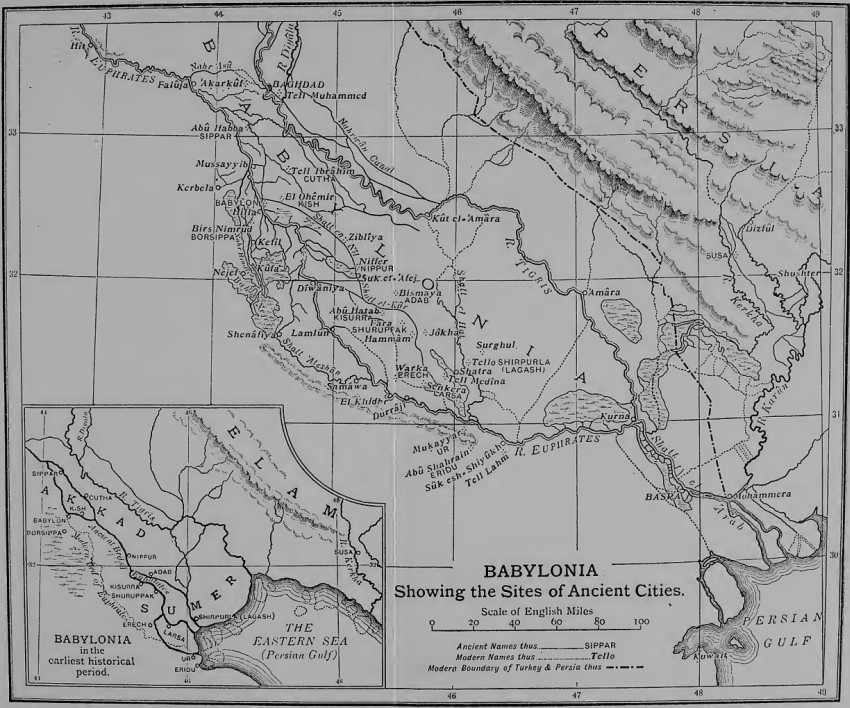
BABYLONIA Showing the Sites of Ancient Cities. [enlarge]