Book 3 — CHAPTER I. BEFORE DANTE.
Reading edition
CHARACTERISTICS OF MEDIÆVAL LITERATURE—ITS ATTITUDE TO CRITICISM—IMPORTANCE OF PROSODY—THE EARLY FORMAL RHETORICS: BEDE—ISIDORE—ALCUIN (?)—ANOTHER TRACK OF INQUIRY—ST AUGUSTINE A PROFESSOR OF RHETORIC—HIS ATTITUDE TO LITERATURE BEFORE AND AFTER HIS CONVERSION—ANALYSIS OF THE ‘CONFESSIONS’ FROM THIS POINT OF VIEW—A CONCLUSION FROM THIS TO THE GENERAL PATRISTIC VIEW OF LITERATURE—SIDONIUS APOLLINARIS—HIS ELABORATE EPITHET-COMPARISON AND MINUTE CRITICISMS OF STYLE AND METRE—A DELIBERATE CRITIQUE—CASSIODORUS—BOETHIUS—CRITICAL ATTITUDE OF THE FIFTH CENTURY—THE SIXTH: FULGENTIUS—THE FULGENTII AND THEIR BOOKS—THE ‘SUPER THEBAIDEN’ AND ‘EXPOSITIO VIRGILIANA’—VENANTIUS FORTUNATUS—ISIDORE OF SEVILLE AGAIN—BEDE AGAIN—HIS ‘ARS METRICA’—THE CENTRAL MIDDLE AGES TO BE MORE RAPIDLY PASSED OVER—PROVENÇAL AND LATIN TREATISES—THE ‘DE DICTAMINE RHYTHMICO’—JOHN OF GARLANDIA—THE ‘LABYRINTHUS’—CRITICAL REVIEW OF POETS CONTAINED IN IT—MINOR RHYTHMICAL TRACTATES—GEOFFREY DE VINSAUF: HIS ‘NOVA POETRIA.’
It may seem a platitude, but it really has much more of the altitudinous than of the platitudinous about it, to say that, before entering on the consideration of mediæval criticism,[457] it is above all things necessary to clear the mind of cant about mediæval literature. For in no division of this work is such a 372caution a more appropriate writing on the door. On the classical |Characteristics of mediæval literature.| and on the modern sections it would be a gratuitous impertinence. In both or them, as here, there is the distinction between linguistic and literary criticism, and the further distinction between literary criticism of different kinds. But in both there are, as there always have been in relation to the classics, and as there sometimes have been in relation to modern literature, a very large number of persons who are aware of the crevasses, and who can cross them.
In mediæval literature such persons are, and for the strongest reasons, much more to seek. Until recently—it is the greatest “refusal” and the greatest misfortune in the literary history of the world—mediæval literature, which some, at least, believe to hold the keys of both ancient and modern, was utterly neglected and contemned. Then, for a time, it was praised without full knowledge, or by divination only. It is now possible to know much if not most of it; but few are they who are content to know it as literature. Not only has it had to go through, all at once, the usual diseases to which literary childhood is obnoxious, the petty grammarianisms which Latin and Greek got over in their own time, the squabbles as to interpretation from which the Renaissance, to a great extent, delivered us in their case, and the criticastry of the seventeenth-eighteenth centuries, but new ailments, diphtherias and influenzas of its own, have arisen in “phonology,” and Heaven knows what else. Even this does not exhaust the list of ills that wait upon its most unhappy state. It has been thought necessary, for political and ecclesiastical reasons, to praise the Middle Ages a little unwisely for a time, and then (more recently) to abuse them with an unwisdom so much greater, that one feels inclined to relapse upon the mood of the real Mr Kenelm Digby of The Broad Stone of Honour, and the imaginary Mr Chainmail of Crotchet Castle. Abused and extolled as “Ages of Faith,” they were really ages of a mixture of logical argument and playful half-scepticism. Regarded with scorn as “Ages of Ignorance,” they knew what they did know thoroughly, which is more than can be said of some others. Commiserated as Ages of Misery, they 373were probably the happiest times of the world, putting Arcadia and Fairyland out of sight. Patronised as Ages of mere preparation, they accomplished things that we have toiled after in vain for some five hundred years. They have in the rarest cases been really understood, even historically. And the understanding which has, in these rare cases, reached their history, has almost always merely scrabbled on the doors of their literature. There are exceptions, of course, some of whom have taught me all I know, and whom I honour only short of the great originals. But they are still exceptions.
Lest any one should accuse me of passing from criticism into dithyrambic, let me acknowledge at once that whatsoever the |Its attitude to criticism.| Middle Ages were or were not, they were certainly not Ages of Criticism. They could not—it has already been hinted—have been anything of the kind; it would have ruined their business and choked their vocation if they had attempted to be so. One mighty figure does indeed show himself in their midst, to pass on the torch from Aristotle and Longinus, through unknowing ages, to Coleridge and Sainte-Beuve. But their very essence was opposed to criticism in any prevalence. The incorrigible and triumphant (though or because wholly unconscious) originality which, in practice, created the Romance, revolutionised the Drama, altered History, devised a fresh Lyric, would have been constrained and paralysed in the face of theory. At no time can we be so thankful for the shortcomings of the School Rhetoric which, if it had been better, might have done frightful harm. Had the Italian critics, with their warpings of Plato and of Aristotle, appeared in the thirteenth century instead of the sixteenth, it might have been all over with us. For the thirteenth century was docile: the sixteenth, fortunately, was not.
In one particular, however, the comparatively scanty criticism of the thousand years from the sack of Rome by Alaric to the |Importance of prosody.| fall of Constantinople before Mahomet, acquires a new significance. We have hitherto said little about the formal criticism of prosody, and for good reasons. The Greek, and in a less degree the Latin, writers on Metric, are interesting, but their interest is hardly literary at all, though it 374has so much to do with literature. Before we have any finished classical literature from them, Greek had by its own euphuia acquired, and Latin had forced on itself by a stern process of gymnastic, systems of prosody which, though in the former case at least easy as nature, were in both cases simply a branch of mathematics. The decay of Greek, the bursting by the strong Italian wine of the earthen or leathern vessel of artificial prosody which had so long contained it, and the rise of the new vernaculars, introduced a perfectly different situation; and the criticism, the tentative unscientific rule-of-thumb criticism, of prosody assumed an importance, at about the beginning of the fifth century of our era, which it has not lost on the eve of the twentieth. But these general questions will be further treated at the close of this Book (see Interchapter iii.) We must now turn to the details of the actual history.
The standard collection[458] of Latin Rhetorics contains four of very early date, speaking from our present point of view. The |The early formal Rhetorics—Bede.| oldest, and, if it were genuine, the most interesting, of all in point of authorship, that attributed to S. Augustine, we shall—for reasons—take last. The others, still of great interest in this respect, are by, or attributed to, the three greatest men of “regular” letters in the whole period (500-1000), except Scotus Erigena—to wit, Bede, Isidore of Seville, and Alcuin.
Bede, who has also left us work of interest on metre,[459] has included in his works a tractate on the Tropes and Figures of the Holy Scriptures which gives us, at least, a glimmer in darkness. His argument is characteristic of his time; but nobody except a churl, and an ignorant and foolish churl, will smile at it. The Figures are the most important things in style; the Scriptures are the most important of books; therefore there must be as good Figures in the Scriptures as in any other book, and better. He uses, to prove his point, seventeen figures with examples. 375In what follows, the chief point of interest is that he first quotes classical examples (chiefly from Virgil) and then Scriptural analogues. But he does not by any means confine himself to the chosen seventeen.
The critical importance of this, for its time especially, can be shown with little labour. The great danger, the great curse, so to say, of uncritical reading, is the taking of things as a matter of course, and the neglect to analyse and ascertain the exact causes and sources of literary excellence. Now, in itself, the comparison of the Bible and the classics, from the hard-and-fast point of view of a scholastic classification of Figures, is a very small matter—and not perhaps even a very good matter. But when these two so different things are compared, from any point of view no matter what, the curiosity is aroused; the mind begins to consider what it really does think fine in this and that; and in happy circumstances and cases a real—in any perhaps some approach to a real—appreciation of the goodness of literature will result. Bede did not intend this—he might have left no pepper to any one who suggested it to him, as a consequence of his work. But such a consequence at least might follow.
The references of that great authority of the early Middle Ages, Isidore of Seville, to Rhetoric are not copious, and are |Isodore.| chiefly made up of the already consecrated tags, while the subject is somewhat mixed with Logic. The orator is the vir bonus dicendi peritus; the parts of Rhetoric are as usual, its kinds likewise. The forensic side is almost exclusively prominent, and style has hardly any attention at all.[460]
Very much more curious is the dialogue with Charlemagne, attributed to Alcuin or Albinus. The emperor-king, in a |Alcuin (?).| rather precious but not inelegant style, beseeches instruction on the point; and his teacher, with grandiosity suitable (at least on the estimate of Martianus) to the subject, protests that the spark of his little intellect can add nothing to the flame-vomiting light of the emperor’s 376genius,[461] but will obey his commands, juxta auctoritatem veterum. In fact, he follows the usual lines, with occasional indulgence in the curiously, and rather barbarically, but sometimes not unpleasantly, ornate style which seems to have pleased the youthful nations of modern Europe. The hard cases of the old Declamations make a considerable appearance—in fact, very much more of the dialogue (which is neither very long nor very short) is devoted to this side of the matter than is the case with Bede and Isidore; and there is even a slight glance into the subject of Fallacies. The passage on Elocution may be scrutinised, not perhaps with very great results, but with some interest and profit, not merely because it directly concerns us, but also because one may at least hope to have the auctoritas veterum qualified by a little personal and temporal colour. From attention to style comes venustas to the cause, and dignitas to the orator. It must be facunda et aperta—that is to say, grammatically correct and clearly arranged. The best authors must be read, and their example followed. In choosing single words (here the characteristic above-mentioned may be thought to appear, while the sentiment, and even the phrase, though of course not new, leads us interestingly on to the great work of Dante) we ought to choose electa et illustria. Metaphor (translatio) brings ornament; as the first object of clothing is to keep the cold out, and then we make it ornamental, so, &c. In fact, metaphor is now quite common—the very vulgar speak of the vines “gemming,” the harvest being “luxuriant,” the crops “waving”: for what can hardly be described by a “proper” word is illustrated by a metaphor. Metaphors make things clearer, as “the sea shivers”; and sometimes save a periphrasis, as “the dart flies from the hand.” But you must be careful only to use honest metaphors; and here the old illustrations recur. Special figures are slightly touched, though Metonymy and Synecdoche occur. The remarks on Composition are very meagre, chiefly deprecating 377hiatus, the juxtaposition of similar syllables, &c. It is not unnoteworthy that much more time is spent on actual delivery, that no illustrations from the poets appear, and that the piece finishes with remarks on religious and moral virtue, of great excellence in themselves, but having very little to do with Rhetoric, save indirectly in the epideictic kind.
But it is unnecessary to hunt further through the formal Rhetorics which appeared during the Dark and earlier |Another track of inquiry.| Middle Ages, though it may be proper to return to the subject in the chapter dealing with Criticism after Dante. Conservative in all their ways, though with a conservatism compatible with limitless expatiation and rehandling, these Ages were nowhere more conservative than in regard to Rhetoric; and Martianus by himself almost represents their manual thereof. The influence of the Marriage of Philology, which is prominent at the middle in the Contention of Phyllis and Flora,[462] appears again at the very close, when Hawes “rang to even-song,” and it will dispense all but specialists from investigation under this head. We have seen how small is its contribution to criticism. We must therefore look elsewhere, and, throwing back a little to St Augustine, himself a Professor of Rhetoric, may endeavour to trace and pick up, often in bypaths, such windfalls of expression about literature as may enable us to compose something like a history, if not of definite and expressed Criticism, at any rate of Literary Taste, century by century, from the fourth to the thirteenth, through a chain of now almost wholly Christian writers.
It is probable, if not certain, that the Principia Rhetorices, which has been already referred to, and which we have |St Augustine a Professor of Rhetoric.| under the name of Aurelius Augustinus, was never written or delivered by the chief of the Latin Fathers, at Tagaste or at Carthage, at Milan or at Rome. The loss to him is certainly not great. The 378treatise, which is short (some ten quarto pages in Capperonnier), is based upon, and apparently to a large extent quoted or stolen from, Hermagoras, Cicero’s Rhodian master. It busies itself first with the nature of Rhetoric, and the calumnies brought against it, and proceeds to the examination of technicalities, not dictionary-fashion, as had lately become usual, but continuously. Perhaps the sole argument (a worthless one enough, for there were probably ten thousand professors of Rhetoric doing the same thing in his time) for the Saint’s authorship is, that no book could better answer to his own bitter description of his worldly profession as “selling words to boys.”
But he was a Professor of Rhetoric, and therefore, in a way, of literature; and the decisive, because in most cases unintentional, evidence of the Confessions[463] touches |His attitude to literature before and after his conversion.| our subject closely and frequently. We can not only see what was Augustine’s attitude to literature even before his conversion, but from his attitude to it after that event we can, without rashness or unfairness, discern the causes which make one huge and important division of late ancient and early mediæval literature—the works of the Fathers of the Church—almost a blank for our special purpose.
That Augustine as a little boy (Conf., I. 13) hated Greek and loved Latin, especially the Latin poets,[464] has nothing in |Analysis of the Confessions from this point of view.| it more marvellous than that any healthy English boy should hate Latin and love (it is to be hoped that he still does love) Robinson Crusoe, and Gulliver, and the Morte d’Arthur, and the Faerie Queene. And there is, no doubt, some allowance to be made for that “megalomania” of repentance which besets the strongly religious, in his regrets for the tears he shed over dead Dido, neglectful of his own death in life as far as the soul was concerned.[465] But his attitude to 379literature, as expressed in this chapter and onwards, is suggestive not merely of religiosity, but of a certain antiquarian priggishness. Will not even the “sellers of grammar” confess that nobody knows when Æneas came to Carthage, while the more learned know that he never did? Which is the more useful, reading and writing per se, or the figments of poetry? Homer, though full of “sweetly idle fiction,” was bitter to him, because he was difficult. And then he returns to the other line, wherein, it must be confessed, he had strong pagan as well as Christian support.
Do not the poets assign vices to the gods, or rather give the divine title to wicked men? (cap. 16.) Does not Terence actually make one of his characters shelter his own sin under Jove’s example? How absurd it was, if not worse, to have to learn by heart the wrath of Juno at her ill-success in thwarting Æneas! Nay, he proceeds to further altitudes. Grammar is more carefully observed than the Law of God. Rhetoric helps you to do harm to human beings. His own father spent more money than he could afford on sending him to Madaura and Carthage for education, but was wholly indifferent to his spiritual welfare (Book II. cap. iii.) His success in the Rhetoric school (III. 2) filled him with wicked pride. He even liked stage plays; was so wretchedly mad as to grieve at their falsehoods and shadows, and so wicked as to sympathise with the imaginary but immoral enjoyments of lovers. He read Cicero’s Hortensius with admiration, but for its wisdom, not its form. His own professorship of Rhetoric was a “covetous selling of tricks to conquer,” though he himself would not fee a wizard to gain a dramatic prize. He wrote a treatise, De Apto et Proprio, which we (like him) have not, but which was evidently, if criticism at all, criticism in the abstract. Although he refers often (e.g., V. 7) to his lectures on literature, he gives us hardly a notion of his literary preferences, estimates, views; and his Manichæan difficulties, his agonies about the origin of evil, 380seem to have drawn him further and further from anything but a mere professional connection with the subject. In his high eulogium of Victorinus (VIII. 2) it can hardly be said that he says a word about his literature. In all his allusions to his Chair he constantly refers to the oratorical, or rather the debating and advocating, not the literary side. And what to me seems the most conclusive and remarkable point of all, the long discourse of sinful, or at least worldly, pleasures with which Book Ten closes, contains not a reference to the pleasures of literature, which, as we know from the beginning, he did think ungodly. They have apparently not importance enough to be taken into consideration, not merely in connection with the pleasures of sense (where there might be a reason for their omission), but along with curiosity, love of praise, fear of blame, vainglory, self-conceit, and other purely intellectual temptations. The boy had been charmed by Virgil and Terence—wicked charms he acknowledges—but the man, though he certainly does not mean to deny their wickedness, has simply put them away as childish things.
I have thought it well to be somewhat particular in regard to this appearance of what we may call the Puritan attitude to |A conclusion from this to the general patristic view of literature.| literature, in its earliest and perhaps almost its greatest exponent. It is of course not entirely new—nothing indeed is ever that; and it is not merely foreshadowed, but to a certain extent fathered, by the Platonic views of poetry, and the Academic and Pyrrhonist views of literature generally. But these older things here acquire an entirely new character and importance—a character and an importance which can hardly be said to be merely matters of history yet. Moreover, as I have hinted above, the attitude is that—varied only by the personal factor—of all the Fathers, more or less, until, and for some time after, the complete downfall of Paganism, and of the great majority of ecclesiastical writers for a thousand years later still.
Its justifications, or at least its excuses, have been often put, and must in great measure be allowed. Not merely had it, as has been said, a most respectable pedigree in purely Pagan philosophy, but, as a fighting creed, it was almost indispensable 381to the Church Militant. Literature, and Heathen religion, and the Seven Deadly Sins, were, it might even seem, inextricably connected. If you wrote an epic you had to begin with Jove or some other false god; if you wrote a parcel of epigrams it was practically de rigueur to accuse somebody of unnatural vices, or affect a partiality for them yourself. But even if things had been better—if there had been no danger of relapses in faith, and none of the worst kind in practice—it was inevitable that the poor Fine Arts should seem vain and trifling exercises to that intense “otherworldliness” which had come (as no doubt it will at some time or other have to come again) as an alternative to secular absorption in things secular. To Augustine, as to monk and homilist long afterwards, not merely was the theology of literature false, and its morals detestable, but it was—merely as occupation—frivolous and puerile, a thing unworthy not only of a Christian but even of a reasonable being. We shall have to count with so much of this in the present book (and not there only) that it seemed worth while to take note of it at the outset. It probably did no great harm, for, as has been repeated more than once, what was wanted was a new development of literature, as fresh and as spontaneous as possible: and this might have been more hindered than helped by too great a devotion to the old. Meanwhile the Seven Liberal Arts were not much interfered with, either by the Seven Deadly Sins or by their opponent Virtues, and the mere necessities of preaching and homily-writing, of controversy with heretics, and of historical summaries, obliged to practise in the more scholastic branches of literature itself. As for the less scholastic, they came soon enough, and more than well enough, as the rains of heaven descended and the wind of the Spirit blew—the Northern wind.
In such a state of mind literary criticism, though the fact is not even yet universally recognised, is practically impossible. It is the furthest stage, and to some extent the converse, of the famous fallacy—stated once by a critic[466] of great though one-sided 382ability, and probably accepted, tacitly or implicitly, by the majority of critics still—that a man “must take pleasure in the thing represented before he can take pleasure in the representation.” Here the assumption is that, if you take pleasure in the representation, you take pleasure in the thing represented. And there is more also. Not only are the subjects of literature in part men or devils masquerading as gods, in part men committing more or less shameful acts; but, even when they are in themselves unobjectionable, they are idle fiction, there is no truth or usefulness in them. Men with immortal souls to be saved or lost should at the worst be horrified at touching such pitch, at the best be ashamed of burdening themselves with such trumpery. Great as is St Augustine’s genius for producing literature, one doubts whether he had much taste for estimating it. The story of the famous pears, which he stole, comes in rather fatally pat. He stole them, he says, not because he wanted them or liked them, but because it was naughty to do it. This, though no uncommon mood, is the worst possible for the critic. It leads him, in the same way, to praise a book or an author, not because he really likes them, but because they are naughty—the reverse of the other fallacy and its punishment.
Taking this fact into consideration, and adding to it the facts already glanced at,—the sickness incidental to the moulting of language, the want of helpfulness in such ancient critics as were likely to fall in the writer’s way, the increasing scarcity, for hundreds of years, of books, and other things of the same kind,—it will be seen to have been not nearly but wholly impossible that the Dark and the Early Middle Ages could produce much criticism—or any, strictly speaking. The importance of what they did produce, with the much greater importance of the wholly new material they offered (to be long slighted by the critical world), will be considered at length in the Interchapter succeeding this Book. In the course of the Book itself we shall have to consider a few rhetorical and art-poetical treatises, entirely in Latin, between the sixth century and the thirteenth, the solitary document of the De vulgari Eloquio at the central point of the history, and perhaps some 383more Rhetorics and Poetics, now dealing in increasing measure for moderns with the modern tongues, between 1300 and 1500. But we shall derive most of our material, and almost all the more interesting part of it, from incidental expressions on literary matters in books not professedly rhetorical or critical. And, taking century by century and beginning with the Fifth, we are lucky in finding at once, in the latter part of this, an interesting and half-famous writer who stands at the gate of the Dark Ages, but is something of a Janus, avowedly looking back on classical times, and, Christian as he is, admiring classical writers.
The literary references in the works of Sidonius Apollinaris[467] are pretty numerous, and no small proportion of them possesses |Sidonius Apollinaris.| direct or indirect critical bearing. On the rather numerous occasions when the good count-bishop puts a little thing of his, in easy or flebile verse, into his letters, he by no means seldom prefaces or follows it with a little modest depreciation; he has not a few references to books and reading, and now and then he criticises in form. We could therefore hardly have a fairer chance of knowing what, at the very eleventh hour and fiftieth minute of the classical period, was the general state of literary taste in the West. That Sidonius was a very well-read man, not merely for his time, and that he had access not merely to most of the things that we have but to many that we have not, is sufficiently established by this evidence. And that he did not merely read but marked—that he endeavoured to shape a style for himself from his reading—is equally certain. Nor would it be any argument against his critical competence that this style is, if not exactly harsh, or even very barbarous, marked by the affectation and involution which seem to beset alike periods of immaturity and periods of decadence, and which were specially likely to affect a period of both at once.
But it is not easy to rank him very high. His critical utterances have a besetting tendency to run off into those epithet-tickets which have been referred to more than once, and which were the curse of the routine criticism of antiquity. Still, he is very 384interesting both for his position and for his intrinsic characteristics: and a selection from the passages bearing on the subject which I have noted in my reading may, as in former cases, be of service.
The very dedication of the Epistles to Constantius shows him to us as modestly endeavouring to follow, if without presumptuous footsteps, “the roundness of Symmachus, the discipline and maturity of Pliny,” for he will not say a word of Cicero, referring only to an odd criticism of that master[468] by Julius Titianus, and to an expression of the school of Fronto, “the ape of the orators,” applied to Titianus himself. The description[469] of the villa at Nîmes which, from Gibbon’s[470] introduction of it, is perhaps better known than anything else of Sidonius, includes that of a library containing religious works arranged in cases among the armchairs of the ladies, and a collection of profane authors near the men’s seats. Thus not merely Augustine, Prudentius, and the Latin translation of Origen by Rufinus, but Varro and Horace, received attention; while the excellence of Rufinus’ work is brought out by a critical allusion to the translations by Apuleius of the Phædo, and by Cicero of the De Corona.
The metrical questions which were becoming of such immense critical importance, in consequence of the impingence of vernacular accent and rhythm on Latin, are frequently touched upon by Sidonius, not, of course, with a full (that was impossible), but with a fair, sense of their magnitude. He thinks, justly enough (Ep. ii. 10),[471] that “unless a remnant, at any rate,[472] vindicates the purity of the Latin tongue from the rust of barbarism, we shall soon have to bewail it as utterly abolished and made away with.” And then he justifies himself for writing a “tumultuous poem” on the church of “Pope”[473] Patiens at Lyons in hendecasyllabics (which he seems oddly to call “trochaic triplets” here, as looking at the end only), because 385he wished not to vie with the hexameters of the eminent poets Constantius and Secundinus.
There is a glance in iii. 3,[474] which may excite indignation in the apostles of the “Celtic Renascence,” at the nobility of |His elaborate epithet-comparison| his correspondent “dropping its Celtic slough” and “imbuing itself, now with the style of oratory, now with Camenal measures.” This was his brother-in-law Ecdicius, son of the Emperor Avitus. The epithets come now in single spies, now in battalions. In a very interesting letter (iv. 3), addressed Claudiano suo (not, of course, the poet, who was dead before Sidonius was born), he says that if the “prerogative of antiquity” does not overwhelm him he will refuse, as equals, the gravity of Fronto and the thunder of the Apuleian weight; nay, both the Varros, both the Plinys. Then, after an equally hyperbolical praise in detail, he addresses Claudian’s work as “O book, multifariously pollent! O language, not of a thin, but of a subtle mind! which neither bombasts itself out with hyperbolical effusion, nor is thinned to tameness by tapeinosis!” And later:—
“Finally, no one in my time has had such a faculty of expressing what he wished to express. When he[475] launches out against his adversary he claims, of right, the symbola of the characters and studies of either tongue. He feels like Pythagoras, he divides like Socrates, he explains[476] like Plato, he is pregnant like Aristotle; he coaxes like Æschines, and like Demosthenes is wroth; he has the Hortensian bloom of spring, and the fruitful summer[477] of Cethegus; he is a Curio in encouragement, and a Fabius in delay; a Crassus in simulation, and in dissimulation a Cæsar. He ‘suades’ like Cato, dissuades like Appius, persuades like Tully. Yea, if we are to bring the holy fathers into comparison, he is instructive like Jerome, destructive like Lactantius, constructive like Augustine; he 386soars like Hilary, and abases himself like John; reproves like Basil, consoles like Gregory; has the fluency of Orosius, and the compression of Rufinus; can relate like Eusebius, implore like Eucherius; challenges like Paulinus, and like Ambrose perseveres.”
As for hymns "your commatic is copious,[478] sweet, lofty, and overtops all lyrical dithyrambs in poetical pleasantness and historical |and minute criticisms of style and metre.| truth. And you have this special peculiarity, that while keeping the feet or your metres, the syllables of your feet, and the natures of your syllables, you can, in a scanty verse, include rich words within its limits, and the shortness of a restricted poem does not banish the length of a fully equipped prose phrase: so easily do you manage, with tiny trochees and tinier pyrrhics, to surpass, not merely the ternaries of the molossus and the anapæst, but even the fourfold combination of the epitrite and the pæon."
In this extravagant, but really interesting and important, passage, we may probably see the critical taste of the meeting of the fifth and sixth centuries—of the late classical and the Dark ages, at its best and most characteristic. Although the mere taste has lost the power of distinction, it retains distinguishing formulas. It has learnt, only too much by heart, certain stock ticket-epithets for distinguished writers, and it applies them fearlessly and, as far as rote goes, well. Secondly, we see that a not unimportant habit of comparison had grown up between the old Pagan and the new Christian literature. Thirdly, that Sidonius was well aware that all poets of his time by no means kept “the feet of their metres, and the syllables of their feet, and the natures of their syllables.” And fourthly, that a lively sense of metrical quality—of the effects that a poet can get out of metre—existed in him. Fortunately, this sense survived and flourished: and it had almost everything to do with the formation of the prosody of the new languages.
387The promise of the twelfth epistle of the same book,[479] which opens with a picture of the poet-bishop’s son reading Terence (the Hecyra), while his father expounded the parallel passages in Menander’s Ἐπιτρέπων is not maintained. But the words, Gaius Tacitus unus ex majoribus tuis, opening another letter[480] to a certain Polemius, bring us once more close to literary matters, though only to hear that (in a characteristically Sidonian calculus) Polemius might vanquish, not only Tacitus in oratory but Ausonius (another, and perhaps more authentic, ancestor) in verse. If we had a few more details, the letter to Syagrius (v. 5) on his acquired skill in German speech[481] would be priceless; as it is, it is rather tantalising. But yet another list[482] of flattering comparative tickets is valuable because it refers in the main to lost authors. The diction of Sapaudus is tam clara tam spectabilis, that “the division of Palæmon,[483] the gravity of Gallio, the copiousness of Delphidius, the discipline of Agroecius, the strength of Alcimus and the tenderness of Adelphius, the rigour of Magnus and the sweetness of Victorius, are not only not superior but scarcely equal.” And then, with a sort of apology for this hyperbolical catalogue, he cites the “acrimony” of Quintilian and the “pomp” of Palladius as perhaps comparable. The sixth and seventh books are, the first wholly, the second mainly, occupied with letters to bishops, of whose interest in literature Sidonius might not be sure, or to whom he might not care to parade his own. But the eighth[484] opens with one of those references to the nasty critics, the envious rivals and derogators, who play the part of Demades to Demosthenes and Antony to Cicero, and of whose likes we have perhaps heard from writers later than the Bishop of Clermont. Their “malice is clear while their diction is obscure,” a play, of course, on the double meanings of clarus as “clear” and “illustrious,” and of “obscure” as still observed. And the third letter of the same has reference to an accompanying 388translation of the Life of Apollonius, not straight from Philostratus, but as Taxius Victorianus did it from a recension by one Nicomachus—which the author depreciates as, by reason of haste, a confused and headlong and “Opic” translation, thrown out in a rough-and-ready draft.
The eleventh[485] contains a much longer critical passage, of something the same character as that quoted and analysed |A deliberate critique.| above. The death of a certain Lampridius gives Sidonius an opportunity of copying one of the little things above noted, which had been composed in the lifetime of its subject, instead of an elegy, and of praising the Ciceronian, Virgilian, Horatian, and other accomplishments of that subject as usual. A prose eulogy follows—a passage among the best of its author’s for the real feeling and force of its descant on the necessitas abjecta nascendi, vivendi misera, dura moriendi, in which we hear approaching the true Mediæval tone. The praise is by no means unmixed as far as character goes; it only approaches panegyric when it comes to the literary part. In orations, it seems, the defunct was “keen, round, well composed and well struck off,”[486] in poems “tender, good at various metres, and a cunning craftsman.” His verses were “very exact but singularly varied both in foot and measure,” his hendecasyllables were “smooth and knotless,” his hexameters “detonating[487] and cothurned (fitted for the buskin)”; his elegiacs “now echoing, now recurrent, now joined at end and beginning by anadiplosis” (the “turn of words” in which the decadence bettered Ovid). In his “ethica dictio” (probably equal to “ethopoeia”) he did not use words as they came, but selected “grand, beautiful, carefully polished” ones.[488] In controversy he was strong and nervous, in satire careful[489] and biting, in tragic passions fierce or plaintive, in 389comic urbane and multiform, in his fescennines showing the bloom of spring (we know this Euphuism) in his words, the warmth of summer in his wishes; watchful, economical, and “carminabund”[490] in bucolics, and in Georgics so rustical as to have nothing clownish about him. His epigrams aimed not at abundance but point; they were not shorter than a distich or longer than a quatrain; they were not seldom peppered, often honeyed, always salt. He followed Horace in swift iambics, weighty choriambics, supple Alcaics, inspired Sapphics. In short, into whatever form of expression his mind carried him, he was subtle, apt, instructed, most eloquent, a swan like to soar, with wings only inferior to those of Horace himself and Pindar. And envious fate has left us not a note of this swan’s song![491]
We may close the account of the Sidonian criticism in prose with a mere reference to the curious list of symbolic gestures and features of the philosophers in ix. 9. His poems need not detain us; but reference should also be made to the verse enclosure in Epist. ix. 13, containing glosses on different metres[492] and poetic forms; to the exposition of “recurrent” verses in the succeeding letter, as well as, in the Carmina, to the long list, with critical remarks, of authors in ix.; to the very interesting, and to this day sound, justification of the introduction of exotic words and neologisms when necessary, in the prose preface to xiv.; and to a crowd of literary references in xxiii.
I have been somewhat copious in dwelling on the bishop-count-poet, because he is infinitely the most valuable document |Cassiodorus.| that we have as to the highwater-mark of the state of critical knowledge and opinion with which the Dark or Earlier Middle Ages started.[493] We have in the last 390book examined the chief text-book of formal grammar and Rhetoric, that of Martianus, with which they were already provided, and we need only glance at two other standards of theirs, Boethius and Cassiodorus, who come close in time to Sidonius, and probably to Martianus likewise. Cassiodorus wrote, like Capella, on the Liberal arts, though in a manner at once informal and less fantastic, and his influence in encouraging the frequenters of the mediæval scriptorium to copy ancient manuscripts deserves eternal gratitude. But I have not yet discovered in him much material for our special inquiry.
Nor is the great name of Boethius here as great as elsewhere. He wrote, indeed, on rhetorical loci, and the author of the |Boethius.| metres in the Consolatio[494] deserves no mean place in creative literature. But if he had taken any really keen critical interest in books, for their form as distinguished from their matter, it must have appeared in the Consolatio itself. On the contrary, as everybody knows who has ever looked at the book, it begins with Philosophy packing the Muses off as “strumpets and mermaidens” in a tone half-suggestive of Plato a little the worse for Augustine. And though the “suasion of sweetness rhetorien” is afterwards patronisingly spoken of (Book II., Prose i.), and Homer with the honey-mouth, Lucan, and others are quoted, yet Rhetoric is expressly warned that “she goeth the right way only when she forsaketh not my statutes.” Moreover, the beautiful metre Vela Neritii ducis is a merely moral, and almost merely allegorical, playing on the story of Circe.
We can, however, see from the comparison some useful 391things. The stock of actual erudition possessed by at any rate some persons was considerable; but the number of these persons was not very large, and both the |Critical attitude of the fifth century.| “remnant” itself[495] and its accomplishments were likely to decline and dwindle. The new vernaculars were already assuming importance; men were likely[496] to be chosen for positions of ecclesiastical eminence (almost the only ones in which study of literature was becoming possible), because of their bilingual skill, or to be driven by such positions to study of the vernacular. And this bilingualism was likely not merely to barbarise even their Latin style, but to draw them away from the study of classical Latin, and still more Greek. In regard to the latter, we see further, from two passages of Sidonius quoted above, that persons of very considerable education were apt to use translations of the Greek fathers, as well as of Pagan writings, in preference to the original. Yet again we see that even the most accomplished scholars of the time (and Sidonius himself may certainly claim that distinction) were, on the one hand, more and more acquiescing in what, to borrow Covenanting phraseology, we may call the “benumbing, deadening, and soul-destroying” list of ticket-epithets: and, on the other, were gradually losing a sense of the relative proportions of things—of the literary ratio of patristic to classical literature, and of the productions of their own day to those of the great masters, whether classical or patristic. And thirdly, we see that even so careful a metrical student as the Bishop of Clermont was succumbing to the charm of “recurrent” verses, acrostics, telestics, and all the rest of it.
On the other hand, this process of “losing grip” is very far from the state in which we find it by the time that we are in full Middle Age: and, for good as well as for evil, the glorious hotch-potch of that period is still distant. Virgil is not yet an enchanter or anything like it: he and his works are perfectly well placed in their proper literary and historical connections. If, on the side of form, there is perhaps already a rather perilous tendency to see no very great difference between Orosius and 392Livy, there is none to put Dares (who probably did not exist) on a level as an authority with Homer, or above him, in point of matter. And while the fables about Alexander probably did exist, men of education did not think of mixing them up with the facts.
The most favourable sign of all, however, is that metrical solicitude which has been already more than once referred to. The anxiety which Sidonius shows to suit his metres to his subject would do credit to a much better poet in a much more “enlightened” age; and it is surely not fantastic to see in his constant reference to success or failure in adjusting “syllables to feet, and feet to measures,” that the difference of the classical prosody from the newer, half-accentual quantification even in Latin, and from the vernacular rhythms sounding all over Europe, was forcing itself, consciously or unconsciously, on his mind. And it cannot be repeated too often that to construct and perfect new prosodies, in Latin and in the vernaculars alike, was perhaps the greatest critical-practical problem that the Middle Age had before it.
The sixth century has even fewer lights among its gathering gloom; in the beginning and at the end of the seventh a kind of rally of torches is made by Isidore and Bede. |The sixth—Fulgentius.| There are, however, two authors at least in the sixth who are full of significance, even if that significance be too much of a negative kind. These are the African grammarian Fulgentius, with his Expositio Virgiliana, probably in the earlier half, and the poet-priest Venantius Fortunatus, certainly in the later.
Fulgentius[497] holds something like a position in the history of Allegory, being not infrequently breveted with the rank of go-between, or the place of fresh starting-point, between the last 393development of the purely classical allegory in Claudian, and the thick-coming allegoric fancies of the early Christian homilists and commentators, which were to thicken ever and spread till the full blossoming of Allegory in the Romance of the Rose, and its busy decadence thenceforward. Unluckily, Allegory was, as we have seen, no novelty in criticism; but rather a congenital or endemic disease—and Fulgentius only marks a fresh and furious outburst of it. Virgil, a favourite everywhere in the late Roman world, was, it has been said, an especial favourite in Africa: and Fulgentius would appear to have given the reins, not exactly to the steed, but to the ass, of his fancy, in reference to the Mantuan.
The writings of the Fulgentian clan (none of which, fortunately, is long) consist of (1) three books of Mitologiæ (Mythologiæ), of (2) the Expositio Virgilianæ Continentiæ |The Fulgentii and their books.| secundum Philosophos Morales which is our principal text, and of (3) a shorter Expositio Sermonum Antiquorum, attributed to Fabius Planciades Fulgentius, who was probably of African birth, and probably lived in the early sixth century; of (4) a tractate, De Ætatibus Mundi et Hominis, attributed to Fabius Claudius Gordianus Fulgentius; and (5) of a note on the Thebaid of Statius, attributed to Fulgentius, Saint and Bishop. The personalities of these persons are to the last degree unknown; and it is very uncertain whether they were in reality one or two or three. The books we may best cite as 1, 2, 3, 4, 5.
4 is far better written and more sensible than the others; but it has nothing to do with our subject. 3 is a short list (sixteen pages and sixty-two articles) of notes on out-of-the-way words (abstrusi sermones), where it is curious to find among really unusual locutions—friguttire, suggrundaria, tittivilitium, and the like—such to us everyday ones as problema and auctio. 2 and 5 concern our business, equally in substance, unequally in importance and extent, and to understand them both, it is desirable to read 1 at least cursorily, although it, like them, is a tissue of appallingly barbarous Latin—enshrining allegorical interpretations as ridiculous as the most absurd in the Gesta 394Romanorum,[498] and derivations which in their sheer serious insanity surpass the most promising efforts of the clever and sportive schoolboy in the same kind. As no one, I think, who reads this book will regard me as a detractor of the Dark and Middle Ages, I may speak here without fear and without favour.
Having surveyed Mythology from the point of view of the most grovelling allegory, etymologically assisted by such fancies as that Teiresias (Teresias in his spelling) is derived |The Super Thebaiden and Expositio Virgiliana.| from theros and æon, meaning “eternal summer,” and that Ulixes Græce (it will go near to be thought shortly that Fulgentius knew less Greek than Shakespeare) is “quasi-olon xenos id est omnium peregrinus,” Fulgentius seems to have turned to literature. If he also wrote the note on the Thebaid attributed to the Sainted Bishop (and it is very much in the same style), he confined himself to a brief argument of the story, with a few etymologies, such as “Creon quasi cremens omnia,” and a short preface. In this he tells us that he “can never without grand ammiration[499] retract the ininvestigable prudence of the poets, and the immarcescible vein of their genius”: and having thus prepared rejoicing for the heart of the Limousin scholar nine hundred years ahead, he sets the fashion to Lyly by observing “Diligit puer nucem ad ludum integram: sapiens autem et adultus frangit ad gustum.” But this, though not insignificant, is a slight thing.
The Expositio Virgiliana or Virgiliana Continentia (this word being late Latin for “contents”) is itself not long: it fills, with apparatus criticus, some five-and-twenty pages. If it were not written in a most detestable style, combining the presence of more than the affectation and barbarism of Martianus with a complete absence of his quaintness and full-blooded savour, it would be rather agreeable to read: even as it is, it is full of interest. We catch Virgil in mid-flight through the void, from that position 395of universal exponent of sober literary art which we have seen him occupy with Macrobius, to his rank as beneficent enchanter a few centuries later. The Bucolics and Georgics are full of such Phisica secreta, such misticæ rationes, that they are actually dangerous to touch. He has passed over the interna viscera nullius pæne artis in these books. In the first Eclogue he has physically summed up the three lives (active, contemplative, and enjoying); in the fourth, he is a prophet; in the fifth, a priest; in the sixth, partly a musician, partly a physiologist; in the seventh, botanicen dinamin tetigit, he has touched the power of botany;[500] in the eighth he has pointed out magic and the apotelesmatic of the musician; combining this with euphemesis,[501] in the ninth.
In the first Georgic he is throughout an astrologer and then a “eufemetic”; in the second, a physiologist and medical man; in the third, wholly an aruspex; and in the fourth, is to the fullest musical. But Fulgentius will not meddle further with the details of these books; and, after a breathless and intricate prologue, attacks the Æneid in a manner easily to be conjectured from what has been said. Every word, every syllable almost, of the first line, is tortured to yield an allegory; the account being thrown into the form, first of a dialogue between poet and interpreter, and then of a long speech from the former. Achates is “Græce quasi aconetos id est tristitiæ consuetudo.” Iopas is “quasi siopas id est taciturnitas puerilis.” The progress of the story is the growth of human life. The wanderings of the first three books are the tales that amuse youth; the fourth shows how love distracts early manhood; the fifth displays it turning to generous exercises; the sixth is deep study of nature and things; the rest active life. And if anybody wishes to know why Turnus’ charioteer was called Metiscus, “Metiscos enim Græce est ebriosus.”
396It cannot be necessary to say much of this, which speaks for itself; it is, as we said at first, the intellectus (or rather the want of intellect) sibi permissus and expatiating unchecked. Qui l’aime le suive!
Venantius Honorius Clementianus Fortunatus[502] (for a plethora of names was as characteristic of the Latin as of other decadences) is a much more interesting figure, and his |Venantius Fortunatus.| critical importance, if less direct, is not really inferior. He goes in the general literary memory with Sidonius, as the twin-light of not yet wholly barbaric Gaul; and he had probably more original poetic gift than his predecessor. At least, I can find nowhere in Sidonius anything approaching the throb and thrill of his two great and universally known hymns, Pange Lingua and Vexilla Regis—the earliest, perhaps, to attain that ineffable word-music of hymn-Latin, which is entirely independent of mere tune, mere setting, and which is not only equal to, but independent of, the choicest sound-music of either ancient or modern verse. He was also a livelier writer; and though he has made even further progress in the direction of affectation and bombast, these things rather add a piquancy, if not to his painful official praises of Queen Brunehault, at any rate to his expression of his half-pious, half-human affection for Radegund the Queen and Agnes the Abbess, his account of the sad results when the hospitable Mummolenus[503] would make him eat too many peaches, and his admirable description of his sail on the Moselle.
Moreover, he was certainly accomplished in all the learning of his time. He could even write very fair, if not delightful, sapphics. And he is not to be treated with the scornful contempt which some have heaped upon him, merely because he composed (with an amount of labour which makes one’s brain and eyes ache to think of) acrostics and cross-poems of various degrees of artificiality. He has one marvellous structure of the latter kind,[504] in which not only do the frame-letters of the 397scheme make sense, but correspondences, interwoven in the text trace out, also in sense, a sort of cross patée, as thus:—
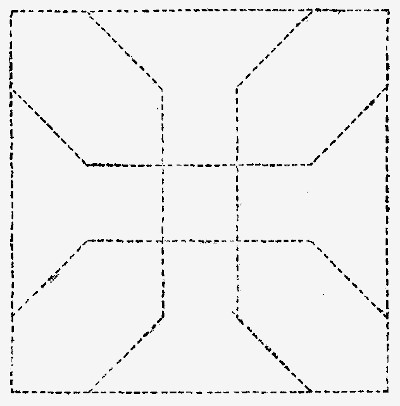
Here the dots represent (though they are fewer) letters doing double duty, as part of sentences straight across, and in the lines of the figure itself. “The grace and liberty of the composition,” as some one says, may indeed be lost in such intricacies, yet are they not in themselves unliterary as a pastime.
It must, however, be most frankly confessed that the literary expressions and references which we find in Fortunatus are (in the sense in which the word has so often to be used in this part of our work) “tell-tales.”
The Preface of his Poems,[505] addressed to Pope Gregory, opens with a somewhat emphatic and inflated laudation of the great men of letters of old, who were, we learn, "provident in invention, serious in partition, balanced in distribution, pleasant with the heel of epilogues, fluent with the fount of bile, beautiful with succise terseness, adorned from head to foot [literally "alike crowned and buskined"] with tropes, paradigms, periods, epicheiremes," which gives us a pretty clear idea of what seemed to Fortunatus to be literature. It contains also some touches of the “Italic”[506] writer’s contempt of those who “make 398no distinction between the shriek of the goose and the song of the swan,” who love “the harp buzzing barbarous leods.” But far fewer direct references to literature occur in these poems than in those of Sidonius. In II. ix.,[507] to the Parisian clergy who bade him resume his long-abandoned lyre, he takes it up purely as the hymn-writer, not the man of letters. There is more of the attitude of the latter in the prose epistle (III. iv.)[508] to Bishop Felix, but it does not come to very much. In the tenth of the same book,[509] the same bishop (who had, it seems, turned a river from its course) receives a complimentary reference to Homer, but none to Herodotus. Yet another bishop (of the undeniably Frankish name of Bertechramnus) is complimented, in the eighteenth, on his epigrams.[510] But Fortunatus, after much applause, does not fear (let us hope that the Frank was more placable than his brother prelate of Granada later) to add—
“Sed tamen in vestro quædam sermone notavi
Carmine de veteri furta novella loqui,
Ex quibus in paucis superedita syllaba fregit
Et pede læsa suo musica clauda gemit.”
Let us congratulate Venantius on not yielding to the heresy of the “extra-metrical syllable,” which has deceived some of the very elect in more illuminated days. Some slight glimmers are given by the flattery,[511] more elaborate than anything yet noticed, of still another bishop, Martin of Gallicia: and in V. iii.[512] we get a ticket-list of the same kind (though shorter and slighter) as those of which Sidonius is so prodigal. In this, after Athanasius has been designated fortis, Hilary clarus, Martin dives, and Ambrose gravis, he adds the distich—
“Gregorius radiat, sacer Augustinus inundat,
Basilius rutilat, Cæsariusque micat.”
The epistle to Syagrius of Autun (V. vi.)[513], which introduces another elaborate cross-poem, contains a vindication of it, by a twist of the Horatian tag to the effect that as painting and poetics are so like, why should you not combine them in such 399a fashion? After which the intricacies of the poem itself are carefully explained. The reference to “us Romans” in the poem to Sigebert (V. ii. 98)[514] (where he compliments the king on his skill, Sicambrian as he is, in the Latin tongue) suggests that the writer would have been scantly grateful for the inclusion of his work among “Monumenta Germaniæ.”
The genuine prose works of Fortunatus, consisting only of a few Saints’ Lives, do not promise much; but there is at least one remarkable passage in them. It is the opening of the Life of Saint Marcellus[515] in which his customary deprecation takes this form. “Illustrious orators of the most eloquent genius, whose speeches are distinguished by varied flowers, and shadowed by the vernal tendrils of eloquence, are wont deliberately to seek common causes and sterile matter, that they may show themselves as possessing an inexhaustible flow of speech on the smallest subjects, and as able to inundate the dryest themes with their internal founts of rhetoric. Men not so clever cannot even treat great subjects,” &c.
And this, falling in with the other glimpses we have obtained, gives no misty view of the critical standpoint of this agreeable writer. The literary nisus, the literary tone, are fairly well maintained; there is no glaring lack of positive knowledge; and neither style nor sense shows anything like the degradation of Fulgentius. But Fortunatus, far more than Sidonius, is, in the good old phrase, “to seek” in the general field of matters literary, and especially in its critical quarters. Glitter and clatter, tinsel and crackers, are in prose, if not in verse (he is far more sober there), too much his ideals. The curse of the ancient formal Rhetoric has so far outlasted its blessings, that the expression of opinion last quoted would suit, and almost exaggerate, the position of the worst of the old declamation-makers. As to prosody, he has to some extent, if not wholly, “kept the bird in his bosom,” and his affection for subtleties in arrangement is, as has been said, not so wholly to his discredit as Mr Addison and Mr Pope thought. But it is rather a dangerous support; and he has very few others.
400As Fulgentius and Venantius have stood for the sixth, so Isidore and Bede[516] may stand for the seventh century, while Bede’s flourishing time stretches into the eighth.
Isidore’s treatment of Grammar[517] is much fuller than his handling of her showier sister Rhetoric.[518] It fills the whole of |Isidore of Seville again.| the First Book of the curious Encyclopædia called the Origines, and is much more liberally arranged than the usual grammatical treatise, including a great deal of applied matter of various kinds, visibly filching Tropes and Figures from Rhetoric herself, and, besides dealing with Prosody, even devoting sections to the Fable and to History under more than one head. There is much interesting (if not for us strictly relevant) matter in the earlier chapters, where we read that literæ are quasi legiteræ, and that Greek and Latin appear to have arisen out of Hebrew. The vitia, from barbarism and solœcism downwards, are pure Rhetoric, containing, as they do, things like tapeinosis and amphibology, with which Grammar, as such, has certainly nothing to do; and they are near the rhetorical side of Criticism herself. The Metaplasms which follow, as purely verbal, may be claimed by the elder sister, but the schemata and the tropi are unquestioned usurpations. And thereafter, with Chapter Thirty-Seven De Prosa, we are almost on our own ground.
Isidore, if not (save in his title) very original, is judicious in his selections from the public stock, and puts them together in a much more useful fashion than some authors of “composition-books” a good deal his juniors. Prose is “a straightforward form of speech freed from metre.” Metres (he has given “feet” a good deal earlier) are the fixed arrangements of feet which constitute verse. Their names are classified and accounted for, as are, subsequently, the chief forms of poetry in which they appear. The origination of these is claimed for various sacred 401persons—of the Hymn for David, “who was long before Ennius,” of the Epithalamium for Solomon. Not a few of the definitions, though desultory and oddly selected, are noteworthy, and the considerable space given to that of the Cento is characteristic of the age.
Fable, as has been said, has a section to itself, an honour which is prophetic of—and considering Isidore’s influence may, to some extent, have caused—the great attention paid in the Middle Ages to that kind. The History sections, though four in number, are much shorter—indeed, scarcely so long together as the single one allotted to Fable, which fact also is true, as the needle is, to the pole of the time. It is much better, Isidore thinks, that a man should only write of what he has actually seen. But History is not useless reading. Strictly, it is of our own time; “Annals” of the past; while Ephemeris is a diurnal and Kalendarium a monthly history. Finally the book ends with a contrast of historia, argumentum, and fabula. The first is of true things really done; the second of things which, though they have not been done, might be; the third of things which neither have been done nor can be, because they are contrary to nature. Here argumentum clearly looks towards oratory: with regard to the difference between historia and fabula, it must be admitted that the ages which followed very scrupulously forgot their teacher’s warning.
But even this does not exhaust our indebtedness to a very agreeable work, full of good sense and sound learning. The Sixth Book, which begins with an account of the Old and New Testament, diverges to the consideration of books generally. A note on famous libraries leads Isidore to record the chief authorities on Biblical Exegesis, from whom he passes to Latin libraries, to others (those of the Martyr Pamphilus and of Jerome), and thence to authors. Much writing attracts him first: and Varro, the Greek Chalcenterus, Origen, and St Augustine are picked out, the not entirely single-edged compliment being paid to the last, that not only could nobody write his books by working day and night, but nobody could read them completely by a similar expenditure of time and labour. An odd division of works follows, into excerpta or scholia, 402“homilies,” and “tomes” or books,[519] or volumes: and this is followed by a string of remarks, as before rather desultory, on different kinds of books and writings, commentaries, prefaces, and what not. Then Isidore passes to the material side, and discusses waxen and wooden tablets, parchment, paper, with something about format. The staff and the plant of libraries follow; and then, returning from things profane to things divine, the book finishes with an account of the Calendar and the Offices of the Church.
Those to whose taste and intellect this kind of thing appears despicable must, of course, be permitted to despise it. Others will prefer to recognise, with interest and sympathy, the combination of an extremely strong desire for knowledge, and the possession of no small quantity thereof, not merely with great disadvantages of resource and supply, but with a most curious and (if it were not so healthy and so promising) pathetic inability to distinguish, to know exactly where to plant the grip, what to discard, what simply to neglect. And they, once more, will see in this whole attitude, in this childhood crying for the light, something more encouraging than the complacent illumination of certain other ages, with which, perhaps, they may be more fully acquainted.
Bede,[520] a century later than Isidore, presents a changed but not a lesser interest. It is utterly improbable that the Bishop |Bede again.| of Seville found himself in face of any vernacular writing that could be called in the least literary—if any vernacular except Latin and Old Basque can be supposed to have existed in Spain at all. Bede’s circumstances were quite different. The most famous passage in his writings—the story of Cædmon—is sufficient to tell us, even if we did not know it from other testimony, and from his extant death-bed verses, that he was well acquainted with vernacular poetry.
But he seems to have thought it either unnecessary or undesirable 403to give any critical attention to it. His Ars Metrica[521], like his Orthography[522] and his Rhetoric,[523] concerns |His Ars Metrica.| itself strictly with Latin. That this was on the whole better for the time, and so indirectly for us, who are the offspring of that time; that it was better for the vernaculars to be left to grow and seed themselves, and be transformed naturally without any attempt to train and so to cramp them; that it was, on the other hand, all important that the hand of discipline should be kept on the only “regular” writing, that of Latin—we may not only admit with frankness, but most eagerly and spontaneously advance and maintain. But the carnal man cannot help sighing for a tractate—a tractatule even of the tiniest—on English verse, from the Venerable One. There are, however, in the Ars Metrica one large and several small crumbs of comfort. It is a pity that the learned and accurate Keil should have spoken so scornfully[524] of the undoubted truth that, while Bede supplements the precepts of the old grammarians in no whit, his whole usefulness lies in regard to the examination of more recent poets, and, as he calls them, “modern versifiers”; and should, a little further, have still more scornfully declined[525] to trouble himself with verifying unnamed references to such persons as Prudentius, Sedulius, Venantius Fortunatus, and others. To despise any age of literature is not literary: and to ignore it (as the motto which I have ventured to borrow from the excellent Leyser hath it in other words) is not safe. I think we may ask Herr Keil this question, “Is it not exactly of the moderni versificatores that Bede can speak to us with advantage?” Do we, except by a supererogation of curiosity, want remarks from him on Virgil and Ovid?
Bede (who addresses the tract to the same Cuthbert whom we have to thank for the charming account of his death) begins with the letter, goes on to the syllable, and then has a chapter of peculiar interest on common syllables—those stumbling-blocks 404to so many modern students of English prosody. The quantity of syllables in various positions is then dealt with successively, and next the metres, cæsura, elision, &c. One may note as specially interesting the section Quæ sit optima Carminis forma (p. 243), both as showing long before, in reference to the hexameter, the same “striving after the best” which appears in Dante’s extrication of the canzone and the hendecasyllable from meaner forms and lines, and as indicating something like a sense of that “verse-paragraph” which was to be the method of Shakespeare and of Milton. In dealing with these things he sometimes quotes, and still more frequently relies upon, Mallius Theodorus. But the passage which, if it existed alone, would make the book valuable (though in that case, as no doubt in many others, we should be prone to think that we had lost something more precious than it actually is), comes under the head De Rhythmo. After saying that the “Common books of a hundred metres”[526] will give many of these which he has omitted, he goes on thus: “But rhythm seems to be like metres, in that it is a modulated arrangement of words, governed not by metrical rule, but by the number of syllables, according to the judgment of the ear. And there can be rhythm without metre, though there can be no metre without rhythm: or, as it may be more clearly defined, metre is rhythm with modulation, rhythm modulation without proportion. But for the most part you will find, by a certain chance, proportion likewise in rhythm: not that any artificial discipline is used, but from the conduct of the sound and the modulation itself; and such as the poets of the people naturally produce in a rustic, learned poets in a learned manner.”[527] And then he quotes, as examples of iambic and trochaic rhythms respectively, the well-known hymns, Rex æterne Domine and Apparebit repentina.
Now this, which, though partly a result of, is quite different from, the classical opposition of rhythm and metre, is a thing 405of the first importance, and could not have been said by any one who had neglected the moderni versificatores: while it would perhaps not have been said so clearly and well by any one who had not known, and paid some attention to, the rising vernaculars. Even if, as Keil thinks, Bede followed such writers as Victorinus and Audax, he confirmed and strengthened this following by his study of recent verse.
I do not perceive any great crux in this passage: but Guest[528] was puzzled by the phrase numero syllabarum, which he seems to have taken as meaning that rhythm was more, not less, strict than metre in syllabic regularity. I am not sure that the words bear this interpretation: but, even if they did, we must remember that the rhythms of which Bede was speaking are very strict syllabically, and admit little or no equivalence. The more prudish hymn-writers even dislike elision, and give every syllable its value.
It is not from caprice or idleness that the somewhat minute examination thus given to the opening centuries of the Dark |The Central Middle Ages to be more rapidly passed over.| or early Middle Ages will now be exchanged for a more rapid flight over the central portion of the same division of history. There are two very good reasons for this course. The first is, that there is a very great absence, probably of all material, certainly of material that is accessible. The second is, that even if such material existed and could be got at, it would probably be of little if of any service. When conditions of rhythmical composition in Latin were once settled, that composition was pursued with delightful results,[529] but with half traditional, half instinctive, absence of critical inquiry as to form. It was impossible that any such inquiry should take place, in the case of the vernaculars, until they had reached a state of actual creative 406development, which none of them enjoyed till the twelfth century, and hardly any of them till the thirteenth. As for appreciation, other than traditional, of authors classical, patristic, or contemporary, this was rendered a rare thing by that very mental constitution of the Middle Ages which has already been often referred to, and which will be more fully discussed in the Interchapter following this book. This constitution, rich in many priceless qualities, almost entirely lacked self-detachment on the one hand, and egotistic introspection on the other. It can very seldom have occurred to any Mediæval to isolate himself from the usual estimate of writers—to separate his opinion of their formal excellence from the interest, or the use, of their contents. And even if it had so occurred to any one, he would probably not have thought that opinion worth communicating. From which things, much more than from the assumed shallowness or puerility, a thousand years saw an almost astoundingly small change in regard to the matters with which we deal. Boethius and Martianus are text-books to the early sixteenth century as to the early sixth: the satirical lampoons of the religious wars in France burlesque the form, and use the language, of the hymns of Venantius Fortunatus:[530] Hawes and Douglas look at literature and science with the eyes of Isidore, if not even of Cassiodorus. Whether this conservatism did not invite, disastrously, the reaction of the Renaissance-criticism, we shall have to consider later; it is certain that it limits, very notably, the material of the present book, and especially of this portion of the present chapter.chapter. On two very remarkable books of the earliest thirteenth century, the Labyrinthus attributed to Eberhard, and the Nova Poetria of Geoffrey de Vinsauf, we may dwell with the utmost advantage. Otherwise a few notes, chiefly on the formal Arts Poetic of the mid-Middle Age, are not only all that need, but almost all that can, be given before we turn to the great mediæval document of our subject, the De Vulgari Eloquio of Dante.
407In the vernacular languages it is hardly necessary to do more than refer to the instructions for accomplishing the intricacies |Provençal and Latin treatises.| of Provençal verse found in that tongue;[531] the Latin rhythmics are rather more interesting. Until quite recently, access to them, save in the case of those students who unite palæographical accomplishment with leisure and means to travel all over Europe, was almost confined to two precious collections, the Reliquiæ Antiquæ of Wright and Halliwell, and the plump and pleasing volume of Polycarp Leyser, which, among its varied treasures, gives the entire Labyrinthus of Eberhard, the most important of them all. Now, however, the really admirable industry of Signor Giovanni Mari has collected, not merely the metrical part of the Labyrinthus, and the work (also rather famous) of John de Garlandia, but no less than six others, all of the thirteenth or fourteenth centuries.[532] It is indeed not impossible that the first of these, the De Rhythmico Dictamine, may in its original have been as old as the twelfth, to which the Labyrinthus itself used also to be assigned.
The Dictamen,[533] the MSS. of which are found all over Europe, is very short. It lays down firmly the principle, which was |The De Dictamine Rhythmico.| later to differentiate Romance from Teutonic, especially English, prosody, that rhythmus est consonans paritas syllabarum sub certo numere comprehensarum; it sets the limits of the line at a minimum of four syllables and a maximum of fourteen; it designs rhyme throughout as consonance; it gives examples from well-known hymns, from the poems attributed to Mapes and some not elsewhere known; and it supplies minute distinctions of kind as “transformed,” “equicomous,” “orbiculate,” “serpentine” rhythms. The tractatule is strictly limited to rhythm proper: classical metres do not appear in it. A rehandling by a certain “Master Sion” 408differs in its examples, and is rather more minute in its subdivisions: and there is yet a third version or pair of versions showing the authority and general influence of the treatise, while the Regulæ de Rhythmis hardly differ essentially, and lead to the same conclusion.
The Ars Rhythmica of John de Garlandia is a much more elaborate composition, which originally followed upon similar |John of Garlandia.| treatments of “prose” and “metre.” It is remarkable on the one hand for giving, not mere verses, but whole poems as examples, and on the other for varying the same theme in different rhythmical dispositions. The terms of ancient metric are also borrowed rather more freely than in the Dictamen; and great attention is paid to “rhetorical colours” of verse—homœoteleuton and the like. It is much longer than any form of the Dictamen, and has a supplement dealing with the strictly metrical forms usual in hymns. This does not exhibit the learned John Garland (he may have been an Englishman) as an expert in literary history, since he writes: “Saphicum, a Sapho muliere quadam quæ fuit inventrix hujus metri: adonicum ab Adone inventore.” But in his liberal contribution of probably original examples he includes an Oda de Archidiacono, which might have been useful in a famous investigation. In fact, probably a major part of the treatise consists of not very excellent verse.
Signor Mari, conformably to his plan, has given of the Labyrinthus[534] only the short section dealing actually with |The Labyrinthus.| rhythm: but the whole poem is of very great interest and importance for us—indeed of more than any work known to me between Isidore and Dante. The work, which is otherwise called De Miseriis Rectorum Scholarum, is an elaborate treatise on pædagogics. In the progress and details of this, the writer seems to forget the lugubrious estimate of his profession with which he starts, and which goes so far as to lay down that the future schoolmaster is cursed in his mother’s 409womb. Very sound rules are however given for guiding the moral nature and conduct of this unfortunate functionary; and then his various businesses are systematically attacked in elegiacs, not at all contemptible with due allowance. The second part deals with “themes,” grammar, and, to some extent, composition in general, though the examples, like the lecture, are in verse; the third with versification. And here we get a really precious estimate of various authors, ostensibly for their educational value, but, as in Quintilian’s case, going a good deal further. Indeed, hardly since Quintilian’s own time have we had such a critical summary. Cato, a special darling of the Middle Age, is “a path of virtue and a rule of Morals,” |Critical review of poets contained in it.| “though the brevity of his metre forbids him to polish his words.” Theodolus,[535] a tenth-century writer of Eclogæ, who “champions” (is this the sense of arcet?) the cause of truth against falsehood, “and in whose verse theology plays,” comes next; and then the far better known Avianus, the instructive and moral virtue of whose fables is acknowledged, though he is debited pauperiore stylo. In one of the puns so dear to the sensible Middle Ages, Æsopus metrum non sopit—i.e., writes no dull or sleepy verse—and is otherwise highly praised. Maximianus[536] and Pamphilus (the original of the Celestina) follow, and “Geta,”[537] and a punning reference[538] to Claudian’s Rape of Proserpine. Statius, of course, is praised, indeed twice over. The “pleasing” work of Ovid, the “satire of the Venusian,” the “not juvenile but mature” ditto of Juvenal, which “lays bare and never cloaks vice”; Persius of the lofty soul, who spares no subtlety of 410mind though he is a lover of brevity, come next, while to these great satirists of old, the Architrenius[539] of John of Hauteville is yoked, with less injustice than may seem likely to devotees of classic and scorners of mediæval literature. The inevitable eccentricity (to us) of the mediæval estimate, and probably also the perseverance of the wooden censorship of Servius, is shown by the fact that only Virgil’s “themes,” not his treatment, are noticed, except obliquely. The second notice of Statius for the Thebaid, as the first had been for the Achilleid, is less reticent, praising him as eloquii jucundus melle; and Lucan is said to sing metro lucidiore, while an Alexandreid (no doubt that of Gautier of Châtillon), though described as “shining by Lucan’s light,” is extolled as a historical poem. Claudian, again by allusion, receives praise for his praise of Stilicho, and Dares (as we expect with resignation) for his “veracity”; indeed the clerestories toward that south-north are quite as lustrous as ebony. Still Homer is placed beside him without depreciation, unless the mention of Argolicum dolum is intended as a stigma. The couplet following—
“Sidonii regis qui pingit prælia morem
Egregium calamus Sidonianus habet”—
is annotated by Leyser “Apollonius,” but there seems some difficulty in this Apollonius. Rhodius has nothing to do with Tyre or Sidon; and Apollonius of Tyre has very little to do with prælia. The poet alluded to, whoever he is, possesses a pen with a noble manner. A Salimarius or Solinarius, who sang of the crusades, may be any versifier of William of Tyre: unless, indeed, the phrase plenus amore crucis refers to one of the numerous poems on the Invention of the Cross. Macer’s matter is praised, but not his verse, non sapit ille metro—a true Quintilianian judgment. Petrus Riga (petra cujus rigat Cristus) 411escapes better. Sedulius is noted for “sedulity” of metre, and Arator “ploughs” the apostolic facts well, while Prudentius, of course, is prudent.
Alanus (de Insulis: “Alanus who was very sage,” as Pierre de la Sippade, the translator of Paris and Vienne from Provençal into French says) is cited for his dealing with the Seven Arts in the Anti-Claudianus; and half-a-dozen lines of rather obscure allusiveness are devoted to Matthias Vindocinensis on Tobit, Geoffrey of Vinsauf (v. infra), and Alexander of Villedieu. Prosper doctrinæ prosperitate sapit; and the list is closed by fresh praises of the above Matthias or Matthew, of Martianus Capella and his “happy style,” of Boethius, Bernardus, the Physiologus, Paraclitus (?), and Sidonius Apollinaris.[540]
This catalogue, partly reasoned, is precious, as showing what the “Thirty best books” of the age of Dante’s birth were. It is succeeded by metrical and rhythmical directions, characterised by a good deal of punning as above, but also by acuteness and knowledge.
The extract from the Labyrinthus given by Signor Mari is followed in his book by two other rhythmical tractates of |Minor rhythmical tractates.| small importance, one very short, from a MS. in the Monaco library, and a longer one, but much later (it is probably as late as 1400), by a certain Nicolo Tibino. This last is chiefly noteworthy as giving fewer examples, but much exposition and discussion: it is indeed, after the custom of these ancestors, a kind of commentary on the Labyrinthus.
But, as it happens, the next piece to the Labyrinthus in Leyser is a treatise of interest as great as its own, if not greater, the Poetria Nova of Geoffrey de Vinsauf. Geoffrey, 412who, despite his French-sounding name, was certainly a |Geoffrey de Vinsauf: his Nova Poetria.| countryman of ours, has been rather unkindly treated by us. Chaucer bestowed upon him one of his most ingeniously humorous gibes,[541] and Mr Wright (the most faithful and enthusiastic guardian and restorer of our Latin poets, and usually as tolerant as any, this side of mere critical omnivorousness) uses hard language of him in the Biographia Britannica Literaria.[542] But he is too valuable to us to be here abused: rather shall we be grateful to him exceedingly for revealing the literary tastes and ideals of the age as they lived. The New Poetic[543] begins by one of those mediæval gambades which, themselves sometimes partaking of the not unamiably nonsensical, seem at the present day to have a special gift of maddening those persons whose imbecility is of a different complexion from theirs. Geoffrey dedicates his poem to Pope Innocent III. (“stupor mundi”), and is at once in a difficulty. It would not do to call the Pope Nocens; Innocens is simply impossible in a hexameter. So he plays about the subject for a score or so of lines, adding eulogistic jocular remarks on other Christian names, especially in relation to the Papacy. “Augustine may hold his tongue: Leo be quiet: John leave off: Gregory halt,”[544] while Innocent is comparable with Bartlemy in nobility, with Andrew in mildness, with St John himself in precious youth, in faith with Peter, in consummate scholarship with Paul. Then Rome is praised in comparison with England, and the poet-professor-of-poetry plunges into his subject.
His value, even if it were more flawed and alloyed than it is, will appear at once from the simple statement of the fact that, unlike the great majority of mediæval writers (such as they are) on literature, he does not confine himself to form on the one hand, and on the other does not adopt, in handling his subject, the extreme cut-and-dried rhetorical restrictions, though his own conception of the matter is more or less regulated by them. I do not remember that he ever quotes Horace; but it is pretty 413certain that he had the Ars Poetica before him. He opens with the most solemn and elaborate commands to the poet not to rush upon his subject, to leave nothing to chance, but to form the conception of the work carefully and completely beforehand. “A little gall embitters a whole mass of honey, and one spot makes a whole face ugly.” In his second chapter he becomes more closely rhetorical. The poet must first choose and arrange his subject; then elaborate and amplify it; then clothe it in “civil, not rustic” words; and lastly, study its proper recitation or delivery. Under the first head the mot d’ordre is order: the very word ordo occurs over and over again in the first dozen or sixteen lines. The exordium must look straight to the end: and all the other parts must follow according to the regular drill of a “theme.” Special attention is given to the employment of Examples and Proverbs. Under the head of treatment, Brevity, Amplification, and all the scholastic tricks of style are inculcated again with plentiful examples, these including that unlucky passage against Friday which tempted the wicked wit of another Geoffrey. It is, however, fair to say that He of the Sound Wine does not himself seem to have been by any means destitute of a certain sense of humour, and demands ridicule of the ridiculous. If by his precept, and still more by his examples, Geoffrey seems too much to encourage word-play as a lighter, and bombast as a graver, ornament of composition, it is well to remember that the fashions of every time are not only liable to exaggeration, but nearly always exhibit it. Professional students of literature have no difficulty in putting a name to such exaggerations in the thirteenth, the sixteenth, or the eighteenth century; nor will such students in the future have any more in performing the same office for the literary fashions of the late nineteenth. Nor are some of the prescriptions for figure, and fanciful colour and conceit, by any means infelicitous—always supposing that such things can be made the subject of regular prescription at all. On the other hand, it must be admitted that Geoffrey is sometimes painfully rudimentary. The budding poet who requires to be told that
“Aptantur bene dentes nix; labra flammæ;
Gustus mel; vultus rosa; frons lac; crines et aurum;”
414and who then obediently “goes and does it,” is a person with whose works reviewers (for their sins) are indeed still well acquainted, but to whom no philanthropist would willingly give encouragement.
This descent to even the lowest ranges of the particular is, however, one of the most interesting points of the book. There are some two thousand lines in all, and the whole, except the dedication and three not very long epilogue-addresses to Pope, Emperor, and a certain Archbishop William (who has not, I think, been identified), is strictly devoted to business.
This poem is, on fair authority, assigned to the year 1216, the Labyrinthus being dated some four years earlier. And, without pinning our faith to these dates and so running the danger of its unsettlement should they be attacked, we may say quite boldly that the Labyrinthus and the Nova Poetria[545] together give us a remarkable and nearly complete conspectus of what the late twelfth and early thirteenth century thought about 415literature, in what was still its almost all-embracing form—poetry, in both its rhythmical and metrical shapes—and in the only thoroughly acknowledged literary language of the time. For although the vernaculars were already knocking at the door, they were doing so as yet timidly and half consciously, while in so far as they were deliberately practised, the principles of composition and of taste which guided the practice cannot have been different. We find, if not always with exactly the same nuance, terms of Dante’s critical vocabulary (e.g., “pexa”) in the Poetria Nova. And though neither Eberhard nor Geoffrey would in all probability have had anything but scorn for the suggestion that “vulgar” could possibly equal “regular” composition; though they were at best men of respectable talent; their general critical estimate was probably not very different from that of their great successor on the bridge of the thirteenth and fourteenth centuries. Of his eagle glance into the future of literature they were entirely destitute, but he shared at least some of their confused vision in reference to the past.[546]
416