Chapter XIII
Reading edition
THE PTOLEMAÏC PERIOD.
Under the capable rule of the earlier Ptolemies, Egypt became prosperous and powerful, and in the reign of Philadelphus she was the wealthiest country in the world. Though they and their court were Greeks and spoke Greek, the language of the priesthood and people was Egyptian, and the native religion of the country remained practically unchanged. As time went on, however, Greek became more and more the official language, and Egyptian was only used officially for religious purposes. The Ptolemies worshipped the Egyptian gods, offered up sacrifices to them, and rebuilt and endowed many of their temples, e.g., at Denderah, Edfû, Esna, Philae, Dakkah, etc. They adopted Egyptian names and titles, married their sisters and nieces, and in every way they adopted the habits of Egyptian Pharaohs; many were crowned with all the ancient rites and ceremonies at Memphis. They did not, however, permit the priests to interfere in the government of the country, which was administered on Greek lines, and though at times their power was skilfully disguised, it was nevertheless ubiquitous and effective. The revenues which they drew from Egypt were very large, and no other monarchs in the world at that time possessed such vast wealth as the Ptolemies. This was due to the encouragement which they gave to commercial enterprises of every kind, and to the freedom to trade which was enjoyed by the Jews, who had settled in large numbers not only in Alexandria, but also in the rich provinces of the Fayyûm, and in the Thebaïd, and in Syene.
Ptolemy I, Soter I, B.C. 304, founded the Alexandrian Library and Museum, settled a number of Jews in Alexandria, and introduced the worship of the god Hades, who was henceforth known in Egypt as Serapis, i.e., Ȧsȧr-Ḥāpi, or Osiris-Apis. (See Wall-cases 176-181, Fourth Egyptian Room.) For a relief and an inscription from his buildings at Terenouthis, see Bay 25, Nos. 951, 952.
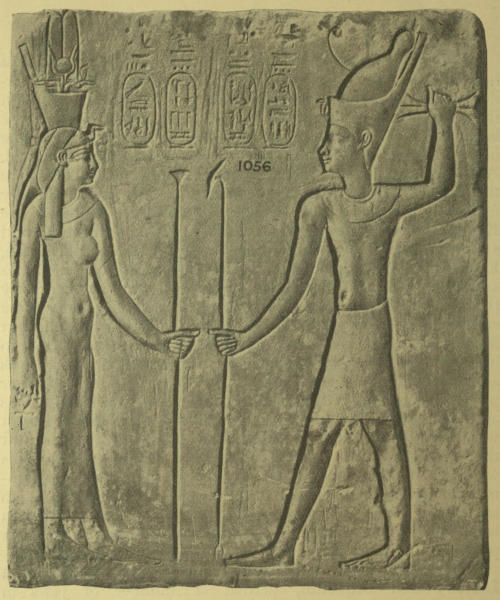
Plate XLVIII.
Relief with figures of Ptolemy II, Philadelphus, and Queen Arsinoë, about B.C. 260.
[Southern Egyptian Gallery, Bay 25, No. 953.]
Ptolemy II, Philadelphus, B.C. 287 or 286, founded the cities of Berenice Troglodytica, on the Red Sea, and Arsinoë in the Fayyûm, and built the famous Pharos, or lighthouse, at Alexandria, one of the seven wonders of the world. In his reign the priest Manetho wrote a History of Egypt, of which only the King List is extant, and the famous Greek version of the Old Testament, known as the Septuagint, was compiled. He added largely to the Alexandrian Library, which is said at that time to have contained 400,000 works. For stelae, sculptured with reliefs in which Ptolemy II and Queen Arsinoë are represented making offerings to the gods, see Bay 25, Nos. 953-955 (see Plate XLVIII); a portion of a royal edict is in Bay 28, No. 956.
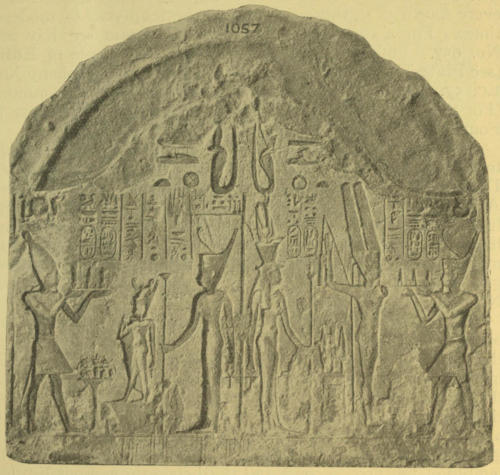
Stele sculptured with a scene representing Ptolemy II, Philadelphus, making offerings to Ȧmsu, or Menu, Uatchet, etc., about B.C. 260.
[Southern Egyptian Gallery, Bay 25, No. 954.]
Ptolemy III, Euergetes I, B.C. 246, conquered the greater portion of Western Asia. He was a patron of the arts and learning, and he repaired and rebuilt many of the ancient temples. To commemorate his victories and the benefits which he conferred on Egypt, the priesthood assembled at Canopus in the ninth year of his reign, and passed a Decree conferring special honours on the king and his queen Berenice. It was ordered that the Decree be cut in the Greek and Egyptian languages on stelae to be set up in the most prominent places in temples of the first, second, and third class throughout Egypt, in order that all men might read of the king’s bounty. The Egyptian version was inscribed in two kinds of writing, viz., in hieroglyphics and in demotic. The Decree also ordered that one day be added to the calendar every fourth year, thus anticipating the leap-year of modern times. For a cast of the Decree of Canopus see Bay 28, No. 957. Ptolemy III began to build the temple of Edfû (see Plate XLIX), B.C. 237, which was finished by Ptolemy XI, B.C. 57. Objects inscribed with his name are not common. (For a gold ring which was made in his reign see Table-case J, Fourth Egyptian Room.)
Ptolemy IV, Philopator I, B.C. 222 or 221, added a hall to the temple which the Nubian king, Ergamenes, built at Dakkah, and dedicated a temple to Homer. He defeated Antiochus the Great at the Battle of Raphia, but did nothing further to break his power. He organized elephant hunts in the Sûdân, and transported the animals by sea to Egypt for military purposes; a Greek inscription set up by Alexandros, general of the elephant hunts of Ptolemy IV, is in Bay 26, No. 958.
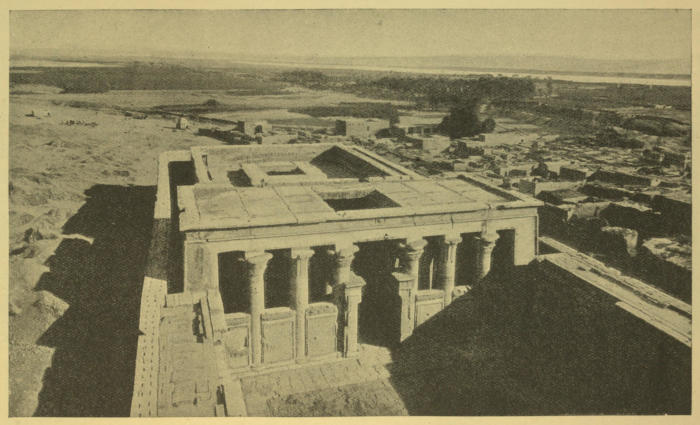
Plate XLIX.
View of the Temple of Edfû, taken from the top of the pylon. The temple was begun B.C. 237 and finished B.C. 57, and its construction occupied 180 years, 3 months, and 14 days.
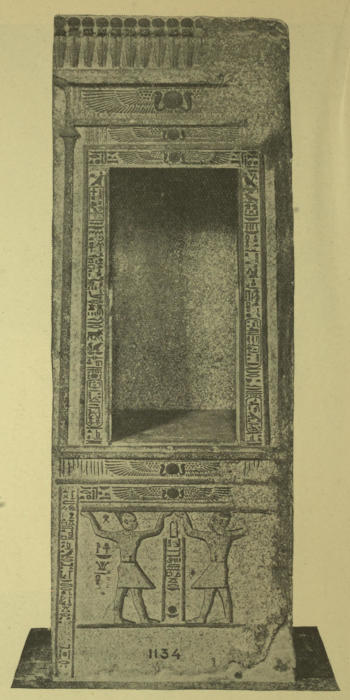
Plate L.
Granite monolithic shrine dedicated to the goddess Isis of Philae by Ptolemy IX (?), Euergetes II, B.C. 147-117.
[Southern Egyptian Gallery, Bay 30, No. 962.]
Ptolemy V, Epiphanes, B.C. 205, was a great benefactor of the temples of Egypt; and to mark their gratitude to him the priests of all Egypt met in solemn assembly at Memphis in the ninth year of his reign, and passed a Decree ordering that increased honours be paid to the king and his ancestors, that a statue of him be set up in each of the temples, and that a copy of the Decree, inscribed upon a stone stele, in hieroglyphic, demotic and Greek writing, be likewise set up in each temple of the first, second, and third class throughout Egypt. This Decree was duly carried out, for portions of three or four stelae, inscribed with the text of it, have been discovered. Most important of all is the stele which was found by M. Boussard in 1798, which, because it was dug up near Rosetta, is commonly known as the Rosetta Stone (see No. 960, Southern Egyptian Gallery). A special interest attaches to this monument, for from it Thomas Young, in 1816-1818, deduced the values of several letters of the Egyptian alphabet, and succeeded in reading the name of Ptolemy. Next with the help of this text and of an obelisk from Philae, the Frenchman Champollion read the name Cleopatra, and formulated a correct system of Egyptian decipherment. (For details see page 41 ff.) During the reign of Ptolemy V, the Egyptians invoked the protection of Rome.
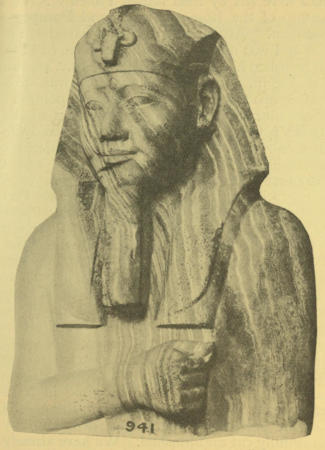
Head of a statue of one of the Ptolemies, about B.C. 300.
[Southern Egyptian Gallery, Bay 27, No. 947.]
Ptolemy VI, Eupator, died the year he became king. During the reign of Ptolemy VII, Philometor (B.C. 173), the Jews were permitted to build a temple at Onion, Onias being high-priest. (For a stele on which are sculptured figures of Ptolemy VII and the two Queens Cleopatra, see Bay 27, No. 961.) Ptolemy VIII was murdered. Ptolemy IX, Euergetes II, B.C. 147-117, finished the temple of Edfû, and repaired many temples both in Egypt and Nubia. From one of these came the fine monolithic granite shrine (see Plate L) in which a sacred bird or animal was kept (Bay 30, No. 962). It was found lying on its side among the ruins of a Coptic church on the Island of Philae; it had been utilized by the builders of the church as the base of a Christian altar. Ptolemy X, B.C. 117, conferred great benefits on the temples of the First Cataract (see Bay 29, No. 963); Ptolemy XI and Ptolemy XII were killed in B.C. 87 and 81 respectively; Ptolemy XIII, B.C. 80-51, began to build the temples of Denderah and Esna; Ptolemy XIV, B.C. 51, and his sister Cleopatra were left by their father, Ptolemy XIII, under the guardianship of the Roman Senate, and Pompey was made their guardian. After the battle of Pharsalia, Pompey fled to Egypt, and was murdered at the instance of Ptolemy XIV, who had banished his wife Cleopatra. In B.C. 48, Julius Caesar landed in Egypt, defeated Ptolemy, who was drowned, and reinstated Cleopatra. Ptolemy XV was appointed co-regent; but he was murdered by Cleopatra’s orders in B.C. 45, and Ptolemy XVI, Caesarion, son of Julius Caesar and Cleopatra, was named co-regent in his stead. After the defeat of Antony by Octavianus and the death of Antony and Cleopatra, Egypt became a Roman Province, B.C. 30.
The Egyptian antiquities of the Ptolemaïc Period in the British Museum consist chiefly of Stelae inscribed with funerary texts; they are comparatively small in size, and are painted in bright colours. The reliefs, in which the figures of the gods are represented, are delicately cut, and the hieroglyphics have the slender form which is one of the chief characteristics of the inscriptions of the period. The texts often contain the ages of the deceased persons, and details concerning the length of time occupied in the process of mummification, which are wholly wanting in the funerary monuments of an earlier period. Among the gods mentioned on the stelae is Serapis, who represents a fusion of the old Egyptian gods, Osiris and Apis. (For figures of this god in terra-cotta see Table-case M in the Fourth Egyptian Room.) The stone coffins of the period are in the form of a mummy, and are usually carefully cut and finished. We have already seen that two important edicts of the priests of Memphis and Canopus were cut on stelae in two forms of Egyptian writing, viz., hieroglyphic and demotic, and in Greek; there are also several examples of funerary monuments in the British Museum in which the hieroglyphic text is followed by a rendering in demotic and Greek. In the case of small objects, e.g., mummy labels, the inscriptions are in demotic and Greek only.
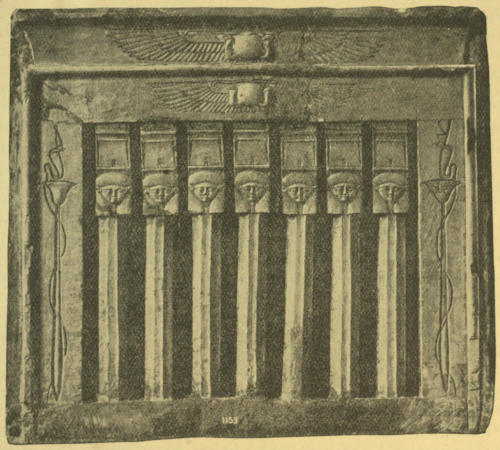
Limestone window with mullions in the form of pillars with Hathor-headed capitals. From the temple at Denderah.
Ptolemaïc Period.
[Southern Egyptian Gallery, Bay 25, No. 972.]
Among the noteworthy monuments of this period are: A statue of the goddess Isis, holding before her a figure of Osiris, whom she protects with her wings, dedicated to the goddess by one Shashanq (Bay 28, No. 964); massive green granite beetle, symbol of Kheperȧ, the self-produced god, the creator of the universe, and the type of resurrection (Central Saloon, No. 965); stone serpent, with the bust of a woman (Bay 32, No. 966); green basalt coffin of the lady Ānkhet (Bay 29, No. 967) and the limestone coffin of Ḥes-Peṭān-Ȧst (Bay 26, No. 968); limestone window from the clerestory of the temple of Denderah (Bay 25, No. 972); and a marble sun-dial from Alexandria (Bay 29, No. 976). An interesting group of stelae, with demotic inscriptions, is exhibited in Bay 27 (Nos. 983-990); and in Bay 29 (No. 994) is the stele of Euonymos, with an inscription in Greek and demotic. Among the stelae which give the ages of deceased persons may be noted those of Ḥer-ȧbu, a priest of king Saḥu-Rā (?), who lived fifty years, seven months, and five days (Bay 30, No. 995); Tashermut, a priestess who died aged ninety-seven years (Bay 27, No. 996); and Berenice (?) who died aged sixty-four years, eight months, and twenty-six days (Bay 29, No. 998).
Of all the stelae of this period the most interesting is that of the lady That-I-em-ḥetep, who belonged to a family that reckoned among its members several princes of Memphis and high priests of Ptaḥ (Bay 29, No. 1027). She was born in the ninth year of the reign of Ptolemy XIII, about B.C. 71, and when fourteen years old she was married to her half-brother, the priest P-shere-en-Ptaḥ (see his stele in Bay 27, No. 1026). During the first twelve years of her married life she gave birth to three daughters, but no son, which caused her husband great grief. She and her husband prayed to the god I-em-ḥetep, the son of Ptaḥ, for a son, and the god, appearing to P-shere-en-Ptaḥ in a dream, promised to grant his prayer if he carried out certain works in connexion with the temple. When the priest awoke he caused the works to be taken in hand, and soon after they were completed his wife gave birth to a son who was named I-em-ḥetep, and surnamed Peṭā-Bast (see his stele in Bay 27, No. 1030). Four years afterwards That-I-em-ḥetep died, and was buried with due ceremony by her husband, whom she addresses thus: “O my brother, my husband, my friend, the Ur-kherp-ḥem (i.e., high priest of Memphis), cease not to drink, to eat, to be drunken, and to marry wives, and to enjoy thyself, and to follow the desire of thy heart by day and by night; and let not sorrow or sadness find a place in thy heart during all the years which thou shalt live upon earth. Ȧmenti (i.e., the land of the dead) is the land of stupor and darkness, and a place of oppression for those who are therein. The august ones sleep in their mummied forms; they cannot awake to see their brethren, they cannot look upon their fathers and mothers, and they are unmindful of wives and children. The living water which the earth hath for its dwellers is stagnant water for me.... I no longer know where I am, now that I have arrived in this valley [of the dead]. Would that I had water to drink from a running stream, and one to say to me, ‘Remove not thy pitcher from the stream’! O that my face were turned towards the north wind on the river bank that the coolness thereof might quiet the anguish which is in my heart!
“He whose name is Universal Death calleth everyone to him; and they come unto him with quaking hearts, and they are terrified through their fear of him. With him is no distinction made between gods and men, and the great are even as the little in his sight. He showeth no favour to those who long for him; for he carrieth away the babe from his mother, as well as the aged man. As he goeth about on his way, all men fear him, and, though all make supplication before him, he turneth not his face towards them. Entreaty reacheth not unto him, for he will not hearken unto him that maketh supplication, and him who presenteth unto him offerings and funerary, he will not regard.”
The ideas expressed in the above extract have their origin in the materialism which found its way into Egypt under the rule of the Ptolemies.
THE ROMAN PERIOD.
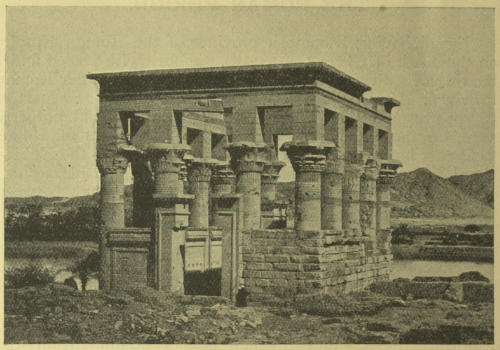
The building at Philae commonly known as “Pharaoh’s Bed.”
Roman Period.
Egypt, having become a province of the Roman Empire on the death of Cleopatra, B.C. 30, was forthwith placed under the rule of a Prefect, and administered like any other Roman Province. Under the strict but just rule of her new masters Egypt prospered, for trade flourished, and life and property were, on the whole, well protected by the laws of Rome. Reference has already been made (see page 255) to the Nubian kingdom founded by Piānkhi, who made Napata his capital; it must also be noted that at the same period, between B.C. 500 and the end of the Ptolemaïc rule, a second Nubian kingdom was founded by some unknown Sûdânî chief on the Island of Meroë, with a capital at Meroë, on the Nile, about 50 miles south of its junction with the Atbara. When the Romans began to rule over Egypt the Meroïtic Kingdom was in a flourishing state, and the authority of its sovereign, who appears to have been Queen Ȧmenṭārit[40] (having also the title Candace, which was common to all the Queens of Meroë), probably extended northwards as far as the First Cataract. In B.C. 29 Candace made a treaty with Cornelius Gallus, the first prefect of Egypt; but, five years later, when Ælius Gallus was prefect, she invaded Egyptian territory and slew the Roman garrisons of Philae and Syene. In revenge the Romans invaded Nubia and marched to Napata, which they sacked and burned; and Candace was forced to submit. From that time onward little is heard of the Kingdom of Meroë; but the pyramids which still stand near Meroë prove that the Nubians observed the old Egyptian customs in connexion with the burial of their dead in chambers under the ground. They offered sacrifices to Osiris, Isis, Nephthys, Anubis, and other gods of the cycle of Osiris, and recited the ancient formulas, which are also written in hieroglyphics on the walls of the funerary chapels; and in some instances they reproduced on the walls whole scenes, e.g., the Weighing of the Heart, and the Pylons of the Other World, from Ptolemaïc copies of the Book of the Dead, as for example, on the sandstone relief from a pyramid chapel at Meroë which is exhibited in Bay 31, No. 1049. On the right Queen Candace is seated, her consort by her side, holding symbols of sovereignty, her feet resting on representatives of conquered tribes. Immediately in front of the large figure of the queen we see her pouring out libations to Osiris, and round about her are vases of wine, beer, unguents, bulls for sacrifice, etc., for the funerary feast. In her company are priests, officials, relatives, and others, who bear offerings, palm branches, etc. This relief was originally coloured red. Also may be mentioned the two altars with Meroïtic Inscriptions exhibited in Bay 30, Nos. 1050, 1051. The Meroïtic character has not yet been deciphered.
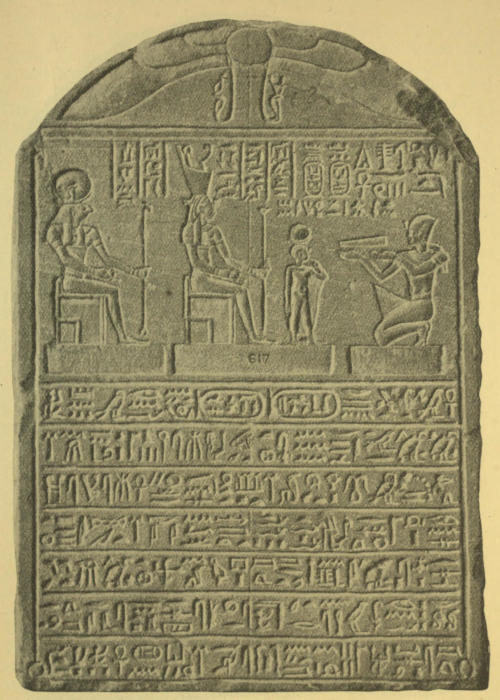
Plate LI.
Tablet recording the restoration of the temple of Mut by the Emperor Tiberius Caesar, about A.D. 20.
[Southern Egyptian Gallery, Bay 27, No. 1052.]
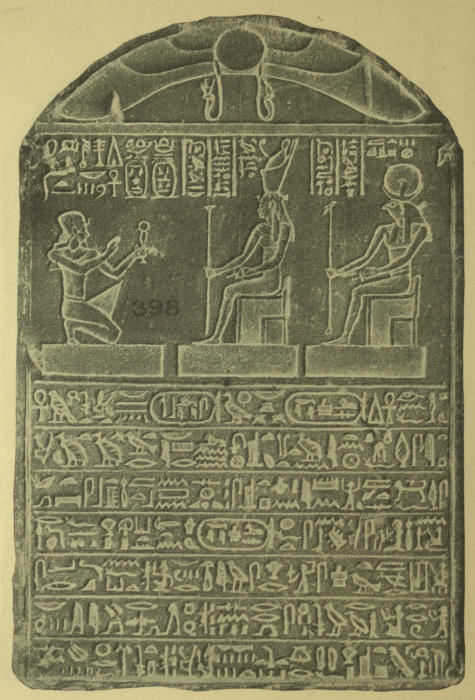
Plate LII.
Tablet recording the setting up of a statue to the goddess Mut, and the restoration of certain buildings by the Emperor Tiberius Caesar, about A.D. 20.
[Southern Egyptian Gallery, Bay 29, No. 1053.]
Nearly all the Roman emperors from Tiberius (A.D. 14) to Decius (A.D. 249) adopted Egyptian names and titles, and caused their names to be written within cartouches like those of the Pharaohs. The stele in Bay 27 (No. 1052) states that Tiberius rebuilt portions of the temple of Mut at Thebes (see Plate LI); and another stele (Bay 29, No. 1053) refers to the setting up by him of a statue of the goddess Mut, and the re-endowment of the portion of the temple wherein it stood (see Plate LII). In the reign of Nero (A.D. 54-69) two centurions sent into the Sûdân to report on the general condition of the country reached the marshes near Shâmbî, about 700 miles south of Kharṭûm. Tradition asserts that Christianity was preached in Alexandria towards the close of his reign, and that St. Mark arrived in that city, A.D. 69. To this period belongs stele No. 1057 (Bay 32), which was set up to mark the gratitude of the Egyptians to Nero for appointing F. Claudius Balbillus, prefect of Egypt. Hadrian visited Egypt twice, and founded the city of Antinoopolis in memory of his friend Antinous who was drowned in the Nile; when at Thebes he went with the Empress Sabina to view the Colossi (see Plate XXXIII). Marcus Aurelius (A.D. 161-180) was a just ruler and favoured Christianity in Egypt; in his reign the walls which surrounded the Sphinx at Gîzah were repaired (see stele, No. 1058, Bay 32). Septimius Severus (A.D. 196) issued an edict against the Christians in Egypt, and his successor, Caracalla (A.D. 211), encouraged the pagan Egyptians and favoured their religion. Decius (A.D. 249) made a systematic attempt to destroy the Christians, and every person was called upon to offer sacrifice to the gods, or suffer death. In the reign of Diocletian (A.D. 284), the Blemmyes, a confederation of tribes who lived in the Eastern Sûdân, became so powerful that they compelled the Roman garrisons to withdraw from the Dodekaschoinos,[41] and the emperor was obliged to hire the Nobadae, or tribes of the Western Desert, to keep them in check. He also agreed to pay the Blemmyes a fixed annual sum to refrain from raiding Roman territory in Egypt, and built a temple at Elephantine wherein representatives of all the peoples concerned might swear to observe the covenant in the presence of their respective gods. Diocletian in fact abandoned the Sûdân. In 304 he issued a savage edict against the Christians in Egypt, and the persecution which followed it was marked with ferocious cruelty. Many thousands of Egyptians fled to the desert monasteries to avoid conscription, and embraced Christianity. From one of his buildings on the Island of Philae comes the stone bearing the names of Diocletian and Constantine (A.D. 324) (No. 1059, Bay 26).
In 378 Theodosius the Great proclaimed Christianity the religion of his Empire, and many temples in Lower Egypt were turned at once into churches; but the ancient Egyptian gods were worshipped as usual in Upper Egypt. Marcianus (A.D. 450-457) invaded Nubia and punished the Blemmyes and Nobadae for raiding Roman territory; they paid a huge fine, gave hostages for their future good behaviour, and made an agreement to keep the peace for one hundred years. In return they stipulated that they should be allowed to make pilgrimages annually to Philae, and to borrow the statue of Isis from time to time, so that they might take it about the country, and give the people the opportunity of invoking the protection and blessing of the goddess. In the first half of the sixth century the Nubians embraced Christianity, and Silko, king of the Nobadae, founded a kingdom having its capital at Dongola. During the reign of Justinian (A.D. 527-565) the hundred years’ truce came to an end, and the Blemmyes and Nobadae again began to give trouble. Justinian, believing that the cause of the revolt was the annual pilgrimage to Philae, sent his officer Narses thither, with strict orders to close the temples of Isis. Narses threw the priests of Isis into prison, confiscated the revenues of the goddess, and carried off the statues of the gods of Philae to Constantinople.
In the reign of Heraclius the Persians, under Chosroës, invaded Egypt (A.D. 619), which they held for ten years. Owing to the desertion from the Persians of the Arab tribes, who had now attached themselves to the victorious troops of Muḥammad the Prophet (born at Mekkah, Aug. 20, A.D. 570, died in June, 632), Heraclius was able to attack the Persians, in Syria, and defeating them became master of Egypt once more. In 640 ʿAmr Ibn al-Âṣî, the general of the Khalîfa Omar, conquered Egypt, and thus the country became a province of the newly-founded Arab Empire.
During the rule of the Romans, which lasted from B.C. 30 to A.D. 640, the Greek language entirely superseded Egyptian for official purposes, and it was also usually employed in the funerary inscriptions. Interesting examples are the stele of Politta, inscribed with a metrical text (Bay 26, No. 1083), and the stele of Artemidorus (Bay 26, No. 1084). On the pillar altar (Bay 31, No. 1086) is a dedication in Greek to the god Serapis of the city of Canopus; and on the square sandstone slab (Bay 26, No. 1087) is a very interesting but difficult text recording the cleansing and restoration of some public building near the town of Kom Ombo in Upper Egypt, whilst Gabriel was Duke of the Thebaïd. Other interesting inscriptions in Greek are found in ostraka, or potsherds, many of which are dated in the reigns of Claudius, Nero, Vespasian, Trajan, Antoninus, Sabinus, Pertinax, etc., will be found exhibited in Table-case C in the Third Egyptian Room. During the early centuries of Roman rule the Egyptians continued to mummify their dead, and to bury them with the ancient rites and ceremonies. The use of the funerary stele or tablet continued down to the fourth century A.D.; but the gods represented on them appeared in different forms, and Greek or demotic took the place of hieroglyphics. In the region about Thebes and to the south of that city the cult of Osiris and Isis continued until about A.D. 560, and a simple system of mummification was practised in connexion with the worship of the dead.
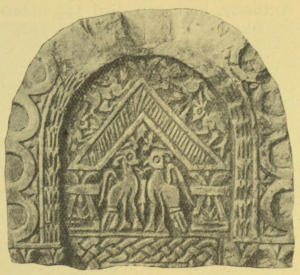
Sepulchral tablet sculptured with figures of doves, pillars, leaf patterns, etc.
[Southern Egyptian Gallery, Bay 30, No. 1156.]
The most important event during the rule of the Romans was the introduction of Christianity by St. Mark the Apostle, who, according to tradition, preached the Gospel in Alexandria about A.D. 69. The knowledge of the new religion spread rapidly, and converts multiplied and, though no direct proof is forthcoming at present, there is reason to think that before the middle of the second century an account of the life of Christ and His words and works existed in the Egyptian tongue. Men who had embraced Christianity retired into the desert to lead a life of austerity and contemplation, among whom may be mentioned Frontonius, who collected seventy disciples, and withdrew to the Nitrian Desert between A.D. 138 and 161, and Paul the Anchorite, who died about A.D. 250, aged 113 years. The life and teaching of Anthony, born 250, died 355, induced thousands to become monks. Pachomius, in 320, systematized monasticism, but he required the recluses to work for their living whilst they cultivated spiritual excellences. Women as well as men flocked to the desert, and nunneries existed in many places in Egypt. The number of such recluses was great; at Nitria alone there were 5,000 monks, and, in addition, 600 lived solitary lives in the neighbouring desert. At Oxyrhynchus there were 10,000 monks, and the bishop had charge of 20,000 nuns. In the monasteries of Nitria and Panopolis, and elsewhere, the Holy Scriptures were translated from Greek into Egyptian (i.e., Coptic, see pages 35-39) and Syriac, and other Oriental languages; and copies of them were carried by monks and fugitive Christians into Nubia, and even into remote Abyssinia, by way of the Blue Nile. In the Oases of the Western Desert were numbers of Christians in the fourth and fifth centuries; wherever the monk went he took Christianity with him. Still, in spite of the spread of the new religion, the beliefs which the Egyptians had received from their pagan ancestors also flourished in Egypt for centuries after the preaching of St. Mark, and people of all classes clung to their amulets, and words of power, and magical ceremonies, even after they had embraced Christianity. For a very long time the Cross was regarded as an amulet possessing the greatest magical power possible, and the Name of Christ was held to be the greatest of all words of power.
Sepulchral tablet of Plêïnôs, a “reader.” [Southern Egyptian Gallery, Bay 32, No. 1145.] Sepulchral tablet of David, an Egyptian Christian. [Southern Egyptian Gallery, Bay 30, No. 1160.]
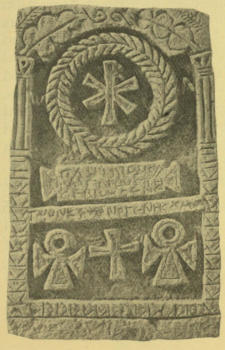
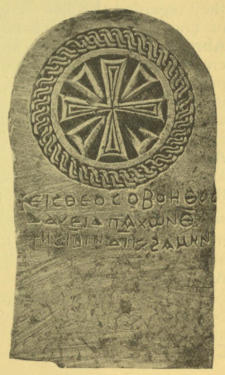
The principal doctrine of the Egyptian Christians, or Copts, is that God the Father and Christ are of one and the Same nature; Arius held that God and Christ are only similar in nature, and was declared a heretic. The Copts are called Monophysites, because they believed, and still believe, that Christ is of one nature only, and Jacobites because their views as to the nature of Christ are identical with those of one Jacob, a famous preacher of the Monophysite doctrine. The head of the Coptic Church is the Patriarch, who is chosen from among the monks of the Monastery of St. Anthony in the Red Sea Desert. The Copts attach great importance to Baptism, they face the East when praying, and they pray seven times a day. They make use of Confession, and keep five Fasts and seven Festivals. The Copts were persecuted severely in the reigns of Hadrian, Decius, Diocletian, and Julian the Apostate (A.D. 361), but the cruellest of the persecutions of the Roman emperors was that of Diocletian in 304. The Copts commemorated the sufferings of their community on this occasion by making the Era of the Martyrs, by which they date their documents, begin with the day of Diocletian’s accession to the throne, i.e., August 29th, A.D. 284. In the reign of Justinian the Copts split up into two great parties, i.e., the Melkites, or Royalists, which included all those who were in the service of the Government, and the Jacobites, or ordinary inhabitants of the country; henceforward each party chose its own Patriarch. The dissensions between them materially aided the Conquest of Egypt by the Arabs.
Side by side with Christianity there also sprang up in Egypt, under Roman rule, a number of sects to which the title “Gnostic” has been given. They derived many of their views and beliefs from the religion of the ancient Egyptians, and they admitted into their system many of the old gods, e.g., Khnemu, Ptaḥ, Rā, Ȧmen, Thoth, Osiris, etc. The founders of Gnosticism, a word derived from the Greek gnosis, “knowledge,” claimed to possess a superiority of knowledge in respect of things divine and celestial, and they regarded the knowledge of God as the truest perfection of knowledge. The characteristic god of the Gnostics was Abrasax, or Abraxas, and he represented the One who embraced All within himself. They attributed magical properties to stones, which, when cut into certain forms, and inscribed with legends, or mystic names, words, and letters, afforded, they thought, protection against moral and physical evil. An unusually fine collection of Gnostic Gems and Amulets is exhibited in Table-case N, in the Fourth Egyptian Room: No. 1 speaks of the “Father of the World, the God in Three Forms”; No. 18 shows us the lion-headed serpent Knoumis and the mystic symbol ; No. 25 makes the Osiris-Christ to be Jah of the Hebrews, and also Alpha and Omega; Nos. 36, 37, and 44 have figures of Abraxas cut upon them; No. 87 mentions Solomon’s Seal, No. 110, the six Archangels; and of peculiar interest are No. 231, engraved with a representation of the Crucifixion, and No 469, engraved with a representation of the Birth of Christ.

THE ARAB PERIOD.
A.D. 640-1517.
As the Arabs were materially assisted in their conquest of Egypt by the Copts, the new masters of the country treated the latter with great consideration for about 100 years; but, from A.D. 750 onwards, they persecuted their Christian subjects at intervals with great severity. The non-Christian inhabitants of the country embraced Islâm, or the doctrine of Muḥammad the Prophet, and, with the religion of the Muslims, the knowledge of the Arabic language spread throughout Egypt. It gradually superseded Egyptian, or Coptic, and about the end of the twelfth century it became the common language of the country, Coptic ceasing to be spoken except in monasteries and remote villages. In 642 the Arabs, under ʿAbd-Allah bin Sa’ad, occupied the Egyptian Sûdân, and ten years later they marched to Dongola, destroyed the church and the town, and levied an annual tribute, or Baḳṭ, consisting of 360 or 365 men upon the Nubians, which was paid with more or less regularity for nearly 500 years. On several occasions the Arabs invited the Christians of Nubia to embrace Islâm, but the latter steadily rejected the offer, paid their tribute, and continued to worship God according to the teachings of their Jacobite priests, who were appointed to their office by the Patriarch of Alexandria. Many hundreds of churches were built in the Sûdân between A.D. 540, when the Christian religion was established by Silko, king of the Nobadae, and 1450, when the Christian kingdom of Alwa, on the Blue Nile, was destroyed. During the greater part of these 900 years the Liturgy was recited in Greek, and the services were conducted after the manner laid down by the spiritual authorities in Alexandria. Certain Books of the Bible and various Offices were translated into Nûbî, the language of the country; but of these few remains are extant.
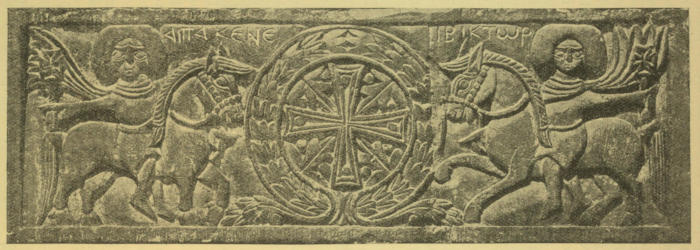
Plate LIII.
Sepulchral tablet set up in memory of Apa Paḥomo, the head of a monastic settlement. On the right is a figure of Saint Victor, and on the left a figure of Saint Apakene.
VIIth to Xth century, A.D.
[Southern Egyptian Gallery, Bay 30, No. 1103.]
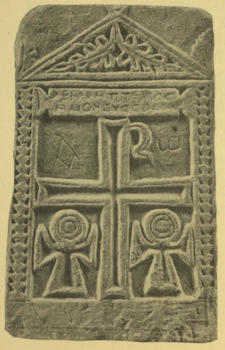
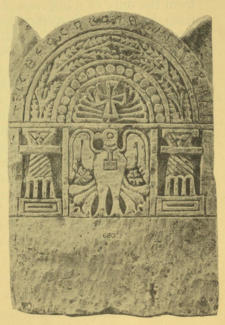
In Egypt the Copts founded and maintained many monasteries, and built many churches; and from these come two remarkable series of monuments, inscribed in Greek and Coptic, which are exhibited in Bays 28, 30, and 32 of the Southern Egyptian Gallery. The greater number of them belong to the period between 600 and 1000 A.D., and among them may be noted:—The stele of Isos(?), inscribed in Greek with a prayer to the “God of Spirits” (Bay 26, No. 1094); the stele of Paḥomo (see Plate LIII), the father of a monastic settlement, with figures of the military saints Apakene and Victor (Bay 30, No. 1103); the apse from the shrine of a saint, on which are sculptured vine branches, with doves seated on them, and figures of flowers, shells, fish, etc.: a very interesting object (Bay 32, No. 1104); the stele of John the Deacon, inscribed with a lament on the bitterness of death (Bay 30, No. 1105); an altar slab from a church (Bay 32, No. 1106); three stelae, inscribed with invocations to saints (Bays 30, 32, Nos. 1107-1109); apse from a shrine of a saint from a church at Philae (Bay 30, No. 1113); and a group of stelae commemorating the holy women Hêlenê, daughter of Peter, deacon and steward of the Church of St. John, in Esna, in Upper Egypt (Bay 30, No. 1115), Sara, Rachel, Teucharis, Troïs, and Rebecca (Bay 32, Nos. 1116-1120). Many of the sepulchral stelae are richly sculptured with pediments of shrines, pillars with elaborate carvings, figures of doves, and everywhere are prominent the cross, which is assumed to be identical with the ānkh 𓋹, the old Egyptian symbol of “life,” and the crown. On several of them also are seen Alpha and Omega, Α Ω. The most elaborately decorated stele is that which was set up for the child Mary in the old church at Ṣûhâḳ. The design is good, the cutting excellent, and it is one of the finest examples extant of this class of monument (Bay 32, No. 1123).[42] A very interesting group of Coptic documents, consisting of affidavits, letters, invoices, contracts, extracts from the Scriptures and from liturgies, hymns, etc., is exhibited in Table-case M in the Fourth Egyptian Room. In division 4 of the same case is a good collection of Coptic crosses, pendants with figures of St. George, etc., from Panopolis. Several very fine examples of linenwork from Coptic graves and churches will be found in Table-cases E and J in the Third Egyptian Room, and a handsome bier cloth in Wall-cases 70 and 71, in the Second Egyptian Room.
Sepulchral tablet of Abraam, the “perfect monk.” [Southern Egyptian Gallery, Bay 30, No. 1136.] Sepulchral tablet of Rachel, a Christian lady. [Southern Egyptian Gallery, Bay 32, No. 1117.]
Soon after the Arabs had conquered Egypt, they found it necessary to keep a strong garrison at Syene, the modern Aswân. In order to relieve the soldiers of the garrison from the duty of a pilgrimage to Mekkah, an order was issued from Fosṭâṭ, the first Arab capital in Egypt, near Old Cairo, that a pilgrimage to Aswân counted as a pilgrimage to Mekkah; hence for some two or three hundred years Aswân was regarded as a holy place, and pious Muslims were brought there from all parts to be buried. A collection of gravestones inscribed in Kûfî, or Kufic, a form of Arabic writing, from the old Muḥammadan cemetery at Aswân, is exhibited in the Second Northern Gallery (Wall-cases 52-54). The oldest example is that of Azhar, son of ʿAbd as-Salâm, who died in the year of the Hejira 252 = A.D. 866.
The Arab dynasties which ruled Egypt and the Sûdân between 656 and 1517 are as follows:—
ʿOmayyad Khalîfas[43] A.D. 661-750.
ʿAbbâsid Khalîfas ” 750-868.
Tûlûnid Khalîfas ” 868-913.
Fâṭimid Khalîfas ” 913-1193.
Ayyûbid Khalîfas ” 1193-1249.
Baḥrite Mamlûks ” 1249-1382.
Circassian Mamlûks[44] ” 1382-1517.
The Arab domination came to an end in 1517, when Selim, sultân of Turkey, conquered the country, and Egypt became a Turkish Province, or Pashalik.