WILTS GLOSSARY (continued 2)
Reading edition
Frog-dubbing. Boys throw a frog into a shallow pool, and then 'dub' or pelt it, as it tries to escape. See Dub.—S.W.
Froom. See Frum.
Frout. Of animals: to take fright. 'My horse frouted and run away.'—S.W.
Frouten, Froughten. To frighten (S.).—N. & S.W.
'Lor, Miss, how you did froughten I!'—Greene Ferne Farm, ch. vii.
Frow. See Brow.
Frum, Froom. Of vegetables, grass, &c.: fresh and juicy (A.B.); strong-growing or rank. A.S. from, vigorous, strong.—N.W.
*Fry. (1) n. A brushwood drain (H.Wr.). See Frith (3).—N.W. (2) v. To make a brushwood drain (D.). Also Frea and Frith (D.).—N.W.
'1790. For 234 Lugg Hollow frying in Englands 2.18.6.'—Records of Chippenham, p. 248.
Fullmare. n. In my childhood I remember being told more than once by servants at Morden, near Swindon, N.W., that a colt which was playing about in a field near was 'a fullmare.' Could this possibly have been a survival of the old word 'Folymare, a young foal,' which is given by Halliwell and Wright as occurring in a fifteenth-century MS. at Jesus College, Oxford? I have never heard the word elsewhere.—G. E. D.
Fur. n. The calcareous sediment in a kettle, &c.—N. & S.W.
Furlong (pronounced Vurlin). The strip of newly-ploughed land lying between two main furrows.—N.W. (Lockeridge.)
Fur up. Water-pipes, kettles, &c., when coated inside with 'rock,' or the calcareous sediment of hard water, are said to 'fur up,' or to be 'furred up.'—N. & S.W.
*Furze-hawker. Saxicola oenanthe, the Wheatear.—N.W.
*Furze Robin. Saxicola rubicola, the Stonechat (Birds of Wilts, p. 150).—N.W. (Sutton Benger.)
Fuzz-ball. Lycoperdon Bovista, L., Puffball.—N. & S.W.
Gaa-oot! See Horses (A.).
Gaam. (1) v. To smear or bedaub with anything sticky. Gaamze (Village Miners). (2) n. A sticky mass of anything. See Gam.—N. & S.W. Many years ago, at a Yeomanry ball in a certain town in N. Wilts, the Mayor, who had done his duty manfully up to then, stopped short in the middle of a dance, and mopping his face vigorously, gasped out to his astonished partner, a lady of high position, 'Well, I don't know how you be, Marm, but I be ael of a gaam o' zweat!'—N.W.
Gaamy, Gammy. Daubed with grease, &c., sticky. In Hal. and Wr. 'Gaam, adj. sticky, clammy,' is apparently an error, gaamy being probably intended.—N.W.
Gaapsey. n. A sight to be stared at. See Gapps.—N.W.
Gaapus. n. A fool, a stupid fellow. 'What be at, ye girt gaapus!'—N.W. (Clyffe Pypard.)
Gabborn. Of rooms or houses, comfortless, bare (B.C.). Gabbern (A.H.) and Gabern (Great Estate, ch. iv. p. 78). This term always denotes largeness without convenience or comfort (Cunnington MS.).—N.W. Gabberny on Berks bord.
*Gage-ring. An engagement ring (Great Estate, ch. x).—N.W.
Galley-bagger. A scarecrow (S.).—S.W.
Galley-crow. A scarecrow (A.H.Wr.).—N. & S.W.
'"Maester," said the child, "wull 'e let m' chainge hats wi' thuck galley-crow yander?" ... pointing to a scarecrow at the other end of the garden.'—Wilts Tales, p. 103.
Gallivant. To be gadding about on a spree with a companion of the opposite sex (S.): to run after the girls, or 'chaps,' as the case may be.—N. & S.W.
Gallow. See Gally.
Gallows (pronounced Gallus). *(1) A pair of braces. (2) Exceedingly. Used with any adjective; as 'Gallus dear,' very expensive (Great Estate, ch. iv. p. 75).—N. & S.W.
'A gallus bad wench her be!'—Dark, ch. xviii.
*(3) 'He's a gallus chap,' i.e. plucky.
Gallows-gate. A light gate, consisting only of a hinged style, top-rail, and one strut.—N.W.
Gallus. See Gallows.—N.W.
Gally, Gallow. To frighten or terrify. Gallow (B.H., Lansd. MS.), Gally (A.B.S.), Pret. gallered, astonished, frightened (A.B.C.S.) 'He gallered I amwost into vits.' Still in use about Marlborough and in S.W. From M.E. galwen; A.S. agælwan, to stupefy.—N. & S.W.
'The wrathful skies Gallow the very wanderers of the dark.'—Lear, iii. 2.
The word is still commonly used in the whale-fishery:—
'Young bulls ... are ... easily "gallied," that is, frightened.'—Marryat, Poor Jack, ch. vi.
Gam. A sticky mass, as 'all in a gam.' See Gaam (2).—N. & S.W. In S. Wilts the a in this word and its derivatives is usually short, while in N. Wilts it is broad in sound.
Gambrel. The piece of wood or iron used by butchers for extending or hanging a carcase (A.). Gamel (S.).—N. & S.W.
Gamel. See Gambrel.
Gammer. A woodlouse.—S.W.
Gammet, Gamut. (1) n. Fun, frolicsome tricks. 'You be vull o' gamuts.'—N.W. (2) v. To frolic, to play the fool. See Gammock and Gannick. 'Thee bist allus a gammetting.'—N.W. (3) v. To play off practical jokes; to take in any one.—N.W.
Gammock. v. To lark about, to play the fool, to frolic. See Gannick and Gammet.—N.W. (Marlborough.)
Gammotty, Gammutty. (1) adj. Frolicsome, larky. See Gammet.—N.W. (2) adj. Of cheese, ill-flavoured. See Cammocky.—N.W.
Gammy. (1) Sticky. See Gaamy.—S.W. (2) Lame, crippled, having a 'game leg.'—N. & S.W.
Gamut. See Gammet.
Gander-flanking, To go. To go off larking or 'wondermenting.' Perhaps a corruption of gallivanting.—S.W. (Upton Scudamore.)
Gandigoslings. Orchis mascula, L., Early Purple Orchis. Compare Gandergosses in Gerarde (Appendix), and Candle-gostes in Folk-Etymology. Also see Dandy-goslings, Dandy-goshen, Goosey-ganders, Goslings, Grampha-Griddle-Goosey-Gander, and Granfer-goslings.—N.W.
Gannick. To lark about, to play the fool. See Gammock.—S.W. (Warminster, &c.)
Gapps, Gaapsey. To gape or stare at anything. 'Thee'st allus a gaapsin' about.'—N.W.
Garley-gut. A gluttonous person. Perhaps connected with gorle, to devour eagerly (see Halliwell).
'"Let's go to bed," says Heavy-Head, "Let's bide a bit," says Sloth, "Put on the pot," says Garley-gut, "We'll sup afore we g'auf" [go off].'—Nursery Rhyme.
Gashly. See Ghastly.
Gate. n. Excitement, 'taking.' 'Her wur in a vine gate wi't.'—N.W.
Gatfer. See Gotfer.
Gauge-brick. A brick which shows by its change of colour when the oven is hot enough for baking. Cf. Warning-stone.—N.W.
'She knew when the oven was hot enough by the gauge-brick: this particular brick as the heat increased became spotted with white, and when it had turned quite white the oven was ready.'—Great Estate, ch. viii. p. 152.
Gawl-cup. See Gold-cup.
Gawney. A simpleton (A.H.S.Wr.).—N. & S.W.
'Leave m' 'lone y' great gawney!'—Wilts Tales, p. 83.
Gay. Of wheat, rank in the blade (D.).—N.W.
Gee, Jee. To agree, to work well together (A.B.).—N.W.
Genow. See Go-now.
*Gentlemen's-and-ladies'-fingers. Arum maculatum, L., Cuckoo-pint. Cf. Lady's-Finger (2).—S.W. (Farley.)
Ghastly (pronounced Gashly). This word is used in many ways, as 'Thick hedge wur gashly high, but it be ter'ble improved now.'—N.W. (Huish.) At Etchilhampton, N.W., a 'gashly ditch' is one that is cut too wide.—N. & S.W.
Gibbles. Onions grown from bulbs. Cf. Chipples and Cribbles.—N. & S.W.
Gicksey. See Kecks.
Giggley. See Goggley.
Gigletting. adj. Fond of rough romping; wanton. Used only of females. 'Dwoan't ha' no truck wi' thuck there giglettin' wench o' his'n.'—N.W. (Malmesbury.)
Gilcup. Buttercups in general; occasionally restricted to R. Ficaria. Cf. Gold-cup.—S.W.
*Gill. A low four-wheeled timber-carriage (Cycl. of Agric.).
*Gilty-cup. Caltha palustris, L., Marsh Marigold.—S.W. (Zeals.)
Gin-and-Water Market. See quotation.
'Some towns have only what is called a "gin-and-water" market: that is, the "deal" is begun and concluded from small samples carried in the pocket and examined at an inn over a glass of spirits and water.'—The Toilers of the Field, p. 28.
Gipsy. Carnation grass, Carex panicea, L., because it turns so brown.—N.W. (Clyffe Pypard.)
Gipsy-rose. Scabiosa atropurpurea, L., the Garden Scabious.—N.W.
Girls. The short-pistilled or 'thrum-eyed' blossoms of the Primrose, Primula vulgaris, L. See Boys.—N.W. (Clyffe Pypard.)
Gix, Gicksey, &c. See Kecks.
Glory-hole. A place for rubbish or odds and ends, as a housemaid's cupboard, or a lumber room.—N.W.
'This has nothing to do with Lat. gloria, but is connected with M.E. glorien, to befoul (Prompt. Parv.). Compare Prov. Eng. glorry, greasy, fat. Thus glory-hole=a dirty, untidy nook. See Folk-Etymology, p. 145.'—Smythe-Palmer.
*Glox. This is given by most authorities as a noun, and defined as 'the sound of liquids when shaken in a barrel' (A.B.H.Wr.); but it is really a verb, and refers to the motion and peculiar gurgling of liquids against the side of a barrel or vessel that is not quite full (C.). In Hants gloxing is the noise made by falling, gurgling water (Cope). Cf. Lottle.—N.W., obsolete.
'Fill the Barrel full, John, or else it will glox in Carriage.'—Cunnington MS.
Glutch. To swallow (A.B.C.S.). According to Cunnington MS, the use of glutch implies that there is some difficulty in swallowing, while quilt is to swallow naturally.—N. & S.W.
Glutcher. The throat (S.). See Glutch.—N. & S.W.
*Gnaa-post. A simpleton (S.).—S.W.
Gnaing. To mock, to insult (S.). Also used in West of England and Sussex.—S.W.
Goat-weed. Polygonum Convolvulus, L., Black Bindweed.—N.W.
*Gob. (1) n. Much chatter (S.).—S.W. (2) v. To talk.—S.W.
*Goche. A pitcher (H.Wr.). Perhaps a mistake, as Morton (Cycl. of Agric.) gives gotch under Norfolk.
Gog, Goggmire. A swamp or quagmire. Cf. Quavin-gog. 'I be all in a goggmire,' in a regular fix or dilemma.—N.W.
'In Minty Common ... is a boggie place, called the Gogges.... Footnote. Perhaps a corruption of quag, itself a corruption of quake. "I be all in a goggmire" is a North Wilts phrase for being in what appears an inextricable difficulty.'—Jackson's Aubrey, p. 271.
Goggle. (1) n. A snail-shell. Cf. E. cockle (Skeat).—N.W.
'Guggles, the empty shells of snails—not the large brown kind, but those of various colours.'—Miss E. Boyer-Brown.
(2) v. 'To go goggling,' to collect snail-shells (Springtide, p. 89).—N.W. (3) v. To shake or tremble, as a table with one leg shorter than the others. 'I do trembly an' goggly ael day.'—N. & S.W. (4) n. 'All of a goggle,' shaking all over, especially from physical weakness. 'How are you to-day, Sally?' 'Lor', Zur! I be aal of a goggle.' 'What on earth do you mean?' 'Why, I be zo ter'ble giggly, I can't scarce kip my lags nohow.'—S.W. (Steeple Ashton.)
Goggles. A disease in sheep (Agric. of Wilts, ch. xiv).—N.W. (Castle Eaton.)
Goggly. Unsteady, shaky. Sometimes Giggly is used, as in example given under Goggle.—N. & S.W.
Goggmire. See Gog.
Gold. Nodules of iron pyrites in chalk.—N.W. Heard once or twice, near Clyffe Pypard, years ago.—G. E. D.
'On past the steep wall of an ancient chalk-quarry, where the ploughboys search for pyrites, and call them thunderbolts and "gold," for when broken the radial metallic fibres glisten yellow.'—Greene Ferne Farm, ch. v.
Gold-cup (pronounced Gawl-cup). The various forms of Buttercup. Cf. Gilcup.—N.W. (Malmesbury.)
Golden Chain. (1) Laburnum (S.). The general name for it in Wilts.—N. & S.W. (2) Lathyrus pratensis, L., Meadow Vetchling.—S.W. (Salisbury.)
Goldlock. Sinapis arvensis, L., Charlock.—S.W. (Zeals.)
Go-now, Genow, Good-now. Used as an expletive, or an address to a person (S.). 'What do 'ee thenk o' that, genow!' Also used in Dorset.—N. & S.W.
Gooding Day. St. Thomas' Day, when children go 'gooding,' or asking for Christmas boxes.—N.W.
*Good Neighbour. Jefferies (Village Miners) speaks of a weed called by this name, but does not identify it. See below.
Good Neighbourhood. (1) Chenopodium Bonus-Henricus, L., Good King Henry.—N.W. (Devizes.) (2) Centranthus ruber, DC., Red Spur Valerian (English Plant Names).—N.W. (Devizes.)
Good-now. See Go-now (S.). Used at Downton, &c.—S.W.
Gooseberry-pie. Valeriana dioica, L., All-heal.—S.W.
Goosegog. A green gooseberry (S.). Used by children.—N. & S.W.
Goosehill. See Guzzle.
*Goosen-chick. A gosling (Wr.). *Goosen-chick's vather. A gander (Wr.). Both these words would appear to belong to Som. and Dev. rather than Wilts.
Goosey-gander. A game played by children (S.).—N. & S.W.
Goosey-ganders. Orchis mascula, L., Early Purple Orchis.—N.W.
*Gore. A triangular piece of ground (D.).
Goslings. Orchis mascula, L., Early Purple Orchis. See Gandigoslings.—N.W.
Goss. Ononis arvensis, L., Restharrow. Gorse, Ulex, is always 'Fuzz.'—N.W.
Gossiping. A christening.—N.W., obsolete.
*Gotfer. An old man (H.Wr.). *Gatfer is still in use about Malmesbury.—N.W.
Grab-hook. A kind of grapnel used for recovering lost buckets from a well.
Graft. (1) A draining spade.—N.W. (2) The depth of earth dug therewith.—N.W.
Grained. Dirty (A.H.Wr.); Grainted (B.); the latter being a mispronunciation.—N.W.
Grains. The tines of a gardening fork, as 'a four-grained prong.'—N. & S.W.
Gramfer. Grandfather (A.B.). Granfer (S.) and Gramp are also used.—N. & S.W.
Grammer. Grandmother (A.B.S.).—N. & S.W. Becoming obsolete.
Grammered in. Of dirt, so grained in, that it is almost impossible to wash it off. Grammered: Begrimed (H.).—N.W.
*Grampha-Griddle-Goosey-Gander. Orchis mascula, L., Early Purple Orchis (Sarum Dioc. Gazette).—S.W. (Zeals.)
*Granfer-goslings. Orchis maculata, L., Spotted Orchis (Village Miners).—N.W.
*Granny-jump-out-of-bed. Aconitum Napellus, L., Monks-hood.—S.W. (Deverill.)
Granny (or Granny's) Nightcap. (1) Anemone nemorosa, L., Wood Anemone.—S.W. (Salisbury.) (2) Aquilegia vulgaris, L., Common Columbine.—N.W. (Huish.) (3) Convolvulus sepium, L., Great Bindweed.—N.W. (4) Convolvulus arvensis, L., Field Bindweed.—N.W.
*Grate. Earth (D.).
*Grate-board. The mould-board of a plough (D.).
*Gratings. The right of feed in the stubbles (D.). See Gretton.
Gravel-Path, The. The Milky Way.—N.W. (Huish.)
*Gray Woodpecker. Picus major, the Great Spotted Woodpecker (Birds of Wilts, p. 253). See Black Woodpecker.
Great axe. The large English woodman's axe (Amateur Poacher, ch. iv).
Greggles, or Greygles. Scilla nutans, Sm., Wild Hyacinth. Cf. Blue Goggles.—S.W.
*Gretton. Stubble (Aubrey's Wilts MS.) See Gratings.
Greybeard. Clematis Vitalba, L., Traveller's Joy, when in seed.—N.W.
Greygles. See Greggles.
Griggles. Small worthless apples remaining on the tree after the crop has been gathered in.—N.W.
Griggling. Knocking down the 'griggles,' as boys are allowed by custom to do.—N.W.
Grindstone Apple. The crab-apple; used to sharpen reap-hooks, its acid biting into the steel. The 'Grindstone Apple' mentioned in the Eulogy of R. Jefferies, p. iv. is probably the 'Grindstone Pippin' of Wood Magic, not the crab.—N.W.
Grip, or Gripe. (1) To grip wheat is to divide it into bundles before making up the sheaves.—N.W. (2) n. 'A grip of wheat,' the handful grasped in reaping (A.). It is laid down in gripe when laid ready in handfuls untied (D.).—N.W. (3) v. To drain with covered turf or stone drains, as opposed to frith. To take up gripe, is to make such drains (D.).—S.W.
Grist, Griz. To snarl and show the teeth, as an angry dog or man (A.H.Wr.).—N.W.
Grizzle. To grumble, complain, whine, cry.—N. & S.W.
*Grom. A forked stick used by thatchers for carrying the bundles of straw up to the roof (A.B.G.).
*Gropsing. 'The gropsing of the evening,' dusk.—Obsolete.
'Both came unto the sayd Tryvatt's howse in the gropsing of the yevening.'—Wilts Arch. Mag. xxii. 227.
Ground. A field.—N.W.
'A whirlewind took him up ... and layd him down safe, without any hurt, in the next ground.'—Aubrey's Nat. Hist. Wilts p. 16, ed. Brit.
*Ground-sill stone. Quarrymen's term for one of the beds of the Portland oolite—useful for bridges, &c., where great strength is required (Britton's Beauties, vol. iii).
Ground-rest. The wood supporting the share, in the old wooden plough (D.). Rest is a mistake for wrest (Skeat).—N.W.
Grout. (1) v. To root like a hog.—N.W. (2) v. Hence, to rummage about.—N.W.
Grouty. adj. Of the sky, thundery, threatening rain. It looks 'ter'ble grouty' in summer when thunder clouds are coming up.—N.W. (Clyffe Pypard.)
Grump. 'To grump about,' to complain of all sorts of ailments.—N.W.
*Grupper. To give up (Wr.). There would appear to be some mistake here, as we cannot trace the word elsewhere.
*Gubbarn. n. A filthy place, a foul gutter or drain (A.H.Wr.), Gubborn (B.). Should not this be adj. instead of n.? Compare Devon gubbings, offal, refuse.
Guggles. See Goggles.
Guinea-pigs, Pigs. Woodlice. See Butchers'-Guinea-Pigs.—N. & S.W.
*Gule. To sneer or make mouths at (A.). Also used in Hereford.
Guley, Guly. adj. (1) Of sheep, giddy, suffering from a disease in the head which affects the brain and causes a kind of vertigo.—N.W. (2) Of persons, queer, stupid, or silly-looking. Compare Guled, bewildered, Berks. After being very drunk over-night, a man looks 'ter'ble guley' in the morning.—N.W.
Gullet-hole. A large drain-hole through a hedge-bank to carry off water.—N.W.
*Gurgeons. Coarse flour (A.).
Gushill. See Guzzle.
Guss. (1) n. The girth of a saddle (A.B.).—N.W. (2) v. To girth; to tie tightly round the middle. A bundle of hay should be 'gussed up tight.' A badly dressed fat woman 'looks vor aal the world like a zack o' whate a-gussed in wi' a rawp.'—N.W.
Gustrill. See Guzzle.
Gutter. To drain land with open drains (D.).—N.W.
Guzzle. (1) The filth of a drain (B.). (2) A filthy drain (A.B.). Goosehill (Wr.), Gushill (K.), and Gustrill (H.Wr.), the latter being probably a misprint.—N.W.
Guzzle-berry. Gooseberry. Used by children.—N. & S.W.
H. It should be noted that the cockney misuse of H is essentially foreign to our dialect. Formerly it was the rarest thing in the world to hear a true Wiltshire rustic make such a slip, though the townsfolk were by no means blameless in this respect, but now the spread of education and the increased facilities of communication have tainted even our rural speech with cockneyisms and slang phrases.
Hack. (1) v. To loosen the earth round potatoes, preparatory to earthing them up. This is done with a 'tater-hacker,' an old three-grained garden-fork, which by bending down the tines or 'grains' at right angles to the handle has been converted into something resembling a rake, but used as a hoe. In Dorset hoeing is called hacking.—N.W. (Clyffe Pypard.) *(2) n. The shed in which newly-made bricks are set out to dry.—N.W. (Malmesbury.)
*Hacka. n. A nervous hesitation in speaking (Village Miners).—N.W.
'He speaks with so many hacks and hesitations.'—Dr. H. More.
Hacker. (1) v. See Hakker. (2) n. The instrument used in 'hacking' potatoes; also known as a Tomahawk.—N.W.
Hacketty. See Hicketty.
Hackle. *(1) n. The mane of a hog (A.H.Wr.). (2) n. The straw covering of a bee-hive or of the apex of a rick (A.).—N.W. *(3) To agree together (A.). (4) To rattle or re-echo.—N.W.
Hagged. Haggard, worn out, exhausted-looking. 'He came in quite hagged.' 'Her 've a had a lot to contend wi' to-year, and her 's hagged to death wi't aal.'—N. & S.W.
Hagger. See Hakker.
Haggle. To cut clumsily. See Agg.—N.W.
'They took out their knives and haggled the skin off.'—Bevis, ch. vii.
Hag-rod. Bewitched, hag-ridden, afflicted with nightmare. *Haig-raig, bewildered (S.).—S.W.
Hail. The beard of barley. See Aile, which is the more correct form (Smythe-Palmer).—N. & S.W.
'The black knots on the delicate barley straw were beginning to be topped with the hail.'—Round about a Great Estate, ch. i. p. 8.
Hain, Hain up. v. To reserve a field of grass for mowing (A.B.D.).—N.W. Treated as a noun by Akerman.
'Three acres of grass ... to be hayned by the farmer at Candlemas and carried by the Vicar at Lammas.'—Hilmarton Parish Terrier, 1704.
Haito. A horse; used by mothers and nurses concurrently with Gee-gee. A contraction of Hait-wo, the order to a horse to go to the left. Highty is similarly used in N. of England.—N. & S.W.
Hait-wo. See above.
Hakker, Hacker. To tremble (S.), as with passion (A.), cold, or ague. Hagger. To chatter with cold (H.Wr.).—N. & S.W.
'Bless m' zoul, if I dwon't think our maester's got the ager! How a hackers an bivers, to be zhure!'—Wilts Tales, p. 55.
Half-baked, or Half-saved. Half-witted.—N. & S.W.
*Hallantide. All Saints' Day (B.).
Hallege, Harrige. n. The latter seems to be the original form of the word, and is still occasionally heard; but for at least seventy years it has been more commonly pronounced as hallege, l and r having been interchanged. We have met with it at Clyffe Pypard, Bromham, Huish, and elsewhere in N. Wilts; but, so far as we know, it is not used in S. Wilts. Havage=disturbance, which the Rev. S. Baring-Gould heard once in Cornwall, and made use of in his fine West-Country romance, John Herring, ch. xxxix, is doubtless a variant of the same word. (1) Of persons, a crowd; also, contemptuously, a low rabble. 'Be you a-gwain down to zee what they be a-doing at the Veast?' 'No, I bean't a-gwain amang such a hallege as that!'—N.W. (2) Of things, confusion, disorder. Were a load of top and lop, intended to be cut up for firewood, shot down clumsily in a yard gateway, it would be said, 'What a hallege you've a-got there, blocking up the way!—N.W. (3) Hence, it sometimes appears to mean rubbish, as when it is applied to the mess and litter of small broken twigs and chips left on the ground after a tree has been cut and carried.—N.W. (4) It is also occasionally used of a disturbance of some sort, as 'What a hallege!' what a row!—N.W.
Ham. (1) A narrow strip of ground by a river, as Mill-ham (A.D.). (2) See Haulm (S.).
Hames. Pieces of wood attached to a horse's collar in drawing (A.D.).—N. & S.W.
Hanch (a broad). Of a cow or bull, to thrust with the horns, whether in play or earnest.—N.W.
Hand. (1) n. Corn has 'a good hand' when it is dry and slippery in the sack, 'a bad hand' when it is damp and rough (D.).—N.W. (2) v. To act as a second in a fight.—N.W. (3) v. 'To have hands with anything,' to have anything to do with it. 'I shan't hae no hands wi't.—N.W. See Hank.
Hand-box. See Box.
Hander. The second to a pugilist (A.). See Hand (2).—N.W.
Handin'-post. A sign-post.—N.W.
Hand-staff. The part of the 'drashell' which is held in the hand.
Hand-wrist. The wrist.—N.W.
Handy. Near to, as 'handy home,' 'handy ten o'clock' (A.B.M.S.). 'A gied un vower days' work, or handy.'—N. & S.W.
Hang. 'To hang up a field,' to take the cattle off it, and give it a long rest, so as to freshen up the pasture.—N.W.
Hang-fair. A public execution, as 'Hang-fair at 'Vize,' formerly treated as a great holiday.—N.W., obsolete. The Pleasure Fair at Warminster on August 11 is known as 'Hang-Fair,' perhaps from the hanging of two murderers there on that day in 1813. See Wilts Notes and Queries, i. 40, 139.
Hang-gallows. A gallows-bird (S.).—N. & S.W.
'"Where's the money I put in th' zack, you hang-gallus?" roared Mr. Twink.'—Wilts Tales, p. 55.
Hanging. (1) The steep wooded slope of a hill.—N. & S.W. (2) A hillside field (S.).—S.W.
Hanging Geranium. Saxifraga sarmentosa, L.; from the way in which it is usually suspended in a cottage window; also known as Strawberry Geranium, from its strawberry-like runners.—S.W.
Hanging-post. The hinder upright timber of a gate, by which it is hung to its post. Frequently heard, although Har is much more commonly used.—N.W. (Huish, &c.)
Hanglers. The hooks by which pots and kettles are suspended over open fireplaces in old cottages and farm-houses. See Coglers.—N.W.
*Hank. Dealings with (S.). 'I won't ha' no hank wi' un,' will have nothing at all to do with him. Cf. Hand (3).—S.W.
*Hants-sheep, Hants-horses. See quotation.
'They were called [in Wilts] hants sheep; they were a sort of sheep that never shelled their teeth, but always had their lambs-teeth without shedding them, and thrusting out two broader in their room every year.... There were such a sort of horses called hants horses, that always showed themselves to be six years old.'—Lisle's Husbandry, 1757.
Happer-down. To come down smartly, to rattle down, as hail, or leaves in autumn.—N.W. (Clyffe Pypard.)
Haps. (1) n. A hasp (A.B.).—N. & S.W. (2) v. To hasp, to fasten up a door or box (A.B.)—N. & S.W.
Har. The hinder upright timber of a gate, by which it is hung to its post. A.S. heorre, M.E. herre, the hinge of a door. See Head and Hanging-post.—N.W. (Marlborough; Huish; Clyffe Pypard.)
'We wants some more heads and hars cut out.' Carpenters about Marlborough usually reduce the word to a single letter in making up their accounts, as 'To a new R to Cow-lease gate, &c.'—Rev. C. Soames.
Hardhead. Centaurea nigra, L., Black Knapweed.—N. & S.W.
Harl. (1) v. To thrust a dead rabbit's hind-foot through a slit in the other leg, so as to form a loop to hang it up or carry it by (Gamekeeper at Home, ch. ii). Hardle in Dorset.—N. & S.W. (2) v. To entangle (C.). Harl, knotted (A.S.), is a mistake for harled.—N. & S.W. (3) n. An entanglement (B.C.). 'The thread be aal in a harl.' A knot (Aubrey's Nat. Hist. Wilts, p. 51, ed. Brit.)—N. & S.W. *(4) Of oats, well-harled is well-eared (D).
Harrige. See Hallege.
*Harrows. The longitudinal bars of a harrow (D.).
Harvest-trow. The shrew-mouse (Wild Life, ch. ix); Harvest-row (A.H.Wr.)—N.W.
*Hask. A husky cough to which cows are subject (Lisle's Husbandry). See Husk.
Hatch. (1) n. A 'wallow,' or line of raked-up hay.—N.W. (2) v. 'To hatch up,' to rake hay into hatches.—N.W. (3) n. A half-door (A.B.C.). 'Barn-hatch,' a low board put across the door, over which you must step to enter.—N.W.
Haulm, Ham, Haam, Helm. A stalk of any vegetable (A.B.), especially potatoes and peas.—N. & S.W.
Haycock. A much larger heap of hay than a 'foot-cock.'—N. & S.W.
*Hayes. A piece of ground enclosed with a live hedge; used as a termination, as Calf-Hayes (D.). A.S. hege (Skeat).
Hay-home. See quotation.
'It was the last day of the hay-harvest—it was "hay-home" that night.'—R. Jefferies, A True Tale of the Wiltshire Labourer.
Hay-making. Grass as it is mown lies in swathe (N. & S.W.); then it is turned (S.W.), preparatory to being tedded (N. & S.W.), or spread; then raked up into lines called hatches (N.W.), which may be either single hatch or double hatch, and are known in some parts as wallows (N.W.); next spread and hatched up again, and put up in small foot-cocks, cocks (N.W.), or pooks (N. & S.W.); finally, after being thrown about again, it is waked up into long wakes (N.W.), or rollers (S.W.), and if not made temporarily into summer-ricks (N.W.), is then carried. No wonder that John Burroughs (Fresh Fields, p. 55) remarks that in England hay 'is usually nearly worn out with handling before they get it into the rick.' Almost every part of the county has its own set of terms. Thus about Warminster meadow-hay is (1) turned, (2) spread or tedded, (3) put in rollers, (4) pooked; while at Clyffe Pypard it is tedded, hatched, waked and cocked, and at Huish waked and pooked. Roller is pronounced as if it rhymed with collar. Hay is 'put in rollers,' or 'rollered up.'
Hazon (a broad). To scold or threaten (A.B.C.H.Wr.). 'Now dwoan't 'ee hazon the child for 't.'—N.W. (Clyffe Pypard.)
Head. The front upright timber of a gate. See Har and Falling-post.—N.W. (Marlborough; Huish; Clyffe Pypard.)
Headland. (1) adj. Headlong, as to 'fall headland' or 'neck-headland.'—N.W. (2) The strip where the plough turns at bottom and top of a field, which must either be ploughed again at right angles to the rest, or dug over with the spade; generally called the Headlong by labourers in S. Wilts.
Headlong. See Headland.
Heal, Hele. Of seeds, to cover or earth over (D.); Heeld, Yeeld (Great Estate, ch. viii). When the ground is dry and hard, and the wheat when sown does not sink in and get covered up at once, it is said not to heal well, and requires harrowing.—N.W.
Heartless. 'A heartless day' is a wet day with a strong south-west wind.—S.W.
Heater (pronounced Hetter). A flat iron (S.).—N. & S.W.
Heave, Eve. Of hearthstones, &c., to sweat or become damp on the surface in dry weather, a sign of coming change and wet. Eave, to sweat (S.).—N. & S.W.
Heavy (pronounced Heevy). Of weather, damp. See Heave.—N.W.
Heaver. Part of the old-fashioned winnowing tackle.—N.W.
*He-body. A woman of masculine appearance.—S.W. (Deverill.)
*Hecth. Height (A.).
Hedge-carpenter. A professional maker and repairer of rail fences, &c. (Gamekeeper at Home, ch. iii).—N.W.
Hedge-hog. The prickly seed-vessel of Ranunculus arvensis, L., Corn Buttercup (Great Estate, ch. vii).—N.W.
Hedge-peg. The fruit of the Sloe, q.v. Cf. Eggs-eggs.—N.W. (Marlborough.)
Hedge-pick, Hedge-speäk. See Sloe.—N.W.
Heeld. See Heal.
Heft. (1) n. The weight of anything as poised in the hand (A.B.C.M.S.).—N. & S.W. (2) v. To weigh or test weight in the hand (A.B.), to lift.—N. & S.W.
Hele, Heel, Hill. (1) To pour out (A.B.H.Wr.), to serve out or dispense.—S.W. (2) See Heal.
Hellocky. See Hullocky.
Helm (1) See Elm. (2) See Haulm.
Helyer. A tiler. An old word, but still in use.—N.W.
Hen-and-Chicken. (1) Saxifraga umbrosa, L., London Pride.—N.W. (2) Saxifraga sarmentosa, L., from its mode of growth.—N.W.
Henge. See Hinge.
Hen-hussey. A meddlesome woman.—N.W.
Here and there one. 'I wur mortal bad aal the way [by sea] and as sick as here and there one.'—N. & S.W.
*Herence. Hence (A.B.).
Hereright. (1) Of time: on the spot, immediately (A.B.), the only use in N.W. (2) Of place: this very spot (S.).—S.W. (3) Hence (A.), probably a mistake.
Hesk. See Husk.
Het. 'A main het o' coughing,' a fit of coughing.—S.W.
Hetter. See Heater (S.).
He-woman. The same as He-body.—N.W. (Clyffe Pypard, &c.)
Hicketty. Hacking, as a cough.—S.W. Hacketty.—N.W.
Hidlock. 'In hidlock,' in concealment. Akerman, by some mistake, treats this as verb instead of noun. 'Her kep' it in hidlock aal this time.'—N.W.
Hike. To hook or catch. 'I hiked my foot in a root.' See Hook and Uck.—N.W.
Hike off. To decamp hastily, to slink off (A.B.C.S.); mostly used in a bad sense.—N. & S.W.
Hile. See Hyle.
Hill. See Heal.
Hill-trot. Apparently a corruption of Eltrot. (1) Heracleum Sphondylium, L., Cow-parsnip. *(2) Oenanthe crocata, L., Water Hemlock.—S.W. (Charlton and Barford.)
Hilp. Fruit of the sloe.—N.W.
Hilp-wine. Sloe-wine.—N.W.
Hilt. A young sow kept for breeding (A.).—N.W. (Clyffe Pypard.)
Hinge, Henge. The heart, liver, and lungs of a sheep or pig (A.). In some parts of S. Wilts used only of the latter.—N. & S.W.
Hinted Harvested, secured in barn (D.). 'Never zeed a better crop o' wheat, if so be could be hinted well.' A.S. hentan, to seize on, to secure.—N.W.
Hit. (1) To bear a good crop, to succeed: as 'Th' apples hit well t' year.' Treated by Akerman as a noun instead of a verb.—N.W. (2) v. To pour out or throw out. 'You ought to het a quart o' drenk into 'ee.' 'Hit it out on the garden patch.'—N.W.
Hitchland. See Hookland.
Hitter. A cow which is ill and appears likely to die is said to be 'going off a hitter.'—N.W.
Hittery. Of cows: suffering from looseness, ill.—N.W.
Hobby. Yunx torquilla, the Wryneck.—S.W. (Bishopstone.).
*Hob-lantern. Will-o'-the-Wisp (A.B.).
Hock about. To treat a thing carelessly; drag it through the mud. 'Now dwoan't 'ee gwo a-hocken on your new vrock about.'—N.W. The usual form in S. Wilts is Hack-about.
Hocks. (1) To cut in an unworkmanlike manner (A.). (2) To trample earth into a muddy, untidy condition.—N.W.
Hocksy, Hoxy. Dirty, muddy, miry.—N.W.
'It's about two miles in vine weather; but when it's hocksey like this, we allows a mile vor zlippin' back!'—Wilts Tales, p. 179.
*Hodmandod, Hodmedod. adj. Short and clumsy (B.).
Hodmedod. (1) n. A snail.—N.W. (Mildenhall.) *(2) Short and clumsy (B.). See Hodmandod.
Ho for. (1) To provide for. See Howed for.—N.W. (Clyffe Pypard; Malmesbury.) (2) To desire, to long for. 'I did hankeran' ho a'ter 'ee zo.'—N.W. (Malmesbury.)
Hog. (1) n. Originally a castrated animal, as a hog pig (D.). (2) Now extended to any animal of a year old, as a chilver hog sheep (D.).
'We have wether hogs, and chilver hogs, and shear hogs ... the word hog is now applied to any animal of a year old, such as a hog bull, a chilver hog sheep.'—Wilts Arch. Mag. xvii 303.
'1580 ... Una ovis vocata a hogge.'—Scrope's History of Castle Combe.
(3) To cut a mane or hedge short (D.), so that the stumps stick up like bristles (Village Miners).—N. & S.W.
Hogo. (Fr. haut goût). A bad smell (Monthly Mag. 1814). Still frequently used of tainted meat or strong cheese.—N. & S.W.
*Hollardy-day. The 3rd of May. Apparently a perversion of 'Holy Rood Day.'—N.W. (Malmesbury.)
Home, to be called. To have the banns of marriage published.—S.W.
'They tells I as 'ow Bet Stingymir is gwain to be caal'd whoam to Jim Spritely on Zundy.'—Slow.
Honesty. Clematis Vitalba, L., Traveller's Joy, occasionally. *Maiden's Honesty (Aubrey's Wilts MS.).—N.W.
Honey-bottle. (1) Heather. (2) Furze. It is not clear which is intended in Great Estate, ch. i.
*Honey-plant. Some old-fashioned sweet-scented plant, perhaps the dark Sweet Scabious, which used to be known as 'Honey-flower' in some counties.
'In the garden, which was full of old-fashioned shrubs and herbs, she watched the bees busy at the sweet-scented "honey-plant."'—Great Estate, ch. ii.
Also see Reproach of Annesley, vol. i. p. 119, for Hants use of the name:—
'Sibyl bent over a honey plant encrusted with pink-scented blossoms, about which the bees ... were humming—an old-fashioned cottage plant.'
Honey-suckle. (1) Lamium album, L., White Dead Nettle, sucked by children for its honey.—S.W. (Salisbury.) (2) Also applied to both Red and White Clover, Trifolium pratense and T. repens.—N.W. (Clyffe Pypard.)
Hook. Of a bull, to gore (S.). See Uck.—N. & S.W.
'Compare huck, to push, lift, gore, Hants; and Prov. hike, to toss.'—Smythe-Palmer.
Hookland (or Hitchland) Field. A portion of the best land in a common field, reserved for vetches, potatoes, &c., instead of lying fallow for two years (Agric. of Wilts, ch. vii). Parts of some fields are still known as Hooklands in S. Wilts, though the system has died out. Sometimes defined as 'land tilled every year.'—N. & S.W.
Hoop. Pyrrhula vulgaris, the Bullfinch (A.B.); also Red Hoop.—N.W.
Hoops, or Waggon-Hoops. The woodwork projecting from the sides of a waggon so as to form an arch over the hind wheels.—N.W. (Clyffe Pypard.)
Hooset. See Housset.
Hop-about. An apple dumpling (B.C.), probably from its bobbing about in the pot. Cf. Apple-bout.—N.W.
Hopper. A grig (Amateur Poacher, ch. i).
Horse-daisy. Chrysanthemum leucanthemum, L., Ox-eye Daisy.—N. & S.W.
*Horse-Matcher. Saxicola rubicola, the Stonechat (Birds of Wilts, p. 150).
'Horse-matchers or stonechats also in summer often visit the rick-yard.'—Wild Life, ch. x. p. 159.
Horses. In N. Wilts the orders given to a plough or team are as follows:—to the front horse, Coom ether, go to the left, and Wowt, to the right: to the hinder horse, Wo-oot, to the right, and Gie aay or Gie aay oot, to the left. The orders to oxen are somewhat different.
Horse-shoe. Acer Pseudo-platanus, L., Sycamore.—S.W. (Barford St. Martin.)
*Horse's-leg. A bassoon.
Horse-Snatcher. Saxicola oenanthe, the Wheatear (Birds of Wilts, p. 152).—N.W. (Huish, &c.)
Horse-stinger, Hosstenger. The Dragon-fly (A.B.S.).—N. & S.W.
Hound. The fore-carriage of a waggon.—N.W.
House, Houst. To grow stout. 'Lor, ma'am, how you've a-housted!'—N.W.
Housset, Hooset, Wooset. (1) n. A serenade of rough music, got up to express public disapproval of marriages where there is great disparity of age, flagrant immorality, &c. See article on The Wooset in Wilts Arch. Mag. vol. i. p. 88; cp. N. & Q. 4 Ser. xi. p. 225. In Berks the 'Hooset' is a draped horse's head, carried at a 'Hooset Hunt.' See Lowsley's Berks Gloss.—N.W. (2) v. To take part in a housset.—N.W.
*Howe. n. 'To be in a howe,' to be in a state of anxiety about anything (C.). See Ho for.—N.W., obsolete.
*Howed-for. Well provided for, taken care of (A.B.C.H.Wr.).
Huckmuck. (1) A strainer placed before the faucet in brewing (A.B.H.Wr.).—N.W. (2) Parus caudatus, the Long-tailed Titmouse (Birds of Wilts, p. 173).—N. & S.W. (3) General untidiness and confusion, as at a spring-cleaning. A very dirty untidy old woman is 'a reg'lar huckmuck.'—N.W.
Hucks, Husks. (1) The chaff of oats (Village Miners).—N.W. (Clyffe Pypard.) (2) Grains of wheat which have the chaff still adhering to them after threshing, and are only fit for feeding poultry.—N.W. (Clyffe Pypard.)
Hud. (1) n. The husk of a walnut, skin of a gooseberry, shell of a pea or bean, &c.—N. & S.W. (2) v. To take off the husk of certain fruits and vegetables. Beans are hudded and peas shelled for cooking.—N.W. (3) A finger-stall or finger of a glove (S.). Also Huddick (S.).—N. & S.W. (4) A lump or clod of earth.—N.W. Cf. Hut.
Huddy, Oddy. Of soil, full of lumps and clods.—N.W.
*Hudgy. Clumsy, thick (A.B.C.H.Wr.).
Hudmedud. (1) n. A scarecrow (A.). In common use in N. Wilts.
'Mester Cullum i sends you back your saddell koz its such a cusnashun rum looking hudmedud of a theng that pipl woll no it direckly.'—Wilts Tales, p. 79.
'"That nimity-pimity odd-me-dod!"... Little contemptible scarecrow.'—Greene Ferne Farm, ch. iii.
*(2) adj. Short and clumsy (B.). See Hodmedod.
Hullocky! 'Hullo! look here!' exclamation denoting surprise, or calling attention to anything (S.). This is usually pronounced Hellucky, and is a contraction of 'Here look ye!' Also Yellucks.—N. & S.W.
'"Now which way is it?"... "Yellucks," said the boy, meaning "Look here."'—Greene Ferne Farm, ch. v.
'"This be the vinest veast ... as ever I zeed.... Yellucks!"—as much as to say, Look here, that is my dictum.'—Ibid. ch. xi.
Humbug. A sweet or lollipop.—N.W.
Humbuz. A cockchafer.—N.W.
*Humdaw. To speak hesitatingly (Village Miners).
Humming-bird. Regulus cristatus, the Golden-crested Wren.—N.W. (Huish.)
'We always calls 'em humming-birds here, and they are humming-birds!' said the school-children at Huish, in the most decided manner, when cross-examined as to the Gold-crest. Apparently the same use obtains in Devon, as Martin speaks of the 'humming-bird' as occurring in certain localities about Tavistock, which are assigned to the Gold-crest by other writers. See Mrs. Bray's Description of Devon, 1836, vol. ii. p. 146.
*Hummocksing. Clumsy, awkward, loutish.
'She had a lover, but he was "a gurt hummocksing noon-naw" ... a "great loose-jointed idiot."'—Great Estate, ch. iv.
Humstrum. A home-made fiddle (S.). Sometimes applied also to a large kind of Jew's-harp.—S.W.
Hunch about. To push or shove about.—S.W.
*Hunder-stones. Thunder-bolts (Aubrey's Wilts, Roy. Soc. MS.). Probably either belemnites, or else the concretionary nodules of iron pyrites, called 'thunder-bolts' by the labourers, are here intended. See Thunder-stones.
Hunked. See Unked (A.H.).
Hurdle-footed. Club-footed.—S.W.
Hurdle-shore. The same as Fold-shore.—S.W.
Hurkle. To crowd together, as round the fire in cold weather. An old form of hurtle.
'Hurtelyn, as too thyngys togedur (al. hurcolyn, hurchyn togeder). Impingo, collido.'—Prompt. Parv. c. 1440 (Smythe-Palmer).
Husk, Hesk. A disease of the throat, often fatal to calves. See Hask.—N.W.
Husks. See Hucks.
Hut. A lump of earth.—N.W. See Hud (4).
Hutty. Lumpy, as ground that does not break up well.—N.W.
Hyle, Hile, Aisle, &c. (1) n. A shock or cock of wheat, consisting of several sheaves set up together for carrying. The number of sheaves was formerly ten, for the tithing man's convenience, but now varies considerably, according to the crop. Tithing in N.W. Hile-a-whate (S.) The forms given by Davis, aisle, aile, and isle, seem purely fanciful, as also does the derivation there suggested, a hyle being merely a single shock. In some parts of Wilts the shape and size of a hyle will depend largely on the weather at harvest-time. Thus in a stormy season it will usually be built compact and round, while in a calm one it may sometimes form a line several yards in length.—S.W.
''Tis merry while the wheat's in hile.'—Barnes, Poems.
(2) v. To make up into hyles. Wheat and rye are always hyled, and oats usually so, about Salisbury.—S.W.
Ichila-pea. The Missel-thrush: only heard from one person, but perhaps an old name.—N.W. (Clyffe Pypard.)
Iles. See Ailes.
Imitate. To resemble. 'The childern be immitatin' o' their vather about the nause.' Participle only so used.—N.W.
In-a-most. Almost.—N. & S.W.
'It inamwoast killed our bwoy Sam.'—Wilts Tales, p. 145.
Innocent. Small, neat, unobtrusive, as 'a innocent little primrose.' Virtually restricted to flowers.—N.W.
Iron Pear. Pyrus Aria, L., White Beam.—N.W. (Heddington, &c.) Iron-Pear-Tree Farm, near Devizes, is said to take its name from this tree.
*Isnet. Alkanet bugloss (D.).
*Ivors. Hanging woods (Slow).—S.W. There would appear to be some misunderstanding here. The word may refer to the coverts on the hillside above Longbridge Deverill, which are known as The Ivors, the farm below being Long Ivor Farm. At Wroughton a field is called 'The Ivory,' but this is perhaps a family name.
Izzard. The letter Z (A.S.). Still in use in S.W.
*Jack. A newt.—N.W. (Swindon.)
Jack, Jack Ern. Ardea cinerea, the Heron (Birds of Wilts, p. 395).—N.W. Also Moll 'ern.
Jack-and-his-team. The Great Bear.—N.W. (Huish.) See Dick-and-his-team.
Jack-go-to-bed-at-noon. Tragopogon pratensis, L., Goat's Beard.—N. & S.W.
Jack-in-the-green. (1) Adonis autumnalis, L., Pheasant's-eye.—S.W. (2) The hose-in-hose variety of Polyanthus.—N. & S.W.
Jack-run-along-by-the-hedge. Alliaria officinalis, Andrzj., Hedge Mustard.
Jacky-Dinah. Sylvia sylvicola, the Wood Warbler.—S.W. (Bishopstone.)
Jacob's-ladder. Polygonatum multiflorum, All., Solomon's Seal.—S.W. (Farley, &c.)
Jag. The awn and head of the oat. Oats are spoken of as 'well-jagged,' 'having a good jag,' 'coming out in jag,' &c.—N.W.
'The despised oats were coming out in jag ... in jag means the spray-like drooping awn of the oat.'—Round about a Great Estate, ch. i. p. 8.
Jan-Chider. See Johnny Chider.
Jarl. To quarrel, to 'have words.'—N.W.
Jaw-bit. Food carried out in the fields by labourers, to be eaten about 10 or 11 o'clock.—N.W. (Clyffe Pypard.)
Jee. See Gee.
Jew-berry. Rubus caesius, L., Dewberry; a corruption of the proper name (Wild Life, ch. xi).—N. & S.W.
Jibbets. Small pieces. 'You never did see such a slut! her gownd a-hangin' in dirty jibbets [rags] aal about her heels!'—N. & S.W.
*Jiffle. At Bishopston, N. Wilts, an old bell-ringer was recently heard to accuse the younger men of having got into a regular 'jiffle' (? confusion) while ringing. We have not met with the word elsewhere, but Hal. and Wright have jiffle, to be restless, var. dial.
Jiggery-poke. Hocus-pocus. Jiggery-pokery. Unfair dealing (S.): deception.—N. & S.W.
Jigget. v. To ride or walk at a jog-trot. 'Here we go a jiggettin' along.'—N. & S.W.
Jiggetty. adj. (1) Jolty, shaky. 'This be a ter'ble jiggetty train.'—N.W. *(2) Fidgetty (S.).—S.W.
Jimmy, Sheep's Jimmy. A sheep's head (S.).—N. & S.W.
*Jimmy-swiver. n. A state of trembling. Apparently connected with whiver or swiver.—N.W.
'"Lor, Miss, how you did froughten I! I be all of a jimmy-swiver," and she visibly trembled, which was what she meant.'—Greene Ferne Farm, ch. vii.
*Jitch, Jitchy. Such.—N.W. (Malmesbury.)
Jobbet. A small load (A.).—N.W.
*Jod. The letter J (A.S.).
Johnny Chider, Chan-chider. The Sedge Warbler, Salicaria phragmitis. So called 'because it scolds so.'—S.W. Jan Chider (S.).
Jolter-headed. Wrong-headed; used generally of a jealous spouse. 'Her wur allus a jolter-headed 'ooman.'—N.W. (Clyffe Pypard.)
Jonnick. Honest, fair, straightforward in dealings (S.).—N. & S.W.
Joseph-and-Mary. Pulmonaria officinalis, L., Common Lung-wort, the flowers being of two colours, red and blue.—N.W.
Joy-bird. The Jay, Garrulus glandarius. The name commonly used in N. Wilts for the Jay. Fr. geai.—N.W. (Savernake Forest, &c.)
Jumble. A kind of coarse dark brown sweetmeat (My Old Village).—N.W.
Jumping Jesuses. The long-legged water-flies, Gerris, which skim along the surface of streams.—N.W. (Hilmarton.)
Junk. A hunch of bread-and-cheese, &c.; a lump of wood or coal. A solid piece (S.).—N.W.
Junket. A treat or spree; still in use. When potatoes were not so common as now, a man would complain of his wife's 'junketing wi' the taters,' i.e. digging them up before they were ripe, as a treat for the children.—N.W.
Just about. Extremely. See About (1).—N. & S.W.
*Jut. To nudge, to touch (S.).—N.W.
K. K sometimes becomes t, as bleat, bleak; blunt, blunk. Conversely, t becomes k, as sleek, sleet.
Keach, &c. See Catch (1).
Keavin. See Cave (1).
Keck. To retch as if sick (A.); to cough; also Cack.—N.W.
Kecker. The windpipe (A.S.).—N. & S.W.
Kecks. Dry stalks of hemlock (A.B.). Hemlock must here be taken to mean several of the larger Umbelliferae, and to include occasionally growing plants as well as dry stems. There are many variants of the word, as Keeks (A.), Kecksey (A.B.), Gix (A.B.H.Wr.), Gicksies (Amateur Poacher, ch. iii), Gicks (Great Estate, ch. v).—N. & S.W.
Keep, Kip. Growing food for cattle, &c. (A.B.S.).—N. & S.W.
Kerf. A layer of turf or hay (A.B.C.). A truss of hay.—N.W.
Ketch. See Catch (1).
Keys, or Keyn. Fruit of ash and sycamore (A.B.).—N. & S.W.
*Kibble. *(1) To chip a stone roughly into shape (A.). Cf. Glouc. cabble, to break smelted pig-iron into small pieces, before proceeding to draw it into bar-iron. *(2) To cut up firewood (Wilts Arch. Mag. vol. xxiv. p. 210).—Obsolete.
Kid. (1) n. The cod or pod of peas, beans, &c.—N. & S.W. (2) v. To form pods; used of peas and beans. Well-kidded, of beans or peas, having the stalks full of pods (D.).—N. & S.W.
Kidney-stones. Dark water-worn pebbles (Eulogy, p. 28).—N.W.
'Kin. The same as Ciderkin.
Kind. Some woods and soils 'work kind,' i.e. easily, pleasantly.—N.W.
King's-cushion. See Queen's-cushion.
Kiss-behind-the-garden-gate. Saxifraga umbrosa, L., London Pride.—S.W. (Som. bord.)
Kissing-gate. A 'Cuckoo-gate,' or swing gate in a V-shaped enclosure.—N. & S.W.
Kiss-me-quick. Centranthus ruber, DC., Red Spur Valerian.—N.W.
*Kite's Pan. Orchis maculata, L., Spotted Orchis.—S.W. (Farley.)
Kitty Candlestick. Ignis fatuus, Will-o'-the-Wisp. Kit of the Candlestick (Aubrey's Nat. Hist. Wilts, p. 17, ed. Brit.).—S.W. (Deverill.)
Kiver. A cooler used in brewing (A.B.).—N. & S.W.
Knacker. To snap the fingers. Nacker (H.Wr.)—S.W.
Knap, Knop. (1) v. To chip stone, as formerly in making a gun-flint.—N.W. (2) n. A little hill; a steep ascent in a road (S.). This is really a Devon use.—S.W. (Dorset bord.)
Knee-sick. Of wheat, drooping at the joints, from weakness in the straw (D.).—N.W.
Knee-socked. Corn beaten down by storms is 'knee-socked down.'—N.W. See Knee-sick.
Knit. Of fruit, to set. 'The gooseberries be knitted a'ready.'—N.W. (Clyffe Pypard.)
Knitch, Nitch, Niche, &c. Usually spelt incorrectly, without the k. M.E. knucche, Germ. knocke: used by Wycliffe, also in Alton Locke, ch. xxviii. (1) Nitch, a burden of wood, straw, or hay (A.B.), such a faggot as a hedger or woodman may carry home with him at night; a short thick heavy chump of wood (Village Miners). Hence a fine baby is spoken of as 'a regular nitch' (Ibid.). A bundle of gleaned corn (S.).—N. & S.W. (2) 'He has got a nitch,' is intoxicated, has had as much liquor as he can carry (A.B.). Compare:—
'He's got his market-nitch.'—Tess of the D'Urbervilles, vol. i. p. 19.
Knot Couch. Avena elatior, so called from the roots sometimes looking like a much-knotted cord or a string of beads.—N.W.
Koomb. See Comb (S.).
Ladies-and-Gentlemen. Arum maculatum, L., Cuckoo-pint. Leades an Genlmin (S.).—N. & S.W.
*Ladies'-balls. Centaurea nigra, L., Black Knapweed.—S.W. (Charlton.)
*Ladies'-fingers-and-thumbs. Lotus corniculatus, L., Bird's-foot Trefoil.—N.W. (Enford.)
Ladies-in-white. Saxifraga umbrosa, L., London Pride.
Lady-cow. The Ladybird.—N.W.
Lady's-cushion. Anthyllis vulneraria, L., Kidney Vetch.—S.W. (Salisbury.)
Lady's-finger. (1) Applied generally to Lotus corniculatus and Hippocrepis comosa, and occasionally also to Lathyrus pratensis. 'Leades vingers, the wild Calceolaria' (S.), probably refers to one of these flowers.—N. & S.W. (2) Arum maculatum, L., Cuckoo-pint.—S.W. (Barford St. Martin): N.W. (Clyffe Pypard.)
*Lady's-glove. 'The Greater Bird's-foot.'—S.W.
Lady's-nightcap. The flower of Convolvulus sepium, L., Great Bindweed (A.B.).
Lady's-petticoat. Anemone nemorosa, L., Wood Anemone.—S.W. (Mere.)
Lady's-ruffles. The double white Narcissus.—N.W.
Lady's-shoe. Fumaria officinalis, L., Common Fumitory.—S.W. (Barford St. Martin.)
Lady's-slipper. Applied generally to the same plants as Lady's-finger.
*Lain. Of a smith, to dress the wing and point of a share (D.). See Lay (4).
Laiter, Loiter. A full laying or clutch of eggs. The whole number of eggs produced by a hen at one laying, before she gets broody and ceases to lay.—N.W.
Lake. A small stream of running water.—S.W. (Hants bord.)
Lambkins. Catkins of hazel.—S.W. (Barford St. Martin.)
Lamb's-cage. A crib for foddering sheep in fold (D.).—N.W.
Lamb's-creep. A hole in the hurdles to enable the lambs to get out of the fold.—N.W.
Lamb's-tails. Catkins of willow and hazel.—N. & S.W.
Land. The 'rudge,' or ground between two water-furrows in a ploughed field.—N.W.
'The ploughman walks in the furrow his share has made, and presently stops to measure the "lands" with the spud.'—Amateur Poacher, ch. vii. pp. 130-1.
*Landshard. The strip of greensward dividing two pieces of arable in a common field (D.).
Land-spring. A spring which only runs in wet weather (Gamekeeper at Home, ch. v. p. 109).—N.W.
Lane (a broad). A strip of grass, generally irregular, bounding an arable field.—N.W. (Devizes.)
*Lannock. A long narrow piece of land (A.H.Wr.).
Lanshet. See Linch.
*Lark's-seed. Plantago major, L., Greater Plantain.—S.W. (Charlton.)
*Latter Lammas. An unpunctual person (S.)—S.W.
'When a person is habitually late and unpunctual, folks say—"What a Latter Lammas thee beest, ta be sure!"'—Letter from Mr. Slow.
Lattermath. Aftermath (A.B.). Lattermass at Cherhill.—N.W.
Lave. (1) Of a candle, to gutter down (H.Wr.).—N.W. (2) To splash up water over yourself, as in a bath. 'Lave it well over ye.'—N.W.
Law. In N. Wilts, when speaking of relations-in-law, the in is always omitted, as brother-law, father-law, &c., the only exception being son-in-law.
Lay. (1) To lay a hedge, to trim it back, cutting the boughs half through, and then bending them down and intertwining them so as to strengthen the fence (A.).—N. & S.W. (2) To lay rough, to sleep about under hedges like a vagabond.—N. & S.W. (3) To lay up a field, to reserve it for mowing.—S.W. (4) To lay a tool, to steel its edge afresh. This appears to be the same as Davis's lain, which is probably a contraction of lay in. At Mildenhall you often hear of laying or laying in a pickaxe, and the word is to be traced back for a century or more in the parish accounts there.—N. & S.W. (5) An idle dissipated man is said to lay about.—N.W.
Laylocks. Usually Syringa vulgaris, L., Lilac, but rarely applied to Cardamine pratensis, L., Lady's Smock, in S. Wilts.
*Lay-over. A wooden bar, or a rope, used to fasten tackle together.
'Two or three horses go abreast, each drawing a harrow diagonally, all the harrows being fastened together with a lay-over or rider.'—Agric. of Wilts, ch. v.
Leach. A strand of a rope.—N.W. (Clyffe Pypard.)
Lear, Leer. (1) Empty (A.B.C.G.).—N. & S.W. (2) Hence, craving for food, hungry (A.C.S.).—N. & S.W. Leary is the usual form on the Som. bord.
'I never eat but two meals a day—breakfast and supper ... and I'm rather lear (hungry) at supper.'—Gamekeeper at Home, ch. i.
'His bill was zharp, his stomack lear, Zo up a snapped the caddlin pair.'—Wilts Tales, p. 97.
Learn. To teach. 'I'll learn 'ee to do that again, you young vaggot!' 'Her do want some 'un to learn she, 'stead o' she learnin' we!' In general use in Wilts.—N. & S.W.
Lease, Leaze, &c.: sometimes used with a prefix, as Cow-leaze, Ox-leaze. (1) As much pasture as will keep a cow (B.).—N. & S.W. (2) A large open pasture. Legh, Lease (Aubrey); Leaze (Amateur Poacher, ch. iii).—N. & S.W.
Lease. To glean (A.S.).—N. & S.W.
Lease-bread. Bread made from lease-corn.—N.W.
Lease-corn. Wheat collected by gleaning.—N.W.
Leaser. A gleaner.—N. & S.W.
Ledged. See Lodged.
Lemfeg. An Elleme fig (A.H.Wr.).—N. & S.W.
'A cure-peg, a curry-peg, A lem-feg, a dough-feg.'—Wilts Nursery Jingle.
*Length, Lent. A loan (A.B.). *Lenth (S.).
Let-off. To abuse.—N.W. (Cherhill.)
'Maester let I off at a vine rate.'—Wilts Arch. Mag. vol. xxii. p. 111.
Lew (pronounced Loo). (1) adj. Warm (H.).—N. & S.W. (2) n. Shelter (A.B.C.S.). 'Get in the lew,' i.e. into a place sheltered from the wind. A.S. hleo, hleow.—N. & S.W.
Lewis's Cat. A person suspected of incendiary habits. Many years ago fires are said to have occurred so frequently on the premises of a person of this name (whose cat sometimes had the blame of starting them), that the phrase passed into common use, and a suspected man soon 'got the name of a Lewis's Cat,' now corrupted into 'Blue Cat.'—S.W.
Lewth. Warmth (A.B.C.). Usually restricted to the sun's warmth, but in Cunnington MS. applied to a thin coat, which 'has no lewth in it.'—N.W.
Lew-warm. Luke-warm.—N. & S.W.
Libbet. A fragment (S.). 'All in a libbet,' or 'All in libbets and jibbets,' torn to rags.—N. & S.W. Also Lippet.
*Liberty. v. To allow anything to run loose. 'It don't matter how much it's libertied,' the more freedom you can give it the better.—N.W. (Cherhill.)
Licket. 'All to a licket,' all to pieces.—N.W. (Clyffe Pypard.)
*Lide. The month of March (A.). A.S. hlýda, hlýdamonath, the stormy month, from hlúd, boisterous, noisy (so Grein). This has nothing to do with lide or lithe, mild, whence come the A.S. names for June and July. See N. & Q. Feb. 6, 1892.
Lieton. See Litton.
Lill. To pant as a dog (A.B.H.).—N.W.
Lily, or Lilies. (1) Convolvulus sepium, L., Great Bindweed.—S.W. (Farley and Charlton.) (2) Arum maculatum, L., Cuckoo-pint.—S.W. (Barford.)
Limb, Limm. (1) n. A ragged tear (Village Miners).—N.W. (2) v. To tear irregularly, to jag out (Ibid.).—N.W.
Limbers. The shafts of a waggon (S.).—N. & S.W.
Linch, Linchet, Lynch, Lanshet (N.W.), Lytchet (S.W.), Linchard, &c. (S.). A.S. hlinc, a bank. For articles on Lynchet, Linchet, or Linch, see Wilts Arch. Mag. xii. 185, and xv. 88. Also articles and letters in Marlborough College Natural History Report and Marlborough Times, 1892, Seebohm's Village Community, and Britten's Old Country Words. In an old MS. schedule of land at Huish, N.W., 'Lanshes and borders,' i.e. turf boundary banks and field margins, are enumerated. (1) Certain terraces, a few yards wide, on the escarpment of the downs, probably the remains of ancient cultivation, are locally known as Lynches or Lynchets.—N. & S.W. (2) The very narrow ledges, running in regular lines along the steep face of a down, probably made by sheep feeding there, are also frequently so called.—S.W. (3) A raised turf bank dividing or bounding a field.—S.W. (4) A strip of greensward dividing two pieces of arable land in a common field (D.).—N. & S.W. (5) An inland cliff, cf. 'The Hawk's Lynch' (Tom Brown at Oxford); occasionally applied to a steep slope or escarpment, as at Bowood and Warminster.
*Linchard A precipitous strip of land on a hillside, left unploughed (Spring-tide, pp. 79 and 186). See Linch. Cf. A.S. hlinc, a bank; and perhaps sceard, a piece or portion (Skeat).
*Lined. Of an animal, having a white back (D.).
Linet. Tinder (H.Wr.). Tinder was made of linen.—N.W., not long obsolete.
*Lipe. A pleat or fold in cloth.—S.W. (Salisbury.)
Lipping. Of weather, showery, wet, and stormy. 'I thenks as we shall have a ter'ble lipping summer to-year.' Cf. Lipping-time, a wet season, Glouc., and Lippen', showery, Som.—N. & S.W.
*Litten, Litton. A churchyard. Lieton (H.Wr.) Chirche-litoun (Chron. Vilod.). Still used in Hants, but probably now obsolete in Wilts (Wilts Arch. Mag. vol. xxv. p. 129).
'His next bed will be in the Litten, if he be laying on the ground on such a night as this.'—Wilts Tales, p. 161.
*Liver-sand. See quotation.
'Sand-veins ... which are deep and tough, and are of the nature called in Wilts "liver-sand."'—Agric. of Wilts, ch. xii.
Lob. Of leaves, to droop limply, as cabbages do before rain.—N. & S.W.
Lock. 'A lock of hay,' a small quantity of hay (A.B.).—N.W.
Locks-and-Keys. Dielytra spectabilis, D.C. The usual cottagers' name for it in Somerset.—S.W. (Som. bord.).
Locky. Of hay which has not been properly shaken about, stuck together in locks as it was cut.—N.W.
Lodged. Of wheat, laid or beaten down by wind or rain (D.).—N. & S.W. Also Ledged (Wilts Arch. Mag. vol. xxii. p. 112).
Log. See Lug (1).
Loggered. A boy who is at plough all day often gets so loggered, or weighed down with loggers, all the time, that he comes home at night quite exhausted.—N.W. (Clyffe Pypard.)
Loggers. Lumps of dirt on a ploughboy's feet.—N.W. (Clyffe Pypard.) In Glouc. a 'logger' is a small log attached to a horse's foot, to prevent straying.
Loggerums. (1) Centaurea nigra, L., Black Knapweed.—N.W. *(2) 'Scabious' (Village Miners).
Loiter. See Laiter.
Lolloper. A lazy lout (S.).—N. & S.W.
Lollup. (1) To loll out. 'Look at he, wi' he's tongue a lolluping out o' he's mouth, vor aal the world like a dog!'—N.W. (2) To loll about, to idle about. 'What be a-lollupin' about like that vor?'—N. & S.W.
*Long Eliza. A kind of long blue earthen jar, formerly often seen in cottages.—N.W. (Berks bord.)
'The high black chimney-shelf was covered with crockery of a low type of beauty; pink and yellow china dogs shared their elevated station with "long Elizas" and squat female figures.'—Dark, ch. i.
Longful. Tedious (A.B.S.).—N. & S.W.
Long purples. Lythrum Salicaria, L., Purple Loosestrife. Rarely used. Tennyson's 'long purples of the dale' have been identified by himself as Vicia Cracca; Shakespeare's are either Orchis mascula, or Arum maculatum, while Clare applies the name to Lythrum.
Long-winded. 'A long-winded man' always means one who is very slow to pay his debts.—N.W.
Long wood. The long branches which are bent down and used to weave in and bind a hedge when it is being laid.—N.W.
Lope along. To run as a hare does.—S.W.
Loppet. (1) v. The same as Lope. (2) v. To idle about, to slouch about. 'A girt veller, allus a loppetin' about.'—N.W. Cf. Sloppet.
Loppetty. Weak, out of sorts.—N.W.
Lords-and-Ladies. Arum maculatum, L., Cuckoo-pint (A.B.).—N. & S.W.
Lot. To reckon, expect, think. 'I do lot her's a bad 'un.'—N.W.
Lot-meads. (1) Common meadows divided into equal-sized pieces, for the hay of which lots were cast each year (D.).—N.W., obsolete.
'"Lot Mead" is not an uncommon name of fields in Wiltshire parishes. It is perhaps a vestige of the original partition of lands when cleared, which the chronicler Simeon of Durham says were distributed by lot. See Kemble's Anglo-Saxons, i. 91.'—Jackson's Aubrey, note, p. 198.
(2) A kind of festival in connexion with this division.
'Here [at Wanborough] is a Lott-mead celebrated yearly with great ceremony. The Lord weareth a garland of flowers: the mowers at one house have always a pound of beefe and a head of garlic every man.'—Jackson's Aubrey, p. 198.
Nothing more appears to be known about this festival.—N.W. (Wanborough), obsolete.
*Lottle. v. To sound as water trickling in a small stream. Cf. Glox.—N.W.
Love-an'-idols, or Loving Idols. Viola tricolor, L., Love-in-idleness, usually the wild form, but occasionally applied to the garden pansy also. Nuffin-idols at Clyffe Pypard. Lovenidolds (S.).—N. & S.W.
*Loving-andrews. Geranium pratense, L., Meadow Cranesbill (Village Miners).
*Lowl-eared. Long-eared (A.B.H.Wr.).
Luce. (1) Luke-warm.—S.W. *(2) A sore in sheep.—S.W.
Lug. (1) In land measure, a pole or perch (A.B.G.H.S.). Log (MS. Gough: K.Wr.)—N. & S.W.
'A lug ... is of three lengths in this county: 15, 18, and 16½ feet. The first of these measures is getting out of use, but is still retained in some places, particularly in increasing mason's work. The second is the ancient forest measure, and is still used in many parts of the county for measuring wood-land. But the last, which is the statute perch, is by much the more general.'—Agric. of Wilts, p. 268.
(2) Any rod or pole (D.H.), as a perch for fowls, a clothes pole (A.B.). See Oven-lug.
'Olde Freeman doe weare ruggs [coarse cloth], And Thomas Lord doe goe to the woods to steal poles and luggs.'
Seventeenth century doggrell rhymes from Wroughton, quoted in Wilts Arch. Mag. vol. xxii. p. 216.
Lug-wood. Lops and tops of trees.—S.W.
Lummakin. Heavy, ungainly, clumsy (A.B.).—N.W.
Lumper. To move heavily, to stumble along. Of a pony, to stumble. To kick against anything (S.).—N. & S.W. (Malmesbury, Pewsey, &c.)
Lumpus. (1) Noise, row. 'Don't 'ee make such a lumpus.'—N.W. (2) All in a lump, heavily, as applied to a fall. 'Th'oss didn't vall down, but a come down wi' a kind of a lumpus.'—N.W.
Lump work. Piece work.—N.W. (Clyffe Pypard.)
Lumpy. Stout and strong. To say to any one, 'Why, ye be growed main lumpy!' is to pay him a high compliment.—N.W.
Lurry. Of cows, suffering from looseness.—N.W.
Lynchet, Lytchet. See Linch.
'Another British coin, found on the "lytchets" at East Dean, has passed into the cabinet of Dr. Blackmore.'—Wilts Arch. Mag. vol. xxii. p. 242.
Maakin. See Malkin.
Mace. See Note to quotation.
'This is a style still used by the lower classes in North Wiltshire to tradesmen and sons of farmers. Thus at Ogbourne St. George, a brickmaker whose name is Davis, is called "Mace Davis," and sons of farmers are called "Mace John," or "Mace Thomas," the surname being sometimes added and sometimes not.'—Wilts Arch. Mag. vol. i. p. 338.
This seems a misapprehension. The word used is simply Mais' (before a consonant), a shortened form of 'Maister.' 'Mais' John' is short for Maister John. Before a vowel it would be Mais'r or Maistr'—as 'Maistr' Etherd' [Edward].—N.W.
'Mas was formerly a common contraction for master, e.g. "Mas John," and is used by Ben Jonson and other Elizabethan writers. See Nares, s.v. Mas.'—Smythe-Palmer.
*Mad. Of land, spoilt, damaged, as by sudden heat after much rain (Lisle's Husbandry).—Obsolete.
Madde. *(1) Asperula odorata, L., Sweet Woodruff.—N.W. (Lyneham.) (2) Anthemis Cotula, L., Stinking Camomile.—N. & S.W.
Madell (a broad), Medal, &c. The game of 'Merrills' or 'Nine Men's Morris.' Also known as Puzzle-Pound. Several varieties of Madell are played in Wilts, known respectively as Eleven-penny (strictly The Merrills), Nine-penny, Six-penny, and Three-penny, according to the number of pieces used. 'Eleven-penny' is played with eleven pieces each side, instead of nine, the game being in other respects identical with 'Nine Men's Morris' as described in Strutt's Sports and Pastimes. The players move alternately, and the general principle is to get three pieces together in a line anywhere on the dots or holes, while at the same time preventing your adversary from making a line. 'Nine-penny,' 'Six-penny,' and 'Three-penny' differ only in the number of men each side and the form of the board (see diagrams). The 'board' is scratched or chalked out on paving-stones, drawn on the slate, cut deep into the turf on the downs, or the top of the corn-bin (with holes instead of dots), in short, made anywhere and anyhow. The 'men' or 'pieces' may be anything available, sticks being played against stones, beans against oats, &c.—N.W. (Devizes, &c.)
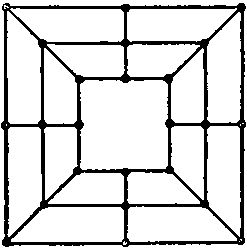
Nine Men's Morris, or Eleven-penny Madell.
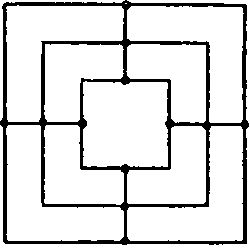
Nine-penny Madell, or The Merrills.
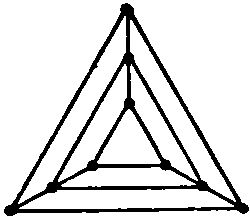
Six-penny Madell.
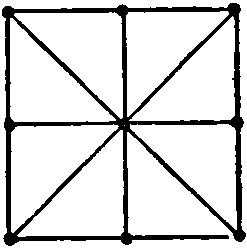
Three-penny Madell.
Maggots. n. Tricks, nonsense. 'Her's at her maggots again.'—N.W.
*Maggotting. Meddling (S.).—S.W.
Maggotty. adj. Frisky, playful (A.S.).—N. & S.W.
Maggotty-pie. Picus caudatus, the Magpie (MS. Lansd. 1033, f. 2), still in use.—N.W.
*Maiden's Honesty. Clematis Vitalba, L., Traveller's Joy. See Honesty.—N.W., obsolete.
'All the hedges about Thickwood (in the parish Colerne) are ... hung with maydens honesty.'—Aubrey's Wilts, Royal Soc. MS. p. 120.
Main. (1) adv. Very, as 'main good,' excellent (A.B.).—N.& S.W. (2) adj. 'A main sight o' frawk,' a great number (S.).—N. & S.W.
Mais'. See Mace.
Make. 'That makes me out,' puzzles me (H.).—N.W.
Malkin. See Mawkin.
*Mammered. Perplexed (A.).
*Mammock. v. To pull to pieces (Leisure Hour, August, 1893).—N.W. (Castle Eaton, &c.)
'He did so set his teeth and tear it; O, I warrant, how he mammocked it!'—Shakespeare, Coriolanus, i. 3.
*Mander. To order about in a worrying dictatorial fashion (S.). 'Measter do mander I about so.'—S.W.
Mandy (long a). (1) Frolicsome, saucy, impudent (A.B.C.): now only used by very old people.—N.W. *(2) Showy (C.).—N.W., obsolete.
Mar. See More.
Marlbro'-handed. People who used their tools awkwardly were formerly called 'Marlbro'-handed vawk,' natives of Marlborough being traditionally famed for clumsiness and unhandiness.—N.W. (Clyffe Pypard.)
Marley. Streaky, marbled; applied to fat beef, or bacon from a fat pig, where the fat seems to streak and grain the lean.—N.W.
Martin, Free-martin. A calf of doubtful sex.—N.W. An animal with an ox-like head and neck, which never breeds, but is excellent for fatting purposes. It is commonly supposed that a female calf born twin with a male is always a free-martin. Recent investigations, however, have proved that though the external organs of a free-martin may be female the internal are in all cases male. The rule laid down by Geddes and Thomson is that twin calves are always normal when of opposite sex or both female; but that if both are male one is invariably thus abnormal (Evolution of Sex, ch. iii. p. 39). Compare Scotch ferow or ferry cow, a cow not in calf, and mart, an ox; also A.S. fear, a bullock (Folk-Etymology).
Masked. See A-masked.
Mathern, Mauthern. *(1) Chrysanthemum leucanthemum, L., Ox-eye Daisy (A.D.H.Wr.).—N.W. (2) Wild Camomile (Great Estate, ch. viii).—N.W.
*Maudlin. The Ox-eye Daisy (D.).—N.W.
Mawk (pronounced Maak). To clean out the oven with the 'maakin,' before putting in the batch of bread.—N.W.
Mawkin, Malkin, Maak, or Maakin, (1) An oven-swab with which the charcoal sticks are swept out of the oven, before putting in the batch (A.).—N. & S.W.
'The malkin, being wetted, cleaned out the ashes ... malkin [is] a bunch of rags on the end of a stick.'—Great Estate, ch. viii.
(2) Also used as a term of reproach.—N.W.
'Thee looks like a girt maakin.'—Great Estate, ch. viii.
*May-beetle, The cockchafer (A.B.).
*May-blobs, May-blubs, or May-bubbles, Flowers and buds of Caltha palustris, L., Marsh Marigold.
Mazzard, *(1) A small kind of cherry (English Plant Names). Merry is the usual Wilts name, Mazzard being Dev. and Som. (2) The head (A.), but only in such threats as:—
'I'll break thee mazzard vor thee!'—Wilts Tales, p. 31.
Ben Jonson has mazzarded, broken-headed.—N.W.
*Meadow-soot, Spiraea Ulmaria, L., Meadow-sweet (Great Estate, ch. ii). Sote, or soot=sweet.—N.W.
*Mealy, Mild and damp. ''Twar a oncommon mealy marnin'.'—N.W. (Bratton.)
Measle-flower, The garden Marigold, the dried flowers having some local reputation as a remedy. Children, however, have an idea that they may catch the complaint from handling the plant.—N. & S.W.
Med, See Mid.
Meg, Meggy. (1) In the game of Must, q.v., a small stone—called a 'meg' or 'meggy'—is placed on the top of a large one, and bowled at with other 'meggies,' of which each player has one.—N. & S.W. *(2) Maig. A peg (S.).—S.W.
Mere. A boundary line or bank of turf.—N. & S.W. A turf boundary between the downs on adjoining farms: formed by cutting two thick turves, one smaller than the other, and placing them, upside down, with the smaller one on top, at intervals of about a chain along the boundary line.—N.W. (Devizes.)
'The strips [in a "common field"] are marked off from one another, not by hedge or wall, but by a simple grass path, a foot or so wide, which they call "balks" or "meres."'—Wilts Arch. Mag. xvii. 294.
'Two acres of arable, of large measure, in Pen field, lying together and bounded by meres on both sides.'—Hilmarton Parish Terrier, dated 1704.
Mere-stone. A boundary stone (Amateur Poacher, ch. iii).—N.W.
Merry. The cherry; applied to both black and red varieties, but especially the small semi-wild fruit.—N. & S.W.
Merry-flower. The wild Cherry.—S.W. (Barford.)
*Mesh (e long). Moss or lichen on an old apple-tree.—S.W. (Som. bord.)
Messenger. (1) A sunbeam reaching down to the horizon from behind a cloud is sometimes said to be the sun 'sending out a messenger.' Cf. Cope's Hants Glossary. Used by children in both N. & S. Wilts. (2) pl. The small detached clouds that precede a storm (Greene Ferne Farm, ch. vi).—N. & S.W.
*Mice's-mouths. Linaria vulgaris, Mill., Snapdragon.—S.W. (Farley.)
Michaelmas Crocus. Colchicum autumnale, L., Meadow Saffron.—N.W.
Mickle. Much (A.S.). A.S. micel.—N. & S.W., occasionally.
Mid, Med. v. Might or may (S.).—N.W.
Middling. (1) Ailing in health (H.); Middlinish (Wilts Tales, p. 137).—N. & S.W. (2) Tolerable, as 'a middlin' good crop.' Middlekin is occasionally used in S. Wilts in this sense.—N. & S.W. 'Very middling' (with a shake of the head), bad, or ill; 'pretty middling' (with a nod), good, or well (Wilts Arch. Mag. vol. xxii. p. 112).
*Midstay. The barn-floor between the mows.—N.W. (Aldbourne.) Compare Middlestead, a threshing-floor: East of England; also
'The old and one-eyed cart-horse dun The middenstead went hobbling round, Blowing the light straw from the ground.'
W. Morris, The Land East of the Sun.
Midsummer men. Sedum Fabaria, Koch., a variety of the red Orpine.—N.W. occasionally; S.W. (Farley.)
Mild. Of stone or wood, easily worked (Great Estate, ch. ix).—N.W.
*Milk-flower. Lychnis vespertina, Sibth., Evening Campion.—S.W. (Charlton All Saints.)
Milkmaids. Cardamine pratensis, L., Lady's Smock. In common use in Hill Deverill and Longbridge Deverill, also at Farley and Hamptworth.—S.W.
Milkwort. Euphorbia Peplus, L., Petty Spurge.—N. & S.W.
Mill. To clean clover-seed from the husk (D.). Milled Hop (D.).—N.W.
Miller, Millard, Mallard, or Dusty Miller. A large white moth (A.S.); generally extended to any large night-flying species.—N. & S.W.
*Mill-peck. A kind of hammer with two chisel-heads, used for deepening the grooves of the millstone (Great Estate, ch. ix).
*Mill-staff. A flat piece of wood, rubbed with ruddle, by which the accuracy of the work done by the mill-peck may be tested (Great Estate, ch. ix).
Mind. (1) To remind. 'That minds I o' Lunnon, it do.'—N. & S.W. (2) To remember. 'I minds I wur just about bad then.'—N. & S.W. (3) 'To be a mind to anything,' to be inclined to do it.—N.W.
Minding. A reminder. After a severe illness you are apt to have 'the mindings on't' now and again.—N.W.
Minnies. Small fry of all kinds of fish.—N. & S.W.
Mint. A cheese-mite (A.). The older form of mite (Skeat).—N.W.
Minty. Of cheese, full of mites (A.).—N.W.
Mist-pond. A pond on the downs, not fed by any spring, but kept up by mist, dew, and rain. Such ponds rarely fail, even in the longest drought. More commonly called Dew-ponds.—S.W. (Broadchalke, &c.)
Mixen, Muxen. A dungheap (A.B.C.S.).—N. & S.W.
Mix-muddle. One who muddles things imbecilely (Village Miners).—N.W.
Miz-maze. Puzzle, perplexity, confusion.—S.W.
Miz-mazed. Thoroughly puzzled, stupefied. Stunned (S.).—S.W.
Mizzy-mazey. Confused. Used of print swimming before the eyes.—S.W.
Moile. Dirt, mud. Mwoile (A.). 'Aal in a mwoile.'—N.W.
Moll*'ern, Molly Heron. The Heron (Great Estate, ch. iv).—N.W.
Mommick, Mommet. A scarecrow. Cf. Mummock.—N.W. (Malmesbury.)
Money-in-both-pockets. Lunaria biennis, L., Honesty, from the seeds showing on both sides of the dissepiment through the transparent pod.
Monkey-musk. The large garden varieties of Mimulus, which resemble the true musk, but are scentless, and therefore merely monkey (i.e. mock, spurious) musk.—N. & S.W.
Monkey Nut. Poa annua, L., Meadow Grass; eaten by boys for its nut-like flavour.—S.W. (Salisbury.)
Monkey-plant. Garden Mimulus (Wild Life, ch. viii).—N.W.
Mooch. See Mouch.
Moocher. See Moucher.
Moochers. Fruit of Rubus fruticosus, L., Blackberry (S.). Cf. Berry-moucher (2).—S.W.
Moon-daisy. Chrysanthemum leucanthemum, L., Ox-eye Daisy (Great Estate, ch. ii). A very general name, especially in N. Wilts. The flowers are sometimes called Moons.—N. & S.W.
Moonied up. Coddled and spoilt by injudicious bringing up. 'Gells as be moonied up bean't never no good.'—N. & S.W.
Moots. Roots of trees left in the ground (A.). See Stowls.—E.W.
Mop. (1) A Statute Fair for hiring servants (A.B.); also used in Glouc. (Wilts Tales, p. 33).—N.W. (2) A rough tuft of grass.
Moral. A child is said to be the 'very moral,' or exact likeness, of its father. A form of 'model.'—N. & S.W.
More, Mar, Moir. (1) An old root or stump of a tree.—N. & S.W. (2) A root of any plant (A.B.G.S.: Aubrey's Wilts MS.), as 'a strawberry more'; 'fern mars'; 'cowslip mars,' &c. (Amateur Poacher, ch. vii.) Occasionally Moir in N. Wilts, as in Crazy Moir.—N. & S.W.
Moreish. Appetizing, so good that you want more of it. 'Viggy pudden be oncommon moreish.'—N. & S.W.
Mort. n. A quantity.—N. & S.W.
'Her talks a mort too vine.'—Dark, ch. x.
'I stuck up to her a mort o' Sundays.'—Ibid. ch. xv.
Most-in-deal. Usually, generally (A.B.C.). 'Where do 'e bide now, Bill?' 'Most-in-deal at 'Vize [Devizes], but zometimes at Ziszeter [Cirencester].' Most-in-general is more commonly used now.—N.W.
Most-in-general. Usually.—N.W.
'Most in gen'ral I catches sight of you when I goes by wi' the horses, but you wasn't in the garden this afternoon.'—Dark, ch. i.
Mote, Maute. A morsel of anything, a very minute quantity.—S.W., formerly.
Mother-of-thousands. (1) Saxifraga sarmentosa, L.—S.W. (2) Linaria Cymbalaria, Mill., Ivy-leaved Toadflax.—S.W. (Salisbury.)
*Mother Shimbles' Snick-needles. Stellaria Holostea, L., Greater Stitchwort (Sarum Dioc. Gazette).—S.W. (Zeals.)
Mothery. Thick, muddy, as spoilt beer or vinegar (A.B.C.S.).—N. & S.W.
Mouch, Mooch. (1) v. To prowl about the woods and lanes, picking up such unconsidered trifles as nuts, watercresses, blackberries, ferns, and flower-roots, with an occasional turn at poaching (Gamekeeper at Home, ch. vii); to pilfer out-of-doors, as an armful of clover from the fresh-cut swathe (Hodge and his Masters, ch. xxiii).—N. & S.W.
'Probably connected with O.F. mucer, muchier, Fr. musser, to hide, to lurk about. It always implies something done more or less by stealth.'—Smythe-Palmer.
(2) v. To play the truant.—N. & S.W. (3) v. To be sulky or out of temper.—N. & S.W. (4) n. 'In a mouch,' in a bad temper. 'On the mouch,' gone off mouching.—N. & S.W.
Moucher, Moocher. (1) A truant (A.B.). See Berry-moucher.—N. & S.W. (2) A man who lives by mouching (Gamekeeper at Home, ch. vii).—N. & S.W.
Moulter. Of birds, to moult.—N.W.
Mound. (1) n. A hedge. In general use in N. Wilts.—N. & S.W. (2) v. To hedge in or enclose.—N.W.
'The Churchyard ... to be mounded partly by the manor, partly by the parish and parsonage except only one gate to be maintained by the vicar.'—1704, Hilmarton Parish Terrier.
Mouse. The 'mouse' is a small oblong piece of muscle, under the blade-bone of a pig.—N.W.
'The chief muscles of the body were named from lively animals; e.g. ... mus, mouse, the biceps muscle of the arm, and so in A.S. and O.H.G. Cf. musculus, (1) a little mouse, (2) a muscle.' (Folk-Etymology, p. 615, sub Calf.)—Smythe-Palmer.
*Mousetails. A kind of grass, perhaps Cats'-tail, but not Myosorus.—N.W.
*Moutch. 'On the moutch,' shuffling (H.). Some meaning of Mouch has probably here been misunderstood.
Mouthy. adj. Abusive, cheeky, impudent.—S.W.
Mow. In a barn, the unboarded space at each end of the threshing-floor, where the corn used to be heaped up for threshing.—N.W.
*Mowing-machine Bird. Salicaria locustella, Grasshopper Warbler, from its peculiar note (Birds of Wilts, p. 154).—S.W. (Mere.)
Much. (1) 'It's much if he do,' most likely he won't do it. 'It's much if he don't,' most likely he will.—N.W. (2) v. To make much of, to pet. 'Her do like muching,' i.e. being petted.—N.W.
Much-about. Used intensively.—N.W.
'I was never one to go bellockin', though I've allus had much-about raison to murmur.'—Dark, ch. x.
Muck. Dirt, mud, earth.—N. & S.W.
*Mucker. A miserly person (S.) Cf. Mouch.—S.W.
'A fine old word, that I do not remember to have met with in other counties. It=Old Eng. mokerer (Old English Miscellany, E. E. T. S. p. 214), a miser; Scot. mochre, mokre, to hoard.'—Smythe-Palmer.
Muckle. (1) n. Manure, long straw from the stable (Agric. of Wilts, ch. vii).—N. & S.W. (2) 'Muckle over,' to cover over tender plants with long straw in autumn, to protect them from frost.—N.W.
Muddle-fuss. A persistent meddler with other people's affairs.—N.W. (Steeple Ashton.)
*Mudel over. The same as Muckle over, q.v. (Agric. of Wilts, ch. vii).
Mud-up. (1) To pamper and spoil a child.—S.W. (Hants bord.) *(2) To bring up by hand (H.Wr.), as 'Mud the child up, dooke' (Monthly Mag., 1814).
Muggeroon. A mushroom.—N.W.
Muggerum. Part of the internal fat of a pig.—N.W.
Muggle. (1) n. Confusion, muddle (A.S.).—N. & S.W.
'Here we be, ael in a muggle like.'—Wilts Tales, p. 137.
(2) To live in a muddling, haphazard way.—N.W. Cf.:—
'Most on us 'ad a precious sight rather work for a faermer like the old measter, an' have our Saturday night reg'lar, than go muggling the best way we could, an' take our chance.'—Jonathan Merle, xxxvii. 412.
Muggle-pin. The pin in the centre of a want-trap.—S.W.
Mullin. The headstall of a cart-horse: sometimes extended to the headstall and blinkers of a carriage horse.—N.W.
Mullock. A heap of rubbish (A.B.), now applied to mine refuse in Australia.
Mummock. A shapeless confused mass. A clumsily-swaddled baby or badly-dressed woman would be 'aal in a mummock.'—N.W.
Mum up. To make much of, pamper, pet, and spoil. 'A granny-bred child's allus a-mummed up.'—N. & S.W.
Mun. Used in addressing any person, as 'Doesn't thee knaw that, mun?' (A.)—N.W.
Must. A game played by children: a small stone—'a meggy'—is placed on the top of a large one, and bowled at with other 'meggies,' of which each player has one.—N.W.
Muxen. See Mixen.
Nacker. See Knacker.
Nail-passer. A gimlet (A.). Kennett has Nailsin in a similar sense.—N.W.
'"Here's the kay" ... holding up a small gimlet. "Whoy, thuck ben't a kay ... that's nothing but a nail-passer."'—Wilts Tales, p. 44.
Nails. Bellis perennis, L., Daisy.—S.W. (Mere.)
Naked Boys. Colchicum autumnale, L., Meadow Saffron, the flowers and leaves of which do not appear together (Aubrey, Nat. Hist. Wilts, p. 51, ed. Brit.). Naked Lady in Cornw., Yks., &c., and Naked Virgins in Chesh.—N. & S.W. (Huish, Stockton, &c.)
*Naked Nanny. Colchicum autumnale, L., Meadow Saffron. See Naked Boys.—S.W. (Deverill.)
Nammet. See Nummet (S.).
'Nan. What do you say? (A.B.C.). See Anan.
Nanny-fodger, or Nunny-fudger. (1) A meddlesome prying person.—S.W. (2) Troglodytes vulgaris, the Wren.—N.W. (Clyffe Pypard.)
Narration. Fuss, commotion. 'He do allus make such a narration about anythin'.'—N. & S.W.
Nash, Naish, Nesh. (1) Tender, delicate, chilly (A.B.H.Wr.).—N. & S.W. (2) Tender and juicy: applied to lettuces.—S.W., occasionally.
Nation, Nashun, &c. Very, extremely, as nation dark (A.B.S.).—N. & S.W.
Nation-grass. Aira caespitosa, L., perhaps an abbreviation of Carnation-grass.—S.W. (Som. bord.)
Natomy, Notamy, Notamize, &c. A very thin person or animal, an anatomy.—N. & S.W.
*Naumpey. A weak foolish-minded person.—N.W.
*Navigator. A drain-maker's spade, with a stout narrow gouge-like blade (Amateur Poacher, ch. xi), more usually known as a Graft.
Neal, Nealded. See Anneal.
Neck-headland. 'To fall neck-headland,' i.e. headlong.—N.W. (Clyffe Pypard.)
Neet. See Nit (S.).
Neoust of a neoustness. Nearly alike (A.). See Aneoust.—N.W.
Nesh. See Nash.
Nessel-tripe, Nessel-trip, Nussel-trip. The smallest and weakest pig in a litter. Commonly used in the Deverills, and elsewhere.—S.W.
Nettle-creeper. Applied generally in Wilts to the following three birds:—(1) Curruca cinerea, Common Whitethroat, (2) C. sylvatica, Lesser Whitethroat, and (3) C. hortensis, Garden Warbler (Birds of Wilts, pp. 159-161).—N.W.
Neust. See Aneoust.
Neust alike. Nearly alike.—N.W. (Clyffe Pypard, &c.)
Neust of a neustness. See Aneoust.
*Never-the-near. To no purpose, uselessly. 'I cwourted she ten year, but there, 'twer aal niver-the-near.'—N.W. (Malmesbury.)
Next akin to nothing. Very little indeed. 'There's next akin to nothen left in the barrel.'—N.W.
Nibs. The handles of a scythe (A.).—N.W.
Niche. See Knitch.
Nightcaps. (1) Convolvulus sepium, L., Great Bindweed.—N. & S.W. (2) Aquilegia vulgaris, L., the garden Columbine.—N.W. (Devizes, Huish, &c.)
Night-fall. n. A disease in horses. A humour in the fetlock joint, recurring until it produces incurable lameness.—S.W.
'Witness ... told him his animal was very lame, and asked what was the matter with it. He replied, "Nothing, it is only 'night-fall,' and it comes on several times during the year."'—Wilts County Mirror, Oct. 27, 1893.
Nightingale. Stellaria Holostea, L., Greater Stitchwort.—S.W. (Hants bord.)
*Night Violet. Habenaria chlorantha, Bab., Greater Butterfly Orchis (Sarum Dioc. Gazette).—N.W. (Lyneham.)
Nine-holes. A game played by children.—N.W.
'This is mentioned among the "illegal games" in the Castle Combe records.'—Wilts Arch. Mag. vol. iii. p. 156.
'1576. Lusum illicitum vocatum nyne holes.'—Scrope's History of Castle Combe.
Nineter. (1) 'A nineter young rascal,' a regular scamp. Not perverted from anoint (as if it meant set apart to evil courses and an evil end), but from Fr. anoienté, anéanti, brought to nothing, worthless (Folk-Etymology, p. 9).—N.W. (Seend.) *(2) A skinflint (S.).
Ninny-hammer. A fool, a silly person.—N.W.
'Nint. See Anoint.
'Ninting (i long). A beating. See Anoint.—N.W.
Nipper. A small boy (S.).—N. & S.W.
Nippers. The same as Grab-hook.—N.W. (Huish.)
Nippy. Stingy (S.).—N. & S.W.
Nistn't. Need not.—N.W.
'Thee nistn't hoopy at I—I can hyar as well as thee.'—Greene Ferne Farm, ch. iii.
Nit, Neet. Nor yet. Wrongly defined by Akerman, Slow, and others as not yet. 'I han't got no money nit no vittles.'—N. & S.W.
Nitch. See Knitch.
Nog. A rough block or small log of wood.—N.W.
Nog-head. A blockhead (S.). Nug-head in W. Somerset.—S.W.
Nolens volens. Used in N. Wilts in various corrupted forms, as 'I be gwain, nolus-bolus,' in any case; 'vorus-norus,' rough, blustering; and 'snorus-vorus,' vehemently.
Noodle along. To lounge aimlessly along, to move drowsily and heavily, as a very spiritless horse.—N.W.
*Noon-naw. A stupid fellow, a 'know-naught' (Great Estate, ch. iv).
Nor, Nur. Than; as 'better nur that' (B.).—N. & S.W.
Not-cow. A cow without horns (A.). A.S. hnot, clipped, shorn.—N. & S.W.
Noust. See Aneoust.
Nummet. The 'noon-meat' or noon-day meal (A.). Nammet in S. Wilts.—N. & S.W.
Numpinole. The Pimpernel.—N.W. (Clyffe Pypard.)
Nuncheon, Nunchin. The noon-meal (A.S.). Nunch (Wilts Tales, p. 117).—N.W.
Nunchin-bag. The little bag in which ploughmen carry their meals (A.).—N.W.
Nunny-fudging. Nonsense. 'That's all nunny-fudgen.'—N.W., now nearly obsolete.
Nunny-fudgy. 'A nunny-fudgy chap,' a poor sort of a fellow with no go in him: now used only by old people.—N.W.
Nur. See Nor.
*Nurk. The worst pig of a litter. See Rinnick.—N.W.
Nurly. Of soil: lying in lumps.—S.W. (Bratton.)
Nut. The nave of a wheel (S.).—S.W.
Nyst, Niest. Often used in Mid Wilts in same way as neust, as 'I be nyst done up,' i.e. over tired.
Nythe. A brood, as 'a nythe o' pheasants'; always used by gamekeepers.—N.W. Apparently a form of Fr. nid, a nest. In the New Forest they say 'an eye of pheasants.' See Cope's Hampshire Glossary (s.v. Nye).
Oak-tree loam or clay. The Kimmeridge Clay (Britton's Beauties, 1825, vol. iii., also Davis's Agric. of Wilts, p. 113, &c.).
Oat-hulls (pronounced Wut-hulls). Oat chaff and refuse.—S.W.
Oaves. (1) Oat chaff.—N. & S.W. (Huish, &c.) (2) The eaves of a house (S.).—S.W.
'A good old form. Mid. Eng. ovese (Old Eng. Miscell., E. E. T. S. p. 15, l. 465),=O. H. Germ, opasa (Vocab. of S. Gall).'—Smythe-Palmer.
Odds. (1) v. To alter, change, set right. 'I'll soon odds that' (Wilts Arch. Mag. vol. xxii. p. 112).—N.W. (2) n. Difference. 'That don't make no odds to I.' 'What's the odds to thee?' what does it matter to you?—N.W.
Oddses. Odds and ends.
Oddy. (1) See Huddy. (2) Strong, vigorous, in hearty health.—N.W.
Of. With. 'You just come along o' I!'—N. & S.W.
Offer. 'To offer to do a thing,' to make as though you were going to do it, or to begin to do it. 'He offered to hit I,' i.e. did not say he would, but just put up his fists and let out.—N.W.
Old man. (1) Artemisia Abrotanum, L., Southernwood.—N. & S.W. (2) Anagallis arvensis, L., Scarlet Pimpernel.—S.W.
Old man's beard. (1) Clematis Vitalba, L., Traveller's Joy, when in fruit.—N. & S.W. (2) The mossy galls on the dog-rose.—N. & S.W.
Old Sow. Melilotus coerulea, L., from its peculiar odour (Science Gossip, Nov. 1868).—N. & S.W., rarely.
*Old woman's bonnet. Geum rivale, Water Avens.—S.W. (Mere.)
*Old woman's pincushion. Orchis maculata, L., Spotted Orchis.—S.W.
Ollit. See Elet.
On. (1) =in, prep., as 'I run agen un on th' street' (A.).—N. & S.W. (2) =in, prefix, as ondacent.—N. & S.W. (3) =im, prefix, as onpossible (A.B.).—N. & S.W. (4) =un, prefix, as ongainly (B.). Onlight, to alight.—N. & S.W. (5) =of, as 'I never did thenk much on 'en.'—N. & S.W. (6) =by, as 'He come on a mistake.'—N. & S.W.
Once. (1) Some time or other (M.). 'Once before ten o'clock,' some time or other before ten.—N. & S.W.
'Send it once this morning, dooke.'—Monthly Mag. 1814.
(2) 'I don't once (=for one moment) think as you'll catch un.'—N. & S.W.
Oo. Such words as hood, wood, want, a mole, wonder, &c., are usually pronounced in N. Wilts as 'ood, 'oont, 'oonder.
*Organy. (1) Mentha Pulegium, L., Pennyroyal (A.B.). (2) Origanum vulgare, L., Marjoram (English Plant Names).
Otherguise. Otherwise.—N.W.
Out-axed. Of a couple, having had their banns fully asked, or called for the last time (Wilts Tales, p. 100). The banns are then out, and the couple out-axed.—N.W.
Oven-cake. Half a loaf, baked at the oven's mouth.—N.W.
Oven-lug. The pole used as a poker in an oven. See Lug (2).—N.W.
*Over-get. To overtake, to catch up.—N.W. (Malmesbury.)
*Overlayer. See quotation.
'The waggons ... seldom have any overlayers or out-riggers, either at the ends or sides.'—Agric. of Wilts, ch. xxxviii.
Overlook. To bewitch. Rare in Wilts, common in Dev. and Som.—N.W. (Malmesbury.)
Over-right, Vorright. Opposite to.—N.W.
Owl about. To moon about out of doors in the dark.—N.W.
Owling. The same as Griggling, q.v.—N.W. (Clyffe Pypard.)
Compare:—
'Howlers. Boys who in former times went round wassailing the orchards.'—Parish, Sussex Glossary.
'The wenches with their wassail bowls About the streets are singing; The boys are come to catch the owls.'—G. Wither.
*Owl-catchers. Gloves of stout leather (Amateur Poacher, ch. xi).
Pack-rag Day. October 11, Old Michaelmas Day, when people change house. Also used in Suffolk.—N.W.
*Paint-brushes. Eleocharis palustris, Br.—S.W. (Charlton All Saints.)
Palm-tree. The Willow. Palms. Its catkins.—S.W.
Pamper. To mess about, to spoil a thing.—N.W. (Clyffe Pypard.)
Pancherd. See Panshard.
Pank. To pant (S.).—N. & S.W.
Panshard, Ponshard, Pancherd. (1) A potshard: a broken bit of crockery (A.B.S.).—N.W. (2) 'In a panshard,' out of temper, in a rage.—S.W. Also used in the New Forest.
Pantony. A cottager's pantry (Wilts Arch. Mag. vol. xxii. p. 112). Compare Entony, an entry: Berks. There are many slight variants, as Panterny.—N. & S.W.
Paper Beech. Betula alba, L.—N.W.
*Parasol. Sanguisorba officinalis, L., Salad Burnet.—S.W. (Little Langford.)
Parson. In carting dung about the fields, the heaps are shot down in lines, and are all of much the same size. Sometimes, however, the cart tips up a little too much, with the result that the whole cartload is shot out into a large heap. This is known as a 'Parson.'—N.W. (Clyffe Pypard.)
Parters. Pieces of wood in a waggon which join the dripple to the bed. See Waggon.—N.W.
Passover. 'A bit of a passover,' a mere passing shower.—S.W. (Som. bord.)
Payze. To raise with a lever (B.). Norman French peiser, cp. Fr. poiser.—N. & S.W.
Peace-and-Plenty. A kind of small double white garden Saxifrage.—S.W.
Peakid, Peaky, Picked, Picky. Wan or sickly-looking.—N. & S.W.
Pearl-blind. See Purley.
Peart. (1) Impertinent (A.S.).—N. & S.W. (2) In good health. 'How be 'ee?' 'Aw, pretty peart, thank'ee.'—N. & S.W. (3) Clever, quick, intelligent.—S.W. (4) Stinging, sharp, as a blister.—S.W. (5) Lively. 'Her's as peart as ar' a bird, that's what her is!'—N.W.
Peck. (1) n. A pickaxe.—N. & S.W. (2) v. To use a pickaxe.—N. & S.W. (3) v. Of a horse, to trip or stumble: also Peck-down.—N.W.
'Captain Middleton's horse "pecked"—it is presumed through putting its foot in a hole—and threw the rider.'—Daily Telegraph, April 11, 1892.
*Pecker. n. The nose (S.).—S.W.
Pecky. Inclined to stumble. 'Th'old hoss goes terr'ble pecky.'—N.W.
Peel. (1) A lace-making pillow (A.B.). A little 'Peel lace' is still made about Malmesbury. A.S. pile.—N.W. (2) The pillow over the axle of a waggon (D.). See Waggon.—N.W. (3) The pole, with a flat board at end, for putting bread into the oven.—N.W.
Peggles. See Pig-all.
Pelt. Rage, passion (A.S.). 'A come in, in such a pelt.'—N. & S.W. The word occurs in this sense in some old plays. Herrick alludes in Oberon's Palace to 'the stings of peltish wasps,' and Topsell uses 'pelting' for angry or passionate.
'You zims 'mazin afeert to zee your gran'fer in a pelt! 'Ten't often as I loses my temper, but I've a-lost 'un now.'—Dark, ch. xii.
Penny (or Perry) moucher. A corruption of Berry-moucher, q.v.
Perkins. The same as Ciderkin.—N.W.
Perk up. To get better, to brighten up.—S.W.
*Perseen. v. To pretend to (S.).—S.W.
'There's Jack White a comin'; I wun't perseen ta know un.'—Mr. Slow.
Peter grievous. (1) n. A dismal person, or one who looks much aggrieved. Pity grievous at Clyffe Pypard, and Peter grievous at Salisbury.—N. & S.W.
'I'll tell you summat as 'll make 'ee look a pater grievous!'—Dark, ch. xv.
(2) adj. Dismal-looking. 'He be a peter-grievious-looking sort of a chap.'—S.W.
*Peter-man. See Jackson's Aubrey, p. 11.—Obsolete.
'At Kington Langley ... the revel of the village was kept on the Sunday following St. Peter's Day (29th June), on which occasions a temporary officer called "the Peter-man" used to be appointed, bearing the office, it may be presumed, of master of the sports.'—Wilts Arch. Mag. vol. xxiv. p. 83.
Peth. The crumb of bread.—N.W.
Pethy. Crumby, as 'a pethy loaf.'—N.W.
Pick. (1) A hay-making fork (A.B.D.), a stable-fork (D.). Pick=pitch, as in pitch-fork (Skeat).—N. & S.W. (2) The fruit of the sloe.
Picked (two syll.). (1) Sharp-pointed. Piggid on Som. bord. 'Thuck there prong yun't picked enough.'—N. & S.W. (2) Looking ill (S.). With features sharpened by ill-health. See Peakid.—N. & S.W.
Pickpocket. Capsella Bursa-pastoris, L., Shepherd's Purse.—N. & S.W. (Enford, Mere, &c.)
Picky. See Peakid.
*Pie-curr. Fuligula cristata, Tufted Duck (Birds of Wilts, p. 190).—S.W.
Pig-all, Pig-haw. Fruit of the hawthorn (A.). Peggles (Jefferies, Marlborough Forest, &c.)—N.W.
Pig-berry. Fruit of the hawthorn (S.).—N. & S.W.
Pigeon-pair. When a woman has only two children, a boy and a girl, they are called a 'pigeon pair.'—N. & S.W.
'So in N. Eng. "a dow's cleckin" (a dove's clutch) is used for two children.'—Smythe-Palmer.
Piggid. See Picked (1).
Pig-haw. See Pig-all.
Pig-meat. The flesh of the pig in Wilts is, if fresh, 'pig-meat.' It is never 'pork' unless the animal is specially killed as a 'little porker.'
*Pig-muddle. Disorder, mess.—N.W.
Pig-nut. (1) Bunium flexuosum, With., The Earth-nut.—N. & S.W. (2) The very similar root of Carum Bulbocastanum, Koch., Tuberous Caraway.—N.W., occasionally.
Pig-potatoes. Small potatoes, usually boiled up for the pigs.—N. & S.W.
Pigs. (1) See Boats.—S.W. (Hants bord.) (2) Woodlice.—N. & S.W. Also Guinea-pigs and Butchers' Guinea-pigs.
Pig-weed. Symphytum officinale, L., Comfrey.—N.W. (Enford.)
Pillars. See Waggon.
Pimrose. A primrose. Also used in Hants.—N. & S.W.
Pin-bone. The hip bone; sometimes the hip itself.—N.W.
Pincushion. (1) Anthyllis vulneraria, L., Kidney Vetch.—S.W. (Barford.) (2) Scabiosa arvensis, L., Field Scabious.—S.W. (Charlton.)
Pinner. A servant's or milker's apron; a child's pinafore being generally called Pinney.—N. & S.W.
'Next morn I missed three hens and an old cock, And off the hedge two pinners and a smock.'
Gay, The Shepherd's Week.
Pinny-land. Arable land where the chalk comes close to the surface, as opposed to the deeper clay land.—N.W. (Clyffe Pypard.)
Pins. The hips. A cow with hips above its back is said to be 'high in the pins.'—N.W.
Pip. The bud of a flower (B.).—N.W.
*Pish! or Pishty! A call to a dog (A.). In co. Clare, Ireland, this is the order to a horse to stop.
Pissabed. Leontodon Taraxacum, L., Dandelion, from its diuretic effects.—N. & S.W.
*Pissing-candle. The least candle in the pound, put in to make up the weight (Kennett's Paroch. Antiq.). Cp. Norman French peiser, to weigh.—Obsolete.
Pit. (1) n. A pond.—N.W. (2) n. The mound in which potatoes or mangolds are stored (Agric. of Wilts, ch. vii).—N. & S.W. (3) v. 'To pit potatoes,' to throw them up in heaps or ridges, in field or garden, well covered over with straw and beaten earth, for keeping through the winter.—N. & S.W.
Pitch. (1) n. A steep place.—N.W. (2) n. 'A pitch of work,' as much of the water-meadows as the water supply will cover well at one time (Agric. of Wilts, ch. xii).—S.W. (3) n. The quantity of hay, &c., taken up by the fork each time in pitching (Gamekeeper at Home, ch. iv).—N. & S.W. (4) v. To load up wheat, &c., pitching the sheaves with a fork (S.).—N. & S.W. (5) v. To fix hurdles, &c., in place (Bevis, ch. xxiii).—N. & S.W. (6) v. To settle down closely.
'Give the meadows a thorough good soaking at first ... to make the land sink and pitch closely together.'—Agric. of Wilts, ch. xii.
(7) v. To lose flesh, waste away. Still in use in N. Wilts.
'The lambs "pitch and get stunted," and the best summer food will not recover them.'—Agric. of Wilts, ch. xii.
(8) v. To set out goods for sale in market. 'There wur a main lot o' cheese pitched s'marnin'.'—N. & S.W. (9) v. To pave with Pitchin, q.v.—N.W. (10) v. Of ground, to have an uneven surface. 'The ground this end o' the Leaze pitches uncommon bad.'—S.W. (Hants bord.)
Pitched market. A market where the corn is exposed for sale, not sold by sample (D.).—N.W.
Pitchin. n. Paving is done with large flat stones, 'pitching' with small uneven ones set on edge (A.S.).—N. & S.W.
Pitching-bar. The iron bar used in pitching hurdles (Amateur Poacher, ch. ii).—N. & S.W.
Pitch-poll. When rooks are flying round and round, playing and tumbling head over heels in the air (a sign of rain), they are said to be 'playing pitch-poll'—N.W.
Pitch-up. A short rest, as when a cart is going up a steep hill.—N.W.
Pit-hole. The grave (S.). Used by children.—N. & S.W.
'They lies, the two on 'em, the fourth and fifth i' the second row, for I dug pit-holes for 'em.'—The Story of Dick, ch. vi. p. 66.
*Pixy. A kind of fairy. This is a Dev. and Som. word, but is said to be in use about Malmesbury.
Plain. Straightforward, unaffected, as 'a plain 'ooman.'—N. & S.W.
Plan. 'In a poor plan,' unwell, in a poor way, &c.—N.W. (Seend.)
*Plank-stone. A flag-stone.
'This soyle (at Easton Piers) brings very good oakes and witch hazles; excellent planke stones.'—Jackson's Aubrey, p. 236.
'At Bowdon Parke, Ano 1666, the diggers found the bones of a man under a quarrie of planke stones.'—Aubrey's Nat. Hist. of Wilts, p. 71, ed. Brit.
*Plash, Pleach. To cut the upper branches of a hedge half through, and then bend and intertwine them with those left upright below, so as to make a strong low fence (A.). Also Splash.—N. & S.W.
Plat. The plateau or plain of the downs.—S.W.
Pleach. See Plash.
Pleachers. Live boughs woven into a hedge in laying.—S.W.
Plim. (1) v. To swell out (A.B.S.), as peas or wood when soaked in water.—N. & S.W. (2) v. Many years ago, near Wootton Bassett, old Captain Goddard spoke to a farmer about a dangerous bull, which had just attacked a young man. The farmer's reply was:—'If a hadn't a bin a plimmin' an' vertin' wi' his stick—so fashion—(i.e. flourishing his stick about in the bull's face), the bull wouldn't ha' run at un.' No further explanation of these two words appears to be forthcoming at present.
Plocks. Large wood, or roots and stumps, sawn up into short lengths, and cleft for firewood (S.). Plock-wood (D.).—N. & S.W.
Plough. A waggon and horses, or cart and horses together, make a plough (D.). See Kennett's Paroch. Antiq.—N.W.
'The team of oxen that drew the plough came to be called the plough, and in some parts of South Wilts they still call even a waggon and horses a plough. This is needful for you to know, in case your man should some day tell you that the plough is gone for coal.'—Wilts. Arch. Mag. vol. xvii. p. 303.
'1690. Paid William Winckworth for Worke downe with his Plough to the causway.'—Records of Chippenham, p. 237.
'1709. Paid for 41 days worke with a ploughe carrying stones to the Causey.'—Ibid. p. 239.
(2) For the various parts of the old wooden plough see as follows:—
'I should like to hear a Wiltshire boy who had been three years at plough or sheep fold, cross-examine one of Her Majesty's Inspectors of Schools, and ask him, in the article of a plough, to be so good as to explain the difference between the vore-shoot and back-shoot, the ground rest, the bread board, the drail, the wing and point, and the whippence.'—Wilts Arch. Mag. vol. xvii. p. 303.
*Ploughman. A waggoner or carter.—N.W., obsolete.
'1690. Paid for beere for the plowmen and pitchers.'—Records of Chippenham, p. 237.
*Ploughman's-weatherglass. Anagallis arvensis, L., Scarlet Pimpernel.—S.W. (Barford.)
Plurals. (1) The old termination in en is still much used, as Housen, Hipsen, &c. See En (1). (2) Plurals in es are very commonly used, as beastes, ghostes, nestes, postes, gutses. Very often a reduplication takes place, as beastises, ghostises, &c.—N. & S.W. (3) Plurals are used sometimes instead of singulars. Examples:—'Nows and thens,' 'You'll find un a little ways furder on,' &c.
'These are rather an adverbial use of the genitive, like always, now-a-days, needs, whiles, etc.'—Smythe-Palmer.
(4) Plant-names are almost invariably used in the plural, even where only a single blossom is referred to, as 'What is that flower in your hand, Polly?' 'That's Robins, ma'am' (or Cuckoos, Poppies, Nightcaps, &c., as the case may be).—N. & S.W.
Poach. (1) Of cattle, to trample soft ground into slush and holes.—N. & S.W. (2) Of ground, to become swampy from much trampling (Wild Life, ch. xx).—N. & S.W.
*Podge. Anything very thick and sticky. Cf. Stodge.
*Pog. *(1) To thrust with the foot.—N.W. (Malmesbury.) *(2) To set beans.—N.W. (Malmesbury.)