Jessie Mansergh (continued 3)
Reading edition
Mildred stood like a figure carved in stone, staring fixedly at the door; her heart was beating like a sledge-hammer, the blood tingled to her finger ends. Supposing she went on and tried to awaken James! His door might be locked; he was an old man, probably a heavy sleeper; by the time he was aroused and had put on his clothes the thieves might have escaped! They were hard at work; at any moment they might come out,—but if those bolts were slipped!—A sudden impulse leapt into the girl’s brain and refused to be shaken off. A dozen steps to the right, a leap forward, one hand on the knob, another raised to shoot the bar of brass into its place, a swift, impetuous movement, and the thing would be done, the thieves caught red-handed, and Mrs Faucit’s treasures saved! “And I can do it,” said Mildred to herself, “as well as James or anyone else; better perhaps, for I am small and light, and they are busy now and unsuspicious. It is the right time, perhaps the only time. I can do it—I will do it, before I get too nervous,—before I have time to think!”
She was nervous enough as it was, poor child, for the fear of failure was in her heart, and a terrible dread of those wicked men; but she had enough self-possession left to know that it must be now or never, and to allow herself no time for wavering.
Cécile and her two accomplices, rifling the safe of its treasures and packing the spoil together in convenient fashion for carrying away, were all unconscious of the white figure in the hall stealing forward step by step, the white face looking out from the veil of golden hair, the outstretched hands creeping nearer and nearer to those two strong brass knobs. A little gurgling sob of emotion swelled in Mildred’s throat at that last crucial moment, her teeth gleamed between her parted lips, then with a spring like that of a wild animal she pounced upon the handle, and with strength born of excitement slammed the door against the lintel, and shot the big brass bar into position. A howl of rage sounded from within as the thieves threw themselves against the door with desperate force, but it was too late. Mildred bent downwards, secured the second fastening, and flew off to awaken James, secure in the knowledge that, rage and struggle as they might, the strong oak door shut them out from escape as surely as the barred window itself.
Chapter Thirteen.
After the Robbery.
There was no sleep for the inhabitants of The Deanery during the remainder of that exciting night. The sudden banging of the strong-room door, with the babel which immediately followed from within, would in themselves have been enough to alarm the household; but Mildred was determined to leave nothing to chance.
She arrived at James’s room just in time to meet that faithful servant hurrying forth with a greatcoat fastened over his night attire, and while he rushed across the garden to arouse the coachman, she turned back into the hall, and began to beat a wild tattoo upon the gong.
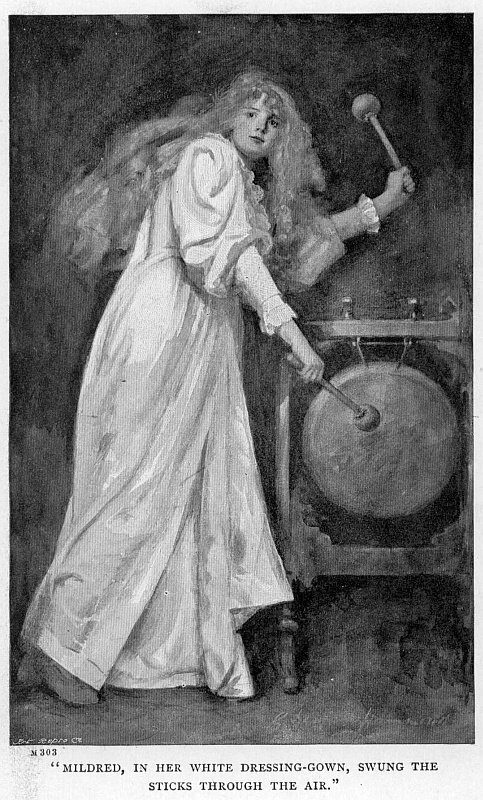
When Bertha came rushing downstairs a moment later, followed by a flock of terrified women-servants, she was horrified by the sight which she beheld. There stood Mildred in her white dressing-gown, her hair hung round her face in wild confusion, her eyes gleamed, her long arms swung the sticks through the air, and brought them down upon the gong with a fierceness of triumph, which had in it something uncanny to the gentle onlooker. She looked strangely unlike Mildred Moore—pretty, merry Mildred, so ready to tease and plague, to kiss and make friends, and tease again all in a moment. She was so carried away by the terrible excitement of the moment that she had no eyes for what was going on around, and seemed perfectly oblivious of the fact that her friends were standing by her side.
It flashed through Bertha’s mind that Mildred was going mad, and she seized hold of the swinging arms in an agony of appeal.
“Mildred, Mildred—don’t! Oh, what are you doing? We are all here; I am here—Bertha! What has happened? what is the matter? Don’t stare like that, you frighten me! You understand what I am saying, don’t you, Mildred, dear?”
“I—I—I,” began Mildred blankly. She turned her head and looked at the strong-room door, before which James stood on guard, waiting the return of the coachman with the policemen; then at the group of women-servants huddled on the stairs; last of all in her friend’s face, white and anxious, and overflowing with sympathy. “You understand me, don’t you, Mil?” Bertha repeated gently, and at that Mildred’s tense attitude relaxed. She put her hand to her head as one awakening from a dream, and clutching Bertha by the arms, burst into a flood of tears.
“Take me away!” she sobbed; “take me away!” and Bertha led her forward into the breakfast-room, followed by a murmur of sympathy from the onlookers.
James had found time to give a brief account of what had taken place to his fellow-servants, and they were filled with wonder and admiration.
“To come down all by herself, in the dead of night—that child! She is brave and no mistake! I always liked her—she has such pretty ways of her own,—but I never thought she would come out like this. She seemed so careless-like! Poor child, to see her beating that gong! She didn’t know what she was doing. It’s enough to upset anyone. To fasten that heavy door herself!”
Then the conversation took another turn, and busied itself in denouncing Cécile and her villainies.
“The deceitful, wicked creature! That’s the end of her smooth tongue and her deceitful ways! Making excuses to poke about all the rooms in turn, and pretending to help when it was nothing else than curiosity and wicked scheming! I saw her with a letter of the master’s in her hand one evening, and she said she had been sent to find it. So likely, when he had half a dozen servants of his own in the house! Now she will have a spell in prison for a change—not the first one either, or I’m mistaken. To think, if it hadn’t been for Miss Mildred, she would have been off with the pick of the valuables in the house!”
So on and so on, while within the breakfast-room the heroine of the occasion was being soothed and petted to her heart’s content, Miss Turner and the two girls hanging round her, and vieing with each other as to who could do most for her comfort. In spite of her agitation, however, it was Mildred who was the first to think of the old lady upstairs, and her quick “Who is with Lady Sarah?” made the governess start in compunction.
“Oh, my dear, I am so glad you reminded me! I am ashamed to say I forgot all about her. One is so accustomed to depend upon Cécile.”
She hurried away, sending the motherly old cook to take her place beside the girls, while the cook in her turn despatched the kitchen-maid to provide refreshment for the household. So it came to pass that at three o’clock in the morning several tea-parties were being held in The Deanery, the guests thereat presenting a motley appearance in their anomalous garments.
When the policemen arrived, Bertha and Mildred refused to go out into the hall to see the capture of the thieves; but Lois could not restrain her curiosity, and came back with a thrilling account of the two big, wicked-looking men who were Cécile’s accomplices, and of Cécile herself, looking “so white, so terrified, so,—so old, that I was obliged to be sorry for her, though I tried to be angry! I expect she wishes now that she had gone to bed, and slept quietly, like a good Christian!” concluded Lois quaintly; and at that Mistress Cook lifted up her voice, and remarked that it would be a good thing if they were all to set about doing that without delay.
“It is nearly four o’clock,” she said, “and to-morrow’s work has to be done, thieves or no thieves. The mistress will get a telegram the moment the office is opened, and she will be home by the first train, or I’m mistaken. You young ladies had better get off to bed at once, or she will be more upset than ever if she finds you looking like ghosts!”
Miss Turner returned to the room at this moment, and warmly seconded the motion. She had left Mary, the pleasant-faced housemaid, in charge of Lady Sarah, who was nervous and unstrung after her fright, and she herself proposed to share Mildred’s bed for the remainder of the night, the twins being left to keep each other company.
Mildred was thankful to accept the offer, for the strain upon her nerves had left her so weak that her legs trembled beneath her as she ascended the staircase. Even with Miss Turner lying beside her, sleep refused to come until the sun was high in the heavens, and the noises of the day rose from the garden beneath. Then at last, in the blissful sense of security brought about by light and sunshine, the tired lids closed, and she fell into a deep, restful slumber.
Miss Turner rose and crept softly from the room; Bertha and Lois peeped in at intervals of half an hour; Mary prepared two tempting breakfast-trays, one after the other, and carried them down untouched, for Mildred slept like the seven sleepers, and no one had the heart to shorten the well-earned rest.
Shortly before one o’clock a cab drove up to the door, and the Dean and Mrs Faucit hurried into the house. They looked anxious and perturbed, and had a great many questions to ask—not about the silver, however,—that seemed quite a secondary consideration,—but about the welfare of Mildred, Lady Sarah, and the children, and as to what had been done with that poor, unhappy Cécile. Miss Turner assured them in reply that the children were as happy and as naughty as ever; that Lady Sarah was rather nervous, but otherwise none the worse for her adventure, and that Mildred had been sound asleep since seven o’clock in the morning.
“I must go up and see her at once—the dear child! the dear, brave child!” cried Mrs Faucit warmly; and she hurried upstairs, the Dean following, shaking his head in meaning manner, and treading on tiptoe as he entered the room, and advanced to the bedside.
Mildred lay fast asleep, her hair falling over the pillow in shining golden tangles; while one arm was thrown over the counterpane, the other tucked under her head, so that her cheek rested in the hollow of her palm.
There were dark shadows beneath her eyes; and she looked so white and spent, so unlike her usual radiant self, that Mrs Faucit’s eyes overflowed with tears, and she bent involuntarily to press a kiss upon her lips.
The scream with which Mildred started up in bed made the two hearers fairly leap back in amazement. The sudden awakening was too much for the disordered nerves, and the soft touch had brought with it a hundred nightmare dreads. When she saw who was standing beside her, she calmed down in a moment, and apologised in shamefaced manner.
“Oh, Mrs Faucit, I am so sorry I startled you! I had just shut my eyes, and I thought it was—something dreadful—I don’t know what exactly! How did you get back? What time is it? Is breakfast ready? Oh, I am so glad you are here! It is all right! I shut the door—they can’t get out!—”
“Yes, dear, yes—I know! Don’t think about it. We will have a long talk to-night when you are rested, but try to go to sleep again now. I am so vexed with myself for disturbing you!”
“I can’t sleep. I’ve tried, but it’s no good. I’ve been awake all night!” sighed Mildred pitifully. She believed that she was speaking the truth, but in reality she was so sleepy at the present moment that she hardly knew what she was saying. She raised pathetic eyes to the Dean’s face, and inquired, with a yawn: “Wh-at did the Archbishop say about Cécile?”
“Bless me!” cried the Dean in alarm. “This is terrible—the child is wandering! She doesn’t know what she is saying!” He laid his hand on Mildred’s forehead, and backed out of the room, beckoning furtively to his wife as he went. Outside in the passage he ruffled his hair in helpless misery.
“Her head is burning, Evelyn! the child is in a fever! Something must be done at once. I don’t like to see her suffering. Er—er—what could you give her, dear? Aconite and belladonna? What do you say to aconite and belladonna—every half-hour?”
He looked so comical with his ruffled hair and distended eyes, that his wife could not restrain a smile.
“Oh, she will be all right, dear, after a day’s rest!” she said reassuringly. “I will keep her in bed, and not allow her to talk too much. You need not be anxious; Mildred is too healthy to be upset for more than a few hours!”
“But I should try the belladonna! I should certainly try the belladonna!” said the Dean urgently. He shuffled along the passage, but before his wife had time to re-enter the room he was back again, his face alight with inspiration.
“Evelyn, I was thinking! A gold watch and chain—the same as we gave the girls at Christmas.—How would that do, eh? We might present them to her as a small—er,—acknowledgment of—er,—gratitude! What do you think of that? Does it strike you as a good idea?”
“Capital, Austin! Much better than the belladonna!” cried Mrs Faucit.
She patted him approvingly upon the shoulder, and the Dean went off to his study rubbing his hands, and chuckling to himself, like a kindly, innocent child, which indeed he was, despite all the learning which had made him famous.
Chapter Fourteen.
Friends at Last!
There was a constant coming and going at The Deanery during the whole of that day, and the very atmosphere seemed full of excitement. Mrs Faucit, however, kept Mildred a prisoner in her own room, gave her an interesting book to read, and forbade the subject of the robbery to be mentioned in her hearing, with the result that by evening she was herself once more, chatting with the girls, and only lapsing into melancholy at the remembrance of poor, unhappy Cécile.
The next morning Mildred saw Lady Sarah for the first time since the eventful moment when she had started on her search for James’s bedroom.
The old lady was sitting in her favourite corner by the drawing-room window, wrapped in shawls, and supported by pillows, for at her advanced age such an experience as she had known was not easily outlived, and as Mildred paced the garden walks with her friends, she received a message to the effect that Lady Sarah wished to see her alone for a few minutes, as she had something particular to say.
“My thanks are due, Most kind and generous maiden, unto you!” quoted Lois, from a play which had been performed at school at the beginning of the Christmas holidays, and Mildred gave a little laugh of complacency.
The quotation sounded appropriately in her ears, for she had no doubt that she was summoned to hear grateful acknowledgment for the help which she had given on the night of the attempted robbery. As she walked across the lawn towards the house, she was rehearsing the scene to herself, after a habit of her own on occasions like the present. “My dear Mildred! How can I thank you sufficiently!” Lady Sarah, she imagined, cried enthusiastically.
“Oh, pray, don’t mention it! I have done nothing at all!”
She screwed her face into the very smile of polite protest with which she would give her answer, and was proceeding to invent an emphatic disclaimer from Lady Sarah, when she came face to face with the Benjamin of the household—little, mischievous Erroll, who was strolling about the garden in search of adventure.
He wore a holland blouse, and absurd little knickerbockers about six inches long, from beneath which his bare legs emerged brown and sturdy.
A scarlet cap was perched on the back of his head, and he swung his arms as he walked with the air of a Grenadier Guard, and a very fierce and warlike one at that. Mildred pinched his ear as she passed, as a mark of affectionate remembrance, whereupon Erroll lifted his funny little face to hers, and volunteered a piece of information.
“I telled Yady Saraw about ze pump!”
“The pump!” Mildred’s heart gave a leap of apprehension. She seized the child by the arm and held him firmly until he had answered her question. “What pump? What do you mean, Erroll?”
“Wat zo pumped ze water wif, on ze window!” said Erroll pleasantly.
He evidently had no idea that Mildred would be discomposed by the intelligence, and was a good deal astonished at the hasty manner in which she shook him off and resumed her walk to the house.
Here, indeed, was a changed position. She was going to be scolded, not thanked—called to account for misdeeds, not praised for valour. Mildred pressed her lips together, and her eyes shone with a gleam of anger.
The more exciting events of the last two days had thrown the picnic into the background, so that she had almost forgotten the unfortunate incident to which Erroll had referred. It had troubled her greatly at the time, but since then she had had an opportunity of “making up”, which should surely have condoned any previous offence. “Lady Sarah need not have said anything about it; even if she were told. She might have forgiven a little thing like that, when I have perhaps saved her life,” she told herself angrily. “I believe she is glad to have something to blame me for, so that she may avoid saying anything nice or grateful!”
Mildred felt thoroughly cross and out of sorts, as was not altogether unnatural under the circumstances. When one has been treated as a heroine for a couple of days, it comes as an unpleasant shock to find one’s self suddenly dragged down from the pedestal and compelled to appear in the character of a culprit. Mildred felt it very hard indeed, and the softened feeling with which she had thought of the old lady during the last forty-eight hours vanished at once, and gave place to the old bitter enmity.
Lady Sarah had seen the girl’s encounter with Erroll, so that she was at no loss to understand the sudden change in her expression, as she drew near. They looked at one another in silence for several minutes—Lady Sarah with her brows drawn together, yet on the whole more anxious than angry; Mildred erect as a dart, her head thrown back in defiant fashion.
“Is this true, may I ask, what the child tells me—that you played the hose on my bedroom window the other morning, in order to make me believe it was raining?”
Lady Sarah sat upright on her chair, her hands clasped together on her lap. The morning light gave a livid hue to the worn features, the bones in her neck seemed more prominent than ever. “But it is not my fault if she is old,” was Mildred’s obstinate comment. “She can’t blame me for that, I suppose?”
“Yes, it’s quite true.”
“It is true! You heard me say that I was afraid of my rheumatism, and tried to persuade me that it was raining so that I might stay at home. You knew I was anxious to go, and you deliberately set to work to prevent me. Nice behaviour, indeed! I wonder you have the audacity to look in my face and acknowledge it!”
“I never tell lies,” said the girl proudly, and Lady Sarah interrupted with a harsh laugh.
“No; you only act them, I suppose. It never struck you that it was acting a lie to go out of your way to deceive an old woman and make her stay at home on false pretences, did it?”
Mildred started.
“No, it never did. I did not think of that. If I had, I would not have done it.”
“And why did you do it? To prevent my going to the picnic, of course; but why were you so anxious about that? What harm would it have done if I had been there?”
There was an unwonted strain of anxiety in the sharp voice, and the answer came but slowly.
“Oh, I don’t know! We had been looking forward to the picnic for the last week. We had done nothing but talk about it. Of course we didn’t want to have it all spoiled.”
“As it would have been by my presence?”
“Y-es.”
Mildred did not exactly relish saying so many unpalatable things, but all the same there was a kind of satisfaction in being obliged to tell this disagreeable old woman what was thought of her. Disagreeable and ungrateful, too! Had she forgotten all that had happened on the night of the picnic that she could greet her deliverer without one word of thanks?
A wave of emotion passed over Lady Sarah’s face as she heard that decisive answer. Her throat worked, her face was full of wistful appeal, as she looked at the unrelenting, girlish figure, but Mildred’s eyes were cast down, and she saw nothing.
“In what way were you afraid I should spoil your pleasure?”
“Oh—in every way! You would have made us stay beside you all the time and forbidden us to run about; or—or sit on the outside of the coach, or—or speak to anyone—or do anything we liked. You said that we ought to come home by an early train. You wanted us to wear cloaks when we were boiling with heat. You would have corrected us before the others, as if we were little children. Oh!” cried Mildred impulsively, as all the fears of two days earlier came suddenly to remembrance, “it would have been miserable!”
Silence. Mildred shuffled uneasily from one foot to another, rolled her handkerchief into a ball, and felt supremely uncomfortable. She had been irritated into speaking with unbecoming warmth, but the words had no sooner passed her lips than conscience began to prick. She longed for Lady Sarah to say something sharper, more unreasonable than ever, so that she might feel that she was the injured person, and get rid of this horrible feeling of guilt. But Lady Sarah did not speak. Was she too angry to find words? Was she gathering her energies for an outburst of indignation? The silence grew oppressive. Mildred longed to be allowed to rejoin her companions, and raised her eyes with impatient defiance.
Mercy! What was this that she saw? This pitiful, huddled-up figure, these trembling hands and quivering features down which the salt, difficult tears of age were trickling? They could never, never belong to the self-possessed and fashionable lady of a moment before!
Mildred gave one gasp of horror, and threw herself on her knees beside the chair.
“Oh! what have I said? what have I said? Oh, the wicked, wicked, detestable creature that I am! Lady Sarah, Lady Sarah, don’t cry! Oh, please don’t cry, please don’t cry! You will break my heart if you go on like this!”
Her voice trembled, she clasped her arms round the old lady’s waist, and swayed with her from side to side, echoing sob for sob, while ever and anon broken utterances fell painfully on her ear.
”—Cumberer of the ground! Cumberer of the ground! Alone in the world.—No one to care! Oh, dear Lord, let me be done with it—let me die!”
“No! no! no!” cried Mildred, in a paroxysm of remorse. She folded the thin figure more closely in her arms, and laid her soft, warm cheek against the quivering face. “Don’t talk like that—don’t! I can’t bear it. I can never be happy again as long as I live if you won’t forgive me, and promise to be friends! I was sorry the moment after I played that trick upon you. It spoiled my pleasure at the picnic. If you had asked me gently I would have told you how sorry I was, but I have such a dreadful temper. I fly into a passion, and then I don’t know what I say. Do please forgive me, and stop crying! There—there’s my handkerchief; let me dry your eyes!”
Lady Sarah trembled.
“You are very good. I don’t blame you, poor child. You are an honest lassie, and I’ve tried your temper many a time. I was young and bright, too, once on a day, but that’s all past now. I am nothing but a fretful, selfish, old woman, a burden to everybody, without chick or child to care what becomes of me.”
“Don’t say that. I’ll love you! I’d like to love you if you will let me. You see it has all been a mistake. I thought you were cold and cross, and didn’t care, but if you are only sad and lonely, why, then, I do love you!” cried Mildred impetuously; “for I’m sure I should be fifty thousand times nastier myself if I were in your place.”
Lady Sarah smiled through her tears.
“I don’t want to be ‘nasty’! I don’t want to spoil your happiness, poor child!” she said pathetically; “but this crabbed spirit has grown and grown, until I seem powerless to overcome it. And you must think me ungrateful, too. I wanted to thank you for your help the other night. I don’t forget it, child—I shall never forget it! I was longing to see you this morning. If you had been half an hour earlier, you would have had a different reception, but that child ran in and began telling his little stories. I wish he had kept quiet. I wish I had never listened.”
“I don’t! I am glad that you know, now that the scolding is over,” said Mildred frankly. “I am not sure that I could have screwed up courage to tell you myself, but I feel much more comfortable now that you do know. I’ve never done anything else like that; I truly haven’t.”
Lady Sarah smiled, and laid her hand caressingly on the golden head.
“I believe you, my dear. I am quite sure you have not, if you say so. You are a bright, hopeful, young creature, Mildred. My heart goes out towards you. Will you help an old woman to get the better of her fretful temper?”
Mildred lifted her face, the grey eyes large and solemn.
“If you help me, too,” she said. “Let us help each other!”
Chapter Fifteen.
A Happy Ending.
The Dean and Mrs Faucit duly presented Mildred with a gold watch to match those already possessed by their own daughters. It had a monogram on the back, an inscription inside the cover, and was altogether the most delightful specimen of its kind that could be imagined.
Mildred developed an absorbing curiosity to know how time was passing during the next few days, which compelled her to pull out the watch every two or three minutes, while the intervals were agreeably spent in playing with the pretty little chain to which it was attached. She wrote enthusiastic letters to her mother and Miss Margaret, describing her new possession and giving a dramatic description of the events which had led to its presentation; but the answers which she received were distinctly disappointing, for Mrs Moore could only send a verbal message, while Mardie treated her news in aggravatingly lukewarm manner.
Mildred realised with chagrin that her thrilling description had failed to arouse anything like the interest which she expected. Even the congratulations which followed were wanting in fervour, as though the presentation of a watch and chain were an everyday occurrence.
“And now, dear, I have something interesting to tell you,” the letter went on, when the subject of Mildred’s own adventures had been dismissed in a few cursory sentences; and as she read the words, the girl tossed her head with a gesture of impatience.
“Interesting indeed! What does she call my news?—A robbery,—a capture,—a quarrel,—a reconciliation,—a watch and chain! She has nothing half so interesting to tell me, I am sure.” Mildred changed her mind, however, before she finished reading Miss Margaret’s letter.
And now, dear, I have something interesting to tell you. You remember the story about my friend, the planter in Ceylon, whose crop of cinchona died down so disastrously? I told it to you the night when you were so distressed about not being able to go home for the holidays. You said at the time that this disappointment was different to yours, because it had not affected my own personal happiness; but you were wrong, Mildred dear, for if that crop had been a success, instead of a failure, I should have been the planter’s wife long ago, and you would not have had “Mardie” at Milvern House! Years have passed since then, but now things look brighter, though there is no prospect of a second fortune, and I am going to live in Ceylon, Mildred, in the very bungalow of which we spoke together.
I am afraid you will not find me at school when you return after the holidays, for we are going to be married very soon; but Mr Lytton will be in England for six months to come, and that wonderful person, his future wife, will, I feel sure, pay many visits to Milvern House, to see the dear girls whose affection has been a comfort to her during the days of her loneliness. Are you very much surprised, Mildred? You must write and tell me what you think of my great news, and tell Bertha and Lois to write too. By the way, Mr Lytton brought a friend to call upon me the other day, a Mr Muir, who is a neighbour in Ceylon. He told me that he had met you at a picnic the other day, and intrusted me with a message which I was to give the next time I wrote: “Give Miss Mildred my love, and tell her that I am quite of her opinion.” What did he mean, dear? I am curious.
Mildred gave a loud shriek of excitement when she came to that thrilling word “wife”, the effect of which was to bring Bertha and Lois flying to peer over her shoulder. Together the three girls read the letter, together they gasped, and groaned, and exclaimed, together they burst into a chorus of lamentation when the end was reached.
“School without Mardie!”
“Lessons without Mardie!”
“Milvern House without Mardie! Oh, oh, oh! how shall we bear it?”
“I hate Mr Lytton!” cried Mildred vindictively, then repenting; “at least, I don’t exactly mean that. It is only natural that he should want Mardie if he can get her; but I call him selfish. What are we to do, I should like to know?”
“Perhaps he would think we were selfish to want to keep her to ourselves,” said Bertha pensively. “I am glad that Mardie is going to be happy, but I can’t imagine school without her. Who will welcome the new girls, and comfort them when they are homesick? Who will take us out on half-holidays, and read aloud in the evening? Who will nurse us when we are ill?”
“Who will have her room when she is gone? I can’t think how she can find it in her heart to leave that sweet little room!” cried Lois, in her turn. “But she must be anxious to go, I suppose, or she would not have promised to marry him.”
“I wouldn’t like to live in a country where you met snakes when you went out for afternoon strolls; but I think Indian people are nice,” declared Mildred. “That Mr Muir had such a nice, sunburnt face, and such kind, twinkling eyes! If Mardie’s husband is like that, I’ll forgive him for taking her away. But I’ll work like a slave, so as to be able to leave school as soon as possible. ‘Mrs Lytton!’ Gracious! We shall have to give her a present. I wish the wedding were not quite so soon, for I have only two and twopence in the world. Perhaps we could join together.”
“I think it would be a good thing if the whole school joined, and gave her something really handsome—a dressing-bag, for instance.”
“Oh, not a dressing-bag. She would use that on the voyage, and perhaps not again for two or three years. We ought to choose something that she would need every day. A clock would be nice,” and Mildred jingled her watch-chain with an air of proud possession.
“I think a ring would be better than either,” said Lois; and the discussion went on with unabated energy for the next half-hour, when it was abandoned to allow the disputants to write letters of hearty, though somewhat lugubrious, congratulation, to the bride-elect.
Mildred had no sooner finished her letter than she ran upstairs to spend half an hour with Lady Sarah in her bedroom. The compact of friendship which had been made a few days earlier had been kept all the more faithfully on the girl’s part because the old lady had been suffering from the effect of shock and excitement, and had been confined to bed for several days. Mary the housemaid was deputed to act as maid in the place of the unhappy Cécile, but half a dozen times a day Mildred would go into the room to rearrange the pillows, and enliven the invalid with her bright, sunshiny presence. Lady Sarah always welcomed her with a smile, and never allowed her to depart without the earnest “Come back soon!” which sounded sweetly in the girl’s ear. She was growing really fond of the old lady, and adopted little airs of authority in the sick-room which amused and fascinated the onlookers.
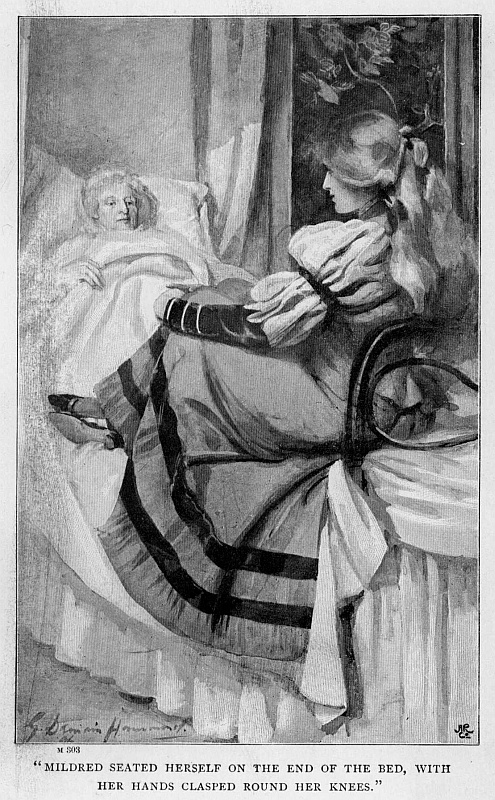
On the present occasion she despatched Mary downstairs to tea, and seated herself on the end of the bed, with her hair falling in showers over her shoulders, and her hands clasped round her knees. A fortnight ago Lady Sarah would have exclaimed at the inelegance of the position, but to-day her gaze rested upon the girlish figure as if the sight were pleasant in her eyes. She herself looked thin and shaken, but the kindly expression transformed her face, and the soft, white hair was much more becoming than the elaborate wig which she was in the habit of wearing. Mildred felt very strongly on this point, and did not hesitate to put her thoughts into words.
“If you are going to be my old lady I shall insist upon burning that ugly, brown wig!” she said this afternoon. “I love old ladies with white hair, and yours is prettier than any imitation. When you get up I am going to arrange it for you over a cushion in front, and with a pretty piece of lace falling over the back. I don’t think the brown hair suits you a bit, and it looks so frizzled up and artificial. You don’t mind my saying so—do you?” she concluded in an artless manner which made Lady Sarah smile in spite of herself.
“No, my dear, no! Whatever please you. It is a long time since anyone took an interest in my appearance. But it will be awkward. People will make remarks—”
“What will that matter, when they will only say that you look twice as nice? Of course everyone knew quite well that it was a wig,” said Mildred, with an unconscious cruelty at which Lady Sarah winced. When the latter spoke again, however, it was to make a request which showed that she cherished no resentment.
“I have been wondering, Mildred, if you would spend the remainder of your holidays with me in Scotland. The Faucits leave for Switzerland next week, Miss Chilton will be busy preparing for the wedding of which you have just told me, and your mother’s house will be closed for three weeks to come. I have taken rooms in an hotel at Pitlochry, and I should like very much to have you with me. It is a lovely spot, and there will be other young people in the house. You would not be dependent upon me for society. Do you think you could make up your mind to come?”
“I should have to ask Mother first, but if she said yes, I could—quite easily,” returned Mildred. She clasped her fingers more tightly together and sat pondering over this latest extraordinary development of affairs—that Lady Sarah should invite her, of all people in the world, to pay her a visit, and that she should be willing to accept such an invitation. If anyone had prophesied as much a fortnight before, how she would have scoffed and jeered, and what sheets of explanation it would take to convince the dear little mother that Lady Sarah was not the ogress which she had been represented, and that she might be trusted to treat her guest with kindness!
“What are you thinking of, Mildred?” asked Lady Sarah, watching the changes in the girl’s expression with curious eyes, and Mildred answered with her usual frankness.
“I was thinking how strange it was that we should be such good friends, when we used to dislike each other so much! You were cross to me,—I was rude to you, and we were always disagreeing! I think I annoyed you the very first night I arrived. You seemed vexed because I was late.”
“I never disliked you, child. If I seemed to do so, it was because I have grown into the unfortunate habit of fault-finding. On the contrary there is something about you which has always attracted me. I don’t know what it is—something in your voice, your laugh, your movements, which brings back memories of my youth. What a long, long way off it seems!—like another life,—and of all that large family of boys and girls there is not one left alive but myself! I am a lonely old woman, Mildred!”
“But there is no need that you should be! There are so many people in the world who need a friend, and you are rich—you can do kind things every day in the year! I have often thought how nice it would be to be a dear old lady with curls, and a beautiful big house, and lots of money. It is one of my castles in the air. I would be a sort of fairy godmother to poor people; help struggling young geniuses, pretty girls who had to work for their living, and old women in dingy lodgings. If I had no people of my own, I would go outside to find them, for I couldn’t live alone, with no one to love me, and nothing to think of but myself! I couldn’t do it!”
Mildred looked at Lady Sarah with wistful eyes, as if demanding sympathy for the very thought. She did not know that older people than herself had long been struggling for courage to impress these views of life upon her companion, and was guiltless of pointing a moral. Lady Sarah listened, however, and pondered on her words without being in the least offended. She was never offended at anything that Mildred said or did in these latter days; she seemed to have opened her heart to the girl with an unreserved affection which made Mrs Faucit very hopeful of the future.
She said as much in the letter to Mrs Moore which accompanied Lady Sarah’s invitation.
I hope very much that you will allow Mildred to accept Lady Sarah’s invitation, she wrote, for I believe the friendship which has grown up between them will be of mutual benefit. Lady Sarah has an unfortunate manner, but I have always believed in her warmth of heart, and she has fallen deeply in love with your dear, bright girl. They were not at all good friends at first, as you will doubtless have heard, but circumstances have drawn them together, and I can see that each is already beginning to exercise a beneficial influence over the character of the other. Mildred’s sunshiny influence is smoothing the wrinkles from the poor old lady’s face, and the knowledge that one so old and frail relies upon her for comfort, will, I am sure, overcome the temptation to hastiness which she is ever bemoaning. I don’t wonder at Lady Sarah’s infatuation, for we are all in love with the dear child. She has been the life of our quiet house. I hope we may see much of her in the future.
Mrs Moore received this letter, and the invitation which accompanied it, one hot afternoon as she sat in the fever room with her patient. Robbie was an invalid no longer, except in name—he was up and clothed and in his right mind; able to amuse himself by painting frescoes on the wall, and to scrub his obstinate little heels with pumice stone, after the morning and evening baths. Mrs Moore read her letters through once, twice, and yet again; then she laid them down upon the table, took her handkerchief from her pocket, and very quietly and deliberately began to cry.
She was a merry little mother as a rule, in spite of her anxieties, and had played the mountebank for Robbie’s benefit with such success during the last few weeks, that he was aghast at the sudden change of mood.
He gave a roar like a wounded bull, and rushing forward, burrowed his head on her knee.
“Don’t ky! don’t ky!” he cried, “I’ll never do it again! never do it again!” for conscience pricked concerning a dozen mischievous freaks, and he was convinced that it was his own wickedness which had brought about this outburst of distress.
His mother seized him by the arm and stared into his face with eager eyes. She was the prettiest little mother in the world, and Mildred did well to be proud of her.
“Robbie!” she cried excitedly, “am I a good mother? Have I been kind to you? Do you love me with all your heart?”
Robbie pranced about in an agony of emotion.
“Boo—hoo—hoo! Yes, I does! Boo—hoo—”
“And supposing a rich old lady came one day—very, very rich, Robbie—with houses, and gardens, and carriages, and horses, and ponies—beautiful little, long-tailed ponies, and she said, ‘Come and live with me, Robbie, and be my own little boy?’ What would you say? Would you go away and leave poor Mother all alone?”
“No—ow—ow! Don’t wants no old ladies! Kick a nasty old pony over the wall!”
The more his mother wept, the louder Robbie roared. They clung together sobbing and crying until the sound penetrated to the lower regions, and the maid-of-all-work crept up the uncarpeted stair and listened, agape with horror.
Then suddenly Mrs Moore shook Robbie off, bounded out of the room, and called to the servant to run down the road to summon Mrs Ross to come at once—at once, and to bring pencil and paper, so that she might write down the words of a letter to be dictated from an upper window.
It was easy to see from whom Mildred had inherited her impetuosity. Poor Mrs Ross was bewildered by the torrent of words which were hurled at her head the moment she arrived. She was obliged to write four separate letters before Mrs Moore was satisfied that she had said the right thing in the right way.
The letter seemed fated to cause excitement from beginning to end. When it arrived at The Deanery, Lady Sarah put up her eye-glasses to read it, only to drop them a moment later with a cry of astonishment. She gasped, and panted, and gasped, and panted again, while the other occupants of the room stared aghast, not knowing what to make of such behaviour.
“M-M-Mildred!” she cried, and when the girl advanced to her side, she clasped her in a passionate embrace. “Mildred, Mildred, do you know who you are? My own little niece—my grand-niece,—Mary’s child! I knew there was something familiar about you—I felt it! I have said so over and over again, and now Mary writes,—poor Mary! You always spoke of me as ‘Lady Sarah’, and she never dreamt that it was I. She has been living in the depths of the country and has never heard of my husband’s honours. She was unmarried when I saw her last—”
“Oh! Oh! Oh!” cried Mildred shrilly, clasping her hands together in excitement, “It was you! You were the rich aunt! Oh, how dreadfully romantic! Then you are my aunt, too. ‘Aunt Sarah!’ Goodness me, who would ever have dreamt of such a thing! And Mother says,—what does Mother say?”
“She seems afraid, poor thing, that I shall try to take you from her, as I wished to separate her from her parents long ago; but be satisfied, Mildred, I have learned a lesson since those days. I shall not try to take you from your mother!”
“I am glad of that, because it would be such a waste of time,” said Mildred promptly. “Besides, you must come and see Mother yourself, and get to know the whole family. You can never call yourself lonely again, Lady Sarah, for you will have a niece, and five grand-nieces, and a grand-nephew. The grand-nephew is more important than all the rest put together. Oh-h!” she gazed round the room with big, bewildered eyes, “I can’t believe it. My aunt! Your niece! If someone doesn’t pinch me this moment, I shall believe I am asleep and dreaming. Mrs Faucit,—Bertha,—Lois,—do you believe it? Do I look at all altered? Lady Sarah’s niece! I—I suppose it doesn’t make any difference in my name, does it? If I have come into a title, break it to me gently, please! I can’t bear much more excitement!”
“Oh, Mildred!” cried the twins in chorus. Mrs Faucit laughed merrily, and Lady Sarah looked round with an air of triumph.
“Ah, my dear, you may take after your father in appearance, but you are your grandmother over again in disposition! My sister Edyth—the brightest, merriest girl! She was my friend and companion; no one knew what I suffered when she went away and left us. Your mother is like her, Mildred—small and dark. It was the resemblance which drew me to her, but she refused to leave home, and I went off to China and we lost sight of each other. I was too proud to inquire what had become of her when I came home, but I have often thought of her. Blood is thicker than water, and I have longed for some of my own kith and kin to be near me in my old age. She is poor, you say, Mildred? Well, well!” Lady Sarah nodded her head in a mysterious fashion, which seemed to argue a hundred delightful possibilities.
So it came to pass that Mildred went to Scotland with Lady Sarah, and when Robbie was out of quarantine, returned home in company with the old lady, who was almost as much excited at the meeting with Mrs Moore as the girl was herself. Aunt and niece had many consultations together, the result of which was that Mrs Moore and her children bade farewell to their cottage home, and went to live in a pretty house situated just outside the gates of Lady Sarah’s country seat. Here they were near enough to be a comfort and cheer to the old lady during her last days, and not too near to become a burden, or to allow the children to disturb her rest.
Lady Sarah took a great interest in her grand-nephew, and in every one of the five grand-nieces, and treated them all with equal generosity, but Mildred was her darling and chosen companion.
The girl spent the greater part of every day up at the big house, and though many people shook their heads, and argued ill of such a friendship, it endured unbroken to the end. By this it is not meant to imply that their lives flow on evenly, without discord or misunderstanding. Quite the contrary. Neither aunt nor niece changed their disposition in a moment; Lady Sarah’s fretfulness often proved very trying to Mildred’s temper, just as the old lady in her turn was overpowered by the girl’s impetuous ways. Old age and youth cannot live together without such trials as these, but they had one grand point in common which never failed to bring them together—they loved each other, and love is the sweetest of peacemakers. Lady Sarah would remember her own youth, and check the hasty words on her lip. Mildred, fretting and fuming, would suddenly bethink herself how sad it must be to be always tired and ailing, and struggle hard for patience. A glance on one side, a word on the other, and the disagreement would be over, while each peacemaking taught a new lesson, and left more strength for the future.
Mrs Moore and her children had much cause to bless the day when Lady Sarah became their friend, but when at last death took her away from their side, none of the good things which she inherited could console Mildred for the loss of the dear, cross, old lady whom she had grown to love so truly.
The End.
|
Chapter 1
| |
Chapter 2
| |
Chapter 3
| |
Chapter 4
| |
Chapter 5
| |
Chapter 6
| |
Chapter 7
| |
Chapter 8
| |
Chapter 9
| |
Chapter 10
| |
Chapter 11
| |
Chapter 12
| |
Chapter 13
| |
Chapter 14
| |
Chapter 15
|