PART II.
Reading edition
THE FORCES OPPOSED.ToC
Here, then, at the beginning of August 1914, are the five great Powers about to engage in war.
Russia, France, and Great Britain, whom we will call the Allies, are upon one side; the German Empire and Austria-Hungary, whom we will call the Germanic Powers, are upon the other.
We must at the outset, if we are to understand the war at all, see how these two combatant groups stood in strength one against the other when the war broke out. And to appreciate this contrast we must know two things—their geographical situation, and their respective weight in arms. For before we can judge the chances of two opponents in war, we have to know how they stand physically one to the other upon the surface of the earth, or we cannot judge how one will attack the other, or how each will defend itself against the other. And we must further be able to judge the numbers engaged both at the beginning of the struggle and arriving in reinforcement as the struggle proceeds, because upon those numbers will mainly depend the final result.
Having acquired these two fundamental pieces of information, we must acquire a third, which is the theories of war held upon either side, and some summary showing which of these theories turned out in practice to be right, and which wrong.
For, after a long peace, the fortune of the next war largely depends upon which of various guesses as to the many changes that have taken place in warfare and in weapons will be best supported by practice, and what way of using new weapons will prove the most effective. Until the test of war is applied, all this remains guess-work; but under the conditions of war it ceases to be guess-work, and becomes either corroborated by experience or exploded, as the case may be. And of two opponents after a long peace, that one which has had the most foresight and has guessed best what the effect of changes in armament and the rest will effect in practice is that one who has the best chance of victory.
We are going, then, in this Second Part, of the little book, to see, first, the geographical position of the belligerents; secondly, their effective numbers; and, thirdly, what theories of war each held, and how far each was right or wrong.
(1) The Geographical Position of the Belligerents.
The position of the original belligerent countries (excluding Turkey) upon the map of Europe was that which will be seen upon the accompanying sketch map.
Of this belligerent area, which is surrounded by a thick black line, the part left white represents the territory of the Allies at the origin of the war—Great Britain, France, Russia, and Servia. This reservation must, however, be made: that in the case of Russia only the effective part is shown, and only the European part at that; Arctic Russia and Siberia are omitted. The part lightly shaded with cross lines represents the Germanic body—to wit, the German Empire and Austria-Hungary.
1. The first thing that strikes the eye upon such a map is the great size of the Germanic body.
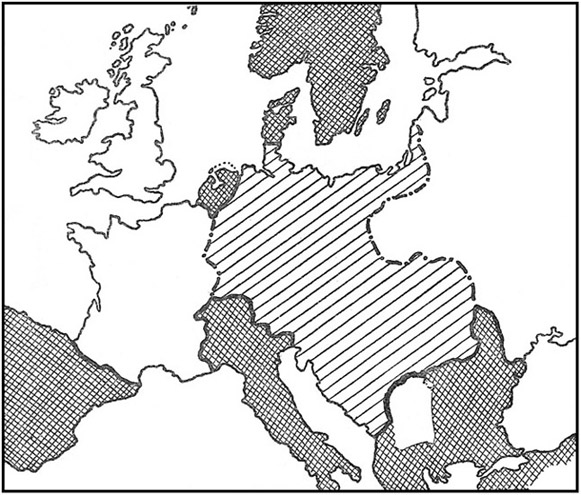
Sketch 4.
When one reads that "Germany" was being attacked by not only France and England, but also Russia; when one reads further that in the Far East, in Asia, Japan was putting in work for the Allies; and when one goes on to read that Belgium added her effort of resistance to the "German" invasion, one gets a false impression that one single nation was fighting a vast coalition greatly superior to it. Most people had an impression of that kind, in this country at least, at the outset of the war. It was this impression that led to the equally false impression that "Germany" must necessarily be beaten, and probably quickly beaten.
The truth was, of course, that we were fighting something very much bigger than "Germany." We set out to fight something more than twice as big as Germany in area, and very nearly twice as big as the German Empire in mere numbers. For what we set out to fight was not the German Empire, but the German Empire plus the whole of the dominions governed by the Hapsburg dynasty at Vienna.
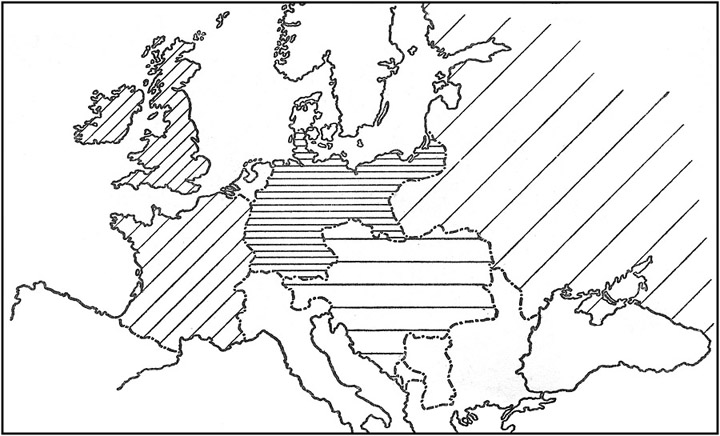
How weighty this Germanic body was geographically is still more clearly seen if we remember that Russia north of St. Petersburg is almost deserted of inhabitants, and that the true European areas of population which are in conflict—that is, the fairly well populated areas—are more accurately represented by a modification of the map on page 81 in some such form as that on page 84, where the comparative density of population is represented by the comparative distances between the parallel cross-lines.
2. The next thing that strikes one is the position of the neutral countries. Supposing Belgium to have remained neutral, or, rather, to have allowed German armies to pass over her soil without actively resisting, the Germanic body would have been free to trade with neutral countries, and to receive support from their commerce, and to get goods through them over the whole of their western front, with the exception of the tiny section which stands for the frontier common to France and Germany. On the north, supposing the Baltic to be open, the Germanic body had a vast open frontier of hundreds of miles, and though Russia closed most of the eastern side, all the Roumanian frontier was open, and so was the frontier of the Adriatic, right away from the Italian border to Cattaro. So was the Swiss frontier and the Italian.
Sketch 5.
Indeed, if we draw the Germanic body by itself surrounded by a frontier of dots, as in the accompanying sketch, and mark in a thick line upon that frontier those parts which touched on enemy's territory, and were therefore closed to supply, we shall be immediately arrested by the comparatively small proportion of that frontier which is thus closed.
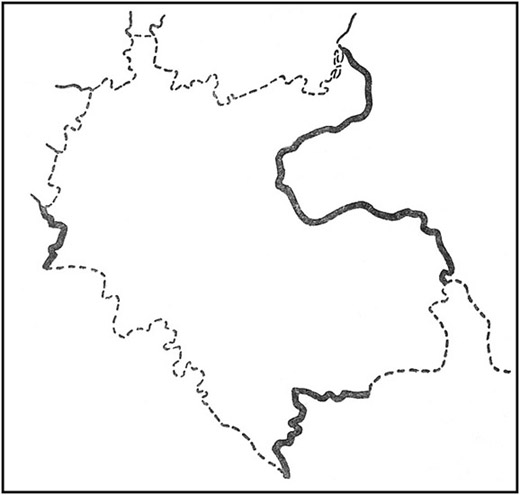
Sketch 6.
It is well to carry this in mind during the remainder of our study of this war, because it has a great effect upon the fighting power of Germany and Austria after a partial—but very partial—blockade is established by the Allied and especially by the British naval power.
3. The third thing that strikes one in such a map of the belligerent area is the way in which the Germanic body stands in the middle facing its two groups of enemies East and West.
The Geographical Advantages and Disadvantages of the Germanic Body.
With this last point we can begin a comparison of the advantages and disadvantages imposed by geographical conditions upon the two opponents, and first of these we will consider the geographical advantages and disadvantages of the Germanic body—that is, of the Austrian and German Empires—passing next to the corresponding advantages and disadvantages of the Allies.
The advantages proceeding from geographical position to Germany in particular, and to the Germanic body as a whole, gravely outweigh the disadvantages. We will consider the disadvantages first.
The chief disadvantage under which the Germanic body suffered in this connection was that, from the outset of hostilities, it had to fight, as the military phrase goes, upon two fronts. That is, the commanders of the German and Austrian armies had to consider two separate campaigns, to keep them distinct in their minds, and to co-ordinate them so that they should not, by wasting too many men on the East or the West, weaken themselves too much on the other side of the field.
To this disadvantage some have been inclined to add that the central position of Austria and Germany in Europe helped the British and Allied blockade (I repeat, a very partial, timid, and insufficient blockade) of their commerce.
But this view is erroneous. The possibility of blockading Austria-Hungary and Germany from imports across the ocean was due not to their central but to their continental position; to the fact that they were more remote from the ocean than France and Great Britain. It had nothing to do with their central position between the two groups of the Allies.
Supposing, for instance, that Germany and Austria-Hungary had stood where Russia stands, and that Western Europe had been in alliance against them. Then they would have been in no way central; their position would have been an extreme position upon one side; and yet, so far as blockading goes, the blockade of them would have been infinitely easier.
Conversely, if Germany and Austria had been in the west, where Great Britain and France are, their enemies lying to the east of them could not have blockaded them at all.
As things are the blockade that has been established exists but is partial. As will be seen upon the following sketch map, the British Fleet, being sufficiently powerful, can search vessels the cargoes of which might reach the Germanic body directly through the Strait of Gibraltar (1), the Strait of Dover (2), or the North Sea between Scotland and Norway (3). But it is unable to prevent supplies reaching the Germanic body from Italy, whether by land or by sea (4), or through Switzerland (5), or through Holland (6), or through Denmark (7), or across the frontier of Roumania (8); or, so long as the German Fleet is strongest in the Baltic, by way of Norway and Sweden across the Baltic (9).
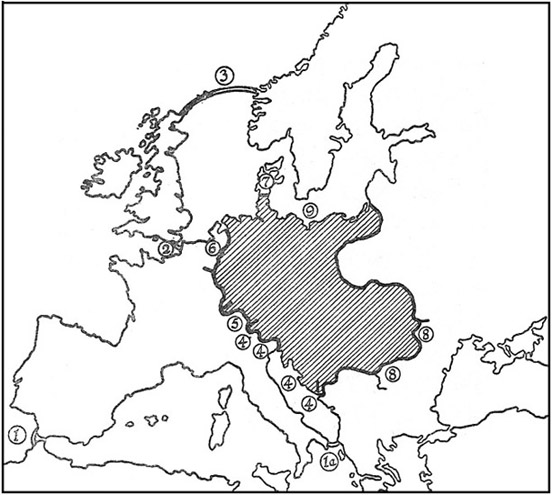
Sketch 7.
The blockading fleet is even embarrassed as to the imports the Germanic body receives indirectly through neutral countries—that is, imports not produced in the importing countries themselves, but provided through the neutral countries as middlemen.
It is embarrassed in three ways.
(a) Because it does not want to offend the European neutral countries, which count in the general European balance of power.
(b) Because it does not wish to offend Powers outside Europe which are neutral in this war, and particularly the United States. Such great neutral Powers are very valuable not only for their moral support if it can be obtained, but on account of their great financial resources untouched by this prolonged struggle, and, what lies behind these, their power of producing materials which the Allies need just as much as Austria and Germany do.
(c) Because, even if you watch the supplies of contraband to neutrals, and propose to stop supplies obviously destined for German use, you cannot prevent Germany from buying the same material "made up" by the neutral: for example, an Italian firm can import copper ore quite straightforwardly, smelt it, and offer the metal in the open market. There is nothing to prevent a German merchant entering that market and purchasing, unless Italy forbids all export of copper, which it is perfectly free not to do.
To leave this side question of blockade, and to return to the relative advantages and disadvantages of our enemy's central position, we may repeat as a summary of its disadvantages the single truth that it compels our enemy to fight upon two fronts.
All the rest is advantage.
It is an advantage that Germany and Austria-Hungary, as a corollary to their common central position, are in some part of similar race and altogether of a common historical experience. For more than a hundred years every part of the area dominated by the Germanic body—with the exception of Bosnia and Alsace-Lorraine—has had a fairly intimate acquaintance with the other part. The Magyars of Hungary, the Poles of Galicia, of Posen, of Thorn, the Croats of the Adriatic border, the Czechs of Bohemia, have nothing in race or language in common with German-speaking Vienna or German-speaking Berlin. But they have the experience of generations uniting them with Vienna and with Berlin. In administration, and to some extent in social life, a common atmosphere spreads over this area, nearly all of which, as I have said, has had something in common for a hundred years, and much of which has had something in common for a thousand.
In a word, as compared with the Allies, the Germanic central body in Europe has a certain advantage of moral homogeneity, especially as the governing body throughout is German-speaking and German in feeling.
That is the first point of advantage—a moral one.
The second is more material. The Governments of the two countries, their means of communication and of supply, are all in touch one with another. Those governments are working in one field within a ring fence, and working for a common object. They are not only spiritually in touch; they are physically in touch. An administrator in Berlin can take the night express after dinner and breakfast with his collaborator in Vienna the next morning.
It so happens, also, that the communications of the two Germanic empires are exactly suited to their central position. There is sufficient fast communication from north to south to serve all the purposes necessary to the intellectual conduct of a war; there is a most admirable communication from east to west for the material conduct of that war upon two fronts. Whenever it may be necessary to move troops from the French frontier to the Russian, or from the Russian to the French, or for Germany to borrow Hungarian cavalry for the Rhine, or for Austria to borrow German army corps to protect Galicia, all that is needed is three or four days in which to entrain and move these great masses of men. There is no area in Europe which is better suited by nature for thus fighting upon two land frontiers than is the area of the combined Austrian and German Empire.
With these three points, then—the great area of our enemy in Europe, his advantage through neutral frontiers, and his advantage in homogeneity of position between distant and morally divided Allies—you have the chief marks of the geographical position he occupies, in so far as this is the great central position of continental Europe.
But it so happens that the Germanic body in general, and the German Empire in particular, suffer from grave geographical disadvantages attached to their political character. And of these I will make my next points.
The Germanic body as a whole suffers by its geographical disposition, coupled with its political constitution, a grave disadvantage in its struggle against the Allies, particularly towards the East, because just that part of it which is thrust out and especially assailable by Russia happens to be the part most likely to be disaffected to the whole interests of the Germanic body; and how this works I will proceed to explain.
Here are two oblongs—A, left blank, and B, lightly shaded. Supposing these two oblongs combined to represent the area of two countries which are in alliance, and which are further so situated that B is the weaker Power to the alliance both (1) in his military strength, and (2) in his tenacity of purpose. Next grant that B is divided by the dotted line, CD, into two halves—B not being one homogeneous State, but two States, B1 and B2.
Next let it be granted that while B1 is more likely to remain attached in its alliance to A, B2 is more separate from the alliance in moral tendency, and is also materially the weaker half of B. Finally, let the whole group, AB, be subject to the attack of enemies from the right and from the left (from the right along the arrows XX, and from the left along the arrows YY) by two groups of enemies represented by the areas M and N respectively.
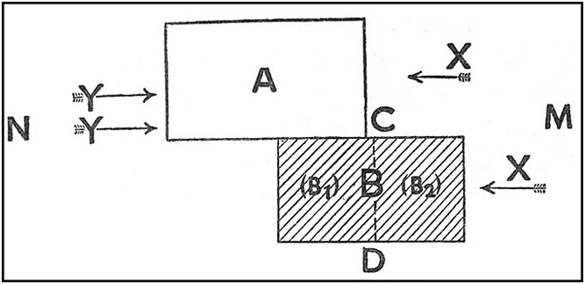
Sketch 8.
It is obvious that in such a situation, if A is the chief object of attack, and is the Power which has both provoked the conflict and made itself the chief object of assault by M and N, A is by this arrangement in a position politically weak.
That is, the strategical position of A is gravely embarrassed by the way in which his ally, B, separated into the two halves, B1 and B2, stands with regard to himself. B2 is isolated and thrust outward. The enemy, M, upon the right, attacking along the lines XX, may be able to give B2 a very bad time before he gets into the area of B1, and long before he gets into the area of the stronger Power, A. It is open to M so to harass B2 that B2 is prepared to break with B1 and give up the war; or, if the bond between B2 and B1 is strong enough, to persuade B1 to give up the struggle at the same time that he does. And if B2 is thus harassed to the breaking-point, the whole alliance, A plus B, will lose the men and materials and wealth represented by B2, and may lose the whole shaded area, B, leaving A to support singly for the future the combined attacks of M and N along the lines of attack, XX and YY.
Now, that diagram accurately represents the political embarrassment in strategy of the German-Austro-Hungarian alliance. B1 is Austria and Bohemia; B2 is Hungary; A is the German Empire; M is the Russians; N is the Allies in the West. With a geographical arrangement such as that of the Germanic alliance, a comparatively small proportion of the Russian forces detached to harry the Hungarian plain can make the Hungarians, who have little moral attachment to the Austrians and none whatever to the Germans, abandon the struggle to save themselves; while it is possible that this outlier, being thus detached, will drag with it its fellow-half, the Austrian half of the dual monarchy, cause the Government of the dual monarchy to sue for peace, and leave the German Empire isolated to support the undivided attention of the Russians from the East and of the French from the West.
It is clear that if a strong Power, A, allied with and dependent for large resources in men upon a weaker Power, B, is attacked from the left and from the right, the ideal arrangement for the strong Power, A, would be something in the nature of the following diagram (Sketch 9), where the weaker Power stands protected in the territory of the stronger Power, and where of the two halves of the weaker Power, B2, the less certain half, is especially protected from attack.
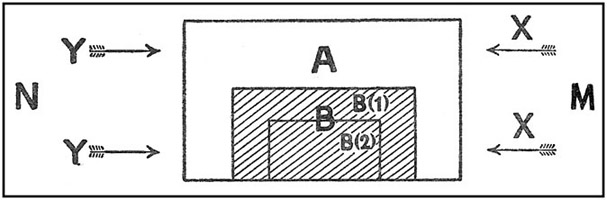
Sketch 9.
Were Switzerland, Alsace-Lorraine, and the Rhineland, upon the one hand, the Hungarian plain, Russian Poland, and East Prussia, upon the other hand, united in one strong, patriotic, homogeneous German-speaking group with the Government of Berlin and the Baltic plain, and were Bavaria, Switzerland, the Tyrol, Bohemia, to constitute the weaker and less certain ally, while the least certain half of that uncertain ally lay in Eastern Bohemia and in what is now Lower Austria, well defended from attack upon the East, the conditions would be exactly reversed, and the Austro-German alliance would be geographically and politically of the stronger sort. As it is, the combined accidents of geography and political circumstance make it peculiarly vulnerable.
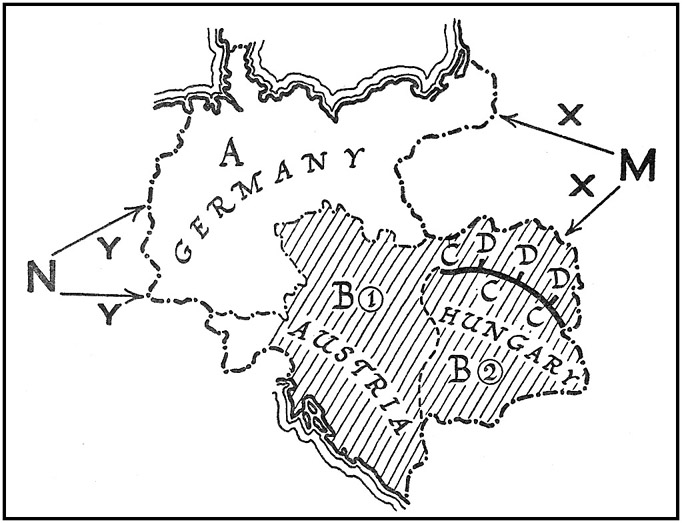
Sketch 10.
Having already considered in a diagram the way in which the geographical disposition of Austria-Hungary weakens Germany in the face of the Allies, let us translate that diagram into terms of actual political geography. These two oblongs, with their separate parts, are, as a fact, as follows: Where A is the German Empire, the shaded portion, B, is Austria-Hungary, and this last divided into B1, the more certain Austrian part, and B2, the less certain exposed Hungarian part, the latter of which is only protected from Russian assault by the Carpathian range of mountains, CCC, with its passes at DDD. M, the enemy on the right, Russia, is attacking the alliance, AB, along XX; while the enemy on the left, N, France and her Allies, is attacking along the lines YY.
Hungary, B2, is not only geographically an outlier, but politically is the weakest link in the chain of the Austro-Germanic alliance. The area of Hungary is almost denuded of men, for most of these have been called up to defend Germany, A, and in particular to prevent the invasion of Germany's territory in Silesia at S. The one defence Hungary has against being raided and persuaded to an already tempting peace is the barrier of the Carpathian mountains, CCC. When or if the passes shall be in Russian possession and the Russian cavalry reappear upon the Hungarian side of the hills, the first great political embarrassment of the enemy will have begun—I mean the first great political embarrassment to his strategy.
(a) Shall he try to defend those passes above all? Then he must detach German corps, and detach them very far from the areas which are vital to the core of the alliance—that is, to the German Empire, A.
(b) Shall he use only Hungarian troops to defend Hungary? Then he emphasizes the peculiar moral isolation of Hungary, and leaves her inclined, if things go ill, to make a separate peace.
(c) Shall he abandon Hungary? And let the Russians do what they will with the passes over the Carpathians and raid the Hungarian plain at large? Then he loses a grave proportion of his next year's wheat, much of his dwindling horse supply, his almost strangled sources of petrol. He tempts Roumania to come in (for a great sweep of Eastern Hungary is nationally Roumanian); and he loses the control in men and financial resources of one-half of his Allies if the danger and the distress persuade Hungary to stand out. For the Hungarians have no quarrel except from their desire to dominate the southern Slavs; to fight Austria's battles means very little to them, and to fight Germany's battles means nothing at all.
There is, of course, much more than this. If Hungary dropped out, could Austria remain? Would not the Government at Vienna, rather than lose the dual monarchy, follow Hungary's lead? In that case, the Germanic alliance would lose at one stroke eleven-twenty-fifths of its men. It would lose more than half of its reserves of men, for the Austrian reserve is, paradoxically enough, larger than the German reserve, though not such good material.
Admire how in every way this geographical and political problem of Hungary confuses the strategical plan of the German General Staff! They cannot here act upon pure strategics. They cannot treat the area of operations like a chessboard, and consider the unique object of inflicting a military defeat upon the Russians. Their inability to do so proceeds from the fact that this great awkward salient, Hungarian territory, is not politically subject to Berlin, is not in spiritual union with Berlin; may be denuded of men to save Berlin, and is the most exposed of all our enemy's territory to attack. Throughout the war it will be found that this problem perpetually presents itself to the Great General Staff of the Prussians: "How can we save Hungary without weakening our Eastern line? If we abandon Hungary, how are we to maintain our effectives?"
Such, in detail, is the political embarrassment to German strategy produced by the geographical situation and the political traditions of Hungary itself, and of Hungary's connection with the Hapsburgs at Vienna. Let us now turn to the even more important embarrassment caused to German strategy by the corner positions of the four essential areas of German territory.
This last political weakness attached to geographical condition concerns the German Empire alone.
Let us suppose a Power concerned to defend itself against invasion and situated between two groups of enemies, from the left and from the right, we will again call that Power A, the enemy upon the right M, and the enemy upon the left N, the first attacking along the lines XX, and the second along the lines YY.
Let us suppose that A has political reasons for particularly desiring to save from invasion four districts, the importance of which I have indicated on Sketch 12 by shading, and which I have numbered 1, 2, 3, 4.
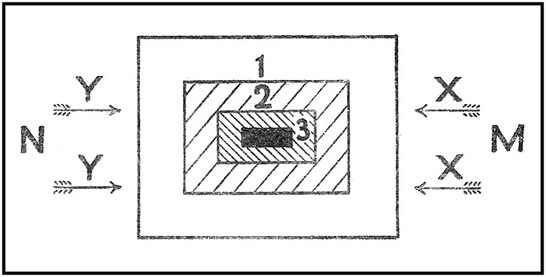
Sketch 11.
Let us suppose that those four districts happen to lie at the four exposed corners of the area which A has to defend. The Government of A knows it to be essential to success in the war that his territory should not be invaded. Or, at least, if it is invaded, it must not, under peril of collapse, be invaded in the shaded areas.
It is apparent upon the very face of such a diagram, that with the all-important shaded areas situated in the corners of his quadrilateral, A is heavily embarrassed. He must disperse his forces in order to protect all four. If wastage of men compels him to shorten his line on the right against M, he will be immediately anxious as to whether he can dare sacrifice 4 to save 2, or whether he should run the dreadful risk of sacrificing 2 to save 4.
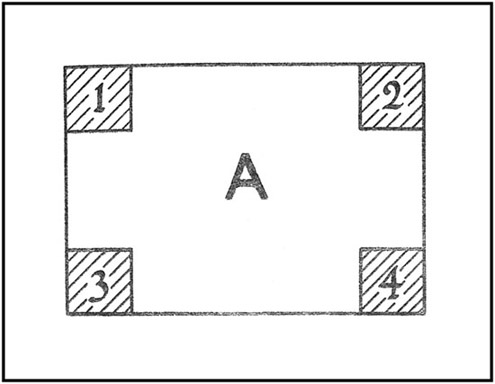
Sketch 12.
If wastage compels him to shorten his defensive line upon the left, he is in a similar quandary between 1 and 3.
The whole situation is one in which he is quite certain that a defensive war, long before he is pushed to extremities, will compel him to "scrap" one of the four corners, yet each one is, for some political reason, especially dear to him and even perhaps necessary to him. Each he desires, with alternating anxieties and indecisions, to preserve at all costs from invasion; yet he cannot, as he is forced upon the defensive, preserve all four.
Here, again, the ideal situation for him would be to possess against the invader some such arrangement as is suggested by Sketch 11. In this arrangement, if one were compelled unfortunately to consider four special districts as more important than the mass of one's territory, one would have the advantage of knowing that they were clearly distinguishable into less and more important, and the further advantage of knowing that the more important the territory was, the more central it was and the better protected against invasion.
Thus, in this diagram, the government of the general oblong, A, may distinguish four special zones, the protection of which from invasion is important, but which vary in the degree of their importance. The least important is the outermost, 1; the more important is an inner one, 2; still more important is 3; and most important of all is the black core of the whole.
Some such arrangement has been the salvation of France time and time again, notably in the Spanish wars, and in the wars of Louis XIV., and in the wars of the Revolution. To some extent you have seen the same thing in the present war.
To save Paris was exceedingly important, next came the zone outside Paris, and so on up to the frontier.
But with the modern German Empire it is exactly the other way, and the situation is that which we found in Sketch 12; the four external corners are the essentials which must be preserved from invasion, and if any one of them goes, the whole political situation is at once in grave peril.
The strategical position of modern Germany is embarrassed because each of these four corners must be saved by the armies. 1 is Belgium—before the war indifferent to Germany, but now destined to be vital to her position—2 is East Prussia, 3 is Alsace-Lorraine, 4 is Silesia, and the German commanders, as well as the German Government, must remain to the last moment—if once they are thrown on the defensive—in grave indecision as to which of the four can best be spared when invasion threatens; or else, as is more probable, they must disperse their forces in the attempt to hold all four at once. It is a situation which has but rarely occurred before in the history of war, and which has always proved disastrous.
Germany then must—once she is in Belgium—hold on to Belgium, or she is in peril; she must hold on to East Prussia, or she is in peril; she must hold on to Alsace-Lorraine, or she is in peril; and she must hold on to Silesia, or it is all up with her. If there were some common strategical factor binding these four areas together, so that the defence of one should involve and aid the defence of all, the difficulties thus imposed upon German strategy would be greatly lessened. Though even then the mere having to defend four outlying corners instead of a centre would produce confusion and embarrassment the moment numerical inferiority had appeared upon the side of the defence. But, as a fact, there is no such common factor. Alsace-Lorraine and Belgium, East Prussia and Silesia, stand strategically badly separated one from the other. Even the two on the East and the two on the West, though apparently forming pairs upon the map, are not dependent on one system of communications, and are cut off from each other by territory difficult or hostile, while between the Eastern and the Western group there is a space of five hundred miles.
Let us, before discussing the political embarrassment to strategy produced by these four widely distant and quite separate areas, translate the diagram in the terms of a sketch map.
On the following sketch map, Belgium, Alsace-Lorraine, East Prussia, and Silesia are shaded, as were the four corners of the diagram. No. 1 is Belgium, 2 is East Prussia, 3 is Alsace-Lorraine, 4 is Silesia. The area occupied by the German Empire, including its present occupation of Belgium, is marked by the broad outline; and the areas shaded represent, not the exact limits of the four territories that are so important, but those portions of them which are essential: the non-Polish portion of Silesia, the non-Polish portion of East Prussia, the plain of Belgium, and all Alsace-Lorraine.
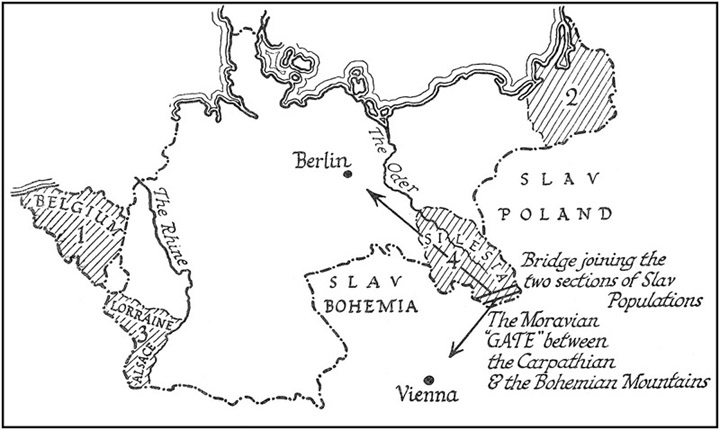
Sketch 13.
Now the reason that each of these must at all costs be preserved from invasion is, as I have said, different in each case, and we shall do well to examine what those reasons are; for upon them depends the political hesitation they inevitably, cause to arise in the plans of the Great General Staff.
1. Belgium. The military annexation of Belgium has been a result of the war, and, from the German point of view, an unexpected result. Germany both hoped and expected that her armies would pass through Belgium as they did, in fact, pass through Luxembourg. The resistance of Belgium produced the military annexation of that country; the reign of terror exercised therein has immobilized about 100,000 of the German troops who would otherwise be free for the front; the checking of the advance into France has turned the German general political objective against England, and, to put the matter in the vaguest but most fundamental terms, the German mind has gradually come, since October, to regard the retention of Belgium as something quite essential. And this because:—(a) It gives a most weighty asset in the bargaining for peace. (b) It gives a seaboard against England. (c) It provides ample munition, house-room, and transport facility, without which the campaign in North-eastern France could hardly be prolonged. (d) It puts Holland at the mercy of Germany, for she can, by retaining Belgium, strangle Dutch trade, if she chooses to divert her carriage of goods through Belgian ports. (e) It is a specific conquest; the Government will be able to say to the German people, "It is true we had to give up this or that, but Belgium is a definite new territory, the occupation of which and the proposed annexation of which is a proof of victory." (f) The retention of Belgium has been particularly laid down as the cause of quarrel between Great Britain and Germany; to retain Belgium is to mark that score against what is now the special enemy of Germany in the German mind. (g) Antwerp is the natural port for all the centre of Europe in commerce westward over the ocean. (h) With Belgium may go the Belgian colonies—that is, the Congo—for the possession of which Germany has worked ceaselessly year in and year out during the last fifteen years by a steady and highly subsidized propaganda against the Belgian administration. She has done it through conscious and unconscious agents; by playing upon the cupidity of French and British Parliamentarians, of rum shippers, upon religious differences, and upon every agency to her hand.
We may take it, then, that the retention of Belgium is in German eyes now quite indispensable. "If I abandon Belgium," she says, "it is much more than a strategic retreat; it is a political confession of failure, and the moral support behind me at home will break down."
If I were writing not of calculable considerations, but of other and stronger forces, I should add that to withdraw from Belgium, where so many women and children have been massacred, so many jewels of the past befouled or destroyed, so wanton an attack upon Christ and His Church delivered, would be a loss of Pagan prestige intolerably strong, and a triumph of all that against which Prussia set out to war.
2. Alsace-Lorraine. But Alsace-Lorraine is also "indispensable." We have seen on an earlier page what the retention of that territory means. Alsace-Lorraine is the symbol of the old victory. It is the German-speaking land which the amazingly unreal superstitions of German academic pedantry discovered to be something sacredly necessary to the unity of an ideal Germany, though the people inhabiting it desired nothing better than the destruction of the Prussian name. It is more than that. It is the bastion beyond the Rhine which keeps the Rhine close covered; it is the two great historic fortresses of Strassburg and Metz which are the challenge Germany has thrown down against European tradition and the civilization of the West; it is something which has become knit up with the whole German soul, and to abandon it is like a man abandoning his title or his name, or surrendering his sword. Through what must not the German mind pass before its directors would consent to the sacrifice of such a fundamentally symbolic possession? There is defeat in the very suggestion; and the very suggestion, though it has already occurred to the Great General Staff, and has already, I believe, been mentioned in one proposal for peace, would be intolerable to the mass of the enemy's opinion.
3. East Prussia. East Prussia is sacred in another, but also an intense fashion. It is the very kernel of the Prussian monarchy. When Berlin was but a market town for the Electors of Brandenburg, those same Electors had contrived that East Prussia, which was outside the empire, should be recognized as a kingdom. Frederick the Great's father, while of Brandenburg an Elector, was in Prussia proper a king, a man who had emancipated that cradle of the Prussian power. The province in all save its southern belt (which is Polish) is the very essence of Prussian society: a mass of serfs, technically free, economically abject, governed by those squires who own them, their goods, and what might be their soil. The Russians wasted East Prussia in their first invasion, and they did well though they paid so heavy a price, for to wound East Prussia was to wound the very soul of that which now governs the German Empire. When the landed proprietors fled before the Russian invasion, and when there fled with them the townsfolk, the serfs rose and looted the country houses. In a way quite different from Belgium, quite different from Alsace-Lorraine, East Prussia is essential. Forces will and must be sent periodically to defend that territory, however urgently they may be needed elsewhere, as the pressure upon Germany increases. The German commanders, if they forget East Prussia for a moment in the consideration of the other essential points, will, the moment their eyes are turned upon East Prussia again, remember with violent emotion all that the province means to the reigning dynasty and its supporters, and they will do anything rather than let that frontier go. The memory of the first invasion is too acute, the terror of its repetition too poignant, to permit its abandonment.
4. Silesia. Silesia, for quite other reasons (and remember that these different reasons for defending such various points are the essence of the embarrassment in which German strategy will find itself), must be saved. It has been insisted over and over again in these pages what Silesia means. Its meaning is twofold. If Silesia goes, the safest, the most remote from the sea, the most independent of imports of the German industrial regions, is gone. Silesia is, again, the country of the great proprietors. Amuse yourselves by remembering the names of Pless and of Lichnowsky. There are dozens of others. But, most important of all, Silesia is what Belgium is not, what Alsace-Lorraine is not, what East Prussia is not—it is the strategic key. Who holds Silesia commands the twin divergent roads to Berlin northwards, to Vienna southwards. Who holds Silesia holds the Moravian Gate. Who holds Silesia turns the line of the Oder, and passes behind the barrier fortresses which Germany has built upon her Eastern front. Who holds Silesia strikes his wedge in between the German-speaking north and the German-speaking south, and joins hands with the Slavs of Bohemia. Not that we should exaggerate the Slav factor, for religion and centuries of varying culture disturb its unity. But it is something. The Russian forces are Slav; the resurrection of Poland has been promised; the Czechs are not submissive to the German claim of natural mastery, and whoever holds Silesia throws a bridge between Slav and Slav if his aims are an extension of power in that race. For a hundred reasons Silesia must be saved.
Now put yourself in the position of the men who must make a decision between these four outliers—Belgium, Alsace-Lorraine, East Prussia, and Silesia—and understand the hesitation such divergent aims impose upon them. Hardly are they prepared to sacrifice one of the four when the defensive problem becomes acute, but its claims will be pressed in every conceivable manner—by public sentiment, by economic considerations, by mere strategy, by a political tradition, by the influence of men powerful with the Prussian monarchy, whose homes and wealth are threatened. "If I am to hold Belgium, I must give up Alsace. How dare I do that? To save Silesia I must expose East Prussia. How dare I? I am at bay, and the East must at all costs be saved. I will hold Prussia and Silesia, but to withdraw from Belgium and from beyond the Rhine is defeat." The whole thing is an embroglio. That conclusion is necessary and inexorable. It would not appear at all until, or if, numerical weakness imposed on the enemy a gradual concentration of the defensive; but once that numerical weakness has come, the fatal choices must be made. It may be that a strict, silent, and virile resolution, such as saved France this summer, a preparedness for particular sacrifices calculated beforehand, will determine first some one retirement and then another. It may be—though it is not in the modern Prussian temperament—that a defensive as prolonged as possible will be attempted even with inferior numbers, and that, as circumstances may dictate, Alsace-Lorraine or Belgium, Silesia or East Prussia will be the first to be deliberately sacrificed; but one must be, and, it would seem, another after, and in the difficulty of choice a wound to the German strategy will come.
The four corners are differently defensible—Alsace-Lorraine and Belgium only by artifice, and with great numbers of men; Silesia only so long as Austria (and Hungary) stand firm. East Prussia has her natural arrangement of lakes to make invasion tedious, and to permit defence with small numbers.
Between the two groups, Eastern and Western, is all the space of Germany—the space separating Aberdeen from London. Between each part of each pair, in spite of an excellent railway system, is the block in the one case of the Ardennes and the Eifel, in the other of empty, ill-communicated Poland. But each is strategically a separate thing; the political value of each a separate thing; the embarrassment between all four insuperable.
Such is the situation imposed by the geography of the European continent upon our enemies, with the opportunities and the drawbacks which that situation affords and imposes.
I repeat, upon the balance, our enemies had geographical opportunities far superior to our own.
Our power of partial blockade (to which I will return in a moment) is more than counterbalanced by the separation which Nature has determined between the two groups of Allies. The ice of the North, the Narrows of the Dardanelles, establish this, as do the Narrows of the Scandinavian Straits.
The necessity of fighting upon two fronts, to which our enemies are compelled, is more than compensated by that natural arrangement of the Danube valley and of the Baltic plain which adds to the advantage of a central situation the power of rapid communication between East and West; while the chief embarrassment of our enemies in their geographical arrangement, which is the outlying situation of Hungary coupled with the presence of four vital regions at the four external corners of the German Empire, is rather political than geographical in nature.
I will now turn to the converse advantages and disadvantages afforded and imposed by geographical conditions upon the Allies.
The Geographical Advantages and Disadvantages of the Allies.
It has been apparent from the above in what way the geographical circumstance of Germany and Austria-Hungary advantaged and disadvantaged those two empires in the course of a war against East and West.
Let us next see how the Allies were advantaged and disadvantaged by their position.
1. The first great disadvantage which the Allies most obviously suffer is their separation one from the other by the Germanic mass.
The same central position which gives Germany and Austria-Hungary their power of close intercommunion, of exactly coordinating all their movements, of using their armies like one army, and of dealing with rapidity alternate blows eastward and westward, produces contrary effects in the case of the Allies. Even if hourly communication were possible by telegraph between the two main groups, French and Russian, that would not be at all the same thing as personal, sustained, and continuous contact such as is enjoyed by the group of their enemies.
But, as a fact, even the very imperfect and indirect kind of contact which can be established by telegraphing over great distances is largely lacking. The French and the Russians are in touch. The commanders can and do pursue a combined plan. But the communication of results and the corresponding arrangement of new dispositions are necessarily slow and gravely interrupted. Indeed, it is, as we shall see in a moment, one of the main effects of geography upon this campaign that Russia must suffer during all its early stages a very severe isolation.
In general, the Allies as a whole suffer from the necessity under which they find themselves of working in two fields, remote the one from the other by a distance of some six hundred miles, not even connected by sea, and geographically most unfortunately independent.
2. A second geographical disadvantage of the Allies consists in the fact that one of them, Great Britain, is in the main a maritime Power.
That this has great compensating advantages we shall also see, but for the moment we are taking the disadvantages separately, and, so counting them one by one, we must recognize that England's being an island (her social structure industrialized and free from conscription, her interests not only those of Europe but those of such a commercial scattered empire as is always characteristic of secure maritime Powers) produces, in several of its aspects, a geographical weakness to the Allied position, and that for several reasons, which I will now tabulate:—
(a) The position of England in the past, her very security as an island, has led her to reject the conception of universal service. She could only, at the outset of hostilities, provide a small Expeditionary Force, the equivalent at the most of a thirtieth of the Allied forces.
(b) Her reserves in men who could approach the continental field in, say, the first year, even under the most vigorous efforts, would never reach anything like the numbers that could be afforded by a conscript nation. The very maximum that can be or is hoped for by the most sanguine is the putting into the field, after at least a year of war, of less than three-sixteenths of the total Allied forces, although her population is larger than that of France, and more than a third that of the enemy.
(c) She is compelled to garrison and defend, and in places to police, dependencies the population of which will in some cases furnish no addition to the forces of the Allies, and in all cases furnish but a small proportion.
(d) The isolation of her territory by the sea, coupled with her large population and its industrial character, makes Britain potentially the most vulnerable point in the alliance.
So long as her fleet is certainly superior to that of the enemy, and has only to meet oversea attack, this vulnerability is but little felt; but once let her position at sea be lost, or even left undecided, or once let the indiscriminate destruction of commercial marine be seriously begun, and she is at the mercy of that enemy. For she cannot feed herself save by supplies from without, and she cannot take part in the supplying of armies with men and munitions upon the continent.
(e) She is open to fear aggression upon any one of her independent colonies oversea, and yet she is not able to draw upon them for the whole of their potential strength, or, indeed, for more than a very small proportion of it. In other words, the British Fleet guarantees some fifteen million of European race beyond the seas from attack by the enemy, but cannot draw from these fifteen million more than an insignificant fraction of the million of men and more which, fully armed, they might furnish; nor has she any control over their finance, so as to be able to count upon the full weight of their wealth; nor can she claim their resources in goods and munitions. She can only obtain these by paying for them.
There is here a very striking contrast between her position and that of the Germanic Powers.
(f) Her isolation and maritime supremacy, coupled with her industrial character, make her during the strain of equipment the workshop of the Allies. That this is a great advantage is evident; but the disadvantage attaching to it is that very large proportions of her manhood are necessarily withdrawn from the field for the purposes of her shipbuilding, her communications, her manufactory of arms and all kinds of supplies, her seafaring work, both civil and military.
Of the two other main Allies, the French disadvantage may be thus summarized, and it is slight:—
(a) The French political frontier, as established since the defeat of the French in 1871, is an open frontier. It has no natural features upon which the defensive can rely. In the lack of this the French fortified at very heavy expense that portion of their frontier which faced their certain enemy, and established a line from Verdun to Belfort calculated to check the first movement of his offensive. But all the two hundred miles to the north of this, the whole line between Verdun and the North Sea, was virtually open. There were, indeed, certain fortified places upon that line, but they formed no consecutive system, and, as their armaments grew old, they were not brought up to date. The truth is, that the defence of France upon this frontier was really left to the co-operation of Belgium. If, as was believed to be almost certain, Prussian morals being what they are, the Prussian guarantee to respect Belgian neutrality would be torn up at the outbreak of war, then three great fortresses—Liége, Namur, and Antwerp—would hold up the enemy's advance in this quarter, and perform the function of delay which the obsolete armament of the north-eastern French frontier could not perform. We shall see, when we come to the conflicting theories of warfare held by the various belligerents, what a grievous miscalculation this was, and how largely it accounted for the first disasters of the war. But, at any rate, let us remember, as our first point, the absence of any natural line of defence in France as against a German invasion, remembering, also, that the French would necessarily, at the beginning of any war, be upon the defensive on account of their inferior numbers. Had France, for instance, had along her frontiers, and just within them, such a line as Germany possesses in the Rhine, she would have fallen back at the outset upon that line. But she has no such advantage.
(b) The second disadvantage of the French geographically is one immixed with political considerations. The French have for centuries produced, and have for two thousand years believed in, central government. For at least three hundred years all the life of the nation has centred upon Paris; all the railways and all the great system of roads and most of the waterways of the north similarly have Paris for their nucleus. Now, this central ganglion of the whole French organism is but 120 miles from the frontier, ten days' easy marching. An enemy coming in from the north-east not only finds no natural obstacle in his way, but has Paris as nearly within his grasp as, say, Cologne is within the grasp of a French invasion of North Germany. This feature has had the most important consequences upon the whole of French history. It was particularly the determining point of 1870.
To meet the handicap, the French of our generation have combined two policies.
First, they have fortified the whole region of Paris so thoroughly that it has sometimes been called "a fortified province;" an area of nearly thirty miles across at its narrowest, and of something like from seven to eight hundred square miles, is comprised within this plan.
The weakness of this in the face of modern fire will again be dealt with when we come to the conflicting theories upon war established during the long peace.
Secondly, the French established a policy whereby, if Paris were menaced in a future campaign, the Government should abandon that central point, and, in spite of the grave inconvenience proceeding from the way in which all material communications centred upon the capital and all established offices were grouped there, would withdraw the whole central system of government to Bordeaux, and leave Paris to defend itself, precisely as though it were of no more importance than any other fortified point. They would recognize the strategic values of the district; they would deliberately sacrifice its political and sentimental value. They would never again run the risk of losing a campaign because one particular area of the national soil happened to be occupied. The plans of their armies and the instructions of their Staff particularly warned commanders against disturbing any defensive scheme by too great an anxiety to save Paris.
If this were the disadvantage geographically of France, what was that of Russia?
Russia's geographical disadvantage was twofold. First, she had no outlet to an open sea in Europe save through the arctic port of Archangel. This port was naturally closed for nearly half the year, and how long it might be artificially kept partially open by ice-breakers it remained for the war to prove. But even if it were kept open the whole year in this precarious fashion, it lay on the farther side of hundreds of miles of waste and deserted land connected only with the active centre of Russia by one narrow-gauge line of railway with very little rolling stock. The great eastern port of Vladivostok was nearly as heavily handicapped, and its immense distance from the scene of operations in the West, with which it was only connected by a line six thousand miles long, was another drawback. Russia might, indeed, by the favour of neutrals or of Allies, use warm water ports. If the Turks should remain neutral and permit supply to reach her through the Dardanelles, the Black Sea ports were open all the year round, and Port Arthur (nearly as far off as Vladivostok) was also open in the Far East. But the Baltic, in a war with Germany, was closed to her. Certain goods from outside could reach her from Scandinavia, round by land along the north of the Baltic, but very slowly and at great expense. It so happened also that, as the war proceeded, this question of supply became unexpectedly important, because all parties found the expenditure of heavy artillery high-explosive ammunition far larger than had been calculated for, and Russia was particularly weak therein and dependent upon the West. This disadvantage under which Russia lay was largely the cause of her embarrassment, and of the prolongation of hostilities in the winter that followed the declaration of war.
The fact that Russia was ill supplied with railways, and hardly supplied at all with hard roads (in a climate where the thaw turned her deep soil into a mass of mud) is political rather than geographical, but it must be remembered in connection with this difficulty of supply.
If these, then, were the various disadvantages which geographical conditions had imposed upon the Allies, what were the corresponding advantages?
They were considerable, and may be thus tabulated:—
1. The western Allies stood between their enemies and the ocean. If they could maintain superiority at sea through the great size and efficiency of the British Fleet, and through its additional power when combined with the French, they could at the least embarrass, and perhaps ultimately starve out the enemy in certain essential materials of war. They could not reduce the enemy to famine, for with care his territories, so long as they were not ravaged, would be just self-supporting. The nitrates for his explosives the enemy could also command, and, in unlimited quantity, iron and coal. But the raw material of textiles for his clothing, cotton for his explosives, copper for his shell, cartridge cases, and electrical instruments, antimony for the hardening of the lead necessary to his small-arm ammunition, to some extent petrol for his aeroplanes and his motor-cars, and india-rubber for his tyres and other parts of machinery, he must obtain from abroad. That he would be able in part to obtain these through the good offices of neutrals was probable; but the Allied fleets in the West would certainly closely watch the extent of neutral imports, and attempt, with however much difficulty and with however partial success, to prevent those neutrals acting as a mere highroad by which such goods could pass into Germany and Austria. They would hardly allow, especially in the later phases of the war, Italy and Switzerland, Holland and Scandinavia, to act as open avenues for the supply of the Germanic body. Though they would have to go warily, and would find it essential to remain at peace with the nations whose commerce they thus hampered and in some sense controlled, the Allies in the West could in some measure, greater or less, embarrass the enemy in these matters.
Conversely, they could supply themselves freely with tropical and neutral goods, and even with munitions of war obtained from across the ocean, from Africa and from America.
So long as North-western France and the ports of Great Britain were free from the enemy this partial blockade would endure, and this freedom of supply for France and Britain from overseas would also endure.
2. The Allies had further the geographical advantage of marine transport for their troops—an important advantage to the French, who had a recruiting ground in North Africa, and to the British, who had a recruiting ground in their dominions oversea, and, above all, an advantage in that it permitted the constant reinforcement of the continental armies by increasing contingents arriving from these islands.
Of geographical advantages attaching to the position of Russia only one can be discovered, and it consists in the immense extent and unity of the Russian Empire. This permitted operations upon a western front from the Baltic to the Carpathians, or rather to the Roumanian border, which vast line could never be firmly held against them by the enemy when once the Russians had trained and equipped a superior number of men. The German forces were sufficient, as events proved, long to maintain a strict cordon upon the shorter front between the Swiss frontiers and the sea, but upon the other side of the great field, between the Baltic and the Carpathians, they could never hope to establish one continued wall of resistance.
(2) The Opposing Strengths.
When nations go to war their probable fortunes, other things being equal, are to be measured in numbers.
Other things being equal, the numbers one party can bring against the other in men, coupled with the numbers of weapons, munitions, and other material, will decide the issue.
But in European civilization other things are more or less equal. Civilian historians are fond of explaining military results in many other ways, particularly in terms of moral values that will flatter the reader. But a military history, however elementary, is compelled to recognize the truth that normally modern war in Europe has followed the course of numbers.
Among the very first, therefore, of the tasks set us in examining the great struggle is a general appreciation of the numbers that were about to meet in battle, and of their respective preparation in material.
More than the most general numbers—more than brief, round statements—I shall not attempt. I shall not do more than state upon such grounds as I can discover proportions in the terms of single units—as, to say that one nation stood to another in its immediate armed men as eight to five, or as two to twenty. Neither shall I give positive numbers in less than the large fractions of a million. But, even with such large outlines alone before one, the task is extraordinarily difficult.
It will almost certainly be found, when full details are available after the war, that the most careful estimates have been grievously erroneous in some particular. Almost every statement of fact in this department can be reasonably challenged, and the evidence upon matters which in civilian life are amply recorded and easily ascertainable is, in this department, everywhere purposely confused or falsified.
To the difficulty provided by the desire for concealment necessary in all military organization, one must add the difficulty presented by the cross categories peculiar to this calculation. You have to consider not only the distinction between active and reserve, but also between men and munitions, between munitions available according to one theory of war, and munitions available according to another. You have to modify statical conclusions by dynamic considerations (thus you have to modify the original numbers by the rate of wastage, and the whole calculus varies progressively with the lapse of time as the war proceeds).
In spite of these difficulties, I believe it to be possible to put before the general reader a clear and simple table of the numbers a knowledge of which any judgment of the war involves, and to be fairly certain that this table will, when full details are available, be discovered not too inaccurate.
We must begin by distinguishing between the two sets of numbers with which we have to deal—the numbers of men, and the amount of munitions which these men have to use.
The third essential element, equipment, we need not separately consider, because, when one says "men" in talking of military affairs, one only means equipped, trained, and organized men, for no others can be usefully present in the field.
Let us start, then, with some estimate of the number of men who are about to take part in battle; let us take for our limits the convenient limits of a year, and let us divide that space of time arbitrarily into three parts or periods.
There was a first period in which the nations opposed brought into the field the men available in the first few weeks for immediate action. It is not possible to set a precise limit, and to say, "This period covers the first six" or "the first eight weeks;" but we can say roughly that, when we are speaking of this first period, we mean the time during which men for whom the equipment was all ready, whose progress and munitioning had all been organized, were being as rapidly as possible brought into play. Such an estimate is not equivalent to an estimate of the very first numbers that met in the shock of battle; those numbers were far smaller, and differed according to the rate of mobilization and the intention of the various parties. The estimate is only that of the total number which the various parties could, and therefore did, bring into play before men not hitherto trained as soldiers, or trained but not believed to be required in the course of the campaign—according as that campaign had been variously foreseen by various governments—came in to swell the figures.
The conclusion of this first period would come, of course, gradually in the case of every combatant, and would come more rapidly in the case of some than in the case of others. But we are fairly safe if we take the general turning-point from the first period to the second to be the month of October 1914. The second period had begun for some—notably for Germany—with the first days of that month; it had already appeared for all, especially for England, before the beginning of November.
The second period is marked for all the combatants by the bringing into play of such forces as, for various reasons, the Government of each had once hoped would not be required. The German Empire might have marked them as not required, in the reasonable hope that victory would be quickly assured. The British Government might, from a very different standpoint, have believed them not to be required, because it regarded the work of its continental Allies as sufficient to gain the common object, etc. But in the case of all, however various the motives, the particular mark of this second period is the straining to put into the field newly trained and equipped bodies which in the first period were, it was imagined, neither needed nor perhaps available.
This second period merges very gradually into the third, or final, period, which is that of the last effort possible to the belligerents. There comes a moment before the end of the first year when, in the case of most of the belligerents, every man who is available at all has been equipped, trained, and put forward, and after which there is nothing left but the successive batches of yearly recruits growing up from boyhood to manhood.
Although Britain is in a peculiar position, and Russia, through her tardiness in equipment, in a peculiar position of another kind, yet one may fairly say that the vague margin between the second period of growth and the third period of finality appears roughly somewhere round the month of June. It will fall earlier with Germany, a good deal earlier with France; but from the middle of May at earliest to the end of June at latest may be said to mark the entry of the numerical factor into its third and final phase.
Let us take these three periods one by one.
The first period is by far the most important to our judgment of the campaign; a misapprehension of it has warped most political statements made in this country, and most contemporary judgments of the war as a whole. It is impossible to get our view of the great European struggle—of its nature in the bulk—other than fantastically wrong, if we misapprehend the opening numbers with which it was waged.
There are three ways of getting at those numbers.
The first and worst way is the consulting of general statistics published before the war broke out. Thus we may see in almanacs the French army put down as a little over four million, the German at the same amount, the Russian at about five million, and so forth.
These figures have no relation to reality, because they omit a hundred modifying considerations—such as the age of the reserves, the degree of training of the reserves, the organization prepared for the enrolment of untrained men, etc. The only element in them which is of real value is the statistics—when we can obtain them—of men actually present with the colours before mobilization, to which one may add, perhaps—or at any rate in the case of France and Germany—the numbers of the active reserve immediately behind the conscript army in peace.
The second method, which is better, but imperfect, is that which has particularly appealed to technical writers. It consists in numbering units; in noting the headquarters and the tale of army corps and of independent divisions.
The fault of this method is twofold. First, that only actual experience can tell one whether units are really being maintained during peace at full strength; and secondly, that only actual experience discovers how many new units can and will be created when war is joined. In other words, the fault of this method (necessary though it is as an adjunct to all military calculations) lies in its divorce from the reality of numbers.
At the end of the retreat from Moscow each army corps of the Grand Army still preserved its name, each regiment its nominal identity. And the roll was called by Ney, for instance, before the Beresina, division by division and regiment by regiment, and even in the regiments company by company; but in most of these last there was no one to answer, and there is a story of one regiment for which one surviving man answered with regularity until he also died. What fights is numbers of living men—not headings; and if five army corps are present, each having lost two-fifths of its men, three full army corps are a match for them.
The third method is that of commonsense. We must deduce from the results obtained, from the fronts covered, from the energy remaining after known losses, from the reports of intelligence, from the avenues of communication available, what least and what largest numbers can be present. We must correct such conclusions by our previous knowledge of the way in which each service regards its strength, which most depends upon reserves, how each uses his depots and drafts, what machinery it has for training the untrained and for equipping them. This complicated survey taken, we can arrive at general figures.[1]
Using that method, and applying it to the present campaign, I think we shall get something like the following.
The Figures of the First Period, say to October 1-31, 1914.
Germany put across the Rhine in the first period (without counting a certain small proportion of Hungarian cavalry and Austrian artillery) rather more than two and a quarter million men. She put into the Eastern field first a quarter of a million, which rapidly grew to half a million, and before the end of October to nearly a million; a balance of rather more than another million she used for filling gaps and for keeping her strength at the full, and also in particular cases (as in her violent attempt to break out through Flanders, or rather the beginning of that attempt) for the immediate reinforcement of a fighting line. Say that Germany put into the field altogether five million men in the first period, and you are saying too much. Say that she put into the field altogether in the first period four and a quarter million men, and you are saying probably somewhat too little.
France met the very first shock with about a million men, which gradually grew in the fighting line to about a million and a half. Here the limit of the French force immediately upon the front will probably be set. The numbers continued to swell long before the end of the first period and well on into the second, but they were kept in reserve. Counting the men drafted in to supply losses and the reserve, it is not unwise to put at about two and a half million men the ultimate French figure, of which one and a half million formed, before the end of the first period, the immediate fighting force.
Austria was ordered by the Germans to put into the field, as an initial body to check any Russian advance and to confuse the beginning of Russian concentration, about a million men; which in the first period very rapidly grew to two million, and probably before the end of the first period to about two million and a half.
Russia put into the field during the first weeks of the war some million and a quarter, which grew during the first period (that is, before the coming of winter had created a very serious handicap, to which allusion will presently be made) to perhaps two million and a half at the very most. I put that number as an outside limit.
Servia, of men actually present and able to fight, we may set down at a quarter of a million; and Belgium, if we like, at one hundred thousand—though the Belgian service being still in a state of transition, and the degree of training very varied within it, that minor point is disputable. Indeed it is better, in taking a general survey, to consider only the five Great Powers concerned.
Of these the fifth, Great Britain, though destined to exercise by sea power and by her recruiting field a very great ultimate effect upon the war, could only provide, in this first period upon the Continent, an average of one hundred thousand men. To begin with, some seventy-five thousand, dwindling through losses to little more than fifty thousand, replenished and increased to about one hundred and twenty-five thousand, and approaching, as the end of the first period was reached, one hundred and fifty thousand men actually present upon the front.
We can now set down these figures in the shape of simple units, and see how the numerical chances stood at the opening of the campaign.
The enemy sets out with 32 men, of whom he bids 10 men against the Russians, and sends 22 against the French. The Russians meet the 10 men with about 12, and the French meet the 22 with about 10; but as they have not the whole 22 to meet in the first shock, they are struck rather in the proportion of 10 to 16 or 17, while the presence of the British contingent makes them rather more than 10½. But these initial figures rapidly change with the growth of the armies, and before the first period is over the Germans have 22 in the West against 15 French and 1 British, making 16; while in the East the Russian 12 has grown to, say, 24, but the Austro-Germans in the East, against those 24, have grown to be quite 32. And there is the numerical situation of the first period clearly, and I think accurately, put, supposing the wastage to be equal in proportion throughout all the armies. The importance of appreciating these figures is that they permit us to understand why the enemy was morally certain of winning, quite apart from his right judgment on certain disputed theories of war (to which I shall turn in a moment), and quite apart from his heavy secret munitioning, which was of such effect in the earlier part of the campaign. He was ready with forces which he knew would be overwhelming, and how superior he was thus numerically in that first period can best be appreciated, I think, by a glance at the diagram on the next page.
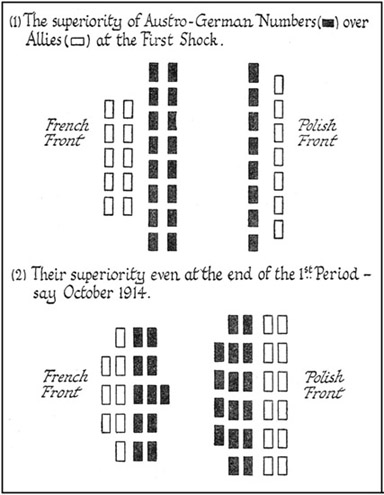
Sketch 14.
It is no wonder that he made certain of a decisive success in the West, and of the indefinite holding up or pushing back of the Russian forces in the East. It is no wonder that he confidently expected a complete victory before the winter, and the signing of peace before the end of the year. To that end all his munitioning, and even the details of his tactics, were directed.
The Figures of the Second Period, say to April 15-June 1, 1915.
The second period saw in the West, and, in the enemy's case, a very great change proceeding by a number of minute steps, but fairly rapid in character.
The French numbers could not grow very rapidly, because the French had armed every available man. They could bring in a certain number of volunteers; but neither was it useful to equip the most of the older men, nor could they be spared from those duties behind the front line which the much larger population of the enemy entrusted to men who, for the most part, had received no regular training. The French did, however, in this second period, gradually grow to some two and a half million men, behind which, ready to come in for the final period, were about a third of a million young recruits.
Great Britain discovered a prodigious effort. She had already, comparatively early in the second period, put across the sea nearly half a million men, and drafts were perpetually arriving as the second period came to a close; while behind the army actually upon the Continent very large bodies—probably another million in number—hastily trained indeed, and presented with a grave problem in the matter of officering, but of excellent material and moral, were ready to appear, before the end of the second period or at its close, the moment their equipment should be furnished. Counting the British effort and the French together, one may say that, without regard to wastage, the Allies in the West grew in the second period from the original 16 to over 30, and might grow even before the second period was over to 35 or even more.
On the enemy's side (neglecting wastage for the moment) there were the simplest elements of growth. Each Power had docketed every untrained man, knew his medical condition, where to find him, where and how to train him. The German Empire had during peace taken about one-half of its young men for soldiers. It had in pure theory five million untrained men in the reserve, excluding the sick, and those not physically efficient for service.
In practice, however, a very large proportion of men, even of the efficients, must be kept behind for civilian work; and in an industrial country such as Germany, mainly urban in population, this proportion is particularly large. We are safe in saying that the German army would not be reinforced during the second period by more than two and a half million men. These were trained in batches of some 800,000 each; the equipment had long been ready for them, and they appeared mainly as drafts for filling gaps, but partly as new formations in groups—the first going in or before November, the second in or before February. A third and last group was expected to have finished this rather elementary training somewhere about the end of April, so that May would complete the second period in the German forces.
Austria-Hungary, by an easily appreciable paradox, possessed, though but 80 per cent. of the Germans in population, a larger available untrained reserve. This was because that empire trained a smaller proportion of its population by far than did the Germans. It is probable that Austria-Hungary was able to train and put forward during the second period some three million men.
It is a great error, into which most critics have fallen, to underestimate or to neglect the Austro-Hungarian factor in the enemy's alliance. Without thus nearly doubling her numbers, Germany could not have fought France and Russia at all, and a very striking feature of all the earlier weeks of 1915 was the presence in the Carpathians of increasing Austro-Hungarian numbers, which checked for more than three months all the Russian efforts upon that front.
Say that Austria-Hungary nearly doubled her effectives (apart from wastage) in this second period, and you will not be far wrong.
Russia, which upon paper could almost indefinitely increase during the second period her numbers in the field, suffered with the advent of winter an unexpected blow. Her equipment, and in particular her munitioning (that is, her provision of missiles, and in especial of heavy shell), must in the main come from abroad. Now the German command of the Baltic created a complete blockade on the eastern frontier of Russia, save upon the short Roumanian frontier; and the entry of Turkey into the campaign on the side of the enemy, which marked the second period, completed that blockade upon the south, and shut upon Russia the gate of the Dardanelles. The port of Archangel in the north was ice-bound, or with great difficulty kept partially open by ice-breakers, and was in any case only connected with Russia by one narrow-gauge and lengthy line; while the only remaining port of Vladivostok was six thousand miles away, and closed also during a part of the winter.
In this situation it was impossible for the great reserves of men which Russia counted on to be put into the field, and the Russians remained throughout the whole of this second period but little stronger than they had been at the end of the first. If we set them down at perhaps somewhat over three millions (excluding wastage) towards the end of this second period, we shall be near to a just estimate.
We can now sum up and say that, apart from wastage, the forces arrayed against each other after this full development should have been about 120 men for the central powers of the enemy—35 (and perhaps ultimately 40) men against them upon the West, and, until sufficient Russian equipment could at least be found, only some 30 men against them upon the East.
Luckily such figures are wholly changed by the enormous rate of the enemy's wastage. The Russians had lost men almost as rapidly as the enemy, but the Russian losses could be and were made good. The handicap of the blockade under which Russia suffered permitted her to maintain only a certain number at the front, but she could continually draft in support of those numbers; and though she lost in the first seven months of the war quite four hundred thousand in prisoners, and perhaps three-quarters of a million in other casualties, her strength of somewhat over three millions was maintained at the close of the first period.
In the same way drafts had further maintained the British numbers. The French had lost not more than one-fifth of a million in prisoners, and perhaps a third of a million or a little more in killed and permanently disabled—that is, unable to return to the fighting line. In the case of both the French and the British sanitary conditions were excellent.
You have, then, quite 35 for your number in the West, and quite 33 for your number in the East of the Allied forces at the end of the winter; but of your enemy forces you may safely deduct 45-50 might be a truer estimate; and it is remarkable that those who have watched the matter carefully at the front are inclined to set the total enemy losses higher than do the critics working at home. But call it only 45 (of which 5 are prisoners), and you have against the 68 Allies in East and West no more at the end of this second period than 75 of the enemy.
The following diagram illustrates in graphic form the change that six months have produced.
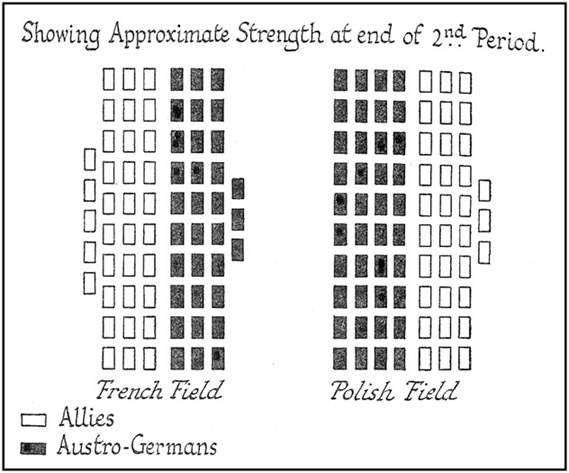
Sketch 15.
In other words, at the end of the winter and with the beginning of the spring, although the enemy still has a numerical preponderance, it is no longer the overwhelming thing it was when the war began, and that change in numbers explains the whole change in the campaign.
The enemy was certain of winning mainly because he was fighting more than equal in the East, and at first nearly two to one, later quite four to three, in the West. Those are the conditions of the late summer of 1914. 1915, before it was a third over, had seen the numbers nearly equalized. With the summer of 1915 we might hope to see the numbers at last reversed, and, after so many perilous months, a total (not local) numerical majority at last appearing upon the side of the Allies. If ever this condition shall arrive before the enemy can accomplish a decisive result in either field the tide will have turned.
The third period belongs at the moment of writing to the future. All we can say of it is that it presents for the enemy no considerable field of recruitment; but while in the West it offers no increase to the French, it does offer another five units at least, and possibly another six or eight, to the British; and to the Russians, if the blockade can be pierced at any point, or if the change of weather, coupled with the broadening of the gauge of the railway to Archangel, permits large imports, an almost indefinite increase in number—certainly an increase of two millions, or twenty of the units we were dealing with in the figures given above.
So much, then, for the numerical factor in men which dominates the whole campaign.
When we turn from this to the second factor—that of munitions—we discover something which can be dealt with far more briefly, but which follows very much the same line.
The enemy in the first period of the war had, if anything, an even greater superiority in munitioning than in men. This superiority was due to two distinct causes. In the first place, as we shall see in a few pages, his theory upon a number of military details was well founded; in the second place, he made war at his own chosen moment, after three years of determined and largely secret preparation.
As to the first point:—
We may take as a particular example of these theories of war the enemies' reliance upon heavy artillery—and in particular upon the power of the modern high explosive and the big howitzer—to destroy permanent fortification rapidly, and to have an effect in the field, particularly in the preparation of an assault, which the military theories of the Allies had wrongly underestimated. It is but one example out of many. It must serve for the rest, and it will be dealt with more fully in the next section. The Germans to some extent, and much more the Austrians, prepared an immensely greater provision of heavy ammunition than their opponents, and entered the field with large pieces of a calibre and in number quite beyond anything that their opponents had at the outset of the campaign.
As to the second point:—
No peaceful nations, no nations not designing a war at their own hour, lock up armament which may be rendered obsolete, or, in equipment more extensive than the reasonable chances of a campaign may demand, the public resources which it can use on what it regards as more useful things. Such nations, to use a just metaphor, "insure" against war at what they think a reasonable rate. But if some one Government in Europe is anarchic in its morals, and proposes, while professing peace, to declare war at an hour and a day chosen by itself, it will obviously have an overwhelming advantage in this respect. The energy and the money which it devotes to the single object of preparation cannot possibly be wasted; and, if its sudden aggression is not fixed too far ahead, will not run the risk of being sunk in obsolete weapons.
Now it is clearly demonstrable from the coincidence of dates, from the exact time required for a special effort of this kind, and from the rate at which munitions and equipment were accumulated, that the Government at Berlin came to a decision in the month of July 1911 to force war upon Russia and upon France immediately after the harvest of 1914; and of a score of indications which all converge upon these dates, not one fails to strike them exactly by more than a few weeks in the matter of preparation, by more than a few days in the date at which war was declared.
Under those circumstances, Berlin with her ally at Vienna had the immense numerical advantage over the French and the Russians when war was suddenly forced upon those countries on the 31st of July last year.
But, as in the case of men, the advantage would only be overwhelming during the first period. The very fact that the war had to be won quickly involved an immense expenditure of heavy ammunition in the earlier part of it, and this expenditure, if it were not successful, would be a waste.
It takes about five months to produce a heavy piece, and the rate of production of heavy ammunition, though slow, is measurable. At the moment of writing this, towards the close of the second period, the balance is not yet redressed, but it is in a fair way to be redressed. The imperfect and too tardy blockade to which the enemy is somewhat timidly subjected is a factor in aid of this; and we may be fairly confident that, if a third period is reached before the enemy shall have the advantage of a decision, there will be a preponderance of munitioning upon the Allied side in the West and the East which will be, if anything, of superior importance to the approaching preponderance in numbers.
Having thus briefly surveyed the opposing strength of either combatant, checked and measured as it varied with the progress of the war, we will turn to the moral opposition of military theory between the one party and the other, and show how here again that, save in the most important matter of all, grand strategy, the enemy was on the highroad to the victory which he confidently and, for that matter, reasonably expected.
(3) The Conflicting Theories of War.
The long peace which the most civilized parts of Europe had enjoyed for now a generation left more and more uncertain the value of theories upon the conduct of war, which theories had for the most part developed as mere hypotheses untested by experience during that considerable period. The South African and the Manchurian war had indeed proved certain theories sound and others unsound, so far as their experience went; but they were fought under conditions very different from those of an European campaign, and the progress of material science was so rapid in the years just preceding the great European conflict that the mass of debated theories still remained untried at its outbreak.
The war in its first six months thoroughly tested these theories, and proved, for the greater part of them, which were sound in practice and which unsound. I will tabulate them here, and beg the special attention of the reader, because upon the accuracy of these forecasts the first fortunes of the war depended.
I. A German theory maintained that, with the organization of and the particular type of discipline in the German service, attacks could be delivered in much closer formation than either the French or the English believed to be possible.
The point is this: After a certain proportion of losses inflicted within a certain limit of time, troops break or are brought to a standstill. That was the universal experience of all past war. When the troops that are attacking break or are brought to a standstill, the attack fails. But what you cannot determine until you test the matter in actual war is what numbers of losses in what time will thus destroy an offensive movement. You cannot determine it, because the chief element in the calculation is the state of the soldier's mind, and that is not a measurable thing. One had only the lessons of the past to help one.
The advantages of attacking in close formation are threefold.
(a) You launch your attack with the least possible delay. It is evident that spreading troops out from the column to the line takes time, and that the more extended your line the more time you consume before you can strike.
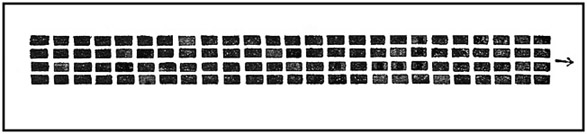
Sketch 16.
If I have here a hundred units advancing in a column towards the place where they are to attack (and to advance in column is necessary, because a broad line cannot long keep together), then it is evident that if I launched them to the attack thus:—
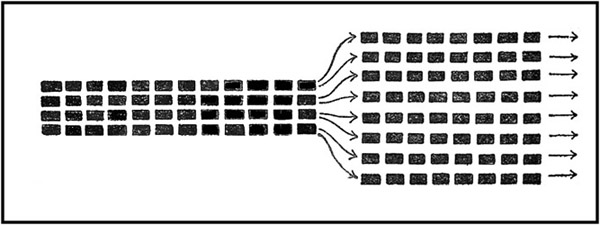
Sketch 17.
packed close together, I get them into that formation much more quickly than if, before attacking, I have to spread them out thus:—
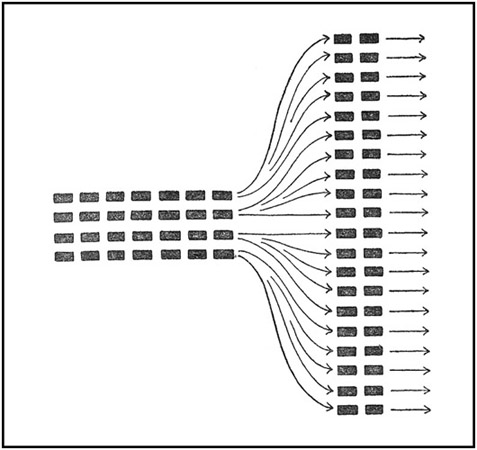
Sketch 18.
(b) The blow which I deliver has also evidently more weight upon it at a given point. If I am attacking a hundred yards of front with a hundred units of man and missile power, I shall do that front more harm in a given time than if I am attacking with only fifty such units.
(c) In particular circumstances, where troops have to advance on a narrow front, as in carrying a bridge or causeway or a street or any other kind of defile, my troops, if they can stand close formation and the corresponding punishment it entails, will be more likely to succeed than troops not used to or not able to bear such close formation. Now, such conditions are very numerous in war. Troops are often compelled, if they are to succeed, to rush narrow gaps of this kind, and their ability to do so is a great element in tactical success.
I have here used the phrase "if they can stand close formation and the corresponding punishment it entails," and that is the whole point. There are circumstances—perhaps, on the whole, the most numerous of all the various circumstances in war—in which close formation, if it can be used, is obviously an advantage; but it is equally self-evident that the losses of troops in close formation will be heavier than their losses in extended order. A group is a better target than a number of dispersed, scattered points.
Now, the Germans maintained in this connection not only, as I have said, that they could get their men to stand the punishment involved in close formation, but also that:—
(a) The great rapidity of such attacks would make the total and final wastage less than was expected, and further:—
(b) That the heavy wastage, such as it was, was worth while, because it would lead to very rapid strategical decision as well as tactical. In other words, because once you had got your men to stand these heavy local losses and to suffer heavy initial wastage, you would win your campaign in a short time, so that the high-rate wastage not being prolonged need not be feared.
Well, in the matter of this theory, the war conclusively proved the following points:—
(a) The Germans were right and the Allies were wrong with regard to the mere possibility of using close formations. The German temper, coupled with the type of discipline in the modern German service, did prove capable of compelling men to stand losses out of all proportion to what the Allies expected they could stand, and yet to continue to advance neither broken nor brought to a standstill. But—
(b) The war also proved that, upon the whole, and taking the operations in their entirety, such formations were an error. In case after case, a swarm of Germans advancing against inferior numbers got home after a third, a half, or even more than a half of their men had fallen in the first few minutes of the rush. But in many, many more cases this tactical experiment failed. Those who can speak as eye-witnesses tell us that, though the occasions on which such attacks actually broke were much rarer than was expected before the war began, yet the occasions on which the attack was thrown into hopeless confusion, and in which the few members of it that got home had lost all power to do harm to the defenders, were so numerous that the experiment must be regarded as, upon the whole, a failure. It may be one that no troops but Germans could employ. It is certainly not one which any troops, after the experience of this war, will copy.
(c) Further, the war proved even more conclusively that the wastage was not worth while. The immense expense in men only succeeded where there was an overwhelming superiority in number. The strategical result was not arrived at quickly (as the Germans had expected) through this tactical method, and after six months of war, the enemy had thrown away more than twice and nearly three times as many men as he need have sacrificed had he judged sanely the length of time over which operations might last.
II. Another German theory had maintained that modern high explosives fired from howitzers and the accuracy of their aim controlled by aircraft would rapidly and promptly dominate permanent fortification.
This theory requires explanation. Its partial success in practice was the most startling discovery and the most unpleasant one to the Allies of the early part of the war.
In the old days, say up to ten years ago or less, permanent fortification mounting heavy guns was impregnable to direct assault if it were properly held and properly munitioned. It could hold out for months. Its heavy guns had a range superior to any movable guns that could be brought against it—indeed, so very heavily superior that movable guns, even if they were howitzers, would be smashed or their crews destroyed long before the fortress was seriously damaged by them.
A howitzer is but a form of mortar, and all such pieces are designed to lob a projectile instead of throwing it. The advantage of using these instruments when you are besieging permanent works is that you can hide them behind an obstacle, such as a hill, and that the heavy gun in the fortress cannot get its shell on to them because that shell has a flatter trajectory. The disadvantage is that the howitzer has a very much shorter range than the gun size for size.
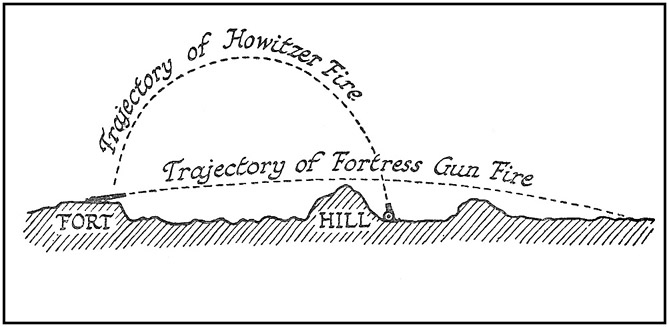
Sketch 19.
Here is a diagram showing how necessarily true this is. The howitzer, lobbing its shell with a comparatively small charge, has the advantage of being able to hide behind a steep bit of ground, but on such a trajectory the range is short. The gun in the fortress does not lob its shell, but throws it. The course of the gun shell is much more straight. It therefore can only hit the howitzer and its crew indirectly by exploding its shell just above them. Until recently, the gun was master of the howitzer for three reasons:—
First, because the largest howitzers capable of movement and of being brought up against any fortress and shifted from one place of concealment to another were so small that their range was insignificant. Therefore the circumference on which they could be used was also a small one; their opportunities for hiding were consequently reduced; the chances of their emplacement being immediately spotted from the fortress were correspondingly high, and the big gun in the fortress was pretty certain to overwhelm the majority of them at least. It is evident that the circumference αβγ offers far more chances of hiding than the circumference ABC, but a still more powerful factor in favour of the new big howitzer is the practical one that at very great ranges in our climate the chances of spotting a particular place are extremely small. Secondly, because the explosives used, even when they landed and during the short time that the howitzer remained undiscovered and unheard, were not sufficiently powerful nor, with the small howitzers then in existence, sufficiently large in amount in each shell to destroy permanent fortification. Thirdly, because the effect of the aim is always doubtful. You are firing at something well above yourself, and you could not tell very exactly where your howitzer shell had fallen.