CHAP. IX. OF Captain Bartho. Roberts, And his CREW.
Reading edition

BArtholomew Roberts sailed in an honest Employ, from London aboard of the Princess, Captain Plumb Commander, of which Ship he was second Mate: He left England, November 1719, and arrived at Guiney about February following, and being at Anamaboe, taking in Slaves for the West-Indies, was taken in the said Ship by Captain Howel Davis, as mentioned in the preceeding Chapter. In the beginning he was very averse to this sort of Life, and would certainly have escaped from them, had a fair Opportunity presented it self; yet afterwards he changed his Principles, as many besides him have done upon another Element, and perhaps for the same Reason too, viz. Preferment,—and what he did not like as a private Man he could reconcile to his Conscience as a Commander.
Davis being cut off in the manner beforementioned, the Company found themselves under a Necessity of filling up his Post, for which there appear’d two or three Candidates among the select Part of them, that were distinguish’d by the Title of Lords, such were Sympson, Ashplant, Anstis, &c. and on canvassing this Matter, how shatter’d and weak a Condition their Government must be without a Head, since Davis had been remov’d, in the manner beforemention’d, my Lord Dennis propos’d, its said, over a Bowl to this Purpose.
That it was not of any great Signification who was dignify’d with Title; for really and in Truth, all good Governments had (like theirs) the supream Power lodged with the Community, who might doubtless depute and revoke as suited Interest or Humour. We are the Original of this Claim (says he) and should a Captain be so sawcy as to exceed Prescription at any time, why down with Him! it will be a Caution after he is dead to his Successors, of what fatal Consequence any sort of assuming may be. However, it is my Advice, that, while we are sober, we pitch upon a Man of Courage, and skill’d in Navigation, one, who by his Council and Bravery seems best able to defend this Commonwealth, and ward us from the Dangers and Tempests of an instable Element, and the fatal Consequences of Anarchy; and such a one I take Roberts to be. A Fellow! I think, in all Respects, worthy your Esteem and Favour.
This Speech was loudly applauded by all but Lord Sympson, who had secret Expectations himself, but on this Disappointment, grew sullen, and left them, swearing, he did not care who they chose Captain, so it was not a Papist, for against them he had conceiv’d an irreconcileable Hatred, for that his Father had been a Sufferer in Monmouth’s Rebellion.
Roberts was accordingly elected, tho’ he had not been above six Weeks among them, the Choice was confirm’d both by the Lords and Commoners, and he accepted of the Honour, saying, That since he had dipp’d his Hands in muddy Water, and must be a Pyrate, it was better being a Commander than a common Man.
As soon as the Government was settled, by promoting other Officers in the room of those that were kill’d by the Portugueze, the Company resolv’d to revenge Captain Davis’s Death, he being more than ordinarily respected by the Crew for his Affability and good Nature, as well as his Conduct and Bravery upon all Occasions; and pursuant to this Resolution, about 30 Men were landed in order to make an Attack upon the Fort, which must be ascended to by a steep Hill against the Mouth of the Cannon. These Men were headed by one Kennedy, a bold daring Fellow, but very wicked and profligate; they march’d directly up under the Fire of their Ship Guns, and as soon as they were discover’d, the Portugueze quitted their Post and fled to the Town, and the Pyrates march’d in without Opposition, set Fire to the Fort, and threw all the Guns off the Hill into the Sea, which after they had done, they retreated quietly to their Ship.
But this was not look’d upon as a sufficient Satisfaction for the Injury they received, therefore most of the Company were for burning the Town, which Roberts said he would yield to, if any Means could be proposed of doing it without their own Destruction, for the Town had a securer Scituation than the Fort, a thick Wood coming almost close to it, affording Cover to the Defendants, who under such an Advantage, he told them, it was to be fear’d, would fire and stand better to their Arms; besides, that bare Houses would be but a slender Reward for their Trouble and Loss. This prudent Advice prevailed; however, they mounted the French Ship, they seiz’d at this Place, with 12 Guns, and light’ned her, in order to come up to the Town, the Water being shoal, and battered down several Houses; after which they all returned on Board, gave back the French Ship to those that had most Right to her, and sailed out of the Harbour by the light of two Portuguese Ships, which they were pleased to set on Fire there.
Roberts stood away to the Southward, and met with a Dutch Guiney Man, which he made Prize of, but after having plundered her, the Skipper had his Ship again: Two Days after, he took an English Ship, called the Experiment, Captain Cornet, at Cape Lopez, the Men went all into the Pyrate Service, and having no Occasion for the Ship, they burnt her, and then steered for St. Thome, but meeting with nothing in their Way, they sailed for Annabona, and there water’d, took in Provisions, and put it to a Vote of the Company, whether their next Voyage should be, to the East-Indies, or to Brasil; the latter being resolved on, they sailed accordingly, and in 28 Days arrived at Ferdinando, an uninhabited Island, on that Coast: Here they water’d, boot-top’d their Ship, and made ready for the designed Cruise.
Now that we are upon this Coast, I think it will be the proper Place to present our Readers with a Description of this Country, and some ingenious Remarks of a Friend, how beneficial a Trade might be carried on here by our West-India Merchants, at a little Hazard.
A DESCRIPTION OF BRASIL, &c.
BRASIL (a Name signifying the holy Cross) was discovered for the King of Portugal, by Alvarez Cabral, Ann. Dom. 1501. extending almost from the Æquinoctial to 28° South. The Air is temperate and cool, in comparison of the West-Indies, from stronger Breezes and an opener Country, which gives less Interruption to the Winds.
The northernmost Part of it stretching about 180 Leagues, (a fine fertile Country,) was taken from the Portuguese by the Dutch West-India Company, Anno. 1637 or thereabouts; but the Conquerors, as is natural where there is little or no Religion subsisting, made such heavy Exactions on the Portuguese, and extended such Cruelty to the Natives, that prepared them both easily to unite for a Revolt, facilitated by the Dutch Mismanagement: For the States being at this Time very intent on their India Settlements, not only recalled Count Morrice their Governor, but neglected Supplies to their Garrisons; however, tho’ the others were countenanced with a Fleet from Portugal, and had the Affection of the Natives, yet they found Means to withstand and struggle with this superior Power, from 1643 to 1660, and then was wholly abandoned by them, on Articles dishonourable to the Portuguese, viz.
That the Dutch, on Relinquishing, should keep all the Places they had conquered in India from Portugal. That they should pay the States 800000 l. and permit them still the Liberty of Trade to Africa and Brasil, on the same Custom and Duties with the King of Portugal’s Subjects. But since that Time, new Stipulations and Treaties have been made; wherein the Dutch, who have been totally excluded the Brasil Trade, have, in lieu thereof, a Composition of 10 per Cent. for the Liberty of trading to Africa; and this is always left by every Portuguese Ship (before she begins her Slaving) with the Dutch General of the Gold-Coast, at Des Minas.
There are only three principal Towns of Trade on the Brasil Coast, St. Salvadore, St. Sebastian, and Pernambuca.
St. Salvadore in the Bahia los todos Santos, is an Archbishoprick and Seat of the Viceroy, the chief Port of Trade for Importation, where most of the Gold from the Mines is lodged, and whence the Fleets for Europe generally depart. The Seas about it abound with Whale-Fish, which in the Season they catch in great Numbers; the Flesh is salted up generally to be the Victualling of their Slave-Ships, and the Train reserved for Exportation, at 30 and 35 Millrays a Pipe.
Rio Janeiro (the Town St. Sebastian) is the Southernmost of the Portuguese, the worst provided of Necessaries, but commodious for a Settlement, because nigh the Mine, and convenient to supervise the Slaves, who, as I have been told, do usually allow their Master a Dollar per Diem, and have the Overplus of their Work (if any) to themselves.
The Gold from hence is esteemed the best, (for being of a copperish Colour,) and they have a Mint to run it into Coin, both here and at Bahia; the Moidors of either having the initial Letters of each Place upon them.
Pernambuca (tho’ mention’d last) is the second in Dignity, a large and populous Town, and has its rise from the Ruins of Olinda, (or the handsome,) a City of a far pleasanter Situation, six Miles up the River, but not so commodious for Traffick and Commerce. Just above the Town the River divides it self into two Branches, not running directly into the Sea, but to the Southward; and in the Nook of the Island made by that Division, stands the Governor’s House, a square plain Building of Prince Maurice’s, with two Towers, on which are only this Date inscribed, Anno 1641. The Avenues to it are every way pleasant, thro’ Visto’s of tall Coco-Nut Trees.
Over each Branch of the River is a Bridge; that leading to the Country is all of Timber, but the other to the Town (of twenty six or twenty eight Arches) is half of Stone, made by the Dutch, who in their Time had little Shops and gaming Houses on each Side for Recreation.
The Pavements also of the Town are in some Places of broad Tiles, the remaining Fragments of their Conquest. The Town has the outer Branch of the River behind it, and the Harbour before it, jetting into which latter are close Keys for the weighing and receiving of Customage on Merchandize, and for the meeting and conferring of Merchants and Traders. The Houses are strong built, but homely, letticed like those of Lisbon, for the Admission of Air, without Closets, and what is worse, Hearths; which makes their Cookery consist all in frying and stewing upon Stoves; and that they do till the Flesh become tender enough to shake it to Pieces, and one Knife is then thought sufficient to serve a Table of half a Score.
The greatest Inconvenience of Pernambuca is, that there is not one Publick-House in it; so that Strangers are obliged to hire any ordinary one they can get, at a Guinea a Month: And others who come to transact Affairs of Importance, must come recommended, if it were only for the sake of Privacy.
The Market is stocked well enough, Beef being at five Farthings per l. a Sheep or Goat at nine Shillings, a Turkey four Shillings, and Fowls two Shillings, the largest I ever saw, and may be procured much Cheaper, by hiring a Man to fetch them out of the Country. The dearest in its kind is Water, which being fetch’d in Vessels from Olinda, will not be put on Board in the Road under two Crusado’s a Pipe.
The Portuguese here are darker than those of Europe, not only from a warmer Climate, but their many Intermarriages with the Negroes, who are numerous there, and some of them of good Credit and Circumstances. The Women (not unlike the Mulatto Generation every where else) are fond of Strangers; not only the Courtezans, whose Interest may be supposed to wind up their Affections, but also the marryed Women who think themselves obliged, when you favour them with the Secrecy of an Appointment; but the Unhappiness of pursuing Amours, is, that the generallity of both Sexes are touched with veneral Taints, without so much as one Surgeon among them, or any Body skilled in Physick, to cure or palliate the progressive Mischief: The only Person pretending that Way, is an Irish Father, whose Knowledge is all comprehended in the Virtues of two or three Simples, and those, with the Salubrity of the Air and Temperance, is what they depend on, for subduing the worst of Malignity; and it may not be unworthy Notice, that tho’ few are exempted from the Misfortune of a Running, Eruptions, or the like, yet I could hear of none precipitated into those deplorable Circumstances we see common in unskillful mercurial Processes.
There are three Monasteries, and about six Churches, none of them Rich or Magnificent, unless one dedicated to St. Antonio, the Patron of their Kingdom, which shines all over with exquisite Pieces of Paint and Gold.
The Export of Brasil (besides Gold) is chiefly Sugars and Tobacco; the latter are sent off in Rowls of a Quintal Weight, kept continually moistened with Mulossus, which, with the Soil it springs from, imparts a strong and peculiar Scent, more sensible in the Snuff made from it, which tho’ under Prohibition of importing to Lisbon, sells here at 2 s. per l. as the Tobacco does at about 6 Millraies a Rowl. The finest of their Sugars sells at 8 s. per Roove, and a small ill tasted Rum drawn from the Dregs and Mulossus, at two Testunes a Gallon.
Besides these, they send off great Quantities of Brasil Wood, and Whale Oyl, some Gums and Parrots, the latter are different from the African in Colour and Bigness, for as they are blue and larger, these are green and smaller; and the Females of them ever retain the wild Note, and cannot be brought to talk.
In lieu of this Produce, the Portugueze, once every Year by their Fleet from Lisbon, import all manner of European Commodities; and whoever is unable or negligent of supplying himself at that Season, buys at a very advanced Rate, before the Return of another.
To transport Passengers, Slaves, or Merchandize from one Settlement to another, or in Fishing; they make use of Bark-Logs, by the Brasilians called Jingadahs: They are made of four Pieces of Timber (the two outermost longest) pinned and fastened together, and sharpened at the Ends: Towards each Extremity a Stool is fixed to sit on for paddling, or holding by, when the Agitation is more than ordinary; with these odd sort of Engines, continually washed over by the Water, do these People, with a little triangular Sail spreeted about the Middle of it, venture out of Sight of Land, and along the Coasts for many Leagues, in any sort of Weather; and if they overset with a Squall (which is not uncommon) they swim and presently turn it up right again.
The Natives are of the darkest Copper Colour, with thin Hair, of a square strong make, and muscular; but not so well looking as the Wooley Generation: They acquiesce patiently to the Portugueze Government, who use them much more humanly and Christian-like than the Dutch did, and by that Means have extended Quietness and Peace, as well as their Possessions, three or four hundred Miles into the Country. A Country abounding with fine Pastures and numerous Herds of Cattle, and yields a vast Increase from every thing that is sown: Hence they bring down to us Parrots, small Monkies, Armadillos and Sanguins, and I have been assured, they have, (far In-land,) a Serpent of a vast Magnitude, called Siboya, able, they say, to swallow a whole Sheep; I have seen my self here the Skin of another Specie full six Yards long, and therefore think the Story not improbable.
The Harbour of Pernambuca is, perhaps, singular, it is made of a Ledge of Rocks, half a Cables length from the Main, and but little above the Surface of the Water, running at that equal Distance and Heighth several Leagues, towards Cape Augustine, a Harbour running between them capable of receiving Ships of the greatest Burthen: The Northermost End of this Wall of Rock, is higher than any Part of the contiguous Line, on which a little Fort is built, commanding the Passage either of Boat or Ship, as they come over the Bar into the Harbour: On the Starboard Side, (i. e. the Main) after you have entered a little way, stands another Fort (a Pentagon) that would prove of small Account, I imagine, against a few disciplined Men; and yet in these consists all their Strength and Security, either for the Harbour or Town: They have begun indeed a Wall, since their removing from Olinda, designed to surround the latter; but the slow Progress they make in raising it, leaves Room to suspect ’twill be a long time in finishing.
The Road without, is used by the Portugueze, when they are nigh sailing for Europe, and wait for the Convoy, or are bound to Bahia to them, and by Strangers only when Necessity compels; the best of it is in ten Fathom Water, near three Miles W. N. W. from the Town; nigher in, is foul with the many Anchors lost there by the Portugueze Ships; and farther out (in 14 Fathom) corally and Rocky. July is the worst and Winter Season of this Coast, the Trade Winds being then very strong and dead, bringing in a prodigious and unsafe Swell into the Road, intermixed every Day with Squalls, Rain, and a hazey Horizon, but at other times serener Skies and Sunshine.
In these Southern Latitudes is a Constellation, which from some Resemblance it bears to a Jerusalem Cross, has the Name of Crosiers, the brightest of this Hemisphere, and are observed by, as the North Star is in Northern Latitudes; but what I mention this for, is, to introduce the admirable Phænomenon in these Seas of the Megellanick Clouds, whose Risings and Sittings are so regular, that I have been assured, the same Nocturnal Observations are made by them as by the Stars; They are two Clouds, small and whitish, no larger in Appearance than a Man’s Hat, and are seen here in July in the Latitude of 8° S. about four of the Clock in the Morning; if their Appearance should be said to be the Reflection of Light, from some Stellary Bodies above them, yet the Difficulty is not easily answered, how these, beyond others, become so durable and regular in their Motions.
From these casual Observations on the Country, the Towns, Coast, and Seas of Brasil, it would be an Omission to leave the Subject, without some Essay on an interloping Slave Trade here, which none of our Countrymen are adventurous enough to pursue, though it very probably, under a prudent Manager, would be attended with Safety and very great Profit; and I admire the more it is not struck at, because Ships from the Southern Coast of Africa, don’t lengthen the Voyage to the West-Indies a great deal, by taking a Part of Brasil in their Way.
The Disadvantages the Portugueze are under for purchasing Slaves, are these, that they have very few proper Commodities for Guiney, and the Gold, which was their chiefest, by an Edict in July 1722, stands now prohibited from being carried thither, so that the Ships employed therein are few, and insufficient for the great Mortality and Call of their Mines; besides, should they venture at breaking so destructive a Law, as the abovementioned (as no doubt they do, or they could make little or no Purchace) yet Gold does not raise its Value like Merchandize in travelling (especially to Africa) and when the Composition with the Dutch is also paid, they may be said to buy their Negroes at almost double the Price the English, Dutch, or French do, which necessarily raises their Value extravagantly at Brasil; (those who can purchase one, buying a certainer Annuity than South-Sea Stock.)
Thus far of the Call for Slaves at Brasil; I shall now consider and obviate some Difficulties objected against any Foreigners (suppose English) interposing in such a Trade, and they are some on theirs, and some on our Side.
On their Side it is prohibited under Pain of Death, a Law less effectual to the Prevention of it than pecuniary Mulcts would be, because a Penalty so inadequate and disproportioned, is only In terrorem, and makes it merciful in the Governor, or his Instruments, to take a Composition of eight or ten Moidors, when any Subject is catched, and is the common Custom so to do as often as they are found out.
On our Side it is Confiscation of what they can get, which considering, they have no Men of War to guard the Coast, need be very little, without supine Neglect and Carelessness.
I am a Man of War, or Privateer, and being in Want of Provisions, or in Search of Pyrates, put in to Pernambuca for Intelligence, to enable me for the Pursuit: The Dread of Pyrates keeps every one off, till you have first sent an Officer, with the proper Compliments to the Governor, who immediately gives Leave for your buying every Necessary you are in want of, provided it be with Money, and not an Exchange of Merchandize, which is against the Laws of the Country.
On this first time of going on Shore, depends the success of the whole Affair, and requires a cautious and discreet Management in the Person entrusted: He will be immediately surrounded at landing with the great and the small Rabble, to enquire who? and whence he comes? and whether bound? &c. and the Men are taught to answer, from Guiney, denying any thing of a Slave on Board, which are under Hatches, and make no Shew; nor need they, for those who have Money to lay out will conclude on that themselves.
By that time the Compliment is paid to the Governor, the News has spread all round the Town, and some Merchant addresses you, as a Stranger, to the Civility of his House, but privately desires to know what Negroes he can have, and what Price. A Governor may possibly use an Instrument in sifting this, but the Appearance of the Gentleman, and the Circumstance of being so soon engaged after leaving the other, will go a great way in forming a Man’s Judgment, and leaves him no room for the Suspicion of such a Snare; however, to have a due Guard, Intimations will suffice, and bring him, and Friends enough to carry off the best Part of a Cargo in two Nights time, from 20 to 30 Moidors a Boy, and from 30 to 40 a Man Slave. The Hazard is less at Rio Janeiro.
There has been another Method attempted, of settling a Correspondence with some Portugueze Merchant or two, who, as they may be certain within a Fortnight of any Vessels arriving on their Coast with Slaves, might settle Signals for the debarquing them at an unfrequented Part of the Coast, but whether any Exceptions were made to the Price, or that the Portuguese dread Discovery, and the severest Prosecution on so notorious a Breach of the Law, I cannot tell but it has hither to proved abortive.
However, Stratagems laudable, and attended with Profit, at no other Hazard (as I can perceive) then loss of Time, are worth attempting; it is what is every Day practised with the Spaniards from Jamaica.
Upon this Coast our Rovers cruiz’d for about nine Weeks, keeping generally out of Sight of Land, but without seeing a Sail, which discourag’d them so, that they determined to leave the Station, and steer for the West-Indies, and in order thereto, stood in to make the Land for the taking of their Departure, and thereby they fell in, unexpectedly, with a Fleet of 42 Sail of Portuguese Ships, off the Bay of los todos Santos, with all their Lading in for Lisbon, several of them of good Force, who lay too waiting for two Men of War of 70 Guns each, their Convoy. However, Roberts thought it should go hard with him, but he would make up his Market among them, and thereupon mix’d with the Fleet, and kept his Men hid till proper Resolutions could be form’d; that done, they came close up to one of the deepest, and ordered her to send the Master on Board quietly, threat’ning to give them no Quarters, if any Resistance, or Signal of Distress was made. The Portuguese being surprized at these Threats, and the sudden flourish of Cutlashes from the Pyrates, submitted without a Word, and the Captain came on Board; Roberts saluted him after a friendly manner, telling him, that they were Gentlemen of Fortune, but that their Business with him, was only to be informed which was the richest Ship in that Fleet; and if he directed them right, he should be restored to his Ship without Molestation, otherwise, he must expect immediate Death.
Whereupon this Portuguese Master pointed to one of 40 Guns, and 150 Men, a Ship of greater Force than the Rover, but this no Ways dismayed them, they were Portuguese, they said, and so immediately steered away for him. When they came within Hail, the Master whom they had Prisoner, was ordered to ask, how Seignior Capitain did? And to invite him on Board, for that he had a Matter of Consequence to impart to him, which being done, he returned for Answer, That he would wait upon him presently: But by the Bustle that immediately followed, the Pyrates perceived, they were discovered, and that this was only a deceitful Answer to gain Time to put their Ship in a Posture of Defence; so without further Delay, they poured in a Broad-Side, boarded and grapled her; the Dispute was short and warm, wherein many of the Portuguese fell, and two only of the Pyrates. By this Time the Fleet was alarmed, Signals of Top-gallant Sheets flying, and Guns fired, to give Notice to the Men of War, who rid still at an Anchor, and made but scurvy hast out to their Assistance; and if what the Pyrates themselves related, be true, the Commanders of those Ships were blameable to the highest Degree, and unworthy the Title, or so much as the Name of Men: For Roberts finding the Prize to sail heavy, and yet resolving not to loose her, lay by for the headmost of them (which much out sailed the other) and prepared for Battle, which was ignominiously declined, tho’ of such superior Force; for not daring to venture on the Pyrate alone, he tarried so long for his Consort as gave them both time leisurely to make off.
They found this Ship exceeding rich, being laden chiefly with Sugar, Skins, and Tobacco, and in Gold 40000 Moidors, besides Chains and Trinckets, of considerable Value; particularly a Cross set with Diamonds, designed for the King of Portugal; which they afterwards presented to the Governor of Caiana, by whom they were obliged.
Elated with this Booty, they had nothing now to think of but some safe Retreat, where they might give themselves up to all the Pleasures that Luxury and Wantonness could bestow, and for the present pitch’d upon a Place called the Devil’s Islands, in the River of Surinam, on the Coast of Caiana, where they arrived, and found the civilest Reception imaginable, not only from the Governor and Factory, but their Wives, who exchanged Wares and drove a considerable Trade with them.
They seiz’d in this River a Sloop, and by her gained Intelligence, that a Brigantine had also sailed in Company with her, from Rhode-Island, laden with Provisions for the Coast. A Welcome Cargo! They growing short in the Sea Store, and as Sancho says, No Adventures to be made without Belly-Timber. One Evening as they were rumaging (their Mine of Treasure) the Portuguese Prize, this expected Vessel was descry’d at Mast-Head, and Roberts, imagining no Body could do the Business so well as himself, takes 40 Men in the Sloop, and goes in pursuit of her; but a fatal Accident followed this rash, tho’ inconsiderable Adventure, for Roberts thinking of nothing less than bringing in the Brigantine that Afternoon, never troubled his Head about the Sloop’s Provision, nor inquired what there was on Board to subsist such a Number of Men; but out he sails after his expected Prize, which he not only lost further Sight of, but after eight Days contending with contrary Winds and Currents, found themselves thirty Leagues to Leeward. The Current still opposing their Endeavours, and perceiving no Hopes of beating up to their Ship, they came to an Anchor, and inconsiderately sent away the Boat to give the rest of the Company Notice of their Condition, and to order the Ship to them; but too soon, even the next Day, their Wants made them sensible of their Infatuation, for their Water was all expended, and they had taken no thought how they should be supply’d, till either the Ship came, or the Boat returned, which was not likely to be under five or six Days. Here like Tantalus, they almost famished in Sight of the fresh Streams and Lakes; being drove to such Extremity at last, that they were forc’d to tare up the Floor of the Cabin, and patch up a sort of Tub or Tray with Rope Yarns, to paddle ashore, and fetch off immediate Supplies of Water to preserve Life.
After some Days, the long-wish’d-for Boat came back, but with the most unwellcome News in the World, for Kennedy, who was Lieutenant, and left in Absence of Roberts, to Command the Privateer and Prize, was gone off with both. This was Mortification with a Vengeance, and you may imagine, they did not depart without some hard Speeches from those that were left, and had suffered by their Treachery: And that there need be no further mention of this Kennedy, I shall leave Captain Roberts, for a Page or two, with the Remains of his Crew, to vent their Wrath in a few Oaths and Execrations, and follow the other, whom we may reckon from that Time, as steering his Course towards Execution Dock.
Kennedy was now chosen Captain of the revolted Crew, but could not bring his Company to any determined Resolution; some of them were for pursuing the old Game, but the greater Part of them seem’d to have Inclinations to turn from those evil Courses, and get home privately, (for there was no Act of Pardon in Force,) therefore they agreed to break up, and every Man to shift for himself, as he should see Occasion. The first Thing they did, was to part with the great Portugueze Prize, and having the Master of the Sloop (whose Name I think was Cane) aboard, who they said was a very honest Fellow, (for he had humoured them upon every Occasion,) told them of the Brigantine that Roberts went after; and when the Pyrates first took him, he complemented them at an odd Rate, telling them they were welcome to his Sloop and Cargo, and wish’d that the Vessel had been larger, and the Loading richer for their Sakes: To this good natured Man they gave the Portugueze Ship, (which was then above half loaded,) three or four Negroes, and all his own Men, who returned Thanks to his kind Benefactors, and departed.
Captain Kennedy in the Rover, sailed to Barbadoes, near which Island, they took a very peaceable Ship belonging to Virginia; the Commander was a Quaker, whose Name was Knot; he had neither Pistol, Sword, nor Cutlash on Board; and Mr. Knot appearing so very passive to all they said to him, some of them thought this a good Opportunity to go off; and accordingly eight of the Pyrates went aboard, and he carried them safe to Virginia; They made the Quaker a Present of 10 Chests of Sugar, 10 Rolls of Brasil Tobacco, 30 Moidors, and some Gold-Dust, in all to the value of about 250 l. They also made Presents to the Sailors, some more, some less, and lived a jovial Life all the while they were upon their Voyage, Captain Knot giving them their Way; nor indeed could he help himself, unless he had taken an Opportunity to surprize them, when they were either drunk or asleep; for awake they wore Arms aboard the Ship, and put him in a continual Terror; it not being his Principle (or the Sect’s) to fight, unless with Art and Collusion; he managed these Weapons well till he arrived at the Capes, and afterwards four of the Pyrates went off in a Boat, which they had taken with them, for the more easily making their Escapes, and made up the Bay towards Maryland, but were forced back by a Storm into an obscure Place of the Country, where meeting with good Entertainment among the Planters, they continued several Days without being discovered to be Pyrates. In the mean Time Captain Knot leaving four others on Board his Ship, (who intended to go to North-Carolina,) made what hast he could to discover to Mr. Spotswood the Governor, what sort of Passengers he had been forced to bring with him, who by good Fortune got them seized; and Search being made after the others, who were revelling about the Country, they were also taken, and all try’d, convicted and hang’d, two Portuguese Jews who were taken on the Coast of Brasil, and whom they brought with them to Virginia, being the principal Evidences. The latter had found Means to lodge Part of their Wealth with the Planters, who never brought it to Account: But Captain Knot surrendered up every Thing that belonged to them, that were taken aboard, even what they presented to him, in lieu of such Things as they had plundered him of in their Passage, and obliged his Men to do the like.
Some Days after the taking of the Virginia Man last mentioned, in cruising in the Latitude of Jamaica, Kennedy took a Sloop bound thither from Boston, loaded with Bread and Flower; aboard of this Sloop went all the Hands who were for breaking the Gang, and left those behind that had a Mind to pursue further Adventures. Among the former were Kennedy, their Captain, of whose Honour they had such a dispicable Notion, that they were about to throw him over-board, when they found him in the Sloop, as fearing he might betray them all, at their return to England; he having in his Childhood been bred a Pick-pocket, and before he became a Pyrate, a House-breaker; both Professions that these Gentlemen have a very mean Opinion of. However, Captain Kennedy, by taking solemn Oaths of Fidelity to his Companions, was suffered to proceed with them.
In this Company there was but one that pretended to any skill in Navigation, (for Kennedy could neither write nor read, he being preferred to the Command merely for his Courage, which indeed he had often signaliz’d, particularly in taking the Portuguese Ship,) and he proved to be a Pretender only; for shaping their Course to Ireland, where they agreed to land, they ran away to the North-West Coast of Scotland, and there were tost about by hard Storms of Wind for several Days, without knowing where they were, and in great Danger of perishing: At length they pushed the Vessel into a little Creek, and went all ashore, leaving the Sloop at an Anchor for the next Comers.
The whole Company refresh’d themselves at a little Village about five Miles from the Place where they left the Sloop, and passed there for Ship-wreck’d Sailors, and no doubt might have travelled on without Suspicion; but the mad and riotous Manner of their Living on the Road, occasion’d their Journey to be cut short, as we shall observe presently.
Kennedy and another left them here, and travelling to one of the Sea-Ports, ship’d themselves for Ireland, and arrived there in Safety. Six or seven wisely withdrew from the rest, travelled at their leasure, and got to their much desired Port of London, without being disturbed or suspected; but the main Gang alarm’d the Country where-ever they came, drinking and roaring at such a Rate, that the People shut themselves up in their Houses, in some Places, not daring to venture out among so many mad Fellows: In other Villages, they treated the whole Town, squandering their Money away, as if, like Æsop, they wanted to lighten their Burthens: This expensive manner of Living procured two of their drunken Straglers to be knocked on the Head, they being found murdered in the Road, and their Money taken from them: All the rest, to the Number of seventeen as they drew nigh to Edinburgh, were arrested and thrown into Goal, upon Suspicion, of they knew not what; However, the Magistrates were not long at a Loss for proper Accusations, for two of the Gang offering themselves for Evidences were accepted of; and the others were brought to a speedy Tryal, whereof nine were convicted and executed.
Kennedy having spent all his Money, came over from Ireland, and kept a common B—y-House on Deptford Road, and now and then, ’twas thought, made an Excursion abroad in the Way of his former Profession, till one of his Houshold W—s gave Information against him for a Robbery, for which he was committed to Bridewell; but because she would not do the Business by halves, she found out a Mate of a Ship that Kennedy had committed Pyracy upon, as he foolishly confess’d to her. This Mate, whose Name was Grant, paid Kennedy a Visit in Bridewell, and knowing him to be the Man, procured a Warrant, and had him committed to the Marshalsea Prison.
The Game that Kennedy had now to play was to turn Evidence himself; accordingly he gave a List of eight or ten of his Comrades; but not being acquainted with their Habitations, one only was taken, who, tho’ condemn’d, appeared to be a Man of a fair Character, was forc’d into their Service, and took the first Opportunity to get from them, and therefore receiv’d a Pardon; but Walter Kennedy being a notorious Offender, was executed the 19th of July, 1721, at Execution Dock.
The rest of the Pyrates who were left in the Ship Rover, staid not long behind, for they went ashore to one of the West-India Islands; what became of them afterwards, I can’t tell, but the Ship was found at Sea by a Sloop belonging to St. Christophers, and carried into that Island with only nine Negroes aboard.
Thus we see what a disastrous Fate ever attends the Wicked, and how rarely they escape the Punishment due to their Crimes, who, abandon’d to such a profligate Life, rob, spoil, and prey upon Mankind, contrary to the Light and Law of Nature, as well as the Law of God. It might have been hoped, that the Examples of these Deaths, would have been as Marks to the Remainder of this Gang, how to shun the Rocks their Companions had split on; that they would have surrendered to Mercy, or divided themselves, for ever from such Pursuits, as in the End they might be sure would subject them to the same Law and Punishment, which they must be conscious they now equally deserved; impending Law, which never let them sleep well, unless when drunk. But all the Use that was made of it here, was to commend the Justice of the Court, that condemn’d Kennedy, for he was a sad Dog (they said) and deserved the Fate he met with.
But to go back to Roberts, whom we left on the Coast of Caiana, in a grievous Passion at what Kennedy and the Crew had done; and who was now projecting new Adventures with his small Company in the Sloop; but finding hitherto they had been but as a Rope of Sand, they formed a Set of Articles, to be signed and sworn to, for the better Conservation of their Society, and doing Justice to one another; excluding all Irish Men from the Benefit of it, to whom they had an implacable Aversion upon the Account of Kennedy. How indeed Roberts could think that an Oath would be obligatory, where Defiance had been given to the Laws of God and Man, I can’t tell, but he thought their greatest Security lay in this, That it was every one’s Interest to observe them if they were minded to keep up so abominable a Combination.
The following, is the Substance of the Articles, as taken from the Pyrates own Informations.
I.
EVery Man has a Vote in Affairs of Moment; has equal Title to the fresh Provisions, or strong Liquors, at any Time seized, and use them at pleasure, unless a Scarcity (no uncommon Thing among them) make it necessary, for the good of all, to vote a Retrenchment.
II.
Every Man to be called fairly in turn, by List, on Board of Prizes, because, (over and above their proper Share,) they were on these Occasions allowed a Shift of Cloaths: But if they defrauded the Company to the Value of a Dollar, in Plate, Jewels, or Money, MAROONING was their Punishment. This was a Barbarous Custom of putting the Offender on Shore, on some desolate or uninhabited Cape or Island, with a Gun, a few Shot, a Bottle of Water, and a Bottle of Powder, to subsist with, or starve. If the Robbery was only between one another, they contented themselves with slitting the Ears and Nose of him that was Guilty, and set him on Shore, not in an uninhabited Place, but somewhere, where he was sure to encounter Hardships.
III.
No Person to Game at Cards or Dice for Money.
IV.
The Lights and Candles to be put out at eight o’Clock at Night: If any of the Crew, after that Hour, still remained inclined for Drinking, they were to do it on the open Deck; which Roberts believed would give a Check to their Debauches, for he was a sober Man himself, but found at length, that all his Endeavours to put an End to this Debauch, proved ineffectual.
V.
To keep their Piece, Pistols, and Cutlash clean, and fit for Service: In this they were extravagantly nice, endeavouring to outdo one another, in the Beauty and Richness of their Arms, giving sometimes at an Auction (at the Mast,) 30 or 40 l. a Pair, for Pistols. These were slung in Time of Service, with different coloured Ribbands, over their Shoulders, in a Way peculiar to these Fellows, in which they took great Delight.
VI.
No Boy or Woman to be allowed amongst them. If any Man were sound seducing anny of the latter Sex, and carried her to Sea, disguised, he was to suffer Death; so that when any fell into their Hands, as it chanced in the Onslow, they put a Centinel immediately over her to prevent ill Consequences from so dangerous an Instrument of Division and Quarrel; but then here lies the Roguery; they contend who shall be Centinel, which happens generally to one of the greatest Bullies, who, to secure the Lady’s Virtue, will let none lye with her but himself.
VII.
To Desert the Ship, or their Quarters in Battle, was punished with Death, or Marooning.
VIII.
No striking one another on Board, but every Man’s Quarrels to be ended on Shore, at Sword and Pistol, Thus; The Quarter-Master of the Ship, when the Parties will not come to any Reconciliation, accompanies them on Shore with what Assistance he thinks proper, and turns the Disputants Back to Back, at so many Paces Distance: At the Word of Command, they turn and fire immediately, (or else the Piece is knocked out of their Hands:) If both miss, they come to their Cutlashes, and then he is declared Victor who draws the first Blood.
IX.
No Man to talk of breaking up their Way of Living, till each had shared a 1000 l. If in order to this, any Man should lose a Limb, or become a Cripple in their Service, he was to have 800 Dollars, out of the publick Stock, and for lesser Hurts, proportionably.
X.
The Captain and Quarter-Master to receive two Shares of a Prize; the Master, Boatswain, and Gunner, one Share and a half, and other Officers, one and a Quarter.
XI.
The Musicians to have Rest on the Sabbath Day, but the other six Days and Nights, none without special Favour.
These, we are assured, were some of Roberts’s Articles, but as they had taken Care to throw over-board the Original they had sign’d and sworn to, there is a great deal of Room to suspect, the remainder contained something too horrid to be disclosed to any, except such as were willing to be Sharers in the Iniquity of them; let them be what they will, they were together the Test of all new Comers, who were initiated by an Oath taken on a Bible, reserv’d for that Purpose only, and were subscrib’d to in Presence of the worshipful Mr. Roberts. And in Case any Doubt should arise concerning the Construction of these Laws, and it should remain a Dispute whether the Party had infring’d them or no, a Jury is appointed to explain them, and bring in a Verdict upon the Case in Doubt.
Since we are now speaking of the Laws of this Company, I shall go on, and, in as brief a Manner as I can, relate the principal Customs, and Government, of this roguish Common-Wealth; which are pretty near the same with all Pyrates.
For the Punishment of small Offences, which are not provided for by the Articles, and which are not of Consequence enough to be left to a Jury, there is a principal Officer among the Pyrates, called the Quarter-Master, of the Mens own chusing, who claims all Authority this Way, (excepting in Time of Battle:) If they disobey his Command, are quarrelsome and mutinous with one another, misuse Prisoners, plunder beyond his Order, and in particular, if they be negligent of their Arms, which he musters at Discretion, he punishes at his own Arbitrement, with drubbing or whipping, which no one else dare do without incurring the Lash from all the Ships Company: In short, this Officer is Trustee for the whole, is the first on Board any Prize, separating for the Company’s Use, what he pleases, and returning what he thinks fit to the Owners, excepting Gold and Silver, which they have voted not returnable.
After a Description of the Quarter-Master, and his Duty, who acts as a sort of a civil Magistrate on Board a Pyrate Ship; I shall consider their military Officer, the Captain; what Privileges he exerts in such anarchy and unrulyness of the Members: Why truly very little, they only permit him to be Captain, on Condition, that they may be Captain over him; they separate to his Use the great Cabin, and sometimes vote him small Parcels of Plate and China, (for it may be noted that Roberts drank his Tea constantly) but then every Man, as the Humour takes him, will use the Plate and China, intrude into his Apartment, swear at him, seize a Part of his Victuals and Drink, if they like it, without his offering to find Fault or contest it: Yet Roberts, by a better Management than usual, became the chief Director in every Thing of Moment, and it happened thus:—The Rank of Captain being obtained by the Suffrage of the Majority, it falls on one superior for Knowledge and Boldness, Pistol Proof (as they call it,) and can make those fear, who do not love him; Roberts is said to have exceeded his Fellows in these Respects, and when advanced, enlarged the Respect that followed it, by making a sort of Privy-Council of half a Dozen of the greatest Bullies; such as were his Competitors, and had Interest enough to make his Government easy; yet even those, in the latter Part of his Reign, he had run counter to in every Project that opposed his own Opinion; for which, and because he grew reserved, and would not drink and roar at their Rate, a Cabal was formed to take away his Captainship, which Death did more effectually.
The Captain’s Power is uncontroulable in Chace, or in Battle, drubbing, cutting, or even shooting any one who dares deny his Command. The same Privilege he takes over Prisoners, who receive good or ill Usage, mostly as he approves of their Behaviour, for tho’ the meanest would take upon them to misuse a Master of a Ship, yet he would controul herein, when he see it, and merrily over a Bottle, give his Prisoners this double Reason for it. First, That it preserved his Precedence; and secondly, That it took the Punishment out of the Hands of a much more rash and mad Sett of Fellows than himself. When he found that Rigour was not expected from his People, (for he often practised it to appease them,) then he would give Strangers to understand, that it was pure Inclination that induced him to a good Treatment of them, and not any Love or Partiality to their Persons; for, says he, there is none of you but will hang me, I know, whenever you can clinch me within your Power.
And now seeing the Disadvantages they were under for pursuing the Account, viz. a small Vessel ill repaired, and without Provisions, or Stores; they resolved one and all, with the little Supplies they could get, to proceed for the West-Indies, not doubting to find a Remedy for all these Evils, and to retreive their Loss.
In the Latitude of Deseada, one of the Islands, they took two Sloops, which supply’d them with Provisions and other Necessaries; and a few Days afterwards, took a Brigantine belonging to Rhode Island, and then proceeded to Barbadoes, off of which Island, they fell in with a Bristol Ship of 10 Guns, in her Voyage out, from whom they took abundance of Cloaths, some Money, twenty five Bales of Goods, five Barrels of Powder, a Cable, Hawser, 10 Casks of Oatmeal, six Casks of Beef, and several other Goods, besides five of their Men; and after they had detained her three Days, let her go; who being bound for the abovesaid Island, she acquainted the Governor with what had happened, as soon as she arrived.
Whereupon a Bristol Galley that lay in the Harbour, was ordered to be fitted out with all imaginable Expedition, of 20 Guns, and 80 Men, there being then no Man of War upon that Station, and also a Sloop with 10 Guns, and 40 Men: The Galley was commanded by one Captain Rogers, of Bristol, and the Sloop by Captain Graves, of that Island, and Captain Rogers by a Commission from the Governor, was appointed Commadore.
The second Day after Rogers sailed out of the Harbour, he was discovered by Roberts, who knowing nothing of their Design, gave them Chase: The Barbadoes Ships kept an easy sail till the Pyrates came up with them, and then Roberts gave them a Gun, expecting they would have immediately struck to his pyratical Flag, but instead thereof, he was forced to receive the Fire of a Broadside, with three Huzzas at the same Time; so that an Engagement ensued, but Roberts being hardly put to it, was obliged to crowd all the Sail the Sloop would bear, to get off: The Galley sailing pretty well, kept Company for a long while, keeping a constant Fire, which gail’d the Pyrate; however, at length by throwing over their Guns, and other heavy Goods, and thereby light’ning the Vessel, they, with much ado, got clear; but Roberts could never endure a Barbadoes Man afterwards, and when any Ships belonging to that Island fell in his Way, he was more particularly severe to them than others.
Captain Roberts sailed in the Sloop to the Island of Dominico, where he watered, and got Provisions of the Inhabitants, to whom he gave Goods in Exchange. At this Place he met with 13 Englishmen, who had been set ashore by a French Guard de la Coste, belonging to Martinico, taken out of two New-England Ships, that had been seiz’d, as Prize, by the said French Sloop: The Men willingly entered with the Pyrates, and it proved a seasonable Recruit.
They staid not long here, tho’ they had immediate Occasion for cleaning their Sloop, but did not think this a proper Place, and herein they judg’d right; for the touching at this Island, had like to have been their Destruction, because they having resolved to go away to the Granada Islands, for the aforesaid Purpose, by some Accident it came to be known to the French Colony, who sending Word to the Governor of Martinico, he equipped and manned two Sloops to go in Quest of them. The Pyrates sailed directly for the Granadilloes, and hall’d into a Lagoon, at Corvocoo, where they cleaned with unusual Dispatch, staying but a little above a Week, by which Expedition they missed of the Martinico Sloops, only a few Hours; Roberts sailing over Night, that the French arrived the next Morning. This was a fortunate Escape, especially considering, that it was not from any Fears of their being discovered, that they made so much hast from the Island; but, as they had the Impudence themselves to own, for the want of Wine and Women.
Thus narrowly escaped, they sailed for Newfoundland, and arrived upon the Banks the latter end of June, 1720. They entered the Harbour of Trepassi, with their black Colours flying, Drums beating, and Trumpets sounding. There were two and twenty Vessels in the Harbour, which the Men all quitted upon the Sight of the Pyrate, and fled ashore. It is impossible particularly to recount the Destruction and Havock they made here, burning and sinking all the shipping, except a Bristol Galley, and destroying the Fisheries, and Stages of the poor Planters, without Remorse or Compunction; for nothing is so deplorable as Power in mean and ignorant Hands, it makes Men wanton and giddy, unconcerned at the Misfortunes they are imposing on their Fellow Creatures, and keeps them smiling at the Mischiefs, that bring themselves no Advantage. They are like mad Men, that cast Fire-Brands, Arrows, and Death, and say, are not we in Sport?
Roberts mann’d the Bristol Galley he took in the Harbour, and mounted 16 Guns on Board her, and cruising out upon the Banks, he met with nine or ten Sail of French Ships, all which he destroyed except one of 26 Guns, which they seiz’d, and carried off for their own Use. This Ship they christ’ned the Fortune, and leaving the Bristol Galley to the French Men, they sailed away in Company with the Sloop, on another Cruise, and took several Prizes, viz. the Richard of Biddiford, Jonathan Whitfield Master; the Willing Mind of Pool; the Expectation of Topsham; and the Samuel, Captain Cary, of London; out of these Ships they encreased their Company, by entring all the Men they could well spare, in their own Service. The Samuel was a rich Ship, and had several Passengers on Board, who were used very roughly, in order to make them discover their Money, threatning them every Moment with Death, if they did not resign every Thing up to them. They tore up the Hatches and entered the Hold like a parcel of Furies, and with Axes and Cutlashes, cut and broke open all the Bales, Cases, and Boxes, they could lay their Hands on; and when any Goods came upon Deck, that they did not like to carry aboard, instead of tossing them into the Hold again, threw them over-board into the Sea; all this was done with incessant cursing and swearing, more like Fiends than Men. They carried with them, Sails, Guns, Powder, Cordage, and 8 or 9000 l. worth of the choicest Goods; and told Captain Cary, That they should accept of no Act of Grace; that the K— and P—t might be damned with their Acts of G— for them; neither would they go to Hope-Point, to be hang’d up a Sun drying, as Kidd’s, and Braddish’s Company were; but that if they should ever be overpower’d, they would set Fire to the Powder, with a Pistol, and go all merrily to Hell together.
After they had brought all the Booty aboard, a Consultation was held whether they should sink or burn the Ship, but whilst they were debating the Matter, they spyed a Sail, and so left the Samuel, to give her Chace; at Midnight they came up with the same, which proved to be a Snow from Bristol, bound for Boston, Captain Bowles Master: They us’d him barbarously, because of his Country, Captain Rogers, who attack’d them off Barbadoes, being of the City of Bristol.
July the 16th, which was two Days afterwards, they took a Virginia Man called the Little York, James Philips Master, and the Love, of Leverpool, which they plundered and let go; the next Day a Snow from Bristol, call’d the Phoenix, John Richards Master, met with the same Fate from them; as also a Brigantine, Captain Thomas, and a Sloop called the Sadbury; they took all the Men out of the Brigantine, and sunk the Vessel.
When they left the Banks of Newfoundland, they sailed for the West-Indies, and the Provisions growing short, they went for the Latitude of the Island Deseada, to cruise, it being esteemed the likeliest Place to meet with such Ships as (they used in their Mirth to say) were consigned to them, with Supplies. And it has been very much suspected that Ships have loaded with Provisions at the English Colonies, on pretence of Trading on the Coast of Africa, when they have in reality been consigned to them; and tho’ a shew of Violence is offered to them when they meet, yet they are pretty sure of bringing their Cargo to a good Market.
However, at this Time they missed with their usual Luck, and Provisions and Necessaries becoming more scarce every Day, they retired towards St. Christophers, where being deny’d all Succour or Assistance from the Government, they fir’d in Revenge on the Town, and burnt two Ships in the Road, one of them commanded by Captain Cox, of Bristol; and then retreated farther to the Island of St. Bartholomew, where they met with much handsomer Treatment. The Governor not only supplying them with Refreshments, but he and the Chiefs carressing them in the most friendly Manner: And the Women, from so good an Example, endeavoured to outvie each other in Dress, and Behaviour, to attract the good Graces of such generous Lovers, that paid well for their Favours.
Sated at length with these Pleasures, and having taken on Board a good supply of fresh Provisions, they voted unanimously for the Coast of Guiney, and in the Latitude of 22 N. in their Voyage thither, met with a French Ship from Martinico, richly laden, and, which was unlucky for the Master, had a property of being fitter for their Purpose, than the Banker. Exchange was no Robbery they said, and so after a little mock Complaisance to Monsieur, for the Favour he had done them, they shifted their Men, and took leave: This was their first Royal Fortune.
In this Ship Roberts proceeded on his designed Voyage; but before they reached Guiney, he proposed to touch at Brava, the Southermost of Cape Verd Islands and clean. But here again by an intolerable Stupidity and want of Judgment, they got so far to Leeward of their Port, that despairing to regain it, or any of the Windward Parts of Africa, they were obliged to go back again with the Trade-Wind, for the West-Indies; which had very near been the Destruction of them all. Surinam was the Place now designed for, which was at no less than 700 Leagues Distance, and they had but one Hogshead of Water left to supply 124 Souls for that Passage; a sad Circumstance that eminently exposes the Folly and Madness among Pyrates, and he must be an inconsiderate Wretch indeed, who, if he could separate the Wickedness and Punishment from the Fact, would yet hazard his Life amidst such Dangers, as their want of Skill and Forecast made them liable to.
Their Sins, we may presume were never so troublesome to their Memories, as now, that inevitable Destruction seem’d to threaten them, without the least Glympse of Comfort or Alleviation to their Misery; for, with what Face could Wretches who had ravaged and made so many Necessitous, look up for Relief; they had to that Moment lived in Defiance of the Power that now alone they must trust for their Preservation, and indeed without the miraculous Intervention of Providence, there appeared only this miserable Choice, viz. a present Death by their own Hands, or a ling’ring one by Famine.
They continued their Course, and came to an Allowance of one single Mouthful of Water for 24 Hours; many of them drank their Urine, or Sea Water, which, instead of allaying, gave them an inextinguishable Thirst, that killed them: Others pined and wasted a little more Time in Fluxes and Apyrexies, so that they dropped away daily. Those that sustain’d the Misery best, were such as almost starved themselves, forbearing all sorts of Food, unless a Mouthful or two of Bread the whole Day, so that those who survived were as weak as it was possible for Men to be and alive.
But if the dismal Prospect they set out with, gave them Anxiety, Trouble, or Pain, what must their Fears and Apprehensions be, when they had not one Drop of Water left, or any other Liquor to moisten or animate. This was their Case, when (by the working of Divine Providence, no doubt,) they were brought into Soundings, and at Night anchored in seven Fathom Water: This was an inexpressible Joy to them, and, as it were, fed the expiring Lamp of Life with fresh Spirits; but this could not hold long. When the Morning came, they saw Land from the Mast-Head, but it was at so great a Distance, that it afforded but an indifferent Prospect to Men who had drank nothing for the two last Days; however, they dispatch’d their Boat away, and late the same Night it return’d, to their no small Comfort, with a load of Water, informing them, that they had got off the Mouth of Meriwinga River on the Coast of Surinam.
One would have thought so miraculous an Escape should have wrought some Reformation, but alass, they had no sooner quenched their Thirst, but they had forgot the Miracle, till Scarcity of Provisions awakened their Senses, and bid them guard against starving; their allowance was very small, and yet they would profanely say, That Providence which had gave them Drink, would, no doubt, bring them Meat also, if they would use but an honest Endeavour.
In pursuance of these honest Endeavours, they were steering for the Latitude of Barbadoes, with what little they had left, to look out for more, or Starve; and, in their Way, met a Ship that answered their Necessities, and after that a Brigantine; the former was called the Greyhound, belonging to St. Christophers, and bound to Philadelphia, the Mate of which signed the Pyrate’s Articles, and was afterwards Captain of the Ranger, Consort to the Royal Fortune.
Out of the Ship and Brigantine, the Pyrates got a good supply of Provisions and Liquor, so that they gave over the designed Cruise, and watered at Tobago, and hearing of the two Sloops that had been fitted out and sent after them at Corvocoo, they sailed to the Island of Martinico, to make the Governor some sort of an Equivalent, for the Care and Expedition he had shewn in that Affair.
It is the Custom at Martinico, for the Dutch Interlopers that have a Mind to Trade with the People of the Island, to hoist their Jacks when they come before the Town: Roberts knew the Signal, and being an utter Enemy to them, he bent his Thoughts upon Mischief; and accordingly came in with his Jack flying, which, as he expected, they mistook for a good Market, and thought themselves happiest that could soonest dispatch off their Sloops and Vessels for Trade. When Roberts had got them within his Power, (one after another,) he told them, he would not have it said that they came off for nothing, and therefore ordered them to leave their Money behind, for that they were a Parcel of Rogues, and hoped they would always meet with such a Dutch Trade as this was; he reserved one Vessel to set the Passengers on Shore again, and fired the rest, to the Number of twenty.
Roberts was so enraged at the Attempts that had been made for taking of him, by the Governors of Barbados and Martinico, that he ordered a new Jack to be made, which they ever after hoisted, with his own Figure pourtray’d, standing upon two Skulls, and under them the Letters A B H and A M H, signifying a Barbadian’s and a Martinican’s Head, as may be seen in the Plate of Captain Roberts.
At Dominico, the next Island they touched at, they took a Dutch Interloper of 22 Guns and 75 Men, and a Brigantine belonging to Rhode-Island, one Norton Master. The former made some Defence, till some of his Men being killed, the rest were discouraged and struck their Colours. With these two Prizes they went down to Guadalupe, and brought out a Sloop, and a French Fly-Boat laden with Sugar; the Sloop they burnt, and went on to Moonay, another Island, thinking to clean, but finding the Sea ran too high there to undertake it with Safety, they bent their Course for the North Part of Hispaniola, where, at Bennet’s Key, in the Gulf of Saminah, they cleaned both the Ship and the Brigantine. For tho’ Hispaniola be settled by the Spaniards and French, and is the Residence of a President from Spain, who receives, and finally determines Appeals from all the other Spanish West-India Islands; yet is its People by no Means proportioned to its Magnitude, so that there are many Harbours in it, to which Pyrates may securely resort without Fear of Discovery from the Inhabitants.
Whilst they were here, two Sloops came in, as they pretended, to pay Roberts a Visit, the Masters, whose Names were Porter and Tuckerman, addressed the Pyrate, as the Queen of Sheba did Solomon, to wit, That having heard of his Fame and Atchievements, they had put in there to learn his Art and Wisdom in the Business of pyrating, being Vessels on the same honourable Design with himself; and hoped with the Communication of his Knowledge, they should also receive his Charity, being in want of Necessaries for such Adventures. Roberts was won upon by the Peculiarity and Bluntness of these two Men, and gave them Powder, Arms, and what ever else they had Occasion for, spent two or three merry Nights with them, and at parting, said, he hoped the L— would Prosper their handy Works.
They passed some Time here, after they had got their Vessel ready, in their usual Debaucheries; they had taken a considerable Quanty of Rum and Sugar, so that Liquor was as plenty as Water, and few there were, who denied themselves the immoderate Use of it; nay, Sobriety brought a Man under a Suspicion of being in a Plot against the Commonwealth, and in their Sense, he was looked upon to be a Villain that would not be drunk. This was evident in the Affair of Harry Glasby, chosen Master of the Royal Fortune, who, with two others, laid hold of the Opportunity at the last Island they were at, to move off without bidding Farewel to his Friends. Glasby was a reserved sober Man, and therefore gave Occasion to be suspected, so that he was soon missed after he went away; and a Detachment being sent in quest of the Deserters, they were all three brought back again the next Day. This was a capital Offence, and for which they were ordered to be brought to an immediate Tryal.
Here was the Form of Justice kept up, which is as much as can be said of several other Courts, that have more lawful Commissions for what they do.—Here was no feeing of Council, and bribing of Witnesses was a Custom not known among them; no packing of Juries, no torturing and wresting the Sense of the Law, for bye Ends and Purposes, no puzzling or perplexing the Cause with unintelligible canting Terms, and useless Distinctions; nor was their Sessions burthened with numberless Officers, the Ministers of Rapine and Extortion, with ill boding Aspects, enough to fright Astræa from the Court. The Place appointed for their Tryals, was the Steerage of the Ship; in order to which, a large Bowl of Rum Punch was made, and placed upon the Table, the Pipes and Tobacco being ready, the judicial Proceedings began; the Prisoners were brought forth, and Articles of Indictment against them read; they were arraigned upon a Statute of their own making, and the Letter of the Law being strong against them, and the Fact plainly proved, they were about to pronounce Sentence, when one of the Judges mov’d, that they should first Smoak t’other Pipe; which was accordingly done.
All the Prisoners pleaded for Arrest of Judgment very movingly, but the Court had such an Abhorrence of their Crime, that they could not be prevailed upon to shew Mercy, till one of the Judges, whose Name was Valentine Ashplant, stood up, and taking his Pipe out of his Mouth, said, he had something to offer to the Court in behalf of one of the Prisoners; and spoke to this Effect.— By G—, Glasby shall not dye; d—n me if he shall. After this learned Speech, he sat down in his Place, and resumed his Pipe. This Motion was loudly opposed by all the rest of the Judges, in equivalent Terms; but Ashplant, who was resolute in his Opinion, made another pathetical Speech in the following Manner. G— d—n ye Gentlemen, I am as good a Man as the best of you; d—m my S—l if ever I turned my Back to any Man in my Life, or ever will, by G—; Glasby is an honest Fellow, notwithstanding this Misfortune, and I love him, D—l d—n me if I don’t: I hope he’ll live and repent of what he has done; but d—n me if he must dye, I will dye along with him. And thereupon, he pulled out a pair of Pistols, and presented them to some of the learned Judges upon the Bench; who, perceiving his Argument so well supported, thought it reasonable that Glasby should be acquitted; and so they all came over to his Opinion, and allowed it to be Law.
But all the Mitigation that could be obtained for the other Prisoners, was, that they should have the Liberty of choosing any four of the whole Company to be their Executioners. The poor Wretches were ty’d immediately to the Mast, and there shot dead, pursuant to their villainous Sentence.
When they put to Sea again, the Prizes which had been detained only for fear of spreading any Rumour concerning them, which had like to have been so fatal at Corvocoo, were thus disposed of: They burnt their own Sloop, and mann’d Norton’s Brigantine, sending the Master away in the Dutch Interloper, not dissatisfied.
With the Royal Fortune, and the Brigantine, which they christened the Good Fortune, they pushed towards the Latitude of Deseada, to look out for Provisions, being very short again, and just to their Wish, Captain Hingstone’s ill Fortune brought him in their Way, richly laden for Jamaica; him they carried to Berbudas and plundered; and stretching back again to the West-Indies, they continually met with some Consignment or other, (chiefly French,) which stored them with Plenty of Provisions, and recruited their starving Condition; so that stocked with this sort of Ammunition, they began to think of something worthier their Aim, for these Robberies that only supplied what was in constant Expenditure, by no Means answered their Intentions; and accordingly they proceeded again for the Coast of Guiney, where they thought to buy Gold-Dust very cheap. In their Passage thither, they took Numbers of Ships of all Nations, some of which they burnt or sunk, as the Carriage or Characters of the Masters displeased them.
Notwithstanding the successful Adventures of this Crew, yet it was with great Difficulty they could be kept together, under any kind of Regulation; for being almost always mad or drunk, their Behaviour produced infinite Disorders, every Man being in his own Imagination a Captain, a Prince, or a King. When Roberts saw there was no managing of such a Company of wild ungovernable Brutes, by gentle means, nor to keep them from drinking to excess, the Cause of all their Disturbances, he put on a rougher Deportment, and a more magesterial Carriage towards them, correcting whom he thought fit; and if any seemed to resent his Usage, he told them, they might go ashore and take Satisfaction of him, if they thought fit, at Sword and Pistol, for he neither valu’d or fear’d any of them.
About 400 Leagues from the Coast of Africa, the Brigantine who had hitherto lived with them, in all amicable Correspondence, thought fit to take the Opportunity of a dark Night, and leave the Commadore, which leads me back to the Relation of an Accident that happened at one of the Islands of the West-Indies, where they water’d before they undertook this Voyage, which had like to have thrown their Government (such as it was) off the Hinges, and was partly the Occasion of the Separation: The Story is as follows.
Captain Roberts having been insulted by one of the drunken Crew, (whose Name I have forgot,) he, in the Heat of his Passion killed the Fellow on the Spot, which was resented by a great many others, put particularly one Jones, a brisk active young Man, who died lately in the Marshalsea, and was his Mess-Mate. This Jones was at that Time ashore a watering the Ship, but as soon as he came on Board, was told that Captain Roberts had killed his Comrade; upon which he cursed Roberts, and said, he ought to be served so himself. Roberts hearing Jones’s Invective, ran to him with a Sword, and ran him into the Body; who, notwithstanding his Wound, seized the Captain, threw him over a Gun, and beat him handsomely. This Adventure put the whole Company in an Uproar, and some taking Part with the Captain, and others against him, there had like to have ensued a general Battle with one another, like my Lord Thomont’s Cocks; however, the Tumult was at length appeas’d by the Mediation of the Quarter-Master; and as the Majority of the Company were of Opinion that the Dignity of the Captain, ought to be supported on Board; that it was a Post of Honour, and therefore the Person whom they thought fit to confer it on, should not be violated by any single Member; wherefore they sentenced Jones to undergo two Lashes from every one of the Company, for his Misdemeanour, which was executed upon him as soon as he was well of his Wound.
This severe Punishment did not at all convince Jones that he was in the wrong, but rather animated him to some sort of a Revenge; but not being able to do it upon Roberts’s Person, on Board the Ship, he and several of his Comrades, correspond with Anstis, Captain of the Brigantine, and conspire with him and some of the principal Pyrates on Board that Vessel, to go off from the Company. What made Anstis a Malecontent, was, the Inferiority he stood in, with Respect to Roberts, who carried himself with a haughty and magisterial Air, to him and his Crew, he regarding the Brigantine only as a Tender, and, as such, left them no more than the Refuse of their Plunder. In short, Jones and his Consort go on Board of Captain Anstis, on Pretence of a Visit, and there consulting with their Brethren, they find a Majority for leaving of Roberts, and so came to a Resolution to bid a soft Farewel, as they call it, that Night, and to throw over-board whosoever should stick out; but they proved to be unanimous, and effected their Design as above-mentioned.
I shall have no more to say of Captain Anstis, till the Story of Roberts is concluded, therefore I return to him, in the pursuit of his Voyage to Guiney. The loss of the Brigantine was a sensible Shock to the Crew, she being an excellent Sailor, and had 70 Hands aboard; however, Roberts who was the Occasion of it, put on a Face of Unconcern at this his ill Conduct and Mismanagement, and resolved not to alter his Purposes upon that Account.
Roberts fell in to Windward nigh the Senegal, a River of great Trade for Gum, on this Part of the Coast, monopolized by the French, who constantly keep Cruisers, to hinder the interloping Trade: At this Time they had two small Ships on that Service, one of 10 Guns and 65 Men, and the other of 16 Guns and 75 Men; who having got a Sight of Mr. Roberts, and supposing him to be one of these prohibited Traders, chased with all the Sail they could make, to come up with him; but their Hopes which had brought them very nigh, too late deceived them, for on the hoisting of Jolly Roger, (the Name they give their black Flag,) their French Hearts failed, and they both surrendred without any, or at least very little Resistance. With these Prizes they went into Sierraleon, and made one of them their Consort, by the Name of the Ranger, and the other a Store-Ship, to clean by.
Sierraleon River disgorges with a large Mouth, the Starboard-Side of which, draughts into little Bays, safe and convenient for cleaning and watering; what still made it preferable to the Pyrates, is, that the Traders settled here, are naturally their Friends. There are about 30 English Men in all, Men who in some Part of their Lives, have been either privateering, buccaneering, or pyrating, and still retain and love the Riots, and Humours, common to that sort of Life. They live very friendly with the Natives, and have many of them of both Sexes, to be their Grometta’s, or Servants: The Men are faithful, and the Women so obedient, that they are very ready to prostitute themselves to whomsoever their Masters shall command them. The Royal African Company has a Fort on a small Island call’d Bence Island, but ’tis of little Use, besides keeping their Slaves; the Distance making it incapable of giving any Molestation to their Starboard Shore. Here lives at this Place an old Fellow, who goes by the Name of Crackers, who was formerly a noted Buccaneer, and while he followed the Calling, robb’d and plundered many a Man; he keeps the best House in the Place, has two or three Guns before his Door, with which he Salutes his Friends, (the Pyrates, when they put in) and lives a jovial Life with him, all the while they are there.
Here follows a List, of the rest of those lawless Merchants, and their Servants, who carry on a private Trade with the Interlopers, to the great Prejudice of the Royal African Company, who with extraordinary Industry and Expence, have made, and maintain, Settlements without any Consideration from those, who, without such Settlements and Forts, would soon be under an Incapacity of pursuing any such private Trade. Wherefore, ’tis to be hop’d, proper Means will be taken, to root out a pernicious set of People, who have all their Lives, supported themselves by the Labours of other Men.
Two of these Fellows enter’d with Robert’s Crew, and continued with them, till the Destruction of the Company.
A List of the White-Men, now living on the high Land of Sierraleon, and the Craft they occupy.
JOHN Leadstone, three Boats and Periagoe.
His Man Tom,
His Man John Brown.
Alexander Middleton, one Long-Boat,
His Man Charles Hawkins.
John Pierce, Partners, one Long-Boat.
William Mead, Partners, one Long-Boat.
Their Man John Vernon.
David Chatmers, one Long-Boat.
John Chatmers, one Long-Boat.
Richard Richardson, one Long-Boat.
Norton, Partners, two Long-Boats, and two small Boats.
Richard Warren, Partners, two Long-Boats, and two small Boats.
Roberts Glynn, Partners, two Long-Boats, and two small Boats.
His Man John Franks.
William Waits, and one young Man.
John Bonnerman.
John England, one Long-Boat.
Robert Samples, one Long-Boat.
William Presgrove, one Sloop, two Long-Boats, a small Boat, and Periagoe.
Harry, one Sloop, two Long-Boats, a small Boat, and Periagoe.
Davis, one Sloop, two Long-Boats, a small Boat, and Periagoe.
Mitchel, one Sloop, two Long-Boats, a small Boat, and Periagoe.
Richard Lamb,
With Roquis Rodrigus, a Portuguese.
George Bishop.
Peter Brown.
John Jones, one Long-Boat,
His Irish young Man.
At Rio Pungo, Benjamen Gun.
At Kidham, George Yeats.
At Gallyneas, Richard Lemmons.
The Harbour is so convenient for Wooding and Watering, that it occasions many of our trading Ships, especially those of Bristol, to call in there, with large Cargoes of Beer, Syder, and strong Liquors, which they Exchange with these private Traders, for Slaves and Teeth, purchased by them at the Rio Nune’s, and other Places to the Northward, so that here was what they call good Living.
Hither Roberts came the End of June, 1721, and had Intelligence that the Swallow, and Weymouth, two Men of War, of 50 Guns each, had left that River about a Month before, and designed to return about Christmas; so that the Pyrates could indulge themselves with all the Satisfaction in the World, in that they knew they were not only secure whilst there, but that in going down the Coast, after the Men of War, they should always be able to get such Intelligence of their Rendezvous, as would serve to make their Expedition safe. So after six Weeks stay, the Ships being cleaned and fitted, and the Men weary of whoring and drinking, they bethought themselves of Business, and went to Sea the Beginning of August, taking their Progress down the whole Coast, as low as Jaquin, plundering every Ship they met, of what was valuable in her, and sometimes to be more mischieviously wicked, would throw what they did not want, overboard, accumulating Cruelty to Theft.
In this Range, they exchanged their old French Ship, for a fine Frigate built Ship, call’d the Onslow, belonging to the Royal African Company, Captain Gee Commander, which happened to lye at Sestos, to get Water and Necessaries for the Company. A great many of Captain Gee’s Men were ashore, when Robert’s bore down, and so the Ship consequently surpriz’d into his Hands, tho’ had they been all on Board, it was not likely the Case would have been otherwise, the Sailors, most of them, voluntarily joyning the Pyrates, and encouraging the same Disposition in the Soldiers, (who were going Passengers with them to Cape-Corso-Castle) whose Ears being constantly tickled with the Feats and Gallantry of those Fellows, made them fancy, that to go, was only being bound on a Voyage of Knight Errantry (to relieve the Distress’d, and gather up Fame) and so they likewise offer’d themselves; but here the Pyrates were at a Stand, they entertain’d so contemptible a Notion of Landmen, that they put ’em off with Refusals for some time, till at length, being weary’d with Solicitations, and pittying a Parcel of stout Fellows, which they said, were going to starve upon a little Canky and Plantane, they accepted of them, and allow’d them ¼ Share, as it was then term’d out of Charity.
There was a Clergyman on Board the Onslow, sent from England, to be Chaplain of Cape-Corso-Castle, some of the Pyrates were for keeping him, alledging merrily, that their Ship wanted a Chaplain; accordingly they offered him a Share, to take on with them, promising, he should do nothing for his Money, but make Punch, and say Prayers; yet, however brutish they might be in other Things, they bore so great a Respect to his Order, that they resolved not to force him against his Inclinations; and the Parson having no Relish for this sort of Life, excused himself from accepting the Honour they designed him; they were satisfied, and generous enough to deliver him back every Thing he owned to be his: The Parson laid hold of this favourable Disposition of the Pyrates, and laid Claim to several Things belonging to others, which were also given up, to his great Satisfaction; in fine, they kept nothing which belonged to the Church, except three Prayer-Books, and a Bottle-Screw.
The Pyrates kept the Onslow for their own Use, and gave Captain Gee the French Ship, and then fell to making such Alterations as might fit her for a Sea-Rover, pulling down her Bulk-Heads, and making her flush, so that she became, in all Respects, as compleat a Ship for their Purpose, as any they could have found; they continued to her the Name of the Royal Fortune, and mounted her with 40 Guns.
She and the Ranger proceeded (as I said before,) to Jaquin, and from thence to Old Calabar, where they arrived about October, in order to clean their Ships, a Place the most suitable along the whole Coast, for there is a Bar with not above 15 Foot Water upon it, and the Channel intricate, so that had the Men of War been sure of their being harbour’d here, they might still have bid Defiance to their Strength, for the Depth of Water at the Bar, as well as the want of a Pilot, was a sufficient Security to the Rovers, and invincible Impediments to them. Here therefore they sat easy, and divided the Fruits of their dishonest Instustry, and drank and drove Care away. The Pilot who brought them into this Harbour, was Captain L—e, who for this, and other Services, was extreamly well paid, according to the Journal of their own Accounts, which do not run in the ordinary and common way, of Debtor, contra Creditor, but much more concise, lumping it to their Friends, and so carrying the Debt in their Heads, against the next honest Trader they meet. They took at Calabar, Captain Loane, and two or three Bristol Ships, the Particulars of all which would be an unnecessary Prolixity, therefore I come now to give an Account of the Usage they received from the Natives of this Place. The Calabar Negroes did not prove so civil as they expected, for they refused to have any Commerce or Trade with them, when they understood they were Pyrates: An Indication that these poor Creatures, in the narrow Circumstances they were in, and without the Light of the Gospel, or the Advantage of an Education, have, notwithstanding, such a moral innate Honesty, as would upbraid and shame the most knowing Christian: But this did but exasperate these lawless Fellows, and so a Party of 40 Men were detach’d to force a Correspondence, or drive the Negroes to Extremities; and they accordingly landed under the Fire of their own Cannon. The Negroes drew up in a Body of 2000 Men, as if they intended to dispute the Matter with them, and staid till the Pyrates advanced within Pistol-shot; but finding the Loss of two or three, made no Impression on the rest, the Negroes thought fit to retreat, which they did, with some Loss: The Pyrates set Fire to the Town, and then return’d to their Ships. This terrified the Natives, and put an entire stop to all the Intercourse between them; so that they could get no Supplies, which obliged them, as soon as they had finished the cleaning and triming of their Ships, to lose no Time, but went for Cape Lopez, and watered, and at Anna-Bona took aboard a Stock of fresh Provisions, and then sailed for the Coast again.
This was their last and fatal Expedition, which we shall be more particular in, because, it cannot be imagined that they could have had Assurance to have undertaken it, but upon a Presumption, that the Men of War, (whom they knew were upon the Coast,) were unable to attack them, or else pursuant to the Rumour that had indiscretionally obtained at Sierraleon, were gone thither again.
It is impossible at this Time, to think they could know of the weak and sickly Condition they were in, and therefore founded the Success of this second Attempt upon the Coast, on the latter Presumption, and this seems to be confirmed by their falling in with the Coast as low as Cape Lahou, (and even that was higher than they designed,) in the beginning of January, and took the Ship called the King Solomon, with 20 Men in their Boat, and a trading Vessel, both belonging to the Company. The Pyrate Ship happened to fall about a League to Leeward of the King Solomon, at Cape Appollonia, and the Current and Wind opposing their working up with the Ship, they agreed to send the Long-Boat, with a sufficient Number of Men to take her: The Pyrates are all Voluntiers on these Occasions, the Word being always given, who will go? And presently the stanch and firm Men offer themselves; because, by such Readiness, they recommend their Courage, and have an Allowance also of a Shift of Cloaths, from Head to Foot, out of the Prize.
They rowed towards the King Solomon with a great deal of Alacrity, and being hailed by the Commander of her, answered, Defiance; Captain Trahern, before this, observing a great Number of Men in the Boat, began not to like his Visitors, and prepared to receive them, firing a Musket as they come under his Stern, which they returned with a Volley, and made greater Speed to get on Board: Upon this, he applied to his Men, and ask’d them, whether they would stand by him, to defend the Ship, it being a Shame they should be taken by half their Number, without any Repulse? But his Boatswain, Philips, took upon him to be the Mouth of the People, and put an End to the Dispute; he said plainly, he would not, laid down his Arms in the King’s Name, as he was pleased to term it, and called out to the Boat for Quarters, so that the rest, by his Example, were mislead to the losing of the Ship.
When they came on Board, they brought her under Sail, by an expeditious Method, of cutting the Cable; Walden, one of the Pyrates, telling the Master, this yo hope of heaving up the Anchor was a needless trouble, when they designed to burn the Ship. They brought her under Commadore Roberts’s Stern, and not only rifled her of what Sails, Cordage, &c. they wanted for themselves, but wantonly throw’d the Goods of the Company overboard, like Spend-thrifts, that neither expected or designed any Account.
On the same Day also, they took the Flushing, a Dutch Ship, robbed her of Masts, Yards and Stores, and then cut down her Fore-Mast; but what sat as heavily as any thing with the Skipper, was, their taking some fine Sausages he had on Board, of his Wife’s making, and stringing them in a ludicrous Manner, round their Necks, till they had sufficiently shew’d their Contempt of them, and then threw them into the Sea. Others chopp’d the Heads of his Fowls off, to be dressed for their Supper, and courteously invited the Landlord, provided he would find Liquor. It was a melancholly Request to the Man, but it must be comply’d with, and he was obliged, as they grew drunk, to sit quietly, and hear them sing French and Spanish Songs out of his Dutch Prayer-Books, with other Prophaness, that he (tho’ a Dutch Man) stood amazed at.
In chasing too near in, they alarmed the Coast, and Expresses were sent to the English and Dutch Factories, giving an Account of it: They were sensible of this Error immediately, and because they would make the best of a bad Market, resolved to keep out of sight of Land, and lose the Prizes they might expect between that and Whydah, to make the more sure of that Port, where commonly is the best Booty; all Nations trading thither, especially Portuguese, who purchase chiefly with Gold, the Idol their Hearts were bent upon. And notwithstanding this unlikely Course, they met and took several Ships between Axim and that Place; the circumstantial Stories of which, and the pannick Terrors they struck into his Majesty’s Subjects, being tedious and unnecessary to relate, I shall pass by, and come to their Arrival in that Road.
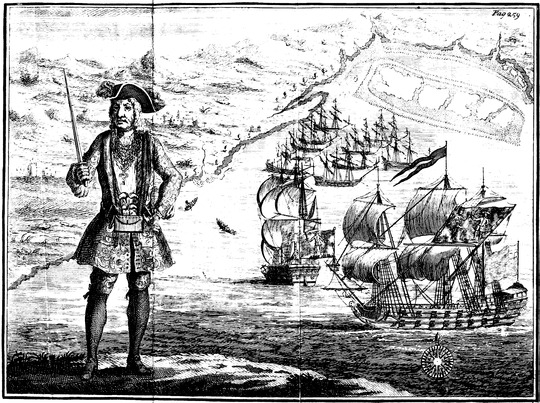
Captain Bartho. Roberts with two Ships, viz. the Royal Fortune and Ranger, takes a Sail in Whydah Road on the Coast of Guiney, January 11th. 172½.
They came to Whydah with a St. George’s Ensign, a black Silk Flag flying at their Mizen-Peek, and a Jack and Pendant of the same: The Flag had a Death in it, with an Hour-Glass in one Hand, and cross Bones in the other, a Dart by it, and underneath a Heart dropping three Drops of Blood.—The Jack had a Man pourtray’d in it, with a flaming Sword in his Hand, and standing on two Skulls, subscribed A B H and A M H i. e. a Barbadian’s and a Martinican’s Head, as has been before taken Notice of. Here they found eleven Sail in the Road, English, French and Portuguese; the French were three stout Ships of 30 Guns, and upwards of 100 Men each, yet when Roberts came to Fire, they, with the other Ships, immediately struck their Colours and surrendred to his Mercy. One Reason, it must be confess’d, of his easy Victory, was, the Commanders and a good Part of the Men being ashore, according to the Custom of the Place, to receive the Cargoes, and return the Slaves, they being obliged to watch the Seasons for it, which otherwise, in so dangerous a Sea as here, would be impracticable. These all, except the Porcupine, ransomed with him for eight Pound of Gold-Dust, a Ship, not without the trouble of some Letters passing and repassing from the Shore, before they could settle it; and notwithstanding the Agreement and Payment, they took away one of the French Ships, tho’ with a Promise to return her, if they found she did not sail well, taking with them several of her Men for that End.
Some of the Foreigners, who never had Dealing this Way before, desired for Satisfaction to their Owners, that they might have Receipts for their Money, which were accordingly given, a Copy of one of them, I have here subjoined, viz.
THIS is to certify whom it may or doth concern, that we GENTLEMEN OF FORTUNE, have received eight Pounds of Gold-Dust, for the Ransom of the Hardey, Captain Dittwitt Commander, so that we Discharge the said Ship,