NORTH AMERICAN INDIANS. (continued 5)
Reading edition
The five men were assisted by a semicircle of twenty women, who only marked time by stepping up and down with short step. They always took their places first and disappeared first, the men making their exit gracefully one by one. The dresses of the women were suitable for the occasion. They were white dresses, trimmed heavily with black velvet. The stripes were about three inches wide, some plain and others edged like saw teeth. This was an indication of their mourning for the dead chief, in whose honor they had prepared that style of dancing. Strings of haliotis and pachydesma shell beads encircled their necks, and around their waists were belts heavily loaded with the same material. Their head-dresses were more showy than those of the men. The head was encircled with a bandeau of otters’ or beavers’ fur, to which were attached short wires standing out in all directions, with glass or shell beads strung on them, and at the tips little feather flags and quail plumes. Surmounting all was a pyramidal plume of feathers, black, gray, and scarlet, the top generally being a bright scarlet bunch, waving and tossing very beautifully. All these combined gave their heads a very brilliant and spangled appearance.
The first day the dance was slow and funereal, in honor of the Yo-kaí-a chief who died a short time before. The music was mournful and simple, being a monotonous chant in which only two tones were used, accompanied with a rattling of split sticks and stamping on a hollow slab. The second day the dance was more lively on the part of the men, the music was better, employing airs which had a greater range of tune, and the women generally joined in the chorus. The dress of the women was not so beautiful, as they appeared in ordinary calico. The third day, if observed in accordance with Indian custom, the dancing was still more lively and the proceedings more gay, just as the coming home from a Christian funeral is apt to be much more jolly than the going out.
A Yo-kaí-a widow’s style of mourning is peculiar. In addition to the usual evidences of grief, she mingles the ashes of her dead husband with pitch, making a white tar or unguent, with which she smears a band about two inches wide all around the edge of the hair (which is previously cut off close to the head), so that at a little distance she appears to be wearing a white chaplet.
It is their custom to “feed the spirits of the dead” for the space of one year by going daily to places which they were accustomed to frequent while living, where they sprinkle pinole upon the ground. A Yo-kaí-a mother who has lost her babe goes every day for a year to some place where her little one played when alive, or to the spot where the body was burned, and milks her breasts into the air. This is accompanied by plaintive mourning and weeping and piteous calling upon her little one to return, and sometimes she sings a hoarse and melancholy chant, and dances with a wild static swaying of the body.
SONGS.
It has nearly always been customary to sing songs at not only funerals, but for varying periods of time afterwards, although these chants may no doubt occasionally have been simply wailing or mournful ejaculation. A writer100 mentions it as follows:
At almost all funerals there is an irregular crying kind of singing, with no accompaniments, but generally all do not sing the same melody at the same time in unison. Several may sing the same song and at the same time, but each begins and finishes when he or she may wish. Often for weeks, or even months, after the decease of a dear friend, a living one, usually a woman, will sit by her house and sing or cry by the hour, and they also sing for a short time when they visit the grave or meet an esteemed friend whom they have not seen since the decease. At the funeral both men and women sing. No. 11 I have heard more frequently some time after the funeral, and No. 12 at the time of the funeral, by the Twanas. (For song see p. 251 of the magazine quoted.) The words are simply an exclamation of grief, as our word “alas,” but they also have other words which they use, and sometimes they use merely the syllable la. Often the notes are sung in this order, and sometimes not, but in some order the notes do and la, and occasionally mi, are sung.
Some pages back will be found a reference, and the words of a peculiar death dirge sung by the Senèl of California, as related by Mr. Powers. It is as follows:
Hel-lel-li-ly, Hel-lel-lo, Hel-lel-lo.
Mr. John Campbell, of Montreal, Canada, has kindly called the attention of the writer to death songs very similar in character; for instance, the Basques of Spain ululate thus:
Lelo il Lelo, Lelo dead Lelo, Lelo il Lelo, Lelo zarat, Lelo zara, Il Lelon killed Lelo.
This was called the “ululating Lelo.” Mr. Campbell says:
This again connects with the Linus or Ailinus of the Greeks and Egyptians *** which Wilkinson connects with the Coptic “ya lay-lee-ya lail.” The Alleluia which Lescarbot heard the South Americans sing must have been the same wail. The Greek verb ὀλολύζω and the Latin ululare, with an English howl and wail, are probably derived from this ancient form of lamentation.
In our own time a writer on the manner and customs of the Creeks describes a peculiar alleluia or hallelujah he heard, from which he inferred that the American Indians must be the descendants of the lost tribes of Israel.
GAMES.
It is not proposed to describe under this heading examples of those athletic and gymnastic performances following the death of a person which have been described by Lafitau, but simply to call attention to a practice as a secondary or adjunct part of the funeral rites, which consists in gambling for the possession of the property of the defunct. Dr. Charles E. McChesney, U.S.A., who for some time was stationed among the Wahpeton and Sisseton Sioux, furnishes a detailed and interesting account of what is called the “ghost gamble.” This is played with marked wild-plum stones. So far as ascertained it is peculiar to the Sioux. Figure 33 appears as a fair illustration of the manner in which this game is played.
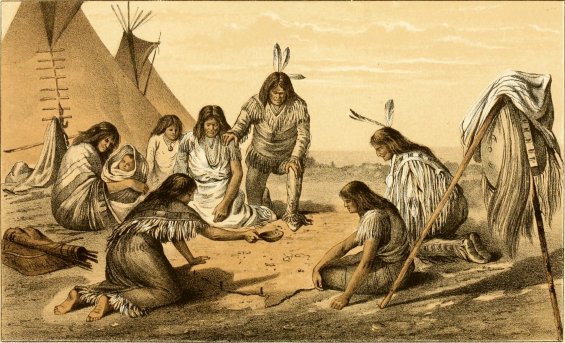
Fig. 33.—Ghost Gamble.
After the death of a wealthy Indian the near relatives take charge of the effects, and at a stated time—usually at the time of the first feast held over the bundle containing the lock of hair—they are divided into many small piles, so as to give all the Indians invited to play an opportunity to win something. One Indian is selected to represent the ghost and he plays against all the others, who are not required to stake anything on the result, but simply invited to take part in the ceremony, which is usually held in the lodge of the dead person, in which is contained the bundle inclosing the lock of hair. In cases where the ghost himself is not wealthy the stakes are furnished by his rich friends, should he have any. The players are called in one at a time, and play singly against the ghost’s representative, the gambling being done in recent years by means of cards. If the invited player succeeds in beating the ghost, he takes one of the piles of goods and passes out, when another is invited to play, &c., until all the piles of goods are won. In cases of men only the men play, and in cases of women the women only take part in the ceremony.
Before white men came among these Indians and taught them many of his improved vices, this game was played by means of figured plum-seeds, the men using eight and the women seven seeds, figured as follows, and shown in Figure 34.
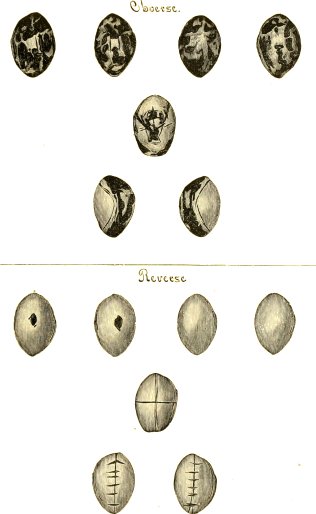
Fig. 34.—Figured Plum Stones.
Two seeds are simply blackened on one side, the reverse containing nothing. Two seeds are black on one side, with a small spot of the color of the seed left in the center, the reverse side having a black spot in the center, the body being plain. Two seeds have a buffalo’s head on one side and the reverse simply two crossed black lines. There is but one seed of this kind in the set used by the women. Two seeds have half of one side blackened and the rest left plain, so as to represent a half moon; the reverse has a black longitudinal line crossed at right angles by six small ones. There are six throws whereby the player can win, and five that entitle him to another throw. The winning throws are as follows, each winner taking a pile of the ghost’s goods:
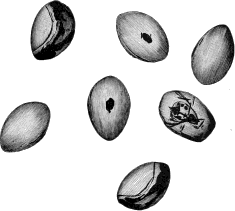
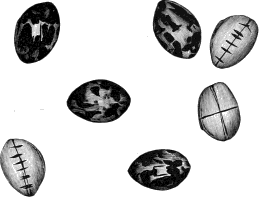
Fig. 35.—Winning Throw No. 1. Fig. 36.—Winning Throw No. 2.
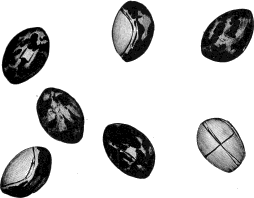
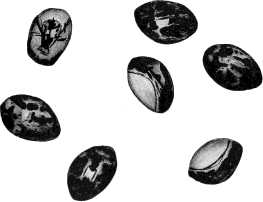
Fig. 37.—Winning Throw No. 3. Fig. 38.—Winning Throw No. 4.
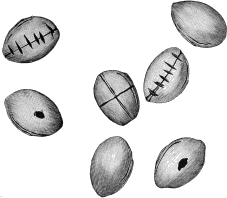
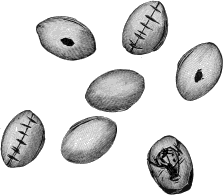
Fig. 39.—Winning Throw No. 5. Fig. 40.—Winning Throw No. 6.
Two plain ones up, two plain with black spots up, buffalo’s head up, and two half moons up wins a pile. Two plain black ones up, two black with natural spots up, two longitudinally crossed ones up, and the transversely crossed one up wins a pile. Two plain black ones up, two black with natural spots up, two half moons up, and the transversely crossed one up wins a pile. Two plain black ones, two black with natural spots up, two half moons up, and the buffalo’s head up wins a pile. Two plain ones up, two with black spots up, two longitudinally crossed ones up, and the transversely crossed one up wins a pile. Two plain ones up, two with black spots up, buffalo’s head up, and two long crossed up wins a pile. The following auxiliary throws entitle to another chance to win: two plain ones up, two with black spots up, one half moon up, one longitudinally crossed one up, and buffalo’s head up gives another throw, and on this throw, if the two plain ones up and two with black spots with either of the half moons or buffalo’s head up, the player takes a pile. Two plain ones up, two with black spots up, two half moons up, and the transversely crossed one up entitles to another throw, when, if all of the black sides come up, excepting one, the throw wins. One of the plain ones up and all the rest with black sides up gives another throw, and the same then turning up wins. One of the plain black ones up with that side up of all the others having the least black on gives another throw, when the same turning up again wins. One half moon up, with that side up of all the others having the least black on gives another throw, and if the throw is then duplicated it wins. The eighth seed, used by the men, has its place in their game whenever its facings are mentioned above. I transmit with this paper a set of these figured seeds, which can be used to illustrate the game if desired. These seeds are said to be nearly a hundred years old, and sets of them are now very rare.
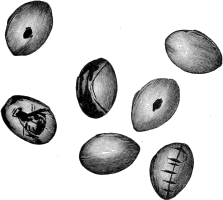
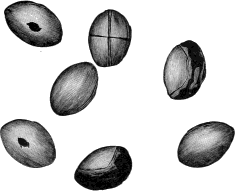
Fig. 41.—Auxiliary Throw No. 1. Fig. 42.—Auxiliary Throw No. 2.
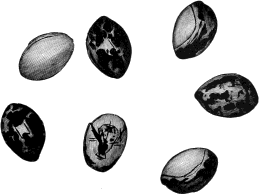
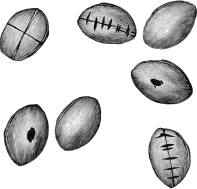
Fig. 43.—Auxiliary Throw No. 3. Fig. 44.—Auxiliary Throw No. 4.
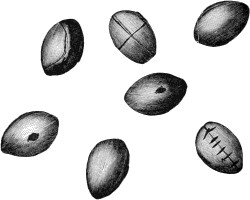
Fig. 45.—Auxiliary throw No 5.
For assisting in obtaining this account Dr. McChesney acknowledges his indebtedness to Dr. C. C. Miller, physician to the Sisseton Indian Agency.
Figures 35 to 45 represent the appearance of the plum stones and the different throws; these have been carefully drawn from the set of stones sent by Dr. McChesney.
POSTS.
These are placed at the head or foot of the grave, or at both ends, and have painted or carved on them a history of the deceased or his family, certain totemic characters, or, according to Schoolcraft, not the achievements of the dead, but of those warriors who assisted and danced at the interment. The northwest tribes and others frequently plant poles near the graves, suspending therefrom bite of rag, flags, horses’ tails, &c. The custom among the present Indians does not exist to any extent. Beltrami101 speaks of it as follows:
Here I saw a most singular union. One of these graves was surmounted by a cross, whilst upon another close to it a trunk of a tree was raised, covered with hieroglyphics recording the number of enemies slain by the tenant of the tomb and several of his tutelary Manitous.
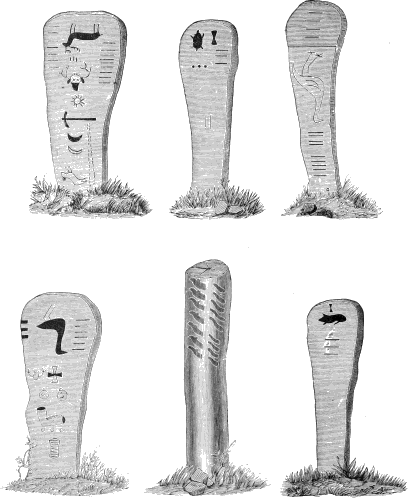
Fig. 46.—Grave Posts.
The following extract from Schoolcraft102 relates to the burial posts used by the Sioux and Chippewas. Figure 46 is after the picture given by this author in connection with the account quoted:
Among the Sioux and Western Chippewas, after the body had been wrapped in its best clothes and ornaments, it is then placed on a scaffold or in a tree until the flesh is entirely decayed, after which the bones are buried and grave-posts fixed. At the head of the grave a tubular piece of cedar or other wood, called the adjedatig, is set. This grave-board contains the symbolic or representative figure, which records, if it be a warrior, his totem, that is to say the symbol of his family, or surname, and such arithmetical or other devices as seem to denote how many times the deceased has been in war parties, and how many scalps he has taken from the enemy—two facts from which his reputation is essentially to be derived. It is seldom that more is attempted in the way of inscription. Often, however, distinguished chiefs have their war flag, or, in modern days, a small ensign of American fabric, displayed on a standard at the head of their graves, which is left to fly over the deceased till it is wasted by the elements. Scalps of their enemies, feathers of the bald or black eagle, the swallow-tailed falcon, or some carnivorous bird, are also placed, in such instances, on the adjedatig, or suspended, with offerings of various kinds, on a separate staff. But the latter are superadditions of a religious character, and belong to the class of the Ke-ke-wa-o-win-an-tig (ante, No. 4). The building of a funeral fire on recent graves is also a rite which belongs to the consideration of their religious faith.
FIRES.
It is extremely difficult to determine why the custom of building fires on or near graves was originated, some authors stating that the soul thereby underwent a certain process of purification, others that demons were driven away by them, and again that they were to afford light to the wandering soul setting out for the spirit land. One writer states that—
The Algonkins believed that the fire lighted nightly on the grave was to light the spirit on its journey. By a coincidence to be explained by the universal sacredness of the number, both Algonkins and Mexicans maintained it for four nights consecutively. The former related the tradition that one of their ancestors returned from the spirit land and informed their nation that the journey thither consumed just four days, and that collecting fuel every night added much to the toil and fatigue the soul encountered, all of which could be spared it.
So it would appear that the belief existed that the fire was also intended to assist the spirit in preparing its repast.
Stephen Powers103 gives a tradition current among the Yurok of California as to the use of fires:
After death they keep a fire burning certain nights in the vicinity of the grave. They hold and believe, at least the “Big Indians” do, that the spirits of the departed are compelled to cross an extremely attenuated greasy pole, which bridges over the chasm of the debatable land, and that they require the fire to light them on their darksome journey. A righteous soul traverses the pole quicker than a wicked one, hence they regulate the number of nights for burning a light according to the character for goodness or the opposite which the deceased possessed in this world.
Dr. Emil Bessels, of the Polaris expedition, informs the writer that a somewhat similar belief obtains among the Esquimaux.
Figure 47 is a fair illustration of a grave-fire; it also shows one of the grave-posts mentioned in a previous section.
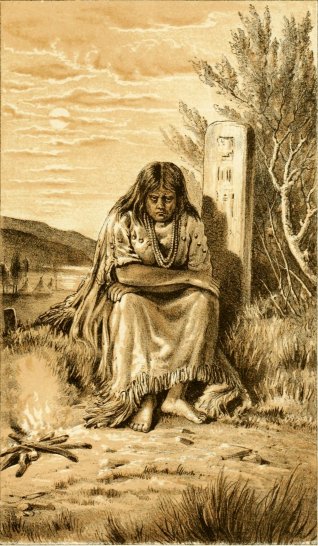
Fig. 47.—Grave Fire.
SUPERSTITIONS.
An entire volume might well be written which should embrace only an account of the superstitious regarding death and burial among the Indians, so thoroughly has the matter been examined and discussed by various authors, and yet so much still remains to be commented on, but in this work, which is mainly tentative, and is hoped will be provocative of future efforts, it is deemed sufficient to give only a few accounts. The first is by Dr. W. Mathews, United States Army,104 and relates to the Hidatsa:
When a Hidatsa dies, his shade lingers four nights around the camp or village in which he died, and then goes to the lodge of his departed kindred in the “village of the dead.” When he has arrived there he is rewarded for his valor, self-denial, and ambition on earth by receiving the same regard in the one place as in the other, for there as here the brave man is honored and the coward despised. Some say that the ghosts of those that commit suicide occupy a separate part of the village, but that their condition differs in no wise from that of the others. In the next world human shades hunt and live in the shades of buffalo and other animals that have here died. There, too there are four seasons, but they come in an inverse order to the terrestrial seasons. During the four nights that the ghost is supposed to linger near his former dwelling, those who disliked or feared the deceased, and do not wish a visit from the shade, scorch with red coals a pair of moccasins which they leave at the door of the lodge. The smell of the burning leather they claim keeps the ghost out; but the true friends of the dead man take no such precautions.
From this account it will be seen that the Hidatsa as well as the Algonkins and Mexicans believed that four days were required before the spirit could finally leave the earth. Why the smell of burning leather should be offensive to spirits it would perhaps be fruitless to speculate on.
The next account, by Keating,105 relating to the Chippewas, shows a slight analogy regarding the slippery-pole tradition already alluded to:
The Chippewas believe that there is in man an essence entirely distinct from the body; they call it Ochechag, and appear to supply to it the qualities which we refer to the soul. They believe that it quits the body it the time of death, and repairs to what they term Chekechekchekawe; this region is supposed to be situated to the south, and on the shores of the great ocean. Previous to arriving there they meet with a stream which they are obliged to cross upon a large snake that answers the purpose of a bridge; those who die from drowning never succeed in crossing the stream; they are thrown into it and remain there forever. Some souls come to the edge of the stream, but are prevented from passing by the snake, which threatens to devour them; these are the souls of the persons in a lethargy or trance. Being refused a passage these souls return to their bodies and reanimate them. They believe that animals have souls, and even that inorganic substances, such as kettles, &c., have in them a similar essence.
In this land of souls all are treated according to their merits. Those who have been good men are free from pain; they have no duties to perform, their time is spent in dancing and singing, and they feed upon mushrooms, which are very abundant. The souls of bad men are haunted by the phantom of the persons or things that they have injured; thus, if a man has destroyed much property the phantoms of the wrecks of this property obstruct his passage wherever he goes; if he has been cruel to his dogs or horses they also torment him after death. The ghosts of those whom during his lifetime he wronged are there permitted to avenge their injuries. They think that when a soul has crossed the stream it cannot return to its body, yet they believe in apparitions, and entertain the opinion that the spirits of the departed will frequently revisit the abodes of their friends in order to invite them to the other world, and to forewarn them of their approaching dissolution.
Stephen Powers, in his valuable work so often quoted, gives a number of examples of superstitions regarding the dead, of which the following relates to the Karok of California:
How well and truly the Karok reverence the memory of the dead is shown by the fact that the highest crime one can commit is the pet-chi-é-ri the mere mention of the dead relative’s name. It is a deadly insult to the survivors, and can be atoned for only by the same amount of blood-money paid for willful murder. In default of that they will have the villain’s blood. *** At the mention of his name the mouldering skeleton turns in his grave and groans. They do not like stragglers even to inspect the burial place. *** They believe that the soul of a good Karok goes to the “happy western land” beyond the great ocean. That they have a well-grounded assurance of an immortality beyond the grave is proven, if not otherwise, by their beautiful and poetical custom of whispering a message in the ear of the dead. *** Believe that dancing will liberate some relative’s soul from bonds of death, and restore him to earth.
According to the same author, when a Kelta dies a little bird flies away with his soul to the spirit land. If he was a bad Indian a hawk will catch the little bird and eat him up, soul and feathers, but if he was good he will reach the spirit land. Mr. Powers also states that—
The Tolowa share in the superstitious observance for the memory of the dead which is common to the Northern Californian tribes. When I asked the chief Tahhokolli to tell me the Indian words for “father” and “mother” and certain others similar, he shook his head mournfully and said, “All dead,” “All dead,” “No good.” They are forbidden to mention the name of the dead, as it is a deadly insult to the relatives, *** and that the Mat-tóal hold that the good depart to a happy region somewhere southward in the great ocean, but the soul of a bad Indian transmigrates into a grizzly bear, which they consider, of all animals, the cousin-german of sin.
The same author who has been so freely quoted states as follows regarding some of the superstitions and beliefs of the Modocs:
*** It has always been one of the most passionate desires among the Modok, as well as their neighbors, the Shastika, to live, die, and be buried where they were born. Some of their usages in regard to the dead and their burial may be gathered from an incident that occurred while the captives of 1873 were on their way from the Lava Beds to Fort Klamath, as it was described by an eye-witness. Curly-headed Jack, a prominent warrior, committed suicide with a pistol. His mother and female friends gathered about him and set up a dismal wailing; they besmeared themselves with his blood and endeavored by other Indian customs to restore his life. The mother took his head in her lap and scooped the blood from his ear, another old woman placed her hand upon his heart, and a third blew in his face. The sight of the group—these poor old women, whose grief was unfeigned, and the dying man—was terrible in its sadness. Outside the tent stood Bogus-Charley, Huka Jim, Shucknasty Jim, Steamboat Frank, Curly-headed Doctor, and others who had been the dying man’s companions from childhood, all affected to tears. When he was lowered into the grave, before the soldiers began to cover the body, Huka Jim was seen running eagerly about the camp trying to exchange a two-dollar bill of currency for silver. He owed the dead warrior that amount of money, and he had grave doubts whether the currency would be of any use to him in the other world—sad commentary on our national currency!—and desired to have the coin instead. Procuring it from one of the soldiers he cast it in and seemed greatly relieved. All the dead man’s other effects, consisting of clothing, trinkets, and a half dollar, were interred with him, together with some root-flour as victual for the journey to the spirit land.
The superstitious fear Indians have of the dead or spirit of the dead may be observed from the following narrative by Swan.106 It regards the natives of Washington Territory:
My opinion about the cause of these deserted villages is this: It is the universal custom with these Indians never to live in a lodge where a person has died. If a person of importance dies, the lodge is usually burned down, or taken down and removed to some other part of the bay; and it can be readily seen that in the case of the Palux Indians, who had been attacked by the Chehalis people, as before stated, their relatives chose at once to leave for some other place. This objection to living in a lodge where a person has died is the reason why their sick slaves are invariably carried out into the woods, where they remain either to recover or die. There is, however, no disputing the fact that an immense mortality has occurred among these people, and they are now reduced to a mere handful.
The great superstitious dread these Indians have for a dead person, and their horror of touching a corpse, oftentimes give rise to a difficulty as to who shall perform the funeral ceremonies; for any person who handles a dead body must not eat of salmon or sturgeon for thirty days. Sometimes, in cases of small-pox, I have known them leave the corpse in the lodge, and all remove elsewhere; and in two instances that came to my knowledge, the whites had to burn the lodges, with the bodies in them, to prevent infection.
So, in the instances I have before mentioned, where we had buried Indians, not one of their friends or relatives could be seen. All kept in their lodges, singing and drumming to keep away the spirits of the dead.
According to Bancroft107—
The Tlascaltecs supposed that the common people were after death transformed into beetles and disgusting objects, while the nobler became stars and beautiful birds.
The Mosquito Indians of Central America studiously and superstitiously avoid mentioning the name of the dead, in this regard resembling those of our own country.
Enough of illustrative examples have now been given, it is thought, to enable observers to thoroughly comprehend the scope of the proposed final volume on the mortuary customs of North American Indians, and while much more might have been added from the stored-up material on hand, it has not been deemed advisable at this time to yield to a desire for amplification. The reader will notice, as in the previous paper, that discussion has been avoided as foreign to the present purpose of the volume, which is intended, as has been already stated, simply to induce further investigation and contribution from careful and conscientious observers. From a perusal of the excerpts from books and correspondence given will be seen what facts are useful and needed; in short, most of them may serve as copies for preparation of similar material.
To assist observers, the queries published in the former volume are also given.
1st. Name of the tribe; present appellation; former, if differing any; and that used by the Indians themselves.
2d. Locality, present and former.—The response should give the range of the tribe and be full and geographically accurate.
3d. Deaths and funeral ceremonies; what are the important and characteristic facts connected with these subjects? How is the corpse prepared after death and disposed of? How long is it retained? Is it spoken to after death as if alive? when and where? What is the character of the addresses? What articles are deposited with it; and why? Is food put in the grave, or in or near it afterwards? Is this said to be an ancient custom? Are persons of the same gens buried together; and is the clan distinction obsolete, or did it ever prevail?
4th. Manner of burial, ancient and modern; structure and position of the graves; cremation.—Are burials usually made in high and dry grounds? Have mounds or tumuli been erected in modern times over the dead? How is the grave prepared and finished? What position are bodies placed in? Give reasons therefor if possible. If cremation is or was practiced, describe the process, disposal of the ashes, and origin of custom or traditions relating thereto. Are the dead ever eaten by the survivors? Are bodies deposited in springs or in any body of water? Are scaffolds or trees used as burial places; if so, describe construction of the former and how the corpse is prepared, and whether placed in skins or boxes. Are bodies placed in canoes? State whether they are suspended from trees, put on scaffolds or posts, allowed to float on the water or sunk beneath it, or buried in the ground. Can any reasons be given for the prevalence of any one or all of the methods? Are burial posts or slabs used, plain, or marked, with flags or other insignia of position of deceased. Describe embalmment, mummification, desiccation, or if antiseptic precautions are taken, and subsequent disposal of remains. Are bones collected and reinterred; describe ceremonies, if any, whether modern or ancient. If charnel houses exist or have been used, describe them.
5th. Mourning observances.—Is scarification practiced, or personal mutilation? What is the garb or sign of mourning? How are the dead lamented? Are periodical visits made to the grave? Do widows carry symbols of their deceased children or husbands, and for how long? Are sacrifices, human or otherwise, voluntary or involuntary, offered? Are fires kindled on graves; why, and at what time, and for how long?
6th. Burial traditions and superstitions.—Give in full all that can be learned on these subjects, as they are full of interest and very important.
In short, every fact bearing on the disposal of the dead; and correlative customs are needed, and details should be as succinct and full as possible.
One of the most important matters upon which information is needed is the “why” and “wherefore” for every rite and custom; for, as a rule, observers are content to simply state a certain occurrence as a fact, but take very little trouble to inquire the reason for it.
Any material the result of careful observation will be most gratefully received and acknowledged in the final volume; but the writer must here confess the lasting obligation he is under to those who have already contributed, a number so large that limited space precludes a mention of their individual names.
Criticism and comments are earnestly invited from all those interested in the special subject of this paper and anthropology in general. Contributions are also requested from persons acquainted with curious forms of burial prevailing among other tribes of savage men.
The lithographs which illustrate this paper have been made by Thos. Sinclair & Son, of Philadelphia, Pa., after original drawings made by Mr. W. H. Holmes, who has with great kindness superintended their preparation.
INDEX
Abiquiu, Ancient cemetery of 111
Acaxers and Yaquis, cairn burial 143
“Adjedatig” 197
Aerial burial in canoes, Chinooks 171
sepulture, 152
Alaric’s burial 181
Alaska cave burial 129
Alaskan mummies 134, 135
Alden, E. H., Scaffold burial 161
Aleutian Islanders, embalmment 135, 136
Algonkins, Burial fires of the 198
Alibamans, Aquatic burial of suicides by 180
Allen, Miss A. J., Burial sacrifice 189
Ancient burial customs of barbaric tribes 152
cemetery of Abiquiu 111
nations, Tree burial of 165, 166
Ancients, Curious mourning observances 165, 166
Antiquity of cremation 143
Apingi burial 125, 126
Aquatic burial, Alibamans, of suicides 180
Cherokees 180
Chinooks 180
Gosh-Utes 181
Hyperboreans 180
Ichthyophagi 180
Itzas 180
Kavague 180
Lotophagians 180
Obongo 180
Ascena or Timber Indians 103
Atwater, Caleb, Burial mounds 117
Australian scaffold burial 167
Aztecs and Taracos, Burial sacrifice 190
Baldwin, C. C., Pottawatomie surface burial 141
Balearic Islanders, Cairn burial 143
Bancroft, H. H., Burial sacrifice 190
, Canoe burial in ground 112
, Costa Rica hut burial 154
, Doracho cist burial 115
, Esquimaux burial boxes 155
, Mourning, Central Americans 185
, Pima burial 98
, Superstitions regarding dead 201
Barbaric tribes, Ancient burial customs of 152
Barber, E. A., Burial urns 138
, Partial cremation 151
Bari of Africa, burial 125
Bartram, John, Cabin burial 122
, Choctaw ossuary 120
, Partial scaffold burial 169
Bechuana burial 126
Beckwourth, James, Crow mourning 183
Beechey, Capt. F. W., Lodge burial 154
Beltrami, J. C., Burial feast 190
, Burial posts 197
Benson, H. C., Choctaw burial 186
Bessels, Dr. Emil, Esquimaux superstition 198
Beverly, Robert, Virginia mummies 131
Birgan, Meaning of word 93
Blackbird’s burial 139
Blackfeet burial lodges 154
cairn burial 143
tree burial 161
Bonaks, Cremation 144
Bone cleaning of the dead 168
Boner, J. H., Moravian mourning 166
Bossu, M., Burial denied to suicides 180
Boteler, Dr. W. C., Oto burial ceremonies 96
Box burial, Creek, Choctaw, and Cherokee 155
, Esquimaux 155, 156
, Indians of Talomeco River 155
, Innuits and Ingaliks 156, 158
, Kalosh 156
Bransford, Dr. J. C., U.S.N., Burial urns discovered by 138
Brebeuf, Pere de, Burial feast 191
Brice, W. A., Surface burial 141
Brinton, Dr. D. G., Burial of collected bones 170
Bruhier, J. J., Corsican customs 147
Persian burial 103
Brule Sioux, tree and scaffold burial 158, 160
Burchard, J. L., Pit burial 124
Butterfield, H., Shoshone cairn burial 143
Burial, Apingi 125, 126
, Aquatic 180
canoes and houses 177-179
, Bari of Africa 125
, Bechuanas 126
beneath or in cabins, wigwams, or houses 122
, Box 155
, Carolina tribes 93
, Caddos 103
, Cairn 142
, Cairn, Ute 142
case, Cheyenne 162, 163
, Cave 126
, Chieftain, of the 110, 111
, Classification of 92-93
, Damara 126
dance, Yo-kaí-a 192, 194
dances 193
feast, Description of, by Beltrami 190, 191
, Hurons, of the 191
feasts 190
, superstitions regarding 191
fires, Algonkins 198
, Yurok 198
, Esquimaux 198
food 192
games 195
, Grave 101
, Ground, in canoes 112
in logs 138, 139
in mounds 115
in standing posture 151, 152
, Indians of Virginia 125
, Iroquois 140
, Kaffir 126
, Klamath and Trinity Indians 106, 107
, Latookas 126
, Lodge 152
lodges, Blackfeet 154
, Cheyenne 154
, Shoshone 153, 154
, Muscogulges 122, 123
, Meaning and derivation of word 93
, Moquis, 114
, Navajo, 123
, Obongo, 139, 140
of Alaric, 181
of Blackbird, 139
of De Soto, 181
of Long Horse, 153
of Ouray, 128
, Parsee, 105, 106
, Pit, 93
, Pitt River Indians, 151
posts, Sioux and Chippewa, 197, 198
, Round Valley Indians, 124
sacrifice, Aztecs and Tarascos, 190
, Indians of Northwest, 180
, Indians of Panama, 180
, Natchez, 187, 189
, Tsinūk, 179
, Wascopums, 189, 190
, Sacs and Foxes, 94, 95
scaffolds, 162
song, Schiller’s, 110, 111
of Basques and others, 195
superstitions, Chippewas, 199, 200
, Indians of Washington Territory, 201
, Karok, 200
, Kelta, 200
, Modocs, 200, 201
, Mosquito Indians, 201
, Tlascaltecs, 201
, Tolowa, 200
, Surface, 138, 139
, Urn, 137
and cover, Georgia, 138
, New Mexico, 138
Cabins, wigwams, or houses, Burial beneath or in, 122
Caddos, Burial, 103
Cairn burial, Acaxers and Yaquis, 143
, Balearic Islanders, 143
, Blackfeet, 143
, Esquimaux, 143
, Kiowas and Comanches, 142, 143
, Pi-Utes, 143
, Reasons for, 143
, Shoshonis, 143
Calaveras Cave, 128, 129
California steatite burial urn, 138
Campbell, John, Burial songs, 195
Canes sepulchrales, 104
Canoe burial in ground, 112
, Mosquito Indians, 112, 113
, Santa Barbara, 112
, Clallam, 173, 174
, Twana, 171, 173
Canoes and houses, Burial, 177-179
Canoes, Superterrene and aerial burial in, 171
Caraibs, Verification of death, 146
Carolina tribes, Burial among, 93
Catlin, George, Burial of Blackbird, 139
, Golgotha of Mandans, 170
, Mourning cradle, 181
Cave burial, 126
, Alaska, 129
, Calaveras, 128, 129
, Utes, 127, 128
Cherokee aquatic burial, 180
Cheyenne burial case, 162, 163
lodges, 154
Chillicothe mound, 117, 118
Chinook aerial burial in canoes, 171
aquatic burial, 180
mourning cradle, 181, 182
Chippewa burial superstitions, 199, 200
mourning, 184
scaffold burial, 161, 162
widow, 184, 185
Choctaw mound burial, 120
scaffold burial, 169
Choctaws funeral ceremonies, 186
Cist burial, Doracho, 115
graves, Kentucky, 114, 115
, Indians of Illinois, 114
Cists or stone graves, 113
, Solutré, 113
, Tennessee, 113
Clallam canoe burial, 173, 174
house burial, 175
Classification of burial, 92
Cleveland, Wm. J., Tree and scaffold burial, 158
Collected bones, Interment of, 170
Comanche inhumation, 99, 100
Congaree and Santee Indians, embalmment 132, 133
Corsican funeral custom 147
Cox, Ross, Cremation 144
Coyotero Apaches, Inhumation 111, 112
Cradle, mourning, Illustration of 181
Crock, Choctaw, and Cherokee box burial 155
Creeks and Seminoles, Inhumation 95, 96
, “Hallelujah” of the 195
Cremation, Antiquity of 143
, Bonaks 144
furnace 149
, Indians of Clear Lake 147
, Indians of Southern Utah 149
mound, Florida 148, 149
, Nishinams 144
, Partial 150, 151
, Se-nél 147, 148
, Tolkotins 144-146
Crow lodge burial 153
mourning 183, 184
Curious mourning observances of ancients 165, 166
Curtiss, E., Exploration by 115, 116
Dakhnias 104
Dall, W. H., Burial boxes 156
, Cave burial 129
, Mummies 134
Damara burial 126
Dance for the dead 192
Dances, Burial 192
Danish burial logs 139
Dead, Dance for the 192
Delano, A., Tree burial 161
Description of burial feast 190, 191
De Soto’s burial 181
Devouring the dead, Fans of Africa 182
, Indians of South America 182, 183
, Massageties, Padæns, and others 182
Dolmens in Japan 115
Doracho cist burial 115
Drew, Benjamin, Schiller’s burial song 110
Dumont, M. Butel de, House burial 124
Eells, Rev. M., Canoe burial 171
Embalmment, Aleutian Islanders. 135, 136
, Congaree and Santee Indians 132, 133
, or mummification 130
Engelhardt, Prof. C. 139
Esquimaux box burial 155, 156
burial fires 198
cairn burial 143
lodge burial 154
European ossuaries 191
Excavation of Indian mound, North Carolina 120-122
Fans of Africa devour the dead 182
Feasts, Burial 190
Fires, Burial 198
Fiske, Moses, Cists 113
Florida cremation mound 148, 149
mound burial 119, 120
Food, Burial 192
Ford, Lieut. Geo. E., U.S.A., Cabin burial 123
Foreman, Dr. E., Burial urns 138
Cremation 149
Foster, J. W., Urn burial 137
Cremation 150
Funeral ceremonies, Choctaws 186
, Twanas and Clallams 176
custom, Corsican 147
Furnace, Cremation 149
Gageby, Capt. J. H., U.S.A., Box burial 155
Games, Burial 195
Gardner, Dr. W., U.S.A., Theory of scaffold burial 167
Ghost gamble 195-197
Gianque, Florian, Mound burial 120
Gibbs, George 106
, Burial canoes and houses 177
Gilbert, G. K., Klamath burial 147
Moquis burial 114
Gillman, Henry, Exploration of mound 148
Given, Dr. O. G., Cairn burial 142
“Golgothas,” Mandans 170
Gosh-Utes, Aquatic burial amongst 181
Grave burial 101
Gregg, Dr. P., Surface burial 140
Grinnell, Dr. Fordyce, Comanche inhumation 99
Wichita burial customs 102
Grossman, Capt. F. E., Pima burial 98
Gros Ventres and Mandans, Scaffold burial 161
“Hallelujah” of the Creeks 195
Hammond, Dr. J. F., Burial lodges 154
Hardisty, W. L., Log burial in trees 166
Hidatsa superstitions 199
Hind, Henry Youle, Burial feast 191
Hoffman, Dr. W. J. 99
Drawing of Pima burial 111, 153
Holbrook, W. C., Burial mounds 118
Holmes, W. H., Drawings by 106, 203
Hough, Franklin B., Canoe burial in the ground 112
House burial, Clallams 175
, Paskagoulas and Billoxis 124, 125
Hurons, Burial feast of 191
Hyperboreans, aquatic burial 180
Ichthyophagi, aquatic burial 180
Illinois mounds 118
Indian mound in North Carolina, Excavation of 120-122
Indians of Bellingham Bay, lodge burial 154
of Clear Lake, cremation 147
of Costa Rica, lodge burial 154
of Illinois, cist burial 114
of Northwest, burial sacrifice 180
of Panama, burial sacrifice 180
of South America devour the dead 182, 183
of Southern Utah, cremation 149
of Talomeco River, box burial 155
of Taos, inhumation 101, 102
of Virginia, burial 125
of Washington Territory, burial superstition 201
Inhumation 93
, Comanches 99, 100
, Coyotero Apaches 111, 112
, Creeks and Seminoles 95, 96
, Indians of Taos 101, 102
, Mohawks 93
, Otoe and Missouri Indians. 96, 97, 98
, Pimas 98, 99
, Wah-peton and Sisseton Sioux 107-110
, Wichitas 102, 103
, Yuki 99
Innuit and Ingalik box burial 156-158
Interment of collected bones 170
Iroquois scaffold burial 169, 170
surface burial 140
Itzas, Aquatic burial 180
Japan dolmens 115
Jenkes, Col. C. W., Partial cremation 150
Johnston, Adam, Cremation myth 144
Jones, Dr. Charles C., Stone graves of Tennessee 114
Natchez burial 169
Joseph, Judge Anthony, Inhumation of Taos Indians 101
Kaffir burial 126
Kalosh box burial 156
Kavague aquatic burial 180
Kaw-a-wāh 142
Keating, William H., Burial scaffolds 162
, Burial superstitions 199
“Keeping the Ghost” 160
Kent, M. B., Sac and Fox burial 94
Kentucky cist graves 114, 115
mummies 133
Kiowa and Comanche cairn burial 142, 143
Kitty-ka-tats 102
Klamath and Trinity Indians, burial 106, 107
Klingbeil, William, Partial cremation 151
Lafitau, J. F. 182
“Last cry” 186
Latookas burial 126
Lawson, John, Partial embalmment 132
, Pit burial 93
List of illustrations, Burial customs 87
Living sepulchers 182
Lodge burial 152
, Crow 153
, Esquimaux 154
, Indians of Bellingham Bay 154
, Indians of Costa Rica 154
, Sioux 152, 153
Log burial 138, 139
, Danish 139
in trees, Loucheux 166
Long Horse, burial of 153
Lotophagians, Aquatic burial 180
Loucheux, log burial in trees 166
McChesney, Dr. Charles E. 107-111
, “Ghost gamble” 195
McDonald, Dr. A. J., Rock fissure burial 127
McKenney, Thomas L., Scaffold burial 161
, Chippewa widow 184
Macrobrian Ethiopians, Preservation of the dead 136, 137
Mahan, I. L., Chippewa mourning 184
Mandan “Golgothas” 170
Matthews, Dr. Washington, U.S.A., Hidatsa superstition 199
, Tree burial 161
Menard, Dr. John, Navajo burial 123
Miami Valley mound burial 120
Midawan, a ceremony of initiation 122
Miller, Dr. C. C., Assistance from 197
Mitchell, Dr. Samuel L., Kentucky mummies 133, 134
Mohawks, Inhumation 93
Moquis burial 114
Moravian mourning 166
Morgan, Lewis H., Burial dance 192
, Partial scaffold burial 169
Morse, E. S., Dolmens in Japan 115
Mortuary customs of Parthians, Medes, etc. 104
Persians 103, 104
Mosquito Indians, Burial superstition of 201
, canoe burial in ground 112, 113
Mound burial 115
, Choctaws 120
, Florida 119, 120
, Miami Valley 120
, Ohio 117, 118
Mounds, Illinois 118, 119
of stone 118
Mourning ceremonies, Sioux 109, 110
, Chippewa 184
cradle, Chinook 181, 182
, engraving of 181
Crows 183, 184
customs of widows 185, 186
, Indians of Northwest 179
Moravian 166
observances, Twana and Clallams 176
sacrifice, feasts, food, etc 183
Mummies, Alaskan 134, 135
, Kentucky 133
, Northwest coast 135
, Virginia 131, 132
Mummification or embalmment 130
Mummification, Theories regarding 130
Muret, Pierre, Living sepulchres 182
, Persian mortuary customs 103
Muscogulge burial 122, 123
Natchez burial sacrifice 187-189
scaffold burial 169
Navajo burial 123
Norm 142
New Mexico burial urn 138
Nishinams, Cremation among the 144
Norris, P. W., lodge burial 153
North Carolina Indians, Partial cremation 150, 151
Northwest coast mummies 135
, Indians of, mourning 179
Obongo aquatic burial 180
surface burial 139, 140
Observers, Queries for, regarding burial 202, 203
Ohio mound burial 117
Oh-sah-ke-uck 94
Ojibwa and Cree surface burial 141
Ossuaries, European 191
Otis, Dr. George A., U.S.A., Burial case 162
Oto and Missouri Indians, Inhumation 96-98
Ouray, Burial of 128
Owsley, Dr. W. J., Cist graves 114
Partial cremation 150
, North Carolina Indians 150, 151
scaffold burial and ossuaries 168
Parsee burial 105, 106
Paskagoulas and Billoxis, House burial 124, 125
Persians, Mortuary customs of the 103, 104
Pimas, Inhumation among 98, 99
Pinart, M. Alphonse, Pima burial 98
Pinkerton, John, Virginia mummies 131
Piros 101
Pit burial 93
Pitt River Indians, Burial and cremation 151
Pi-Ute cairn burial 143
Posts, Burial 197
Potherie, De la M., Surface burial 140
Powell, J. W., Stone graves or cists 113
Powers, Stephen, Burial dance 192
, Burial song 194
, Origin of cremation 144
, Se-nél cremation 147
, Yuki burial 99
Preparation of dead, Similarity of, between Comanches and African tribes 100
Preservation of dead, Macrobrian Ethiopians 136, 137
, Werowance of Virginia 131, 132
Priest, Josiah, Box burial 155
Putnam, F. W., Stone graves or cists 115, 116
Queries for observers regarding burial 202, 203
Quiogozon or ossuary 94
Reason for cairn burial 143
Remarks, Final 203
Review of Turner’s narrative 165
Robertson, R. S., Surface burial 139
Roman, Bernard, Choctaw hone houses 168
, Funeral customs of Chickasaws 123
Round Valley Indians, burial among 124
Sacrifice 187
Sacs and Foxes, burial among 94, 95
, surface burial 140, 141
Sauer, Martin, Aleutian mummies 135
Sauks, Foxes, and Pottawatomies, surface burial among 151
Scaffold burial, Australia 167
, Chippewas 161, 162
, Choctaw 169
, Gros-Ventres and Mandans 161
, Iroquois 169, 170
, Natchez 169
, Sioux 163, 164
, Tent burial on 174
Scaffolds, Theory regarding 167, 168
Schiller’s burial song 110
Schoolcraft, Henry R., Burial posts 197
, Cremation myth 144
, Mohawk burial 93, 95
, Partial embalmment 132
Seechaugas 158
Sellers, George Escoll, Cist burial 114
Se-nél, Cremation among the 147, 148
Sepulture, Aerial 152
Sheldon, William, Caraib burial customs 146
Shoshone burial lodges 153, 154
cairn burial 143
Sicaugu 158
Simpson, Capt. J. H., U.S.A., Aquatic burial 181
Sioux and Chippewa burial posts 197, 198
lodge burial 152, 153
mourning ceremonies 109, 110
Sioux, scaffold burial of the 163, 164
, tree burial of the 161
Solutré cists 113
Songs, Burial 194
, of Basques and others 195
Southern Indians, Urn burial among 137
Spainhour, Dr. J. Mason, Curious burial 120
Spencer, J. W., Partial surface burial 140
Standing posture, Burial in 151, 152
Stansbury, Capt. H., U.S.A., Lodge burial 152
Steatite burial urn, California 138
Sternberg, Dr. George M., U.S.A., Grave mounds 119
, Burial case discovered 162
Stone graves or cists 113
mounds 118
Superstition, Hidatsa 199
regarding burial feasts 191
Superstitions, Burial 199
Superterrene and aerial burial in canoes 171
Surface burial 138, 139
, Ojibways and Crees 141
, Sacs and Foxes 140, 141
, Sauks, Foxes, and Pottawatomies 141
Swan, James G., Canoe burial 171
, Klamath burial 106
, Superstitions 201
Tāh-zee 142
Tegg, William, Antiquity of cremation 143
, Towers of silence 104
Tennessee cists 113
Tent burial on scaffold 174
Theories regarding mummification or embalmment 130
regarding use of scaffolds 176, 168
Tiffany, A. S., Cremation furnace 149
Timberlake, H., Aquatic burial 180
Tolkotin cremation 144, 146
Tompkins, Gen. Chas. H., U.S.A., Partial cremation 151
Towers of silence, Description of 104-106
Tree and scaffold burial 158
, Brulé Sioux 158, 160
burial, ancient nations 165, 166
, Blackfeet 101
, Sioux 101
Tsinūk burial sacrifice 179
Turner, Dr. L. S., Scaffold burial 163
Turner’s narrative, Review of 165
Twana and Clallam mourning observances 176
canoe burial 171-173
Twanas and Clallams, funeral ceremonies 176
Urn burial by Southern Indians 137
Ute cairn burial 142
cave burial 127, 128
Van Camper, Moses. Mode of burial of Indians inhabiting Pennsylvania 112
Van Vliet, Gen. Stewart, U.S.A., Tree and scaffold burial 153
Verification of death, Caraibs 146
Virginia mummies 131, 132
Wah-peton and Sisseton Sioux, Inhumation among 107-110
Wascopums, Burial sacrifice of 189, 190
Wee-ka-nahs 101
Welch, H., Surface burial 141
Werowance of Virginia, preservation of the dead 131, 132
Whitney, J. D., burial cave, Description of a 128
Whymper, Frederic, Burial boxes 156
Wichitas, Inhumation among the 102, 103
Widow, Chippewa 184, 185
Widows, Mourning customs of 185, 186
Wilcox, E., Partial cremation 150
Wilkins, Charles, Kentucky mummies 133
Williams, Monier, Parsee burial 104
Wood, Rev. J. G., African surface burial 139
, Bari burial 125
, Fans of Africa devour the dead 182
, Obongo aquatic burial 180
Wright, Dr. S. G., Superstitions regarding burial feasts 191
Yo-kaí-a burial dance 192-194
Young, John, Tree burial 161
Yuki inhumation 99
Yurok burial fires 198
Note on Illustrations
BAE Annual Report 1 did not distinguish between Plates (full page, unpaginated) and Figures (inline). In the present article, most illustrations were full-page plates.
For this e-text, Plates were rescaled to 25% by pixel count, while most Figures were rescaled to 33%. The original is strongly sepia-toned, so the distinction between color and grayscale illustrations reflects the transcriber’s judgement rather than a clear difference in the original.