THE PREACHER’S STORY.
Reading edition
In one of my annual rounds among the poor of a bleak district in the west of Scotland, after a day of weary travel, I came at nightfall to the little cottage of John Wilson.
I had frequently halted there before, when out on similar errands, and, as often as I had done so, I was reminded of Burns’ faithful pictures of the cotter’s home.
It was Saturday night. I met John just 67coming in from work, and we entered his home together.
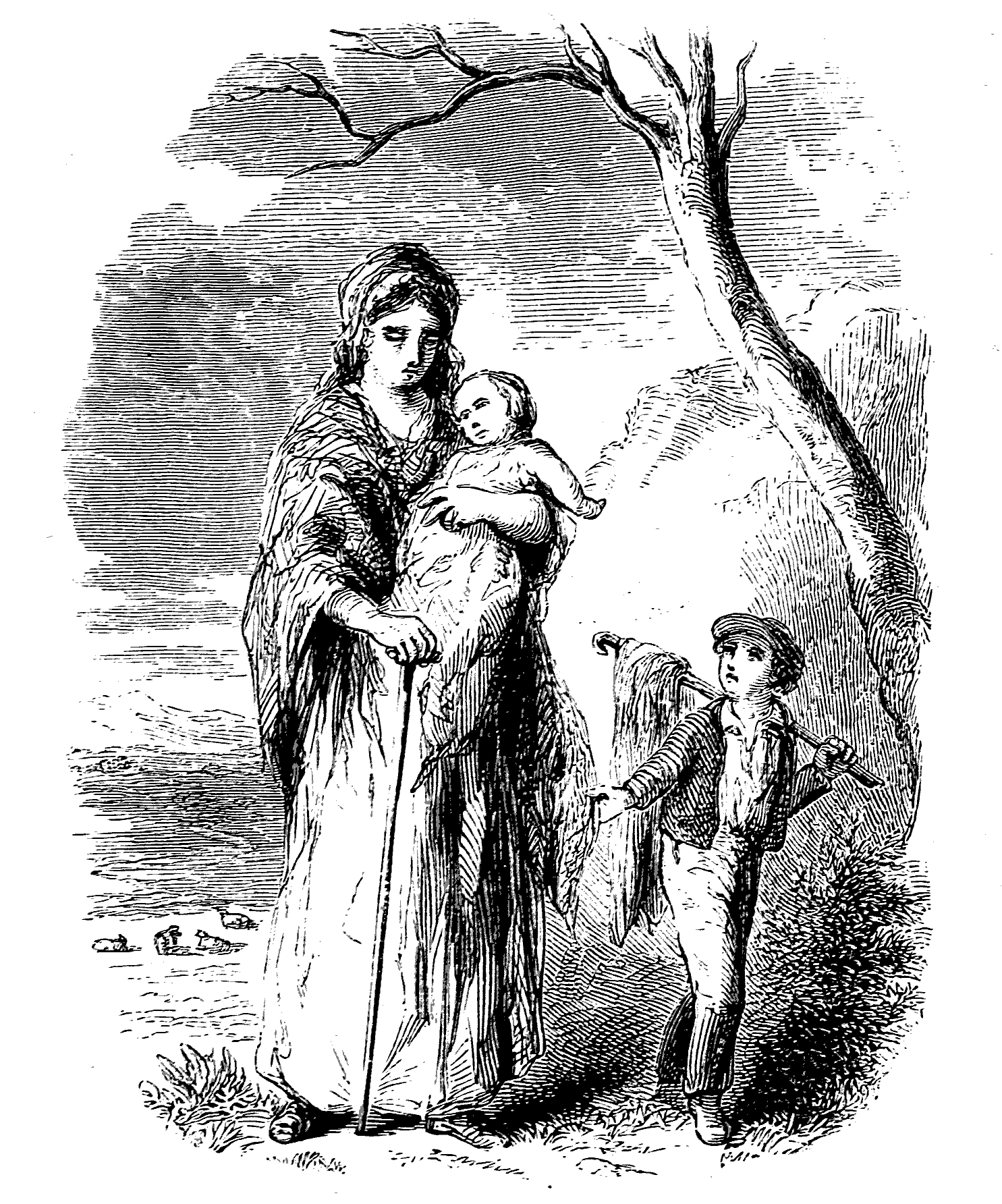
Fifth Day. Whenever she went out, she carried the baby in her arms, and Jamie went before as a guide.—p. 67.
“His wee bit ingle[A] blinkin’ bonnily,
His clean hearth-stane, his thrifty wifie’s smile,
The lisping infant prattling on his knee,
Does a’ his weary, carking cares beguile,
And makes him quite forget his labour an’ his toil.”
In a snug corner of the fireplace sat a stranger—a woman with a baby in her lap; and on the floor beside her, lay a little boy asleep. I soon found that it was blind Amy Duncan, the widow of an honest fisherman who had been lost in a storm a few weeks before.
I had often heard of little Jamie Duncan, 68her son. He was a good, bright boy, and as he could not be spared to go regularly to school, he had been instructed at the manse, by the minister. His mother had learned, blind as she was, to knit, and to prepare thread and yarn for the weavers; and now that her husband was dead, this occupation was all that she had to depend on for support. Little Jamie had been his mother’s guide all along the shore among the cottages of the fishermen. He would lead her by the hand, a few times, to any new place where she wanted to go, and after that he would run on before her, and she would follow, by listening to the sound of his footsteps. He brought her the wool and flax which she 69used, and when it was ready for the weavers he would carry it to them.
He had but little time for his book, for while his mother was at work, he had to mind the baby for her; and whenever she went out, she carried the baby in her arms, and Jamie went before as a guide.
Jamie used to think a great deal about what the minister taught him, and he learned his spelling and Scripture lessons by saying them over aloud, as he led his mother about. When the poor, blind widow was left without a home, John Wilson made a place for her and her little ones at his hearth, though he was a poor man himself and had to work hard for his bread.
I left the cottage early the next day, to 70fulfil an engagement in a distant part of the country, and, for a long time after, I heard nothing of John Wilson’s family, nor of the blind widow.
The next season, in the course of my rounds, I purposed visiting them again; and just after I had entered upon the wide moor which lay between my road and the cotter’s, I met little Jamie Duncan, with a stick over his shoulder, hung with the weaver’s thread, and his mother and the baby following on close behind. I drew near, unperceived by them, for Jamie’s face was turned toward his mother, and she, being blind, could not see me. She appeared to be weeping, and little Jamie was saying to her—
“Don’t cry mother, for you know that we 71have a Father in heaven, and if we mind what He says to us, He will take care of us. You know when our father died, you said you couldn’t tell what was to become of you and me and the baby. So I went out under the fir-tree and said a little prayer to our heavenly Father. I told Him you were blind, and asked Him to help you and to take care of us all.”
“Who put that into your head, child?” said Jamie’s mother.
Jamie. Nobody. I learned it out of the Bible. The Bible says, “Ask, and ye shall receive;” and our minister told me that every word in the Bible was true, and that we must try to obey all our Saviour’s commands, and then we would believe all His promises.
72“What else does the Bible say?” Jamie.
“It says, ‘Trust in the Lord;’ and it says ‘God is a husband of the widow and a father of the fatherless.’ Dear mother, I am sure if we ask our Heavenly Father, He will find a place for us to go to.”
“I cannot see him, child. I am blind!”
Jamie. I cannot see him either, mother: nobody can see him; but sometimes, when I am all alone, I feel as if some good being, that I could not see, is walking along by me, just as you are now; and then I can pray, and sing little hymns, and I feel so happy, that if I am ever so hungry and tired, I don’t mind it. I think, mother, that when we feel so, our Heavenly Father’s good Spirit is with 73us; and our minister says, nothing can harm us then.
I now advanced toward them, and questioned them about the Wilsons. I found that death had been in the house. The father and mother were both laid in the burying-ground of the little church. Elsie, the oldest daughter, was married, and had taken the younger children to her new home; and the family circle of the Wilsons was broken up, and there was no longer a place by the fireside for the poor blind widow.
It seemed clearly my duty to take them into my own home for the present, which I did. The widow did not live very long, but the baby and little Jamie are still with me; and I thank God for the blessing he has given to 74my household in that sweet child of faith—Jamie Duncan.
Mary now heard the geography class, arranged and fitted the sewing-work, attended to “tables” and sums, and then took the Bible to select a portion for the reading.
“Where shall we read? and what shall we read about?” said she.
“Under the oak! Under the oak!” exclaimed the scholars, all at once. And there, once more, teacher and flock gathered together, finding in its shade, a most agreeable retreat from the heat of the schoolroom.
“Mary,” said Eddy Forester, “I have been wanting all day to get a chance to ask you a question. Will you answer it now, before 75we begin to read? Will you tell me why the Thompsons are so much richer than my mother, and why Lily and I cannot have little ponies to ride, as Willy and Alfred Thompson have?”
Mary. I cannot answer your question, my dear little boy. Why some are rich and prosperous, and why some, equally deserving, are poor and unprosperous, are questions which have puzzled the wise of all ages. But this I can tell you, that God, who knows all things, and who knows what is best for every one of us, permits an unequal distribution of such things among his children. Wealth for some and poverty for others, and a condition between poverty and wealth for many, is of God’s permission; and, therefore, this difference 76of condition must be good for us. If it were not so, He would find some way to change it. You remember, we were reading the other day, in the Bible, about Abraham. Abraham was very rich; he had lands and cattle in abundance. God loved Abraham, and he blessed him and made him rich. But God had other servants, whom we read of in the Bible, whom it pleased Him, for some wise purpose of his own, to make poor.
The apostle Peter was a poor fisherman. The apostle Paul was a poor tent-maker. And so it is at this day. Some of the Lord’s most faithful servants are rich men, and some, whose lives are equally acceptable to Him, are very poor—have to work for their daily bread, as the apostles did.
77Charles Linn. But, Mary, you told us once, that our Heavenly Father’s children were equally the objects of his care and love. How is it, then, that poor people have to work so hard, while the rich have nothing to do?
Mary. It is not really so, that the poor only work, and that the rich do nothing. Rich people work just as hard as poor people do.
Eddy. How can that be? Do Alfred and Willy Thompson work as hard as I do? and does their mother work as much as my mother?
Mary. Yes. Your work and their work are not alike, but it is, I should think, about equal. Our Heavenly Father placed us here to do different kinds of work in his harvest-field, 78which is the world. The rich man’s work and the poor man’s work can never be the same; if it were so, then the ends for which we were placed here would not be gained.
You are too young to understand this subject now so well as I hope you will when you are older; but I will select for our reading some portions of Scripture which, I think, will enlighten you.
You remember that I read to you, on a former occasion, the history of Adam and Eve—of their disobedience—for which God sent them out of the garden of Eden; and you will remember also, that I read to you the sentence which He passed upon Adam, and that I told you that sentence was passed 79upon all of Adam’s race who should be born after him. This is the sentence: “In the sweat of thy face shall thou eat bread, until thou return unto the ground.”[B] Many, many years after these words were spoken to Adam, we find the same sentence in full force upon Adam’s descendants. David mentions it in the Psalms: “Man goeth forth unto his work, and to his labour until the evening.”[C] “For thou shalt eat the labour of thine hands.”[D]
I will now read to you what is said about labour. “All things are full of labour.”[E] “The thing that hath been, it is that which shall be, and that which is done, is that which shall be done. It hath been 80already of old time which was before us.”[F] These passages of Holy Writ will show you that God’s command to labour has been obeyed by millions of people who have lived before us, and that it must be obeyed over and over again by every succeeding generation.
I will now read to you another scriptural command to labour; and you must remember that all the commands of God, as recorded in the Bible, are to be obeyed: “In the morning sow thy seed, and in the evening withhold not thine hand, for thou knowest not whether shall prosper, either this or that, or whether they both shall be alike good.”[G] Now hear the blessings which are promised to the labourer: “The sleep of a labouring man is 81sweet.” “It is good and comely for one to eat and to drink, and to enjoy the good of all his labour that he taketh under the sun all the days of his life, which God giveth him: for it is his portion.” “Every man also to whom God hath given riches and wealth, and hath given him power to eat thereof, and to take his portion, and to rejoice in his labour, this is the gift of God.”[H]
Our Heavenly Father has not only commanded us to labour, but, because He loves us and knows what is best for us, He has so ordered our life that we find our happiness in it.
You will now see, by the Holy Scriptures, that labour is the condition of our being, that 82God commands us to labour—that He makes no distinctions in giving the command to the race of Adam. It is for all; for rich and poor—for high and low—for great and small. None can escape from it, and do their duty. Whoever does escape from it and lives in idleness, disobeys God, and will be punished for disobeying him. Idleness is sin; and we cannot commit any sin, you know, without disobeying and displeasing our Heavenly Father.
Charles Linn’s merry face was full of serious thoughtfulness while Mary was speaking, and her younger scholars were listening attentively to every word she said.
“You understand now,” continued Mary, “that human beings come into the world to 83work—not to live in idleness; and that our Heavenly Father plants us in different parts of the world, and in different positions, in order that we may be near the duties and occupations which He has appointed for us.
One little boy finds himself born in a great house, where there are many servants, and handsome grounds, and horses to ride, as at our neighbour Thompson’s. Another little boy finds himself in a snug cottage, with only his mother and a dear little sister. And both these boys must work, though their work will be different, as it ought to be. When they are old enough to be useful, the little cottager, if he is a good boy, will assist his mother in taking care of the chickens and pigs, in gathering eggs, picking cherries, and in doing 84any little services about the house for which his strength is sufficient. The child in the great house, if he is a good boy, will try to repay the servants for their care of him, by teaching them, when they have time, to read in the Bible, if they do not know how, and entertaining them sometimes from other books. Some of them may be old and sickly, and the rich little boy can take some of his money and buy them warmer clothing than they can afford to buy for themselves. And when they are weary of waiting and running to do this and that, the rich little boy can say to himself—“John has been out in the rain, or cold, all day, and I will light the fire in my own room myself. I think I know very well how to do it, for I have often looked at John 85while he made the fires.” Or, if Sally, the chamber-maid, is busy, he can quickly take his pitcher and fill it with fresh water, without calling upon her to do it. This will be the work of the rich little boy, just as helping his mother is the work of the poor little boy; and our Heavenly Father will look with approving eye on both, because both are obeying His command—to labour.
Little boys and girls who are so happy as to be sent to school, have another sort of work to do, in which the rich and poor fare alike. They must be diligent, obedient, industrious, and try to understand all that they are learning. This is their school-work; and pretty hard it is sometimes. Do you not think so?
“No!” said Mary’s scholars all at once. 86“It is not hard at all, at our school. It is altogether pleasant.”
Mary. I am glad to hear you say so. But let me tell you, it is because you observe my rules and attend to my instructions, and do as I bid you, that you find it so pleasant. Your dutiful and agreeable behaviour to me, beautifully illustrates God’s law of labour; for you find your happiness in it, do you not?
“Yes! that we do,” said Eddy Forester. “If we were idle and bad, we should be very unhappy, I am sure.”
Mary. And just so it is, if we obey God’s law of labour. We find our happiness in our obedience to it. He is so merciful and loving, that He lays no command upon us and holds 87no law over us which we cannot convert into a blessing by cheerful obedience to it.
Charles Linn. We understand now, that the lots of poor and rich children are not so unequal as we had thought they were. Will you tell us something about grown people? Do ladies and gentlemen work?
Mary. You know that Willy Thompson’s father is the owner of very extensive factories, where he employs several hundred persons—men and women. When he purchased these factories, the workmen were vicious and intemperate. Their wives had wretched homes, and their children were idle and ignorant, because they had no one to instruct them.
Willy’s father and mother went up there to see how their workmen lived, and they immediately 88set to work to reform and improve them. They provided a school for their children, and Willy’s mother went round among the cottagers’ wives and instructed them in housewifery, and in making garments for their husbands and children. His father talked to the men about drinking whisky, but they told him they were too poor to buy coffee, and that they drank whisky because it was cheap. He then made a calculation for them; showed them how much time they lost by drunkenness, for which they received no wages, of course, and made them see clearly that if that lost time were filled up with work, they would have more money, and could afford to buy many things that they must now do without. After a long time 89of weary but steady and kind labour among them, he succeeded in prevailing upon them to hear the Bible read and to go to a place of worship.
The Thompsons have been labouring with these people for ten years, and now, by the blessing of God on their efforts, they have the gratification of seeing them changed from a vicious, idle population, into honest, temperate, and respectable people.
Besides all this work, Willy’s father regulates the labour on his own farm, and his mother takes care of her large household and orders her domestic arrangements.
Now tell me if rich people, who are good stewards of wealth, have not as much work to do as their poorer neighbours.
90Eddy Forester opened his blue eyes wide, when Mary had told him all these things, and said, “Yes; and I am glad my mother has only Lily and me to take care of, instead of all neighbour Thompson’s people.”
Mary. As we do not go to the harvest-party yet, I will pursue the subject; and, perhaps, if you try to remember and think upon what I have said, you will find it opening more and more clearly to your comprehension.
You know, I have told you that our Heavenly Father has many different kinds of work to be done on earth, and he has endowed men and women with a great variety of gifts and faculties, which are adapted to a great variety of occupations. There are men and women whose appropriate work is to spend a 91great part of their lives in thinking and writing books. If there were not such men and women we should have no schools, we should have no learning, we should have no arts, we should have no sciences. There are also men and women whose business it is to go about among the poor and sick and afflicted, to relieve and comfort them, and sympathize with them by personal intercourse. There are many whose proper business it is to be engaged in trade and merchandise, for a civilized nation could not live without commerce. There are those whose chief business it is to instruct the souls of people, by preaching the gospel, who do all they can to win souls to Christ our Saviour; to induce poor sinners to come to the Saviour who died for us that we 92might have eternal life. There are many, (women especially,) whose lives are acceptable to God, who are scarcely known outside of their own family circle; who make our HOMES what homes ought to be—pleasant, cheerful places, where every thing is well ordered in the spirit of love and kindness, and under whose influences all the domestic virtues flourish. These are the good mothers, the good wives, the good sisters, the good daughters.
God has a place and a purpose for all of us. He has given us bodies to take care of, and minds to be cultivated, and souls to be instructed. Nothing is to be done without labour, and nothing is to be got without labour. We cannot live without the labour 93of others. Hence, it is our individual duty to contribute, by our own labour, to the common good of our fellow-creatures. To labour, according to our different gifts, is only to pay a debt of gratitude which we owe to one another; and, above all, to labour is our duty, because God has said, “In the sweat of thy face shalt thou eat bread.”
The little clock on the mantelpiece now began to strike, one—two—three—four, the hour for school to close on this afternoon.
Books and work were soon smoothed away, and the whole party were at neighbour Linn’s at the time appointed for hay-making.

TRANSCRIBER’S NOTE:
Perceived typos have been silently corrected.
Inconsistencies in hyphenation have been standardized.
Archaic or variant spelling, and punctuation, excluding the above, have been retained.