A DICTIONARY OF MODERN SLANG, CANT, & VULGAR WORDS; MANY WITH THEIR ETYMOLOGIES TRACED.
Reading edition
A 1, first rate, the very best; “she’s a prime girl she is; she is A 1.“—Sam Slick. The highest classification of ships at Lloyd’s; common term in the United States, also at Liverpool and other English seaports. Another, even more intensitive form, is “first-class, letter A, No. 1.”
ABOUT RIGHT, “to do the thing ABOUT RIGHT,” i.e., to do it properly, soundly, correctly; “he guv it ’im ABOUT RIGHT,” i.e., he beat him severely.
ABRAM-SHAM, or SHAM-ABRAHAM, to feign sickness or distress. From ABRAM MAN, the ancient cant term for a begging impostor, or one who pretended to have been mad.—Burton’s Anatomy of Melancholy, part i., sec. 2, vol. i., p. 360. When Abraham Newland was Cashier of the Bank of England, and signed their notes, it was sung:—
“I have heard people say That SHAM ABRAHAM you may, But you mustn’t SHAM ABRAHAM Newland.”
ABSQUATULATE, to run away, or abscond; a hybrid American expression, from the Latin ab, and “squat,” to settle.
ADAM’S ALE, water.—English. The Scotch term is ADAM’S WINE.
AGGERAWATORS (corruption of Aggravators), the greasy locks of hair in vogue among costermongers and other street folk, worn twisted from the temple back towards the ear. They are also, from a supposed resemblance in form, termed NEWGATE KNOCKERS, which see.—Sala’s Gas-light, &c.
ALDERMAN, a half-crown—possibly from its rotundity.
ALDERMAN, a turkey.
ALDERMAN IN CHAINS, a turkey hung with sausages.
ALL OF A HUGH! all on one side, or with a thump; the word HUGH being pronounced with a grunt.—Suffolk.
ALL MY EYE, answer of astonishment to an improbable story; ALL MY EYE AND BETTY MARTIN, a vulgar phrase with similar meaning, said to be the commencement of a Popish prayer to St. Martin, “Oh mihi, beate Martine,” and fallen into discredit at the Reformation.
ALL-OVERISH, neither sick nor well, the premonitory symptoms of illness.
ALL-ROUNDERS, the fashionable shirt collars of the present time worn meeting in front.
ALL-SERENE, an ejaculation of acquiescence.
ALLS, tap-droppings, refuse spirits sold at a cheap rate in gin-palaces.—See LOVEAGE.
ALL-THERE, in strict fashion, first-rate, “up to the mark;” a vulgar person would speak of a spruce, showily-dressed female as being ALL-THERE. An artizan would use the same phrase to express the capabilities of a skilful fellow workman.
ALL TO PIECES, utterly, excessively; “he beat him ALL TO PIECES,” i.e., excelled or surpassed him exceedingly.
ALL TO SMASH, or GONE TO PIECES, bankrupt, or smashed to pieces.—Somersetshire.
ALMIGHTY DOLLAR, an American expression for the “power of money,” first introduced by Washington Irving in 1837.
AN’T, or AÏN’T, the vulgar abbreviation of “am not,” or “are not.”
ANOINTING, a good beating.
ANY HOW, in any way, or at any rate, bad; “he went on ANY HOW,” i.e., badly or indifferently.
APPLE CART, “down with his APPLE CART,” i.e., upset him.—North.
APPLE PIE ORDER, in exact or very nice order.
AREA-SNEAK, a boy thief who commits depredations upon kitchens and cellars.—See CROW.
ARGOT, a term used amongst London thieves for their secret or cant language. French term for slang.
ARTICLE, a man or boy, derisive term.
ARY, corruption of ever a, e’er a; ARY ONE, e’er a one.
ATTACK, to carve, or commence operations on; “ATTACK that beef, and oblige!”
ATTIC, the head; “queer in the ATTIC,” intoxicated.—Pugilistic.
AUNT-SALLY, a favourite game on race-courses and at fairs, consisting of a wooden head mounted on a stick, firmly fixed in the ground; in the nose of which, or rather in that part of the facial arrangement of AUNT SALLY which is generally considered incomplete without a nasal projection, a tobacco pipe is inserted. The fun consists in standing at a distance and demolishing AUNT SALLY’S pipe-clay projection with short bludgeons, very similar to the half of a broom-handle. The Duke of Beaufort is a “crack hand” at smashing pipe noses, and his performances two years ago on Brighton race-course are yet fresh in remembrance. The noble Duke, in the summer months, frequently drives the old London and Brighton four-horse mail coach, “Age”—a whim singular enough now, but common forty years ago.
AUTUMN, a slang term for an execution by hanging. When the drop was introduced instead of the old gallows, cart, and ladder, and a man was for the first time “turned-off” in the present fashion, the mob were so pleased with the invention that they spoke of the operation as at AUTUMN, or the FALL OF THE LEAF (sc. the drop), with the man about to be hung.
AVAST, a sailor’s phrase for stop, shut up, go away,—apparently connected with the old cant, BYNGE A WASTE.
AWAKE, or FLY, knowing, thoroughly understanding, not ignorant of. The phrase WIDE AWAKE carries the same meaning in ordinary conversation.
AWFUL (or, with the Cockneys, ORFUL), a senseless expletive, used to intensify a description of anything good or bad; “what an AWFUL fine woman!” i.e., how handsome, or showy!
AXE, to ask.—Saxon, ACSIAN.
BABES, the lowest order of KNOCK-OUTS (which see), who are prevailed upon not to give opposing biddings at auctions, in consideration of their receiving a small sum (from one shilling to half-a-crown), and a certain quantity of beer. Babes exist in Baltimore, U.S., where they are known as blackguards and “rowdies.”
BACK JUMP, a back window.
BACK SLANG IT, to go out the back way.
BACK OUT, to retreat from a difficulty; the reverse of GO AHEAD. Metaphor borrowed from the stables.
BACON, “to save one’s BACON,” to escape.
BAD, “to go to the BAD,” to deteriorate in character, be ruined. Virgil has an exactly similar phrase, in pejus ruere.
BAGMAN, a commercial traveller.
BAGS, trowsers. Trowsers of an extensive pattern, or exaggerated fashionable cut, have lately been termed HOWLING-BAGS, but only when the style has been very “loud.” The word is probably an abbreviation for b—mbags. “To have the BAGS off,” to be of age and one’s own master, to have plenty of money.
BAKE, “he’s only HALF BAKED,” i.e., soft, inexperienced.
BAKER’S DOZEN. This consists of thirteen or fourteen; the surplus number, called the inbread, being thrown in for fear of incurring the penalty for short weight. To “give a man a BAKER’S DOZEN,” in a slang sense, means to give him an extra good beating or pummelling.
BALAAM, printers’ slang for matter kept in type about monstrous productions of nature, &c., to fill up spaces in newspapers that would otherwise be vacant. The term BALAAM-BOX has long been used in Blackwood as the name of the depository for rejected articles.
BALL, prison allowance, viz., six ounces of meat.
BALLYRAG, to scold vehemently, to swindle one out of his money by intimidation and sheer abuse, as alleged in a late cab case (Evans v. Robinson).
BALMY, insane.
BAMBOOZLE, to deceive, make fun of, or cheat a person; abbreviated to BAM, which is used also as a substantive, a deception, a sham, a “sell.” Swift says BAMBOOZLE was invented by a nobleman in the reign of Charles II.; but this I conceive to be an error. The probability is that a nobleman first used it in polite society. The term is derived from the Gipseys.
BANDED, hungry.
BANDY, or CRIPPLE, a sixpence, so called from this coin being generally bent or crooked; old term for flimsy or bad cloth, temp. Q. Elizabeth.
BANG, to excel or surpass; BANGING, great or thumping.
BANG-UP, first-rate.
BANTLING, a child; stated in Bacchus and Venus, 1737, and by Grose, to be a cant term.
BANYAN-DAY, a day on which no meat is served out for rations; probably derived from the BANIANS, a Hindoo caste, who abstain from animal food.—Sea.
BAR, or BARRING, excepting; in common use in the betting-ring; “I bet against the field BAR two.” The Irish use of BARRIN’ is very similar.
BARKER, a man employed to cry at the doors of “gaffs,” shows, and puffing shops, to entice people inside.
BARKING IRONS, pistols.
BARNACLES, a pair of spectacles; corruption of BINOCULI?
BARNEY, a LARK, SPREE, rough enjoyment; “get up a BARNEY,” to have a “lark.”
BARNEY, a mob, a crowd.
BARN-STORMERS, theatrical performers who travel the country and act in barns, selecting short and frantic pieces to suit the rustic taste.—Theatrical.
BARRIKIN, jargon, speech, or discourse; “we can’t tumble to that BARRIKIN,” i.e., we don’t understand what he says. Miege calls it “a sort of stuff.”
BASH, to beat, thrash; “BASHING a donna,” beating a woman; originally a provincial word, and chiefly applied to the practice of beating walnut trees, when in bud, with long poles, to increase their productiveness. Hence the West country proverb—
“A woman, a whelp, and a walnut tree, The more you BASH ’em, the better they be.”
BAT, “on his own BAT,” on his own account.—See HOOK.
BATS, a pair of bad boots.
BATTER, “on the BATTER,” literally “on the streets,” or given up to roistering and debauchery.
BATTLES, the students’ term at Oxford for rations. At Cambridge, COMMONS.
BAWDYKEN, a brothel.—See KEN.
BAZAAR, a shop or counter. Gipsey and Hindoo, a market.
BEAK, a magistrate, judge, or policeman; “baffling the BEAK,” to get remanded. Ancient cant, BECK. Saxon, BEAG, a necklace or gold collar—emblem of authority. Sir John Fielding was called the BLIND-BEAK in the last century Query, if connected with the Italian BECCO, which means a (bird’s) beak, and also a blockhead.
BEAKER-HUNTER, a stealer of poultry.
BEANS, money; “a haddock of BEANS,” a purse of money; formerly BEAN meant a guinea; French, BIENS, property; also used as a synonyme for BRICK, which see.
BEAR, one who contracts to deliver or sell a certain quantity of stock in the public funds on a forthcoming day at a stated place, but who does not possess it, trusting to a decline in public securities to enable him to fulfil the agreement and realise a profit.—See BULL. Both words are slang terms on the Stock Exchange, and are frequently used in the business columns of newspapers.
“He who sells that of which he is not possessed is proverbially said to sell the skin before he has caught the BEAR. It was the practice of stock-jobbers, in the year 1720, to enter into a contract for transferring South Sea Stock at a future time for a certain price; but he who contracted to sell had frequently no stock to transfer, nor did he who bought intend to receive any in consequence of his bargain; the seller was, therefore, called a BEAR, in allusion to the proverb, and the buyer a BULL, perhaps only as a similar distinction. The contract was merely a wager, to be determined by the rise or fall of stock; if it rose, the seller paid the difference to the buyer, proportioned to the sum determined by the same computation to the seller.”—Dr. Warton on Pope.
BEARGERED, to be drunk.
BEAT, or BEAT-HOLLOW, to surpass or excel.
BEAT, the allotted range traversed by a policeman on duty.
BEAT-OUT, DEAD-BEAT, tired or fagged.
BEATER-CASES, boots: Nearly obsolete.
BEAVER, old street term for a hat; GOSS is the modern word, BEAVER, except in the country, having fallen into disuse.
BE-BLOWED, a windy exclamation equivalent to an oath.—See BLOW-ME.
BED-POST, “in the twinkling of a BED-POST,” in a moment, or very quickly. Originally BED-STAFF, a stick placed vertically in the frame of a bed to keep the bedding in its place.—Shadwell’s Virtuoso, 1676, act i., scene 1. This was used sometimes as a defensive weapon.
BEE, “to have a BEE in one’s bonnet,” i.e., to be not exactly sane.
BEERY, intoxicated, or fuddled with beer.
BEESWAX, poor soft cheese.
BEETLE-CRUSHERS, or SQUASHERS, large flat feet.
BELCHER, a kind of handkerchief.—See BILLY.
BELL, a song.
BELLOWS, the lungs.
BELLOWSED, or LAGGED, transported.
BELLOWS-TO-MEND, out of breath.
BELLY-TIMBER, food, or “grub.”
BELLY-VENGEANCE, small sour beer, apt to cause gastralgia.
BEMUSE, to fuddle one’s self with drink, “BEMUSING himself with beer,” &c.—Sala’s Gas-light and Day-light, p. 308.
BEN, a benefit.—Theatrical.
BEND, “that’s above my BEND,” i.e., beyond my power, too expensive, or too difficult for me to perform.
BENDER, a sixpence,—from its liability to bend.
BENDER, the arm; “over the BENDER,” synonymous with “over the left.”—See OVER. Also an ironical exclamation similar to WALKER.
BENE, good.—Ancient cant; BENAR was the comparative.—See BONE. Latin.
BENJAMIN, a coat. Formerly termed a JOSEPH, in allusion, perhaps, to Joseph’s coat of many colours.—See UPPER-BENJAMIN.
BENJY, a waistcoat.
BEONG, a shilling.—See SALTEE.
BESTER, a low betting cheat.
BESTING, excelling, cheating. Bested, taken in, or defrauded.
BETTER, more; “how far is it to town?” “oh, BETTER ’n a mile.”Saxon and Old English, now a vulgarism.
BETTY, a skeleton key, or picklock.—Old cant.
B. FLATS, bugs.
BIBLE CARRIER, a person who sells songs without singing them.
BIG, “to look BIG,” to assume an inflated dress, or manner; “to talk BIG,” i.e.
BIG-HOUSE, the work-house.
BILBO, a sword; abbrev. of BILBOA blade. Spanish swords were anciently very celebrated, especially those of Toledo, Bilboa, &c.
BILK, a cheat, or a swindler. Formerly in frequent use, now confined to the streets, where it is very general. Gothic, BILAICAN.
BILK, to defraud, or obtain goods, &c. without paying for them; “to BILK the schoolmaster,” to get information or experience without paying for it.
BILLINGSGATE (when applied to speech), foul and coarse language. Not many years since, one of the London notorieties was to hear the fishwomen at Billingsgate abuse each other. The anecdote of Dr. Johnson and the Billingsgate virago is well known.
BILLY, a silk pocket handkerchief.—Scotch.—See WIPE.
⁂ A list of the slang terms descriptive of the various patterns of handkerchiefs, pocket and neck, is here subjoined:—
Belcher, close striped pattern, yellow silk, and intermixed with white and a little black; named from the pugilist, Jim Belcher.
Bird’s eye wipe, diamond spots.
Blood-red, red.
Blue billy, blue ground with white spots.
Cream fancy, any pattern on a white ground.
Green king’s man, any pattern on a green ground.
Randal’s man, green, with white spots; named after Jack Randal, pugilist.
Water’s man, sky coloured.
Yellow fancy, yellow, with white spots.
Yellow man, all yellow.
BILLY-BARLOW, a street clown; sometimes termed a JIM CROW, or SALTIMBANCO,—so called from the hero of a slang song.—Bulwer’s Paul Clifford.
BILLY-HUNTING, buying old metal.
BIRD-CAGE, a four-wheeled cab.
BIT, fourpence; in America 12½ cents is called a BIT, and a defaced 20 cent piece is termed a LONG BIT. A BIT is the smallest coin in Jamaica, equal to 6d.
BIT, a purse, or any sum of money.
BIT-FAKER, or TURNER OUT, a coiner of bad money.
BITCH, tea; “a BITCH party,” a tea-drinking.—University.
BITE, a cheat; “a Yorkshire BITE,” a cheating fellow from that county.—North; also old slang, used by Pope. Swift says it originated with a nobleman in his day.
BITE, to cheat; “to be BITTEN,” to be taken in or imposed upon. Originally a Gipsey term.—See Bacchus and Venus.
BIVVY, or GATTER, beer; “shant of BIVVY,” a pot, or quart of beer. In Suffolk, the afternoon refreshment of reapers is called BEVER. It is also an old English term.
“He is none of those same ordinary eaters, that will devour three breakfasts, and as many dinners, without any prejudice to their BEVERS, drinkings, or suppers.”—Beaumont and Fletcher’s Woman Hater 1–3.
Both words are probably from the Italian, bevere, bere. Latin, bibere. English, beverage.
BLACK AND WHITE, handwriting.
BLACKBERRY-SWAGGER, a person who hawks tapes, boot laces, &c.
BLACK-LEG, a rascal, swindler, or card cheat.
BLACK-SHEEP, a “bad lot,” “mauvais sujet;” also a workman who refuses to join in a strike.
BLACK-STRAP, port wine.
BLADE, a man—in ancient times the term for a soldier; “knowing BLADE,” a wide awake, sharp, or cunning man.
BLACKGUARD, a low, or dirty fellow.
“A cant word amongst the vulgar, by which is implied a dirty fellow of the meanest kind, Dr. Johnson says, and he cites only the modern authority of Swift. But the introduction of this word into our language belongs not to the vulgar, and is more than a century prior to the time of Swift. Mr. Malone agrees with me in exhibiting the two first of the following examples. The black-guard is evidently designed to imply a fit attendant on the devil. Mr. Gifford, however, in his late edition of Ben Jonson’s works, assigns an origin of the name different from what the old examples which I have cited seem to countenance. It has been formed, he says, from those ‘mean and dirty dependants, in great houses, who were selected to carry coals to the kitchen, halls, &c. To this smutty regiment, who attended the progresses, and rode in the carts with the pots and kettles, which, with every other article of furniture, were then moved from palace to palace, the people, in derision, gave the name of black guards; a term since become sufficiently familiar, and never properly explained.’—Ben Jonson, ii. 169, vii. 250”—Todd’s Johnson’s Dictionary.
BLARNEY, flattery, exaggeration.—Hibernicism.
BLAST, to curse.
BLAZES, “like BLAZES,” furious or desperate, a low comparison.
BLEST, a vow; “BLEST if I’ll do it,” i.e., I am determined not to do it; euphemism for CURST.
BLEED, to victimise, or extract money from a person, to spunge on, to make suffer vindictively.
BLEW, or BLOW, to inform, or peach.
BLEWED, got rid of, disposed of, spent; “I BLEWED all my blunt last night,” I spent all my money.
BLIND, a pretence, or make believe.
BLIND-HOOKEY, a gambling game at cards.
BLINKER, a blackened eye.—Norwich slang.
BLINK FENCER, a person who sells spectacles.
BLOAK, or BLOKE, a man; “the BLOAK with a jasey,” the man with a wig, i.e., the Judge. Gipsey and Hindoo, LOKE. North, BLOACHER, any large animal.
BLOB (from BLAB), to talk. Beggars are of two kinds,—those who SCREEVE (introduce themselves with a FAKEMENT, or false document), and those who BLOB, or state their case in their own truly “unvarnished” language.
BLOCK, the head.
BLOCK ORNAMENTS, the small dark coloured pieces of meat exposed on the cheap butchers’ blocks or counters,—debateable points to all the sharp visaged argumentative old women in low neighbourhoods.
BLOOD, a fast or high-mettled man. Nearly obsolete in the sense in which it was used in George the Fourth’s time.
BLOOD-RED FANCY, a kind of handkerchief worn by pugilists and frequenters of prize fights.—See BILLY.
BLOODY-JEMMY, a sheep’s head.—See SANGUINARY JAMES.
BLOW, to expose, or inform; “BLOW the gaff,” to inform against a person. In America, to BLOW is slang for to taunt.
BLOW A CLOUD, to smoke a cigar or pipe—a phrase in use two centuries ago.
BLOW ME, or BLOW ME TIGHT, a vow, a ridiculous and unmeaning ejaculation, inferring an appeal to the ejaculator; “I’m BLOWED if you will” is a common expression among the lower orders; “BLOW ME UP” was the term a century ago.—See Parker’s Adventures, 1781.
BLOW OUT, or TUCK IN, a feast.
BLOW UP, to make a noise, or scold; formerly a cant expression used amongst thieves, now a recognised and respectable phrase. Blowing up, a jobation, a scolding.
BLOWEN, a showy or flaunting prostitute, a thief’s paramour. In Wilts, a BLOWEN is a blossom. Germ. BLUHEN, to bloom.
“O du blühendeGerman Song.
Possibly, however, the street term BLOWEN may mean one whose reputation has been BLOWN UPON, or damaged.
BLOWER, a girl; a contemptuous name in opposition to JOMER.
BLUBBER, to cry in a childish manner.—Ancient.
BLUDGERS, low thieves, who use violence.
BLUE, a policeman; “disguised in BLUE and liquor.”—Boots at the Swan.
BLUE, or BLEW, to pawn or pledge.
BLUE, confounded or surprised; “to look BLUE,” to be astonished or disappointed.
BLUE BILLY, the handkerchief (blue ground with white spots) worn and used at prize fights. Before a SET TO, it is common to take it from the neck and tie it round the leg as a garter, or round the waist, to “keep in the wind.” Also, the refuse ammoniacal lime from gas factories.
BLUE BLANKET, a rough over coat made of coarse pilot cloth.
BLUE-BOTTLE, a policeman. It is singular that this well known slang term for a London constable should have been used by Shakespere. In part ii. of King Henry IV., act v., scene 4, Doll Tearsheet calls the beadle, who is dragging her in, a “thin man in a censer, a BLUE-BOTTLE rogue.”
BLUED, or BLEWED, tipsey or drunk.
BLUE DEVILS, the apparitions supposed to be seen by habitual drunkards.
BLUE MOON, an unlimited period.
BLUE MURDER, a desperate or alarming cry. French, MORT-BLEU.
BLUE RUIN, gin.
BLUE-PIGEON FLYERS, journeymen plumbers, glaziers, and others, who, under the plea of repairing houses, strip off the lead, and make way with it. Sometimes they get off with it by wrapping it round their bodies.
BLUES, a fit of despondency.—See BLUE DEVILS.
BLUEY, lead. German, BLEI.
BLUFF, an excuse.
BLUFF, to turn aside, stop, or excuse.
BLUNT, money. It has been said that this term is from the French BLOND, sandy or golden colour, and that a parallel may be found in BROWN or BROWNS, the slang for half-pence. The etymology seems far fetched, however.
BLURT OUT, to speak from impulse, and without reflection.—Shakespere.
BOB, a shilling. Formerly BOBSTICK, which may have been the original.
BOB, “s’help my BOB,” a street oath, equivalent to “so help me God.” Other words are used in street language for a similarly evasive purpose, i.e., CAT, GREENS, TATUR, &c., all equally profane and disgusting.
BOBBISH, very well, clever, spruce; “how are you doing?” “oh! pretty BOBBISH.”—Old.
BOBBY, a policeman. Both BOBBY and PEELER were nicknames given to the new police, in allusion to the christian and surnames of the late Sir Robert Peel, who was the prime mover in effecting their introduction and improvement. The term BOBBY is, however, older than the Saturday Reviewer, in his childish and petulant remarks, imagines. The official square-keeper, who is always armed with a cane to drive away idle and disorderly urchins, has, time out of mind, been called by the said urchins, BOBBY the Beadle. Bobby is also, I may remark, an old English word for striking or hitting, a quality not unknown to policemen.—See Halliwell’s Dictionary.
BODMINTON, blood.—Pugilistic.
BODY-SNATCHERS, bailiffs and runners: SNATCH, the trick by which the bailiff captures the delinquent.
BODY-SNATCHERS, cat stealers.
BOG or BOG-HOUSE, a water-closet.—School term. In the Inns of Court, I am informed, this term is very common.
BOG-TROTTER, satirical name for an Irishman.—Miege. Camden, however, speaking of the “debateable land” on the borders of England and Scotland, says “both these dales breed notable BOG-TROTTERS.”
BOILERS, the slang name given to the New Kensington Museum and School of Art, in allusion to the peculiar form of the buildings, and the fact of their being mainly composed of, and covered with, sheet iron.—See PEPPER-BOXES.
BOLT, to run away, decamp, or abscond.
BOLT, to swallow without chewing.
BONE, good, excellent. the vagabond’s hieroglyphic for BONE, or good, chalked by them on houses and street corners, as a hint to succeeding beggars. French, BON.

BONE, to steal or pilfer. Boned, seized, apprehended.—Old.
BONE-GRUBBERS, persons who hunt dust-holes, gutters, and all likely spots for refuse bones, which they sell at the rag-shops, or to the bone-grinders.
BONE-PICKER, a footman.
BONES, dice; also called ST. HUGH’S BONES.
BONES, “he made no BONES of it,” he did not hesitate, i.e., undertook and finished the work without difficulty, “found no BONES in the jelly.”—Ancient, vide Cotgrave.
BONNET, a gambling cheat. “A man who sits at a gaming-table, and appears to be playing against the table; when a stranger enters, the BONNET generally wins.”—Times, Nov. 17, 1856. Also, a pretence, or make-believe, a sham bidder at auctions.
BONNET, to strike a man’s cap or hat over his eyes and nose.
BONNETTER, one who induces another to gamble.
BOOK, an arrangement of bets for and against, chronicled in a pocket-book made for that purpose; “making a BOOK upon it,” common phrase to denote the general arrangement of a person’s bets on a race. “That does not suit my BOOK,” i.e., does not accord with my other arrangements. Shakespere uses BOOK in the sense of “a paper of conditions.”
BOOM, “to tip one’s BOOM off,” to be off, or start in a certain direction.—Sea.
BOOKED, caught, fixed, disposed of.—Term in Book-keeping.
BOOZE, drink. Ancient cant, BOWSE.
BOOZE, to drink, or more properly, to use another slang term, to “lush,” viz, to drink continually, until drunk, or nearly so. The term is an old one. Harman, in Queen Elizabeth’s days, speaks of “BOUSING (or boozing) and belly-cheere.” The term was good English in the fourteenth century, and comes from the Dutch, BUYZEN, to tipple.
BOOZE, or SUCK-CASA, a public-house.
BOOZING-KEN, a beer-shop, a low public house.—Ancient.
BOOZY, intoxicated or fuddled.
BORE, a troublesome friend or acquaintance, a nuisance, anything which wearies or annoys. The Gradus ad Cantabrigiam suggests the derivation of BORE from the Greek, Βαρος, a burden. Shakespere uses it, King Henry VIII., i., 1—
“—— at this instant He BORES me with some trick.”
Grose speaks of this word as being much in fashion about the year 1780–81, and states that it vanished of a sudden, without leaving a trace behind. Not so, burly Grose, the term is still in favour, and is as piquant and expressive as ever. Of the modern sense of the word BORE, the Prince Consort made an amusing and effective use in his masterly address to the British Association, at Aberdeen, September 14, 1859. He said (as reported by the Times):—
“I will not weary you by further examples, with which most of you are better acquainted than I am myself but merely express my satisfaction that there should exist bodies of men who will bring the well-considered and understood wants of science before the public and the Government, who will even hand round the begging-box, and expose themselves to refusals and rebuffs, to which all beggars all liable, with the certainty besides of being considered great BORES. Please to recollect that this species of “bore” is a most useful animal, well adapted for the ends for which nature intended him. He alone, by constantly returning to the charge, and repeating the same truths and the same requests, succeeds in awakening attention to the cause which he advocates, and obtains that hearing which is granted him at last for self-protection, as the minor evil compared to his importunity, but which is requisite to make his cause understood.”
BOSH, nonsense, stupidity.—Gipsey and Persian. Also pure Turkish, BOSH LAKERDI, empty talk. A person, in the Saturday Review, has stated that BOSH is coeval with Morier’s novel, Hadji Babi, which was published in 1828; but this is a blunder. The term was used in this country as early as 1760, and may be found in the Student, vol. ii., p. 217.
BOSH, a fiddle.
BOSH-FAKER, a violin player.
BOS-KEN, a farm-house. Ancient.—See KEN.
BOSKY, inebriated—Household Words, No. 183.
BOSMAN, a farmer; “faking a BOSMAN on the main toby,” robbing a farmer on the highway. Boss, a master.—American. Both terms from the Dutch, BOSCH-MAN, one who lives in the woods; otherwise Boschjeman or Bushman.
BOSS-EYED, a person with one eye, or rather with one eye injured.
BOTHER, to teaze, to annoy.
BOTHER (from the Hibernicism POTHER), trouble, or annoyance. Grose has a singular derivation, BOTHER, or BOTH-EARED, from two persons talking at the same time, or to both ears. Blother, an old word, signifying to chatter idly.—See Halliwell.
BOTHERATION! trouble, annoyance; “BOTHERATION to it,” confound it, or deuce take it, an exclamation when irritated.
BOTTLE-HOLDER, an assistant to a “Second,”—Pugilistic; an abettor; also, the bridegroom’s man at a wedding.
BOTTY, conceited, swaggering.
BOUNCE, impudence.
BOUNCE, a showy swindler.
BOUNCE, to boast, cheat, or bully.—Old cant.
BOUNCER, a person who steals whilst bargaining with a tradesman; a lie.
BOUNDER, a four-wheel cab. Lucus a non lucendo?
BOUNETTER, a fortune-telling cheat.—Gipsey.
BOW-CATCHERS, or KISS-CURLS, small curls twisted on the cheeks or temples of young—and often old—girls, adhering to the face as if gummed or pasted. Evidently a corruption of BEAU-CATCHERS. In old times these were called love-locks, when they were the marks at which all the puritan and ranting preachers levelled their pulpit pop-guns, loaded with sharp and virulent abuse. Hall and Prynne looked upon all women as strumpets who dared to let the hair depart from a straight line upon their cheeks. The French prettily term them accroche-cœurs, whilst in the United States they are plainly and unpleasantly called SPIT-CURLS. Bartlett says:—“Spit Curl, a detached lock of hair curled upon the temple; probably from having been at first plastered
“You may prate of your lips, and your teeth of pearl, And your eyes so brightly flashing; My song shall be of that SALIVA CURL Which threatens my heart to smash in.” Boston Transcript, October 30, 1858.
When men twist the hair on each side of their faces into ropes they are sometimes called BELL-ROPES, as being wherewith to draw the belles. Whether BELL-ROPES or BOW-CATCHERS, it is singular they should form part of the prisoner’s paraphernalia, and that a jaunty little kiss-me quick curl should, of all things in the world, ornament a gaol dock; yet such was formerly the case. Hunt, the murderer of Weare, on his trial, we are informed by the Athenæum, appeared at the bar with a highly pomatumed love-lock sticking tight to his forehead. Young ladies, think of this!
BOWL-OUT, to put out of the game, to remove out of one’s way, to detect.—Cricketing term.
BOWLAS, round tarts made of sugar, apple, and bread, sold in the streets.
BOWLES, shoes.
BOX-HARRY, a term with bagmen or commercial travellers, implying dinner and tea at one meal; also dining with Humphrey, i.e., going without.—Lincolnshire.
BRACE UP, to pawn stolen goods.
BRACELETS, handcuffs.
BRADS, money. Properly, a small kind of nails used by cobblers.—Compare HORSE NAILS.
BRAD-FAKING, playing at cards.
BRAGGADOCIO, three months’ imprisonment as a reputed thief or old offender,—sometimes termed a DOSE, or a DOLLOP.—Household Words, vol. i., p. 579.
BRAN-NEW, quite new. Properly, Brent, BRAND, or Fire-new, i.e., fresh from the anvil.
BRASS, money.
BREAD-BASKET, DUMPLING DEPOT, VICTUALLING OFFICE, &c., are terms given by the “Fancy” to the digestive organ.
BREAK-DOWN, a jovial, social gathering, a FLARE UP; in Ireland, a wedding.
BREAKING SHINS, borrowing money.
BREAKY-LEG, a shilling.
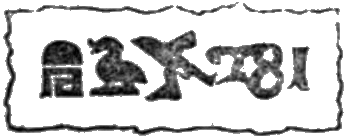
BREAKY-LEG, strong drink; “he’s been to Bungay fair, and BROKE BOTH HIS LEGS,” i.e., got drunk. In the ancient Egyptian language the determinative character in the hieroglyphic verb “to be drunk,” has the significant form of the leg of a man being amputated.
BREECHED, or TO HAVE THE BAGS OFF, to have plenty of money; “to be well BREECHED,” to be in good circumstances.
BREECHES, “to wear the BREECHES,” said of a wife who usurps the husband’s prerogative.
BREEKS, breeches.—Scotch, now common.
BRICK, a “jolly good fellow;” “a regular BRICK,” a staunch fellow.
“I bonnetted Whewell, when we gave the Rads their gruel, And taught them to eschew all their addresses to the Queen. If again they try it on, why to floor them I’ll make one, Spite of Peeler or of Don, like a BRICK and a Bean.” The Jolly Bachelors, Cambridge, 1840.
Said to be derived from an expression of Aristotle, τετραγωνος ἀνηρ.
BRIEF, a pawnbroker’s duplicate.
BRISKET BEATER, a Roman Catholic.
BROADS, cards. Broadsman, a card sharper.
BROAD AND SHALLOW, an epithet applied to the so-called “Broad Church,” in contradistinction to the “High” and “Low” Church.—See HIGH AND DRY.
BROAD-FENCER, card seller at races.
BROSIER, a bankrupt.—Cheshire. Brosier-my-dame, school term, implying a clearing of the housekeeper’s larder of provisions, in revenge for stinginess.—Eton.
BROTHER-CHIP, fellow carpenter. Also, BROTHER-WHIP, a fellow coachman; and BROTHER-BLADE, of the same occupation or calling—originally a fellow soldier.
BROWN, a halfpenny.—See BLUNT.
BROWN, “to do BROWN,” to do well or completely (in allusion to roasting); “doing it BROWN,” prolonging the frolic, or exceeding sober bounds; “DONE BROWN,” taken in, deceived, or surprised.
BROWN BESS, the old Government regulation musket.
BROWN PAPERMEN, low gamblers.
BROWN SALVE, a token of surprise at what is heard, and at the same time means “I understand you.”
BROWN-STUDY, a reverie. Very common even in educated society, but hardly admissible in writing, and therefore must be considered a vulgarism. It is derived, by a writer in Notes and Queries, from BROW study, from the old German BRAUN, or AUG-BRAUN, an eye-brow.—Ben Jonson.
BROWN-TO, to understand, to comprehend.—American.
BRUISER, a fighting man, a pugilist.—Pugilistic. Shakespere uses the word BRUISING in a similar sense.
BRUMS, counterfeit coins. Nearly obsolete. Corruption of Brummagem (Bromwicham), the ancient name of Birmingham, the great emporium of plated goods and imitation jewellery.
BRUSH, or BRUSH-OFF, to run away, or move on.—Old cant.
BUB, drink of any kind.—See GRUB. Middleton, the dramatist, mentions BUBBER, a great drinker.
BUB, a teat, woman’s breast.
BUCK, a gay or smart man, a cuckold.
BUCKHORSE, a smart blow or box on the ear; derived from the name of a celebrated “bruiser” of that name.
BUCKLE, to bend; “I can’t BUCKLE to that,” I don’t understand it; to yield or give in to a person. Shakespere uses the word in the latter sense, Henry IV., i. 1; and Halliwell says that “the commentators do not supply another example.” How strange that in our own streets the term should be used every day! Stop the first costermonger, and he will soon inform you the various meanings of BUCKLE.—See Notes and Queries, vols. vii., viii., and ix.
BUCKLE-TO, to bend to one’s work, to begin at once, and with great energy.
BUDGE, to move, to inform, to SPLIT, or tell tales.
BUFF, to swear to, or accuse; to SPLIT, or peach upon. Old word for boasting, 1582.
BUFF, the bare skin; “stripped to the BUFF.”
BUFFER, a dog. Their skins were formerly in great request—hence the term, BUFF meaning in old English to skin. It is still used in the ring, BUFFED meaning stripped to the skin. In Irish cant, BUFFER is a boxer. The BUFFER of a railway carriage doubtless received its very appropriate name from the old pugilistic application of this term.
BUFFER, a familiar expression for a jolly acquaintance, probably from the French, BOUFFARD, a fool or clown; a “jolly old BUFFER,” said of a good humoured or liberal old man. In 1737, a BUFFER was a “rogue that killed good sound horses for the sake of their skins, by running a long wire into them.”—Bacchus and Venus. The term was once applied to those who took false oaths for a consideration.
BUFFLE HEAD, a stupid or obtuse person.—Miege. German, BUFFEL-HAUPT, buffalo-headed.
BUFFY, intoxicated.—Household Words, No. 183.
BUGGY, a gig, or light chaise. Common term in America and in Ireland.
BUG-HUNTERS, low wretches who plunder drunken men.
BUILD, applied in fashionable slang to the make or style of dress, &c.; “it’s a tidy BUILD, who made it?”
BULGER, large; synonymous with BUSTER.
BULL, term amongst prisoners for the meat served to them in jail.
BULL, one who agrees to purchase stock at a future day, at a stated price, but who does not possess money to pay for it, trusting to a rise in public securities to render the transaction a profitable one. Should stocks fall, the bull is then called upon to pay the difference.—See BEAR, who is the opposite of a BULL, the former selling, the latter purchasing—the one operating for a fall or a pull down, whilst the other operates for a rise or toss up.
BULL, a crown piece; formerly, BULL’S EYE.
BULL-THE-CASK, to pour hot water into an empty rum puncheon, and let it stand until it extracts the spirit from the wood. The result is drunk by sailors in default of something stronger.—Sea.
BULLY, a braggart; but in the language of the streets, a man of the most degraded morals, who protects prostitutes, and lives off their miserable earnings.—Shakespere, Midsummer Night’s Dream, iii. 1; iv. 2.
BUM, the part on which we sit.—Shakespere. Bumbags, trowsers.
BUM-BAILIFF, a sheriff’s officer,—a term, some say, derived from the proximity which this gentleman generally maintains to his victims. Blackstone says it is a corruption of “bound bailiff.”
BUM-BOATS, shore boats which supply ships with provisions, and serve as means of communication between the sailors and the shore.
BUM-BRUSHER, a schoolmaster.
BUMMAREE. This term is given to a class of speculating salesmen at Billingsgate market, not recognised as such by the trade, but who get a living by buying large quantities of fish of the salesmen and re-selling it to smaller buyers. The word has been used in the statutes and bye-laws of the markets for upwards of 100 years. It has been variously derived, but is most probably from the French, BONNE MAREE, good fresh fish! “Marée signifie toute sorte de poisson de mer qûi n’est pas salé; bonne marée—marée fraiche, vendeur de marée.”—Dict. de l’Acad. Franc. The BUMMAREES are accused of many trade tricks. One of them is to blow up cod-fish with a pipe until they look double their actual size. Of course when the fish come to table they are flabby, sunken, and half dwindled away. In Norwich, TO BUMMAREE ONE is to run up a score at a public house just open, and is equivalent to “running into debt with one.”
BUNCH OF FIVES, the hand, or fist.
BUNDLE, “to BUNDLE a person off,” i.e., to pack him off, send him flying.
BUNG, the landlord of a public-house.
BUNG, to give, pass, hand over, drink, or indeed to perform any action; BUNG UP, to close up—Pugilistic; “BUNG over the rag,” hand over the money—Old, used by Beaumont and Fletcher, and Shakespere. Also, to deceive one by a lie, to CRAM, which see.
BUNKER, beer.
BUNTS, costermonger’s perquisites; the money obtained by giving light weight, &c.; costermongers’ goods sold by boys on commission. Probably a corruption of bonus, BONE being the slang for good. Bunce, Grose gives as the cant word for money.
BURDON’S HOTEL, Whitecross-street prison, of which the Governor is or was a Mr. Burdon.
BURERK, a lady. Grose gives BURICK, a prostitute.
BURKE, to kill, to murder, by pitch plaster or other foul means. From Burke, the notorious Whitechapel murderer, who with others used to waylay people, kill them, and sell their bodies for dissection at the hospitals.
BURYING A MOLL, running away from a mistress.
BUSKER, a man who sings or performs in a public house.—Scotch.
BUSK (or BUSKING), to sell obscene songs and books at the bars and in the tap rooms of public houses. Sometimes implies selling any articles.
BUSS, an abbreviation of “omnibus,” a public carriage. Also, a kiss.
BUST, or BURST, to tell tales, to SPLIT, to inform. Busting, informing against accomplices when in custody.
BUSTER (BURSTER), a small new loaf; “twopenny BUSTER,” a twopenny loaf. “A pennorth o’ BEES WAX (cheese) and a penny BUSTER,” a common snack at beershops.
BUSTER, an extra size; “what a BUSTER,” what a large one; “in for a BUSTER,” determined on an extensive frolic or spree. Scotch, BUSTUOUS; Icelandic, BOSTRA.
BUSTLE, money; “to draw the BUSTLE.”
BUTTER, or BATTER, praise or flattery. To BUTTER, to flatter, cajole.
BUTTER-FINGERED, apt to let things fall.
BUTTON, a decoy, sham purchaser, &c. At any mock or sham auction seedy specimens may be seen. Probably from the connection of buttons with Brummagem, which is often used as a synonyme for a sham.
BUTTONER, a man who entices another to play.—See BONNETTER.
BUTTONS, a page,—from the rows of gilt buttons which adorn his jacket.
BUTTONS, “not to have all one’s BUTTONS,” to be deficient in intellect.
BUZ, to pick pockets; BUZ-FAKING, robbing.
BUZ, to share equally the last of a bottle of wine, when there is not enough for a full glass for each of the party.
BUZZERS, pickpockets. Grose gives BUZ COVE and BUZ GLOAK, the latter is very ancient cant.
BUZ-BLOAK, a pickpocket, who principally confines his attention to purses and loose cash. Grose gives BUZ-GLOAK (or CLOAK?), an ancient cant word. Buz-napper, a young pickpocket.
BUZ-NAPPER’S ACADEMY, a school in which young thieves are trained. Figures are dressed up, and experienced tutors stand in various difficult attitudes for the boys to practice upon. When clever enough they are sent on the streets. It is reported that a house of this nature is situated in a court near Hatton Garden. The system is well explained in Dickens’ Oliver Twist.
BYE-BLOW, a bastard child.
BY GEORGE, an exclamation similar to BY JOVE. The term is older than is frequently imagined, vide Bacchus and Venus (p. 117), 1737. “Fore (or by) GEORGE, I’d knock him down.” A street compliment to Saint George, the patron Saint of England, or possibly to the House of Hanover.
BY GOLLY, an ejaculation, or oath; a compromise for “by God.” In the United States, small boys are permitted by their guardians to say GOL DARN anything, but they are on no account allowed to commit the profanity of G—d d——g anything. An effective ejaculation and moral waste pipe for interior passion or wrath is seen in the exclamation—BY THE-EVER-LIVING-JUMPING-MOSES—a harmless phrase, that from its length expends a considerable quantity of fiery anger.
CAB, in statutory language, “a hackney carriage drawn by one horse.” Abbreviated from CABRIOLET, French; originally meaning “a light low chaise.” The wags of Paris playing upon the word (quasi cabri au lait) used to call a superior turn-out of the kind a cabri au crême. Our abbreviation, which certainly smacks of slang, has been stamped with the authority of “George, Ranger.” See the notices affixed to the carriage entrances of St. James’s Park.
CAB, to stick together, to muck, or tumble up.—Devonshire.
CABBAGE, pieces of cloth said to be purloined by tailors.
CABBAGE, to pilfer or purloin. Termed by Johnson a cant word, but adopted by later lexicographers as a respectable term. Said to have been first used in this sense by Arbuthnot.
CABBY, the driver of a cab.
CAD, or CADGER (from which it is shortened), a mean or vulgar fellow; a beggar; one who would rather live on other people than work for himself; a man trying to worm something out of another, either money or information. Johnson uses the word, and gives huckster as the meaning, but I never heard it used in this sense. Cager, or GAGER, the old cant term for a man. The exclusives in the Universities apply the term CAD to all non-members.
CAD, an omnibus conductor.
CADGE, to beg in an artful or wheedling manner.—North.
CADGING, begging of the lowest degree.
CAG-MAG, bad food, scraps, odds and ends; or that which no one could relish. Grose gives CAGG MAGGS, old and tough Lincolnshire geese, sent to London to feast the poor cockneys.
CAGE, a minor kind of prison.—Shakespere, part ii. of Henry IV., iv. 2.
CAKE, a flat, a soft or doughy person, a fool.
CAKEY-PANNUM-FENCER, a man who sells street pastry.
CALL-A-GO, in street “patter,” is to remove to another spot, or address the public in different vein.
CAMESA, shirt or chemise.—Span. Ancient cant, COMMISSION.
CAMISTER, a preacher, clergyman, or master.
CANARY, a sovereign. This is stated by a correspondent to be a Norwich term, that city being famous for its breed of those birds.
CANISTER, the head.—Pugilistic.
CANISTER-CAP, a hat.—Pugilistic.
CANNIKEN, a small can, similar to PANNIKIN.—Shakespere.
CANT, a blow or toss; “a cant over the kisser,” a blow on the mouth.—Kentish.
CANT OF TOGS, a gift of clothes.
CARDINAL, a lady’s cloak. This, I am assured, is the Seven Dials cant term for a lady’s garment, but curiously enough the same name is given to the most fashionable patterns of the article by Regent-street drapers. A cloak with this name was in fashion in the year 1760. It received its title from its similarity in shape to one of the vestments of a cardinal.
CARNEY, soft talk, nonsense, gammon.—Hibernicism.
CAROON, five shillings. French, COURONNE; Gipsey, COURNA,—PANSH COURNA, half-a-crown.
CARPET, “upon the CARPET,” any subject or matter that is uppermost for discussion or conversation. Frequently quoted as sur le tapis, but it does not seem to be a correct Parisian phrase.
CARRIER PIGEONS, swindlers, who formerly used to cheat Lottery Office Keepers. Nearly obsolete.
CARROTS, the coarse and satirical term for red hair.
CARRY-ON, to joke a person to excess, to carry on a “spree” too far; “how we CARRIED ON, to be sure!” i.e., what fun we had.
CART, a race-course.
CARTS, a pair of shoes. In Norfolk the carapace of a crab is called a crab cart, hence CARTS would be synonymous with CRAB SHELLS, which see.
CART WHEEL, a five shilling piece.
CASA, or CASE, a house, respectable or otherwise. Probably from the Italian, CASA.—Old cant. The Dutch use the word KAST in a vulgar sense for a house, i.e., MOTTEKAST, a brothel. Case sometimes means a water-closet.
CASCADING, vomiting.
CASE, a bad crown piece. Half-a-case, a counterfeit half crown. There are two sources, either of which may have contributed this slang term. Caser is the Hebrew word for a crown; and silver coin is frequently counterfeited by coating or CASING pewter or iron imitations with silver.
CASE. A few years ago the term CASE was applied to persons and things; “what a CASE he is,” i.e., what a curious person; “a rum CASE that,” or “you are a CASE,” both synonymous with the phrase “odd fish,” common half-a-century ago. Among young ladies at boarding schools a CASE means a love affair.
CASK, fashionable slang for a brougham, or other private carriage.—Household Words, No. 183.
CASSAM, cheese—not CAFFAN, which Egan, in his edition of Grose, has ridiculously inserted.—Ancient cant. Latin, CASEUS.
CASTING UP ONE’S ACCOUNTS, vomiting.—Old.
CASTOR, a hat. Castor was once the ancient word for a BEAVER; and strange to add, BEAVER was the slang for CASTOR, or hat, thirty years ago, before gossamer came into fashion.
CAT, to vomit like a cat.—See SHOOT THE CAT.
CAT, a lady’s muff; “to free a CAT,” i.e., steal a muff.
CATARACT, a black satin scarf arranged for the display of jewellery, much in vogue among “commercial gents.”
CATCH ’EM ALIVE, a trap, also a small-tooth comb.
CATCHY (similar formation to touchy), inclined to take an undue advantage.
CATEVER, a queer, or singular affair; anything poor, or very bad. From the Lingua Franca, and Italian, CATTIVO, bad. Variously spelled by the lower orders.—See KERTEVER.
CATGUT-SCRAPER, a fiddler.
CAT-LAP, a contemptuous expression for weak drink.
CAT’S WATER, old Tom, or Gin.
CAT AND KITTEN SNEAKING, stealing pint and quart pots from public-houses.
CATCH-PENNY, any temporary contrivance to obtain money from the public, penny shows, or cheap exhibitions.
CAT-IN-THE-PAN, a traitor, a turn-coat—derived by some from the Greek, καταπαν, altogether; or from cake in pan, a pan cake, which is frequently turned from side to side.
CAUCUS, a private meeting held for the purpose of concerting measures, agreeing upon candidates for office before an election, &c.—See Pickering’s Vocabulary.
CAVAULTING, coition. Lingua Franca, CAVOLTA.
CAVE, or CAVE IN, to submit, shut up.—American. Metaphor taken from the sinking of an abandoned mining shaft.
CHAFF, to gammon, joke, quiz, or praise ironically. Chaff-bone, the jaw-bone.—Yorkshire. Chaff, jesting. In Anglo Saxon, CEAF is chaff; and CEAFL, bill, beak, or jaw. In the “Ancien Riwle,” A.D. 1221, ceafle is used in the sense of idle discourse.
CHALK-OUT, or CHALK DOWN, to mark out a line of conduct or action; to make a rule, order. Phrase derived from the Workshop.
CHALK UP, to credit, make entry in account books of indebtedness; “I can’t pay you now, but you can CHALK IT UP,” i.e., charge me with the article in your day-book. From the old practice of chalking one’s score for drink behind the bar-doors of public houses.
CHALKS, “to walk one’s CHALKS,” to move off, or run away. An ordeal for drunkenness used on board ship, to see whether the suspected person can walk on a chalked line without overstepping it on either side.
CHAP, a fellow, a boy; “a low CHAP,” a low fellow—abbreviation of CHAP-MAN, a huckster. Used by Byron in his Critical Remarks.
CHARIOT-BUZZING, picking pockets in an omnibus.
CHARLEY, a watchman, a beadle.
CHARLEY-PITCHERS, low, cheating gamblers.
CHATTER BASKET, common term for a prattling child amongst nurses.
CHATTER-BOX, an incessant talker or chatterer.
CHATTRY-FEEDER, a spoon.
CHATTS, dice,—formerly the gallows; a bunch of seals.
CHATTS, lice, or body vermin.
CHATTY, a filthy person, one whose clothes are not free from vermin; CHATTY DOSS, a lousy bed.
CHAUNTER-CULLS, a singular body of men who used to haunt certain well known public-houses, and write satirical or libellous ballads on any person, or body of persons, for a consideration. 7s. 6d. was the usual fee, and in three hours the ballad might be heard in St. Paul’s Churchyard, or other public spot. There are two men in London at the present day who gain their living in this way.
CHAUNTERS, those street sellers of ballads, last copies of verses, and other broadsheets, who sing or bawl the contents of their papers. They often term themselves PAPER WORKERS. A. N.—See HORSE CHAUNTERS.
CHAUNT, to sing the contents of any paper in the streets. Cant, as applied to vulgar language, was derived from CHAUNT.—See Introduction.
CHEAP, “doing it on the CHEAP,” living economically, or keeping up a showy appearance with very little means.
CHEAP JACKS, or JOHNS, oratorical hucksters and patterers of hardware, &c., at fairs and races. They put an article up at a high price, and then cheapen it by degrees, indulging in volleys of coarse wit, until it becomes to all appearance a bargain, and as such it is bought by one of the crowd. The popular idea is that the inverse method of auctioneering saves them paying for the auction license.
CHEEK, share or portion; “where’s my CHEEK?” where is my allowance?
CHEEK, impudence, assurance; CHEEKY, saucy or forward. Lincolnshire, CHEEK, to accuse.
CHEEK, to irritate by impudence.
CHEEK BY JOWL, side by side,—said often of persons in such close confabulation as almost to have their faces touch.
CHEESE, anything good, first-rate in quality, genuine, pleasant, or advantageous, is termed THE CHEESE. Mayhew thinks CHEESE, in this sense, is from the Saxon, CEOSAN, to choose, and quotes Chaucer, who uses CHESE in the sense of choice. The London Guide, 1818, says it was from some young fellows translating “c’est une autre CHOSE” into “that is another CHEESE.” CHEESE is also Gipsey and Hindoo (see Introduction); and Persian, CHIZ, a thing.—See STILTON.
CHEESE, or CHEESE IT (evidently a corruption of cease), leave off, or have done; “CHEESE your barrikin,” hold your noise.
CHEESY, fine or showy.
CHERUBS, or CHERUBIMS, the chorister boys who chaunt in the services at the abbeys.
CHESHIRE CAT, “to grin like a CHESHIRE CAT,” to display the teeth and gums when laughing. Formerly the phrase was “to grin like a CHESHIRE CAT eating CHEESE.” A hardly satisfactory explanation has been given of this phrase—that Cheshire is a county palatine, and the cats, when they think of it, are so tickled with the notion that they can’t help grinning.
CHICKEN, a young girl.
CHICKEN-HEARTED, cowardly, fearful.
CHI-IKE, a hurrah, a good word, or hearty praise.
CHINK, money.—Ancient.—See FLORIO.
CHINKERS, money.
CHIP OF THE OLD BLOCK, a child who resembles its father. Brother chip, one of the same trade or profession.
CHIPS, money.
CHISEL, to cheat.
CHITTERLINGS, the shirt frills worn still by ancient beaux; properly, the entrails of a pig, to which they are supposed to bear some resemblance. Belgian, SCHYTERLINGH.
CHIVARLY, coition. Probably a corruption from the Lingua Franca.
CHIVE, a knife; a sharp tool of any kind.—Old cant. This term is particularly applied to the tin knives used in gaols.
CHIVE, to cut, saw, or file.
CHIVE, or CHIVEY, a shout; a halloo, or cheer, loud tongued. From CHEVY-CHASE, a boy’s game, in which the word CHEVY is bawled aloud; or from the Gipsey?—See Introduction.
CHIVE-FENCER, a street hawker of cutlery.
CHIVEY, to chase round, or hunt about.
CHOCK-FULL, full till the scale comes down with a shock. French, CHOC. A correspondent suggests CHOKED-FULL.
CHOKE OFF, to get rid of. Bull dogs can only be made to loose their hold by choking them.
CHOKER, a cravat, a neckerchief. White-choker, the white neckerchief worn by mutes at a funeral, and waiters at a tavern. Clergymen are frequently termed WHITE-CHOKERS.
CHOKER, or WIND-STOPPER, a garrotter.
CHONKEYS, a kind of mince meat baked in a crust, and sold in the streets.
CHOP, to change.—Old.
CHOPS, properly CHAPS, the mouth, or cheeks; “down in the CHOPS,” or “down in the mouth,” i.e., sad or melancholy.
CHOUSE, to cheat out of one’s share or portion. Hackluyt, CHAUS; Massinger, CHIAUS. From the Turkish, in which language it signifies an interpreter. Gifford gives a curious story as to its origin:—
In the year 1609 there was attached to the Turkish embassy in England an interpreter, or CHIAOUS, who by cunning, aided by his official position, managed to cheat the Turkish and Persian merchants then in London out of the large sum of £1,000, then deemed an enormous amount. From the notoriety which attended the fraud, and the magnitude of the swindle, any one who cheated or defrauded was said to chiaous, or chause, or CHOUSE; to do, that is, as this Chiaous had done.—See Trench, Eng. Past and Present, p. 87.
CHOUT, an entertainment.
CHOVEY, a shop.
CHRISTENING, erasing the name of the maker from a stolen watch, and inserting a fictitious one in its place.
CHUBBY, round-faced, plump.
CHUCK, a schoolboy’s treat.—Westminster school. Food, provision for an entertainment.—Norwich.
CHUCK, to throw or pitch.
CHUCKING A JOLLY, when a costermonger praises the inferior article his mate or partner is trying to sell.
CHUCKING A STALL, where one rogue walks in front of a person while another picks his pockets.
CHUCKLE-HEAD, a fool.—Devonshire.
CHUFF IT, i.e., be off, or take it away, in answer to a street seller who is importuning you to purchase. Halliwell mentions CHUFF as a “term of reproach,” surly, &c.
CHUM, an acquaintance. A recognised term, but in such frequent use with the lower orders that it demanded a place in this glossary.
CHUM, to occupy a joint lodging with another person.
CHUMMING-UP, an old custom amongst prisoners when a fresh culprit is admitted to their number, consisting of a noisy welcome—rough music made with pokers, tongs, sticks, and saucepans. For this ovation the initiated prisoner has to pay, or FORK OVER, half a crown—or submit to a loss of coat and waistcoat. The practice is ancient.
CHUMMY, a chimney sweep; also a low-crowned felt hat.
CHUNK, a thick or dumpy piece of any substance.—Kentish.
CHURCH A YACK (or watch), to take the works of a watch from its original case and put them into another one, to avoid detection.—See CHRISTEN.
CHURCHWARDEN, a long pipe, “A YARD OF CLAY.”
CLAGGUM, boiled treacle in a hardened state, Hardbake.—See CLIGGY.
CLAP, to place; “do you think you can CLAP your hand on him?” i.e., find him out.
CLAPPER, the tongue.
CLAP-TRAP, high-sounding nonsense. An ancient Theatrical term for a “TRAP to catch a CLAP by way of applause from the spectators at a play.”—Bailey’s Dictionary.
CLARET, blood.—Pugilistic.
CLEAN, quite, or entirely; “CLEAN gone,” entirely out of sight, or away.—Old, see Cotgrave.—Shakespere.
CLEAN OUT, to thrash, or beat; to ruin, or bankrupt any one; to take all they have got, by purchase, or force. De Quincey, in his article on “Richard Bentley,” speaking of the lawsuit between that great scholar and Dr. Colbatch, remarks that the latter “must have been pretty well CLEANED OUT.”
CLICK, knock, or blow. Click-handed, left-handed.—Cornish.
CLICK, to snatch.
CLIFT, to steal.
CLIGGY, or CLIDGY, sticky.—Anglo Saxon, CLÆG, clay.—See CLAGGUM.
CLINCHER, that which rivets or confirms an argument, an incontrovertible position. Metaphor from the workshop.
CLINK-RIG, stealing tankards from public-houses, taverns, &c.
CLIPPING, excellent, very good.
CLOCK, “to know what’s O’CLOCK,” a definition of knowingness in general.—See TIME O’DAY.
CLOD-HOPPER, a country clown.
CLOUT, or RAG, a cotton pocket handkerchief.—Old cant.
CLOUT, a blow, or intentional strike.—Ancient.
CLOVER, happiness, or luck.
CLUMP, to strike.
CLY, a pocket.—Old cant for to steal. A correspondent derives this word from the Old English, CLEYES, claws; Anglo Saxon, CLEA. This pronunciation is still retained in Norfolk; thus, to CLY would mean to pounce upon, snatch.—See FRISK.
CLY-FAKER, a pickpocket.
COACH, a Cambridge term for a private tutor.
COACH WHEEL, or TUSHEROON, a crown piece, or five shillings.
COALS, “to call (or pull) over the COALS,” to take to task, to scold.
COCK, or more frequently now a days, COCK-E-E, a vulgar street salutation—corruption of COCK-EYE. The latter is frequently heard as a shout or street cry after a man or boy.
COCK AND A BULL STORY, a long, rambling anecdote.—See Notes and Queries, vol. iv., p. 313.
COCKCHAFER, the treadmill.
COCK-EYE, one that squints.
COCKLES, “to rejoice the COCKLES of one’s heart,” a vulgar phrase implying great pleasure.—See PLUCK.
COCKNEY, a native of London. Originally, a spoilt or effeminate boy, derived from COCKERING, or foolishly petting a person, rendering them of soft or luxurious manners. Halliwell states, in his admirable essay upon the word, that “some writers trace the word with much probability to the imaginary land of COCKAYGNE, the lubber land of the olden times.” Grose gives Minsheu’s absurd but comical derivation:—A citizen of London being in the country, and hearing a horse neigh, exclaimed, “Lord! how that horse laughs.” A bystander informed him that that noise was called neighing. The next morning, when the cock crowed, the citizen, to show that he had not forgotten what was told him, cried out, “do you hear how the COCK NEIGHS?”
COCK OF THE WALK, a master spirit, head of a party. Places where poultry are fed are called WALKS, and the barn-door cocks invariably fight for the supremacy till one has obtained it.
COCKS, fictitious narratives, in verse or prose, of murders, fires, and terrible accidents, sold in the streets as true accounts. The man who hawks them, a patterer, often changes the scene of the awful event to suit the taste of the neighbourhood he is trying to delude. Possibly a corruption of cook, a cooked statement, or, as a correspondent suggests, the COCK LANE Ghost may have given rise to the term. This had a great run, and was a rich harvest to the running stationers.
COCK ONE’S TOES, to die.
COCK ROBIN SHOP, a small printer’s office, where low wages are paid to journeymen who have never served a regular apprenticeship.
COCKSHY, a game at fairs and races, where trinkets are set upon sticks, and for one penny three throws at them are accorded, the thrower keeping whatever he knocks off. From the ancient game of throwing or “shying” at live cocks.
COCKSURE, certain.
COCKY, pert, saucy.
COCKYOLY BIRDS, little birds, frequently called “dickey birds.”—Kingsley’s Two Years Ago.
COCK, “to COCK your eye,” to shut or wink one eye.
COCUM, advantage, luck, cunning, or sly, “to fight COCUM,” to be wily and cautious.
CODDS, the “poor brethren” of the Charter house. At p. 133 of the Newcomes, Mr. Thackeray writes, “The Cistercian lads call these old gentlemen CODDS, I know not wherefore.” An abbreviation of CODGER.
CODGER, an old man; “a rum old CODGER,” a curious old fellow. Codger is sometimes used synonymous with CADGER, and then signifies a person who gets his living in a questionable manner. Cager, or GAGER, was the old cant term for a man.
COFFEE-SHOP, a water-closet, or house of office.
COG, to cheat at dice.—Shakespere. Also, to agree with, as one cog-wheel does with another.
COLD BLOOD, a house licensed for the sale of beer “NOT to be drunk on the premises.”
COLD COOK, an undertaker.
COLD MEAT, a corpse.
COLD SHOULDER, “to show or give any one the COLD SHOULDER,” to assume a distant manner towards them, to evince a desire to cease acquaintanceship. Sometimes it is termed “cold shoulder of mutton.”
COLLAR, “out of COLLAR,” i.e., out of place, no work.
COLLAR, to seize, to lay hold of.
COLLY-WOBBLES, a stomach ache, a person’s bowels,—supposed by many of the lower orders to be the seat of feeling and nutrition; an idea either borrowed from, or transmitted by, the ancients.—Devonshire.
COLT’S TOOTH, elderly persons of juvenile tastes are said to have a colt’s tooth.
COMB-CUT, mortified, disgraced, “down on one’s luck.”—See CUT.
COME, a slang verb used in many phrases; “A’nt he COMING IT?” i.e., is he not proceeding at a great rate? “Don’t COME TRICKS here,” “don’t COME THE OLD SOLDIER over me,” i.e., we are aware of your practices, and “twig” your manœuvre. Coming it strong, exaggerating, going a-head, the opposite of “drawing it mild.” Coming it also means informing or disclosing.
COME DOWN, to pay down.
COMMISSION, a shirt.—Ancient cant. Italian, CAMICIA.
COMMISTER, a chaplain or clergyman.
COMMON SEWER, a DRAIN, or drink.
COMMONS, rations, because eaten in common.—University. Short commons (derived from the University slang term), a scanty meal, a scarcity.
CONK, a nose; CONKY, having a projecting or remarkable nose. The Duke of Wellington was frequently termed “Old CONKY” in satirical papers and caricatures.
CONSTABLE, “to overrun the CONSTABLE,” to exceed one’s income, get deep in debt.
CONVEY, to steal; “CONVEY, the wise it call.”
CONVEYANCER, a pick-pocket. Shakespere uses the cant expression, CONVEYER, a thief. The same term is also French slang.
COOK, a term well known in the Bankruptcy Courts, referring to accounts that have been meddled with, or COOKED, by the bankrupt; also the forming a balance sheet from general trade inferences; stated by a correspondent to have been first used in reference to the celebrated alteration of the accounts of the Eastern Counties Railway, by George Hudson, the Railway King.
COOK ONE’S GOOSE, to kill or ruin any person.—North.
COOLIE, a soldier, in allusion to the Hindoo COOLIES, or day labourers.
COON, abbreviation of Racoon.—American. A GONE COON—ditto, one in an awful fix, past praying for. This expression is said to have originated in the American war with a spy, who dressed himself in a racoon skin, and ensconced himself in a tree. An English rifleman taking him for a veritable coon levelled his piece at him, upon which he exclaimed, “Don’t shoot, I’ll come down of myself, I know I’m a GONE COON.” The Yankees say the Britisher was so flummuxed, that he flung down his rifle and “made tracks” for home. The phrase is pretty usual in England.
COOPER, stout half-and-half, i.e., half stout and half porter.
COOPER, to destroy, spoil, settle, or finish. Cooper’d, spoilt, “done up,” synonymous with the Americanism, CAVED IN, fallen in and ruined. The vagabonds’ hieroglyphic , chalked by them on gate posts and houses, signifies that the place has been spoilt by too many tramps calling there.

COOPER, to forge, or imitate in writing; “COOPER a moneker,” to forge a signature.
COP, to seize or lay hold of anything unpleasant; used in a similar sense to catch in the phrase “to COP (or catch) a beating,” “to get COPT.”
COPER, properly HORSE-COUPER, a Scotch horse-dealer,—used to denote a dishonest one.
COPPER, a policeman, i.e., one who COPS, which see.
COPPER, a penny. Coppers, mixed pence.
COPUS, a Cambridge drink, consisting of ale combined with spices, and varied by spirits, wines, &c. Corruption of HIPPOCRAS.
CORINTHIANISM, a term derived from the classics, much in vogue some years ago, implying pugilism, high life, “sprees,” roistering, &c.—Shakespere. The immorality of Corinth was proverbial in Greece. Κορινθίαζ εσθαι, to Corinthianise, indulge in the company of courtesans, was a Greek slang expression. Hence the proverb—
Οὐ παντὸς ἀνδρὸς εἰς Κόρινθον ἔσθ' ὁ πλοῦς,
and Horace, Epist. lib. 1, xvii. 36—
Non cuivis homini contingit adire Corinthum,
in allusion to the spoliation practised by the “hetæræ” on those who visited them.
CORK, “to draw a CORK,” to give a bloody nose.—Pugilistic.
CORKS, money; “how are you off for corks?” a soldier’s term of a very expressive kind, denoting the means of “keeping afloat.”
CORNED, drunk or intoxicated. Possibly from soaking or pickling oneself like CORNED beef.
CORNERED, hemmed in a corner, placed in a position from which there is no escape.—American.
CORPORATION, the protuberant front of an obese person.
CORPSE, to confuse or put out the actors by making a mistake.—Theatrical.
COSSACK, a policeman.
COSTERMONGERS, street sellers of fish, fruit, vegetables, poultry, &c. The London costermongers number more than 30,000. They form a distinct class, occupying whole neighbourhoods, and are cut off from the rest of metropolitan society by their low habits, general improvidence, pugnacity, love of gambling, total want of education, disregard for lawful marriage ceremonies, and their use of a cant (or so-called back slang) language.
COSTER, the short and slang term for a costermonger, or costard-monger, who was originally an apple seller. Costering, i.e., costermongering.
COTTON, to like, adhere to, or agree with any person; “to cotton on to a man,” to attach yourself to him, or fancy him, literally, to stick to him as cotton would. Vide Bartlett, who claims it as an Americanism; and Halliwell, who terms it an Archaism; also Bacchus and Venus, 1737.
COUNCIL OF TEN, the toes of a man who turns his feet inward.
COUNTER JUMPER, a shopman, a draper’s assistant.
COUNTY-CROP (i.e., COUNTY-PRISON CROP), hair cut close and round, as if guided by a basin—an indication of having been in prison.
COUTER, a sovereign. Half-a-couter, half-a-sovereign.
COVE, or COVEY, a boy or man of any age or station. A term generally preceded by an expressive adjective, thus a “flash COVE,” a “rum COVE,” a “downy COVE,” &c. The feminine, COVESS, was once popular, but it has fallen into disuse. Ancient cant, originally (temp. Henry VIII.) COFE, or CUFFIN, altered in Decker’s time to COVE. Probably connected with CUIF, which, in the North of England, signifies a lout or awkward fellow. Amongst Negroes, CUFFEE.
COVENTRY, “to send a man to COVENTRY,” not to speak to or notice him. Coventry was one of those towns in which the privilege of practising most trades was anciently confined to certain privileged persons, as the freemen, &c. Hence a stranger stood little chance of custom, or countenance, and “to send a man to COVENTRY,” came to be equivalent to putting him out of the pale of society.
COVER-DOWN, a tossing coin with a false cover, enabling either head or tail to be shown, according as the cover is left on or taken off.
COWAN, a sneak, an inquisitive or prying person.—Masonic term. Greek, κύων, a dog.
COW’S GREASE, butter.
COW-LICK, the term given to the lock of hair which costermongers and thieves usually twist forward from the ear; a large greasy curl upon the cheek, seemingly licked into shape. The opposite of NEWGATE-KNOCKER, which see.
COXY-LOXY, good-tempered, drunk.—Norfolk.
CRAB, or GRAB, a disagreeable old person. Name of a wild and sour fruit. “To catch a CRAB,” to fall backwards by missing a stroke in rowing.
CRAB, to offend, or insult; to expose or defeat a robbery, to inform against.
CRABSHELLS, or TROTTING CASES, shoes.—See CARTS.
CRACK, first-rate, excellent; “a CRACK HAND,” an adept; a “CRACK article,” a good one.—Old.
CRACK, dry firewood.—Modern Gipsey.
CRACK, “in a CRACK (of the finger and thumb),” in a moment.
CRACK A BOTTLE, to drink. Shakespere uses CRUSH in the same slang sense.
CRACK A KIRK, to break into a church or chapel.
CRACK-FENCER, a man who sells nuts.
CRACK-UP, to boast or praise.—Ancient English.
CRACKED-UP, penniless, or ruined.
CRACKSMAN, a burglar.
CRAM, to lie or deceive, implying to fill up or CRAM a person with false stories; to acquire learning quickly, to “grind,” or prepare for an examination.
CRAMMER, a lie; or a person who commits a falsehood.
CRANKY, foolish, idiotic, ricketty, capricious, not confined to persons. Ancient cant, CRANKE, simulated sickness. German, KRANK, sickly.
CRAP, to ease oneself, to evacuate. Old word for refuse; also old cant, CROP.
CRAPPING CASE, or KEN, a privy, or water-closet.
CRAPPED, hanged.
CREAM OF THE VALLEY, gin.
CRIB, house, public or otherwise; lodgings, apartments.
CRIB, a situation.
CRIB, to steal or purloin.
CRIB, a literal translation of a classic author.—University.
CRIB-BITER, an inveterate grumbler; properly said of a horse which has this habit, a sign of its bad digestion.
CRIBBAGE-FACED, marked with the small pox, full of holes like a cribbage board.
CRIKEY, profane exclamation of astonishment; “Oh, CRIKEY, you don’t say so!” corruption of “Oh, Christ.”
CRIMPS, men who trepan others into the clutches of the recruiting sergeant. They generally pretend to give employment in the colonies, and in that manner cheat those mechanics who are half famished. Nearly obsolete.
CRIPPLE, a bent sixpence.
CROAK, to die—from the gurgling sound a person makes when the breath of life is departing.—Oxon.
CROAKER, one who takes a desponding view of everything; an alarmist. From the croaking of a raven.—Ben Jonson.
CROAKER, a beggar.
CROAKER, a corpse, or dying person beyond hope.
CROAKS, last dying speeches, and murderers’ confessions.
CROCODILES’ TEARS, the tears of a hypocrite. An ancient phrase, introduced into this country by Mandeville, or other early English traveller.—Othello, iv., 1.
CROCUS, or CROAKUS, a quack or travelling doctor; CROCUS-CHOVEY, a chemist’s shop.
CRONY, a termagant or malicious old woman; an intimate friend. Johnson calls it cant.
CROOKY, to hang on to, to lead, walk arm-in-arm; to court or pay addresses to a girl.
CROPPIE, a person who has had his hair cut, or CROPPED, in prison.
CROPPED, hanged.
CROSS, a general term amongst thieves expressive of their plundering profession, the opposite of SQUARE. “To get anything on the CROSS” is to obtain it surreptitiously. “Cross-fanning in a crowd,” robbing persons of their scarf pins.
CROSS COVE and MOLLISHER, a man and woman who live by thieving.
CROSS-CRIB, a house frequented by thieves.
CROW, one who watches whilst another commits a theft, a confederate in a robbery. The CROW looks to see that the way is clear, whilst the SNEAK, his partner, commits the depredation.
CROW, “a regular crow,” a success, a stroke of luck,—equivalent to a FLUKE.
CROW, “I have a CROW to pick with you,” i.e., an explanation to demand, a disagreeable matter to settle; “to COCK-CROW over a person,” to exalt over his abasement or misfortune.
CRUG, food.—Household Words, No. 183.
CRUMBS, “to pick up one’s CRUMBS,” to begin to have an appetite after an illness; to improve in health, circumstances, &c., after a loss thereof.
CRUMMY, fat, plump.—North.
CRUMMY-DOSS, a lousy or filthy bed.
CRUNCH, to crush. Corruption; or, perhaps from the sound of teeth grinding against each other.
CRUSHER, a policeman.
CRUSHING, excellent, first rate.
CRUSTY, ill tempered, petulant, morose.—Old.
CULL, a man or boy.—Old cant.
CULLING, or CULING, stealing from the carriages on race-courses.
CUPBOARD HEADED, an expressive designation of one whose head is both wooden and hollow.—Norfolk.
CURE, an odd person; a contemptuous term, abridged from CURIOSITY—which was formerly the favourite expression.—Compare STIPE.
CURSE OF SCOTLAND, the Nine of Diamonds. Various hypotheses have been set up as to this appellation—that it was the card on which the “Butcher Duke” wrote a cruel order with respect to the rebels after the battle of Culloden; that the diamonds are the nine lozenges in the arms of Dalrymple, Earl of Stair, detested for his share in the Massacre of Glencoe; that it is a corruption of Cross of Scotland, the nine diamonds being arranged somewhat after the fashion of a St. Andrew’s Cross; but the most probable explanation is, that in the game of Pope Joan the nine of diamonds is the POPE, of whom the Scotch have an especial horror.
CURTAIL, to cut off. Originally a cant word, vide Hudibras, and Bacchus and Venus, 1737.
CUSHION THUMPER, polite rendering of TUB THUMPER, a clergyman, a preacher.
CUSTOMER, synonymous with CHAP, a fellow; “a rum CUSTOMER,” i.e., an odd fish, or curious person.—Shakespere.
CUSTOMHOUSE OFFICER, an aperient pill.
CUT, to run away, move off quickly; to cease doing anything; CUT AND RUN, to quit work, or occupation, and start off at once; to CUT DIDOES, synonymous with to CUT CAPERS; CUT A DASH, make a show; CUT A CAPER, to dance or show off in a strange manner; CUT A FIGURE, to make either a good or bad appearance; CUT OUT, to excel, thus in affairs of gallantry one Adonis is said to “cut the other out” in the affections of the wished for lady; CUT THAT! be quiet, or stop; CUT OUT OF, done out of; CUT OF ONE’S GIB, the expression or cast of his countenance [see GIB]; TO CUT ONE’S COMB, to take down a conceited person, from the practice of cutting the combs of capons [see COMB-CUT]; CUT AND COME AGAIN, plenty, if one cut does not suffice, plenty remains to “come again;” CUT UP, mortified, to criticise severely, or expose; CUT UP SHINES, to play tricks; CUT ONE’S STICK, to be off quickly, i.e., be in readiness for a journey, further elaborated into AMPUTATE YOUR MAHOGANY [see STICK]; CUT IT FAT, to exaggerate or show off in an extensive manner; to CUT UP FAT, to die, leaving a large property; CUT UNDER, to undersell; CUT YOUR LUCKY, to run off; CUT ONE’S CART, to expose their tricks; CUT AN ACQUAINTANCE, to cease friendly intercourse with them—Cambridge. Old; CUTTE, to say.
CUT, in theatrical language, means to strike out portions of a dramatic piece, so as to render it shorter for representation. A late treasurer of one of the so called Patent Theatres, when asked his opinion of a new play, always gave utterance to the brief, but safe piece of criticism, “wants CUTTING.”
CUT, tipsey.—Household Words, No. 183.
CUT, to compete in business.
CUT-THROAT, a butcher, a cattle slaughterer; a ruffian.
CUTE, sharp, cunning. Abbreviation of ACUTE.
CUTTER, a ruffian, a cut purse. Of Robin Hood it was said—
“So being outlawed (as ’tis told), He with a crew went forth Of lusty CUTTERS, bold and strong, And robbed in the north.”
This ancient cant word now survives in the phrase, “to swear like a CUTTER.”
CUTTY PIPE, a short clay pipe. Scotch, CUTTY, short. Cutty-sark, a scantily draped lady is so called by Burns.
DAB, or DABSTER, an expert person. Johnson says, “in low language, an artist.”
DAB, a bed.
DAB, street term for a flat fish of any kind.—Old.
DACHA-SALTEE, tenpence. Probably from the Lingua Franca. Modern Greek, δεκα; Italian, DIECI SOLDI, tenpence; Gipsey, DIK, ten. So also DACHA-ONE, i.e., dieci uno, elevenpence.—See SALTEE.
DADDLES, hands; “tip us your DADDLES,”i.e., shake hands.
DADDY, the stage manager.—Theatrical. Also the person who gives away the bride at weddings.
DAGS, feat or performance; “I’ll do your DAGS,” i.e., I will do something that you cannot do.
DAISY CUTTER, a horse which trots or gallops without lifting its feet much from the ground.
DAISY KICKERS, the name hostlers at large inns used to give each other, now nearly obsolete. Daisy-kicker, or GROGHAM, was likewise the cant term for a horse.
The DAISY-KICKERS were sad rogues in the old posting-days; frequently the landlords rented the stables to them, as the only plan to make them return a profit.
DAMPER, a shop till; to DRAW A DAMPER, i.e., rob a till.
DANCE UPON NOTHING, to be hanged.
DANCERS, stairs.—Old cant.
DANDER, passion, or temper; “to get one’s DANDER up,” to rouse his passion.—Old.
DANDY, a fop, or fashionable nondescript. This word, in the sense of a fop, is of modern origin. Egan says it was first used in 1820, and Bee in 1816. Johnson does not mention it, although it is to be found in all late dictionaries. Dandies wore stays, studied feminity, and tried to undo their manhood. Lord Petersham headed them. At the present day dandies of this stamp are fast disappearing. The feminine of DANDY was DANDIZETTE, but the term only lived for a short season.
DANDYPRAT, a funny little fellow, a mannikin; originally a half-farthing.
DANNA, excrement; DANNA DRAG, a nightman’s or dustman’s cart.
DARBIES, handcuffs.—Old cant.
DARBLE, the devil.—French, DIABLE.
DARK, “keep it DARK,” i.e., secret. Dark horse, in racing phraseology a horse whose chance of success is unknown, and whose capabilities have not been made the subject of comment.
DARKEY, twilight. Darkmans, the night.
DARN, vulgar corruption of d——n.—American.
DASHING, showy, fast.
DAVID’S SOW, “as drunk as DAVID’S SOW,” i.e., beastly drunk.—See origin of the phrase in Grose’s Dictionary.
DAVY, “on my DAVY,” on my affidavit, of which it is a vulgar corruption. Latterly DAVY has become synonymous in street language with the name of the Deity; “so help me DAVY,” slang rendering of the conclusion of the oath usually exacted of witnesses.
DAVY’S LOCKER, or DAVY JONES’ LOCKER, the sea, the common receptacle for all things thrown overboard;—a nautical phrase for death, the other world.
DAWDLE, to loiter, or fritter away time.
DAYLIGHTS, eyes; “to darken his DAYLIGHTS,” to give a person black eyes.
DEAD ALIVE, stupid, dull.
DEAD HORSE, “to draw the DEAD HORSE,” DEAD-HORSE work,—working for wages already paid; also any thankless or unassisted service.
DEAD-LURK, entering a dwelling-house during divine service.
DEAD MEN, the term for wine bottles after they are emptied of their contents.—Old.—See MARINES.
DEAD-SET, a pointed attack on a person.
DEANER, a shilling. Provincial Gipsey, DEANEE, a pound.
DEATH, “to dress to DEATH,” i.e., to the very extreme of fashion, perhaps so as to be KILLING.
DEATH-HUNTERS, running patterers, who vend last dying speeches and confessions.
DECK, a pack of cards.—Old. Used by Bulwer as a cant term. General in the United States.
DEE, a pocket book, term used by tramps.—Gipsey.
DEMIREP (or RIP), a courtesan. Contraction of DEMI-REPUTATION—Grose.
DESPATCHES, false “dice with two sides, double four, double five, and double six.”—Times, 27th November, 1856.
DEUCE, the devil.—Old. Stated by Junius and others to be from DEUS.
DEUCE, twopence; DEUCE at cards or dice, one with two pips or holes.
DEVIL, a printer’s youngest apprentice, an errand boy.
DEVIL-DODGERS, clergymen; also people who go sometimes to church and sometimes to meeting.
DEVIL’S-TEETH, dice.
DEVOTIONAL HABITS, horses weak in the knees and apt to stumble and fall are said to have these.—Stable.
DEWSKITCH, a good thrashing.
DIBBS, money; so called from the huckle bones of sheep, which have been used from the earliest times for gambling purposes, being thrown up five at a time and caught on the back of the hand like halfpence.
DICKEY, bad, sorry, or foolish; food or lodging is pronounced DICKEY when of a poor description; “it’s all DICKEY with him,” i.e., all over with him.
DICKEY, formerly the cant for a worn out shirt, but means now-a-days a front or half-shirt. Dickey was originally TOMMY (from the Greek, τομη, a section), a name which I understand was formerly used in Trinity College, Dublin. The students are said to have invented the term, and the Gyps changed it to DICKEY, in which dress it is supposed to have been imported into England.
DICKEY, a donkey.
DICKENS, synonymous with devil; “what the DICKENS are you after?” what the d—l are you doing? Used by Shakespere in the Merry Wives of Windsor.
DIDDLE, to cheat, or defraud.—Old.
DIDDLE, old cant word for geneva, or gin.
DIDDLER, or JEREMY DIDDLER, an artful swindler
DIDOES, pranks or capers; “to cut up DIDOES,” to make pranks.
DIES, last dying speeches, and criminal trials.
DIGS, hard blows.
DIGGERS, spurs; also the spades on cards.
DIGGINGS, lodgings, apartments, residence; an expression probably imported from California, or Australia, with reference to the gold diggings.
DILLY DALLY, to trifle.
DIMBER, neat or pretty.—Worcestershire, but old cant.
DIMBER DAMBER, very pretty; a clever rogue who excels his fellows; chief of a gang. Old cant in the latter sense.—English Rogue..
DIMMOCK, money; “how are you off for DIMMOCK?” diminutive of DIME, a small foreign silver coin.
DINARLY, money; “NANTEE DINARLY,” I have no money, corrupted from the Lingua Franca, “NIENTE DINARO,” not a penny. Turkish, DINARI; Spanish, DINERO; Latin, DENARIUS.
DING, to strike; to throw away, or get rid of anything; to pass to a confederate.
DIPPED, mortgaged.—Household Words, No. 183.
DISGUISED, intoxicated.—Household Words, No. 183.
DISH, to stop, to do away with, to suppress; DISHED, done for, floored, beaten, or silenced. A correspondent suggests that meat is usually DONE BROWN before being DISHED, and conceives that the latter term may have arisen as the natural sequence of the former.
DISHABBILLY, the ridiculous corruption of the French, DESHABILLE, amongst fashionably affected, but ignorant “stuck-up” people.
DITHERS, nervous or cold shiverings. “It gave me the DITHERS.”
DIVE, to pick pockets.
DIVERS, pickpockets.
DO, this useful and industrious verb has for many years done service as a slang term. To DO a person is to cheat him. Sometimes another tense is employed, such as “I DONE him,” meaning I cheated or “paid him out;” DONE BROWN, cheated thoroughly, befooled; DONE OVER, upset, cheated, knocked down, ruined; DONE UP, used up, finished, or quieted. Done also means convicted, or sentenced; so does DONE-FOR. To DO a person in pugilism is to excel him in fisticuffs. Humphreys, who fought Mendoza, a Jew, wrote this laconic note to his supporter—“Sir,—I have DONE the Jew, and am in good health. Rich. Humphreys.” Tourists use the expression “I have DONE France and Italy,” meaning I have completely explored those countries.
DOCTOR, to adulterate or drug liquor; also to falsify accounts.—See COOK.
DODGE, a cunning trick. “Dodge, that homely but expressive phrase.”—Sir Hugh Cairns on the Reform Bill, 2nd March, 1859. Anglo Saxon, DEOGIAN, to colour, to conceal. The TIDY DODGE, as it is called by street-folk, consists in dressing up a family clean and tidy, and parading the streets to excite compassion and obtain alms. A correspondent suggests that the verb DODGE may have been formed (like wench from wink) from DOG, i.e., to double quickly and unexpectedly, as in coursing.
DODGER, a tricky person, or one who, to use the popular phrase, “knows too much.”—See DEVIL-DODGER.
DODGER, a dram. In Kent, a DODGER signifies a nightcap; which name is often given to the last dram at night.
DOG, to follow in one’s footsteps on the sly, to track.
DOG-CHEAP, or DOG-FOOLISH, very, or singularly cheap, or foolish. Latham, in his English Language, says:—“This has nothing to do with dogs. The first syllable is god = good transposed, and the second, the ch—p, is chapman, merchant: compare EASTCHEAP.”—Old term.
DOG-LATIN, barbarous Latin, such as was formerly used by lawyers in their pleadings.
DOG-ON-IT, a form of mild swearing used by boys. It is just worthy of mention that DOGONE, in Anglo-Norman, is equivalent to a term of contempt. Friesic, DOGENIET.
DOGSNOSE, gin and beer, so called from the mixture being cold, like a dog’s nose.
DOLDRUMS, difficulties, low spirits, dumps.—Sea.
DOLLOP, a lump or portion.—Norfolk. Ang. Sax. DAEL, dole.
DOLLOP, to dole up, give up a share.—Ib.
DOLLYMOP, a tawdrily-dressed maid servant, a street walker.
DOLLY SHOP, an illegal pawnshop,—where goods, or stolen property, not good enough for the pawnbroker, are received, and charged at so much per day. If not redeemed the third day the goods are forfeited. Anglo Saxon, DAEL, a part,—to dole?—See NIX. A correspondent thinks it may have been derived from the black doll, the usual sign of a rag shop.
DOMINE, a parson.
DOMINOS, the teeth.
DON, a clever fellow, the opposite of a muff; a person of distinction in his line or walk. At the Universities, the Masters and Fellows are THE DONS. Don is also used as an adjective, “a DON hand at a knife and fork,” i.e., a first-rate feeder at a dinner table.—Spanish.
DONE FOR A RAMP, convicted for thieving.
DONKEY, “three more and up goes the DONKEY,” a vulgar street phrase for extracting as much money as possible before performing any task. The phrase had its origin with a travelling showman, the finale of whose performance was the hoisting of a DONKEY on a pole or ladder; but this consummation was never arrived at unless the required number of “browns” was first paid up, and “three more” was generally the unfortunate deficit.
DONNA AND FEELES, a woman and children. Italian or Lingua Franca, DONNE E FIGLIE.
DOOKIN, fortune telling. Gipsey, DUKKERIN.
DOSE, three months’ imprisonment as a known thief.—See BRAGGADOCIO.
DOSS, a bed.—North. Probably from DOZE. Mayhew thinks it is from the Norman, DOSSEL, a hanging, or bed canopy.
DOSS, to sleep, formerly spelt DORSE. Perhaps from the phrase to lie on one’s dorsum, back.
DOSS-KEN, a lodging house.
DOUBLE, “to tip (or give) the DOUBLE,” to run away from any person; to double back, turn short round upon one’s pursuers and so escape, as a hare does.—Sporting.
DOUBLE-UP, to pair off, or “chum,” with another man; to beat severely.
DOUBLE-SHUFFLE, a low, shuffling, noisy dance, common amongst costermongers.—See FLIP-FLAPS.
DOUSE, to put out; “DOUSE that glim,” put out that candle.—Sea.
DOWD, a woman’s nightcap.—Devonshire; also an American term; possibly from DOWDY, a slatternly woman.
DOWN, to be aware of, or awake to, any move—in this meaning, synonymous with UP; “DOWN upon one’s luck,” unfortunate; “DOWN in the mouth,” disconsolate; “to be DOWN on one,” to treat him harshly or suspiciously, to pounce upon him, or detect his tricks.
DOWN THE DOLLY, a favourite gambling contrivance, often seen in the tap rooms of public houses, at race-courses, and fairs, consisting of a round board and the figure of an old man or “doll,” down which is a spiral hole. A marble is dropped “down the dolly,” and stops in one of the small holes or pits (numbered) on the board. The bet is decided according as the marble stops on a high or low figure.
DOWN THE ROAD, stylish, showy, after the fashion.
DOWNER, a sixpence; apparently the Gipsey word, TAWNO, “little one,” in course of metamorphosis into the more usual “tanner.”
DOWNS, Tothill Fields’ prison.
DOWNY, knowing or cunning; “a DOWNY COVE,” a knowing or experienced sharper.
DOWRY, a lot, a great deal; “DOWRY of parny,” lot of rain or water.—See PARNY. Probably from the Gipsey.
DOXY, the female companion of a thief or beggar. In the West of England, the women frequently call their little girls DOXIES, in a familiar or endearing sense. A learned divine once described orthodoxy as being a man’s own DOXY, and heterodoxy another man’s DOXY.—Ancient cant.
DRAB, a vulgar or low woman.—Shakespere.
DRAG, a cart of any kind, a coach; gentlemen drive to the races in drags.
DRAG, a street, or road; BACK-DRAG, back-street.
DRAG, or THREE MOON, three months in prison.
DRAGGING, robbing carts, &c.
DRAGSMEN, fellows who cut trunks from the backs of carriages. They sometimes have a light cart, and “drop behind” the plundered vehicle, and then drive off in an opposite direction with the booty.
DRAIN, a drink; “to do a DRAIN,” to take a friendly drink—“do a wet;” sometimes called a COMMON SEWER.
DRAW, “come, DRAW it mild!” i.e., don’t exaggerate; opposite of “come it strong.” From the phraseology of the bar (of a PUBLIC), where customers desire the beer to be DRAWN mild.
DRAWERS, formerly the ancient cant name for very long stockings, now a hosier’s term.
DRAWING TEETH, wrenching off knockers.
DRIVE-AT, to aim at; “what is he DRIVING AT?”
DRIVE, a term used by tradesmen in speaking of business; “he’s DRIVING a roaring trade,” i.e., a very good one; hence, to succeed in a bargain, “I DROVE a good bargain,” i.e., got the best end of it.
DRIZ, lace. In a low lodging house this singular autograph inscription appeared over the mantelpiece, “Scotch Mary, with DRIZ (lace), bound to Dover and back, please God.”
DRIZ FENCER, a person who sells lace.
DROP, to quit, go off, or turn aside; “DROP the main Toby,” go off the main road.
DROP, “to DROP INTO a person,” to give him a thrashing.—See SLIP and WALK. “To DROP ON to a man,” to accuse or rebuke him suddenly.
DRUM, a house, a lodging, a street; HAZARD-DRUM, a gambling house; FLASH-DRUM, a house of ill-fame.
DRUMMER, a robber who first makes his victims insensible by drugs or violence, and then plunders them.
DUB, to pay or give; “DUB UP,” pay up.
DUBBER, the mouth; “mum your DUBBER,” hold your tongue.
DUBLIN PACKET, to turn a corner; to “take the DUBLIN PACKET,” viz., run round the corner.
DUBS, a bunch of keys.—Nearly obsolete.
DUBSMAN, or SCREW, a turnkey.
DUCKS AND DRAKES, “to make DUCKS AND DRAKES of one’s money,” to throw it away childishly,—derived from children “shying” flat stones on the surface of a pool, which they call DUCKS AND DRAKES, according to the number of skips they make.
DUDDERS, or DUDSMEN, persons who formerly travelled the country as pedlars, selling gown-pieces, silk waistcoats, &c., to countrymen. In selling a waistcoat-piece for thirty shillings or two pounds, which cost them perhaps five shillings, they would show great fear of the revenue officer, and beg of the purchasing clodhopper to kneel down in a puddle of water, crook his arm, and swear that it might never become straight if he told an exciseman, or even his own wife. The term and practice are nearly obsolete. In Liverpool, however, and at the east end of London, men dressed up as sailors, with pretended silk handkerchiefs and cigars “only just smuggled from the Indies,” are still to be plentifully found.
DUDDS, clothes, or personal property. Gaelic, DUD; Ancient cant; also Dutch.
DUFF, pudding; vulgar pronunciation of DOUGH.—Sea.
DUFFER, a hawker of “Brummagem” or sham jewellery; a sham of any kind; a fool, or worthless person. DUFFER was formerly synonymous with DUDDER, and was a general term given to pedlars. It is mentioned in the Frauds of London (1760), as a word in frequent use in the last century to express cheats of all kinds. From the German, DURFEN, to want?
DUFFING, false, counterfeit, worthless.
DUKE, gin.—Household Words, No. 183.
DUMB-FOUND, to perplex, to beat soundly till not able to speak. Originally a cant word. Johnson cites the Spectator for the earliest use. Scotch, DUMFOUNDER.
DUMMACKER, a knowing or acute person.
DUMMIES, empty bottles and drawers in an apothecary’s shop, labelled so as to give an idea of an extensive stock.
DUMMY, in three-handed whist the person who holds two hands plays DUMMY.
DUMMY, a pocket book.
DUMP FENCER, a man who sells buttons.
DUMPY, short and stout.
DUMPISH, sullen, or glumpy.
DUN, to solicit payment.—Old cant, from the French DONNEZ, give; or from JOE DUN, the famous bailiff of Lincoln; or simply a corruption of DIN, from the Anglo Saxon DUNAN, to clamour?
DUNAKER, a stealer of cows or calves.Nearly obsolete.
DUNDERHEAD, a blockhead.
DUNG, an operative who works for an employer who does not give full or “society” wages.
DUNNAGE, baggage, clothes. Also, a Sea term for wood or loose faggots laid at the bottom of ships, upon which is placed the cargo.
DUNNY-KEN, a water-closet.—See KEN.
DURRYNACKING, offering lace or any other article as an introduction to fortune-telling; generally pursued by women.
DUST, money; “down with the DUST,” put down the money.—Ancient. Dean Swift once took for his text, “He who giveth to the poor lendeth to the Lord.” His sermon was short. “Now, my brethren,” said he, “if you are satisfied with the security, down with the DUST.”
DUST, a disturbance, or noise, “to raise a DUST,” to make a row.
DUTCH CONSOLATION, “thank God it is no worse.”
DUTCH CONCERT, where each performer plays a different tune.
DUTCH COURAGE, false courage, generally excited by drink,—pot-valour.
DUTCH FEAST, where the host gets drunk before his guest.
DUTCH UNCLE, a personage often introduced in conversation, but exceedingly difficult to describe; “I’ll talk to him like a DUTCH UNCLE!” conveys the notion of anything but a desirable relation.—Americanism.
DOUBLE DUTCH, gibberish, or any foreign tongue.
EARL OF CORK, the ace of diamonds.—Hibernicism.
“What do you mean by the Earl of Cork?” asked Mr. Squander. “The ace of diamonds, your honour. It’s the worst ace, and the poorest card in the pack, and is called the Earl of Cork, because he’s the poorest nobleman in Ireland.”—Carleton’s Traits and Stories of the Irish Peasantry.
EARWIG, a clergyman, also one who prompts another maliciously.
EARWIGGING, a rebuke in private; a WIGGING is more public.
EASE, to rob; “EASING a bloak,” robbing a man.
EGG, or EGG on, to excite, stimulate, or provoke one person to quarrel with another, &c. Cor. of edge, or edge on.—Ancient.
ELBOW, “to shake one’s ELBOW,” to play at cards.
ELBOW GREASE, labour, or industry.
ELEPHANT, “to have SEEN THE ELEPHANT,” to be “up to the latest move,” or “down to the last new trick;” to be knowing, and not “green,” &c. Possibly a metaphor taken from the travelling menageries, where the ELEPHANT is the finale of the exhibition.—Originally an Americanism. Bartlett gives conflicting examples. General now, however.
EVAPORATE, to go, or run away.
EVERLASTING STAIRCASE, the treadmill. Sometimes called “Colonel Chesterton’s everlasting staircase,” from the gallant inventor or improver.
EXTENSIVE, frequently applied in a slang sense to a person’s appearance or talk; “rather EXTENSIVE that!” intimating that the person alluded to is showing off, or “cutting it fat.”
EYE WATER, gin.
FAD, a hobby, a favourite pursuit.
FADGE, a farthing.
FADGE, to suit or fit; “it won’t FADGE,” it will not do. Used by Shakespere, but now heard only in the streets.
FAG, to beat, also one boy working for another at school.
FAG, a schoolboy who performs a servant’s offices to a superior school-mate. Grose thinks FAGGED OUT is derived from this.
FAGOT, a term of opprobrium used by low people to children; “you little FAGOT, you!” Fagot was originally a term of contempt for a dry, shrivelled old woman, whose bones were like a bundle of sticks, only fit to burn.—Compare the French expression for a heretic, sentir le fagot.
FAKE, to cheat, or swindle; to do anything; to go on, or continue; to make or construct; to steal, or rob,—a verb variously used. Faked, done, or done for; “FAKE away, there’s no down,” go on, there is nobody looking. Mayhew says it is from the Latin, FACIMENTUM.
FAKEMENT, a false begging petition, any act of robbery, swindling, or deception.
FAKEMENT CHARLEY, the owner’s private mark.
FAKER, one who makes or FAKES anything.
FAKING A CLY, picking a pocket.
FAMBLES, or FAMMS, the hands.—Ancient cant. German, FAUGEN.
FAMILY MEN, or PEOPLE, thieves, or burglars.
FAN, a waistcoat.
FANCY, the favourite sports, pets, or pastime of a person, the tan of low life. Pugilists are sometimes termed THE FANCY. Shakespere uses the word in the sense of a favourite, or pet; and the paramour of a prostitute is still called her FANCY-MAN.
FANCY-BLOAK, a fancy or sporting man.
FAN-TAIL, a dustman’s hat.
FAST, gay, spreeish, unsteady, thoughtless,—an Americanism that has of late ascended from the streets to the drawing-room. The word has certainly now a distinct meaning, which it had not thirty years ago. Quick is the synonyme for FAST, but a QUICK MAN would not convey the meaning of a FAST MAN,—a person who by late hours, gaiety, and continual rounds of pleasure, lives too fast and wears himself out. In polite society a FAST young lady is one who affects mannish habits, or makes herself conspicuous by some unfeminine accomplishment,—talks slang, drives about in London, smokes cigarettes, is knowing in dogs, horses, &c. An amusing anecdote is told of a FAST young lady, the daughter of a right reverend prelate, who was an adept in horseflesh. Being desirous of ascertaining the opinion of a candidate for ordination, who had the look of a bird of the same feather, as to the merits of some cattle just brought to her father’s palace for her to select from, she was assured by him they were utterly unfit for a lady’s use. With a knowing look at the horses’ points, she gave her decision in these choice words, “Well, I agree with you; they are a rum lot, as the Devil said of the ten commandments.”
FAST, embarrassed, wanting money. Synonymous with HARD UP.—Yorkshire.
FAT, a printer’s term signifying the void spaces on a page, for which he is paid at the same rate as full or unbroken pages. This work afforded much FAT for the printers.
FAT, rich, abundant, &c.; “a FAT lot;” “to cut it FAT,” to exaggerate, to show off in an extensive or grand manner, to assume undue importance; FAT,” see under CUT. As a Theatrical term, a part with plenty of FAT in it, is one which affords the actor an opportunity of effective display.