A DIARY OF THE WRECK OF HIS MAJESTY’S SHIP CHALLENGER. (continued 2)
Reading edition
About half-past 3 P.M., in one of these temporary wooden houses, we found H. W. Rouse, Esq., His Majesty’s Consul; and I need not say how happy we were to introduce ourselves to him, and deliver the Captain’s letter. From our shabby dress and dirty appearance, he for a moment eyed us with suspicion; but having opened the letter, his countenance assumed an expression of benevolence and pity. He shook hands with us, called for wine and water; and we immediately saw in him all those characteristics which endear us to one another. He then left us to consult the Intendenté, and deliver the letter we brought from the officers at Arauco: he did not return till 6, when we dined; and the circumstances attending the wreck formed the subject of our conversation, as Captain Seymour’s letter put him only in possession of the bare fact. At 11 we each took a tepid bath, and “turned in” to comfortable beds, the Consul having previously left us to pay his last visit to a dying native, and did not return till 4 in the morning, when he awoke me, and related a few particulars connected with his visit, and the customs of the people in such a case. This story was not at all calculated to strengthen the nerves of a person whose whole system had recently been severely shaken, nor calculated to prepare him for the shock of an earthquake which at this moment threatened destruction. This shock roused me; under the influence of great alarm, I jumped out of bed, and was about to escape from the house, when the Consul called out, “It’s over!” and I returned to my bed, but too much frightened to expect more sleep. The Consul told us they had been visited with shocks, more or less severe, ever since the great earthquake, which amongst the natives appears to mark an epoch, as in conversation they date every thing so many days before or after “the earthquake.” The 24th and 25th were employed in busily writing with the Consul, who determined on accompanying us to the wreck; and requested our whole assistance in preparing despatches for the Consul-general at Santiago, and other persons likely to be the means of affording relief to the unfortunate crew. I need not say that our undivided attention to this and other services was commanded by this gentleman, in order to expedite our return to the wreck, which was his most anxious desire, his whole head and soul being in the hope of relieving or rendering assistance to his distressed countrymen, fully aware that even if they had all succeeded in reaching the shore in safety, there was great danger to be apprehended of an attack by the Indians, should they come upon them by surprise, or if they had not been able to save the means of defence against that vindictive race of savages, who on former disasters had plundered the unfortunate crews of four vessels wrecked upon their coast, and who were more particularly to be feared at this season of the year, as that intoxicating drink chichi is plentiful; and when excited by this beverage they make desperate attacks on horseback, armed with spears of bamboo from twenty to thirty feet in length, and are not an enemy to be trifled with.
May 26.—The despatches, having been completed at a late hour last night, were sent off this morning at 4 o’clock by an extraordinary courier, who was to be rewarded for his services according to his expedition: if he reached Santiago in seven days, he was to have forty-five dollars, but if in less time, five dollars more for every day less than seven, and decreased in the same proportion for every day more than seven. We were, until five in the afternoon, engaged in preparing for our journey to the wreck, purchasing presents to conciliate the Indians, indigo and other articles to traffic with them, and hiring mules, horses, and servants, to take charge of and guard the numerous things the Consul thought might be of service to the crew, whom he supposed might be destitute. We left Concepçion at half-past five, and rode to the bank of the river, intending to cross and sleep at San Pedro that night; but to our disappointment the launch had gone over, and we were obliged to return to the Consul’s house, where we dined and retired early, purposing to start at daybreak next morning.
Wednesday, 27.—Arose, took an early breakfast, and crossed the river. We were delayed at San Pedro till 2 P.M. in arranging loads for the mules, hiring horses, &c.; at sunset had only reached the extreme end of the plain before described.
We stopped at the house of a gentleman well known to the Consul, but who at this time was at Santiago. His major-domo, however, offered the use of the house to the Consul, which he declined accepting, or putting him to any trouble more than to prepare a supper, and allow us to arrange our beds inside the corridor. We made a hearty supper; Camilo messing with us, and treated as a valuable friend by the Consul, who placed every confidence in his honesty, and, from his better knowledge of the country people and Indians, intrusted to him the entire arrangement of the journey. After supper, in the course of conversation, it was agreed that Mr. Lane and Camilo should precede us with letters to Captain Seymour and the commandant of Arauco, acquainting them with our proceedings. The letters were written, and we retired to rest.
At daylight, on the 28th, Mr. Lane and Camilo set out, the former to be guided by Camilo’s son, Antonio. The Consul and myself proceeded at 9 on our journey, but found some difficulty in getting the mules on, the rains having rendered the roads almost impassable, the mules constantly falling, and requiring to be relieved of their burdens. Came to Colcura; and, in passing through Fuerte Viejo, I waved my hand to the pretty brunette; and, about 9, after a long and tedious journey, came to the Rio Carampanque, which we crossed about 10 o’clock; arrived at Camilo’s house, where we supped on roasted turkey, cascuella, and the roasted seeds of the Araucano pine; enjoyed our pipes, and retired to rest.
Friday, 29.—In no hurry to rise this morning: breakfasted at 10, and occupied three hours in loading the mules and hiring horses and additional mules for the conveyance of the shipwrecked crew. At 2 in the afternoon we took leave of Camilo’s family, and proceeded towards Arauco, where we arrived about 3; and dined with the Commandant Valenzuela, and the officers who were so kind to us on our way up. After dinner, a meeting of the friendly caciques was held at this gentleman’s house; when, through the means of an interpreter, they intimated to the Consul and Commandant their friendly disposition towards the shipwrecked crew, and their readiness to assist them. The Consul presented each of them with a jacket, some indigo, tobacco, and Jew’s harps, together with some trinkets for their wives. The Commandant having made up his mind to accompany us to the wreck, we started at 5 o’clock, and about sunset came to a few ranchos on the top of a hill, called Mitmessin: here we supped, and retired to bed; but passed a miserable night, in consequence of its blowing a gale from the northward, and the rancho being neither wind nor water tight.
Saturday, 30.—Arose and breakfasted; it still blowing hard, and raining heavily: our anxiety greatly increasing for the safety of the crew. At 10 took leave of our friends, and arrived at the Indian pueblo of Albarado at 11, and went to the rancho at which we slept on our way up. Here we found the people celebrating a festival—singing and dancing in a frightfully savage manner, all more or less intoxicated with chichi. They would not allow us to proceed until we acknowledged our friendship by partaking of some of their chichi. We then lit our pajitas, and, about 3, crossed the river, which we found running very rapidly, the current being increased by the heavy rains. I stopped a few minutes at the house of Camilo’s major-domo: the inmates welcomed my return; but I was obliged to hurry my visit, and rejoin the party. We arrived at Lumaco at 6, having passed the troop of mules, which were to remain at the major-domo’s house should night overtake them. We dismounted perfectly drenched, it having rained incessantly during the day, dried our clothes by the fire, supped, and retired to rest, with the consolation that we were only a short day’s journey from the wreck.
Arose at daybreak, it still blowing and raining; waited till 10 for the mules, when they arrived. The servants having breakfasted, at half-past 11 we mounted, and at 2 came to the Rio Leubu, which we crossed in a much better conveyance than we did in our way up; the Consul having brought a large batsa, and a man to manage it, in the hope of assisting the shipwrecked crew in transporting parties and baggage across the rivers. The Consul, Camilo, and myself having crossed, we hurried on our way to the wreck, leaving the mules to follow.
About 5 we arrived; and I introduced the Captain to the Consul, who presented the Commandant, and was gratified by the kind welcome of my shipmates and fellow-sufferers, who hailed us as the harbingers of their deliverance from the wretchedness and privations they had endured; and those only who have been placed in similar circumstances can imagine the delightful feelings produced by such a meeting: having left them surrounded by danger, and now finding them encamped in comparative safety on a mound of sand about 200 yards from the unfortunate ship.
Monday, June 1.—Wind light from the north. Several pieces of the ship’s bottom were picked up on the beach. The officers sent to examine the entrance of the Rio Leubu returned, bringing a favourable report on the objects in view. The Consul, with the governor, being convinced of the absolute necessity of instantly removing from our present encampment, the Captain and officers met in the presence of the Consul, for the purpose of drawing up a statement of the reasons which caused such a course (of abandoning the wreck) imperative. The opinion of all on this subject was unanimous.
The nature of the resolutions at this meeting will be understood by a perusal of them; they are signed by each person then present, and were prepared as a public document for the information of the Admiralty, if called for. Captain Seymour, feeling it his duty to protect the wreck as long as circumstances would permit, in order that a communication might be made to the senior officers for his decision on the case, also addressed a letter, through the Consul, to the governor of Arauco, requesting his authority, with a force from him to guard it from the inroads of the Indians, until the pleasure of the Commodore could be received. The reply to this request from the governor states his inability, from various insurmountable difficulties, to give the assistance asked for.
The decision of moving to the entrance of the Rio Leubu drew the attention of all to the necessary preparations. The crew were, therefore, variously employed in packing provisions for carriage on mules, a number of which, with many horses, had followed or accompanied the governor of Arauco. The sail-makers were employed in making small tents of a transportable size, the carpenters fitting poles for them; and spars were prepared to form sledges for the conveyance of heavy articles and casks, to be drawn by oxen, which we hoped, through the interference of the governor and the friendly caciques, to have driven down to our encampment for that purpose.
The officers examined into the state of the men’s clothing, and gave directions for every thing to be packed ready for a moment’s warning; and they were allowed to furnish themselves with bags, where wanted, out of certain sails, or canvass appropriated to that purpose. The crew, as well as the officers, being much distressed for shoes, the hides of the bullocks which we had been furnished with were carefully portioned out in pieces of a size to make moccassins, which, being laced on tight to the foot, soon assumed a form, and proved a convenient and excellent substitute in so important a want; and, during the latter part of our sojourn on the shores of Chili, were used almost universally.
At 1 P.M. Lieutenant Collins, with Mr. Macdonald, the master, was sent to the entrance of the Rio Leubu, to make a more particular examination, with reference to the safety of a ship’s approach to it. The former, furnished with a passport from the governor of Arauco, and a guide, was to proceed on to Concepçion, with a letter from Captain Seymour to the senior or naval officer there, or elsewhere, stating our intention of proceeding to the Rio Leubu, there to await succours for our removal by sea. Lieutenant Collins was furnished with an order from the Captain to this effect: that if he found, on his arrival at Concepçion, there appeared no early prospect of any naval officer having it in his power to come to our assistance, he was to use his endeavours to hire a vessel capable of embarking the crew, and bring her himself to our relief.
At sunset the weather was moderate and cloudy. The usual daily muster under arms was gone through, and preparation made for the night, on board the wreck as well as on shore.
Tuesday, June 2.—Light winds from the east, and fine weather. Mr. Macdonald returned from the entrance to the Leubu, confirming its advantages in favour of our measure of encamping there, as well as for embarkation. At noon, Lieutenant Tause, with an armed party to the number of about thirty men, including two midshipmen, started for the newly destined site of encampment, taking under their escort from thirty to forty mule-loads of provisions, tents, and various articles of baggage. We were most fortunate in a continuance of a few days of fine weather, as rain would almost have put a stop to our march, from the obstacles offered on the road. In one instance we had a mile to cut through an aged forest, whose solitude would appear to have reigned unbroken for centuries. The governor of Arauco was most attentive and vigilant in acquiring a knowledge of the movement and position of the hostile Indians, and constant spies were despatched to the hills south of us. A good number of mules and horses had been collected and driven to the vicinity of our camp, and great exertions were made, therefore, by all to expedite our march. Several of the caciques had consented to allow their bullocks to be yoked to assist the transport of our heavy baggage. Pinoleo, his wife and daughter, and followers, took another look at us this day, but did not remain any length of time, though they accepted a little rum and water previous to returning to the hills.
June 3.—Fine weather, light wind from N.E. We this day loaded about sixty mules, and, with poles lashed together, on which were secured casks, and other heavy articles, made up loads for eleven yokes of oxen; the whole of which started for the Leubu: a party of men in advance, to cut down the trees and clear the road for them. The difficulties which the oxen had to overcome, in dragging heavy loads through swampy ground and thick abrupt woods, were very great, and could only have been overcome by the steady perseverance and patience so characteristic of the Indians who guided them. Five caciques now arrived from different directions, and with many followers, for the purpose of having a formal interview with the Governor of Arauco, the Consul, and Captain. They were, Cheuquante, cacique of Molquilla; Pinoleo, cacique of Lumuco; Antinao, cacique of Arauco; Currinir, cacique of Tucapel; and Udalevi, cacique of Arauco (father of Antinao). Rafael Lobo was also present: he is the accredited interpreter for the Chilian government amongst the Indians of the district of Arauco, and is allowed to style himself Teuciente de la Reduçion di Tucapel. This interview was highly interesting, as displaying much of the character and manners peculiar to the Araucanian Indians: it lasted almost three hours; an interpreter, accustomed to the office, on the part of the governor, undertaking to make and receive the various communications that passed. The Indian language is not unpleasant, and reminded us a good deal of that of the South Sea Islands. Their mode of address, however, is very singular, in short abrupt sentences, on the latter words of which was laid a loud and peculiar emphasis. Before the conclusion of the meeting the Consul spread out his bundle of presents, consisting of strings of coloured glass beads, papers of indigo, tobacco, cotton printed handkerchiefs, and Jew’s harps, the whole of which were appropriately distributed, and received by the Indians with great apparent satisfaction, as offered by Mr. Rouse, the Consul, in the name of His Majesty the King of Great Britain. With the caciques came the infant child of one of them: the mode in which it was brought was singular. It was placed in a rude wooden box, framed something like a wooden coal-scuttle, contrived so as to make a snug fit for its little imprisoned inmate, whose head only was visible over the edge of the front; the back formed the handle, by which it was slung, by hide straps, to the Indian woman who took charge of it, and who, mounted on horseback, conveyed it away. On taking leave, the caciques went through the ceremony of a parting embrace with the governor, Consul, and Captain; which was by putting the right arm over the left shoulder, the left arm round the waist, under the right arm, the head resting on the right shoulder, and the contrary. They finally accepted from the Consul a small cask of Concepçion wine, with which they retired to the hills to drink.
June 4.—The weather continued quiet and fine. The Captain, taking with him a guide, started early this morning to examine the progress and position of our new encampment at the entrance of the Leubu. Advantage was taken of this day to transport our sick, eight in number, to the camp: they were mounted on the quietest horses we could procure, and made their journey very comfortably under the charge of Mr. Lane, the assistant-surgeon. The Captain returned towards sunset, highly satisfied with the judicious selection, by Mr. Tause the first lieutenant, of the spot, on which his exertions had made great progress towards the erection of tents for the reception of the crew, provisions, and stores. An attempt was made to-day to drag the cutter on spars beyond the promontory of land W.N.W. of the wreck, distant about a league, with the intention of watching an opportunity, if the surf should ever permit it, to launch her, under the shelter of a reef of rocks, and take her round to the entrance of the Leubu; but it was not persisted in, from the little chance of success; the strength and exertions of the crew being, also, of much more consequence for other purposes. The governor of Arauco had procured a small ox, which he presented to the Captain, and which we killed for the mess. Towards the evening a messenger arrived with despatches from Arauco for the governor, informing him that a body of 600 hostile Indians, under the cacique Cadin, were within two days’ march of us, and that 2000 more were assembled on the hills to support them. This intelligence, with other reports, was sufficient to keep us on the alert, and increased our desire to leave our present encampment for one where, we hoped, we should feel less apprehension of being molested. Spies were immediately sent in the direction of the hostile Indians. The usual preparations were made for the night, with a muster, and discharge and reload, of the small arms.
June 5.—Northerly winds and fine weather, with occasional fog. Busily employed in forwarding baggage to the Leubu, as our means of carriage permitted. The caciques came again in a body with their followers to pay another visit to us; occupying, most inconveniently, much of the valuable time of some of our party. A few more presents were found for them. A sort of apology was made to the governor for the unruly drunken conduct of a connection of one of the caciques on their former visit, when the interpreter drew his sword, and threatened to cut him down if he did not desist from interrupting him. The penitent Indian afterwards made himself very useful, in conducting and influencing other Indians in the transport with oxen of our baggage to the Leubu. The dress of the caciques was, in both their visits, not very different from their followers, except in the case of Pinoleo, whose costume has been already described, and Cheuquante, who looked not very unlike one of the monkies which the Savoyard boys exhibit in the streets of London; he having, by some means or other, furnished himself with what was meant for a cocked hat, with a cockade, a blue coatee with red cuffs and collar, and a very long sabre, and adding to his ridiculous appearance by his evident self-satisfaction.
A supply of rum and water, in a small cask, was given them; on which they took the hint, and retired to the hills.
June 6.—Moderate breeze from S.W., with thick foggy weather: the crew busily employed in collecting every useful article to pack for our newly destined camp; a party in the wreck clearing every part that could be got at of all worth the difficulty of transporting to the Leubu. The governor of Arauco earnestly requested that we would destroy any powder which we had saved over the full supply we moved with, lest it should fall into the hands of the Indians, when it would be turned to the serious disadvantage of the Chilian arms; he not having it in his power to take safe custody of it. Several cases of large-grained powder were consequently blown up, to the astonishment of the wonder-stricken Indians. A detachment of sixteen loaded mules again started this day for the Leubu. Sad complaints began to be made of the mice, and bitter denunciations against them; but their numbers overpowered every effort on our part to get rid of them. It was now not uncommon, in the morning, on putting on what had been a jacket, or other whole garment, at night, to discover the disappearance of a large portion of it,—the effects of the mice during the interval. To the canvass they were most destructive, eating large holes in all parts of our tents. Our force having been now much divided, we were most anxious to make a final march of all to our new camp. Our usual precautions were exercised in examining the arms and mustering watches.
Sunday, June 7.—Fresh breezes, and cloudy from the southward. It had been our intention this day to have abandoned our Molquilla encampment; but the failure of the means of carriage, the mules not having returned from the Leubu, prevented our accomplishing it. The tents were struck at daylight, cut up, and placed ready for transport. An express had reached the governor, requiring his return to his command at Arauco, and announcing that the second in authority there, the major of the troops, was on his road, by the concurrence of the Chilian government, to relieve him. This major arrived about mid-day. It being evident that it would be only by getting a detachment away to-day to Leubu that the final abandonment of Molquilla could be accomplished on the morrow, all the mules that were on the spot were laden and forwarded; and about 2 P.M. the captain, with Mr. Sarjeant, the major, and six men, quitted the now dismantled camp for the Leubu; having previously appointed a strong rear-guard, under the third lieutenant, Mr. W. K. Stephens, with Mr. Rouse, the Consul, consisting of a full quarter-watch, twelve marines, the surgeon, Mr. Mould, the second master, a mate, and a midshipman, to guard the few remaining stores, and to proceed as early as possible the next day to join our new camp. Great was the satisfaction felt by all at quitting a spot the scene of which embittered every recollection. The Captain and officers, on clearing the wreck, had got on shore the remains of their cabin furniture, which proved very acceptable presents to the governor and Chilino party, the late earthquake having destroyed the little they could previously boast of. The journey to the Leubu began by passing the promontory along the beach, on the north, to a distance of three leagues; then up an abrupt grassy slope to a thick forest of very old timber, ascending through it, for a mile and a half or two miles, to an open level country, from two to three leagues, covered with several species of dwarf myrtles and coarse grass, to a second and third patch of wood, and eventually to a short steep descent to a swamp, the western side of which skirted the slope and hill on which was situated our Leubu encampment: seventeen or eighteen miles was considered the whole distance.
June 8.—Southern bank of the entrance of the Rio Leubu. Fair weather, with light S.E. winds. The whole number of cargoes that were transported from Molquilla were 279 mule and 61 bullock-loads. The situation of our present encampment was the direct opposite of the last. From a flat deep sand, we were now on a steep declivity in the niche of a thick wood; the soil greasy and slippery, and in wet weather it was difficult to preserve a footing. The river Leubu ran into a bay about 200 yards below us. The system which had been practised at Molquilla was adhered to here; the men being carefully mustered every night at sunset, and their arms reported ready for immediate use: sentinels being placed at different points of the camp to prevent any Indian from entering it. Our tents were now reduced in size, and therefore more numerous. The crew was divided into one large tent, and ten small circular ones; four or five of the latter form being allotted for the captain and officers. The consul had brought a small tent with him, one in which he had been some time living at Concepçion after the earthquake. In the course of the day the party from Molquilla arrived; and we were once more united in our full force, and confiding in a hope that from this spot we should, ere long, be relieved. Two of the seamen who had lost their way in the fog on the hills, during their march from Molquilla, also had come into the camp. We had felt a little uneasy about them, and two Chilino guides on horseback had been despatched in search of them. They had passed the night in the woods. A pet English sheep, which had been saved and carefully protected by many friends amongst the crew, had also moved with them. He marched with them half the distance, with a pair of saddle-bags, which his friends had made for him, across his back, containing a supply, as Jack termed it, of provisions for his journey: on becoming tired, he was carried on a horse to his journey’s end. The evident intelligence displayed by this animal, on first landing from the raft, was very striking; he no sooner got on the beach than, turning to the wreck, he bleated in a most unusual and extraordinary manner. He had no fear of the Indian dogs, and would attack any that offered to come into the camp. His daily custom was to attend the grog tub, and he was sure of collecting a dinner from all quarters. “Jack,” as he was called by his messmates, was a Southdown sheep, taken from Portsmouth in 1833, as part of the Captain’s live stock. After passing over above 55,000 miles, in the course of two years, he was landed from the Conway, with the Challenger’s crew, at Portsmouth in 1835; and has now a run on his native soil for the remainder of his life.
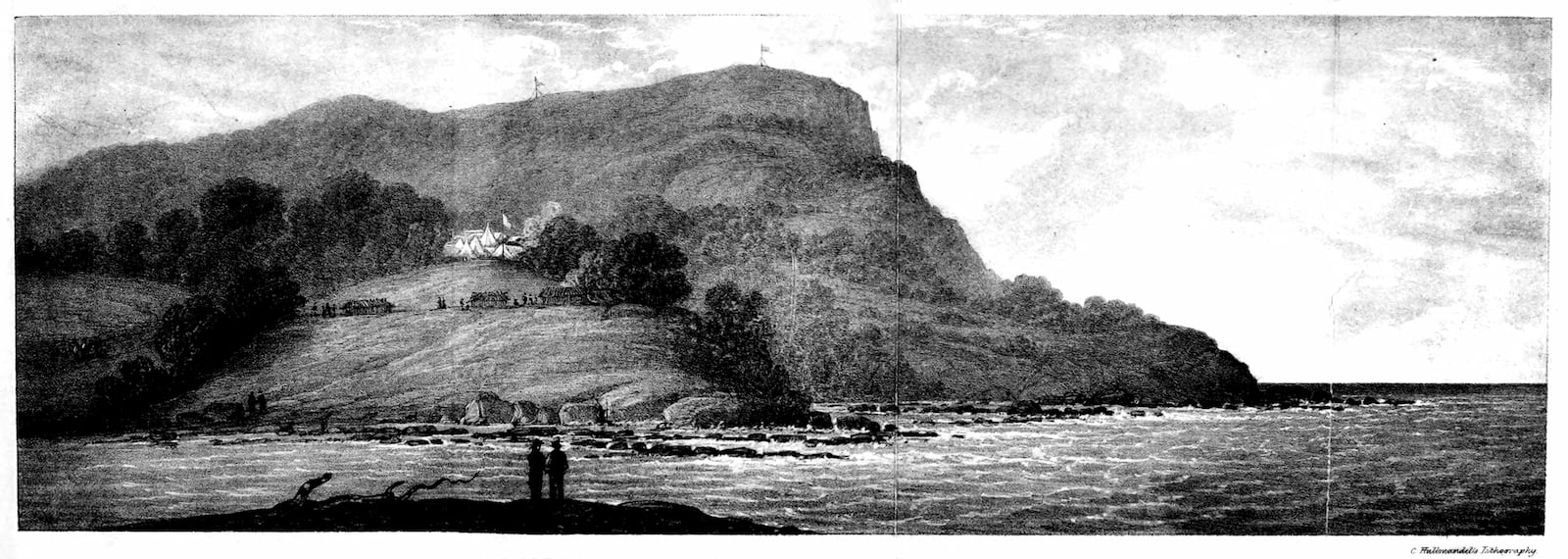
VIEW OF THE LEİİBU CAMP FROM THE NORTH BANK OF THE RIVER.
C Hullmandel’s Lithography
The weather, which had so long befriended us, now began to threaten with those heavy rains, the effects of which we were afterwards to feel so severely; the tents proving very inadequate to protect us from them. The evening cleared the weather, and a bright moon was visible. The note of the horned plover was loudly heard. In allusion to this bird, we were told by the major, Signor Sylva, who had been on many expeditions against the Indians, that they had a superstition regarding the horned plover; which was, that if the note was heard on the right, it was to them a bad omen, and the contrary if heard on the left. The inmates of each tent had worked hard during the past day, to discover the means of keeping off the damp from below, as well as from above.
Tuesday, June 9.—Squally weather, with showers of rain; the wind N.W. A few Indians made their appearance at the camp, bringing, tied to their saddles, some nets of potatoes and apples for barter: also Rafael Lobo, with a present to the captain of some avellanos (a species of nut, the kernels of which the Indians roast, and are not unlike a small chesnut); and to establish a claim of some reward, for having given us his protection and assistance against the hostile Indians at Molquillo, as he then had assumed the command of the armed Indians, and had sent spies out to the southward. The seine, which had been carefully preserved, and brought to the Leubu, was this day tried in the river, but with no great success. At night, we afterwards found the attempts were more productive of luck. The few fish we caught were highly acceptable. The crew’s employment for this day was draining the ground round their tents; a party bringing stones from the beach at the entrance of the river, to lay as a footpath through the camp,—the rain having rendered it almost impossible to walk, from the swampy state of the ground; and in cutting down trees to form a barricade round the encampment. The greatest regularity was observed in the hours of breakfast, dinner, supper; and such issues of provisions made as the state of our store-tent, and the destruction of the mice, would permit. We had brought the ship’s bell with us, which was under the charge of the sentinel posted at the entrance of our camp, and who struck it regularly on receiving the time from the officer on guard. The lights in the ship’s company’s tents were reported as put out every night at 8, and the midshipmen and warrant officers’ at 9. None of the crew were allowed to go outside the barricade after 6 P.M. Having some spare canvass, with abundance of timber surrounding us, two tents were put up in the form of a house, with a good sloping roof, which we covered, and used, one as a mess tent for the Captain and officers, the other for the warrant officers and midshipmen. This description of tent we found superior in point of dryness to the usual form, and, after a short interval, others were put up by the officers: one was occupied by the captain, and shared with Mr. Sarjeant; and in another were four or five of the officers. However, though each day saw some of us endeavouring to give dryness to our habitation, the damp and wet proved unconquerable.
Signor Sylva made himself very useful to us, whenever his authority with the Chilinos or friendly Indians was called for. He expressed great satisfaction at being associated with British officers after a service of twenty-three years, a part of which time he had been campaigning against the Araucanian Indians. He related to us many histories of their undaunted courage, as well as some cruel acts of treachery which they had been guilty of towards the Chilinos, by deceiving them in an assurance of a friendly disposition towards Chili. The information which Signor Sylva gave, together with that from other sources, put the Indian population at about 40,000: scattered over a vast tract of country, mustering 8000 fighting men, but rarely bringing against the Chilinos more than from 2000 to 3000 at any one time.
On examining and taking an account of our stores, baggage, and provisions, the cunning of the Indians proved to have been too much for us. We discovered that there had been a great number of articles plundered on the road from Molquilla, particularly clothing and small parcels of private property. They had also attempted to secrete a cask of spirits, by dropping it in the woods, and not making their appearance at the camp. We, however, sent a party out, and, with a few mules, found the rum, and brought it away in small barrels.
On a high headland, immediately above the camp, we erected a flag-staff, on which we kept a flag constantly flying, and a strict look-out to seaward. This hill had a commanding view, not only of the sea, but over the surrounding country, including the river and camp; and was peculiarly adapted to our purpose, as a spot to establish our look-out. The ascent to it from the camp was abrupt and laborious, though only at a short distance. It was to be got at more easily by making a little circuit through the wood in the rear of us. The timber which composed the forests with which we were encircled was principally myrtle and evergreen oaks, and of great variety. Large tracts of land were free from timber; and the soil was filled with various bulbous roots, several specimens of grasses, abundance of strawberry plants, and an infinity of flowering shrubs and creepers.
The lateness of the season unfortunately prevented our seeing in flower much of what has been enumerated. On the north side of the river a plain extended to the hills, on which were several patches of maize growing, and a herd of horses and a few sheep grazing. Two Indian huts were also situated there, the inmates of which attended to the care of the stock and labour of the cultivated parts.
This plain was rented by a Chilian of Arauco from the Indian proprietor. The land is exceedingly rich; and, whenever the time arrives that Chili is able to extend her authority over the Indian territory, the result of even a moderate attention to agricultural pursuits must prove most beneficial. At present, the system pursued by the Chilian farmer, who is fully alive to the value of the Indian land, is, by fair means and persuasion, or bribery, to induce the caciques to allow him to rent his land, which they do for a mere trifle; the only use now made of it is as a run, for the increase of their cattle, which is the most important part of a Chilian land-owner’s property,—a Chilino’s riches being estimated in proportion to the number of cattle he possesses. The price of a bullock is about sixteen dollars. The policy of the government of Chili appears to be, to exterminate the race of Indians, and get forcible possession of the whole country south of their present frontier. In some instances the caciques have allowed a sale of a portion of their land, on obtaining the consent of their neighbours; but there exists a great jealousy of their doing so. The mice continued their destructive and annoying visits.
The morning after our first detachment had reached the banks of the Rio Leubu, one of the boys, furnished with a tin pot, sought out a spring of fresh water, which ran at the foot of the slope on which we were entrenching ourselves, for the purpose of drinking. An Indian rode up, and earnestly supplicated, by signs, his desire to drink. The boy handed the tin to him, which he no sooner got possession of, than he turned his horse, galloped off, and, swimming the river, was soon lost sight of amongst the opposite hills. At Molquilla, many articles thrown from the wreck, when washed on shore, were taken off the beach, under the ponchos of the Indians. The cunning mode in which they loaded themselves was very characteristic: they were seen to get off their horses, and lay down by the side of the longed-for object, which they gradually gathered up under their ponchos, and secured possession of by mounting their horses and galloping off to the hills.
Wednesday, June 10.—Fair quiet weather: the crew employed in strengthening our barricade, draining the camp, cutting wood, and drying their beds and clothing. The damp from the ground in our tents was very great, and some few complaints of rheumatism were heard. At 6 30′ A.M. we had a very severe shock of an earthquake. We saw but few Indians at our present camp, as compared with the numbers who used to surround us at Molquilla. As duty permitted, the officers were allowed to go out with their guns, by which we benefited in a supply of game for our mess, which was highly acceptable; and the important objects of a diversion of mind and health were gained by exercise over the surrounding country. We began to feel uneasy at not hearing, from some quarter, of a chance of relief; but we had been told by our friend Mr. Rouse, the Consul, on his first joining us, that we ought to make up our minds to pass the winter where we were, knowing the impassable state of the country at this season of the year lying between us and Concepçion, as well as Santiago; and hence a difficulty of communication with those to whom we might look for succour. At noon, a party of officers crossed the river in a balsa, which had been brought by the consul, with the hope of its being useful to us. They shot over the country north of us with tolerable success. Amongst the occupations for the crew, was the construction of a pier or wharf at the entrance of the river, by filling up the space between some scattered rocks; and intended to facilitate our embarkation, whenever that wished-for event might occur. The look-out hill was kept constantly occupied, and reports made regularly from it by the midshipmen stationed there. The mice continued most troublesome: the little bread we had left decreased every night from their visits, as well as our supply of sugar and peas; nor did the tents or clothing escape. It was difficult to get sleep at night in consequence of their rambles. No plan could prevent their getting into our beds, not even when raised on stakes, or in a cot slung off the ground. Their feet were formed like a lizard’s, and enabled them to climb in all directions, and along the smallest line or bough of a tree. Covered mole buttons seemed greatly to attract them, and one night would suffice them to run off with any number. In our inquiries of the natives, and others around us, as to the cause of such myriads of mice, we were told that the Indians supposed it originated from the effects of the late earthquake; having a tradition of a similar result on a former convulsion of the earth. Our supplies of potatoes and poultry were become scanty, from having consumed all that the immediate neighbourhood could furnish; it was become necessary to send to a distance for what could be collected. Don Bernardino procured for us two bullocks. The produce of our guns often formed a large part of our dinner: we were quite safe from want, having a good supply of salt beef and pork; our bread was, however, almost consumed, and we could only serve out to all one quarter of the daily allowance (a quarter of a pound). This shortly failed us, and potatoes became the substitute.
June 12.—The wind southerly, and fine weather. The crew airing clothing and beds, completing our pier, cutting wood for the cooks, and clearing the camp. A party of the officers shot over the country surrounding us, to the southward, with tolerable success; bringing in several partridges, snipes, and a few widgeons. At 5 P.M. the captain received, by way of Arauco, through the governor there, a letter from Lieutenant Collins, stating his inability to procure any vessel to come to our relief, and his intention to take an opportunity of returning with his guide to rejoin us at the Leubu, as he could get no intelligence whatever relative to the movements of any man-of-war on the coast. This was disheartening; but, as letters had been despatched to Santiago, we hoped, through the medium of the Chilian government, soon to have some satisfactory communication. Towards evening, after the usual muster of the arms had been gone through, a tolerably successful haul of the seine was got.
June 13.—The morning cloudy, the wind northerly; the tents very damp: a few small fires were lighted in, and at the entrance of, some of them, to endeavour to dry them. The caciques Cheuquante and Rafael Lobo paid us a visit to see what they could get from us, bringing an offering of some avellanos, which was their usual bait. They gave us the account of Pinoleo having killed the wife we saw at Molquilla. We this day received the two boat cannonades, which we had dismounted, and put in charge of some of the Chilino party, to be dragged over to us by four bullocks: they were now mounted one at each end of our encampment. The crew variously employed, cutting wood and stacking it on the flag-staff hill for signal-fires, and about the barricade round the camp. A small vessel was this day seen, from the hill, in the offing, passing to the southward. The weather, towards night, became dark and threatening, and the wind fresh in gusts from the northward.
June 14.—Strong winds from the northward, with heavy rain, which continued throughout the day, wetting the tents very much and causing excessive damp. The people employed in endeavouring to make better shelter for themselves. At 5 P.M. less rain, but moist and foggy: a good deal of surf falling into the bay below us outside the river. In the evening, mustered as usual. The weather cleared towards night, but continued to threaten more rain.
June 15.—Heavy rain during the night; wind about N.N.W., 8 A.M. The weather clearing, the Captain wrote a letter, which was forwarded to Concepçion, through the governor of Arauco, by a Chilino going in that direction, addressed to the senior or any naval officer; stating our situation, the ill success of Lieutenant Collins in hiring a vessel, and begging immediate relief. Repaired our flag on the hill, which the strong wind had blown away. As the weather permitted, all hands airing and drying clothes and bedding. The mice very troublesome, though we calculated that we destroyed at least 500 daily. The weather became squally towards the evening, with rain, thunder, and lightning.
June 16.—A bright morning, which was gladly hailed by all, and eager advantage taken of it to air and dry the numerous wet articles throughout the camp. Our small boat, the Dingy, had been dragged over from Molquilla, and was of great use on the river. It accidentally got adrift to-day, with a man in her, who, without the paddles, was carried past the entrance of the river, by the rapid current setting out, and narrowly escaped being dashed to pieces, by the surf, on the rocks outside: she was, however, secured eventually without any bad result.
Mustered under arms at sunset; discharged and reloaded them, as well as the cannonades. At 6 30′ P.M. Lieutenant Collins arrived, with a guide, on the opposite side of the river, whence we sent the balsa, and brought him over. The only information he brought was, a report that a man-of-war was expected at Valparaiso, where she would hear of our disaster, and, doubtless, take steps for our immediate succour. Several rats, of the opossum species, were seen about the camp, and a young one taken.
June 17.—Fine weather; the wind light and variable. Employed the crew in various ways; drying clothes, cutting wood, and ditching to drain the ground in front of the camp. A strong shooting party started over the hills above us, to the southward. At 8 P.M., the officer of the watch having reported that five guns were heard to seaward, and being ever anxious to attract the attention of any one passing near, to show our position, we fired five shot from our cannonades, accompanying each with a rocket, and lighted a large fire on the hill, where we also burnt a blue light: nothing, however, was seen, though many of us ran to the hill, in all haste, to discover the supposed sail; we therefore concluded that the noise of the sea on the rocks, below the hill, might have given rise to the mistake.
June 18.—Fine weather, with light variable winds. All hands employed in airing and drying bedding, &c., and as otherwise necessary. A party were despatched to reconnoitre the state of the wreck, which was found much displaced, from the effects of the late gales; and the flat, on which our camp had stood, showed marks of having been much overflowed. Many Indians were searching round the wreck, and stared hard at our party: they had their horses ready to decamp. Nothing in sight from our look-out hill. The glories of Waterloo were this day not forgotten by us, even in this wild and distant spot; the health of the Duke of Wellington being drank, with cheers, in the officers’ tent. Our companion, Signor Sylva, the Chilian major of Arauco, had heard of Napoleon and of the Duke of Wellington, and was quite eloquent on this occasion.
June 19.—Fine morning; wind variable. Mustered; examined, and took an account of the ship’s company’s clothing and bedding. The store-tent was this day examined, and an attack made on the mice. A shooting party went out to try the ground on the south bank of the Leubu; which, about a league from the entrance, begins to be thickly wooded on each side, presenting some very picturesque windings. On the tops of the hills overhanging the river, the views, inland, are very extended; and ranges of hills can be traced, till lost amongst the chain of the Andes; but not a vestige of a habitation is to be seen. A Chilino was detected, to-day, in attempting to introduce a strong spirit, peculiar to the province of Arauco, into the camp; and, knowing the threat which the Captain had, through Signor Sylva, held out against such a transaction, attempted to make his escape across the river; but his horse, being tired, failed him: the skin of spirits was, therefore, taken possession of, and emptied in the mud. Nothing in sight from the hill. The bay below us being smooth, the Dingy was sent out to sound, and found a depth of water for anchorage from nineteen to five fathoms, in a direction between the two points which formed it. The seine was hauled outside the river, and several fine fish, of the carbinu tribe, taken.
June 20.—Dark and cloudy weather, with showers of rain. Employed the ship’s company in making a road to the pier, laying on stones, and ditching it on each side. Though our sick list had happily continued low in number, there were many amongst the crew who were suffering from rheumatic attacks, the effects of the constant exposure to damp. Another reconnoisance was made of the wreck, which continued much as it had been in the former visit. Many Indians, strangers to us, from the southward, were engaged in examining it. The annoyance of the mice continued incessant, frequently obliging the crew to rise in the night to drive them from their beds, and preventing the possibility of getting rest. A few fish were again taken in the evening. At night, the weather moderate and cloudy: wind N.W.
June 21.—Cloudy, foggy morning. Mustered the crew by the open list. The Consul despatched a man to Concepçion, viâ Arauco, with letters. A brig hove in sight this morning from the signal-post; but, though we used all our endeavours to attract her attention, they were unsuccessful; and we had the disappointment of losing sight of her at dusk. The night promised to be calm and quiet.
June 22.—Moderate and cloudy weather, with an appearance of rain: the wind northerly. The crew employed road-making, and clearing up our camp. The Captain and a party of officers crossed the river; rode to the opposite point of the bay, to see a curious cavern, known to the Indians as having formerly given shelter to the notorious pirate and rebel, Benivedes, and his party, and who were for some time succoured by them against the wrath of the Chilian forces. The road to this cave was a difficult one, through an almost impassable wood, and down a steep declivity from the hills above it. It was large, and sufficiently spacious to contain 1000 or 1500 men.
The party, on their return, visited the Indians in the huts on the plain north of the river; and succeeded, under the authority and assistance of Sylva, in extracting from them a couple of fine turkeys, with which they returned to the camp: they sat some time in the huts, and got some well-roasted potatoes from the inmates. A mother, half naked, was suckling her naked infant; and poultry and dogs were moving about in all directions: a pile of maize straw was heaped, in a particular form, on one side, which appeared to be the sleeping place for the whole party, and common to all, and very dirty. The influence of Don Bernardino had procured us the luxury of milk; several cows having been driven down and swam across the river, and established at the huts immediately below our encampment, near the entrance of the Leubu, in one of which resided the old Indian proprietor of the ground which we were on.
June 23.—It blew a gale of wind from the northward during the night, with heavy rain, causing a good deal of surf to roll into the bay. It continued raining hard till towards the evening, when it became foggy, with less wind. The crew suffered much from the wet state of their tents and clothing, and the confinement occasioned by the rains. The want of warm clothing was much felt: every possible substitute was resorted to; one of which was, the turning the blankets of those who were fortunate enough to possess one into ponchos, by putting the head through a hole cut in the middle, and which, with the addition of a belt, was the usual dress of the sentinels and watch.
An occasional visit was made to our old Indian landlord, the landed proprietor over many miles of land around us: his family consisted of eight or ten in number of either sex, subject to his control; they lived in what appeared to us great misery, dirt, and smoke, with mud outside their hut a foot deep. A little ground maize, some shell fish, or potatoes, appeared to form their food. Several small patches of ground were cleared and tilled by them for raising grain and potatoes; but during our stay little attention was paid to these objects. Indolence is certainly allied to the character of the Indian. The old proprietor was never met without receiving from him the friendly sentence of salutation of “Mai, mai;” and in his manner, he appeared to have a great respect towards us. Our tents felt the gale very much, and the rain penetrated on all sides. The bay was also rough and unquiet, with a good deal of surf breaking on the beach. The evening was cloudy, with rain. At 11 30′ P.M. we were joyfully surprised by a hail from the opposite bank of the river in our own language, which elated all with a hope, that the time had now arrived when we might look for the means of at length abandoning our tedious and comfortless encampment. The Dingy was immediately launched, and passed over to the north side, and returned with Captain Fitzroy, of his Majesty’s sloop Beagle, a German pilot, a servant, and their guide. Captain Fitzroy, to whom we owe a debt of great gratitude for his zealous exertions in our behalf, had arrived at Concepçion in his Majesty’s ship Blonde, Commodore Mason, C. B., and had volunteered to come overland, and take back to the commodore a report of our situation. The state of weather, and season of the year, had rendered his journey difficult and perilous, from the unusually flooded state of several rivers which he had to pass on his route. He had experienced many falls, from the difficulty of preserving the path through the woods in the dark, during the latter part of his journey.
We now heard that the Commodore had arrived at Concepçion on the 20th, from Valparaiso, where our disaster had only been known on the 17th, a month after the event: that he had hired, to despatch to our relief, an American schooner (the Carmen) from Concepçion, and that we might expect to see her off the Leubu in the course of a few days. We did our best to find supper, a sleeping place, and dry clothes for Captain Fitzroy and his companions. It is not to be sufficiently expressed how much joy and cheerfulness was at once diffused throughout the camp.
Our relief we now looked forward to as near at hand.
June 24.—It rained hard during the night, but towards morning it cleared off. After examining the state of our situation, and consulting with Captain Seymour as to the expediency of the Blonde’s immediately proceeding to our assistance, Captain Fitzroy set off without delay on his journey, to return to Concepçion, and was fortunately favoured by an interval of fine weather.
Our sick list had increased but little; yet it was evident that many amongst the crew, as well as officers, were suffering greatly from the constant exposure to wet and damp. That it was not more felt is a matter of surprise: happily we had enough food and spirits, though our bread had failed us; and we had saved a cask of tobacco, which permitted smoking to be generally practised by all of us, and the benefit which arose from it was evidently great. The crew were employed in cutting and stacking wood for signal fires on the hill above the camp, and in drying clothes and clearing the camp: a party also thatching, with boughs of trees, the sentry boxes, to afford the men some shelter from the weather. We this morning received a report that the Indians had set fire to the wreck, and that it had burnt to the water’s edge. Towards night the weather became cloudy, with showers of rain.
June 25.—Hard rain during the night, but clearing since daylight. Signor Sylva, who had rendered himself of use in all cases where his authority was necessary, this day took his departure for Arauco, with our consent that he should do so; his presence now with us not being of sufficient consequence to detain him longer from his command at Aruaco: the influence of Mr. Rouse, the Consul, still with us, ensuring on all occasions the countenance and aid of the Chilian government, if wanted. Our friend Sylva found our rum particularly cordial to his taste, and his desire to have a small supply for his journey was granted. The crew was employed in drying bedding, &c., and scrubbing hammocks. We received a supply of potatoes, and a few cheeses, which we found very acceptable. Nothing in sight from the hills. The seine was hauled in the river, but without success. Erected a hut on the hill near the flag-staff, for the shelter of the party who were now posted regularly there throughout the night, to keep the signal fires supplied with fuel. Three midshipmen were permanently established in this hut, which was large enough to hold the party of men who joined them every evening, at dusk, to arrange the fires. Some of the officers, who were rambling over the hills above the camp, discovered the skulls and skeletons of several Indians. They were accounted for by the Chilians, as some of the many who fell in the time of the rebel Benivedes, who, with the Indians to assist him, had made this neighbourhood the scene of many battles against the Chilinos.
June 26.—It rained throughout the night, and drenched the camp, causing most serious discomfort to the sick and invalids. Two officers were despatched to ascertain the truth of the report of the burning the wreck, which was confirmed on their return, scarcely a vestige remaining. The force of the surf had washed up on the beach several of the tanks, which the Indians were examining. The crew employed in drying and airing clothes and bedding. The mice continued their destructive attacks on us. At 5 P.M. a sail was reported to be in sight from the hill in the N.N.W. direction, and there existed little doubt that it was the schooner Carmen, on her way to find us. Most unfortunately, the weather becoming foggy and squally, she was soon lost sight of, and our only hope of attracting her attention was by making large fires, which was immediately done, and kept burning all night, but with ill success. A fine condor was shot by one of the midshipmen on the hill. It was one of several which were constantly hovering over our camp. Some of our sick began to exhibit symptoms of fever, and caused us to feel an increasing anxiety to be relieved; for we could not ensure a dry bed for a sick person, and the surgeon was much abridged in the necessary medicines. At sunset, mustered under arms. The night squally, with hard rain.
June 27.—Continued heavy rain, with thunder and lightning, causing the greatest possible discomfort to us; the weather so bad, that the crew could be employed only in their tents, and were suffering much from the wet. The fires had, with great difficulty, been kept burning during the night. The evening still dark, cloudy, and threatening.
June 28.—No improvement in the weather, the rain falling heavily. Our camp in a deplorable condition, and the crew prevented from employment and exercise. The sick not improving, and several instances of despondency amongst them. The night promising no prospect of fairer weather.
June 29.—Wind N.W. and N. Still raining, and with no appearance of its clearing. Our camp in a worse state than ever, and our situation becoming hourly more serious and anxious, from our want of comfort and protection for the sick, whose numbers were increasing. Towards evening it rained less heavily, and the crew were employed in cutting fire-wood for the cooks and the hill. At night it was dark and cloudy, with a dense fog.
June 30.—Wind northerly and N.W. Drizzling rain, with fog: nothing in sight from the hill. The necessity of drying clothes and bedding had become so great, that the crew were employed in lighting large fires in the neighbouring wood, to endeavour to effect this object; and, though a novel one, and in a damp fog, it succeeded tolerably well. The officers could not now stroll far, and our supply of game was at an end. Occasional visits to the Indian hut below us were sometimes paid. To day, our little old Indian proprietor was squatted before his fire in the centre of his hut, which was full of smoke, poultry, and dogs, making a net, for holding potatoes or apples, out of strips of coarse rushes, that grow abundantly in the neighbourhood. A native of Arauco rents of him land to the extent of from 4000 to 6000 acres, for the value of ten dollars annually; used as a run for a few horses and cattle, but liable to a visit from the more southern or hostile Indians. Two or three of the grown up females usually paid a daily visit to a spring situated in the wood joining our camp, with calabashes, and aided each other in washing their heads and hair, to which they appeared to pay great attention; a considerable time being occupied in the examination and arrangement of the back hair, which was dark and very long, bound up in the form of the old-fashioned queue, with a band comprised of coloured worsted threads, and allowed to hang down the back, and terminating with many little ornaments of brass or glass beads. Mustered, as usual. The weather dark and foggy.
July 1. 1835.—Wind northerly. The weather thick and misty. The crew had again recourse to lighting large fires in the wood, to dry their bedding and clothes. Nothing yet in sight from our look-out. Our sick list numbered about eleven, who were seriously ill, but many more were complaining from rheumatism; but the hope, which was kept alive, of our being succoured made them bear their pains patiently. Mustered our arms as usual, and prepared and lighted the signal fires on the hills. The evening proved dark and foggy.
July 2.—Wind N.W. and N. The weather remained thick, with rain at times. Nothing visible in the offing: and our hope of seeing the schooner at an end. As the weather permitted, the crew were occupied in preparing wood for the camp and hill fires. A supply of potatoes arrived from the northward for us, and proved most seasonable, as our stock was nearly exhausted. One addition was made to our sick list; Mr. Lane, the assistant surgeon, was amongst the seriously ill with fever. A portion of clothing, &c., was dried by fire during the day. The weather cleared towards evening, and at intervals the moon was seen, which, for a length of time, with us, had been a rare occurrence.
July 3.—Wind north-westerly and calm; the morning thick and foggy, but inclined to clear at times on the horizon at sea, with a prospect of better weather. At 1 30′ P.M. two guns were distinctly heard from the look-out hill, by the captain and several officers who were there, in the south direction, and apparently not more distant than six or eight miles. Several of us walked along the cliff bordering on the sea, for some miles to the southward, watching anxiously for the weather to clear away, and discover a sail; but nothing was seen. The mice continued our enemies, and habit in their case did not overcome the annoyance they were to us; at night particularly, in disturbing our sleep. One of the sentinels was taken ill to-day on his post. No further increase of our sick list. A party of the officers gathered enough wild turnip-tops for our mess dinner, which proved very acceptable. At sunset, discharged arms and cannonade, and reloaded for the night. All anxiously looking for some relief. A part of our stock of blue lights was placed in the hut on the hill, in case they might be wanted as signals to any ship appearing at sea.
July 4.—Wind light and westerly. This was the first clear morning we had witnessed for many days, and it cheered us to see once again the sunshine. Some more turnip-tops were gathered for our dinner to-day on the hills; this, though apparently trifling, was in our situation very acceptable. Discharged arms as usual at sunset, and reloaded for the night.
An altitude obtained to-day on the sand at the entrance of the Leubu gave us a latitude of 37° 36′ S., which proved to be many miles north of our situation as shown on the old Spanish chart. A tolerable haul of fish was got outside the river. The crew busily employed in airing and drying their clothes and bedding, and in holding themselves prepared at any moment to embark; orders to that effect having been given for some days past, as well as preparations made for moving our baggage from the camp to the pier. The necessity of separating our sick from their companions, who were still in health, caused us to set about erecting a large hut in imitation of that of the Indians, endeavouring, if possible, to thatch it in a similar manner with the common rushes that grow in great abundance very near us, and thus afford to the sick shelter from the rains. To this end the united strength of our carpenters and the greater part of our crew was employed in felling trees of a convenient size to form uprights for the sides and rafters, for the purpose of a good sloping roof; cutting and collecting also the rushes for thatch; and so earnestly did we set about the work, that the whole frame of the hut, which was secured together with strands of rope-yarns, was near its completion by the evening. Several flocks of parrots visited us this morning, and continued their flight and noise round our camp for some hours: two of them were shot. Don Bernardino complained to us of the difficulty he found in getting a supply of potatoes, arising from the great distance they had to be brought, and in many instances the ravages committed on the crops by the mice. Our sick list remained stationary; several of the crew were in a weak state, and with the assistant-surgeon and three midshipmen were most seriously ill, with what now looked like typhus fever. At sunset went through our daily muster; the weather cloudy, but dry; wind light and variable.
July 5.—The wind light from the southward, and the weather clear. At 7 30′ A.M. a sail was reported in sight from the look-out on the hill: this joyful sound opened the ears of all; and when, after a most anxious examination, through the few glasses we possessed, she was pronounced to be a man-of-war, it was received by a cheer throughout the camp, and every heart expanded with joy at the gladdening prospect at length opened to us. Large fires were lighted on the hill, and all possible demonstration made to show our position. About 10 A.M. we had the satisfaction of making out His Majesty’s ship Blonde, and observing her hoist her colours, and fire two guns as a signal that we were seen. Orders were now given to prepare for embarkation; all hands were therefore employed in removing to the pier our heavy baggage, in which we were much expedited by our having made several sledges adapted to this purpose, and dragged by the crew. Towards noon four boats were seen to leave the Blonde, but the distance they had to row prevented their reaching our little landing place inside the entrance of the river until it was too late to risk any embarkation. The first boat that arrived brought our tried friend Captain Fitzroy, who, agreeing with Captain Seymour on the propriety of deferring our operations until daylight next morning, immediately returned to the Blonde to communicate to Commodore Mason the arrangement that had been made, fortunately getting to the ship soon after dark, taking with him a second boat’s crew of the Challenger’s men, to supply the place of those who were to remain on shore with the three boats, which we had hauled up on the banks of the Leubu, and secured for the night. Captain Seymour had also sent an officer with Captain Fitzroy, to give to the Commodore every information he might require as to our condition and readiness for embarkation.
During the day there arrived on the north bank of the Leubu a guard of thirty infantry from Arauco, under the command of an officer, sent by the authorities there to be at our service: however, as most happily our period of encampment was about to be put an end to, they bivouacked on the opposite bank of the river, the officer crossing and taking up his quarters with us, and receiving our thanks for his exertions in our cause, and a letter from the Consul to the government authorities at Arauco, expressive of our warm acknowledgment for their kind attention towards us. Some showers of rain fell in the evening, but the night promised fair and clear weather.
July 6.—Wind S.E., with clear weather. Nothing could have happened more providentially for us than the favourable manner in which we were this day circumstanced with regard to the wind and weather, and which permitted the Blonde at 9 A.M. to anchor off the point below our signal hill. We had at daylight launched and loaded the Blonde’s three boats, and immediately despatched them; had struck the tents, lashed up our bedding and clothing, and brought all to the pier, ready to put into the boats as they arrived.
Many of the sick were sent off in the fastest rowing boat of those which were first despatched. Towards the middle of the day, the Commodore landed and visited the remains of our camp, and by 6 P.M. every one, with the whole of our baggage, was embarked, the last two boats having taken off the Captain, Mr. Rouse the Consul, and five officers with the marines, who had, as consistent with our previous system of caution, been retained to the last as a rear-guard, and only discharged their muskets as they left the scene of our long and cheerless encampment.
It can fall to the lot of few to experience the varied sensations occasioned by our sudden transition to a man-of-war, and our restoration to those comforts to which we had so long been strangers; allied, it is to be hoped, with thankful hearts to the Almighty for the abundant mercies vouchsafed towards us. We shall long cherish recollections of the very kind attentions paid by the officers of the Blonde to our wants and comforts. We were under weigh soon after dusk for Concepçion.
July 7.—When about to enter the port of Concepçion, we observed a schooner to leeward, under jury-masts: on going to her relief she proved to be the Carmen, which the Commodore had despatched from this port to our assistance. In her way to the Leubu, that river being incorrectly laid down in the chart, she had run past it; and having been dismasted in a heavy squall, and drifted into the current which had proved fatal to the Challenger, was for some time in danger of sharing her fate on the Isle of Mocha. The Blonde towed her into Talcuhuana Bay, where and at Concepçion we were eyewitnesses to the wide-spreading devastation occasioned by the late earthquake. The Commodore, with Captains Seymour and Fitzroy, made visits to the Chilian authorities at Concepçion, for the purpose of thanking them for the attentions and assistance we had experienced, connected with our shipwreck.
An old English inhabitant of the city of Concepçion described the earthquake as having taken place at a time when he was in the street fronting his house, overlooking the labour of some workmen in building a wall that was to enclose it. It was a clear sunny morning, and about twenty minutes after eleven: he suddenly found himself unable to stand from the heaving of the earth, which increased so much that he fell to the ground; and there, on his knees and hands to steady himself, he remained in a dense cloud of dust, which precluded the possibility of seeing any of the surrounding objects, until the first dreadful shock had passed. The shrieks and cries of the inhabitants, which had accompanied the destruction of the city, continued to be heard far and near; and the scene which presented itself, on the clearing of the dust caused by the falling of the buildings, was one of the most appalling desolation. Parents and children, relations and friends, were searching for each other in that distraction of mind which terror, anxiety, and apprehension for their safety at such a calamitous moment created. Not a building remained standing of the late city of Concepçion: high and low, rich and poor, were mingled in an overwhelming destruction. The ruins of a church and a convent, erected by the old Spaniards on a most magnificent and substantial scale, and which had withstood for ages the frequent shocks of previous earthquakes, with which the southern continent of America is so peculiarly afflicted, were scattered on all sides, and presented to the beholder a most striking and fearful assurance of the vanity, as well as the instability, of all that is created by the hand of man.
At Talcuhuana, the village which is situated on the border of the bay forming the anchorage for shipping, communicating with Concepçion, and about six miles from that city, the sea rose between thirty and forty feet, and came in, in one great wave immediately following the movement of the earth; landed a schooner at the back of the houses; and retiring, swept every thing before it; the inhabitants only escaping to the hills with their lives. Numerous articles were found on an island at the entrance of the bay of Talcuhuana, twelves miles distant from the village; and, most singular to relate, amongst them, lying on a sandy beach, was a large window frame, recognised by its owner, with the sash and glass unbroken. Several volcanos were seen to rise outside the bay, which, after burning with violence for twenty minutes or more, sank again below the surface of the water.
Our informant was a man of seventy-five years, married, but had no family; he had experienced, in the course of his long life, the most severe reverses of fortune; and had retired from the coast of Peru, with the little resources his labours had allowed him to collect, to end his days on a small spot of ground he had purchased in the city of Concepçion. With the destruction of the city perished the greatest portion of his property; yet, despite of such a misfortune, there was visible that beautiful contentedness of mind which is alone to be derived from an acquiescence in whatever affliction the hand of the Almighty is pleased to send us. It must not be omitted to mention, that Mrs. ——, the wife of this gentleman, recovering from the panic of fear, got out from the ruins of their house a part of that day’s dinner, which was eaten, in thankfulness and tranquillity, under a tree in the court-yard adjoining the remains of their dwelling.
The effects of this calamitous earthquake were not confined to the immediate neighbourhood of Concepçion, but were also particularly severe at the island of Juan Fernandez, distant 300 miles in a W.N.W. direction. The sea, there, advanced as in Talcuhuana Bay, and totally destroyed the few buildings which were in the occupation of the military governor and Chilian garrison. On the sea retiring, a volcano rose in the anchorage, and continued burning for some time. It was also reported that the island had sunk many feet below its former level.
The island of Santa Maria, situated near the spot of the Challenger’s wreck, was found, on examination, to have been upheaved ten feet; and the anchorage which had previously existed between it and the main land was no longer considered safe.
On the 9th we sailed from Concepçion, taking leave of Mr. Rouse, our worthy Consul, who left us, carrying with him the warm esteem and respect of all. During the whole time since his entering into communication with us, we had benefited by his able services: added to his official tact, his urbanity and kind disposition had endeared him to all classes; and should his assistance be called for under a calamity similar to our own, the unfortunate will find an efficient friend in the British Consul at Concepçion. After touching at Valparaiso, where two of our sick companions were sent to sick quarters, and performing the melancholy duty of burying Mr. Lane, the assistant-surgeon, who had sunk under the effects of typhus fever, the officers and part of the Challenger’s crew embarked on board His Majesty’s ship Convoy at Coquimbo; whence we sailed on the 22d July, cheered by the Blonde, and our own pleasing anticipations of soon meeting the congratulations of our friends, and the sympathy of our generous countrymen.
Including our stay of one week at Rio de Janeiro, we completed our passage to Spithead in eighty-four days, during which the inconveniences of a crowded ship were obviated by the attentions to our accommodation, and the arrangements kindly made by Captain Eden. Amongst the sick during this period, of whom the young gentlemen formed a large portion, Mr. Fry, a supernumerary clerk, died; the others, with a few exceptions, shortly became convalescent.
The misfortune of the Challenger may not be without a moral bearing. Our costly experience may prove useful to future navigators upon this dangerous coast. With the civilised portion of the inhabitants of a country of growing commercial importance, the British character has been upheld; and the many relics of our disaster left with the rude natives, during our long sojourn amongst them, will tend to perpetuate the event; and in their remote traditions may figure, as a leading tale, the fate of the “Desafiador,” and the adventures of her crew on the plains of Molquilla.
It remains but to add the result of the Court Martial, which was held on the 19th of October, on board His Majesty’s ship Victory, at Portsmouth harbour, by order of the Lords Commissioners of the Admiralty, for the trial of Captain Seymour, the officers, and crew of His Majesty’s late ship Challenger, for their conduct in the loss of that ship.
The sentence pronounced on that occasion, so honourable to the feelings of all, was as follows:—
“The Court is of opinion, that the cause of the loss of His Majesty’s late ship Challenger was by the ship being then by an unusual and unexpected current, set between noon of the 17th of May last to the time of her wreck, on the 19th of the same month, thirty-four miles of latitude to the southward, which latitude, by dead reckoning, up to the time of taking the sights, being used to work the sights of the chronometer, on the morning of the 19th of May, placed the ship sixty miles to the N.W. of her actual position at that time. The Court is further of opinion, that no blame whatever is attached to Captain Michael Seymour, nor to the said John MacDonald, nor to any of the officers or ship’s company of His Majesty’s late ship Challenger, on the occasion of the loss of the said ship; and the Court doth therefore fully acquit the said Captain Michael Seymour, the said Mr. J. MacDonald, and the surviving officers and ship’s company of His Majesty’s said late ship Challenger, and they are hereby fully acquitted accordingly. The Court cannot close its proceedings without expressing the high sense it entertains of the conduct of Captain Michael Seymour, his surviving officers and ship’s company, when placed in circumstances of the greatest danger, as well as afterwards during a period of seven weeks that they remained on a wild and inhospitable coast, strongly marking the advantages of that steady discipline that has raised the British navy to the confidence of the country, and which, in this instance (as well as in many others), has been the cause of the preservation of the lives and health of the crew, and of their arrival, with two melancholy exceptions, in safety to their own country.”
The President then rose and said, “Captain Seymour, I have much pleasure in returning you your sword, and may you continue to wear it with honour to yourself and advantage to your country.—Mr. MacDonald, I have equal pleasure in returning you yours.”
The Court Martial excited a great degree of interest, in which sympathy for the officers and ship’s company of the Challenger for the hardships they had endured had a considerable share.