BOOK II (continued 3)
Reading edition
She was the future, my father the past. Birth and death, equally inexplicable, were expressed to me in these two beings, so vital to me, so dependent upon me, and beside me, suffering, joying with me, walked the mother with unfaltering steps.
I was in the midst of a novel at this time, another story of Colorado, which I called Money Magic, and without doubt all this distraction and travel weakened it, although Howells spoke well of it. "It is one of your best books," he said, when we next met.
[Mary Isabel reads the book at intervals and places it next to Hesper and The Captain of the Gray Horse Troop.]
Marriage, paternity, householding, during these years unquestionably put the brakes on my work as a writer, but I had no desire to return to bachelorhood. Undoubtedly I had lost something, but I had gained more. As a human being I was enriched beyond my deserving by a wife and a child.
Perhaps I would have gone farther and mounted higher as a selfish solitary bachelor, but that did not trouble me then, and does not now. Concerned with the problem of providing a comfortable winter home for my family, and happy in maintaining the old house in West Salem as a monument to the memory of my mother, I wrote, committed carpentry and lectured.
My frequent absences from home soon made a deep impression on my daughter's mind, and whenever she was naughty I had but to say, "If you do that again Papa will go away to New York," and she would instantly say, "I'm doodie now papa, I'm doodie——" and yet my mention of going to New York could not have been altogether a punishment for I always brought to her some toy or book. Nothing afforded me keener joy than the moment when I showed her the presents I had brought.
The fact that she loved to have her heavy-handed old Daddy near her, was a kind of miracle, a concession for which I could not be too grateful.
"You shall have a happy childhood," I vowed, "no matter what comes later, you shall remember these days with unalloyed delight. They shall be your heaven, your fairyland."
Each month I set down in my diary some new phrase, some development, some significant event in her life, and when she found this out she loved to have me read what she had said, "When I was a little baby." She listened gravely, contrasting her ignorance at two with her wisdom at five. "Was I cute, Daddy? Did you like me then?" she would ask.
She early learned the meaning of Decoration Day, which she called "Flag Day," and took pride in the fact that her grand-sire was a soldier. Each year she called for her flag and asked to be taken to the cemetery to see the decorations and to hear the bugles blow above the graves, and I always complied; although to me, each year, a more poignant pathos quavered in the wailing cadence of "Lights out," and the passing of the veterans, thinning so rapidly—was like the march of men toward their open graves.
Happily my daughter did not realize any part of this tragic concept. For her it was natural that a soldier should be old and bent. Waving her little flag and shouting with silver-sweet voice she saluted with vague admiration those who were about to die—an age about to die—and in her eyes flamed the spirit of her grand-sire, the love of country which will carry the Republic through every storm no matter from which quarter the wind may spring.
So far as I could, I taught her to take up the traditions which were about to slip from the hands of Richard Garland and his sons, "She shall be our representative, the custodian of our faith."
For four years she remained our only child, and yet I can not say that she was either spoiled or exacting, on the contrary she was a constant, joyous pupil and a lovely appealing teacher. Through her I rediscovered the wonder of the sunrise and the stars. In the study of her face the lost beauty of the rainbow returned to me, in her presence I felt once more the mystic charm of dusk. I reaccepted the universe, putting aside the measureless horror of its recorded wars. I grew strangely selfish. My interests narrowed to my own country, my own home, to my fireside. Counting upon the world well lost, I built upon my daughter's love.
That my wife was equally happy in her parentage was obvious for at times she treated Mary Isabel as if she were a doll, spending many hours of many days designing dainty gowns and hoods for her delight. She could hardly be separated from the child, even for a night and it was in her battles with croup and other nocturnal enemies that her maternal love was tested to the full. I do not assume to know what she felt as a wife, but of her devotion as a mother I am able to write with certainty. On her fell the burden of those hours of sickness in the city, and when the time came for us to go back to the birds and trees of our beloved valley she rejoiced as openly as her daughter. "Now we shall be free of colds and fever," she said.
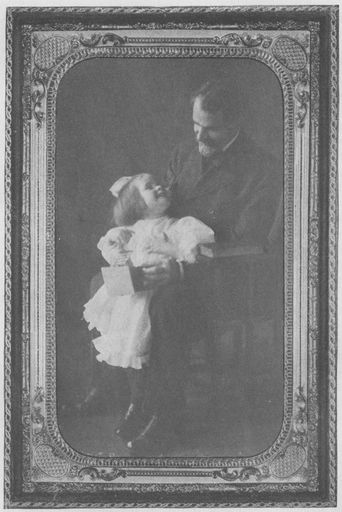
Entirely subject to my daughter, who regarded me as a wonder-working giant, I paid tribute to her in song, in story, and in frankincense and myrrh. Led by her trusting little hand I re-discovered the haunts of fairies and explored once more the land beneath the rainbow.
For the most part this was true. For several summers our daughter lived and throve at her birthplace, free of pain and in idyllic security—and then suddenly, one September day, like the chill shadow from an Autumn stormcloud, misfortune fell upon us. Our daughter became sick, how sick I did not realize until on the eighth day as I took her in my arms I discovered in her a horrifying weakness. Her little body, thinned with fever, hung so laxly, so lightly on my knee that my blood chilled with sudden terror.
With a conviction that I dared not even admit to myself, I put her back into her mother's keeping and hurried to the telephone. In ten minutes I had called to her aid the best medical men of the region. Especially did I appeal to Doctor Evans, who had helped to bring her into the world. "You must come," I said to him. "It is life or death."
He came, swiftly, but in a few moments after his arrival he gravely announced the dreadful truth. "Your child is in the last stages of diphtheria. I will do what I can for her but she should have had the antitoxin five days ago."
For forty-eight hours our baby's life was despaired of, yet fought for by a heroic nurse who refused to leave her for a single hour.
Oh, the suspense, the agony of those days and nights, when her mother and I, helpless to serve, were shut away from her, not even permitted to look at her. We could do nothing—nothing but wait through the interminable hours, tortured by the thought that she might be calling for us. During one entire dreadful night we writhed under one doctor's sentence, "The child can not live," and in these hours I discovered that it is the sweetest love that casts the blackest shadow. My joy in my daughter was an agony of fear and remorse—why had I not acted sooner?
As I imagined my world without that radiant face, that bird-like voice, I fell into black despair. My only hope was in the nurse, who refused to give her up. I could not talk or write or think of any other thing. The child's sufferings filled my mind with an intolerable ache of apprehension. I had possessed her only a few years and yet she was already woven into the innermost fibers of my heart.
That night, which I dare not dwell upon, put my youth definitely behind me. When the blessed word came that she would live, and I was permitted to look upon her small wasted face, I was a care-worn middle-aged man—willing to give up any part of my life to win that tiny sufferer back to health and happiness.
Pitiful little Mary Isabel, pale wraith of my sturdy comrade! When she lifted her beseeching eyes to me and faintly, fleetingly smiled—unable to even whisper my name, I, forbidden to speak, could only touch her cheek with my lips and leave her alone with her devoted nurse—for, so weak was she that a breath might have blown her away, back into the endless shadow and silence of the grave.
At that moment I asked myself, "What right have men and women to bring exquisite souls like this into a world of disease and death? Why maintain the race? What purpose is subserved by keeping the endless chain of human misery lengthening on?"
In times like these I was weaker than my wife. I grant her marvelous fortitude, sustained by something which I did not possess and could not acquire. She met every crisis. I leaned upon her serenity, her courage, her faith in the future which was in no sense a religious creed. It was only a womanly inheritance, something which came down the long line of her maternal Anglo-Saxon ancestors.
At last the day came when the nurse permitted me to take my daughter again in my arms and carry her out to the easy chair before the fire. The moment was perfect. The veil of snow falling without, the leaping firelight on the hearth, and the presence of my wife and father, united to fill me with happiness. I became the fond optimist again—the world was not so black—our year was worthy of Thanksgiving after all.
Nevertheless I was aware that a bitter ineradicable dusk had gathered in the corners and crannies of the old house. Something depressing, repellent, was in the air. My sense of joy, my feeling of comfort in its seclusion were gone.
"Never again will this be a restful home for you or for me," I declared to my daughter. "Its shadow is now an enemy, its isolation a menace." To my wife I said, "Let us go back to the city where the highest type of medical science is at the end of the telephone wire."
She consented, and taking the child in my arms, I left the village with no intention of ever returning to it. The fire on my family altar seemed dead, never again to be rekindled.
CHAPTER TWENTY-TWO
The Old Soldier Gains a New Granddaughter
For nearly two years I did not even see the Homestead. My aversion to it remained almost a hatred. The memory of those desolate weeks of quarantine when my little daughter suffered all the agonies of death, still lingered over its walls, a poisonous shadow which time alone could remove. "I shall never live in it again," I repeated to my friends, and when some one wanted to rent it for the summer I consented—with a twinge of pain I must confess, for to open it to strangers even for a few weeks seemed an act of disloyalty to the memory of my mother.
Meanwhile I remained a moderately happy and very busy citizen of Chicago. Not content with esthetic conditions and in the belief that my home for years to come must be somewhere in the city's confines, I had resolved to establish a Club which should be (like the Players in New York) a meeting place for artists and writers, a rallying point for Midland Arts. Feeling very keenly the lack of such a rendezvous I said to Lorado, "I believe the time has come when a successful literary and artistic club can be established and maintained."
The more I pondered on the situation, the greater the discrepancy between the Chicago of my day and the Boston of my father's day became. "Why was it that the Boston of 1860, a city of three hundred thousand people, should have been so productive of great writers, while this vast inland metropolis of over two million of people remains almost negligible in the world of Art and Letters?"
Fuller, who refused, characteristically, to endorse my plan, was openly discouraging. To him the town was a pestilential slough in which he, at any rate, was inextricably mired, and though he was not quite so definite with me, he said to others, "Garland's idea is sure to fail."
Clarkson, Browne and Taft, however, heartily joined my committee, and the "Cliff Dwellers," a union of workers in the fine arts, resulted. As president of the organization, I set to work on plans for housing the club, and for months I was absorbed in this work.
On the eighteenth of June, 1908, in the midst of my work on the club affairs, another daughter was born to us, a vigorous and shapely babe, with delicate limbs, gray eyes, and a lively disposition, and while my wife, who came through this ordeal much better than before, was debating a choice of names for her, Mary Isabel gravely announced that she had decided to call her sister "Marjorie Christmas," for the reason, as she explained, that these were the nicest names she knew. Trusting first born!—she did not realize the difference which this new-found playmate was about to make in her life, and her joy in being permitted to hold the tiny stranger in her arms was pathetic.
My own attitude toward "Marjorie Christmas" was not indifferent but I did not receive her with the same intensity of interest with which I had welcomed my first child. Her place was not waiting for her as was the case of Mary Isabel. She was a lovely infant and perhaps I would have taken her to my arms with keen paternal pride had it not been for the realization that in doing so I was neglecting her sister whose comradeship with me had been so close (so full of exquisite moments) that it could not be transferred to another daughter, no matter how alluring. A second child is—a second child.
To further complicate our problem, Constance (as we finally called her), passed under the care of a nursemaid, and for two years I had very little to do with her. I seldom sang this child to sleep as I had done countless times with Mary Isabel. She did not ride on the crook of my elbow, or climb on my back, or look at picture books with me, until she was nearly three years old. We regained her, but we could not regain the hours of companionship we had sacrificed. This experience enables me to understand the unhappiness which comes to so many homes, in which the children are only boarders, foundlings in the care of nurses and governesses. My poverty, my small dwelling have given me the most precious memories of my daughters in their childish innocence.
[Connie, who is now as tall as her mother and signs her drawings "Constance Hamlin Garland" is looking over my shoulder at this moment with a sly smile. It has long been known to her that she was, for several years, very much "in the discard" but she does not hold it against me. She knows that it would be hard for me to make a choice between my two jewels to-day—I allude to them as mine because I am writing this book. My wife has a different angle of vision concerning them.]
My father came down from West Salem to see this second granddaughter, and on the whole, approved of her, although his tenderest interest, like mine, remained with Mary Isabel, who was now old enough to walk and talk with him. To watch her trotting along the street with that white-haired warrior, her small hand linked with his, was to gain a deeply moving sense of the continuity of life. How slender the link between the generations appears in such a case!
Nothing, not even the birth of a new grandchild, could divert my father from his accustomed round of city sight-seeing. As in other times, so now he again demanded to be shown the Stockyards, the Wheat Pit, the Masonic Temple and Lincoln Park. I groaned but I consented.
It happened that Ira Morris, one of the owners of the Stockyards, was an acquaintance, and the courtesy and attentions which were shown us gave the old farmer immense satisfaction—and when he found that Frank Logan, of "Logan & Bryan," (a Commission firm to which he had been wont to send his wheat) was also my friend, he began to find in my Chicago life certain compensating particulars, especially as in his presence I assumed a prosperity I did not possess.
On paper I sounded fairly well. I was one of the vice-presidents of the National Institute of Arts and Letters. I had a "Town house" as well as a "country place," and under cover of the fact that very few of my friends had ever inspected both properties, I was able in some degree to camouflage my situation. In the city I alluded casually to "my Wisconsin Homestead," and when in West Salem I referred with quiet affluence to "my residence in Woodlawn." Explaining that it was a three story house I passed lightly over the fact that it was only eighteen feet wide! Similarly, in speaking of "our country home" I did not explain to all my friends that it was merely an ugly old farmhouse on the edge of a commonplace village. I stated the truth in each case but not the whole truth.
If my city friend, Charles Hutchinson, imagined me spending my summers in a noble mansion on the bank of a shining river it was not my duty to shock him by declaring that there was no water in sight and that my garden was only a truck patch. On the other hand, if my neighbors in West Salem thought of me as living in a handsome brick mansion in Chicago, and writing my stories in a spacious study walled with books, I was not obliged to undeceive them.
Fuller, alas! knew all the facts in both cases, and so did Ernest Seton, who had visited us in the country as well as in our city home. Fuller not only knew the ins and outs of my houses; he was also aware that my royalties were dwindling and that my wife was forced to get along with one servant and that we used the street cars habitually.
Being president of the Cliff Dwellers was an honor, but the distinction carried with it something of the responsibility of a hotel-keeper as well as the duties of a lecture agent, for one of our methods in building up attendance at the Club, was to announce special luncheons in honor of distinguished visitors from abroad, and the task of arranging these meetings fell usually to me. In truth, the activities of the club took a large part of my time and carried a serious distraction from my work, but I welcomed the diversion, and was more content in my Chicago residence than I had been for several years.
Whenever I spoke to Zulime of my failure as a money-getter she loyally declared herself rich in what I had given her, although she still rode to grand dinners in the elevated trains, carrying her slippers in a bag. It was her patient industry, her cheerful acceptance of endless household drudgery which kept me clear of self-conceit. I began to suspect that I would never be able to furnish her with a better home than that which we already owned, and this suspicion sometimes robbed me of rest.
This may seem to some of my readers an unworthy admission on the part of a man of letters but it is a perfectly natural and in a sense, logical result of my close associations with several of the most successful writers and artists of my day. It was inevitable that while contrasting my home with theirs, I should occasionally fall into moods of self-disparagement, almost of despair.
To see my wife (whom everybody admired) wearing thread-bare cloaks and home-made gowns, to watch her making the best of our crowded little dining-room with its pitiful furniture and its sparse silver, were constant humiliations, an accusation which embittered me especially as I saw no prospect of ever providing anything more worthy of her care.
For a woman of taste, wearing made-over gowns is a very real hardship, but Zulime bore her deprivations with heroic cheerfulness, taking a never-failing delight in our narrow home. She made our table a notable meeting place, for, if we had few dollars we owned many friends who found their way to us, and often from our commonplace little portal we plodded away in the rain or snow to dine in the stately palaces of the rich,—kings of commerce and finance.
Apparently we were everywhere welcome, and that this was due almost entirely to the winning personality of my wife, I freely acknowledge. That she had scores of devoted admirers was only too evident, for the telephone bell rang almost continuously of a morning. Always ready to give her time, her skill and her abounding sympathy to those who made piteous demands upon her, she permitted these incessant telephone interruptions, although I charged her with being foolishly prodigal in this regard. If she felt resentful of the narrow walls in which I had confined her, she did not complain.
Whatever my wife's state of mind may have been these were restless years for me. As an officer of several organizations and as lecturer, I was traveling much of the time, mostly on the trail between New York City and Chicago. Even when at home I had only three morning hours for writing—but that was not the worst of it. My convictions concerning my literary mission were in process of disintegration.
My children, my manifold duties as theatrical up-lifter and club promoter, together with a swift letting down of my mental and physical powers, caused me to question the value of all my writing. I went so far as to say, "As a writer I have failed. Perhaps I can be of service as a citizen," with my Oklahoma farms bringing in a small annual income, the scrape of my pen became a weariness.
That I was passing from robust manhood to middle age was also evident to me and I didn't like that. I resented deepening wrinkles, whitening hairs and the sense of weariness which came over me at the end of my morning's work. My power of concentration was lessening. Noises irritated me and little things distracted me. I could no longer bend to my desk for five hours in complete absorption. How my wife endured me during those years I can not explain. The chirp of my babies' voices, the ring of the telephone, the rattle of the garbage cart, the whistle of the postman—each annoyance chopped into my composition, and as my afternoons and evenings had no value in a literary way, I was often completely defeated for the day. Altogether and inevitably my work as a fictionist sank into an unimportant place. I was on the down-grade, that was evident. Writing was a tiresome habit. I was in a rut and longing to get out—to be forced out.
The annual dinner of the Institute of Arts and Letters that year was not cheering. With the loss of four members, Stedman, Aldrich, MacDowell and St. Gaudens, I realized as never before the swift changes at work in American letters. It was my duty and my privilege to speak that night in memory of MacDowell who had so often been my seat-mate, and as I looked around that small circle of familiar faces, a scene of loss, a perception of decay came over me like a keen wind from out a desolate landscape. On every head the snows had thickened, on every face a shadow rested. All—all were hastening to be history.
* * * * * *
From that circle of my elders in the East, I returned to my children in the West with a sense of returning to the future. The radiant joy of Mary Isabel's face as I displayed her presents, a ring and a story book, restored me to something like a normal faith in the world. "Wead to me, wead to me!" was now her insistent plea, and putting aside all other concerns I turned the pages of her new book, realizing that to her the universe was still a great and never-ending fairy tale, and her Daddy a wonder-working magician, an amiable ogre. Her eager voice, her raptured attention enabled me to recover, for a moment, a wholesome faith and joy in my world—a world which was growing gray and wan and cold with terrifying swiftness.
"Your childhood shall be as happy as my powers will permit," I vowed once again as I looked into her uplifted face. "You shall have only pleasant memories of me," and in this spirit I gave her the best of myself. I taught her to read, I told her stories which linked her mind with that of her pioneer grandmother, filling her brain with traditions of the middle border. Dear little daughter, her daddy was veritably a nobleman, her mother a queen—in those days!
My wife says that for ten years I was always either on the point of going somewhere, or just returning, and as I turn the pages of my diaries, I find this to be true, but also I find frequent mention of meetings with John Burroughs, Bacheller, Gilder, Alexander, Madame Modjeska, William Vaughn Moody and many others of my friends distinguished in the arts.
All my publishing interests and most of my literary friends were in New York (my support came from there), hence my frequent coming and going. Whether this constant change, these sudden and violent contrasts in my way of life strengthened my fictional faculty or weakened it, I can not say, but I do know that as the head of a family I found concentrated effort increasingly difficult and at times very nearly impossible. Constance was ailing for a year, and was a source of care, of pain to me, as to her mother. At times, many times, her sufferings filled me with a passionate pity, a sense of rage, of helplessness. Indeed both children were subject to throat and lung disorders, especially when in the city.
Oh, those cruel coughing spells, those nights of burning fever, those alarming hours of stupor or of terrifying delirium! "Can science find no check upon these recurrent forms of disease?" I demanded of our doctor. "Must humanity forever suffer the agonies of diphtheria and pneumonia? If so why bring children into the world?"
We always knew when these disorders had set in, we knew all the signs but no medicine availed to stop their progress. Each attack ran its course in spite of nurse and drug whilst I raged helplessly and Zulime grew hollow-eyed with anxious midnight vigil. Death was a never-absent hovering shadow when those bitter winter winds were blowing, and realizing this I came to hate the great desolate city in which we lived, and to long with the most passionate ardor for the coming of April's sun.
One of the first signs of spring (so far as Mary Isabel was concerned) was the opening of the "White City," a pleasure park near us, and the second event quite as conclusive and much more exciting was the coming of the circus. These were the red letter days in her vernal calendar, and were inescapable outings, for her memory was tenacious. Each May she demanded to be taken to the "Fite City" and later "the Kings and Queens" and "the fairies" of the circus claimed her worship. Together we saw these glorious sights, which filled her little soul with rapture.
For two years my estrangement from the old Homestead was complete, but when one April day I found myself passing it on my way to St. Paul, I was constrained to stop off just to see how my father and the garden were coming on.
This was late April, and the day warm, windless and musical with sounds of spring. The maples and the elms had adorned themselves with most bewitching greens, the dandelions beckoned from sunny banks, and through the radiant mist, the nesting birds were calling. In a flood, all the ancient witchery of the valley, all of the Homestead's loveliest associations came back to soften my mood, to regain my love. Wrought upon by the ever-returning youth of the world—a world to which my daughters were akin, I relented, "We will come back. Cruel as some of its memories are, this is home, I belong here, and so does Mary Isabel."
The sunlight streaming into my mother's chamber lay like a fairy carpet on the floor, waiting for the dancing feet of her grandchildren. Her spirit filled the room, calling to me, consoling me, convincing me.
All day I worked at trimming vines, and planting flowers while the robins chuckled from the lawn, and the maples expanded overhead. How spacious and wide and safe the yard appeared, a natural playground for the use of children.
And so it came about that on June seventeenth, just before Constance's second birthday, Mary Isabel and I took the night train for West Salem, leaving Zulime and the nurse to follow next morning. Greatly excited at the prospect of going to sleep on the cars my daughter went to her bed. "I kick for joy," she said, her eyes shining with elfin delight.
She loved the "little house" as she called her berth, and for an hour she lay peering out at the moon. "It follows us!" she cried out in pleased surprise.
"Yes, it is a kindly moon. It will keep right along overhead all the way to West Salem. But you must go to sleep now. I shall call you early in the morning to meet Grandfather."
She was a reasonable soul, entirely confident of my care, and so, putting her head on my arm, she went away to dreamland. At such times my literary ambitions and failures were of no account. [To wish myself back there with that tiny form beside me is folly—but I do—I do!]
In the cool lusciousness of the June morning we met Grandpa, and as we entered the gate of the Homestead (which Mary Isabel only dimly remembered), I said, "This is your home, daughter, you belong here."
"Can I pick the flowers? Can I walk on the grass?" she asked quickly.
"Yes, pick all you want. You can roll on the grass if you wish."
Too excited to eat any breakfast, she ran from posy bed to posy bed, and from tree to tree, indefatigable as a bee or humming-bird. At five in the afternoon Zulime and Constance came.
In the weeks which followed I renewed my childhood. To Mary Isabel as to me at her age, the cornfield was a vast mysterious forest, and the rainbow an overpowering miracle.
"Don't they have rainbows in the city?" she asked one evening as we were watching a glorious arch fade out of the sky above the hills.
"Not such big beautiful double ones," I replied. "They haven't room for them in the city."
She took the same delight in the flame and flare of the Fourth of July which I once owned. She loved to walk in the fields. Snakes, bugs, worms and spiders enthralled her. Each hour brought its vivid message, its wonder and its delight, and when now and again she was allowed to explore the garden with me at night, the murk and the stars, and the stealthily moving winds in the corn, scared, awed her. At such moments the universe was a delicious mystery. Keeping close hold upon my hand she whispered with excitement, "What was that, Poppie? What was that noise? Was it a gnome?"
For her I built a "House" high in the big maple, and there she often climbed, spending many happy hours singing to her dollies or conning over her picture books. Her face shone down upon me radiant with life's ecstasy. Baby Constance was to her a toy, a doll, I was her companion, her playmate. The garden seemed fashioned for her uses, and whenever I saw her among the flowers or sitting on the lawn, I forgot my writing, realizing that these were golden days for me as well as for her,—days that would pass like waves of light across the wheat.
Together with Zulime I received the house back into my affection. Once more I thought of it as something permanent, a sure refuge in time of trouble. It gave us both a comforting sense of security to know that we could, at need, come back to it and live in comfort. With no hope of attaining a larger income, saving money was earning money for us both. In this spirit I put in another bathroom, and enlarged the dining-room—doing much of the work with my own hands.
Nothing could be more idyllic than our daily routine that summer. Our diversions, dependent on a love of odorous fields, colorful hills and fruitful vines, were of arcadian content. Our wealth expressed in nuts and apples and berries was ample. With Mary Isabel I assumed that wild grapes were enormously important articles of food. "Without them we might grow hungry this winter," I warned her. In this spirit we harvested, intent as chipmunks.
After the nurse left us the two children slept together on an upstairs screened-in porch, and every night, just before they went to sleep, it was my habit to visit them. Lying down between them with a small head on each arm, I told them stories or answered the questions which were suggested by the trees and the sky. "What are stars? What makes the moon spotted? What does iron come from? How do people make wall paper?" and many others equally elemental. It was a tender hour for me and a delicious one for them.
Gradually as they grew older, they fell into the habit of saying, "Now tell us about when you were a little boy," and so I was led to freshen up on A Son of the Middle Border, which I had begun to rewrite. They could never get enough of these reminiscences and when, at nine o'clock, I said, "Daughties, you must go to sleep," they pleaded for "Just one more," and from this interest I derived a foolish hope that the book, if it should ever get published, would be successful.
It was sweet to hear those soft voices demanding an explanation of the universe whose wonders they were rediscovering in their turn. Every changing season, every expanding leaf was magical to them. A bat skittering about the chimney, the rustle of a breeze in the maples, were of sinister significance requiring explanation, and when at last I went away and they began to softly sing their wistful little evening prayer, one which Mary Isabel had composed, life seemed worthwhile even to me. I forgot the irrevocable past and confronted old age with composure.
Meanwhile my father's mind was becoming more and more reminiscent. His stories once so vivid and so full of detail had narrowed down to a few familiar phrases. "Just then Sherman and his staff came riding along," or "When I was camped on the upper waters of the Wisconsin." His memory was failing and so was his sense of hearing. He seldom quoted from a book, but he still cited Blaine's speeches or referred to Lincoln's anecdotes, and certain of Grant's phrases were often on his lips. In all his interests he remained objective, concerned with the world of action not with the library, and while he made no effort to talk down to Mary Isabel, he contrived to win her adoration, perhaps because she detected in his voice his adoring love for her. In the mist of his glance was the tender worship of youth on the part of age.
Always of a Sunday we sang for him and sometimes Uncle Frank, the last of the McClintocks, gray haired and lean and bent, came in with his fiddle and played while the children danced in the light of our fire, so lithe, so happy, so fairy-like in their loveliness that he and Lorette sat in silence, a silence which was at once tender and tragic. There was something alien as well as marvelous in the dramatic movements of those small forms.
Witnessing such scenes, moved by something elemental in their decay, I continued to brood over the manuscript which was to be a kind of autobiography, the blended story of the vicissitudes of the Garlands and the McClintocks. At times I worked upon it to the exclusion of all else, and when I read a part of the tale to Mary Isabel and found that she understood it and liked it, I was heartened.
Consider this! I now had a daughter to whom I could read my manuscript! Where did that personality come from? Was her soul merely the automatic reaction of a material organism against a material environment? Was her spirit dependent on the life of its little body or could it live on independent of the flesh? Acknowledging the benumbing, hopeless mystery of it all, I continued to live for my children, finding in them my comfort and my justification.
I have never known anything more perfect than some of those mid-August days when on some woodland slope, we gathered the luscious musky fruit of wild blackberry vines and at our camp fire broiled our steak and made our coffee for our evening, open-air meal.
There were no flies, no mosquitoes, no snakes, and the hillsides were abloom with luscious shining berries, berries so ripe they fell into our hands with the slightest touch, and so tender that they melted in our mouths. The wind filled with the odor of yellowing corn, and the smell of nuts and leaves, carried our songs to the mist-filled valley below us, and the children playing on the smooth sward found our world a paradise.
As the cool dusk began to cover the farms below us, we sang "Juanita" and "Kentucky Home" and told our last stories while the children lay at our feet, silent with rapture as I used to be, in similar circumstances, forty years before.
And then when the fire had died down and sleepy babies were ready to turn their faces bedward, we drove slowly down the winding lane to the dust-covered bridge, past the small cemetery where mother was sleeping, back to where the broad-roofed old house was waiting for us like some huge, faithful creature yearning to receive us once again beneath its wings. It was commonplace to our neighbors and without special significance to the world, but to my children it was noble and beautiful and poetic—it was home.
CHAPTER TWENTY-THREE
"Cavanagh" and the "Winds of Destiny"
No doubt the reader has come to the conclusion, at this point, that my habits as an author were not in the least like those of Burroughs or Howells. There has never been anything cloistered about my life, on the contrary my study has always been a point of departure rather than a cell of meditation. From Elm Street, from the Homestead, I frequently darted away to the plains or the Rocky Mountains, keenly aware of the fact that the miner and cattleman, the trapper and the trailer were being pushed into ever remoter valleys by the men of the hoe and the spade, and that the customs and habits which the mountaineer had established were about to pass, precisely as the blossoming prairies had long since been broken and fenced and made commonplace by the plow.
That the destruction of the eagle and the mountain lion marked another stage of that remorseless march which is called civilization I fully recognized and—in a certain sense—approved, although the raising of billions of hens and pigs admittedly useful, was not to me an inspiring employment of human energy. The long-horn white-faced steer was more picturesque than a "Mooly" cow.
Doubtless a dairyman is a more valuable citizen in the long run than a prospector or miner, but he does not so easily appeal to the imagination. To wade irrigating ditches, hoe in hand, is not incompatible with the noblest manhood, but it is none the less true that men riding the trail or exploring ledges of quartz are more alluring characters to the novelist—at least that was the way I felt in 1909 when I began to shape another book concerning the great drama which was going on in the forests of the High Country.
For more than fifteen years, while trailing among the mountains of Colorado, Montana and Wyoming, I had seen the Forest Service, under Gifford Pinchot's leadership, gradually getting into effect. I had seen the silver miner disappear and the army of forest rangers grow from a handful of hardy cowboys and "lonesome men" into a disciplined force of over two thousand young foresters who represented in some degree the science and the patriotism of their chief.
As in Hesper and The Captain of the Gray Horse Troop I had attempted to depict certain types of the red men, miners and ranchers. I now began to study the mountain vedettes from the point of view of the Forest Ranger, a federal officer who represented our newly acquired ideals of Conservation, and whose duty it was to act as custodian of the National Forests. I decided to write a novel which should, in some degree, delineate the heroic side of this warden's solitary life as I had seen it and shared it in a half-dozen forests in Colorado, Wyoming and Montana.
In this writing I put myself at the opposite pole from the scenes of The Shadow World, a study of psychic phenomena with which I had been deeply involved for a year or more. From dark cabinets in murky seance chambers, from contact with morbid, death-fearing, light-avoiding residents of crowded apartments, I now found myself riding once again ten thousand feet above sea level with men who "took chances" almost every hour of their lives—not from any reckless defiance of death but merely by way of duty, men who lived alone and rode alone, men in whose ears the mountain streams as they fell from the white silences of the snows, uttered songs of exultation. In the presence of these hardy trailers the doings of darkened seance rooms seemed morbid, if not actually insane.
The stark heroism of these forest guards, their loyalty to a far-off chieftain (whom they knew only by name) appealed to me with increasing power. Their problem became my problem. More than this they kindled my admiration, for many of them possessed the cowboy's masterful skill with bronchos, his deft handling of rope and gun and the grace which had made him the most admired figure in our literature,—but in addition to all this, they had something finer, something which the cowboy often lacked. At their best they manifested the loyalty of soldiers. Heedful of the Federal Government, they strove to dispense justice over the lands which had been allotted to their care, and their flags—the Stars and Stripes—as I came upon them fluttering from the peaks of their cabins were to me the guidons of a new and valiant skirmish line. They were of the Border in a new and noble sense. In short the Federal Ranger was a hero made to my hand.
Not all the soldiers in the service were of this large mold, I admit, but many of those I had met did possess precisely the qualities I have outlined. Ready, cheerful, undaunted in the face of danger, some of them had the capacity for lonely action which rendered them as admirable in their way as any of the long line of frontiersmen who had made the winning of the West an epic of singular hardihood. To fight cold and snow and loneliness during long months, with no one looking on, calls for stern resolution. Such work is directly antithetic to that of the city fireman who goes to his duties with a crowd looking on. The ranger has only his own conscience as spectator. For many weeks he does not even see his supervisor.
To the writing of Cavanagh I came, therefore, in the spirit of one who had discovered not only a new hero but the reverse side of the squatter's shield. Just as in my studies for The Captain of the Gray Horse Troop, I had come upon the seamy side of the cattleman's activity, so now I perceived that many of the men who had settled on the national forests were merely adventurers trying to get something for nothing. To filch Uncle Sam's gold, to pasture on his grass, to dig his coal and seize his water-power—these were the real designs of the claim-holders, while the ranger was in effect a federal policeman, the guardian of a domain whose wealth was the heritage of us all. He was the prophet of a new order, the evangel of a new faith.
The actual composition of Cavanagh began as I was riding the glorious trails around Cloud Peak in the Big Horn Mountains of northern Wyoming in the summer of 1908, one of the most beautiful of all my outings, for while the Big Horns are low and tame compared to the Wind River Range, yet the play of their lights and shadows, their clouds, and their mist was as romantic as anything I had ever encountered.
I recall riding alone down the eastern slope one afternoon, while prodigious rivers of cloud—white as wool and soundless as light—descended the cañon on my right and spread above the foothills, forming a level sea out of which the high dark peaks rose like rocky islands. This flood came so swiftly, flowed so marvelously and enveloped my world so silently that the granite ledges appeared to melt beneath my horse's feet.
At times the vapor closed densely round me, shutting out even the rocks of the trail and as I cautiously descended, I almost bumped astonished steers whose heads burst from the mist as if through a covered hoop. The high granite crags on the opposite side of the ravine took on the shapes of ruined castles seated on sloping shores by foaming seas, their smooth lawns reaching to the foam.
At one point, as I came out upon a ledge which overlooked the valley, I perceived my horse's shadow floating on the phantom ocean far below me, a dark equestrian statue encircled with a triple-ringed halo of fire. In all my mountain experiences I had never seen anything so marvelous.
At another time while riding up the trail, I perceived above my head a far-stretching roof of seamless cloud. As I rose, coming closer and closer to it, it seemed a ceiling just above my reach, then my head merged in it. A kind of dry mist surrounded me—and for ten or fifteen minutes I mounted through this luminous, strangely shrouding, all pervasive, mountain cloud. My horse, feeling his way with cautious care, steadily mounted and soon we burst out into the clear sunlight above. While still the mist curled about my horse's hoofs, I looked across a shoreless ocean with only Cloud Peak and its granite crags looming above its surface.
I describe these two spectacular effects out of many others merely to suggest the splendors which inspired me, and which, as I imagined, enriched the daily walk of the forest guard. "To get into my story some part of this glory, my hero must be something of a nature lover—as many rangers are," I argued, and this was true. Before a man will consent to ride the lonely road which leads to his cabin high in the forest, he must not only have a heart which thrills to the wonder of the lonely places, he must be self-sufficing and fearless. I rode with several such men and out of my experiences with them I composed the character of Ross Cavanagh.
The actual writing of this novel was begun on my forty-ninth birthday at my desk in the old Homestead, and I started off with enthusiasm notwithstanding the fact that Fuller, who was visiting me at the time, expressed only a tepid interest in my "theme." "Why concern yourself with forestry?" he asked. "No one wants to read about the ranger and his problems. Grapple with Chicago—or New York. That's the only way to do a 'best seller.'"
Henry always amused me but never so much as when tolerating rural joys. He was the exact opposite of my Cavanagh. Everything pastoral wearied him or irritated him. The "yelping" of the robins, the "drone" of the katydids, the "eternal twitter" of the sparrows infuriated him. The "accursed roosters" unseasonably wakened him in the morning, the "silly cackle" of the chickens prevented him from writing. Flowers bored him and the weather was always too cold or too hot, too damp or too dusty. Butterflies filled him with pessimistic forebodings of generations of cabbage worms. Moths suggested ruined coat collars—only at night, before our fire, with nature safely and firmly shut out, did he regain his customary and charming humor.
He belonged to the brick pavement, the electric-car line. He did not mind being awakened by the "twitter" of a milk cart. The "yelp" of the ice man, the snort of a six o'clock switch engine and the "cackle" of a laundry wagon formed for him a pleasant morning symphony. The clatter of an elevated train was with him the normal accompaniment of dawn, but the poetry of the pastoral—well, it didn't exist, that's all—except in "maudlin verses of lying sentimentalists." "I'm like George Ade's clerk: I never enjoy my vacation till I get back to the city."
To all such diatribes Zulime and I gave delighted ear. We rejoiced in his comment, for we did not believe a word of it, it was all a part of Henry's delightful perversity.
For six consecutive weeks I bent to the work of writing my novel undisturbed. A peaceful season which I shall long remember, for almost every afternoon, when the weather permitted, we joined the Dudleys and McKees and drove to some lovely spot on the river bank or sought out some half-hidden spring at the far end of a coulee and there, while the children picked nuts or apples and the women read magazines or stitched, George Dudley and I lighted our fire and broiled our steak. Nothing could be simpler, homelier, more wholesome, than this life, and I was able to do nearly half my story before a return to Chicago became necessary.
Practically all of the spring months of 1910 were given to revising and proof-reading Cavanagh, Forest Ranger, which had genuinely interested me and which should have been as important in my scheme of delineating the West as The Captain of the Gray Horse Troop, but it wasn't. It was too controversial, and besides I did not give it time enough. I should have taken another year to it—but I didn't. I permitted myself to be hurried by Duneka, who was (like most publishers) enslaved to a program. By April it was off my hands.
After the last page of this proof was returned to the printer a sense of weakness, of age, a feeling altogether new to me, led me to say to Fuller, "I shall never do another book. I have finished what I started out to do, I have pictured certain broad phases of the West as I know it, and I'm done. I am out of commission."
Fuller, who had been of this mood for several years, was not content to have me assume a despairing attitude. "You're just tired, that's all," he insisted. "You'll come to a new theme soon."
Movement is swift on the Border. Nothing endures for more than a generation. No family really takes root. Every man is on his way. Cities come and builders go. Unfinished edifices are left behind in order that something new and grander may be started. Some other field is better than the one we are reaping. I do not condemn this, I believe in it. It is America's genius. We are all experimenters, pioneers, progressives.
For years I had in mind to write a book to be called The Winds of Destiny, in which I should take up one by one the differing careers of my classmates and friends who had found our little prairie town too narrow and too poor to afford them fullest action. I never got to it, but from time to time I found some new material for it—material which, alas! I can not now find imagination enough to vitalize.
For example: One morning during a stay in New York, I found among my letters a note from an almost forgotten school-fellow, inviting me to dine with himself and wife at the Ritzdorf. The name on this note-head developed on the negative plate of my memory, the picture of two shock-headed, slender-legged schoolboys pacing solemnly, regularly, morning after morning, into the campus of the Seminary in Osage, Iowa. Their arms were always laden with books, their big brows bulging with thought. Invariably marching side by side like a faithful team of horses, turning aside neither to fight nor to play, they provoked laughter.
They were the sons of a farmer (a man of small means, who lived a mile or two from the village), and although they were familiar figures in the school they could hardly be said to be a part of it. Their poverty, their homespun trousers which were usually too short and too tight, and their poverty together with a natural shyness, kept them out of school affairs, although they were always at the top of their classes. To me they were worthy—though a bit grotesque.
My letter of invitation was from the younger of these boys, and having accepted his invitation, I was a bit in doubt as to what I should wear, for he had written, "with Mrs. Roberts and myself," and something in the tone of the letter had decided me to play safe. I put on evening dress, and it was well I did, for Ben met me in irreproachable dinner coat and presented his wife, a handsome and beautifully gowned woman, quite in the manner of a city-bred host. No one looking at us as we sat at our flower-decked table would have imagined that he or I had ever been plow-boys of the Middle Border.
As the dinner went on I lost all my conviction that the preternaturally solemn, heavy-footed lad of 1880 was in any way connected with this rich middle-aged inventor, but then he was probably having the same difficulty relating me with the beardless senior of 1881.
On the surface our dinner was a pleasant and rather conventional meeting, and yet the more it is dwelt upon the more significant it becomes. Starting from almost the same point, with somewhat similar handicaps, we two had "arrived," though at widely separated goals. Each of our courses was characteristically American, and each was in demonstration—for the millionth time—of the magic power of the open lands.
In the free air of the Middle Border, this man's genius for inventing had full power of expansion, and in result he was in possession of a fortune, whilst I, in my literary way, had won what my kindest critics called success—by another kind of service. My position though less secure and far less remunerative, was none the less honorable—that I shall insist on saying even though I must admit that in the eyes of my Seminary classmates the inventor made the handsomer showing. As the owner of a patent bringing in many thousands of dollars per year in royalty he had certain very definite claims to respect which I lacked. My home in contrast with his would have seemed very humble. Measured by material things, his imagination had proved enormously more potent than mine.
This meeting not only led me to re-value my own achievement, it brought up to me with peculiar pathos the career of another classmate, my comrade Burton Babcock, whom I (in 1898) had left standing on the bank of the Stickeen River in Alaska. He, too, was characteristically American. He had carried out his plan. After leading his pack train across the divide to the upper waters of the Yukon, he had built a raft and floated down the Hotalinqua. He had been frozen in, and had spent the winter in a windowless hut in the deep snow of an arctic landscape—and when, after incredible hardships, he had reached the Klondike, he had found himself almost as far from a gold claim as ever. All the mines were monopolized.
For the next four years he had alternately worked for wages and prospected for himself. One year he had "mushed" in the Copper River Country and later in the Tanana. In these explorations he went alone, and once he sledged far within the Arctic circle with only two dogs to keep him company. He became one of the most daring and persistent prospectors and yet he had always been just a little too late. He had never shared in any of the big strikes.
At last, after five years of this disheartening life, he had succeeded in breaking away from the fatal lure of the North. Returning to Anacortes on Puget Sound, he had taken up the threads of his life at the point where he had dropped them, to meet me, at Ashcroft, in '98, and on my little daughter's wrist was a bracelet, a string of nuggets, which represented all that he had been able to win from the desolate North.
He left his youth in Alaska. He was an old and broken man when he landed in Seattle, a silent, gray and introspective philosopher. Seeking out the cabin he had built on the Skagit River, he resumed his residence there, solitary and somber. In winter he cooked for a nearby lumber camp, in summer he served as watchman for an electric power company, patient, faithful, brooding over his books, austere, taciturn, mystical.
He read much on occult subjects, and corresponded ceaselessly with a certain school of esoteric philosophy, reaching at last a lofty serenity which approached content. He wrote me that the men of the lumber camp spoke of him as a "queer old cuss," but that disturbed him not at all. To me, however, he uttered his mind freely, and as I followed him thus, in imagination, remembering him as he once was, my graceful companion on the bright Iowa prairie, my sense of something futile in his whole life was deepened into pain.
His letters contained no complaint. He dwelt mainly upon his trips into the forest (occasional vacations from repulsive labor), but I was able to infer from a word here and there, his detestation of the coarse jests and senseless arguments of his "Siwash" companions. His philosophy prevented repining; but he could not entirely conceal his moods of loneliness, of defeat.
My heart ached as I thought of him, wearing his life away in the solitude of the forest, or in waiting on a crowd of unthinking lumber jacks, but I could do little to aid him. I had sent him books and loaned him money whenever he would accept it (which was seldom), and I had offered each year to bring him back to the Middle West and put him on a farm; but to all these suggestions he continued to repeat, "I can't bring myself to it. I can't return, a defeated explorer."
Like my uncle David, he preferred to walk the path he had chosen, no matter to what depth it might descend.
Not long after this meeting with Ben and while I was still absorbed in youthful memories, dreaming of my prairie comrades, a letter came to me from Blanche Babcock, telling me that her brother Burton, my boyhood chum, my companion on The Long Trail to the Yukon, had crossed the Wide Dark River, and with this news, a sense of heavy loss darkened my day. It was as if a part, and no small part, of my life had slipped away from me, irrecoverably, into a soundless abyss.
For more than forty years this singular soul had been a subject of my care (at times he had been closer to me than my own brother), and now he had vanished from the tangible realities of his mountain home into the unmapped region whose blind trails we had so often manfully discussed.
By all the laws which his family recognized, his life was a failure. To Ben Roberts he was a derelict—and yet to me a kind of elemental dignity lay in the attitude he had maintained when surrounded by coarse and ignorant workmen. He remained unmoved, uncontaminated. His mind inhabited a calm inner region beyond the reach of any coarse word or mocking phrase. Growing ever more mystical as he grew older he had gone his lonely way bent and gray and silent, a student of the forest and the stream. So far as I know he never uttered a bitter or despairing word, and when the final great boundary river confronted him he entered it with the same courage with which he ferried the Yukon or crossed the ice fields of Iskoot.
It happened that on the day this news came to me one of my Chicago friends sent their beautiful motor car to fetch Zulime and me to the opera, and as the children saw us in our evening dress, they cried out, "Oh papa, mama is a queen and you look like a king!" Thus it happened that I rode away in a luxury which I had not earned at the very moment when my faithful trail-mate, after toiling all his life, was passing to his grave wifeless, childless and unknown.
"I wish I could have shared just a little of my good fortune with him," I said to Zulime, who really was as stately as a queen. But the best of all my possessions I would not, could not, share with any one—I mean the adoration of my little daughters to whom I possessed the majesty of an emperor.
"Here his trail ends. Here by the landing I wait the same oar—the slow, silent one. We each go alone—no man with another, Each into the gloom of the swift, black flood. Burt, it is hard, but here we must sever. The gray boatman waits, and you—you go first. All is dark over there where the dim boat is rocking, But that is no matter—no trailer need fear, For clearly we're told, the powers which lead us, Will govern the game till the end of the day. Good-by!—Here the trail ends!"
* * *
Christmas came this year with special significance. Two pairs of eager eyes now peered at all bundles which came into the house. The faith and love and eager hope of my daughters made amends for the world's lack of interest in my writings. They and their mother were my wealth, their love compensated me for the slender dribble of my royalties.
"Our Christmas shall be as happy as that of any millionaire," was the thought which actuated me in the purchase and decoration of our tree. Wealth was highly desirable, but absurd as it may seem I had no desire to change places with any merchant or banker. The foolish notion that something historical in my work made it worth while, supported me in my toil. It was a hazy kind of comfort, I will concede, but I wrapped myself in it, and stole away out into the street to buy and sneak a Christmas tree up the back stairs. It was a noble tree, warranted to reach the ceiling of our library.
Father came down from Wisconsin and Franklin came up from Oklahoma to help me decorate it, and when, on Christmas morning, they both rose with me, and went down to light the candles, they were almost as gleeful as I. Mary Isabel was awake and piping from the top of the stairs, "Is it time, papa? Can we come now, papa?" and at last when the tower of glory was alight I called back, "Yes, now you may all come."
Slowly she descended step by step, clinging to her mother, who was carrying Constance. Very slowly the procession approached, for the little voluptuary in front was loath as well as eager—avid to enjoy yet hesitating to devour. Suddenly she saw, and into her face flamed an expression of wonder, of awe, of adoration, a look such as a cherub angel might wear while confronting The Great White Throne, a kind of rapture, humble yet exultant.
Silently she crept toward the center of the room, turning her eyes from this and to that unearthly splendor, yet always bringing them back to rest upon the faces of the dollies, sitting so still and so radiant beneath the glittering boughs. At last with a little gasping cry of joy she seized the largest and most splendid of these wondrous beings and clasped it to her breast, while Constance sat silent with her awe.
Their Christmas was complete. Another shining mark had been set in the upward slope of their happy march! Nothing, not even Death himself, can rob me of that precious memory.
CHAPTER TWENTY-FOUR
The Old Homestead Suffers Disaster
The summer of 1912, so stormy in a political sense was singularly serene and happy for us. The old house had been received back into favor. It was beloved by us all but especially was it dear to my children. To Mary Isabel it possessed a value which it could not have to any of us, for it was her birth-place and she knew every stick and stone of it. To her it had all the glamor of a childhood home in summer time.
On Sunday, October 6, we began to plan our return to the city, and as we sat about our fire that night the big room never looked so warm, so homelike, so permanent. The deep fireplace was ablaze with light, and the walls packed with books and hung with pictures spoke of a realized ideal. On the tall settee (which I had built myself), lay a richly-colored balletta Navajo blanket, one that I had bought of a Flathead Indian in St. Ignatius. Others from Zuni and Ganado covered the floor. Over the piano "Apple Blossom Time," a wedding present from John Ennecking glowed like a jewel in the light of the quaint electric candles which had been set in the sockets of hammered brass sconces. In short, the place had the mellow charm of a completed home, and I said to Zulime "There isn't much more to do to it. It is rude and queer, a mixture of Paris, Boston, and the Wild West; but it belongs to us." It was in truth a union of what we both represented, including our poverty, for it was all cheap and humble.
My father, white-haired, eighty-two years of age was living with us again, basking in the light of our fire and smiling at his grandchildren, who with lithe limbs and sweet young voices were singing and circling before him. I was glad to have him back in mother's room, and to him and to those who were to be his care-takers for the winter I gravely repeated, "I want everything kept just as it is. I want to feel that we can come back to it at any time and find every object in place, including the fire."
To which father replied, "I don't want to change it. It suits me."
The children, darting out of the music-room (which was the "dressing-room" of their stage), swung their Japanese lanterns, enacting once again their pretty little play, and then our guests rose two by two and went away. Zulime led the march to bed, the lights were turned out and the clear, crisp, odorous October night closed over our scene.
As I was about to leave the low-ceiled library, I took another look at it saying to myself, "It seems absurd to abandon this roomy, human habitation for a cramped little dwelling on a city lot." But with a sense of what the city offered by way of compensation, I climbed the old-fashioned, crooked, narrow stairway to my bed in the chamber over the music-room, content to say good-by for the winter....
It was dusky dawn when I awoke, with a sense of alarm, unable to tell what had awakened me. For several seconds I lay in confusion and vague suspense. Then a cry, a strange cry—a woman's scream—arose, followed by a rush of feet. Other cries, and the shrieks of children succeeded close, one upon the other.
My first thought was, "Constance has fallen." I sprang from my bed and was standing in the middle of the room when I heard Zulime cross the floor beneath me, and a moment later she called up the stairway, "Hamlin, Fan has set the house on fire!"
My heart was gripped as if by an icy hand for I knew how inflammable the whole building was, and without stopping to put on coat or slippers, I ran swiftly down the stairs. As I entered the sitting-room so silent, so peaceful, so undisturbed, it seemed that my alarm was only a part of a dream till the sobbing of my daughters and my wife's voice at the telephone calling for help, convinced me of the frightful reality. I heard, too, the ominous crackling of flames in the kitchen.
Pushing open the swinging door I confronted a wall of smoke. One-half of the floor was already consumed, and along the linoleum a sharply-defined line of fire told that it rose from burning oil—and yet I could not quite believe it, even then. It was like a scene in a motion picture play.
My first thought was to check, to hold back the flames, till help came. The garden hose was lying out under a tree (I had put it there the day before) and with desperate haste I hurried to attach it to the water pipes. I saw father in the yard, but he uttered no word. We were each thinking the same thought—"The old homestead is doomed. Our life here is ended."
The hose was heavy and sanely perverse, and it seemed an age before I had the water turned on. Catching up the nozzle I approached the kitchen door. The thin stream had no effect, and the heat was so intense I could not face it. Throwing down the hose I reëntered the house.
The children, hysterical with fright, were just leaving by the east door and Zulime was upstairs. Opening the front door I stepped out upon the porch to call for help. The beauty of the morning, its stillness, its serenity, its odorous opulence, struck upon my senses with a kind of ironic benignancy, as if to say, "Why agonize over so small a thing?"
I shouted "Fire!" and my voice went ringing far up the street. I cried out again, a third time, a fourth, but no one answered, no one appeared, and behind me the crackling roar of the flames increased. In despair I turned back into the sitting-room.
It had been arranged between Zulime and myself that in case of fire (once the children were safe), she was to secure the silverware and her jewelry whilst I flew to collect my manuscripts.
With this thought in my mind, and believing that I had but a few minutes in which to work, I ran up the stairs to my study and began gathering such of my manuscripts as had no duplicates. As I thought of the hundreds of letters from my literary friends, of the many family records, of the innumerable notes, pictures, keepsakes, souvenirs and mementoes which had been assembling there for a quarter of a century, I became confused, indecisive. It was so hard to choose. At last I caught up a sheaf of unpublished stories which filled one drawer, and beating off the screen of the north window threw the manuscripts out upon the grass.
A neighbor's wife, quick to understand the meaning of my anxiety about these sheets, ran to her home across the way and bringing a valise, began to stuff them into it. Having cleared my desk of its most valuable papers I hurried to my dressing-room to secure shoes and trousers; but by this time the hall was full of the most nauseating smoke. The fire having swept entirely through the library, was burning the front porch. My escape by way of the stairway was cut off. Blinded and gasping I gave up the search for clothes and turned back into my study.
I was not in the least scared; on the contrary, I was filled with a kind of fatalistic rage. In imagination I saw the old house, with all that it meant to me, in ruins. I saw the great elms and maples scorched, dead, the tall black locust burned to a ship's mast. As I peered from the window, a neighbor called earnestly, "You'd better get off there; the whole house is going."
From the window I could see the villagers rapidly assembling, and not knowing how far advanced the flames might be I yielded to the advice of my friend, and swinging myself from the window dropped to the ground.
My next care was for the children. I could hear them crying frantically for "papa!" and I hurried to where they stood cowering in the door of the barn. "O, papa, put it out. I don't want it to burn. Put it out!" moaned Mary Isabel with passionate intensity.
Her faith in her father had an infinite pathos at the moment. She loved the house. It was a part of her very brain and blood. To have it burn was a kind of outrage. Little Connie, five years old, with chattering teeth, joined her pleading cry, "Can't you put it out, papa?" she asked piteously.
"No," I answered sadly. "Papa can not put it out. Nobody can. You must say good-by to our dear old home."
Wrapping a quilt about her I started across the road toward my neighbor's porch. The yard was full of my fellow-citizens, and young men were heroically dragging out smoking furniture from the lower floor, while over in the Sander's yard piles of books, bedding and furniture were accumulating. It was all curiously familiar and typical.
In the full belief that the homestead would soon be a heap of charcoal, we took the children back into our friend's dining-room. "Pull down the curtain," entreated Zulime, "we don't want to see the old place go."
Helpless for lack of street clothing, with my children on my knees, I sat in silence, noting the flickering glare of the light on the walls, and hearing the shouts of the firemen and the sound of their axes.
Huldah, our neighbor's daughter, entered. "They're checking it!" she exclaimed. "It is under control."
This seemed incredible, but it was confirmed by George Dudley, who came in bringing my shoes and a suit of my clothing.
When at last I was fully clothed and could go out into the street I was amazed to find a part of the house standing. Most of the east wing seemed quite untouched, except of smoke and water. The west wing and front porch were in black disarray, but the roof held its place and the trees seemed scarcely scorched. A few firemen, among them the village plumber, the young banker, and a dentist, were on guard, watchfully intent that the flames should not break out again. The sun was rising gloriously over the hills. The fire, my fire, was over.
No doubt this event appeared most trivial to the travelers in a passing train. From the car windows it was only a column of smoke in the edge of a small village. Our disaster offered, indeed, only a mild sensation to the occupants of an early automobile party, but to my father, to Zulime and to the children, it was a desolate and appalling ruin. They had grown to love this old house foolishly, illogically, for it was neither beautiful nor historic, nor spacious. It was only a commonplace frame cottage, inwrought with memories and associations, but it was home—all we had.
The yard was piled with furniture, half-burned, soaked and malodorous, but none of my manuscripts were in sight. I had expected to find them scattered like feathers across the garden or trampled into the muddy sward. In reply to my question my friend Dudley replied, "They're all safe. I had the boys carry them down in blankets. You'll find them in the barn."
As I moved about silently, studying the ruins, the kindliest of my neighbors said, "You'll have to entirely rebuild." And to this a carpenter, a skilled and honest workman, agreed. "The cheapest thing to do is to tear it all down and start from the foundation."
Slowly, minutely, I studied the ruin. Surely here was gruesome change! Black, ill-smelling, smoking debris lay where our pretty dining-room had been. The library with all my best books (many of them autographed) was equally desolate, heaped with steaming, charred masses of tables, chairs, rugs and fallen plaster. I thought of it as it had been the night before, with the soft lights of the candles falling upon my children dancing with swinging lanterns. I recalled Ennecking's radiant spring painting, and Steele's "Bloom of the Grape," which glowed above the mantle, and my heart almost failed me—"Is this the end of my life in Wisconsin?"
For twenty years this little village had been the place of my family altar, not because it was remarkable in any way, but because since 1850 it had been the habitat of my mother's people and because it was filled with my father's pioneer friends. "Is it worth while to rebuild?" I asked myself. For the time I lost direction. I had no plan.
The sight of my white-haired father wandering about the yard, dazed, bewildered, his eyes filled with a look of despair at last decided me. Realizing that this was his true home; that no other roof could have the same appeal, and he could not be transplanted, I resolved to cover his head; to make it possible for him to live out his few remaining years under this roof with his granddaughters. "For his sake and the children's sake," I announced to Zulime, "I shall begin at once to clear away and restore. Before the winter comes you shall all be back in the old House. Perhaps we can eat our Thanksgiving dinner in the restored dining-room."
Whether she fully shared my desire to rebuild or whether she believed in my ability to carry out my plan so quickly I can not say. In such matters she was not decisive—she rested on my stubborn will.
The day came on—glorious, odorous, golden—but we saw little of its beauty. Engaged in digging the family silver out of the embers, and collecting my scattered books and papers I had no time to look at the sky. Occasionally, as I looked up from my work I saw my little daughters playing with childish intentness among the fallen leaves in my neighbor's yard, and in mistaken confidence I remarked what a blessing it is that childhood can so easily forget disaster.
I did not realize then, nor till many months after, how profound the shock had been to them. For years after the event they started at every unusual sound and woke at night screaming of fire.
All that day and all the days of the week which followed they played with the same singular insect-like absorption and at last I began to get some notion of their horror. They refused to enter the yard. "I don't want to see it," Mary Isabel wailed. Then she asked, "Will it ever be home for us again?"
"Yes," I answered with final determination. "I'll put it back just as it was before the fire came. It shall be nicer than ever when I am done."
Before night I had engaged a crew of men to clear away. Thereafter I lived like a man in a tunnel. I saw almost nothing of the opulent, golden sunshine, nothing of the exquisite foliage, nothing of the far hills, purple with Indian summer haze. Busily sorting my burned books or spreading out my treasured rugs, I toiled as long as light lasted. There were a few pleasant surprises. From one charred frame the face of Frank Norris, miraculously fresh and handsome and smiling, looked out through smoked and broken glass. In one corner of the sideboard (decorated by Thompson-Seton), a part of the silver bearing my mother's initials lay quite unharmed, though all of the pieces on the top were melted into a flat mass of bullion. Autographed books from Howells, Riley, Gilbert Parker, Conan Doyle, Arnold Bennett, fell to pieces in my hand, or showed so deep a stain of smoke as to make their rebinding impossible. My best Navajo rug, a fine example of the ancient weaving, was a frail cinder on the back of the charred settee, and a Hopi ceremonial dress which hung upon the wall was a blackened shred.
All these things had small money value, and to many men, would have represented no interest whatsoever, but to me they were precious. They were a part of my life. To burn them was to char a section of my brain. Pitiful possessions! Worthless rags! And yet they were the best I could show after thirty years of labor with the pen!
My father's condition troubled me most. To have him rendered homeless at eighty-two with winter coming on seemed to me an intolerable cruelty, and so with a driving haste I set to work with my own hands to clear away and restore. Wielding the wrecking bar and the spade each day, I toiled like a hired man—even after the carpenters were gone at night I scraped paint and shoveled rubbish.
Let no one pity me! A curious pleasure came with all this, for it seemed to advance the reconstruction with double swiftness.
At the end of the week I sent my wife and the children back to their city home, and thereafter I had but one interest, one diversion—to plan and execute my rebuilding. To close the walls, to make the rooms secure against wind and rain was imperative.
The insurance inspector came pleasantly to the rescue, and with a small balance in the bank I hired roofers, plumbers, carpenters, masons, till the street resounded with their clamor. In a week I had the rooms cleared, the doors and windows closed, and my father living in one corner of the house, whilst I camped down in my study. Water-soaked, ill-smelling, but inhabitable, the old house again possessed a light and a hearth.
"The children and their grandsire shall eat Thanksgiving dinner in the rebuilt dining-room," was my secret sentimental resolution. "To do that will turn a wail into a song—a disaster into a poem."
All very foolish, you say. No doubt, but it interested me and I was of an age when very few things interested me vitally. With clothing black as soot, with hands brown with stain and skinned and swollen and feverish, I kept to my job without regard to Sundays or the ordinary hours of labor. I was not seeking sympathy,—I was renewing my youth. I was both artist and workman. My muscles hardened, my palms broadened, my appetite became prodigious. I lost all fear of indigestion and ate anything which my friend Dudley was good enough to provide. I even drank coffee at every opportunity, and went so far as to eat doughnuts and pancakes at breakfast! To be deliciously hungry as of old was heartening.
The weather continued merciful. Each day the sun rose red and genial, and at noon the warm haze of Indian summer trailed along the hills—though I had little time in which to enjoy it. Each sunset marked a new stanza in my poem, a completed phrase, a recovered figure. "Our small affairs have shut out the light of the sun," I said to father, "the political situation has lost all interest for me."
Bare, clean and sweet, the library and music-room at last were ready for furniture. All these must be replaced. A hurried trip to the city, three days of determined shopping with Zulime, and a stream of new goods (necessary to refurnish), began to set toward the threshold. The draymen plied busily between the station and the gate.
By November first my father and I were camping in the library and cooking our own food in the dining-room. We rose each day before dawn and ate our bacon and coffee while yet the stars twinkled in the west, and both of us were reminded of the frosty mornings on our Iowa farm, when we used to eat by candle-light in order to husk corn by starlight. My hands felt as they used to feel when, worn by the rasping husks, they burned with fever. Heavy as hams, they refused to hold a pen, and my mind refused to compose even letters—but the pen was not needed. "My poem is composed of wood and steel," I remarked to Dudley.
At last the yard was cleared of its charred rubbish, the porch restored to its old foundation, and the new metal roof, broad-spreading and hospitable, gleamed like snow in dusk and dawn, and from the uncurtained windows our relighted lamps called to the world that the Garland household was about to reassemble and the author permitted himself to straighten up. Changing to my city garments I took the train for Chicago, promising to bring the children with me when our Thanksgiving turkey was fatted for the fire.
My daughters listened eagerly to my tale of the new house, but expressed a fear of sleeping in it. This fear I determined to expel.
On the Saturday before Thanksgiving I rejoined my workmen, finding the house in a worse state of disarray than when I had last seen it. The floors were littered with dust and shavings, and in the dining-room my father, deeply discouraged, was gloomily cooking his breakfast on an oil stove set in the middle of the floor. "It'll take another month to finish the job," he said.
"Oh, no it won't," I replied. "It won't take a week."
Fortunately the stain on the floor was dry and with the aid of two good men I finished the woodwork and beat the rugs. In a couple of days the lower house was livable.
On Wednesday at five o'clock I went to the train, leaving the electric lights all ablaze and the fire snapping in the chimney. It looked amazingly comfortable, restored, settled, and I was confident the children would respond to its cheer.
"Is it all made new?" they asked wistfully.
"Wait and see!" I confidently replied.
The night was cold and dark but as they neared the old house its windows winked a cheery welcome. "Why, it looks just as it used to!" exclaimed Mary Isabel.
"There are lights in our room!" exclaimed Constance.
"Run ahead, and knock," I urged.
She hung back. "I'm afraid," she said.
"So am I," echoed Connie.
The new metal roof gleaming like frost interested them as they entered the gate.
"Why, the porch is all here!" shouted Constance.
"But the screens are off," commented Mary Isabel.
"Knock!" I commanded.
Reaching up to the shining old brass knocker she banged it sharply.
The house awoke! White-haired old father came to the door and, first of all, the children sprang to his arms.
Then as they looked around they shouted with joy. "Why, it's just as it was—only nicer," was their verdict.
While Zulime looked keenly and smilingly around, Connie ran from settee to bookcase. "Everything is here—our books, the fireplace."
"Isn't it wonderful!" Mary Isabel exclaimed.
After greeting father Zulime surveyed the result of my six weeks' toil with critical but approving eyes. "I like it. It's much better than I expected. It is wonderful. But we must have new curtains for the windows," she added, with the housewife's attention to details.
The children danced through the brilliantly lighted rooms, but declined to go into the dining-room or to open the door to the kitchen which they remembered only as a mass of black embers and steaming ashes. I did not urge them to do so. On the contrary, I gathered them round me on the restored hearth and talked of the Thanksgiving dinner of the morrow.
As the hour for bedtime came Connie's eyes grew big and dark, and every small unusual sound startled her. Daddy's presence at last reassured them both and they went to sleep and, with only one or two restless intervals, slumbered till daylight.
Two of our neighbors—two capable women, came in next morning to help, and in a few hours the windows were curtained, the linen laid out and the turkey in the oven. Under Zulime's hands the rooms bloomed into homeliness. The kitchen things fell into orderly array. Pictures took their places on the walls, little knick-knacks which had been brought from the city were set on the mantels and bookcases, and when our guests arrived they each and all exclaimed, "No one would ever know you'd had a fire!"
At one o'clock the cooks, the children and Zulime all agreed that the fowl was ready for the carver and so we all assembled in the new and larger dining-room. No formal Thanksgiving was spoken, but vaguely forming in my mind was a poem which should express our joy and gratitude. My brother's seat was empty and so were those of other loved ones, but we did not dwell upon these sad things. I was living, working and planning now for the vivid souls of my daughters whose glowing cheeks and laughing eyes repaid me for all my toil. For them I had rebuilt this house—for them and their grandsire—whose trail was almost at its end. How happy he was in their presence! They, too, were happy because they were young, the sun was shining and their home was magically restored.
The happiest time of all was at night, when the evening shadows closed round the friendly walls, and the trees sighed in the chill wind—for beside the fire we gathered, the Garlands and McClintocks, in the good old fashion, while our neighbors came in to congratulate and rejoice. All the black terror of the dismantled house, all the toil and worry of the months which lay between, were forgotten as the children, without a care, sang and danced in the light of our new and broadened hearth.
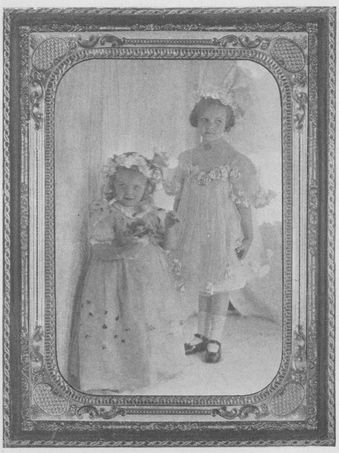
That night as my daughters, "dressed up" as princesses, danced like fairies in the light of our restored and broadened hearth, I forgot all the toil, all the disheartenment which the burning of the house had brought upon me. To them the re-built homestead was only another evidence of their Daddy's magic power. His lamp was not less potent than Aladdin's.
CHAPTER TWENTY-FIVE
Darkness Just Before the Dawn
In going back over the records of the years 1912 and 1913, I can see that my life was lacking in "drive." It is true I wrote two fairly successful novels which were well spoken of by my reviewers and in addition I continued to conduct the Cliff Dwellers' Club and to act as one of the Vice Presidents of the National Institute of Arts and Letters, but I was very far from a feeling of satisfaction with my position. My life seemed dwindling into futility. I was in physical pain much of the time and tortured by a fear of the future.
Naturally and inevitably the burden of my increasing discontent, worse health, fell with sad reiteration upon my wife, who was not only called upon to endure poverty, but to bear with a sick and disheartened husband. The bravery of her smile served to increase my sense of unworthiness. Her very sweetness, her cheerful acceptance of never-ending household drudgery, was an accusation.
She no longer touched brush or clay, although I strongly urged her to sketch or model the children. She had no time, even if she had retained the will, to continue her work as an artist. With a faculty for entertaining handsomely and largely, with hosts of friends who would have clustered about her with loyal admiration, she remained the mistress of a narrow home and one more or less incompetent housemaid. All these considerations added to my sense of weakness and made the particular manuscript upon which I was spending most of my time, a piece of selfish folly.
For ten years I had been working, from time to time, on an autobiographical manuscript which I had called by various names, but which had finally solidified into A Son of the Middle Border. Even in my days of deepest discouragement I turned most of my energy to its revision. In the belief that it was my final story and with small hope of its finding favor in any form, I toiled away, year after year, finding in the aroused memories of my youthful world a respite from the dull grind of my present.
My duties as head of the Cliff Dwellers and as Secretary of The Theater Society tended to keep me in Chicago. My lecture engagements became fewer and I dropped out or Eastern Club life, retaining only long distance connection with the world of Arts and Letters. In losing touch with my fellows something vital had gone out of me.
In spite of all my former protestations, the city began to take on the color of Henry Fuller's pessimism. My youthful faith in Chicago's future as a great literary center had faded into middle-aged doubt. One by one its writers were slipping away to Manhattan. The Midland seemed farther away from publishers than ever, "The current is all against us," declared Fuller.
As a man of fifty-two I found myself more and more discordant with my surroundings. With sadness I conceded that not in my time would any marked change for the better take place. "Such as Chicago now is, so it will remain during my life," I admitted to Fuller.