Chapter XV
Reading edition
A 1,000-Mile Horseback Ride from Grand Junction, Colo., to Alma, New Mexico—In with “Kid” Curry’s “Wild Bunch” Crowd, in Colorado, Utah, Arizona, New Mexico and Wyoming.
Arriving in Denver, Colorado, I found out the particulars of a late train holdup on the U. P. railroad at Tipton, Wyoming.
Our Asst. Supt., Mr. Goddil, had been on the ground investigating this late robbery and had decided that “Kid” Curry, Bill Cruzan and a man who might be Longbough, did the job.
Jim T. of Landusky, Montana, had told me that “Kid” Curry was planning to rob the U. P. Ry. again to get revenge for the Dickensons killing his brother, Loney, hence I concluded that Jim T. knew what he was talking about.
Our agency had just received a “tip” through an ex-convict in Grand Junction, Colo., that he talked with “Kid” Curry and a tall companion at their camp on a mesa twenty miles south of Grand Junction, and that they told him they were going south where the “climate would fit their clothes,” and that they had just broken camp and started south on horseback. Therefore, I was hustled right out to get on the trail of these two men.
I was instructed to pick up their trail if possible, and stay with it wherever it might lead, and should the trail not be found, then I was to drift southwest through Utah and Arizona and into New Mexico to Alma, in western Socorro county, where some of the stolen unsigned U. S. bills from the Silcox, Wyo., robbery had been passed.
A 300 mile ride over the Continental Divide on the D. & R. G. Ry., brought me to the little city of Grand Junction where my friend “Doc” Shores and his lovely wife—she who fed my face so well while I was a prisoner in the Gunnison jail, years before—have a beautiful home.
While purchasing horses and getting an outfit ready for the trail, I made my headquarters at the Shores residence, but on the sly, so no one would see me coming and going, as every man, woman and child in that town knows Shores as an officer.
During my stay I made the acquaintance of Charlie Wallis, the sheriff of this, Mesa county. He was an ex-cowboy from Texas, and New Mexico, and an old friend of Tom Hall’s, now Tom Nichols, of Price, Utah; hence we had some pleasant chats of old-time cowboy days.
I started south with a blue-roan saddle horse and a red-roan pack horse, and they were both good ones for such a trip, more especially the saddle animal which could make a meal on greasewood or any kind of rubbish when it came to a show-down during deep snows when the feed played out.
Before reaching the Paradox Valley, the home of the notorious Young boys who are known far and wide as “bad” men, I made the acquaintance of a Mr. Elliott and his brother-in-law W. B. Moss, and found out for sure that my men had passed their ranch only a week ahead of me. I showed Mr. Elliott the photo of “Kid” Curry and he was positive that the small dark man was the same as the photo. Before making a confidant of young Elliott, I satisfied myself that he was all right and could be trusted. Of course I had to trust to my judgment in human nature.
From Elliott’s ranch the two train holdups were trailed into the Paradox Valley and right up to Ed Young’s ranch, and from Ed Young’s father-in-law, who had no idea that I was a detective, I found out that the two robbers had gone south with Lafe Young, who was an outlaw and dodging the officers. He had last seen them in the La Salle mountains where they had a bunch of range horses rounded up with a view of stealing a fresh mount.
I remained in the Paradox Valley about a week and became quite “chummy” with Bill Young and met his mother and pretty black-eyed young sister.
There was a store in the valley, and from the proprietor Thomas Swain, I gained much valuable information. He was an honest old Englishman and I made a confidant of him.
I had got on the wrong trail by following two men into the La Salle mountains, and through Thomas Swain I found out that one of them was my friend “Cunny” of New Mexico. They were on a prospecting trip to Utah and Nevada. Seeing “Cunny’s” handwriting where he wrote to have his mail forwarded, convinced me that I was on the wrong trail, but I soon got on the right trail and headed south through a wild unsettled country, for the Blue Mountains of southern Utah.
In the Blue Mountains I got in with a tough gang, one of whom was Bill G. the manager of the Carlisle Cattle Ranch. He was an outlaw from Oklahoma and New Mexico, and gave me the secrets of his past life. From him I found out that my men “Kid” Curry and his tall chum, who was a stranger in that country, had left the hidden haystack the morning previous to my arrival, Lafe Young being with them. The two train robbers he said were broke, as they had failed to get any money from their last train holdup at Tipton, Wyoming, hence he gave them a supply of grub. They told G. that they were going where the climate would fit their clothes. He figured that meant Arizona or New Mexico, as their clothes were light for cold weather.
Every fall Bill G. put up a stack of hay for his outlaw friends so that they wouldn’t have to feed their horses at his ranch. This haystack was hidden in a heavy grove of piñon and cedar timber a couple of miles from the ranch. My men camped one night at this hidden haystack and then pulled out for Indian Creek where Bill G. visited their camp next day to recover a Winchester rifle which they had stolen by mistake from one of his cowboys. He had just returned when I arrived.
I drifted over to Indian Creek, a place noted for tough characters, and got in “solid” with an outlaw named “Peg-leg.” His chum “Kid” Jackson was afraid of me for fear I might be a detective.
“Peg-leg” had been to the camp of my two men, and Lafe Young had told him that they were Union Pacific train robbers making their “getaway,” but he didn’t learn their names. His description of the small dark man tallied with that of “Kid” Curry to a dot.
“Peg-leg” informed me that just previous to my arrival on Indian Creek, these men broke camp. Lafe Young returned north while the two train robbers drifted south down the Colorado river.
One day “Peg-leg” and I rode into Monticello, the Mormon county seat of San Juan County, Utah, a distance of twenty miles. It was a small town of 200 people, presided over by Bishop Jones of the Mormon church.
En route to Monticello “Peg-leg” and I rested for an hour on top of a high mountain ridge from whence we could view the whole country around for a hundred miles or more. It was a clear sunshiny day. Looking to the westward beyond the Indian Creek settlement, the great Colorado river could be seen with its jagged cliffs and canyons, which made a beautiful sight. And beyond the Colorado river “Peg-leg” pointed out the “Robbers’ Roost,” which “Butch” Casiday and the “Wild Bunch” used as headquarters for several years until Joe Bush and a posse of Salt Lake City officers made a raid on the “Roost” and killed some of the gang.
Beyond the “Robbers’ Roost” was the Henry mountains, a mere bluish blotch on the lovely blue sky. The distance to them from where we lay, as the bird flies, was about seventy-five miles, but in order to reach them one would have to travel about 200 miles, as the country between is almost impassable and devoid of inhabitants.
“Peg-leg” told of secret trails to the Colorado river, and of the “Wild Bunch” having a boat hidden in the rushes at a certain point so they could cross the river and reach the Henry mountains quickly. He said that “Kid” Jackson used this boat a week previous.
Southwest from where we were there is not a human habitation for about 300 miles down in Arizona, and it is a very rough country with a scarcity of water, therefore it can be realized what a haven of rest it must be for the “Wild Bunch” and their kind.
“Peg-leg” and I aimed to reach Monticello after dark, so that he wouldn’t be seen until he found out if the coast was clear; in other words, if there were any outside officers in the county looking for criminals. After we had put up our horses and had a lunch in a cabin on the outskirts of town, “Peg-leg” borrowed my pistol so that he would have two, leaving his Winchester rifle with me, and struck out in the dark to find the sheriff of the county. He had told me that the sheriff stood in with the outlaws and kept them posted as to when there was danger in the air, but I didn’t know whether to believe it or not. To satisfy myself I followed “Peg-leg” in the dark, keeping my rifle hidden under my coat.
“Peg-leg” found the sheriff at a dance and they met under some trees in a dark place and had a long pow-wow. This seemed strange considering that the sheriff had warrants in his pocket for “Peg-leg” and at least half a dozen for “Peg-leg’s” chum, “Kid” Jackson.
On returning to the cabin “Peg-leg” reported to me that the coast was clear and that no outside officers or detectives were in the county. We then put in a few hours with “Peg-leg’s” sweetheart and her mother.
“Peg-leg” told how the past winter two officers left the railroad with a team and buggy to search for “Kid” Jackson in the Indian Creek country, there being big rewards out for his arrest; that these officers wrote to the sheriff asking that he meet them. The sheriff then sent for “Kid” Jackson and told him to “hit the high places” until these officers left. But instead of hiding out, “Kid” Jackson and “Peg-leg” went to these officers’ camp one night, running off their horses and shooting into their tent, the result being the two sleuths had to “hoof it” back to Moab where they secured transportation to the railroad.
I found out that Bill G. had been sheriff of this county two terms, and when he couldn’t hold it any longer he selected a man who was a member of the Mormon church whom he could trust to protect his friends among the outlaw class. I got this from “Peg-leg” and Bill G. himself. No wonder the Blue Mountains have been an outlaw’s paradise for many years.
During my three weeks’ stay in the Blue Mountains I gained much information about past crimes and the names of noted outlaws. I found out that a “bad” outlaw of Texas had married a Mormon girl on Indian Creek, under an assumed name, but after they had been married a year or two he confessed the truth to his wife. She then fixed it with the church so that they could be married in his own name in a way that the secret wouldn’t leak out. This was done to place their children on the shady side of Heaven; otherwise they would be on the sunny side of Hades. Bishop Jones of Monticello performed the church ceremony in secret, so that the man’s true name wouldn’t leak out. I got this from Bishop Jones’ own lips after I had made a confidant of him. I also met this ex-outlaw from Texas and found him to be a nice fellow, apparently.
After making a confidant of Bishop Jones, a fine law-abiding citizen, he gave me some valuable “tips;” but he was very angry when I gave him the secrets of how his Mormon sheriff was standing in with the “Wild Bunch.” He assured me that a law-abiding sheriff would be put in at the next election, and no doubt he kept his word, for I heard that Bill G. was sent to the Utah penitentiary soon after election.
After leaving the Blue Mountains I drifted south to Bluff City on the San Juan river, thence west 120 miles over that uninhabited, rocky, desert country, over which Sayles and I passed, to Dandy Crossing on the Colorado river.
On reaching the foot of Elk mountain a deep snow covered up all trails and the clouds and falling snow prevented my seeing familiar landmarks to guide my way. The result was that I was lost for a couple of days and nights; and one dark night I saw the camp fire of Jim Scorrup down in a deep canyon. I was then twenty miles off my road to the southward. Jim Scorrup of Bluff City was camped all alone under a ledge of rock, and had a whopping big fire burning. The sight of this fire raised a cowboy yell in my throat that startled Scorrup and his shepherd dog. I was wet, tired, and hungry.
Scorrup was out hunting lost stock. Next day the sun came out and Scorrup put me on the right trail to Dandy Crossing. He went with me as far as White’s Canyon and we camped together that night. We bade each other goodby next morning and I haven’t seen him since, but there will always remain a warm spot in my heart for Jim Scorrup, as he knows how to put new life into a lost sinner.
On reaching Dandy Crossing about night, during a severe rain storm, Col. Hite, formerly a wealthy politician of Springfield, Illinois, helped to swim my two horses across the Colorado river. In doing so the Colonel got his 250 pounds of flesh wet to the skin. We had trouble making the horses “take the water,” and Hite let me do all the swearing, as he said he had been brought up a Christian and felt better to do his swearing by proxy.
From Dandy Crossing I rode north through the Henry mountains to Hanksville, two hard days’ ride. As Sayers and I had been in Hanksville, I felt at home here with Charlie Gibbons and his family, with whom I put up. I made a confidant of Mr. Gibbons and told him my business. He gave me some new pointers about “Butch” Casiday and the “Wild Bunch.” He had first become acquainted with Casiday after he helped to rob the Montpelier, Idaho, bank out of a large pile of gold. This gold was turned over to Gibbons for safe keeping, he not knowing of the robbery. Later it was taken to the “Robbers’ Roost,” fifty miles east of Hanksville, where the “Wild Bunch” used twenty dollar gold pieces for poker chips.
Bill G. had told me of going into the “Robbers’ Roost” while sheriff of San Juan County, Utah, and of how his friend “Butch” Casiday and his gang kept him there two days playing poker for twenty dollar gold pieces, they staking him out of their pile of gold.
I had received orders from Asst. Supt. “Rank” Curran, through the mail, to drift over to the Sevier Valley, where “Butch” Casiday was born and raised, and find out all I could about that outlaw, for future use; and from there drift south through Arizona and New Mexico to Alma, in the latter territory, Alma being the southern rendezvous for the “Wild Bunch,” while the Hole-in-the-Wall, in Wyoming, was their northern hang-out. This of course meant a horseback ride of over 1000 miles through the most God-forsaken desert country in the United States.
On leaving Hanksville one morning a traveling photographer took a snapshot of me and my horses. This photograph I present herein to show what a cowboy detective looks like when on the warpath, with bedding, grub, and kitchen fixings tied to his saddle-pony’s tail.
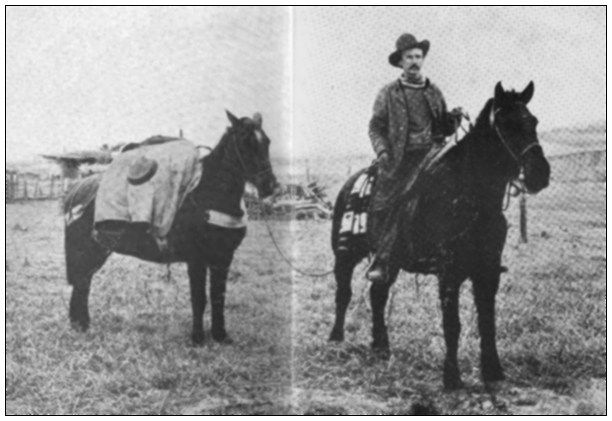
The Author trailing train robbers.
A day’s ride due west up the Dirty Devil river brought me to the Mormon settlement of Cainsville. Here I put up for the night. On leaving the Dirty Devil next morning to cross an unsettled rough desert called San Rafael Swell, I bade goodby to civilization for a few days.
After the first night out I lost the dim trail and concluded to head due west over a high snowy range of mountains for the town of Emery, at the head of Castle Valley. Sayles and I had stopped there, hence I knew by the lay of the mountains where the little Mormon town was located on the opposite side of the mountains. This proved to be a bad mistake, for after camping out in the snow two nights I had to turn back as the snow became too deep for travel, and I was not yet to the top of the range.
That night I had no feed for the horses, and through kindness of heart I hobbled them out, that is, tied their front feet together so they could hobble around among the rocks on a side hill and pick up a little dry grass. This was mistake No. 2, for next morning I had to shoulder my wrath and follow their tracks fifteen miles to the head of Starvation Creek, where there was a small spring. This was back in the direction of Dirty Devil river. In traveling these fifteen miles afoot I felt like swearing, but I realized the uselessness of uttering cuss words where they would have been wasted on the desert air. I contented myself by making a vow that hereafter one of the horses would be tied up to a tree, feed or no feed, as I would rather count their ribs than their tracks.
The next morning I found the dim trail over which Sayles and I had traveled. This was followed until dark, where camp was pitched without either wood or horse feed. And to make matters worse it was raining hard.
The following morning I pushed ahead to reach a ranch where Sayles and I had stopped nearly two years previous. At that time a Mormon lady and her pretty young daughter lived there alone, as their lord and master was absent trying to make a living, the soil on their homestead being too poor to grow sufficient food. But imagine my surprise on finding the place vacated and not a blade of grass for my tired and hungry horses in sight. It was about night and raining hard, which made the road slippery and hard on the horses.
About midnight we came to a ranch on the side of the road, which was considered as being only four miles from Emery. Dismounting, I went to the house and knocked on the door, and a dog inside made a terrible racket, as though he wanted to eat me up. Repeated knocks and loud calls failed to bring any one to the door. I thought seriously of breaking down the door, and if it had to be done, killing the dog and cooking a supper, providing there was anything to eat in the house. But on second thought I concluded it dangerous, as there might be someone inside with a gun. Thus was my well developed cautious bump getting in its work.
Finally I started in the cold rain, and the poor horses didn’t want to go. A half-hour’s ride brought me to a small raging creek which my horses wouldn’t go into, despite the severe spurring received by my mount. Then we turned back with the intention of breaking down the ranchman’s door, but to my great delight, on coming in sight, a light was shining in the window and before knocking I heard voices inside. On knocking I was admitted, and the frightened woman who was alone with her small children, explained that she didn’t open the door the first time because she was afraid, and that after I had been gone quite awhile, she built a fire to make coffee to quiet her nerves.
By the time the horses were put in the stable and fed, the kind lady had a hot meal on the table and I ate dinner, supper, and a three o’clock breakfast all at one time. Then I lay down by the open fireplace to sleep.
But why waste time to chronicle the hardships of a fool cowpuncher who had started out as a detective to see the world and to study the phrenology bumps on the heads of other people, instead of living the “simple life” on a small patch of the earth’s surface. So I will hurry on to Alma, New Mexico, the outlaws’ Paradise, near the border of Old Mexico.
A ride of several days over mountain trails landed me in Circleville, the home of “Butch” Casiday before he turned out to be the shrewdest and most daring outlaw of the present age, though not of the blood-spilling kind like “Kid” Curry and “Black Jack.”
A week was spent in the straggling village of Circleville, and I found out all about “Butch’s” early life and much about his late doings. His true name was Parker, his nickname being “Sallie” Parker when a boy. This nickname of itself was enough to drive a sensitive boy to the “bad.”
I had hard work to keep from falling in love with Miss Parker, the pretty young sister of “Butch” Casiday. She was the deputy postmistress in Circleville, and I made her acquaintance.
Hard, cold rides brought me to the town of Panguitch, thence due south to the Mormon town of Kanab, on the line of Arizona. Here I laid in a good supply of grub, as this was the last settlement for hundreds of miles.
A three days’ ride over the Buckskin mountains and down the great Colorado river, brought me to Lee’s Ferry on that stream. Not a habitation or a settler was seen between Kanab and Lee’s Ferry, Arizona, and I found water scarce and “far between.” But it was surely a treat to see this lone ranch down in the narrow valley of the Colorado. It was indeed an oasis in the desert. Here green alfalfa was a foot high and the flowers, and the combs on the chickens were in full bloom.
Another three days over an uninhabited desert country brought me to the Indian trading store at Willow Creek. From here I turned due east across the Navajo Indian Reservation and through the Moqui Indian country, my object being to find out if any of the “Wild Bunch” had been seen lately. Therefore, for the next two weeks I was among Indians all the time, and I learned some interesting lessons, especially among the Moquis, who live on the very top of round mountains in the desert. At one of the big Moqui villages I took my horses up the steep trail and rode into the Chief’s front yard. My horses were fed and the Indians made an idol of me. They dug up old rusty dried venison which had been buried for a coon’s age, so as to give me a feast fit for the gods. I remained all night and was invited to take me a squaw and become one of them, but I told the Chief that I wasn’t ready to settle down, as I wanted to settle up first.
On the Navajo and Moqui Indian Reservations I visited the Keams and the Hubbell trading posts. Both Captain Keams and Mr. Lorenzo Hubbell treated me royally and gave me valuable information about “Kid” Curry and his gang, when the previous spring, they left a trail of blood behind them in making their “getaway” from southern New Mexico. They had killed two officers near here, and killed other men before reaching Wyoming.
Finally I crossed the Atlantic & Pacific railroad at Gallup, New Mexico, thence south through the Zuni Indian country to a salt lake a few miles east of the Arizona line. Here I found a settlement of Mexicans putting up salt for the markets in far-off towns. And here I saw a great curiosity in the form of a bottomless lake on the top of a round mountain. To reach it one has to climb to the top of the mountain on the outside and down a trail on the inside. I went swimming in it, as the water is warm in winter, it being out of reach of the wind. It is said that the Government tried to find the bottom of this salty body of hidden water, but failed after putting down a line 3000 feet. The lake from whence the salt is gathered lies at the foot of this round mountain.
From here I went to the line of Arizona, where a few days previous two of Pete Slaughter’s boys murdered William Beeler, the brave officer who had trailed “Kid” Curry and his gang to Baggs, Wyoming, the spring previous. The two seventeen-year-old boys murdered Beeler in revenge for the killing of Monte Slaughter not long before.
From here I drifted south to the American Valley ranch, where my friend W. J. C. Moore, the outlaw cowboy whom I saw in Juneau, Alaska, killed two men, which set him adrift with a big reward on his head.
From American Valley I rode south to Luna Valley and made the acquaintance of many tough characters. Here I made a confidant of a ranchman by the name of James G. Smith, and found out that he had known me in Texas years before. He gave me valuable information about the “Wild Bunch,” and his good wife filled me up on civilized food.
Finally I reached the sleepy little town of Alma, New Mexico, and my thousand-mile horseback journey was ended.
The town of Alma supported one store and one saloon, both being well patronized by the wild and wooly population thinly scattered over the surrounding country.
I started in to make myself “solid” with the tough element of the district, so as to find out more about the “Wild Bunch” and as to who passed a lot of that unsigned money stolen in the Silcox, Wyoming, train holdup. This stolen money had been passed in Alma a few months after the train holdup, and when the matter leaked out Asst. Supt. “Rank” Curran, of our Denver office, was sent there to investigate. There being no deputy sheriffs in this western part of Socorro county, it being about 120 miles from the county seat of Socorro on the Rio Grande river, Mr. Curran had no local officers to assist him. I was told that the sheriff couldn’t get a man to accept the deputyship in the western part of this county, as it was too tough and dangerous, being overrun with outlaws and desperados.
Mr. Curran had to take someone into his confidence, so he used bad judgment by selecting the two leading business men and citizens of Alma. One of these was the storekeeper and the other the saloon proprietor, Jim Lowe. Of course Curran went into detail of how he was on a hot trail of the Union Pacific train robbers who had passed some of the stolen money in Alma. This was enough. That night Mr. Curran was driven out of town and would have been killed had it not been for saloonman Jim Lowe.
Curran was not a western man, he having formerly been Superintendent of our Chicago office before being taken down with that dread disease, consumption, and coming to Denver for his health. Hence he was glad to get out of Alma alive, and of course he naturally felt grateful to Jim Lowe.
After getting in with the tough gang, I learned the truth of how Jim Lowe saved Murray’s life, and how next morning Lowe sold his saloon and “hit the trail” with outlaw “Red” Weaver, for “tall timber;” that Jim Lowe was none other than the notorious “Butch” Casiday of the “Kid” Curry gang.
Among the men whose friendship I made was Jesse Black, one of Jim Lowe’s warmest friends, who had figured in the raid on Frank Murray. He was considered a hard case, but no one seemed to know who he was or where he came from.
Part of my time was spent out in the mountains in the Mogollon mining camp and at the mining town of Graham, where there was a gold mill; also at the cattle town of Frisco, near the Arizona line.
In Frisco I got in with a bronco buster and “bad” man, who told me the spot in the mountains, about forty miles southwest, where Jim Lowe had established a “Robbers’ Roost” or rendezvous, and at that very time was there with eight outlaw companions, but who these companions were he didn’t know, as they were from the north. He was only acquainted with Jim Lowe. He pointed out the particular mountain in the distance where they were camped, and getting ready for some kind of a raid. This bronco buster had been to their camp lately.
On learning of this, I at once wrote to Asst. Supt. Curran, telling him of Jim Lowe’s rendezvous and of my plans to visit their camp and try to get in with the gang.
Soon I received a reply by mail saying that I was mistaken about Jim Lowe being “Butch” Casiday, as he (“Rank” Curran) had met Lowe and found him to be a nice gentleman. In the letter he instructed me to sell my horses and return to Denver as he wanted me to join a tough gang in western Colorado and southern Wyoming, who stood in with the “Wild Bunch.”
So this ended my work in Alma during the late spring. Putting a stop to my visiting Jim Lowe and his gang may have been a godsend, as they might have killed me; but still, it may have terminated in the killing or capture of the whole bunch.
After selling my horses in the Mogollon mining camp I boarded the stagecoach for Silver City, the county seat of Grant county, New Mexico, a distance of about eighty miles to the southward, this being the nearest railroad.
Blake Graham, a warm friend of Jim Lowe, was a passenger on the stage with me. We had a good supply of liquor along and he told me the whole secret of Jim Lowe being “Butch” Casiday. He told of how when Asst. Supt. Murray was run out of Alma, Jim Lowe sold his saloon and skipped; that he (Blake Graham) rode several miles with Lowe and “Red” Weaver when they were leaving, and of how Lowe said he didn’t have the heart to see Frank Murray killed, and for that reason he helped get him out of town in the night.
This outlaw “Red” Weaver was killed in a pistol duel with Jim Hollman in the street of Alma just before my arrival.
The driver of the stagecoach was Bill Kelly, who claimed to be the original “L. S. Kid” of the Panhandle, Texas. I had known the “L. S. Kid” as a wild smooth-face boy, hence Kelly and I became quite “chummy.” Young Graham and I and the two traveling men aboard kept Kelly loaded with liquor so that he would make good time, and amuse us with his western songs. He claimed to have originated one of these songs while a cowboy in the Panhandle, Texas, and he sang it half a dozen times en route. It had a lovely tune and seemed to strike me just right. It ran thus:
My lover is a cowboy, He’s kind, he’s brave and true; He rides the Spanish pony And throws the lasso, too; And when he comes to see me And our vows we have redeemed, He puts his arms around me And then begins to sing:
Chorus:
Oh, I am a jolly cowboy, From Texas now I hail, Give me my saddle and pony And I’m ready for the trail. I love the rolling prairie Where we are free from care and strife, And behind a herd of long-horns, I will journey all my life. We rise up in the morning At the early dawn of day, We vault into the saddle And quickly ride away. We rope, brand and ear-mark, I tell you what, we’re smart, We get the herd all ready For Kansas, then, we start. Chorus. When lowering clouds do gather And livid lightnings flash, And crashing thunder rattles And heavy rain-drops splash. What keeps the herd from roaming And stampeding far and wide? ’Tis the cowboy’s long, low whistle And singing by their side. Chorus. And when in Kansas City The boss he pays us up, We loaf around a few days, We have a parting cup. We bid farewell to city, From noisy marts we come Right back to dear old Texas The cowboys’ native home.
Before reaching Silver City about night, the liquor began to work. Then Graham and I pulled our pistols and emptied them through the canvas-covered top of the stagecoach. This set fire to the canvas top and the wind carried the fire to my roll of bedding in the rear; then we all became fire-fighters. We drove into Silver City without a buggy-top and the liquor all gone.
As my daughter Viola lived in Silver City with her aunt and uncle, Mr. and Mrs. Will F. Read, I laid over the next day to visit them. Viola had grown to be a pretty young lady and was just finishing her education in the Territorial Normal College in Silver City.
I also visited with my old White Oaks (N. M.) friend, Jim Brent, who was now City Marshal of this town; also with Sheriff Goodall and ex-Sheriff J. K. Blair, both model officers.
I then boarded a train for Denver, stopping off in Santa Fe one day to visit my pets.
On arriving in Denver, Asst. Supt. Curran sent me at once to Grand Junction in the western part of Colorado, there to purchase a horse and locate one Jim F. who had been run out of Dixon, Wyoming, by the vigilantes, as he was known to be in with the “Wild Bunch.” It was reported that he had taken his family and settled somewhere near Grand Junction.
I finally located Jim F. through my friend Sheriff Charlie Wallis. He had bought a small patch of land in an out-of-the-way place on Grand River near Palisade, twenty miles above Grand Junction, and lived there with his young wife and two pretty little girls.
After much planning and scheming I got in “solid” with Jim F., although he had received a letter of warning from his friend Tom T., in Dixon, Wyoming, to the effect that the Union Pacific Railroad Company had a Dickenson detective on his trail. I brought him this letter from Palisade, as he had given me orders to get his mail. On reading it he swore the most wicked oaths against all detectives and swore to cut out the heart of any detective who undertook to win his friendship. He let me read the letter.
I had been cautioned to watch Jim F. as he was a wicked fellow and would kill a man without mercy. He had cut his own brother-in-law’s throat in a fit of anger, and he had once served a term in the South Dakota penitentiary, while his brother Charlie, whose friendship I won later, was an ex-convict from Utah.
To show what a temper Jim F. had, I will cite a case wherein he came very near drowning his own child while sitting at the dinner table. The door was open and a swift irrigation ditch full of water flowed by the door. The eldest girl, eight years old, cried for more fish when there was none left. Jim grabbed the child and threw her with all the force of his makeup,—he being nearly six feet tall, 190 pounds in weight and thirty-two years of age,—into the irrigation ditch. It was only a few hundred yards to the treacherous Grand River, and Jim had to run fast to catch the half drowned girl before she reached the river. Of course this broke the child of wanting fish after it was all eaten.
Jim F. and I became fast friends after he had seen the newspaper accounts of my shooting scrape in southern New Mexico, and of my being an outlaw who was badly wanted by the officers of Grant county, New Mexico. Of course I had these accounts put into the papers and marked copies sent to me.
I was going by the name of Lee Roy Davis. The Palisade paper once referred to me as “mysterious white-horse Davis,” my saddle horse being white.
During the month of August, Jim F. and I pulled out for “tall timber.” We put in a couple of weeks at the head of White River above Meeker. We lived on venison and fish and camped out alone. From here we drifted to Hayden, Colo., where Jim F. had friends; thence to Dixon, Wyo., to show Bob Meldrum the “man-killer” town marshal and the vigilantes, that Jim F. was not afraid to come back. I had promised to help fight his battles, and we came within an ace of having a shooting scrape with Bob Meldrum on reaching Dixon.
To recite how Jim F. and an ex-convict friend of his by the name of Ed. Muirr made the blood flow one night when they beat up and robbed a gang of telephone company workmen who had been paid off, would take up too much space. I didn’t care to take a hand in the robbery. Still, I got $60.00 of the tainted money from Jim F. in payment for a loan made in Meeker.
On the Snake River, above Dixon, at the foot of Black Mountain, is where Jim F. lived on his ranch when run out of the country by the Cattle Association, as it was known that he was a cattle rustler and used his ranch for a rendezvous for tough characters.
It was at this Black Mountain ranch that Jim F. furnished horses and grub to “Kid” Curry and his gang when they started out to rob the Union Pacific train at Tipton, Wyo., about 100 miles north, the fall previous, and after the robbery Jim F. kept them hid on Black Mountain until the officers quit searching for them. I was shown the exact spot where they camped high up on the timbered mountain. Here Jim F. carried grub to them and kept them posted as to the movements of the officers. From him I learned that “Kid” Curry, Bill Cruzan and the “Tall Texan,” whose right name was Kilpatrick, held up the train at Tipton, Wyo. And I found out that after leaving the Black Mountain they drifted south to the Blue Mountains in Utah, thence further south into New Mexico. But before reaching Utah, Bill Cruzan turned back on his mule and later was met by Bert C. south of Grand Junction, Colo. Bert C., Jim F. said, was a go-between and kept the “Wild Bunch” posted by getting mail or word to them.
Jim F. also gave me the secrets of the Silcox, Wyo., train holdup, and many other noted cases. Also told how he assisted in a bank robbery in Nebraska, and of his many cattle-stealing and fighting scrapes in the Black Hills of Dakota.
Jim F. and I were fixing to pull out of Dixon and go to Rawlins to meet friends of Jim F.’s, when Ellis, a merchant of Dixon, called Jim to the rear of his store and advised him not to go to the Union Pacific Railroad as Pinkerton detectives were on his trail and would arrest him. At this Jim F. concluded to “hit” the road back to Grand Junction, Colo. He sold me his pack horse and outfit and gave me a letter of introduction to his friend Jack R. who stood in with the “Wild Bunch,” and who had two saloons in Rawlins, Wyo.
On leaving the Grand River at Jim F.’s home, my name had been changed to Harry Blevins, so that the New Mexico officers couldn’t get track of me. Jim F. selected my new name, and in this name he gave me the letter of introduction which was short and to the point. It merely stated: “This will introduce to you my friend Harry Blevins. He is righter than hell.” Among the “Wild Bunch,” “right” meant that a man is all right and can be trusted.
After seeing Jim F. off and headed south for Colorado, I pulled out for the north. I put up one night at the Twenty-mile ranch owned by Jim H., a friend to Jim F. and the “Wild Bunch.” He was a wealthy stock man and had furnished one of the horses to “Kid” Curry for the Tipton train holdup. I let him read the letter to Jack R. and he told me to come to him and he would find me a hiding place should the officers ever get on my trail. He told me about the Tipton and Silcox robberies and said he had helped “Kid” Curry out more than once.
I arrived in the hurrah little city of Rawlins, where half the men are railroad employes and the other half, with the exception of the gamblers and saloon men, smell sheepy. Even the cattlemen get to smelling like sheep from the constant chasing of sheep off their ranges. Rawlins is the center of a great sheep country.
Jack R. welcomed me with open arms on the strength of Jim F.’s letter, and it wasn’t long until he told me of the “Wild Bunch” and their doings. He had made his first stake through “Butch” Casiday and his gang, after they robbed the Montpelier, Idaho, bank out of about $30,000 in gold. At that time Jack R. owned a small saloon in Baggs, on Snake River near Dixon. The gang was headed for the “Robbers’ Roost” in southern Utah and stopped over a few days to rest in Baggs, and while there they threw enough twenty dollar gold pieces over Jack R.’s bar to give him a stake, so that he could open a good saloon in Rawlins. Jack R. told of how “Butch” would shoot an old widow’s chickens just to hear her swear. Then he would have the old lady smiling by giving her a twenty dollar gold piece for every chicken killed.
During the winter in and around Rawlins, I led a hurrah drinking life, and made friends among the tough element. Among those met was Bert C., virtually one of the “Wild Bunch,” but who was slick enough to keep out of the law’s clutches. His home was in Grand Junction, Colo. He and I became “chummy,” but he kept his secrets to himself. He was noted for being “close-mouthed” and no doubt that is why “Kid” Curry and the “Wild Bunch” put such confidence in him. But I played my cards so as to open Bert C.’s mouth and get his secrets.
In the Spring he and I went to Grand Junction, Colo., where we hobnobbed with his tough cowboy friends. Among them was our friend Jim F.
During the summer Bert C. and I rode from Grand Junction to Rawlins, a distance of about 300 miles, on horseback.
While in Grand Junction, I received a fake letter from my supposed attorney, Ex-Governor L. Bradford Prince, requesting that I come to Santa Fe, New Mexico, and sign some papers in order that certain property could be sold. This letter was on Attorney Prince’s letter head and looked genuine.
Jim F. asked me to visit his friend Bob McGinnis in the Santa Fe penitentiary, and if I got a chance to give him a “Wild Bunch” cipher code, so that they could Communicate with each other through the mail. The code was each fourth word, in a friendly letter on general news; that is, each fourth word to be written down which would convey the secret. And I was instructed to tell Bob McGinnis to hold a stiff upper lip, as his friends would bribe the officials of New Mexico and have him out before many years.
Jim F. and Bert C. had told me confidentially who Bob McGinnis was, that he was a Utah chum of “Butch” Casiday’s, whose right name was Elza Lay. This was a secret which hadn’t yet leaked out.
Jim F. gave me certain words to say to Bob McGinnis which would convince him that I was all right. He and Jim F. had been in the cattle-stealing business together several years previous.
In Santa Fe, New Mexico, I took Ex-Governor Prince, Attorney General E. L. Bartlett, and Warden H. O. Bursom, of the penitentiary, into my confidence, so that I got to visit McGinnis and gave him Jim F.’s secrets.
I found McGinnis to be a pleasant fellow, but a hard looking “mug.” He acted as though he felt that a job was being put up on him when the guard was called away for a few minutes. It was then that I imparted the secrets to him.
Bob McGinnis was one of “Black Jack’s” gang and helped kill my warm friend Ed. Farr, sheriff of Huerfano County, Colo., also Ed. Farr’s deputy, Mr. Love. In this fight Bob McGinnis was shot three or four times through the body and then made his “getaway.” Several months later he had a hand-to-hand fight with the sheriff of Eddy county, New Mexico, and shot two officers before being overpowered and captured. He had just recovered from his previous wounds. He and “Franks” were camped out in the sand hills east of the Pecos River, when the sheriff and his posse surprised them. “Franks” made his “getaway.”
McGinnis was tried for the killing of Sheriff Farr and his deputy, Love, after robbing a Denver & Ft. Worth train. He received a life sentence in the penitentiary at Santa Fe.
About the time of my visit with Bob McGinnis in the Santa Fe pen “Butch” Casiday, Bill Carver and Harry Longbough robbed the Winnamuca, Nev., bank and secured $30,000 in gold. It was plain to me now, that some of this money would be used to free McGinnis from prison.
On rejoining Jim F. in Palisade, Colo., I gave him a hair bridle and steel bit made by Bob McGinnis, the bit being made from old files, as McGinnis had learned to be a blacksmith and electrician. I had also brought from the Santa Fe pen a hair bridle and bit for my own use. This is now kept as a relic.
It was early summer when Bert C. and I started, in company with his young brother, across country for Rawlins, Wyo. We each had a saddle horse and I had a pack animal to carry the grub and bedding.
On reaching the Green Cattle Company’s headquarters ranch on the edge of Wyoming, we learned of the Denver & Rio Grande train holdup east of Grand Junction, and from now on we were suspected of having had a hand in the holdup. Bert C. gave me to understand that Bill Cruzan was in this last holdup. It seems that Bert knew it was billed to come off.
Before reaching Dixon, Wyo., we met many of Bert C.’s and Jim F.’s tough chums.
In Dixon, Bert C. got a tip from someone, whom I suspected to be merchant Ellis—knowing that he had given Jim F. a friendly tip—that the Dickenson agency had a cowboy detective by the name of Charlie Siringo working in with the “Wild Bunch,” so as to get their secrets. This worried Bert and he became sullen for awhile, as though suspicious of me. He questioned me as to whether I had ever heard of Charlie Siringo. Of course I hadn’t. I felt confident that Ellis had gotten the secret from either Asst. Supt. Goddil or Curran, as they had told me of what a fine man he was and how he could be trusted with any secret. This goes to prove that it is unsafe for a detective to trust his life in the hands of any man, and this very knowledge is the cause of much sweating of blood by detectives.
From Dixon, Bert C. and I visited Baggs, where his sweetheart, Miss Maud, a respectable girl, lived. We remained in this little hurrah town a few days drinking and visiting with Bert’s friends.
Bert C. had, previous to our arrival in Dixon, given me many secrets of the “Wild Bunch.” He told of how they kept a system of blind post offices all the way from the Hole-in-the-Wall in northern Wyoming to Alma in southern New Mexico, these post offices being in rocky crevices or on top of round mounds on the desert. In passing these post offices he said members of the “Wild Bunch,” who were on the inside, would look for mail or deposit notes of importance. Also late news of interest would be clipped from newspapers and deposited in the post office by passing members.
Bert C. also told me the whole secret of “Butch” Casiday’s “getaway” from Alma, New Mexico, when he ran a saloon there under the name of Jim Lowe. He told of how a Dickenson detective named “Rank” Curran came there in search of the men who had passed some of the stolen unsigned bills from the Wilcox train holdup, and that “Butch” Casiday happened to be the man who had passed these bills; that after the gang had run Murray out of the country “Butch” sold his saloon, and in company with outlaw “Red” Weaver, drifted west to the Arizona line to join “Kid” Curry and his gang. He told of how “Butch” and “Red” Weaver were waylaid and captured by William Beeler’s posse who were on trail of “Kid” Curry and gang, they being headed north after committing bloody crimes, but that in the night “Butch” made his “getaway” from the officers on a bareback horse, without firearms or grub; that in riding north, “Butch” overtook the “Kid” Curry gang, and thinking them officers of the law he kept out of sight by hiding in daylight and riding in the night, but when he came to one of their blind post offices he found news which convinced him that he had been hiding from friends, with nothing to eat but crackers.
On reaching Baggs, Wyo., “Butch” was kept hid by “Mid” Nichols (brother to my friend Tom Hall) in his residence. “Mid” then owned a saloon in Baggs.
Finally Beeler and his Arizona posse arrived in Baggs and took “Mid” Nichols into their confidence, telling him of how they were on the trail of the “Kid” Curry gang.
That night “Butch” left the Nichols home riding a good horse and saddle and armed to the teeth. He had to cross a bridge where two of Beeler’s men were on guard. They supposed he was a rancher leaving town, and gave him a friendly salute.
“Butch” then remained hidden in the mountains near by until the Beeler posse left Baggs. Mrs. “Mid” Nichols kept “Butch” supplied with grub and liquor, as she was in the habit of taking a horseback ride every day for exercise.
On reaching Rawlins, Bert C. and I boarded a train for Wolcott, there to meet Jack R., “Chip” Reed, and other friends. Jack R. also owned a saloon in Wolcott. From Wolcott we all returned to Rawlins. Then champagne corks flew thick and fast for several days—then several days of agonizing headaches.
One of the “Wild Bunch” secrets given me by Bert C. disclosed the fact that my friend Jesse Black, of Alma, New Mexico, was a hard “hombre” whose right name was Byron Sessions. He had been brought up in Utah and went to New Mexico with “Butch” Casiday after the Montpelier, Idaho, bank robbery.
I spent the whole fall in and around Rawlins and had the pleasure of riding “Butch” Casiday’s pet mule “Ikey.” I had gone with Jack R. on a wild horse hunt into the Haystack Mountains, where Jack R. kept a hired man and a pile of grub to feed the “Wild Bunch” when passing through the country. On his last visit here, after our Asst. Supt. Frank Murray had scared him out of Alma, New Mexico, “Butch” had left “Ikey” to be cared for by Jack R. I found “Ikey” to be a “peach” of a mule, easy riding and as limber as a cat, and he could run like a scared wolf. But he had one fault—he was afraid of shooting. He left me on the desert once afoot, when I got down to shoot at game.
On this trip Jack R. showed me outlaw Bill Cruzan’s rendezvous, a rock cabin built high up in the bluffs overlooking the Laramie River, but I found out that Bill Cruzan had quit living here since the Dickenson agency had got on his trail for the Tipton train holdup; that now he kept moving from place to place, since “Kid” Curry had given him the shake.
During the summer “Kid” Curry and his gang had robbed a Great Northern railroad train up in Montana, securing a large sum of new unsigned U. S. Government bills, and I found out that “Kid” Curry had been in Rawlins where he met Jack R. and Jim H. of the Twenty-mile ranch.
The Dickenson agency was employed to run down these West-Northern train holdups, and, of course, all the information secured by me was used in tracing up the robbers.
Finally, during the fall, the “Tall Texan” (Kilpatrick), who was with “Kid” Curry when I trailed him into the Blue Mountains, and who assisted in the Tipton, Wyo., Union Pacific train holdup, was arrested in St. Louis, Mo., along with “Kid” Curry’s sweetheart. “Kid” Curry and one of his chums made their “getaway” and Curry came direct to Rawlins to dig up some of the stolen Great Northern money which he had cached on Jim H.’s Twenty-mile ranch. He wanted this money to hire lawyers to defend his sweetheart, who had been passing some of the stolen bills in St. Louis.
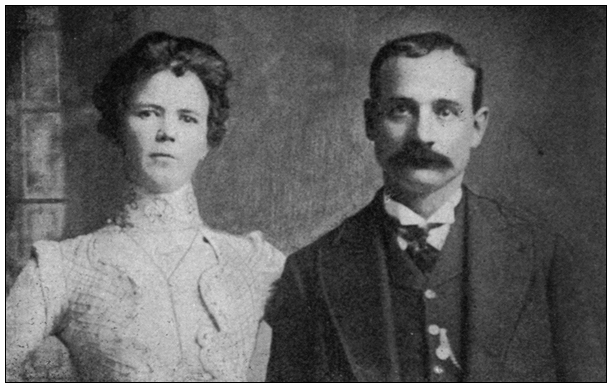
“Kid” Curry and his sweetheart.
“Kid” Curry only remained in the vicinity of Rawlins two days. He then boarded a train for the east. I didn’t know of his being in Rawlins until two days after he had gone. Then I got the secret from Jack R. and Sid. J. The latter told of how “Kid” Curry had seen me in a saloon one night when he was watching the crowd through the rear door. He singled me out as a suspect, saying that I looked too bright and wide-awake for a common rounder; but Sid. J. assured him that I was all right, though “Kid” Curry wouldn’t believe it until told so by Jack R. They called Jack R. out of his saloon into the alley. Then Sid. J. said he asked Jack R. if Harry Blevins was “right;” that Jack replied “yes.” Then “Kid” Curry was satisfied. I considered it quite a compliment to be called bright by such a wide-awake judge.
But poor “Kid” Curry ran up against a live issue on this trip east. In Knoxville, Tenn., he was arrested after shooting two officers. He finally had a trial in the United States Court, for passing money stolen in the Great Northern train holdup. He was convicted on several different counts and was sentenced to the pen for a total of 130 years, so it was said.
During the trial I was told that my friend Jim T. of the Little Rockies in Montana, was on hand with a good supply of the “long-green” which makes the mare go. The result was that “Kid” Curry made his “getaway” from the high sheriff before reaching the penitentiary walls, and the supposition is that the aforesaid “long-green” and Jim T. were the lifting powers which placed the “Kid” on the smooth road of freedom.
The sheriff was arrested for liberating the “Kid,” as it was said he received the snug sum of $8,000.00 for being asleep at the proper time. But I never heard how this honorable official got out of the scrape. The chances are though, that he had to use some of his tainted money to get himself out of the law’s clutches.
Kilpatrick, the “Tall Texan,” received a sentence of 15 years in the pen, and “Kid” Curry’s sweetheart got a long sentence behind prison walls.
Early in the spring another one of the “Wild Bunch,” Bill Carver, was killed in Texas while trying to make his escape. Bert C. informed me confidentially, that Bill Carver was the notorious “Franks” of “Black Jack” fame.
I put in a lively fall in Rawlins and the towns adjoining, including Grand Encampment, the big mining camp, and I drank poison liquor enough, against my will, to kill a mule.
In Rawlins I was considered an ex-outlaw, though no one but my friends knew where I came from. Sheriff McDaniels wrote a full description of me to the Dickenson officials in Denver, and in the letter he said I was the toughest looking fellow he had ever seen, and he knew that I must be an outlaw from the way I stood in with Bert C., Jack R. and their gang. McDaniels even went to Denver and had Asst. Supt. Curran look into my case to see if something couldn’t be dug up against me, but Mr. Curran couldn’t find any one in the agency’s rogue’s gallery who would fit my complexion.
During the fall I was arrested in Rawlins and paid a $20 fine for carrying a pistol. Judge Smith gave me the full extent of the law on the strength of my tough looking face and the company which I kept.
There was a big machinists’ and boiler-makers’ strike under headway on the Union Pacific railroad, and Rawlins was the hot-bed of slugging matches on “scabs,” and of course, I was in a position to give valuable tips on the matter in my reports. My friends, the city marshal and his policemen, all stood in with the union sluggers.
Among my friends who stood in with the “Wild Bunch” gang was Charlie I., a saloon man of Ft. Steel, Wyo. As boys, he and I had run cattle together in the Panhandle of Texas. He would have known me had I been going under my own name.
Another tough “hombre” whom I knew in Caldwell, Kans., when he was a wild and woolly cowboy there, was Newt. Kelly, the man who stabbed my friend Tim Corn to the point of death in Baggs, Wyo. Once when drunk he felt sure that he had seen me in the Indian Territory or Kansas, but I made him forget the idea.
Early in the winter U. S. Deputy Marshal Joe LaFors came to Rawlins and Jack R. asked if he knew a Dickenson detective by the name of Charlie Siringo. Not knowing that I was in the country, LaFors replied “Yes,” and described me to a dot. Later Jack R. introduced us. We pretended to never have met before, and LaFors insisted to Jack R. privately, that I was not Charlie Siringo, although the same size and complexion, etc. LaFors and I met to talk the matter over later.
I could see a coolness on the part of Bert C. and Jack R. which showed that they were suspicious of me, although they tried to hide their true feeling.
A couple of days later I boarded a train for Salt Lake City, Utah, thence to join my friend Jim F. in Palisade, Colo. My horse was put in a pasture in the Ferris Mountains, and my saddle and camp outfit were stored in Jack R.’s saloon to show that I intended coming back. Several years later Joe LaFors found out that Bert C. had left the country with my saddle and outfit and that my horse was killed and used for wolf bait in poisoning wolves.
After visiting a week with Jim F. in Palisade, I started for the Big Horn Basin in the vicinity of the Hole-in-the-Wall in northern Wyoming. I had received instructions from Asst. Supt. Curran to go up there and get in with friends of the “Wild Bunch,” and learn their secrets.
In order to reach the Big Horn Basin and the Wind River country I had to go by rail through Denver, Colo., and Sidney, Neb., thence to Cody, Wyo., at the edge of Yellowstone Park, thence by stage coach 100 miles south to Thermopolis, Wyo. Thermopolis I found to be a small town with the largest hot water springs in the United States. Her hope for the future was also large.
Here I registered at the Keystone hotel under a new name—Chas. Tony Lloyd—so that my associates further south wouldn’t learn of my being here.
The Keystone hotel was run by an ex-cowboy, Emory, who was friendly with all the tough characters in the surrounding country, therefore I courted his friendship and led him to believe that I was a hard case. Mr. Emory was a law-abiding citizen himself, but having been a cowboy he naturally sympathized with other cowboys and cattlemen who were in trouble. In fact, I found the general sentiment here to be on the side of the “Wild Bunch” and their class. Those who didn’t sympathize with them didn’t dare express themselves; that is, with the exception of a few men, among whom was a Dr. Hale and an ex-deputy sheriff by the name of Cameron. But the latter had been put out of business a few weeks previous to my arrival. He now lay at the Keystone hotel shot full of holes and at the point of death. He had been shot by Fred Sted, a young tough. Cameron was the worst shot up man, to be alive, that I had ever seen. He was shot in different places through the arms and body with soft-nose Winchester rifle bullets, which generally tear a hole big enough for a cat to crawl through. He finally recovered though, but was disfigured and crippled for life.
In Thermopolis and the surrounding mountains, I put in the winter and made friends with all the hard cases, among whom were Fred Sted, the fellow who shot Cameron, Jim McCloud, an ex-convict who escaped from the Leavenworth, Kan., penitentiary, and Tom O’Day, one of the original members of the “Wild Bunch,” who had helped “Kid” Curry and his gang rob a Belle Fourche, S. D., bank, besides many other crimes.
I also made friends with Mike B., a well-to-do cattleman who stood in with the “Wild Bunch,” by furnishing them grub, horses and money, and going on their bonds when in trouble. He had gone on Fred Sted’s bond for the shooting of Cameron, and before the trial came off, Sted jumped his bond and “hit the road” for “tall timber.” He waited until green grass came in the spring, of course.
Tom O’Day hung out at Lost Cabin, about 20 miles out in the mountains, while Jim McCloud made his headquarters with ex-convict Shaffer and a bad “hombre” by the name of Frank James at the Mike B. cattle ranch a few miles down the Big Horn River. Before the winter was half over, I had become “chummy” with O’Day and McCloud.
One morning O’Day came to town and we met in Skinner’s saloon. As O’Day was hungry he sat at a table with Fred Sted in the rear of the saloon, where there was a restaurant, to eat a lunch. Before doing so he unbuckled his big Colts 45 and belt of cartridges from his waist and gave them to the barkeeper to lay behind the bar. After he had sat down to eat, an enemy walked up in front of him and pulling a pistol shot six times at O’Day’s head, but the fellow was excited and didn’t take time to aim. Each bullet went over O’Day’s head, just missing him by a scratch. After the pistol was empty the fellow broke to run out of the door. As he did so O’Day threw his coffee cup at him with such force that it struck the door knob, shattering it into a hundred fragments. Then O’Day put on his pistol and swore he wouldn’t be so foolish as to play law-abiding citizen by putting it behind the bar again.
This excitement started O’Day to getting drunk earlier than usual, and of course, I joined him. At the Beals bath house, where we had gone with a crowd, tougher than ourselves, we came very near getting into a pistol war with the Beals family, who ran a respectable place. We ran the place to suit ourselves, and I had to endure the agony of hearing O’Day call Mrs. Beals all the foul names in the cowboy language, and furthermore, I had to tell the good lady to keep her mouth shut and to keep her hubby hid out if she didn’t want to become a widow.
O’Day and I had agreed to paint the town red and stick to each other in spite of hades and high water, hence I couldn’t follow the dictates of my conscience, as that wouldn’t be business. Of course, if it had come to a matter of saving the life of a good citizen, business wouldn’t have been considered.
It was 3 o’clock next morning when O’Day became too drunk to navigate. Then we retired to our virtuous couches.
For several days after, I received lectures from the preacher and two civilized school marms who boarded at the Keystone hotel. They thought it a shame that a man like me should throw himself away by associating with such men as O’Day and his lewd female companions. These good people had been trying to reform me ever since my arrival, and this last carouse seemed to be the straw which broke the camel’s back, hence the lectures. Of course, these were bitter pills for me to swallow, but I had to gulp them down as though they were sweet, for it wouldn’t be policy to make a face showing they were bitter, for fear of offending O’Day and his gang, should they hear of it.
This hurrah life was kept up until late in the spring, when I shook the dust of the Big Horn Basin from my feet. I hadn’t been gone very long when my chums, O’Day and McCloud, were arrested for holding up a stage coach and stealing a bunch of horses.
While awaiting trial in the Cheyenne City prison, Jim McCloud and the noted stock detective, Tim Corn, broke jail, but both were captured before getting out of the city, and soon after Corn was hung. Both McCloud and O’Day were sent to the Wyoming penitentiary for six years each. My friend, Joe LaFors, helped to land them in prison, where they both belonged. Of course, it was tough on me to thus lose two dear “chums.”
Having finished my work in Wyoming, I was hurried to Arizona to find out the whereabouts of a certain “bad” man, who was supposed to be in with the “Wild Bunch,” so that our agency could keep track of his movements. I had nothing to work on but the fact that he was getting mail at Flagstaff, Ariz.
From the postmaster in Flagstaff, I found out that this “bad” man had left for parts unknown and left instructions that his mail be forwarded to Gunnison, Colo.
I had also been instructed to locate a brother-in-law of the late outlaw, Bill Carver, alias Franks, and get some secrets from him.
A trip to Phoenix, thence to Douglas on the Mexican border, put me on trail of my man. I had found my old cowboy chum, Jim East, in Douglas, and he assisted me.
Up in the mountains near Rodeo I found Bill Carver’s brother-in-law, and got all the information wanted. Then I made a little jump of over 1,000 miles to Gunnison, Colo. Here I located a sister of my “bad” man. She had a pretty 18-year-old daughter whom I had to fall in love with, in order to find out the whereabouts of her “bad” uncle. For about two weeks I did some swift courting and learned new lessons in human nature, and the power of wealth.
I had made a confidant of Mr. George Holmes and his lovely wife, who owned a large store in Gunnison. They introduced me into the upper crust of Gunnison society, so that I could take my girl to the club dances, and Mr. Holmes gave the young lady a tip that I was a wealthy timber man. That settled it; she did the courting after that. She actually proposed to me one night when we were out buggy riding. If I blushed she couldn’t see it as the night was very dark. Of course, I tried to reason with this tender bud by telling her that I was too old to marry a young creature like herself, but she argued that age “cut no ice” where there is love and plenty of money to keep the pot boiling. I managed to put off the wedding until I could give the matter mature thought, and in the meantime I advised her to figure out about how much she would need for a swell wedding gown with the necessary trimmings. She thought $250.00 would cover the bill nicely.
After getting the information wanted, I cut my suspenders and went straight up, so far as the poor girl was concerned. But in reality my confidants, Mr. and Mrs. Holmes and Sheriff Watson, were bade goodby. Then the train carried me home.
On reaching Denver, I closed the Union Pacific train robbery case after having traveled more than 25,000 miles by rail, vehicles, afoot and on horseback, and after being on the operation constantly for about four years.
The “Wild Bunch” during these four years were pretty well scattered, many being put in their graves and others in prison. The only two really “bad” ones who escaped were “Butch” Casiday and Harry Longbough. But through my work on Jim F. we found out for the first time who Longbough was, and where his relatives live. Jim F. had first known him as the “Sundance Kid” up in northern Wyoming.
And “Butch” Casiday would no doubt have been caught had my hands not been tied by Asst. Supt. Curran, who insisted that he was not Jim Lowe, whose rendezvous I wanted to visit; but before his death Mr. Curran acknowledged his mistake. Also Mr. W. L. Dickenson confessed to me that there was no further doubt about “Butch” Casiday and Jim Lowe being one and the same person.
And if Sayles and I had been allowed to use our own judgment in hurrying to Dandy Crossing instead of going to Ft. Duchesne, matters might have taken a different turn, although it might have caused one or both of us being planted on a Utah desert.
During these four years of strenuous life along the West-Pacific Railroad lines, I secured much valuable information for the Dickenson agency. That is, information not connected with train holdups, the agency having a system wherein matters of importance are put on record, for immediate or future reference.