Chapter IX · (continued 2)
Reading edition
Examples of a field semé of roundles are very usual, these being termed bezanté or platé if semé of bezants or plates; but in the cases of roundles of other colours the words "semé of" need to be used.
THE ANNULET
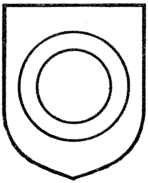
Fig. 244.—Annulet.
Closely akin to the roundel is the annulet (Fig. 244) and though, as far as I am aware, no text-book has as yet included this in its list of ordinaries and sub-ordinaries, one can see no reason, as the annulet is a regularly used heraldic figure, why the lozenge should have been included and the annulet excluded, when the annulet is of quite as frequent occurrence. It is, as its name implies, simply a plain ring of metal or colour, as will be found in the arms of Lowther, Hutton, and many other families. Annulets appear anciently to have been termed false roundles.
Annulets will frequently be found interlaced. Care should be taken to distinguish them from gem-rings, which are always drawn in a very natural manner with stones, which, however, in real life would approach an impossible size.
THE LABEL
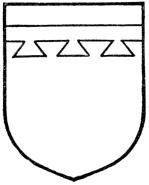
Fig. 245.—The Label.
The label (Fig. 245) as a charge must be distinguished from the label as a mark of difference for the eldest son, though there is no doubt that in those cases in which it now exists as a charge, the origin must be traced to its earlier use as a difference. Concerning its use as a mark of difference it will be treated of further in the chapter upon marks of difference and cadency, but as a charge it will seldom be found in any position except in chief, and not often of other than three points, and it will always be found drawn throughout, that is, with the upper line extended to the size of the field. It consists of a narrow band straight across the shield, from which depend at right angles three short bands. These shorter arms have each of late years been drawn more in the shape of a dovetail, but this was not the case until a comparatively recent period, and now-a-days we are quite as inclined to revert to the old forms as to perpetuate this modern variety. Other names for the label are the "lambel" and the "file." The label is the only mark of difference now borne by the Royal Family. Every member of the Royal Family has the Royal arms assigned to him for use presumably during life, and in these warrants, which are separate and personal for each individual, both the coronet and the difference marks which are to be borne upon the label are quoted and assigned. This use of the label, however, will be subsequently fully dealt with. As a charge, the label occurs in the arms of Barrington: "Argent, three chevronels gules, a label azure;" and Babington: "Argent, ten torteaux, four, three, two, and one, in chief a label of three points azure;" also in the earlier form of the arms of De Quincy (Fig. 235) and Courtenay (Fig. 246). Various curious coats of arms in which the label appears are given in Papworth as follows:—
"... a label of four points in bend sinister ... Wm. de Curli, 20th Hen. III. (Cotton, Julius F., vii. 175.)
"Argent, a label of five points azure. Henlington, co. Gloucester. (Harl. MS. 1404, fo. 109.)
"Or, a file gules, with three bells pendent azure, clappers sable. (Belfile.)
"Sable, three crescents, in chief a label of two drops and in fess another of one drop argent. Fitz-Simons. (Harl. MS. 1441 and 5866.)
"Or, three files borne barways gules, the first having five points, the second four, and the last three. Liskirke, Holland. (Gwillim.)"
A curious label will have been noticed in the arms of De Valence (Fig. 120).
THE BILLET
The billet (Fig. 247), though not often met with as a charge, does sometimes occur, as for example, in the arms of Alington.
Fig. 246.—Arms of Hugh Courtenay, Earl of Devon (d. 1422): Or, three torteaux, a label azure. (From his seal.) Fig. 247.—The Billet. Fig. 248.—Billetté.
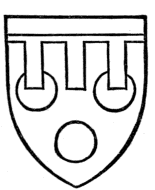
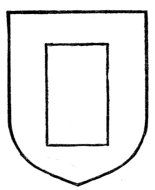
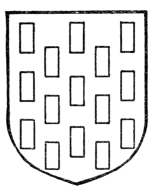
Its more frequent appearance is as an object with which a field or superior charge is semé, in which case these are termed billetté (Fig. 248). The best known instance of this is probably the coat borne on an inescutcheon over the arms of England during the joint reign of William and Mary. The arms of Gasceline afford another example of a field billetté. These are "or, billetté azure, and a label gules." Though not many instances are given under each subdivision, Papworth affords examples of coats with every number of billets from 1 to 20, but many of them, particularly some of those from 10 to 20 in number, are merely mistaken renderings of fields which should have been termed billetté. The billet, slightly widened, is sometimes known as a block, and as such will be found in the arms of Paynter. Other instances are to be found where the billets are termed delves or gads. The billet will sometimes be found pointed at the bottom, in which case it is termed "urdy at the foot." But neither as a form of semé, nor as a charge, is the billet of sufficiently frequent use to warrant its inclusion as one of the ordinaries or sub-ordinaries.
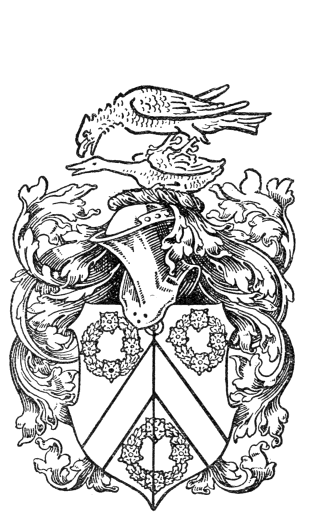
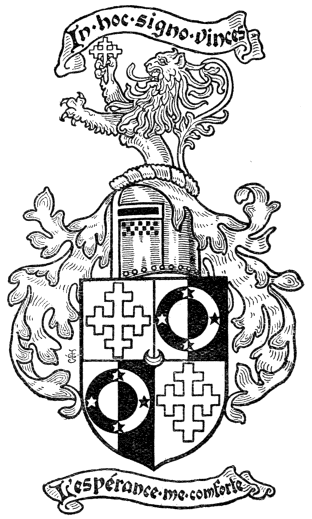
Fig. 249.—Armorial bearings of R. E. Yerburgh, Esq.: Per pale argent and azure, on a chevron between three chaplets all counterchanged, an annulet for difference. Mantling azure and argent. Crest: on a wreath of the colours, a falcon close or, belled of the last, preying upon a mallard proper. Fig. 250.—Armorial bearings of Robert Berry, Esq.: Quarterly, 1 and 4, vert, a cross crosslet argent (for Berry); 2 and 3, parted per pale argent and sable, on a chaplet four mullets counterchanged (for Nairne), in the centre of the quarters a crescent or, for difference. Mantling vert, doubled argent. Crest: upon a wreath of his liveries, a demi-lion rampant gules, armed and langued, holding in his dexter paw a cross crosslet fitchée azure; and in an escroll over the same this motto, "In hoc signo vinces," and in another under the shield, "L'espérance me comforte."
THE CHAPLET
Why the chaplet was ever included amongst the ordinaries and sub-ordinaries passes my comprehension. It is not of frequent occurrence, and I have yet to ascertain in which form it has acquired this status. The chaplet which is usually meant when the term is employed is the garland of oak, laurel, or other leaves or flowers (Fig. 249), which is found more frequently as part of a crest. There is also the chaplet, which it is difficult to describe, save as a large broad annulet such as the one which figures in the arms of Nairne (Fig. 250), and which is charged at four regular intervals with roses, mullets, or some other objects.
The chaplet of oak and acorns is sometimes known as a civic crown, but the term chaplet will more frequently be found giving place to the use of the word wreath, and a chaplet of laurel or roses, unless completely conjoined and figuring as a charge upon the shield, will be far more likely to be termed a wreath or garland of laurel or roses than a chaplet.
There are many other charges which have no great distinction from some of these which have been enumerated, but as nobody hitherto has classed them as ordinaries I suppose there could be no excuse for so introducing them, but the division of any heraldic charges into ordinaries and sub-ordinaries, and their separation from other figures, seems to a certain extent incomprehensible and very unnecessary.