Mrs George de Horne Vaizey (continued 3)
Reading edition
The short breathing space had allowed Darsie to recover her self-possession, to master the overpowering temptation to cry, and to swallow the lump in her throat sufficiently to be able to say in a weak little voice—
“You’ve saved my life!”
“You’ve spoiled my trousers!” retorted Ralph in a matter-of-fact manner calculated to put an instant check on sentimentality. He sat down on the bank, unfastened his mud-soaked gaiters, and threw them on one side. “The river’s beastly dirty, and the mud sticks like the Dickens. A new suit, too! It will never look the same again.”
“I’m sorry.”
“So you ought to be. Things are bad enough as they are, but... How on earth did you come to be careering about alone in that punt?”
“I was waiting to see your sisters. I wandered down here, and thought I’d just sit in it for a rest, then I thought I could just paddle up and down. I managed quite well going up the stream; I got as far as the willow!” Even at that moment a faint note of pride crept into Darsie’s voice. “We grounded there, and I—I must have fallen asleep, I suppose, and that hateful old mill must needs choose the opportunity to begin working at that very moment... Just my luck!”
Ralph pursed his lips in eloquent comment.
“If it comes to that, I think you have had a fair amount of luck in another way! I heard the noise of the mill and came down to look on. If I hadn’t been there, you’d have been pretty considerably in Queer Street by this time. Nice thing it would have been for us to discover your drowned body in the millpond, and have had to tell your aunt!”
“I thought of that,” agreed Darsie meekly. “It was one of my dying thoughts. Don’t scold me, please, for I feel so shaky, and you wouldn’t like it if I cried. It was my own fault, and I got what I deserved. I wasn’t a bit frightened till I missed the jetty, but that one moment was like a hundred years. Did my yell sound very awful?”
“Pretty middling blood-curdling!” replied Ralph, smiling. “Good thing it did. Gave me a bit of a shock, I can tell you, to see the old punt dashing down to the gates, with you sitting huddled up in the bottom, with your hair hanging wild, and your face the colour of chalk. You looked like a young Medusa.”
“Sounds attractive, I must say! Medusa froze other people’s blood, not her own,” declared Darsie, tilting her chin with a little air of offence, at which her companion laughed triumphantly.
“Oh, you’re better; you’re coming round again all right! I was afraid you were going to faint. I don’t mind telling you that you were jolly plucky. Most girls would have started screaming miles before, but you held on like a Briton. How do the arms feel now? Rather rusty at the hinges, I expect. The stiffness will probably spread to the back by to-morrow, but it’ll come all right in time. It is a pretty good weight, that punt, and I had to pull for all I was worth... Don’t you think you’d better come up to the house and have some tea?”
“Yes, please. And you can change your clothes, too. I should feel so miserable if you caught cold.”
“No fear of that. I’m used to splashing in and out of the water half a dozen times a day. You need have no anxiety about me.”
“But—the trousers?”
“Oh, bother the trousers! I piled that on a bit, just to prevent you from getting sentimental. They’re all right!” Ralph paused a moment, then, “I say!” he cried anxiously, “is this going to get you into trouble with the aunt? Need you say anything about it, do you think? I’ll swear to secrecy, if you say the word, and not a soul need know.”
Darsie debated the point thoughtfully while the two walked side by side along the gravelled paths, and finally arrived at a conclusion.
“I think, on the whole, I’ll tell! Aunt Maria allowed me to go out alone as a great concession, and it was mean to take advantage and run risks. So upsetting for her if I were killed in her house! So I’m in honour bound to confess, and promise not to do it again.”
“You might do something else just as bad! Probably she’ll withdraw her permission and keep you under her thumb as she did those first weeks.”
“She may; but I don’t think she will! I think she will appreciate my confidence,” said Darsie, with a grandiloquent air, at which her companion whistled softly, his face twitching with amusement. He was much more natural and boyish in his manner than on either of the previous occasions on which Darsie had met him, and the agitation of the last few minutes seemed to have carried them in a bound past all the formalities of early acquaintance.
“Right you are!” he said briskly. “I like a straight girl. But if you don’t mind we won’t speak of it before the mater. She’s a bit nervous, and would be always imagining that the girls were going to have the same experience. You might warn Lady Hayes not to speak of it either. We’ll keep it a secret between us.”
“Just as you like! I believe,” said Darsie shrewdly, “that you’re afraid of being praised and fussed over, as you would be if people knew that you had saved my life! Men hate a fuss, but you can’t escape my gratitude. I didn’t want to die. It came over me with a sort of horror—the thought of leaving the flowers, and the trees, and the blue sky, and all the people I love. Have you ever been so nearly dead to know how it feels?”
“Once—when I had enteric at school. It was a near squeak at the crisis.”
“And how did you feel? What did you think?”
“I didn’t care a whit one way or another. I wanted to have the pillow turned. That seemed a hundred times more important than life or death; I was too ill to think... Well, thank goodness, you are not dead! I hope you’ll live for many years to be a pride and glory to—er—er—the ranks of women blue-stockings!”
Darsie looked at him sharply.
“The girls have been telling you of my ambitions! Mean of them! They might have known you’d scoff. All boys do, but I fail to see why if a girl has brains she should not use them as well as a man.”
“The inference being—”
“Certainly! I’m unusually clever for my years!” returned Darsie proudly, whereupon they simultaneously burst into a peal of laughter.
“Well, you goaded me to it!” Darsie declared in self-vindication. “I can’t stand it when boys are superior. Why must they sneer and jeer because a girl wants to go in for the same training as themselves, especially when she has to make her own living afterwards? In our two cases it’s more important for me than for you, for you will be a rich landowner, and I shall be a poor school marm. You ought to be kind and sympathetic, and do all you can to cheer me on, instead of being lofty and blighting.”
Ralph Percival looked down at her with his handsome, quizzical eyes—
“I don’t mind betting that you’ll never be a school marm!” he said calmly; and at that very moment, round a bend of the path, the two girls came suddenly into view, trotting briskly towards the river. They waved their hands, and tore down upon the visitor in lively welcome.
“There you are! This is nice. Bates said you were in the garden, so we just flew and changed, and rushed off in pursuit. So glad you had Ralph to amuse you. The mill’s working! We guessed you’d be there looking on...”
“There’s nothing to see but the old wheel creaking round. Tea is far more to the point. I’m dying for some, and I’m sure—er—Miss—er—Garnett is, too! She’s had a tiring afternoon.”
“Er—Miss—er—Garnett’s name is Darsie. You can always call a girl by her Christian name till her hair’s up,” said Darsie quickly, and Ralph immediately availed himself of the permission.
“All right, Darsie. It’s a jolly little name. Much easier to say.”
Rather to Darsie’s disappointment tea was served in the drawing-room in formal, grown-up fashion, Mrs Percival presiding over the little table, with its shining silver and fine old-world china. There were hot, brown little scones, crisp buttered toast, iced cakes, thick cream, and other indigestible luxuries, which came as an agreeable change from Lady Hayes’s careful dietary, and Darsie was acutely conscious of the beauty and elegance of the room. How small and poky and drab the home drawing-room would appear in comparison! How different the outlook on another row of red-brick houses, from the sweep of green lawns, and the avenue of great beech-trees seen through the four long French windows which broke the side of this long, low room!
How different her own life promised to be from those of the two girls by her side—the girls who had just returned from a ride on their own horses over their own land! ... They would never need to worry about money; their rôle in life for the next few years would consist in being pretty and agreeable, wearing charming frocks, visiting at friends’ houses, travelling in summer, hunting in winter, and, finally, making suitable Carriages, settling down as mistresses of other luxurious houses, and living happily ever after!
She herself would study and cram for examination after examination; go through agonies of suspense waiting for results, and as she passed or failed, obtain a good or second-rate appointment in a suburban school. Henceforth work, work, work—teaching by day, correcting exercises by night, in a deserted schoolroom, with three months’ holiday a year spent at home among brothers and sisters whose interests had necessarily drifted apart from her own! As the years passed by she would become staid and prim; schoolmistressy manner; the girls would speak of her by derisive nicknames...
A knifelike pang of envy pierced Darsie’s heart; she dropped the dainty morsel of cake on to her plate with a feeling of actual physical nausea; for the moment her old ambitions lost their savour, and appeared grey and dead; she was pierced with an overpowering pity for her own hard lot.
The sensation was, perhaps, as much physical as mental, for no one can pass through a moment of acute mental tension without suffering from a corresponding nervous collapse, but being too young and inexperienced to realise as much, Darsie mentally heaped ashes on her head, and shed tears over her blighted life. The signs of her emotion were noticeable, not only in an unusual silence but in whitening cheeks, which brought upon her the quick attention of her friends.
“Aren’t you feeling quite well, dear?” Mrs Percival asked kindly. “You look pale. Would you like to lie down?”
“Darsie, you are green! What’s the matter? You were all right a moment ago.”
“I’m all right now. Please, please, take no notice. I’m perfectly all right.”
Noreen was beginning to protest again, when Ralph called her sharply to order—
“That’s enough, Nora! Awfully bad form to fuss. Talk about something else. What about that garden-party you were discussing? I thought you wanted to ask suggestions.”
Instantly both sisters were sparkling with excitement and animation.
“Oh, yes, yes. Of course! We must ask Darsie. She has such lovely ideas. Darsie, we are going to have a garden-party. The invitations are going out to-morrow. Hundreds of people are coming—mother’s friends, our friends, everybody’s friends, every bowing acquaintance for miles around. The question of the hour is—What shall we do? Garden-parties are such monotonous occasions, always the same over and over again—people sitting about in their best clothes, eating ices and fruit, listening to a band, and quizzing each other’s best clothes. We want to hit on a brilliant novelty. What shall it be?”
Darsie mused, her face lighting with pleasure and anticipation.
“I know nothing about garden-parties. There aren’t any in town. What have you done before?”
“Tennis, croquet, clock-golf, ping-pong, archery, yeomanry sports, blue bands, red bands, black and yellow bands, glee-singers, Punch and Judy,” Ida counted off one item after another on the ringers of her left hand. “And now we seem to have come to the end of our resources. We can’t think of anything else. Do, like a darling, give us an idea!”
The darling deliberated once more, head on one side, lips pursed, eyes on the ceiling, while the Percival family looked on, and exchanged furtive glances of admiration. She was pretty! prettier by far than ordinary pretty people, by reason of some picturesque and piquant quality more readily felt than denned. It didn’t seem to matter one bit that her nose turned up, and that her mouth was several sizes too large. “If you described me on paper, I’d sound far nicer, but I look a wur–r–rm beside her!” sighed Noreen mentally, just as Darsie lowered her eyes to meet those of her hostess, and inquired gravely—
“How much may it cost?”
It was the question which accompanied every home plan, and on which hung a momentous importance, but the Percivals appeared quite taken aback by the suggestion. The girls stared, and their mother smilingly waved it aside.
“Oh–h, I don’t think we need trouble about that! It’s only once a year, and we must do the thing well. If you have a suggestion, dear, please let us have it!”
“I was thinking,” said Darsie hesitatingly, “of a treasure hunt!”
Instantly all four hearers acclaimed the idea with such unanimity and fervour that the proposer thereof was quite overpowered by the thanks lavished upon her.
“The very thing! Why did we never think of it ourselves? Every one will like it, and it will keep them moving about, which is always the great problem to solve. Presents, presents, lots of presents, stowed away in odd corners...”
“We’ll each take a certain number and hide them in our own pet corners when no one else is in the garden. We’ll make the parcels up in green paper, so as to be less easy to find...”
“Every one must be told to bring them back to the lawn for a grand public opening, so that the disappointed ones may join in the fun...”
“We may take part ourselves, mother? We must take part! Get lots and lots of presents, and let us hunt with the rest!”
“Certainly, dears, certainly. It is your party as much as mine; of course you must hunt. I’ll run up to town and buy the presents at the stores. You must help me to think of suitable things. Bags, purses, umbrellas, blotters, manicure-cases—”
“Boxes of French bonbons, belts, scarfs—”
“Cigarettes, brushes—”
“Nice little bits of jewellery—”
Suggestions poured in thick and fast, and Mrs Percival jotted them down on a little gold and ivory tablet which hung by her side unperturbed by what seemed to Darsie the reckless extravagance of their nature. It was most exciting talking over the arrangements for the hunt; most agreeable and soothing to be constantly referred to in the character of author and praised for cleverness and originality. Darsie entirely forgot the wave of depression which had threatened to upset her composure a few minutes before, forgot for the time being the suspense and danger of the earlier afternoon.
Some one else, it appeared, however, was more remindful, for when she prepared to depart the dog-cart stood at the door, and Ralph announced in his most grand seigneur manner—
“We’re going to drive you back, don’t you know! Too awfully fagging to bicycle on a hot afternoon. Put on your hats, girls, and hurry up.”
The girls obediently flew upstairs, and Darsie’s protestation of “My bicycle!” was silenced with a word.
“The stable-boy shall ride it over to-morrow morning. You’re a bit jumpy still and can’t be allowed to run any risks. I mean to see you safely back in your aunt’s charge.”
Darsie scrambled up to her high seat and leaned back thereon with an agreeable sense of importance.
“I feel like a cat that’s been stroked,” she said to herself, smiling. “When you’re one of a large family you are not used to fussing. It’s most invigorating! I’d like to go in for a long course!”
Chapter Thirteen.
The Treasure Hunt.
The invitations for the garden-party arrived in due course: one for Lady Hayes, another for Miss Darsie Garnett, and in the corner of each, beside the name of a celebrated military band, appeared the magic words “Treasure Hunt.” Darsie felt something of the proud interest of the author who beholds in print the maiden effort of his brain, as she gazed upon those words, and reflected that but for her own suggestion they would never have appeared. Lady Hayes also seemed to feel a reflected pride in her niece’s ingenuity, which pride showed itself in a most agreeable anxiety about the girl’s toilette for the occasion.
After a survey of the few simple dresses which composed Darsie’s wardrobe, it was pronounced that nothing was suitable for garden-party wear, and a dressmaker was summoned from the country town to take measurements for a dainty white dress and hat to match. The dress was made to reach right down to the ankles, in deference to Lady Hayes’s ideas of propriety, and Darsie felt prodigiously fine and grown-up as she peacocked about before the long glass of her bedroom wardrobe on the day of the garden-party itself. Never in her life before had she possessed a gown made by an expert dressmaker, and the result was surprisingly flattering. She expatiated on the same with a candour startling to the audience of aunt and her maid.
“Don’t I look s–weet? So slim! I’d no idea I was such a nice shape. I don’t know which looks nicest, the frock on me or me in the frock! Aren’t I tall? Isn’t it graceful when I stand like this, and show the pleats? The hat’s a duck! I must say I do look most scrumptiously nice!”
“My dear!” Lady Hayes looked both shocked and alarmed. “My dear, how can you? I shall begin to regret my purchases if they encourage a spirit of vanity. I was always taught to allow others to praise me and to keep silent myself.”
“But you thought all the time, Aunt Maria, you couldn’t help thinking, and it’s worse to bottle it up. I’m always quite candid on the subject of my appearance,” returned Darsie calmly. “On principle! Why should you speak the truth on every other subject, and humbug about that? When I’ve a plain fit I know it, and grovel accordingly, and when I’m nice I’m as pleased as Punch. I am nice to-day, thanks to you and Mason, and if other people admire me, why shouldn’t I admire myself? I like to admire myself! It’s like the cocoa advertisements, ‘grateful and comforting.’ Honest Ingin, Aunt Maria! Didn’t you admire yourself when you saw yourself in the glass in that ducky grey bonnet?”
Evidently the question hit home, for Lady Hayes made a swift change of front.
“My dear, my dear, moderate your language! Your expressions are unsuitable for a young gentlewoman. You are growing up. Try, I beg, to cultivate a more ladylike demeanour!”
Darsie made a little face at the charming reflection in the glass, the which Lady Hayes wisely affected not to see, and presently aunt and niece were seated side by side in the big old barouche, forming one of a concourse of vehicles which were converging together out of every cross road, and turning in a seemingly endless string in the direction of the Hall. Shut carriages, open carriages, motors of different sizes and makes, dog-carts, pony carriages, governess carts—on they came, one after another, stirring up the dust of the road till the air seemed full of a powdery mist, through which unhappy pedestrians ploughed along in the shadow of the hedgerows, their skirts held high in white-gloved hands.
Darsie thought it inhuman of her aunt not to fill the carriage to overflowing with these unfortunates, but she made no attempt to do so, but sat up stiff and straight in her seat, a typical old lady of the olden times, in her large bonnet, grey satin gown, and richly embroidered China crape shawl.
“If you’re not proud of yourself, I’m proud of you!” the girl declared, smoothing the satin folds with an approving hand. “You look just what you are, a dear old fairy godmother who pretends to be proud and fierce, and is really a lump of kindness and generosity. All the other old ladies look dowds beside you.”
“Don’t flatter me, my dear. I dislike it extremely,” returned Lady Hayes with such an obvious look of satisfaction the while that Darsie laughed in her face, and laughed unreproved.
Arrived at the Hall, the guests were escorted through the perilously slippery hall, on which the mats seemed to turn into fresh pitfalls and slide beneath the feet; then through a side-door on to a miniature lawn, in the centre of which stood Mrs Percival, sweetly smiling, and ejaculating endlessly: “Delighted to see you! So nice of you to come!” before passing the visitors on to her husband and children who were ranged at discreet intervals along the sweep of the lawn. The girls whispered dramatically to Darsie that for the time being they were tied, literally tied by the heels, so she sat demurely by her aunt’s side under the shade of a great beech-tree, listened to the band, spilt drops of hot tea down the front of her white dress, buttered the thumbs of her white kid gloves, and discovered the unwelcome but no doubt wholesome fact that there were other girls present who appeared just as attractive, or even more so than herself! Then the band began to play item number four on the programme, and Noreen Percival came forward with a sigh of relief.
“At last I am free! They’ve all come, or practically all, and we can’t wait for the laggards. The Hunt begins at three o’clock. Mother thought we’d better have it early, as it would shake them up and make them more lively and sociable. You’ll have to search by yourself, Darsie, for as we have all done some of the hiding, it wouldn’t be fair to us to go about in pairs. There are piles of presents, and your eyes are so sharp that you are sure to find two or three. You mustn’t open them on the spot, but bring them up to the cedar lawn, where mother will be waiting with the old fogies who are too old to run about, but who would like to see the fun of opening. I do hope I find the right thing! There’s the sweetest oxydised buckle with a cairngorm in the centre that would be the making of my grey dress. I have set my heart upon it, but I haven’t the least notion where it’s stowed. It may even have been among my own parcels, and of course I can’t go near those...”
“If I get it, we’ll swop! I wish I knew the garden better. I don’t know of one good hiding-place except those I made myself... Perhaps I shan’t find anything at all.”
“Oh, nonsense! Keep your eyes open and poke about with your feet and hands, and you can’t go wrong. The paper’s just a shade lighter than the grass. Remember!”
Noreen flew off again to move a chair for an old lady who wished to escape the rays of the sun, and once more Darsie was left to her own resources. By her side Lady Hayes was deep in conversation with another old lady on the well-worn subject of a forthcoming agricultural show, and the town-bred visitor, failing to take an intelligent interest in prize carrots and potatoes, turned her attention to the group on the right, where Ralph Percival was making himself agreeable to three fashionable-looking girls of about her own age.
He wore an immaculate grey suit and a Panama hat, and regarding him critically, Darsie felt another shock of surprise at being compelled to admire a man! Hitherto she had regarded the race as useful, intelligent creatures, strictly utilitarian in looks, as in attire, but to-day it was impossible to deny that the beauty was on Ralph’s side more than on that of his companions. The poise of the tall, slim figure was so graceful and easy that it was a pleasure to behold; the perfect lines of aquiline nose, and dented chin, the little kink and wave which refused to be banished from the clipped hair, the long narrow eyes, and well-shaped lips made up a whole which was quite startlingly handsome and attractive. The three girls looked back at him with undisguised admiration and vied with one another in animated conversation, in return for which he drawled out slow replies in a tone of languid boredom.
During the fortnight which had elapsed since the date of her misadventure on the river, Darsie had had frequent meetings with the Percivals, and now felt on the footing of a friend rather than an acquaintance. Concerning the girls, there was no question in her mind. They were dears, not dears of the same calibre as Vie and plain Hannah, dears of a less interesting, more conventional description, but dears all the same, lively, good-tempered, and affectionate. The only brother was a far more complex character, with regard to whom Darsie changed her mind a dozen times a day. At one time he was all that was delightful, full of natural, boy-like good-comradeships at another he was a bored and supercilious dandy, looking down on schoolgirls from an intolerable height of patronage, and evidently priding himself on a blasé indifference. The present moment showed him in the latter mood, and Darsie’s lips curled as she watched and listened, and in her eyes there danced a mocking light. “Like a vain, affected girl!” was the mental comment, as her thoughts flew back to Harry and Russell, uncompromising and blunt, and to Dan Vernon in his shaggy strength. Even as the thought passed through her mind Ralph turned, met the dancing light of the grey eyes, and turned impatiently aside. He would not look at her, but he could feel! Darsie watched with a malicious triumph the flush creeping slowly over the smooth pale cheek, the hitch of the shoulders, the restless movement of the hands which betrayed the hidden discomfort. Presently some friends came forward to join the three ladies, when Ralph immediately joined her with an invitation which sounded more like a command—
“Come for a walk round the gardens!”
Darsie rose, nothing loath, conscious that she was about to be reproved, and finding an agreeable sense of support in her lengthened skirts, and the semblance of grown-up-ness which they imparted.
“What did you mean by staring at me like that?”
“Like which?”
“You know very well. You did it on purpose to annoy me, and make me uncomfortable.”
“Oh no, I didn’t! I didn’t do anything. It did itself. It was just the outward and visible expression of my inward and invisible thoughts.”
“Pretty middling disagreeable thoughts they must have been!”
“Humph! Not disagreeable exactly. Hardly strong enough for that. Just amused!”
“Amused!” The flush deepened on the lad’s cheek. Unwittingly Darsie had hit upon the most scathing of all indictments. To be an object of amusement to others! What could be more lacerating to the dignity of nineteen years. “I had no idea that I was being so funny. Will you have the goodness to point out what you found so amusing?”
“Your airs,” replied Darsie bluntly. “And graces! You asked me, you know, so I’m bound to tell you. It’s so odd to see a boy like that. But you needn’t be cross. I’m speaking only for myself. Those other girls liked it very much... You could see that for yourself.”
“Just so. We are talking of your opinion at the moment, however, not of theirs. What sort of—er—boys are you accustomed to meet, if one may ask?”
The strong accent thrown on the word “boys” showed a fresh ground of complaint. Darsie felt a twinge of compunction, remembering the episode of the punt and her own great cause for gratitude. The answer came with startling earnestness.
“Not a bit braver than you, nor quicker and cleverer in an emergency. Perhaps not so good. If you’d hesitated one moment I mightn’t have been here to criticise. But, just big, simple boys, not an ounce of affectation between them. Of course, they are not handsome. That makes a difference...”
But Ralph was not to be mollified by a compliment on his good looks. He was irritated, and considered that he had good reason for being so. Darsie Garnett was an unusually pretty and attractive girl, and having saved her from a perilous position but a fortnight earlier, it had been an agreeable delusion to imagine himself ensconced for life in her estimation as a gallant young rescuer, the object of her undying gratitude and admiration—a delusion indeed, since the criticism of those mocking eyes was more than equalled by the explicitness of her explanations!
Ralph looked injured and melancholy, and Darsie, with characteristic softness of heart, was instantly seized with compunction. She was finding out for herself what every one who came in contact with Ralph Percival discovered sooner or later—that it was exceedingly difficult to keep up a feeling of offence against any one who showed his displeasure in so interesting and attractive a fashion.
He was so handsome, so graceful in movement, he had the art of concealing the most ordinary emotions behind a cloak of baffling superiority. To-day, as he paced the garden paths by Darsie’s side, Ralph wore the air of a lovelorn poet, of a patriot sorrowing for his country, an artist wrestling over a life’s masterpiece, like anything or everything, in fact, but just what he was—a sulky and empty-headed young gentleman, wounded in his own conceit!
To her own amazement Darsie presently found herself engaged in the humble position of “making it up,” and in taking back one after another each disparaging remark which she had made, which, being done, Ralph graciously consented to “think no more about it!” and strolled off to speak to a friend, leaving her stranded by herself at the far end of the garden.
The position would have been an uncomfortable one had it not happened that just at that moment a bell rang loudly, followed by a sudden gathering together of the guests upon the cedar lawn. Mr Percival was making some announcement which was greeted by bursts of approving laughter. The words of the announcement were inaudible to Darsie’s ears, but the purport was unmistakable. The treasure hunt had begun! With one accord the guests turned and streamed in the direction of the gardens, turning to right and to left, peering beneath bushes, poking delicately among the foliage of flower-beds with the ferules of walking-sticks and parasols...
Darsie turned and fled like a lapwing along the path leading past the tennis-lawn and rose and vegetable gardens, to the shaded fern grotto which formed one of the boundaries of the grounds. The idea had come to her to begin, so to speak, at the end and have the field to herself, but, as is usually the case, she was to discover that others were as ingenious as herself, for she had soon quite a string of followers along the narrow paths.
The thickly growing ferns seemed to offer endless hiding-places, but a printed notice to the effect that “It is not necessary to walk upon the Beds!” seemed to limit the possible area to that within reach of hand or stick. Darsie poked and peered, lifted the hanging fronds which fell over the rockwork border of the lily pond, stood on tiptoe on the rustic seat to peer between the branches of surrounding trees, but could discover nothing in the semblance of a paper packet. It was the same story in the rose garden, though the thick foliage on the pergolas seemed to offer numberless hiding-places for dainty packets, containing great gear in little bulk; it was the same story in the wide, herbaceous border, though pathways on either side offered double opportunities for search. For the first few minutes the search was pursued in almost complete silence, but as time went on there came the sound of one triumphant cry after another, as a busy searcher was rewarded by a sudden sight of the longed-for paper wrapping. Darsie’s envious eyes beheld one young girl running gaily past, with no less than three trophies carried bag-like in the folds of a chiffon scarf. Three! And she herself had not yet discovered one! What would the Percivals say if at the end of the hunt she returned empty-handed? The surprised incredulity of the girls, the patronising condolences of Ralph, seemed in prospect equally unwelcome. Desire for a present itself became subservient to anxiety for the credit of her own sharp-sightedness and intuition. She must and would discover a parcel before the time limit was past.
The next half-hour passed in a search ever more eager and strenuous, as with every moment that passed the chance of success diminished. So many treasures had already been discovered that Darsie began to think with a pang that perhaps there were no more to be found. Every third or fourth visitor seemed to be carrying a trophy; some with airs of would-be modesty were wending their way back to the cedar lawn carrying as many as three or four, declaring that really and really they must not look any more—it was altogether too greedy! As they passed by the spot where Darsie pursued her ceaseless search, they would pause with words of maddening advice or condolence.
“Not found anything yet? How unfortunate! Look beneath the leaves...” Once Ralph passed by and arched his eyebrows in eloquent surprise. He seemed on the point of offering advice, but Darsie whisked off in the opposite direction, to take refuge in the least frequented portion of the grounds, the orchard.
Only ten minutes left! The bell of warning was pealing loudly from the cedar lawn, she could hear the merry chatter of the returning guests.
Darsie lifted her muslin skirts and ran quickly in and out between the trees, searching for some hiding-place as yet undiscovered. The gnarled branches seemed to offer endless convenient niches, but in none of them could anything in the shape of a parcel be discovered. She was on the point of abandoning the search and returning empty-handed, when, lifting up a heavy branch, her eyes suddenly lit upon a cavity in the trunk of one of the oldest trees. When the branch remained in its ordinary position, the hollow was completely hidden from sight; moreover its position facing the wall made it doubly invisible. It hardly seemed possible that so very obscure a hiding-place would be chosen under the circumstances, but at this last moment no chance could be neglected.
Darsie rolled back her dainty net sleeve, plunged her hand deep into the hollow trunk, and flushed with triumph as her fingers came in contact with something loose and soft. It was not a paper parcel, it felt more like cloth—cloth with knotted ends all ready to pull. Darsie pulled with a will, found an unexpected weight, put up a second hand to aid the first, and with a tug and a cloud of dust brought to light nothing more exciting than a workman’s handkerchief, knotted round a lumpy parcel which seemed obviously a midday meal.
It was a disappointment, but the next moment an inherent sense of humour had discovered its possibilities of the position and gallantly accepted a second best.
Since she might not possess a proper present, she could at least be the happy proprietor of a joke! Into the middle of the ring of guests she would march, handkerchief bundle in hand, and to her credit would remain, if not the greatest applause, at least the biggest laugh of the afternoon! Darsie drew down her sleeve, brushed the top coating of dust from the handkerchief, and hurried onwards towards the cedar lawn.
Chapter Fourteen.
A Treasure indeed.
Darsie was one of the last guests to arrive upon the final scene of the treasure hunt, and already the merry process of parcel opening had begun. The young girl who had captured three prizes was on her knees before a garden seat, laying them out in a row to be seen and admired of all. Gaily dressed women were running about appealing to their male friends for the loan of penknives to cut the encircling string, and the air was full of the sound of laughter and happy, triumphant voices.
“How lovely! How beautiful! Isn’t it charming? Just what I wanted!”
Darsie stood in the background, her hands clasping her bundle behind her back, so as to screen it from view until the right moment arrived for its production. The prize-winners were one and all in such a desperate hurry to examine their “finds” that she would not have long to wait, and meanwhile the scene was delightful to witness.
Every one looked gay, and happy and smiling; the many-coloured frocks of the women made charming flecks of colour against the sombre green of the old cedar, as they moved to and fro with dazzling, kaleidoscopic effect. Darsie had never even imagined such a scene; it seemed to her more like fairyland than the dull work-a-day world.
She looked on, absorbed in delighted admiration, while one after another the coverings were torn from the dainty packages, and the brilliance of the scene was enhanced by the glitter of silver, and glass, and dainty patches of colour. It would take long, indeed, to write of the treasures which Mrs Percival had amassed in that day in town; it seemed to Darsie that nothing less than the contents of an entire shop window could have supplied so bewildering a variety. Bags, purses, satchels, brushes, manicure-cases, blotters, boxes, cigarette-cases, photograph frames, fans, brooches, bracelets, buckles, studs, tie-pins, waistcoat buttons—wherever the eye turned there seemed something fresh and beautiful to admire.
After such an Aladdin’s feast, would not her workman’s bundle fall very flat? With a sudden access of humility Darsie was about to turn tail and put the poor man’s dinner back in its hiding-place, when from across the lawn she met Ralph’s eyes fixed upon her with an expression of patronising commiseration. He was pitying her, because she had come back empty-handed when sharper eyes had reaped so rich a harvest! That touch of superiority made short work of Darsie’s hesitation. She would show that she was in no need of pity, that so far from being overpowered by failure, she remained jaunty and self-confident enough to turn her own disappointment into a joke for the amusement of others! With head thrown back she marched dramatically forward to the spot where Mrs Percival stood, the gracious mistress of the ceremonies, and held the bundle towards her in extended hands.
“Dear child, what have you there? A bundle—a workman’s bundle! Where in the world have you discovered that?”
“In the trunk of an old tree, in the orchard near the wall.”
“In the orchard? It belongs most likely to one of the men. His dinner, I should say, but what an odd place to hide it! So dirty!” She gave a dainty little shake of distaste. “I should put it away, dear, really! It is covered with dust.”
“It’s a very lumpy dinner,” said Darsie, patting the surface of the bundle with curious fingers. “I thought perhaps it was a treasure done up in a different way from the others. It’s heavy, too, far heavier than bread and cheese. I can open it, can’t I? Just to make sure!”
“Oh, certainly, if you like—” assented Mrs Percival dubiously, and Darsie waited for no further permission, but promptly knelt down on the grass and set to work to untie the knotted ends of the checked handkerchief. The surrounding guests gathered around in a laughing circle, being in the gay and gratified frame of mind when any distraction is met halfway, and ensured of a favourable reception. What was this pretty girl about? What joke was hidden away in this commonplace-looking bundle?
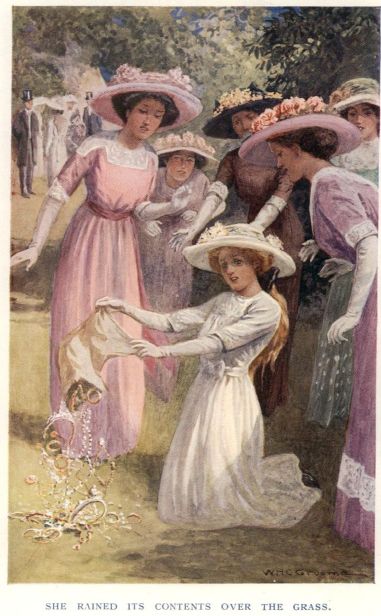
The knot was strongly tied, but Darsie’s fingers were strong also and in a minute’s time it was undone, and the corners of the handkerchief dropped on the grass to reveal an inner bag of thick grey linen tied again round the mouth.
“It is lumpy!” repeated Darsie again; then with a tug the string came loose, and lifting the bag in her hands, she rained its contents over the grass.
Was it a dream? Was it some fantasy of imagination—some wonderful effect of sunshine shining upon hundreds and hundreds of dewdrops, and turning them into scintillating balls of light, catching reflections from the flowers in yonder beds, and sending dancing rays of red, blue, and green across the grass? Red and blue and green the rainbow drops gleamed upon the ground, vivid and clear as the loveliest among the blossoms, but possessed of a radiance which no earth flower had inherited before.
Darsie sat back on her heels, her arms, falling slack by her sides, her wide eyes fixed on the ground in a surprise too complete for speech. Nobody spoke; the stupor in her own brain must surely have communicated itself to the guests crowding around, for while one might have counted fifty there was blank, utter silence upon the lawn. Then suddenly came a dramatic interruption; a cry, almost a scream, in a high, feminine voice, and a tall, fashionably dressed woman grasped wildly at a dangling chain of stones.
“My rubies! My rubies! My beautiful, beautiful rubies! Found again! Safe! Oh, my rubies!” She burst into excited sobs, a gentleman came forward and led her gently aside, but her place was immediately taken by other women—white-faced, eager, trembling with anxiety.
“Oh! Oh–h—let me look! It’s the jewels, the lost jewels— Are my diamonds among them? Do you see a diamond necklace with an emerald clasp? Oh, do, do look!”
“My sapphires! They were taken, too. My sapphires!—”
They fell on their knees, regardless of their filmy draperies, and grasped at one shining treasure after another. The delicate chains were knotted together; curved corners of gold had caught in other curved corners, so that in some cases half a dozen different ornaments presented the appearance of one big, bejewelled ball, and it was no easy matter to disentangle one from the other. The different owners, however, showed a marvellous quickness in recognising even a fragment of their lost treasures, and their exultation was somewhat undignified as they turned and twisted and coaxed the dainty threads, and finally clasped their lost treasures, safe and sound, and all the time Darsie sat back on her heels, with her golden hair hanging in heavy masses over her shoulders, her eyes fixed upon this extraordinary scene, staring—staring!
“Darsie, dear child, how can we thank you?” Mrs Percival’s low voice trembled with earnestness; she had lifted a long string of pearls from the grass, and now held it between both hands, with a transparent pleasure it was true, but without any of the hysteric excitement shown by her guests.
“Do you realise all that your workman’s bundle contained, or the weight you have taken off our minds? It was the thief’s bundle, the bundle of jewels which he stole from the house on the night of the Hunt Ball, which we have tried so hard to recover! To think—to think that all this time they have been hidden close at hand!”
“Hidden with a purpose, too! Look at this, Evelyn!” interrupted Mr Percival, holding out a corner of the checked handkerchief towards his wife, with a stern look on his handsome face—
“‘B.W.’ That’s Wilson’s property! He was a worse offender than we thought.”
“Wilson? That was the young gamekeeper, wasn’t it?” asked another man—the husband of the lady who was still crooning over her recovered diamonds. “You thought he had been led away by smart London thieves, but this seems as if he had taken a leading part. Looks, too, as if there may have been only himself and Forbes in the affair!”
“Just so! No wonder Wilson refused to give the names of his colleagues. When the chase grew too hot he hid the spoils in this tree—evidently an old hiding-place—before climbing the wall. If he had made clear away that night we should never have suspected his share in the theft. He would have turned up as usual next morning, and expressed great surprise at the news. As it is he and Forbes are no doubt patiently waiting until their sentences are out, expecting to slip back some dark night and secure their prey. From such point of view it is a small business to serve a few months when there’s a fortune waiting at the end! Well, this takes ten years off my back. I can’t tell you how the whole business has preyed on our minds. My dear fellow, I am so thankful that your diamonds have turned up!”
“My dear fellow, it was fifteen times worse for you than for us! A most uncomfortable position; I congratulate you a hundred times. Just in the nick of time, too. In a month or so there would have been no bundle to discover.”
A general gasp at once of dismay and relief passed round the little inner circle of those most nearly interested in the recovered treasures, and the first excitement of recovery having passed, every one seemed bent on lavishing thanks and praises upon the girl through whom the happy discovery had come about.
“Who is she?”
“What is her name?”
“Where does she come from?” The questions buzzed on every side, and the answer, “Lady Hayes’s grand-niece,” served only to enhance existing attractions. Darsie found herself kissed, patted, embraced, called by a dozen caressing names by half a dozen fine ladies in turn, during which process every eye on the lawn was turned upon her blushing face. Through a gap in the crowd she could see Lady Hayes holding as it were a secondary court, being thanked effusively for possessing a grand-niece with a faculty for recovering jewels, and bowing acknowledgments with a bright patch of colour on either cheekbone. The position was so strange and bewildering that even yet it seemed more like a dream than reality; that sudden rain of jewels descending from the linen bag was the sort of thing one might expect in an Arabian night adventure rather than in the midst of a decorous English garden-party! It must surely be in imagination that she, Darsie Garnett, has been hailed as a good fairy to all these fashionably dressed men and women!
The almost hysteric effusion of the women who kissed and gushed around her must surely have something infectious in its nature, since she herself was beginning to feel an insane inclination to burst into tears or laughter, it was immaterial which of the two it should be. Darsie turned a quick look around, searching for a way of escape, and at that moment Noreen’s hand pressed on her arm, and she found herself being led gently towards the house.
“Poor old Darsie, then! She looks quite dazed!” said Noreen’s voice. “No wonder, after all that fuss. You’ve been kissed to pieces, poor dear, and howled over, too. Silly things! howling when things are lost, and howling again when they are found! I’ve no patience with them; but, oh, my dear, I do bless you for what you’ve done! You’ve no idea how relieved we shall be. It was such a stigma to have your guests robbed under your own roof, and by one of your own men, too. Mother has never been the same since—worried herself into nerves, and fancied every one blamed her, and thought she’d been careless. You can’t think how happy she’ll be writing to the people who aren’t here to-day telling them that their things are found. She’ll feel a new creature.”
“I’m so glad. She’s a dear. Wasn’t she sweet and dignified among them all? Oh, dear! I’m all churned up. I thought as I couldn’t find a treasure I’d have a little joke on my own account, and after all I found the biggest treasure of all, Noreen! how much money were those things worth?”
“Oh, my dear, don’t ask me! Mother’s pearls alone are worth three thousand, and that’s nothing to the rest. Mrs Ferriers’ rubies are the most valuable, I believe. Altogether it must be a fortune—to say nothing of the associations. Isn’t it strange to think of? An hour ago you were a stranger whom scarcely any one knew even by sight, and now in a flash you have become a celebrity, a heroine—the pet of the county!”
“Am I? Really? It sounds agreeable. I’ll write to-night and tell Vie Vernon, and sign myself ‘The Pet of the County.’ She will be impressed. Pity it wasn’t my own county, where it would be of more use. I shall probably never see these good people again.”
“Fiddle!” cried Noreen derisively. “No chance of that. Whether you like it or no, my dear, this day has settled your fate. You can never be a mere acquaintance any more. You’ve done us a service which will bind us together as long as we live. Henceforth a bit of you belongs to us, and we’ll see that we get it!”
Chapter Fifteen.
A Dream Fulfilled.
The next week brought with it a succession of bewildering excitements. From morn till night, as it seemed, the bell rang, and visitors were ushered in to congratulate Lady Hayes and her niece on the happy episode of the jewel-finding, and to repeat ad infinitum the same questions, ejaculations, and remarks. People who had no personal interest in the theft seemed, strangely enough, quite as excited and curious as those who had; and even when their curiosity was satisfied there still remained the servants in the house, the tradesmen in the village, the very children in the roads, who seemed one and all possessed with a thirst to hear the romantic story from the lips of the heroine herself.
Then letters from relations and friends! However minutely one might retail every incident, there still seemed an endless number of details which remained to be told to people who could not be satisfied without knowing in each case what he said, how she looked, how you yourself felt and behaved! The first three days were spent in talk; on the fourth began a second and still more exciting stage. The bell rang, a small, daintily tied parcel was handed in for Miss Garnett, which being unwrapped revealed a red velvet jeweller’s box, and within that a small heart-shaped pendant, slung on a gold chain, and composed of one large and several small rubies, set transparently, so as to show to advantage their glowing rosy light. An accompanying card bore the inscription, “A small expression of gratitude from Mrs Eustace Ferriers”; but even this proof was hardly sufficient to convince Darsie that such splendour was really for her own possession.
“Aunt Maria! Can she mean it? Is it really to keep?”
“Certainly, my dear. Why not? It is quite natural that Mrs Ferriers should wish to give you some little remembrance as you were the means of restoring a valuable heirloom. It is a good stone. You must be careful not to lose it.”
“Is it valuable, Aunt Maria—worth a lot of money?”
“It is a pretty ornament, my dear. Do not look a gift horse in the mouth.”
It was all very well for Aunt Maria, a titled lady with a box full of jewels of her own, to take things calmly, but for a member of a poor large family to receive a ruby pendant was a petrifying experience, only to be credited by a continual opening of the box and holding of it in one’s hand to gaze upon its splendours. And then the very next morning the bell rang again, and in came another parcel, another jeweller’s box, and inside it a blue enamelled watch with an encircling glitter of light where a family of tiny diamonds formed a border round the edge. There was an enamel bow also to fasten it on to a dress, but Darsie fairly quaked at the thought of the responsibility of wearing so gorgeous an ornament.
“That will do for mother,” she announced decidedly. “It wouldn’t be decent for me to flaunt about in enamel and diamonds when she has an old gold thing that is always slow. Besides, if she wears it I can watch the diamonds flash, and that is the best part of the fun. Aunt Maria, that’s two! Do you suppose, should you imagine, that they’ll all—”
Lady Hayes looked shocked, as in duty bound.
“My dear, I don’t suppose anything about it. That is not our affair. It is sufficient that these two friends have been most kind and generous, and that you ought to be a very grateful girl. Surmises as to future gifts are in the worst possible taste.”
Darsie wrinkled her nose and sat in silence for several moments, moving the little watch to and fro to catch the play of light upon the stones. Then suddenly she spoke again—
“Aunt Maria, what are your ideas with regard to luck?”
“I have none, my dear. I don’t believe in its existence!”
“But you must, Aunt Maria. You must. It was the merest luck my seeing that hole, and thinking of feeling inside, but it seems as if it were going to have such big consequences. Just in a moment it has brought me more influential friends than most girls meet with in the whole of their lives. They are all grateful to me; they feel that I have helped them; they want to help me in return; but after all there’s no credit to me, it was all done without one scrap of thought or trouble. It seems hard to think that many people work and slave for years, and fail to gain a quarter as much as I have done by just pure luck!”
“Don’t be so sweeping in your assertions, child. These are early days yet to talk about results. When you come to my age, my dear, you will look back and realise that those who go through life in the right spirit are never left to the mercy of what you call ‘luck.’ ‘Submit thy way unto the Lord, and He will direct thy path.’ I am an old woman, Darsie, but I can say from my heart that goodness and mercy have followed me all the days of my life.”
Darsie sat gazing thoughtfully into her aunt’s face. Within the last weeks a degree of intimacy had developed between the old woman and the girl, which made it possible for the latter to speak out more openly than she would have believed possible a short month before.
“Aunt Maria,” she said slowly, “I wish you would explain... You talk of goodness and mercy, but—don’t be shocked!—it doesn’t seem to me that you have so much to be thankful for! ... You are rich, of course, but that doesn’t count for much by itself, and your life must have been hard... You are delicate, and your husband died, and you have no children—no one to live with you in this big house. Now when you are old you are so lonely that you are glad to have me—a girl like me—for a few weeks’ visit! When I go away you will be lonely again...”
A tremor passed over Lady Hayes’s face; the thin fingers crossed and uncrossed themselves on her lap, but she smiled, a brave and patient smile. “You are right, Darsie. I have had bitter trials, nevertheless I have gained the greatest treasure that is given to any one on this earth.”
“What is that, Aunt Maria?”
“Peace in my soul, child—‘the peace of God, which passeth understanding,’” said the old woman solemnly.
There was silence in the room. Darsie bent her head, awed and touched by the sound of those wondrous words. A month ago, at home with her brothers and sisters, she would have scoffed at the idea of peace in connection with Great-aunt Maria, but a closer intimacy had altered her opinion. About the trifling affairs of every day Aunt Maria continued to fuss. No one could deny for a moment that she fussed; but the big demands of life found her calm, serene, prepared. On the surface the waters might dash occasionally into foam, but the deep, strong current bore steadily towards the sea!
Darsie pondered, and as though divining the course of her thoughts, Lady Hayes spoke once more.
“Perhaps that appears to you a serious statement for me to make, since there are times when I must appear a very unpeaceful person. I am apt to be unduly concerned about trifles, to my own exhaustion and that of others. I am aware of the fact, and also that to one of your impetuous disposition such a failing must be particularly trying. Nevertheless, Darsie,”—the old voice deepened impressively—“the peace is there!”
Slowly, thoughtfully Darsie bowed her head.
“Yes, I know. I’ve felt it. It has made me ashamed. The human part of you may get out of hand sometimes, but you are very nearly an angel, Aunt Maria. You haven’t much more to learn!”
Lady Hayes shook her head, but her hand fell on Darsie’s head with a tender touch, and a light shone in the tired eyes. The lonely heart was grateful for those words of encouragement.
Darsie’s surmise that still more presents might arrive was justified by the delivery of three more packets—a dainty little pearl necklace from Mrs Percival, a turquoise and diamond ring (oh, the rapture of owning a real ring of one’s very own!) and a combination present of a jewelled bangle from three other ladies who had benefited by the lucky find. Thus in one short week had Darsie’s jewellery risen from a total which she herself described as consisting of “a few glass beads and a gold safety-pin” to five separate articles of real beauty and value.
She was fond of spreading her treasures in a row on the table and gazing at them en bulk, moving her head from side to side to enjoy the flashing colours of the stones, and as she did so Lady Hayes was more than surprised by a mercenary element which seemed out of keeping with the girl’s natural character.
“Rubies are the most valuable stones, aren’t they, Aunt Maria—more valuable than diamonds?”
“If they are of the right colour and depth, and of sufficient size.”
“You said this was a good stone. It’s a ripping colour. I should think this must be a valuable stone, wouldn’t you?”
“I prefer not to speculate on the subject, child.”
Or again—
“I should think this watch was worth lots of money. I have just counted, and there are forty diamonds, teenies, of course, but still— And the enamel is so fine. My bracelet has five big diamonds, and a whole heap of pearls; and there’s the necklace, too. Should you think, Aunt Maria, that they were worth a hundred pounds put together?”
Lady Hayes laid down her knitting, and stared with stony eyes into the girl’s face.
“I have told you before, Darsie, that I excessively dislike surmises as to the value of presents. I am surprised and disappointed to discover signs of an avaricious and grasping nature!”
To her surprise and dismay the only reply to this serious aspersion was a good-natured laugh.
“Goodness gracious, mercy on us!” cried Darsie audaciously. “I’m bad enough, in all conscience, but I’m not that! Not a grasp in me! You ask any one at home, and they’ll tell you I’m quite stupidly generous. It’s not the money for the money’s sake, I think of, but for what it will do! I’ve no use for jewels, Aunt Maria—shan’t ever have a chance of wearing them, like Noreen and Ida. Imagine a daily governess glittering with gems! But if only—only I could turn them into money, it might fulfil the big ambition of my life and send me to Newnham, without troubling father for a penny! Can you wonder that I feel impatient with watches and chains when I think of that?”
“I am sorry, my dear. I did not understand. I apologise!” said Lady Hayes promptly. It was this unfailing sense of justice, combined with the dignity which never forsook her under any stress of excitement or agitation, which had been most largely instrumental in attracting the girl’s admiration. From the impetuous standpoint of youth it seemed an almost inhuman pinnacle of perfection, but Darsie was quite determined that at some far-distant elderly epoch—say, in thirty years’ time—she would begin practising these virtues on her own account. They seemed the only decorous accompaniment of white hair and spectacles.
She stretched out a sunburnt hand and patted the old lady’s shoulder with an affectionate touch.
“All right! Don’t worry. It did seem greedy, and of course you couldn’t guess. You see, it’s particularly hard because plain Ha– Hannah Vernon, I mean—is going up, and that seems to make it worse for me. Her father is richer than ours, and he believes in higher education, so it’s all settled that she is to go to Newnham, and she talks about it all the time, and pities me when she’s in a good temper, and brags when she’s not. And Dan would be at Cambridge, too, and Ralph Percival, and, oh dear, oh dear, we’d have such sport! Balls, and picnics, and cocoa parties, and boating in summer—no end of lovely exciting pranks!”
“Excuse me, my dear,”—Lady Hayes was frosty again, staring stonily over the rim of her spectacles—“excuse me, but would you kindly explain for what reason you are anxious to go to Cambridge? I had imagined that it was for education, now it appears that balls and picnics are the attraction. Which of the two is it of which you are really thinking?”
“Oh, Aunt Maria, I’m a human girl! Of both!” cried Darsie, laughing. “Education first, of course, because of the result, and all it will mean afterwards, but if you want the truth, I shouldn’t be so keen if it wasn’t for the fun! We know a girl who’s just come down, and it sounds such a lovely life... I’d work hard; I love work, and when there is any on hand there’s no peace for me till it’s done; but wouldn’t I just play, too! It would be the time of my life. Oh, Aunt Maria, when I look at the governesses at school, and think that I’m going to be like that all my days, it does seem hard that I shouldn’t have just two or three years first of the life I want!”
The words, the tone, both bore a touch of real pathos; nevertheless Lady Hayes smiled, as if, so far from being pained by the sad prospect, she found something amusing in the contemplation.
“It is a mistake to look too far ahead in life, but of course if you contemplate teaching, you ought to be thoroughly equipped.” She was silent for a moment, gazing thoughtfully through the window. Then in a level, perfectly commonplace voice she continued: “I shall be pleased, my dear, to defray the expenses of your course at Newnham...”
The manner in which our great ambitions in life meet their realisation is always and inevitably other than we have imagined. Sometimes so many years have passed by since the dreaming of the cherished plans, that the eager spirit is transformed into a wearied and dispirited being, to whom fulfilment brings no joy; sometimes it comes freighted with complications which rob it of half its zest; sometimes it brings no charm at all, but only bitterness and disappointment; and again—oh, often again, thank God for His mercies!—it comes at the moment of hopelessness, of renunciation, dazzling the eyes and heart with a very incredulity of joy.
Those few quiet words in an old woman’s voice transformed for Darsie Garnett the whole path ahead, making what had seemed a far-away vision become a solid, tangible fact. Quietly, prosaically, without any nourish of trumpets, the great prize of life had been handed into her grasp.
She sat motionless, staring with distended eyes, while Lady Hayes continued to speak in calm, even tones.
“I should like to explain to you, my dear, that I am not as rich a woman as I appear. It was my dear husband’s wish that I should continue to occupy this house for the term of my life, but after that it passes to his relations. It is an expensive place to keep up, and leaves little margin out of the income which goes with it. I cannot save as I should have wished, and my own property is not large. When it is divided among my various nephews and nieces, there will not be much for each. I should like to have done more for your father, as he has a large family to provide for, but it is impossible. In your case, however, you have done me a kindness in spending these weeks with me when I needed companionship—and, I think, we are good friends! I can spare a few hundreds to give you your training and your fun—and it will be a pleasure to me to do so. I will make a formal arrangement in my will so that in the case of my—so that in any case the money may be forthcoming. So, my dear, you may look upon the matter as settled, and make your arrangements accordingly.”
Darsie put her hands to her head. Her cheeks were white, but around her eyes and nose an increasing pinkness of hue betrayed the inward struggle of emotion.
“I’m going to cry! I’m going to cry!” she cried. And when Lady Hayes began a protest, “Oh, Aunt Maria, don’t, don’t be proper!” she pleaded piteously. “I can’t bear it just now. Please, please let me thank you in my own way! I must howl! I must! I’m all seething and churning with emotion, and if I don’t cry I shall burst; but oh, I do love you—I adore you—I shall worship you until my dying day... You’ll be like a saint to me. I’ll put you up on a pedestal and burn incense to you every day of my life. If you knew what it meant! And I’ve been so mean and hateful—such a contemptible little worm! Oh, if I lived a hundred thousand years, I could never repay you for this!”
“My dear, does it strike you that you are talking in a very wild, exaggerated fashion?”
“I am, I am! Girls do, Aunt Maria, when they are off their heads with joy. Wild, I mean, not exaggerated—I mean it, every word. Oh, I must hug you. Never mind your cap; I must give you a bear hug, if I die for it. Dear, dearest, kindest, best—”
The old lady’s stiff, upright figure disappeared bodily within the swooping arms; she was squeezed, hugged, rocked to and fro, and pelted with kisses until she was speechless and gasping for breath. When she was released her cap was askew, and the muslin folds in the front of her gown crumpled out of recognition; but for a marvel she spoke no word of reproach, and Darsie saw, with a sobering thrill, a glitter as of tears in the old eyes, and the mental question which arose at the sight was answered with intuitive sharpness. It was so long since she had been hugged before, so many, many years since anything more than a conventional peck had been pressed upon her cheek! Old, stern, proper as she was, Aunt Maria loved to be loved!
For the rest of the morning Darsie was as subdued and gentle in manner as she had hitherto been boisterous. The future was discussed in detail, and plans made which revolutionised more and more her future life, for Lady Hayes seemed to take for granted that in taking upon herself the responsibility for the girl’s education she had earned a certain right to her society. Such phrases as “And in the holiday-time we can discuss,” “When you are here in the summer vacation,” “I shall look forward to hearing your descriptions,” could not be misunderstood, but for the moment the big gain outweighed the loss, and Darsie smiled on unperturbed. In time to come the sacrifice of merry family holidays would of a certainty demand its toll of suffering, but why encourage trouble that lay ahead when the present was so blissfully full of contentment?
When lunch was over Darsie tucked her hostess on the sofa, and hailed with delight the opportunity of a free hour in which to dream uninterrupted over the wonderful development of the day.
“I’ll go out and walk it off. I’ll rush down to the village and telegraph home. I can’t possibly wait to write. How can I put it so that it will be plain enough and not too plain? ‘Newnham ahoy!’ ‘I’m off to Newnham College in the morning!’ ‘Plans for Newnham satisfactorily arranged. Break news to Hannah.’ Won’t they stare! It’s a blessing that neither Clemence nor Lavender would care to go if they had the chance, so they won’t be jealous, but Hannah will jump. And Dan—what will Dan say? It is good luck knowing the boys so well. We’ll make them take us about. To think that I was so furious and rebellious about this visit, and that it should have ended like this! It will be a lesson to me for life!”
It was very pleasant to ride through the sweet smelling lanes on this bright summer afternoon; very pleasant work sending off that telegram to the parents at the seaside, and drawing mental pictures of the excitement and rejoicings which would follow its arrival; pleasant to meet on every side kindly, interested glances, and to realise that if she were, as Noreen had declared, “the pet of the county,” she was assuredly also “the heroine of the village.”
It was a temptation to linger in the quaint little streets; but on this afternoon of all others Darsie was anxious not to be late for tea, so, with a sigh of regret, she turned up a side lane leading to the field path to the Manor, and in so doing came face to face with Ralph Percival, who, in his lightest and most sporting attire, was escorting a pack of dogs for an airing. There was the big silky-haired collie whom Darsie loved, the splay-footed dachshund which she hated, the huge mastiff which she feared, with one or two terriers of different breeds—alert, friendly, and gentle-eyed. One and all came sniffing round her as their master stopped to shake hands, and she stood up stiff and straight, trying to look at ease, and as if she were not really in momentary terror of an attack upon her ankles and skirts.
“Halloa!”
“How are you? Still living in a shower of jewels?”
“I have been, but it’s clearing off! The combination bracelet finished the list. Now I’m beginning to live in fear of another burglary, on myself. It will be a relief to get the things distributed. Mother is to have the watch, Clemence the pendant, Lavender the brooch, and I am going to be greedy and keep the bracelet and necklace and ring for myself.”
“What a miser!” cried Ralph, laughing. His grey eyes looked very handsome and agreeable lit up with the twinkling light of amusement, and Darsie’s spirits rose still a degree higher as he whistled to the dogs and turned round with the evident intention of accompanying her home.
“We’ll come along with you. It doesn’t matter where we go so long as we have a run. Bound for the Manor, I suppose? How’s the old lady? In a good humour, I should say. You look particularly full of beams this afternoon!”
“I am—brimming over! You see before you, kind sir, the touching spectacle of a young female who has not a single ungratified wish in the world, and is so happy that she doesn’t know how to preserve a decent appearance of calm. It’s the more extraordinary because she usually wants quite a lot.”
Ralph’s eyebrows went up in expressive disdain.
“Re-al-ly! You don’t say so! Glad to hear it, I’m shaw! The kind donors would be much gratified to know of the magic effect of their gifts. I wonder, under the circumstances, that you could bear to part from any of them!”
The words were spoken in his most drawling and superior voice, and brought the blood rushing into Darsie’s cheeks. She stood still in the middle of the road, and glared at him with flashing eyes.
“Horrible boy! What a disagreeable mind you must have, to think such mean, contemptible thoughts! Bother the jewellery! It may go to Jericho for all I care. I’m happy for a very different reason. Aunt Maria has just promised to pay for me to go to Newnham, and that has been the dream of my life. There’s nothing to sneer at, you see, though perhaps you can manage to be superior even about that!”
“Yes, easily. I hate blue-stockings,” said Ralph calmly, but his eyes twinkled as he spoke, and in spite of herself Darsie was obliged to smile in response.
“And I hate narrow-minded, prejudiced young men! Oh dear! you’ve put me in a bad temper on this day of days, just when I felt that I could never be cross again. I’ll forgive you only because it’s impossible to go on being cross. I’ve just been to the post-office to telegraph the great news to my people at the seaside. They’ll be wild with excitement, especially my chum who will be going up at the same time, Hannah Vernon—‘plain Hannah’ we call her. Funny nickname, isn’t it?”
“Sounds ingratiating!” Voice and expression were alike so expressive that Darsie went off into a merry trill of laughter, as she hastened to take up the cudgels in plain Hannah’s defence.
“She doesn’t care a bit. Jokes about it with the rest. And she is so funnily ugly that it’s really rather dear. And clever! She’ll be a first-class girl, you’ll see if she isn’t. I shall be nowhere beside her, but I’m going to grind. Let me see: if we go up in three years’ time, when we’re eighteen, how long will you have left of your course?”
“Perhaps a year, perhaps two. Depends upon how soon I go up. It isn’t as if I had to go in for a profession or anything of that kind. I shall spend my life looking after the property, and there’s no particular need to swot for that.”
“I hate loafers,” said Darsie in her turn, then once more relented and said genially, “But I don’t believe you mean half that you say. Anyway, I shall look forward to meeting you at Cambridge, and I hope you are prepared to be kind, and to be ready to return the good offices which I have been able to render to your respected family.”
“I am. What do you want me to do?”
“To be nice to me at Cambridge! I shall be a shy, lone Fresher, and you can make things much livelier for me if you like. I want you to like! Dan Vernon will be there, too, but he’s so serious and clever that he won’t be much good for the fun part. I want you to promise not to be superior and proud, but a real friend to take us about, and dance with us at the balls, and get up picnics on the river. I can manage the work part for myself, but I want some help for the fun!”
She expected an instant response, but Ralph was too cautious to be drawn into rash promises.
“Er—what exactly do you mean by ‘we’?”
“Myself and my chum, of course—Hannah Vernon.”
“Plain Hannah?”
“Plain Hannah!”
Ralph shook his handsome head.
“I make no promise as regards plain Hannah. I’m not particularly partial to plain Hannahs, but I’ll do my level best for Darsie Garnett. Like to! You can count upon me to do my best to give you a rattling good time.”
Darsie regarded him doubtfully, reflected that it was wisdom to accept what one could get, and smiled a gracious approval.
“Thanks—so much! Then it’s a promise?”
“Certainly. A promise!”
They laughed again. The dogs leaped in the air and barked with delight. Everything and every one seemed happy to-day. Darsie felt that if she lived to be a hundred she could never, by any possibility, reach a higher pinnacle of content.
Chapter Sixteen.
After three Years.
“Is your trunk ready, Darsie? Are you ready to come down? Lunch is on the table and we’re all waiting. Have you fitted everything in? Oh dear, oh dear, how bleak and bare the room does look! I shall never have the heart to enter it after you’re gone.”
Clemence Garnett, aged twenty years, gave a pitiful glance round the dismantled room, which a few hours before had been decorated with the many and varied objects which were Darsie’s treasures. She looked at the wooden wardrobe, the doors of which swung wide, showing a row of empty pegs, at the scattering of paper and rejected ends of ribbon and lace which littered the floor, and finally back at the figure of Darsie herself, kneeling before the great black trunk, with her golden hair ruffling round a flushed, eager face.
“Sit on it, Clemence, like a lamb. It’s got to meet, but it’s inches apart still. Sit down with a flop, and be your heaviest, while I fight with the lock.”
“Better take something out. If you make it so full, it may burst half-way. How would you like that?”
“Not much; but better than leaving anything behind. It wouldn’t dare to burst after costing so much money. There! It’s done. You’re a pretty substantial weight, my dear. Now then for lunch and a rest; I’ve had a terrific morning.”
Darsie rose to her feet and stood for a moment before the mirror, putting a tidying touch to hair and dress. She was a tall, slim girl, nearly a head taller than the more substantial Clemence, and the easy grace which characterised her movements was the first thing which attracted an unaccustomed eye. Even Clemence, with perceptions dulled by custom, felt dimly that it was an agreeable thing to watch Darsie brush her hair and shake out her skirts, though in another person such acts would be prosaic and tiresome. The crisp hair needed nothing but a brush and a pat to settle itself into a becoming halo of waves, and the small face on the long white neck had a quaint, kitten-like charm. Clemence looked from the real Darsie to the reflected Darsie in the glass, and felt a sudden knife-like pang.
“Oh, how I hate you going! How dull it will be. Why couldn’t you be content to stay at home instead of taking up this Newnham craze? I shall miss you hideously, Darsie!”
Darsie smiled involuntarily, then nobly tried to look sad.
“I expect you will, but one grown-up at home is as much as we can afford, and there’ll be lovely long vacs. You must think of those, and the letters, and coming up to see me sometimes, and term time will pass in a flash. I’ll be back before you realise that I’m gone.”
Clemence pouted in sulky denial.
“Nothing of the sort. It will seem an age. It’s easy to talk! People who go away have all the fun and excitement and novelty; it’s the poor stay-at-homes who are to be pitied. How would you like to be me, sitting down to-morrow morning to darn the socks?”
“Poor old Clem!” said Darsie lightly. A moment later, with relenting candour, she added: “You’ll like it a lot better than being examined by a Cambridge coach! So don’t grouse, my dear; we’ve both got the work we like best—come down to lunch, and let’s see what mother has provided for my go-away meal!”
Darsie slid a hand through Clemence’s arm as she spoke and the two sisters squeezed down the narrow staircase, glad in their English, undemonstrative fashion of the close contact which an inherent shyness would have forbidden except in this accidental fashion. Across the oil-clothed passage they went, into the red-walled dining-room, where the other members of the family waited their arrival.
Mrs Garnett smiled at the traveller with a tinge of wistfulness on her face; the four young people stared, with a curiosity oddly infused with respect. A girl who was on the eve of starting for college had soared high above the level of ordinary school. Lavender, at “nearly seventeen,” wore her fair locks tied back with a broad black ribbon; her skirts reached to her ankles; she was thin and angular; her head was perpetually thrust forward, and a pair of spectacles were worn perpetually over the bridge of her pointed little nose. The description does not sound attractive, yet in some mysterious manner, and despite all drawbacks, Lavender did manage to be attractive, and had a select band of followers at school who practised stoops and poked-out heads out of sheer admiration of her defects.
Harry’s voice was beginning to croak, which, taken together with a dawning passion for socks, ties, and brilliantine, was an unmistakable sign of growing up; Russell was preternaturally thin and looked all arms and legs; while Tim had forsaken knickers for full-fledged trousers, and resented any attempt at petting as an insufferable offence.
One and all were on their best company manners on the occasion of Darsie’s last lunch, and the most honeyed replies took the place of the usual somewhat stormy skirmish of wits; nevertheless, there was a universal feeling of relief when the meal was over, and a peal at the bell announced the arrival of the cab which was to convey Darsie and a girl companion on the first stage of their journey.
If anything could have added to Darsie’s joy in the fulfilment of a lifelong ambition, it would have been the fact that Hannah Vernon was to be her companion at Newnham, as she had been through the earlier schooldays. All the Vernon family were dears of the first water, and might have been specially created to meet the needs of their neighbours, the Garnetts. It is true that the Vernons possessed the enviable advantage of a big grown-up brother, but when the Garnetts felt particularly tried on this score, they sought comfort from the reflection that a brother so solemn and scholarly, so reserved and unresponsive, hardly counted as a brother at all. Dan was already in the second year of his Cambridge course, and was expected to do great things before he left. So far as such a sober person could be made useful, Darsie Garnett intended to use him towards the furtherance of her own enjoyment of the new life.
For the rest, Vie, the eldest daughter of the Vernon household, was the sworn ally and confidante of Clemence, and John, the younger son, was in himself such a tower of mischievous strength that the Garnett trio sat at his feet. Last, but certainly not least, came Hannah, and Hannah was—Darsie would have found it an almost impossible task to describe “plain Hannah” to an unfortunate who had not the honour of her acquaintance. Hannah was Hannah, a being distinct by herself—absolutely different from any one else. To begin with, she was extraordinarily plain; but, so far from grieving over the fact, Hannah wore it proudly as the foremost feather in her cap.
It was she herself who had originated and sanctioned the continued use of the sobriquet, which had its origin in a juvenile answer given by herself to a stranger who inquired her name.
Now Hannah was the only member of the family who was limited to one cognomen, so she answered unthinkingly, “Hannah; plain Hannah!” and instantly descrying the twinkling appreciation in that stranger’s eyes, she twinkled herself, and henceforth led the adoption of the title. Long use had almost deadened its meaning in the ears of the family, but strangers still suffered at the hearing.
Plain Hannah’s face peered cheerily out of the cab window, her little eyes twinkled merrily, her preposterous eyebrows arched in derision of the melancholy group upon the doorsteps. No one dared shed a tear when she was so evidently on the watch for any sign of weakness, sentimental farewells were checked upon the speaker’s lips, and the whole business of parting assumed a lighter, a more matter-of-fact air.
A second big box was hoisted on to the cab roof, a few kisses shamefacedly exchanged, and then the travellers were off, and nothing remained to the watchers but to trail drearily back into a house from which half the brightness seemed to have departed.
Well might Clemence say that the worst pain of a parting fell on those who were left behind! While the stay-at-homes struggled heavily through a long afternoon, in every moment of which the feeling of loss became even more acute, Darsie and plain Hannah were enjoying one of the most exciting experiences of their lives.
In spite of an almost lifelong interest in Cambridge, neither girl had as yet visited the town itself, so that each incident of the journey was full of interest and excitement. The station was disappointingly like other stations, and they had abundant opportunity of examining it at leisure, since the porters rushed in a body to attend to the male students who had arrived at the same time, and who could be trusted to give larger tips than their female companions. The drive through the streets also fell short of expectations; but, after all, Cambridge meant Newnham, and there could be no disappointment there! Peered at through the cab window, the building appeared unexpectedly large and imposing. It gave one a thrill of importance to realise that for the next three years one would be part and parcel of its life, an inhabitant of its great halls.
The cabman descended from the box and rang a peal at the bell, and it came as something as a shock to see an ordinary-looking maid throw open the door, though what exactly they had imagined the girls would have found it difficult to say. The maid inquired their names, led them forward through a long corridor, and flung open the door of a sitting-room where a lady sat before a desk. It was a pretty, cheerful-looking apartment, full of flowers, books, pictures, and quaint old-world furniture, and the lady herself looked so much like other middle-aged ladies, that if you had not known it you would never have suspected her of being the Vice-President of a Women’s College.
She was kind and agreeable. She shook hands, and hoped you were well; hoped you had had a pleasant journey, hoped you would be happy in College, hoped you would like your rooms; but there was a certain mechanical quality in her voice which betrayed the fact that she had said the same thing over and over again on innumerable occasions, would say it twenty times or more this very afternoon, and that your own personal arrival left her perfectly calm and cool.
The girls stuttered and stammered in response, felt vaguely crestfallen, and worried as to what they should do next, but the Vice herself was in no doubt. “She hoped they were ready for tea,” and with a wave of the hand summoned the maid to lead them a stage forward on their journey.
The second stage deposited the new-comers in the dining-hall, where tea was already in progress, and about a dozen disconsolate-looking Freshers were munching at bread-and-butter and cake in a silence which could be felt. Apparently Darsie and Hannah were the only ones of the number lucky enough to have come up in pairs, but even their tried powers of speech were paralysed beneath the spell of that terrible silence, and still more so by the relentless scrutiny of those twelve pairs of eyes. And how those Freshers did stare! The whites of their eyes positively shone, as with one accord the pupils turned towards the opening door. They had been stared at themselves, had come through the ordeal of being the last arrival; now, with thanksgiving, they were revenging themselves upon fresh victims! Darsie felt a horrible certainty that she would drop her cup, and spill the tea over the floor; plain Hannah munched and munched, and looked plainer than ever, with her shoulders half-way up to her ears and her chin burrowed in her necktie.
Presently the door opened again, and another Fresher entered, cast a frightened glance around, and subsided on to the nearest chair, while every eye turned to gaze upon her, in her turn. This programme was enacted several times over before Darsie and Hannah had finished tea, and were ready to be escorted to the upstairs apartments, which were to act as bedroom and study combined.
Mercifully the rooms were close together, so that, leaving Darsie half-way along the corridor, the maid could point to a door near at hand, where she could join her friend when her inspection was complete. She entered with the feeling of one on the threshold of a new life, and stood gazing around in mingled disappointment and delight. The first impression was of bareness and severity, an effect caused by the absence of picture or ornament of any kind. A small white bed stood in one corner; a curtain draped another, acting as a substitute for a wardrobe; a very inadequate screen essayed unsuccessfully to conceal a wooden washstand, and a small square of glass discouraged vanity on the part of an occupant. So far, bad! but, on the other hand, the room contained inexpensive luxuries, in the shape of an old oak chest, a bureau, a standing bookcase, and a really comfortable wicker chair.
Darsie could hardly believe that these treasures were meant for her own use; it seemed more likely that they had belonged to a former student, who would presently demand their return. She was sorrowfully resigning herself to this contingency when the door burst open, and in rushed Hannah, aglow with excitement.
“I’ve got a chest, and a bookcase, and a bu—”
Her eyes rounded with surprise. “I say! So have you—I thought I was swag! Do you suppose it’s the usual thing?”
“Can’t say. Topping for us if it is. But the screen’s a wretch, and the walls will need a lot of covering. My few mites of pictures will go nowhere. There’s not too much room for our clothes, either. We’d better unpack, I suppose, and get out things for dinner. What are you going to wear?”
“Oh, something—whatever comes handy,” replied plain Hannah in her most casual manner.
The subject seemed to her of infinitesimal importance; but Darsie went through many agitations of mind before she decided on a high-necked summer frock, and then suffered still keener pangs because, on descending to Hall, several Freshers were discovered in full evening dress, and, in her imagination at least, eyed her lace yoke with disdain.
Dinner was almost as silent as tea—an ordeal of curious, appraising eyes, as each Fresher continued to stare at every other Fresher, condemning her mentally for want of frankness and kindliness, while utterly neglecting to practise these virtues on her own account. Then one by one the girls slunk upstairs, tired, shy, and homesick, and crept gratefully into their narrow beds.
Sleep was long in coming to Darsie Garnett that night: she lay awake hour after hour, living over again in thought the events of the last three years.
First and foremost her thoughts went back to the old great-aunt to whose generosity she owed the present fulfilment of her ambition. Until Lady Hayes’s death, a year ago, Darsie had spent the major part of her holidays at The Towers, and the friendship between the old woman and the girl had developed into a very real affection.
It had been a wonderful experience, Darsie reflected, to watch the gradual mellowing of character, the patient endurance of suffering, the peaceful death which was so truly a “falling asleep.” Until that time Darsie had felt all a girl’s natural shrinking from death, but the sight of Aunt Maria’s peaceful face had dissipated that fear once for all. As she knelt by the bedside looking at the still, majestic features, she offered the most fervent prayer of her life—a prayer that she, too, might be enabled to “submit her way,” and so in the end find peace in her soul!
Her acquaintance with the Percival family had ripened into friendship, so that, though Noreen and Ida could never by any chance supplant the Vernon sisters, there were moments when she actually felt more at home with Ralph than with queer, silent Dan.
Ralph, at twenty-one, had outgrown many of his boyish failings—or rather, as Darsie shrewdly surmised, had attained the art of screening them from view. Instead of snubbing his sisters’ friends and adopting airs of haughty superiority, he was now all deference and attention, transparently eager for her society. Dan, on the contrary, was absorbed in work; he had taken the Longs in summer, so that Darsie had no chance of meeting him before starting on her annual visits to Lady Hayes. In the Easter vac. he had visited France and Germany to study languages, while at Christmas-times he was at once too shy and too busy to take part in the daily excursions indulged in by his brothers and sisters. He was doing brilliantly at College, and as a better preparation for his life’s work had decided on a four-years course—taking the Tripos in two parts, in both of which it was a foregone conclusion that he would take a first-class.
Ralph Percival was contentedly slacking it in preparation for a pass degree. “What did it matter?” he demanded serenely. One came to Cambridge, don’t you know, because all one’s people had been there, because it was the thing to do, and a rattling old place for sport and having a good time. He would be confoundedly sorry when it was over. Only wished he could slack it out for twice as long!
Darsie first frowned, and then smiled to herself in the dark as she recalled those utterances, and the actions fitly symbolised her sentiments towards the heir of the Percivals. Her head had no mercy for such an utter want of ambition and energy, but the heart plays often a bigger part than the head in an estimate of a fellow-creature, and Darsie’s heart had a way of making excuses for the handsome truant, who smiled with such beguiling eyes, had such a pretty knack of compliment, and was—generally!—ready to play knight-errant in her service. She felt herself lucky in possessing so charming a friend to act the part of gallant, and to be at her service when she chose to call. And then quite suddenly she drew a sharp breath and said aloud in a trembling voice, “Oh, Aunt Maria, dear Aunt Maria!” and her pillow was wet with tears; for Aunt Maria was dead, had died too soon to hear of her grand-niece’s experiences at Newnham, to which she had looked forward with such interest, but not before evoking a real love and gratitude in Darsie’s heart. How thankful the girl was to remember that she had been able to cheer the last year of that lonely life, to recall every loving word and action, every tiny scrap of self-denial on her own part which had repaid in some small way the great gift to herself. Thankful and grateful she would be to the end of her life, but she was not, and had not even pretended to be, sorry that Aunt Maria was dead.