Chapter IX · PAUL AT ROME. THE SEVEN CHURCHES. COLOSSE AND HIERAPOLIS.
Reading edition
1. After their arrival at Rome, Paul was permitted to dwell by himself with a soldier who kept him and to whom he was bound with a chain, Acts 28:20. For two years Paul remained at Rome in a hired house, Acts 28:30, teaching and preaching to all those who came to visit him, and no one forbade him, for the Jews at Rome were under so great fear of the Government that they were exceedingly cautious to cause no uproar. They had not long before been expelled from the city in consequence of an uproar, and they were forced to express any objections to the new faith in a very quiet way.204
2. We can learn nothing of the subsequent life of the apostle except from notices which occur in the various epistles. It appears that the Jews were unable to gather any definite charge sufficient to sustain them in any plea against Paul. But during this long residence at Rome several epistles were written and many converts were made through the apostle’s efforts.
3. For his success in preaching see Phile. 14. It is evident that Luke was with him, Col. 4:15; Phile. 24; Timothy also, Phile. 1; Col. 1:1; Phil. 1:1; and others; see Col. 4:7; Eph. 6:21; and John Mark was found “profitable to him,” Col. 4:10; 2 Tim. 4:1; Phile. 24; Col. 4:14; 2 Tim. 4:10, wherein we see that Demas afterward forsook him; Col. 1:7.
At this time the case of Onesimus is interesting; see Epistle to Philemon. Onesimus had escaped to Rome and had been converted to the true faith, but after his conversion returned with a letter from Paul to his master.
The Epistle to the Colossians was now written and sent probably by Onesimus and Tychicus, the latter being charged with another epistle, namely, to the Ephesians.
These letters were written probably in the spring of A. D. 62. About this time Paul was cheered by an offering sent from the church in Philippi, who remembered the apostle in his confinement, Phil. 4. This Epistle to the Philippians was also written from Rome and sent by the same one that brought the gift from the church, namely, Epaphroditus.
4. All we know of the apostle after this is from ecclesiastical writers of the early Christian church. From these it has been supposed that he was tried and acquitted of the charges against him and that after this he visited some of the churches he had been instrumental in planting.
In this route it is thought that from Rome he went by Brundusium, thence to Dyrrachium and onward to Macedonia and to the churches there. It is even thought that now he visited Spain, A. D. 64, in accordance with an expression in Rom. 15:24, 28. But these visits are only conjectural.
5. It seems however that he was again arrested and sent to Rome, some think while spending a time at Nicopolis, on the Bay of Actium. In this second imprisonment he was confined as a malefactor, 2 Tim. 2:9, and none would visit him or stand by him, 2 Tim. 1:16; 4:16, and now it is said the second Epistle to Timothy was written. Whether Timothy ever arrived in Rome after this is not known. But the second trial came on, and the history states that he was condemned to be beheaded; and beyond the city walls, along the road to Ostia, the port of Rome, he was led out and executed, a Roman swordsman beheading him.
6. Besides the apostle Paul, only three appear as writers in the remaining parts of Scripture; these are James, “the Lord’s brother,” Peter, and John. James is author of one of the general epistles, evidently intended for universal use and not sent to any one church, and hence called “The Epistle General of James.” It makes the twentieth of the New Testament books.
Peter is last mentioned when at Antioch, as recorded in Gal. 2:11‒21. It is supposed from 1 Pet. 5:13 that he remained in Babylon in Chaldæa, where at an early period many Jews were settled, as Josephus shows. He wrote two epistles, which form the twenty-first and twenty-second books of the New Testament, and these were written apparently in his old age. The tradition is that he suffered martyrdom in Rome.
THE SEVEN CHURCHES OF ASIA.
7. The only other writer of the New Testament not yet mentioned is John. He wrote three epistles and the book of Revelation, in which are mentioned the churches of Ephesus, Smyrna, Pergamos, Thyatira, Sardis, Philadelphia, and Laodicea, Rev. 1:11.
Ephesus has already been described.
8. Smyrna was then “the ornament of Asia, with the finest harbor in the world.” Although no mention is made of it in the book of Acts nor in any of the epistles of St. Paul, it may have been one of the earliest churches founded by St. John. Eratosthenes states that Smyrna was built by the Cumæans B. C. 1015, and according to Pliny it took its name from an Amazon, Smyrna by name, who founded it. In the time of the apostles it had a temple and hot springs.205 It is at present a populous city, built however a little to the south of the ancient site, and contains about 200,000 inhabitants.
9. Pergamos is 50 miles nearly due north from Smyrna. It is described during the Roman period as the finest city of their new province of Asia. Its possession by the Romans was due to the gift of Attalus its king, B. C. 132.
Pergamos was celebrated for its extensive collections of libraries and for the patronage of art and science at its court. All the ruins now found are of the Roman period except a tunnel over the river Selinus, now a small stream. This double tunnel appears to be extremely ancient, and is supposed to be of the time of Attalus. It runs under the present town of Bergamah for 600 feet, with arches of 40 feet diameter and 20 feet high. The present town contains about 30,000 inhabitants. As the artisans were skilled in preparing skins for manuscripts, the skins themselves were known by the name of the place, and hence the name “parchment,” which is only a change of the ancient name of Pergamos.
10. Thyatira is now called Ak-hissar, “the white castle,” from a castle on the white hill back of the plain upon which the city is built. The plain has always been inhabited, and was celebrated at and long before the period of the apostles for its manufacture of dyes,206 and this art is alluded to in Acts 16:14. It never had any reputation otherwise, but was always a busy trading city. It is 52 or 53 miles northeast of Smyrna, and was a Macedonian colony in the time of Strabo,207 but before his time it was called Pelopia,208 upon which site the colony was placed by the Syrian king Seleucus Nicator, a general of Alexander the Great.
11. Sardis, the once proud capital of Lydia, the residence of Crœsus, the wealthiest monarch of his age, and “the queen of Asia,”209 is now utterly desolate. The site is about 50 miles east of Smyrna, and the river Pactolus is on the west. It is now called Sart, and there are to be found only two or three huts and a water-mill.
If Smyrna be taken as a centre of a great circle, the three cities last mentioned will be nearly on the circumference: Pergamos north, Thyatira northeast, and Sardis east, each about 50 miles from the centre.
12. Philadelphia, the next in order as mentioned in Revelation, is east of Sardis about 30 miles, on the northeastern slope of Mt. Tmolus, near the little stream of the Cogamus, which winds about on the plain and falls into the Hermus near Sardis. It received its name from its founder, Attalus Philadelphus, king of Pergamos, B. C. about 140 years. Strabo says that the city was subject to frequent earthquakes,210 and Tacitus says that Philadelphia was nearly entirely destroyed by an earthquake in the reign of Tiberius.211 Although never a city of much prominence, it has outlasted Ephesus, Sardis, and Laodicea. One-third of the present population, 15,000, are Christians of the Greek Church. It is still surrounded by walls, but they are very much dilapidated.
13. Laodicea was once a rich and flourishing city, but nothing remains of it but a vast stadium, a theatre, and a gymnasium. Laodicea is nearly 100 miles due east of Ephesus, Colosse is 10 or 12 miles southeast, and Hierapolis about the same distance nearly north.
14. Besides the seven cities forming the sites of the famous seven churches of Asia, there are two others to be noticed, Colosse and Hierapolis. The former was written to by St. Paul in his Epistle to the Colossians. Nothing remains but a few fragments of broken columns and building stones.
Hierapolis received its name from its remarkable hot springs. At one place the deadly gas (carbonic dioxide) exhaled from the opening of a cave where the spring was located, and this exhalation caused death to animals and men. This fact originated the superstition that some divinity presided over the city, and hence it became called Hierapolis, “the holy city.” About the time of the apostles there was so great an abundance of the water supply that baths were built in every part of the city. The waters are so heavily charged with lime that they deposit stalactites and stalagmites in every direction, and the whiteness of the rock and ground over which the waters flow is so general that the place may be seen at a great distance, and because of its dazzling whiteness it receives the name of Pembouk Kalessi, “Cotton Castle.” It is only mentioned in Col. 4:13.
The apostle John, who outlived the rest of the apostles, seems to have had a special interest in those seven churches of Asia. He is said to have exercised a pastoral care over them all, but at some time after the death of Paul he went to Ephesus and dwelt there. He was banished to Patmos, probably by the Emperor Domitian, A. D. 95, where he wrote the Revelation.
PATMOS.
This little rugged island was used as a place of banishment of Roman criminals. It is 32 miles west of the coast of Asia Minor, and is rocky and barren and about 28 miles in circumference. It has a port on the east where is a deep indentation. The population at present is 4,000, all Greeks and a seafaring people. On a height above the principal town is a large convent, resembling a fortress, where are said to be some valuable manuscripts.
On his return from banishment John went back to Ephesus, where he died at the great age of 95, A. D. 100. He was known to the last as the Holy Theologian, and the present name of the little village, Ayasoluk, near Ephesus, is the Turkish form of the Greek Hagios-Theologos, the Holy Theologian.
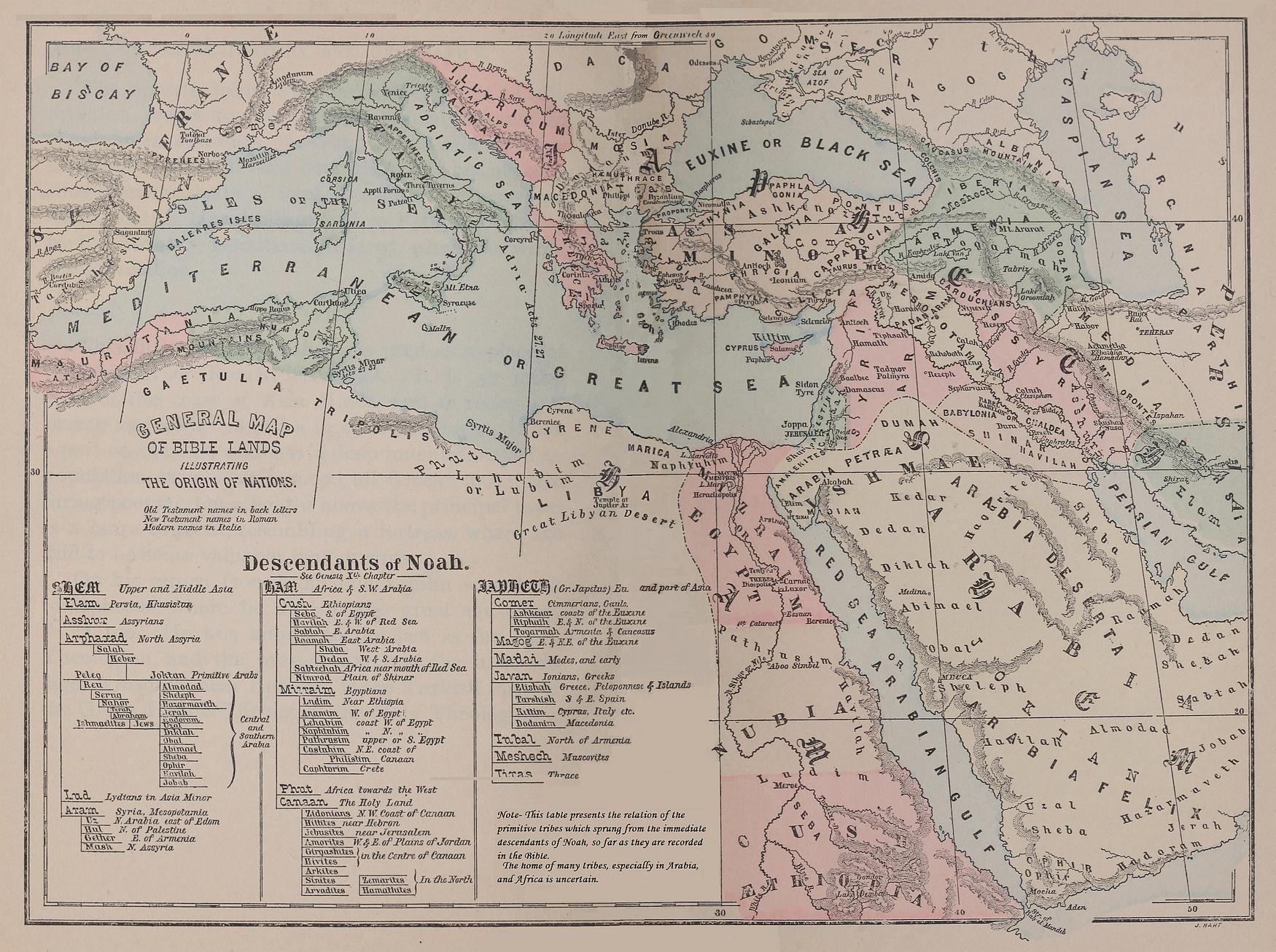
GENERAL MAP OF BIBLE LANDS ILLUSTRATING THE ORIGIN OF NATIONS
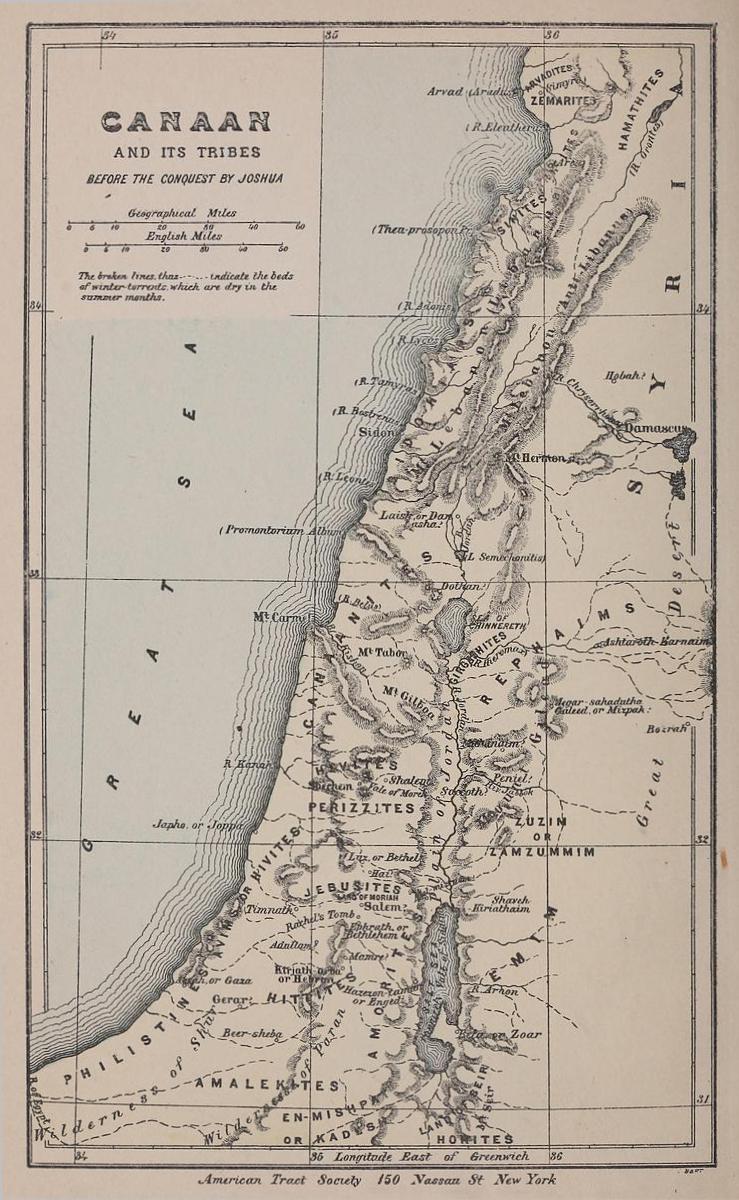
CANAAN AND ITS TRIBES BEFORE THE CONQUEST BY JOSHUA
American Tract Society 150 Nassau St New York
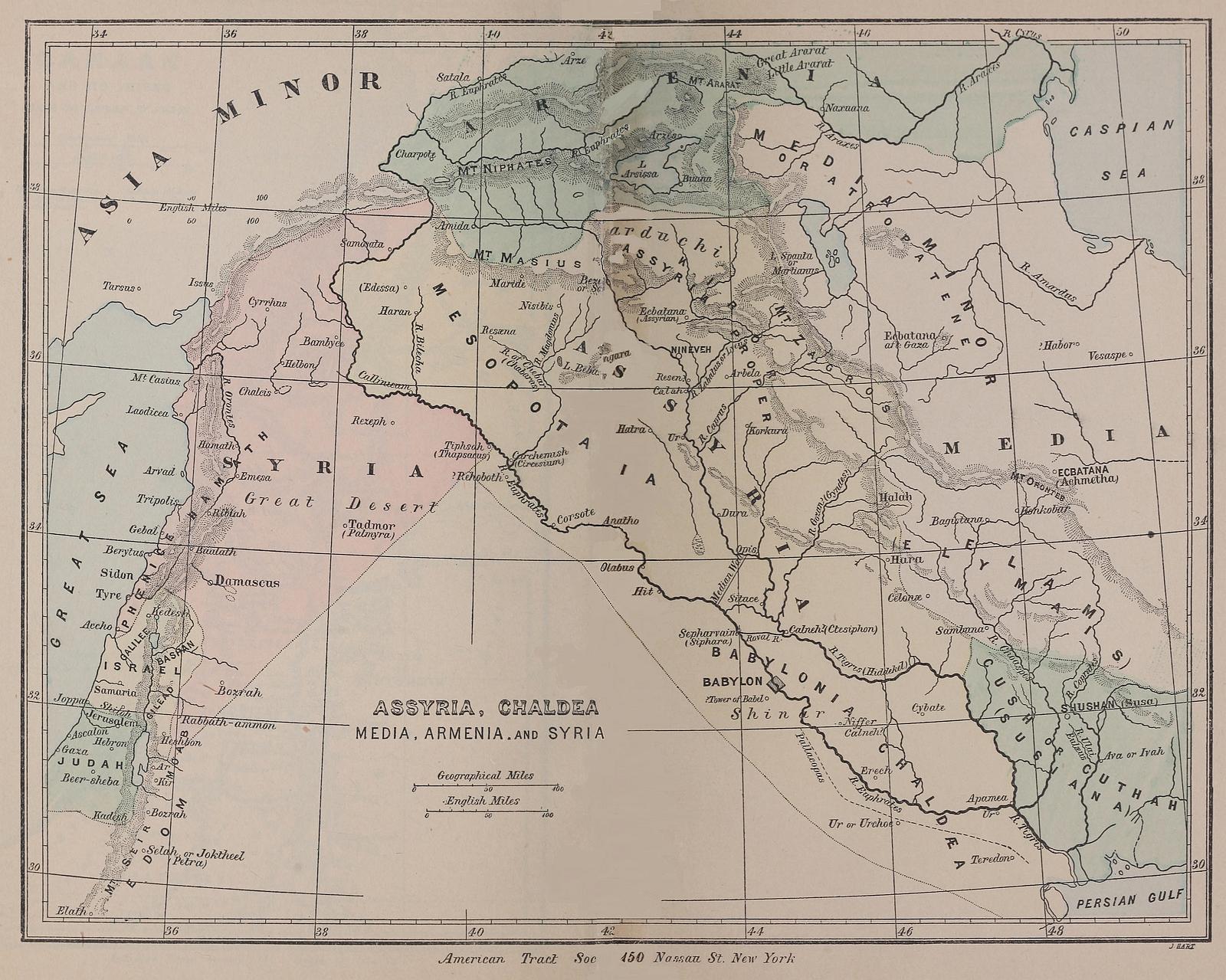
ASSYRIA, CHALDEA MEDIA, ARMENIA, AND SYRIA
American Tract Society 150 Nassau St New York
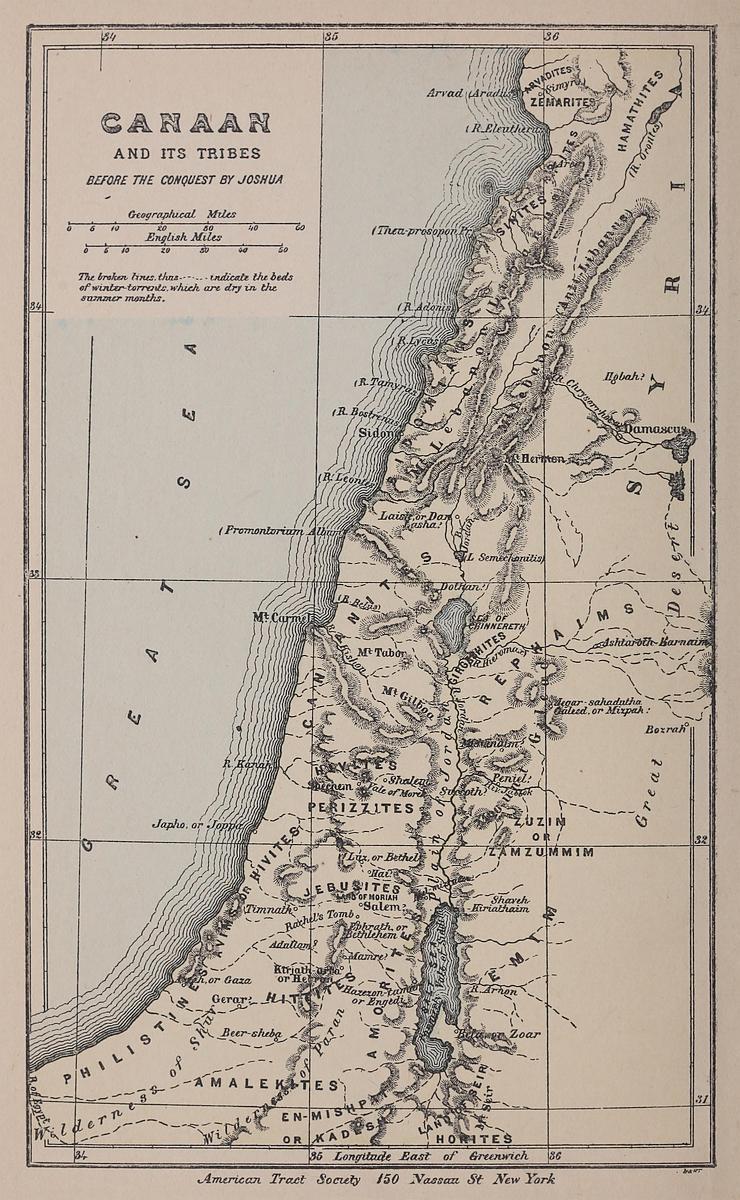
CANAAN AND ITS TRIBES BEFORE THE CONQUEST BY JOSHUA
American Tract Society 150 Nassau St New York
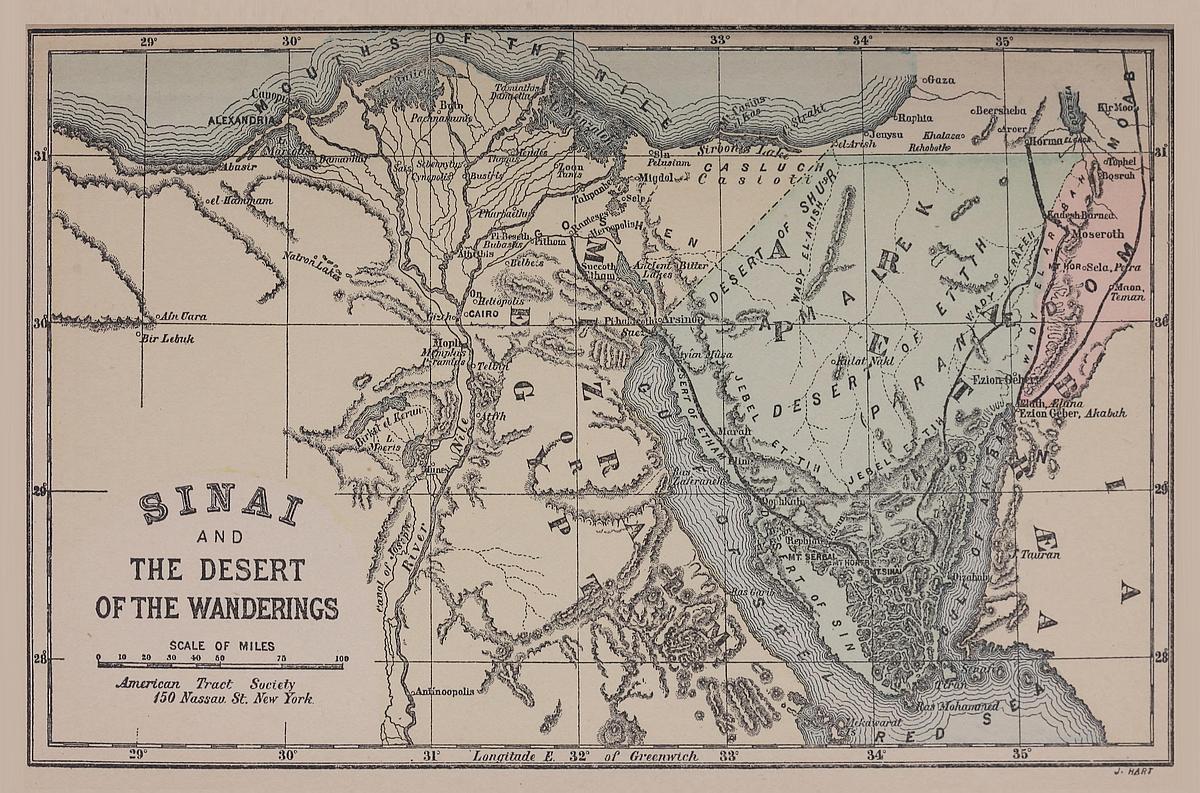
SINAI AND THE DESERT OF THE WANDERINGS
American Tract Society 150 Nassau St New York
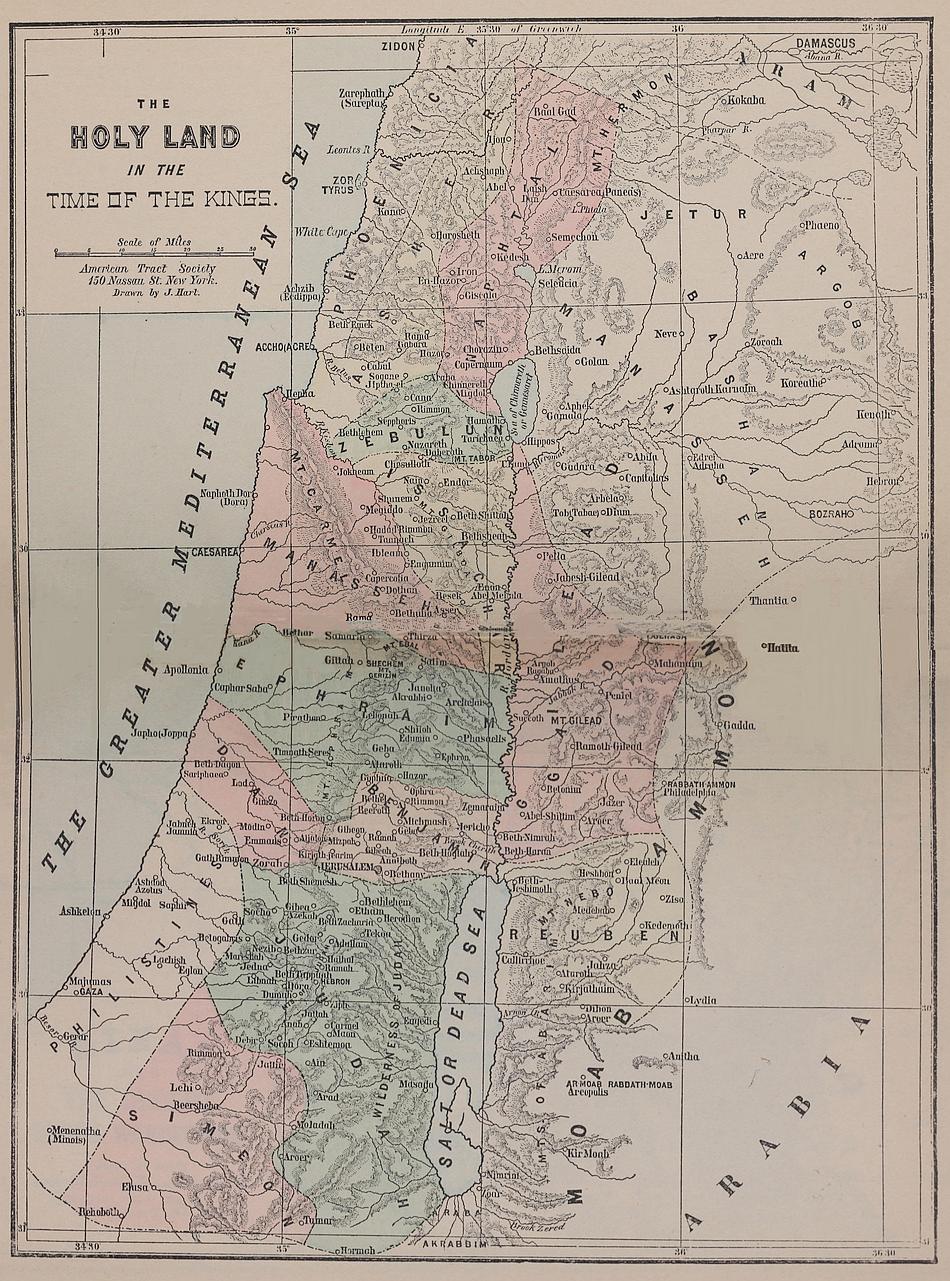
THE HOLY LAND IN THE TIME OF THE KINGS.
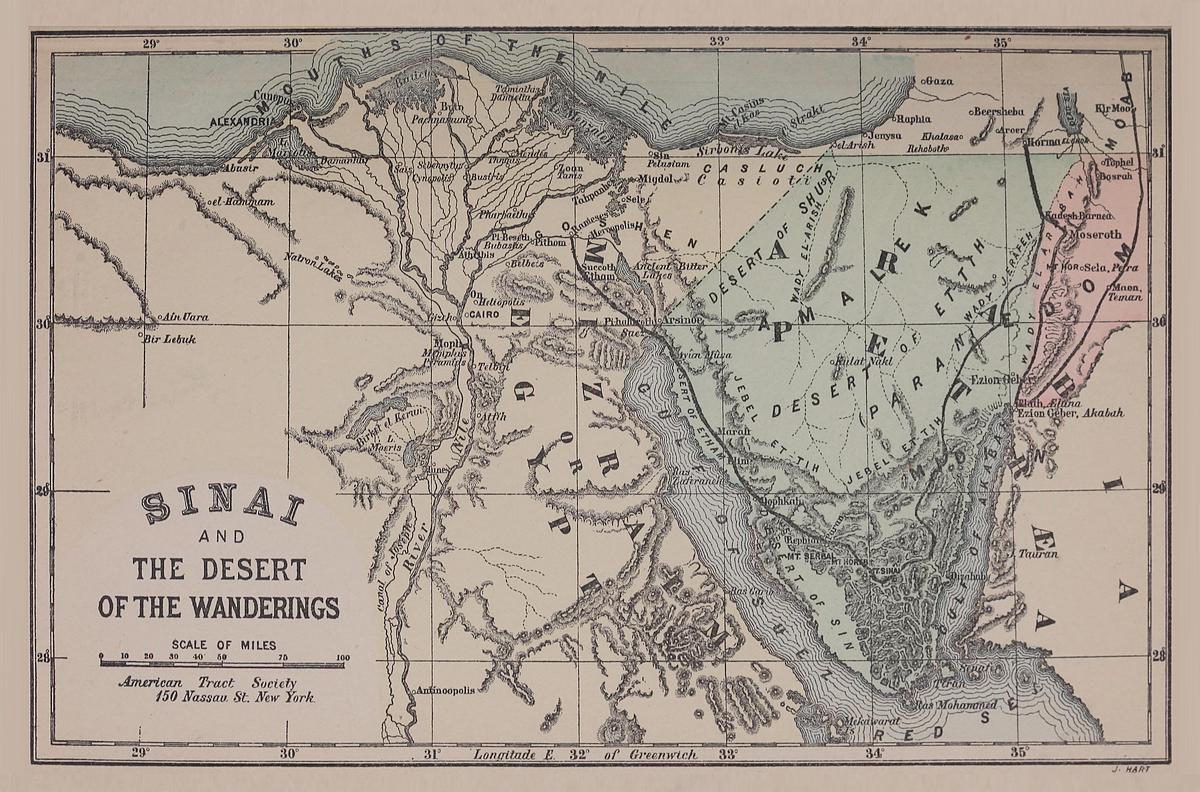
SINAI AND THE DESERT OF THE WANDERINGS
American Tract Society 150 Nassau St New York
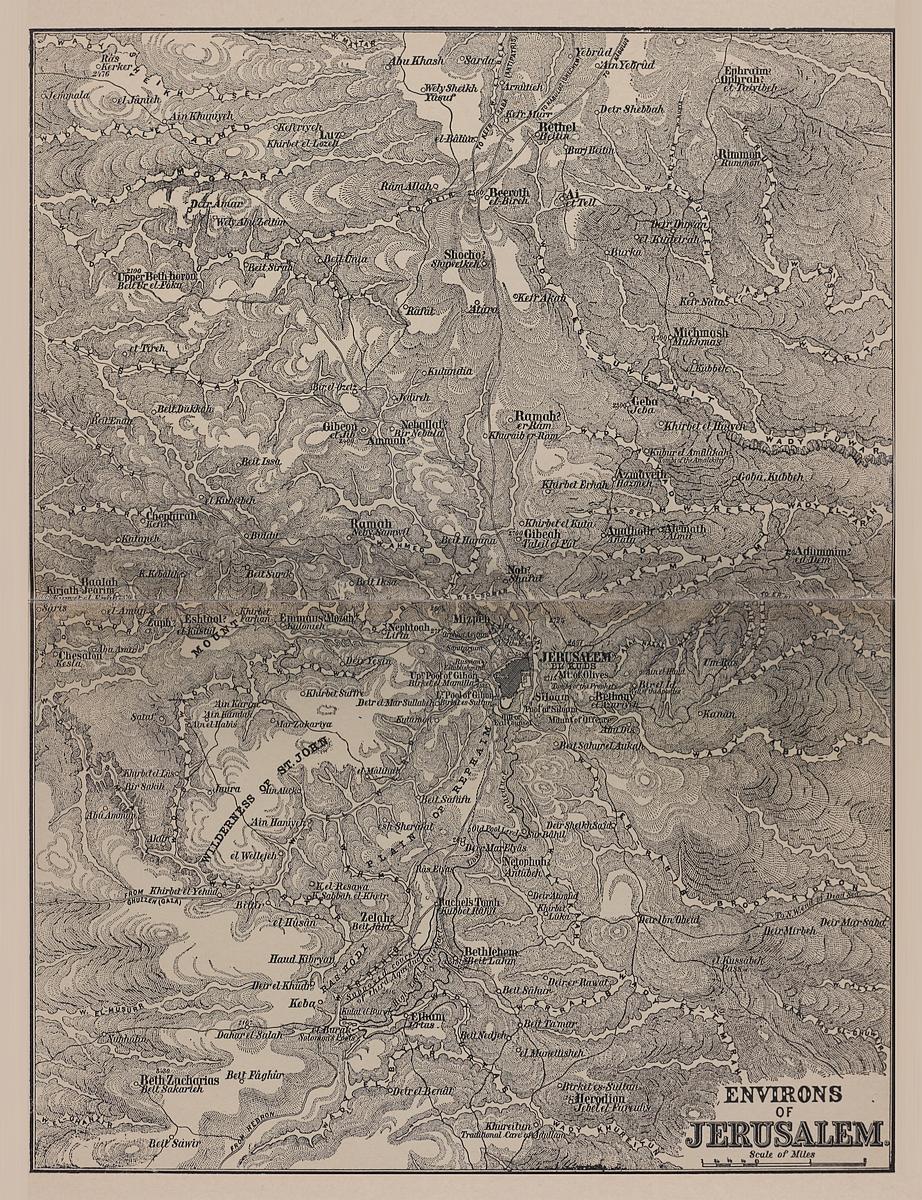
ENVIRONS OF JERUSALEM.
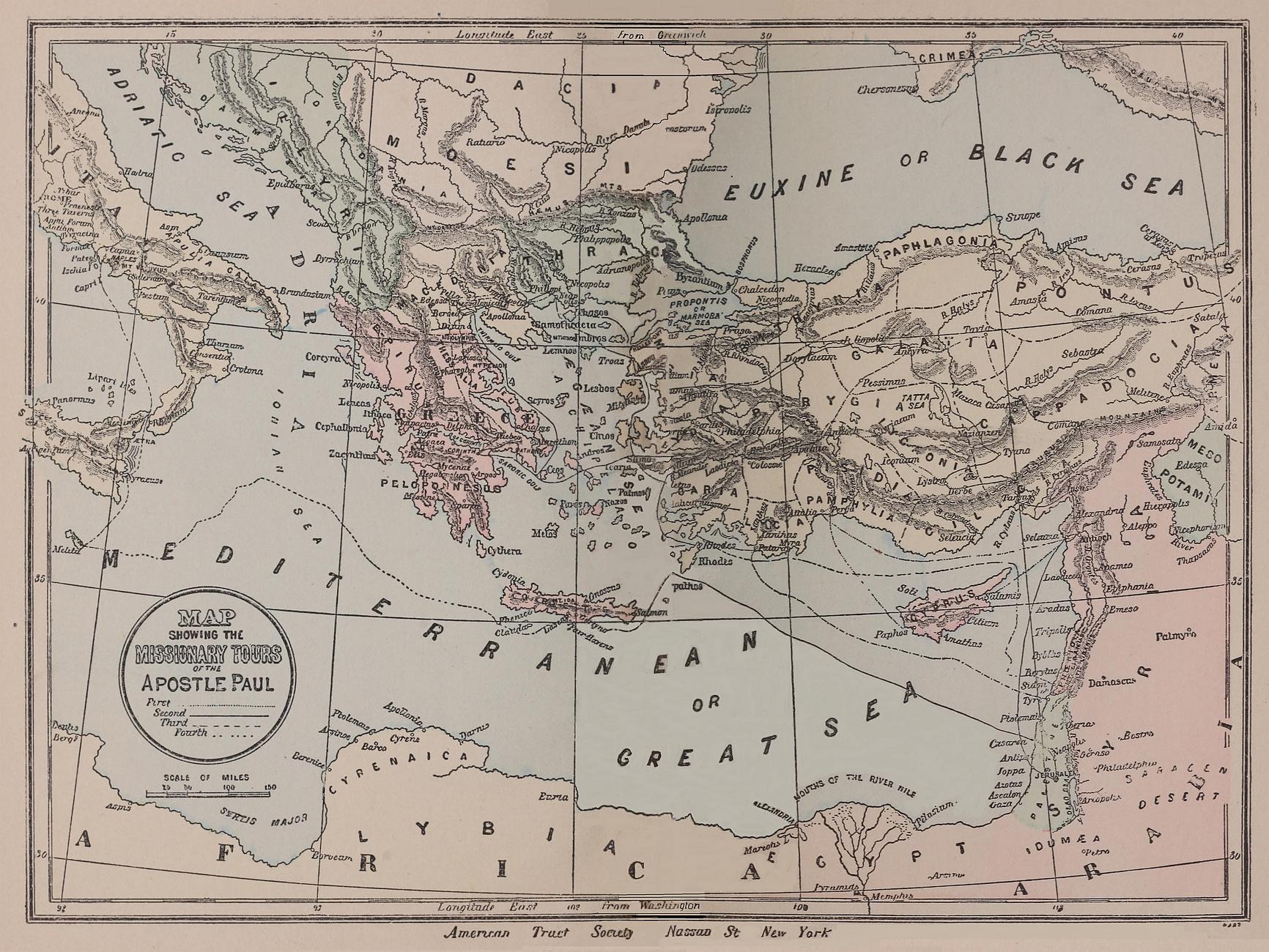
MAP SHOWING THE MISSIONARY TOURS OF THE Apostle Paul
American Tract Society 150 Nassau St New York