Front matter
Reading edition · Edition 7
19722(Published in 1916; Black and White illustrations by M. Sheldon)
25608 (Published in 1905; Single Tone illustratons by B. C. Pease)
25609 (Published in 1905; Illustrations in Color by J. W. Smith)
25610 (Published in 1895; Black and White illustrations by C.Robins)
25611 (Publication date unknown; Black and White illustrations)
25617 (Published in 1900; Illustrations in Color by Mars and Squire)
28722 (Published in 1919; Illustrations in Color by Maria L. Kirk)
A CHILD'S GARDEN of VERSES
A Child's Garden
By ROBERT LOUIS STEVENSON

ILLUSTRATED by E. MARS AND M. H. SQUIRE


RAND McNALLY & COMPANY CHICAGO NEW YORK LONDON




Copyright, 1900, by Robert Howard Russell Copyright, 1902, by Rand McNally & Company All rights reserved Edition of 1928
Made in U.S.A.

BY WAY OF INTRODUCTION
Robert Lewis Balfour Stevenson, or Robert Louis Stevenson, as the world knows him, was still a boy when he published this rare volume of "A Child's Garden of Verses," although by the calendar he was thirty-five years old. You and I have sighed, no doubt, to be a boy again, but here was one who, while he outgrew his knickerbockers, never outgrew the quick sympathy, the brave heart, the fresh outlook, the confident faith and buoyant spirit of the little Scotch boy who roamed the hills 'round Edinburgh. Better than any man of any time he was able to enter into the heart of a boy, to view things with a boy's eyes, and to write of them in simple verse, touched with the warmth and color of his rich imagination. In these "Verses" he writes as a child rather than about children, and in this lies much of the charm which they possess for little readers. There is in them the surprise of reality, the beauty of a simple rhythm, and the mysterious flavor of magic that grips a boy's heart and will not let him go until the book has become a part of him. Surely this is a rare quality in schoolbooks.
The Stevensons had been famous engineers for more than a hundred years, building lighthouses along the Scottish coast, and it was natural that his father should have expected Robert Louis to follow in the family footsteps. But the slim boy with brown eyes, who at eight had written a "History of Moses," and illustrated it with his own pen; who was slow to learn from books, but quick to understand things that he saw and felt; the boy who carried a volume of history in one pocket and a notebook in another, had other plans for himself, and even his father came to see the wisdom of his son's choice of a literary life. As early as 1873, when only twenty-three years old, Stevenson was ordered south for the winter by his physician, to ward off impending consumption. For more than twenty years, or until his death in Samoa late in 1894, he was never far from this pursuing enemy. It followed him over tossing seas and through many lands as he journeyed in search of health; yet through all these years he carried a brave and happy heart, and wrote at the end this Requiem, the last three lines of which are upon his tomb on the mountain-top in Samoa;
"Under the wide and starry sky, Dig the grave and let me lie. Glad did I live and gladly die, And I laid me down with a will. "This be the verse you grave for me: Here he lies where he longed to be; Home is the sailor, home from sea, And the hunter home from the hill."
Robert Louis Stevenson's first book, "An Inland Voyage," was published in 1878, when he was twenty-eight years old, and is a fresh and charming account of a canoe trip up the rivers of Holland. It was during this journey that he wrote: "If we were charged so much a head for sunsets, or if God sent around a drum before the hawthorn came into flower, what a work we should make about their beauty! But these things, like good companions, stupid people early cease to observe."
The next year came his "Travels With a Donkey," which told in the same naïve style the story of his journey through the Cevennes Mountains with no other companion than a donkey, whose gait he describes as being "As much slower than a walk as a walk is slower than a run."
He first visited America in 1879, in search of health, returning in 1880 to Scotland with Mrs. Stevenson, whom he had married in California. In 1887 he came again with the hope that a dry winter in the Adirondack Mountains would stand off the hand of Death. But he was little benefited, and took up his search for health by chartering a yacht for a voyage through the South Seas. It was on this trip that he fell in love with the beauty of the scenery and the healthful climate of Samoa, and in 1890 he took up his home there, never again to leave the island except for occasional visits to Honolulu and Sydney. And when the time came for him to die, the natives, with their knives and axes cut a path up the steep mountain-side and carried him on their broad shoulders to his grave on the mountain-top.
"A Child's Garden of Verses" was first published in London in 1885, and long ago became a children's classic; yet it is now for the first time made available as a supplementary reader for the primary grades in a suitable form and at a possible price. There have been many and beautiful editions, but they have all appealed to "grown-ups" rather than to boys and girls to whom the book really belongs. To put such a book, with its simple style, its wise observations, its kindly sympathy, and fanciful humor into the hands of a boy or girl, is not only to make him happy, it is to start him on the straight path to culture.
This volume contains all the poems originally appearing under the title "A Child's Garden of Verses." The poems grouped under "The Child Alone," "Garden Days," and "Envoys" have been omitted, as many of them are too philosophical to be understood by children in the primary grades.
The illustrations in this book are used by special arrangement with Harper & Brothers of New York City, who publish the complete "Verses" in a beautiful edition suitable for the home or the library.
So with Stevenson's own words the book is yours:
"Go little book, and wish to all, Flowers in the garden, meat in the hall, A living river by the door, A nightingale in the sycamore."
E. O. G.
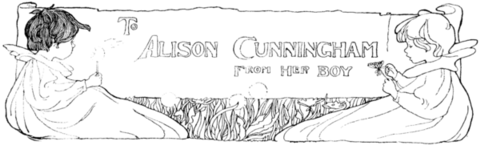
For the long nights you lay awake And watched for my unworthy sake: For your most comfortable hand That led me through the uneven land: For all the story-books you read: For all the pains you comforted: For all you pitied, all you bore, In sad and happy days of yore:— My second Mother, my first Wife, The angel of my infant life— From the sick child, now well and old, Take, nurse, the little book you hold! And grant it, Heaven, that all who read May find as dear a nurse at need, And every child who lists my rhyme, In the bright, fireside, nursery clime, May hear it in as kind a voice As made my childish days rejoice!
R. L. S.

PAGE
By Way of Introduction5
To Alison Cunningham8
Bed in Summer13
Young Night Thought15
Rain16
My Shadow17
Time To Rise20
At the Seaside21
Windy Nights22
Pirate Story24
Whole Duty of Children27
Foreign Lands28
System30
A Good Play32
The Land of Counterpane33
A Good Boy34
Looking Forward36
The Swing37
Good and Bad Children38
Marching Song40
Travel42
Where Go the Boats?46
Escape at Bedtime48
From a Railway Carriage50
The Wind52
Auntie's Skirts54
Happy Thought55
The Cow56
My Bed Is a Boat58
The Land of Nod60
Fairy Bread61
Keepsake Mill62
Winter-time64
Looking-glass River66
The Sun's Travels69
The Lamplighter70
Foreign Children73
The Moon74
The Hayloft77
Farewell To the Farm78
A Thought80
Singing81
North-west Passage
I. Good-night82
II. Shadow March84
III. In Port86
To My Mother88
Guide To Pronunciation89
A Word List90
A CHILD'S GARDEN of VERSES
"I have to go to bed by day."