SKETCH OF Canadian Political History, 1841 TO 1879
Reading edition
From the date of the English conquest of Quebec and the Treaty of Paris (1763) down to the year at which the present brief historical sketch opens, (1841), the history of Canada is a story of unrest and agitation. The old-world simplicity and pious contentment of the French habitant was intruded upon by the advent of the more enterprising Briton, and ere long the inevitable struggle began. The French Canadian, whose language, laws and religion had been specially reserved to him by the Treaty, was not unnaturally apprehensive of the consequences of English domination, and with a new-born energy he awoke to the defence of his rights. His English fellow-colonist having discovered that the governmental arrangements were too primitive and narrow for the comfort of one who had formerly lived under the British constitution, lost no time in commencing the agitation for reform. In some of his views—outside of the sacred reservation referred to—his French neighbor joined him. Hand in hand they protested against the infringement of their common rights by the Governor and his Council, and demanded changes in the constitution. Meantime the English element was growing in the country west of Montreal, by emigration from the old land, and accessions of Loyalists from the newly-established Republic of the United States. The superiority of the British settler soon made itself manifest in the material conquests which he achieved over the forests. The new English Province rapidly surpassed the old French one in prosperity, and the flames of jealousy were rekindled. Ultimate ruin of the colony from internecine strife seemed inevitable unless some adequate remedy could be found. The separation of the rival races naturally suggested itself as that remedy, and as they were already practically divided geographically—the number of English settlers in the French Province being comparatively small—great hopes were built upon a similar division politically. The Imperial Government accordingly in 1791 passed the Constitutional Act, by which the country was divided into the two Provinces of Upper and Lower Canada, each being granted a representative form of government and a constitution supposed to be suited to its population. The governmental machinery provided for each Province under this Act was a Governor, appointed by the Crown, and responsible to the Imperial authorities alone; a Legislative Council, appointed for life by the Governor, and a Legislative Assembly, elected by the people on a suffrage almost universal. The executive functions of the supposedly popular branch of this governmental system were nominally 14vested in a committee known as the Executive Council, the members of which were selected by the Governor, usually from the judiciary, the membership of the Legislative Council, and the ranks of salaried officials. Practically the Governor himself was the real executive, as his Council thus chosen (and responsible only to himself as representative of the Crown) was regarded by him merely as an advisory committee in grave matters of policy, but as possessing no control over appointments to office, and the various other matters, which under our present system appertain to the executive. This proved a fatal weakness. In both Provinces the Executive Councils gradually drifted away from the sympathy of the people as represented in the Assemblies. The breach became wider and wider, until at length the discontent of the people terminated in open rebellion (1838).
At this juncture the Imperial Government appointed Lord Durham to proceed to Canada and report upon the state and requirements of the country, civil and military. After five months spent in investigation, Lord Durham prepared his celebrated Report, which was duly submitted to the government of Lord John Russell (1839). In this document a legislative union of the Provinces was recommended, and the Home Government proceeded without delay to carry the recommendation into effect. It was thought desirable, however, to secure the assent of the people of the Provinces before passing the Union measure, and for this purpose Mr. Charles Poulett Thompson (afterwards Lord Sydenham), was despatched to Canada. On his arrival (17th October, 1839) he found Lower Canada without an Assembly—that body having been superseded by a Select Council appointed by Lord Durham’s successor in the governorship—Sir John Colborne. This Council being chiefly composed of adherents of the British party readily gave the required assent, and subsequently the Upper Canada Assembly and Legislative Council acquiesced. A draft Union Act was forthwith prepared and forwarded to England, and a measure founded upon it was at once passed.
By this Act, the country was renamed the Province of Canada, and the governmental machinery provided was, a Governor, representing the Crown, a Legislative Council of 24, to be appointed for life, and an assembly of 84 members, to be elected by the people, and executing its business through a Responsible Government. This Act went into effect in the year 1841, when the first United Parliament met at Kingston, which had been chosen as the Capital by the Governor. The first session passed off in a manner which on the whole promised well for the new system, although it was made manifest that the people of Quebec regarded the Union as a scheme to which they had not assented—the Special Council, which had acted for them in the matter, having been in no sense a truly representative body. The session was chiefly remarkable, however, for a distinct pledge given by the Ministry—though with apparent reluctance—that the Government would fully acknowledge its responsibility to the people as that term was understood under the British constitution. This was regarded as a signal victory by the advocates of the responsible system, as the first Cabinet was composed of mixed elements—some of its leading members having been known as pronounced opponents of “Responsibility.” The fact that there was no French representative in the Ministry augmented the discontent of Lower Canada, but the election of one of their trusted compatriots to the speakership did something to mollify this feeling.
15
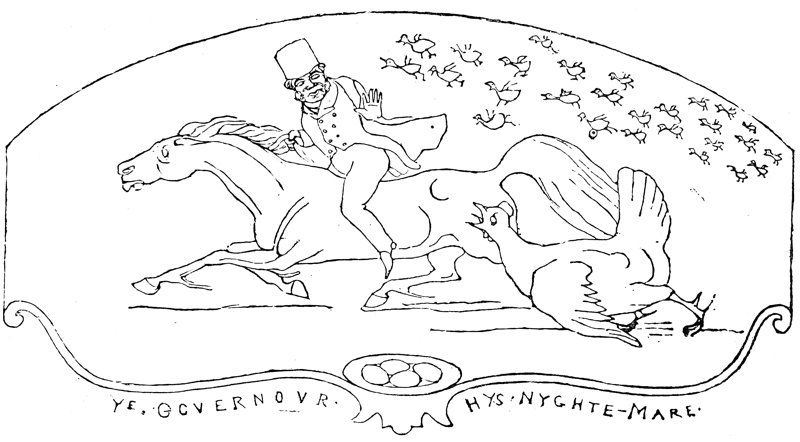
(From Punch in Canada, after the attack by the mob on Lord Elgin, 1849.)
The Governor-General, who, for his services in connection with the Union, had been raised to the Peerage, under the title of Lord Sydenham, was in delicate health at the time of the first session of the House, and died before the second session began, his end being hastened by an accident which befel him while taking his customary horseback exercise. It was some months before the Home Government appointed a successor to the vice-royalty, and during the interregnum the affairs of the Province were administered by Lieut.-General Sir Richard Jackson, commander of the forces in Canada. Meantime, Sir Robert Peel had succeeded to power in England, and, as a natural consequence, the new Governor-General was selected from the Conservative ranks. The choice fell upon Rt. Hon. Sir Charles Bagot, who was known in Imperial politics as a “High Tory,” and was a man of acknowledged ability and wide diplomatic experience. The friends of Responsible Government in Canada were apprehensive of bad consequences to the newly inaugurated system as a result of this appointment, but their fears were in due time dispelled, as Sir Charles proved a thoroughly constitutional Governor. Indeed, so conscientiously did he keep within the exact limits of his powers throughout his term of office, that his only enemies were amongst the reactionary section of the Canadian Tory party. The new Governor, when he met Parliament in 1842, found the Sydenham Government still in office, though manifestly weak in the House, and almost certain of defeat on the first opportunity offered. A Kingston paper of the day described this Cabinet as follows: “Instead of being a coalition of moderate men it is a coalition of fierce extremes. How they can meet at the Council Board and not laugh in each other’s faces if in merry mood, or come to fisticuffs if in angry one, must be an eighth wonder of the world.” In Parliament they were earnestly opposed on the one hand by the old-line Conservatives, under the leadership of Sir Allan Macnab and Mr. John S. Cartwright, 16member for Lennox and Addington, and on the other hand by the Upper Canada Reformers and Radicals, under Hon. Robt. Baldwin, in alliance with the French Canadian members, who acknowledged Louis Hypolite Lafontaine as their leader. This distinguished gentleman now entered the Union Parliament for the first time, sitting for the fourth riding of York, for which constituency he had been elected on the personal introduction of Mr. Baldwin. A motion of no confidence was moved early in the session, but, instead of allowing the vote to be taken, the Cabinet resolved upon a reconstruction, and after considerable difficulty this was effected by the retirement of three of the Conservative members, and the accession in their stead of Mr. Baldwin, Mr. Lafontaine and Mr. Morin, the two latter being the first French representatives admitted to seats in the Cabinet. With the second session ended the career of the second Governor-General. Sir Charles Bagot was through illness obliged to relinquish the post. His successor was Sir Charles T. Metcalf, late of India and Jamaica, who assumed office in Canada, March 30th, 1843. Sir Charles Bagot died on the 19th of May following, at Kingston. The new Governor-General entered upon his duties with a high reputation for ability, rectitude and independence of mind, and a record which marked him as a Liberal statesman. His eastern experiences and training, however, were against the probability of his success in his new sphere, for a colonial application of Responsible Government was one of those things he did not understand. The Cabinet that saluted him on his arrival is known in our history as the Lafontaine-Baldwin Ministry, and on the assembling of the third session, it was found that this reconstructed Government commanded a large majority in the House. The weakness of the Opposition, composed as it was, in Sir Chas. Metcalf’s opinion, of representatives of “the only party in the country upon whom the mother country might confidently rely in the hour of need,” evoked the sympathy of the new Governor, and it was not long before the cordiality between him and some of the members of the administration began to wane. It became apparent that the Governor was not disposed to interpret “Responsible Government” to mean that the Governor-General was a mere figure-head. He claimed the right to exercise a certain amount of patronage on his own account, and asserted that his responsibility in various matters was to the Imperial authorities directly and not to the people of Canada through his ministers. Sir Charles’ ardent wish was to obliterate the strong party lines and allay the rancorous hostilities around him, and it is evident that he thought to effect these good ends by appointing Conservatives to various offices as opportunity might offer. In the meantime, while outwardly at peace with his ministers, the Governor openly cultivated very friendly relations with prominent members of the Opposition party.
The session of 1843 began on the 28th of September, and was signalized by a long and hot debate on the subject of the removal of the seat of Government, the ministry having decided to establish the capital at Montreal. The vote finally taken showed a good majority in favor of the removal, though as one consequence of it, Mr. Jameson, Speaker of the Legislative Council, resigned his seat. This resignation assumed some importance as a factor in the developments of the near future, when it came to the knowledge of the ministry that the vacant chair had been offered by the Governor-General—acting, of course, without their advice—to a prominent Conservative, Mr. L. P. Sherwood, and 17subsequently to another opponent of the Government, Mr. Neilson, of Quebec. Prior to this discovery, however, His Excellency appointed one Mr. Francis Powell (also a Conservative) to the position of Clerk of the Peace for Dalhousie District—of which action he subsequently informed his ministers in a note. This little missive was the signal for a long and stubborn contest, in which the very principles of Responsible Government were considered by the Reform Party to be at stake.
The Cabinet at once deputed Messrs. Lafontaine and Baldwin to wait upon the Governor-General, and to represent to him that in their view the exercise of the prerogatives of the Crown without reference to the responsible ministry was contrary to the letter and spirit of the resolutions of 1841, in which Responsible Government in its fullest sense had been affirmed as the new Canadian constitution. That the Governor possessed certain prerogatives of appointment to office, etc., they did not deny, but they insisted that before exercising any of these the system required him to consult his advisers, who, if they could not approve, had the alternative of resigning. Sir Charles Metcalfe could not be brought to take this view of his duty; on the contrary, he regarded it as derogatory to the dignity of the Crown to accept such a condition, which, he contended, was not contained in the Resolutions of 1841, as he interpreted them. In this position, which he maintained throughout the contest, the Governor appears to have been upheld by Lord Stanley, the Colonial Secretary in the Home Government. The conference having been without result—except to make the attitude of the Governor perfectly clear—all the members of the Government, excepting Mr. Dominic Daly, Provincial Secretary for Lower Canada, resigned their portfolios. A prolonged debate ensued in the House, which was brought to a close by the passage of the following resolution by a vote of 64 to 23: Moved by Mr. Price, seconded by Mr. Benjamin Holmes, “That an humble address be presented to His Excellency, humbly representing to His Excellency the deep regret felt by this House at the retirement of certain members of the Provincial Administration on the question of the right to be consulted on what the House unhesitatingly avow to be the prerogative of the Crown, appointments to office; and further to assure His Excellency that the advocacy of this principle entitles them to the confidence of this House, being in strict accordance with the principles embraced in the resolution adopted by this House on the 3rd of September, 1841.” Parliament rose on December 9th, and the country was thus left without any regular Ministry, in which condition it practically remained for some nine months. In the meantime, Mr. D. B. Viger, a prominent French Canadian, and Mr. Draper (afterwards Chief Justice) had been prevailed upon to join Mr. Daly—and for the greater portion of the period mentioned this semblance of a Cabinet were the only advisers of the Governor. These months, as may easily be supposed, were filled up with vociferous debate on the platform and through the press. The Conservative Party very generally sided with the Governor, and he was not without many able defenders of the course he had taken; on the other hand he was violently denounced and even defamed by the Liberals, who looked upon him and his sympathisers as the deliberate enemies of popular rights. It was during this “interregnum,” i.e., on the 5th of March, 1844, that the Toronto Globe made its first appearance as an organ of the Liberal Party under the editorship of Mr. Peter Brown and his subsequently famous son, George, and it was the 18struggle then going on which paved the way for the public career of the younger man. Mr. Viger exerted his utmost influence to win the Lower Canadians to the Governor’s side, but in this he signally failed, and when at length after vast trouble the vacant Cabinet places had been filled up, it was so evident that they could command no following in the House that a dissolution and general election were decided upon. The result of this contest—which was bitter beyond precedent—was a small majority for the Government in the Parliament of 1844. Amongst the newly-elected members was Mr. (now Sir) John A. Macdonald, who was returned as Member for Kingston. Mr. Draper resigned his seat in the Legislative Council to assume the leadership of the Government, and it required all his acknowledged ability to weather the storm of the Session, for meantime the Lafontaine-Baldwin Party was steadily gaining strength. While matters were in this precarious condition, the Governor-General was obliged on account of ill health to resign his office, and return to England. Ere leaving Canada he was raised to the Peerage with the title Baron Metcalfe of Fern Hill, but he had worn his new honors but a few months before death relieved him of his sufferings (5th September, 1846). Whatever may be thought of Lord Metcalfe’s political views or actions, all who are authorized to speak of him personally agree in describing him as a most generous, kindly and lovable man. Earl Cathcart, Commander-in-Chief of the Forces in Canada, succeeded to the Governor-Generalship after a brief period as Administrator, and under his rule the struggle between the parties continued.
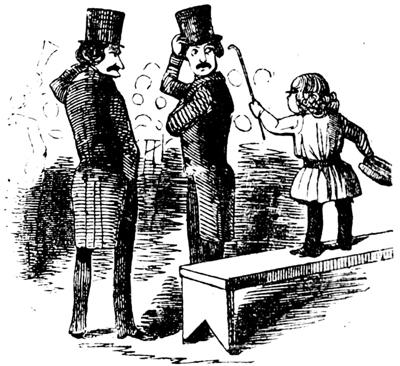
“FRENCH DOMINATION.” (From Punch in Canada.)
But that time was fortunately very brief. In justice to Lord Cathcart it must be said that he took no active part in the Government, his attention being wholly occupied by military matters in view of the strained relations of England and the United States over the Oregon Boundary matter. It was chiefly as a military expert that he had been placed at the head of affairs, and the probability of war having disappeared by the ratification of the Oregon Treaty, the Imperial Government relieved him of the Viceroyalty, and selected Lord Elgin, a trained statesman, as his successor. This nobleman bore an exceptionally high character and his official career had hitherto been very successful. Like Lord Metcalfe he left the Governorship of Jamaica to assume that of Canada. In politics he was a Conservative, but could not fairly be described as a Tory in the fullest meaning of that term. The new Governor-General was sworn into office on January 30th, 1847, and one of his first utterances in reply to the usual addresses of welcome was, “I am sensible that I shall best maintain the prerogative of the Crown, and most effectually carry out the instructions with which Her Majesty has honored me, by manifesting a due regard for the wishes and feelings of the people and by seeking the advice and assistance of those who enjoy their confidence.” Lord Elgin met his first Parliament on June 2nd. The 19Government had meanwhile been reconstructed, Mr. Draper having retired from the leadership in favor of Mr. Henry Sherwood, and amongst other new members was Mr. John A. Macdonald, who had accepted the post of Receiver-General. At the close of this session Mr. Draper was honored with a judgeship, and rising from one judicial dignity to another, he at length achieved the highest place on the Canadian Bench—the Presidency of the Court of Error and Appeal. He died in 1877. The Sherwood-Daly Government was overwhelmingly defeated at the general election held early in 1848, and the Baldwin-Lafontaine Ministry returned to power. Amongst the members of the new House were William Hume Blake (father of Hon. Edward Blake) and Louis Joseph Papineau, who, from 1809 until his banishment for complicity in the rebellion of 1838, had been an influential leader of the Lower Canadians. He had been permitted to return to Canada in 1843, but his distrust of British rule and his wild project of a Canadian Republic were in no respect abated. In the House of Assembly he soon arrayed himself in deadly opposition to the Cabinet, denouncing “Responsible Government” in unmeasured terms. The adoption of the Free Trade policy in England at this time had a depressing effect upon Canadian commerce, as Canada ceased to be as heretofore the highway of American exports to the 20English markets. The result of this was the growth of a sentiment in favor of annexation. Parliament next met on the 18th of January, 1849, when Mr. George Etienne Cartier and Alexander Galt made their first appearance as members. Early in the session an Amnesty Bill in favor of those expelled from the country through the rebellion of ’37-8 was passed. Under this measure Mr. Wm. Lyon Mackenzie returned to Canada from his exile in the United States. Besides this Bill, some two hundred more or less important measures were passed, amongst them being the Act reorganizing the Court of Chancery. While this Bill was regarded as an inestimable boon by all concerned, it was the means of closing the promising political career of Mr. Hume Blake, who, in deference to the wishes of his colleagues and of the legal profession of the Province, accepted the Chancellorship. The great measure of the session, from the historical point of view, was the Rebellion Losses Bill. This measure was intended to supplement the compensation already granted by the Provincial Assemblies of Upper and Lower Canada to loyal citizens who had suffered loss by the rebellion of 1837-8. The legislation referred to had not recognized the cases of many whose property had been destroyed or damaged, not by rebels, but by those acting ostensibly in support of the authorities. This further relief was granted by an Act passed in the first session of the Union Parliament, but was restricted to Upper Canada. The Bill now passed extended the provisions for compensation to Lower Canada as well. Commissioners had been appointed by the Draper Government in 1845 to investigate and report upon the amount of money which would be required to settle the claims indicated, but great difficulty had been encountered in distinguishing between claimants who were entitled to relief and those who had been implicated more or less seriously in the rebellion. The report of the Commissioners was therefore not such as to afford a safe basis for legislation, and the Government, owing nothing to the Lower Canadians on the score of political support, had taken no further action. The Lafontaine-Baldwin Government felt that they were in duty bound to carry out the measure of justice which the former Government had initiated, and the French influence had now become strong enough to compel this even if the Government had felt otherwise. The Bill as passed expressly excluded from participation in the indemnity all rebels under the description of those “who had been convicted of treason or had been transported to Bermuda.” It was reasonably believed that after the lapse of so many years, it would be impracticable to make any distinctions between “loyal citizens” and “rebels” apart from the record of the courts of law. The Opposition insisted, however, that such distinction must be made: and that no person who had taken part in the rebellion, whether convicted or not, should on any account be paid for his losses. The whole Conservative party took this “high loyal” ground, and the Bill at once evoked the most furious enmity in that quarter. The measure was debated in the House with unexampled passion—its chief opponents there being Mr. Sherwood, Col. Gugy, Sir Allan MacNab and Col. Prince; and its ablest defender Mr. Wm. Hume Blake, whose speech is justly regarded as the greatest effort of his life and the most powerful address ever delivered in the Canadian Parliament. The Bill was finally carried on March 9th by a majority of forty-seven to eighteen. Meantime the Tory party throughout the Province had poured in petitions to the Governor-General, demanding the reservation of the Bill or a dissolution of the House. After careful consideration, Lord Elgin could not see 21that his duty lay in either of these directions, and he accordingly assented to the measure amongst others on Wednesday, April 25th. As he retired from the Council Chamber after this ceremony, he was greeted with groans and hisses by a mob assembled in front of the building, and as his carriage rolled away it was pelted with rotten eggs. This incident is referred to in the first cartoon from Punch in Canada imbedded in our letter-press. In the evening of the same day a crowd assembled on the Champ-de-Mars, where “loyal speeches,” openly advocating violence, were made. The mob was in a fitting frame of mind, and was swift to act upon the ill-advice. Amidst shouts and curses, an advance was made upon the Houses of Parliament. The legislators, engaged in discussing an important measure at the moment, were startled by the crashing in of the windows, and soon the rioters entered the chamber where, with maniacal fury, they demolished everything that was breakable, and wound up the peculiar display of “fealty to the Crown” by setting fire to the buildings. The Assembly House was totally consumed, involving a direct money loss far exceeding the amount appropriated by the Bill which had afforded the pretext for the outrage. Parliament assembled the next day in a chamber improvised in the Bonsecours market building. Sir Allan MacNab and a few of his political colleagues spoke in justification of the riot, and declared that the blame rested more with the Government than with the mob (see Cartoon 1). The members of the Ministry and many of their leading supporters were for several days maltreated on the streets, and the residences of Mr. Lafontaine and others in Montreal were wrecked by the mob. The carnival of “Loyalty” was kept up until the 30th when it culminated in a second and still more disgraceful attack upon Lord Elgin, on the occasion of an official visit to the Government House on Notre Dame street. After this outrage Lord Elgin remained in seclusion at Monklands for many months, earning thereby the sobriquet of the Hermit (see Cartoon 4). Parliament was prorogued on May 30th, Major General Rowan, Commander of the Forces, being commissioned to act for the Governor-General, who thought it best to avoid another demonstration of the “loyalists.” The Government re-appointed the Draper Commissioners to carry out the provisions of the Rebellion Losses Bill in the adjudication of claims, and instructions were given them to use all possible care to distinguish between “rebels” and “loyalists” amongst the claimants, but this conciliatory action passed for little with the Tory press.
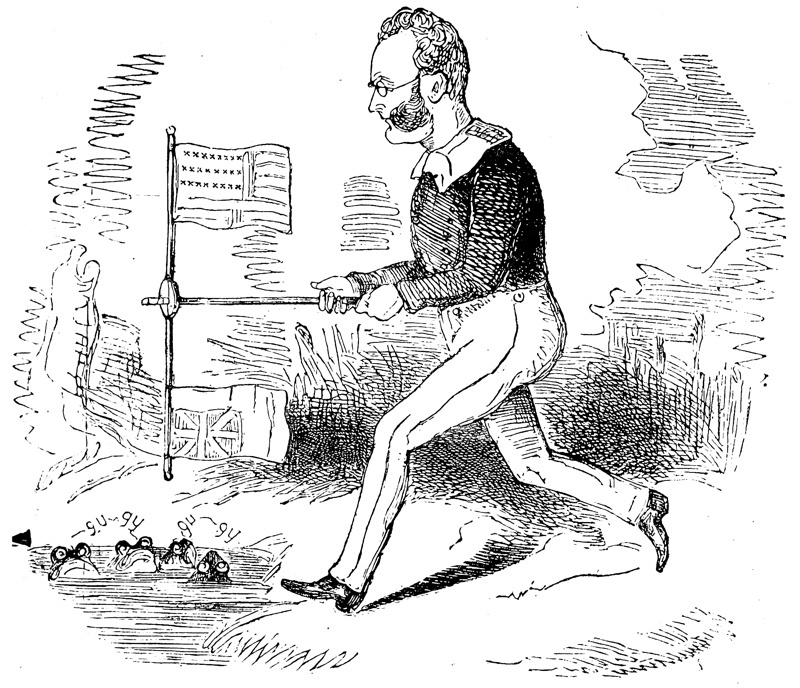
COLONEL GUGY’S POLITICAL TOY. (From Punch in Canada.)
During the vacation, Sir Allan MacNab and Hon. Wm. Cayley proceeded to England to place the Tory view of the Rebellion Losses Bill before the public there; and about the same time Mr. Francis Hincks crossed the ocean on a similar errand for the Liberal party. Lord Elgin’s course in the matter was ultimately sustained in both Houses of the Imperial Parliament when the subject came up for consideration. Subsequent riotous demonstrations in Montreal decided the question of the removal of the seat of Government from that city. The remaining two sessions were accordingly held in Toronto, and thereafter it was arranged to transfer the honor alternately to Quebec and Toronto every four years. The removal to Toronto took place in November, 1849, and the official residence was fixed at Elmsley Villa, on the site of the present Central Presbyterian Church.
As an outcome of the prevailing commercial depression of the time the project of annexation to the United States had come prominently forward for discussion, and in October a manifesto in favor of a peaceful separation from the Mother Country and a union 22with the Republic was published at Montreal. Amongst the signers of this celebrated document were many prominent persons connected with both political parties, amongst the number being Mr. Benjamin Holmes, to whom reference is made in this connection in the Punch in Canada cartoons. Mr. Papineau earnestly advocated the scheme, in consistence with his long cherished republican opinions, and many other public men—amongst them Col. Gugy—were suspected of sympathy with the movement. The only practical result of the agitation was to deprive some of those implicated in it of offices which they held at the pleasure of the Crown.
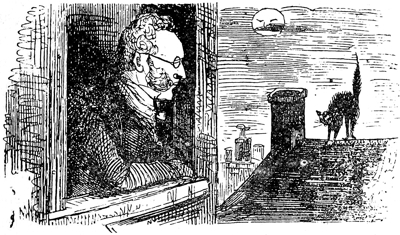
COLONEL GUGY’S NEW POSITION. (From Punch in Canada.)
The next great questions to press for settlement were those relating to the Secularization of the Clergy Reserves and the abolition of Seigniorial Tenure—questions which concerned the Upper and Lower Provinces respectively. The first of these had its rise in the blunder originally made by the Imperial authorities in setting apart a large portion of the public domain for the maintenance of “a Protestant clergy.” As population increased and settlement spread, the lands thus apportioned in various parts of the country—particularly those in Upper Canada—became valuable, and a hot dispute as to their ownership naturally arose. The Church of England laid exclusive claim to the term “Protestant Clergy,” and, as a consequence, to the Reserves. The other denominations opposed these pretensions. At length, in 1840, an Imperial Act, intended to settle the question finally, decreed that the proceeds of all sales of reserved lands to date should be divided between the churches of England and Scotland,—the former body to receive two-thirds and the latter one-third; and that all future proceeds from such sales should be handed over, in the proportion of one-third and one-sixth, to the same churches; the residue to be devoted to the cause of public worship and religious instruction generally—in other words, to be divided, as might be, amongst such of the other Protestant denominations as cared to apply for it. This Act quite failed to allay the sense of injustice in regard to the Reserves, and the matter continued in agitation. In 1844 many supporters of the Reform party insisted on the question being made a political issue, and called upon the Government to petition the Home authorities for the repeal of the Act of 1840 as a preliminary to a radical settlement of the difficulty by the complete secularization of the Reserves. The Government failed to respond to this suggestion, and in 1849 a number of influential Reformers protested against the delay by stepping out of the Government ranks and forming a new organization, which became known by the sobriquet of the “Clear Grit” party. About the same time a somewhat similar departure was made by a number of French Liberals, who formed Le Parti Rouge under the leadership of Mr. Papineau. These new organizations joined in the advocacy of several advanced measures of reform, though the Rouges were on many points far more radical than the “Grits.” When the session of 1850 opened, the Government found themselves confronted by an opposition not to be despised either in numbers or influence, aside from Conservatives, led by Sir Allan MacNab, John A. Macdonald, Wm. Cayley and Henry Sherwood. An incident of the session (to which reference is made in the caricature from Punch in Canada annexed) was the defection from the Conservative ranks of Col. Gugy, who had long been known as an ultra Tory. The reason assigned for this step by the hon. gentleman was his disapproval of the extreme rancor displayed during the opening debate by Sir Allan MacNab towards his political opponents, on issues 23which were practically dead, and to aspersions cast by that gentleman upon the Governor-General in connection with the events of 1837-8. The Clear Grits vigorously attacked the Government for their procrastination in the matter of the Clergy Reserves, and advocated the immediate passage of a Bill, without waiting for the formality of the repeal of the Imperial Act. It was evident that the Cabinet were by no means of one mind on this important question, and these passionate appeals were unheeded. The pressure was great enough, however, to ensure the passage of a resolution in favor of the repeal of the Act, and in due course an Address in accordance therewith was forwarded to the Imperial authorities. The attitude of the Ministry, however, was not definite enough to meet the views of the Reform Party at large, and the consequence was many defections from the ranks. Amongst warm friends who had been transformed to lukewarmness, was Mr. George Brown. The Globe, which had ridiculed the “Clear Grit” movement from its inception, was now preparing to cast in its fortunes with that faction. The next year was notable for the re-entry into Parliament of William Lyon Mackenzie, the hero of the Rebellion of ’38. He was elected as member for Haldimand, having defeated Mr. Brown, who as yet professed a certain amount of friendship for the Government. Mackenzie, of course, entered the House as their pronounced opponent, and soon became the clearest of Clear Grits. During the session of this year (1851) an Act was introduced by Hon. Mr. Hincks to make provision for the construction of a trunk line of railway from Quebec to the west. A guaranteed loan from the Home Government—such as had already been promised to Nova Scotia in promotion of a line from Halifax to Quebec, was anticipated. The outcome of this Act, some years later, was the Grand Trunk railway. Before the close of the session the Globe had reached the point of open hostility to the Government, and clamored for immediate action on the Clergy Reserves question. As yet, however, Mr. Brown was not in actual alliance with the Clear Grits. One of the planks in the platform of that party was the abolition of the Court of Chancery, which, as has been mentioned, was re-organized and established under Mr. Baldwin’s auspices in 1849. Toward the end of the session, Mr. Lyon Mackenzie introduced a resolution looking to the abolition of this Court, and although defeated on a division, the fact that a majority of the Upper Canada members had voted in favor of the motion affected Mr. Baldwin so keenly that he resigned his office and retired from the Cabinet. Before the end of the same year Mr. Lafontaine also resigned, in pursuance of his expressed intention of retiring from public life. This act was immediately followed by the resignation of the remaining ministers, and the Lafontaine-Baldwin Cabinet thus passed calmly out of existence. Mr. Lafontaine was raised to the Bench as Chief Justice of Quebec in 1853, 24and the next year was created a Baronet. He died at Montreal, Feb. 26, 1864. Mr. Baldwin was defeated in North York at the ensuing general election by Mr. Joseph Hartman, a Clear Grit candidate, and this respected leader then permanently retired from public life. In 1854 he was made a C. B. The late Ministry having practically fallen before the Reform spirit of the day, the demand was for a Cabinet still less conservative. The formation of such a Cabinet was entrusted to Mr. (now Sir Francis) Hincks, who had been a prominent member of the late Administration, and was regarded as one of the most capable public men of the time. In a few months Mr. Hincks had completed the task committed to him by making judicious concessions to the Clear Grit sentiment and to all other forces which were capable of retarding the course of legislation. Mr. Morin, being the acknowledged leader of the French Liberals since the retirement of Mr. Lafontaine, headed the Lower Canada branch of the Government, which is known in our history as the Hincks-Morin Administration. The Globe came out strongly against the new Premier, expressing a total want of confidence in the sincerity of his Reform professions, and charging him with surrendering to French Canadian influence. The cause of the Government was on the other hand ably advocated by the Toronto North American (edited by Mr. Wm. Macdougall) and the Montreal Pilot, a journal established some years previously by Mr. Hincks himself. During the general election (1851) Mr. Brown was returned as member for Kent, and at once became a conspicuous figure in the House at Quebec—whither, in accordance with the alternating system, the seat of Government had been removed. Early in the new year Mr. Hincks proceeded to England, in company with Mr. E. B. Chandler of New Brunswick, to arrange for the Imperial guarantee to the construction of the Intercolonial railway, which, it had been agreed, should be built by the three Provinces of Quebec, New Brunswick and Nova Scotia, to connect Halifax and Quebec by way of the St. John Valley. The Home authorities expressed a preference for a military route around the shore, and declined the guarantee on any other condition. Though unsuccessful in this matter, Mr. Hincks succeeded, during his stay in England, in arranging for the formation of what is now known as the Grand Trunk railway company, to secure the early construction of the line westward from Montreal. On the Premier’s return to Canada in 1852, the session opened, and Mr. Brown took the earliest opportunity of expressing his opinion that the Government was Reform in name only. Mr. John A. Macdonald also attacked them sharply, alleging that there was no principle in common among members of the Administration except the desire to hold office. During the session Mr. Hincks introduced a series of resolutions strongly urging the repeal of the Clergy Reserves Act of 1840, and an Address founded upon them was forwarded to the Queen. In October of this year Mr. Narcisse Fortunat Belleau (the subject of one of our cartoons) received a seat in the Legislative Council. Parliament adjourned on account of the presence of cholera at Quebec, between Nov. 10, 1852, and Feb. 14th, 1853. During this recess a despatch from the Home Secretary announced the intention of the Imperial Government to repeal the Act of 1840, and to pass an Act authorizing the Canadian Parliament to deal with the Clergy Reserves question. On the re-assembling of the House a Representation Act was passed, increasing the membership from 84 to 130—65 for each section of the Province. About the same time it became known in Canada that the promised legislation in the matter of 25the Clergy Reserves had been passed in England, and the ardent advocates of secularization renewed their agitation for immediate action by the Provincial Government. The session was allowed to end, however, without any intimation of the Government’s intentions, and this apparent want of good faith, in connection with various charges of extravagance in connection with railway contracts, and other shortcomings, furnished an abundance of ammunition for the Opposition in the interim. The Ministry decided to take no action on the Clergy Reserves question, the reason assigned being that it would be better to leave such important legislation to the next Parliament, in which there would be a larger representation of the people. This resolve, when announced in Parliament, raised a furious storm amongst the extreme members of the Opposition. No fewer than four amendments were moved to the Address in Reply, and the defeat of the Government was practically accomplished on a vote regretting that a measure for the settlement of the Seigniorial Tenure and Reserves question was not to be submitted during the session. This motion was carried by forty-two against twenty-nine. Mr. Hincks asked for an adjournment for a day or two, which was granted. The Ministry decided to dissolve the House, and when the members re-assembled, Black Rod forthwith knocked at the door. The general election came off in the following July and August. Amongst the members of the new House subsequently noticed in our cartoons were Messrs. Luther Hamilton Holton and A. A. Dorion. The Assembly was now divided into three distinct parties: Ministerialists; Conservatives, led nominally by Sir A. MacNab,—really by Mr. John A. Macdonald; and Advanced Reformers, including Clear Grits and Rouges. Mr. Brown was now, to all intents and purposes, not only an ally but a leader of the last named party, with Mr. Dorion for his Lower Canada colleague. The Ministry managed to weather the storm for but a few days after the opening of the session; they were then defeated by a vote on a question of privilege raised by the Opposition, and handed in their resignations. This was on Sept. 8th, 1854. Sir Allan MacNab was called upon to form an Administration, a task which was only possible of accomplishment by the sacrifice on his part of cherished convictions at the bidding of expediency. The Government to be formed had before it the work of secularizing the Reserves, and to this Sir Allan, in common with the old Conservatives whom he represented, was opposed. Rather, however, than yield the leadership to the hands of his rising colleague, Macdonald, Sir Allan accepted the responsibility, and in due time completed the formation of a Government by an alliance of Conservatives and moderate French Liberals, with two representatives of the ministerial party nominated by Mr. Hincks. This Government, taking the names of the leaders of the two sections as was customary, is known as the MacNab-Morin Administration. The immediate secularization of the Reserves was an essential condition of the coalition, and the passage of a Bill abolishing the Seigniorial Tenure had also been stipulated for. With the advent of the new Cabinet, the old Tory Party may be said to have become extinct, as the leading colleagues of the new Premier were imbued with the prevailing spirit of progress to an extent which would almost entitle them to the name of Liberals. That title was, indeed, adopted, and the party in question has ever since been known as Liberal-Conservative. The old time Reform Party became similarly modified, by the absorption of its more conservative element into the ranks of Government supporters 26and of its radical members into the Clear Grit or Rouge party. The pledges of the Government as to the Reserves question were duly fulfilled by the introduction of the Secularization Act by Mr. John A. Macdonald in 1854. During the same session, the Seignioral Tenure system, a long-standing grievance of Lower Canada—a remnant of mediævalism, under which the tillers of the soil were practically the vassals of feudal lords—was also abolished. Upon the prorogation of Parliament Lord Elgin retired from the Governor-Generalship, and was succeeded by Sir Edmund Head. By a reconstruction of the Lower Canada section of the Cabinet during the recess, Mr. Geo. E. Cartier became Provincial Secretary. This is noteworthy, as marking the commencement of the long-continued comradeship in office of that gentleman with Mr. J. A. Macdonald. After another brief session at Quebec, the seat of Government was removed to Toronto. Meantime (in 1855) Mr. Hincks, while absent in England, received the appointment of Governor of Barbadoes and the Windward Islands and his connection with Canadian affairs thus ended for the time being. The questions of Separate Schools for Roman Catholics, and Representation by Population, were the important topics of political discussion next to be brought forward, but before they had become ripe for legislative action, an important change had taken place in the Ministry. The colleagues and supporters of the Government had become impatient of the nerveless leadership of Sir Allan MacNab, and anxious to replace him by an abler man, who stood ready for the position in the person of Mr. John A. Macdonald. Sir Allan MacNab, however, would not voluntarily resign, and the affairs of the Government were thus kept in a awkward state of suspense for a considerable time. The “conspirators” in the Cabinet at last succeeded in carrying their point. A resolution of confidence having been moved on the question of making Quebec the permanent seat of Government, the vote was taken, and it was found that although duly carried, a majority of the Upper Canada members had voted against it. This was seized upon as a pretext and, on a profession of adherence to the principle of a “double majority” (a principle which had never been adopted by either party), the Ministers handed in their resignations. This left Sir Allan alone in his glory, and he being unable to fill the vacant places. Col. Taché, as the senior Executive Councillor, was entrusted with the task of forming a ministry, which he speedily accomplished by replacing the members of the late Cabinet. Mr. Macdonald was made Attorney-General West, and was the actual leader (May, 1856). On a motion of no confidence moved by Mr. Dorion, the reconstructed ministry found the adverse Upper Canada majority increased, but having got rid of old Sir Allan they were not now so particular about the double majority “principle” and entertained no thought of resigning. For some time prior to 1856 Mr. Wm. Macdougall, as editor of the North American, had been agitating the question of the Hudson’s Bay Company’s possessions in the North-West. The project of obtaining control of that valuable domain for Canada now began to take shape, and was warmly advocated by many of the leading public men. Communications on the subject were opened with the Company, and early in 1857, Chief Justice Draper was sent over to England to represent the Province in the negotiations. During the Parliamentary session of the same year Mr. George Brown introduced a resolution in favor of the principle of Representation by Population, which, although defeated, received strong support in the House and throughout the country. The vexed question of the 27permanent seat of Government was avoided by the submission of the matter to Her Majesty, who, in due course, named Ottawa, as a compromise between the conflicting claims of Toronto and Quebec. By the retirement of Col. Taché, which took place this year, Mr. Macdonald became Premier, and Mr. Cartier was formally appointed leader of the Lower Canada section of the Government. Parliament was dissolved in November and the general election came off in December and January. It was during this campaign that Mr. George Brown contested Toronto against Mr. John Beverley Robinson and others—reference to which is made in cartoons 17 to 24. Amongst the new members elected were Messrs. T. D’Arcy McGee, Hector L. Langevin, Christopher Duncan, Oliver Mowat, Wm. P. Howland, and John Carling. The main questions upon which the elections turned were Separate Schools and Representation by Population, and the general result was a weakening of the Upper Canada support of the Government and a more than proportionate addition to their Lower Canada following. When the House met in 1858, the “double majority” doctrine was promptly cast overboard, as it was clear the Ministry had to rely wholly on a Lower Canada majority. A motion expressing dissatisfaction with the selection of Ottawa as seat of Government, which appealed alike to the French and English members of the House, was carried by sixty-four to fifty. Thereupon the Government resigned, and Mr. George Brown was called upon, as leader of the Opposition, to form an Administration. This he succeeded in doing. He asked, however, for a dissolution of the House and an appeal to the country, on the ground that the present Assembly did not fairly represent public opinion. The Governor-General, upon consideration, declined to accede to this, and a vote of no confidence having been carried in the House, Mr. Brown and his colleagues handed in their resignations. The lately deposed ministers were recalled, and, taking advantage of the letter of the law which permitted of an interchange of portfolios without an appeal to the country, Mr. Macdonald and his colleagues performed what is notorious in our annals as the “Double Shuffle.” The members of the Government resumed the treasury benches upon making a mere re-distribution of the offices. Having been duly sworn in, they then made another re-distribution which left them in the positions which they originally occupied.
The rejection of the double majority principle, and the popular demand for representation by population had given rise to the idea of a Federal Union of the Provinces of British North America, and the “new” Government announced that the feasibility of this scheme would receive the most serious consideration. Mr. A. T. Galt, who was now Inspector-General, was known as a strong advocate of Confederation, and on entering the Ministry he had insisted on it being made a Cabinet question. In the next session Ottawa was formally accepted as the seat of Government by a motion in the House, which was carried by a majority of five. A new Tariff Act, raising the general duties to fifteen per cent., was amongst the measures of the session, and marks the commencement of Protection in Canada.
At the close of the session the departments were once more established at Quebec, whence in 1866 they were removed to Ottawa and permanently settled in the new Parliament buildings. The Government was now sustained entirely by Lower Canada votes, and the cry of French domination was being vociferously raised in the Upper Province. As the 28outcome of a Liberal convention an address to the people made its appearance in 1860. This document, which forcibly exposed the unsatisfactory state into which public affairs had been brought by the existing system, was widely distributed, and is regarded as having done much to pave the way for the Confederation scheme subsequently matured. The Liberal leaders of Lower Canada were disposed to admit the justice of the complaints thus formulated, but no great expression of sympathy could be expected in that quarter for a cause with which the name of George Brown was intimately associated. In the meantime, the divisions in the ranks of the Opposition aided the Government. In the following session (1860) Mr. Brown introduced two motions embodying the reforms discussed at the convention, and suggesting, as a remedy for the evils complained of, the formation of local governments for the management of Provincial affairs, with some central authority to take cognizance of affairs common to all sections. These resolutions were defeated by overwhelming majorities. In connection with changes in the personnel of the Parliamentary forces during 1860, it may be noted that Sir Allan MacNab was elected to a seat in the Legislative Council, and Mr. Chas. J. Rykert succeeded Mr. Merritt as member for Lincoln in the Assembly. The agitation for “Rep. by Pop.” and its proposed accompanying reforms was not allowed to die out. Mr. D’Arcy McGee continued to eloquently advocate the Federal Union plan, and the Globe kept steadily educating public opinion upon the subject. In the next session resolutions in favor of the “double majority” principle, moved respectively by Mr. J. Sandfield Macdonald and Mr. A. A. Dorion, obtained a fair measure of support in the House, being defeated by majorities of only thirteen and nineteen. Amongst the supporters of these motions were several prominent French Canadians who had hitherto acted with the Government, and ere long an alliance between these gentlemen and the Upper Canada followers of Mr. J. S. Macdonald was brought about, much to the embarrassment of the Ministry. The publication of the returns of the census, which had just been completed, gave new life to the agitation for Rep. by Pop. as they showed that the population of the Upper Province was 300,000 in excess of that of Lower Canada. A measure embodying to some extent the principles contended for was, however, defeated by a vote of sixty-seven to forty-nine. On the 10th of June Parliament was dissolved, and at the ensuing general election the Government was sustained, notwithstanding the herculean efforts of the Opposition. Mr. Brown himself was defeated in East Toronto, and Mr. Dorion failed in Lower Canada. Mr. Brown remained out of Parliament until 1863; Mr. Dorion was returned for Hochelaga in the year following his defeat. Amongst the new members (subsequently noticed in our cartoons) were Alexander Mackenzie and H. G. Joly. Mr. Mackenzie was elected for Lambton, and has remained in Parliament to the present time. M. Joly sat as member for Lotbinière. Mr. Wm. Lyon Mackenzie, who had resigned his seat for Haldimand in 1858, died during the summer of this year.
Sir Edmund Head’s term having expired, he was succeeded in the Governorship by Viscount Monck. In 1862 Mr. John Beverley Robinson and Mr. John Carling became members of the Cabinet, the former as President of the Council, and the latter as Receiver-General. Both of these gentlemen (who figure in several of our cartoons) were favorable to Rep. by Pop., and that question was henceforth to be regarded as “open” in the Cabinet. The Ministerial span of life was, however, now at an end. Before the session closed 29the Government sustained a decisive defeat on a militia bill introduced by Attorney-General Macdonald, and resigned on the following day. The Macdonald-Sicotte Administration succeeded to the vacant benches, the Premier being Mr. John Sandfield Macdonald, and his Lower Canadian colleague, Mr. L. V. Sicotte, a former follower of Mr. Cartier. The new Ministry, in announcing their programme, practically ignored the question of Rep. by Pop., and adopted the principle of Separate Schools. In the following session Mr. George Brown (who had meantime been elected for South Oxford) found himself at the head of a strong party in opposition to the Government on the issues named, and although the “double majority” principle was supposed to have been adopted by the Ministry, they resisted defeat on many divisions by a solid Lower Canada vote. Indeed, in this respect they were in precisely the same position as the Government they had replaced. This disingenuous conduct brought swift punishment. The Government was in May defeated on a direct vote of want of confidence, and a dissolution was decided upon. The general election was fixed for June, and resulted in the Government being sustained. The personnel of the Cabinet had undergone some changes in the meantime. Mr. Oliver Mowat being taken in as Postmaster-General, and the Lower Canada section being as follows: A. A. Dorion, L. H. Holton, Isidore Thibaudeau, L. Letellier de St. Just, L. S. Huntington and Maurice Laframboise. Mr. Huntington was comparatively new to Parliament, and represented Shefford. In the second session after its formation this Government voluntarily resigned office, being unable to command a working majority, and in the meantime little if any progress had been made toward the settlement of the great question of the day. After some difficulty a new Government was formed under the joint leadership of Sir E. P. Taché and Hon. John A. Macdonald. In this Cabinet Mr. Hector L. Langevin first sat as a Minister; the new names in the Upper Canada section were those of Messrs. John Simpson and James Cockburn. It was found, on the reassembly of Parliament, that this Government, like its predecessor, could not command a working majority, and it was evident that no Ministry it would be possible to form from the material available would be in any better position. It had been decided to dissolve the House and appeal to the country, when, at the critical moment, Mr. George Brown suggested that the crisis might be utilized to settle the constitutional difficulties between Upper and Lower Canada on the line of the recommendations just laid before the House by a committee entrusted with the consideration of that subject, viz.: a Confederation of the Provinces.
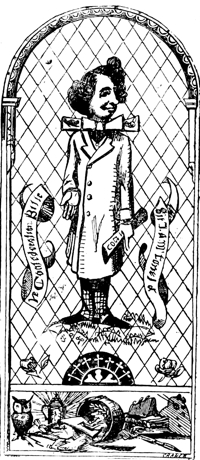
PROPOSED WINDOW FOR THE PARLIAMENT BUILDING. (From Diogenes.)
As the result of conferences then initiated a Federal Union of the Provinces was decided upon, and three Reformers, Messrs. Brown, Mowat and Macdougall entered the Government to assist in carrying the plan into effect. In due course the Imperial authorities passed the necessary legislation, under the title of the British North America Act, and on the 1st of July, 1867, the plan was consummated, and the Dominion of Canada came into existence. For distinguished services in connection with this great measure, Mr. Macdonald was honored with knighthood, and in the following year Mr. Cartier accepted a baronetcy. Other distinguished Confederationists received minor honors. In the ensuing general election, Mr. Brown was defeated in South Ontario, and never thereafter sat in Parliament. In 1873 he accepted a seat in the Senate at the hands of the Reform 30Government of Mr. Mackenzie, and in that quiet retreat ended his eventful political career. The formation of Provincial Ministries had meantime been arranged for. In Ontario, the first Cabinet—a coalition—was under the leadership of Mr. John Sandfield Macdonald, and remained in office for the ensuing four years. Amongst the new Members of the first Dominion Parliament were Joseph Howe of Nova Scotia and Edward Blake of Ontario, the latter gentleman being at the same election (1867) returned as a member of the Ontario Assembly, where he soon assumed the leadership of the Opposition. Mr. Howe continued his active efforts against Confederation both in and out of the House. In 1868 he was the leading member of a delegation to England to present an address in favor of the repeal of the Union on behalf of Nova Scotia. This petition was rejected, and early in 1869 Mr. Howe was induced to enter the Cabinet, certain modifications of the terms of Union being promised. In 1868, Lord Monck was succeeded in the Governorship by Sir John Young (afterward Lord Lisgar). In the ensuing session, the North-West Territories, which had been acquired by the extinction of the Hudson’s Bay Company’s claim, were formally added to the Dominion, and an Act was passed to provide for the appointment of a Lieutenant-Governor and Council to administer their affairs. The closing negotiations in England had been conducted by Sir Geo. Cartier (Cartoon 32) and Hon. Wm. Macdougall, and in recognition of his services the latter gentleman was appointed Lieutenant-Governor of the new Territory. The Metis settlers, however, felt aggrieved that the transfer had been effected without their consent, and entertained a want of confidence in the good-will of the new owners of the country. The result was that when Lieutenant-Governor Macdougall undertook to assume the direction of affairs he was met by armed resistance, and found that the half-breeds about Fort Garry were in open rebellion under the leadership of one Louis Riel. Upon the peremptory order of the rebels Mr. Macdougall was forced to retreat from the frontier (Cartoon 49). Meanwhile the rebellion went on. Bishop Taché, a prelate of vast influence amongst the half-breeds, happened unfortunately to be absent in Rome. It being clear that peace could not be restored without his intervention, he was communicated with, and on his arrival at Ottawa he was empowered to offer the rebels an amnesty for all past offences and to assure them of the good-will of the Dominion. He at once departed on his mission, but before his arrival at the Red River, Riel had crowned his folly and wickedness by the cold-blooded murder of a loyalist named Thomas Scott, under form of a “court martial” execution. The Bishop, notwithstanding this, duly delivered his message. The rebels were ultimately overawed by the appearance of a military force under command of Colonel (afterwards Sir Garnet) Wolseley, 31and Riel took flight. He returned, however, after a time, and remained in Manitoba unmolested until the offer of a reward for his apprehension by the Ontario Government caused him to seek safety on the American side. To forestall further trouble the Dominion Government, at the suggestion of Bishop Taché, secretly provided him with some $1,500 on condition of his remaining out of the country for good. With this strangely acquired booty he took up his residence in the United States. He was subsequently twice elected to Parliament for the constituency of Provencher, Manitoba, but his banishment from the country for five years was decreed in connection with the general amnesty subsequently ratified by the Mackenzie Government.
In 1872 Sir John Macdonald was appointed one of the British Commissioners for the arrangement of a treaty involving the fishery interests of Canada, amongst other important matters, as between Great Britain and the United States. The result of the Commissioners’ labors is known as the Washington Treaty, which was ratified in that year. By this document, inter alia, the right to take fish in Canadian waters was extended to the United States for the period of ten years in consideration of a money payment, the amount subsequently agreed upon by a joint Commission, which met at Halifax in 1877, being $5,500,000. This the Americans paid, but only after a protest on flimsy grounds by their representative, Mr. Kellogg, and much grumbling by Congress. In 1871, British Columbia was admitted to the Union. In the session of the following year a Bill was passed empowering the Government to contract with a chartered company for the construction of a railway to connect British Columbia with the Eastern Provinces. This year was also signalized by the advent of Lord Dufferin as the successor of Baron Lisgar in the vice-regal office, and by a general election, the term of the first Parliament of the Dominion having expired. The result of the election was favorable to the Government, though the Opposition was materially strengthened. In 1873 Confederation was rounded off by the admission of Prince Edward Island into the Union. The session of this year is memorable for the “Pacific Scandal.” Mr. Huntington from his place in the House charged the Government with having corruptly sold the contract for the construction of the C. P. R., to Sir Hugh Allan, in consideration of a large contribution by that worthy knight to the Conservative election fund. This unparalleled indictment caused a great sensation, and eventually compelled the resignation of the Ministry. A Reform Government under Mr. Mackenzie succeeded to office, and continued down to 1878, when the prevailing depression of trade compassed its defeat, the Conservatives having declared for Protection to native industries as a “National Policy,” a cry which caught the public fancy wonderfully. The leading political incidents of the term thus briefly indicated are commented upon in their order in the cartoons from Grip presented in this volume. Early in 1880, Mr. Mackenzie was succeeded in the leadership by Mr. Blake, who still remains at the head of the Reform Party.
32THE MAN WOT FIRED THE PARLIAMENT HOUSE.
As a climax to the excitement which attended the passage of the Rebellion Losses Bill, the House of Parliament at Montreal was destroyed by incendiarism. This outrage was well-known to have been the act of a Party, but the individual hand that wielded the torch, was not known. Punch in Canada, the comic paper of the day, and a strong opponent of the measure in question, took advantage of this fact to suggest humorously that “the man wot fired the Parliament House” was Lafontaine—the man who led the Government in the matter which had so excited the Conservative wrath, and so led to the catastrophe.
Punch in Canada, May 19th, 1849.
33
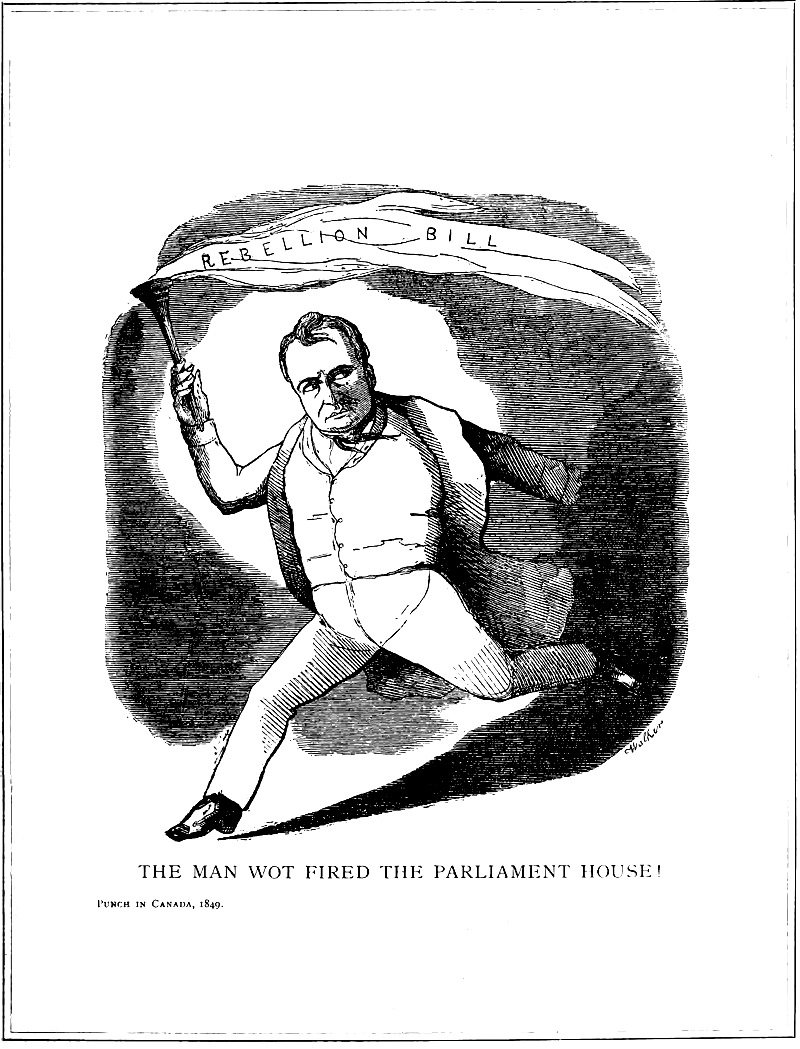
THE MAN WOT FIRED THE PARLIAMENT HOUSE! Punch in Canada, 1849.
34THE CLUB NATIONALE DEMOCRATIQUE PREPARING TO TRAMPLE ON THE BRITISH LION.
This was a satirical allusion to the “tall talk” indulged in by a coterie of French followers of Papineau, who favored a democratic form of Government for Canada as a cure for the prevailing discontent.
Punch in Canada, July 7th, 1849.
35
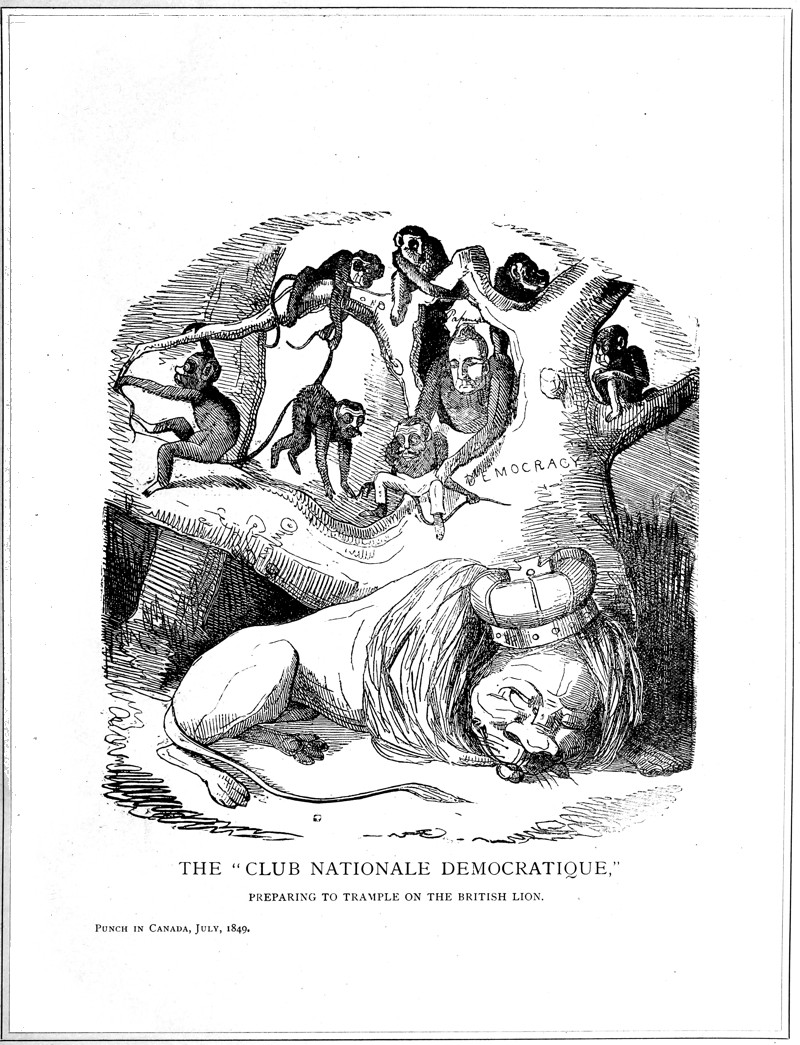
THE “CLUB NATIONALE DEMOCRATIQUE,” PREPARING TO TRAMPLE ON THE BRITISH LION. Punch in Canada, July, 1849.
36SCENE AT BUCKINGHAM PALACE.
Sir Allan Macnab and Hon. Wm. Cayley visited England on behalf of the Conservative Party, to endeavor to influence public and Parliamentary opinion in connection with Canadian questions, which at the time were exciting unusual attention. Mr. Francis Hincks was sent over about the same time to represent the Reform view, and to counteract the influence of the gentlemen named.
Punch in Canada, July, 1849.
37
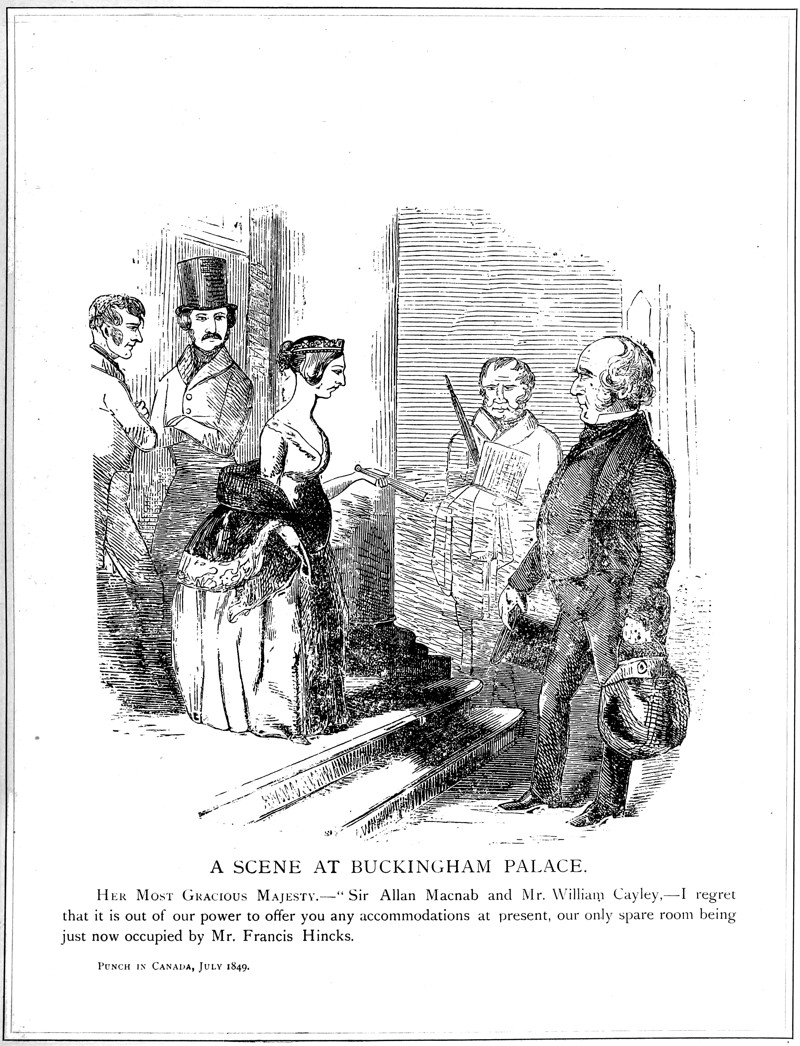
A SCENE AT BUCKINGHAM PALACE.
Her Most Gracious Majesty.—“Sir Allan Macnab and Mr. William Cayley,—I regret that it is out of our power to offer you any accommodations at present, our only spare room being just now occupied by Mr. Francis Hincks.”
Punch in Canada, July 1849.
38THE HERMIT.
Lord Elgin, the Governor-General, was criticised for secluding himself from society at the official residence, Monklands.
Punch in Canada, August, 1849.
39
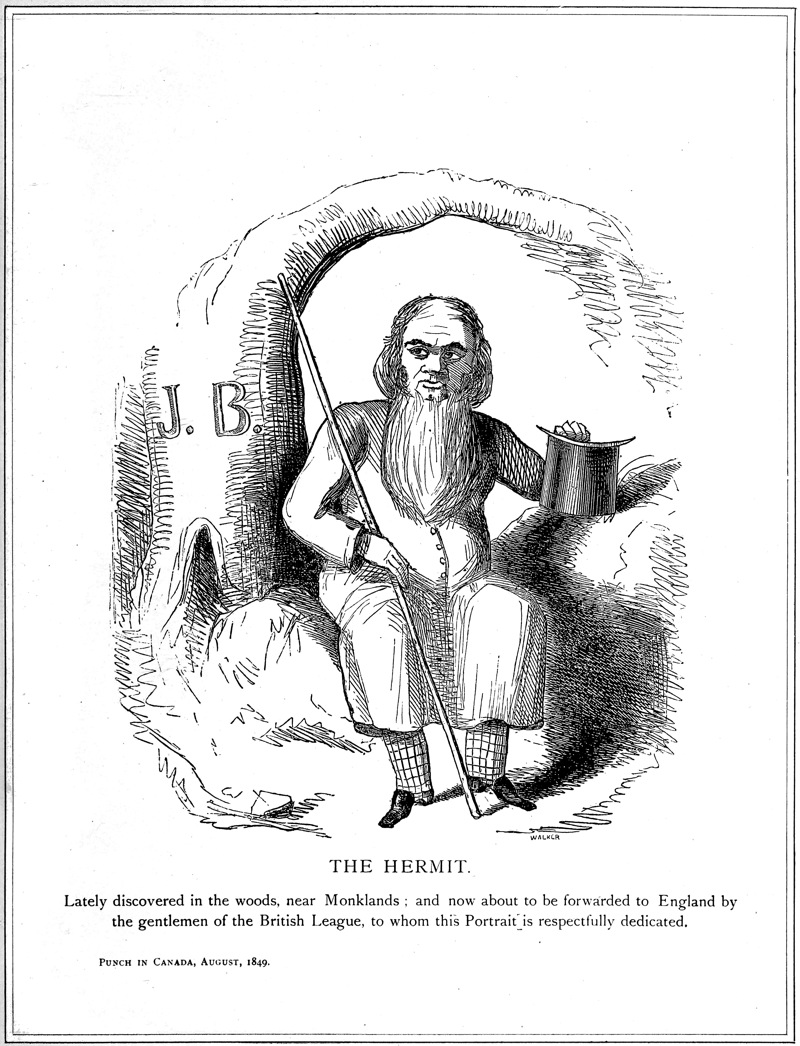
THE HERMIT.
Lately discovered in the woods, near Monklands; and now about to be forwarded to England by the gentlemen of the British League, to whom this Portrait is respectfully dedicated.
Punch in Canada, August, 1849.
40DROPPING A HINT.
Colonel Gugy, M.P., was a prominent member of the Opposition under the Baldwin-Lafontaine Ministry, but announced his withdrawal from that position during the heated scenes which followed the Rebellion Losses riots. He is regarded as having been the progenitor of the Liberal-Conservative Party of the present time. The cartoon conveys the insinuation that Colonel Gugy sympathized with the Annexation movement, which was the sensation of the day.
Punch in Canada, May, 1849.
41
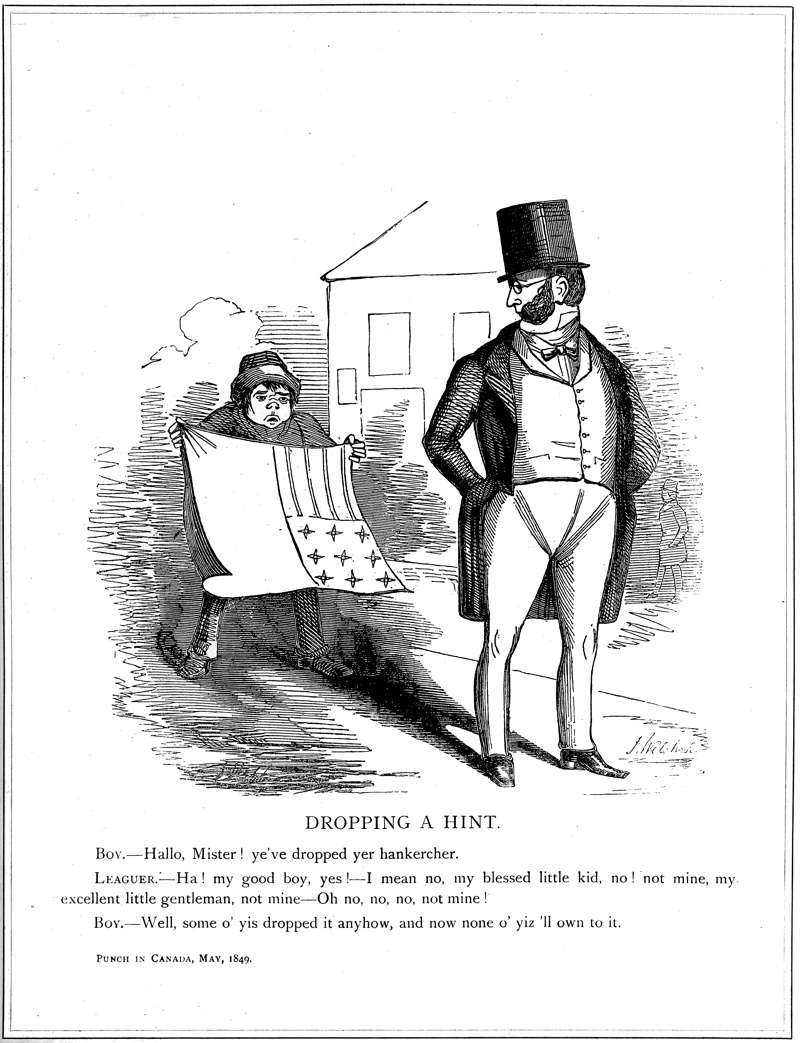
DROPPING A HINT.
Boy.—Hallo, Mister! ye’ve dropped yer hankercher.
Leaguer.—Ha! my good boy, yes!—I mean no, my blessed little kid, no! not mine, my excellent little gentleman, not mine—Oh no, no, no, not mine!
Boy.—Well, some o’ yis dropped it anyhow, and now none o’ yiz ’ll own to it.
Punch in Canada, May, 1849.
42THE ANNEXATION ENGINE.
This was another attack upon the Annexation sentiment which prevailed in Lower Canada. Mr. Papineau is again the principal figure, and Punch’s idea was that if Annexation were ever realized its first effect would be to rob the French-Canadians of the special privileges they enjoyed under British rule. The artist’s conception of Brother Jonathan is somewhat unique.
Punch in Canada, 1849.
43
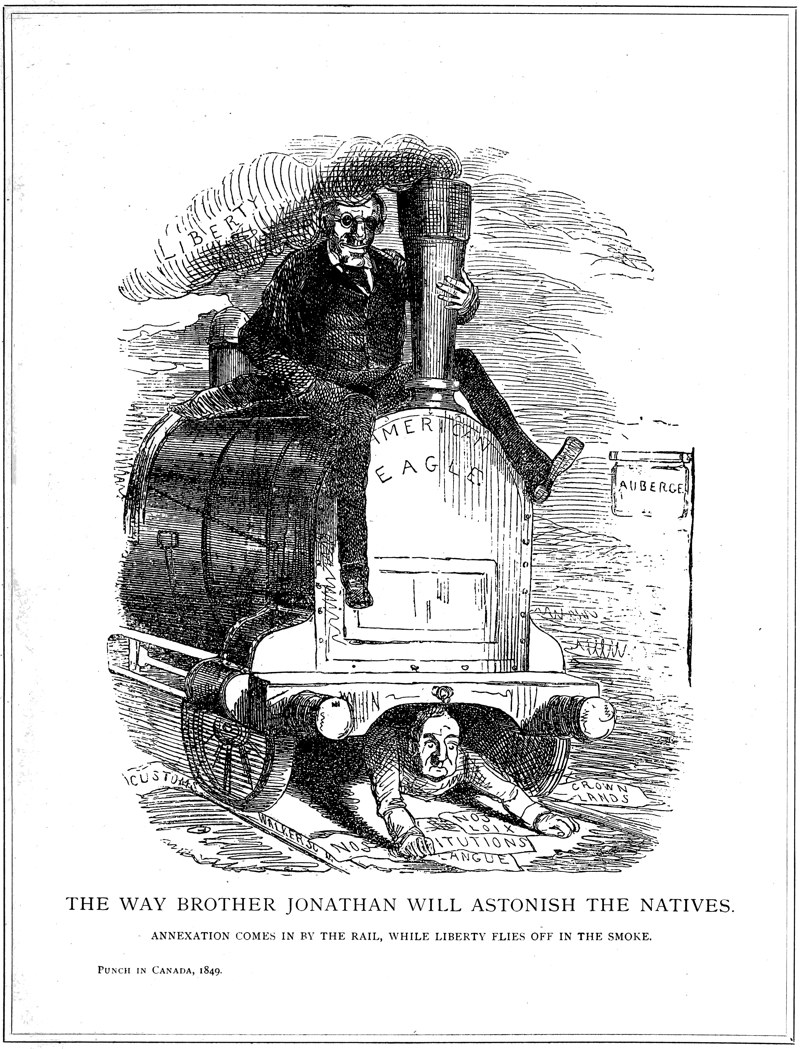
THE WAY BROTHER JONATHAN WILL ASTONISH THE NATIVES. ANNEXATION COMES IN BY THE RAIL, WHILE LIBERTY FLIES OFF IN THE SMOKE. Punch in Canada, 1849.
44THE THIMBLERIG.
This cartoon appeared during the discussion of the removal of the Seat of Government from Montreal after the destruction of the old building at the hands of the mob. Hon. Robert Baldwin, who was Premier at the time, was supposed to favor his native place, Toronto, in the selection; Kingston and Montreal were the other competitors for the honor. Mr. Punch naturally gave Montreal the preference.
Punch in Canada, September, 1849.
45
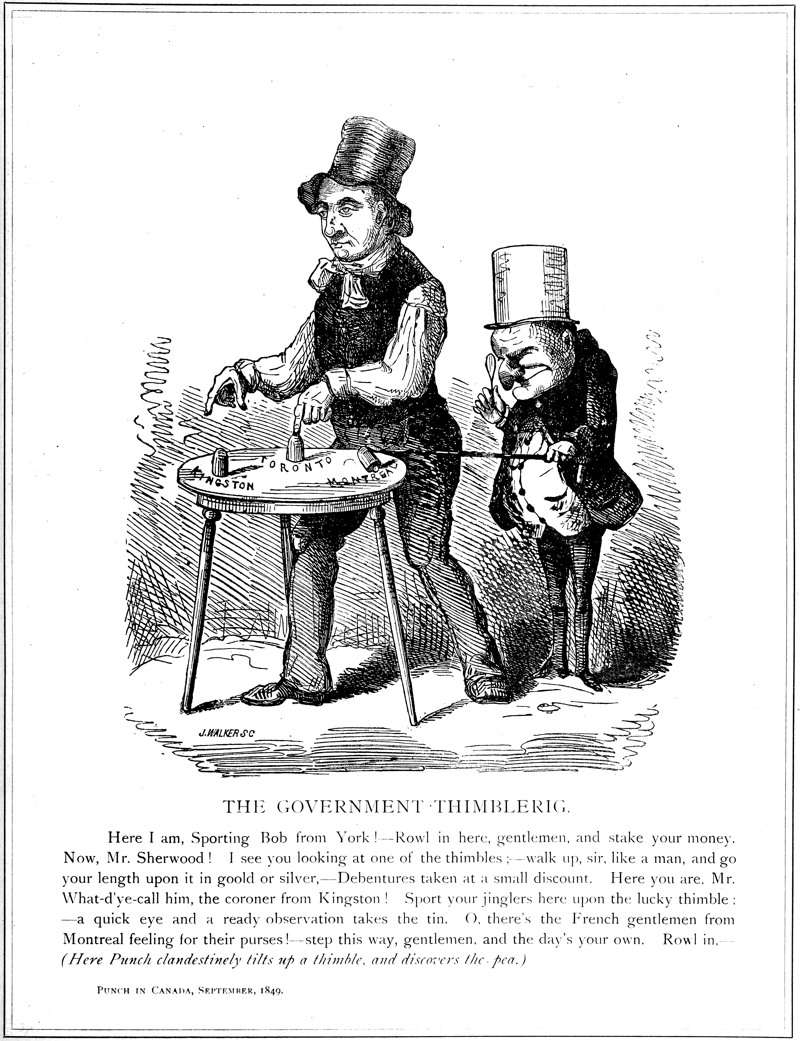
THE GOVERNMENT THIMBLERIG.
Here I am, Sporting Bob from York!—Rowl in here, gentlemen, and stake your money. Now, Mr. Sherwood! I see you looking at one of the thimbles;—walk up, sir, like a man, and go your length upon it in gold or silver,—Debentures taken at a small discount. Here you are, Mr. What-d’ye-call him, the coroner from Kingston! Sport your jinglers here upon the lucky thimble;—a quick eye and a ready observation takes the tin. O, there’s the French gentlemen from Montreal feeling for their purses!—step this way, gentlemen, and the day’s your own. Rowl in.
(Here Punch clandestinely tilts up a thimble, and discovers the pea.)
Punch in Canada, September, 1849.]
46PAWNING THE FLAG.
Mr. Benjamin Holmes was one of the Members for Montreal in the first Parliament after the Union, and was amongst the most active public men of the time. In 1849 he was an advocate of Annexation, and subsequently voted for the reception of an address in favor of Canadian Independence. His Annexation proclivities are hit off in the cartoon, which represents him as pawning the British flag to Brother Jonathan.
Punch in Canada, October 10th, 1849.
47
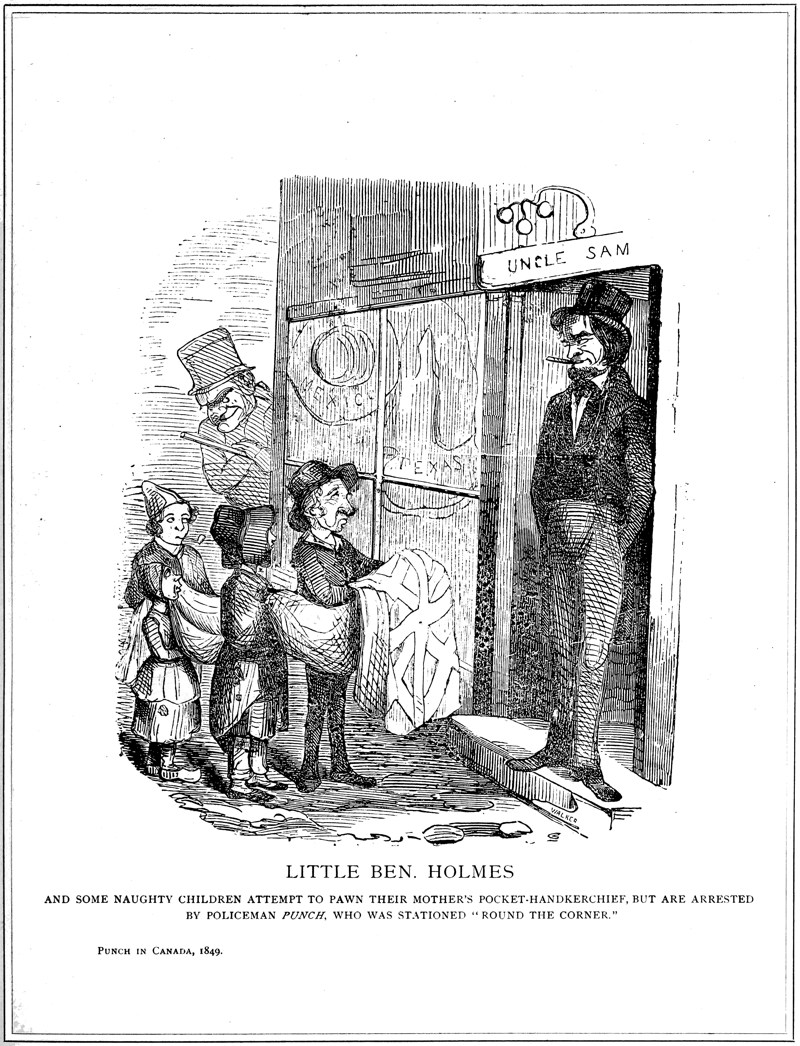
LITTLE BEN. HOLMES AND SOME NAUGHTY CHILDREN ATTEMPT TO PAWN THEIR MOTHER’S POCKET-HANDKERCHIEF, BUT ARE ARRESTED BY POLICEMAN PUNCH, WHO WAS STATIONED “ROUND THE CORNER.” Punch in Canada, 1849.
48THE EAGLE AND THE FAWN.
A piece of excusable self-glorification on the part of Mr. Punch, who was “truly loyal” from first to last. Here he dashes forth upon his charger to rescue the Canadian fawn from the talons of the designing American Eagle.
Punch in Canada, October, 1849.
49
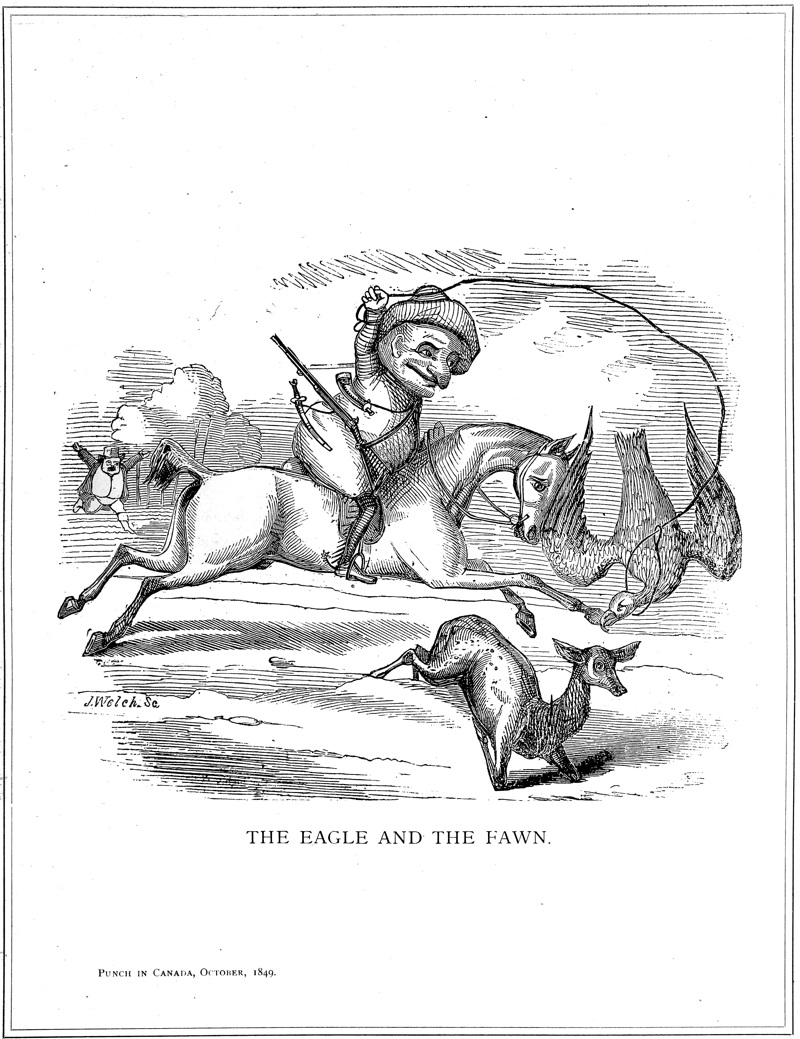
THE EAGLE AND THE FAWN. Punch in Canada, October, 1849.
50TWO YEARS AFTER ANNEXATION.
This satire is at the expense of Mr. Benjamin Holmes’ infirmity in the matter of strong drink, while it also includes a hit at his Annexation record.
Punch in Canada, November, 1849.
51
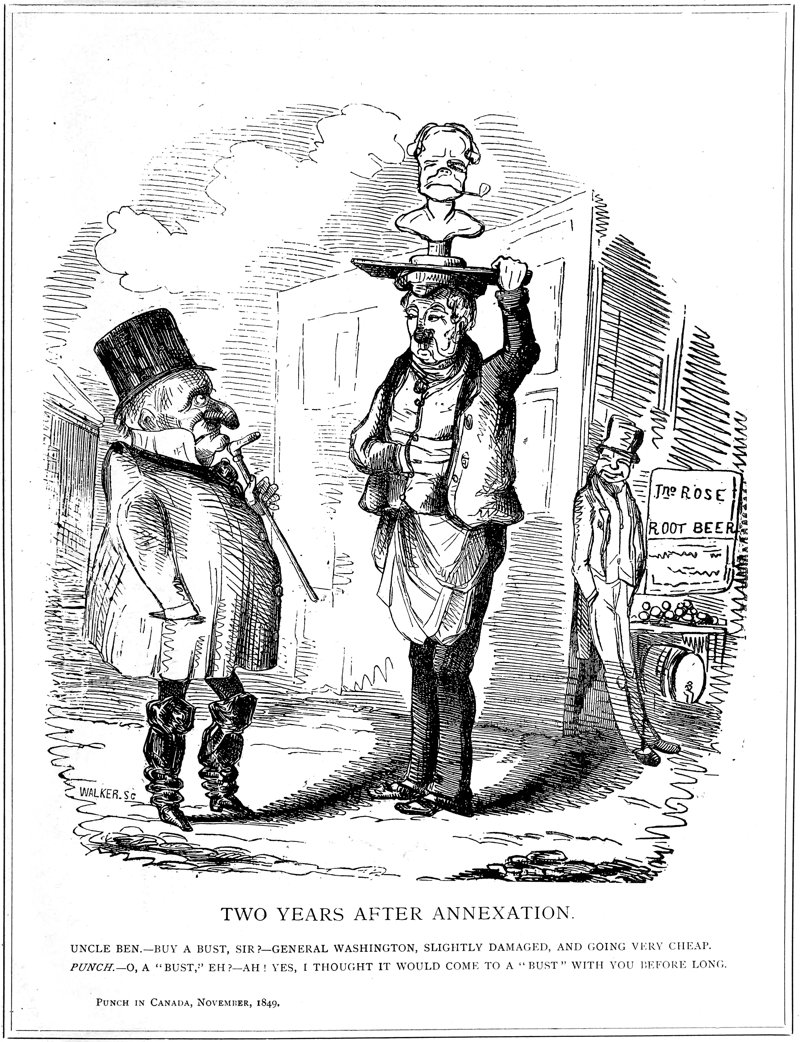
TWO YEARS AFTER ANNEXATION.
UNCLE BEN.—BUY A BUST, SIR?—GENERAL WASHINGTON, SLIGHTLY DAMAGED, AND GOING VERY CHEAP.
PUNCH.—O, A “BUST,” EH?—AH! YES, I THOUGHT IT WOULD COME TO A “BUST” WITH YOU BEFORE LONG.
Punch in Canada, November, 1849.
52HERE WE ARE AND HERE WE GO.
The question of the removal of the Seat of Government having been decided in favor of Toronto, the cartoon affects to give a view of the removal itself under the similitude of a circus caravan. The figure upon the wagon in the foreground was no doubt intended to represent Lord Elgin, although no attempt was made to catch the likeness. The basket of eggs and the hen in close proximity are a sufficient hint as to the identity, Lord Elgin having been “rotten-egged” by a Montreal mob for signing the Rebellion Losses Bill.
Punch in Canada, November 29th, 1849.
53
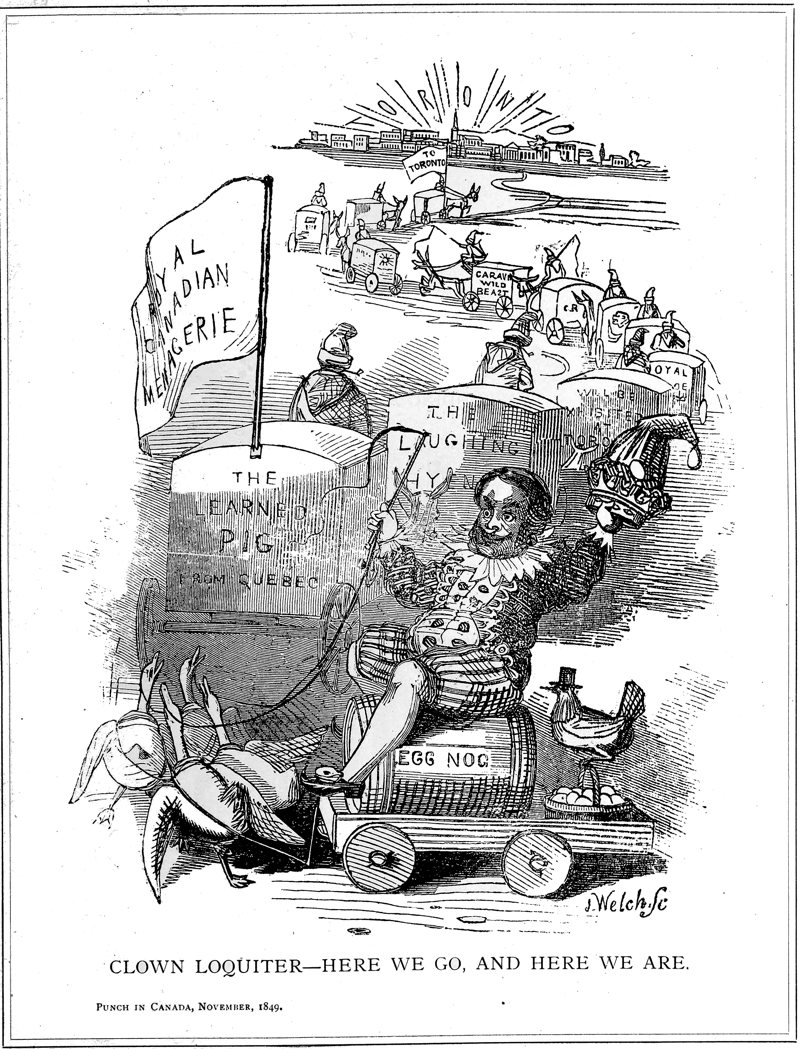
CLOWN LOQUITER—HERE WE GO, AND HERE WE ARE. Punch in Canada, November, 1849.
54THE PUDDING AND THE WASP.
Mr. Henry John Boulton, M.P., for Niagara, was a somewhat prominent figure in the Canadian Parliament, in which he occupied an “independent” attitude. Toward the close of his Parliamentary career he was favorably mentioned for appointment to the Judicial Bench, but the honor was withheld, chiefly through the opposition offered by the Colonist, an influential paper published at Toronto.
Punch in Canada, December, 1849.
55
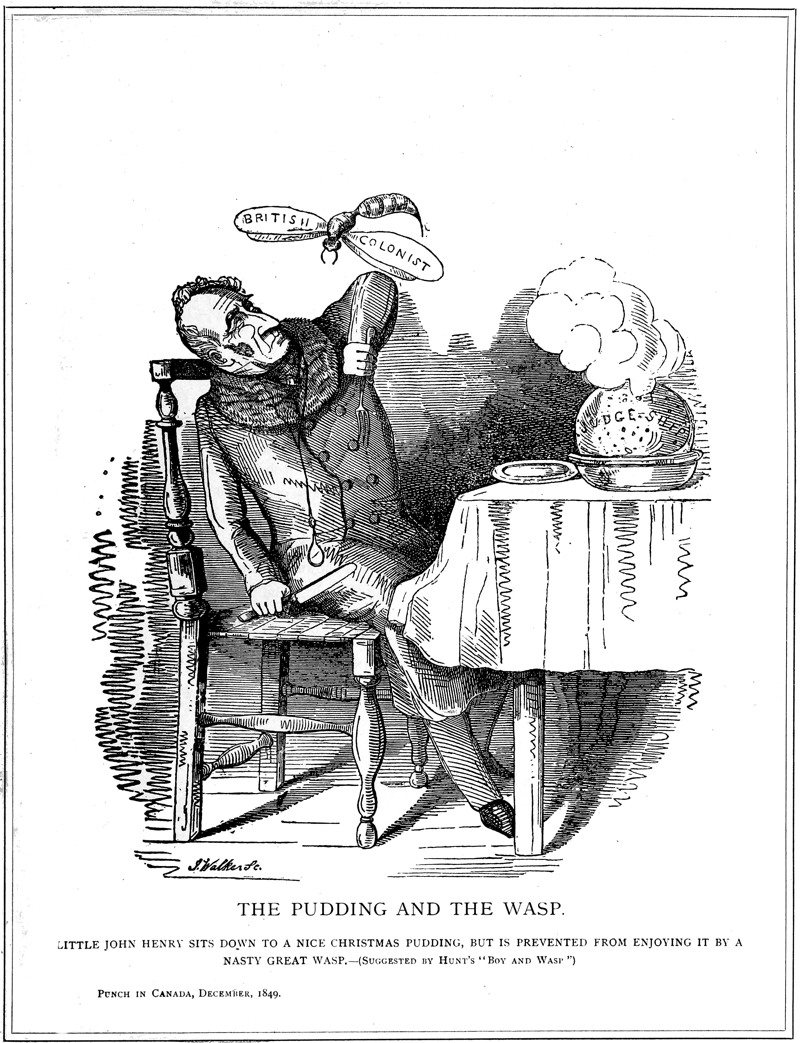
THE PUDDING AND THE WASP.
LITTLE JOHN HENRY SITS DOWN TO A NICE CHRISTMAS PUDDING, BUT IS PREVENTED FROM ENJOYING IT BY A NASTY GREAT WASP.—(Suggested by Hunt’s “Boy and Wasp”)
Punch in Canada, December, 1849.
56THE TRAPPERS.
This cartoon signalizes the triumph of Toronto in being at last made the Seat of Government. Henry Sherwood and Robert Baldwin, the “trappers” of the picture, were prominent representatives of Toronto, though on opposite sides of politics, and both had urged the claims of their native city when the Government was first removed from Kingston. Elmsley Hut indicates the official residence, which was known as Elmsley House, on the site of the present Central Presbyterian Church. The “Beaver” in the case is, of course, Lord Elgin.
Punch in Canada, December 28th, 1849.
57
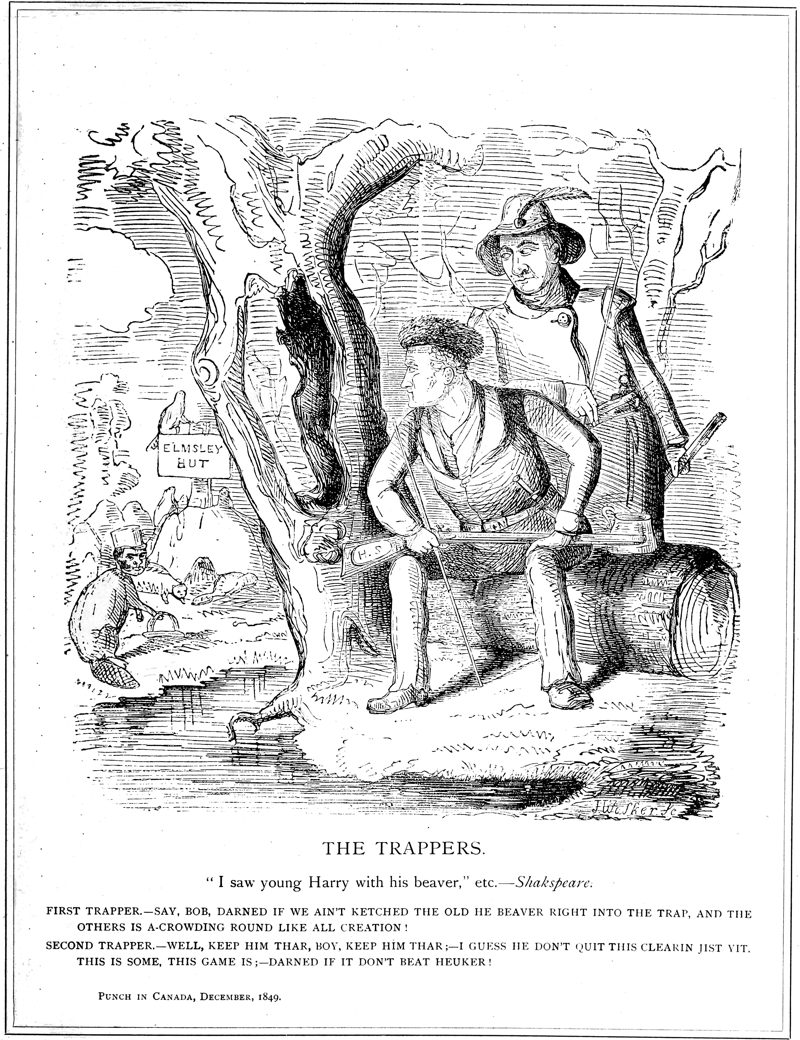
THE TRAPPERS. “I saw young Harry with his beaver,” etc.—Shakspeare.
FIRST TRAPPER.—SAY, BOB, DARNED IF WE AIN’T KETCHED THE OLD HE BEAVER RIGHT INTO THE TRAP, AND THE OTHERS IS A-CROWDING ROUND LIKE ALL CREATION!
SECOND TRAPPER.—WELL, KEEP HIM THAR, BOY, KEEP HIM THAR: —I GUESS HE DON’T QUIT THIS CLEARIN JIST YIT. THIS IS SOME, THIS GAME IS:—DARNED IF IT DON’T BEAT HEUKER!
Punch in Canada, December, 1849.]
58TOWNSHIPS COLONIZATION—A SETTLER.
This was an allusion, from the English standpoint, to the unfitness of French emigrants as agricultural settlers. The contrast between the results of farming industry in Upper and Lower Canada seemed to justify this prejudice. The comparison of the newly-arrived Frenchman to the frogs is a time-honored joke, supposed to have arisen from the alleged French national taste for frogs’-legs as a table delicacy.
Punch in Canada, 1849.
59
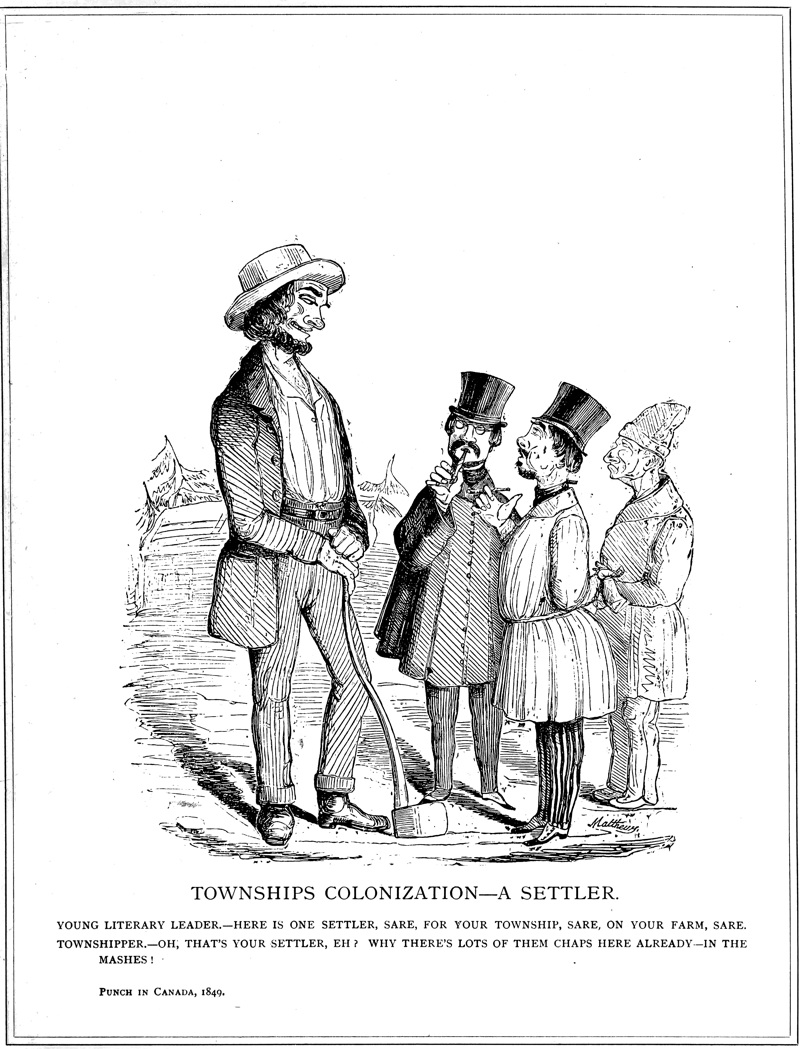
TOWNSHIPS COLONIZATION—A SETTLER.
YOUNG LITERARY LEADER.—HERE IS ONE SETTLER, SARE, FOR YOUR TOWNSHIP, SARE, ON YOUR FARM, SARE.
TOWNSHIPPER.—OH, THAT’S YOUR SETTLER, EH? WHY THERE’S LOTS OF THEM CHAPS HERE ALREADY—IN THE MASHES!
Punch in Canada, 1849.
60A WINTER’S TALE.
After the troubles of 1837, William Lyon Mackenzie became an exile from Canada. In the verses in the legend, he recounts his unhappy experiences in political life to Robert Baldwin, who is figuratively represented as bearing him company. The gallows on the mainland in the distance is a reminder that a price had been set upon Mackenzie’s head.
Punch in Canada, 1849.
61
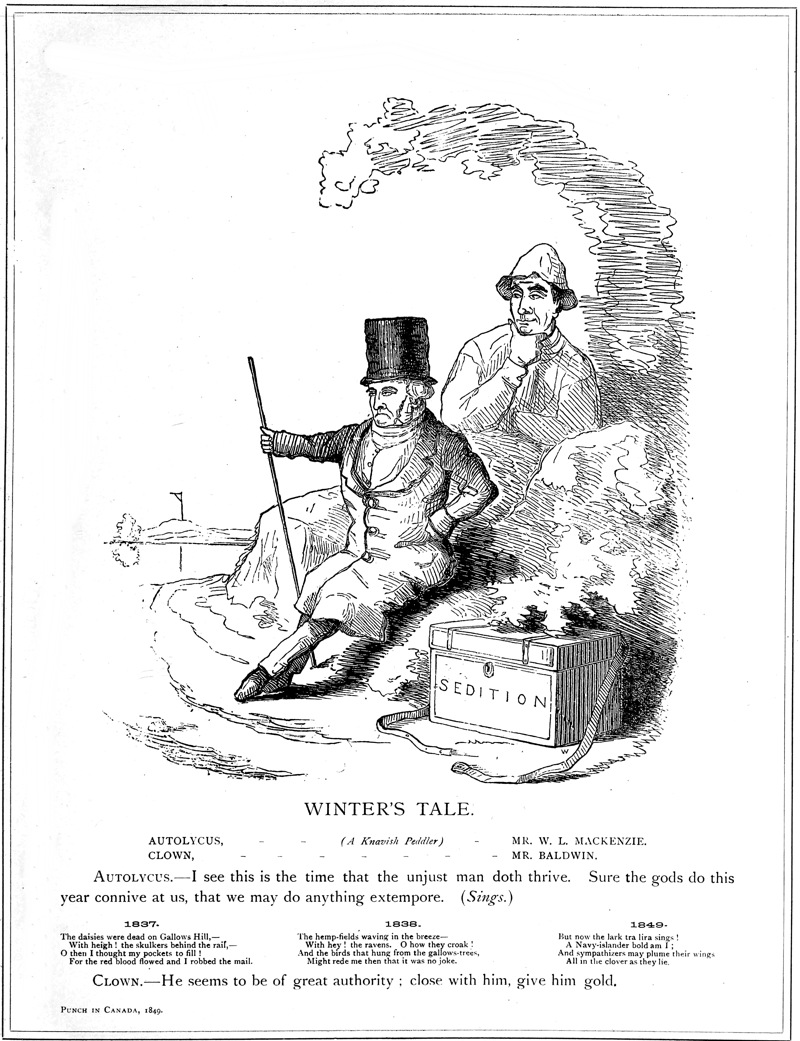
WINTER’S TALE. AUTOLYCUS, — (A Knavish Peddler) — MR. W. L. MACKENZIE. CLOWN, — — MR. BALDWIN.
Autolycus.—I see this is the time that the unjust man doth thrive. Sure the gods do this year connive at us, that we may do anything extempore. (Sings.)
1837.
The daisies were dead on Gallows Hill,—
With heigh! the skulkers behind the rail,—
O then I thought my pockets to fill!
For the red blood flowed and I robbed the mail.
1838.
The hemp-fields waving in the breeze—
With hey! the ravens. O how they croak!
And the birds that hung from the gallows-trees,
Might rede me then that it was no joke.
1849.
But now the lark tra lira sings!
A Navy-islander bold am I;
And sympathizers may plume their wings
All in the clover as they lie.
Clown.—He seems to be of great authority; close with him, give him gold.
Punch in Canada, 1849.
62EFFECT OF TORONTO BEER AND BEEF, ETC.
It is not unlikely that there was some physical ground for this reference to Lafontaine, although the satirist’s primary allusion is to the happy political effect of the calmer atmosphere in which the French leader was now living.
Punch in Canada, 1849.
63
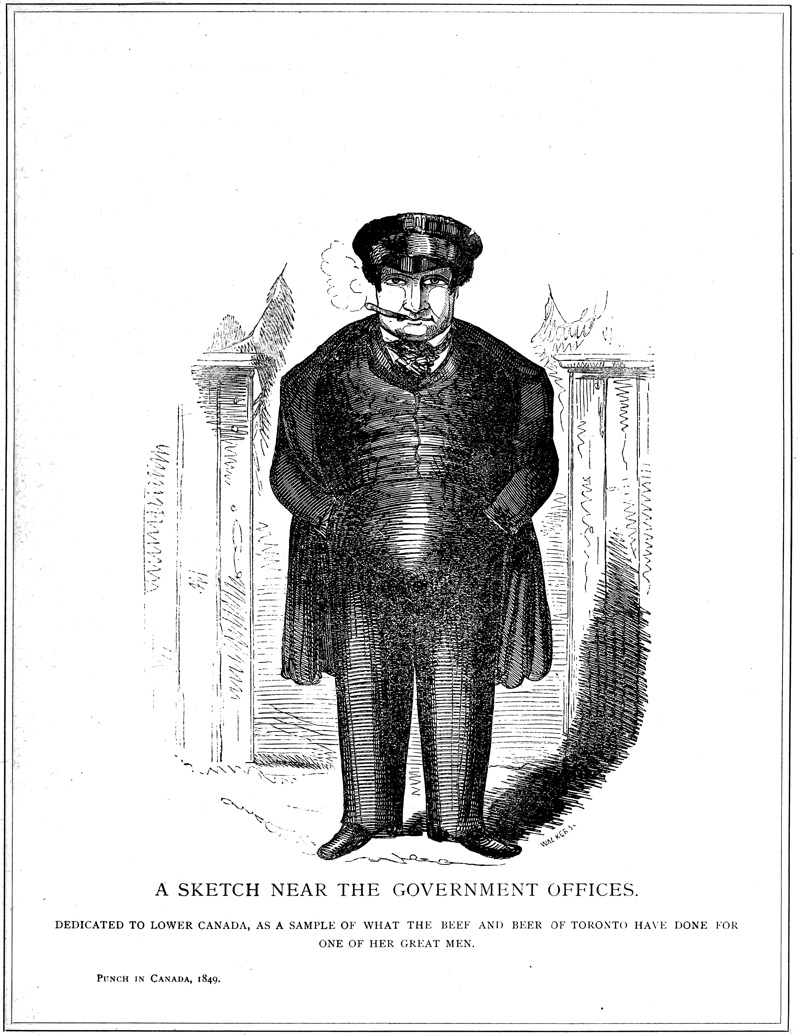
A SKETCH NEAR THE GOVERNMENT OFFICES.
DEDICATED TO LOWER CANADA, AS A SAMPLE OF WHAT THE BEEF AND BEER OF
TORONTO HAVE DONE FOR ONE OF HER GREAT MEN.
Punch in Canada, 1849.
64UP GOES THE DONKEY.
This was the first of a series of cartoons which appeared in Toronto, in 1858, in connection with the election contest between Mr. John Beverley Robinson and Mr. George Brown, for the representation of the city of Toronto in Parliament. Mr. Bowes was Mayor for several years. He was Mr. Robinson’s “right hand man” in the campaign, though, with a not over-friendly hand the artist represents the candidate as occupying a secondary position throughout. This was the occasion of Mr. Robinson’s first entry into parliamentary life. This, and the five following cartoons are inserted as an illustration of the manner in which public questions were caricatured in those days.
Fly Sheet, 1858.
65
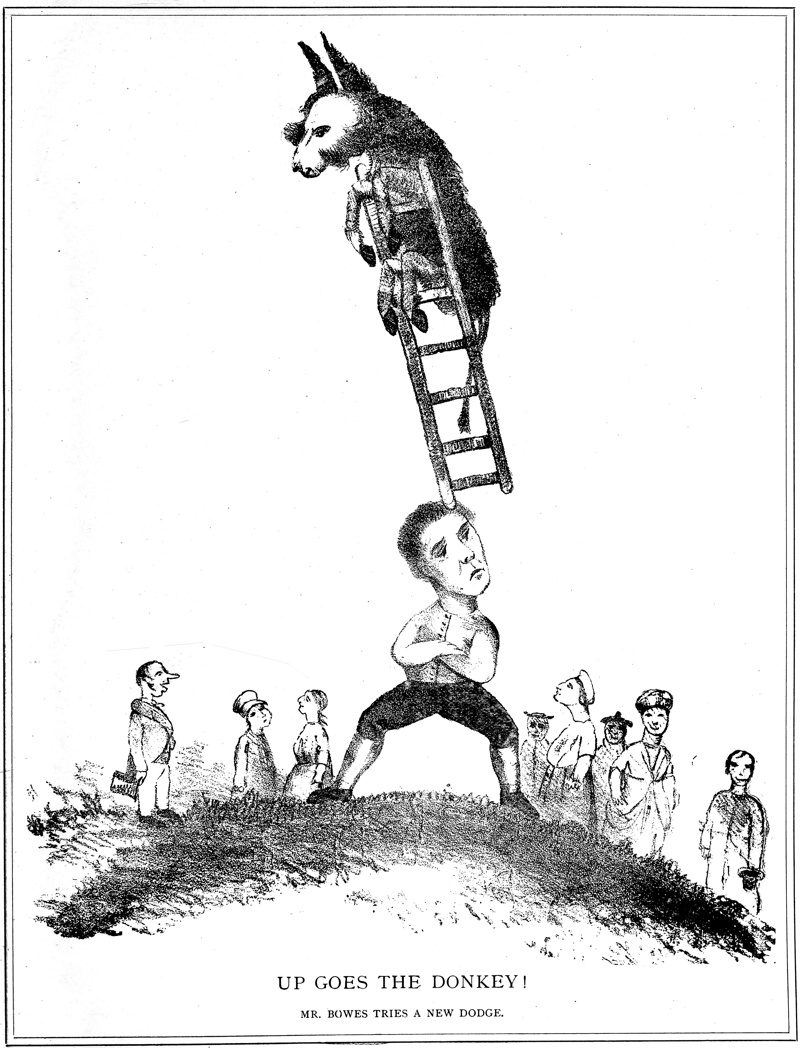
UP GOES THE DONKEY! MR. BOWES TRIES A NEW DODGE.
66BOWES BAGGING HIS GAME.
From what is known of the amenities of politics in those days, it is not unlikely that the charge of wholesale, open bribery, here made against the Conservative candidates, was well founded. The Conservatives were not so fortunate as to have a caricaturist on their side, or no doubt an equally faithful picture might have been levelled at Mr. Brown and his supporters.
Flysheet, 1857.
67
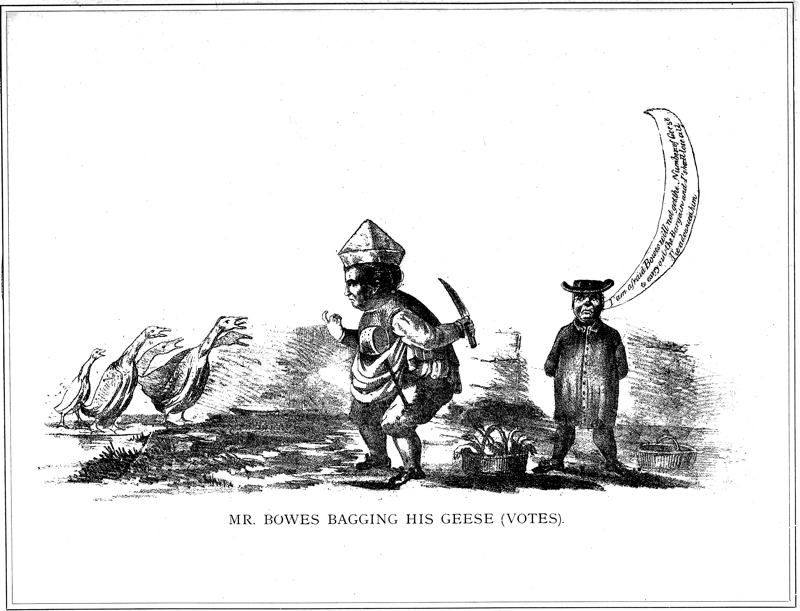
MR. BOWES BAGGING HIS GEESE (VOTES).
68USED UP.
The despondency, here attributed to the Conservative candidate, is supposed, of course, to have resulted from the fact that Mr. Brown was on the popular side of the question then occupying public attention. He was also more than a match for his opponent on the platform by virtue of natural gifts.
Flysheet, 1857.
69
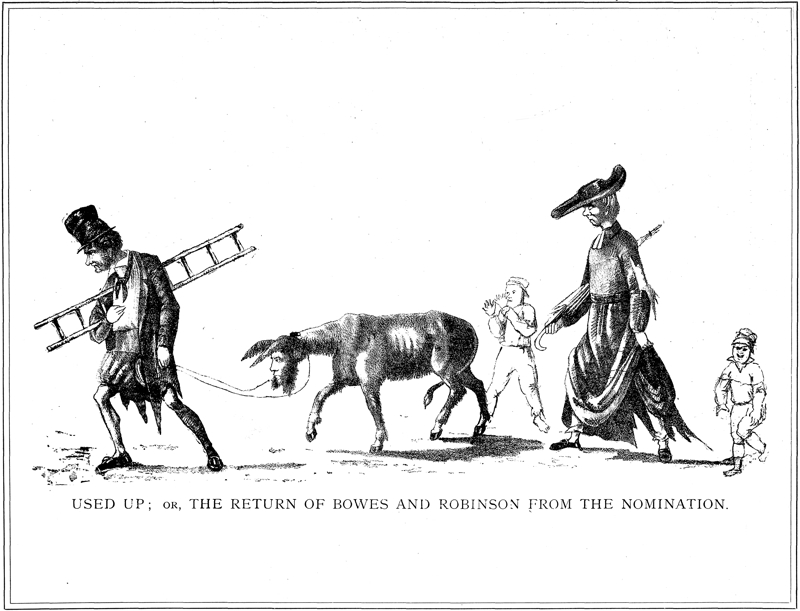
USED UP; OR, THE RETURN OF BOWES AND ROBINSON FROM THE NOMINATION.
70BOWES AND HIS PETTICOATED FRIENDS.
Mr. Bowes appears to have enlisted the sympathies of the Roman Catholic hierarchy on the side of the Tory candidates by the usual means—glowing promises of special favors to that denomination.
Flysheet, 1857.
71
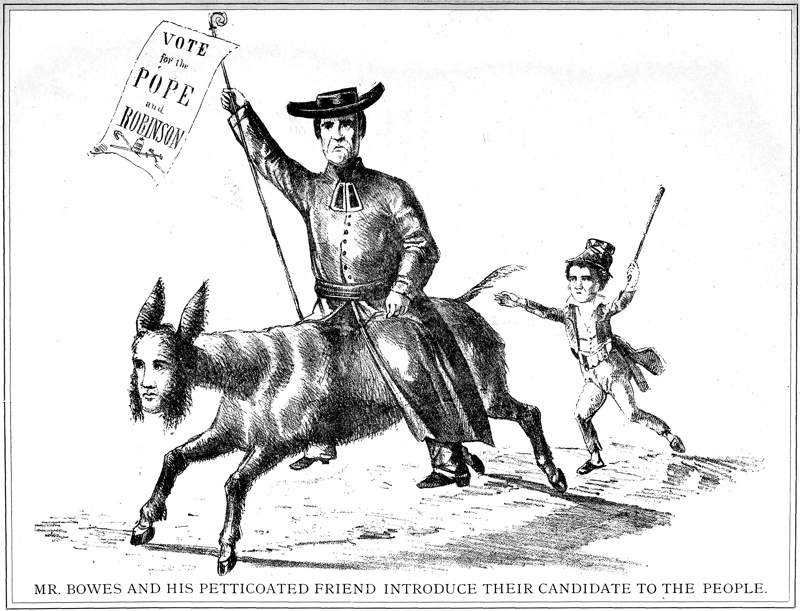
MR. BOWES AND HIS PETTICOATED FRIEND INTRODUCE THEIR CANDIDATE TO THE PEOPLE.
72THE RAT TRAP.
This cartoon depicts the attempt to catch the Catholic votes by baiting the trap with the Tory candidate. Mr. George Brown was at this time exceedingly unpopular with the Roman Catholics, on account of his outspoken ultra-Protestantism in the Globe.
Flysheet, 1857.
73
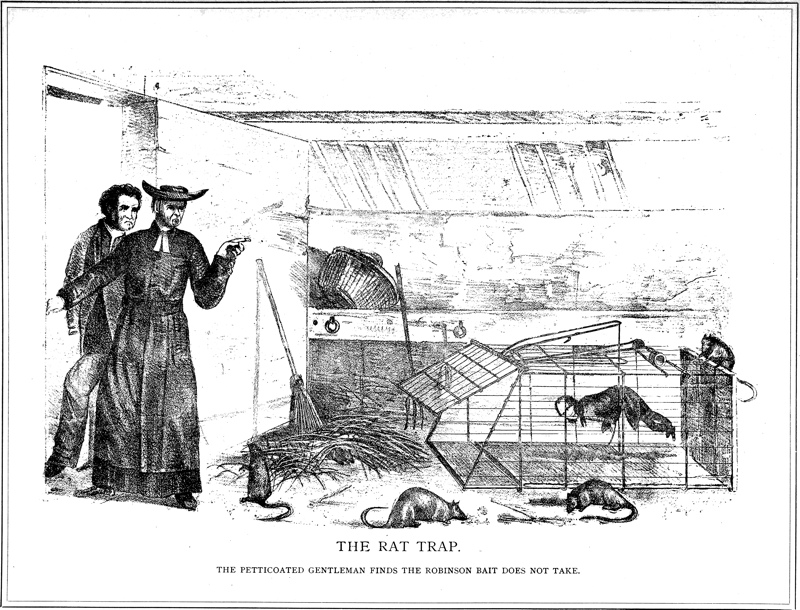
THE RAT TRAP. THE PETTICOATED GENTLEMAN FINDS THE ROBINSON BAIT DOES NOT TAKE.
74THE SICK CANDIDATE.
As the campaign progressed this valiant artist-partizan of course descried signs of the complete collapse of Mr. Robinson.
Flysheet, 1857.
75
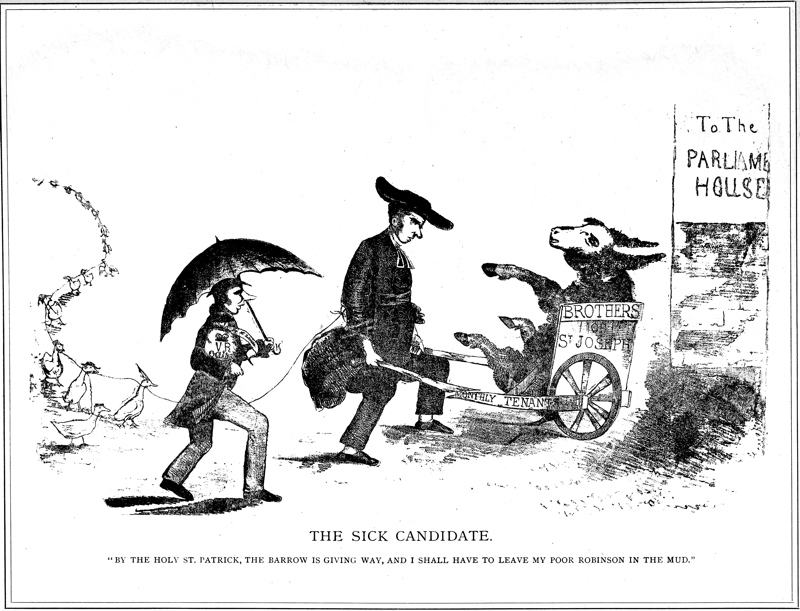
THE SICK CANDIDATE.
“BY THE HOLY ST. PATRICK, THE BARROW IS GIVING WAY, AND I SHALL HAVE TO LEAVE MY POOR ROBINSON IN THE MUD.”
76THE BROKEN PLANK.
The idea of the last cartoon is reiterated in another form. The discomfiture and defeat of the Conservative candidate is practically complete (in the artist’s mind).
Flysheet, 1857.
77
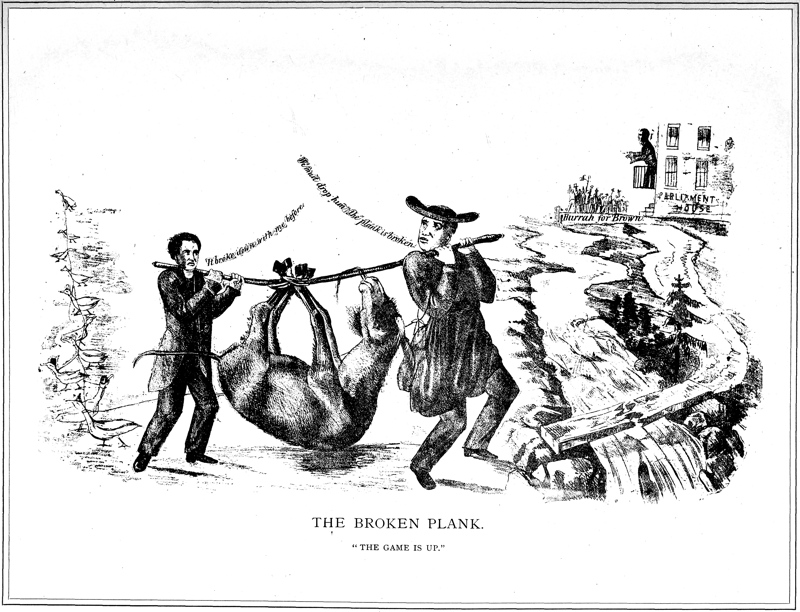
THE BROKEN PLANK. “THE GAME IS UP.”
78THE LAST KICK.
The cartoon, of course, appeared before the polling-day. The fact that Mr. Robinson was elected, as well as Mr. Brown, would seem to require a slight revision of the picture.
Flysheet, December 22nd, 1857.
79
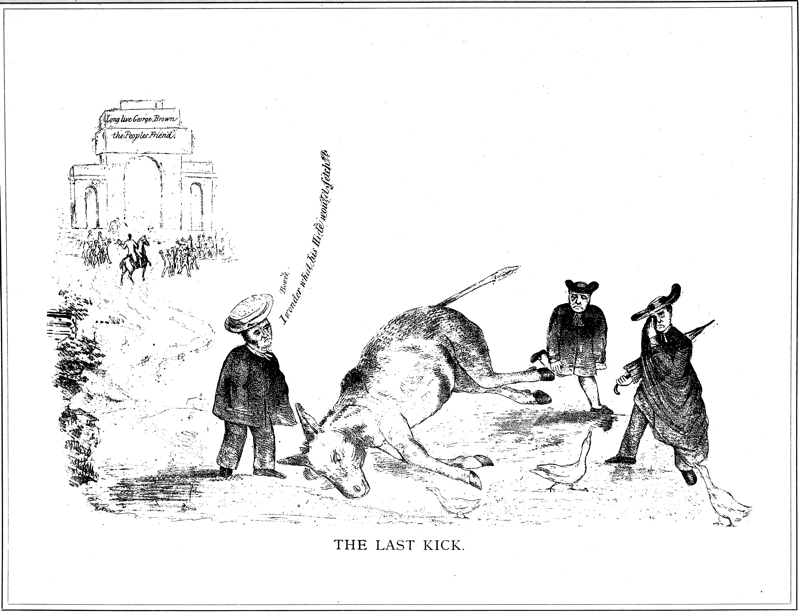
THE LAST KICK.
80THE THREE MARTYRS.
Nine members of the Reform party, who were won over to the side of the Government of J. S. Macdonald (which was a coalition), were dubbed “the martyrs.” This cartoon represents Mr. Macdonald in the act of compelling the ratification of the bargain with three of the number—Messrs. Lauder, Colcohoun, and Hamilton.
Flysheet, 1868.
81
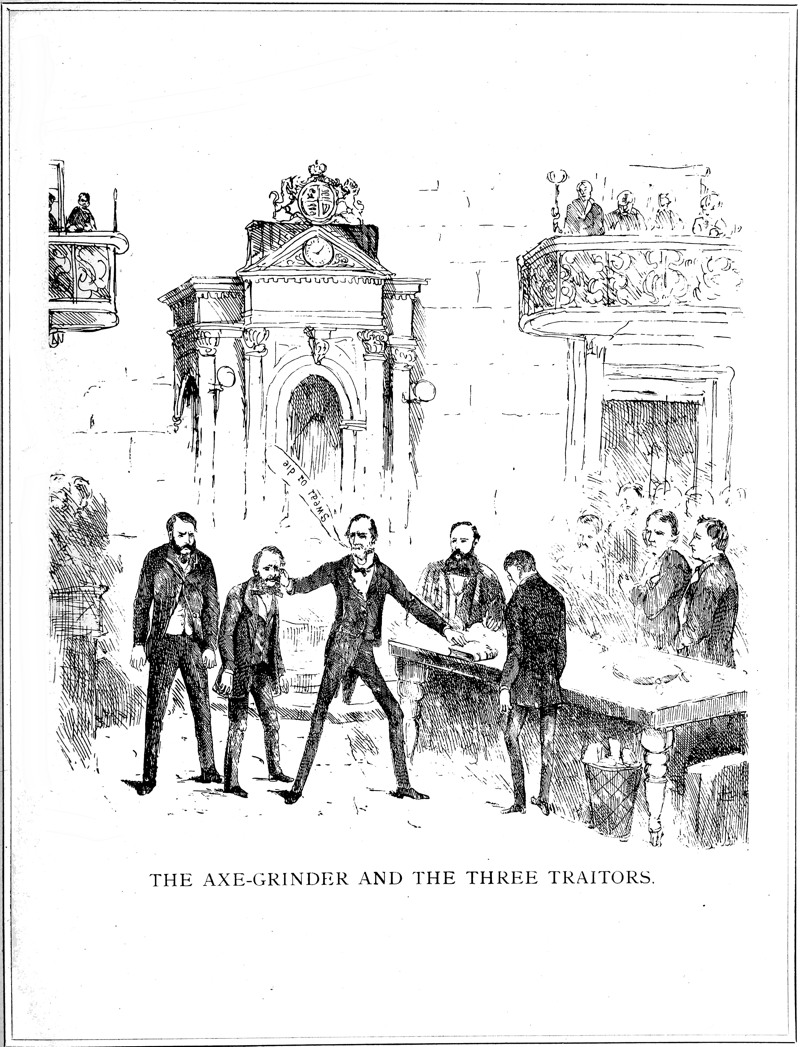
THE AXE-GRINDER AND THE THREE TRAITORS.
82THE NEEDY AXE-GRINDER.
Mr. John Sandfield Macdonald, who was at this time Premier of Ontario, earned the sobriquet of the Axe-Grinder by some self-descriptive expression he had made use of in a public speech. His political methods were largely based upon the quid pro quo principle.
Flysheet, 1868.
83
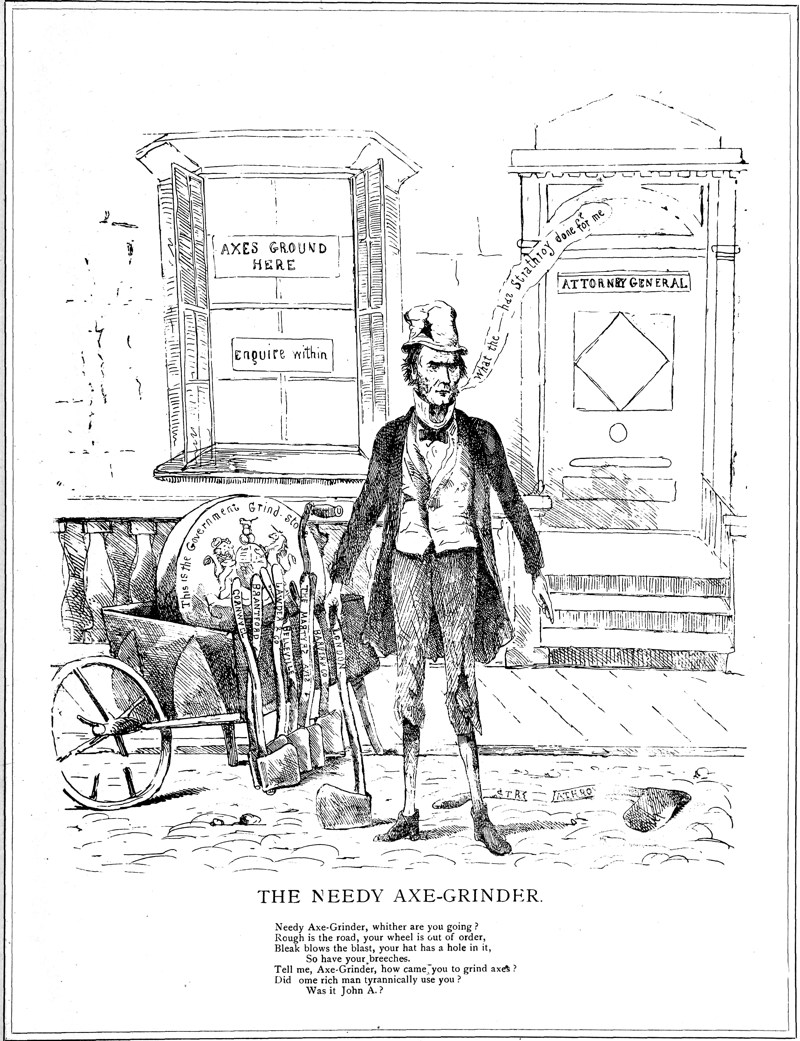
THE NEEDY AXE-GRINDER.
Needy Axe-Grinder, whither are you going?
Rough is the road, your wheel is out of order,
Bleak blows the blast, your hat has a hole in it,
So have your breeches.
Tell me, Axe-Grinder, how came you to grind axes?
Did some rich man tyrannically use you?
Was it John A.?
84CROSS ROADS.
Dr. (now Sir) Chas. Tupper was a warm advocate of Confederation, and did more than any other public man to induce his native Province, Nova Scotia (Acadia), to enter the Union in 1867. Hon. Joseph Howe, a much greater statesman than Tupper, and a man of vast influence, was amongst the opponents of the measure in question, and was suspected of a preference for annexation to the United States. In the cartoon the Province is represented as halting between the two opinions, and the loyal artist takes pains to point out that the advantages are all in the way that leads “to Ottawa.”
Diogenes, November 20th, 1868.
85
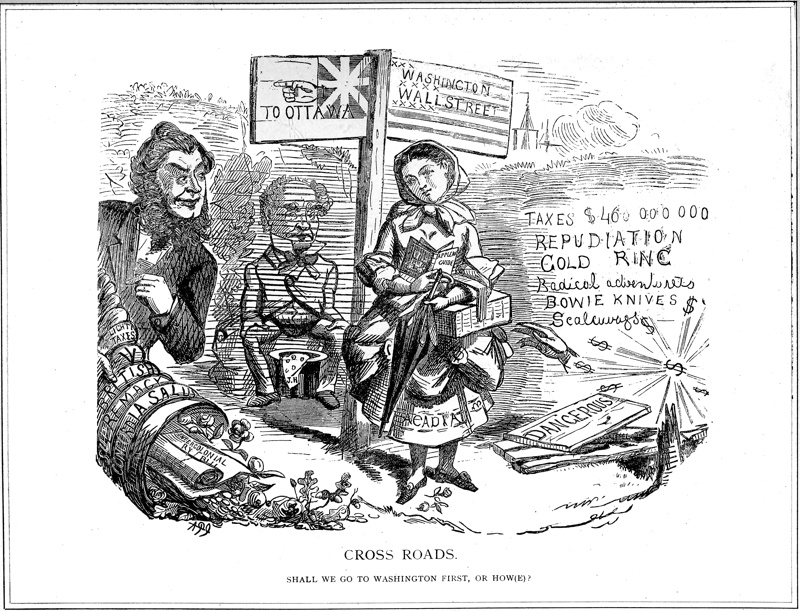
CROSS ROADS. SHALL WE GO TO WASHINGTON FIRST, OR HOW(E)?
86THE DOMINION COUNTING-HOUSE.
Referring to Hon. Joseph Howe’s acceptance of a seat in the Dominion Government, as President of the Council, an action which was regarded by many of his Nova Scotia friends in the light of an apostacy. The other persons represented are Sir John Rose, Minister of Finance, and Sir John A. Macdonald.
Diogenes, January 20th, 1869.
87
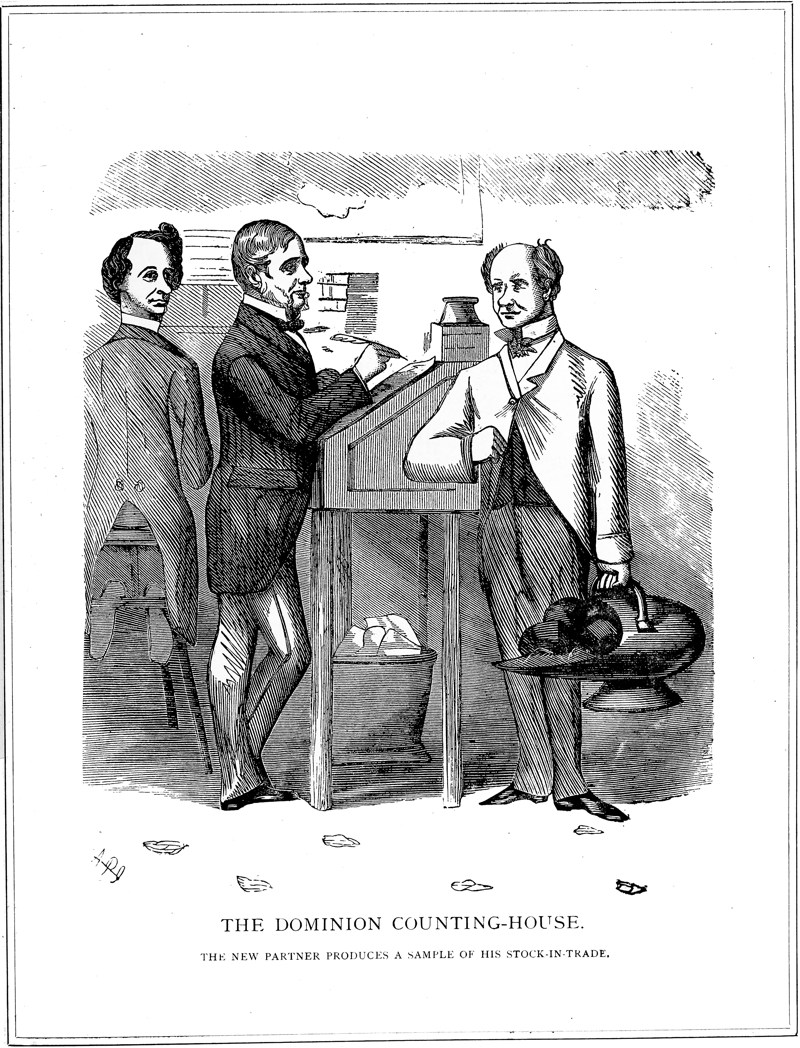
THE DOMINION COUNTING-HOUSE. THE NEW PARTNER PRODUCES A SAMPLE OF HIS STOCK-IN-TRADE.
88A SCENE IN THE QUEBEC CIRCLE.
This cartoon, which refers to matters of current interest in the Quebec Local House, was originally accompanied by the following rhyming comment:
Pity the sorrows of a little man[1]
Weighted with load beyond his puny power;
He does his best—the best a small man can—
But sinks, contorted, in the trying hour.
Chauveau would willingly bestow his aid,
But, all engrossed, stuffs Education “Bill;”
While Cauchon’s grunt is heard from out the shade,
“Root, hog or die,” he cries, “It is my will!”
Diogenes, March 19th, 1869.
89
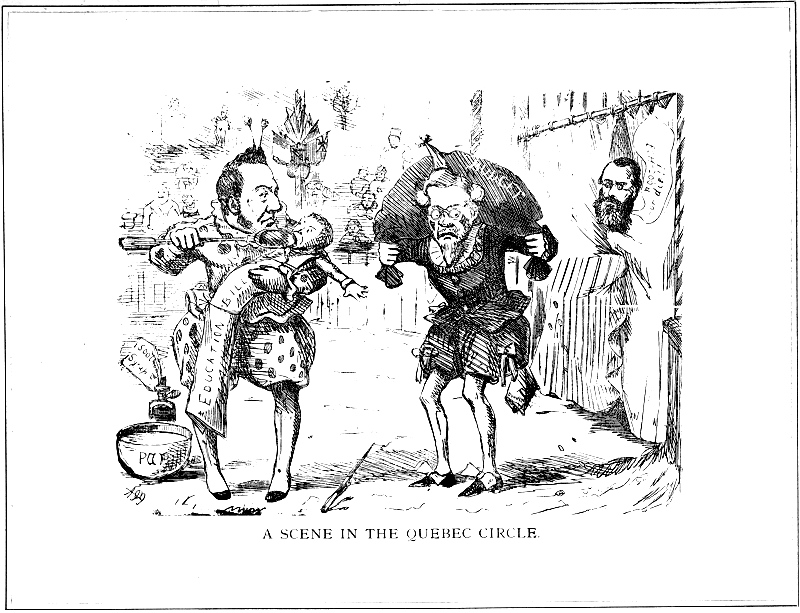
A SCENE IN THE QUEBEC CIRCLE.
90THE HAPPY PAIR.
Hon. Joseph Howe had relinquished his efforts in favor of the Repeal of Confederation after the rejection of the petition sent to England by the Nova Scotians, and had expressed a formal acceptance of the Union, prior to becoming a member of the Dominion Cabinet. This was exceedingly distasteful to his former Repeal allies in Nova Scotia, two of whom, Messrs. Wilkins and Annand, are represented in the cartoon. Mr. Howe’s change of base was attributed to self interest in some quarters; the artist in turn assigns jealousy as the motive of his opponents.
Diogenes, March 26th, 1869.
91
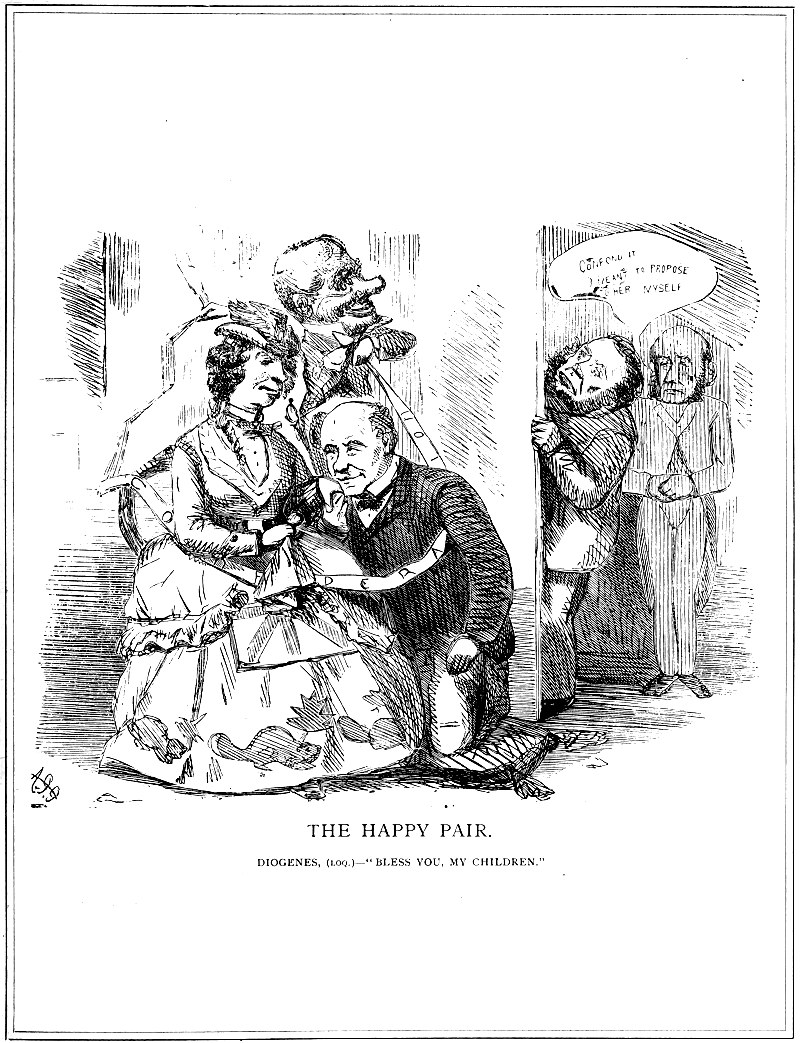
THE HAPPY PAIR. DIOGENES, (LOQ.)—“BLESS YOU, MY CHILDREN.”
92THE CANADIAN AUTOLYCUS.
A playful allusion to Sir George E. Cartier’s well-known fondness for official life and its stately surroundings, in anticipation of the opening of the Session at Ottawa on April 15th.
Diogenes, April 2nd, 1869.
93
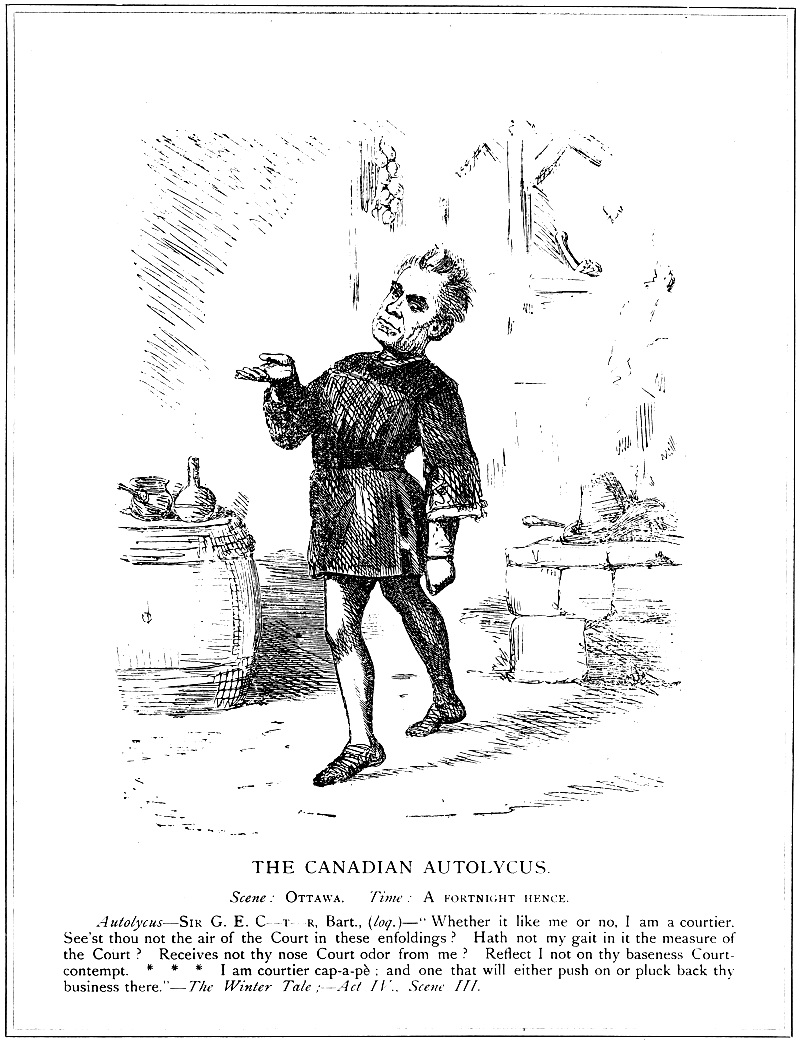
THE CANADIAN AUTOLYCUS. Scene: Ottawa. Time: A fortnight hence.
Autolycus—Sir G. E. C—t—r, Bart., (loq.)—“Whether it like me or no, I am a courtier. See’st thou not the air of the Court in these enfoldings? Hath not my gait in it the measure of the Court? Receives not thy nose Court odor from me? Reflect I not on thy baseness Court contempt. * * * I am courtier cap-a-pe; and one that will either push on or pluck back thy business there.”—The Winter Tale;—Act IV., Scene III.
94A DOMINION EASTER OFFERING.
Sir George E. Cartier had been a member of the Commission sent to England to negotiate for the transfer of the North-West Territory to the Dominion, and the surrender of the rights of the Hudson Bay Company. The successful result of the mission was now announced to Parliament. The conditions agreed upon involved a payment by the Dominion Government of £300,000.
Diogenes, April 16th, 1869.
95
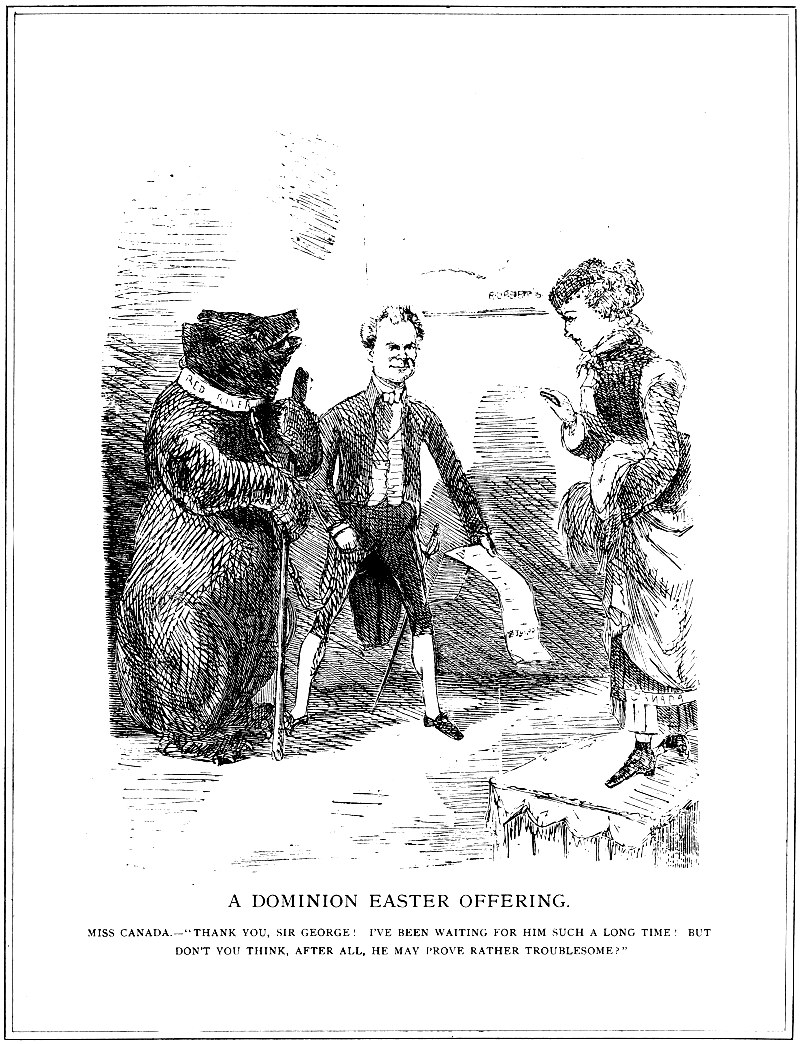
A DOMINION EASTER OFFERING. MISS CANADA.—“THANK YOU, SIR GEORGE! I’VE BEEN WAITING FOR HIM SUCH A LONG TIME! BUT DON’T YOU THINK, AFTER ALL, HE MAY PROVE RATHER TROUBLESOME?”
96AXES TO GRIND.
To those who understand what is ordinarily expected of a man who controls patronage, by his political “friends,” the meaning of this sketch will be sufficiently obvious. Sir George E. Cartier was not exempt from the penalties of such a position.
Diogenes, April 23rd, 1869.
97
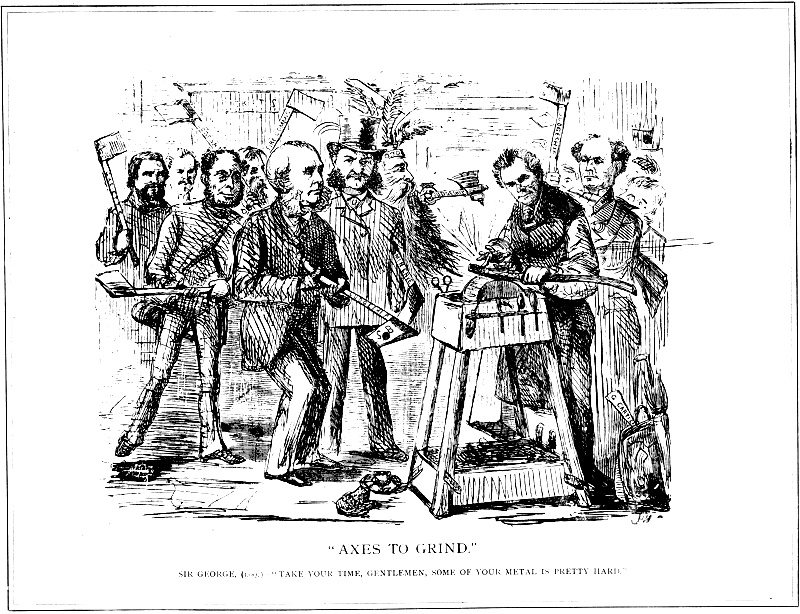
“AXES TO GRIND.” SIR GEORGE, (LOQ.)—“TAKE YOUR TIME, GENTLEMEN, SOME OF YOUR METAL IS PRETTY HARD.”
98TOO OLD TO BE CAUGHT WITH CHAFF.
This was intended as a tribute to the unquestionable loyalty of Sir John Macdonald, as opposed to the alleged annexation proclivities of Mr. Lucius Seth Huntington (afterwards Postmaster-General in the Mackenzie Government), and other prominent men in the Eastern townships district.
Diogenes, June 4th, 1869.
99
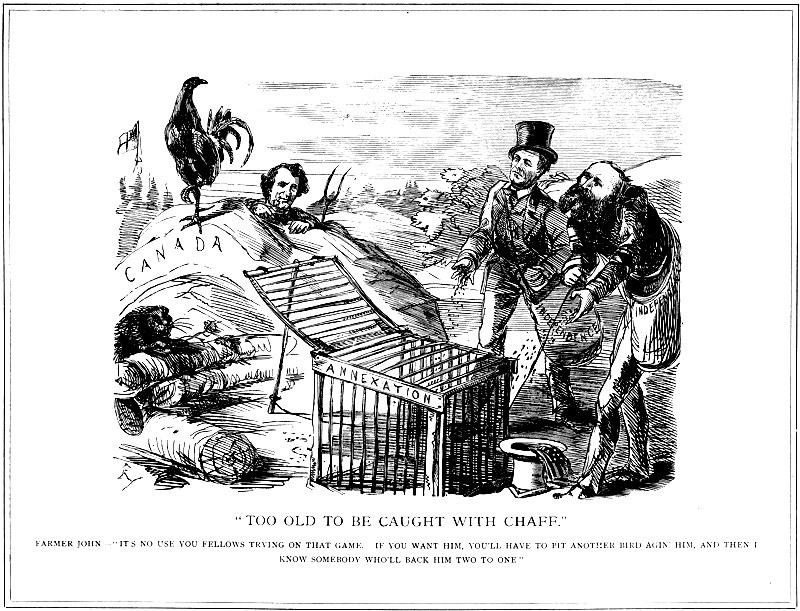
“TOO OLD TO BE CAUGHT WITH CHAFF.” FARMER JOHN.—“IT’S NO USE YOU FELLOWS TRYING ON THAT GAME. IF YOU WANT HIM, YOU’LL HAVE TO PIT ANOTHER BIRD AGIN’ HIM, AND THEN I KNOW SOMEBODY WHO’LL BACK HIM TWO TO ONE.”
100A PERTINENT QUESTION.
This cartoon faithfully reflected the sentiments of the Canadian people on the subject of annexation. While it is still true that there is no general feeling in favor of the change indicated, there is an appreciable absence of the unfriendly feeling toward the United States which was generally cherished at this time.
Diogenes, June 18th, 1869.
101
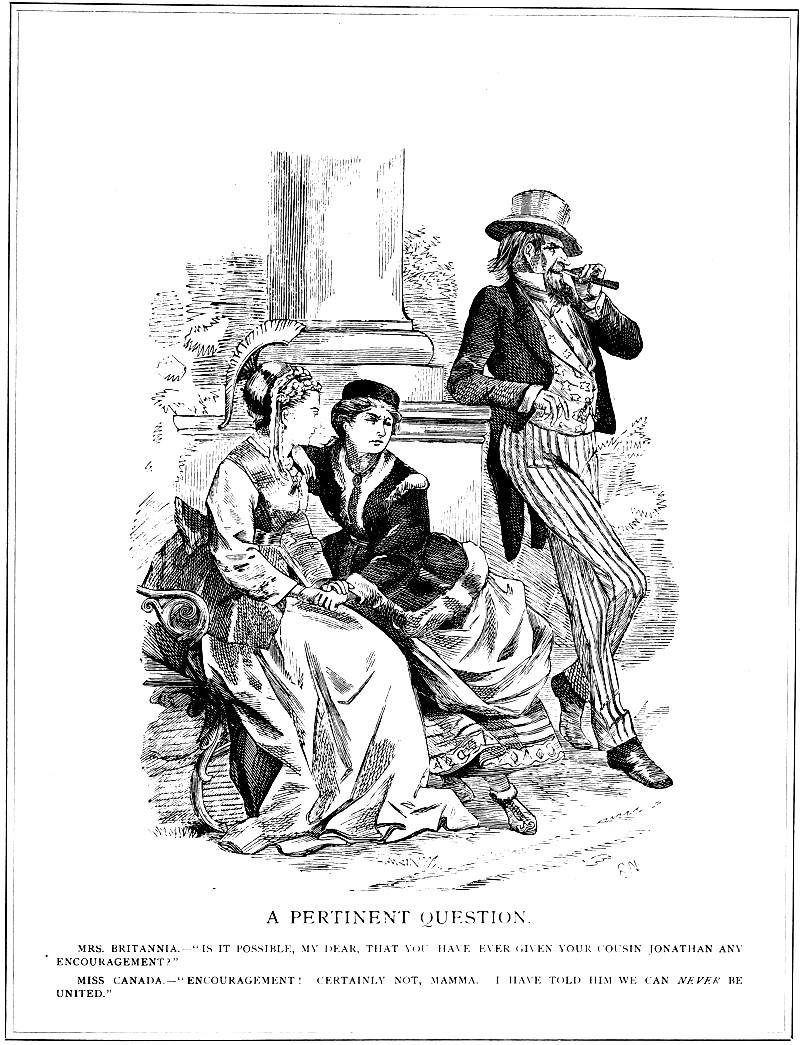
A PERTINENT QUESTION.
MRS. BRITANNIA.—“IS IT POSSIBLE, MY DEAR, THAT YOU HAVE EVER GIVEN YOUR COUSIN JONATHAN ANY ENCOURAGEMENT?”
MISS CANADA.—“ENCOURAGEMENT! CERTAINLY NOT, MAMMA. I HAVE TOLD HIM WE CAN NEVER BE UNITED.”
102“WELCOME THE COMING—SPEED THE PARTING.”
About this time Hon. (now Sir) John Rose, late Minister of Finance in the Dominion Government, left Canada to take up his residence in England, where he still resides. Sir Alexander Galt, Mr. Rose’s predecessor in the Finance Department, had recently re-entered public life. Both gentlemen had long been prominent citizens of Montreal.
Diogenes, July 23rd, 1869.
103
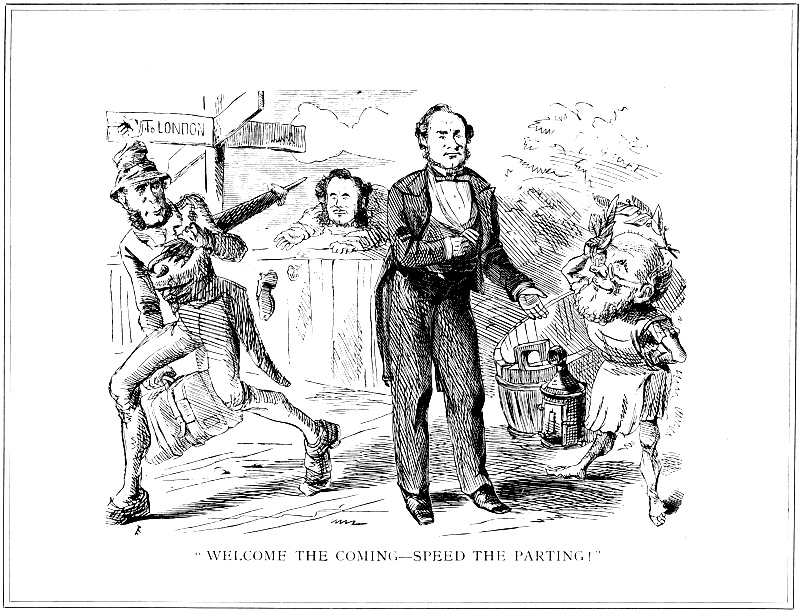
“WELCOME THE COMING—SPEED THE PARTING!”
104“FRIENDS IN COUNCIL;” OR, “IS THE GAME WORTH THE CANDLE?”
The persons represented in this sketch are Hons. S. L. Tilley, Sir George Cartier and A. T. Galt. The latter gentleman resumed for a brief period the charge of the Finance Department, after the resignation of Hon. John Rose. The financial affairs of the new Dominion were not in the most prosperous condition at the moment.
Diogenes, August 27th, 1869.
105
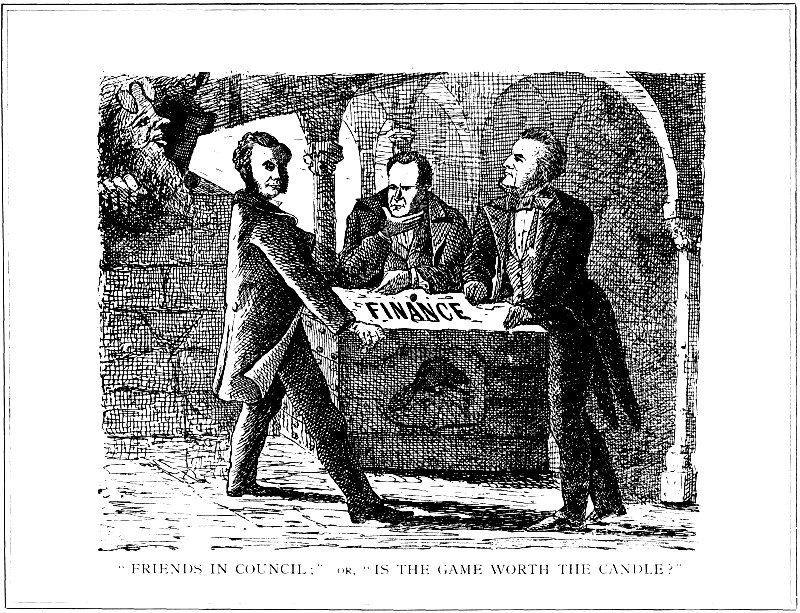
“FRIENDS IN COUNCIL;” OR, “IS THE GAME WORTH THE CANDLE?”
106FORBIDDEN FRUIT.
Mr. L. S. Huntington, M.P. for Shefford (Quebec), had entered public life in 1861, and was chiefly distinguished for decided views in favor of Canadian Independence. He soon came to be looked upon as an annexationist in disguise—a fate which awaits every Canadian public man who avows Independence ideas. The Mr. Chamberlain in the cartoon was a gentleman of local repute.
Diogenes, September 24th, 1869.
107
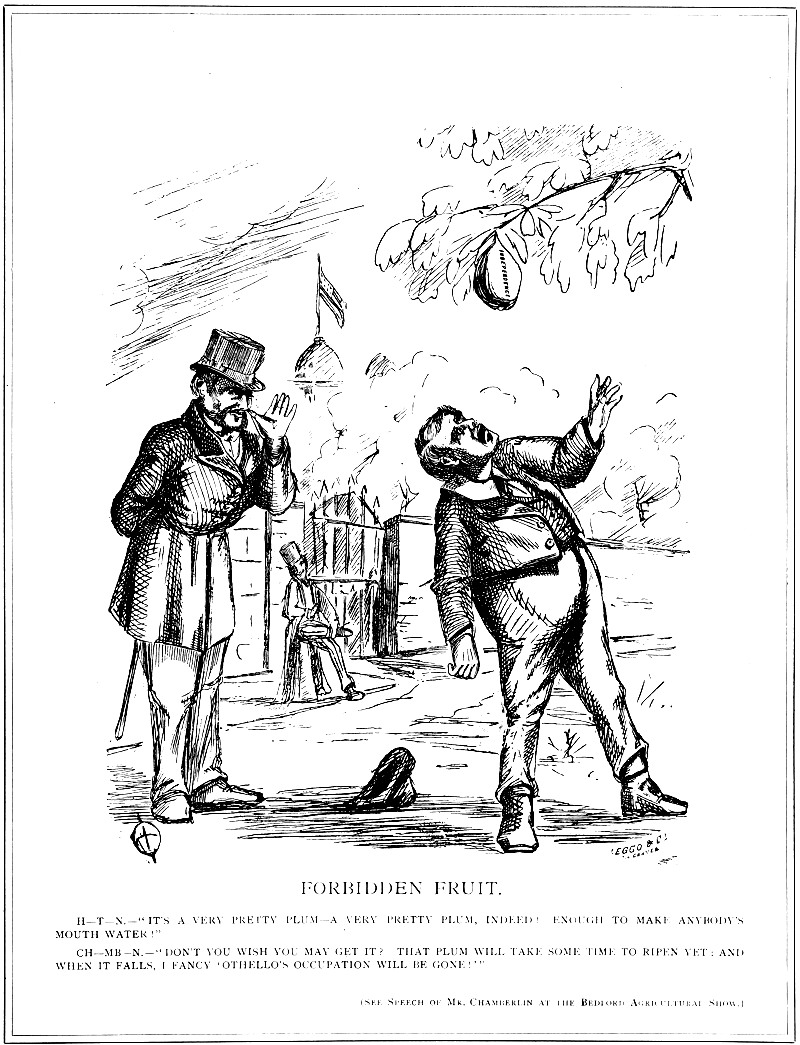
FORBIDDEN FRUIT.
H—T—N.—“IT’S A VERY PRETTY PLUM—A VERY PRETTY PLUM, INDEED! ENOUGH TO MAKE ANYBODY’S MOUTH WATER!”
CH—MB—N.—“DON’T YOU WISH YOU MAY GET IT? THAT PLUM WILL TAKE SOME TIME TO RIPEN YET; AND WHEN IT FALLS, I FANCY ‘OTHELLO’S OCCUPATION WILL BE GONE!’”
(See Speech of Mr. Chamberlin at the Bedford Agricultural Show.)
108UNCLE SAM KICKED OUT.
The anti-annexation sentiment which has always prevailed in Canada is presented with considerable “force” in this picture.
Grinchuckle, September 23rd, 1869.
109
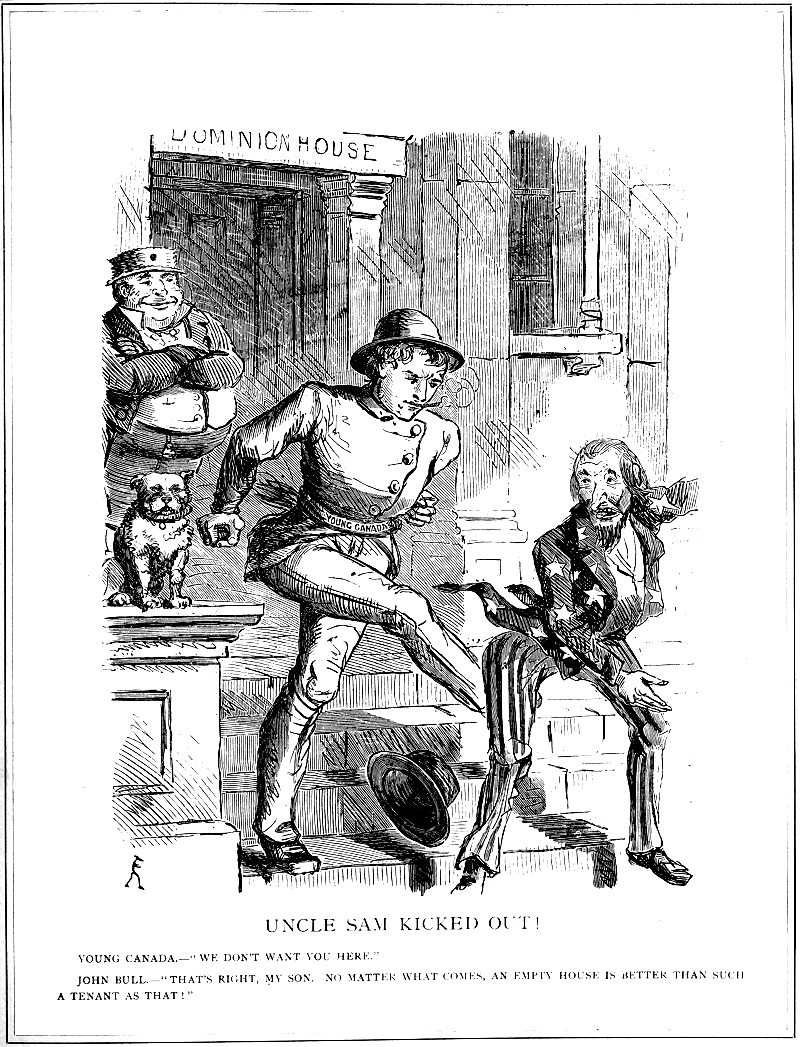
UNCLE SAM KICKED OUT!
YOUNG CANADA.—“WE DON’T WANT YOU HERE.”
JOHN BULL.—“THAT’S RIGHT, MY SON. NO MATTER WHAT COMES, AN EMPTY HOUSE IS BETTER THAN SUCH A TENANT AS THAT!”
110STIRRING TIMES AHEAD.
Hon. George Brown had been defeated in 1867 in South Ontario by Hon. T. N. Gibbs, and his place in Parliament as the leader of the Reform Party had remained vacant. It may be added that the “stirring times” anticipated in the cartoon were never realized so far as the House of Commons was concerned. On the accession of the Reform Government in 1873, Mr. Brown was offered and accepted a seat in the Senate.
Grinchuckle, September 30th, 1869.
111
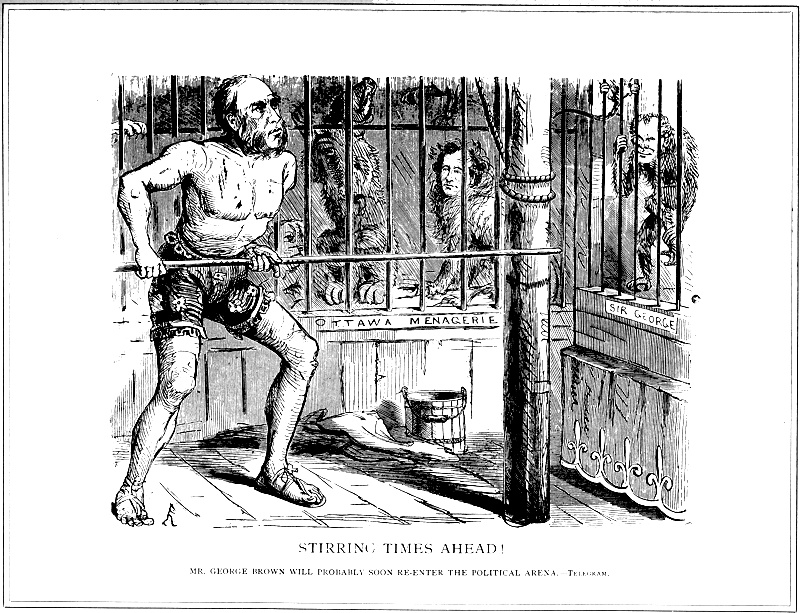
STIRRING TIMES AHEAD! MR. GEORGE BROWN WILL PROBABLY SOON RE-ENTER THE POLITICAL ARENA.—Telegram.]
112TOO LATE!
This cartoon refers to the selection of Sir Francis Hincks for the post of Finance Minister, in opposition to the claims put forth by the press on behalf of others who were considered to be more entitled to the honor.
Diogenes, October 1st, 1869.
113
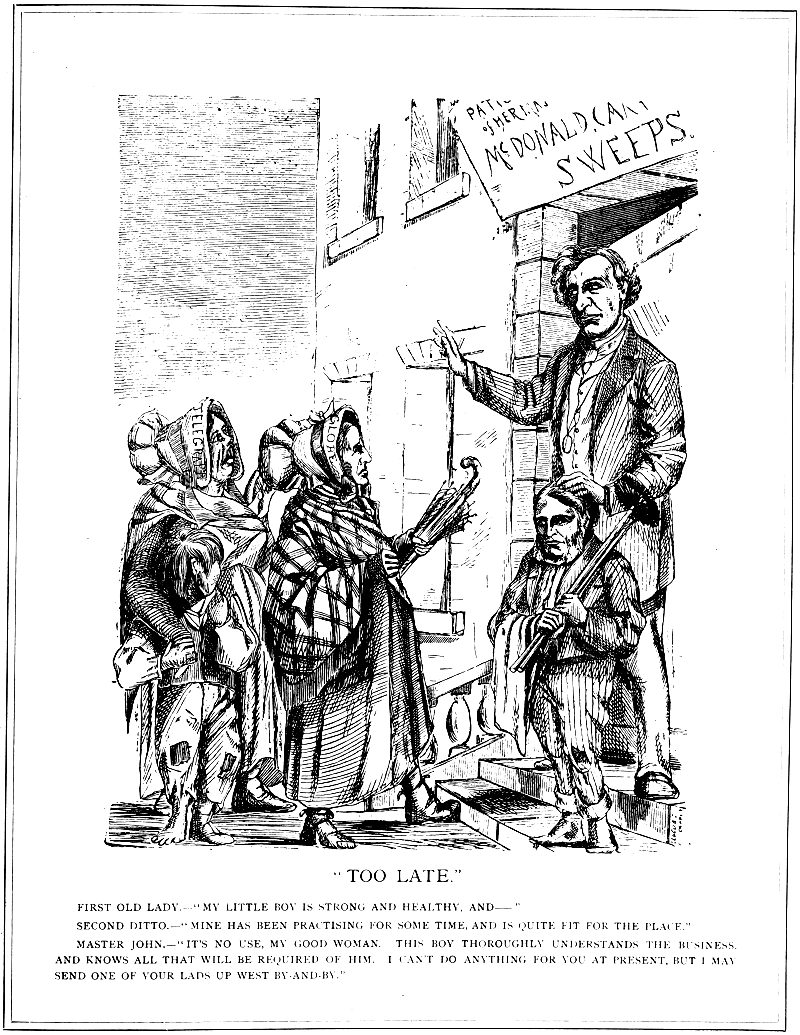
“TOO LATE.”
FIRST OLD LADY.—“MY LITTLE BOY IS STRONG AND HEALTHY, AND—”
SECOND DITTO.—“MINE HAS BEEN PRACTISING FOR SOME TIME, AND IS QUITE FIT FOR THE PLACE.”
MASTER JOHN.—“IT’S NO USE, MY GOOD WOMAN. THIS BOY THOROUGHLY UNDERSTANDS THE BUSINESS, AND KNOWS ALL THAT WILL BE REQUIRED OF HIM. I CAN’T DO ANYTHING FOR YOU AT PRESENT, BUT I MAY SEND ONE OF YOUR LADS UP WEST BY-AND-BY.”
114THE POLITICAL “GIRL OF THE PERIOD.”
In his speeches and writings, Mr. Huntington pictured Canadian Independence in glowing colors. This cartoon professes to show the “maiden” as she is.
Diogenes, October 15th, 1869.
115
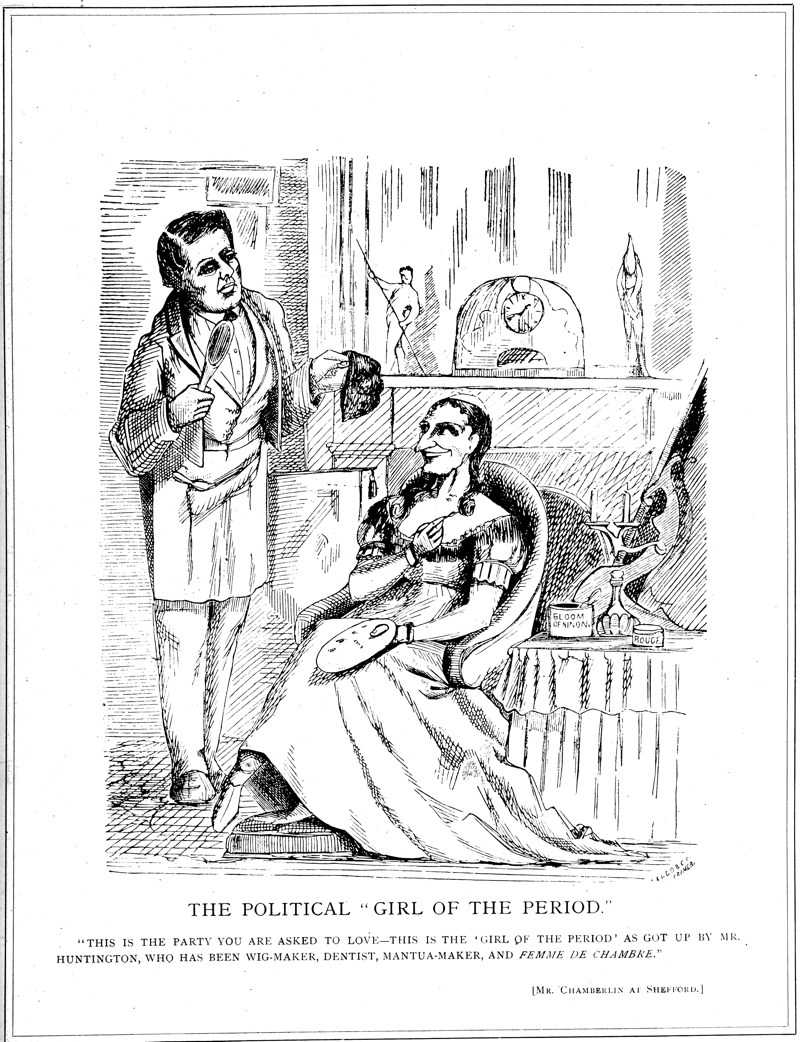
THE POLITICAL “GIRL OF THE PERIOD.”
“THIS IS THE PARTY YOU ARE ASKED TO LOVE—THIS IS THE ‘GIRL OF THE PERIOD’ AS GOT UP BY MR. HUNTINGTON, WHO HAS BEEN WIG-MAKER, DENTIST, MANTUA-MAKER, AND FEMME DE CHAMBRE.”
Mr. Chamberlin at Shefford.
116“L’HOMME QUI RIT.”
Upon accepting office as Finance Minister in the Dominion Cabinet, Sir Francis Hincks presented himself for election in the constituency of Renfrew, the sitting member, Mr. Rankin, making way for him. Sir Francis had declared that the acceptance of office at this time involved personal sacrifice on his part.
Diogenes, October 22nd, 1869.
117
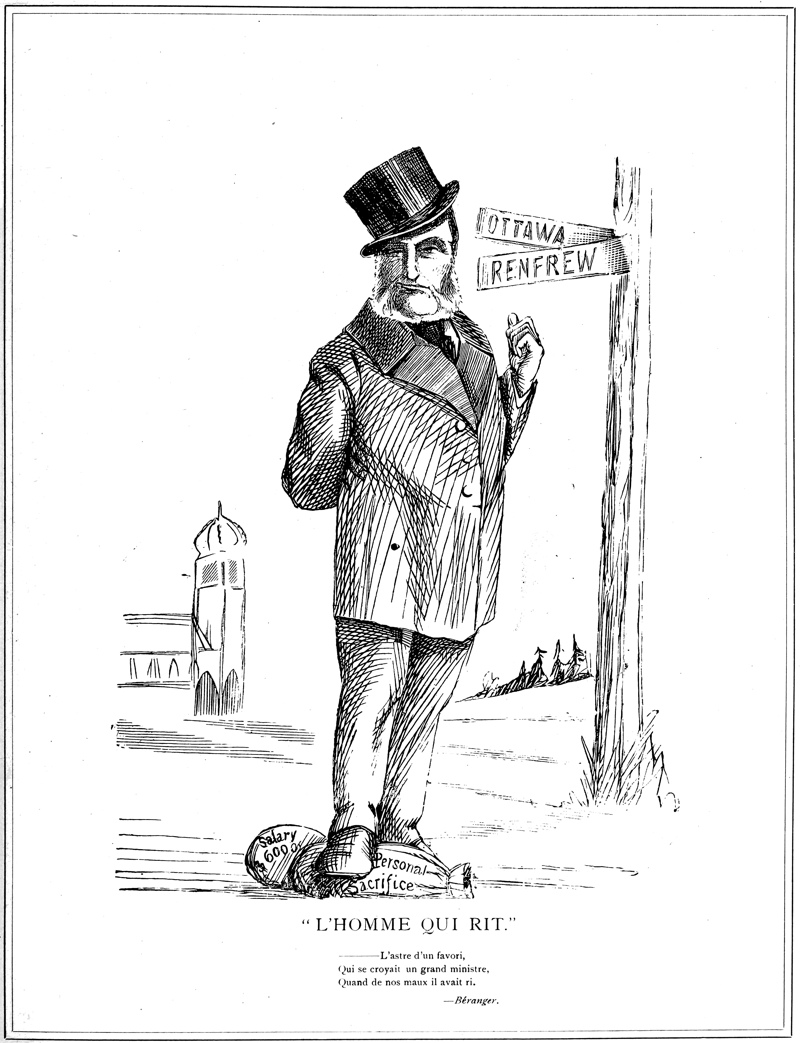
“L’HOMME QUI RIT.”
—L’astre d’un favori,
Qui se croyait un grand ministre,
Quand de nos maux il avait ri.
—Béranger.
118SCENE FROM THE COMEDY OF “THE TICKET-OF-LEAVE MAN.”
Sir Francis Hincks had but shortly returned to Canada from the Windward Islands, where he had for several years occupied the position of Governor. The claim that he was making a “personal sacrifice” in accepting office seems to have been too much for Diogenes.
Diogenes, October 29th, 1869.
119
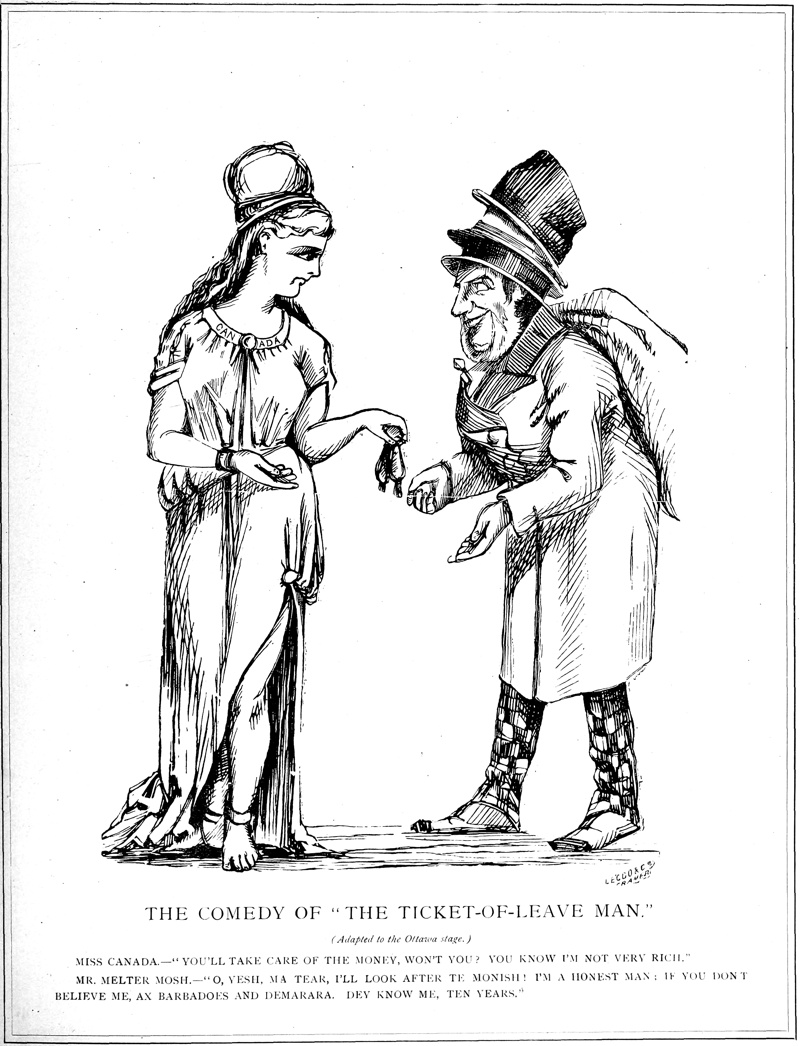
THE COMEDY OF “THE TICKET-OF-LEAVE MAN.” (Adapted to the Ottawa stage.)
MISS CANADA.—“YOU’LL TAKE CARE OF THE MONEY, WON’T YOU? YOU KNOW I’M NOT VERY RICH.”
MR. MELTER MOSH.—“O, YESH, MA TEAR, I’LL LOOK AFTER TE MONISH! I’M A HONEST MAN; IF YOU DON’T BELIEVE ME, AX BARBADOES AND DEMARARA. DEY KNOW ME, TEN YEARS.”
120A MOONLIGHT SCENE ON THE OTTAWA.
This is another reference to the selection of Sir Francis Hincks as Finance Minister in preference to the other available candidates for the position.
Grinchuckle, November 4th, 1869.
121
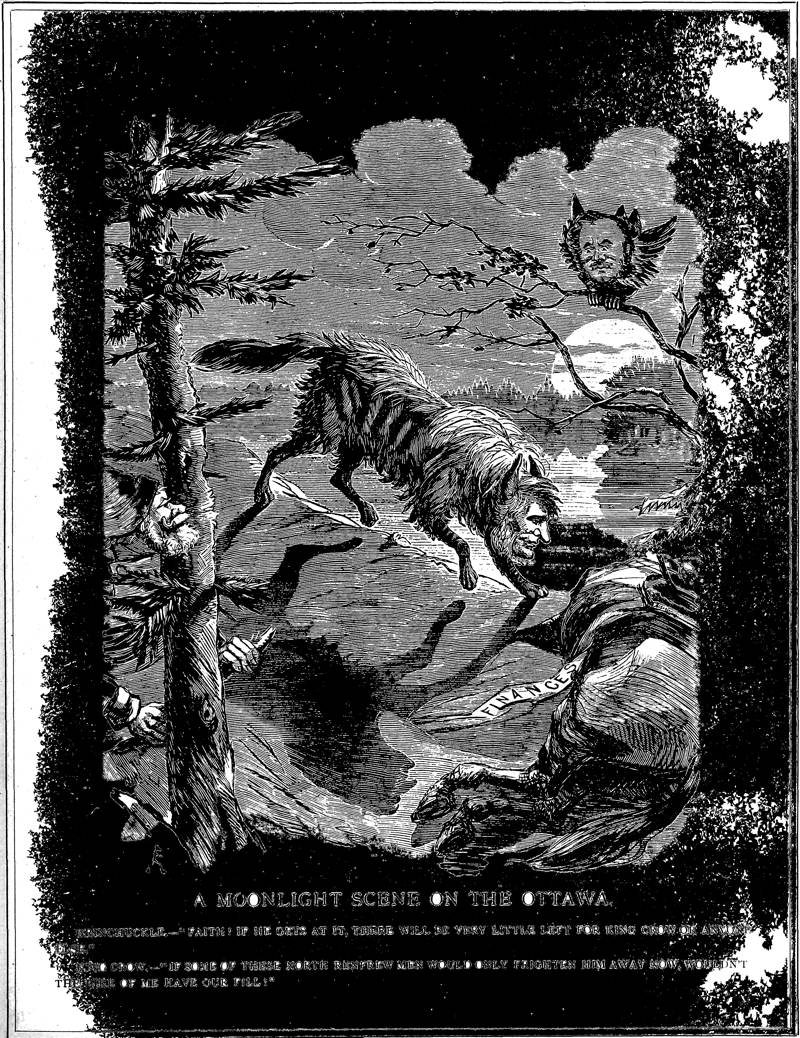
A MOONLIGHT SCENE ON THE OTTAWA.
GRINCHUCKLE.—“FAITH! IF HE GETS AT IT, THERE WILL BE VERY LITTLE LEFT FOR KING CROW OR ANYONE ELSE.”
KING CROW.—“IF SOME OF THESE NORTH RENFREW MEN WOULD ONLY FRIGHTEN HIM AWAY NOW, WOULDN’T THE LIKE OF ME HAVE OUR FILL!”
122FROM HALIFAX TO VANCOUVER.
The project of an all rail route from the Atlantic to the Pacific on Canadian territory had begun to be agitated. The incredulity attributed to Uncle Sam in the cartoon was fully shared by many more immediately interested. The year 1886, however, saw the feat accomplished.
Diogenes, November 5th, 1869.
123
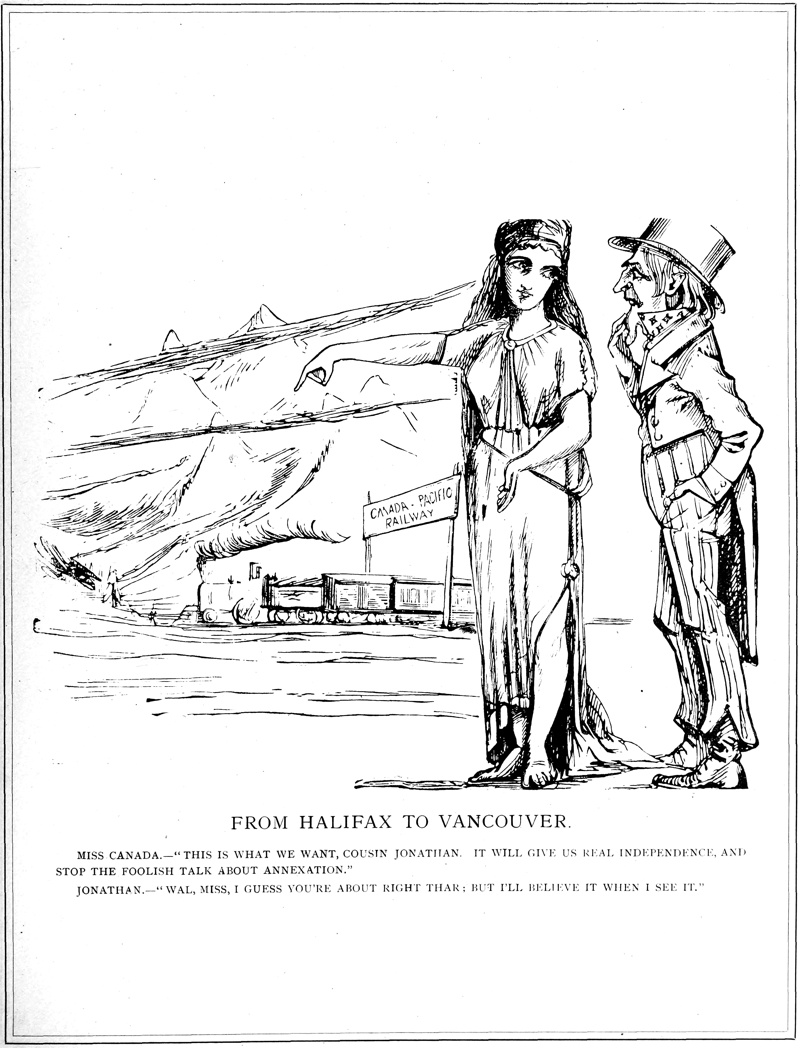
FROM HALIFAX TO VANCOUVER.
MISS CANADA.—“THIS IS WHAT WE WANT, COUSIN JONATHAN. IT WILL GIVE US REAL INDEPENDENCE, AND STOP THE FOOLISH TALK ABOUT ANNEXATION.”
JONATHAN.—“WAL, MISS, I GUESS YOU’RE ABOUT RIGHT THAR; BUT I’LL BELIEVE IT WHEN I SEE IT.”
124WAITING FOR THE CAT TO JUMP.
This cartoon gives an intimation that the views of Mr. Luther H. Holton on the subject of Canada’s future destiny were not perfectly clear and fixed. In this Mr. Holton was by no means singular among our public men. The insinuation that he was a blind follower of public opinion does him less than justice.
Grinchuckle, November 18th, 1869.
125
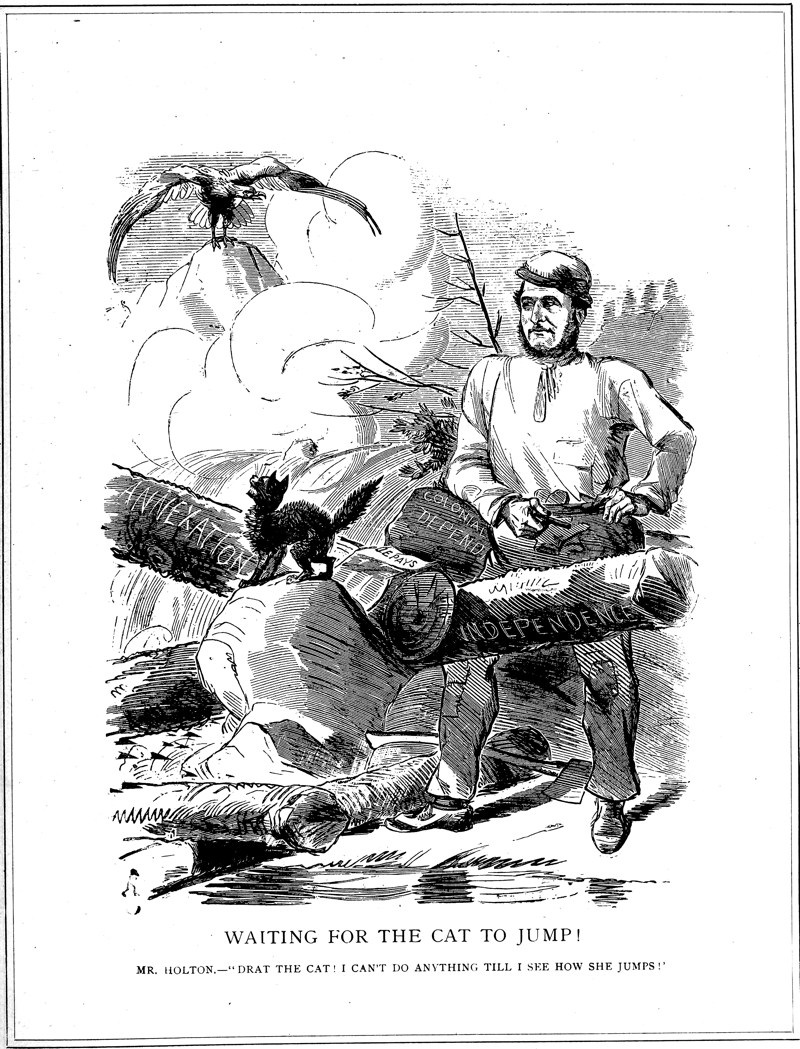
WAITING FOR THE CAT TO JUMP! MR. HOLTON.—“DRAT THE CAT! I CAN’T DO ANYTHING TILL I SEE HOW SHE JUMPS!”
126THE DOMINION CURTIUS.
Another ironical allusion to Sir Francis Hincks’ vast “personal sacrifice” in accepting the emoluments of office. The allusion is to the classic story of Curtius saving Rome by jumping into the chasm. The attendant heroes are Honorable George Brown and Sir John Macdonald.
Diogenes, November 19th, 1869.
127
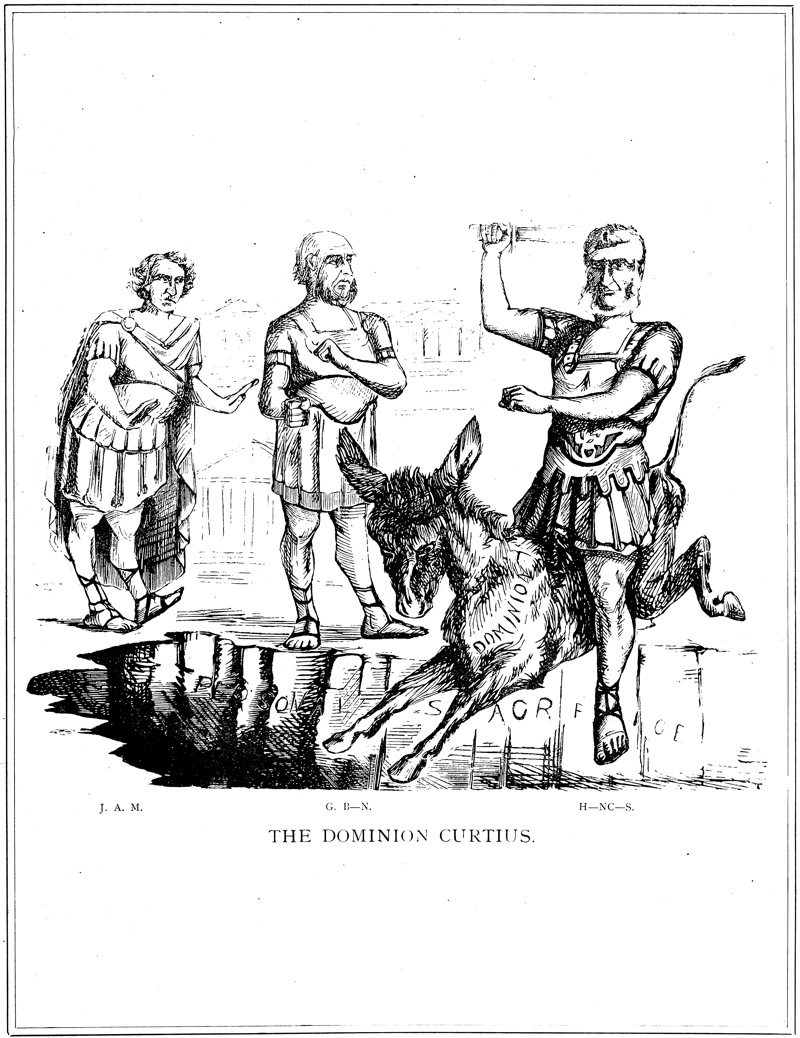
THE DOMINION CURTIUS.
128MACDOUGALL’S SOLILOQUY.
Hon. William Macdougall was appointed to the Lieut.-Governorship of the North-West Territories on the cession of that country to the Dominion by the Hudson Bay Co. The Half-breed settlers, however, deeming it an infringement of their rights that the country was ceded without their formal consent, opposed Mr. Macdougall’s entrance on his arrival. He was obliged to return without enjoying the office he had gone to assume.
Grinchuckle, November 25th, 1869.
129
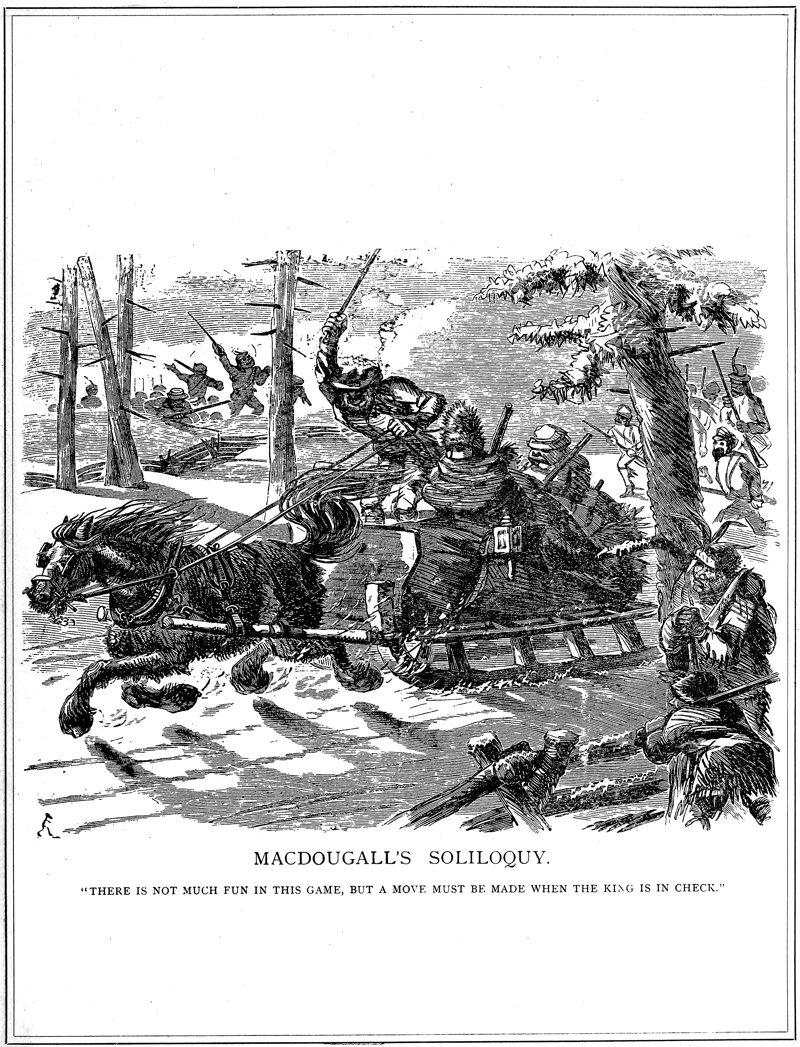
MACDOUGALL’S SOLILOQUY. “THERE IS NOT MUCH FUN IN THIS GAME, BUT A MOVE MUST BE MADE WHEN THE KING IS IN CHECK.”
130“HOPE TOLD A FLATTERING TALE.”
Sir Narcisse Fortunat Belleau, Lieutenant-Governor of Quebec, is the principal figure in this cartoon. The financial position of the Province was not satisfactory at this time, and the hope expressed in the speech from the throne, to which allusion is made, was one which the people would cordially share.
Grinchuckle, December 2nd, 1869.
131
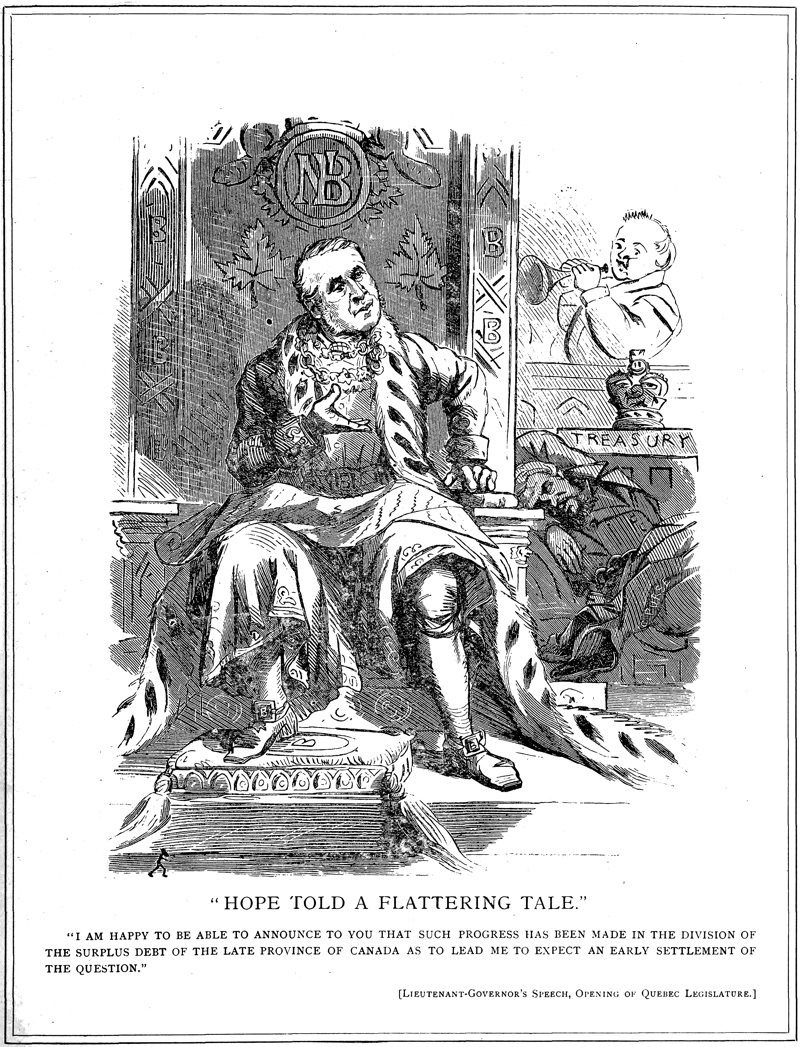
“HOPE TOLD A FLATTERING TALE.”
“I AM HAPPY TO BE ABLE TO ANNOUNCE TO YOU THAT SUCH PROGRESS HAS BEEN MADE IN THE DIVISION OF THE SURPLUS DEBT OF THE LATE PROVINCE OF CANADA AS TO LEAD ME TO EXPECT AN EARLY SETTLEMENT OF THE QUESTION.”
Lieutenant-Governor’s Speech, Opening of Quebec Legislature.
132ENOUGH IS AS GOOD AS A FEAST.
This was an allusion to the debate which took place on the Nova Scotia “better terms” resolution in the House of Commons. Mr. Blake introduced a motion setting forth the unconstitutionality of the bargain which had been made after the Act of Union, under which Nova Scotia got additional subsidy. Honorable J. S. Macdonald, on the other hand, supported the action of the Government. In connection with this cartoon Grinchuckle addressed the following lines to “Joe Howe”:—
It’s of no use, Joe Howe, to be craving for plunder,
For we know you are but a political rake;
And Ontario will never consent to strike under,
While she has for her leader redoubtable Blake.
Old Sandfield, we know, is a premier squeezable,
And he’s willing to give, and you’re eager to take;
He would buy up your Province by any means feasible;
But he cannot buy up that redoubtable Blake.
Grinchuckle, December 9th, 1869.
133
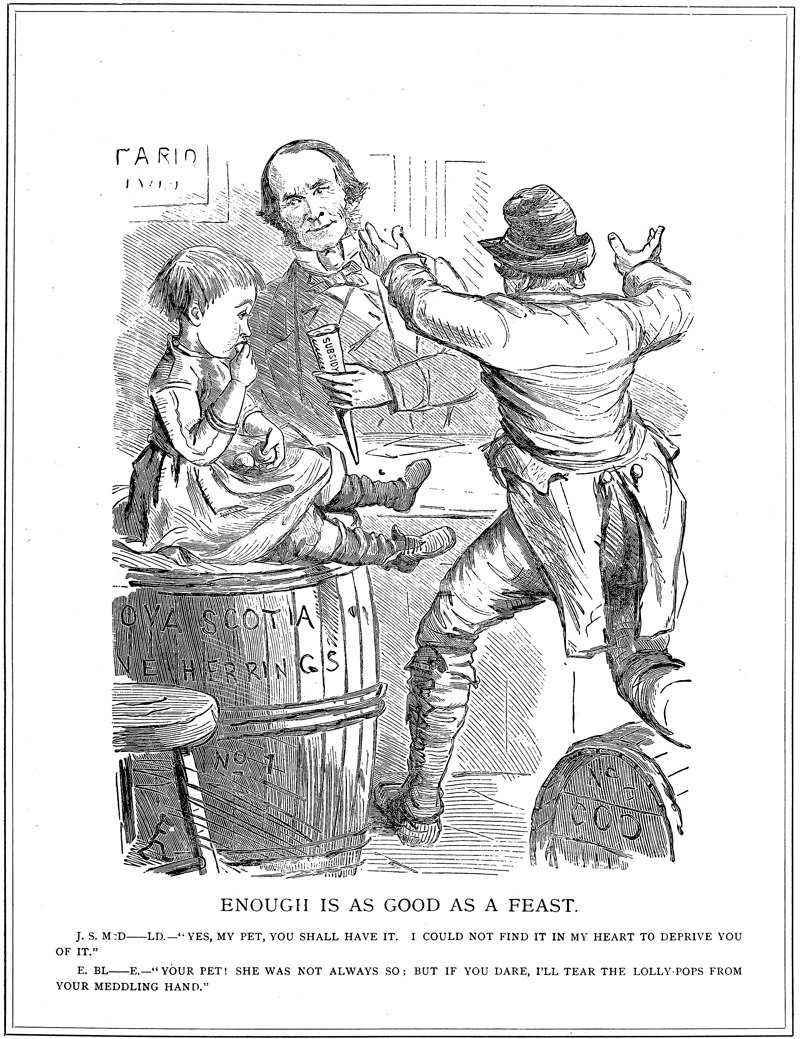
ENOUGH IS AS GOOD AS A FEAST.
J. S. McD——LD.—“YES, MY PET, YOU SHALL HAVE IT. I COULD NOT FIND IT IN MY HEART TO DEPRIVE YOU OF IT.”
E. BL——E.—“YOUR PET! SHE WAS NOT ALWAYS SO; BUT IF YOU DARE, I’LL TEAR THE LOLLY-POPS FROM YOUR MEDDLING HAND.”
134THE CANADIAN BARNUM NOW EXHIBITING AT QUEBEC.
The “Court” of Lieutenant-Governor Belleau was conducted in a style of magnificence quite out of harmony with the democratic spirit of the people, as well as the condition of the Provincial purse. This grandeur, with its ridiculous accompaniments of “state balls,” etc., was encouraged by Sir Geo. Cartier, whose own tastes were courtly. The subject offered too tempting a theme to escape caricature.
Grinchuckle, January 6th, 1870.
135
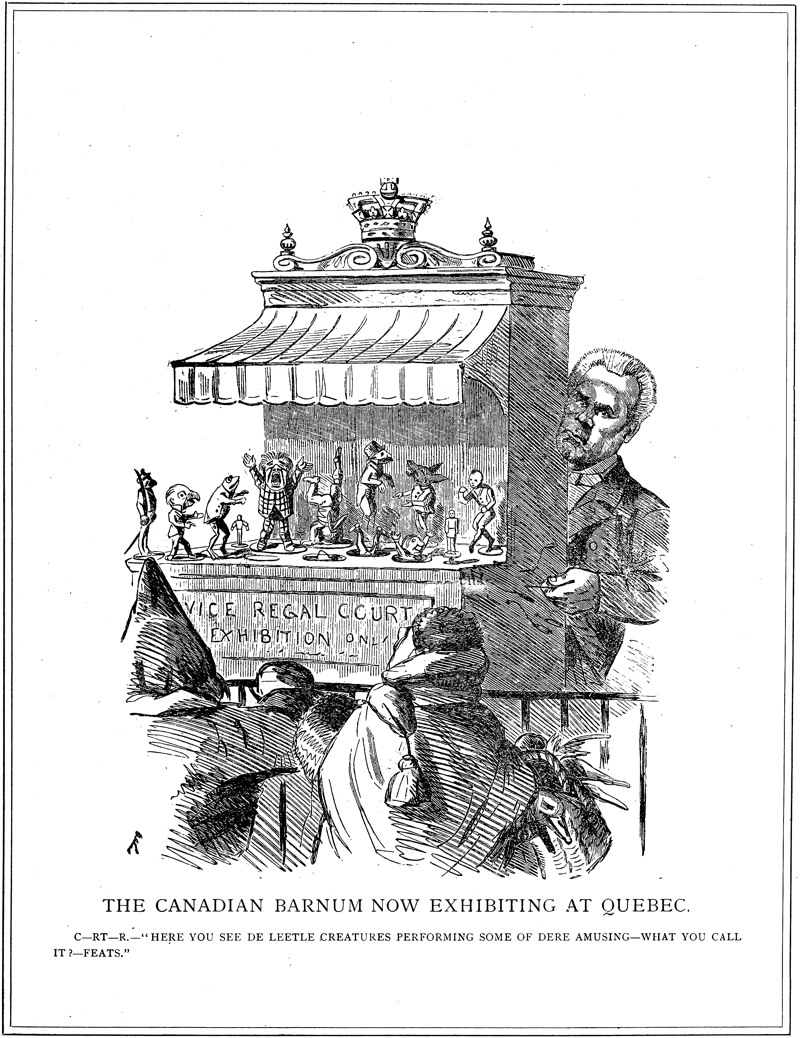
THE CANADIAN BARNUM NOW EXHIBITING AT QUEBEC. C—RT—R.—“HERE YOU SEE DE LEETLE CREATURES PERFORMING SOME OF DERE AMUSING—WHAT YOU CALL IT?—FEATS.”
136EXTREMES MEET.
The Half-breeds of Manitoba were in rebellion under the leadership of Louis Riel, on account of their alleged rights having been ignored in the bargain with the Hudson Bay Company. They demanded compensation for the land assumed by the Dominion. The artist cites this as a parallel to the position assumed by Mr. Howe on behalf of Nova Scotia, when “better terms” were demanded, and secured.
Grinchuckle, January 27th, 1870.
137
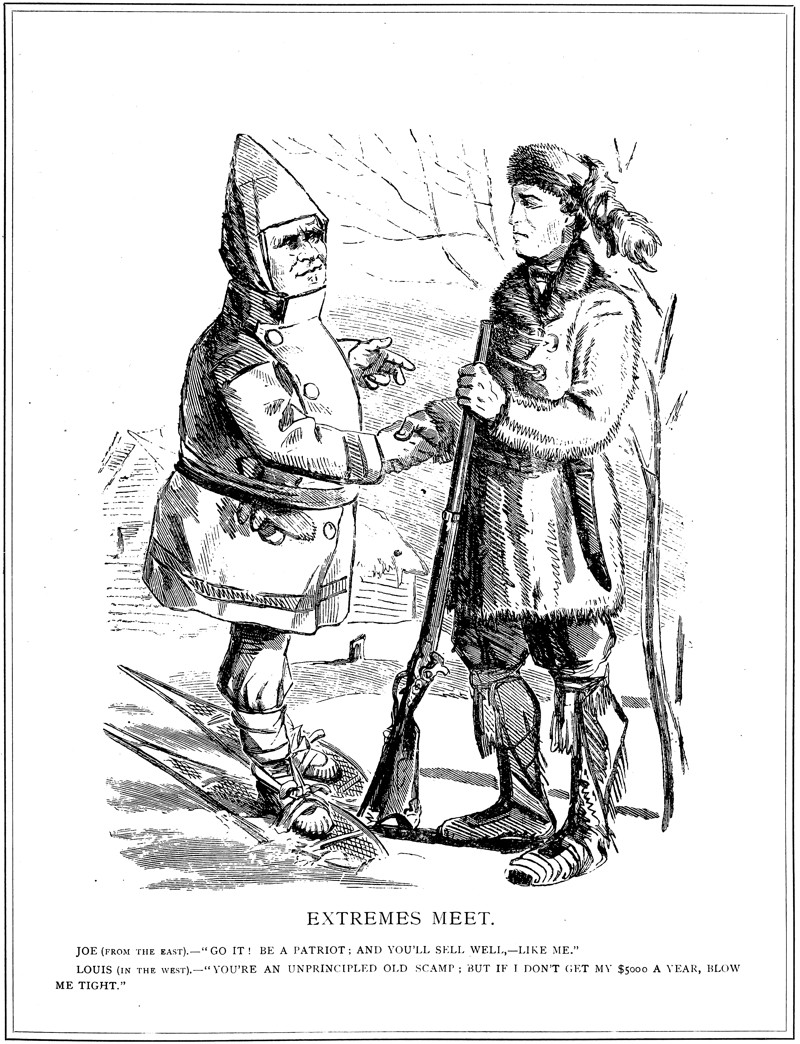
EXTREMES MEET.
JOE (FROM THE EAST).—“GO IT! BE A PATRIOT; AND YOU’LL SELL WELL,—LIKE ME.”
LOUIS (IN THE WEST).—“YOU’RE AN UNPRINCIPLED OLD SCAMP; BUT IF I DON’T GET MY $5000 A YEAR, BLOW ME TIGHT.”
138THE YOUNG LADY’S APPEAL TO A “GALLANT KNIGHT.”
Sir Francis Hincks was the author of the Canadian “Shinplaster” currency, a scheme adopted to drive out the American silver. The cartoon will be understood from the following legend which accompanied it:—
Miss Canada: O, Sir Francis, I am suffering so much from this light American silver skate. It is no mate for the heavy gold one on my other foot. The doctors differ, but I shall never get along without another gold one.
Sir Francis H——s: The doctors be fiddled! Who asked the doctors? I’m your doctor! You shall have the gold skate, my dear. Mr. Weir will attend to it. Meantime you can strengthen your ankle with a twenty-five cent Dominion plaster.
Miss Canada: A thousand thanks. Oh, I’m so glad! (Aside: But I’ll burn the Plaster!)
Sir Francis H——s (whose hearing is sharp): I hope you will?
Grinchuckle, February 10th, 1870.
139
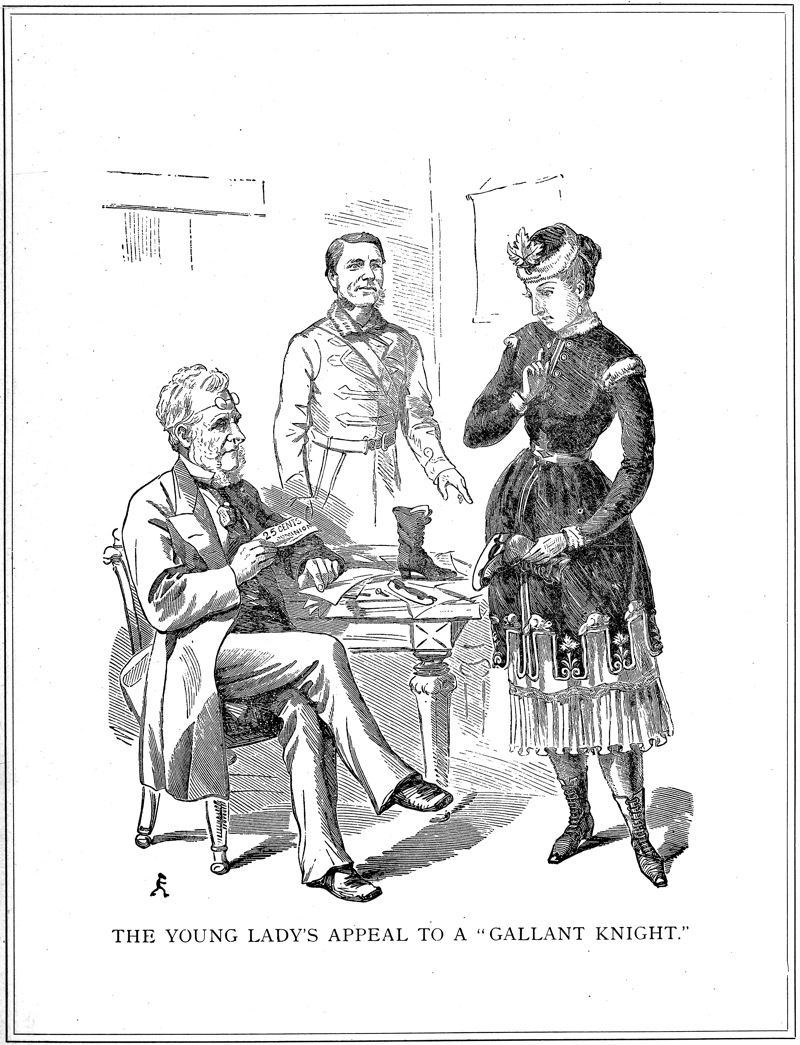
THE YOUNG LADY’S APPEAL TO A “GALLANT KNIGHT.”
140THE MID-DAY GUN AT OTTAWA.
This cartoon is chiefly interesting as giving amusing portraits of a number of prominent parliamentarians. It is the custom to fire a gun from Nepean Point, opposite the House of Parliament, at twelve o’clock, noon, each day, which gives distinguished personages and others an opportunity of regulating their watches. At the date of this cartoon, workmen were engaged in making some additions to the central block.
Canadian Illustrated News, May 11th, 1872.
141
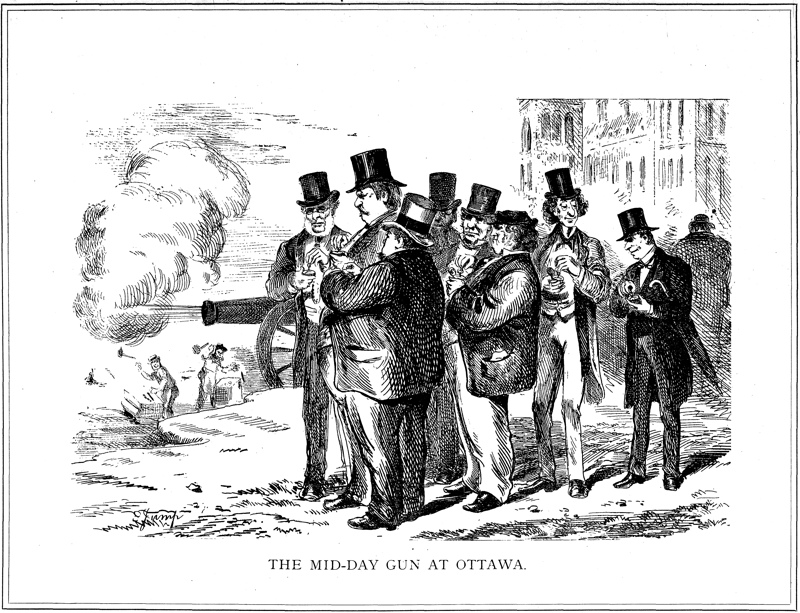
THE MID-DAY GUN AT OTTAWA.
142JOHN CANUCK’S NEW ROAD.
Great dissatisfaction was expressed in the Maritime Provinces at the rejection of the St. John Valley route for the Intercolonial Railway. The change to the route subsequently selected—a much longer and costlier one—was made as the result of a conference with the Imperial authorities by Sir F. Hincks and Hon. Mr. Chandler, of New Brunswick. The contemplated expense of the road was a matter of serious concern, however, to all the Provinces.
Canadian Illustrated News, May 11th, 1872.
143
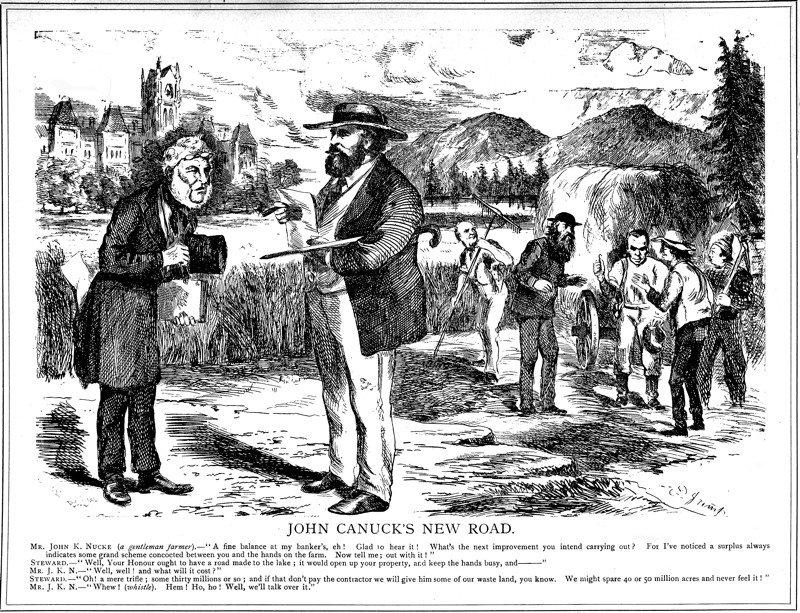
JOHN CANUCK’S NEW ROAD.
Mr. John K. Nucke (a gentleman farmer).—“A fine balance at my banker’s, eh! Glad to hear it! What’s the next improvement you intend carrying out? For I’ve noticed a surplus always indicates some grand scheme concocted between you and the hands on the farm. Now tell me; out with it!”
Steward.—“Well, Your Honour ought to have a road made to the lake; it would open up your property, and keep the hands busy, and——”
Mr. J. K. N.—“Well, well! and what will it cost?”
Steward.—“Oh! a mere trifle; some thirty millions or so; and if that don’t pay the contractor we will give him some of our waste land, you know. We might spare 40 or 50 million acres and never feel it!”
Mr. J. K. N.—“Whew! (whistle). Hem! Ho, ho! Well, we’ll talk over it.”
144SCENE FROM THE MERRY WIVES OF WINDSOR.
An allusion to the annexation utterances of Hon. Joseph Howe. The figures in the group are Sir George E. Cartier, Sir John Macdonald, Sir Francis Hincks, and Mr. H. L. Langevin.
Canadian Illustrated News, March 30th, 1872.
145
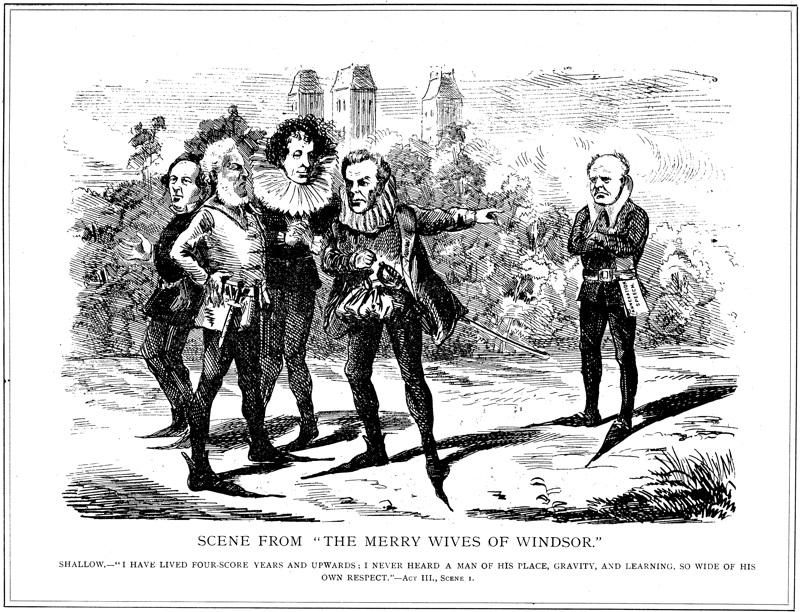
SCENE FROM “THE MERRY WIVES OF WINDSOR.” SHALLOW.—“I HAVE LIVED FOUR-SCORE YEARS AND UPWARDS; I NEVER HEARD A MAN OF HIS PLACE, GRAVITY, AND LEARNING, SO WIDE OF HIS OWN RESPECT.”—Act III., Scene I.
146THE GAME OF SEE-SAW.
The Maritime Provinces exhibited much fickleness in the bestowal of their political favor. In the first general election after Confederation only one supporter of the Conservative ministry was returned. In the next election, this state of affairs was exactly reversed.
Canadian Illustrated News, May 4th, 1872.
147
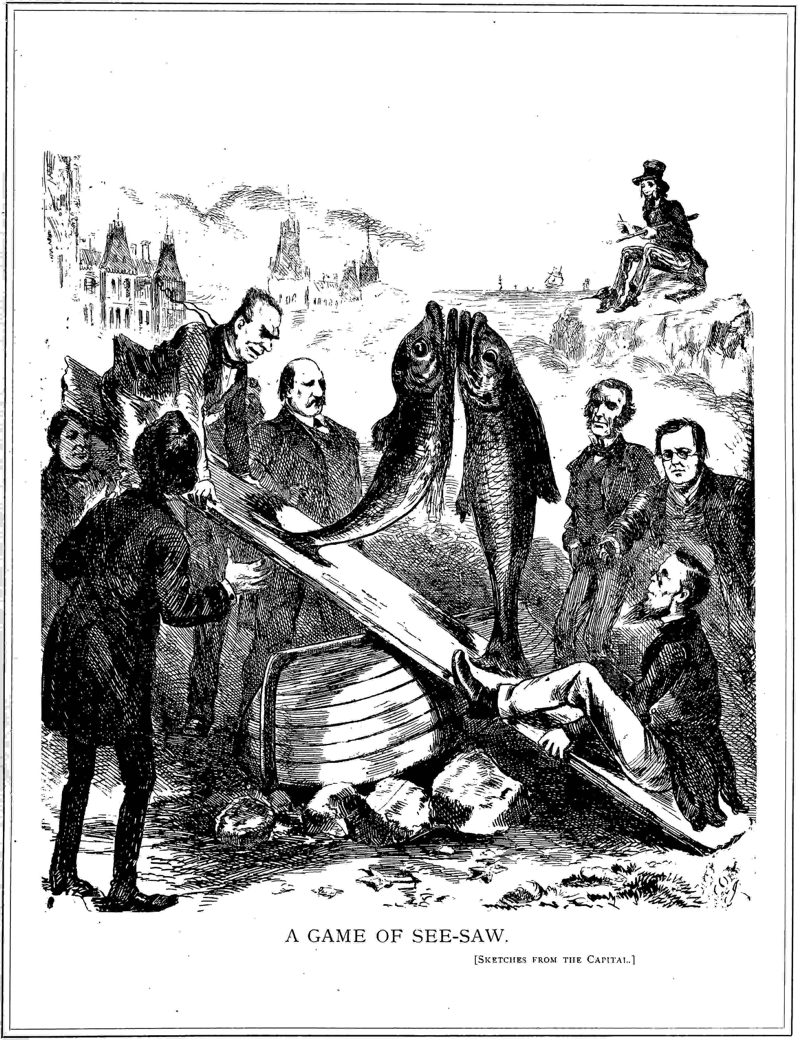
A GAME OF SEE-SAW. Sketches from the Capital.
148“TOODLES” AT TORONTO.
Mr. Rykert, a prominent member of the Opposition in Ontario, had taken a prominent part in the attack made upon the Government for extravagant expenditure in the furniture and fittings of the apartment occupied by Hon. A. McKellar, Minister of Agriculture.