Chapter XVI · LESSON PLANS
Reading edition
The best teachers never reach the point where preparation for the day’s work is unnecessary. The teacher who stimulates her pupils to their best effort must herself be interested in the work in hand. If nothing new in material or method is found to vary the work, interest soon lags. The lesson often repeated is as dry and lacking in power to interest or inspire as the proverbial sermon taken from the barrel. Even when a teacher has taught a most successful lesson, it is dangerous to try to repeat that exercise in precisely the same way. The two situations will not be alike. The fact that she tries to repeat will take the edge off the lesson for the teacher, and make it correspondingly dull for the pupils. Young and inexperienced teachers are often most successful because of the zest with which they attack the problems which are new to them. The older teacher may be able to keep a class in order and teach them something with a minimum of preparation; but her best work will be done only when she has planned as carefully as the novice for whom the need of preparation is so apparent.
The subject matter which should be drawn upon for any lesson constantly changes. No two groups of children have had exactly the same varieties of experience; hence the need for varying the approach, as well as the demand for differences in observations, experiments, reading, or other methods employed to bring the data necessary for the solution of their problem before children. Subject matter is growing, is being made all of the time. Last year’s discussion of the geography of Europe, of South America, of Africa, or of Asia will not suffice for this year, because interesting and important events have occurred in these countries during the year intervening. For the wide-awake teacher, even that most exact of the sciences, mathematics, represented by arithmetic in our curriculum, will change; since the number aspect of children’s experience will vary. If spelling means the study of words which are needed for use in written expression, the work in spelling will vary just as surely as the occasions for written expression vary among children. No teacher could, if she would, repeat a series of lessons which deal with natural phenomena. In any field, the need for preparation becomes apparent for one who would command the material which should be made available for children.
In the preparation of a lesson plan the first and in some respects the most important step is to become acquainted with the subject to be taught. There is no method of teaching which can take the place of a thoroughgoing knowledge of the material which bears upon the topic to be treated. The teacher who finds in the life of the children outside of school, in school activities, in books, pictures, magazines, in study and travel, material for her daily class work, will make any course of study vital and interesting to children. In such an atmosphere pupils will grow not only in knowledge, but also in the desire to inquire and investigate and in power to satisfy their intellectual craving.
After the teacher has in hand an abundance of interesting material, the next step in the plan is to organize the data to be presented. Some organization is usually found in textbooks and courses of study, and it is possible simply to try to fit any additional material which may have been collected to the scheme provided. The difficulty with this ready-made organization is found in the fact that it has little or no relation to the needs or problems of the particular group of children to be taught. Any organization which is to be significant to children must take account of their point of view, and attempt to present subject matter in response to the need which they feel for the material to be presented. This is precisely what is meant by the difference between the logical and psychological methods of presenting subject matter. Not that the psychological method is illogical, rather it takes account of the child’s needs and is for him logical beyond the most complete adult logical scheme. It may seem logical to the adult to teach the crayfish by calling attention to the large parts and then to the smaller parts in order, or to deal with the structure of the skeleton, nervous and circulatory systems, connective tissues, and the like. To an eight-year-old child, the problems which will probably be most logical, most satisfying to his desire for investigation, will deal with the way in which the crayfish gets his living, how he protects himself from his enemies, how he brings disaster by making holes in levees, and how important he is as an article of food. In satisfying these childish problems, much of the information which might have been imparted, had the adult scientific order been followed, will be mastered by the pupils. Much more will be remembered, because the information is associated with the solution of interesting problems. It may seem logical in teaching India to a sixth-grade class to treat of prevailing winds, surface features, climate, vegetation, animals, mineral products, and people; but the children whose teacher approached this subject by asking them to try to discover why they have had such terrible famines in India probably remember more of the geography of India to-day than those who followed the adult logical order. In organization, then, the starting point is to get the child’s point of view, to discover his problems, and to organize the material to be presented with reference to these childish aims.
Good organization demands that material presented to satisfy the demand made by the child’s problem be grouped around few coördinate heads.[26] Many topics of equal value in an outline generally indicate a lack of organization, a lack of appreciation of the relation of the various facts to be presented. For example, one might think of a great many facts about plant growth; the seeds must be put in the earth, the weather must be warm enough, they must have water, they need to be hoed, the ground should be fertile, they need air, they grow best when they have sunlight, they may have too much moisture, in rocky ground the soil may not be deep enough, they must not be too close together, weeds and insects must be destroyed, the roots should not be disturbed, the choice of the seed is important, and so on. For a group of lower-grade children there are two problems; namely, (1) what kind of plants do we want, and (2) what can we do to make them grow well. Under the first head would come the plants which are suitable for our conditions of soil and climate, and the question of seed selection. Under the second head the topics will be moisture, sunlight, air, and cultivation, including the destroying of insects or other pests. Each of these topics will be suggested in answer to the problems which have been raised (what plants we want, and how we can make them grow well) by a group of children who have had any experience with growing plants. If any important topic is omitted, the teacher will call for it by a question which suggests the lack of a complete solution to the problem which is being considered. This brings us to the next step in plan making.
A good lesson plan will include pivotal questions which will serve to call for the data as indicated by the main topics given in the organization of the subject matter. The problem of questioning has been discussed at some length in a previous chapter.[27] In planning a lesson, a question or two which will discover to the children the problem to be solved should come first in the plan. With the problem before the children, the function of the question is to stimulate thought in the direction of the solution of the problem. The writer is familiar with the objection that questions cannot be prepared ahead of time.
It is true that the form of question may need to be varied because of progress or the lack of it, not anticipated by the teacher, but the question carefully prepared ahead of time will help rather than hinder in the formulation of a question to meet the situation. It is true, too, that not all of the questions can be prepared ahead of time. All the more reason for careful preparation of a few questions which will enable the teacher to prevent wandering by children during the development of the topic. Thought-provoking questions which guide and stimulate children in the solution of their problems are dependent upon the aim which has been established and upon the organization of material which it is desired to follow in the solution of the problem. One might as well deny the need of organizing material, as to question the value of preparing a few pivotal questions as a part of the plan.
Lessons often fail because the ground covered during the period cannot be retraced by the children at the end of the exercise. In a well-organized plan the teacher will provide for summaries as each main point is covered. In general these summaries should aim to recall the subject matter covered from the beginning of the lesson. It may be suggested that any good teacher summarizes her work as she passes from point to point in her teaching, and that no artificial reminder is necessary. The difficulty is that a good summary is not accomplished merely by asking for a recapitulation of the material covered. The skillful teacher puts her question which involves a summary in such form that the pupils get a new view of the ground already covered. In the experience of the writer, questions which involve a summary of the work covered, with the added element of a new view as a stimulus to further thought on the subject, are more rare than good questions introducing new topics.
A good plan will include a list of illustrations, illustrative material, books including references to chapter or page, maps or charts which are to be consulted during the recitation. Teacher and children are often disappointed because of the lack of materials which could have been at hand had the teacher only thought about the lesson before teaching it. In like manner, the opportunities for motor expression, other than reciting or discussing, should be noted in the plan. Dramatization, constructive work, graphic representation at the seat or on the blackboard, may make the difference between success and failure in a recitation.
A lesson which has been well planned will naturally end in the assignment of work to be done in preparation for the next recitation. In the discussion of any problem there must arise questions which cannot then be answered. A good lesson is characterized not simply by the ability of children to report progress, but quite as much by their statement of the questions still unanswered. The direction sometimes given to call up again the question which is left unanswered during the recitation indicates a teacher whose assignments provide a real stimulus for study in preparation for the next day’s work. If it is necessary to have a live problem before children during the recitation conducted by the teacher, obviously it is much more necessary to make assignments which involve real issues for children to meet.
In outline form the discussion of plan making given above would appear as given below. This lesson on plan making may be taken as an illustration of the type of plan a teacher should prepare for a development lesson. In this plan, as in others, it seems wise to keep the subject matter separate from the method of procedure.
A plan for teaching lesson plans: Their importance and the elements which enter into their composition.
Teacher’s aim: To show the importance of plan making and to indicate the elements which enter into the construction of a good plan.
Preparation (which aims to get the problem before the class). How do you prepare for your day’s work? Do you think you would do better work if you planned your several recitations somewhat systematically?
Pupil’s aim: Why do I need to make plans, and what are the elements of a good plan?
Subject Matter
I. Necessity for planning.
A. Lack of interest in old work.
B. Subject matter changes.
a. Subjects grow.
b. The experiences of different groups of children vary.
C. Not safe to depend upon the inspiration of the moment for
a. Good questions.
b. Illustrations and illustrative material.
c. References to books or magazines.
d. Plans for constructive work and the like.
Method of Procedure
Do you ever grow tired of teaching the same subject over and over again?
Why does a sermon out of the “barrel” lack in interest or power to inspire?
Do you know a subject thoroughly to-day because you once studied it?
Why do different groups of children respond differently to the same material?
Formulate three good questions which you might use in teaching a lesson on the oak tree to second-grade children.
Do you think you might have asked better questions if you had had time to think them over?
What picture or other illustrative material would you use in teaching this lesson?
Do you think the children would gain by drawing a picture of the oak near by?
When do you think you will have had enough experience in teaching to be able to get along without making plans?
II. The elements in a good plan.
A. A thoroughgoing knowledge of the subject matter.
B. The organization of material depends upon the problem to be solved by the children, hence the necessity for discovering a problem to the pupils which can be satisfied by the subject matter to be presented.
a. Problems essential to thinking.
b. Logical vs. the psychological organization of material.
c. Organization involves sequence and the subordination of less important points.
McMurry,
How to Study
, Chapter III.
(The questions in this part of the plan will be few. I should expect questions, suggestions, and discussions on the part of the class. I should probably use the blackboard to show the organization of subject matter as given under subject matter.) What would you do first, if I asked you to teach a lesson on habit formation? What will determine the organization of the material which you are to present?
C. Pivotal questions.
a. Thought-provoking questions prepared in advance in order to guide the children in the development of the topic as well as to stimulate them to their best thinking.
D. Provision for summaries.
a. A summary enables children to keep sequence and gives new point of view.
E. Illustrative material, and references noted on the plan.
a. Materials prepared ahead of time.
b. References to maps, charts, books indicated definitely to save time and conserve interest.
F. Provision for assignments.
a. A good lesson makes provision for definite progress and makes clear the questions yet unsolved.
b. Children need definite problems more when working by themselves at home than when with the teacher.
Show class plans found in McMurry,
Method of the Recitation
, pp. 329-339; Third Yearbook, National Society for the Scientific Study of Education, pp. 60-64; syllabus on
Theory and Practice of Teaching
, pp. 14-18.
One cannot prepare all of the questions to be asked in advance. What is the function of those questions which should be placed in the plan? When children have been interested throughout the lesson, why are they sometimes unable to solve for themselves the problem which has been discussed? What aids does a teacher need to use in teaching a lesson other than the textbook and her own plan? What do you do with questions which are not answered during the recitation? How do you prepare children to work at their seats, or at home? Is plan making worth the time and energy which it requires?
A PLAN FOR TEACHING THE TOPIC OF IRRIGATION[28]
Teacher’s aim: To arouse or increase the interest of children in the development of the western part of the United States, and to acquaint them with the problems of irrigation.
What effect would a long drought in this part of our country have upon the price of fruits and vegetables? What would happen if the drought were to be continuous? There are arid regions in the United States. Can they be made to raise good crops?
Pupil’s aim: Can the arid regions of the United States be made to raise good crops? What effect would that have on the other parts of the country?
Subject Matter
I. Arid regions of the United States.
A. Continuous drought.
B. Size of area. See maps.
C. Description of region.
Dodge, Adv. Geog., pp. 44. Tarr and McMurry, second book, p. 120.
II. Why should we desire to reclaim arid lands?
A. Increase in population with consequent increased demands for food at home and abroad.
B. Capital seeks a good investment.
III. How arid regions are made productive.
A. Conditions necessary for plant growth.
a. Fertile soil.
b. Heat and light.
c. Moisture.
B. The effect of drought overcome.
a. In limited areas—by sprinkling.
b. In extensive areas—by irrigation.
Tarr and McMurry, p. 120. Dodge, Adv. Geog., p. 166. King, Adv. Geog., pp. 141-146.
Method of Procedure
In what parts of the United States are the arid regions located?
Look at your rainfall maps.
Name the states included.
Compare the population of the plateau states with a like area in the Mississippi Valley, or on the Atlantic coast.
Is it significant to the country as a whole that these regions remain unproductive?
What would be the effects produced in case these large tracts of land could be brought under cultivation?
In order that plants in the garden or crops in the field may grow, what conditions are necessary?
When the lawns or gardens in our part of the country grow too dry, how are they kept growing? What means must be employed to provide water in very large areas? Are these means used in the Plateau and Pacific states? (Class consult the references named.)
C. Sources of water supply.
a. Rivers.
b. Mountain streams fed by rain, snow, or glaciers.
c. Artesian wells.
d. Lakes.
Tarr and McMurry, pp. 129-133. Dodge, Adv. Geog., p. 172. King, Adv. Geog., p. 142. Review of Reviews, 31:701-704.
D. The process of irrigation.
a. Water storage, reservoirs, dams.
b. Ditches or canals.
c. Surface irrigation.
d. Subirrigation.
See geographies quoted under C, above. Popular Science Monthly, 67:648-686.
E. The reclamation service.
a. The nature of its work.
b. The territory affected.
(See the World’s Work, Dec., 1907.)
F. How the government gets its money back.
a. Sale of land in tracts not exceeding 160 acres to an individual.
b. Payment in ten equal annual installments.
Where can the water be obtained for irrigating purposes in these dry areas? (Conversation. Assignment to books in use by all of the class. Assign article in Review of Reviews, 31:701-704, to a pupil as a special topic.) How can the supply of water which falls during the rainy season be kept for use during the dry season? (Assignment of special topics relating to particular subjects.) How is the water in the reservoirs or rivers distributed to the fields when it is needed? (Illustrate by an outdoor lesson; or if the nature of the country is not suited to illustrate the process, use the sand table and construct a system of irrigation showing reservoir, main canals, and the distributing ditches. Assign subirrigation as a special topic.) How does the United States government aid in reclaiming the waste lands of the West? What disposition does the government make of the reclaimed lands?
Ref. the Cosmopolitan, 37:715-722.
The World’s Work, Dec., 1907.
G. The effects of irrigation.
a. Upon agriculture.
(See geographies quoted above; also the Cosmopolitan, 37:718-722; the World’s Work, Dec., 1907.)
b. Upon secondary industries
c. Upon population in the areas irrigated.
(King, Adv. Geog., pp. 152-154; also other geographies quoted above; the World’s Work, Dec., 1907.)
Would it pay a man to buy a forty-acre tract in the irrigated region? What crops could he produce? Value of crops? (Estimated.) Where there are prosperous farming communities, what other industries are possible? Are they found in the irrigated districts? With agriculture, fruit growing, and other industries made possible and profitable, what effect is produced upon immigration to the Western states? What problems did we set out to solve in these lessons on irrigation? What is the answer to each? Further topics for class study:— 1. Value of forests to systems of irrigation. 2. Our relations to the irrigated regions. 3. Advisability of introducing irrigation in the Eastern states. 4. Irrigation in Egypt. 5. Irrigation in India. Individual assignments:— 1. Economy of water in irrigation. 2. Fruit growing on irrigated land. 3. Advantages and disadvantages of farming in the East and in the West. 4. Relative value to a state of gold mining and of farming. 5. Relation of irrigation in the West to the people of Europe. 6. To the people of the Eastern states.
The plan given above for the topic “irrigation” is typical of many plans which the teacher should make. It indicates the development of the whole topic, which will need the time of several recitations for its complete development. The topics given at the end of the plan for class study and for individual assignment show that the teacher had thought over the problems which might arise as the subject was taught, and that she was ready to make such assignments as the situation demanded from day to day. If such a list of possible assignments has been prepared before the topic is taught, the chances are that the ground will be much more thoroughly covered than would be the case if the teacher trusted to her ability to select an interesting problem at the end of each day’s work. Lesson plans should, as a rule, cover a complete unit of work or topic. One plan will commonly include inductive development work in the derivation of principles, drill work to fix these generalizations or to give skill in their application, and at times deductive work in the use of the principles derived to explain new situations. A complete plan for teaching percentage in arithmetic would include all of the elements mentioned. A lesson for appreciation or a recitation lesson may often be followed by drill work. When the topic lesson plan has been prepared, the teacher will need to consider from day to day the best method of proceeding with the subject. She may wish to vary somewhat the approach or order of development.
A PLAN FOR A DRILL LESSON
The work indicated here can be done in one period. The plan is given as an illustration of the principles involved in good drill work. It is especially necessary, in planning for lessons of this type, to be ready to vary the exercises in order to maintain the interest and attention of the class. Repetition with attention is what counts for habit formation. The children have been playing a game in which the score secured by throwing a bean bag in squares, numbered from one to ten, has been multiplied by two and later by three. The class has been divided into sides, and the competition has been keen. They want to make larger scores, and, therefore, have a compelling motive for studying the next table.
Teacher’s aim: To teach multiplication by four. If we are to make larger scores, what table must we learn next? How many think they can learn half of the table of fours to-day? If you learn it, we will play our game for ten minutes.
Pupil’s aim: To learn the multiplication table of fours.
Subject Matter
4 × 4 = 16
4 × 2 = 8
4 × 6 = 24
4 × 3 = 12
4 × 5 = 20
Method
Teacher writes the table on the blackboard, as indicated under subject matter.
How many are sure they know the first two? Look at me and answer as I ask the results. Don’t answer unless you are sure.
Now let us take the first three. Proceed as before.
I’ll erase the first three. Look at them carefully. Now write them on your tablets.
4 × 4 = 4 × 2 = 4 × 6 =
Don’t write the answers unless you are sure you are right.
Let four or five children read their answers.
Margaret may ask for answers. She drills on the first three combinations.
The other two are easy to remember,—four times three we know; it is the same as three times four, and four times five are twenty we can all remember. Look carefully; I am going to erase them.
Drill by teacher on last two combinations.
All combinations put on board again and read and written by children.
Robert tries to discover whether there is any girl who has forgotten any part of the table.
Katharine tries to catch the boys.
All write at the dictation of the teacher, supplying the products. The game is then played. When any one makes a mistake in recording his score on the blackboard, his side is penalized the amount of his mistake.
Possibly all the plans the experienced teacher needs for the lesson outlined above are a few notes concerning the variations to be introduced from time to time in the drill. She must plan, however, to put zest into the lesson by means of the variety which she introduces, and she must, if she is to get the best work, provide some motive which will make the drill work seem worth while to the children.
A LESSON ESSENTIALLY DEDUCTIVE
A part of a larger topic plan on taxation. The children have begun the study of taxation by inquiring how policemen, street cleaners, firemen, and other city employees are paid; how money is secured to run the schools, to provide water, and the like.
Teacher’s aim: To teach how to determine the amount of taxes to be paid when the assessed value of the property and the rate of taxation are known.
George, did you find out the assessed valuation of your father’s house and lot?
Henry, did you find the rate on real estate?
Pupil’s aim: Let us try to find out how much tax George’s father must pay on his house and lot.
Subject Matter
A knowledge of percentage is assumed.
To find the percentage we multiply the base by the rate.
House is worth $3500. Rate of taxation is $1.80 on the hundred dollars.
$1.80 on one hundred dollars
35 times $1.80 would be the
900
amount due on thirty-five
540 hundred.
$63.00
Taxation is simply an application of percentage.
Houses worth $4,250
$18,400
$1,260
$1,500
$7,500
$800
$12,000
How much tax must each pay?
Method Of Procedure
If you want to find six per cent of $3500, how do you proceed?
If George’s father pays $1.80 on each hundred dollars, how can you tell how much he must pay on thirty-five hundred dollars?
Do you discover in this example anything like the problems in which you find a certain per cent of a given sum?
Find .018 (1
8
/
10
per cent) of $3500. If you multiply the assessed value by the rate, will you get the amount of the tax?
Why must you point off two places?
Do you think you can find the amount of the tax to be paid on any house and lot in the city, if I tell you how much the assessed value of the house is?
Is the rate of taxation the same on all houses?
Teacher gives problems to the whole class and has each explained in turn on the board.
For to-morrow you may solve the following problems (written on the board):—
Assessed Rate Of
Value Taxation
$4,200 $2.20
$16,750 $1.35
$425,000 $1.90
$1,000 $0.78
$56,000 $1.64
$400 $2.18
PLAN FOR A SERIES OF TOPICS IN HISTORY—SIXTH GRADE
A plan covering the work for several weeks given in the form of a topical outline with suggestions as to methods of treatment. This general plan would need to be supplemented by definite additional preparation from day to day. This plan was prepared by Miss Lida Lee Tall, supervisor of grammar grades, Baltimore County, Maryland.
Aim: To teach the colonization of Maryland and show its development as a part of England’s colonial empire in the New World.
Topical Outline (for the Teacher)
I. Conditions in Europe at the time of the settlement of Maryland.
II. Conditions in the New World.
III. Life of George Calvert.
a. In England.
b. In the New World.
IV. The settlement of Maryland.
V. The development of Maryland.
Textbooks
Any good history of England, as Walker’s, Gardiner’s, or Andrews’. Warren. Stories from English History. Harding. Stories of the English. Mowry. First Steps in the History of England. Browne. Maryland: the History of a Palatinate. Cheyney. European Background of American History. Cheyney. A Short History of England. Hall. Lords Baltimore and the Maryland Palatinate. Gambrill. Leading Events of Maryland History (class text). Coman and Kendall. History of England.
TOPIC I: CONDITIONS IN EUROPE IN THE SEVENTEENTH CENTURY
Subject Matter
1. Monarch. King James.
2. Incidents of the reign that will help interpret the life of the times:
{Religious
Controversies {Political
{Commercial.
{vain
{arrogant
{weak
3. Character of {amiable
the King {loved peace at
{ all costs
{ambitious
{approved
{ learning
{Sir Walter
{ Raleigh
{Sir Robert
{ Cecil
4. Men of {George Calvert
England {Cromwell
{Guy Fawkes
{Robert Carr
{Francis Bacon
5. Reason for England’s interest in other countries:
a. Trade.
b. Spain’s success in colonization in the New World.
c. Spain’s usurpation of Holland.
d. Increase in woolen manufacture in England.
6. Topics of the day at the English court:
a. Spanish king and his power.
b. Spanish resources.
c. New World.
d. Religion.
e. England’s { Stock companies.
trading { Proprietary
companies { privileges.
Method of Procedure
Much of the work can be developed from assigned readings for which the pupils must be held responsible. Where textbooks are not available the teacher, or a pupil who reads well, may read to the class. Of course, the assignment must be very definite. For example:
a. As you read see if you can tell from incidents in the story the kind of man King James must have been. You must argue for what you think about him.
b. England was interested particularly in Spain, Holland, France, and the New World. As you read find out why this was so.
Half the class may be given the first assignment, the other half the second.
When at the close of the study period, the teacher calls for the work, it will be through her sequence of questions that the subject matter will be organized according to the outline under “Subject Matter.” If the discussions are lively and argumentative, the spirit of the seventeenth century will be felt and the life of the time pictured. Pictures of castles, London streets, Ireland, the continent, sea vessels, etc., will help to make impressions more vivid. Topic 6 makes a good summary and can be conducted in a way to make the work most attractive to the pupils.
TOPIC II: CONDITIONS IN THE NEW WORLD
Subject Matter
1. Spanish America.
2. French America.
3. English and Dutch America.
Method of Procedure
Assign readings from available textbooks.
A further assignment which correlates with geography is the following: Draw a map of the world; show Old World; show New World; color the part of the New World that belonged to Spain, to France. Also draw a map of Europe; show the Catholic countries, show the Protestant countries.
As the teacher develops the lesson from the class, by means of thought-provoking questions, she can make an outline on the board, the class helping; then this outline may be copied by the pupils in notebooks used for history lessons only. These outlines should serve as summaries and also as reviews as the lessons continue.
TOPIC III: LIFE OF GEORGE CALVERT
Subject Matter
1. George Calvert in England at this time.
a. Early life:
Born in Yorkshire (locate).
Educated at Oxford (picture of school).
Traveled on the Continent (map showing university towns).
b. Later life:
Important position in England.
Interests in the New World: Trade: religion.
2. George Calvert. In the New World:
a. Newfoundland.
Management.
{ Climate
Difficulties { Soil
encountered { The
{ French
Disappointment and departure.
b. In Virginia
Reception unwelcome because of religion, character troubles, business relations.
Result.
3. His return to England.
New charter from Charles I.
Death of George Calvert.
Method of Procedure
1. Assigned reading for class: Gambrill, pp. 3-6.
Teacher may fill in with details from Browne’s
Maryland
, or Hall’s
Lords Baltimore and the Palatinate
. Much of this, however, may be developed. By this time the class will have been put into a mental attitude, both historically and geographically, to answer problems very intelligently.
Assignment for map work:
A map of England—locate Yorkshire, Oxford, London.
A map of Europe showing George Calvert’s travels on the Continent.
2. (a) Draw a map of the New World showing Newfoundland and other settlements of that time.
Why was Newfoundland bought?
(b) Why in Virginia and not Plymouth?
3. Textbook assignment.
TOPIC IV: THE SETTLEMENT OF MARYLAND
Subject Matter
1. Cecilius Calvert—To carry out his father’s plan of making a settlement in the New World.
a. Conditions of the new charter. (Gambrill, pp. 6-8.)
(a) Rights and duties of the proprietor.
(b) Rights and duties of the colonists.
Kind of man necessary to rule the colony wisely.
b. Preparation for the trip:
{Hostility of
{the old London
{Co.
Difficulties {Objections to
{the charter
{by Claiborne.
Getting {The Ark.
ready at {The Dove,
Gravesend {Nov., 1633.
{Men bound to
{service (probably
{Protestants),
{300.
Men for the {Freemen (probably
expedition {Catholics), 20;
{priests, 2.
{Members of the
{Calvert family.
Stop at the Isle of Wight.
Off for the voyage.
Method of Procedure
1. Assigned reading: Gambrill, pp. 6-8.
As has been indicated, where no problem development is possible, use textbooks or the teacher’s wealth of details to fill in the connecting links. The texts should be read just when the need for the information arises: for instance, when it is necessary to know the conditions of the charter granted to Cecilius Calvert, the books should be opened, the page found, the page or paragraph read silently by the class, and the information then given.
If the previous situations have been vividly presented, then the problem of the difficulties of getting such a trip under way that confronted Cecilius Calvert should be eagerly discussed by the class. There can be map work—England: locate Gravesend, Isle of Wight; also make the flag of England under which the expedition sailed. (The flag of 1608 was the united flag of England and Scotland, the flag of St. George and St. Andrew combined. Lord Baltimore’s own banner can be made and colored, though it was not known to have been used until the battle of Severn; it was adopted as the state flag in 1904.)
2. The voyage.
a. The stop at the Barbadoes. (It is necessary that the class understand something of England’s colonial territory at the time: England colonized Barbadoes in 1625, after it had been depopulated by the Spanish. The island had, therefore, been under English control for eight years. It was possible that the Ark and the Dove carried mail for the Barbadoes. The colonists stopped for three weeks, in that time repairing the vessels, securing negro slaves, and buying supplies, among which was seed corn for the Maryland settlement.)
b. The stop at Point Comfort.—Letters from Cecilius Calvert and the king were to be delivered with great respect, by the hands of a messenger who was conformable to the Church of England, to Sir John Harvie, the governor of the Virginias.
3. The landing on Blackiston’s Island, March 25, 1634. Why not a suitable place for a permanent settlement?
4. The visit to the Pascataway Indians. The sale of the Yaocomaco Village. The advantages of such an arrangement with native Indians.
5. The settlement on St. George’s Creek, afterward known as St. Mary’s Creek. The settlement was named Augusta Carolina.
2. The voyage can be treated as a recall of the knowledge gained from the celebration of a holiday like Maryland Day in a previous grade, or an outline map may be drawn and pupils may trace the route if they can.
(More map work can follow to indicate the stop at the Barbadoes, the route up the Atlantic to Old Point Comfort, another stop, and on to Blackiston Island.)
a. Why was a stop at the Barbadoes planned?
b. Why was a stop at Point Comfort planned?
3, 4, 5, 6. From the landing on Blackiston Island to the end of this topic the method followed should be: developing questions, with the use of a textbook which should be read either before the lesson or after the development in order to verify conclusions made; but this must be left to the judgment of the teacher and her own individual plan for dealing with the subject. Assigned reading: Gambrill, pp. 17-19.
6. The favorable conditions of the settlement.
a. Spring of the year.
b. Houses of the Indians (log) could be occupied temporarily by the settlers while deciding upon sites for building.
c. Aid of friendly Indians:
1. Routes through the country.
2. Protection.
3. Education—corn planting, harvesting, clipping tobacco, hunting game, fishing, climate.
4. Land was already cleared and cultivated.
d. Condition of plantation grants:
A man with five persons—2000 acres.
A man with less than five—100 acres for self; 100 acres for wife; 100 acres for each child under sixteen years; 100 acres for each servant; 100 acres for each laborer.
e. Physical features of country for tobacco industry:
Tide water.
Estuaries—wharves for each plantation.
7. Life in the colony:
a. Plantation— extent, sheds for drying tobacco, slave quarters, barns, rolling roads, chapel, house.
b. Food— wild turkey, venison, oysters, hominy, corn pone.
c. Amusements— hunting, dancing, singing by slaves.
d. Travel— boats, horse.
e. Affairs of interest—Virginia news.
Claiborne’s trading post in the Chesapeake.
Relations with the Indians.
English politics (Charles I, Cromwell, and Parliament.)
Military arrangements in the settlement.
Currency for trading.
Need for an assembly to settle matters in a legal way.
f. First Assembly—1635.
Matters taken up—Boundaries,
Military protection,
Claiborne trouble,
Framing laws to be sent to Cecilius Calvert, the proprietor in England.
g. Sending back these laws; also letters, and products, as well as the two Indian arrows required by the king.
An interesting account of the arrival and departure of the trading ships can be given. They came from November to January, and the captains were entertained at the different plantations. They brought new settlers, indentured servants, more slaves, letters from England, news of the world.
h. Trouble in the colony.
Claiborne on Kent Island.
Virginia’s hostility.
Troubles with the Indians— Susquehannoughs and Pocomokes.
Civil War in England.
7. For the life in the colonies, reading periods may be occupied with readings from any good book that gives a graphic account of the times, such as Alice Morse Earle’s Home Life in the Colonies. If the sand table is used, the children should consult these books. Another way to vary the procedure, if there are books enough, is to assign readings and let the pupils bring to the class accounts of the details of the life in the colonies that seemed most interesting to them individually.
In the Affairs of Interest it will be necessary for the teacher to tell about the conditions in England. Mowry, Guerber, or Warren may have all the information necessary for this purpose, but Cheyney’s European Background of American History should be studied by the teacher. The European background can be very simply drawn.
The Kent Island affair may be read before being discussed, but there is good problem work there, and the better plan would be to read the text last. Text: Gambrill, pp. 21-25, 99-111.
References:
Tudor Jenks, When America was New. Chap. IV, “Maryland and the Dutch.” Chap. V, “New World Living.” Chap. IX, “What the Colonists Knew and Thought.”
Wm. H. Browne, Maryland, The History of a Palatinate.
Alice Morse Earle, Home Life in Colonial Days.
The chapters on Virginia plantation life will serve to show the life in Maryland colony also. The material is as follows: Light, Kitchen, Fireside, Serving Meals, Food of Forest and Sea, Indian Corn, Meat and Drink, Flax Culture, Wool Culture and Spinning, Girls’ Occupation, Dress of the Colonists, Jack-knife Industries, Travel, Transportation and Taverns, Colonial Neighborliness, Sunday, Oldtime Flower Gardens.
h. Textbook assignment: Gambrill, pp. 27-30, 34-47.
TOPIC V: DEVELOPMENT OF THE COUNTRY AND REPRESENTATIVE GOVERNMENT
Subject Matter
1. Assemblies—
First Assembly in 1635.
Second Assembly in 1638. Why three years later than first?
What was its organization? Freemen, governor, and Council. Importance.
Third Assembly in 1659.
Representatives from the hundreds making a House of Burgesses, governor, and Council.
2. The Claiborne affair and its settlement.
3. The effect of the Civil War in England upon the colonies:
a. Colonies in general:
1. Increase or decrease in population according to the sentiments of the colonists regarding the questions in England.
2. Strife in colonies. Councils called on to decide for or against king or Parliament.
3. Effect on commerce.
b. Upon Maryland in particular:
1. Increase in Catholic population.
2. Caused strife and dissension.
3. Return of Leonard Calvert to England for advice; Giles Brent left governor pro tem.
4. Invasion of Ingle.
5. Ingle and Claiborne.
6. Leonard Calvert’s return from England.
7. Leonard Calvert’s refuge in Virginia.
8. Return of Calvert and restoration of the colony under his government.
9. Death of Leonard Calvert, June 9, 1647.
Thomas Greene made governor pro tem. by Leonard Calvert on his deathbed.
Method of Procedure
1. Discuss the organization of the several assemblies.
Explain hundreds.
Textbook: Gambrill, pp. 14-19; penal laws; prisons, 21-23; judicial courts, 63-68.
2, 3, 4, 5, 6, 7, 8. Textbook Assignments: To be given by teacher.
4. The appointing of a new governor by the proprietor and the reorganization of the government: Factor in this—Civil War; the Protestants in power in England.
1. William Stone appointed governor.
Effect—he chose Protestants for his Council, from those brought into Maryland from Virginia.
They made a settlement on Severn River.
5. Trouble with the Puritans resulting in the battle of the Severn.
6. Reconcilement with Virginia.
7. Change in organization of government— Upper House. Lower House.
Due to growth of colony; freemen; indentured slaves who became freemen.
8. Removal of the capital to Annapolis.
8. For “Life in Annapolis” see Churchill’s Richard Carvel: Chapter on “Christmas at Carvel Hall.” This should be read to the class.
Note.—Here the development of the Maryland colony may be closed because of the political difficulties which are entirely beyond the experience of the sixth-year child. The French and Indian Wars might be studied; also the opening up of western Maryland by the coming of the Germans; but the main point has been accomplished. The children have worked their way through the study by living in the conditions of the colony and solving Leonard Calvert’s problems for him. To work such a plan out in detail, to give just enough to whet the appetite of the child and then make him think for himself, to have him live as a colonist of the times, interested particularly in the details of government that concern the colonists as a united body until finally a “two house” legislature is demanded because of the growth in population, area occupied, and interests represented, is a task for the skill of the teacher, and is worth while.
Lida Lee Tall, Baltimore County Schools.
A LESSON IN NATURE STUDY INVOLVING A REAL PROBLEM
This lesson was planned and taught very successfully in the third grade by Miss Roxana A. Steele of the Speyer School, Teachers College, Columbia University.
Teacher’s aims:—
1. To teach pupils why and how to transplant.
2. To prepare for the transplanting of the salvia plants in our school garden.
Pupil’s aims:
1. To be able to select good plants for transplanting.
2. To know how to transplant in order to plant salvia plants without help.
Subject Matter
Box of young salvia plants for observation and comparison with cabbage and tomato plants.
(Salvia plants to be transplanted into garden later.)
Advantages of transplanting
:
Plants get an early start.
Opportunity for good arrangement.
Disadvantages
:
Extra work.
Extra care.
Cabbage and tomato plants discarded by Teachers College gardener.
I. Choice of Plants.
Very small plants:
Do not root well.
Are slow in getting started.
Large plants:
Stalks too long and weak.
Bend very easily.
If used, need to be planted deep.
Roots have not had room enough in hotbed.
Medium-sized, strong plants:
Best for planting.
Good roots.
Good stalk.
Green leaves.
Crooked plants.
Can be straightened by the sun.
Method of Procedure
What are we planning to do with our salvia plants when they are a little larger?
Why didn’t we plant the salvia seeds in the garden?
What are some of the advantages of transplanting? disadvantages?
How many children feel that they know just the best way to transfer a plant? (Pupils’ Aim.) Do you think we can afford to practice with the salvia plants when we have so few? Who can suggest a good way to learn to transplant?
Let us look at those cabbage and tomato plants which I have brought from Teachers College and see what we think about them. These are from the box from which plants were selected by the gardener last week.
I shall divide the plants into small, large, and medium-sized. Tell which you think are best for transplanting and why.
Why would you not select the very small ones? the very large ones?
When a gardener has not enough fine, straight plants, can you think of a way of planting by which he might use a crooked plant?
II. Manner of Planting.
Preparation of hole.
Water at roots.
Planted deep enough for branching of first leaves to be but an inch or two above ground.
Earth pressed firmly around plant.
Practice planting of cabbage and tomato plants in a box of earth.
Trowel.
Choice of plant.
Water.
Account of what is being done.
Summary.
How to select a plant for transplanting.
How to plant it.
Now that we know what kind of a plant to select, can you think of something else we must learn before we are ready to transplant our salvia plants? (Statement of Pupils’ Aim.) Can you think of some things which might help a very young plant to get a good start? Has any child ever seen a farmer plant cabbage or tomato plants? Tell us exactly how he did it and why. Several children who can select a good plant may plant them in this box of earth. The class will decide whether they are good gardeners. Each child will have an opportunity to plant a salvia plant in the garden. Can you tell which plants will be most liable to grow well?
A LESSON PLAN IN GEOGRAPHY WHICH IS PREDOMINANTLY DEDUCTIVE
The study of maps forms the basis for inferences which are later verified by referring to the text. This plan was written by Miss Mary F. Kirchwey of the Horace Mann School, Teachers College, Columbia University. This lesson was most successfully taught to sixth-grade pupils in the Horace Mann School.
Teacher’s aim: To teach the geography of India and to give practice in the application of principles of geography known by the pupils.
Children’s aim: Why do they have such terrible famines in India?
Subject Matter
Failure of crops—dense population directly dependent upon agriculture for a living—lack of sufficient means of transportation.
We have abundant rainfall— temperature favorable to crops— great land area in proportion to our population.
In Egypt—even as far back as in the days of Joseph (Bible)—also in recent years.
Nile’s overflow less abundant than usual—dense population.
Location and approximate extent of the Indus Valley.
Between latitudes 23° and 30° N. the temperature is warm.
Florida is in about the same latitude, but the extremes of temperature are not so great owing to the water mass that surrounds it and tempers both heat and cold.
Method of Procedure
What is a famine?
Sufficient conversation to impress upon the children the suffering attendant upon famine.
What are some of the conditions that bring about a famine?
Have you ever heard of famines in our country? Why not?
In what part of the world have you heard of famines?
What were some of the causes of famine in Egypt?
The Indus Valley in India is one of the regions that is subject to terrible famines. Let us see if we can find the reason for it.
Point out the Indus on the map. Where does it rise? Where empty? Draw your pointer along the length of the valley—across it.
In what latitude is it?
What temperature conditions must prevail there? What part of North America is in about the same latitude? What do you know about the temperature of Florida? Do you think that the Indus Valley has about the same temperature? Look carefully at the location of both places— Florida and the Indus Valley. Can you see any reason for thinking that temperature is not the same? How are the summer and winter temperatures of Florida affected by the waters about it? How are the summer and winter temperatures of the Indus Valley affected by the land mass about it?
Isothermal maps for January and July verify the class conclusions.
Jan. July.
Indus Valley, 40°-60° 90°
Florida 50°-60° 80°
Rainfall.
Indus Valley is in the trade wind belt.
North of the equator the trades blow from the northeast.
The air over the land becomes heated and expands. The cooler air from the water blows in.
From a general southerly direction.
Arrows on map show that the winds come from the southwest.
From the northeast in winter.
From the southwest in summer.
There can be practically no rainfall in the Indus Valley in winter because the winds blow over the great land mass of eastern and south-central Asia before reaching the Indus and have lost their moisture.
There is more rainfall in summer because the winds from the southwest come directly from the ocean. The valley lies so low, however, that the winds sweep over the southern part of it without having much of their moisture condensed. There is little condensation until they near the highlands on the north.
Refer to rainfall maps which show well-watered regions in the upper valley—desert in the lower.
Generally favorable in the upper valley—unfavorable in the lower.
The Nile Valley—Egypt.
The annual overflow of the river.
The heavy precipitation in the mountainous districts that feed its tributaries.
Indus has many tributaries that rise in the Himalayas. In the summer, when the snows on the mountains melt, these tributaries carry to the main stream such a quantity of water that an inundation results.
Find out whether your conclusions are right. Is the temperature of Florida favorable or unfavorable to crops? Is a temperature somewhat hotter in summer and colder in winter unfavorable to crops? Is there anything, then, in the temperature of the Indus Valley that explains their famines? We must evidently look for some other cause for the famines. Upon what other climatic conditions do crops depend? In what wind belt does the Indus Valley lie? From what general direction do the trades blow in the northern hemisphere? Let us see if there is ever any exception to this rule. How does the temperature of the land compare with the temperature of the water in summer? What effect has this upon the air over the land? What naturally follows? From what direction, then, do the winds blow in India? Turn to the map of the winds and find the exact direction. These winds are called the Southwest Monsoons. Tell again from what direction the winds of India come. What, then, do you conclude as to the rainfall of the Indus Valley in winter? Is there apt to be more or less rainfall in summer? Why? Look at the map very carefully and see if it is likely that even the summer winds bring much rainfall. Is the rainfall equally light all through the valley? Where is it apt to be heaviest? Why? Prove that your conclusions are correct. Would you then say that the rainfall is favorable or unfavorable for agriculture? Does this mean, necessarily, that agriculture cannot be carried on in the lower valley? What other river valley have you studied that is noted for its agriculture in spite of a very light rainfall? What makes agriculture possible in the Nile Valley? To what is the overflow of the Nile due? Is there anything in the location of the Indus that makes it likely that it, too, overflows?
Overflow is less and a correspondingly smaller area productive. Character of the soil. River valleys in general have a rich soil. A river that overflows leaves a deposit of rich mud that makes its banks very fertile. Favorable—warm climate, rich soil, overflow of the river. Unfavorable—scanty rainfall. Crops grow so rapidly and easily when rains do not fail, that vast numbers of the people engage in farming. It is almost purely an agricultural region. It has attracted vast numbers of people. Principal products—millet, rice, cotton, sugar cane, wheat, tea. Practically all needed for home consumption. More railroads might be built in order that food products could be carried readily from one section to another. Better methods of irrigation might be employed. More variety of occupation might be introduced, so that fewer people would be directly dependent upon agriculture for a living.
What is the result if the rainfall is less abundant than usual? Upon what beside temperature and rainfall does the productiveness of a region depend? Can you come to any conclusion in regard to the soil of the Indus Valley? State again the conditions in the valley that are favorable to agriculture. Those that are unfavorable. What has been the effect of these physical conditions upon the occupations of the people? What has been their effect upon the density of population? What crops would you expect to find in the Indus Valley? Consult your textbooks and see what else is grown there. Do you think that much is exported? Why, then, do they have such terrible famines in India? Can you suggest anything that might be done to lessen the danger of famine? Consult your textbooks and see what steps have already been taken in this direction.
A LESSON FOR APPRECIATION
A lesson for appreciation which includes creative and interpretative work. The interpretation of the song in the dance, or dramatic game.
This lesson was planned and taught to a group of second-grade children by Miss Eleanor Wright of the Speyer School, Teachers College, Columbia University.
The lesson was based upon the little German folk song which follows:—
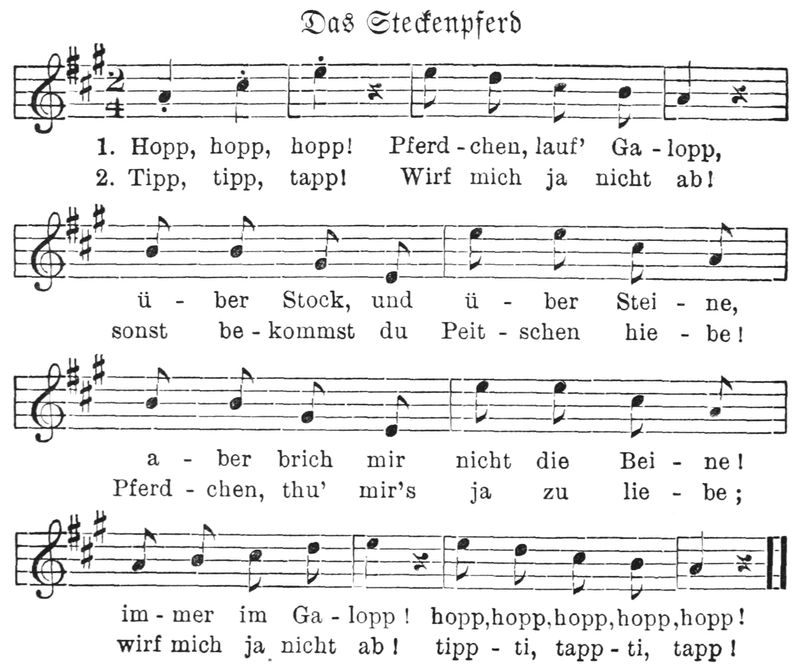
Das Steckenpferd
1. Hopp, hopp, hopp! Pferd-chen, lauf’ Ga-lopp,
2. Tipp, tipp, tapp! Wirf mich ja nicht ab!
ü-ber Stock, und ü-ber Stei-ne,
sonst be-kommst du Peit-schen hie-be!
a-ber brich mir nicht die Bei-ne!
Pferd-chen, thu’ mir’s ja zu lie-be;
im-mer im Ga-lopp! hopp, hopp, hopp, hopp, hopp!
wirf mich ja nicht ab! tipp-ti, tapp-ti, tapp!
Teacher’s aims:—
1. To have the children make a dance which will be suitable to the music of Das Steckenpferd.
2. To help the children to appreciate this form of self-expression,—expression by means of the whole body.
Pupils’ aim:—
To make a little “folk dance” which they will present at the May Festival for the entertainment of parents and friends.
Subject Matter
I. A. Getting the problem before the children.
1. The surprise.
2. Reason for doing this work.
3. Nature of the problem.
B. 1. Set the standard for judging the value of the work done: that is, to have the dance tell the same story as the music.
2. Consider some other familiar melodies, and show, in physical expression, what they tell.
a. Soldier Song. (Bentley Song Primer.)
b. Bye-Low. (Bentley Song Primer.)
c. Old Black Joe.
d. Robin Hood and Little John.
C. Choose those pupils to interpret a song to whom it seems to appeal most.
1.
Soldier Song
—boys.
2.
Bye-Low
—girls.
3.
Robin Hood
—partners.
Method of Procedure
I. A. 1. Do you remember, children, that I promised you a great surprise this morning? Well, this is it.
2. One day, not long ago, Miss S., Miss T., and I were talking over our program for the May Festival, and we decided that the little people did not have enough to do.
The first-grade children are to play a little story, and our two grades, you know, are to sing The Little Princess—so we thought that the second grade ought to have a little part of its own. Now what do you think it is to be? I am going to tell you.
3. We are going to make our own little dance to the music of Das Pferdchen. Don’t you think that will be very interesting?
1. When we made the tunes for our songs last winter, what did the music always have to tell?
Just so, as we make our dance to-day, it must tell the same story as the folk song.
2. Let us sing one of our little songs that we have known for a long time, and see if we can tell, in a dance, how that makes us feel.
Different children may here give different, individual interpretations. Encourage much freedom.
I am thinking of another tune that is quite different from this one. You may sing it with me if you like.
Virginia may show us how that song makes her feel: what she wishes to do when she hears it.
(Handle these two songs in a manner similar to that used for the other two.)
I am going to choose James to dance this, for he knows so much about soldiers.
Whom do you think could best show us how Bye-Low “goes”? Yes, I believe the girls can.
Henry may choose a little boy and girl to show us how this tune (Robin Hood) seems to go.
II. A. Das Pferdchen.
1. Kind of song—gay.
2. Things a little horse would do.
a. Gallop. b. Jump. c. Trot. d. Paw the earth. e. Stamp. f. Step very high. g. Carry his head proudly. h. Prance.
3. Find any or all of these movements in the song.
4. Analysis of stanzas. First stanza—3 parts.
a. Jumping. b. Galloping. c. Jumping lightly.
5. Interpretation of each part by several different children.
6. Criticism.
a. Suggestions and constructive criticism of work done.
b. Judgment of the class as to the relative values of work.
c. Selection made for permanent dance.
7. a. Analysis of second stanza—3 movements.
b. Contrast the general spirit of first and second stanzas.
8. Encourage timid pupils to put forth effort. Have a very weak one work with one who is strong in this line.
II. A. Our little song, Das Pferdchen, is very different from all these.
Let us sing it together, to “la.”
1. What kind of song do you think it is? How does it make you feel?
2. This song is about a little horse. Now what can a little horse do?
3. Now we shall sing our song again, and this time you must listen very carefully so that you can tell what this little horse does.
4. Is this stanza alike throughout, or are there different parts to it? You may raise your hands when we come to the end of each part. Name each part.
5. You may show us how that first part makes you feel, Leland.
Irving may show us his way of doing it.
You have seen these two boys work; have you any suggestion to give?
Which piece of work do you consider more appropriate? Why?
Are you willing to accept this for your finished dance?
Now we have gotten the movements for our first stanza, we shall see if the second stanza is very like it.
How many movements did you hear in it?
b. Is the general spirit of the second stanza just like that of the first?
Compare?
Will you not show us, Josephine, how that little horse seems to go, in this second stanza.
Now William is a very strong horse, so we shall put you with him and make a fine “team.”
III. A. 1. Review the whole dance.
2. Give the incentive to work upon this until it is a very finished product.
3. Provide for a way of getting on and off the floor, when the dance is given.
4. Assignment.
III. A. 1. Since we have gotten all our dance, in parts, maybe you would like to see some one dance it all the way through. Who will be strong enough to do this without any help?
We liked that very much.
2. But I wonder if you feel ready to give this at the May Festival, just as it is?
Why not?
What will be necessary, then, before we can feel satisfied with it?
3. Now we know how our dance is to go after we have gotten out on the floor, but we have not said how we shall get to and from our places.
Don’t you think this is very important?
4. I am going to ask you to be ready to answer this question on Monday:
What will be the most suitable and pleasing way in which to get before our audience; and also, back to our places after our dance has been given.
A LESSON IN ARITHMETIC BASED ON A REAL PROBLEM WHICH WAS INTERESTING TO CHILDREN
Such a lesson gives little opportunity for practice in arithmetical computation, but gives the very best possible motive for the drill work which is to follow. This lesson was planned and taught in the third grade of the Speyer School, Teachers College, Columbia University, by Miss Roxana A. Steele.
Teacher’s aims: To have children appreciate the practical value of itemized bills.
To make children conscious of their need for the multiplication table of six.
Pupil’s aim: To find the cost of the basket of food to be given to a poor family on Thanksgiving Day.
Subject Matter
Thanksgiving baskets are sent annually to the needy families of the neighborhood.
Voluntary offerings of money, groceries, help in preparing and distributing.
An offer to pay for a Thanksgiving basket if the value were estimated.
List of things for the Thanksgiving basket:
1 squash. 2 cans of vegetables. 3 qt. of potatoes. 2 qt. of apples. 6 lb. of beef. 1 qt. of cranberries. 1 lb. of sugar. 1 lb. of nuts. Market list prices:
Small squash 12¢
Large squash 18¢
Canned vegetables 10¢
Potatoes per qt. 8¢
Apples per qt. 12¢
Cranberries per qt. 12¢
Sugar per lb. 6¢
Nuts mixed per lb. 18¢
Small squash 12¢
Large squash 18¢
2 ) 30¢
Medium squash 15¢
Method of Procedure
How many children know about the Thanksgiving baskets which are sent from the Speyer School?
You may tell the rest of the class how this work is planned for.
Miss S. was telling me yesterday that a gentleman offered to pay for one of the baskets, but she did not know the value of one. She said that she knew the different articles which are put into the basket, but did not know the value of each. I thought Grade III could find the cost for her. Would you like to try to do it? (Pupils’ Aim.)
Miss S. gave me a list of the things which are to go into the basket.
As I put the list on the board try to think of the price of each article.
We will choose the average price because our goods will be average goods.
How many are ready to tell the price of squash? How can you find the medium price? You may record the squash. Who can fill in the second line and explain it? Class be ready to criticize.
6 lb. of beef at 16¢ = $.96
$.16
.16
.16 $.16 a lb.
.16 × 6
.16 $.96 for 6 lb.
.16
$.96
Suggestions.
Numbers in straight columns.
Add up and down.
Give proper name to answer.
Board addition.
Papers for Miss S. and the gentleman.
Neat.
Correct.
Good writing.
Cost of Thanksgiving basket, $2.15.
Need of 6 table.
Same method with the other items except item about meat. How can we find the cost of 6 lb. of beef at 16¢ a pound? Teacher do the multiplying, showing the practical value of the knowledge of the 6 table. Which is the better way and why? Is there any question before finding the value of the basket as a whole? Who can give helpful suggestions to make sure that the answer is correct? Checking of results at board by pupil whose work is incorrect. These three children may choose the two best papers and tell why they select them. What have we found out in to-day’s lesson? What do you think we ought to do in the arithmetic lesson to-morrow? (Problem to carry over.) Aim for next lesson to be expressed by pupils.
We cannot always follow in every detail the plan which we make for a lesson. It is interesting in this connection to read Miss Steele’s accurate account of what actually happened when the lesson, as planned above, was taught. The description which follows appeared in the Atlantic Educational Journal for November, 1910.
A PRACTICAL LESSON IN ARITHMETIC
By Roxana A. Steele, Speyer School, Teachers College, Columbia University
Pupil’s aim: To find the cost of a Thanksgiving dinner.
Teacher’s aim: To make children conscious of their needs in arithmetic.
Last fall Grade Three had been studying the wholesale market in industrial work. The wholesale market was compared with the retail market, prices contrasted, etc., and much language and arithmetic work was based upon this work.
A few days before Thanksgiving a gentleman stepped into the school office and offered to pay for one of the Thanksgiving baskets which the school sends out to poor families in the neighborhood. No one seemed to know the exact value of one of the baskets, so Grade Three was asked to make the estimate.
This could have been done by an adult in a few minutes, but it would have been done no more accurately than the children were able to do it after having made a careful study of market lists. The exercise also furnished an excellent child’s aim for the arithmetic lesson. The class felt its responsibility and was anxious to do good work.
The list of things generally put into one of the baskets was given to the class. The children decided upon the average price of each item. This called for an appreciation of the word average. The work was done orally with class discussion. For instance, when the price of a squash was asked, one child said “twelve cents,” another, “eighteen cents,” etc. The class finally agreed that a medium-sized squash would cost about fifteen cents.
Small squash 12¢
Large squash 18¢
2 ) 30¢
15¢
The child who recorded the price of the squash on the board wrote fifteen cents—$.15. Before the lesson was over, several children had a little trouble in writing cents without dimes ($.06), keeping the money columns straight, using the dollar mark and decimal point, etc. With suggestions from other members of the class, the list was complete.
In the item “6 lb. of beef @ 16¢” the class found that it was necessary to multiply by six. As they had never had the six table, I did not expect them to be able to do it, but it chanced that one boy knew his six table and did the work readily.
Marion Thalman.
Nov. 23, 1909.
The Cost of a Thanksgiving Dinner
1 squash $.15
2 cans of vegetables @ 10¢ .20
3 qt. of potatoes @ 8¢ .24
6 lb. of beef @ 16¢ .96
2 qt. of apples @ 12¢ .24
1 qt. cranberries .12
1 lb. sugar .06
1 lb. nuts .18
$2.15
When the price of each item had been decided upon, the children found the total cost at their seats, and their results were compared.
The lesson closed with the question, “What did you find out in to-day’s lesson?” The answers were: “The cost of a Thanksgiving basket”; “That Russell is the only child who knows his six table”; “That we need to write dollars and cents so that we won’t make mistakes.”
At the beginning of the arithmetic lesson the following day, when the class was asked, “What do we need to do to-day?” there was a division of opinion as to whether the drill on dollars and cents or learning of the six table should come first. The decision was in favor of the drill on writing money, and the six table was presented later in the same period.
The result of the lesson on the cost of the dinner was sent to the principal. The class received a note of thanks for the help which it had rendered. The children were proud of their accomplishment and anxious to work out more real problems.
A LESSON FOR APPRECIATION
Teacher’s aim: To help children to enjoy Stevenson’s Bed in Summer.
Did any child in the room ever have to go to bed before it was dark? Did you ever get up in the morning before daylight? Stevenson remembered how he used to feel when he had to go to bed before dark, and wrote a story about it. Would you like to hear the story?
Children’s aim: To enjoy Stevenson’s story about going to bed before dark.
Subject Matter
BED IN SUMMER
“In winter I get up at night
And dress by yellow candle light;
In summer quite the other way,
I have to go to bed by day.
“I have to go to bed and see
The birds still hopping on the tree,
And hear the grown-up people’s feet
Still going past me in the street.
“And does it not seem hard to you,
When all the sky is clear and blue,
And I should like so much to play,
To have to go to bed by day?”
Method of Procedure
I want you to tell me all you can about the place where Stevenson lived, when I am through reading the story.
Read the poem.
Who will describe the place where he lived?
Were there other children who lived near by?
Were there any trees near the house?
I’ll read the poem again and you will see how many reasons Stevenson had for not wanting to go to bed by day.
Read the poem again twice.
Why does he tell you that he has to get up at night in the winter?
When do the birds go to bed?
Do the grown-up people go to bed when children do?
How was he able to see the birds in the trees? Do you think he ever got out of bed?
Do you think all the children in the street had to go to bed as early as Stevenson? Let me read the last stanza and see whether you can tell.
Recall the Mother Goose Rhyme:
“Girls and boys come out to play,
The moon doth shine as bright as day;
Leave your supper and leave your sleep,
And come with your playfellows into the street.”
How did Stevenson know the other children were in the street?
Read the last stanza.
I’ll read the whole story again, and then ask some one to tell me Stevenson’s story about going to bed in summer.
Read the poem, calling attention to the different scenes: (1) The boy that gets up by night and dresses by yellow candle-light. (2) In summer quite the other way, he has to go to bed by day—he has to go to bed and see the birds still hopping on the tree and hear the grown-up people’s feet still going past him in the street. (3) The little boy lying in bed who feels very much abused.
And does it not seem hard to you, etc.? Let us see all of the pictures again. Read in same way again. Who will tell the story? I am going to write it on the board, so that we can tell the story as Stevenson did.
After the treatment indicated above, memorization will be very easily accomplished. The preliminary study for appreciation will make the poem mean more to the children than it could have meant had the teacher simply read it to the children two or three times and then asked them to memorize it.
In a study lesson, the plans will vary from a single exercise in finding the principal thought in a paragraph to a development lesson, not dissimilar as to plan to other lessons of the same type. The recitation lesson may be a development lesson, inductive or deductive, or a drill lesson. The plans would therefore be similar to those given above.
In conclusion, it may be suggested that any teacher who feels that it is impossible to plan all of her work will gain greatly if she will plan carefully for a single subject. As facility is gained in plan making, it will be possible to write plans for two or three or for more subjects. A topic plan should result in definiteness in the work of both teacher and pupils. Good plans give the teacher more freedom in conducting her work, and enable her to tell definitely the progress which the class has made. Plans are necessary in teaching. No one has a right to pretend to teach without previous thought concerning the subject to be taught, and the method to be employed in giving children command of this material.
For Collateral Reading
W. W. Charters, Methods of Teaching, Chapter XIX.
C. A. and F. M. McMurry, The Method of the Recitation, Chapter XIV.
Exercises.
The plans which follow were offered to teachers as suggestions rather than as outlines of subject matter or of procedure to be followed absolutely. Reorganize these plans so as to show subject matter and method separately. Add to the subject matter or method wherever necessary. If you think best, change the organization of material, the statement of aim, the references to books, and the like. Do not change the topic. As a result of your work you should be ready to present a plan for which you are willing to stand.
LITERATURE—THIRD GRADE
Atalanta’s Race
Note.—The story of Atalanta’s Race furnishes material for several lessons. The following outline embraces the whole set of lessons.
Aim:—
To teach the story of Atalanta’s Race.
I. Division into parts.
1. Atalanta.
2. Hippomenes.
3. The Race.
II. Outlining of each part.
1. Atalanta.
a. Her home.
b. Swiftness of foot.
c. Beauty and grace. Desire of youths to win her.
d. Her determination.
2. Hippomenes.
a. Who he was.
b. His decision.
c. His resort to strategy.
3. The Race.
a. Atalanta’s self-confidence.
b. The first apple; the result.
c. The second apple; the result.
d. The third apple; the result.
Preparation:—
Tell me of a game in which one child outruns another.
Tell me of a story in which two animals played a game like this race of Atalanta. (Hare and Tortoise.)
Let us play a game in which two boys run a race.
Let us play the Hare and the Tortoise.
Which is the faster runner, the hare or the tortoise?
How, then, did the tortoise win the race?
Presentation:—
Let the teacher tell the story of the Hare and the Tortoise.
Find in the Atalanta story the person who takes the place of the hare, and the one who takes the place of the tortoise.
By showing the picture in the book, have the children solve the problem.
Did Atalanta expect to win the race? Why not?
How did this make her act?
Did the hare expect to lose the race? Why not?
The teacher may tell the story of the girl going to market with a basket of eggs on her head. She was so sure of getting sale for her eggs that she set to dreaming of the pretty things she would buy with the money she was to get for the eggs. She would buy, she thought, a bright new dress and a new hat; and then how mean and shabby she could make the other girls look; and how she could walk past them all, tossing her head in pride! Forgetting that she was still only on her way to market, she then gave her head a proud little toss; and—what do you think happened?
Let the children give the story of the Hare and the Tortoise in their own words.
What is likely to happen to any one of us who is too sure of winning?
What will we say, then, of any one who is too sure of anything?
It has been said, “Count not your chickens before they are hatched.” What does this mean?
ARITHMETIC—FIFTH GRADE
Aim:—
To teach division of decimals.
The following is assumed as class knowledge upon which the process should be based.
1. Ability to read and write decimals.
2. Vivid knowledge of the relations of one hundred to ten, ten to one unit, one unit to one tenth, one tenth to one hundredth, etc.
3. Knowledge of the process of division of whole numbers.
4. The principle: multiplying or dividing both dividend and divisor by the same number does not change the quotient.
Preparation:—
1. Division by an integer.
a. Find the value of 1 acre of land if 15 acres cost $77115.
$ 5141 15 ) $ 77115 75 21 15 61 60 15 15
b. Find the value of 1 acre of land if 15 acres cost $771.15.
$ 51.41 15 ) $ 771.15 75 21 15 6.1 6.0 .15 .15
Compare the steps in (b) with the corresponding steps in (a). The pupil will experience no difficulty in telling the unit that each quotient figure represents, for he knows that dividing any number into parts does not change its unit.
Presentation:—
a. 12 is contained in 36 how many times?
12 ) 36 3
b. Multiply both dividend and divisor in (a) by 2. 24 is contained in 72 how many times?
24 ) 72 3
c. Multiply both dividend and divisor in (a) by 10. 120 is contained in 360 how many times?
120 ) 360 3
Compare the quotients. Recall the principle: Multiplying both dividend and divisor by the same number does not change the quotient.
d. .2 is contained in 2.4 how many times? Multiplying both numbers by 10, to what is the divisor changed? To a whole number. 2 is contained in 24 how many times?
2 ) 24 12
e. .22 is contained in 2.42 how many times? Change .22 to a whole number, by multiplying both the numbers by 100. 22 is contained in 242 how many times?
11 22 ) 242 22 22 22
f. .005 is contained in .125 how many times? By what shall both numbers be multiplied so that .005 may become the whole number 5? 5 is contained in 125 how many times?
5 ) 125 25
g. 2.88 is contained in 3.456 how many times? By what shall both numbers be multiplied so that 2.88 may become the whole number 288? 288 is contained in 345.6 how many times?
1.2 288 ) 345.6 288 57.6 57.6
Many such examples will enable the pupils to formulate the generalization: “To divide a decimal by a decimal, multiply the dividend and divisor by the power of ten that will change the divisor to an integer, then divide as in simple division.”
NATURE STUDY—FIFTH GRADE
Detailed Plan for a Series of Lessons
Topic:—
The horse.
Materials:—
The horse seen on the street; drinking fountains; horsemanship observed; harness; shoes; protection; different kinds of vehicles; printed matter issued by the Society for the Prevention of Cruelty to Animals and by the Department of Agriculture.
Aim:—
To train the children to meet sympathetically and intelligently their responsibilities to the horse.
Preparation:—
Years of interest in horses; directed observation of other periods.
Presentation:—
1. Stories of horses known to the children—those owned by their parents, fire horses, horses of the mounted police, showing their faithfulness, intelligence, strength, training, treatment.
In the city of Baltimore the old fire horse is practically pensioned when unfit for further service. This is one way in which right-minded people acknowledge their obligations to horses, by providing for their comfort in their old age.
Have stories like the Pacing Mustang read to the class; allow the children to take the storybooks home, and encourage them to bring to the class other stories about horses. Encourage the children to read brief histories of the great breeds of horses—the Norman horses, Clydesdales, etc.—horses that hold the world’s records for speed.
2. Observations to identify horses that show normal blood, and discover their fitness of blood and temperament for the work they are doing.
Are they strong enough for the work they are required to do?
Are they disturbed by passing street cars? If so, how do they show it?
What is the effect upon them of the confusion of other city noises?
Notice that while some horses are evidently distressed by the confusion of city life, others love it and become homesick when sold for use in the country.
Blanketing:—
Call attention to the manner in which large firms so carefully blanket their horses.
Why should a horse be blanketed when he is standing?
Shoeing:—
Notice the cause of slipping, stumbling, and falling on icy or wet pavements, and therefore the necessity for rough shoes, rubber shoes, etc.
If possible, bring into the class a specimen of a patent horseshoe; the shoe and shield of a cart horse.
Harness:—
Is the horse easy in harness?
What sort of a checkrein would you use? Why?
Why is the back pad used with the two-wheel cart?
What are the effects of an ill-fitting harness?
What do you think of the law which in some places punishes a man whose horses show galls?
Horsemanship:—
Have the children report critical situations which have happened within their observation and how they were met by drivers; their observation of the affection shown by a horse toward his master.
General Condition of Horses:—
Discuss the effect of grooming upon the horse’s coat.
Why should the horse be fed regularly?
Why should ground food be given to an old horse whose teeth are poor?
Discuss the necessity of allowing the horse freedom in traveling.
Temporary lameness is frequently due to a stone in the foot; how may it be removed?
What should be done for a horse that is seriously lame?
3. The economic value of such knowledge as the foregoing:—
Horses are stiffened by standing unblanketed in the wind or cold.
Foundering is caused by watering a horse when he is over-heated.
A properly fitted harness and a comfortable checkrein, if any is used, save the strength of the horse.
The selection of a horse whose strength and temperament fit him for his work adds to his value and usefulness.
Skillful drivers, especially those who like their teams, can secure a great amount of work from them and yet save much of their energy. It frequently happens that after a day’s work one man will bring in a team comparatively fresh, while under a different driver the same team will be worried into exhaustion.
4. Knowledge of the work of the Society for the Prevention of Cruelty to Animals:—
The work of this society demands judgment based on a fuller knowledge of conditions and causes than most children of their ages possess. Its work, therefore, is not intended for children, but they should know what help they may give the society, and be taught to use it.
5. Knowledge of the city law for protecting horses.
Seat Work:—
Sketches of horses’ hoofs showing how a stone may cause lameness.
Sketches of different kinds of shoes.
Sketches of different kinds of checkreins: the overdraw check and its effect; side check and its effect.
Different head and ear postures of horses indicative of their conditions and feelings.
Getting records of observations into shape to present to class.
Have each member of the class imagine himself to be his favorite horse,—a fire horse; mounted policeman’s horse; a United Railway repair wagon horse; a hospital ambulance horse; an express-wagon horse; a carriage horse; a broken-down carriage horse, etc.,—and write a story of his part in a fire, a serious accident, or some other situation.
Give related language work.
GEOGRAPHY—FIFTH GRADE
Detailed Plan for a Series of Lessons
Topic:—
Pittsburg as a trade center.
Materials:—
Pictures, maps, sand table, specimens of iron ore, coal, coke, limestone, reference books, railroad folders.
Aim:—
To show how natural advantages have determined the location and growth of Pittsburg; to show the direction and extent of manufacturing and commerce in Pittsburg.
Preparation:—
1. Study of coal mine, iron mine, blast furnace.
2. Relation of iron mines to coal mines.
3. Location of Pittsburg—
(a) in coal region.
(b) at junction of rivers which form the Ohio River.
Presentation:—
(Following closely McMurry’s Special Method in Geography.)
1. Advantages of Pittsburg for iron and steel manufacturing. Illustrate with sand map.
(a) Coal region—rivers bring coal to Pittsburg.
(b) Iron region near.
Much iron ore brought from Lake Superior region via Great Lakes, by railroad from Lake Erie.
In manufacture of steel more coal is used than iron ore; it pays to bring iron ore to coal.
(c) Manufactured products—steel rails, armor plate, pig iron.
(d) Rank of Pittsburg in regard to manufacture of iron and steel. Pittsburg makes 10 per cent of all iron and steel goods made in the United States.
2. Neighboring manufacturing towns.
(a) Names—Allegheny, Carnegie, Homestead, Braddock, etc.
(b) How do their manufactures compare with those of Pittsburg in kind? in quantity? in value?
3. Coke ovens.
Uses of coke.
Kind of coal used; where obtained.
Amount of it put into each oven.
Length of burning.
By-products.
Drawing out and cooling.
Extent of ovens.
Effect on landscape.
4. Blast furnaces.
5. Other manufactures.
(a) Oil refining.
Where oil comes from.
How it is pumped, carried, stored.
Value of pipe lines.
How is oil brought to Baltimore?
Effect of oil tanks on landscape.
Processes of refining.
Dangers.
Uses.
By-products.
(b) Glass making.
Kinds of glass made.
Materials used.
Where found.
6. Transportation by water. Illustrate with sand map.
(a) Need for means of transportation: of raw material to Pittsburg; of manufactured products from Pittsburg.
(b) Rivers.
The Allegheny and Monongahela bring raw materials to Pittsburg.
The Ohio carries raw materials and manufactured products away from Pittsburg.
No tracks or roadbed to be laid for river,—river always ready; Ohio deep enough for large barges; swiftness of current due to nature of slopes.
Coal and iron carried by river as far as New Orleans.
7. Railroad center.
(a) Sections of country not reached by waterways. How products are transported to those parts?
(b) Need of railroads for people who travel to and from Pittsburg.
(c) Chief directions in which railroads lead from Pittsburg. What roads lead from Baltimore to Pittsburg? From New York to Pittsburg?
(d) What supplies are brought by railroad besides those needed in manufacturing?
8. Aspects of the city of Pittsburg:—
Wealth—opportunities for getting, for spending.
Education—what special class of schools likely to develop.
Smoke and dirt—due to nature of manufactures.
Seat Work:—
Illustrative drawings.
Maps showing coal and iron regions, course of rivers.
Related language work.
Reference reading.