A BREATH OF PRAIRIE
Reading edition
AND OTHER STORIES
By WILL LILLIBRIDGE
THE DOMINANT DOLLAR. Illustrated in color by Lester Ralph. Crown 8vo . . . $1.50 BEN BLAIR, PLAINSMAN. Frontispiece in color by Maynard Dixon. Seventieth thousand. Crown 8vo . . . $1.50
QUERCUS ALBA: The Veteran of the Ozarks. With frontispiece. 16mo. Net . . . $.50
A. C. MCCLURG & CO., Publishers CHICAGO
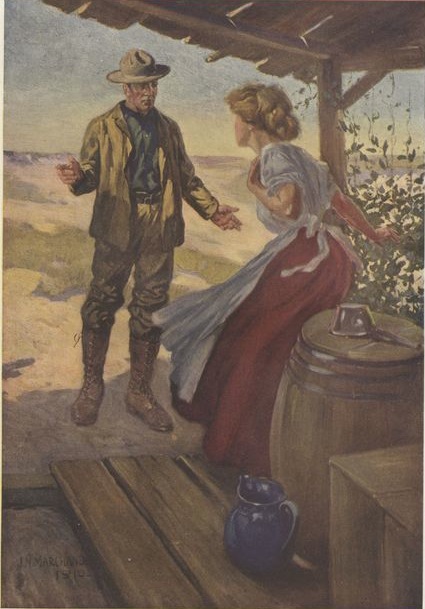
She wheeled swiftly round, confronting him. [See “Journey’s End.”]
A
BREATH of PRAIRIE
AND OTHER STORIES
BY
WILL LILLIBRIDGE
AUTHOR OF “BEN BLAIR,” “THE DOMINANT DOLLAR,” ETC.
WITH FIVE ILLUSTRATIONS IN COLOR BY J. N. MARCHAND

CHICAGO
A. C. McCLURG & CO.
1911
Copyright A. C. McCLURG & CO. 1911
Published April, 1911
W. J. Hall Printing Company Chicago
A TRIBUTE
It is an accepted truth, I believe, that every novelist embodies in the personalities of his heroes some of his own traits of character. Those who were intimately acquainted with William Otis Lillibridge could not fail to recognize this in a marked degree. To a casual reader, the heroes of his five novels might perhaps suggest five totally different personalities, but one who knows them well will inevitably recognize beneath the various disguises the same dominant characteristics in them all. Whether it be Ben Blair the sturdy plainsman, Bob McLeod the cripple, Dr. Watson, Darley Roberts, or even How Landor the Indian, one finds the same foundation stones of character,––repression, virility, firmness of purpose, an abhorrence of artificiality or affectation,––love of Nature and of Nature’s works rather than things man-made. And these were unquestionably the pronounced traits of Will Lillibridge’s personality. Markedly reserved, silent, forceful, he was seldom found in the places where men congregate, but loved rather the company of books and of the great out-doors. Living practically his entire life on the prairies it is undoubtedly true that he was greatly influenced by his environment. And certain it is that he could never have so successfully painted the various phases of prairie-life without a sympathetic, personal knowledge.
The story of his life is characteristically told in this brief autobiographical sketch, written at the request of an interested magazine.
“I was born on a farm in Union County, Iowa, near the boundary of the then Dakota Territory. Like most boys bred and raised in an atmosphere of eighteen hours of work out of twenty-four, I matured early. At twelve I was a useful citizen, at fifteen I was to all practical purposes a man,––did a man’s work whatever the need. In this capacity I was alternately farmer, rancher, cattleman. Something prompted me to explore a university and I went to Iowa, where for six years I vibrated between the collegiate, dental, and medical departments. After graduating from the dental in 1898 I drifted to Sioux Falls and began to practise my profession. As the years passed the roots sank deeper and I am still here.
“Work? My writing is done entirely at night. The waiting-room,––the plum-tree,––requires vigorous shaking in the daytime. After dinner,––I have a den, telephone-proof, piano-proof, friend-proof. What transpires therein no one knows because no one has ever seen.
“Recreation? I have a mania, by no means always gratified,––to be out of doors. Once each summer ‘the Lady’ and I go somewhere for a time,––and forget it absolutely. In this way we’ve been able to travel a bit. We,––again ‘the Lady’ and I,––steal an hour when we can, and drive a gasoline car, keeping within the speed laws when necessary. Once each Fall, when the first frost shrivels the corn-stalk and when, if you chance to be out of doors after dark you hear, away up overhead, invisible, the accelerating, throbbing, diminishing purr of wings that drives the sportsman mad,––the town knows me no more.”
Every novel may have a happy close, but a real life’s story has but one inevitable ending,––Death.
And to “the Lady” has been left the sorrowful task of writing “Finis” across the final page.
January 29, 1909, he died at his home in Sioux Falls after a brief illness. But thirty-one years of age, he had won a place in literature so gratifying that one might well rest content with a recital of his accomplishments. But his youth suggests a tale that is only partly told and the conjecture naturally arises,––“What success might he not have won?” Five novels, “Ben Blair,” “Where the Trail Divides,” “The Dissolving Circle,” “The Quest Eternal,” and “The Dominant Dollar,” besides magazine articles, and a number of short stories (many of them appearing in this volume) were all written in the space of eight years’ time, and, as he said, were entirely produced after nightfall.
While interested naturally in the many phases of his life,––as a professional man, as an author, as the chief factor in the domestic drama,––yet most of all it pleases me to remember him as he appeared when under the spell of the prairies he loved so well. Tramping the fields in search of prairie-chicken or quail, a patient watcher in the rushes of a duck-pond, or merely lying flat on his back in the sunshine,––he was a being transformed. For he had in him much of the primitive man and his whole nature responded to the “call of the wild.” But you who know his prairie-tales must have read between the lines,––for who, unless he loved the “honk” of the wild geese, could write, “to those who have heard it year by year it is the sweetest, most insistent of music. It is the spirit of the wild, of magnificent distances, of freedom impersonate”?
To the late Mrs. Wilbur Teeters I am indebted for the following tribute, which appeared in the “Iowa Alumnus.”
“Dr. Lillibridge’s field of romance was his own. Others have told of the Western mountains and pictured the great desert of the Southwest, but none has painted with so masterful a hand the great prairies of the Northwest, shown the lavish hand with which Nature pours out her gifts upon the pioneer, and again the calm cruelty with which she effaces him. In the midst of these scenes his actors played their parts and there he played his own part, clean in life and thought, a man to the last, slipping away upon the wings of the great storm which had just swept over his much-loved land, wrapped in the snowy mantle of his own prairies.”
Edith Keller-Lillibridge
CONTENTS
I A BREATH OF PRAIRIE 13
II THE DOMINANT IMPULSE 61
III THE STUFF OF HEROES 87
IV ARCADIA IN AVERNUS 109
ChapterIPrelude
ChapterIIThe Leap
ChapterIIIThe Wonder of Prairie
ChapterIVA Revelation
ChapterVThe Dominance of the Evolved
ChapterVIBy a Candle’s Flame
ChapterVIIThe Price of the Leap
V JOURNEY’S END 239
VI A PRAIRIE IDYL 265
VII THE MADNESS OF WHISTLING WINGS 279
ChapterISandford the Exemplary
ChapterIIThe Presage of the Wings
ChapterIIIThe Other Man
ChapterIVCapitulation
ChapterVAnticipation
ChapterVI“Mark the Right, Sandford!”
ChapterVIIThe Bacon What Am!
ChapterVIIIFeathered Bullets
ChapterIXOblivion
ChapterXUpon “Wiping the Eye”
ChapterXIThe Cold Gray Dawn
VIII A FRONTIER ROMANCE: A TALE OF JUMEL MANSION 309
IX THE CUP THAT O’ERFLOWED: AN OUTLINE 339
X UNJUDGED 347
XI THE TOUCH HUMAN 367
XII A DARK HORSE 373
XIII THE WORTH OF THE PRICE 393
ILLUSTRATIONS
She wheeled swiftly round, confronting him. Frontispiece
They saw the hands which had gone to hips flash up and forward like pistons, and two puffs of smoke like escaping steam. 74
“You’ll apologize.” 190
The two men went East together. 326
He heard a voice ... and glanced back. 388