Front matter (continued 4)
Reading edition
Of an evening, too, while the weather was so open, George and his brother, Jim and other neighbours would drive over, and there would be a jovial supper, followed by a dance, when Mrs. Strike bustled Joe tremendously, till the rough furniture was cleared aside and the boarded floor made ready for the dancers. Then it was Hank's turn, and sometimes Jim's, though Hank was the one who usually obliged. Seated cross-legged in a corner, his face as serious as if he had an army of Redskins after him, the curious and lovable little fellow would bend over his concertina and send forth such notes, that dancing became easy even to the most clumsy.
Those were jolly days. The jovial and friendly fellow who had come out from England had found not a set of desperadoes in the settlers of the Dominion, but men and women just as he had known at home, with only the difference which climate and environment necessarily bring. Hard workers, they liked Joe because he was like them in that, and because of his modesty. They liked him, too, because of his open admiration of the country of his adoption and the life he led.
"Ef they was all like you there never wouldn't be any squabbling," said Peter; "but Canadians is getting to understand the Britisher better. He's coming out in greater numbers now, and sense he and we are the backbone of the country, why, we're fools if we ain't friends."
It was on a bright, clear, frosty morning that Hank and Joe climbed into Peter's rig and, with that worthy driving, set off for the nearest station. Mrs. Strike wiped her eyes as they went, for she was genuinely fond of them, while Tom shook Joe's hand as if he would wrench it off and hold it as a keepsake. An hour later they were aboard the train, and could see Peter driving back home to the settlement.
"Guess he's a good fellow, and deserves to succeed," said Hank, settling himself into a corner. "When next we see him it'll be spring or later hereabouts, and things will have changed wonderfully. There'll be a pile of people here compared with what's settled now. That's always the case; every year makes a huge difference. Shouldn't wonder if the plots you've bought didn't bring you in a small fortune; but of course it's a toss up."
Joe watched the surroundings as they pulled out of the station, noting the many shacks in the distance, and the fact that nearer the railway some of the older settlers had replaced their log dwellings by neatly-boarded houses. It was close to some of these that he himself, with the advice of Hank and Peter, had purchased certain portions of vacant ground in the hope that, as time passed, a township might spring up, and thereby make his purchases more valuable. As to Hurley's quarter section, the winter being on them, it happened that there was no one who cared to purchase, and Joe had picked it up at a very modest figure.
"You jest forget all about them things and set yer mind to the expedition we're after," said Hank, after a while. "Fust we goes along to Sudbury, where we can buy all that we want; then we sets off for Fennick's. Guess we'll put in a week with him, and then strike off for the country we're after. Maybe we'll get a bit of huntin', and seems to me we should be wise, for a pelt or two will be useful for bedcovering. Of course you've got to be able to stand the cold, youngster. There's lots would think this job but madness. But a man can easy stand the winter ef he's in hard condition, and particularly ef he's in amongst the forests. As to bear, why, seeing as they hibernate, there ain't much chance of meeting the beasts, though it do happen sometimes that one of them gets disturbed, and then, ef he ain't too sleepy, jest you look out fer ructions. I don't know of any animal that's so tarnation dangerous as a bear, 'cept perhaps a caribou, and he's jest every bit as bad as, they tell me, is a rhinoceros. Ever hunted, lad?"
Joe was forced to admit that he had not. "Never had the chance," he answered. "Minding a cycle shop for Father didn't give one opportunities of going hunting, and besides, there isn't much to be had in England, not of the sort you mean."
Of a sudden, as they sped along in the train, his thoughts went back to the little township in which he had spent his boyhood, till the moment had arrived for him to emigrate. He could not help but contrast his condition here in Canada with what it had been there, and with what it might have been had he remained. Travel and the wide expanse of New Ontario lands had broadened Joe's mind, as it is bound to broaden the outlook that any traveller takes of the world. Joe was, in fact, beginning to realize that there is some truth in the statement that travel is one of the finest educations.
"In course it is," asserted Hank, when he broached the subject, with the idea of starting up a conversation with the little hunter. "How could it fail to be? Don't I know the lives of them stay-at-homes. They work hard, no doubt. They does their whack of toil that helps to make the earth turn round, as you might say, and keep things hummin'; but, 'cept for the papers and sichlike, they ain't got two ideas as to what other people's like, what they does with themselves, and how they lives. And there's more, too, ef I could tell you. Stay-at-homes is sometimes narrow-minded. Narrow-mindedness gives rise to suspicion, so that it follows that men who are ignorant of one another's affairs and of all that concerns 'em is often not too good friends. That's how it is with nations. One don't know the other, and suspects all sorts of things. Wall, see what's happenin'. The railways and the steamships and them motor cars has made a deal of difference. People move about a heap these days and see other people. So they get to understand 'em, and, understandin' them, they see as they ain't much different to themselves; also, they see that their intentions are just as friendly as their own. And what follows? Why, better understanding, and the way is paved to international friendships. Dear, how jawin' do tire a man! I'm on fer a smoke."
He shut up like the proverbial oyster, leaving Joe to go on immersed in his own particular brown study. He was wondering now what the Fennicks had been doing with themselves, for though he had had a few lines from them, he had had but the scantiest information; he had heard, in fact, that they had settled, and that was all. Whether they had been fortunate in finding exactly the class of surroundings they desired, and whether the land they had chosen was rich, he had no idea. This he knew, they were a two-days' march from the railway, so that he and Hank had a long step before them.
"Guess we'll fill up at Sudbury," said Hank, after a while. "There's a gun wanted fer you, and ammunition for both of us. A shooter, too, ain't out of the way. We shall require warm clothing, too, though we'll trust to our shooting to get us pelts and make the most of those. A kettle, a fry-pan, and a few sich trifles will fill our kit, and then we'll step it to the Fennicks'. Guess we ain't so far from Sudbury now."
They found all they required in the town to which they had booked on the railway, and laid out quite a number of dollars in buying necessaries for their journey; for Hank insisted that salt, sugar, coffee, and tea were as necessary to them as were bullets. Each bought three pairs of thick socks, as well as roughly-fashioned fur gloves. The cooking equipment presented no difficulties, while neither bothered to buy extra boots.
"They'd load us up, that's all," said Hank; "besides, they ain't no use with snowshoes. You wait a bit till we're well away. We'll bag a few beasts that will give us skins, and then ef Hank can't make moccasins and caps and sichlike, why, all his eddication in the woods is lost. We've got enough as it is to carry, and come the time we reaches up at Fennicks' we'll be sorry we brought so much."
"What about some sort of covering for the night?" asked Joe, who was as yet ignorant on such matters.
"Coverin'?" asked Hank, scratching his head.
"Yes; surely we shall need it. It'll be frightfully cold, that is, if the story I have heard is true."
"True enough, lad," agreed Hank; "only, yer see, you and I'll be movin' every day, and exercise on snowshoes warms a man's blood. I know lots of young fellows who go off from their farms when snow's lyin' everywhere and the thermometer is 'way down below zero; but their shirts is open in front jest as ef it war summer, while they ain't got no use fer gloves. We'll be much the same, while at night a lean-to—a double lean-to, you understand—made by driving two forked sticks into the snow and laying one across the forks, with others leaning up agin it, will give us a crib that couldn't be beaten fer warmth. I kin hear folks that stays at home always shiverin' talkin' of rheumatism; but there ain't nothing of that. A man who starts healthy through a Canadian winter can keep healthy. Of course there's blizzards, and nasty, dangerous things they are! I've laid in one of them lean-to shacks as I've mentioned fer a week together till the snow was piled deep over the top, and would ha' broken through ef I hadn't crawled out every few hours and beaten it down. Cold? It warn't! It war hot inside that 'ere crib. As fer lonely, wall, to some folks it might be, but to me and mates like me—no, not bit! There's always a gun wants cleaning; logs has to be broke and the fire kept going, and there's tea and sichlike to prepare; while in between a man's got his pipe, and can smoke and think. Thinkin' ain't bad fer a man, nor fer a woman, ef it comes to that. There's many a time 'way back in my life when I might ha' done different and better. Wall, then, rememberin' that aer good; it's a sort of eddication. Then there's friends that you've knowed and had high times with. Guess it's when a man gets stuck up in a blizzard, with only his pipe to smoke, that he gets thinking of his old pals, wondering what they're doing, where they are, and how the world aer going fer them generally."
"But what about frostbite?" asked Joe, for that was a bogy which had been presented to him in glaring colours.
Hank laughed, a silent little laugh which shook every inch of his frail body. "Them old woman's tales was invented to scare new folks out from home," he said. "There's frostbites and there's frostbites. I ain't saying that they don't exist, but a hunter don't often get 'em, unless he's held up somewheres and can't get cover. His blood runs strong and hot most times, and the frost don't touch him. But it's the man who ain't used to the cold, and who huddles up in a shack most of the day, that gets bitten. Ef he's sensible, or has sensible friends, it don't make much harm to him. Ef not, like as not he loses a toe or a finger, or maybe a foot, though it's rare, so far as I'm able to reckon. You ain't likely to get bit; a chap same as you, who's always on the hop, gets his blood runnin' all the time. Don't you give a thought to it, Joe."
Having stayed in the town sufficiently long to complete their equipment, Joe and Hank finally took the track for that part of the country in which the Fennicks had settled. The weather was still quite open, though cold. But the bracing air agreed wonderfully with them both, and though there was not the smallest need for haste, they stepped out strongly, sending the miles rapidly behind them. It was some distance outside the town that they came upon a party of travellers riding in, and recognized Mike, the policeman, as one of them.
"Hallo, Mike!" sang out Hank. "Been after more of them 'ere murderers? How'd the case go with Hurley? This here Joe ha' been waitin' case he should be called for evidence; but he heard a while ago as he warn't likely to be wanted."
The face of the huge policeman, already tanned a deep colour, went red under his tan, while an expression of annoyance flitted across his features.
"We made a muss of that 'ere thing, Hank," he declared. "Joe wasn't called for the simple reason that the folks who'd taken Hurley in charge let him give 'em the slip. He got clear away, and I'm jest now returning after a chase. He's gone—where, I don't know. But he's got clear, which aer a bad nuisance. Jest you mind that you don't come up agin him. He's not the one to forget old scores, and he'd rub it in ef he'd the power. Wall, so long! I must get back and report; someone's going to get trouble over this business."
They parted where they had met, Hank and Joe pushing onward still at a sharp pace.
"I'm jest sorry that Hurley got clear," said Hank, after a while, as if he had been thinking the matter out. "He's a bad man aer Hurley, and bad men away in the wilds are apt to bring trouble to people. I've knowed one who took up with a party of Redskins wandering in the forests, and, gee! he didn't stop at anything. He'd made bad trouble before the police rounded him up and shot him down. Let's hope we shan't knock across this Hurley. Now, lad, guess we'll do another mile or so and then fix our camp fer the night. Looks ter me as ef it might snow, so we'll be wise to make all snug and tidy."
They came to a halt finally beside a small wood, and, penetrating to a part where the trees were of considerable size, deposited their belongings on the ground.
"Don't do to camp where it's damp, in the fust place," explained Hank. "Where there's muskegs the trees soon rot, and ef a wind springs up you might have the trunks coming about your ears, to say nothing of rotten branches. This place is high and dry, and the trees, being stout and well inside the wood, will stand up to a gale. Now fer that shack I was talking about. Look out fer a tidy long-forked stick, and fer other straight ones to lay across."
Hank was evidently a past master at all that appertained to camping, for even without Joe's aid he would soon have erected the shack. Taking two forked sticks, he drove the straight end in each case as deeply into the ground as he was able; a third was laid over the forks, and then a number were allowed to lean against the one laid horizontally. Thus a species of tente d'abri was constructed, and a roofing quickly put to it, by the simple means of slashing off spruce twigs and branches and laying them on top.
"That ain't always enough," explained Hank. "Ef there's a bad wind, it would blow all them branches away. But it don't take long to cut turfs or to peg the branches down, whichever you've a fancy for. Seein' as the ground in here ain't over-hard, we'll take turfs; the wind won't hurt 'em, and ef it turns to rain instead o' snow, why, not a drop'll fall through. Now fer a bed—one between us, mate, for we'll be companions in every way. A pile of these spruce twigs will suit us well; then we'll light the fire and get the kettle going. A pot of tea with a morsel to bite won't come amiss after our march. How do yer think you'll like prospecting?"
Joe did not think; he was emphatic about the matter, for the farther they went the better he enjoyed the trip. He busied himself now with the fire, for, during the chase of Hurley, George Bailey had taught him much that concerned the culinary portion of a camp. Then he produced a small loin of pork, and, cutting portions from it, soon had them sizzling over the flames.
"My, what with the smell of these here spruce boughs and that 'ere pork, it makes a hunter's mouth jest water!" declared Hank, sitting down to watch Joe, and smoking the pipe which he loved so much. "See here, youngster, while you're gettin' supper ready I'll collect a few more logs. There's never any sayin' what sort of weather we may have, and ef we was short of firin' we'd have to eat cold grub, which ain't over fanciful, I kin tell you."
By the time he was back in the camp Joe had a number of pieces of pork cooked, and was fain to admit himself that the smell of cooking them was most appetizing. Then, as the shades of night drew in, he and Hank—as strangely an assorted couple as one could well come upon—sat down in the entrance of their humble shack and, wrapping blankets about their shoulders, ate their supper, enjoying every mouthful of it as others cannot do, even your gourmet set before the most recherché meal that was ever invented; for an active open-air life gives zest to everything. Your traveller does not complain of the toughness of his steak or of the weakness of his tea. He is thankful for all that is set before him, and with appetite sharpened by exercise, and tastes unspoiled and unpampered by a multiplicity of viands and etceteras, eats heartily, thankful that there is food to be had, mindful perhaps of other times when he went hungry.
"Wind's turned," stated Hank, as he rose after supper. "It's got away round, and we're in for a north-easter. That mostly brings snow, so I shouldn't wonder ef we was buried nigh the mornin'. That means snowshoes, and it aer a lucky thing that I brought all the fixings. There's many as buys their snowshoes. I ain't one of them. Ever sense I was as high as a table I've made 'em myself. Throw on another log, Joe, and let's get snug down inside. And jest for a moment have a look at our shack. You can see that I've faced it so that the opening looks west and south. Ef there's snow from the north-east it won't enter so easy, though, in course, there'll be eddies in here amongst the trees, and some of it'll be blowed in."
Tossing branches on the fire, Joe soon joined his comrade, when the two wrapped their blankets round them and were quickly asleep; but at midnight they were awakened by noise without, and crept to the exit of their shack.
"Blowin' moderate," said Hank, "and my, ain't it snowin'! Lucky there's a moon. It makes it look as ef the weather wouldn't be outrageous."
Joe was enchanted when he looked out into the forest. It was his first real taste of a Canadian winter; for here, besides the cold blast which whistled amongst the trees, there was snow. Flakes eddied and twirled everywhere. They came sidling down upon the shack as if afraid to disturb the campers. They had already formed a white carpet over the ground, while many a branch was groaning beneath the added weight. Under the rays of a pale, wintry moon the scene was simply enchanting.
"Beautiful!" declared our hero. "And just fancy being in camp at such a time! It would make them all sit up and have fits away back in Old England."
"It'd make men of some of them that needs changin'," grunted Hank. "You jest wait a tidy bit. This ain't nothing to what we'll get before we've done with the winter. But let's creep back agin'. It ain't too warm outside, and reckon the inside of that 'ere shack aer as comfortable as a feather bed under the roof of a palace."
It was, in fact. Joe's head hardly touched the heaped pillow of twigs when he fell asleep, and slumbered on, oblivious of the increasing sounds without and of the silent snowflakes settling overhead.
CHAPTER XII
The Canadian Winter
"It aer jest blowin' an almighty gale, and there ain't nothing to do but feed and make our snowshoes," said Hank, when early on the following morning he and Joe looked out of the shack. "It aer a lucky thing fer us that we brought a tidy-sized piece of pork along with us, 'cos this gale might last fer days. Not as I think it will, but it might; and ef we hadn't had plenty of grub, gee! it would ha' been a bad case."
Such a prospect met Joe's gaze when he stood to his full height and, having helped to throw the snow away from the entrance of the shack, peered over the white edge before him! The trees on either hand were heavily laden with snow. Branches here and there had crashed to the ground and lay in an unrecognizable heap, save for a twig here or a stronger bough there thrusting a way upward into the light; for all around everything was covered, smoothly clad in an all-pervading vestment of white. Gorgeous blue shadows lurked here and there, the faintness of the colouring adding to its beauty. Long icicles, beside which those to be seen in England were but babies, hung from branches already overweighted, one, a ponderous fellow, drooping to within a few feet of the shack; for the heat of the fire had melted the snow as it fell upon a branch above, and had produced this monster with the help of the frost.
"You kin get in at breakfast," said Hank, looking about him with the manner of a man who saw nothing extraordinary about the transformation which had arrived since the day before. "The fire's been out this two hours, so you'd best start another."
Joe showed his want of experience at once, for he began to rake away the snow, so as to get down to the ashes of the fire he had built on the evening of their arrival. But Hank stopped him with a merry guffaw.
"That ain't the way," he said. "You start buildin' yer fire right here on top of the snow. It'll eat its way down. Yer see, ef you was to begin right down in a hole, there wouldn't be any sorter draught, and how's flames to get in at the damp wood ef you don't have draught to help 'em? But once they get movin', and things is hot, why, in course the fire burns its way slowly downward to the ground level, when there ain't sich draught required."
It was one of the sort of things Joe and many another new to this country, and to such quaint surroundings, would never have thought of, though he was quick to see the reason in Hank's explanation. He arranged his logs, therefore, on the top of the snow, and then removed them once more.
"Wall?" asked Hank, who seemed always to have one eye for our hero, whatever he happened to be doing himself. "What are the game now?"
"Too much draught, that's all," grinned Joe, blowing on his fingers, for an icy wind whirled the flakes about him. "Too much of it, Hank. Blow the fire out or set our shack alight. Fine that'd be—eh?"
The little hunter grinned widely and nodded vigorously. "Good fer you," he shouted. "I've knowd chaps as would ha' taken a month o' Sundays ter spot that. There's some as is jest almighty windbags, and go about talkin' so much that they can't think, let alone allow others that has a mind to. There's something in bein' silent at times, Joe. A man ain't a fool 'cos he stays quiet takin' in things as they happen."
He sniffed the air as Joe's pork steaks began to frizzle, and looked up from the work he was engaged on when the kettle began to send out a merry tune, heard in spite of the howling wind. Steam whistled from the spout, and was the signal for Hank to step across to the canteen and extract the tea leaves which were to form their staple beverage during the trip.
"Tea aer comfortin'," he had said many a time, "and tea aer sustainin'. There ain't a one as I knows of that don't drink tea and feel better fer it. In course there's a few as is ill and find it hurts 'em, but, gee! you get to thinkin' of all the old ladies who swears by a cup! As fer hunters and prospectors and sich-like, tea don't hurt none of 'em. Summertime, when it's cold, it quenches thirst better nor anything I've met. And winter, when it's that cold you can't feel yer hands, why, a tin dish of the stuff warms yer right down into yer boots and sets toes and fingers tingling. Pitch in the dose, lad. I'm that set this mornin', seems to me I could eat all you've cooked single-handed, and a tidy slice more in addition."
It was all good-humoured fun, and Joe found that Hank was a splendid travelling companion; for he had proved time and again now that he had a means to get over more than ordinary difficulties, and that whatever the times, pleasant or foul, he was genial and bright, always looking on the right side of misfortunes.
"Now, jest as soon as you've cleaned up these here things, we'll finish off the shoes and try 'em," said Hank, when they had eaten their fill. "I brought along these two sets of frames from home, they being the ones I made this four year back. The strip to go across 'em war to be had back there in the settlement, and all we've got to do is to bind it on. Ever been across snow afore, lad?"
Joe had to acknowledge that he had not. As he melted snow in his kettle and washed the few tin utensils they carried with the resulting water, he watched the busy fingers of the hunter threading raw hide strips through holes bored in the tough, bending wood which formed the frames of the snowshoes. Then he was shown how to lash them to his feet, while a little later he essayed to test them, and, clambering out of the hollow which they now occupied, joined Hank on the snow. But Joe did not remain long there; a projecting bough brought his attempt to a sudden ending. One shoe caught badly, and before our hero knew precisely what was happening or where he was going, he took a header into the soft snow, till Hank could merely see a pair of shoes waving wildly above it.
"You jest try agin, and take care of snags comin' up from below," he cautioned our hero. "This here snowshoein' ain't really difficult. A fellow soon gets the knack or hang of it, and then he can go across frozen and snowed-under country quicker'n he could walk ef the ground was hard and he jest in boots. You stick to it, mate; nothing was ever larned but what caused trouble."
Joe did stick to it, in spite of the wind howling about him, and though he took many a tumble, there was nothing in that soft, unfrozen snow to do him injury; and in course of time he became more handy.
"You ain't done badly fer one lesson," said Hank encouragingly. "Best give in for a time now and go inside the shack. It aer snowin' a trifle harder, and sense it's gettin' dark too, it seems to me as ef the wust war before us. We'll smoke and sleep; a long rest won't harm either of us. 'Sides, there's heaps we could do. Now, see here, Joe. I don't rightly know much about England, nor more'n a little bit about Europe. Jest you get in at the job and tell me about it all. When you're tired I'll yarn to you all about the other provinces in Canada, for I've been in most of 'em. It might turn out handy for you, for one of these days you may be going west. They say out here that a settler in Manitoba or Ontario stays jest so long as is wanted to make enough dollars, then he streaks off west and takes to fruit farming, or settles nigh to Vancouver. In course he goes so as to have more folks about him, and also because the winter is a good deal less severe. Fer me, give me this sort of thing; I ain't afraid of winter."
Hank was a cheery individual to have to deal with and Joe found him, as one might have expected, a most attentive and intelligent listener. It was well, too, that they got on so easily together, for the gale lasted some twenty-four hours longer, though snow ceased to fall long before the wind had subsided. This change was followed by a sudden rise in temperature and then by a fierce frost.
"Couldn't have been better fer us," declared Hank. "That 'ere thaw made the snow soft and sloppy on top. Now it's all ice, and it aer likely we shall be able in parts to walk without snowshoes. In any case, the shoes will hold us up over the deepest drifts, seein' that there's now a firm skin all over. Guess we'll move come mornin'."
Busy always, for he could not sit down, in spite of his own statements to the contrary, and remain idle, Hank that evening, with the aid of a torch of the yellow birch bark, instructed Joe how to fashion moccasins, the soft leather socks and boots combined, with which all trappers and hunters are shod. Using some of the same hide which he had employed for the snowshoes, he laid out a pattern in a few moments, and then, with the small blade of a knife to bore the holes, and a thin lace of the same material, laced the sides of the sock together.
"In course, like that it ain't waterproof," he said, "and though trappers ain't so very careful, yet ef you've to march miles in moccasins, and has to sleep in 'em during the night, you might jest as well have comfort and dry feet. We'll march along in these to-morrow. It'll be easier than using snowshoes, for the surface is nice and hard. Soon as we kill a beast or two we'll make ourselves an extra pair, so as to have a change."
A brilliant wintry sun flooded the landscape as the two emerged from the forest on the following morning, and Joe got some idea of Canada's appearance once winter has set in. Everywhere a mantle of snow covered the ground, while trees, bushes, and rocks were clad in a thin coating of ice following the thaw. As for the surface of the snow, it was harder than that so much in request for skiing in Switzerland. The sharp thaw had liquefied the surface for a depth of perhaps half an inch, and this was now frozen hard.
"Likely as not there'll come another thaw," said Hank, "and in a jiffy almost all this snow'll go, and the country be jest as it war before. But that won't last long. Now that November's set in, we soon gets winter fer good, and then it ain't till late March that there's a sign of its ending. Sometimes it's later; sometimes earlier. But once the snow's down, we gets bright days same as this often enough, and though the thermometer may show thirty and forty degrees below zero, one don't seem to feel it. Now, lad, put yer best foot forward; we ain't goin' to fetch up at Fennick's to-night. This here snow'll delay us; but ter-morrer, somewheres about noon."
With their packs slung over their backs, and each one using a strong stick, the two went away on their journey, sometimes travelling over a smooth expanse which must have been the surface of some frozen lake, of which there are many in that part of Canada, and at other times plunging into forests. The backwoods, in fact, extended as far as the eye could reach, with open spaces here and there. Joe enjoyed the journey amazingly. Think of the delights of such a new experience. Well clad, and in suitable clothing, he was as warm as a toast, while the unwonted exercise and the crispness of the frosty air made him step out as he had never done before. Hank even was hard put to to keep up with his young comrade.
"Blest ef you won't tire me one of these fine days," he cried, calling for a halt. "It's them long legs of yourn; they takes you along over the snow quicker'n mine. Do yer feel lonely, lad?"
Joe shook his head with marked emphasis. "Not a bit," he said, "though if I were by myself I might very well do so. But there's something new to look at all the while, and the sun is so jolly. Still, I can imagine a farm hand, stuck away in some place right away from the villages or townships, eating his heart out if he had never been used to the wilds."
"Jest so; and that's why it is that bad tales of Canadian winters gets out of the Dominion and reaches the ears of those thinkin' of emigrating. It stands to reason that ef you take a young fellow that's lived in a thickly-populated town all his life and plank him away right in the wilds, he aer likely to feel lonesome come the winter, specially ef he ain't got move enough on him to find a job or so to occupy his time. He'll get thinking of the picture palaces and sichlike he might be able to see ef he was back in a town, and he gets grumbling. Even married folks do. I've knowed a chap go half crazy long afore the winter was ended—but then, there you are!"
He raised his eyes significantly, for Hank had experience of what every old settler has seen amongst newcomers. The life in the Dominion is new to them. The winter is cruelly hard, without a shadow of doubt; but grumbling does not help matters. Those who are ready to grumble at their surroundings find the winter more than trying. Those who have their hearts in the new life, and the firm resolve to persevere and be successful, make the most and the best of what cannot be avoided, and in place of longing for old conditions, for the amusements of a town, settle down to find tasks to occupy their attention. As Hank had told Joe before, and Peter also, there was always furniture to be made for the shack. The winter months, when the shack was as warm as possible, was just the time when papering and whitewashing could be done. There were, in fact, a number of jobs to keep idle hands busy, to help pass the time, and to aid settlers to happiness. However, if the winter were hard elsewhere, Joe found this, his first experience of it, most exhilarating. He trudged along blithely, whistling often. It was a couple of hours after noon, when they had eaten and were on their way once more, that something occurred to interrupt the journey. They were thrusting their way noiselessly through a wooded glade, when Hank brought his companion to a stop.
"There's been moose hereabouts," he told Joe, pointing to the snow. "You could tell it blindfold, for though there ain't no footmarks, there's deep holes. Yer see, a moose is that heavy and his feet so small comparatively, that the hard crust of snow that's frozen ain't strong enough to hold him up. He goes through deep ef he's making a new track, while ef he and his mates has been along afore, there's a deep hard path that there ain't no mistakin'. There's been jest one along here; it's likely they has a yard 'way up here."
"A yard?" asked Joe, ignorant of what that might be. "What's a yard?"
"Jest a place to which moose flock every winter almost. In course it's more or less open ground what's known as a 'barren', and there is always heaps of the class of trees and moss on which they feed. They congregates and treads the snow flat, and lives there till their food is eaten; then off they goes to form another. Jest you slip along easy, lad; a bull moose ain't the sorter fellow one asks to come up aginst."
A mile or so farther on it was evident that the moose whose tracks they were following, and who happened to have preceded them in their own direction, joined a well-worn track which plunged at once into forest. It was then that Hank again came to a sudden halt.
"Did you hear that sort of cough?" he asked. "That's a bull moose fer sure; 'praps we'll come in fer some shootin'. Anyway, reckon we'll get our guns unslung and ready in case."
Slipping cartridges into the breaches of their rifles, the two proceeded cautiously, and before many minutes had passed heard a succession of sounds which puzzled Joe immensely. Someone might have been thrashing the trunks of the trees with a heavy stake; at times the sounds were almost metallic, while now and again an angry cough came to their ears.
"It aer a moose bull fer sure," whispered Hank. "Yer see, the wind's fallen and there ain't a breath, else he'd have scented us long ago; what's more, there's been something happenin' to upset his temper. Bull moose aer the angriest, fiercest things as ever I clapped eyes on. One moment they'll run at the very shadow of a human, and next they'll charge with their heads up and their spreading antlers ready for the enemy. Hark there, he's 'sounding'!"
When our hero had the latter term explained to him, he gathered that it meant that the moose, scenting an enemy or a rival bull moose, perhaps, had halted and was thrashing some tree stump with his antlers, till a succession of blows sounded through the forest, for all the world as if lumbermen were at work with their axes. Then followed a series of lower-toned noises.
"He aer fairly working hisself up fer a fight," whispered Hank, crouching behind a trunk. "That 'ere bull moose aer laying into the trees with his fore hoofs, and lucky we are that it ain't us. Their fore hoofs is just edged as sharp as any axe and would cut badly, while a dig with the antlers would kill a man. You kin lay it as sartin that there's another bull moose around. Mayhap there's been a cow moose a-callin'. That's brought two of the others along, and now, ef I ain't altogether mistaken, there's likely to be an almighty ruction, for it ain't in reason fer one moose to give way to another; they're terrible fighters. Jest about this time o' the year they're in grand condition, and fights take place constantly. I ain't never seed one, but I've come up to moose as was in them as was nigh killed. Come along quietly; we may have a peep at what's happenin'."
Creeping on through the wood, the strange sounds which they had heard were for a time altogether absent. But it was not for long, for a dull croaking cough suddenly reached them from an opposite direction, and was followed instantly by loud and furious "sounding" and by a huge clatter that told of falling branches. Ten minutes later Hank put up his hand and slank in behind a thick mass of underwood.
"Look away over there," he whispered hoarsely. "He aer hidin' jest in amongst the trees, and another challenge from his rival will bring him out. Ain't he layin' into the trunks and sichlike?"
The noise made by the furious beast became in fact even greater, while there was a commotion amongst the branches and withered leaves which still clung in places. A second later there came a croaking roar from some point to the right, the trees in that direction were thrust asunder, while a magnificent beast pushed its way into the clearing. Joe's eyes opened wide in amazement, for never had he beheld such a sight. There, standing erect before him, was one of the wonders of the Dominion; in fact, one of the deer tribe peculiar to Canada, which, unlike ordinary deer, noted for their timidity, was obviously the reverse. A coat of shimmering black clothed the beast, setting off a neck and shoulders which were decidedly massive; huge palmated antlers of enormous breadth crowned a head which was large, like other portions of this animal, and extremely fierce in aspect. Grand upper limbs supported on slender lower ones, both streaked with orange lines, were finished off by shapely hoofs, which, as Hank had said, could be extremely dangerous. The animal made a truly magnificent spectacle, and Joe could have continued gazing at him for a considerable time. However, there was more to come yet, for of a sudden the leaves away to the right parted, and a second moose bull, bigger if anything than he who had already appeared, came striding into the arena.
"It'll be a fight that'll be worth watchin'," whispered Hank, his face set with excitement, his eyes blazing. "See 'em charge."
It took perhaps less than a minute for the two rivals to take stock of one another. A glance at either showed that their courage was raised to the highest and their tempers ferocious. Then they charged furiously, their heads down and their formidable antlers to the front. The shock of their meeting could have been heard a mile away, while Joe could easily hear their loud hissing breathing. Rising very cautiously so as to obtain a better view, he looked on spellbound while the two massive beasts fought for the victory, sometimes with their antlers locked, and then, separating for a little space, only to dash forward once more and come into contact with a crash which vibrated through the forest. It was at one of the moments when they withdrew from one another, as if to gather strength for another charge, that the brute Joe and Hank had first come upon suddenly threw up his head and gazed in their direction, causing both of them to crouch lower; then there came a bellowing roar and a commotion there could be no misunderstanding.
"He's scented us and is charging," cried Hank, leaping to his feet. "There ain't nothing for it but a tree. Quick, Joe; climb into one!"
So sudden had been the change, that our hero was altogether taken aback and, as it were, robbed of his energies. He could be quick enough at other times, but now, when there was urgent need for haste, his feet seemed too heavy, while as yet he had hardly taken in the danger of the situation. It was when he saw Hank's active figure already shinning up a tree that Joe awakened to his own position. By then the moose was within some ten yards of him, its head down, coughing and bellowing angrily.
"Dodge him! Dodge him!" shouted Hank, now astride a branch and looking as if he were about to leap down to aid his comrade. "Don't try to climb, or he'll cut you to pieces with his hoofs. Dodge him, lad!"
Joe heeded the warning, and, darting to one side, took cover behind a slender oak which happened to be there. But if he thought it would protect him he was much mistaken, for the moose charged madly, and, striking the tree with head and antlers, broke it off short at the bottom, sending the other portion and our hero flying together. In fact, the whole thing was a huge surprise, and might well have been expected to rob Joe of his wits altogether. But a sharp pang in his shoulder as the trunk struck him heavily seemed to sharpen his energies, and, leaping to his feet, he raced at once to another tree and sheltered behind it. Then began a chase that was anything but amusing, for the moose bull struck repeatedly at him, making the tree shake, and sending the sound of his blows echoing and reverberating through the forest. He rose on his hind legs and slashed fiercely with his fore legs, ripping long strips of bark away. It looked, in fact, as if any one of his rushes might take Joe unawares, and that his dodging behind the tree might come to a sudden ending. As for Hank, he was entirely helpless, for it was this selfsame tree in which he had taken refuge, while his own and our hero's rifles lay behind the thick underwood where they had been hiding. However, the little man was not the one to give in without a struggle, more particularly when Joe's life might depend upon his efforts, and presently a brilliant thought came to his aid.
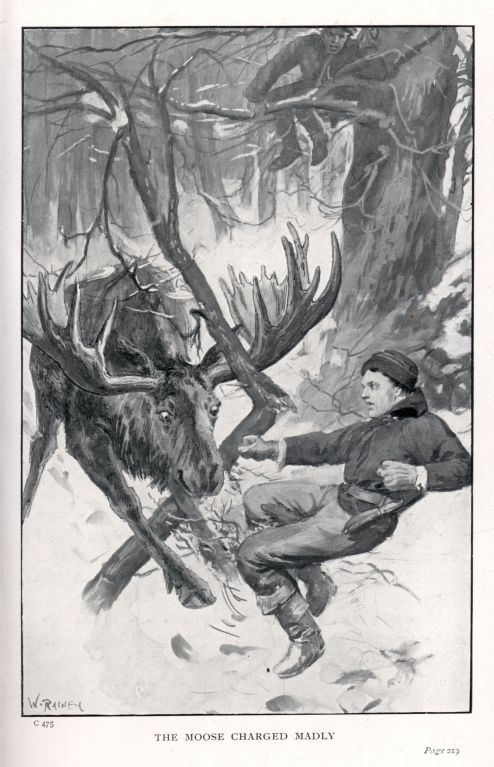
THE MOOSE CHARGED MADLY
"Jest keep dodging him," he sang out encouragingly. "Ef he ain't reached you yet he ain't likely to. Jest keep well clear of his hoofs and out of sight of the brute as much as you can. He ain't as fresh as he war, and that'll help us."
The cunning hunter rapidly unwound the long piece of raw hide that he had cut for use on the snowshoes, and which, having more than he required, he had carried with him since, in case of renewals being wanted. Perhaps he had as much as eight feet, perhaps there was less; but, in any case, it was as tough and strong as any rope ever constructed. While Joe continued to dodge the angry moose, now escaping his attacks with comparative ease—for he had regained his coolness—Hank made one end of his rope fast to the tree, looped the other, and then crawled out on the branch.
"Jest get him to come dodging round this way," he said hoarsely. "Ef I hooks him, you make a run fer one of the guns, and then climb into the nearest tree. This rope won't hold him overlong, but it'll do to let you get clear. Now, I'm ready."
Joe merely required to show himself plainly for the maddened moose to come dodging after him. The huge antlers, as hard almost as steel, struck the tree a resounding clang, then the fore feet were used till strips of bark were flying. Slowly Joe edged round the trunk, luring the animal after him, till a lucky move brought the moose directly under Hank.
"Git ready!" he shouted, at the same time dropping one foot and kicking the antlers. Instantly the beast raised his head, and like lightning Hank slipped his noose over one of the broad branches.
"Run!" he bellowed. "Don't ferget the gun, or we'll be both of us fixed for days together."
It may be imagined that Joe did run. He dashed across the open space to the spot where their rifles were lying, turning his head to see what was happening. If he had felt less confidence in the little hunter, there is small doubt that he would have neglected to pick up a weapon; for the fury of the moose on seeing his movement was terrible. It lowered its head and dashed after him, till the strong hide rope brought it up with a jerk that threatened to snap the noose. Then began a mad struggle on the part of the moose for freedom. Rearing up on its hind legs, it struck out with its fore feet, almost reaching the bough on which Hank was seated. It backed and tugged, it fell to the ground, trusting by those means to tear itself free; then it dashed this way and that, arrested on each occasion with a mighty jerk that actually shook the tree.
"Even a chain wouldn't stand much more of such tugging," shouted Hank, watching Joe anxiously out of the corner of his eye. "You be slippy with that gun, lad, or else we'll lose him. Ah, that's a relief! He's into a tree. Now, wonder what sort of shooting he'll make. Say, lad," he called out loudly, "take him when he lifts his head, and put a bullet into his shoulder jest about where the neck joins it. Steady, Joe; you're puffed. Pull yerself together."
If our hero had attempted a shot then, there is little doubt but that he would have missed entirely, for what with the active movements of the moose and his own trembling fingers, a sure aim was more than difficult. However, he did as he was ordered. Bracing his legs round a branch, he brought the butt of his weapon firmly to his shoulder, then, choosing a moment when the animal lifted its head, he sent a bullet crashing into it. A yell from Hank told him, even before the thin cloud of smoke had cleared away, that he had been successful.
"Good fer you! Killed him dead!" Joe heard, and, looking down, saw the huge bulk of the animal stretched on the snow, thick steam still issuing from the nostrils.
Let us be strictly truthful again with regard to our hero. Joe was shaking in every limb as he dropped to the ground and stood over the fallen animal; for excitement had told upon his nerves, as yet unaccustomed to such strenuous moments.
"You don't need to be ashamed," said Hank, seeing that Joe looked downcast. "I've seen many an older chap all of a shiver with excitement when the thing was over. The main thing aer that you kept your head and held your sights straight when they was wanted. This here exhibition will have given you a good idea of the moose that roams about Canada, and next time you meet one don't wait too long for his charge. I've known a man to be skewered on those antlers afore you could shout, and killed jest as dead as possible. Reckon we'll skin the brute and take his head. It'll be a fine gift for the Fennicks."
They spent the remainder of the day in skinning the moose and in removing the skull and antlers. Indeed, they camped beside the carcass, not troubling themselves about the other brute, which had retreated at the very beginning of their adventure. That night, for the first time in his young life, Joe cooked moose steaks over the fire and ate of meat of his own getting.
"Prime, ain't it?" grinned Hank, as he devoured a savoury morsel. "But you wait; there'll be more huntin' before we've done with this here expedition."
CHAPTER XIII
A Co-operative Proposition
It was rather later than they had anticipated when Hank and Joe arrived at Sam Fennick's shack on the following day; for again a thaw had set in—not the "silver thaw" so much prized in Canada, which they had previously experienced, and which, by freezing the upper layer of snow and, as it were, laying a sound crust upon it, had enabled them to make good progress, but a thaw unaccompanied by change, or, to be exact, not followed by a succeeding frost. They finished their journey, therefore, through a snowy slush, sinking often above their knees, while their moccasins and their feet were wringing wet and very cold.
Shouts greeted them.
"Why, if it ain't Joe!" came from Sam heartily, in his well-known bellowing tones, while the ineradicable cockney accent was obviously there; in fact, it was an accent of which Sam was proud. It was something never likely to leave him however long he remained in Canada, and however much he interlarded his conversation with Americanisms. "Missus, it's Joe!" he shouted, turning his head over his shoulder. Then he dashed forward, seized our hero's hand, and squeezed it till the latter almost winced.
"Howdy?" he exclaimed, swinging on Hank. "Introduce us."
"Hank," said Joe shortly, "hunter and trapper, a friend of mine. Hank, this is Sam Fennick; but——"
"In course I knows Sam," cried Hank, stretching out his wiry little paw, but one, nevertheless, which could give a grip that would make a strong man squirm. After all, outside the polite society of London and other large cities, where very vigorous handshaking is not looked on with favour, men often enough, the rough men of the plain, the prairie, the backwoods farm, and of the forest, exchange greetings with an earnestness there is no denying. Such men do not simper and dangle nerveless fingers before a stranger. They stand facing squarely, looking closely into the other's eyes, and when their hands meet, and their fingers grip the other's, the firmness of the grip, its vigour, its unflinching support of the return pressure somehow conveys something of the character of one man to the other. Hank had treated Joe in that way. To a man such as Hurley, whom he did not like, whom he suspected to be a craven, Hank merely waved or nodded; for he had his own views of what was proper, and they were far more exact and far more straightforward than one would have imagined.
"What! You, Hank—me old pal!" shouted Sam, delighted beyond measure, and almost hugging the little hunter. "You along o' Joe? How's that? He been doing something fer you, same as he did fer us?"
Hank asked an abrupt question. "What?"
"Ain't he never let on about the fire aboard ship, the rumpus there was, and how he led the volunteers?"
"Nary a word. Peter—Peter Strike, that is—did tell me a tale, but he warn't too sure of it. The young cuss is that silent when it comes to hisself. But he's been doing well. Sam, let's get these wet things off us, and something hot inside, and then we'll gas. Gee! Ef that ain't Mrs. Fennick! Howdy, maam? Here's Joe."
The good woman almost embraced our hero, for she felt like a mother to him.
"Come right in and let us hear all about you and your doings," she cried. "And Hank Mitchell too! I'm that glad to see you both, and Sam has been waitin' these many days for you to arrive. He's got a scheme for the winter."
The grinning master of the shack accompanied the visitors into the interior of the shack, and there stood, first on one leg and then on the other, while Joe and Hank looked keenly about them. It was to be expected that a man of Sam's energy, a Canadian settler who liked things to be right, should have erected a dwelling which should be fitting for his wife. Besides, there was reason for even greater magnificence.
"Guess you've been hard at work," said Hank, looking about him with twinkling eyes that nothing escaped. "This here shack's meant to last."
"It's that and more," cried Mrs. Fennick, pride in her tones. "Sam has built for a purpose. This shack's too big for what we want; he planned to have an office."
"Eh?" asked Hank, turning on the grinning owner, who had flushed to the roots of his hair for all the world as if he were a schoolboy. "What's this?"
"Part of the scheme, lad," came the answer. "Jest you two get seated and pull off those wet moccasins; then, when you've got dry socks to your feet and has had a bite, I'll get to at it. It's a fine yarn; I've dreamed of it this past five years."
No amount of persuasion would drag from Sam what his scheme was till Joe and Hank had eaten, and the latter had lit up a pipe.
"You kin fire in at it, Sam," said Hank at length, in the crisp little manner which was so distinctly his own. "I kinder gathered from this here Joe that when you came along up here prospecting it warn't with the idea of the ordinary farm. Maam, it's plain to see as my old friend has nigh worked his fingers to the bone."
Once more the little hunter's eyes went round the large parlour in which he and the others were seated, while Mrs. Fennick and her husband followed his glances with frank pride staring from their own eyes. Nor could Joe help but admire all that he saw; for he and Sam had been parted but a matter of a few months, and in the course of that time the latter had pitched upon a suitable holding for his farm, and had cut the timber for his shack, besides erecting the house. As to the latter, it was far bigger than the ordinary shack erected by the settler. There was a parlour, a kitchen, and three bedrooms, while attached at one side was a large office.
"Where we'll have the telephone afore you kin look round," declared Sam. "It's jest like this. Me and a mate or two agreed to go along together into New Ontario and pitch upon a spot that was likely to open up. Wall, we took the line the branch railway was following, though there's not one save those in the know behind the scenes, who kin say exactly where it'll run. Still, me and the others prospected a heap till we came along here. What with the difficulties of rocks to the south, and big, straggling elevations, it was clear as the rails must follow the valley, and there warn't more'n one for 'em to take. So we prospected along it till we came here. You jist come outside the door and you'll see what I'm after."
He led the way to the door of the shack and pointed to the north across a narrow stretch of country bounded on either hand by elevated land, and seamed along a straggling line running a little to one side of its centre by a thin strip of blue which, here and there, was entirely covered with snow. As for the landscape itself, it was difficult to tell its aspect exactly, in spite of the thaw, for snow lay deeply in most parts.
"Wall?" asked Hank curtly, looking about him and taking in every feature. "It's the top end of the valley, I kin see that. Rails running north kin easily pass out, seeing that the two ridges on either side don't run together. But they can't cut off to right or left. Ef the rails comes along this way, why, in course they passes right through this location."
"Along by the river," said Sam quickly. "Hank, it's an easy rise all the way. The river ain't got no current to speak of, which tells the tale easily. As to the rails coming along into the valley down south, why, that is almost certain, as sure as one can take it. Anyway, me and my mates agreed that it was more than likely, and so we arranged to take up holdings here. There's four of us already, Claude and Jim and Joe makes seven, and come spring-time there's nigh twenty more married men to join us."
"Wall?" asked Hank, not as yet clear as to what was Sam's meaning. "Where's the difference between this and other settlements? You takes up land, and the rails come along. Good! Up goes the value of the land, as it aer sartin to do. You get a reward for foresight; after that, where's the difference?"
Sam had evidently sought for the question, for he rubbed his hands together eagerly and gripped Hank's sleeve.
"Jest here," he declared with enthusiasm. "Instead of some twenty of us starting to work our sections separately, and going mighty slow in consequence, we're forming a corporation. Each man who takes land will pool money with the corporation. With that money we buy implements, horses, cattle, everything that's needed. We divide our numbers into parties, and come the spring one of 'em sets to work to build the shacks, another does the ploughing, while a third'll get to at the irrigation channels."
"Ah!" gasped Hank. "This aer new."
"Sam worked the scheme out all alone," declared Mrs. Fennick, with energy, causing her lord and master to blush again.
"It sounds just splendid," cried Hank. "Wall? What more? I kin see that there's an advantage in working ground on the corporation system. If you've got the timber cut already, it stands to reason that ten men working on a shack can put it up more'n ten times quicker than one man all alone. If there's twenty shacks wanted, ten men can put 'em up heaps faster than twenty fellers working on their own. And irrigation too! That sounds fine; it's doing well elsewhere."
Hank spoke but the truth there. A far-seeing Dominion Government and an all-powerful railway company have already seamed portions of Canada with canals and ditches with which water is borne to lands hitherto useless. Their forethought has converted, and is fast converting, barren soil into country which in parts already bears smiling crops and happy homesteads. As for the corporate system, if the Dominion Government has not attempted that—and one must admit that it is a question more for individual settlers—it has at least other worthy schemes. A would-be settler can now sail for the Dominion, to find there a quarter section prepared for his coming, with the shack built, the well dug, and some forty acres broken and seeded. For this he pays a reasonably small sum down, and the rest by small instalments. Think of the huge advantage of such a system. In place of finding naked soil, and having first to build a shelter and then break the land, a settler finds a home in readiness and crops already sprouting. Then consider Sam Fennick's proposition.
"It aer bound to go with a bang," declared Hank, pushing his skin cap to the back of his head and scratching his forehead. "It aer jest tremendous."
"It'll work, I think," agreed Sam, with the natural modesty of the inventor of such a daring scheme. "Anyway, we've got the party together, and there'll be money in abundance. Each man will own his own taking, and ef others come along and settle nigh us, why, we're prepared to hire ourselves out ef there's a call and we've the time. As for implements, me and a few of them has talked it over, and come the spring there'll be two steam agricultural motors up here, in which we kin burn wood. They'll each do ploughing at three to four acres a day, and will draw the reapers and binders when it comes to harvesting. There won't be no need to wait for a threshing gang, 'cos the tractors will drive the machine we shall buy. They kin do wood sawing too, and a hundred other things, besides hauling the stuff to market."
"Ah!" gasped Hank, for this was a proposition which rather took his breath away by its novelty and its possibilities. "But——"
"Yes?" asked Sam, bracing himself, as if to face any awkward questions the little hunter might fire off at him.
"There's the winter," said Hank. "Your corporation comes to an end when the snow comes; you ain't thought of that."
But Sam had; he wagged a knowing finger, while Mrs. Fennick giggled. Indeed, it must be admitted that this cockney settler, who had come from London and done so well in the Dominion, had proved himself more than astute. Perhaps he had thought the whole matter out during some past winter in Canada. In any case, he had been wonderfully close where his scheme was concerned, for never once had he more than hinted at it to Joe. However, the question of work in the winter had not escaped him.
"You listen here," he said, shaking Hank as if he were a dog. "Come wintertime east of the rockies things mostly closes down in Canada; even in the towns there ain't too much work. There's men wandering to and fro searching for jobs, whereas, most times and in most places, when there's spring and summer, there's more jobs than men."
"Guess that aer so," agreed Hank, sucking hard at his pipe.
"But there's work in Canada that starts in the fall, and only then—eh?"
"Lumberin'," suggested Hank.
"Lumbering it aer," cried Sam, drawling the words. "Up there beyond the break through which the railway'll pass, ef we've any luck, there's land that's heavily timbered. Wall, it's part of the scheme. You kin get a timber concession from Government by paying so much on the logs you cut, and me and my mates has taken up a tidy piece of timber country. There's a lake twenty miles and more north into which we can slide the logs, and there's another jest at the head of the valley. Way south there's a quickish fall, with water in plenty, and ef all goes well, and we kin make enough dollars, why, we'll start a mill there and saw our timber. The rails'll be close by then, and will take 'em on to market."
"My," cried Hank, "you've been moving!"
"We're only beginning," said Sam. "But we starts out for a lumber camp soon as the frost comes, and there we'll work till springtime. You axed what we was going to do in the winter. There's the answer."
It must be confessed that Sam Fennick's scheme was ambitious to the last degree. But then, if one analyses it, one can see the possibilities that Hank saw, for co-operative working is often enough wonderfully successful where the single individual fails. Again, in a country where labour is scarce, and profits often lessened because of the lack of labour at critical periods; where, in fact, a man who may have broken and sown his land with the greatest industry may see his crops rot in spite of his energy, simply and solely because of the lack of help to harvest them; there, in a case such as that, the co-operation of his fellows would be all in all to him. Indeed, with pooled labour, and a certain sum pooled by all the settlers with which to buy implements, it stands to reason that work could be done more cheaply, more expeditiously, and always at the proper season.
"It aer a grand proposition," declared Hank, when he had thoroughly considered the matter. "I kin see a big saving in more than one way, and one of 'em's this. Suppose there's twenty settlers in the combine. Wall, now, with ten ploughs and ten harrows and seeders you've tools to break the land. Supposing there warn't a combine; each man has his own tools. They ain't all in use together, so some of 'em's lying idle. That's gain number one, and don't you try to contradict me. And so you're goin' lumberin'?"
"We are that," assented Sam; "and seems to me you and Joe had better come along with us. You could put in a month or more, and then go along on prospecting."
It took our hero and his hunter companion but a little while to accept the invitation, the more so as Joe was already more or less one of the corporation Sam was forming.
"There's dollars in the scheme right through," Hank said, as they sat round the stove that evening. "Ef you'll have me as one of the band, I'll apply for my two hundred acres right off, paying for 'em, for I ain't able to take up more free land. Joe's in the same fix. But he aer got the dollars to pay. We'll come north with you and do a little lumbering. Afterwards he and I kin move on farther, for I've a proposition of my own to look into."
"But——" began Joe, who had been a listener for the most part up till now.
"Huh! He's agoin' to criticize the scheme and pour cold water on it," grinned Hank, swinging round on our hero. "Tell you, Sam, this here youngster aer had his eyes opened wide sense he came out, and he's turnin' into a business farmer. Wall, what are it?"
"This lumbering," began Joe diffidently, colouring at so much attention being attracted to him.
"Just you give 'em what you think and don't be afraid," cried Mrs. Fennick encouragingly. "The lad that could organize volunteers aboard ship has a right to speak. Sam, likely as not he'll show you and Hank that you've made a big error somewheres. Now, Joe."
"I was merely asking about the lumbering," said Joe. "I always gathered that lumberers were men who were more or less trained. They go out in gangs, don't they?"
"And so'll we," interrupted Sam, with eagerness. "But there ain't so many chaps out here that hasn't had a turn with the gangs some time. I've done a season; p'raps Hank has too."
"You bet," came from that individual. "I've done most things 'way out here, from gold diggin' to farming pure and simple. Huntin' aer my proper trade, but I ain't too proud to do anything. Even when I'm my own master I ain't above takin' on a job for someone else ef I've the time, and the money's good enough."
"Then there's two of us has done the work before," declared Sam. "Eight or nine of the boys I've fixed it with to join our corporation are already up in the woods, where we'll join 'em. They've a shack built this three months, and no doubt they've started in felling."
It appeared, indeed, as if the thoughtful Sam had made very complete arrangements, and there was little doubt but that Hank, as an old and experienced colonial, was delighted.
"It aer a fine proposition," he repeated for perhaps the twentieth time. "When other folks is buried in the snow, and only finding work with feeding the cattle and sichlike, we'll be cutting timber that'll bring dollars in the summer, and be back on our holdings time enough to plough and sow and make ready for harvest. Autumn will see us threshing, and by the time the grain is hauled down to the railway there'll be frosts. Then out we go again. Gee, Sam, this fair tickles me!"
A week later the little band of lumbermen was collected together, while Tom Egan, a sturdy settler some fifty years of age, had arrived from his own little shack across the valley and had taken up his residence at Sam's dwelling, where it was arranged that Mrs. Fennick should stay with Egan's wife and children.
"Yer see," explained Sam, "a lumber camp ain't no sorter place for a woman. It's rough living all the while. Men are packed together as close as sardines, and even then it's mighty cold. So the missus stays here with the Egans while we move on."
They slung their traps over their shoulders, and with snowshoes on their feet set out towards the north. The thaw of the past week had by now given way to severe frosts, while there had been a heavy fall of snow. However, none but a confirmed grumbler could have found fault with the conditions, for a bright sun flooded the landscape, shimmering on hillocks of snow, throwing long blue shadows athwart the hollows, and causing the millions of particles of ice to flash and scintillate. There was a dry, exhilarating crispness about the atmosphere that was typically Canadian, a bracing coldness that made the little band step out briskly, Hank at their head, Sam following; then Joe, and Jim and Claude, the two young friends he had made aboard the steamer, marching side by side. Dick Parsons, a lanky, bearded colonial, brought up the rear, a veritable grenadier in proportions.
They formed a merry party in their lean-to that night, and went on their journey on the following morning with undiminished vigour. Late the following day the crisp ring of axes coming to their ears through the tree trunks of the forest they had plunged into some hours before told them that the lumber camp was within easy distance. Shouts greeted them as they trailed into a narrow clearing, at the back of which stood a low-built shack half-buried in snow, and with its roof supporting a vast mass of that material. Smoke issued gently from a centrally-placed chimney, while the door was wide open. Hearty indeed was the greeting, then the hut swallowed the whole party.
"You've jest come along in time for tea," cried one of the lumbermen, a bearded giant even taller than Parsons. "Sit ye down right there and we'll give you a meal that'll show you how we've been living. Bill, you fish out that bear's meat you've a-stewing, while we others get the tea on the table."
The table, let us explain, was a mere apology for that article as civilized individuals understand the term, for your lumberman has no time to devote to the niceties of furniture construction. Joe indeed found himself marvelling at the crudeness of their work and yet at its obvious utility; for split stakes had been driven into the ground down the centre of the shack, and cross pieces nailed on top. More long split logs secured to these formed the top of a table some two feet wide. As for benches, they were fashioned in the same manner along either side, and were by now fully occupied. A huge enamelled-ware teapot was passing from hand to hand, while Bill, the cook to this expedition, was standing at one end of the table dealing out helpings of a savoury bear-meat stew that tickled the nostrils of everyone.
"What about sleeping?" asked Joe presently, when the meal was finished and the lumber gang had gathered round the open fire placed at one end of the table. "Is there another room?"
"Another!" exclaimed Harvey Bent, the chief of the party. "Young man, there ain't time fer buildin' luxuries when you're lumberin', and what's more, guess there ain't warmth enough. Time we turns in to-night there'll be jest about room fer the lot of us, and no more. The closer we are the warmer, and 'way out here, when the thermometer's down below zero, that means something to men who has to work."
Joe and his friends found that the sleeping accommodation was quaint in the extreme. Along one side of the shack a sloping platform had been built of the usual split logs, and piles of blankets lay upon it. Going to bed was a simple proceeding in this lumber camp; for men merely slipped off their boots and hats and wrapped themselves in a blanket. Then they lay down side by side, packed closely together, so closely, in fact, that to turn was an impossibility. But Joe and his young friends, who were novices like himself, discovered very soon that these old lumbermen were not without consideration. They allowed for the possibility of a change of position, and that very night, some time in the small hours, a hoarse command awakened them.
"Heave!" they heard, and promptly, more asleep than awake, the band of men rolled over on to the other side and once more settled into snores and slumber.
"It's a sight that'll do your eyes good," declared Hank, early on the following morning, when the gang had eaten. "You watch these fellers cutting down their timber. It ain't likely that you'll be wanted fer much to-day, and so we'll take a look at 'em and then see their mates. All of the gang ain't fellers. It stands to reason that someone's got to deal with the timber when it's down, and has to haul it out of the way to where the water kin deal with it. We're high up here, for we was climbing most of yesterday, and this here shack aer located jest at the top of a steep slope cutting sheer down to the lake that Sam mentioned. You come along with me; when we've had a look round we kin tackle a job with the others."
Donning their snowshoes and taking their rifles with them—for it was already agreed that Hank should hunt for the gang and procure them fresh meat—he and Joe went sliding off along the hillside, and presently, reaching a spot where the lumberman's axe had cleared the trees, were able to get a clear view of their surroundings. Down below them, two or more hundred feet perhaps, was a vast expanse of white, unbroken for the most part, though here and there there was a dark-coloured elevation denoting an island, the huge expanse being the frozen and snow-covered surface of the lake. Beyond there was forest, patched with snow, silent and forbidding. As for the steep slope at that part, it was scored with a hundred and more tracks.
"Where the logs slide down to the lake," said Hank. "Now we'll go along and see 'em at it. My, these trees are mighty big, and will saw into fine logs! Ef that railway comes up this way, as Sam believes, timber'll be wanted, and the work that's being done here will bring its own reward. Ah! there's axes! Jest you come and see how a Canadian lumberman tackles a forest giant, and can throw the tree jest wherever he wants."
Joe marvelled, indeed, at the skill and the energy of the lumbermen. Hearty, healthy fellows one and all, they went at their work as if they loved it. Cutting niches with their axes high up the stem of a giant, they drove wooden stakes into the crevices thus prepared, and soon had a platform built on this somewhat insecure foundation. Then came the ring of axes swiftly falling, a hoarse cry of warning, twice repeated, followed by a reverberating roar as the giant succumbed to human forces, crashing to the ground with a thud which shook the surroundings. Joe stood by as one of the biggest of the trees tumbled, and watched the lumbermen shredding the branches from the fallen timber. The naked trunk was then levered with crowbars, and with a final jerk was sent skidding and sliding down the hillside, to come to a halt at the bottom, perhaps on the frozen surface of the lake, or at any rate within a few feet of it.
"There's a couple of men working down there with a hoss," explained Hank. "They hitches on to the logs that don't reach the lake and drag 'em into position. Look away down. There's a hull crowd of timber waitin' for the end of winter."
"And then?" asked Joe, for he was ignorant for the most part of the work of lumbermen.
"Why, the ice breaks up," said Hank, "the logs gets carried into the lake, and the 'drivers' takes 'em in hand. A mighty hard and dangerous job theirs is, too. They has to be at it night and day, wet and fine. Each of 'em has a long pole with a spike at the end, and their particular work aer to send the logs down. Sometimes the stream carries 'em all right. Sometimes they gets hung up in corners and eddies, and the driver has to set 'em afloat agin. Then, down at the bottom of a lake same as this it ain't so seldom that logs and ice'll form a jam. One of the logs gets across the outlet, stuck up on a rock or two. Others piles up behind, with blocks of ice maybe, till there's ten foot high of logs and stuff, with a mass of water and ice and logs 'way behind. That aer a ticklish job to tackle, and many a driver has been killed or drowned. But they ain't never afraid, and there ain't much that they can't do. I've seed 'em hopping from floating log to log and steering a single trunk downstream, as ef they was aboard a canoe and not on top of a thing that'd roll over with the ordinary feller. Now, we'll make right off out of hearing of the camp. Bill war telling me this morning that when that bear's meat aer done, there ain't nothing left but pork."
It was with the keenness of a schoolboy that Joe threw himself into the work at the lumber camp. That very evening he was told off with the hauling gang, and for a month and more assisted in dragging the felled timber to the edge of the lake; and never once did he find the hours drag or the work too heavy. As for the evenings, they were a delight to all; for your lumberman's camp is a veritable club. There, with the door shut and a hot fire burning, the men made a circle once their meal was finished. Pipes were filled, and clouds of smoke obscured the surroundings, dimming the rays from the single oil lantern hanging overhead. And what yarns those colonials could tell! Rugged, honest fellows, they spoke in a simple manly manner which was captivating. The boaster was not to be found amongst them; their tales were of deeds which had actually occurred, while the truth of their statements was apparent. As for chaff, they were never done with it. Harmless jokes and horse-play made the evenings jovial and merry. It was thus that our hero passed a portion of his first Canadian winter, revelling in the brisk atmosphere and in his work, boon companion to every member of the lumber gang. Then he and Hank bade farewell to their comrades and, shouldering their packs, set out for the north, for a country hardly ever explored, where danger and difficulty awaited them.
CHAPTER XIV
Moose Hunting
"I'm agoin ter tell you now what's brought me away up here through the backwoods of New Ontario," said Hank, the very evening he and Joe had left the lumber camp and their friends, amongst whom Sam Fennick was numbered. "I'm looking fer Beaver Jack."
"Beaver Jack! Who's he?" demanded our hero doubtfully.
"That's what I'm jest about to tell. Beaver Jack aer the cutest, quietest, cussedest Indian that ever you set eyes on, or that ever anyone else set eyes on either. He kin talk our language fairly well, and he war for three years or more along with me and my father. That's a time ago. Of late he's mooned about in the settlements during summer, not doing more'n a hand's turn, as is the nature of the Redskin. And winter's found him 'way up north, trappin' and huntin' fer the pelts that keeps him in food during the summer months. Beaver Jack and me's old friends, and with him to lead there's a chance of our striking a country I've heard of from mates of his. There ain't been much prospecting up in New Ontario, lad, but I've heard there's gold, and gold mines are worth finding."
So that was the secret of this expedition. Hank, a naturally silent man, had said little about his intentions up to date, and Joe had but a vague idea as to his real object. For himself, it had been sufficient that he was to travel through the Canadian wastes with such a pleasant fellow, and experience a life the very mention of which was most fascinating. It can be imagined, therefore, that he looked forward to the meeting with Beaver Jack with some anticipation, and hailed that taciturn Redskin heartily when, two weeks later, they came across him.
"You'd say as it aer fair wonderful that we should meet him right up here in the wilderness," smiled Hank, as he and Joe prepared for the night's bivouac. "But Jack aer a long-legged man, and, Injun-like, he turns his toes in. You could tell his mark in the snow amongst a thousand, and it ain't much altered even with snowshoes. See there—there's my marks, there's yourn, here's Beaver Jack's."
"With a longer distance between each one," agreed Joe. "And the back of each shoe seems to have been trailed along the snow as he went. There's a clean line every time. With you there's much the same, but the distance between the shoe marks is less, while mine are broken and the snow is irregularly marked in between."
"So as you could swear to any one of the three any day," said Hank. "Now, guess how it war that I steered a course so as to cross his tracks."
The question was one of greater difficulty, and Joe found himself unable to answer. However, the explanation was simple enough when it came to be given.
"It aer like this," smiled Hank. "Beaver Jack don't never come far into the settlements, and his line ain't never due north. Reckon he ain't fond of coming across other Injuns that way, nor the half-breeds that live up towards James Bay. So his line's always to the west. Ours being north, and cutting up through the country Beaver Jack crosses, why, in course we was bound to drop across his tracks. Had sport this season, Jack?"
The Indian turned slowly upon his questioner and straightened himself, for he had been bending over the narrow sledge upon which he was wont to haul his pelts when their number became too burdensome for carrying. The failing light of a midwinter day fell upon a scarred and seamed face that might have belonged to a man of sixty, of seventy, or even of eighty. The brows were drawn down over the eyes, the hooked nose approached closely to the thin, closely-shut lips, while even the chin, square and determined, and yet narrower than is customary with white men, appeared to turn up towards the centre of the face. But the eyes were the feature that attracted one. Small, and set wide apart, they flashed round at Hank and then at Joe. At one moment they looked severe, fierce, almost cruel; the next moment one could have sworn that they were twinkling. As for the remainder of this native trapper, he was clad in skin clothing of his own making. Fringed leggings covered his lanky lower limbs, while a shirt of leather, soft and wonderfully pliable and stained with much exposure, was over his shoulders, wide open at the neck, the sleeves reaching only down to his elbows. The man pointed slowly to his pile of pelts, and then, as if to speak would be to waste words, bent down over his sledge again and went on with the work that engaged his attention.
"He aer a rare 'un to talk," laughed Hank. "You get almost tired of hearin' his voice. But he kin hunt, and he aer the best man as ever I came across for calling up the moose. Know what that means, Joe?"
"Haven't an idea," answered our hero; for even now he was ignorant of the ways of hunters.
"Then we'll teach you, me and Jack," said Hank. "Jack, have you seen moose tracks hereabouts? If there's some of the beasts within twenty mile, you ain't likely to have missed them."
The mention of something to do with hunting brought the Indian to an erect position again with remarkable swiftness. He lifted an arm and pointed away to the west, to where the snow-clad landscape reared itself abruptly till, rising to a great height, it cut across the darkening sky in a succession of jagged peaks, upon which the rays of the fallen sun flickered, though the orb itself had long since disappeared from sight.
"Moose yard up there," he said abruptly; "plenty beast."
"Then to-morrow we'll see what we kin do with 'em," cried Hank. "We kin leave our traps 'way down here in this camp, and jest take our rifles with us. We ain't likely to be back before the night comes, and ef we're still out on the hills, why, in course we'll make a camp that'll keep us warm and right till the dawn comes. Now, lad, on with that kettle; it aer time almost for supper."
Joe's experience of moose hunting had not been so great up to this moment that he was not keen on a hunt. Once only, in fact, had he encountered this huge, fierce beast of the Canadian forests, and then the moose bull may be said to have hunted him. It was, therefore, with a certain amount of elation and excitement that he set off with his comrades on the following morning. Leaving their pelts behind in the lean-to—for Joe and Hank had trapped and shot many beasts during the last two weeks—and taking only rifles and ammunition and ready-cooked food with them—the three turned their faces towards the west, where the land reared itself up suddenly into a long chain of hills which might almost be described as mountains. Trudging along in front went Beaver Jack, as silent as ever, his face always to the front, never turning his head by so much as an inch, and yet seeing and remembering every feature of his surroundings. Joe noted the long swing of his lanky legs, the sliding stride with which he carried his snowshoes from one part to another, and the manner in which he kicked his shoes from time to time. Then came Hank, keen and energetic, his rifle across his shoulder, his shoes sinking hardly at all into the snow. However, Joe found walking on this occasion somewhat difficult, for the pace the Indian set was terrific, while a mild-tempered wind had softened the snow which clung to his shoes, making them ponderously heavy.
"Steady!" called Hank, after a while, arresting the rapid progress of the Indian. "This here pal of mine are puffin' and blowin'. Yer see, Joe, you ain't so used to snowshoein' as Jack and me, and when there's a thaw it aer heavy work. But jest you watch Beaver Jack. He gives a sorter kick every few steps, and so rids himself of the weight that you have to carry. We'll rest here a few minutes, and then you kin go in front and so set the pace."
An hour later they began to ascend a little, while within less than two hours the path they were making took them upward at a somewhat abrupt angle, which made the work extremely heavy. It was a relief to Joe, therefore, when Hank called another halt, and when Beaver Jack pointed away along the side of the mountain.
"We ain't likely to find moose much higher," said Hank, seating himself beside Joe; "not because it aer too cold for 'em high up, but because the stuff they feed on don't grow up there. Seems to me that we've a biggish wood in front of us, and we've got to make right through it before we shall come across their tracks. Even then there mayn't be any of the beasts, for ef they happen to have caught sight of us, or winded us, which aer far more likely, why, the hull crowd will have gone right off. You could shoot a charging moose, lad?"
"I'd try, anyway," answered Joe, mindful of his previous effort. "I think that by now I ought to be able to hold a gun straight, and if only I don't get too excited I ought to be able to hit a beast. I'm ready to move on if you are."
Once more they began their trudge across the sloping snowfield, Hank now leading, and presently he plunged into a forest clinging to the hillside. A wide space beyond was devoid of animal life, though Beaver Jack declared that moose had recently been across it. Then they dived into a narrow belt of trees, where the Indian came to a sudden halt.
"Try here," he said. "Not sure, but think beasts near; and if we go on, sure to hear us. Wait little—soon ready."
"Watch him," whispered Hank; "you'll see him set to work as only an Indian can. He's looking about for a birch tree, and with that knife of his will strip the bark in a matter of a few minutes. I kin tell you this, give a Redskin a knife and firelock and powder, and he kin go anywhere and make most anything in these forests. Birch bark aer the stuff he puts to roof his lean-to. A long strip cut from an extry big tree, and shaped and sewn, makes him a canoe that's better than any other craft known on any water; while, ef it's pots and kettles that's wanted fer cookin', he can fix the business easy with his knife, and so long as there's a tree of the right sort about. See him cut that roll free. Now, in a jiffy he'll have a trumpet."
Beaver Jack went about his work in a manner which showed that he was accustomed to it, and came back towards his comrades bearing a long strip of bark which he was slowly coaxing into the shape of a funnel. Then with his knife and a few strips of hide cut from the fringes of his leggings he tied the edges of the bark, so that the implement he had fashioned retained its shape. A little later he bent his lanky form, applied the smaller end of the funnel to his mouth, and blew heavily into it. The lines across forehead and face became even deeper. To look at the Indian one would have declared that he was in agony, and no doubt he was making a special effort. The result was truly wonderful. Joe had heard moose calling before, the sounds they made echoing through the forest. And here the calls were repeated, more loudly, it is true, since they were meant to pass to a distance, but wonderfully realistic and lifelike.
"Now listen," said Hank, in a whisper. "Ef there's a moose bull within two mile of this he'll answer."
The long, deep-toned call produced by Beaver Jack with the aid of his birch-bark trumpet was answered by a deadly silence that nothing broke, and though the call was repeated, it appeared as if the result was to be similar. But suddenly the Indian stirred, while Joe saw Hank's eyes concentrate themselves upon the forest. Then, far off, there came a dismal echo of the sound, as if the hillside were casting it back at the hunters. At once, without so much as a word, the Redskin slunk off into the forest, Hank and Joe following closely.
"You kin look for a burst of speed," whispered Hank hurriedly, turning his head. "There's a moose bull 'way ahead, and Beaver Jack aer going nearer so as to coax him. Jest make sure as you don't knock that rifle against the trees, or else there won't be much huntin'."
Silent after that, with hardly a glance to left or to right, the three pushed on through the wood, Beaver Jack choosing, as if by instinct, a path that avoided thick underwood, and allowed himself and his comrades to retain their snowshoes. Slowly the trees diminished in number, till they straggled out into the open in broken groups of two and three, and finally singly, scattered here and there over a wide field of snow that seemed to be unbroken and unmarked by beasts of any description. To the left the hills reared their heads abruptly, snow-covered to the summits, grey and forbidding, as if they resented the coming of these strangers. Ah! The Redskin had lifted a hand; he came to a halt.