PART I. EDITIONES PRINCIPES, etc. (continued 2)
Reading edition
Collation:—Crown octavo, pp. viii + 331; consisting of: Half-title (with blank reverse) pp. i–ii; Title-page, as above (with imprint “London: / Printed by William Clowes and Sons, / Stamford Street and Charing Cross” upon the centre of the reverse) pp. iii–iv; Prefatory Note regarding the Vocabulary p. v; Advertisements of five Works of George Borrow p. vi; Table of Contents pp. vii–viii; and Text pp. 1–331, including Fly-titles (each with blank reverse) to each section of the book. The reverse of p. 331 is blank. At the foot of p. 331 the imprint is repeated thus, “London: Printed by Wm. Clowes and Sons, Stamford Street / and Charing Cross.” There are head-lines throughout, each page being headed with the title of the particular subject occupying it. The signatures, are A (a half-sheet of 4 leaves), B to X (20 sheets, each 8 leaves), Y (a half-sheet of 4 leaves), and Z (a quarter-sheet of 2 leaves).
Issued in dark blue cloth boards, with white paper back-label, lettered “Romano Lavo-Lil; / Word-Book / of / The Romany. / By / George Borrow.” The leaves measure 7¾ × 4⅞ inches. The published price was 10s. 6d.
One Thousand Copies were printed.
The book was set up in type towards the end of 1873, and published early in 1874. Proof-sheets still exist bearing the earlier date upon the title-page.
A considerable amount of Verse by Borrow made its first appearance in the pages of Romano Lavo-Lil, as detailed in the following list:
Contents
page
Little Sayings:
1. [ Whatever ignorance men may show] 109
2. [What must I do, mother, to make you well?] 111
3. [I would rather hear him speak than hear Lally sing] 115
English Gypsy Songs:
1. The Gypsy Meeting. [Who’s your mother, who’s your father?] 175
2. Making a Fortune (1). [Come along, my little gypsy girl] 177
3. Making a Fortune (2). [Come along, my little gypsy girl] 179
The Two Gypsies. [Two gypsy lads were transported] 181
My Roman Lass. [As I to the town was going one day] This is the first stanza only of The English Gypsy. The complete Song will be found in Marsk Stig’s Daughters and Other Songs and Ballads, 1913, pp. 14–15. Here is the concluding stanza, omitted in Romano Lavo-Lil: As I to the town was going one day, I met a young Roman upon the way. Said he, “Young maid will you share my lot?” Said I, “Another wife you’ve got.” “No, no!” the handsome young Roman cried, “No wife have I in the world so wide; And you my wedded wife shall be, If you will share my lot with me.” 183
Yes, my Girl. [If to me you prove untrue] 185
The Youthful Earl. [Said the youthful earl to the Gypsy girl] 185
Love Song. [I’d choose as pillows for my head] 187
Woe is Me. [I’m sailing across the water] 189
The Squire and Lady. [The squire he roams the good greenwood] 191
Gypsy Lullaby. [Sleep thee, little tawny boy!] 193
Our Blessed Queen. [Coaches fine in London] 195
Run for it. [Up, up, brothers!] This is the first stanza only of the Gypsy Song, printed complete in Marsk Stig’s Daughters and other Songs and Ballads, 1913, p. 16. 195
The Romany Songstress. [Her temples they are aching] 199
The Friar. [A Friar Was preaching once with zeal and with fire] The Manuscript of these amusing verses, which were translated by Borrow from the dialect of the Spanish Gypsies, affords some curious variants from the published text. Here are the lines as they stand in the MS.: A Friar Was preaching once with zeal and with fire; And a butcher of the plain Had lost a bonny swine; And the friar did opine That the Gypsies it had ta’en. So, breaking off, he shouted, “Gypsy ho! Hie home, and from the pot Take the butcher’s porker out, The porker good and fat, And in its place throw A clout, a dingy clout Of thy brat, of thy brat; A clout, a dingy clout, of thy brat.” 201
Malbrouk. From the Spanish Gypsy Version. [Malbrouk is gone to the wars] 205
Sorrowful Years. [The wit and the skill] 211
Fortune-Telling. [Late rather one morning] 240
The Fortune-Teller’s Song. [Britannia is my name] 243
Gypsy Stanza. [Can you speak the Roman tongue?] 254
Charlotte Cooper. [Old Charlotte I am called] 259
Epigram. [A beautiful face and a black wicked mind] 262
Lines. [Mickie, Huwie and Larry bold] 272
Lines. [What care we, though we be so small?] 280
Ryley Bosvil. [The Gorgios seek to hang me] 296
Ryley and the Gypsy. [Methinks I see a brother] 298
To Yocky Shuri. [Beneath the bright sun, there is none, there is none] 301
Lines. [Roman lads Before the door] 325
Upon page 122 of Romano Lavo-Lil, is printed a version of The Lord’s Prayer cast into Romany by Borrow. The original Manuscript of this translation has survived, and its text presents some curious variations from the published version. A reduced facsimile of this Manuscript serves as Frontispiece to the present Bibliography.
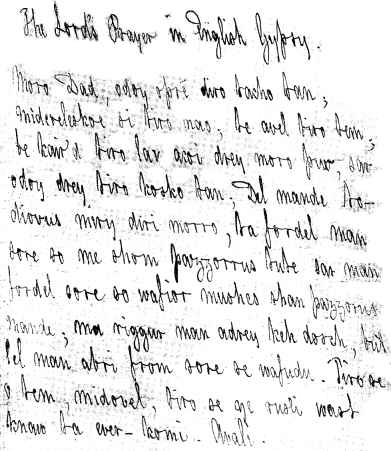
Accompanying the Manuscript of The Lord’s Prayer in Romany, is the Manuscript of a translation made by Borrow into the dialect of the English Gypsies. This translation has never, so far as I am aware, appeared in print. It is an interesting document, and well worthy of preservation. A reduced facsimile of it will be found facing the present page.
A Second Edition of Romano Lavo-Lil was issued by the same publisher, John Murray, in 1888, and a Third in 1905.
There is a copy of the First Edition of Romano Lavo-Lil in the Library of the British Museum. The Press-mark is 2278. c. 15.
(16) [The Turkish Jester: 1884]
The Turkish Jester; / Or, / The Pleasantries / of / Cogia Nasr Eddin Effendi. / Translated from the Turkish / By / George Borrow. / Ipswich: / W. Webber, Dial Lane. / 1884.
Collation:—Crown octavo, printed in half-sheets, pp. ii + 52; consisting of: Title-page, as above (with Certificate of Issue upon the centre of the reverse) pp. i–ii; and Text pp. 1–52. There are no head-lines, the pages being numbered centrally. The book is made up in a somewhat unusual manner, each half-sheet having a separately printed quarter-sheet of two leaves imposed within it. The register is therefore B to E (four sections, each 6 leaves), plus F (2 leaves), the whole preceded by two leaves, one of which is blank, whilst the other carries the Title-page. There is no printer’s imprint. The book was issued without any Half-title. The title is enclosed within a single rectangular ruled frame.
Issued in cream-coloured paper wrappers, with the title-page reproduced upon the front, but reset in types of different character, and without the ruled frame, and with the imprint reading High Street in place of Dial Lane. Inside the front cover the Certificate of Issue is repeated. The leaves measure 7¾ × 5 inches. The edition consisted of One Hundred and Fifty Copies. The published price was 7s. 6d.
The Manuscript of The Turkish Jester was formerly owned by Dr. Knapp, and is now the property of the Hispanic Society, of New York. It extends to 71 pages 4to. The translation was probably made about 1854, at the time when Borrow was at work upon his Songs of Europe. In 1857, the book was included among the Advertisements appended to the second volume of The Romany Rye.
There is a copy of the First Edition of The Turkish Jester in the Library of the British Museum. The Press-mark is 758. b. 16.
(17) [The Death of Balder: 1889]
The / Death of Balder / From the Danish / of / Johannes Ewald / (1773) / Translated by / George Borrow / Author of “Bible in Spain,” “Lavengro,” “Wild Wales,” etc. / London / Jarrold & Sons, 3 Paternoster Buildings, E.C. / 1889 / All Rights Reserved.
Collation:—Crown octavo, pp. viii + 77; consisting of: Half-title (with Certificate of Issue upon the centre of the reverse) pp. i–ii; Title-page, as above (with blank reverse) pp. iii–iv; Preface and List of The Persons (each with blank reverse) pp. v–viii; and Text pp. 1–77. The reverse of p. 77 is blank. The head-line is Death of Balder throughout, upon both sides of the page. At the foot of p. 77 is the following imprint, “Printed by Ballantyne, Hanson & Co. / London and Edinburgh.” The signatures are A (4 leaves), and B to F (5 sheets, each 8 leaves). Sig. F 8 is a blank.
Issued in dark brown ‘diced’ cloth boards, with white paper back-label. The leaves measure 7¾ × 5 inches. Two Hundred and Fifty Copies were printed. The published price was 7s. 6d.
The Death of Balder was written in 1829, the year during which Borrow produced so many of his ballad translations, the year in which he made his fruitless effort to obtain subscribers for his Songs of Scandinavia. On December 6th of that year he wrote to Dr. [afterwards Sir] John Bowring:
“I wish to shew you my translation of The Death of Balder, Ewald’s most celebrated production, which, if you approve of, you will perhaps render me some assistance in bringing forth, for I don’t know many publishers. I think this will be a proper time to introduce it to the British public, as your account of Danish literature will doubtless cause a sensation.”
Evidently no publisher was forthcoming, for the work remained in manuscript until 1889, when, eight years after Borrow’s death, Messrs. Jarrold & Sons gave it to the world. In 1857 Borrow included the Tragedy among the series of Works advertised as “ready for the Press” at the end of the second volume of The Romany Rye. It was there described as “A Heroic Play.”
Although published only in 1889, The Death of Balder was actually set up in type three years earlier. It had been intended that the book should have been issued in London by Messrs. Reeves & Turner, and proof-sheets exist carrying upon the title-page the name of that firm as publishers, and bearing the date 1886. It would appear that Mr. W. Webber, a bookseller of Ipswich, who then owned the Manuscript, had at first contemplated issuing the book through Messrs. Reeves & Turner. But at this juncture he entered into the employment of Messrs. Jarrold & Sons, and consequently the books was finally brought out by that firm. The types were not reset, but were kept standing during the interval.
Another version of the song of The Three Valkyrier, which appears in The Death of Balder, pp. 53–54, was printed in Marsk Stig’s Daughters and Other Songs and Ballads, 1913, pp. 19–20. The text of the two versions differs entirely, in addition to which the 1913 version forms one complete single song, whilst in that of 1889 the lines are divided up between the several characters.
The Manuscript of The Death of Balder, referred to above, passed into the hands of Dr. Knapp, and is now in the possession of the Hispanic Society, of New York. It consists of 97 pages 4to. A transcript in the handwriting of Mrs. Borrow is also the property of the Society.
There is a copy of the First Edition of The Death of Balder in the Library of the British Museum. The Press-mark is 11755. f 9.
(18) [Letters to the Bible Society: 1911]
Letters of / George Borrow / To the British and Foreign / Bible Society / Published by Direction of the Committee / Edited by / T. H. Darlow / Hodder and Stoughton / London New York Toronto / 1911.
Collation:—Octavo, pp. xviii + 471; consisting of: Half-title (with blank reverse) pp. i–ii; Title-page, as above (with blank reverse) pp. iii–iv; Dedication To Williamson Lamplough (with blank reverse) pp. v–vi; Preface vii–xi; Note regarding “the officials of the Bible Society with whom Borrow came into close relationship” pp. xi–xii; List of Borrow’s Letters, etc., printed in this Volume pp. xiii–xvii; chronological Outline of Borrow’s career p. xviii; and Text of the Letters, &c., pp. 1–471. There are head-lines throughout, each verso being headed George Borrow’s Letters, and each recto To the Bible Society. Upon the reverse of p. 471 is the following imprint “Printed by T. and A. Constable, Printers to His Majesty / at the Edinburgh University Press.” The signatures are a (one sheet of 8 leaves), b (a quarter-sheet of 2 leaves), A to 2 F (29 sheets, each 8 leaves) plus 2 G (a half-sheet of 4 leaves). Sig. a 1 is a blank. A facsimile of one of the Letters included in the volume is inserted as Frontispiece.
Issued in dark crimson buckram, with paper sides, lettered in gold across the back, “Letters of / George / Borrow / To the / Bible Society / Edited by / T. H. Darlow / Hodder & / Stoughton.” The leaves measure 8⅜ × 5⅞ inches. The published price was 7s. 6d.
“When Borrow set about preparing The Bible in Spain, he obtained from the Committee of the Bible Society the loan of the letters which are here published, and introduced considerable portions of them into that most picturesque and popular of his works. Perhaps one-third of the contents of the present volume was utilised in this way, being more or less altered and edited by Borrow for the purpose.”—[Preface, pp. ix-x].
The holographs of the complete series of Letters included in this volume are preserved in the archives of the British and Foreign Bible Society.
There is a copy of Letters of George Borrow to the British and Foreign Bible Society in the Library of the British Museum. The Press-mark is 010902.e.10.
(19) [Letters to Mary Borrow: 1913]
Letters / To his Wife / Mary Borrow / By / George Borrow / London: / Printed for Private Circulation / 1913.
Collation:—Crown octavo, pp. 38; consisting of: Half-title (with blank reverse) pp. 1–2; Title-page, as above (with blank reverse), pp. 3–4; and Text of the Letters pp. 5–38. The head-line is Letters to His Wife throughout, upon both sides of the page. Following p. 38 is a leaf, with blank reverse, and with the following imprint upon its recto, “London: / Printed for Thomas J. Wise, Hampstead, N.W. / Edition limited to Thirty Copies.” The signatures are A (a half sheet of 4 leaves), plus B and C (2 sheets, each 8 leaves), inset within each other.
Issued in bright green paper wrappers, with untrimmed edges, and with the title-page reproduced upon the front. The leaves measure 7½ × 5 inches.
Thirty Copies only were printed.
Holograph Letters by Borrow are extremely uncommon, the number known to be extant being far less than one might have supposed would be the case, considering the good age to which Borrow attained. His correspondents were few, and, save to the officials of the Bible Society, he was not a diligent letter-writer. The holographs of this series of letters addressed to his wife are in my own collection of Borroviana.
The majority of the letters included in this volume were reprinted in George Borrow and his Circle. By Clement King Shorter, 8vo, 1913.
There is a copy of Letters to his Wife, Mary Borrow, in the Library of the British Museum. The Press-mark is C. 44. d. 32.
(20) [Marsk Stig: 1913]
Marsk Stig / A Ballad / By / George Borrow / London: / Printed for Private Circulation / 1913.
Collation:—Crown octavo, pp. 40; consisting of: Half-title (with blank reverse) pp. 1–2; Title-page, as above (with blank reverse) pp. 3–4; and Text of the Ballad pp. 5–40. The head-line is Marsk Stig throughout, upon both sides of the page. At the foot of p. 40 is the following imprint, “London: / Printed for Thomas J. Wise, Hampstead, N.W. / Edition limited to Thirty Copies.” The signatures are A (a half-sheet of 4 leaves), plus B and C (2 sheets, each 8 leaves), inset within each other.
Issued in bright green paper wrappers, with untrimmed edges, and with the title-page reproduced upon the front. The leaves measure 7½ × 5 inches.
Thirty Copies only were printed.
Marsk Stig consists of four separate Ballads, or Songs as Borrow styled them, the whole forming one complete and connected story. The plot is an old Danish legend of the same character as the history of David and Bathsheba, Marsk Stig himself being the counterpart of Uriah the Hittite.
The four Songs commence as follows:—
page
1. Marsk Stig he out of the country rode To win him fame with his good bright sword 5
2. Marsk Stig he woke at black midnight, And loudly cried to his Lady dear 15
3. There’s many I ween in Denmark green Who all to be masters now desire 23
4. There were seven and seven times twenty That met upon the verdant wold 34
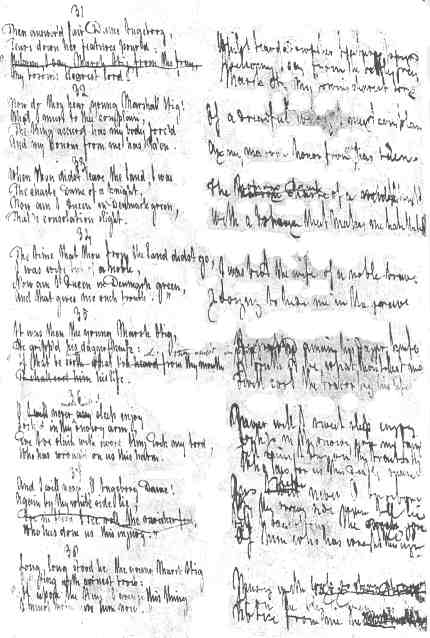
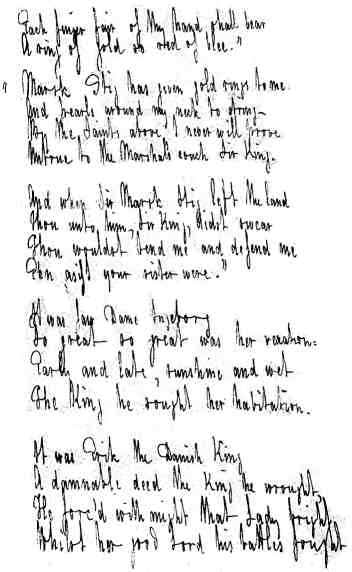
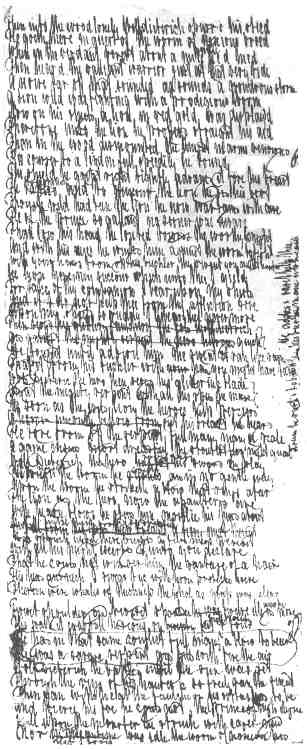
Marsk Stig was one of the ballads prepared by Borrow for The Songs of Scandinavia in 1829, and revised for the Kœmpe Viser in 1854. Both Manuscripts are extant, and I give reproductions of a page of each. It will be observed that upon the margins of the earlier Manuscript Borrow wrote his revisions, so that this Manuscript practically carries in itself both versions of the ballad. The Manuscript of 1829 is in the possession of Mr. J. H. Spoor, of Chicago. The Manuscript of 1854 is in my own library. As a specimen of Marsk Stig I quote the following stanzas:
It was the young and bold Marsk Stig Came riding into the Castle yard, Abroad did stand the King of the land So fair array’d in sable and mard.
“Now lend an ear, young Marshal Stig, I have for thee a fair emprise, Ride thou this year to the war and bear My flag amongst my enemies.”
“And if I shall fare to the war this year, And risk my life among thy foes, Do thou take care of my Lady dear, Of Ingeborg, that beauteous rose.”
Then answer’d Erik, the youthful King, With a laugh in his sleeve thus answered he: “No more I swear has thy lady to fear Than if my sister dear were she.”
It was then the bold Sir Marshal Stig, From out of the country he did depart, In her castle sate his lonely mate, Fair Ingeborg, with grief at heart.
“Now saddle my steed,” cried Eric the King, “Now saddle my steed,” King Eric cried, “To visit the Dame of beauteous fame Your King will into the country ride.”
* * * * *
“Now list, now list, Dame Ingeborg, Thou art, I swear, a beauteous star, Live thou with me in love and glee, Whilst Marshal Stig is engag’d in war.”
Then up and spake Dame Ingeborg, For nought was she but a virtuous wife: “Rather, I say, than Stig betray, Sir King, I’d gladly lose my life.”
“Give ear, thou proud Dame Ingeborg, If thou my leman and love will be, Each finger fair of thy hand shall bear A ring of gold so red of blee.”
“Marsk Stig has given gold rings to me, And pearls around my neck to string; By the Saints above I never will prove Untrue to the Marshal’s couch, Sir King.”
* * * * *
It was Erik the Danish King, A damnable deed the King he wrought; He forc’d with might that Lady bright, Whilst her good Lord his battles fought.
* * * * *
It was the young Sir Marshal Stig Stepp’d proudly in at the lofty door; And bold knights then, and bold knight’s men, Stood up the Marshal Stig before.
So up to the King of the land he goes, And straight to make his plaint began; Then murmured loud the assembled crowd, And clench’d his fist each honest man.
“Ye good men hear a tale of fear, A tale of horror, a tale of hell—
&c., &c.
There is a copy of Marsk Stig A Ballad in the Library of the British Museum. The Press-mark is C. 44. d. 38.
(21) [The Serpent Knight: 1913]
The Serpent Knight / and / Other Ballads / By / George Borrow / London: / Printed for Private Circulation / 1913.
Collation:—Square demy octavo, pp. 35; consisting of: Half-title (with blank reverse) pp. 1–2; Title-page, as above (with blank reverse) pp. 3–4; Table of Contents (with blank reverse) pp. 5–6; and Text of the Ballads pp. 7–35. There are head-lines throughout, each page being headed with the title of the particular Ballad occupying it. Upon the reverse of p. 35 is the following imprint: “London: / Printed for Thomas J. Wise, Hampstead, N.W. / Edition limited to thirty copies.” The signatures are A (a quarter-sheet of two leaves), plus B & C (two sheets, each eight leaves), inset within each other.
Issued in bright green paper wrappers, with untrimmed edges, and with the title-page reproduced upon the front. The leaves measure 8½ × 6⅞ inches.
Thirty Copies only were printed.
Contents.
page
The Serpent Knight. [Signelil sits in her bower alone] The only extant MS. of this ballad originally bore the title The Transformed Knight, but the word Transformed is struck out and replaced by Serpent, in Borrow’s handwriting. 7
Sir Olaf. [Sir Olaf rides on his courser tall] Sir Olaf is one of Borrow’s most successful ballads. The only extant Manuscript is written upon paper water-marked with the date 1845, and was prepared for the projected Kœmpe Viser. 10
The Treacherous Merman. [“Now rede me mother,” the merman cried] This Ballad is a later, and greatly improved, version of one which appeared under the title The Merman only, in the Romantic Ballads of 1826. The introduction of the incident of the changing by magic of the horse into a boat, furnishes a reason for the catastrophe which was lacking in the earlier version. In its final shape The Treacherous Merman is another of Borrow’s most successful ballads, and it is evident that he bestowed upon it an infinite amount of care and labour. An early draft of the final version [a reduced facsimile of its first page will be found ante, facing p. 40] bears the tentative title Marsk Stig’s Daughter. Besides the two printed versions Borrow certainly composed a third, for a fragment exists of a third MS., the text of which differs considerably from that of both the others. 15
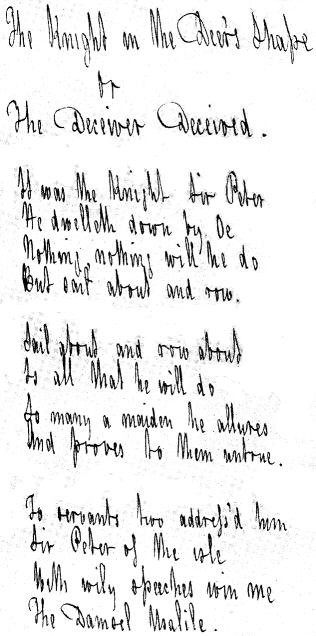
The Knight in the Deer’s Shape. [It was the Knight Sir Peter] Facing the present page is a reduced facsimile of the first page of the Manuscript of The Knight in the Deer’s Shape. 18
The Stalwart Monk. [Above the wood a cloister towers] The Stalwart Monk was composed by Borrow about the year 1860. Whether he had worked upon the ballad in earlier years cannot be ascertained, as no other Manuscript besides that from which it was printed in the present volume is known to exist. 24
The Cruel Step-Dame. [My father up of the country rode] 30
The Cuckoo. [Yonder the cuckoo flutters] 34
The complete Manuscript of The Serpent Knight and Other Ballads is in my own collection of Borroviana.
There is a copy of The Serpent Knight and Other Ballads in the Library of the British Museum. The Press-mark is C. 44. d. 38.
(22) [The King’s Wake: 1913]
The King’s Wake / and Other Ballads / By / George Borrow / London: / Printed for Private Circulation / 1913.
Collation:—Square demy octavo, pp. 23; consisting of: Half-title (with blank reverse) pp. 1–2; Title-page, as above (with blank reverse) pp. 3–4; and Text of the Ballads pp. 5–23. There are head-lines throughout, each page being headed with the title of the particular Ballad occupying it. Upon the reverse of p. 23 is the following imprint: “London: / Printed for Thomas J. Wise, Hampstead, N.W. / Edition limited to Thirty Copies.” The signatures are A (a half-sheet of four leaves), with B (a full sheet of eight leaves) inset within it.
Issued in bright green paper wrappers, with untrimmed edges, and with the title-page reproduced upon the front. The leaves measure 8½ × 6⅞ inches.
Thirty Copies only were printed.
Contents.
page
The King’s Wake. [To-night is the night that the wake they hold] An early draft of this ballad has the title The Watchnight. 5
Swayne Felding. [Swayne Felding sits at Helsingborg] Of Swayne Felding two Manuscripts are extant. One, originally destined for The Songs of Scandinavia, is written upon white paper water-marked with the date 1828. The other, written upon blue paper, was prepared for the Kœmpe Viser of 1854. In the earlier MS. the ballad bears the title Swayne Felding’s Combat with the Giant; the later MS. is entitled Swayne Felding only. The texts of the two MSS. differ widely. 10
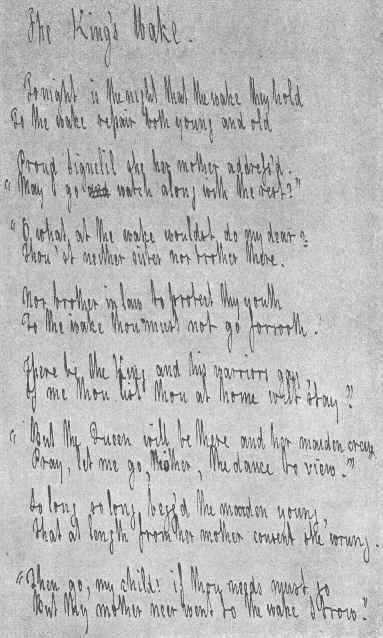
Innocence Defamed. [Misfortune comes to every door] The heroic ballads included in these collections are all far too long to admit of any one of them being given in full. As an example of the shorter ballads I quote the title-poem of the present pamphlet, The King’s Wake: THE KING’S WAKE [132] To-night is the night that the wake they hold, To the wake repair both young and old. Proud Signelil she her mother address’d: “May I go watch along with the rest?” “O what at the wake wouldst do my dear? Thou’st neither sister nor brother there. “Nor brother-in-law to protect thy youth, To the wake thou must not go forsooth. “There be the King and his warriors gay, If me thou list thou at home wilt stay.” “But the Queen will be there and her maiden crew, Pray let me go, mother, the dance to view.” So long, so long begged the maiden young, That at length from her mother consent she wrung. “Then go, my child, if thou needs must go, But thy mother ne’er went to the wake I trow.” Then through the thick forest the maiden went, To reach the wake her mind was bent. When o’er the green meadows she had won, The Queen and her maidens to bed were gone. And when she came to the castle gate They were plying the dance at a furious rate. There danced full many a mail-clad man, And the youthful King he led the van. He stretched forth his hand with an air so free: “Wilt dance, thou pretty maid, with me?” “O, sir, I’ve come across the wold That I with the Queen discourse might hold.” “Come dance,” said the King with a courteous smile, “The Queen will be here in a little while.” Then forward she stepped like a blushing rose, She takes his hand and to dance she goes. “Hear Signelil what I say to thee, A ditty of love sing thou to me.” “A ditty of love I will not, Sir King, But as well as I can another I’ll sing.” Proud Signil began, a ditty she sang, To the ears of the Queen in her bed it rang. Says the Queen in her chamber as she lay: “O which of my maidens doth sing so gay? “O which of my maidens doth sing so late, To bed why followed they me not straight?” Then answered the Queen the little foot page: “’Tis none of thy maidens I’ll engage. “’Tis none I’ll engage of the maiden band, ’Tis Signil proud from the islet’s strand.” “O bring my red mantle hither to me, For I’ll go down this maid to see.” And when they came down to the castle gate The dance it moved at so brave a rate. About and around they danced with glee, There stood the Queen and the whole did see. The Queen she felt so sore aggrieved When the King with Signil she perceived. Sophia the Queen to her maid did sign: “Go fetch me hither a horn of wine.” His hand the King stretched forth so free: “Wilt thou Sophia my partner be?” “O I’ll not dance with thee, I vow, Unless proud Signil pledge me now.” The horn she raised to her lips, athirst, The innocent heart in her bosom burst. There stood King Valdemar pale as clay, Stone dead at his feet the maiden lay. “A fairer maid since I first drew breath Ne’er came more guiltless to her death.” For her wept woman and maid so sore, To the Church her beauteous corse they bore. But better with her it would have sped, Had she but heard what her mother said. 20
There is a copy of The King’s Wake and Other Ballads in the Library of the British Museum. The Press-mark is C. 44. d. 38.
(23) [The Dalby Bear: 1913]
The Dalby Bear / and Other Ballads / By / George Borrow / London: / Printed for Private Circulation / 1913.
Collation:—Square demy octavo, pp. 20; consisting of: Half-title (with blank reverse) pp. 1–2; Title-page, as above (with blank reverse) pp. 3–4; and Text of the Ballads pp. 5–20. There are head-lines throughout, each page being headed with the title of the particular Ballad occupying it. At the foot of p. 20 is the following imprint: “London / Printed for Thomas J. Wise, Hampstead, N.W. / Edition limited to Thirty Copies.” The signatures are A (a quarter-sheet of two leaves), with B (a full sheet of 8 leaves) inset within it.
Issued in bright green paper wrappers, with untrimmed edges, and with the title-page reproduced upon the front. The leaves measure 8½ × 6⅞ inches.
Thirty Copies only were printed.
Contents.
page
The Dalby Bear. [There goes a bear on Dalby moors] 5
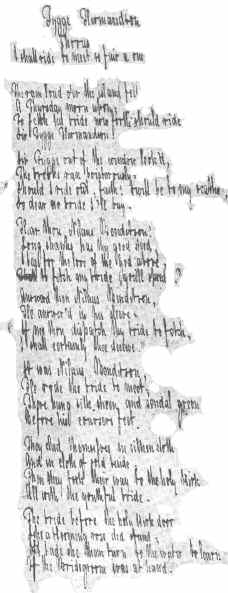
Tygge Hermandsen. [Down o’er the isle in torrents fell] The ballad was printed from a Manuscript written in 1854. I give a reduced facsimile of a page of an earlier Manuscript written in 1830. 9
The Wicked Stepmother. [Sir Ove he has no daughter but one] This ballad should be read in conjunction with The Wicked Stepmother, No. ii, printed in Young Swaigder or The Force of Runes and Other Ballads, 1913, pp. 23–37. 14
The complete Manuscript of The Dalby Bear and Other Ballads is in the library of Mr. Clement Shorter.
There is a copy of The Dalby Bear and Other Ballads in the Library of the British Museum. The Press-mark is C. 44. d. 38.
(24.) [The Mermaid’s Prophecy: 1913]
The / Mermaid’s Prophecy / and other / Songs relating to Queen Dagmar / By / George Borrow / London: / Printed for Private Circulation / 1913.
Collation:—Square demy octavo, pp. 30; consisting of Half-title (with blank reverse) pp. 1–2; Title-page, as above (with blank reverse) pp. 3–4; and Text of the Songs pp. 5–30. There are head-lines throughout, each page being headed with the title of the particular Song occupying it. Following p. 30 is a leaf, with a notice regarding the American copyright upon the reverse, and with the following imprint upon its recto: “London: / Printed for Thomas J. Wise, Hampstead, N.W. / Edition limited to Thirty Copies.” The signatures are A and B (two sheets, each eight leaves), the one inset within the other.
Issued in bright green paper wrappers, with untrimmed edges, and with the title-page reproduced upon the front. The leaves measure 8¾ × 6⅞ inches.
Thirty Copies only were printed.
Contents.
page
Songs relating to Queen Dagmar:
I. King Valdemar’s Wooing. [Valdemar King and Sir Strange bold] 5
II. Queen Dagmar’s Arrival in Denmark. [It was Bohemia’s Queen began] 14
III. The Mermaid’s Prophecy. [The King he has caught the fair mermaid, and deep] 19
Rosmer. [Buckshank bold and Elfinstone] This ballad should be read in conjunction with Rosmer Mereman, printed in Young Swaigder or The Force of Runes and Other Ballads, 1913, pp. 16–22. 25
Of The Mermaid’s Prophecy there are two Manuscripts extant. In the earlier of these, written in 1829, the Poem is entitled The Mermaid’s Prophecy. In the later Manuscript, written apparently about the year 1854, it is entitled The Mermaid only. From this later Manuscript the Poem was printed in the present volume.
Unlike the majority of Borrow’s Manuscripts, which usually exhibit extreme differences of text when two holographs exist of the same Poem, the texts of the two versions of The Mermaid’s Prophecy are practically identical, the opening stanza alone presenting any important variation. Here are the two versions of this stanza:
1829
The Dane King had the Mermaiden caught by his swains, The mermaid dances the floor upon— And her in the tower had loaded with chains, Because his will she had not done.
1854
The King he has caught the fair mermaid, and deep (The mermaid dances the floor upon) In the dungeon has placed her, to pine and to weep, Because his will she had not done.
There is a copy of The Mermaid’s Prophecy and other Songs relating to Queen Dagmar in the Library of the British Museum. The Press mark is C. 44. d. 38.
(25.) [Hafbur and Signe: 1913]
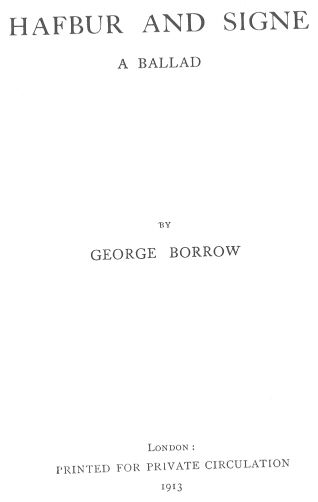
Hafbur and Signe / A Ballad / By / George Borrow / London: / Printed for Private Circulation / 1913.
Collation:—Square demy octavo, pp. 23; consisting of: Half-title (with blank reverse) pp. 1–2; Title-page, as above (with blank reverse) pp. 3–4; and Text of the Ballad pp. 5–23. The head-line is Hafbur and Signe throughout, upon both sides of the page. Upon the reverse of p. 23 is the following imprint: “London: / Printed for Thomas J. Wise, Hampstead, N.W. / Edition limited to Thirty Copies.” The signatures are A (a half-sheet of four leaves), with B (a full sheet of eight leaves) inset within it.
Issued in bright green paper wrappers, with untrimmed edges, and with the title-page reproduced upon the front. The leaves measure 8½ × 6⅞ inches.
Thirty Copies only were printed.
Contents.
page
Hafbur and Signe. [Young Hafbur King and Sivard King They lived in bitter enmity] 5
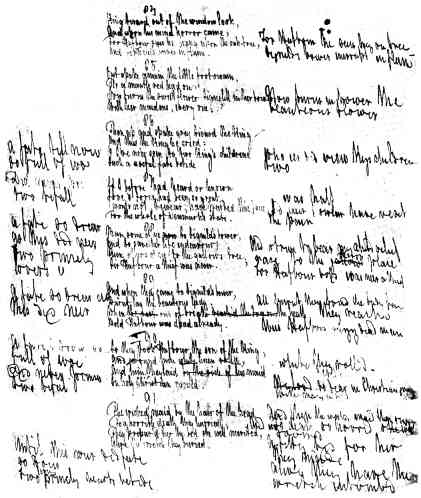
Of Hafbur and Signe two Manuscripts are extant. The first of these was doubtless written in the early summer of 1830, for on June 1st of that year Borrow wrote to Dr. Bowring:
I send you “Hafbur and Signe” to deposit in the Scandinavian Treasury [i.e. among the Songs of Scandinavia].
The later Manuscript was written in or about the year 1854.
The earlier of these two Manuscripts is in the collection of Mr. Herbert T. Butler. The later Manuscript is in my own library.
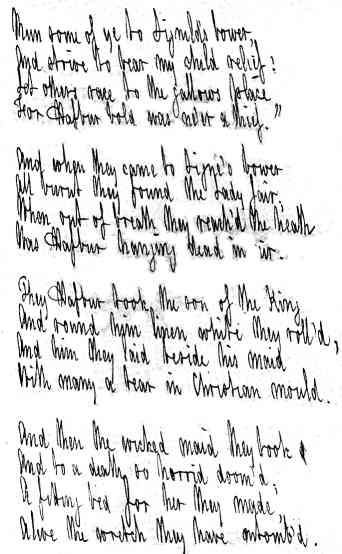
As is usually the case when two Manuscripts of one of Borrow’s ballads are available, the difference in poetical value of the two versions of Hafbur and Signe is considerably. Few examples could exhibit more distinctly the advance made by Borrow in the art of poetical composition during the interval. Here are some stanzas from the version of 1854.
So late it was at nightly tide, Down fell the dew o’er hill and mead; Then lists it her proud Signild fair With all the rest to bed to speed.
“O where shall I a bed procure?” Said Hafbur then, the King’s good son. “O thou shalt rest in chamber best With me the bolsters blue upon.”
Proud Signild foremost went, and stepped The threshold of her chamber o’er; With secret glee came Hafbur, he Had never been so glad before.
Then lighted they the waxen lights, So fairly twisted were the same. Behind, behind, with ill at mind, The wicked servant maiden came
The following are the parallel stanzas from the version of 1830
So late it was in the nightly tide, Dew fell o’er hill and mead; Then listed her proud Signild fair With the rest to bed to speed.
“O where shall I a bed procure?” Said Hafbour the King’s good son. “In the chamber best with me thou shalt rest, The bolsters blue upon.”
Proud Signild foremost went and stepp’d The high chamber’s threshold o’er, Prince Hafbour came after with secret laughter, He’d ne’er been delighted more
Then lighted they the waxen lights, Fair twisted were the same. Behind, behind with ill in her mind The wicked servant came.
I give herewith a reduced facsimile of the last page of each Manuscript.
There is a copy of Hafbur and Signe A Ballad in the Library of the British Museum. The Press-mark is C. 44. d. 38.
(26) [The Story of Yvashka: 1913]
The Story / of / Yvashka with the Bear’s Ear / Translated from the Russian / By / George Borrow / London: / Printed for Private Circulation / 1913.
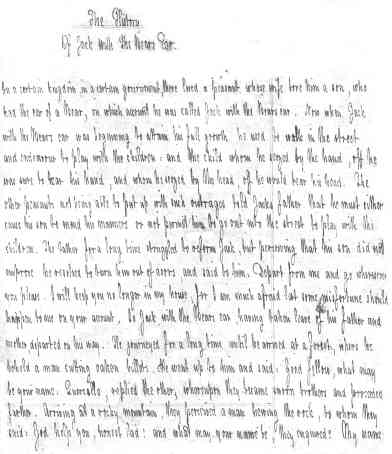
Collation:—Square demy octavo, pp. 23; consisting of: Half title (with blank reverse) pp. 1–2; Frontispiece (with blank recto) pp. 3–4; Title-page, as above (with blank reverse) pp. 5–6; Introduction (by Borrow) pp. 7–10; and Text of the Story pp. 11–23. The head-line is Yvashka with the Bears Ear throughout, upon both sides of the page. Upon the reverse of p. 23 is the following imprint: “London: / Printed for Thomas J. Wise, Hampstead, N. W. / Edition limited to Thirty Copies.” The signatures are A (a half sheet of 4 leaves), and B (a full sheet of 8 leaves), the one inset within the other. The Frontispiece consists of a reduced facsimile of the first page of the original Manuscript in Borrow’s handwriting.
Issued in bright green paper wrappers, with untrimmed edges, and with the title-page reproduced upon the front. The leaves measure 8½ × 6⅞ inches.
Thirty Copies only were printed.
The Story of Yvashka was the second of three Russian Popular Tales, which were contributed by Borrow to the pages of Once a Week during 1862. The Story of Yvashka appeared in the number for May 17th, 1862, Vol. vi, pp. 572–574.
The Story was reprinted in The Sphere, Feb. 1st, 1913, p. 136.
The Text of Yvashka as printed in Once a Week differs appreciably from that printed in The Sphere, and in the private pamphlet of 1913, both of which are identical. The Manuscript from which the two latter versions were taken was the original translation. The version which appeared in Once a Week was printed from a fresh Manuscript (which fills 11 quarto pages) prepared in 1862. A reduced facsimile of the first page of the earlier Manuscript (which extends to 5⅛ quarto pages) will be found reproduced upon the opposite page. In this Manuscript the story is entitled The History of Jack with the Bear’s Ear.
Judging from the appearance of this MS., both paper and handwriting, together with that of fragments which remain of the original MSS. of the other two published Tales, it seems probable that the whole were produced by Borrow during his residence in St. Petersburg. Should such surmise be correct, the Tales are contemporary with Targum.
The Once a Week version of The Story of Yvashka was reprinted in The Avon Booklet, Vol. ii, 1904, pp. 199–210.
There is a copy of The Story of Yvashka in the Library of the British Museum. The Press-mark is C. 44. d. 37.
(27) [The Verner Raven: 1913]
The Verner Raven / The Count of Vendel’s / Daughter / and Other Ballads / By / George Borrow / London: / Printed for Private Circulation / 1913.
Collation:—Square demy octavo, pp. 27; consisting of: Half-title (with blank reverse) pp. 1–2; Title-page, as above (with a note regarding the American copyright upon the centre of the reverse) pp. 3–4, and Text of the Ballads pp. 5–27. There are headlines throughout, each page being headed with the title of the particular Ballad occupying it. Upon the reverse of p. 27 is the following imprint: “London / Printed for Thomas J. Wise, Hampstead, N.W. / Edition limited to Thirty Copies.” The signatures are A (a quarter-sheet of 2 leaves), B (a half sheet of 4 leaves), and C (a full sheet of 8 leaves), all inset within each other.
Issued in bright green paper wrappers, with untrimmed edges, and with the title-page reproduced upon the front. The leaves measure 8½ × 6⅞ inches.
Thirty Copies only were printed.
Contents.
page
The Verner Raven. [The Raven he flies in the evening tide] 5
The Count of Vendel’s Daughter. [Within a bower the womb I left] Previously printed in Once a Week, Vol. viii, January 3rd, 1863, pp. 35–36. 12
The Cruel Mother-in-Law. [From his home and his country Sir Volmor should fare] 18
The Faithful King of Thule. [A King so true and steady] 25
The Fairies’ Song. [Balmy the evening air] 27
Note.—Each poem to which no reference is attached, appeared for the first time in this volume.
The Manuscript of The Count of Vendel’s Daughter is included in the extensive collection of Borroviana belonging to Mr. F. J. Farrell, of Great Yarmouth.
There is a copy of The Verner Raven, The Count of Vendel’s Daughter, and Other Ballads in the Library of the British Museum. The Press-mark is C. 44. d. 38.
(28) [The Return of the Dead: 1913]
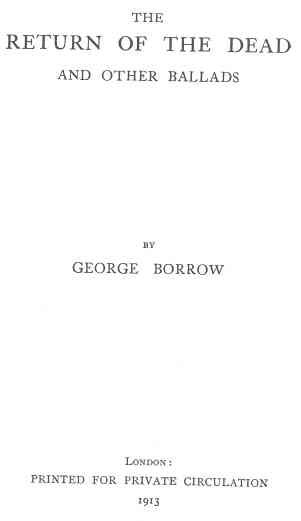
The / Return of the Dead / and Other Ballads / By / George Borrow / London: / Printed for Private Circulation / 1913.
Collation:—Square demy octavo, pp. 22; consisting of: Half-title (with blank reverse) pp. 1–2; Title-page, as above (with blank reverse) pp. 3–4; and Text of the Ballads pp. 5–22. There are head-lines throughout, each page being headed with the title of the particular Ballad occupying it. Following p. 22 is a leaf, with blank reverse, and with the following imprint upon its recto: “London: / Printed for Thomas J. Wise, Hampstead, N.W. / Edition limited to Thirty copies.” The signatures are A (a half-sheet of four leaves), with B (a full sheet of eight leaves), inset within it.
Issued in bright green paper wrappers, with untrimmed edges, and with the title-page reproduced upon the front. The leaves measure 8½ × 6⅞ inches.
Thirty Copies only were printed.
Contents.
page
The Return of the Dead. [Swayne Dyring o’er to the island strayed] 5
The Transformed Damsel. [I take my axe upon my back] 13
The Forced Consent. [Within her own fair castelaye] 15
Ingeborg’s Disguise. [Such handsome court clothes the proud Ingeborg buys] 19
Song. [I’ve pleasure not a little] 22
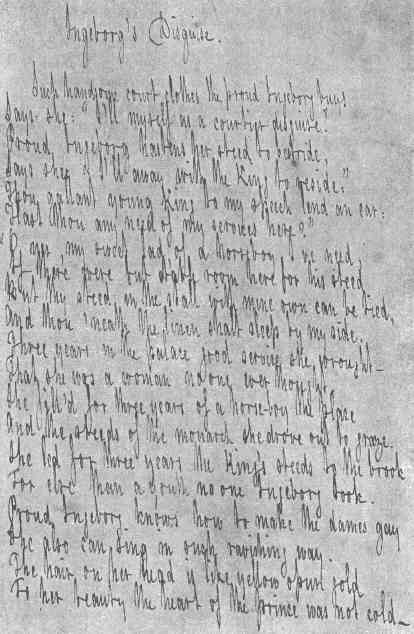
As a further example of Borrow’s shorter Ballads, I give Ingeborg’s Disguise in full. The entire series included in The Return of the Dead and Other Ballads ranks among the most uniformly successful of Borrow’s achievements in this particular branch of literature:—
INGEBORG’S DISGUISE [161]
Such handsome court clothes the proud Ingeborg buys, Says she, “I’ll myself as a courtier disguise.”
Proud Ingeborg hastens her steed to bestride, Says she, “I’ll away with the King to reside.”
“Thou gallant young King to my speech lend an ear, Hast thou any need of my services here?”
“O yes, my sweet lad, of a horseboy I’ve need, If there were but stable room here for his steed.
“But thy steed in the stall with my own can be tied, And thou ’neath the linen shalt sleep by my side.”
Three years in the palate good service she wrought That she was a woman no one ever thought.
She filled for three years of a horse-boy the place, And the steeds of the monarch she drove out to graze.
She led for three years the King’s steeds to the brook, For else than a youth no one Ingeborg took.
Proud Ingeborg knows how to make the dames gay, She also can sing in such ravishing way.
The hair on her head is like yellow spun gold, To her beauty the heart of the prince was not cold.
But at length up and down in the palace she strayed, Her colour and hair began swiftly to fade.
What eye has seen ever so wondrous a case? The boy his own spurs to his heel cannot brace.
The horse-boy is brought to so wondrous a plight, To draw his own weapon he has not the might.
The son of the King to five damsels now sends, And Ingeborg fair to their care he commends.
Proud Ingeborg took they and wrapped in their weed, And to the stone chamber with her they proceed.
Upon the blue cushions they Ingeborg laid, Where light of two beautiful sons she is made.
Then in came the prince, smiled the babies to view: “’Tis not every horse-boy can bear such a two.”
He patted her soft on her cheek sleek and fair: “Forget my heart’s dearest all sorrow and care.”
He placed the gold crown on her temples I ween: “With me shalt thou live as my wife and my Queen.”
The complete Manuscript of The Return of the Dead and Other Ballads is in my own library.
There is a copy of The Return of the Dead and Other Ballads in the Library of the British Museum. The Press-mark is C.44.d.38.
(29) [Axel Thordson: 1913]
Axel Thordson / and Fair Valborg / A Ballad / By / George Borrow / London: / Printed for Private Circulation / 1913.
Collation:—Square demy octavo, pp. 45; consisting of: Half-title (with blank reverse) pp. 1–2; Title-page, as above (with a notice regarding the American copyright upon the reverse) pp. 3–4; and text of the Ballad pp. 5–45. The head-line is Axel Thordson and Fair Valborg throughout, upon both sides of the page. Upon the reverse of p. 45 is the following imprint: “London: / Printed for Thomas J. Wise, Hampstead, N.W. / Edition limited to Thirty Copies.” The signatures are A to C (Three sheets, each eight leaves) inset within each other. The last leaf of Sig. C is a blank.
Issued in bright green paper wrappers, with untrimmed edges, and with the title-page reproduced upon the front. The leaves measure 8½ × 6⅞ inches.
Thirty Copies only were printed.
Contents.
page
Axel Thordson and Fair Valborg. [At the wide board at tables play] 5
In some respects Axel Thordson and Fair Valborg is the most ambitious of Borrow’s Ballads. It is considerably the longest, unless we regard the four “Songs” of which Marsk Stig is comprised as forming one complete poem. But it is by no means the most successful; indeed it is invariably in his shorter Ballads that we find Borrow obtaining the happiest result.
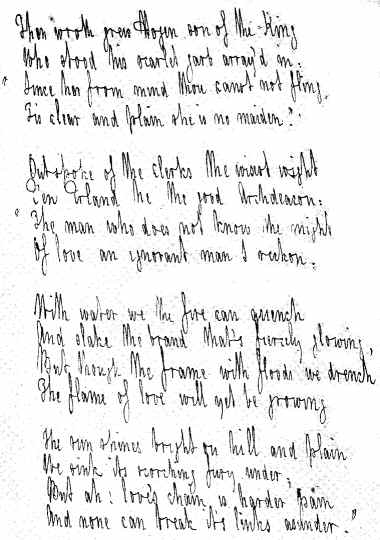
Two Manuscripts of Axel Thordson and Fair Valborg are available. The first was prepared in 1829 for the Songs of Scandinavia. The second was revised in 1854 for the Kœmpe Viser. This later Manuscript is in my own possession. I give herewith a reduced facsimile of one of its pages.
There is a copy of Axel Thordson and Fair Valborg in the Library of the British Museum. The Press-mark is C.44.d.38.
(30) [King Hacon’s Death: 1913]
King Hacon’s Death / and / Bran and the Black Dog / Two Ballads / By / George Borrow / London: / Printed for Private Circulation / 1913.
Collation:—Crown octavo, pp. 14; consisting of: Half-title (with blank reverse) pp. 1–2; Title-page, as above (with blank reverse) pp. 3–4; and Text of the Two Ballads pp. 5–14. There are head-lines throughout, each page being headed with the title of the particular Ballad occupying it. Following p. 14 is a leaf, with blank reverse, and with the following imprint upon its recto, “London: / Printed for Thomas J. Wise, Hampstead, N.W. / Edition limited to Thirty Copies.” There are no signatures, the pamphlet being composed of a single sheet, folded to form sixteen pages.
Issued in bright green paper wrappers, with untrimmed edges, and with the title-page reproduced upon the front. The leaves measure 7½ × 5 inches.
Thirty Copies only were printed.
Contents.
page
King Hacon’s Death. [“And now has happened in our day”] 5
Bran and the Black Dog. [“The day we went to the hills to chase”] I venture to regard this ballad of the fight between Bran and the Black Dog as one of Borrow’s happiest efforts. Here are some of its vigorous stanzas: The valiant Finn arose next day, Just as the sun rose above the foam; And he beheld up the Lairgo way, A man clad in red with a black dog come. He came up with a lofty gait, Said not for shelter he sought our doors; And wanted neither drink nor meat, But would match his dog ’gainst the best of ours. * * * * * “A strange fight this,” the great Finn said, As he turn’d his face towards his clan; Then his face with rage grew fiery red, And he struck with his fist his good dog Bran. “Take off from his neck the collar of gold, Not right for him now such a thing to bear; And a free good fight we shall behold Betwixt my dog and his black compeer.” The dogs their noses together placed, Then their blood was scatter’d on every side; Desperate the fight, and the fight did last ’Till the brave black dog in Bran’s grip died. * * * * * We went to the dwelling of high Mac Cuol, With the King to drink, and dice, and throw; The King was joyous, his hall was full, Though empty and dark this night I trow. 11
There is a copy of King Hacon’s Death and Bran and the Black Dog in the Library of the British Museum. The Pressmark is C. 44. d. 38.
(31) [Marsk Stig’s Daughters: 1913]
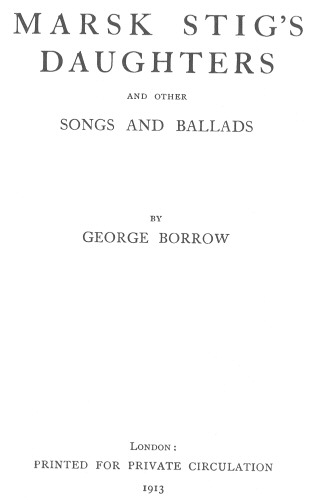
Marsk Stig’s / Daughters / and other / Songs and Ballads / By / George Borrow / London: / Printed for Private Circulation / 1913.
Collation:—Crown octavo, pp. 21; consisting of: Half-title (with blank reverse), pp. 1–2; Title-page, as above (with blank reverse), pp. 3–4; Table of Contents, pp. 5–6; and Text of the Songs and Ballads, pp. 7–21. The reverse of p. 21 is blank. The head-line is Songs and Ballads throughout, upon both sides of the page. The pamphlet concludes with a leaf, with blank reverse, and with the following imprint upon its recto: “London: / Printed for Thomas J. Wise, Hampstead, N.W. / Edition limited to Thirty Copies.” There are no signatures, but the pamphlet consists of a half-sheet (of four leaves), with a full sheet (of eight leaves) inset within it.
Issued in bright green paper wrappers, with untrimmed edges, and with the title-page reproduced upon the front. The leaves measure 7½ × 5 inches.
Thirty Copies only were printed.
Contents.
page
Marsk Stig’s Daughters. [Two daughters fair the Marshal had] 7
The Three Expectants. [There are three for my death that now pine] 11
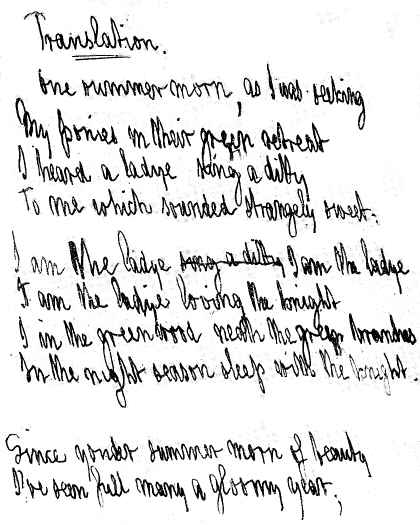
Translation. [One summer morn, as I was seeking] 13
The English Gipsy:
He. [As I to the town was going one day My Roman lass I met by the way] 14
She. [As I to the town was going one day I met a young Roman upon the way] The first of these two stanzas had been printed previously in Romano Lavo-Lil, 1874, p. 183. 14
Gipsy Song. [Up, up, brothers] The first stanza of this Song was printed previously (under the title Run for it!) in Romano Lavo-Lil, 1874, p. 195. 16
Our Heart is Heavy, Brother. [The strength of the ox] Another version of this poem was printed previously (under the title Sorrowful Tears, and with an entirely different text) in Romano Lavo-Lil, 1874, p. 211. In order to give some clear idea of the difference between the two versions, I quote the opening stanza of each: 1874. The wit and the skill Of the Father of ill, Who’s clever indeed, If they would hope With their foes to cope The Romany need. 1913. The strength of the ox, The wit of the fox, And the leveret’s speed; All, all to oppose Their numerous foes The Romany need. 17
Song. [Nastrond’s blazes] Another version of this Song was printed previously (divided up, and with many textual variations) in The Death of Balder, 1899, pp. 53–54. 19
Lines. [To read the great mysterious Past] As a specimen of Borrow’s lighter lyrical verse, as distinguished from his Ballads, I give the text of the Translation noted above, accompanied by a facsimile of the first page of the MS.: TRANSLATION. One summer morn, as I was seeking My ponies in their green retreat, I heard a lady sing a ditty To me which sounded strangely sweet: I am the ladye, I am the ladye, I am the ladye loving the knight; I in the green wood, ’neath the green branches, In the night season sleep with the knight. Since yonder summer morn of beauty I’ve seen full many a gloomy year; But in my mind still lives the ditty That in the green wood met my ear: I am the ladye, I am the ladye, I am the ladye loving the knight; I in the green wood, ’neath the green branches, In the night season sleep with the knight. A second Manuscript of this Translation has the ‘ditty’ arranged in eight lines, instead of in four. In this MS. the word ladye is spelled in the conventional manner: I am the lady, I am the lady, I am the lady Loving the knight; I in the greenwood, ’Neath the green branches, Through the night season Sleep with the knight. 21
Note.—Each poem to which no reference is attached appeared for the first time in this volume.
There is a copy of Marsk Stig’s Daughters and other Songs and Ballads in the Library of the British Museum. The Press-mark is C. 44. d. 38.
(32) [The Tale of Brynild: 1913]
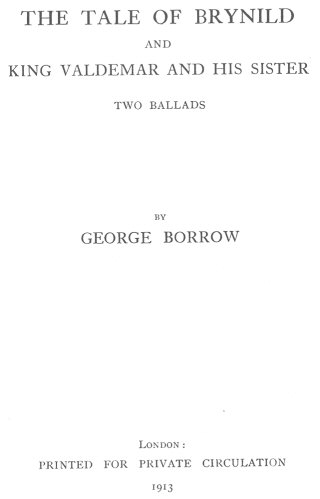
The Tale of Brynild / and / King Valdemar and his Sister / Two Ballads / By / George Borrow / London: Printed for Private Circulation / 1913.
Collation:—Square demy octavo, pp. 35; consisting of: Half-title (with blank reverse) pp. 1–2; Title-page as above (with a notice regarding the American copyright upon the reverse) pp. 3–4; and Text of the Ballads pp. 5–35. There are head-lines throughout, each page being headed with the title of the particular Ballad occupying it. Upon the reverse of p. 35 is the following imprint: “London: / Printed for Thomas J. Wise, Hampstead, N.W. / Edition limited to Thirty Copies.” The signatures are A (a quarter-sheet of two leaves), and B and C (two sheets, each eight leaves), each inset within the other.
Issued in bright green paper wrappers, with untrimmed edges, and with the title-page reproduced upon the front. The leaves measure 8½ × 6⅞ inches.
Thirty Copies only were printed.
Contents.
page
The Tale of Brynild. [Sivard he a colt has got] Of The Tale of Brynild, two manuscripts are extant, written in 1829 and 1854 respectively. The text of the latter, from which the ballad was printed in the present pamphlet, is immeasurably the superior. 5
King Valdemar and his sister. [See, see, with Queen Sophy sits Valdemar bold] 13
Mirror of Cintra. [Tiny fields in charming order] 34
The Harp. [The harp to everyone is dear] 35
There can be little doubt that the series of poems included in this volume present Borrow at his best as a writer of Ballads.
There is a copy of The Tale of Brynild and King Valdemar and his Sister in the Library of the British Museum. The Pressmark is C. 44. d. 38.
(33) [Proud Signild: 1913]
Proud Signild / and / Other Ballads / By / George Borrow / London: / Printed for Private Circulation / 1913.
Collation: Square demy octavo, pp. 28; consisting of: Half-title (with blank reverse) pp. 1–2; Title-page, as above (with a notice regarding the American copyright upon the reverse) pp. 3–4; and Text of the Ballads pp. 5–28. There are head-lines throughout, each page being headed with the title of the particular Ballad occupying it. At the foot of p. 28 is the following imprint: “London: Printed for Thomas J. Wise, Hampstead, N.W. Edition limited to Thirty Copies.” The signatures are A (six leaves), and B (a full sheet of eight leaves), the one inset within the other.
Issued in bright green paper wrappers, with the title-page reproduced upon the front. The leaves measure 8½ × 6⅞ inches.
Thirty Copies only were printed.
Contents.
page
Proud Signild. [Proud Signild’s bold brothers have taken her hand] 5
The Damsel of the Wood. [The Knight takes hawk, and the man takes hound] 16
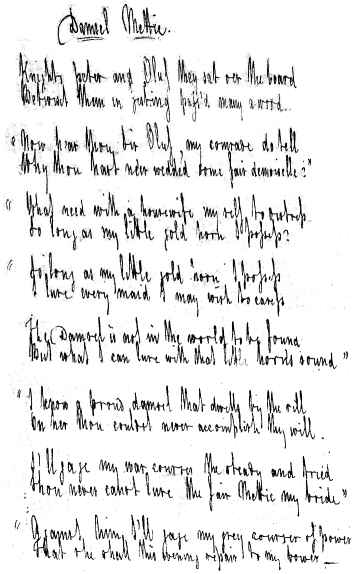
Damsel Mettie. [Knights Peter and Olaf they sat o’er the board] As is the case with quite a number of Borrow’s ballads, two Manuscripts of Damsel Mettie have been preserved. The earlier, composed not later than 1829, is written upon paper water marked with the date 1828; the later is written upon paper water-marked 1843. The earlier version has a refrain, “’Neath the linden tree watches the lord of my heart,” which is wanting in the later. Otherwise the text of both MSS. is identical, the differences to be observed between them being merely verbal. For example, the seventh couplet in the earlier reads: I’ll gage my war courser, the steady and tried, That thou canst not obtain the fair Mettie, my bride. In the later MS. this couplet reads: I’ll gage my war courser, the steady and tried, Thou never canst lure the fair Mettie, my bride. 22
There is a copy of Proud Signild and Other Ballads in the Library of the British Museum. The Press-mark is C. 44. d. 38.
(34) [Ulf Van Yern: 1913]
Ulf Van Yern / and / Other Ballads / By / George Borrow / London: / Printed for Private Circulation / 1913.
Collation:—Square demy octavo, pp. 27; consisting of: Half-title (with blank reverse) pp. 1–2; Title-page (with notice regarding the American copyright upon the reverse) pp. 3–4; and Text of the Ballads pp. 5–27. There are head-lines throughout, each page being headed with the title of the particular Ballad occupying it. Upon the reverse of p. 27 is the following imprint: “London: / Printed for Thomas J. Wise, Hampstead, N.W. / Edition limited to Thirty Copies.” The signatures are A (a quarter-sheet of two leaves), B (a half-sheet of four leaves), and C (a full sheet of eight leaves), all inset within each other.
Issued in bright green paper wrappers, with untrimmed edges, and with the title-page reproduced upon the front. The leaves measure 8½ × 6⅞ inches.
Thirty Copies only were printed.
Contents.
page
Ulf Van Yern. [It was youthful Ulf Van Yern] This ballad was here printed from the Manuscript prepared for the projected Kœmpe Viser of 1854. In the MS of 1829 the ballad is entitled Ulf Van Yern and Vidrik Verlandson. The texts of the two versions differ widely in almost every stanza. 5
The Chosen Knight. [Sir Oluf rode forth over hill and lea] 16
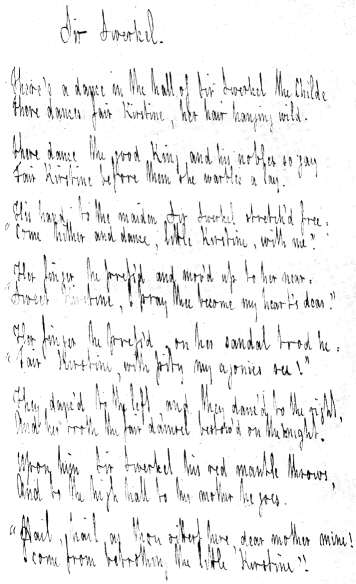
Sir Swerkel. [There’s a dance in the hall of Sir Swerkel the Childe] 19
Finn and the Damsel, or The Trial of Wits. [“What’s rifer than leaves?” Finn cried] 23
Epigrams by Carolan:
1. On Friars. [Would’st thou on good terms with friars live] 26
2. On a surly Butler, who had refused him admission to the cellar. [O Dermod Flynn it grieveth me] 26
Lines. [How deadly the blow I received] The last four lines of this Poem had already served (but with a widely different text) as the last four lines of the Ode from the Gaelic, printed in Romantic Ballads, 1826, pp 142–143. 27
There is a copy of Ulf Van Yern and Other Ballads in the Library of the British Museum. The Press-mark is C. 44. d. 38.
(35) [Ellen of Villenskov: 1913]
Ellen of Villenskov / and Other Ballads / By / George Borrow / London: / Printed for Private Circulation / 1913.
Collation:—Square demy octavo, pp. 22; consisting of: Half-title (with blank reverse) pp. 1–2; Title-page, as above (with blank reverse) pp. 3–4; and Text of the Ballads pp. 5–22. There are head-lines throughout, each page being headed with the title of the particular Ballad occupying it. Following p. 22 is a leaf, with blank reverse, and with the following imprint upon its recto: “London: / Printed for Thomas J. Wise, Hampstead, N.W. / Edition limited to Thirty Copies.” The signatures are A (a half-sheet of four leaves), with B (a full sheet of eight leaves) inset within it.
Issued in bright green paper wrappers, with untrimmed edges, and with the title-page reproduced upon the front. The leaves measure 8½ × 6⅞ inches.
Thirty Copies only were printed.
Contents.
page
Ellen of Villenskov. [There lies a wold in Vester Haf] 5
Uranienborg. [Thou who the strand dost wander] Previously printed, with an earlier and far inferior text, under the title The Ruins of Uranienborg, in The Foreign Quarterly Review. June, 1830, pp. 85–86. 13
The Ready Answer. [The brother to his dear sister spake] 19
Epigrams:
1. There’s no living, my boy, without plenty of gold 22
2. O think not you’ll change what on high is designed 22
3. Load not thyself with gold, O mortal man, for know 22
Note.—Each poem to which no reference is attached, appeared for the first time in this volume.
The Manuscripts of the poems included in Ellen of Villenskov and Other Ballads are in the Library of Mr. Clement K. Shorter.
There is a copy of Ellen of Villenskov and Other Ballads in the Library of the British Museum. The Press-mark is C. 44. d. 38.
(36) [The Songs of Ranild: 1913]
The Songs of Ranild / By / George Borrow / London: / Printed for Private Circulation / 1913.
Collation:—Square demy octavo, pp. 26; consisting of: Half-title (with blank reverse) pp. 1–2; Title-page, as above (with blank reverse) pp. 3–4; and Text of the Poems pp. 5–26. There are head-lines throughout, each page being headed with the title of the particular poem occupying it. Following p. 26 is a leaf, with a notice regarding the American copyright upon the reverse, and with the following imprint upon its recto: “London: / Printed for Thomas J. Wise, Hampstead, N.W. / Edition limited to Thirty Copies.” The signatures are A (six leaves), and B (a full sheet of eight leaves), the one inset within the other.
Issued in bright green paper wrappers, with untrimmed edges, and with the title-page reproduced upon the front. The leaves measure 8½ × 6⅞ inches.
Thirty Copies only were printed.
Contents.
page
The Songs of Ranild:
Song the First. [Up Riber’s street the dance they ply] 5
Song the Second. [To saddle his courser Ranild cried] 10
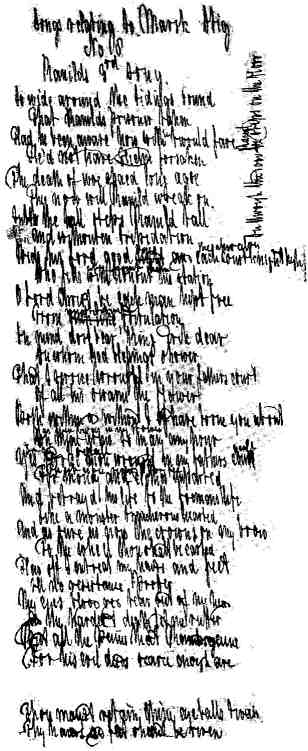
Song the Third. [So wide around the tidings bound] 13
Child Stig and Child Findal. [Child Stig and Child Findal two brothers were they] The Songs of Ranild were first written in 1826, and were finally prepared for press in 1854. I give herewith, facing p. 191, a facsimile, the exact size of the original, of the first page of the first draft of Song the Third. The complete MS. from which these four Ballads were printed is in the Library of Mr. J. A. Spoor, of Chicago. 17
There is a copy of The Songs of Ranild in the Library of the British Museum. The Press-mark is C. 44. d. 38.
(37) [Niels Ebbesen: 1913]
Niels Ebbesen / and / Germand Gladenswayne / Two Ballads / By / George Borrow / London: / Printed for Private Circulation / 1913.
Collation:—Square demy octavo, pp. 32; consisting of: Half-title (with blank reverse) pp. 1–2; Title-page as above (with notice regarding the American copyright upon the reverse) pp. 3–4; and Text of the Ballads pp. 5–32. There are head-lines throughout, each page being headed with the title of the particular Ballad occupying it. At the foot of p. 32 is the following imprint: “London: / Printed for Thomas J. Wise, Hampstead, N.W. / Edition limited to Thirty Copies.” The signatures are A and B (two sheets, each eight leaves), the one inset within the other.
Issued in bright green paper wrappers, with untrimmed edges, and with the title-page reproduced upon the front. The leaves measure 8½ × 6⅞ inches.
Thirty Copies only were printed.
Contents.
page
Niels Ebbesen. [All his men the Count collects] 5
Germand Gladenswayne. [Our King and Queen sat o’er the board] 22
There is a copy of Niels Ebbesen and Germand Gladenswayne in the Library of the British Museum. The Press-mark is C. 44. d. 38.
(38) [Child Maidelvold: 1913]
Child Maidelvold / and Other Ballads / By / George Borrow / London: / Printed for Private Circulation / 1913.
Collation:—Square demy octavo, pp. 27; consisting of: Half-title (with blank reverse) pp. 1–2; Title-page, as above (with a notice regarding the American copyright upon the reverse) pp. 3–4; and Text of the Ballads pp. 5–27. There are head-lines throughout, each page being headed with the title of the particular Ballad occupying it. Upon the reverse of p. 27 is the following imprint: “London: / Printed for Thomas J. Wise, Hampstead, N.W. / Edition limited to Thirty Copies.” The signatures are A (a quarter-sheet of two leaves), B (a half-sheet of four leaves), and C (a full sheet of eight leaves), each inset within the other.
Issued in bright green paper wrappers, with untrimmed edges, and with the title-page reproduced upon the front. The leaves measure 8½ × 6⅞ inches.
Thirty Copies only were printed.
Contents.
page
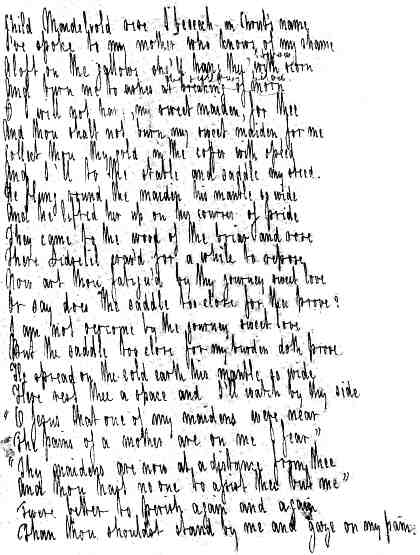
Child Maidelvold. [The fair Sidselil, of all maidens the flower] Another, but widely different and altogether inferior, version of this beautiful and pathetic ballad—one of Borrow’s best—was printed (under the title Skion Middel) in The Monthly Magazine, November, 1823, p. 308; and again (under the amended title Sir Middel, and with a slightly revised text) in Romantic Ballads, 1826, pp. 28–31. In these earlier versions the name of the heroine is Swanelil in place of Sidselil, and that of the hero is Sir Middel in place of Child Maidelvold. 5
Sir Peter. [Sir Peter and Kirstin they sat by the board] 11
Ingefred and Gudrune. [Ingefred and Gudrune they sate in their bower] 15
Sir Ribolt. [Ribolt the son of a Count was he] 20
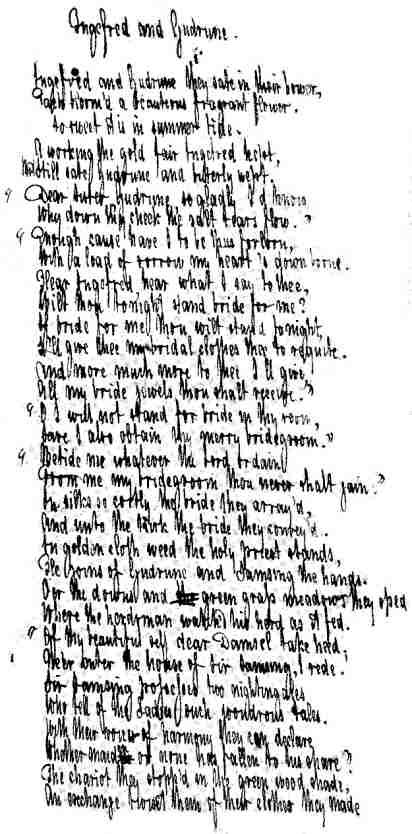
As a further example of these Ballads I give Ingefred and Gudrune in full.
INGEFRED AND GUDRUNE [199]
Ingefred and Gudrune they sate in their bower, Each bloomed a beauteous fragrant flower— So sweet it is in summer tide!
A working the gold fair Ingefred kept, Still sate Gudrune, and bitterly wept.
“Dear sister Gudrune so fain I’d know Why down thy cheek the salt tears flow?”
“Cause enough have I to be thus forlorn, With a load of sorrow my heart is worn.
“Hear, Ingefred, hear what I say to thee, Wilt thou to-night stand bride for me?
“If bride for me thou wilt stand to-night, I’ll give thee my bridal clothes thee to requite.
“And more, much more to thee I’ll give, All my bride jewels thou shalt receive.”
“O, I will not stand for bride in thy room, Save I also obtain thy merry bridegroom.”
“Betide me whatever the Lord ordain, From me my bridegroom thou never shalt gain.”
In silks so costly the bride they arrayed, And unto the kirk the bride they conveyed.
In golden cloth weed the holy priest stands, He joins of Gudrune and Samsing the hands.
O’er the downs and green grass meadows they sped, Where the herdsman watched his herd as it fed.
“Of thy beauteous self, dear Damsel, take heed, Ne’er enter the house of Sir Samsing, I rede.
“Sir Samsing possesses two nightingales Who tell of the Ladies such wondrous tales.
“With their voices of harmony they can declare Whether maiden or none has fallen to his share.”
The chariot they stopped in the green wood shade, An exchange ’twixt them of their clothes they made.
They change of their dress whatever they please, Their faces they cannot exchange with ease.
To Sir Samsung’s house the bride they conveyed, Of the ruddy gold no spare was made.
On the bridal throne the bride they plac’d, They skinked the mead for the bride to taste.
Then said from his place the court buffoon: “Methinks thou art Ingefred, not Gudrune.”
From off her hand a gold ring she took, Which she gave the buffoon with entreating look.
Said he: “I’m an oaf, and have drunk too hard, To words of mine pay no regard.”
’Twas deep at night, and down fell the mist, To her bed the young bride they assist.
Sir Samsing spoke to his nightingales twain: “Before my young bride sing now a strain.
“A song now sing which shall avouch Whether I’ve a maiden or none in my couch.”
“A maid’s in the bed, that’s certain and sure, Gudrune is standing yet on the floor.”
“Proud Ingefred, straight from my couch retire! Gudrune come hither, or dread my ire!
“Now tell me, Gudrune, with open heart, What made thee from thy bed depart?”
“My father, alas! dwelt near the strand, When war and bloodshed filled the land.
“Full eight there were broke into my bower, One only ravished my virgin flower.”
Upon her fair cheek he gave a kiss: “My dearest, my dearest, all sorrow dismiss;
“My swains they were that broke into thy bower, ’Twas I that gathered thy virgin flower.”
Fair Ingefred gained, because bride she had been, One of the King’s knights of handsome mien.
There is a copy of Child Maidelvold and Other Ballads in the Library of the British Museum. The Press-mark is C. 44. d. 38.
(39) [Ermeline: 1913]
Ermeline / A Ballad / By / George Borrow / London: / Printed for Private Circulation / 1913.
Collation:—Square demy octavo, pp. 23; consisting of: Half-title (with blank reverse) pp. 1–2; Title-page, as above (with blank reverse) pp. 3–4; and Text of the Poems pp. 5–23. There are head-lines throughout, each page being headed with the title of the particular poem occupying it. Upon the reverse of p. 23 is the following imprint: “London / Printed for Thomas J. Wise, Hampstead, N.W. / Edition limited to Thirty Copies.” The signatures are A (a half-sheet of four leaves), and B (a full sheet of eight leaves), the one inset within the other.
Issued in bright green paper wrappers, with untrimmed edges, and with the title-page reproduced upon the front. The leaves measure 8½ × 6⅞ inches.
Thirty Copies only were printed.
Contents.
page
Ermeline. [With lance upraised so haughtily] The paper upon which the Manuscript of Ermeline is written is water-marked with the date 1843. No other MS. is forthcoming. 5
The Cuckoo’s Song in Merion. [Though it has been my fate to see] The fifth stanza of this Song was printed by Borrow in Wild Wales, 1862, vol. i, p. 153. The two versions of this stanza offer some interesting variations of text; I give them both: 1862 Full fair the gleisiad in the flood, Which sparkles ’neath the summer’s sun, And fair the thrush in green abode Spreading his wings in sportive fun, But fairer look if truth be spoke, The maids of County Merion. 1913 O fair the salmon in the flood, That over golden sands doth run; And fair the thrush in his abode, That spreads his wings in gladsome fun; More beauteous look, if truth be spoke, The maids of county Merion. 21
There is a copy of Ermeline A Ballad in the Library of the British Museum. The Press-mark is C. 44. d. 38.
(40) [The Giant of Bern: 1913]
The Giant of Bern / and Orm Ungerswayne / A Ballad / By / George Borrow / London: / Printed for Private Circulation / 1913.
Collation:—Crown octavo, pp. 15; consisting of Half-title (with blank reverse) pp. 1–2; Title-page, as above (with blank reverse) pp. 3–4; and Text of the Ballad pp. 5–15. The head-line is The Giant of Bern throughout, upon both sides of the page. Upon the reverse of p. 15 is the following imprint: “London: / Printed for Thomas J. Wise, Hampstead, N.W. / Edition limited to Thirty Copies.” There are no signatures, the pamphlet being composed of a single sheet, folded to form sixteen pages.
Issued in bright green paper wrappers, with untrimmed edges, and with the title-page reproduced upon the front. The leaves measure 7½ × 5 inches.
Thirty Copies only were printed.
Contents.
page
The Giant of Bern and Orme Ungerswayne. [It was the lofty jutt of Bern, O’er all the walls he grew] Fifteen stanzas, descriptive of the incident of Orm’s obtaining his father’s sword from the dead man’s grave, were printed in Targum, 1835, pp. 59–61, under the title Birting. A Fragment. The text differs greatly in the two versions, that of the later (which, though not printed until 1913, was written about 1854) is much the superior. As an example I give the first two stanzas of each version: 1835 It was late at evening tide, Sinks the day-star in the wave, When alone Orm Ungarswayne Rode to seek his father’s grave. Late it was at evening hour, When the steeds to streams are led; Let me now, said Orm the young, Wake my father from the dead. 1913 It was so late at evening tide, The sun had reached the wave, When Orm the youthful swain set out To seek his father’s grave. It was the hour when grooms do ride The coursers to the rill, That Orm set out resolved to wake The dead man in the hill. 5
There is a copy of The Giant of Bern and Orm Ungerswayne in the Library of the British Museum. The Press-mark is C. 44. d. 38.
(41) [Little Engel: 1913]
Little Engel / A Ballad / With a Series of / Epigrams from the Persian / By / George Borrow / London: / Printed for Private Circulation / 1913.
Collation:—Square demy octavo, pp. 27; consisting of: Half-title (with blank reverse) pp. 1–2; Title-page, as above (with blank reverse) pp. 3–4; and Text of the Ballad and Epigrams pp. 5–27. There are head-lines throughout, each page being headed with the title of the particular Poem occupying it—save for pp. 23–27, which are headed Epigrams. Upon the reverse of p. 27 is the following imprint: “London: / Printed for Thomas J. Wise, Hampstead, N.W. / Edition limited to Thirty Copies.” The signatures are A (six leaves), and B (a full sheet of eight leaves), the one inset within the other.
Issued in bright green paper wrappers, with untrimmed edges, and with the title-page reproduced upon the front. The leaves measure 8½ × 6⅞ inches.
Thirty Copies only were printed.
Contents.
page
Little Engel. [It was the little Engel, he] 5
An Elegy. [Where shall I rest my hapless head] 21
Epigrams. From the Persian:
1. [Hear what once the pigmy clever] 23
2. [The man who of his words is sparing] 23
3. [If thou would’st ruin ’scape, and blackest woe] 24
4. [Sit down with your friends in delightful repose] 24
5. [The hungry hound upon the bone will pounce] 24
6. [Great Aaroun is dead, and is nothing, the man] 25
7. [Though God provides our daily bread] 25
8. The King and his Followers. [If in the boor’s garden the King eats a pear] 25
9. The Devout Man and the Tyrant. [If the half of a loaf the devout man receives] 26
10. The Cat and the Beggar. [If a cat could the power of flying enjoy] 26
11. The King and Taylor. [The taylor who travels in far foreign lands] 26
12. Gold Coin and Stamped Leather. [Of the children of wisdom how like is the face] 27
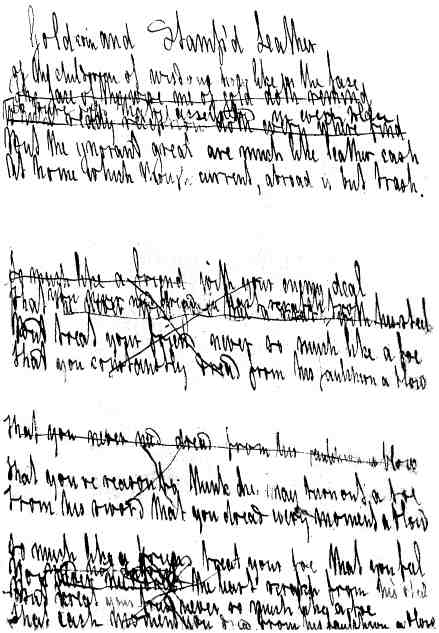
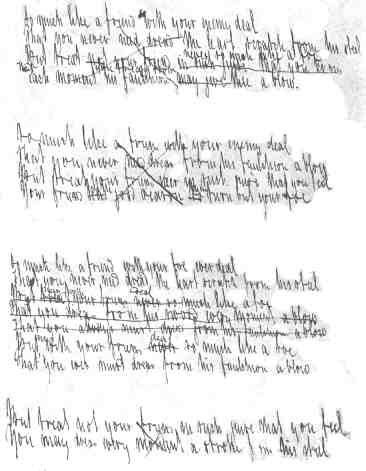
13. [So much like a friend with your foe ever deal] The Manuscript of these Epigrams bears instructive evidence of the immense amount of care and labour expended by Borrow upon his metrical compositions. Reduced facsimiles of two of the pages of this Manuscript are given herewith. It will be observed that a full page and a half are occupied by the thirteenth Epigram, at which Borrow made no fewer than seven attempts before he succeeded in producing a version which satisfied him. The completed Epigram is as follows:— So much like a friend with your foe ever deal, That you never need dread the least scratch from his steel; But ne’er with your friend deal so much like a foe, That you ever must dread from his faulchion a blow. 27
The original Manuscript of Little Engel, written in 1829, is in the library of Mr. Edmund Gosse. The Manuscript of 1854, from which the ballad was printed, is in my own library.
There is a copy of Little Engel, A Ballad, &c., in the Library of the British Museum. The Press-mark is C. 44. d. 38.
(42) [Alf the Freebooter: 1913]
Alf the Freebooter / Little Danneved and / Swayne Trost / and Other Ballads / By / George Borrow / London: / Printed for Private Circulation / 1913.
Collation:—Square demy octavo, pp. 27; consisting of: Half-title (with blank reverse) pp. 1–2; Title-page, as above (with a note regarding the American copyright upon the centre of the reverse) pp. 3–4; and Text of the Ballads pp. 5–27. There are headlines throughout, each page being headed with the title of the particular Ballad occupying it. Upon the reverse of p. 27 is the following imprint, “London: / Printed for Thomas J. Wise, Hampstead, N.W. / Edition limited to Thirty Copies.” The signatures are A (a quarter-sheet of 2 leaves), B (a half-sheet of 4 leaves), and C (a full sheet of 8 leaves), all inset within each other.
Issued in bright green paper wrappers, with untrimmed edges, and with the title-page reproduced upon the front. The leaves measure 8½ × 6⅞ inches.
Thirty Copies only were printed.
Contents.
page
Sir Alf the Freebooter. [Sir Alf he is an Atheling.] 5
Little Danneved and Swayne Trost. [“O what shall I in Denmark do?”] 14
Sir Pall, Sir Bear, And Sir Liden. [Liden he rode to the Ting, and shewed] 20
Belardo’s Wedding. [From the banks, in mornings beam] 23
The Yew Tree. [O tree of yew, which here I spy] Two earlier versions of this Ode were printed by Borrow in Wild Wales, vol. iii, pp. 203 and 247. The texts of all three versions differ very considerably. 27
There is a copy of Alf the Freebooter and Other Ballads in the Library of the British Museum. The Press-mark is C. 44. d. 38.
(43) [King Diderik: 1913]
King Diderik / and the Fight between the / Lion and Dragon / and Other Ballads / By / George Borrow / London: / Printed for Private Circulation / 1913.
Collation:—Square demy octavo, pp. 27; consisting of: Half-title (with blank reverse) pp. 1–2; Title-page, as above (with a note regarding the American copyright upon the centre of the reverse) pp. 3–4; and Text of the Ballads pp. 5–27. There are head-lines throughout, each page being headed with the title of the particular Ballad occupying it. Upon the reverse of p. 27 is the following imprint, “London: / Printed for Thomas J. Wise, Hampstead, N.W. / Edition limited to Thirty Copies.” The signatures are A (a quarter-sheet of 2 leaves), B (a half-sheet of 4 leaves), and C (a full sheet of 8 leaves), all inset within each other.
Issued in bright green paper wrappers, with untrimmed edges, and with the title-page reproduced upon the front. The leaves measure 8½ × 6⅞ inches.
Thirty Copies only were printed.
Contents.
page
King Diderik and the Lion’s Fight with the Dragon. [From Bern rode forth King Diderik] There exists a single leaf of an early draft of another, entirely different, version of this ballad. Upon the opposite page is a facsimile, the exact size of the original, of this fragment. 5
Diderik and Olger the Dane. [With his eighteen brothers Diderik stark] 14
Olger the Dane and Burman. [Burman in the mountain holds] 21
The complete Manuscript of King Diderik, &c., and Other Ballads, as prepared for the Songs of Scandinavia of 1829, is preserved in the British Museum.
There is a copy of King Diderik and the Fight between the Lion and Dragon, &c. in the Library of the British Museum. The Press-mark is C. 44. d. 38.
(44) [The Nightingale: 1913]
The Nightingale / The Valkyrie and Raven / and Other Ballads / By / George Borrow / London: / Printed for Private Circulation / 1913.
Collation:—Square demy octavo, pp. 27; consisting of: Half-title (with blank reverse) pp. 1–2; Title-page, as above (with a note regarding the American copyright upon the centre of the reverse) pp. 3–4; and Text of the Ballads pp. 5–27. There are head-lines throughout, each page being headed with the title of the particular Ballad occupying it. Upon the reverse of p. 27 is the following imprint: “London: / Printed for Thomas J. Wise, Hampstead, N. W. / Edition limited to Thirty Copies.” The signatures are A (a quarter-sheet of 2 leaves), B (a half-sheet of 4 leaves), and C (a full sheet of 8 leaves), all inset within each other.
Issued in bright green paper wrappers, with untrimmed edges, and with the title-page reproduced upon the front. The leaves measure 8½ × 6⅞ inches.
Thirty Copies only were printed.
Contents.
page
The Nightingale, or The Transformed Damsel. [I know where stands a Castellaye] 5
The Valkyrie and Raven. [Ye men wearing bracelets] Previously printed in Once a Week, August 2nd, 1862, pp. 152–156, where the Ballad was accompanied by a full-page Illustration engraved upon wood. [See post, pp. 302–305.] 11
Erik Emun and Sir Plog. [Early at morn the lark sang gay] 21
The Elves. [Take heed, good people, of yourselves] There are two Manuscripts of The Elves available. So far as the body of the poem is concerned the texts of these are identical, the fifth line alone differing materially in each. This line, as printed, reads: The lass he woo’ d, her promise won. In the earlier of the two MSS. it reads: Inflamed with passion her he woo’d. A cancelled reading of the same MS. runs: Whom when he saw the peasant woo’d. But the Ballad is furnished with a repeated refrain. This refrain in the printed version reads: Take heed, good people, of yourselves; And oh! beware ye of the elves. In the earlier MS. the refrain employed is: ’Tis wonderful the Lord can brook The insolence of the fairy folk! A reduced facsimile of the first page of the later MS. will be found facing the present page. The entire poem should be compared with The Elf Bride, printed in The Brother Avenged and Other Ballads, 1913, pp. 21–22. 25
Feridun. [No face of an Angel could Feridun claim] 26
Epigrams:
1. [A worthless thing is song, I trow] 27
2. [Though pedants have essayed to hammer] 27
3. [When of yourself you have cause to speak] 27
Note.—Each poem to which no reference is attached, appeared for the first time in this volume.
There is a copy of The Nightingale, The Valkyrie and Raven, and Other Ballads in the Library of the British Museum. The Press-mark is C. 44. d. 38.
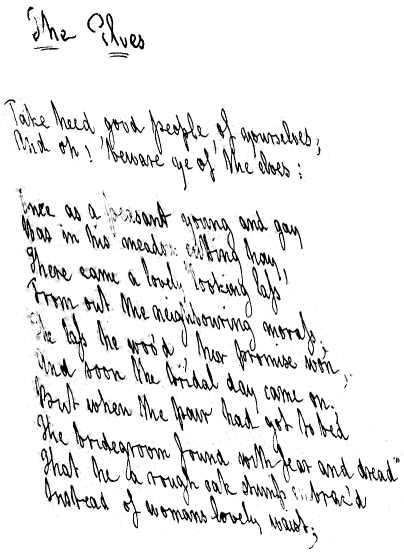
(45) [Grimmer and Kamper: 1913]
Grimmer and Kamper / The End of Sivard Snarenswayne / and Other Ballads / By / George Borrow / London: / Printed for Private Circulation / 1913.
Collation:—Square demy octavo, pp. 28; consisting of: Half-title (with blank reverse) pp. 1–2; Title-page, as above (with a note regarding the American copyright upon the centre of the reverse) pp. 3–4; and Text of the Ballads pp. 5–28. There are headlines throughout, each page being headed with the title of the particular Ballad occupying it. At the foot of p. 28 is the following imprint: “London: / Printed for Thomas J. Wise, Hampstead, N. W. / Edition limited to Thirty Copies.” The signatures are A (a quarter-sheet of 2 leaves), B (a half-sheet of 4 leaves), and C (a full-sheet of 8 leaves), all inset within each other.
Issued in bright green paper wrappers, with untrimmed edges, and with the title-page reproduced upon the front. The leaves measure 8½ × 6⅞ inches.
Thirty Copies only were printed.
Contents.
page
Grimmer and Kamper. [Grimmer walks upon the floor] 5
Mimmering Tan. [The smallest man was Mimmering] 11
The End of Sivard Snarenswayne. [Young Sivard he his step-sire slew] The two Manuscripts, belonging to the years 1829 and 1854 respectively, of this ballad exhibit very numerous differences of text. As a brief, but sufficient, example I give the second stanza as it occurs in each: 1829 It was Sivard Snareswayne [sic] To his mother’s presence hied: “Say, shall I go from thee on foot, Or, tell me, shall I ride?” 1854 It was Sivard Snarenswayne To his mother’s presence strode: “Say, shall I ride from hence?” he cried, “Or wend on foot my road?” 14
Sir Guncelin’s Wedding. [It was the Count Sir Guncelin] 19
Epigrams:
Honesty. [No wonder honesty’s a lasting article] 27
A Politician. [He served his God in such a fashion] 27
The Candle. [For foolish pastimes oft, full oft, they thee ignite] 27
Epigram on Himself. By Wessel [He ate, and drank, and slip-shod went] 28
There is a copy of Grimmer and Kamper, The End of Sivard Snarenswayne, and Other Ballads in the Library of the British Museum. The Press-mark is C. 44. d. 38.
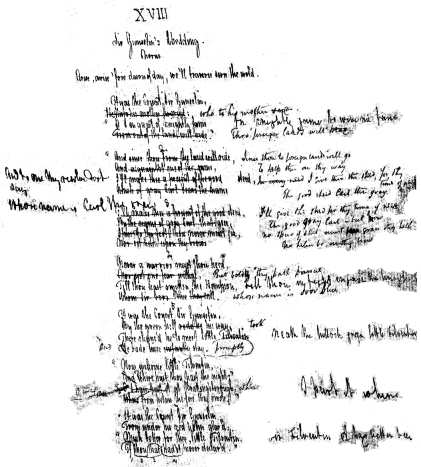
(46) [The Fountain of Maribo: 1913]
The / Fountain of Maribo / and Other Ballads / By / George Borrow / London: / Printed for Private Circulation / 1913.
Collation:—Square demy octavo, pp. 27; consisting of: Half-title (with blank reverse) pp. 1–2; Frontispiece (with blank recto) pp. 3–4; Title-page (with notice regarding the American copyright upon the centre of the reverse) pp. 5–6; and Text of the Ballads pp. 7–27. There are head-lines throughout, each page being headed with the title of the particular Ballad occupying it. Upon the reverse of p. 27 is the following imprint: “London: / Printed for Thomas J. Wise, Hampstead, N.W. / Edition limited to Thirty Copies.” The signatures are A (a quarter-sheet of two leaves), B (a half-sheet of four leaves), and C (a full sheet of eight leaves), each inset within the other.
Issued in bright green paper wrappers, with untrimmed edges, and with the title-page reproduced upon the front. The leaves measure 8½ × 6⅞ inches.
Thirty Copies only were printed.
The Frontispiece is a reduced facsimile of the first page of the original Manuscript of Ramund.
Contents.
page
The Fountain of Maribo, Or The Queen and the Algreve. [The Algreve he his bugle wound] Of The Fountain of Maribo there are two Manuscripts available, one written in 1829 and the other in 1854. The text of these differs appreciably, that of the second being as usual the superior. Here are some stanzas from each version: 1829 The Algreve he his bugle wound, The longest night. The Queen in her bower heard the sound Love me doth thrall. The Queen her little foot boy address’d: The longest night. “Go, come to me hither the Algreve request.” Love me doth thrall. In came the Algrave, ’fore the board stood he: “What wilt thou my Queen that thou’st sent for me?” “If I survive when my lord is dead, Thou shall rule o’er my gold so red.” 1854 The Algreve he his bugle wound The long night all— The Queen in bower heard the sound, I’m passion’s thrall. The Queen her little page address’d, The long night all— “To come to me the Greve request,” I’m passion’s thrall. He came, before the board stood he, The long night all— “Wherefore, O Queen, hast sent for me?” I’m passion’s thrall, “As soon as e’er my lord is dead, The long night all— Thou shall rule o’er my gold so red,” I’m passion’s thrall. 7
Ramund. [Ramund thought he should a better man be] A reduced facsimile of the first page of the manuscript of Ramund faces the present page. 13
Alf of Odderskier. [Alf he dwells at Odderskier] 22
There is a copy of The Fountain of Maribo and Other Ballads in the Library of the British Museum. The Press-mark is C. 44. d. 38.
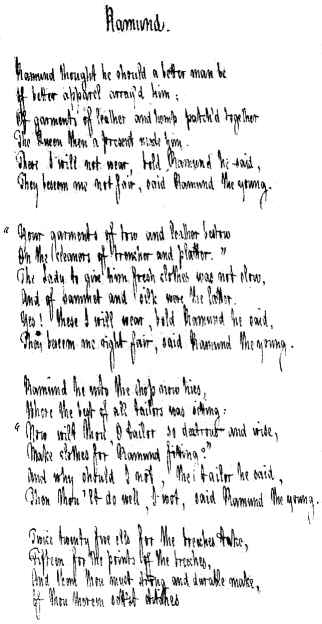
(47) [Queen Berngerd: 1913]
Queen Berngerd / The Bard and the Dreams / and / Other Ballads / By / George Borrow / London: / Printed for Private Circulation / 1913.
Collation:—Square demy octavo, pp. 31; consisting of: Half-title (with blank reverse) pp. 1–2; Frontispiece (with blank recto) pp. 3–4; Title-page, as above (with a note regarding the American copyright upon the centre of the reverse) pp. 5–6; and Text of the Ballads pp. 7–31. There are headlines throughout, each page being headed with the title of the particular Ballad occupying it. Upon the reverse of p. 31 is the following imprint: “London: / Printed for Thomas J. Wise, Hampstead, N.W. / Edition limited to Thirty Copies.” The signatures are A and B (two sheets each eight leaves), the one inset within the other.
Issued in bright green paper wrappers, with untrimmed edges, and with the title-page reproduced upon the front. The leaves measure 8½ x6¾ inches.
Thirty Copies only were printed.
The Frontispiece consists of a reduced facsimile of the original Manuscript, in Borrow’s handwriting, of The Bard and the Dreams.
Contents.
page
Queen Berngerd. [Long ere the Sun the heaven arrayed] 7
Dame Martha’s Fountain. [Dame Martha dwelt at Karisegaard] Previously printed (with some small differences of text) in The Foreign Quarterly Review, June 1830, p. 83. 13
The Bard and the Dreams. [O’er the sweet smelling meads with his lyre in his hand] 16
King Oluf the Saint. [King Oluf and his brother bold] Previously printed (with some slight differences of text) in The Foreign Quarterly Review, June 1830, pp. 59–61. 23
To Scribblers. [Would it not be more dignified] This delightful Squib, here first printed, was written by Borrow upon the refusal by Lockhart to insert in The Quarterly Review Borrow’s Essay suggested by Ford’s Handbook for Travellers in Spain, 1845, in the unmutilated and unamended form in which the author had written it.—[See ante, No. 10.] 30
To a Conceited Woman. [Be still, be still, and speak not back again] 31
Note.—Each poem, to which no reference is attached, appeared for the first time in this volume.
There is a copy of Queen Berngerd, The Bard and the Dreams, and Other Ballads in the Library of the British Museum. The Press-mark is C. 44. d. 38.
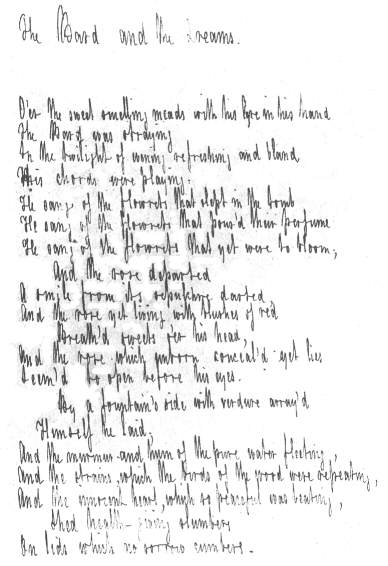
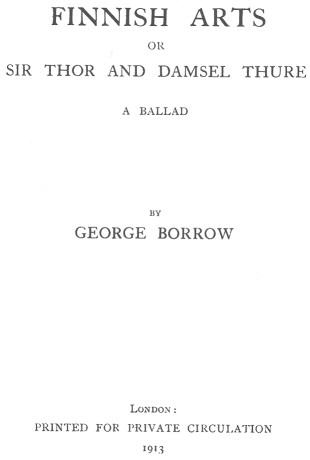
(48) [Finnish Arts: 1913]
Finnish Arts / Or / Sir Thor and Damsel Thure / A Ballad / By / George Borrow / London: / Printed for Private Circulation / 1913.
Collation:—Square demy octavo, pp. 27; consisting of: Half-title (with blank reverse) pp. 1–2; Frontispiece (with blank recto), pp. 3–4; Title-page, as above (with notice regarding the American copyright upon the centre of the reverse) pp. 5–6; and Text of the Ballads pp. 7–27. There are head-lines throughout, each page being headed with the title of the particular Ballad occupying it. Upon the reverse of p. 27 is the following imprint: “London: / Printed for Thomas J. Wise, Hampstead, N.W. / Edition limited to Thirty Copies.” The signatures are A (a quarter-sheet of two leaves), B (a half-sheet of four leaves), and C (a full sheet of eight leaves), each inset within the other.
Issued in bright green paper wrappers, with untrimmed edges, and with the title-page reproduced upon the front. The leaves measure 8½ × 6⅞ inches.
Thirty Copies only were printed.
The Frontispiece is a reduced facsimile of the first page of the original Manuscript of Finnish Arts, or Sir Thor and Damsel Thure.
Contents.
page
Finnish Arts, Or, Sir Thor and Damsel Thure. [Sir Thor was a knight of prowess tried] A reduced facsimile of the first page of the Manuscript of Finnish Arts will be found facing the present page. 7
A New Song to an Old Tune. [Who starves his wife] 22
Ode from Anacreon. [The earth to drink does not disdain] 24
Lines from the Italian. [“Repent, O repent!” said a Friar one day] 25
A Drinking Song. [O how my breast is glowing] 26
There is a copy of Finnish Arts, Or Sir Thor and Damsel Thure in the Library of the British Museum. The Pressmark is C. 44. d. 38.
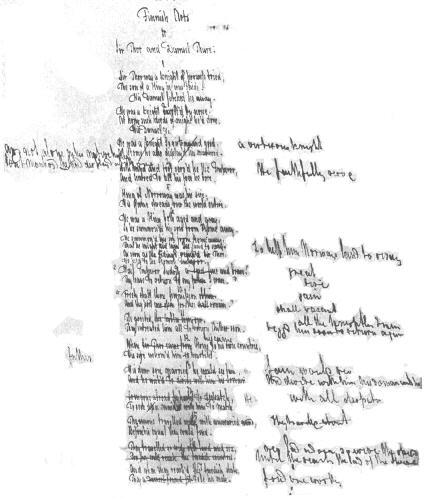
(49) [Brown William: 1913]
Brown William / The Power of the Harp / and / Other Ballads / By / George Borrow / London: / Printed for Private Circulation / 1913.
Collation:—Square demy octavo, pp. 31; consisting of: Half-title (with blank reverse) pp. 1–2; Title-page, as above (with notice regarding the American copyright upon the centre of the reverse) pp. 3–4; and Text of the Ballads pp. 5–31. There are head-lines throughout, each page being headed with the title of the particular Ballad occupying it. Upon the reverse of p. 31 is the following imprint: “London / Printed for Thomas J. Wise, Hampstead, N.W. / Edition limited to Thirty Copies.” The signatures are A and B (two sheets, each eight leaves), the one inset within the other.
Issued in bright green paper wrappers, with untrimmed edges, and with the title-page reproduced upon the front. The leaves measure 8½ × 6⅞ inches.
Thirty Copies only were printed.
Contents.
page
Brown William. [Let no one in greatness too confident be] Previously printed in Once a Week, January 4th, 1862, pp. 37–38. 5
The Power of the Harp. [Sir Peter would forth from the castle ride] A reduced facsimile of one of the pages of the Manuscript of The Power of The Harp will be found facing herewith. 12
The Unfortunate Marriage. [Hildebrand gave his sister away] 18
The Wrestling-Match. [As one day I wandered lonely, in extreme distress of mind] 25
The Warrior. From the Arabic. [Thou lov’st to look on myrtles green] 31
Note.—Each poem to which no reference is attached, appeared for the first time in this volume.
There is a copy of Brown William, The Power of the Harp, and Other Ballads in the Library of the British Museum. The Press-mark is C. 44. d. 38.
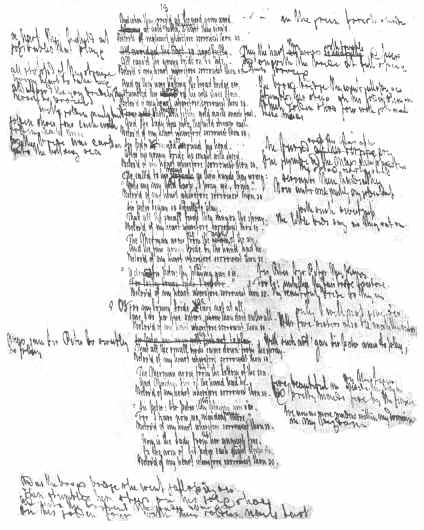
(50) [The Song Of Deirdra: 1913]
The Song of Deirdra / King Byrge and his Brothers / and / Other Ballads / By / George Borrow / London: / Printed for Private Circulation / 1913.
Collation:—Square demy octavo, pp. 28; consisting of: Half-title (with blank reverse) pp. 1–2; Title-page, as above (with a note regarding the American copyright upon the centre of the reverse) pp. 3–4; and Text of the Ballads pp. 5–28. There are head-lines throughout, each page being headed with the title of the particular Ballad occupying it. At the foot of p. 28 is the following imprint: “London: / Printed for Thomas J. Wise, Hampstead, N.W. / Edition limited to Thirty Copies.” The signatures are A (a quarter-sheet of two leaves), B (a half-sheet of four leaves), and C (a full sheet of eight leaves), all inset within each other.
Issued in bright green paper wrappers, with untrimmed edges, and with the title-page reproduced upon the front. The leaves measure 8½ × 6¾ inches.