BOOK SIX
Reading edition
25 BIRTH OF THE RING
With the February issue of 1957, The Ring, my boxing publication, completed thirty-five years of service in the interest of the sport; years of war, prosperity, gloom, and world turmoil. They were years that included “The Golden Era” of boxing and a paralyzing depression; and throughout the three decades, The Ring, which started with a circulation of 2,500, carried on without interruption. From a small magazine confined to the environs of New York it grew into a world publication, published in America and in England with a total circulation of over 200,000.
The Ring made its wavering début on February 10, 1922, to combat attacks against boxing. I operated out of a cubbyhole in the old Madison Square Garden, in a little room donated by Tex Rickard. It was a one-man job. I was editor, business manager, circulation manager, and general handy man, though the stock was owned by four of us. About half a year after the first issue was published, Eddie Borden, well known in boxing circles, joined me as an assistant.
Between 1917 and 1920, when the Walker Law went into effect following the demise of the Frawley Law, boxing in America was in a sad state. But the Walker Law brought about a change, a promise of order in what had become a corrupt racket.
Rickard had come East soon after the Walker Law was passed, and decided to promote fights and other sports events in the old Garden and at the Polo Grounds. He was so successful that he aroused the envy of crooked politicians who found it more profitable to operate without state supervision. They tried to put him out of business and to kill legalized boxing. Those politicians formed an unholy alliance with reformers against the new boxing bill. With the help of Rickard, I enlisted the services of friends, most of them nationally known newspapermen, to fight for the life of legalized boxing.
Rickard asked me what could be done to halt Governor Smith from killing the sport. I suggested that we flood the Albany Senate and Assembly with pamphlets outlining our reasons for opposing the bill which would have halted boxing. He agreed. I received the support of every sports writer in New York to help the cause.
Articles were written for the pamphlet by New York’s leading sports editors and columnists: Bill McGeehan, Damon Runyon, Walter Trumbull, George Daley, Wurra Wurra McLaughlin, Ned Brown, George Sands, Bat Masterson, Bill McBeth, Harry Cross, Charles F. Mathison, Francis Albertanti, Grantland Rice, George B. Underwood and myself. Copies were sent to every member of the New York State Legislature.
With Senators Frawley and Walker fighting our battle in the Senate, and Assemblyman Marty McCue, a former pugilist, doing the chores for us in the Assembly, we fought a winning campaign. Governor Smith listened to the plea and then made his historic decision, saving boxing for New York State. He said that though he didn’t like boxing and had never attended a show, he was highly impressed by the editorial comment of the sports writers and those who had gone to Albany to attend the hearing. He vetoed the measure of the reformers and boxing was saved.
Following that narrow escape, I decided that a publication devoted wholly to the sport would be worth starting. I asked for Rickard’s help, but he balked at spending any more money. I argued that if a pamphlet such as we presented to the State Legislature and the Governor of New York could do so much good for boxing, a magazine devoted to the sport, an organ to give boxing an articulate mouthpiece, would be a venture worth tackling. Rickard was not impressed. I was to be only too grateful for this later on.
But I wasn’t licked. I. C. Brenner, of Golfers’ Magazine, had heard of my plans, and he came to my rescue. He knew the magazine field and offered to help launch a publication if someone would back it financially. I became the backer.
I went to Frank A. Munsey, my employer, who had ditched the New York Press and had purchased the New York Telegram to which I was shifted, and I asked permission to bring out the publication. He gave me the green light after I promised that the work would not interfere with my duties as sports editor, and that I would keep the contents clean and do nothing to hurt The Telegram.
With Brenner, I took as partners (without any financial aid from them) Frank Coultry, treasurer of Madison Square Garden, and Ike Dorgan, brother of the famous cartoonist, Tad. Ike was Rickard’s publicity chief. I gave each of them equal shares at 25 per cent.
Three months later, Coultry and Brenner retired from the enterprise. They didn’t think the magazine would be a success and sold their stock to Ike Dorgan and me. But within a year, the magazine had jumped from 2,700 to 13,000 and from 24 pages to 38.
Thereafter there was a steady rise. From America’s leading newspapers and magazines foremost writers were added to the staff. The appearance of the book was improved.
In 1929, I bought out Dorgan’s stock and became the sole owner. I had constant faith in the magazine and despite the depression, I decided to take over the ownership and put everything I had into it. However, trouble came when I lost my bankroll in the financial crash, and for two years I accepted Bernarr MacFadden as my partner. In 1931 that arrangement was abandoned, and since then I have carried on as publisher and editor. With the help of an excellent staff, I have built the publication to its present circulation of over 200,000 in the U.S. and in England and aided by the good management of Nathaniel R. Loubet, my son-in-law, we have modernized the format to meet current needs.
Rivals have come and rivals have gone, but The Ring continues, steadily improving, with a record of never having missed an issue since its inception. We suffered losses during the war years, but never faltered. The friends we made by shipping The Ring gratis to all areas where our men were fighting, more than offset those losses, for we gained good will we couldn’t have purchased with money.
While many magazines were forced to discontinue during World War II, The Ring continued to serve its readers, those in hospitals and in training camps, a service unequalled in the history of American publications. Lectures with motion pictures of famous fights were given through The Ring in camps and hospitals, and no expense was spared to see that the men received what they cherished most in reading matter—boxing news. In addition, we organized The Ring’s Servicemen’s Athletic Fund, which purchased athletic paraphernalia for camps in all parts of the world.
One of the greatest achievements of The Ring is the publication of its annual record book (an international guide to boxing), and its annual rating of boxers, a listing that is used by promoters and commissions in pairing fighters.
Many years ago the late Walter Camp initiated the custom of designating the outstanding football players of the year as the All-American or best-players of the season. A flood of imitators adopted this idea and today All-American football team selections are almost as numerous as the players.
When Camp died, I thought of having some sort of honor roll of boxing similar to his gridiron ratings. Looking around for a boxing figure of equal prominence to make the selections, I chose Tex Rickard.
The fabulous Tex was in his heyday then, and following the announcement that he was to make a selection of the world’s ranking boxers, his ratings were awaited with tremendous interest.
The forerunner of the detailed and highly classified Ring rankings of today appeared in the February 1925 issue for the first time and caused world-wide comment. Such ring immortals as Jack Dempsey, Benny Leonard, Mickey Walker, Harry Greb, Gene Tunney and Pancho Villa were in action at the time, and, of course, their names led all the rest in their respective divisions.
Dempsey was naturally rated top heavyweight, with his perennial shadow, Harry Wills, in the number two spot. Tunney was a light heavyweight in those days and was ranked first in the 175-pound division. Young Willie Stribling and Kid Norfolk were second and third, respectively.
The great Harry Greb headed the middleweights, and the man who was to succeed him, Tiger Flowers, was in the runner-up spot. Mighty Mickey Walker was welterweight kingpin, followed by Dave Shade, who was to trail the Toy Bulldog throughout his career. The peerless Benny Leonard was still showing his heels to a new generation of lightweights, his old rivals having fallen by the wayside. Sid Terris and Sammy Mandell, a couple of up-and-coming youngsters, had edged the oldsters out of the second and third positions.
Kid Sullivan topped the junior lightweight division, a favorite of the time, and Louis Kid Kaplan led the feathers. Cannonball Eddie Martin was ranked best of the bantams, and Pancho Villa headed the popular flyweight division as world champion.
Rickard continued to make his choices in the pages of The Ring for some years, but Tex, while a genuine connoisseur of heavyweight material, was not always as painstaking in his examinations of the smaller fellows. It was difficult to convince him that the selections in the lighter divisions were just as important. The big lads were always closest to Tex’s heart. That was where the money was. They were the raw material for the promotional extravaganzas that had placed Rickard at the top of the heap in his field.
After Rickard’s death in 1929, I had Jack Dempsey make the selections. However, Jack suffered from the same shortcomings as his predecessor. He knew all the answers so far as heavies were concerned, but was inclined to overlook the lighter classes. He lasted only one year.
By this time The Ring rankings had attained such a position that I realized that their compilation required the knowledge of one whose boxing interest and knowledge included all the divisions. The Matchmaker of Madison Square Garden seemed an obvious choice because he had to be fully informed concerning boxers in all classes all over the world. Tom McArdle, then occupying that position in the Garden, fell heir to the job, which he capably performed for the next few years.
As the interest in ratings grew, however, I decided on a staff compilation, and in 1933 I inaugurated the present system of rating boxers on the basis of a census of Ring correspondents throughout the world. Their decisions are looked upon as the official ranking in every division by the European Boxing Union and the various boxing commissions.
The wide range of opinion to which the ratings are exposed has put the name of many an obscure but talented lad before the public. A typical example of this was Billy Conn, whose first real recognition by Mike Jacobs came as a result of the high ranking he received in The Ring. Conn’s was just one of many similar cases.
The year-end rankings also serve the important function of starting off the new year in a flurry of comment and enthusiasm. Boxing has thus received a much-needed stimulus and I’m proud to think that I inaugurated the system.
26 MEET THE PRESS
Let me tell you about some of the outstanding sports writers in American journalism. I am not going to attempt to list all the great reporters, past and present, who have kept the achievements of our athletic heroes in the headlines, because it would take far more space than can be devoted to it here.
Of all the colorful writers from all parts of the world with whom I worked, my first choice is Tad Dorgan, whose boxing cartoons were unexcelled and whose coinage of words formed the pattern for later-day sports writers. Tad held an amazing place in American journalism. He was not only a great writer about fighters and an expert in the game, but he was one of the most graphic cartoonists we have had on the west side of the Atlantic. He was the John Leech of the modern school—now, alas, modern no longer. In England the closest to him is Tom Webster, whom I also esteem among my friends.
When Tad Dorgan died, a stout heart ceased to beat; he was a man who had given pleasure and a laugh daily to hundreds of thousands of people throughout the world. In the quarter of a century that I knew Tad, I can recall at least fifty “nicknames” that he had originated to describe fighters with certain peculiarities; and the names by which he called them are to this day their identification in the fistic world. He was the most accomplished coiner of the sports page phrase. He and Damon Runyon and Bill McGeehan contributed more to the slang expressions that swept the country from time to time than any other writers.
Battling Nelson, Tad dubbed “The Bat” and the “Durable Dane.” Billy Petrolle in later years he called the “Fargo Express” because of his speed, and the “Fargo Express” he remained throughout his fighting days. Jem Driscoll, to Tad, was the “Will O’ The Wisp.” ...
Tad’s comic strips, his humorous, human interest cartoons and wisecracks continue to retain the appeal they had years ago. Tad had a flavor and the tang that no man in the boxing game has ever been able to duplicate.
As a boxing commentator Tad rated with the best: Bill Naughton, Bill McGeehan, Ed Smith, Charley Van Loan, Hugh Fullerton, George Siler, Macon McCormack, Bat Masterson, Charley Mathison, Sam Austin, George Touhey, and others whose articles made them famous authorities on boxing in America.
Tad was an intimate of every sportsman of note from the early nineties to the day of his death. He was a good friend of James J. Corbett, John L. Sullivan, Jim Jeffries, and Jack Johnson—the four aces in his list of fistic celebrities. Jim Corbett once said that Tad, who was born in the same district as Gentleman Jim, when only a lad showed all the symptoms of becoming “the funniest man in the world.”
When Tad became famous as a cartoonist and a writer, he often referred to Jim’s remark. Among Tad’s favorite sports writers were Hype Igoe, Bill McGeehan, and Rube Goldberg, each a noted man in his profession.
“The gamest man I ever knew,” is what Gene Tunney called Tad, and Tunney knew something of many kinds of courage. Tad was responsible for the discovery of many young writers who later became stars in the sports world. It was he who encouraged the famous Charles E. Van Loan, whose books on sports are well known in England and in the United States. Van Loan became one of the greatest baseball writers in America while working on the San Francisco Bulletin and later, when Van Loan accepted a post in Denver, he discovered another youth—now known to the sports and movie world as Damon Runyon.
Though Tad did not originate all the famous slang expressions credited to him, he at least was responsible for popularizing them. Remember when “23 skidoo” was the rage? That was one of Tad’s expressions.
It was he who named Jack Johnson “Lil Arthur” at the time that the giant Negro was in training for his fight with Jim Jeffries at Reno. Tad was the only fistic expert in Reno who picked Johnson to win by a knockout.
Joe Gans was dubbed “The Old Master” and Harry Wills, he called “Ol Har.” Pete Stone, one of the favorites in Stanley Ketchel’s camp when Hype Igoe was Ketchel’s manager, Tad nicknamed “Pete the Goat.” He called Jack Dempsey, “The Manassa Mauler” and “The Killer” and these “titles” have been identified with Dempsey ever since.
The stories about Tad are so numerous that it would take a volume to tell them. His escapades in “Jack’s,” a famous New York restaurant of pre-prohibition days, are frequently told in sports circles. The story of how two song writers picked up his expression, “Yes, we have no bananas” and made a million out of it, is an old one.
If making millions laugh every day qualifies a man to call himself an artist—and I know of no higher art—then Tad was an artist. I enjoyed his company and was proud to have been numbered among his friends. Not only did he bring laughter into the world with his “Silk Hat Harry,” “Judge Rummy,” “Indoor Sports” and other famous drawings, but created words that Webster never dreamed of.
Tad was the “Emperor of Prince Regent,” and “High Commissioner” of the sports gatherings in New York. He loved that bawdy life and he understood it as few others did. His greatness lay in his understanding of humanity. Shams never fooled him. He looked behind them, and saw human emotions—petty, silly, or noble. He loved Broadway and the sports world with a passionate intensity which he transmitted to others in the journalistic profession.
Several years before heart trouble made it impossible for him to attend fights, I saw him in Tex Rickard’s office and we discussed old times.
“I don’t go to as many fights as I used to,” he said. “It’s the same old thing—fight after fight; fouls, holding, referees interfering with the boys and poor decisions. I’m fed up on it, Nat. The boys rush in headlong and then slap their way through the bouts, round after round. They either have their eyes shut or their hands open.
“Remember the old Barnum saying, ‘There’s a sucker born every minute?’ The population is bigger now so that the sucker crop is much greater than in his day, but they’re still falling.”
We discussed Johnson, Jeffries, Tom Sharkey, Ketchel and a few others among the old time greats and compared them with the fighters of this era. Tad challenged me to name eight topnotchers who came to the front since 1916. I started but he cut me short.
“What’s the use?” he asked. “Even if you name fifteen, you won’t find four equal to those I’ve named. I like to talk about the stars of other days because they were the real masters. Their names will go on forever, just as those of the great actors, musicians, painters and writers—Dickens, Cruikshank, Leech, Shakespeare, Balzac, Dore, Kipling, O. Henry and Jack London. Birds like that will continue to be chatted about. They were the cream in their specialty as were Corbett, John L., Jeffries, Fitz, Ryan, Sharkey, Johnson, Choynski, Walcott, Gans, Dixon and Attell in theirs.”
We had attended a show a few nights before in the Garden at which about 16,000 persons had crowded the arena, but the main event was marred by repeated holding and waltzing and Tad, turning to me, remarked:
“Just because 16,000 fight fans saw that bout and only about 800 saw some of the ring classics of the past, some of the stirring contests we used to attend, doesn’t prove that the boxer of today is better than the fellows of twenty years ago. Where do they get off to compare these birds to men like George Kid Lavigne, Bat Nelson, Gans, Jack McAuliffe, Frank Erne, and many others of their brand I can name? A magazine writer today gets ten times what Dickens got fifty years ago, but that doesn’t mean anything so far as comparative ability goes. Half of the fans of today think that they’re seeing great fights, when as a matter of fact, they’re just being entertained by dubs.”
Tad knew his fights and fighters. He had the facts. The day before the Berlenbach-Delaney fight, I sat with Tad and we discussed the coming battle.
“Is a great left better than a great right hand?” he asked.
I thought for a moment and then replied that I thought the best fighters in recent years were those who possessed good, powerful lefts.
“Let’s see,” Tad answered. “Take a pencil and jot down these names.”
Both Tad and I got our pencils out and we started to name good fighters who could hit hard, and we found that the man with powerful lefts rated higher than those who had a good right. Tad remarked that Billy Delaney, the old-time trainer who handled three champions—Corbett, Jeffries, and Johnson—said that he wouldn’t handle a man who didn’t possess a good left. “The left,” according to Delaney, “is the best fighting hand because it is the natural hand for hitting purposes.”
Tad recalled Jack Johnson’s telling him that a fighter is never off balance or out of position after leading with the left, whereas he is all wet after the right is shot.
Among the fighters with great rights whom Tad named were John L. Sullivan, Peter Maher, Bert Keyes, Gunboat Smith, Joe Choynski, Aurelia Herrera, Georges Carpentier, Australian Billy Murphy, Willie Fitzgerald, Young Corbett, and Jack Delaney. Those with powerful hitting lefts were Stanley Ketchel, Bob Fitzsimmons, George Dixon, Dal Hawkins, Frankie Neil, Fred Fulton, Jim Corbett, Nonpareil Jack Dempsey, Paul Berlenbach, and Kid McCoy.
Tad’s favorite fighter was Gans, with Jack Johnson rating a close second. He thought that Dempsey was a great scrapper, but he told me on several occasions that Dempsey never saw the day when he could whip “Lil’ Artha.” He saw Dempsey at Toledo and watched Jack beat Billy Miske in Benton Harbor. That was the last fight he viewed from ringside. Thereafter, he listened to them on the radio.
He often remarked that the radio was a God-sent gift to him, and it undoubtedly prolonged his life. Always a great hand for forming likes and dislikes for figures in the sports world, he got to taking impressions from the radio and on many occasions his follow-up story and drawings on a great fight event which he didn’t see but to which he listened were amazingly accurate.
In covering a fight or other important sports event, Tad’s ability to cut loose with a flow of descriptive writing that spread the picture before the eye and the mind of the reader surpassed that of any other writer of his time. He was uncanny in the accuracy of his description.
I recall the first time the word “hard boiled egg,” was used in a sports story. The expression was coined by Tad following a heated discussion over the division of a fight purse, in which Harry Pollock and Dan McKettrick played leading parts. When an agreement could not be reached, Tad came forth with a cartoon depicting the wrangling and a caption beneath the cartoon of Pollock read:
“How a hard boiled egg looks when fighting for the dough.”
That expression became extremely popular in a short time and soon was used as a gag on the stage and in stories of crime to indicate a tough character. Still later he dropped part of the expression and simplified it to just plain “egg,” and thereafter that word took its place in English slang, meaning ordinary, useless, unfit.
There never lived a more ardent fight-fan than Jack London; as a matter of fact, Jack, though he never boxed in public, was a nifty hand with the gloves. The first time I met him was in Jack Cooper’s New York Gymnasium, the place where Mike Donovan, Theodore Roosevelt, and many other noted New Yorkers gathered. London was exercising with the mitts, and he surprised me with his skill. I asked him where he learned to spar.
“I was a pupil of the greatest teacher in the world,” he responded. “Old Professor Hard Experience drilled me. When I was a kid I traveled with a tough gang, and had to learn how to scrap, or get my block knocked off every day,” he said. “Then in my hobo days, riding on freights in box car pullmans, I was up against a still tougher game. A young fellow needs to know how to handle himself if he elects to carry on in the tramp life.
“But I picked up a lot of glove knowledge sparring with Battling Nelson when Bat was lightweight champion, with Jimmy Britt, Young Corbett, and other cracks. I always liked the game.”
London wrote some of the finest fight fiction ever published. He had the gift of making a reader actually see and feel what he described within the ring. Jack had some newspaper experience on San Francisco papers, but the reporter phase didn’t last long, as his talent for fiction soon transferred him to a more lucrative field.
Even after he became famous as a novelist, the newspapers and syndicates often paid him big money to act as ring correspondent for championship matches. It was while covering the Battling Nelson-Jimmy Britt match for the world’s lightweight championship in 1905 that London coined the phrase “abysmal brute,” applying it to Nelson’s seeming insensibility to punishment. The iron-jawed Dane took everything Britt could give him in the punching line, until he wore Jimmy down and kayoed him in the eighteenth round.
London greatly admired the clever Britt and wanted him to win, but it wasn’t in the cards for Jimmy to come out top-dog. Jack also was anxious to see Jeffries whip Johnson. He was engaged by a newspaper syndicate to cover the Jeffries-Johnson battle at Reno, Nevada, in 1910, and he was hurt as much as Jeffries when Johnson knocked the big Californian out. London was Jeff’s most ardent rooter.
Like Tad, Bill McGeehan, famous Sports Editor of the New York Herald Tribune, was a coiner of phrases. While Tad made friends through his cartoons, McGeehan gained an army of readers through his unique style of sports journalism. His sarcasm, often biting to the marrow, held the attention of his readers to the very end. He was a master of satire, and founded a school of sports writers in this vein which now numbers among its clan some of the best scribes in America—men like Westbrook Pegler of the Chicago Tribune Service and Joe Williams of The World-Telegram. They, like McGeehan, are members of the school of sports debunking.
However, McGeehan’s coinage of sports epithets led the field, his phrases far outnumbering those of Tad. The fight game was McGeehan’s richest source, although his dubbing of Notre Dame football players as the “Fighting Irish” is probably the most memorable nickname he ever created. Among his most popular descriptions of boxing were “The Manly Art Of Modified Murder,” and “The Cauliflower Industry.” The “Scrambled Egg Brigade” he applied to fighters in general. In the area of particularization, one of his best-remembered tags is the one he hung on Primo Carnera: “The Tall Tower Of Gorgonzola.” “The Battle Of What Of It” he applied to any fight that he judged to be worthless.
“The Ex-Millionaires Hole,” was the name he gave to the Madison Square Garden Bowl, after the Depression depleted the fortunes of many of the directors of the Garden. “The Boy Bandit,” was his epithet for Jimmy Johnston, while “The Exploiter of Pachyderm,” was Jack Curley’s designation.
When boxing was attacked in the New York State Legislature in 1921, and it looked like the sport would receive its death blow from the Governor, McGeehan, Damon Runyon, Bill McBeth, George B. Underwood, Charles F. Mathison and I, went up to Albany to plead for the continuation of boxing. We were fortified with facts to prove the sport was conducted on as high a plane as any other.
McGeehan, known in our circle as “the Sheriff,” made the hit of the meeting when he spoke up:
“Prize fighting, Governor, is not a sport. It is a gigantic business. As a business, I dare say it is conducted as honestly as American politics or the average business, and I venture to say, a little more honestly than the stockmarket. Every profession has its crooks, its gamblers, its undesirables, even the profession of politics. Then why condemn boxing and whitewash all other business?
“Prize fights today are merely entertainments staged for the box office. The sporting element went out when the business became legal and respectable. If this legislature should kill boxing, it would do a gross injustice to hundreds of boys who are engaged in it as a profession; to managers who handle them; and to the promoters who hire them for the public’s entertainment. Such action will result in only one thing—boxing will go back to the bootlegging days.”
So impressed was the Governor with that statement that you could read his thoughts as he absorbed every word McGeehan uttered.
McGeehan was dubbed by his fellow writers as “the man with the fighting pen.” He waged war on crookedness in every branch of athletics, as do my good friends Dan Parker and Jimmy Cannon today.
Probably the best informed sports writers of my time, among those with whom I was well acquainted and with whom I worked, were Charles F. Mathison, my boxing critic on the Press, Sun, and Telegram, and the man who formulated the rules of boxing which became known as the Walker Law; Ed Smith of Chicago, and Arthur Lumley, who handled the Illustrated News and was several times manager of John L. Sullivan. He also wrote for my Ring magazine.
Mathison, who at one time was the editor of the Detroit Free Press and also of the New York Globe and the Morning Telegraph, had a vast acquaintance in the boxing world. He, like McGeehan, was a tough man for the crooked element in boxing. Neither showed any mercy. It was their vitriolic writings that did much to save the sport at a time when it was in danger of annihilation.
McGeehan was a very heavy drinker, and he frequently ran into trouble when he was assigned to cover a fight story of national importance. I recall his arrival the day before the Sharkey-Stribling fight in Miami Beach.
As I remarked in a previous chapter, Steve Hannigan, Sid Mercer, and I handled the publicity and hotel accommodations. I reserved rooms for the most prominent reporters from New York and other big cities, including the British visitors, in the George Washington Hotel, where my wife and I occupied a suite.
McGeehan reached Miami Beach with Don Skene, his protégé, and Graham McNamee, then America’s outstanding sports announcer, working for the National Broadcasting Company. Graham was to do the broadcasting. All three had imbibed too much, and I quickly realized that I had a job on my hands. McGeehan walked into press headquarters supported by Skene and Graham, and in a gruff, commanding tone he demanded to know where his room was. When I told him that he had a reservation in the Fisher Estate where Bill Carey was living, he shoved me aside and walked down the corridor. My wife Trudie had emerged from her room and as the door was open, Bill stopped in front of the room, walked in, opened the window and started to toss out our trunk and handbags. I rushed in as he was about to throw out my suit and remonstrated with him. But it did no good. He dispossessed us and took over. Within a short time, he and Don Skene were fast asleep, and my wife and I had to find new quarters.
On the day of the fight, McGeehan was nowhere to be found and Skene was so far gone that he couldn’t see the typewriter keys. After the contest, messages kept pouring into our headquarters asking for the New York Tribune stories. To cover the absence of the reporters, Sid Mercer tackled McGeehan’s yarn, while I wrote one for Skene. We tried as closely as we could to imitate their style, a mighty tough task. After Mercer had filed McGeehan’s story, the editor sent the following message:
“What happened to McGeehan’s report? What we received was not written by him.”
Batting for a fellow writer was nothing new in the sports field in those days. My friend Warren Brown, in his excellent book, Win, Lose or Draw, confirmed that. He has a good yarn in that book on McGeehan.
“At Benton Harbor, Bill had particularly rough going the night before the Dempsey-Miske fight and on the day of the contest, he was almost as bad. He made his way by forced march to the press headquarters to finish his story. When he got there, the only typewriter available was one of those old-fashioned Olivers on which the type faces rose from left to right on slender ovals.
“As McGeehan thrust his fingers on the keyboard, coils of these type faces rose from both sides and met in the center in an appalling knot. Bill shuddered as he surveyed the scene, rose unsteadily, and made his way out of the place. He was next heard from when he arrived in the press box in the Cleveland Baseball Park two days later. His clothes and personal belongings were forwarded to him. His story on the fight reached his paper on time. It wasn’t pure McGeehan, but it got by!”
In Miami, where we had more than 450 newspapermen from all parts of the world on hand for the first fight promoted by the Garden without Tex Rickard’s help, many such yarns were telegraphed without aid from the reporter whose name was signed without ever seeing the copy. Sid Mercer and I often worked fourteen or more hours daily to write specials for visiting writers who for six weeks were having the time of their lives while we two were slaving to meet their deadlines. Even some of the British newspapermen soon caught on to the American style of covering a fight camp, and I had to send special cables out for them as well.
In most cases newspapermen assigned to camps in the years preceding the Jim Norris regime, were from an entirely different school than the present day boxing writers. The majority were more thorough in their work and possessed a keener knowledge of boxing than the writers of this era. They knew the game from A to Z, were more familiar with the techniques, knew the background of the characters who were the hangers-on in the camps and didn’t depend on the stereotyped reports of the publicity bureau for an angle.
Today most of the boxing reporters are copyists who take what is handed out to them on a silver platter and merely elaborate. Few investigate. The majority take for granted what is given to them by the press bureau. Few go in for digging feature material as we did daily.
How different the old school was! The most prolific of all fight publicists was the late Francis Albertanti, who for many years was my star boxing reporter on the Telegram. He prepared more fighters for the opening bell than any one I knew, and his camp reports, when he was in charge of the ballyhoo, were tops. I know of no writer who could beat him in obtaining human interest material. He often had the other reporters tearing their hair because of the number of “scoops” he scored for our paper. Many a bonus Francis received from our Managing Editor, Fred Walker.
On one occasion when Francis was out of work, Mike Jacobs asked him to take charge of Billy Conn’s camp when Billy was preparing for his second fight with Joe Louis. Mike offered him $1,200 for three weeks work plus all expenses. Francis turned it down. “You need the money more than I do,” he replied in a huff. “I’ll take the job for $5,000—nothing less.”
Then he added: “You’re a millionaire; I’m an ordinary working man. I can get along on ham and beans. You need steaks daily.”
So Mike and Francis parted, and for the first time in years, they were not on talking terms. But Francis was a frequent visitor in Conn’s camp, and one day after Billy’s workout, a mediocre one, Joe Williams, who took my place as Sports Editor of the Telegram asked Francis for his opinion.
“Billy looks great,” said Francis with a straight face. “He’s full of energy. He is fast, sharp, hits well, punches with accuracy. He’s clever and game. He’s determined to win.”
Then after a short pause, Albertanti wound up his commentary with a knockout punch at Uncle Mike’s ballyhoo: “But I pick Louis to take the kid out any time Joe wants to. He’s a cinch in my book to keep the title.”
Ed Smith was another scribe who played a dominant part in American sports for half a century. The by-line of Ed Smith, so well known to readers of The Ring for which he wrote for many years, was known throughout the world of sports. For twenty-six years he wrote for the Chicago Chronicle, the Chicago American and the Los Angeles Examiner. Back in the “good old days” it was sacrilegious to stage a fight or a wrestling match of national importance without Smith acting as referee.
Recognized as one of the best referees, there was never a complaint about his honesty or his ability. He was third man in the ring when Luther McCarty fell dead in his bout with Arthur Pelkey in Calgary. He also officiated at the memorable international wrestling championship match between Hackenschmidt and Gotch at Dexter Pavilion in Chicago in 1911. He took part in thousands of other famous contests, a complete list of which would fill a record book.
Lumley, Mathison, Bat Masterson, and Smith were among the last of the old school of sports writers, which also included Joe Vila of The Evening Sun of New York, one of the most fearless boxing writers in America. Like Lumley, Smith and Mathison revelled in the past. They saw the romance that ended with the commercialization of boxing, and they kept the old days alive with thrilling and absorbingly interesting tales.
Arthur Lumley was editor of the Police Gazette fifty years ago. He came into the spotlight at a time when the writers wore long beards, curling moustaches, high boots, and other disguises when they went to cover a fight. I visited Lumley just before his death a few years ago. He had broken his leg in a fall, and this injury, combined with another ailment, had left him an invalid. His failing sight could hardly discern my presence.
“Come closer, Nat,” he said to me. “I won’t treat you like they used to treat reporters fifty years ago, when I went the rounds to do my work. You know, prize fight promoters and fighters didn’t want newspapermen about, then. It was too dangerous. Everything had to be kept quiet so that there couldn’t be a give-away to the cops.”
He then told me the story of his attempt to cover the fight between Paddy Ryan and Joe Goss in 1880, at Collier’s Station, West Virginia.
“I decided that I would report that fight and I went along with the few who knew where it would be staged. When I got to the scene, those in charge drove away every member of the press except me. I seemed to be a privileged character.
“They let me stay because I stood in well with several bank robbers who were associated with the promotion. We had an awful time getting to the scene of action and still worse a time convincing the principals that it was all right for me to remain and report the fight for my paper. We took a boat and started across Lake Michigan for Canada, but when we got to the Canadian shore we found a company of British soldiers and six cannon facing us, so we decided it was best not to attempt to land.
“We turned back, but before we reached the Michigan shore, the Governor had been tipped off that we were on our way and he had a posse after us, so we couldn’t land there, either. We ran into the same trouble in Indiana and later in Ohio, but we finally made it into West Virginia.
“It was a tough fight to stage and tougher to handle because of constant danger of being discovered by the law. The fight lasted eighty-seven rounds, with Ryan the winner. It was the first big event I covered after becoming sports editor of the Police Gazette in 1879.”
Speaking of the old Police Gazette, which the author of this book bought in 1932 when the Fox family, because of heavy losses, decided to give it up after controlling it for half a century, Lumley remarked:
“We covered all the prize fights in The Gazette, and we also went in for sensations. We gave the readers all sorts of dots and dashes—little spicy items of divorces, separations, escapades, and crime. You know, the kind of personal bits they couldn’t get elsewhere. That made an instantaneous hit and our circulation doubled. Then we decided to give them any news that wouldn’t be printed in the daily papers and featured stories of hold-ups, stabbings, murders, debauchery, wild west fights, Indian uprisings, floods, and the like, and what a hit we made!
“The Gazette, under my management with Richard K. Fox, the owner, became internationally known and the craze for the sheet in England was as great as it was in America. We decided to go after more circulation and at my suggestion, we opened a page for the barbers and the bartenders, and by running the pictures of favorites, the paper sold like hot cakes. Everybody wanted a copy. We were the oldest illustrated paper in America and The Gazette, as we ran it, was the forerunner of our modern tabloids.”
A splendid reporter and editor, Lumley was also a manager. In addition to Sullivan, he handled Nonpareil Jack Dempsey and Jack McAuliffe. Unlike the manager of today, he never got a cent out of such management. It was the honor the managers went after in those days, and, as Lumley said to me:
“I didn’t make a sou out of them. It wasn’t the custom in those days to take money from a fighter. However, I made up a medallion of the three Jacks—McAuliffe, Sullivan, and Dempsey—and I sold these all over the country and made plenty. In my opinion, they were three of the greatest fighters, barring no one, America has ever seen.”
England, like America, had many excellent boxing writers of the old school, the most prominent being Hugh Bradley, Harry Cleveland, Trevor Wignall, Ben Bennison, Fred Dartnell, James Butler, Norman Hurst, and a wonderful sports cartoonist, Tom Webster.
They represent the gallant old guard who wrote many thrilling and interesting tales. Their stories, many of which are in my possession, I can read over and over again and never tire. We covered many international affairs together.
No sporting writer in his day was more popular in the Middle West than Harry Weldon, who for many years was the active and genial Sports Editor of the Cincinnati Enquirer. He was an all-round sporting man whose forte was boxing and baseball. He had a wide reputation for honesty, and his opinion settled bets throughout the nation.
George Touhey of Boston was another writer of note, and one who contributed a mass of data on the history of American boxing, in addition to being a prominent promoter and manager. Then there was Joe McGinn, grand old man of the Associated Press and first president of the Old Sports Writers Association of New York.
I recall going to a private fight with McGinn and Jim Bagley, who was a master of slang before George Ade ever was heard of. In the latter years of his life, Joe was a teetotaler, but at the time I speak of, he would, upon occasion, indulge in the cup that cheers.
It was a cold, wet, rainy night. We had to walk more than a mile through mud and wet fields before we found the roadhouse where the bouts were held. The cold rain and the mud offered a fitting excuse for a nip or two along the way—an excuse for several, in fact—and Joe became more than a little drunk. He knew it and feared the reception he would get from the boss.
“Never mind, Joe,” hiccoughed Jim, “I’ll square you with the boss. I’ll write a heartbreaking story about this trip through the rain and mud and how all of us braved pneumonia and had to liquor up to save our lives.”
Bagley wrote the story, giving a moving account of the privations endured by the correspondents. He told, as only Bagley could tell, of the march through the mud and rain and how the writers wandered for miles in the darkness in a vain search for the roadhouse where the fight took place.
“All of a sudden,” wrote Bagley, “out of the rain and the wet and the mud and the stark, black darkness of the night, loomed a building. It was all lit up like Joe McGinn.”
That is the way Jim Bagley squared Joe McGinn, if squaring with reverse English can be considered help.
The great boxing matches in the huge stadiums of the present day are marked by perfect order and decorum. They are wonderful things, but once in a while some of us can’t help longing for the days when the boxing game was sowing its wild oats. We sigh for the lost romance and adventure. Say what you want, you fellows, those were the days! Those were the good old days!
A new school of boxing writer has developed in recent years, one that mixed the new with the old and thus continued to give some sense of the romance of the old prize ring days. There were writers who, like myself, had passed through the transition period and could appreciate the glamor and the thrills of those old times.
Leaders of this school were Damon Runyon, Hype Igoe, “Doc” Almy, veteran of the Boston Post, Westbrook Pegler of the Chicago Tribune Syndicate; Paul Gallico of the Daily News, Sid Mercer of the New York Journal, and Harry Smith, the dean of the California critics, who died the day of the Ezzard Charles-Joey Maxim fight in San Francisco in January 1952, at the age of seventy-six. He had been at every big fight since 1890, and was one of my dearest friends.
These men stood out not merely as sports specialists but as all-round reporters. In many cases, outstanding sports writers during my early years as a journalist were recruited to cover major news events on the “outside,” such as lurid murder trials, kidnapings, Presidential campaigns, and the like.
Other notable journalists with whom I frequently worked on assignments include Jersey Jones, now of The Ring staff, who covered boxing for the New York Globe; Dan Parker, Sports Editor of the New York Daily Mirror; James P. Dawson of The Times; Frank Graham and Bill Corum of the New York Journal American; Red Smith and Jesse Abramson of the New York Herald Tribune; Daniel M. Daniel, Joe Williams, and Lester Bromberg of the New York World-Telegram; Barney Nagler of the Morning Telegraph; Jim Jennings of the New York Daily Mirror; Arthur Daley and Joe Nichols of the New York Times; Bob Considine, star columnist of the Hearst organizations; Ted Smits, Jack Hand, and Murray Rose of the Associated Press; Jack Cuddy and Oscar Fraley of the United Press; Harry Grayson of the NEA service, and Al Buck and Jimmy Cannon of the New York Post. Also Harry Markson of the Bronx Home News and Murray Goodman of the New York American, both now members of the International Boxing Club staff; Hugh Bradley and Murray Robinson of the Journal-American, Murray Lewin of the Daily Mirror and Gene Ward and Jimmy Powers of the New York Daily News. They all contributed to journalistic history as sports writers.
Others were Warren Brown, Johnny Carmichael, Gene Kessler, Charley Dunkley, and Arch Ward in Chicago; Ed Wray, Bill McGoogan, Roy Stockton, and Sid Keener in St. Louis; Harry Salsinger, Bob Murphy, Lyall Smith, and Leo McDonell in Detroit; and Bill Cunningham, Dave Egan, and Harry Hirschfield in Boston.
Friendly hands stretched across the continent through the years: Jack Laing of Buffalo; Bill Lee of the Hartford Courant; Whitey Lewis of the Cleveland Press; Ed Bang of the Cleveland News; Max Kase of the New York Journal-American; George Barton, veteran writer of the Minneapolis Tribune; Elmer Ferguson of the Montreal Herald; Harry Keck of the Pittsburgh Sun-Telegraph; Bill Keefe of the New Orleans Item; and Roger Pippin of the Baltimore Sun.
Also, Al Abrams of the Pittsburgh Post-Gazette; Royal Brougham of the Seattle Post-Intelligencer; Jack Kofoed of the Miami Herald, whom I started on the big-time circuit in New York; Dink Carroll of the Montreal Gazette; George Davis of the San Francisco Express; Jack Fried of the Philadelphia Bulletin; and Sec Taylor of the Des Moines Register.
Others who shared countless ringside thrills with me were Hy Goldberg and Ed Friel of the Newark News; Tony Merenghi of the Newark Star Ledger; L. H. Gregory of the Portland Oregonian; Curley Grieve of the San Francisco Examiner; Ray Grody of the Milwaukee Sentinel; Eddie Muller of the San Francisco Examiner; Shirley Povich of the Washington Post; Willie Ratner of the Newark Evening News; Wilfred Smith of the Chicago Tribune; Frank Mastro of the Chicago Tribune; and Pat Robinson of the International News Service.
There are many, many others. In England, where I am as much at home as in my own country, I frequently reported international boxing matches and other events with Frank Butler, Tom Phillips, George Whiting, Peter Wilson, Maurice Smith, Harold Mayes, Lanson Wood, John Macadam, Ralph Hadley, Desmond Hackett, Reg Gutteridge, Joe Bromely, L. N. Bailey, Gerald Walter and Bill Mann.
The Fourth Estate’s sports writers constitute a grand crew, doing a tremendous job in a vital department of American and British journalism. They are the men whose dynamic prose has brought pleasure to sports fans the world over.
27 A SUMMING UP
On June 6, 1958, I completed my thirtieth round trip to Europe. During my five-weeks’ tour of the continent I appeared on a number of radio and television programs, and, as has been the case on other such occasions, I was asked to compare ranked fighters of this era with the stars of the past. Queries pertaining to the respective punching powers of Jack Dempsey, Joe Louis and Rocky Marciano; the cleverness of Ray Robinson; the cause of boxing’s decline; television’s effect on pugilism; the International Boxing Club’s difficulties with the government, and the investigations into boxing in various parts of the United States, seemed to be of particular interest to my interviewers.
Watching the passing sports parade during my many years as a journalist, I have been most impressed by the changes that have taken place in boxing, changes which I enumerated in my overseas talks. There have been changes in style, and the brutality that predominated in pre-commission days has been eliminated. Boxing has spread throughout the world and there is no doubt that it enjoys a greater following today than ever before in its history.
However, in most major sports the champions of today are as good, and in sports such as track and field, far superior, to those who ruled the roost when I covered sports as a cub reporter. This is definitely not so in boxing. All one need do is to watch some of the televised bouts that are dished out as main events to realize that fighting talent has gone into an amazing decline. It is difficult to grow ecstatic over what one observes nowadays as compared with the really first class matches of the past.
There is at present a general lack of knowledge of the finer points of the game which can be attributed to the training and management of young fighters by incompetents. Prior to World War II the difficulty in ranking fighters lay in selecting ten from an outstanding field of possibly fifteen or more prominent performers. Today’s headache comes from trying to find a sufficient number of worthies in any division after the first three or four have been listed.
The factors that make a great fighter, or even a good one, are the ability to deliver a crushing blow, the ability to stand up against punishment, and the ability to avoid punishment through ring cleverness. Cleverness can be developed through gymnasium workouts, but it requires far more than that to acquire the toughness and fighting spirit of the old timers, who, in most cases, were men who had followed a difficult manual trade before taking up pugilism as a livelihood.
The trades that developed our greatest fighters were those which had to do with swinging a hammer, mining, or hauling heavy loads. Take a glance over the list of all-time greats in The Ring Record Book. There’s Bob Fitzsimmons, one of the few men who could bring down an opponent with a single shot. He developed his tremendous power and stamina by pounding out horse shoes on an anvil.
Jack Dempsey, the Nonpareil, a top middleweight, was a cooper by trade, as was the famed Jack McAuliffe, who retired as undefeated lightweight king. Both developed their punching muscles by pounding the hoops on barrels, which in their day were made by hand.
Jim Jeffries, the man whom Tex Rickard called the toughest of all the heavyweights, was a boilermaker by trade. The electric hammer had not been invented when he started working and the rivets were driven in by hand.
Jack Johnson, whom I consider the best all-around man among the heavyweights, past and present, gained his strength and endurance as a stevedore lifting heavy bales of cotton on a Galveston wharf. Harry Wills, almost as sound physically today as he was in his prime, is another who developed on the docks of the South.
Jack Dempsey, the Manassa Mauler, whose powerfully built shoulders and iron fists brought him into the million-dollar class of fighting men, started out in the Colorado mines. Even the great John L. Sullivan, a heavy drinker and a tough one to handle in training, did a lot of laborious work before he became a professional prize fighter. And though Jim Corbett never wielded a hammer, he spent hour upon hour, even as a bank clerk, in outdoor exercise.
One cannot gain ring fame by the easy pink tea route or the playboy road. Many fighters learn this lesson at the price of a heavy shellacking, which more than likely kills their ambition altogether. But the fact that so many of the fine performers of yesterday were blacksmiths, lumbermen, stevedores, teamsters and piano movers is testimony to the fact that it’s the boys who have to battle their way to the top who make the grade.
The fighters themselves can’t be blamed for everything. Much of the responsibility for present day mediocrity lies in poor coaching. Men like Billy Delaney, Parson Davies, Doc Robb, Tom O’Rourke and Young Otto, among dozens of others of the old school, knew the game thoroughly. Many of today’s trainers know less about boxing than the lads they are trying to instruct. Doc Robb taught Benny Leonard to box when Benny was a kid, and even when Leonard was champion he looked to Robb to advise him on the finer points.
Years ago, pugilism was an art and good instructors were in abundance. They were the “professors” who taught their charges proper stance before any other aspect of boxing was discussed. Watching today’s lads in gymnasiums both here and abroad, or in ring battles, one can see how little most present day boxers have been taught. For every top coach or trainer today there are a dozen or more poor ones who have no business in the ring looking after a fighter. Among the few who rate high in my book as teachers today are Whitey Bimstein, Jimmy August, Angelo Dundee, Bill Gore, Freddie Brown, Dan and Nick Florio, Izzy Kline, George Chemaris, Johnny Sullo, Chickie Ferrera, Charley Goldman and Doc Moore.
The art of boxing was at its height long before padded gloves took the place of bare fists. The oldest of sports, it began before the Christian era dawned. Boxing matches were fought with the cruel metal-studded cestus, one of which, discovered in the old ruins of Pompeii by me in 1922, now rests in The Ring Museum in Madison Square Garden.
The cestus was abandoned as civilization advanced. Bare fist fighting became a leading sport in Great Britain during the eighteenth century, and from there it spread to America. It was only slightly less dangerous than the old Roman way of boxing and those who practiced it just had to learn how to protect themselves. Since necessity is the mother of invention, the bare knuckle warriors discovered much that continued to be useful after gloves were introduced. Unfortunately, much of this has been forgotten with the passage of years as fighters became less cautious of their weapons and correct hitting began to give way to wild swinging.
In the bare knuckle days, a straight left was the foundation of ring strategy. It was not a tap to be ignored, such as one frequently sees today, but a punishing blow that often produced a knock-down. Feinting, which was best exemplified among gloved fighters by Jack Johnson, is for the most part a lost art today, as is punching with the full weight of the body behind the blow.
This is not to say that all the really good fighters were of prehistoric vintage, for there have been some notable examples of distinction in recent times. There is no doubt that Joe Louis and Ray Robinson would have stood out in any era, and Rocky Marciano was as strong and courageous as any man who ever stepped into the roped square. But the deterioration of fighters in general is strikingly obvious when I consider the overwhelming preponderance of old-timers in my ranking of top ringmen from the first Marquis of Queensberry heavyweight championship bout between Sullivan and Corbett in 1892 to the present.
Leading my list of fighters whose best performances were given in the last sixty-six years is my favorite heavyweight, Jack Johnson. I rate James J. Jeffries second, and close on his heels are Bob Fitzsimmons, Jack Dempsey, James J. Corbett, Joe Louis, Sam Langford and Gene Tunney, in that order.
Tunney was not a colorful battler, but he was a cool, mechanical operator who mastered the technical ends of the game and definitely has been a much underrated fighter. He proved in his two bouts with Dempsey that he was far superior to the rest of the heavyweight fighters during the years that Jack held sway.
Dempsey came at a time when boxing was badly in need of a man of his stamp. Jess Willard had lifted the crown from Johnson, thus ending the era of the “white hopes,” but somehow boxing fans could not get it into their heads that Willard had won the world’s title squarely. His was an empty triumph that thrilled nobody.
Along came the Mauler from Manassa. Along came Tex Rickard. This wonderful combination of fighter and promoter revived the sport and resuscitated its finances, and the old guard suddenly discovered that the “good old days” had come again. Boxing was lifted into the million-dollar class. And Dempsey did it. He did it with his dynamic right, his bobbing and weaving style, his popularity with the public, and his ability to produce electric shocks. Those qualities make him the fourth greatest fighter of the modern era in my book.
As for the recently retired, undefeated heavyweight champion, Rocky Marciano, he was a great hitter, but I’d rate Max Schmeling, of Germany, above him in the number nine spot.
In the light-heavyweight class, I give the wily Kid McCoy, the corkscrew artist, top rating, with clever Philadelphia Jack O’Brien next in line, and Jack Dillon, the “Hoosier Bearcat,” in third place.
Stanley Ketchel, the “Michigan Assassin,” Tommy Ryan, and Harry Greb, “The Pittsburgh Whirlwind,” occupy the top positions, respectively, among the middleweights, with Mickey Walker, the “Toy Bulldog,” and “Sugar” Ray Robinson following in that order.
The great Joe Walcott, the “Barbados Demon,” who fought in four classes with considerable success, is my choice as the leading welterweight, while the mighty Joe Gans and Benny Leonard lead the lightweights. Each was a ring marvel. There was very little difference between the pair in cleverness and general ability.
Terry McGovern, clever Jem Driscoll, and Abe Attell, are the leading figures in the featherweight class, which includes such wonderful boxers who made ring history in this division as Johnny Dundee, Johnny Kilbane, Kid Chocolate, Willie Pep, and Young Griffo.
The bantam division produced such memorable names as George Dixon (“Little Chocolate”) Pete Herman, and Kid Williams.
Looking over the list of heavyweight champions from Sullivan to Patterson, we find that the majority of the leaders were fighting men who could hit. Who hit the hardest? That’s a matter of opinion.
Tommy Burns, Jack Johnson, and Jess Willard were harder hitters than Corbett or Tunney, but of the trio, only Johnson possessed the cleverness and speed that distinguished these two master boxers.
Johnson was a marvelous boxer with all-around ability, and I am not the only boxing writer to rate him as the kingpin of the heavyweights. However, as a powerful hitter he lacked the punishing effectiveness of Jeffries, Fitzsimmons, Tom Sharkey, Dempsey, Louis, and Marciano.
Willard had a heavy wallop, as his fight with Bull Young, whom he killed in the ring at Vernon, California, in 1915, certainly proved. But that tragic misfortune made Big Jess extremely cautious in all of his subsequent battles. In his fight with Dempsey, after being floored seven times in the opening round, and battered about the ring until he was virtually helpless, he jarred Jack with a right to the jaw in the third round that almost floored him.
Coming down to Tunney, we find in him the cleverest of all heavyweights from the time of Corbett. He was a master boxer, an excellent jabber, and extremely fast. In him, Dempsey faced his cleverest opponent, a boxer who, despite the much-discussed “long count,” whipped him decisively both in Philadelphia and in Chicago. But Tunney’s inability to stop Dempsey when he had him at his mercy in Philadelphia was fair proof of his deficiencies as a puncher. He crashed his fists so frequently against Jack’s face that one of Dempsey’s eyes was partially closed in each contest, but Gene couldn’t finish his man. The big wallop which men like Sullivan, Jeff, Fitz and Dempsey were able to deliver in their heyday, was the missing ingredient in Tunney’s make-up.
As for Joe Louis, there is no need to go into details about his hitting. He was on a par with Dempsey in that respect, but wasn’t as fast and couldn’t take it on the chin as could Jack. Joe was an exceedingly slow starter, yet one of the greatest in the division for setting up an opponent for the “kill.” His record as a heavyweight is one of the best.
His successor as a hitter was Rocky Marciano. We cannot compare Rocky with Louis or Dempsey, except as a puncher. One thing we do know—the public loves a hard hitter, and in Rocky, the “Brockton Blockbuster,” it had such a champion.
One fighter who should have become an all-time great but didn’t, was Max Baer. The Californian had the size, the strength, the ruggedness, the stamina, and as deadly a punch as the heavyweight class has known, but Max was too much of a psychological problem. His clout did carry him to the top of the heavyweight heap, but he didn’t remain there long. He was too irresponsible and undependable.
Here is a detailed breakdown of my evaluation of the fighting abilities of the heavyweights under discussion here:
Best Boxer James J. Corbett
Fastest James J. Corbett
Best All-Around Jack Johnson
Best Uppercut Jack Johnson
Best Defensive Jack Johnson
Best Counter Puncher Jack Johnson
Most Crafty Jack Johnson
Best at Feinting Jack Johnson
Best Left Hand Hitter James J. Jeffries
Best Knockout Puncher Bob Fitzsimmons
Best Hooker Bob Fitzsimmons
Most Damaging Body Puncher Bob Fitzsimmons
Best Heart Puncher Jack Dempsey
Best at Infighting Jack Dempsey
The Roughest Jack Dempsey
Best combination, right to heart and left to chin Jack Dempsey
Best Two-Hand Hitter Jack Dempsey
Smartest Boxer Gene Tunney
Best Jabber Gene Tunney
Best Conditioned Gene Tunney
Best Straight Right Joe Louis
Best Finisher Joe Louis
As for my all-time rankings in each division, they are as follows:
Heavyweights
1—Jack Johnson
2—James J. Jeffries
3—Bob Fitzsimmons
4—Jack Dempsey
5—James J. Corbett
6—Joe Louis
7—Sam Langford
8—Gene Tunney
9—Max Schmeling
10—Rocky Marciano
Middleweights
1—Stanley Ketchel
2—Tommy Ryan
3—Harry Greb
4—Mickey Walker
5—Ray Robinson
6—Frank Klaus
7—Billy Papke
8—Les Darcy
9—Mike Gibbons
10—Jeff Smith
Light Heavyweights
1—Kid McCoy
2—Philadelphia Jack O’Brien
3—Jack Dillon
4—Tommy Loughran
5—Jack Root
6—Battling Levinsky
7—Georges Carpentier
8—Tom Gibbons
9—Jack Delaney
10—Paul Berlenbach
Welterweights
1—Joe Walcott
2—Mysterious Billy Smith
3—Jack Britton
4—Ted Kid Lewis
5—Dixie Kid
6—Harry Lewis
7—Willie Lewis
8—Henry Armstrong
9—Barney Ross
10—Jimmy McLarnin
Lightweights
1—Joe Gans
2—Benny Leonard
3—Owen Moran
4—Freddy Welsh
5—Battling Nelson
6—George Kid Lavigne
7—Tony Canzoneri
8—Willie Ritchie
9—Lew Tendler
10—Charley White
Bantamweights
1—George Dixon
2—Pete Herman
3—Kid Williams
4—Joe Lynch
5—Bud Taylor
6—Johnny Coulon
7—Pal Moore
8—Frankie Burns
9—Eddie Campi
10—Panama Al Brown
Featherweights
1—Terry McGovern
2—Jem Driscoll
3—Abe Attell
4—Johnny Dundee
5—Johnny Kilbane
6—Kid Chocolate
7—Willie Pep
8—Young Griffo
9—George K. O. Chaney
10—Louis Kid Kaplan
Flyweights
1—Jimmy Wilde
2—Pancho Villa
3—Frankie Genaro
4—Fidel La Barba
5—Benny Lynch
6—Elky Clark
7—Johnny Buff
8—Midget Wolgast
9—Peter Kane
10—Pascual Perez
It will take a long time, probably years after I’m gone, before we will thrill again to the likes of these men. I do not live in the past, but I do believe that the romance of the prize ring rests almost entirely in the years gone by.
There is no end to what one can recall when one attempts, as I have, to jot down the names of fistic heroes whose acquaintances I have made and whose friendships I cherished. The vivid anecdotes associated with their names, and the names of others close to boxing in my lifetime, the thrilling contests I’ve seen, the people I’ve met in my world travels, my experiences in far-off countries, have all left their special impression on me which I have tried to pass on to you.
Down the years I have meandered, telling a bit about this and a bit about that, and with all, having as fine a time as I hope you have had in following my journalistic career.
As for the future, I don’t agree with those who predict nothing but gloom for boxing while they lament the lost glories of Rickard and Dempsey, Jacobs and Louis. Studio television will dominate promotional efforts during the coming years and eliminate the fear of financial failure. There is no end to the fabulous returns the future holds for world championship matches with television wired for theater and home pay viewing exclusively. The receipts of the golden era of boxing will seem insignificant measured against what can be grossed with this new medium.
I see America’s boxing monopoly broken now that the sport has taken a firm hold in far-off countries hitherto unseen on the fistic map. South America, Central America, Europe and Asia will crown world champions.
Whatever the caliber of present and future talent as compared with olden times, the pulse-stirring excitement will still be there. The humor, pathos and glamour of the ring will never cease.
Were I to live my life over again, there is nothing I would cherish more than to be a part of the boxing scene and play the role that has been mine during the past half century.
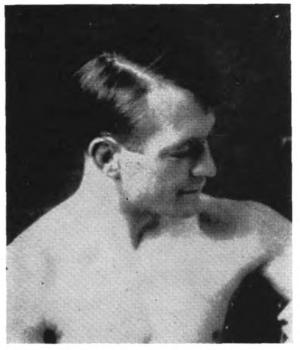
Stanley Ketchel, the famed “Michigan Assassin,” was the most exciting fighter I have ever seen. I rate him the greatest middleweight of all time and often wonder what other ring glories might have been his, had he not been shot and killed by Walter Dipley at the age of 24.
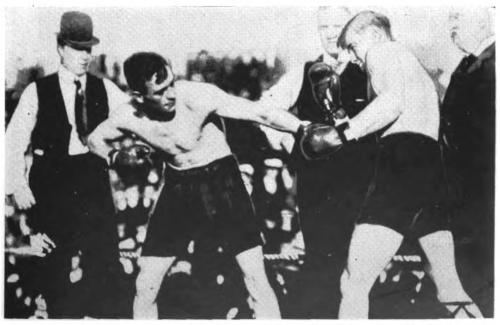
Here Ketchel (left) poses with Billy Papke prior to their second 1908 title fight in San Francisco. Stanley regained the championship with an eleventh round knockout.
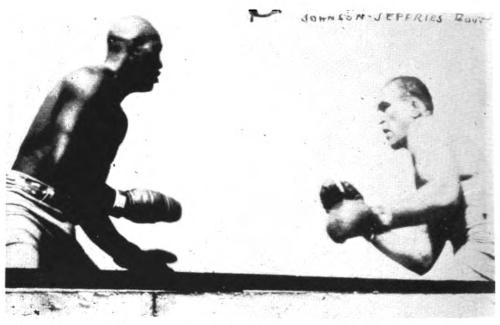
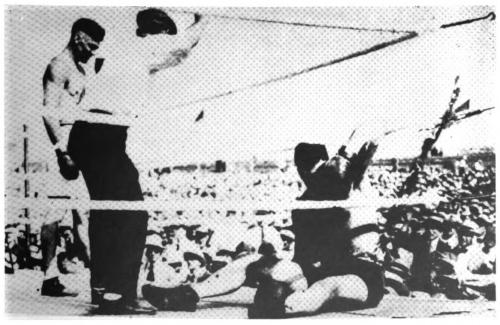
Though not a popular champion, Jack Johnson ranks as the best all-around fighter of modern times in my book. The demand for his dethronement brought aging Jim Jeffries out of retirement. Tex Rickard promoted the bout in Reno, July 4, 1910 and refereed it. Sentiment rode with the balding Jeffries (shown above sparring for an opening in an early round), but age soon told as the cat-like Johnson battered him into submission. The end came in the fifteenth round (below) as Sam Berger threw in the sponge and referee Rickard pushed Jack off the fallen ex-champ.
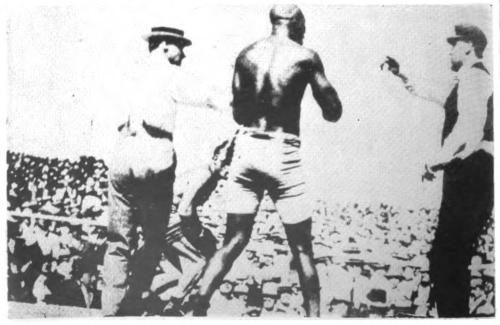
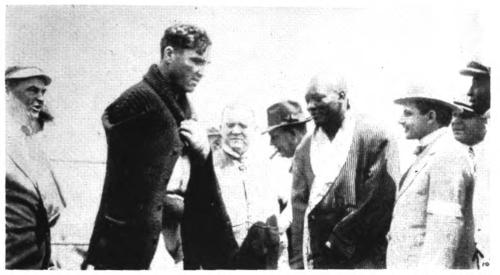
Johnson’s unpopular reign as champion continued until high living and Jess Willard caught up with him in Havana, June 10, 1914 (above). Willard’s great size and strength proved decisive as the bout wore on and Jack was finally counted out in the twenty-sixth round. He claimed afterwards to have taken a dive. In the picture below it appears that Johnson is shading his eyes from the sun. However, such a gesture is not uncommon for a beaten fighter (see photo of Billy Conn on another page), and since I was present at the Havana fight, I cannot agree with Johnson’s version.
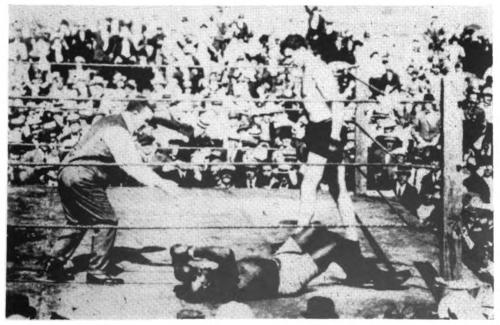
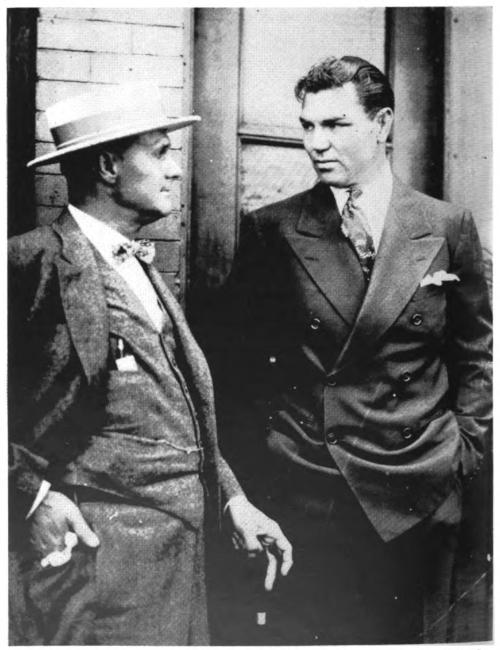
Tex Rickard’s rise to greatness coincided with the appearance of hobo camp brawler Jack Dempsey on the heavyweight scene. Paired together by destiny, the rough, pug-nosed battler from Manassa, Colorado, and the imaginative promoter personified Boxing’s Golden Age.
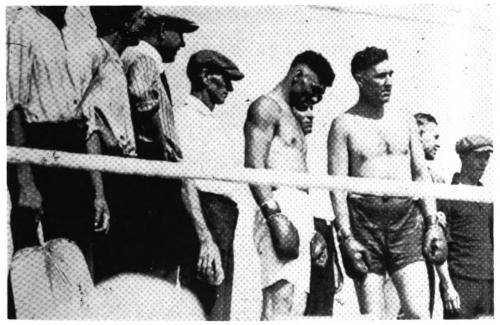
Dempsey had been nothing more than a rugged in-and-out slugger until he fell into the hands of Jack Kearns (white cap, above), who groomed him for the title meeting with Willard at Toledo, July 4, 1919. Jack gained fistic immortality with an explosive three-round knockout victory. The beating that Jess suffered was so severe as to seem impossible to administer with only padded gloves. The false rumors that Jack’s gloves were “loaded” with plaster of Paris persist until this day. Jimmy Deforest (standing next to Dempsey), who bandaged Jack’s hands, denied the story. Below we see Willard down for the seventh time in the opening round.
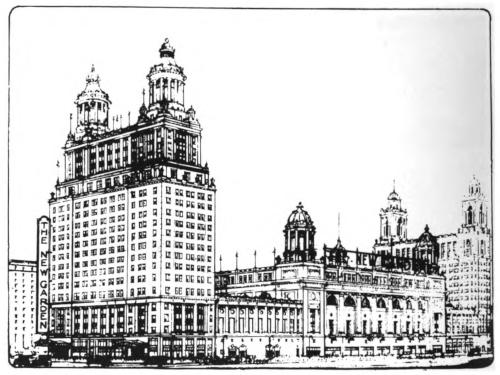
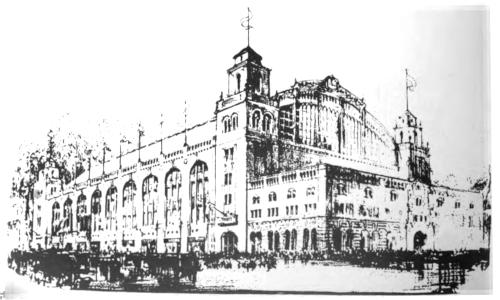
Above is the architect’s sketch for a new Madison Square Garden which Dinty Scanlon had drawn up and which appeared with my exclusive story in the New York Telegram, May 22, 1923. We submitted it to Tex Rickard the following day. Tex feigned disinterest, calling our proposal impractical. However, he used our idea to get financial backing for the building of his own Garden, as is indicated by his architect’s drawing (below) which was not submitted to the press until more than a year later.
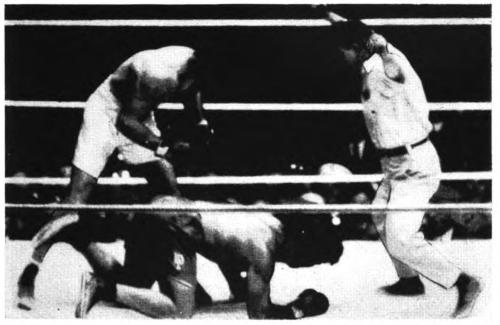
For breath-taking excitement, the Dempsey-Luis Firpo title fight at the Polo Grounds, September 14, 1923, was the wildest I have ever witnessed. In the picture above, Jack, who was down twice himself—once completely out of the ring—stands over the fallen challenger. Though as courageous as any man I’ve ever seen, the mammoth Firpo was finally knocked senseless and the fight ended with his tenth knock-down at 1:12 of the second round. Luis was floored seven times in the first round and twice in the second before the knockout punch was delivered.
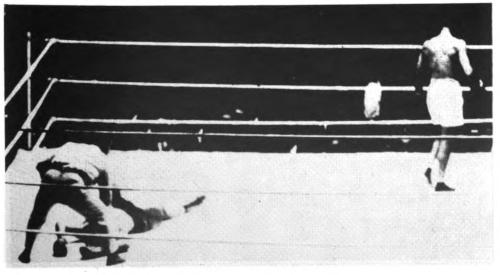
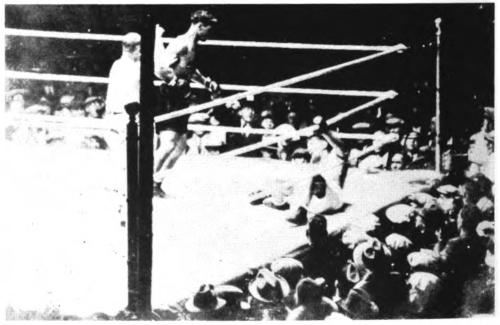
Dempsey’s dominance of the heavyweight division was brought to an end by handsome ex-Marine Gene Tunney, who took the title with a ten round decision in Philadelphia, September 23, 1926. Jack’s defeat stunned the entire sporting world. Rematched before 104,000 in Chicago’s Soldier’s Field, September 22, 1927, Dempsey flashed his old time fury in flooring Gene in the seventh round (above). The long count resulting from his delay in going to a neutral corner (below) remains a subject for debate until this day, for Gene regained his feet, and his senses, and went on to victory.
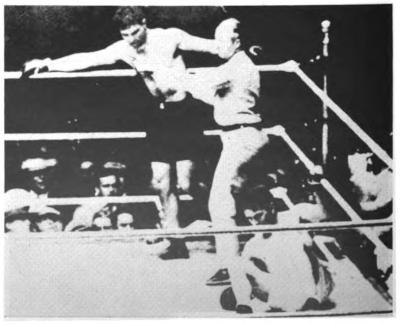
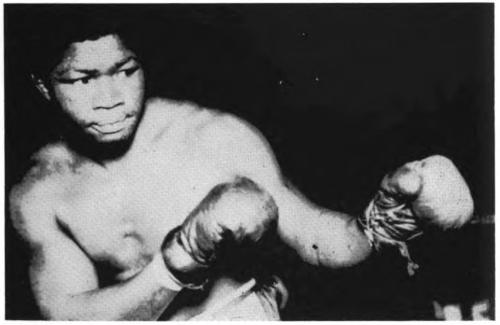
One of the more colorful fighters of the 1920s was the unschooled primitive, Battling Siki, who somehow managed to swarm over Georges Carpentier to win the light heavyweight championship of the world, September 24, 1922.
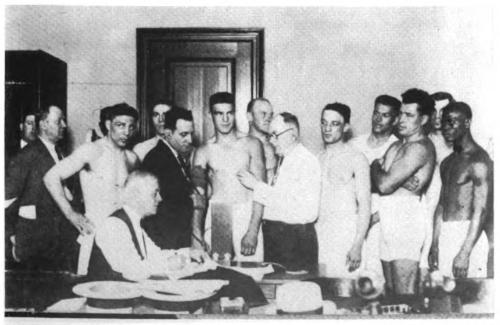
Here is one of the greatest arrays of fistic talent ever assembled for an evening of boxing. Shown at the weigh-in for the Milk Fund Show at Yankee Stadium, June 26, 1924, are (l. to r.) Harry Greb, Tommy Loughran, Young Stribling, Sandy Seifer, Ted Moore, Gene Tunney, Ermino Spalla, Dan Lieber and Panama Joe Gans.
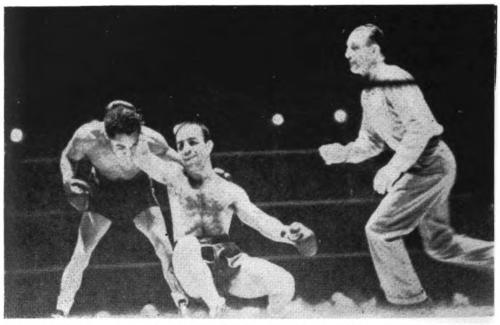
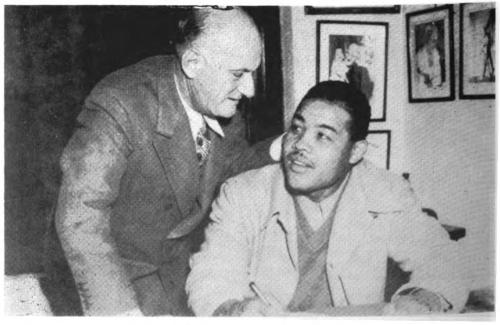
Rickard’s death in 1929 closed as exciting an era as the fight game has ever known. Though marred by depression, the decade that followed was almost as eventful, with shrewd Mike Jacobs the heir to Tex’s promotional mantle. I negotiated Mike’s first title fight between Henry Armstrong and Petey Sarron (above) at Madison Square Garden, October 29, 1937. Jacobs’ meal ticket was Detroit “Brown Bomber” Joe Louis (below), who ruled the heavyweights from 1937 to his retirement in 1949.
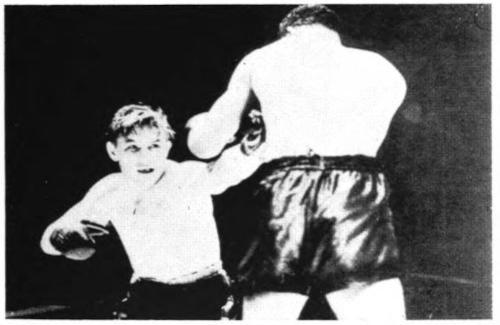
Joe’s first title defense saw him gain a fifteen-round decision over the Welshman Tommy Farr in the Yankee Stadium in New York City, August 30, 1937. Farr earned the respect of the American sporting crowd, but he never would have gotten the match had it not been for my trans-Atlantic telephone negotiations in Jacobs’ behalf.
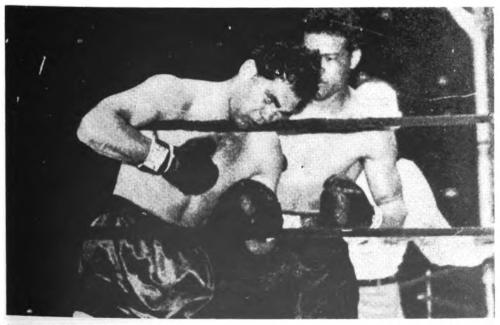
A devastating puncher with either hand, Louis was one of the greatest finishers the ring has ever seen. His destruction of Max Schmeling in 2:04 of the first round of their meeting, June 22, 1938, at Yankee Stadium is often compared with the carnage wrought by Dempsey at Toledo.
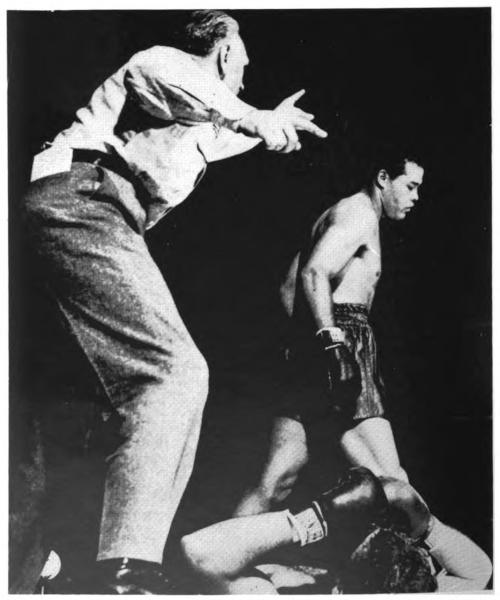
Jacobs had to wait five years to rematch Louis with Irish Billy Conn after their sensational 1941 meeting. This $100 a ringside seat offering saw a heavier and not so daring Conn fall beneath Louis’ fists in the eighth round at Yankee Stadium, June 19, 1946. Conn is shading his eyes as did Jack Johnson in his bout with Willard.
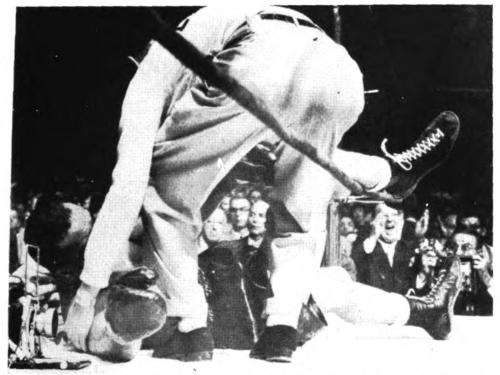
Joe retired in 1949, but financial difficulties forced him to return to the ring wars in 1950. He lost a fifteen round decision to then champion Ezzard Charles, but managed to campaign successfully among the other challengers until hard punching Rocky Marciano belted him into permanent retirement with an eighth round kayo at Madison Square Garden, October 26, 1951.
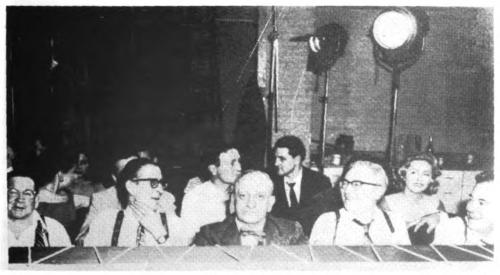
This shot of me in a familiar ringside setting was made for a fight sequence in Rocky Graziano’s 1957 film biography, “Somebody Up There Likes Me.” Also shown with me are some of my longstanding pals among the fight scribes: (l. to r.) the late Jim Jennings of the Mirror, the late Caswell Adams of the Journal-American and Joe Nichols of the Times.
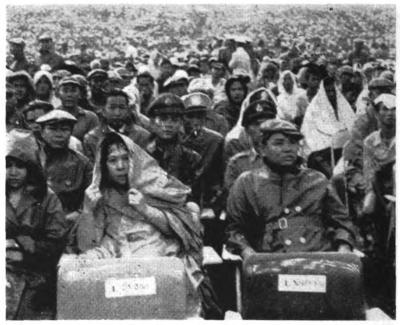
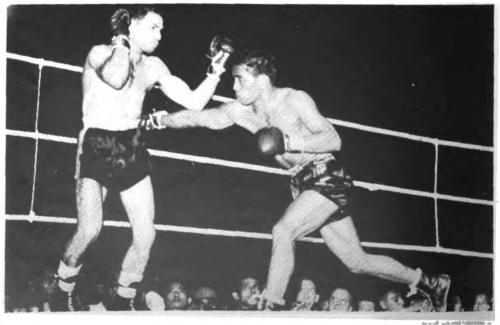
My work has taken me around the world several times through the years. The picture above shows part of the crowd of 69,962 that sat in the huge Bangkok stadium to watch the Chamrern Songkitrat-Robert Cohen bantamweight championship match on September 19, 1954, despite a terrific downpour that lasted until the main event was about to get under way. Cohen, shown (left) in an early exchange below, won the title by decision. I am proud to have been associated in the negotiations for the battle and to have acted as judge.
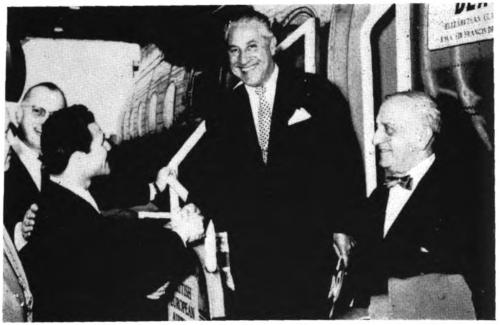
Here bantam king Cohen and myself greet New York State Athletic Commissioner Julius Helfand upon his arrival in Paris for a meeting of the World Boxing Championship Committee in 1955.
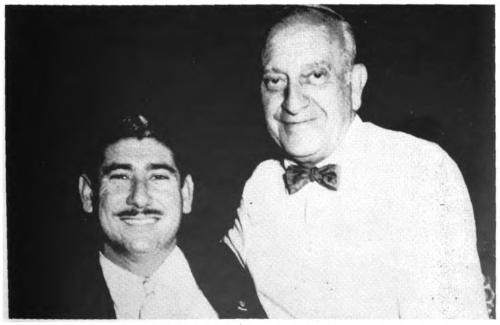
This picture of my 1958 visit with Cuban Sports Commissioner, General Fernandez y Miranda, caused me considerable embarrassment when it appeared as part of a Life Magazine feature article on gambling and gangsterism in Cuba. A long time sports friend, Miranda is also a Batista relative and in Life was alleged to have interests in slot machines.
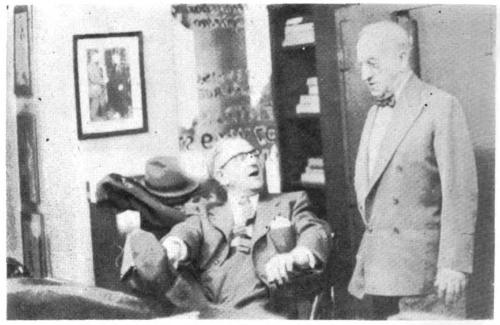
Here I am chatting with my life-long friend, Dan Daniel, at The Ring offices. Dan and I have shared many an exciting moment through my more than fifty years of sports writing.
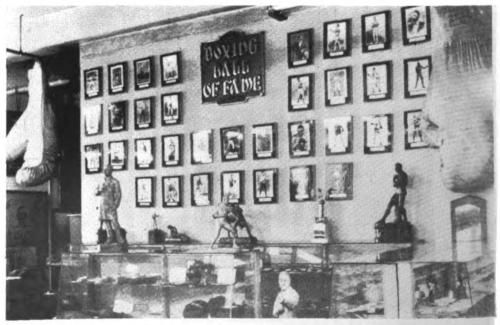
This is part of the Boxing Hall of Fame, which I organized in 1954 to commemorate the many truly great fighters of days gone by. Those of modern times are selected by the votes of a panel of more than 100 of the leading sports writers of the world. To be elected, a fighter must receive at least 75 percent of the total votes cast. The old timers are chosen by a panel of twenty veterans who have covered the sports field for forty or more years.