THE YOUTH’S DICTIONARY OF MYTHOLOGY. (continued 2)
Reading edition
Narcissus (Narcis′sus), son of Cephisus and the Naiad Liriope, was a beautiful youth, who was so pleased with the reflection of himself which he saw in the placid water of a fountain that he could not help loving it, imagining that it must be some beautiful nymph. His fruitless endeavors to possess himself of the supposed nymph drove him to despair, and he killed himself. There sprang from his blood a flower, which was named after him, Narcissus.
“Narcissus so himself forsook, And died to kiss his shadow in the brook.”
“Hadst thou Narcissus in thy face, to me Thou wouldst appear most ugly.” Shakespeare.
Nastrond (Nas′trond). The Scandinavian place of eternal punishment, corresponding with Hades.
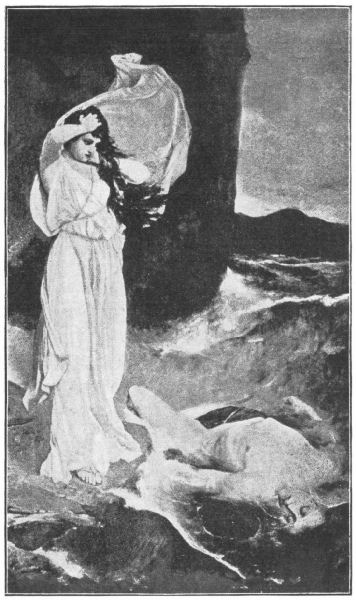
See page 66
Hero and Leander
Natio (Na′tio). A Roman goddess who took care of young infants.
Nemaean Lion (Nemae′an), see Hercules.
Nemesis (Nem′esis), the goddess of vengeance or justice, was one of the infernal deities. Her mother was Nox. She was supposed to be constantly traveling about the earth in search of wickedness, which she punished with the greatest severity. She is referred to by some writers under the name of Adrasteia. The Romans always sacrificed to this goddess before they went to war, because they wished to signify that they never took up arms but in the cause of justice.
“Forbear, said Nemesis, my loss to moan, The fainting, trembling hand was mine alone.” Dr. J. Wharton.
Nephalia (Nepha′lia). Grecian festivals in honor of Mnemosyne, the mother of the Muses.
Neptune (Nep′tune), god of the sea, was a son of Saturn and Cybele, and brother to Jupiter and Pluto. He quarreled with Jupiter because he did not consider that the dominion of the sea was equal to Jupiter’s empire of heaven and earth; and he was banished from the celestial regions, after having conspired with Pluto to dethrone Jupiter. Neptune was married to Amphitrite, daughter of Oceanus and Tethys, by whom he had a son named Triton. He was also father of Polyphemus (one of the Cyclopes), Phoreus, and Proteus. Neptune is represented as being seated in a shell chariot, drawn by dolphins or sea-horses, and surrounded by Tritons and sea-nymphs. He holds in his hand a trident, with which he rules the waves. Though a marine deity, he was reputed to have presided over horse-training and horse-races; but he is principally known as the god of the ocean; and the two functions of the god are portrayed in the sea horses with which his chariot is drawn, the fore-half of the animal being a horse, and the hind-half a dolphin. Ships were also under his protection, and whenever he appeared on the ocean there was a dead calm.
Nereides, The (Nere′ides), were aquatic nymphs. They were daughters of Nereus and Doris, and were fifty in number. They are generally represented as beautiful girls riding on dolphins, and carrying tridents in the right hand or garlands of flowers.
Nereus (Nere′us). A sea deity, husband of Doris. He had the gift of prophecy, and foretold fates; but he had also the power of assuming various shapes, which enabled him to escape from the importunities of those who were anxious to consult him.
Nessus (Nes′sus). The name of the Centaur that was destroyed by Hercules for insulting his wife Deianira. Nessus’s blood-smeared robe proved fatal to Hercules.
Nestor (Nes′tor). A grandson of Neptune, his father being Neleus, and his mother Chloris. Homer makes him one of the greatest of the Greek heroes. He was present at the famous battle between the Lapithae and the Centaurs, and took a leading part in the Trojan war.
“... Here’s Nestor Instructed by the antiquary times, He must, he is, he cannot but be wise.” Shakespeare.
Nicephorus (Niceph′orus). A name of Jupiter, meaning the bearer of victory.
Nidhogg (Nid′hogg). In Scandinavian mythology the dragon who dwells in Nastrond.
Niflheim (Nifl′heim). The Scandinavian hell. It was supposed to consist of nine vast regions of ice beneath the North Pole, where darkness reigns eternally. See Nastrond.
Night, see Nox.
Nightingale, see Philomela.
Nightmare, see Incubus.
Nilus (Ni′lus), a king of Thebes, who gave his name to the Nile, the great Egyptian river.
Nine, The, see Muses.
Niobe (Ni′obe) was a daughter of Tantalus, and is the personification of grief. By her husband Amphion she had seven sons and seven daughters. By the orders of Latona the father and sons were killed by Apollo, and the daughters (except Chloris) by Diana. Niobe, being overwhelmed with grief, escaped further trouble by being turned into a stone.
Nomius (No′mius). A law-giver; one of the names of Apollo. This title was also given to Mercury for the part he took in inventing beneficent laws.
Norns. Three Scandinavian goddesses, who wove the woof of human destiny. The three witches in Shakespeare’s “Macbeth” have their origin in the Scandinavian Norns.
Notus (No′tus). Another name for Auster, the south wind.
Nox was the daughter of Chaos, and sister of Erebus and Mors. She personified night, and was the mother of Nemesis and the Fates.
Nundina (Nundi′na). The goddess who took charge of children when they were nine days old—the day (Nona dies) on which the Romans named their children.
Nuptialis (Nuptia′lis). A title of Juno. When the goddess was invoked under this name the gall of the victim was taken out and thrown behind the altar, signifying that there should be no gall (bitterness) or anger between married people.
Nuriel (Nu′riel). In Hebrew mythology the god of hailstorms.
Nyctelius (Nycte′lius). A name given to Bacchus, because his festivals were celebrated by torchlight.
Nymphs. This was a general name for a class of inferior female deities who were attendants of the gods. Some of them presided over springs, fountains, wells, woods, and the sea. They are spoken of as land-nymphs or Naiads, and sea-nymphs or Nereids, though the former are associated also with fountains and rivers. The Dryads were forest-nymphs, and the Hamadryads were nymphs who lived among the oak-trees—the oak being always specially venerated by the ancients. The mountain-nymphs were called Oreads.
“With flower-inwoven tresses torn, The nymphs in twilight shade Of tangled thickets mourn.” Milton.
Nysae (Ny′sae). The names of the nymphs by whom Bacchus was nursed. See Dionysius.
Nysaeus (Ny′saeus). A name of Bacchus, because he was worshiped at Nysa, a town of Aethiopia.
Nysus (Ny′sus). A king of Megara who was invisible by virtue of a particular lock of hair. This lock his daughter Scylla cut off, and so betrayed her father to his enemies. She was changed into a lark, and the king into a hawk, and he still pursues his daughter, intending to punish her for her treachery.
Oannes (Oan′nes). An Eastern (Babylonian) god, represented as a monster, half-man, half-fish. He was said to have taught men the use of letters in the day-time, and at night to have retired to the depth of the ocean.
Oath, see Lapis.
Obambou (Obam′bou). A devil of African mythology.
Ocean, see Neptune.
Oceanides (Ocean′ides). Sea-nymphs, daughters of Oceanus and Tethys. Their numbers are variously estimated by different poets; some saying there were as many as 3,000, while others say they were as few as sixteen. The principal of them are mentioned under their respective names, as Amphitrite, Doris, Metis, etc.
Oceanus (Oce′anus), son of Coelus and Terra, and husband of Tethys. Several mythological rivers were called his sons, as Alpheus, Peneus, etc., and his daughters were called the Oceanides. Some of the ancients worshiped him as the god of the seas, and invariably invoked his aid when they were about to start on a voyage. He was also thought to personify the immense stream which it was supposed surrounded the earth, and into which the sun and moon and other heavenly bodies sank every day.
Ocridion (Ocrid′ion). A king of Rhodes, who was deified after his death.
Ocypete (Ocy′pete). One of the Harpies, who infected everything she touched. The word means swift of flight.
Ocyroe (Ocy′roe). A daughter of Chiron, who had the gift of prophecy. She was metamorphosed into a mare.
Odin (O′din). In Scandinavian mythology the god of the universe, and reputed father of all the Scandinavian kings. His wife’s name was Friga, and his two sons were Thor and Balder. The Wodin of the early German tribes.
Oeagrus (Oe′agrus). King of Thrace, and father of Orpheus.
Oedipus (Oed′ipus). A son of Laius, King of Thebes, best known as the solver of the famous enigma propounded by the Sphinx. In solving the riddle Oedipus unwittingly killed his father, and, discovering the fact, he destroyed his own eyesight, and wandered away from Thebes, attended by his daughter Antigone. Oedipus is the subject of two famous tragedies by Sophocles.
Oenone (Oeno′ne). Wife of Paris, a nymph of Mount Ida, who had the gift of prophecy.
Ogygia (Ogyg′ia). An island, the abode of Calypso, in the Mediterranean Sea, on which Ulysses was shipwrecked. It was so beautiful in sylvan scenery that even Mercury (who dwelt on Olympus) was charmed with the spot.
Ointment, see Phaon.
Olenus (Ole′nus). A son of Vulcan, who married Lathaea, a woman who thought herself more beautiful than the goddesses, and as a punishment she and her husband were turned into stone statues.
Olives, see Aristaeus.
Olympius (Olym′pius). A name of Jupiter, from Olympia, where the god had a splendid temple, which was considered to be one of the seven wonders of the world.
Olympus (Olym′pus) was the magnificent mountain on the coast of Thessaly, 9,000 feet high, where the gods were supposed to reside. There were several other smaller mountains of the same name.
“High heaven with trembling the dread signal took, And all Olympus to the center shook.” Pope.
Olyras (Oly′ras). A river near Thermopylae, which, it is said, attempted to extinguish the funeral pile on which Hercules was consumed.
Omophagia (Omopha′gia). A Bacchanalian festival at which some uncooked meats were served.
Omphale (Om′phale). The Queen of Lydia, to whom Hercules was sold as a bondsman for three years for the murder of Iphitus. Hercules fell in love with her, and led an effeminate life in her society, wearing female apparel, while Omphale wore the lion’s skin.
Onarus (Ona′rus). A priest of Bacchus, said to have married Ariadne after she had been abandoned by Theseus.
Onuva (Onu′va). The Venus of the ancient Gauls.
Opalia (Opa′lia). Roman festivals in honor of Ops, held on 14th of the calends of January.
Opiate-rod, see Caduceus.
“Eyes ... more wakeful than to drowse, Charmed with Arcadian pipe—the pastoral reed Of Hermes or his opiate-rod.” Milton.
Ops. Mother of the gods, a daughter of Coelus and Terra. She was known by the several names of Bona Dea, Rhea, Cybele, Magna Mater, Proserpine, Tellus, and Thya; and occasionally she is spoken of as Juno and Minerva. She personified labor, and is represented as a comely matron, distributing gifts with her right hand, and holding in her left hand a loaf of bread. Her festival was the 14th day of the January calends.
Oracles, see Themis.
Oraea (Orae′a). Certain sacrifices offered to the goddesses of the seasons to invoke fair weather for the ripening of the fruits of the earth.
Orbona (Orbo′na). Roman goddess of children, invoked by mothers when they lost or were in danger of losing their offspring.
Orchards, see Feronia.
Oreades (O′reades) were mountain nymphs, attendants on Diana.
Orgies. Drunken revels. The riotous feasts of Bacchus were so designated.
Orion (Ori′on). A handsome hunter, of great stature, who was blinded by Oenopion for a grievous wrong done to Merope, and was therefore expelled from Chios. The sound of the Cyclops’ hammers led him to the abode of Vulcan, who gave him a guide. He then consulted an oracle, and had his sight restored, as Longfellow says, by fixing
“His blank eyes upon the sun.”
He was afterward slain by Diana and placed amongst the stars, where his constellation is one of the most splendid.
Orithyia (Ori′thy′ia). A daughter of Erechtheus, whose lover, Boreas, carried her off while she was wandering by the river Ilissus. Her children were Zetus and Calais, two winged warriors who accompanied the Argonauts.
Ormuzd (Or′muzd). In Persian mythology the creator of all things.
Oros (O′ros). The Egyptian Apollo.
Orphans, see Orbona.
Orpheus (Or′pheus) was son of Apollo and the Muse Calliope. He was married to Eurydice; but she was stung by a serpent, and died. Orpheus went down to Hades to claim her, and played so sweetly with his lute that Pluto allowed Eurydice to return to the earth with Orpheus, but on condition that he did not look behind him until he had reached the terrestrial regions. Orpheus, however, in his anxiety to see if she were following him, looked round, and Eurydice disappeared from his sight, instantly and forever.
“Orpheus’ lute was strung with poets’ sinews.” Shakespeare.
Osiris (Osi′ris). The Egyptian god of the sun, the source of warmth, life, and fruitfulness; he was worshiped under the form of a sacred bull, named Apis.
“... After these appeared A crew who, under names of old renown, Osiris, Isis, Orus, and their train, With monstrous shapes and sorceries abused Fanatic Egypt and her priests to seek Their wandering gods, disguised in brutish forms Rather than human.” Milton.
Ossa (Os′sa). One of the mountains of Thessaly (once the residence of the centaurs) which the giants piled on the top of Mount Pelion to enable them to ascend to heaven and attack the gods.
Ox, see Apis.
Owl, see Aesculapius and Itys.
Pactolus (Pacto′lus). The river in Lydia where Midas washed himself by order of Bacchus, and the sands were turned to gold.
Paean (Pae′an). A name given Apollo, from paean, the hymn which was sung in his honor after he had killed the serpent Python. Paeans were solemn songs, praying either for the averting of evil and for rescue, or giving thanks for help vouchsafed.
“With hymns divine the joyous banquet ends, The Paeans lengthened till the sun descends.” Pope.
Palaemon (Palae′mon), or Melicerta, a sea-god, son of Athamas and Ino.
Pales (Pa′les). The goddess of shepherds and sheepfolds and protectress of flocks; her festivals were called by the Romans Palilia.
“Pomona loves the orchard, And Liber loves the wine, And Pales loves the straw-built shed, Warm with the breath of kine.” Macaulay.
“Great Pales help, the pastoral rites I sing, With humble duty mentioning each thing.” Pope.
Palladium (Palla′dium). A famous statue of the goddess Pallas (Minerva). She is sitting with a spear in her right hand, and in her left a distaff and spindle. Various accounts are given of the origin of the statue. Some writers say that it fell from the skies. It was supposed that the preservation of the statue would be the preservation of Troy; and during the Trojan War the Greeks were greatly encouraged when they became the possessors of it.
Pallas (Pal′las), or Minerva. The name was given to Minerva when she destroyed a famous giant named Pallas. The Greeks called their goddess of wisdom Pallas Athene. See Minerva.
“Apollo, Pallas, Jove, or Mercury, Inspire me that I may this treason find.” Shakespeare.
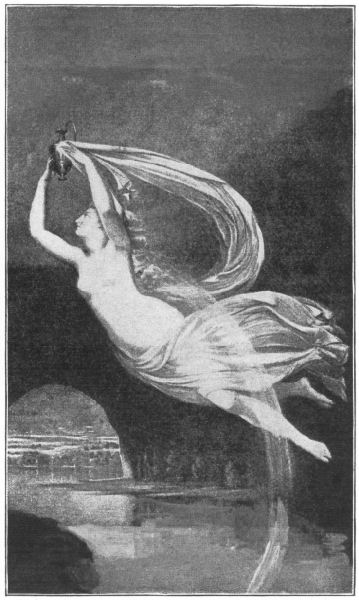
See page 73
Iris
Pan. The Arcadian god of shepherds, huntsmen, and country folk, and chief of the inferior deities, is usually considered to have been the son of Mercury and Penelope. After his birth he was metamorphosed into the mythical form in which we find him depicted, namely, a horned, long-eared man, with the lower half of the body like a goat. He is generally seen playing a pipe made of reeds of various lengths, which he invented himself, and from which he could produce music which charmed even the gods. These are the Pan-pipes, or Syrinx. Pan’s terrific appearance once so frightened the Gauls when they invaded Greece that they ran away though no one pursued them; and the word panic is said to have been derived from this episode. The Fauns, who greatly resembled Pan, were his attendants.
“Piping on their reeds the shepherds go, Nor fear an ambush, nor suspect a foe.” Pope.
Pandora (Pando′ra), according to Hesiod, was the first mortal female. Vulcan made her of clay, and gave her life. Venus gave her beauty; and the art of captivating was bestowed upon her by the Graces. She was taught singing by Apollo, and Mercury taught her oratory. Jupiter gave her a box, the famous “Pandora’s Box,” which she was told to give to her husband, Epimetheus, brother of Prometheus. As soon as he opened it there issued from it numberless diseases and evils which were soon spread all over the world, and from that moment they have afflicted the human race. It is said that Hope alone remained in the box. Pandora means “the all-gifted.”
“More lovely than Pandora, whom the gods Endowed with all their gifts.” Milton.
Pantheon (Panthe′on) (lit. “the all-divine place”). The temple of all the gods, built by Agrippa at Rome, in the reign of Augustus (B.C. 27). It was 144 feet in diameter, and 144 feet high; and was built in the Corinthian style of architecture, mostly of marble; while its walls were covered with engraved brass and silver. Its magnificence induced Pliny to give it rank among the wonders of the world.
Paphia (Pa′phia), a name of Venus.
Papremis (Pap′remis). The Egyptian Mars.
Parcae, The (Par′cae), were goddesses who presided over the destiny of human beings. They were also called the Fates, and were three in number, Atropos, Clotho, and Lachesis. See Fates.
Paris (Par′is), the son of Priam, king of Troy, and of his mother Hecuba. It had been predicted that he would be the cause of the destruction of Troy, and his father therefore ordered him to be strangled as soon as he was born; but the slave who had been entrusted with this mission took the child to Mount Ida, and left it there. Some shepherds, however, found the infant and took care of him. He lived among them till he had grown to man’s estate, and he then married Oenone, a nymph of Ida. At the famous nuptial feast of Peleus and Thetis, Discordia, who had not been invited, attended secretly; and when all were assembled, she threw among the goddesses a golden apple, on which was inscribed “Let the fairest take it.” This occasioned a great contention, for each thought herself the fairest. Ultimately, the contestants were reduced to three, Juno, Pallas (Minerva), and Venus; but Jove himself could not make these three agree, and it was decided that Paris should be the umpire. He was sent for, and each of the goddesses courted his favor by offering all sorts of bribes. Juno offered him power, Pallas wisdom, and Venus promised him the most beautiful woman in the world. Paris gave the golden apple to Venus. Soon after this episode Priam owned Paris as his son, and sent him to Greece to fetch Helen, who was renowned as being the most beautiful woman in the world. She was the wife of Menelaus, king of Sparta; but during his absence Paris carried Helen away to Troy, and this gave rise to the celebrated war between the Greeks and the Trojans, which ended in the destruction of Troy. Paris was among the 676,000 Trojans who fell during or after the siege.
Parnassides (Parnas′sides), a name common to the Muses, from Mount Parnassus.
Parnassus (Parnas′sus). The mountain of the Muses in Phocis, and sacred to Apollo and Bacchus. Any one who slept on this mountain became a poet. It was named after one of the sons of Bacchus.
Parthenon (Par′thenon). The temple of Minerva (or Pallas) on the Acropolis at Athens. It was destroyed by the Persians, and rebuilt by Pericles.
Parthenos (Par′thenos) was a name of Juno, and also of Minerva. See Pallas.
Pasiphae (Pasiph′ae) was the reputed mother of the Minotaur killed by Theseus. She was said to be the daughter of Sol and Perseis, and her husband was Minos, king of Crete.
Pasithea (Pasith′ea). Sometimes there are four Graces spoken of; when this is so, the name of the fourth is Pasithea. Also called Aglaia.
Pavan (Pav′an), the Hindoo god of the winds.
Peace, see Concordia.
Peacock, see Argus.
Pegasus (Peg′asus). The famous winged horse which was said to have sprung from the blood of Medusa when her head was cut off by Perseus. His abode was on Mount Helicon, where, by striking the ground with his hoof, he caused water to spring forth, which formed the fountain afterward called Hippocrene.
“Each spurs his faded Pegasus apace.” Byron.
“Thy stumbling founder’d jade can trot as high As any other Pegasus can fly.” Earl of Dorset.
“To turn and wind a fiery Pegasus, And witch the world with noble horsemanship.” Shakespeare.
Peleus (Pe′leus). A king of Thessaly, who married Thetis, one of the Nereides. It is said that he was the only mortal who married an immortal.
Pelias (Pe′lias). A son of Neptune and Tyro. He usurped the throne of Cretheus, which Jason was persuaded to relinquish and take the command of the Argonautic expedition. On the return of Jason, Medea, the sorceress, undertook to restore Pelias to youth, but required that the body should first be cut up and put in a caldron of boiling water. When this had been done, Medea refused to fulfil her promise. Pelias had four daughters, who were called the Peliades.
Pelias (Pe′lias) was the name of the spear of Achilles, which was so large that none could wield it but the hero himself.
Pelion (Pe′lion). A well-wooded mountain, famous for the wars between the giants and the gods, and as the abode of the Centaurs, who were expelled by the Lapithae. See Ossa, a mount, which the giants piled upon Pelion, to enable them to scale the heavens.
“The gods they challenge, and affect the skies, Heaved on Olympus tottering Ossa stood; On Ossa, Pelion nods with all his wood.” Pope.
Pelops (Pe′lops), son of Tantalus, king of Phrygia. His father killed him, and served him up to be eaten at a feast given to the gods, who, when they found out what the father of Pelops had done, restored the son to life, and he afterward became the husband of Hippodamia.
Penates (Pena′tes). Roman domestic gods. The hearth of the house was their altar. See Lares.
Perpetual Punishment, see Sisyphus.
Persephone (Perseph′one). The Greek name of Proserpine.
Perseus (Per′seus) was a son of Jupiter and Danae, the daughter of Acrisius. His first famous exploit was against the Gorgon, Medusa. He was assisted in this enterprise by Pluto, who lent him a helmet which would make him invisible. Pallas lent him her shield, and Mercury supplied him with wings. He made a speedy conquest of the Gorgons, and cut off Medusa’s head, with which he flew through the air, and from the blood sprang the winged horse Pegasus. As he flew along he saw Andromeda chained to the rock, and a sea-monster ready to devour her. He killed the monster, and married Andromeda. When he got back, he showed the Gorgon’s head to King Polydectes, and the monarch was immediately turned into stone.
“Now on Daedalian waxen pinions stray, Or those which wafted Perseus on his way.” F. Lewis.
Persuasion, goddess of, see Pitho.
Phaeton (Pha′eton). A son of Sol, or, according to many mythologists, of Phoebus and Clymene. Anxious to display his skill in horsemanship, he was allowed to drive the chariot of the sun for one day. The horses soon found out the incapacity of the charioteer, became unmanageable, and overturned the chariot. There was such great fear of injury to heaven and earth, that Jove, to stop the destruction, killed Phaeton with a thunderbolt.
“Now Phaeton, by lofty hopes possessed, The burning seat with youthful vigor pressed.”
“The breathless Phaeton, with flaming hair, Shot from the chariot like a falling star That in a summer’s evening from the top Of heaven drops down, or seems at least to drop.” Addison.
Phaon (Pha′on). A boatman of Mitylene, in Lesbos, who received from Venus a box of ointment, with which, when he anointed himself, he grew so beautiful that Sappho became enamored of him; but when the ointment had all been used Phaon returned to his former condition, and Sappho, in despair, drowned herself.
Pheasant, see Itys.
Philoctetes (Philoct′etes) was son of Poeas, and one of the companions of Jason on his Argonautic expedition. He was present at the death of Hercules, and received from him the poisoned arrows which had been dipped in the blood of Hydra. These arrows, an oracle declared, were necessary to be used in the destruction of Troy, and Philoctetes was persuaded by Ulysses to go and assist at the siege. He appears to have used the weapons with great dexterity and with wonderful effect, for Paris was among the heroes whom he killed. The story of Philoctetes was dramatized by the Greek tragedians Aeschylus, Euripides, and Sophocles.
Philomela (Philome′la) was a daughter of Pandion, king of Athens, who was transformed into a nightingale. She was sister to Procne, who married Tereus, King of Thrace. The latter having offered violence to Philomela, her sister, Procne, came to her rescue, and to punish her husband slew her son Itylus, and at a feast Philomela threw Itylus’s head on the banquet table.
“Forth like a fury Philomela flew, And at his face the head of Itys threw.” Pope.
“And thou, melodious Philomel, Again thy plaintive story tell.” Sir Thomas Lyttleton.
Phlegethon (Phleg′ethon). A river of fire in the infernal regions. It was the picture of desolation, for nothing could grow on its parched and withered banks. Also called Pyriphlegethon.
“... Infernal rivers ... ... Fierce Phlegethon, Whose waves of torrent fire inflame with rage.” Milton.
Phlegon (Phle′gon) (burning), one of the four chariot horses of Sol.
Phlegyas (Phle′gyas). Son of Mars and father of Ixion and Coronis. For his impiety in desecrating and plundering the temple of Apollo at Delphi, he was sent to Hades, and there was made to sit with a huge stone suspended over his head, ready to be dropped on him at any moment.
Phoebus (Phoe′bus). A name of Apollo, signifying light and life.
“Gallop apace, you fiery-footed steeds, Toward Phoebus’ lodging.” Shakespeare.
Phorcus (Phor′cus), or Porcys. A son of Neptune, father of the Gorgons. The same as Oceanus.
Phryxus (Phryx′us), see Golden Fleece.
Picumnus (Picum′nus). A rural divinity, who presided over the manuring of lands, also called Sterentius.
Picus (Pi′cus). A son of Saturn, father of Faunus, was turned into a woodpecker by Circe, whose love he had not requited.
Pierides (Pier′ides). A name of the Muses, derived from Pieria, a fountain in Thessaly, near Mount Olympus, where they were supposed to have been born. Also, the daughters of Pierus, a king of Macedonia, who settled in Boeotia. They challenged the Muses to sing, and were changed into magpies.
Pietas (Pie′tas). The Roman goddess of domestic affection.
Pillar, see Calpe.
Pilumnus (Pilum′nus). A rural divinity that presided over the corn while it was being ground. At Rome he was hence called the god of bakers.
Pine-Tree, see Atys.
Pirithous (Pirith′ous). A son of Ixion and great friend of Theseus, king of Athens. The marriage of Pirithous and Hippodamia became famous for the quarrel between the drunken Centaurs and the Lapithae, who, with the help of Theseus, Pirithous, and Hercules, attacked and overcame the Centaurs, many of whom were killed, and the remainder took to flight.
Pitho (Pi′tho), the goddess of Persuasion, daughter of Mercury and Venus. She is sometimes referred to under the name of Suada.
Plants, see Demogorgon.
Pleasure, see Rembha.
Pleiades, The (Plei′ades). Seven daughters of Atlas and Pleione. Their names were Electra, Alcyone, Celaeno, Maia, Sterope, Taygete, and Merope. They were made a constellation, but as there are only six stars to be seen, the ancients believed that one of the sisters, Merope, married a mortal, and was ashamed to show herself among her sisters, who had all been married to gods.
“... The gray Dawn and the Pleiades before him danced. Shedding sweet influence.” Milton.
Pluto (Plu′to). King of the infernal regions. He was a son of Saturn and Ops, and husband of Proserpine, daughter of Ceres. He is sometimes referred to under the name Dis, and he personifies hell. His principal attendant was the three-headed dog Cerberus, and about his throne were the Eumenides, the Harpies, and the Furies.
“With equal foot, rich friend, impartial fate Knocks at the cottage and the palace gate. . . . . . Night soon will seize, and you must go below, To story’d ghosts and Pluto’s house below.” Creech.
Plutus (Plu′tus), the god of riches, was son of Jasion or Iasius and Ceres (Demeter), the goddess of corn. He is described as being blind and lame; blind because he so often injudiciously bestows his riches, and lame because fortunes come so slowly.
Pluvius (Plu′vius). A name of Jupiter, because he had the rain in his control.
Podalirius (Podalir′ius). A famous surgeon, a son of Aesculapius and Epione. His skill in medicine made him very serviceable among the soldiers in the Trojan war.
Poet, see Parnassus.
Poetry, see Apollo, Calliope, The Muses.
Poisonous Herbs, see Circe.
Poisonous Lake, see Avernus.
Pollear (Poll′ear). Son of Siva, the Hindoo god of wisdom.
Pollux (Pol′lux). Twin brother of Castor. Their father was Jupiter and their mother Leda. He and his brother form the constellation Gemini. His Greek name was Polydeuces. Castor and Pollux are also known under the name of Dioscuri, the presiding deities of public games in Rome, Castor being the god of equestrian exercise, and Pollux the god of boxing. See Aedepol.
Polybotes (Polybo′tes). One of the giants who made war against Jupiter. He was killed by Neptune.
Polydectes (Polydec′tes) was turned into stone when Perseus showed him Medusa’s head. See Perseus.
Polydeuces (Polydeu′ces). The Greek name of Pollux.
Polyhymnia (Polyhym′nia). Daughter of Jupiter and Mnemosyne. One of the Muses who presided over singing and rhetoric.
Polyphemus (Polyphe′mus), one of the most celebrated of the Cyclops, a son of the nymph Thoosa and Neptune, or Poseidon, as the Greeks called the god of the sea. He captured Ulysses and twelve of his companions, and it is said that six of them were eaten. The remainder escaped by the ingenuity of Ulysses, who destroyed Polyphemus’s one eye with a fire-brand.
“Charybdis barks and Polyphemus roars.” Francis.
Polyxena (Polyx′ena). Daughter of Hecuba and Priam, king of Troy. It was by her treachery that Achilles was shot in the heel.
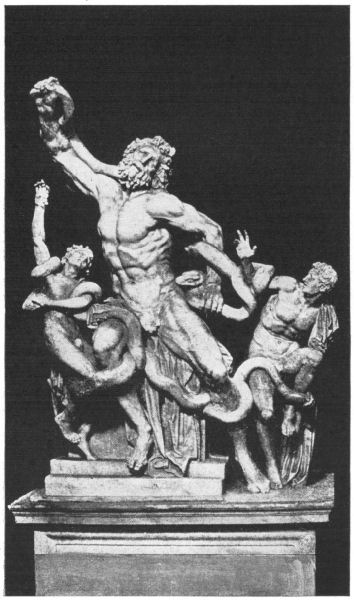
See page 79
Laocoon
Pomona (Pomo′na). The Roman goddess of fruit-trees and gardens.
“So to the sylvan lodge They came, that like Pomona’s arbor smiled With flowerets decked and fragrant smells.” Milton.
Poplar-Tree, see Heliades.
Portunus (Portu′nus) (Palaemon), son of Ino, was the Roman god of harbors.
Poseidon (Posei′don). The Greek name of Neptune, god of the sea.
Pracriti (Prac′riti). The Hindoo goddess of nature.
Predictions, see Cassandra.
Priam (Pri′am). The last king of Troy. See Paris.
Priapus (Pria′pus), the guardian of gardens and god of natural reproduction, was the son of Venus and Bacchus.
“Priapus could not half describe the grace (Though god of gardens) of this charming place.” Pope.
Prisca (Pris′ca). Another name of Vesta.
Procris (Pro′cris). Daughter of Erechtheus, king of Athens. See Cephalus, her husband.
Progne (Prog′ne), wife of Tereus. Commonly called Procne, whose sister was Philomela. See Itys and Tereus.
“Complaining oft gives respite to our grief, From hence the wretched Progne sought relief.” F. Lewis.
Prometheus (Prome′theus), the son of Japetus and father of Deucalion. He presumed to make clay men, and animate them with fire which he had stolen from heaven. This so displeased Jupiter that he sent him a box full of evils, which Prometheus refused; but his brother Epimetheus, not so cautious, opened it, and the evils spread over all the earth. Jupiter then punished Prometheus by commanding Mercury to bind him to Mount Caucasus, where a vulture daily preyed upon his liver, which grew in the night as much as it had been reduced in the day, so that the punishment was a prolonged torture. Hercules at last killed the vulture and set Prometheus free.
Prophecy, see Nereus.
Proserpine (Proser′pine). A daughter of Jupiter and Ceres. Pluto carried her off to the infernal regions and made her his wife. She was known by the names of “the Queen of Hell,” Hecate, Juno Inferna, and Libitina. She was called by the Greeks Persephone.
“He sung, and hell consented To hear the poet’s prayer, Stern Proserpine relented, And gave him back the fair.” F. Lewis.
Proteus (Pro′teus). A marine deity, who could foretell events and convert himself at will into all sorts of shapes. According to later legends, Proteus was a son of Poseidon.
“The changeful Proteus, whose prophetic mind, The secret cause of Bacchus’ rage divined.” The Lusiad.
“What chain can hold this varying Proteus fast?” Budgell.
Psyche (Psy′che). The wife of Cupid. The name is Greek, signifying the soul or spirit.
Pygmalion (Pygma′lion). A famous sculptor who had resolved to remain unmarried, but he made such a beautiful statue of a goddess that he begged Venus to give it life. His request being granted, Pygmalion married the animated statue.
“Few, like Pygmalion, doat on lifeless charms, Or care to clasp a statue in their arms.”
Pylades (Py′lades). The son of Strophius, King of Phanote, and husband of Electra; famous on account of his faithful friendship with Orestes.
“His wine Was better, Pylades, than thine. ... If you please To choose me for your Pylades.” F. Lewis.
Pylotis (Pylo′tis). A Greek name of Minerva.
Pyracmon (Pyr′acmon), one of the chiefs of the Cyclopes.
Pyramus and Thisbe (Pyr′amus and This′be). Two Babylonian lovers, the children of hostile neighbors. See Shakespeare’s burlesque of the story of their loves, in “Midsummer Night’s Dream.”
Pyrois (Py′rois) (luminous). One of the four chariot horses of Sol, the Sun.
Pythia (Py′thia). The priestess of Apollo at Delphi, who delivered the answers of the oracle. Also the name of the Pythian games celebrated in honor of Apollo’s victory over the dragon Python.
Python (Py′thon). A famous serpent killed by Apollo, which haunted the caves of Parnassus. See Septerion.
Quadratus (Quadra′tus). A surname given to Mercury, because some of his statues were four-sided.
Quadrifrons (Quad′rifrons). Janus was sometimes depicted with four faces instead of the usual two, and he was then called Janus Quadrifrons.
Quies (Qui′es). The Roman goddess of rest; she had a temple just outside the Colline gate of Rome.
Quietus (Quie′tus). One of the names of Pluto.
Quirinus (Quiri′nus). A name given to Mars during wartime; Virgil refers to Jupiter under the same name.
Quoit, see Hyacinthus.
Race, see Atalanta.
Radamanthus (Radaman′thus), see Rhadamanthus.
Rage, see Furies.
Rainbow, see Iris.
Rama (Ra′ma). A Hindoo god, who was the terrestrial representative of Vishnu.
Ram’s Hide, see Golden Fleece.
Reeds, see Pan, also Syrinx.
Rembha (Rem′bha). The Hindoo goddess of pleasure.
Reproduction, see Priapus.
Rest, see Quies.
Revenge, see Ate.
Rhadamanthus (Rhadaman′thus), a son of Jupiter and Europa, was the ruler of the Greeks in the Asiatic islands, and judge of the dead in the infernal regions.
“These are the realms of unrelenting fate: And awful Rhadamanthus rules the state. He hears and judges each committed crime, Inquires into the manner, place, and time; The conscious wretch must all his acts reveal, Loth to confess, unable to conceal; From the first moment of his vital breath, To the last hour of unrepenting death.” Dryden.
Rhamnusia (Rhamnu′sia). A name of Nemesis, from Rhamnus, a town in Attica, where she had a temple in which was her statue, made of one stone ten cubits high.
Rhea (Rhe′a). The Greek name of Cybele. She was a daughter of Uranus and Gaea, and was called Mother of the gods.
Rhetoric, see Calliope, also Polyhymnia.
Riches, see Plutus.
Riddle, see Sphinx.
Rimmon (Rim′mon). A Phrygian god of whom Milton says—
“... Rimmon, whose delightful seat Was fair Damascus, on the fertile banks Of Abana and Pharpar, lucid streams.”
Riot, see Saturnalia.
River of Fire, see Phlegethon.
Roads, see Vialis.
Robber, see Cacus, Coeculus.
Romulus (Rom′ulus). The traditional founder of Rome. He was a son of Mars and Ilia, and twin brother of Remus. The infants were thrown into the Tiber, but were miraculously saved and suckled by a she-wolf, till they were found by Faustulus, a shepherd, who brought them up. Remus was killed in a quarrel with his brother, and Romulus became the first King of Rome.
Rumia Dea (Rumi′a Dea). The Roman goddess of babes in arms.
Rumina (Ru′mina). Roman pastoral deities, who protected suckling cattle.
Runcina (Runci′na). The goddess of weeding or cleansing the ground.
Sacrifices were ceremonious offerings made to the gods. To every deity a distinct victim was allotted, and the greatest care was always taken in the selection of them. Anything in any way blemished was considered as an insult to the god. At the time of the sacrifice the people were called together by heralds led by a procession of musicians. The priest, clothed in white, was crowned with a wreath made of the leaves of the tree which was sacred to the particular god to whom the sacrifice was offered. The victim had its horns gilt, and was adorned with a chaplet similar to that of the priest, and was decorated with bright-colored ribbons. The priest then said, “Who is here?” to which the spectators replied, “Many good people.” “Begone all ye who are profane,” said the priest; and he then began a prayer addressed to all the gods. The sacrifice was begun by putting corn, frankincense, flour, salt, cakes, and fruit on the head of the victim. This was called the Immolation. The priest then took a cup of wine, tasted it, and handed it to the bystanders to taste also; some of it was then poured between the horns of the victim, and a few of the saturated hairs were pulled off and put in the fire which was burning on the altar. Then, turning to the east, the priest drew with his knife a crooked line along the back of the beast from the head to the tail, and told the assistants to kill the animal. This was done directly, and the entrails of the victim taken out and carefully examined by the Haruspices to find out what was prognosticated. The carcase was then divided, and the thighs, covered with fat, were put in the fire, and the rest of the animal was cut up, cooked, and eaten. This feast was celebrated with dancing, music, and hymns, in praise of the god in whose honor the sacrifice was made. On great occasions as many as a hundred bullocks were offered at one time; and it is said that Pythagoras made this offering when he found out the demonstration of the forty-seventh proposition of the book of Euclid.
Saga (Sa′ga). The Scandinavian goddess of history. The word means a saw or saying; hence Sagas, which embody Scandinavian legends, and heroic or mythical traditions.
Sagittarius (Sagitta′rius), see Chiron.
Sails, see Daedalus.
Salamanders (Sal′aman′ders). The genii who, according to Plato, lived in fire.
“The spirits of fiery termagants in flame, Mount up and take a Salamander’s name.” Pope.
Salatia (Sala′tia), or Salacia, a Roman goddess of the salt water. See Amphitrite.
Salii (Sal′ii). The priests of Mars who had charge of the sacred shields.
Salmoneus (Salmo′neus). A king of Elis who, for trying to imitate Jupiter’s thunders, was sent by the god straight to the infernal regions.
Salus (Sa′lus). The Roman goddess of health.
Sappho (Sap′pho), a celebrated poetess, a native of Lesbos, who flourished in the seventh century B.C. Her only connection with the goddesses of the time is that the Greeks called her “The tenth Muse.”
Sarcasm, see Momus.
Saron (Sa′ron), a sea-god.
Sarpedon (Sarpe′don), son of Jupiter by Europa. He accompanied Glaucus, when the latter set out to assist Priam against the Greeks in the Trojan War. He was slain by Patroclus.
Saturn (Sat′urn), king of the Universe, was father of Jupiter, Neptune, and Pluto. These gods quarreled amongst themselves as to the division of their father’s kingdom, which ended in Jupiter having heaven and earth, Neptune the sea, and Pluto the infernal regions.
Saturnalia (Saturna′lia). Festivals held in honor of Saturn about the 16th or 18th of December. Principally famous for the riotous disorder which generally attended them.
Saturnius (Satur′nius). A name given to Jupiter, Neptune, and Pluto, as sons of Saturn.
Satyavrata (Satya′vra′ta). The Hindoo god of law. The same as Menu.
Satyrs (Sat′yrs). Spirits of the woodland, half men, half goats, and fond of wine and women. They were the attendants of Dionysus, and were similar in most respects to the fauns who attended Pan. See Silenus.
“Five satyrs of the woodland sort. . . . . . . With asses’ hoofs, great goggle eyes, And double chins of monstrous size.” Yalden.
Scylla (Scyl′la). A beautiful nymph who excited the jealousy of Neptune’s wife, Amphitrite, and was changed by the goddess into a frightful sea-monster, which had six fearfully ugly heads and necks, and which, rising unexpectedly from the deep, used to take off as many as six sailors from a vessel, and carry them to the bottom of the sea. An alternative danger with the whirlpool, Charybdis, which threatened destruction to all mariners.
“There on the right her dogs foul Scylla hides, Charybdis roaring on the left presides.” Virgil.
Scylla (Scyl′la). A daughter of Nysus, who was changed into a lark for cutting off a charmed lock of her father’s hair. See Nysus.
Sea, see Neptune.
Seasons, see Vertumnus.
Sea-Weed, see Glaucus.
Segetia (Sege′tia). A rural divinity who protected corn during harvest-time.
Sem. The Egyptian Hercules.
Semele (Sem′ele), daughter of Cadmus and the mother of Bacchus (Dionysus), who was born in a miraculous manner after Jupiter had visited her, at her special request, in all his terrible splendor. She was deified after her death, and named Thyone.
Semi-Dei were the demi-gods.
Semones (Semo′nes). Roman gods of a class between the “immortal” and the “mortal,” such as the Satyrs and Fauns.
Septerion (Septe′rion). A festival held every nine years at Delphi in honor of Apollo, at which the victory of that god over the Python was grandly represented.
Serapis (Sera′pis). The Egyptian Jupiter, and generally considered to be the same as Osiris. See Apis.
Serpent. The Greeks and Romans considered the serpent as symbolical of guardian spirits, and as such were often engraved on their altars. See Aesculapius, Apollo, Chimaera, Eurydice, and Medusa.
“Pleasing was his shape, And lovely; never since of serpent kind, Lovelier; not those that in Illyria changed Hermione and Cadmus, or the god In Epidaurus, nor to which transformed Ammonian Jove, or Capitoline, was seen.” Milton.
Seshanaga (Sesh′anag′a). The Egyptian Pluto.
Sewers, see Cloacina.
Sharp-sightedness, see Lynceus.
Shepherds, see Pan.
Shields, see Ancilia.
Ships, see Neptune.
Silence, see Harpocrates and Tacita.
Silenus (Sile′nus). A Bacchanalian demi-god, the chief of the Satyrs. He is generally represented as a fat, drunken old man, riding on an ass, and crowned with flowers.
“And there two Satyrs on the ground, Stretched at his ease, their sire Silenus found.”
Singing, see Polyhymnia, Thamyris.
Sirens, The (Si′rens). Sea nymphs, who by their music allured mariners to destruction. To avoid the snare when nearing their abode, Ulysses had the ears of his companions stopped with wax, and had himself tied to the mast of his ship. They thus sailed past in safety; but the Sirens, thinking that their charms had lost their powers, drowned themselves.
Sisyphus (Sis′yphus), son of Aeolus and Enaretta. He was condemned to roll a stone to the top of a hill in the infernal regions, and as it rolled down again when he reached the summit, his punishment was perpetual.
“I turned my eye, and as I turned, surveyed A mournful vision! The Sisyphian shade. With many a weary step and many a groan, Up the high hill he leaves a huge round stone, The huge round stone, resulting with a bound Thunders impetuous down, and smokes along the ground.” Pope.
“Thy stone, O Sisyphus, stands still Ixion rests upon his wheel, And the pale specters dance.” F. Lewis.
Siva (Si′va). In Hindoo mythology the “changer of form.” He is usually spoken of as the “Destroyer and Regenerator.”
Slaughter, see Furies.
Slaves, see Feronia.
Sleep, see Caduceus, Morpheus, and Somnus.
Sleipner (Sleip′ner). The eight-legged horse of Odin, the chief of the Scandinavian gods.
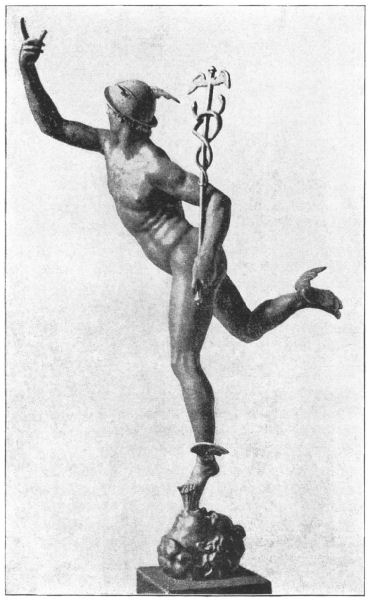
See page 86
Winged Mercury
Sol. The sun. The worship of the god Sol is the oldest on record, and though he is sometimes referred to as being the same as the god Apollo, there is no doubt he was worshiped by the Egyptians, Persians, and other nations long before the Apollo of the Greeks was heard of. See Surya.
“Sol through white curtains shot a timorous ray, And oped those eyes that must eclipse the day.” Pope.
Somnus (Som′nus). The Roman god of sleep, son of Erebus and Nox (Night). He was one of the infernal deities, and resided in a gloomy cave, void of light and air.
Sospita (Sos′pita). A name of Juno, as the safeguard of women. She is called the “saving goddess.”
Soter (So′ter). A Greek name of Jupiter, meaning Savior or deliverer.
Soul, see Psyche.
South Wind, see Auster.
Spear, see Pelias.
Sphinx, The. A monster having the head and breast of a woman, the body of a dog, the tail of a serpent, the wings of a bird, the paws of a lion, and a human voice. She lived in the country near Thebes, and proposed to every passer-by the following enigma: “What animal is that which walks on four legs in the morning, two at noon, and three in the evening.” Oedipus solved the riddle thus: Man is the animal; for, when an infant he crawls on his hands and feet, in the noontide of life he walks erect, and as the evening of his existence sets in, he supports himself with a stick. When the Sphinx found her riddle solved she destroyed herself.
Spider, see Arachne.
Spindle, see Pallas.
Spinning, see Arachne, Ergatis.
Spring, see Vertumnus.
Stable, see Augaeas.
Stars, see Aurora.
Sterentius (Steren′tius). The Roman god who invented the art of manuring lands. See also Picumnus.
Steropes (Ster′opes). One of the Cyclopes.
Stone, see Medusa and Phlegyas.
Stone (rolling), see Sisyphus.
Streets, see Apollo.
Stymphalides (Stym′phali′des). The carnivorous birds destroyed in the sixth labor of Hercules.
Styx. A noted river of hell, which was held in such high esteem by the gods that they always swore “By the Styx,” and such an oath was never violated. The river has to be crossed in passing to the regions of the dead. See Achilles and Thetis.
“To seal his sacred vow by Styx he swore:— The lake with liquid pitch,—the dreary shore.” Dryden.
“... Infernal rivers that disgorge Into the burning lake their baleful streams, Abhorrèd Styx, the flood of deadly hate.”
Suada (Sua′da), the goddess of Persuasion. See Pitho.
Success, see Bonus Eventus.
Sun, see Aurora, Belus, Sol, and Surya.
Sunflower, see Clytie.
Suradevi (Sura′de′vi). The Hindoo goddess of wine.
Surgeon (Sur′geon), see Podalirius.
Surya (Su′ry′a). The Hindoo god corresponding to the Roman Sol, the sun.
Swallow, see Itys.
Swan, see Cygnus and Leda.
Swiftness, see Atalanta.
Swine, see Circe.
Sylphs. Genii who, according to Plato, lived in the air.
“The light coquettes as Sylphs aloft repair, And sport and flutter in the fields of air.” Pope.
Sylvester (Sylves′ter). The name of Mars when he was invoked to protect cultivated land from the ravages of war.
Syrinx. The name of the nymph who, to escape from the importunities of Pan, was by Diana changed into reeds, out of which he made his celebrated pipes, and named them “The Syrinx.”
Tacita (Tac′ita). The goddess of Silence. See Harpocrates, also Horus.
Tantalus (Tan′talus). Father of Niobe and Pelops, who, as a punishment for serving up his son Pelops as meat at a feast given to the gods, was placed in a pool of water in the infernal regions; but the waters receded from him whenever he attempted to quench his burning thirst. Hence the word “tantalizing”.
Speaking of this god, Homer’s Ulysses says: “I saw the severe punishment of Tantalus. In a lake, whose waters approached to his lips, he stood burning with thirst, without the power to drink. Whenever he inclined his head to the stream, some deity commanded it to be dry, and the dark earth appeared at his feet. Around him lofty trees spread their fruits to view; the pear, the pomegranate, and the apple, the green olive, and the luscious fig quivered before him, which, whenever he extended his hand to seize them, were snatched by the winds into clouds and obscurity.”
“There, Tantalus, along the Stygian bound, Pours out deep groans,—his groans through hell resound. E’en in the circling flood refreshment craves And pines with thirst amidst a sea of waves.”
“... And of itself the water flies All taste of living wight, as once it fled The lip of Tantalus.” Milton.
Tartarus (Tar′tarus). An inner region of hell, to which the gods sent the exceptionally depraved.
Telchines (Telchi′nes). People of Rhodes, who were envious sorcerers and magicians.
Tellus (Tel′lus). A name of Cybele, wife of Saturn, and the Roman deity of mother-earth.
Tempests, see Fro.
Temple. An edifice erected to the honor of a god or goddess in which the sacrifices were offered.
Tenth Muse. Sappho was so called.
Tereus (Ter′eus) was a son of Mars. He married Procne, daughter of the king of Athens, but became enamored of her sister Philomela, who, however, resented his attentions, which so enraged him that he cut out her tongue. When Procne heard of her husband’s unfaithfulness she took a terrible revenge (see Itys). Procne was turned into a swallow, Philomela into a nightingale, Itys into a pheasant, and Tereus into a hoopoe, a kind of vulture, some say an owl.
Tergemina (Tergemi′na). A name of Diana, alluding to her triform divinity as goddess of heaven, earth, and hell.
Terminus (Ter′minus). The Roman god of boundaries.
Terpsichore (Terpsich′ore). One of the nine Muses; she presided over dancing.
Terra. The Earth; one of the most ancient of the Grecian goddesses.
Thalestris (Thales′tris). A queen of the Amazons.
Thalia (Thali′a). One of the nine Muses; she presided over festivals, pastoral poetry and comedy.
Thalia (Thali′a). One of the Graces. (See Charities).
Thamyris (Tham′yris). A skilful singer, who presumed to challenge the Muses to sing, upon condition that if he did not sing best they might inflict any penalty they pleased. He was, of course, defeated, and the Muses made him blind.
Theia (The′ia) or Thea. A daughter of Uranus and Terra, wife of Hyperion.
Themis (The′mis), a daughter of Coelus and Terra, and wife of Jupiter, was the Roman goddess of laws, ceremonies, and oracles.
Theseus (The′seus). One of the most famous of the Greek heroes. He was a son of Aegeus, king of Athens. He rid Attica of Procrustes and other evil-doers, slew the Minotaur, conquered the Amazons and married their Queen.
“Breasts that with sympathizing ardor glowed, And holy friendship such as Theseus vowed.” Budgell.
Thesmorphonis (Thesmorpho′nis). A name of Ceres.
Thetis (The′tis). A sea-goddess, daughter of Nereus and Doris. Her husband was Peleus, king of Thessaly, and she was the mother of the famous Achilles, whom she rendered all but invulnerable by dipping him into the River Styx. See Achilles.
Thief, see Laverna, Mercury.
Thor. The Scandinavian war-god (son of Odin), who had rule over the aerial regions, and, like Jupiter, hurled thunder against his foes.
Thor’s Belt is a girdle which doubles his strength whenever the war-god puts it on.
Thoth. The Mercury of the Egyptians.
Thread of Life, see Fates.
Thunderbolts, see Cyclops.
Thunderer, The, Jupiter. See Tonitrualis.
“O king of gods and men, whose awful hand Disperses thunder on the seas and land, Disposing all with absolute command.” Virgil.
“The eternal Thunderer sat enthroned in gold.” Homer.
“So when thick clouds enwrap the mountain’s head, O’er heaven’s expanse like one black ceiling spread; Sudden the Thunderer, with flashing ray, Bursts through the darkness and lets down the day.” Pope.
Thya (Thy′a), a name of Ops.
Thyades (Thya′des). Priestesses of Bacchus, who ran wild in the hills, wearing tiger-skins and carrying torches.
Thyrsus (Thyr′sus), a kind of javelin or staff carried by Dionysus and his attendants. It was usually wreathed with ivy and topped by a pine-cone. See Bacchus.
Tides, see Narayan.
Time (or Saturn). The husband of Virtue and father of Truth.
Tisiphone (Tis-iph′one). One of the Furies, daughter of Nox and Acheron, who was the minister of divine vengeance upon mankind.
Titan (Ti′tan). Elder brother of Saturn, who made war against him, and was ultimately vanquished by Jupiter.
Titans (Ti′tans) were the supporters of Titan in his war against Saturn and Jupiter. They were the sons of Uranus and Gaea, men of gigantic stature and of great strength. Hence our English word Titanic.
Tithonus (Ti-tho′nus). The husband of Aurora. At the request of his wife the gods granted him immortality, but she forgot at the same time to ask that he should be granted perpetual youth. The consequence was that Tithonus grew old and decrepit, while Aurora remained as fresh as the morning. The gods, however, changed him into a grasshopper, which is supposed to moult as it gets old, and grows young again.
Tityus (Tit′yus). A son of Jupiter. A giant who was thrown into the innermost hell for insulting Diana. He, like Prometheus, has a vulture constantly feeding on his ever-growing liver, the liver being supposed to be the seat of the passions.
Toil, see Atlas.
Tombs, see Manes.
Tongue, see Tereus.
Tonitrualis (Tonitrua′lis), or Tonans. The Thunderer; a name of Jupiter.
Towers, see Cybele.
Tragedy, see Melpomene.
Trees, see Aristaeus.
Tribulation, see Echidna.
Triformis (Trifor′mis), see Tergemina.
Triptolemus (Triptol′emus). A son of Oceanus and Terra. He was a great favorite of the goddess Ceres, who cured him of a dangerous illness when he was young, and afterwards taught him agriculture. She gave him her chariot, which was drawn by dragons, in which he carried seed-corn to all the inhabitants of the earth, and communicated the knowledge given to him by Ceres. Cicero mentions a Triptolemus as the fourth judge of the dead.
“Triptolemus, whose useful cares intend The common good.” Pope.
Triterica (Triteri′ca). Bacchanalian festivals.
Tritons (Tri′tons) were sons of Triton, a son of Neptune and Amphitrite. They were the trumpeters of the sea-gods, and were depicted as a sort of mermen—the upper half of the body being like a man, and the lower half like dolphins.
Trivia (Tri′via). A surname given to Diana, because she presided over all places where three roads meet.
Trophonius (Tropho′nius). A legendary hero of architecture, and one of Jupiter’s most famous oracles.
Troy. The classic poets say that the walls of this famous city were built by the magic sound of Apollo’s lyre. See Dardanus, Helen, Hercules, Paris.
Trumpeters, see Tritons.
Truth. A daughter of Time, because Truth is discovered in the course of Time. Democritus says that Truth lies hidden at the bottom of a well.
Tutelina (Tutel′ina). A rural divinity—the goddess of granaries.
Two Faces, see Janus.
Typhoeus (Typhoe′us), see Typhon.
Typhon (Ty′phon). A monster with a hundred heads who made war against the gods, but was crushed by Jove’s thunderbolts, and imprisoned under Mount Etna.
“... Typhon huge, ending in snaky twine.” Milton.
Typhon (Ty′phon). In Egyptian mythology the god who tried to undo all the good work effected by Osiris. According to the Greek writer, Hesiod, Typhon or Typhoeus was a monster giant, son of Terra and Tartarus.
Uller (Ul′ler). The Scandinavian god who presided over archery and duels.
Ulysses (Ulys′ses). A noted king of Ithaca, whose exploits in connection with the Trojan war, and his adventures on his return therefrom, are the subject of Homer’s Odyssey. His wife’s name was Penelope, and he was so much endeared to her that he feigned madness to get himself excused from going to the Trojan war; but this artifice was discovered, and he was compelled to go. He was of great help to the Grecians, and forced Achilles from his retreat, and obtained the charmed arrows of Hercules from Philoctetes, and used them against the Trojans. He enabled Paris to shoot one of them at the heel of Achilles, and so kill that charmed warrior. During his wanderings on his homeward voyage he was taken prisoner by the Cyclopes and escaped, after blinding Polyphemus, their chief. At Aeolia he obtained all the winds of heaven, and put them in a bag; but his companions, thinking that the bags contained treasure which they could rob him of when they got to Ithaca, cut the bags, and let out the winds, and the ships were immediately blown back to Aeolia. After Circe had turned his companions into swine on an island where he and they were shipwrecked, he compelled the goddess to restore them to their human shape again. As he passed the islands of the Sirens he escaped their allurements by stopping the ears of his companions with wax, and fastening himself to the mast of his ship. His wife Penelope was a pattern of constancy; for, though Ulysses was reported to be dead, she would not marry any one else, and had the satisfaction of finding her husband return after an absence of about twenty years. The Greek name of Ulysses is Odysseus.
“To show what pious wisdom’s power can do, The poet sets Ulysses in our view.”
Undine (Un′dine). A water-nymph, or sylph, who, according to fable, might receive a human soul by marrying a mortal.
Unknown God, An. With reference to this God, nothing can be more appropriate than St. Paul’s address to the Athenians, as recorded in the 17th chapter of the Acts of the Apostles:
“Ye men of Athens, I perceive that in all things ye are too superstitious. For as I passed by, and beheld your devotions, I found an altar with this inscription, TO THE UNKNOWN GOD. Whom therefore ye ignorantly worship, him declare I unto you. God that made the world and all things therein, seeing that he is Lord of heaven and earth, dwelleth not in temples made with hands; neither is worshiped with men’s hands, as though he needed anything, seeing he giveth to all life, and breath, and all things; and hath made of one blood all nations of men for to dwell on all the face of the earth, and hath determined the times before appointed, and the bounds of their habitation; that they should seek the Lord, if haply they might feel after him, and find him, though he be not far from every one of us: for in him we live, and move, and have our being; as certain also of your own poets have said, For we are also his offspring. Forasmuch then as we are the offspring of God, we ought not to think that the Godhead is like unto gold, or silver, or stone, graven by art and man’s device. And the times of this ignorance God winked at; but now commandeth all men everywhere to repent: because he hath appointed a day, in the which he will judge the world in righteousness by that man whom he hath ordained; whereof he hath given assurance unto all men, in that he hath raised him from the dead.”
Unxia (Unx′ia). A name of Juno, relating to her protection of newly married people.
Urania (Ura′nia). A daughter of Jupiter and Mnemosyne—one of the Muses who presided over astronomy.
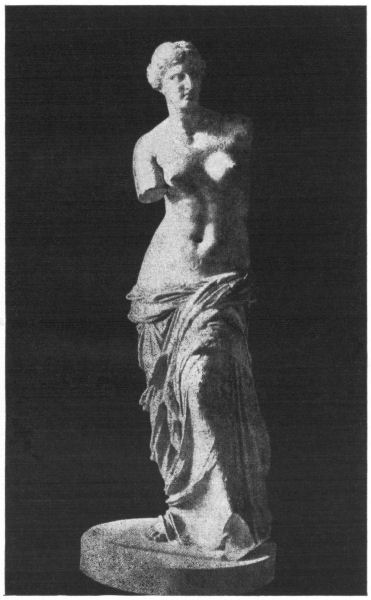
See page 142
Venus de Milo
Uranus (Ura′nus), literally, heaven. Son and husband of Gaea, the Earth, and father of Chronos (Time) and the Titans. The Greek name of Coelus; his descendants are sometimes called Uranides.
Urgus (Ur′gus). A name of Pluto, signifying the Impeller.
Ursa Major (Ur′sa Ma′jor), see Calisto.
Ursa Minor (Ur′sa Mi′nor), see Arcas.
Usurers, see Jani.
Utgard Loki (Ut′gard Lo′ki). In Scandinavian mythology the king of the giants.
Valhalla (Valhal′la). The Scandinavian temple of immortality, inhabited by the souls of heroes slain in battle.
Vali (Va′li). The Scandinavian god of archery.
Valleys, see Vallonia.
Vallonia (Vallo′nia). The goddess of valleys.
Varuna (Varu′na). The Hindoo Neptune—generally represented as a white man riding on a sea-horse, carrying a club in one hand and a rope or noose to bind offenders in the other.
Vedius (Ve′dius). The same as Vejovis.
Vejovis (Vejo′vis). “Little Jupiter”—a name given to Jupiter when he appeared without his thunder.
Vejupiter (Veju′piter), see Vejovis.
Vengeance, see Nemesis.
Venus (Ve′nus). The goddess of beauty, and mother of love. She is said to have sprung from the foam of the sea, and was immediately carried to the abode of the gods on Olympus, where they were all charmed with her extreme beauty. Vulcan married her, but she permitted the attentions of others of the gods, and notably of Mars, their offspring being Hermione, Cupid, and Anteros. After this she left Olympus and fell in love with Adonis, a beautiful youth, who was killed when hunting a wild boar. Venus indirectly caused the Trojan War, for, when the goddess of discord had thrown among the goddesses the golden apple inscribed “To the fairest,” Paris adjudged the apple to Venus, and she inspired him with love for Helen, wife of Menelaus, king of Sparta. Paris carried off Helen to Troy, and the Greeks pursued and besieged the city (see Helen, Paris, and Troy). Venus is mentioned by the classic poets under the names of Aphrodite, Cypria, Urania, Astarte, Paphia, Cythera, and the laughter-loving goddess. Her favorite residence was at Cyprus. Incense alone was usually offered on her altars, but if there was a victim it was a white goat. Her attendants were Cupids and the Graces.
Verticordia (Verti′cor′dia). A Roman name of Venus, signifying the power of love to change the hard-hearted. The corresponding Greek name was Epistrophia.
Vertumnus (Vertum′nus) (“the Turner,” “Changer”). God of spring, or, as some mythologists say, of the seasons; the husband of Pomona, the goddess of fruits and orchards.
Vesta (Ves′ta), daughter of Saturn and Cybele, was the goddess of the hearth and its fire. She had under her special care and protection a famous statue of Minerva, before which the Vestal Virgins kept a fire or lamp constantly burning.
Vestal Virgins (Ves′tal Vir′gins) were the priestesses of Vesta, whose chief duty was to see that the sacred fire in the temple of Vesta was not extinguished. They were always selected from the best families, and were under a solemn vow of chastity, and compelled to live perfectly pure lives.
Vialis (Via′lis). A name of Mercury, because he presided over the making of roads.
Victory (Vic′tory). A goddess, the daughter of Styx and Acheron, generally represented as flying in the air holding out a wreath of laurel. Her Greek name is Nike (Nicē). See Nicephorus.
Vidor. A Scandinavian god, who could walk on the water and in the air. The god of silence (corresponding with the classic Harpocrates).
Virtue. A goddess worshiped by most of the ancients under various names. The way to the temple of honor was through the temple of virtue.
Virtuous Women, see Juno.
Vishnu (Vish′nu). The Preserver, the principal Hindoo goddess.
Volupia (Volu′pia), see Angeronia.
Vulcan (Vul′can), the god of fire, was the son of Jupiter and Juno. He offended Jupiter, and was by him thrown out of heaven; he was nine days falling, and at last dropped into Lemnos with such violence that he broke his leg, and was lame forever after. Vulcan was married to Venus. He is supposed to have formed Pandora out of clay. His servants were the Cyclopes. He was the patron deity of blacksmiths, and as the smelter or softener of metal bears also the name of Mulciber.
“Men call him Mulciber; and how he fell From heaven, they fabled, thrown by angry Jove, Sheer o’er the crystal battlements.” Milton.
Vulcanalia (Vulcān-al′ia) were Roman festivals in honor of Vulcan, at which the victims (certain fish and animals) were thrown into the fire and burned to death.
War, see Bellona, Chemos, Mars.
Water, see Canopus.
Water-Nymphs, see Doris.
Wax Tablets, see Calliope.
Wealth, see Cuvera.
Weaving, see Ergatis.
Weeding, see Runcina.
Weights and Measures, see Mercury.
Well, see Truth.
West Wind, see Favonius.
Winds, see Aurora, Auster, Boreas, Zephyr.
Wine, see Bacchus, Suradevi.
Wisdom, see Pollear, Minerva.
Woden (Wo′den), the Anglo-Saxon form of the Scandinavian god Odin; Wednesday is called after him.
Women’s Safeguard, see Sospita.
Woodpecker, see Picus.
Woods, see Dryads.
World, see Chaos.
Xanthus (Xan′thus), the name of the wonderful horse of Achilles.
Yama (Ya′ma). The Hindoo devil, generally represented as a terrible monster of a green color, with flaming eyes.
Ygdrasil (Yg′dra′sil). The famous ash-tree of Scandinavian mythology, under which the gods held daily council.
Ymir (Y′mir). The Scandinavian god, corresponding to Chaos of the classics.
Youth (perpetual), see Tithonus.
Zephyr (Zeph′yr) or Zephyrus (Zeph′yrus). The west wind and god of flowers, a son of Astraeus and Aurora (Eos). See Favonius.
“Wanton Zephyr, come away. . . . . . The sun, and Mira’s charming eyes, At thy return more charming grow. With double glory they appear, To warm and grace the infant year.” John Hughes, 1700.
Zetes (Ze′tes), with his brother Calais, drove the Harpies from Thrace.
Zethus (Ze′thus), twin brother of Amphion. He was the son of Antiope and Zeus. See Amphion.
Zeus (Zūs). The Greek name of Jupiter, the greatest god in Grecian mythology. He was the god of the sky and its phenomena, and as such was worshiped on the highest mountains, on which he was enthroned. From Zeus come all changes in the sky or the winds; he is the gatherer of the clouds which dispense fertilizing rain; and is also the thunderer and hurler of lightning.
THE END.
Entertainments for Every Occasion. Ideas, games, charades, tricks, plans—for keeping those present entertained, on whatever occasion, whether a party, a festival, a bazaar, an entertainment, or merely “our own folks” or an “entre nous.”
The Humorous Speaker. The choicest, most recent humor that lends itself to recitation. Easily the best collection that has been made. The selections are chosen because they are good literature, and because they are good recitations. Unhackneyed material—most of it from recently copyrighted books, for which special permission has been secured. A hundred and twenty five selections, about 500 pages.
Commencement Parts. “Efforts” for all occasions. Models for every possible occasion in high-school and college career, every one of the “efforts” being what some fellow has stood on his feet and actually delivered on a similar occasion—not what the compiler would say if he should happen to be called on for an ivy song or a response to a toast, or what not; but what the fellow himself, when his turn came, did say! Invaluable, indispensable to those preparing any kind of “effort.” Unique.
Contains models of the salutatory, the valedictory, orations, class poems, class songs, class mottoes, class will, ivy poem and song, Dux’s speech; essays and addresses for flag day, the seasons, national and other holidays; after-dinner speeches and responses to toasts. Also models for occasional addresses—social, educational, political, religious. Also models for superintendents’ and principals’ addresses to graduating class, debating team, educational conference; on dedication of school building, public building, library; for holidays, festival days, and scores of social and other occasions. Also themes for essays, and lists of subjects for orations, essays, toasts.
College Men’s 3-Minute Declamations. Material with vitality in it for prize speaking. 14th edit.
College Maids’ 3-Minute Readings. Up-to-date recitations from living men and women. On the plan of the popular College Men’s 3-Minute Declamations, and on the same high plane. Twelfth edition.
Pieces for Prize Speaking Contests. Volume I. Over one hundred pieces that have actually taken prizes in prize speaking contests. Successful.
Pieces for Prize Speaking Contests. Vol. II.
Pieces for Every Occasion. “Special days.”
Famous Poems Explained. (Barbe).
How to Attract and Hold an Audience. Every student in college or school, every lawyer, every teacher, every clergyman, every man or woman occupying an official position, every citizen and every youth who is likely ever to have occasion in committee, or in public, to enlist the interest, to attract and hold the attention of one or more hearers, and convince them—every person who ever has to, or is likely to have to “speak” to one or more listeners will find in our new book a clear, concise, complete handbook which will enable him to succeed!
Thorough, concise, methodical, replete with common sense, complete. In his logical method, in the crystal-like lucidity of his style, in his forceful, incisive, penetrating mastery of his subject, the author has at one bound placed himself on a plane with the very ablest teacher-authors of his day.
Fenno’s Science and Art of Elocution. Standard. Probably the most successful of its kind.
The Power of Speech, How to Acquire It. A comprehensive system of vocal expression. Thorough and practical instruction in the use of the speaking voice, embracing deep breathing, articulation, modulation, emphasis and delivery; vocal coloring, interpretation of the written word, the conveying of thought by means of vocal expression, and the principles of oratory and dramatic art.
The Psychology of Public Speaking. A scientific treatment of the practical needs of the public speaker. A worth-while book.
How to Use the Voice in Reading and Speaking. By Ed. Amherst Ott, head of the School of Oratory, Drake University. Suitable for class work.
How to Gesture. E. A. Ott. New illus. edit.
Constitution of U. S. In English, German and French.
Constitution of U. S., with Index. (Thorpe’s Pocket Edition).
Brief History of Civilization. (Blackmar).
The Changing Values of English Speech.
The Worth of Words. (Bell).
The Religion of Beauty. (Bell).
Dictionaries: The Classic Series. Half morocco. Especially planned for students and teachers in colleges and high schools. Up to the times in point of contents, authoritative while modern as regards scholarship, instantly accessible in respect to arrangement, in a binding elegant and durable. 8×5½ in.
French-English and Eng.-French, German-English and Eng.-German, Latin-English and Eng.-Latin, Greek-English and Eng.-Greek, English-Greek Dictionary.
Dictionaries: The Handy Series. Pocket Edition. Scholarship modern and accurate; beautiful print.
Spanish-English and Eng.-Spanish, Italian-English and Eng.-Italian, New-Testament Lexicon. With a fine presentation of the Synonyms of the Greek Testament.
Liddell and Scott’s Abridged Greek Lexicon. With new Appendix of Proper and Geog’l names.
White’s Latin-English Dictionary.
White’s English-Latin Dictionary.
White’s Lat.-Eng. and Eng.-Lat. Diction.
International Pronouncing French-English and Eng.-French Dictionary. Half morocco. The pronunciation is indicated by a full re-spelling of each title-word in the system of the International Phonetic Associ’n, a widely used means of indicating, simply and accurately, the pronunciation of all languages in a single (amplified) Roman alphabet.
Who’s Who in Mythology? A dictionary of mythological characters. Identifies and locates instanter every god and goddess, hero and myth that are likely to be broached either in conversation, sermon, song, drama, painting or statuary.
Who’s Who in History? A dictionary of classical characters and allusions. Locates the places, identifies the persons, describes the things, which are constantly alluded to in literature, in sermons, in paintings, in sculpture and in conversation.
BOOKS BY RALCY HUSTED BELL
The Worth of Words
Third Edition, Revised and Enlarged.
The SOULS of words live after their forms change. This spiritual element of words survives as literature. The living book contains the EGO of the author—the spiritual personality of his mind. This book treats of the right usage of words on this vital basis. It is a living guide. Simple and clear, it aids correct speech and shows how to vitalize words with SOUL.
The Changing Values of English Speech
A mate to THE WORTH OF WORDS. Touches lightly the philosophical side in a practical way: illumines Style, Soul of Words, Early English, Language Change, Poetry, Syntax, Variations in Word-Meanings, Distinctions, Origin of Language, Old Celtic Friends, English Orthography, Words Changed Since Shakespeare, Commonplace Poetry, Aborigines. Reads with the fascination of romance.
The Religion of Beauty
Second Edition, Revised and Enlarged.
This is the autobiography of a Soul glad of life—one who finds riches in the possessions of others and, above all, a golden wealth in man’s Impersonal Estate—in SKY and STAR, SUN and CITY, the SEA and the OPEN WORLD—one who finds the Religion of Beauty in all things, and reveals the secret whereby all who will may dig up “real wealth” while having a good time.
Taormina
Illustrated. New Historic Matter.
History is told here with Maeterlinck’s charm of style; scenes are painted with the power and beauty of Hearn; philosophy is unconsciously brought forth from events. Greek legend weaves a necklace of imagery which holds ETNA in its clasp. Martial echoes mingle with the voices of ancient poets, the murmur of the Ionian Sea and of olive leaves in sunny Sicily.
English and American Literature
A One Year Course FROM CHAUCER TO MARK TWAIN
By B. A. HEYDRICK, A. B. DEPARTMENT OF ENGLISH, HIGH SCHOOL OF COMMERCE NEW YORK CITY
Interestingly written, illustrated with portraits and enlivened by pictures of scenes described, facsimiles of manuscripts, etc.
In the space of three hundred pages the author has managed to give a clear account of English literature from Chaucer to Mark Twain and James Whitcomb Riley. It is not a mere outline, but a continuous narrative, and really the most engaging book on the subject that has appeared. It is written on a different plan from most brief text-books. The author has wisely not attempted to treat every author in English literature. By omitting the names which have no meaning for us to-day the author has gained space to treat the really significant writers quite fully enough for the needs of young students. An excellent feature of the book is the profusion of illustrations. Throughout the work emphasis is placed upon books that still live. The nineteenth century in particular is treated fully; the writers may be no greater than those of the eighteenth, but they have more to say to us.
Each chapter is followed by a list of recommended reading in the chief authors, with references to volumes where these may be found. By means of this recommended reading the course covered by this book may readily be extended to cover two years’ work, or more. Under each chief author is mentioned a standard library edition of his works and inexpensive editions of single volumes.
The Speaker Series
The Speaker Series (32 vols) paper.
No. 1 Popular Short Stories
No. 2 Selections Chosen for Declamation Contest
No. 3 Selections for Children to Recite
No. 4 Cuttings from Stories
No. 5 Cuttings from Stories
No. 6 Ten Short Plays
No. 7 Readings, and Four Plays
No. 8 Briefs of Debates, and Readings
No. 9 Cuttings of Popular Stories
No. 10 Modern American Oratory
No. 11 Dramatic and Humorous Readings
No. 12 Centennial Number
No. 13 New Platform Selections
No. 14 Selections for Religious Occasions
No. 15 Encores: Nearly 200 Fresh, Bright Hits
No. 16 Popular Platform Readings
No. 17 Humorous and Dramatic Readings
No. 18 Monologues
No. 19 On Temperance
No. 20 For Declamation Contests
No. 21 After-dinner Speaking
No. 22 School and College Readings
No. 23 Selections for Entertainments
No. 24 Dramatic Selections
No. 25 Popular Prose and Poetry
No. 26 Readings from Great Authors
No. 27 Readings and Debates Not Found Elsewhere
No. 28 Classic Masterpieces
No. 29 Best Fiction for the Platform
No. 30 Humorous and Pathetic Readings
No. 31 Patriotic Selections
No. 32 Scenes from Plays for Platform Readings
THE ABOVE NUMBERS IN EIGHT BOUND VOLUMES, indexed by authors and titles:
Vol. I. Including Nos. 1, 2, 3 and 4,
Vol. II. Including Nos. 5, 6, 7 and 8,
Vol. III. Including Nos. 9, 10, 11 and 12,
Vol. IV. Including Nos. 13, 14, 15 and 16,
Vol. V. Including Nos. 17, 18, 19, 20,
Vol. VI. Including Nos. 21, 22, 23, 24,
Vol. VII. Including Nos. 25, 26, 27, 28,
Vol. VIII. Including Nos. 29, 30, 31, 32.
Transcriber's Note
As referred to in the Transcriber's Note at the beginning of this ebook, proper nouns have been amended for ease of searching as follows:
Page 13—Deianeira amended to Deianira—... in his love for Deianira.
Page 18—Podalirus amended to Podalirius—... Machaon and Podalirius, both famous physicians, ...
Page 31—Rumina amended to Rumia—Babes, see Rumia Dea.
Page 32—Thanyris amended to Thamyris—Blind, see Thamyris.
Page 49—Antaeas amended to Antaeus—Earth, see Antaeus.
Page 55—Plato amended to Pluto—Februus (Feb′ruus). A name of Pluto, ...
Page 56—Chimera amended to Chimaera—She was the reputed mother of Chimaera, ...
Page 61—Segestia amended to Segetia—Harvest, see Segetia.
Page 70—Venns amended to Venus—... in which there is a grove sacred to Venus.
Page 72—Argus amended to Argos—... and a priestess of Juno at Argos.
Page 79—Romas amended to Romans—The Romans used to swear by Jupiter Lapis.
Page 84—Diomede amended to Diomedes—... but was defeated by Diomedes.
Page 87—Thot amended to Thoth—There was also an Egyptian Mercury under the name of Thoth, ...
Page 89—Glaucopis amended to Glaukopis—... Pallas, Parthenos, Tritonia, and Glaukopis.
Page 117—Japetes amended to Japetus—... the son of Japetus ...
Page 122—Runcia amended to Runcina—Runcina (Runcina). The goddess of weeding ...
Page 127—Chimera amended to Chimaera—See Aesculapius, Apollo, Chimaera, ...
Page 127—Thanyris amended to Thamyris—Singing, see Polyhymnia, Thamyris.
Page 130—Ergotis amended to Ergatis—Spinning, see Arachne, Ergatis.
Page 134—Thesmorphonius amended to Thesmorphonis—Thesmorphonis (Thesmorphonis). A name of Ceres.
Page 135—Naryanan amended to Narayan—Tides, see Narayan.
Page 141—Calistro amended to Calisto—Ursa Major (Ur′sa Ma′jor), see Calisto.
Page 145—Ergatos amended to Ergatis—Weaving, see Ergatis.
The book notes Vishnu as a goddess, and Laksmi as one of Vishnu's husbands. This is preserved as printed.
Minor punctuation errors have been repaired. Hyphenation has been made consistent.
The following printer errors have been repaired:
Page 102—anxiiety amended to anxiety—Orpheus, however, in his anxiety ...
Page 124—spirites amended to sprites—The sprites of fiery termagants in flame, ...
Page 140—preceive amended to perceive—... I perceive that in all things ye are too superstitious.
With regard to quoted material, all attributions (or lack thereof) are preserved as in the original.
The transcriber notes that, on page 16, two couplets are attributed to Pope, although the second is actually from Dryden. However, this is preserved as printed.
The transcriber has added alphabetic links at the beginning of the book and at the beginning of the dictionary for ease of navigation.
The frontispiece illustration has been moved to follow the title page. Other illustrations have been moved where necessary so that they are not in the middle of a paragraph.