Now for the fun!
Reading edition
Frosting Tips
Here are the crowning touches—the simple, easy ways to add glamour to your cakes
Designing and executing a pretty decorative finish for a handsome cake is pure fun—and certainly worth the trouble in the extra pleasure that it gives. Do it when you won’t be disturbed and remember planning is half the battle. If the plan is elaborate, draw it on paper first and then mark the important spots with toothpicks set lightly in place after the cake is frosted. They will serve as guides and insure even spacing.
Be sure cake is thoroughly cold (see inside back cover) before starting to frost. Brush off loose crumbs and trim off over-browned or ragged edges. Have decorations ready to use.
How to frost a cake
For layer cakes: Turn the bottom layer from the rack onto the cake plate, bottom side up, and spread some of the frosting with a spatula evenly over the surface. Top it with the second layer, bottom side down, with edges even. Frost sides of cake first, using light up-and-down strokes and bringing the frosting up and just over the top rim of the cake. Pile the remaining frosting on top and spread out to rim, making graceful swirls or soft ridges according to the type of frosting. With a seven-minute frosting, attractive little peaks can be made by lifting the frosting gently with a spatula. For certain types of decoration, like lettering, a smooth frosted top is best. Avoid “puttering” with frosting, as overworking ruins its appearance.
* * * * * * * *
For tube or loaf cake: Place cake top or bottom side up, as preferred. Frost sides, then top, following suggestions for frosting layer cakes.
To adorn the frosted cake
For decorating, use good-to-eat ingredients, chosen to go with the cake in color, texture, and character. Let the decorations be simple but artistic and effective. For example, the ingredients commonly found in the kitchen cupboard make beautiful decorations when used correctly.
14
Coconut—For an all-over sprinkle of coconut, use the canned moist shredded coconut with long glistening white shreds. Pat it on while the frosting is still soft. To tint, add a few drops of food coloring, then rub between the palms of the hands to color it evenly. For a rainbow effect, tint separate lots of coconut pink, green, yellow, and violet, and then mix them. To tint and flavor, rub 1 cup coconut with 8 fine-cut maraschino cherries or with the grated rind of 1 orange. For some cakes, golden toasted coconut is effective.
To toast coconut, spread a thin layer in a shallow pan, toast in moderate oven (350°F.) until a delicate brown, stirring often to toast evenly.
* * * * * * *
{decorated cake frosting}
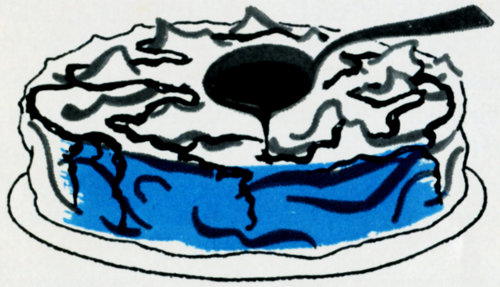
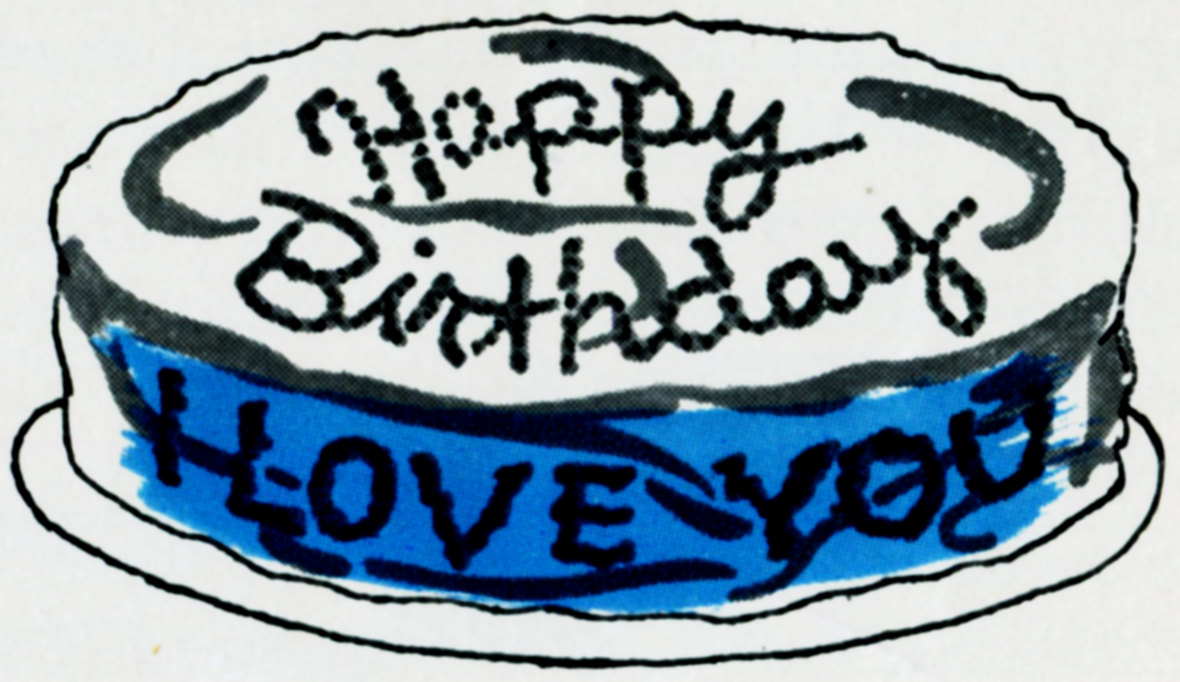
Chocolate—Striking effects can be obtained on a frosted cake with melted chocolate (see directions for Chocolate Rapture Cake, p. 1). For decorative dribbles or lettering, melt together over hot water ½ oz. unsweetened chocolate and ½ teaspoon Spry. Cool before using. For enough chocolate to cover the entire top of the cake and let it drip down the sides in interesting icicle formations, double these quantities. Melted chocolate can also be used for lettering as in “Happy Birthday” treatment. White frostings or delicately tinted pink or green mint frostings are especially pretty with melted chocolate decorations. Halloween black cats or witches for the top of a frosted cake can be made as follows: Draw or trace an outline of the desired shape on waxed paper, fill in the outline with melted chocolate. Put in refrigerator to harden, loosen from paper, and place on cake. Make other designs similarly.
{decorated cake frosting}
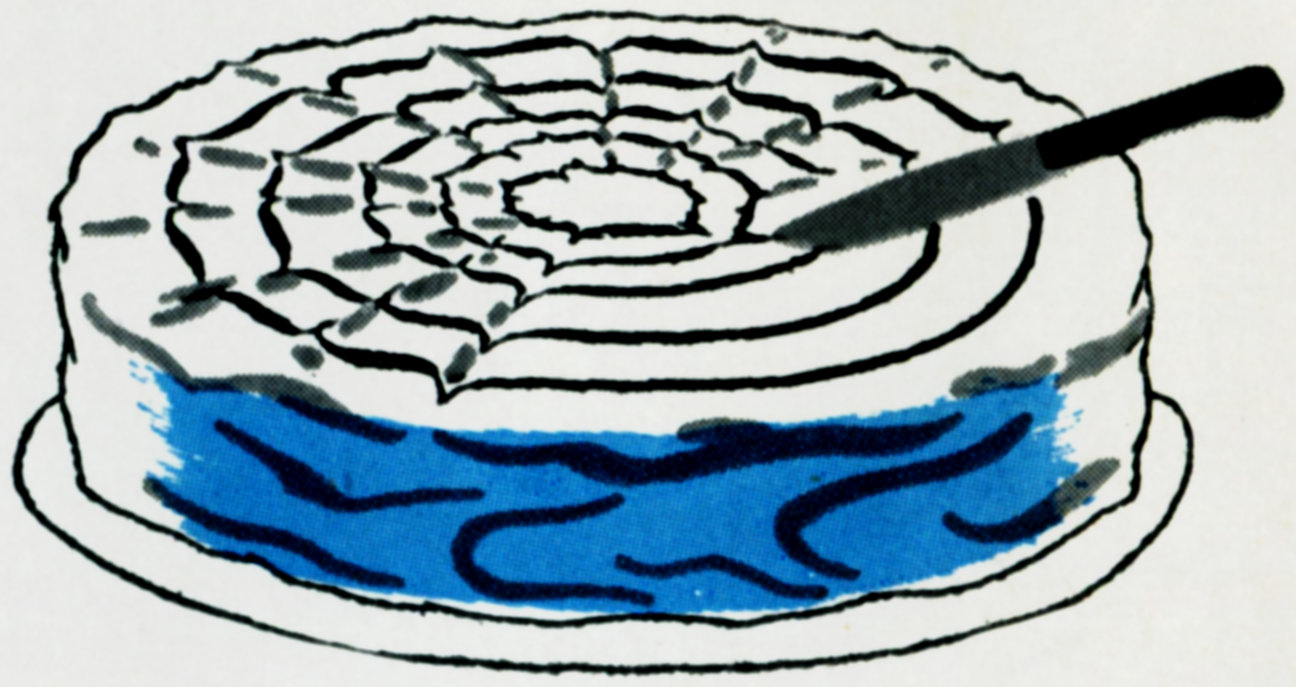
A lacy filigree effect can be made on a white-frosted cake as follows: Melt ½ oz. chocolate with ½ teaspoon Spry. Mark 5 circles around top of cake and pour in chocolate. With a pointed knife, make 8 evenly spaced strokes toward the edge of the cake, then between them make 8 upward strokes toward the center, to get web effect (see illustration).
* * * * * * * *
Thin curls or shavings of sweetened or unsweetened chocolate make interesting decoration. They can be made with a vegetable peeler or a sharp knife. Semisweet chocolate bits can be used as push-ins on a soft frosting to form letters or designs.
* * * * * * * *
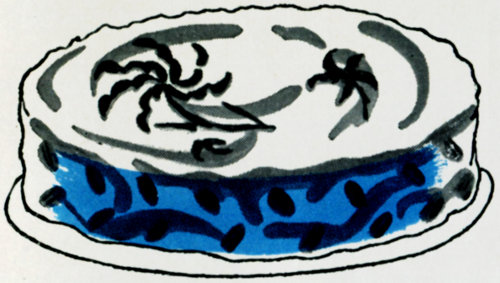
Nuts—Use perfect walnut or pecan halves for making interesting patterns on frosted cakes, pressing them in while the frosting is soft. Nuts can be tipped or tilted into frosting with artistic effect. For making nut borders, lines, or designs, cut the nuts in pieces; do not chop the nuts as this makes unattractive “dust.” Brazil nuts can be “curled” by softening them first in hot water, then cutting in very thin slices or “curls.” Blanched almonds can be used for 15 making patterns; sprinkles of toasted slivered almonds are attractive on beige-colored frostings. Sprinkling the sides of the cake with chopped nuts gives an attractive finish.
{decorated cake frosting}
Fruits and Peels—Fruits (canned, candied, dried, or fresh) can be used endlessly. Maraschino cherries are especially good for Valentine, holiday, or party cakes. Cherry halves can be cut to resemble hearts or flowers, then placed around the rim of a frosted cake. Lengthwise cherry slices can be arranged to form attractive poinsettias.
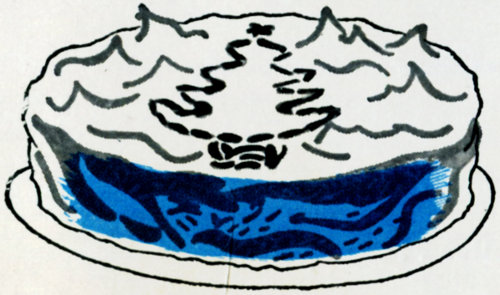
Pineapple can be tinted with food coloring, or cut up and arranged in simple patterns with green citron; crushed pineapple, citron, and orange peel can be used to make an unusual “flower lei” (p. 9). At Christmastime, charming holly wreaths and Christmas trees can be fashioned on frosted cakes with bits of red and green cherries and green citron. Citron can be colored bright green with green coloring. Streamers of fine-cut dates, figs, or raisins are pretty on some frosted cakes, or definite patterns can be made with larger pieces if preferred.
{decorated cake frosting}
Candies—Sprinkles of silver or gold dragées are beautiful on cakes with fluffy white or pastel frostings. Dragées can be used to outline interlocking hearts for a bridal shower, or to spell out “Happy Birthday.” Gumdrops, cut in small pieces, can be sprinkled on a white frosted cake for sparkling color, or arranged to outline a pattern like a green shamrock for St. Patrick’s Day.
* * * * * * * *
Lollipops, canes, all-day-suckers, or stick candy can be crushed and used as gay color on the frosted sides and for lettering on top of the cake. Contrasting colors are pretty.
{decorated cake frosting}
Those round flat orange patties can be used as jack-o’-lanterns by making little faces on them with melted chocolate and arranging them on a chocolate frosted cake for Halloween. Chocolate candy animals standing lightly on frosted cupcakes delight the children.
Tiny colored sugar flowers can be bought in the 5-and-10 cent store and these are pretty arranged on cakes with fluffy white or pastel frostings. For “extra-special” cakes you can buy candied violets or rose petals to make wreaths of dainty flowers on a frosted cake.
You’ve probably had thoughts of your own as you were reading—of other materials and other ways to use them. Go to it! Experimenting is half the fun. Happy decorating!
16
Fancy Frosting Effects
These call for special tools, “boughten” or homemade, and special frostings. Cake-decorating sets, consisting of a bag or “gun” and assorted tubes can be purchased in housewares departments. They can be used for making flowers, designs, or lettering on special-occasion cakes.
If you haven’t a tube set, a paper cone for decorating can be easily made. Just cut a 6” square of waxed paper and roll it into a cone. Spoon in the frosting, filling the cone not more than half full. Fold down the top edges and cut off the tip at the bottom to make a tiny opening for the frosting to come through. Then take the cone in left hand, and grasp its top with right hand, bringing thumb down to about the center. Pressing down with the thumb forces the frosting down to the tip of the cone and out through the hole, while your hand directs the movement of the cone. With a little practice, lovely effects can be obtained.
The best frosting for this purpose is Ornamental Frosting because it is very stiff, squeezes out ideally, and sets up firm on the cake.
How to make your own Cake Decorator
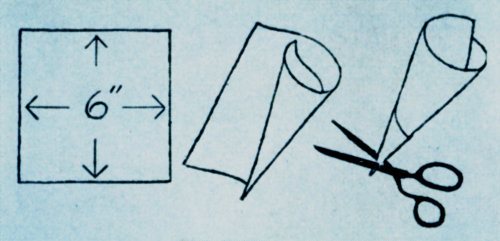
Make a waxed paper cone for each color icing you plan to use (see instructions above).
Ornamental Frosting
(To use in cake-decorating set or paper cone)
2¼ cups confectioners’ sugar ⅓ teaspoon cream of tartar 2 egg whites, unbeaten ⅓ teaspoon vanilla
Sift sugar and cream of tartar through very fine sieve.... Add egg whites and mix with slotted spoon or wire whip.... Continue to mix for 3-4 min.... Add vanilla.... Beat 8-20 min. longer with spoon or 3-4 min. on mixer at high speed.... Frosting should be so stiff that a sharp ridge is held when the tip of a knife is drawn through.... Frosting may be tinted with a few drops of food coloring, if desired.... Yield: 1½ cups.
Spry Pan-Coat
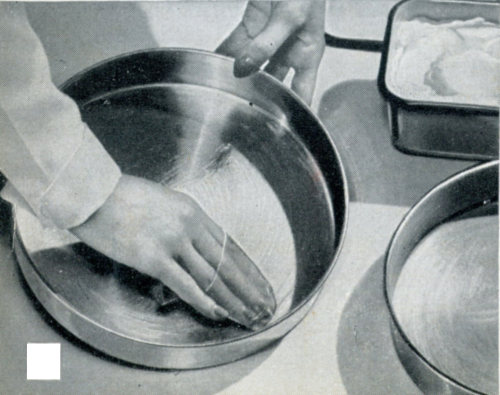
Prepare cake pans for baking by rubbing them with Spry Pan-coat.
Mix ...½ cup Homogenized Spry ¼ cup all-purpose flour
Use ...for “greasing” cake pans, baking sheets, etc. Gives even, brown crust—prevents sticking.
Store ...Pan-coat in covered dish in cupboard for handy use—can be made ahead and stored till wanted. Need not be refrigerated.
17
How to tell when a cake is done
The cake recipes in this booklet specify a baking range in minutes within which the cake should finish baking and be “done.” However, before removing the cake from the oven, test it for doneness by touching the top of the cake in the center lightly with finger. If the cake springs back leaving no impression, the cake is done. Also, insert a toothpick or wire cake tester in the center, and if it comes out clean, the cake is done. If any dough adheres to the tester, longer baking is needed.
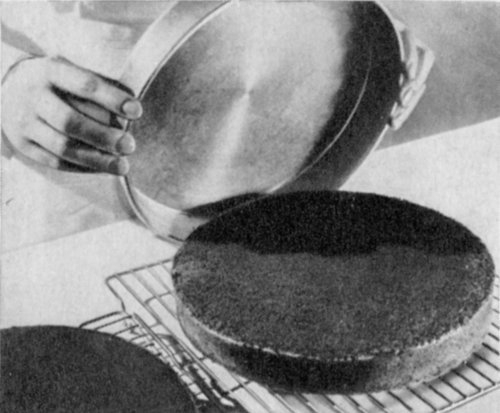
Cakes come out of pans readily with Spry Pan-coat (p. 16) and proper cooling.
Care of cake after baking
When cake has finished baking, remove it from the oven and put it on a wire cake rack, in the pan. This permits circulation of air around it and insures even cooling. Let it stand 10-15 min. Then gently loosen the cake from the sides of the pan with a spatula or knife, working carefully to avoid breaking edge. Place another rack on top of the pan, turn over, and lift off the pan. Then turn cake right side up on rack to finish cooling. When the cake is thoroughly cold, it is ready to be frosted. For frosting recipes and frosting suggestions, see pp. 11-16.