Note 33 — Chapter XII
Reading edition
You can mark a point on one string 3' from one stake and a point on the other string 4' from the same stake, and then increase or decrease the angle made by the two strings until another string exactly 5' long will just reach from the marked point on one string to that on the other. This process is based on the principle of mathematics that if the two sides of a right-angled triangle are respectively 3 units and 4 units in length, the length of the hypothenuse will be 5 units. Another way, if you are fond of mathematics, is to find the length of the diagonals of the plan of the house by extracting the square root of the sum of the squares of the two sides. (The square described on the hypothenuse of a right-angled triangle is equal to the sum of the squares described on the other two sides.) You can measure the diagonal directly from a plan if you understand mechanical drawing well enough to make an accurate plan on a scale of perhaps ½" or 1" to a foot. Then take one tape, or string, measuring the width of the building, with one end held on the stake C (Fig. 387), and another tape measuring the length of the diagonal, with the end held on the stake D. Drive the stake A at the point where the two tapes meet when brought together. Reversing the positions of the tapes will give in the same way the fourth corner B. The distance A B should equal C D.
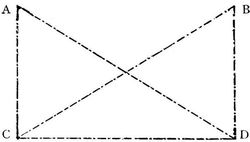
Fig. 387.