Note 309 — Chapter II · METAMORPHY OF THE FLORAL ORGANS.
Reading edition
Although it is generally admitted that the filament of the stamen corresponds to the stalk of the leaf, and the anther to the leaf-blade, yet there are some points on which uncertainty still rests. One of these is as to the sutures of the anther. Do these chinks through which the pollen escapes correspond (as would at first sight seem probable) to the margins of the antheral leaf, or do they answer to the lines that separate the two pollen-cavities on each half of the anther one from the other? Professor Oliver, 'Trans. Linn. Soc.,' vol. xxiii, 1862, p. 423, in alluding to the views held by others on this subject, concludes, from an examination of some geranium flowers in which the stamens were more or less petaloid, that Bischoff's notion as to the sutures of the anther is correct, viz., that they are the equivalents of the septa of untransformed tissue between the pollen-sacs. Some double fuchsias ('Gard. Chron.,' 1863, p. 989) add confirmation to this opinion. In these flowers the petals were present as usual, but the stamens were more or less petaloid, the filaments were unchanged, but the anthers existed in the form of a petal-like cup from the centre of which projected two imperfect pollen-lobes (the other two lobes being petaloid). Now, in this case, the margins of the anther were coherent to form the cup, and the pollen was emitted along a line separating the polliniferous from the petaloid portion of the anther. This view is also borne out by the double-flowered Arbutus Unedo, and also by what occurs in some double violets, wherein the anther exists in the guise of a broad lancet-shaped expansion, from the surface of which project four plates (fig. 157), representing apparently the walls of the pollen-sacs, but destitute of pollen; the chink left between these plates corresponds thus to the suture of the normal anther.
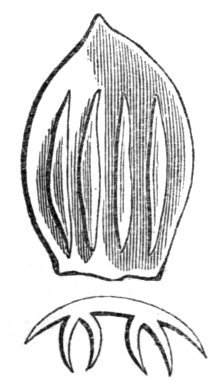
Fig. 157.—Petaloid stamen of Viola, with four projecting plates.
The inner or upper portion of the anther-leaf is that which is most intimately concerned in the formation of pollen; it comparatively rarely (query ever) happens that the back or lower surface of the antheral leaf is specially devoted to the formation of pollen. On the other hand, in cases like those of the common houseleek, where we meet with petaloid organs combining the attributes of anthers and of carpels, we find the inner layers devoted to the production of pollen, the outer to the formation of ovules.
That the pollen-lobes are not to be taken as halves of a staminal leaf, but rather as specialised portions of it, not necessarily occupying half its surface, is shown also in the case of double-flowered Malvaceæ, in which the stamens are frequently partly petal-like, partly divided into numerous separate filaments, each bearing a one-, or it may be even a two-lobed anther. This circumstance is confirmatory of the opinion held by Payer, Duchartre, Dickson, and other organogenists, as to the compound nature of the stamens in these plants. The stamens are here analogues not of a simple entire leaf, but of a lobed, digitate, or compound leaf, each subdivision bearing its separate anther. On this subject the reader may consult M. Müller's paper on the anther of Jatropha Pohliana, &c., referred to at page 255.