Act 1 — Act I. Scene 1
Frank Justus Miller translation
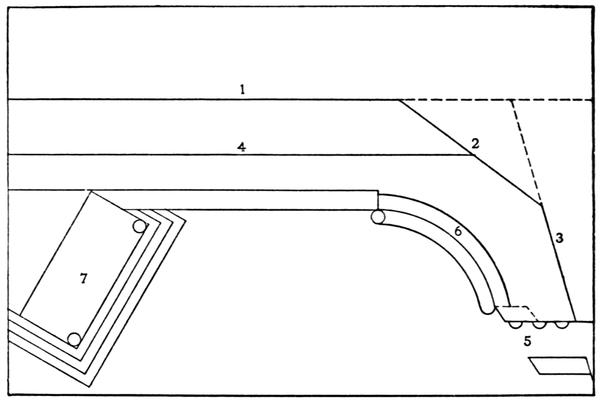
Early morning; the open square before the temple of Juno on a height near Carthage. In the distance (see cut, 1, 2, 3) appear mountains, and at their foot lies the city, clustered about the harbor where ships are riding at anchor. The effect of elevation is increased by the unfinished columns and the tree-tops just showing above the low marble wall which encloses the square. This scene (4) is set nearer than 1, 2, 3, to increase the perspective.
At the first wing on the right (5), a colonnade, leading to a flight of steps, forms the entrance from the city below. On the same side, along the wall, is a broad marble seat (6), shaded by a wild crab tree, pink with bloom. The dark rug on the step before it is strewn with fallen petals. On the left is the front of the temple (7). Two large columns of white marble flank three broad steps leading to the platform. Above these columns, the architrave bears a frieze representing scenes from the Trojan war. Before the temple door is an altar on which fire is burning.
At the rise of the curtain, a chorus of Carthaginian maidens, clad in white, are seen kneeling before the altar on the temple steps; they sing a greeting to the dawn.
10 Hymn to the Dawn
[For music, see p. 61]
Wake, Aurora, Wake!
Come, rosy-fingered goddess of the dawn,
The saffron couch of old Tithonus scorning;
Fling wide the golden portals of the morning,
And bid the gloomy mists of night be gone.
Hail, Aurora, Hail!
The dewy stars have sped their silent flight,
The fuller glories of thy rays expecting;
With rosy beauty from afar reflecting,
Thy Orient steeds come panting into sight.
Rise, Apollo, Rise!
Send forth thy healing rays to greet the world,
Upon the lands thy blessed radiance streaming;
Arise, and fling afar, in splendor gleaming,
The banners of thy golden light unfurled.
Enter Æneas and Achates, on their way into the city, evidently attracted hither by the singing. Æneas is resplendent in full armor. Achates wears the Phrygian costume: long trousers of brown, a tunic of deep old blue, ornate with embroidered patterns in gold and purple thread; over this a traveling cloak of brown. He carries two spears. The maidens withdraw and as their voices grow fainter Æneas and Achates kneel before the altar. The light brightens. A bugle call in the distance rouses them from their devotion. They arise. Enter Venus, dressed as a huntress.
Venus (Æneid, I. 321-324):
I crave your grace, good sirs. If my attendant maids
Have chanced to wander hither, quiver-girt, and clad
In tawny robes of fur, the trophies of the chase,
Or with triumphant shouts close pressing in pursuit
The foaming boar,—I fain would know their course.
11Æneas (326-334):
Fair maid,
No huntress of thy train have we beheld, nor heard
The clamor of their chase.—But oh, no mortal maid
Art thou! Th’ immortal beauty of thy face and voice
Proclaim thee goddess. Art thou Phœbus’ sister then?
Or some fair nymph? Whoe’er thou art, we crave thy grace:
Be merciful and tell beneath what sky at length,
Upon what shores we ‘re tossed. For ignorant of men
And land we wander, driven on by wind and wave
In vast conspiracy.
Full many a victim slain
Upon thine altars shall repay thine aid.
Venus (335-350):
For me,
I claim no homage due the gods. Behold a maid
Of ancient Tyre, with quiver girt and feet high shod
With purple buskin—such our country’s garb. Thou seest
Before thee Punic realms; the city and its men
Are both alike Phœnician; but around them lie
The borders of the Libyans, hardy race, unmatched
In war. The city owns the sway of Dido, late
Escaped from Tyre and from her brother’s threat’nings. Long
The story of her wrongs, and devious its way;
But here I ‘ll trace the outline of her history.
Her husband was Sychæus, of his countrymen
The richest far in wide possessions; well beloved
By his ill-fated bride was he, whose virgin hand
In wedlock’s primal rite her sire had given him.
But Tyre’s domain Pygmalion her brother held,
Surpassing all in crime. Between these Tyrian lords
A deadly feud arose. With impious hand and blind
12With love of gold, Pygmalion, at the altar-side,
With stealthy, unsuspected stroke Sychæus slew;
And little recked he of his sister’s doting love.
Æneas (III. 56, 57):
O awful, quenchless thirst of gold! ‘T was ever thus
That thou hast spurred the hearts of men to deeds of blood.
Venus (I. 351-370):
He long concealed the deed with wanton, feigned excuse,
And mocked his sister, sick at heart, with empty hopes.
In vain: for in the visions of the night the shade,
The pallid shade of her unburied husband came;
The cruel altar and his piercèd breast he showed,
And all the hidden guilt of that proud house revealed.
He bade her speed her flight and leave her fatherland,
And showed, to aid her cause, deep buried in the earth,
An ancient treasure, store of silver and of gold
Uncounted.
Thus forewarned the queen prepared her flight
And bade her comrades join her enterprise. They came,
Whom hatred or consuming terror of the prince
Inspired. A fleet of ships at anchor chanced to lie
In waiting. These they seized and quickly filled with gold;
Pygmalion’s treasure, heaped with greedy care, was reft
Away upon the sea, a woman leading all.
They reached at last the place where now the mighty walls
And newly rising citadel of Carthage stand.
But who and whence are ye? and whither do ye fare?
Æneas (372-385):
O goddess, if beginning at the first the tale
Of direful woes on land and deep I should relate,
13The day, before my story’s end, would sink to rest.
From Troy (perchance the name of Troy has reached your ears)
Borne over many seas, the fitful tempest’s will
Has brought us to these shores.
Æneas am I called,
The Pious, for that in my ships I ever bear
My country’s gods, snatched from our burning Troy. My fame
O’erleaps the stars. My quest is Italy, a land
And race that mighty Jove hath promised me. For this,
With score of vessels staunch I braved the Phrygian sea,
By Venus’ star directed and by fate impelled.
But oh, alas for Venus’ star, alas for fate!
Scarce seven shattered barks survive the waves, and I—
And I, a beggared stranger, wander helpless here,
A fugitive from all the world.
Venus (387-401):
Whoe’er thou art,
Full sure am I the gods must love thee well, since thou
Through dangers manifold hast reached this Tyrian realm.
But haste thee and with heart of cheer seek out the queen.
For lo, thy friends are rescued and thy fleet restored,
Unless in vain my parents taught me augury.
For see, those joyous swans are fluttering to the earth,
Which, swooping from the sky, but now the bird of Jove
Was harrying. As they, with fluttering wings and cries
Of joy regain the earth, so, by this token know,
Thy ships and comrades even now are safe in port,
Or with full sails the harbor’s mouth are entering.
Then fare thee on, and follow where the path of fate
May lead.
As Venus vanishes from the temple steps she is illumined in rosy light.
14Æneas (402-409):
Achates, see the bright refulgent glow
Upon her face! ‘T is light divine! And from her locks
Ambrosial, heavenly odors breathe! Her garments sweep
In stately folds, and she doth walk, a goddess all,
With tread majestic!
Lo, ‘t is Venus’ self! O stay,
My heavenly mother, stay! Why dost thou, cruel too,
So often mock thy son with borrowed semblances?
Why may we not join hands, each in his proper self,
And speak the words of truth? Ah me! She’s vanished quite,
And I am left forlorn!—
Deeply moved, he follows her vanishing figure.
Achates, seeking to divert Æneas, leads him to the parapet and points out to him the life awakening in the city below (422-429).
Behold this city with its gates and mighty walls,
And well-paved streets, where even now the Tyrians
With eager zeal press on their various toil. See there,
Some build the citadel and heave up massive stones
With straining hands; while some a humbler task essay,
And trace the furrow round their future homes. Behold,
Within the harbor others toil, and here thou seest
The deep foundations of the theater, where soon
Shall rise huge columns, stately set, to deck the scene.
Æneas(430-437):
Yea all, like busy bees throughout the flowery mead,
Are all astir with eager toil. O blessed toil!
O happy ye, whose walls already rise! But I,—
When shall I see my city and my city’s walls?
He remains in deep dejection.
15Achates, observing the pediment of the temple itself (456-458):
But here, O friend, behold, in carvèd imagery,
Our Trojan battles one by one, that mighty strife
Whose fame has filled the world. Here see Achilles fierce,
The sons of Atreus,—and, alas, our fallen king!
Æneas, deeply affected (459-463):
What place, Achates, what far corner of the world
Is not o’erburdened with our woes? O fallen King,
E’en here our glorious struggle wins its meed of praise,
And those our mortal hopes defeated and o’erthrown,
Are mourned by human tears.
Therefore our present cares
Let us dismiss. This fame shall bring us safety too.
Achates, continuing to examine the pediment (467, 468):
See how the Greeks are fleeing, pressed by Trojan youth!
While here, alas, our warriors flee Achilles’ might.
Æneas (469-478):
And here behold the ill-starred Rhesus’ white-winged tents,
Where fierce Tydides slays his sleeping foe; and drives
Those snowy steeds to join the Grecian camp, before
They graze in Trojan meadows or the Xanthus drink.
Alas poor Troilus, I see thee too, ill-matched
With great Achilles. Prone thou liest within thy car,
While in the dust thy comely locks and valiant spear
Are basely trailed.
Achates (479-482):
Here to Minerva’s temple come
Our Trojan dames with suppliant mien and votive gifts;
With locks dishevelled, self-inflicted blows, and tears;
16But all for naught. All unappeased the goddess stands
With stern averted face, nor will she heed their prayers.
Æneas (483-487):
Thrice round the walls of Troy the fell Achilles drags
The body of my friend.—O Hector, Hector! Here
He sells thy lifeless body for accursed gold,
While aged Priam stretches forth his helpless hands.
Achates (488-497):
And here behold thyself amid the Grecian chiefs
In combat raging. See the swarthy Memnon’s arms,
And that fierce maid, who, clad in gleaming armor, dares
To lead her Amazons and mingle in the fray.
Music is heard in the distance, flutes and zithers leading a chorus.
But hark! The distant strains of music greet my ear,
As of some stately progress fitly timed with flute
And zither.
See, it is the queen, who with her band
Of chosen youths and maidens hither takes her way.
Æneas (498-501):
How like Diana when she leads her bands by swift
Eurotas, or on Cynthus green, while round her press
A thousand graceful creatures of the wood; but she,
With shoulder quiver-girt, a very goddess moves
With stately tread among the lesser beings of
Her train. To such an one I liken yonder queen.
They conceal themselves in the foreground behind the columns of the temple. Dido, accompanied by her bands of courtiers, crosses the stage and ascends the 17temple steps. She seats herself on the throne which has been placed for her at the temple door.
Dido throughout this act is dressed in white, the symbol of her widowhood. Her dress, worn without himation, is of light filmy stuff draped in the Greek style, and unornamented save for a border of gold thread. Anna wears a dress of delicate blue, elaborately embroidered about the edges with a Greek pattern in gold thread. Her himation, wrapped gracefully about her, is a tender shade of rose pink.
In Dido’s train all classes are represented, gayly dressed courtiers, soldiers, and peasants. The men wear cloaks of dark blue and of rich brown over their tunics. The women are clad in dresses of cream color, pink, and faint green.
When all are on the stage, the general effect should be a mingling of pink, blue, brown, green, and white, which harmonize with the tints of the marble, of the flowering crab tree, the blue sky, and the purple mountains.
Suddenly Ilioneus and his following of Trojans appear. They wear the Phrygian costume, but over it the long brown traveling cloak. The singing ceases, the guards lower their spears, and great excitement reigns.
Æneas, aside (509, 510):
Achates, can it be? What! Antheus, and our brave
Cloanthus and Sergestus too?
Achates, aside (511-514):
Yea, all our friends
Whose ships the raging storm hath parted from our fleet
And driven far away. O joy! Come, let us go
And grasp their hands in greeting.
Æneas, aside (515-521):
Nay, not so, for still
Our fortune in the balance hangs. Here let us see
What fate befalls our friends, where they have left their fleet,
And why they hither come. For chosen messengers
In suppliant aspect do they seek this sacred fane,
While round them rage the mob.—But see, Ilioneus speaks.
Dido has arisen and with a gesture bids the soldiers stand aside. She sends a page to lead Ilioneus to her throne. Ilioneus kneels before her; she extends the scepter, which he touches.
18Ilioneus, rising and standing before the queen (522-558):
O Queen to whom the king of heav’n hath given to found
A city and to curb proud nations with the reins
Of law, we Trojans in our need, the sport of winds
On every sea, implore thee, spare a pious race
And look, we pray, with nearer view upon our cause.
We have not come to devastate with fire and sword
The Libyan homes, or fill our ships with plundered stores.
Such violence and such high-handed deeds a race
By fate o’ercome may not attempt. There is a place,
Hesperia the Greeks have named it, ancient, rich
In heroes, and of fertile soil. Œnotrians
Once held the land; but now, as rumor goes, their sons
In honor of their mighty leader have the place
Italia called. To this our seaward course was bent:
When suddenly, upstarting from the deep, all charged
With tempests, did Orion on the shallows drive
Our vessels, with the aid of boisterous winds and waves,
Through boiling, overtopping floods and trackless reefs,
And put us utterly to rout. To these thy shores
A few of us have drifted. But alas! what race
Of men is this? What land permits such savage deeds
As these? We are refused the barren refuge of
The sandy shore; they seek a cause for mortal strife,
And will not that we set our feet upon the land.
What though the human race and mortal arms are naught
To thee; be sure that gods regard the evil and
The good. We had a king, Æneas, more than peer
Of all in justice, piety, and warrior’s might.
If by decree of fate he still survives, if still
He draws the vital air of heav’n, and lies not low
Amid the gloomy shades, fear not, and let it not
19Repent thee that in deeds of mercy thou didst strive
To be the first. We still possess both towns and lands
Upon Sicilia’s isle; Acestes too, renowned,
And born of Trojan blood, is ours. Our only prayer,
That we may draw our shattered fleet upon the shore,
And in the forest shade renew our weakened beams
And broken oars. That thus, if to Italia’s realms,
Our comrades and our king regained, ‘t is ours again
To hold our way, with joy we may that selfsame land
And Latium’s borders seek. But if in vain our hope,
And if, loved father of the Teucri, thou art held
By Libya’s billows and no more we may upon
Iulus rest our hopes, then let us seek the land
And homes reserved for us, whence, setting sail, we came
To these thy hostile shores, and make Acestes king.
Shouts of applause from the Trojans.
Dido, with modest bearing (562-578):
Let not a fear disturb your souls, O Teucrians;
Away with all your cares. My cruel fortune and
My yet unstable throne compel me thus to guard
My bounds with wide and jealous watch. Who knows not well
Æneas and his race, their city Troy, their brave,
Heroic deeds? Who has not seen the far-off flames
Of their great war? We carry not such brutish hearts
Within our breasts, nor yet does Phœbus yoke his steeds
So far from this our land. Seek you the mighty west,
The land of Saturn’s reign, or where your foster-king,
Acestes, rules within Sicilia’s borders? Lo,
In safety will I send you forth and gird you with
My aid. Or would you share with me this realm? Behold,
The city which I build is yours. Draw up your ships.
20To Trojan and to Tyrian will I favor show
In equal measure. Would that your Æneas’ self,
Conducted by the same o’er-mastering gale, were here!
My messengers along the shore will I despatch,
And bid them search the farthest bounds of Libya,
If he in wood or city, rescued from the waves,
May chance to stray.
She despatches courtiers to seek Æneas. Æneas and Achates, meantime, are greatly agitated by her words.
Achates, to Æneas, aside (582-585):
Æneas, what thy purpose now?
Thou seest all is well. Thy fleet and captains all,
Save one, are rescued. One we saw ourselves o’erwhelmed
Within the deep. All else thy mother’s prophecy
Upholds.
At this, Æneas suddenly reveals himself, to the great surprise of both Trojans and Carthaginians.
Æneas, to Dido (595-609):
O Queen, before thee, whom thou wouldst behold, am I,
Æneas, Prince of Troy, late rescued from the waves
Of Libya. O thou, who only o’er the woes,
The dreadful woes of Troy hast wept, who to thy town
And home dost welcome us, the leavings of the Greeks,
Who every peril of the land and sea have faced,
And lost our all: we may not thank thee worthily,
O Queen, nor yet the Trojan race, what remnant still
In distant lands in exile wanders. May the gods
A fitting gift bestow upon thee; if indeed
They feel a true regard for pious souls, if e’er
The truth and conscious virtue aught avail. But thee—
What blessed age, what mighty parents gave thee birth?
21Whate’er my fate, while to the sea the rivers flow,
While o’er the mountains’ rounded sides the shadows drift,
While on the plains of heav’n the stars shall feed, so long
Thine honor and thy name and praises shall abide.
The queen is silent with amazement, while Æneas greets his friends amid general rejoicing.
Dido, recovering from her astonishment (615-630):
What fate, thou son of heav’n, decrees these perils vast?
And what the power that drives thee on our savage shores?
And art thou that Æneas whom to Ilium’s prince,
Anchises, on the bank of Phrygian Simois,
The kindly Venus bore? And now do I recall
That Teucer once to Sidon came as suppliant;
For exiled from his native Salamis he came.
‘T was at the time when fertile Cyprus bowed beneath
My father’s might, and by the victor’s sway was held.
From that time on, thy name, and all the Grecian kings,
And the fortunes of thy city have been known to me.
Nay, Teucer’s self, though foeman, sang the praise of Troy,
And said that he himself from ancient Trojan stock
Had sprung.
Wherefore, O princes, come and make my halls
Your own. An equal fate has willed that I, like you,
The sport of many toils, should find a resting place
Within this land. With grief acquainted, I have learned
To comfort hapless wanderers oppressed with grief.
They prepare to leave the scene. Dido despatches men to bear gifts to the Trojan fleet, and proclaims a banquet for the ensuing night in honor of Æneas and the Trojan princes.
22Æneas, to Achates (643-655):
Go, speed thee, friend, to where, upon the sandy beach,
Our comrades camp about the ships. This joyful news
To young Ascanius bear, and bid him come with thee
To Dido’s town.
Exit Achates.
To other Trojans:
Go ye, and fetch from out the ships
The treasures that we saved from Ilium’s fall: the robe,
Stiff wrought with golden pattern, and the flowing veil
All interwov’n with bright acanthus’ yellow bloom,
Those beauteous robes of price which Argive Helen brought
From rich Mycenæ when to Pergama she came,
Her mother’s wondrous gift. And bring the scepter fair
Which once Ilione, the eldest daughter of
Our monarch, bore; the pearl-set necklace, and the crown,
Its double golden circlet spangled o’er with gems.
The Trojans withdraw to do his bidding. The music sounds, and as the entire court moves from the scene, Dido sends some of her maidens back to throw incense upon the flames. They kneel upon the steps and Anna advances to the altar. As the smoke ascends, Dido and Æneas turn to follow the rest. Curtain.