Note 496 — Chapter XXVII
Reading edition
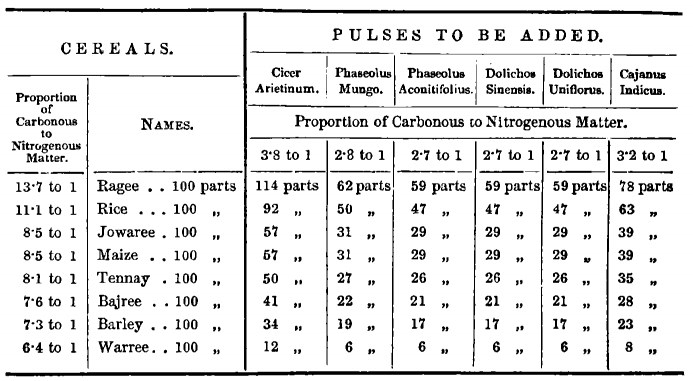
Dr. Forbes Watson has made some very interesting calculations on the amount of pulses rich in nitrogen, which must be added to rice and other cereals comparatively poor in that constituent, in order that the mixture may contain the same proportion of carbonous to nitrogenous matter as is found in wheat, namely six to one. (See Table, next page.)
The cereals which I saw growing in the peninsula of India, besides rice, maize, wheat, and barley, were:—
1. Setaria Italica, called tennay in Tamil, and samee by the tribes on the Neilgherry hills, which is the Italian millet. The seeds are used for cakes and porridge. In the Deccan it is only cultivated in small quantities for the ryot's own use, and seldom for market. The grain is very small.
2. Panicum Miliaceum, called varagoo on the Pulney hills, and warree in the Deccan: a small millet, generally sown broadcast on the sides of hills. In the Neilgherries it is used as an offering to the gods, mixed with honey, and wrapped in plantain-leaves.
3. Panicum pilosum, or badlee, will grow in the worst soil, but is not much cultivated, unless the rains happen to be too scanty for other crops. The seed is very small, forming a long hairy spike.
4. Cynosurus corocanus, or ragee, is a very prolific grain, and forms the staple food of the poorer classes in Mysore, and on the slopes of the ghauts. It requires a light good soil, from which the water readily flows. In the Deccan they raise it in seed-beds, and transplant when a few inches high. It is made into dark brown cakes.
5. Holcus spicatus, or spiked millet, called cumboo in Madras, and bajree in the Deccan, where it is the chief food of the inhabitants, and is considered very nutritious.
6. Sorghum vulgare, or great millet, called cholum in Madras, and jowaree in the Deccan. It is made into cakes and porridge, and the stalks, which contain sugar, are excellent fodder for cattle. It grows six or eight feet high, and soon exhausts the soil, so that two crops are never taken in succession.
7. Sesamum Indicum, or gingelee oil-plant, called till in the Deccan. Oil is expressed from the seeds, which are also toasted and ground into meal for food. In the Deccan it is sown on gravelly or red soil, and the plants grow three or four feet high. Presents of the seed, made up in little boxes, are exchanged by friends on the day that the sun takes its northerly declination; and they are also acceptable as offerings to the god Mahadeo or Siva.
With these seven grains, the following pulses are usually raised:—
1. Cicer arietinum, or Bengal gram, the seeds of which are eaten, and the oxalic acid, which exudes from all parts of the plant, is used as vinegar for curries.
2. Dolichos unifloris, or horse gram, with grey seeds, used for feeding horses and cattle.
3. Dolichos sinensis, or lobia, a twining annual, with large pale violet flowers. The seeds are much used for food.
4. Cajanus Indicus, pigeon-pea, or toor. A shrub three to six feet high, with yellow papilionaceous flowers. This is an excellent pulse, and makes a good peas-pudding.
5. Phaseolus mungo, black gram, or moong. A nearly erect, hairy annual, with greenish-yellow flowers. It is much cultivated, and is a very important article of food.
6. Phaseolus rostratus, or hullounda, a twining plant, with large, deep rose-purple, papilionaceous flowers, grown in Malabar, and other parts of the peninsula.
7. Another kind of moong, called ooreed, with black and white seeds.
8. Lablab cultratus, a twining plant, with white, red, or purple papilionaceous flowers; much cultivated in gardens, and used for food.
9. Dolichos lablab, or bulla, a twining plant of which there are several varieties. The seeds are much eaten by the poorer classes when rice is dear, and are reckoned a wholesome substantial food. Cattle are very fond of the stalks. One variety, with white flowers, is cultivated in gardens, supported on poles, forming arbours about the doors of houses. The pods are eaten, but not the seeds.