Note 71 — Chapter II · HABITS WHEN WILD.
Reading edition
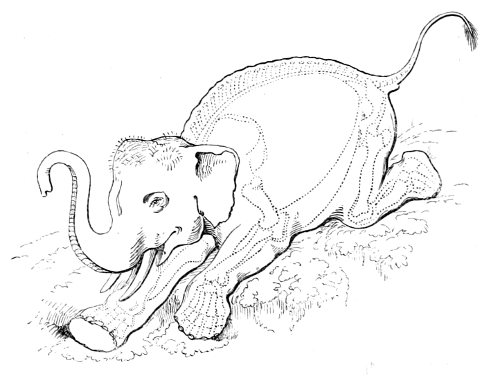
Since the above passage was written, I have seen in the Journal of the Asiatic Society of Bengal, vol. xiii. pt. ii. p. 916, a paper upon this subject, illustrated by the subjoined diagram.
The writer says, “an elephant descending a bank of too acute an angle to admit of his walking down it direct, (which, were he to attempt, his huge body, soon disarranging the centre of gravity, would certainly topple over,) proceeds thus. His first manœuvre is to kneel down close to the edge of the declivity, placing his chest to the ground: one fore leg is then cautiously passed a short way down the slope; and if there is no natural protection to afford a firm footing, he speedily forms one by stamping into the soil if moist, or kicking out a footing if dry. This point gained, the other fore leg is brought down in the same way; and performs the same work, a little in advance of the first; which is thus at liberty to move lower still. Then, first one and then the second of the hind legs is carefully drawn over the side, and the hind feet in turn occupy the resting-places previously used and left by the fore ones. The course, however, in such precipitous ground is not straight from top to bottom, but slopes along the face of the bank, descending till the animal gains the level below. This an elephant has done, at an angle of 45 degrees, carrying a howdah, its occupant, his attendant, and sporting apparatus; and in a much less time than it takes to describe the operation.” I have observed that an elephant in descending a declivity uses his knees, on the side next the bank; and his feet on the lower side only.