Note 11 — THE STORM-CLOUD OF THE NINETEENTH CENTURY.
Reading edition
'Glaciers of the Alps,' page 146.—"The sun was near the western horizon, and I remained alone upon the Grat to see his last beams illuminate the mountains, which, with one exception, were without a trace of cloud.
"This exception was the Matterhorn, the appearance of which was extremely instructive. The obelisk appeared to be divided in two halves by a vertical line, drawn from its summit half-way down, to the windward of which we had the bare cliffs of the mountain; and to the left of it a cloud which appeared to cling tenaciously to the rocks.
"In reality, however, there was no clinging; the condensed vapor incessantly got away, but it was ever renewed, and thus a river of cloud had been sent from the mountain over the valley of Aosta. The wind, in fact, blew lightly up the valley of St. Nicholas, charged with moisture, and when the air that held it rubbed against the cold cone of the Matterhorn, the vapor was chilled and precipitated in his lee."
It is not explained, why the wind was not chilled by rubbing against any of the neighboring mountains, nor why the cone of the Matterhorn, mostly of rock, should be colder than cones of snow. The phenomenon was first described by De Saussure, who gives the same explanation as Tyndall; and from whom, in the first volume of 'Modern Painters,' I adopted it without sufficient examination. Afterwards I re-examined it, and showed its fallacy, with respect to the cap or helmet cloud, in the fifth volume of 'Modern Painters,' page 124, in the terms given in the subjoined note,[A] but I still retained the explanation of Saussure for the lee-side cloud, engraving in plate 69 the modes of its occurrence on the Aiguille Dru, of which the most ordinary one was afterwards represented by Tyndall in his 'Glaciers of the Alps,' under the title of 'Banner-cloud.' Its less imaginative title, in 'Modern Painters,' of 'Lee-side cloud,' is more comprehensive, for this cloud forms often under the brows of far-terraced precipices, where it has no resemblance to a banner. No true explanation of it has ever yet been given; for the first condition of the problem has hitherto been unobserved,—namely, that such cloud is constant in certain states of weather, under precipitous rocks;—but never developed with distinctness by domes of snow.
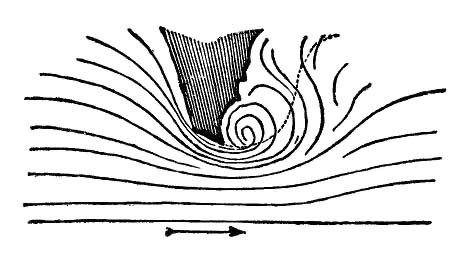
But my former expansion of Saussure's theory is at least closer to the facts than Professor Tyndall's "rubbing against the rocks," and I therefore allow room for it here, with its illustrative wood-cut.
"When a moist wind blows in clear weather over a cold summit, it has not time to get chilled as it approaches the rock, and therefore the air remains clear, and the sky bright on the windward side; but under the lee of the peak, there is partly a back eddy, and partly still air; and in that lull and eddy the wind gets time to be chilled by the rock, and the cloud appears, as a boiling mass of white vapor, rising continually with the return current to the upper edge of the mountain, where it is caught by the straight wind and partly torn, partly melted away in broken fragments.
"In the accompanying figure, the dark mass represents the mountain peak, the arrow the main direction of the wind, the curved lines show the directions of such current and its concentration, and the dotted line encloses the space in which cloud forms densely, floating away beyond and above in irregular tongues and flakes."