Note 424 — Chapter XIII
Reading edition
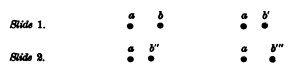
The explanation I offer presupposes that a difference too faint to have any direct effect in the way of making the mind notice it per se will nevertheless be strong enough to keep its 'terms' from calling up identical associates. It seems probable from many observations that this is the case. All the facts of 'unconscious' inference are proofs of it. We say a painting 'looks' like the work of a certain artist, though we cannot name the characteristic differentiæ. We see by a man's face that he is sincere, though we can give no definite reason for our faith. The facts of sense-perception quoted from Helmholtz a few pages below will be additional examples. Here is another good one, though it will perhaps be easier understood after reading the chapter on Space-perception than now. Take two stereoscopic slides and represent on each half-slide a pair of spots, a and b, but make their distances such that the a's are equidistant on both slides, whilst the b's are nearer together on slide 1 than on slide 2. Make moreover the distance ab = ab''' and the distance ab' = ab''. Then look successively at the two slides stereoscopically, so that the a's in both are directly fixated (that is fall on the two foveæ, or centres of distinctest vision). The a's will then appear single, and so probably will the b's. But the now single-seeming b on slide 1 will look nearer, whilst that on slide 2 will look farther than the a. But, if the diagrams are rightly drawn, b and b''' must affect 'identical' spots, spots equally far to the right of the fovea, b in the left eye and b''' in the right eye. The same is true of b' and b''. Identical spots are spots whose sensations cannot possibly be discriminated as such. Since in these two observations, however, they give rise to such opposite perceptions of distance, and prompt such opposite tendencies to movement (since in slide 1 we converge in looking from a to b, whilst in slide 2 we diverge), it follows that two processes which occasion feelings quite indistinguishable to direct consciousness may nevertheless be each allied with disparate associates both of a sensorial and of a motor kind. Cf. Donders, Archiv f. Ophthalmologie, Bd. 13 (1867). The basis of his essay is that we cannot feel on which eye any particular element of a compound picture falls, but its effects on our total perception differ in the two eyes.