Note 13 — Chapter XXIV · COPPER, SILVER, AND GOLD
George Kamensky translation
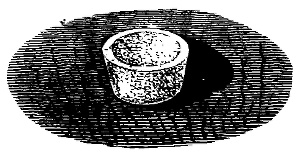
Fig. 97.—Cupel for silver assaying.
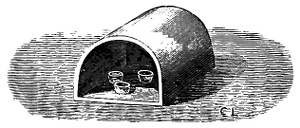
Fig. 98.—Clay muffle.
[13] There are not many soft metals; lead, tin, copper, silver, iron, and gold are somewhat soft, and potassium and sodium very soft. The metals of the alkaline earths are sonorous and hard, and many other metals are even brittle, especially bismuth and antimony. But the very slight significance which these properties have in determining the fundamental chemical properties of substances (although, however, of immense importance in the practical applications of metals) is seen from the example shown by zinc, which is hard at the ordinary temperature, soft at 100°, and brittle at 200°.
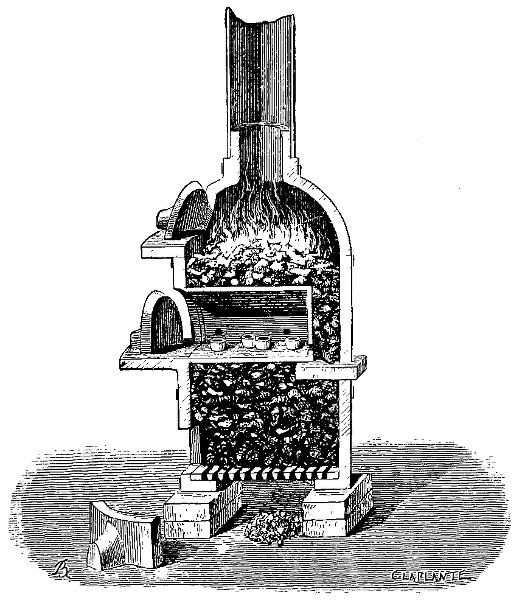
Fig. 99.—Portable muffle furnace.
As the value of silver depends exclusively on its purity, and as there is no possibility of telling the amount of impurities alloyed with it from its external appearance, it is customary in most countries to mark an article with the amount of pure silver it contains after an accurately-made analysis known as the assay of the silver. In France the assay of silver shows the amount of pure silver in 1,000 parts by weight; in Russia the amount of pure silver in 96 parts—that is, the assay shows the number of zolotniks (4·26 grams) of pure silver in one pound (410 grams) of alloyed silver. Russian silver is generally 84 assay—that is, contains 84 parts by weight of pure silver and 12 parts of copper and other metals. French money contains 90 p.c. (in the Russian system this will be 86·4 assay) by weight of silver [English coins and jewellery contain 92·5 p.c. of silver]; the silver rouble is of 83⅓ assay—that is, it contains 86·8 p.c. of silver—and the smaller Russian silver coinage is of 48 assay, and therefore contains 50 p.c. of silver. Silver ornaments and articles are usually made in Russia of 84 and 72 assay. As the alloys of silver and copper, especially after being subjected to the action of heat, are not so white as pure silver, they generally undergo a process known as ‘blanching’ (or ‘pickling’) after being worked up. This consists in removing the copper from the surface of the article by subjecting it to a dark-red heat and then immersing it in dilute acid. During the calcination the copper on the surface is oxidised, whilst the silver remains unchanged; the dilute acid then dissolves the copper oxides formed, and pure silver is left on the surface. The surface is dull after this treatment, owing to the removal of a portion of the metal by the acid. After being polished the article acquires the desired lustre and colour, so as to be indistinguishable from a pure silver object. In order to test a silver article, a portion of its mass must be taken, not from the surface, but to a certain depth. The methods of assay used in practice are very varied. The commonest and most often used is that known as cupellation. It is based on the difference in the oxidisability of copper, lead, and silver. The cupel is a porous cup with thick sides, made by compressing bone ash. The porous mass of bone ash absorbs the fused oxides, especially the lead oxide, which is easily fusible, but it does not absorb the unoxidised metal. The latter collects into a globule under the action of a strong heat in the cupel, and on cooling solidifies into a button, which may then be weighed. Several cupels are placed in a muffle. A muffle is a semi-cylindrical clay vessel, shown in the accompanying drawing. The sides of the muffle are pierced with several orifices, which allow the access of air into it. The muffle is placed in a furnace, where it is strongly heated. Under the action of the air entering the muffle the copper of the silver alloy is oxidised, but as the oxide of copper is infusible, or, more strictly speaking, difficultly fusible, a certain quantity of lead is added to the alloy; the lead is also oxidised by the air at the high temperature of the muffle, and gives the very fusible lead oxide. The copper oxide then fuses with the lead oxide, and is absorbed by the cupel, whilst the silver remains as a bright white globule. If the weight of the alloy taken and of the silver left on the cupel be determined, it is possible to calculate the composition of the alloy. Thus the essence of cupellation consists in the separation of the oxidisable metals from silver, which does not oxidise under the action of heat. A more accurate method, based on the precipitation of silver from its solutions in the form of silver chloride, is described in detail in works on analytical chemistry.