Note 23 — Chapter XXII · IRON, COBALT, AND NICKEL
George Kamensky translation
The ferric compound which is most used in practice (for instance, in medicine, for cauterising, stopping bleeding, &c.—Oleum Martis) is ferric chloride, Fe2Cl6, easily obtained by dissolving the ordinary hydrated oxide of iron in hydrochloric acid. It is obtained in the anhydrous state by the action of chlorine on heated iron. The experiment is carried on in a porcelain tube, and a solid volatile substance is then formed in the shape of brilliant violet scales which very readily absorb moisture from the air, and when heated with water decompose into crystalline ferric oxide and hydrochloric acid: Fe2Cl6 + 3H2O = 6HCl + Fe2O3. Ferric chloride is so volatile that the density of its vapour may be determined. At 440° it is equal to 164·0 referred to hydrogen; the formula Fe2Cl6 corresponds with a density of 162·5. An aqueous solution of this salt has a brown colour. On evaporating and cooling this solution, crystals separate containing 6 or 12 molecules of H2O. Ferric chloride is not only soluble in water, but also in alcohol (similarly to magnesium chloride, &c.) and in ether. If the latter solutions are exposed to the rays of the sun they become colourless, and deposit ferrous chloride, FeCl2, chlorine being disengaged. After a certain lapse of time, the aqueous solutions of ferric chloride decompose with precipitation of a basic salt, thus demonstrating the instability of ferric chloride, like the other salts of ferric oxide (Note 22). This salt is much more stable in the form of double salts, like all the ferric salts and also the salts of many other feeble bases. Potassium or ammonium chloride forms with it very beautiful red crystals of a double salt, having the composition Fe2Cl6,4KCl,2H2O. When a solution of this salt is evaporated it decomposes, with separation of potassium chloride.
B. Roozeboom (1892) studied in detail (as for CaCl2, Chapter XIV., Note 50) the separation of different hydrates from saturated solutions of Fe2Cl6 at various concentrations and temperatures; he found that there are 4 crystallohydrates with 12, 7, 5, and 4 molecules of water. An orange yellow only slightly hygroscopic hydrate, Fe2Cl6,12H2O, is most easily and usually obtained, which melts at 37°; its solubility at different temperatures is represented by the curve BCD in the accompanying figure, where the point B corresponds to the formation, at -55°, of a cryohydrate containing about Fe2Cl6 + 36H2O, the point C corresponds to the melting-point (+37°) of the hydrate Fe2Cl6,12H2O, and the curve CD to the fall in the temperature of crystallisation with an increase in the amount of salt, or decrease in the amount of water (in the figure the temperatures are taken along the axis of abscissæ, and the amount of n in the formula nFe2Cl6 + 100H2O along the axis of ordinates). When anhydrous Fe2Cl6 is added to the above hydrate (12H2O), or some of the water is evaporated from the latter, very hygroscopic crystals of Fe2Cl6,5H2O (Fritsche) are formed; they melt at 56°, their solubility is expressed by the curve HJ, which also presents a small branch at the end J. This again gives the fall in the temperature of crystallisation with an increase in the amount of Fe2Cl6. Besides these curves and the solubility of the anhydrous salt expressed by the line KL (up to 100°, beyond which chlorine is liberated), Roozeboom also gives the two curves, EFG and JK, corresponding to the crystallohydrates, Fe2Cl6,7H2O (melts at +32°·5, that is lower than any of the others) and Fe2Cl6,4H2O (melts at 73°·5), which he discovered by a systematic research on the solutions of ferric chloride. The curve AB represents the separation of ice from dilute solutions of the salt.
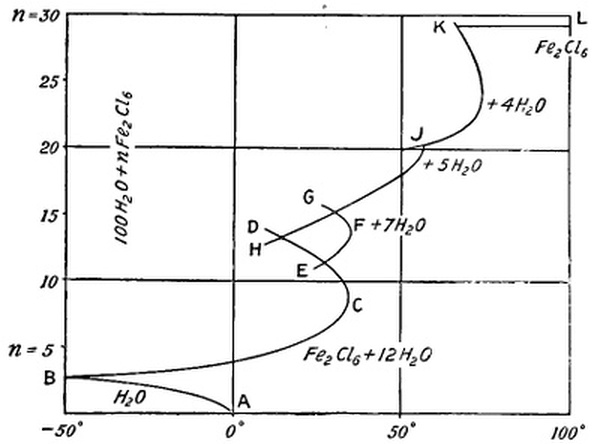
Fig. 95.—Diagram of the solubility of Fe2Cl6.
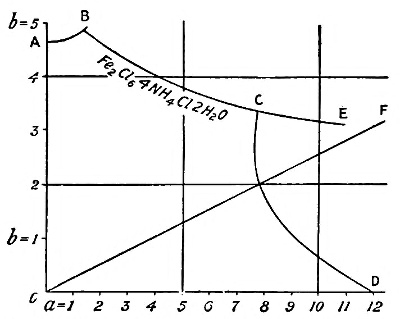
Fig. 96.—Diagram of the formation, at 15°, of the double salt Fe2Cl64NH4Cl2H2O or Fe(NH4)2Cl5H2O. (After Roozeboom.)
The researches of the same Dutch chemist upon the conditions of the formation of crystals from the double salt (NH4Cl)4Fe2Cl6,2H2O are even more perfect. This salt was obtained in 1839 by Fritsche, and is easily formed from a strong solution of Fe2Cl6 by adding sal-ammoniac, when it separates in crimson rhombic crystals, which, after dissolving in water, only deposit again on evaporation, together with the sal-ammoniac.
Roozeboom (1892) found that when the solution contains b molecules of Fe2Cl6, and a molecules of NH4Cl, per 100 molecules H2O, then at 15° one of the following separations takes place: (1) crystals, Fe2Cl6,12H2O, when a varies between 0 and 11, and b between 4·65 and 4·8, or (2) a mixture of these crystals and the double salt, when a = 1·36, and b = 4·47, or (3) the double salt, Fe2Cl6,4NH4Cl,2H2O, when a varies between 2 and 11·8, and b between 3·1 and 4·56, or (4) a mixture of sal-ammoniac with the iron salt (it crystallises in separate cubes, Retgers, Lehmann), when a varies between 7·7 and 10·9, and b is less than 3·38, or (5) sal-ammoniac, when a = 11·88. And as in the double salt, a : b :: 4 : 1 it is evident that the double salt only separates out when the ratio a : b is less than 4 : 1 (i.e. when Fe2Cl6 predominates). The above is seen more clearly in the accompanying figure, where a, or the number of molecules of NH4Cl per 100H2O, is taken along the axis of abscissæ, and b, or the number of molecules of Fe2Cl6, along the ordinates. The curves ABCD correspond to saturation and present an iso-therm of 15°. The portion AB corresponds to the separation of chloride of iron (the ascending nature of this curve shows that the solubility of Fe2Cl6 is increased by the presence of NH4Cl, while that of NH4Cl decreases in the presence of Fe2Cl6), the portion BC to the double salt, and the portion CD to a mixture of sal-ammoniac and ferric chloride, while the straight line OF corresponds to the ratio Fe2Cl6,4NH4Cl, or a : b :: 4 : 1. The portion CE shows that more double salt may be introduced into the solution without decomposition, but then the solution deposits a mixture of sal-ammoniac and ferric chloride (see Chapter XXIV. Note 9bis). If there were more such well-investigated cases of solutions, our knowledge of double salts, solutions, the influence of water, equilibria, isomorphous mixtures, and such-like provinces of chemical relations might be considerably advanced.